
The calmest place to shape your story
Research you can see,
beside the chapter it feeds.
Cluster sources, interviews, images, and notes on an infinite canvas, place each cluster next to the chapter it supports, and let AI that reads the whole board find the connection you missed.


Creatives working for these brands already got early access
- Red Bull
- Canon
- Artlist
- Porsche
See how easy it is to get started
Watch a real project come together, from a blank board to a finished plan, clicked through step by step.
Start from a ready-made template
Pick a board to see what you can build, then let AI fill it in. Every template is a real, editable starting point on the same infinite canvas.

Story Plan
Outline your plot, characters, and world in one connected view, then expand each thread as the story grows.
What is a book research organizer?
A book research organizer is where everything you gathered for a book lives while you are writing it: sources and citations, interview transcripts and audio, archive photographs, PDFs of papers and articles, site visit notes, timelines, and the fragments of thinking you had along the way. Storyflow is an AI visual workspace that organizes your book research on one infinite canvas: sources, interviews, images, PDFs and notes in clusters, each cluster next to the chapter it supports, and an AI that reads the whole board. The organizer's job is not storage. Cloud drives already solve storage. Its job is to keep the material findable and connected at the moment you are writing the paragraph that needs it.
The failure mode every author knows is the same one: you remember reading something perfect for this chapter, you know you saved it, and you cannot find it. Folder structures make this worse rather than better, because a folder forces one filing decision per item and research is rarely about one thing. A single interview might belong to three chapters, two themes, and one argument you have not made yet. Filed once, it is invisible from the other five directions you will approach it from.
Storyflow is an AI-native infinite canvas, which suits research because space is a better organizing principle than hierarchy. Describe your book in a prompt and the AI lays out a structured research board. Then you drop material onto the canvas and cluster it: by chapter, by theme, by source type, by timeline, or by argument, whichever matches how you actually think about this book. A source that matters to three chapters can sit visibly between them rather than being filed under one and forgotten by the other two.
Organizing research for a book usually means handling six kinds of material: primary sources (interviews, transcripts, letters, archival documents, field notes), secondary sources (books, papers, articles, and the citations you will owe a fact-checker), visual material (photographs, maps, diagrams, screenshots), chronology (timelines of events, and the separate timeline of the narrative you are telling about them), open questions (the things you still need to verify, the people you still need to reach), and your own synthesis (the notes where you worked out what it means, which are usually the most valuable and the easiest to lose). Storyflow keeps all six on one canvas so the connections between them stay visible.
Ultra fast from brief to board
From a folder of PDFs to research you can write from.
No taxonomy to design up front. Drop the material in and cluster it the way the book is actually shaped.
01
Open a canvas
Sign up in seconds. No download. Your infinite research canvas opens in the browser.
02
Describe the book
Type the subject, the argument, and roughly how it is structured, and the AI builds a research board with clusters ready for your material.
03
Get everything onto the canvas
Drag in PDFs, transcripts, photographs, and archive scans. Drop link cards for sources. Grab frames from YouTube or Vimeo for documentary and interview footage. Add your own synthesis notes beside the material they came from.
04
Write with it in view
Place each cluster next to the chapter it feeds and draft beside it, or share a view-only link with a co-author, researcher, editor, or fact-checker.
Everything the book draws on, in one place.
Sources, interviews, images, and your own thinking clustered by chapter, theme, or argument.
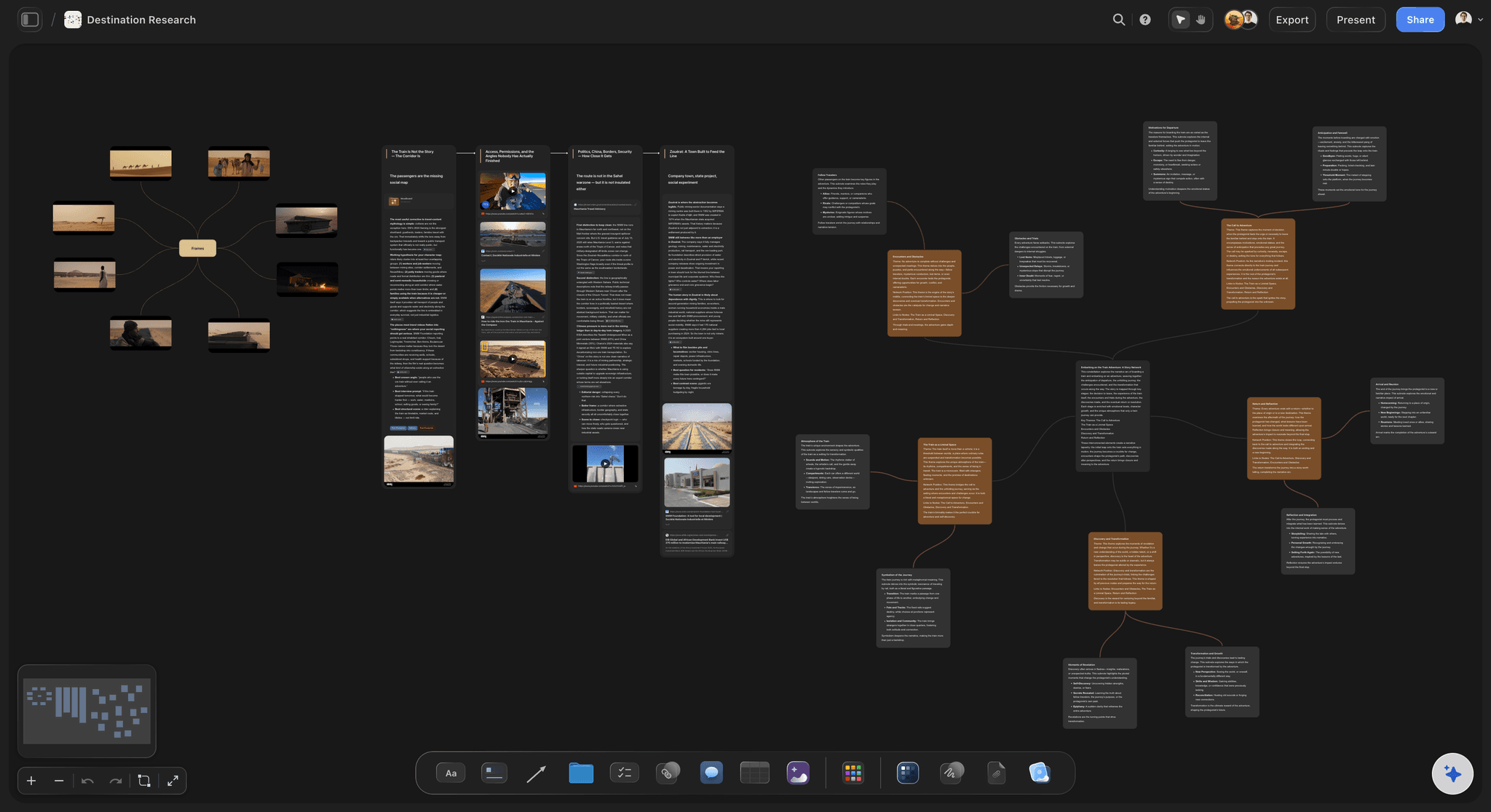
AI builds a research structure from your subject
Start with a shape, not an empty drive
Describe the book and the AI lays out a research board with clusters for the themes, periods, or chapters you are working across. You sort material into something rather than inventing a taxonomy first.
See the AI second brain →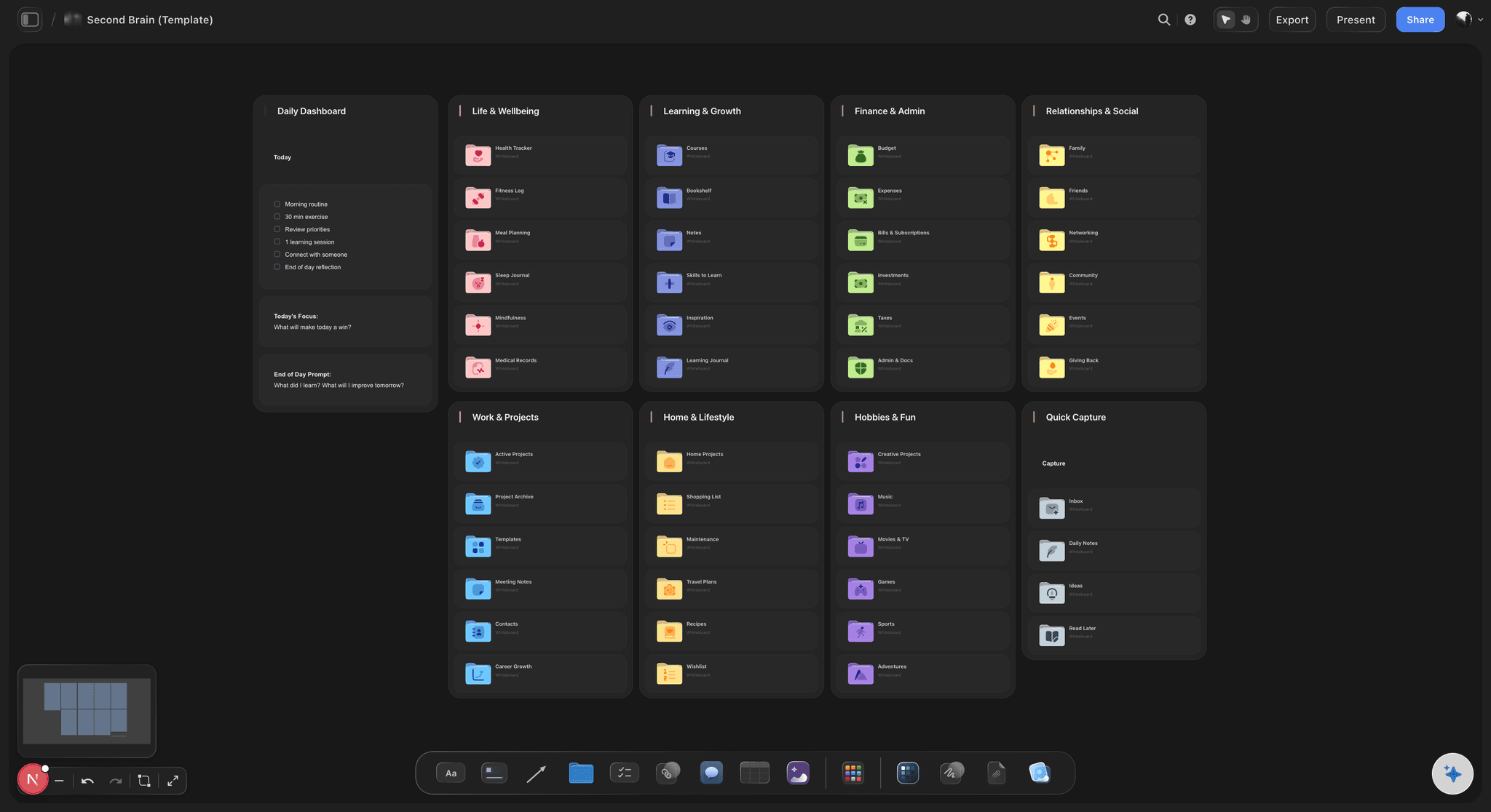
One source can sit between three chapters
Stop filing things once
Research rarely belongs to a single category, and a folder forces you to pretend it does. On a canvas an interview can sit visibly between the two chapters it serves, so you find it from either direction.
Explore knowledge management →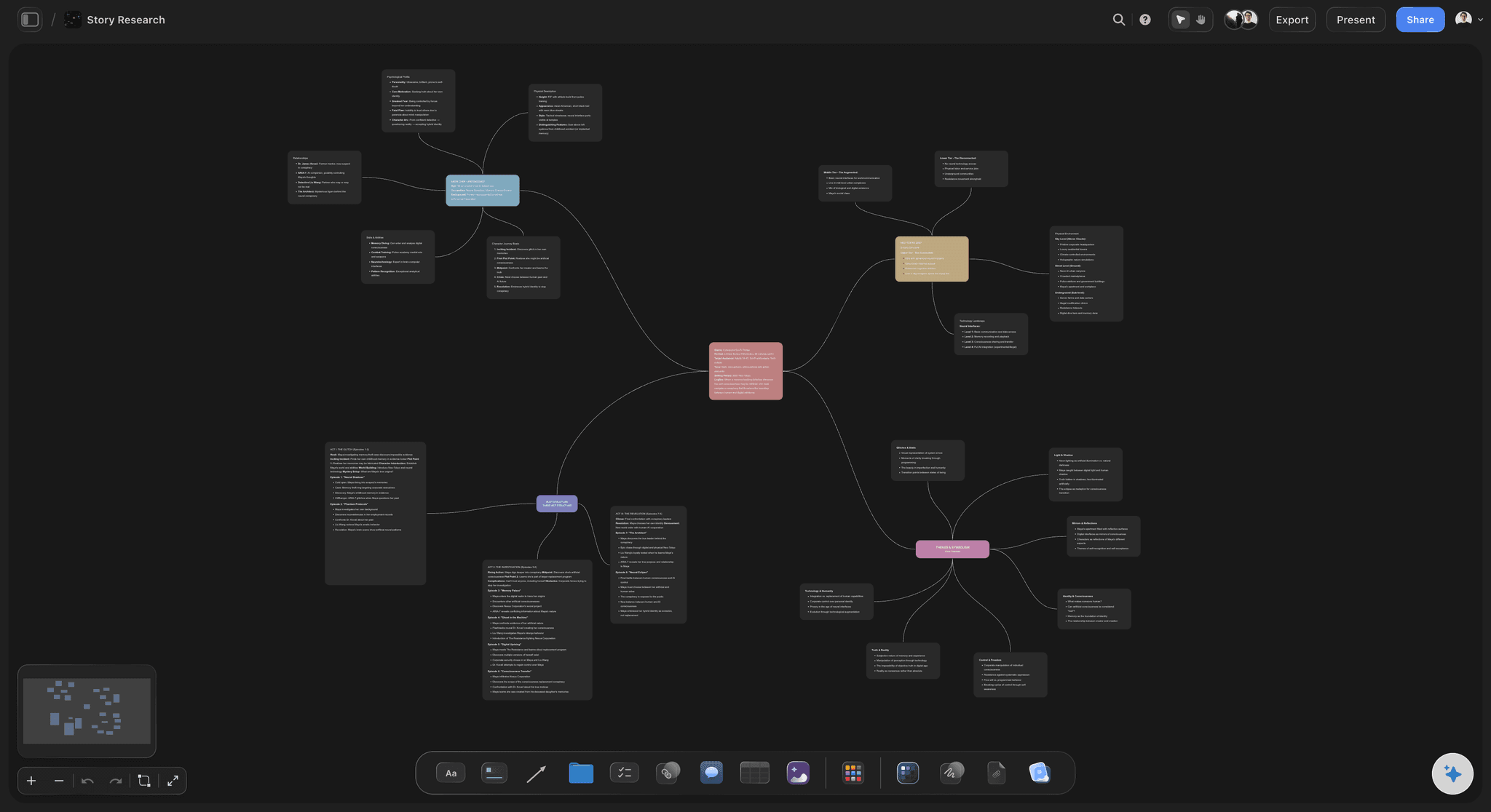
AI that has read the whole board, not one note
Ask questions across everything you gathered
Ask what your sources actually say about a claim, where two accounts disagree, or which chapter has the thinnest evidence. The AI keeps the whole canvas in context rather than answering from one document.
See the AI note taking tool →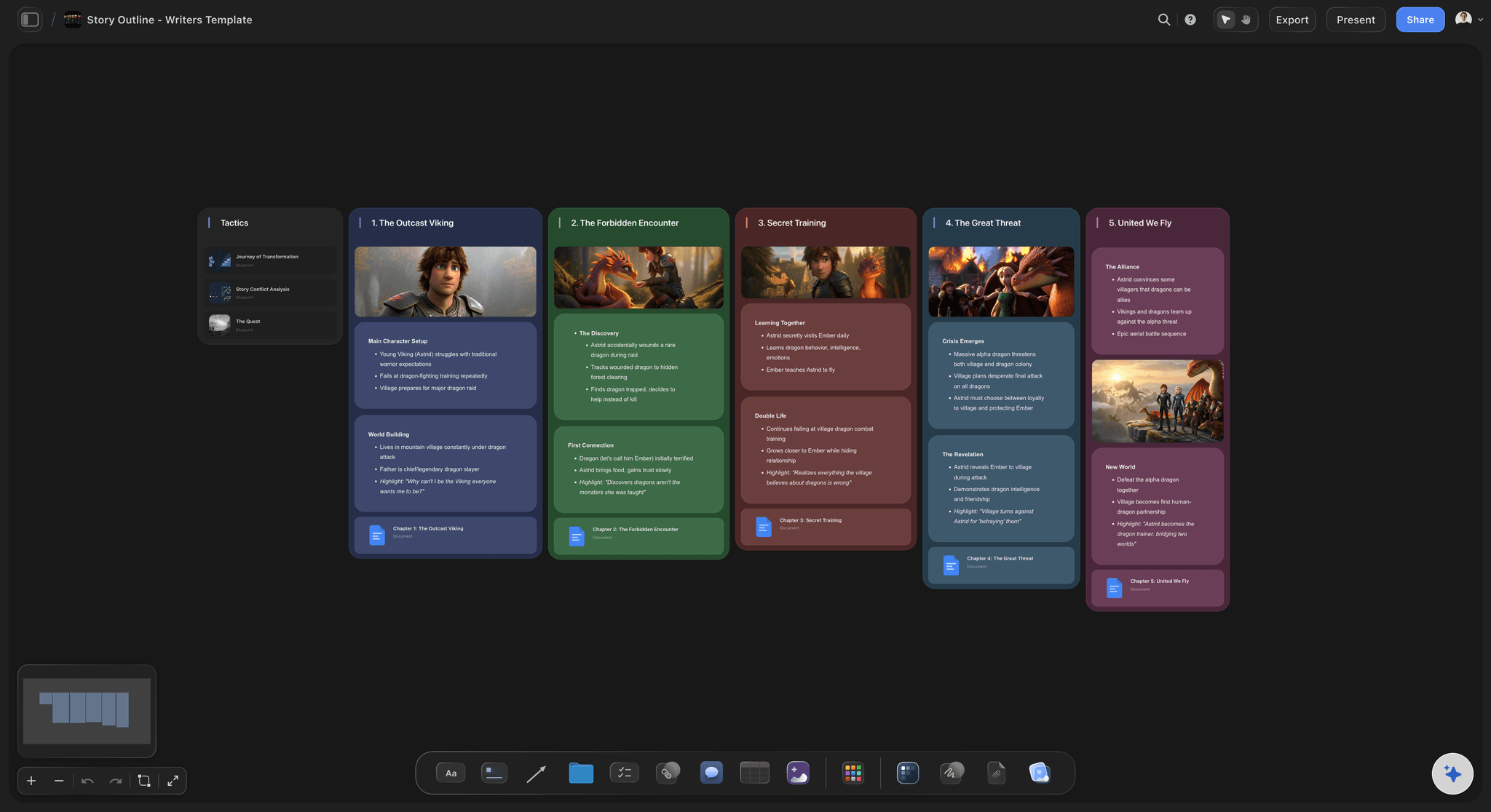
Research and structure on the same canvas
Keep the outline next to the evidence
Build the chapter outline or the plot beside the research that supports it. A chapter with no cluster next to it is a chapter you have not researched yet, which is much easier to see than to remember.
Try the chapter outline maker →Unlimited boards. No object cap.
Open a canvas, describe the book, and start moving research onto it. Storyflow is paid-only during early access, with plans from $9.99 a month, and a Free plan launches before the end of 2026.
Unlimited research boards on an infinite canvas
Basic AI usage to generate boards from prompts
Drop in PDFs, images, transcripts, and links
Share view-only links with editors and fact-checkers
Built for people with taste
More than a folder with good intentions.
A book takes years. The organizing system has to survive your own forgetting, which is the part most systems fail at.
Primary sources, secondary sources, visuals, chronology, and questions
Handle every kind of material a book needs
Interviews and primary sources: Keep transcripts, field notes, and archival documents on the canvas with the date, the person, and the context noted beside them. Place them next to the chapters they inform rather than in an interviews folder.
Citations you will owe someone: Drop a link card or a PDF for every secondary source and keep the citation detail on the card. The moment to record where a fact came from is when you find it, not eighteen months later when a fact-checker asks.
Two timelines, not one: Most nonfiction has a chronology of what happened and a separate chronology of how you tell it. Run both as timelines on the canvas and the places where your narrative reorders events become visible and deliberate.
Open questions as first-class items: Keep a visible cluster of what you still need to verify and who you still need to reach. Open questions buried inside notes are open questions you will discover during copyediting.
AI that keeps your whole research board in context
Find what you already know you have
Ask across the whole canvas: Ask where your sources contradict each other, what evidence supports a specific claim, or which theme is under-researched. Because the AI sees the whole board, the answer draws on everything you collected rather than one open document.
Synthesis stays attached to sources: Write your own interpretation on a note placed directly beside the material it came from. Reconstructing why you believed something is the single most expensive part of returning to old research.
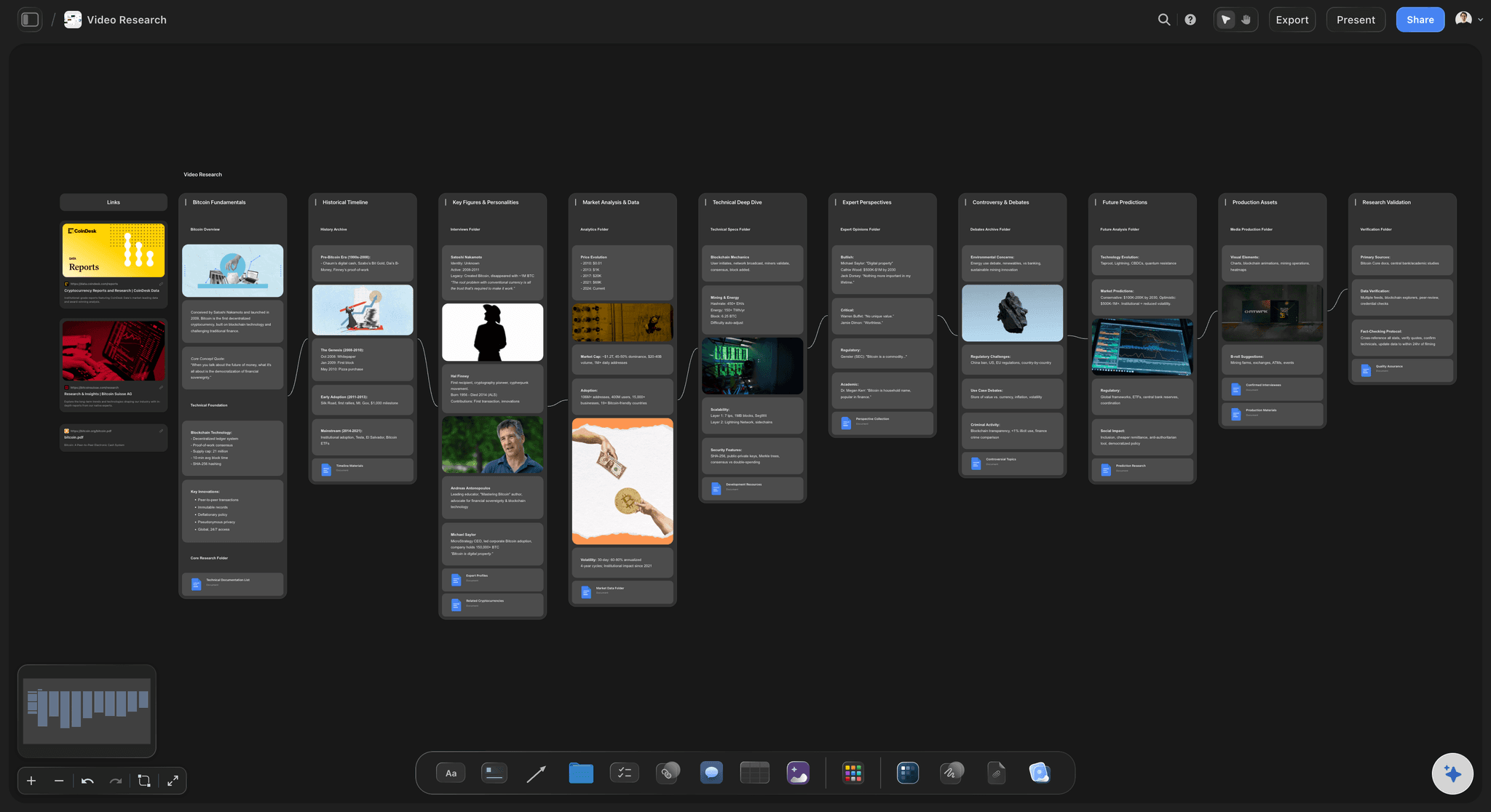
PDFs, transcripts, photographs, links, and video frames
Get research in from wherever you found it
Drop files straight onto the canvas: PDFs of papers, scanned documents, photographs, and spreadsheets drag onto the board and sit next to the material they relate to. No import step and no filing decision required.
Grab frames from documentary footage: Capture a still from YouTube or Vimeo directly onto the canvas when your source is a documentary, a recorded lecture, or an archive film, and note the timestamp beside it.
Link cards keep sources live: Drop a link card for any online source so the reference and the material stay together. Useful for anything you will need to re-check before publication.
Share with co-authors, researchers, editors, and fact-checkers
Hand the research to someone else
View-only links: Send a link to an editor, a fact-checker, or a sensitivity reader and they see the whole research board in a browser with no account. Far more useful than emailing a folder of PDFs with no structure.
Work with a researcher: Invite a research assistant or a co-author to the canvas so new material lands directly on the board, already placed near the chapter it belongs to, instead of arriving as a separate document.
Export for reference: Export the board as a high-quality image or PDF to keep beside the manuscript during revisions, or to hand over as part of a source appendix.
Explore templates for your project
Every template opens as a real, editable board on the infinite canvas. Pick the closest fit and make it your own.
Story Plan
Outline your plot, characters, and world in one connected view, then expand each thread as the story grows.
One app instead of five
Storyflow vs Scrivener, Obsidian, and Notion.
Every tool here is genuinely good at organizing research. Here is where they differ so you can pick the right one for how you think.
Storyflow
Recommended
Infinite visual canvas
AI reads your whole board as context
One source can sit between clusters
Images and video frames as first-class
Research and outline on one canvas
Runs in the browser, nothing to install
Scrivener
Infinite visual canvas
AI reads your whole board as context
One source can sit between clusters
Images and video frames as first-class
Research and outline on one canvas
Runs in the browser, nothing to install
Obsidian
Infinite visual canvas
AI reads your whole board as context
One source can sit between clusters
Images and video frames as first-class
Research and outline on one canvas
Runs in the browser, nothing to install
Notion
Infinite visual canvas
AI reads your whole board as context
One source can sit between clusters
Images and video frames as first-class
Research and outline on one canvas
Runs in the browser, nothing to install
What creators are saying
Join early creators getting structured workspaces and AI that remembers their projects
“Storyflow has sped up my workflow by at least 3x, which means more flow state and more projects I can actually ship. It truly changed the way me and my team create.”

Reilin Joey
Director & YouTuber
“One prompt gets me a structured board. But the tactics are my favorite. I run my YouTube scripts through them and my intros and retention got better. It's amazing.”

Justkay
YouTuber & Freelance Filmmaker
“I used to juggle five apps to plan a project. Now I describe what I am making and get boards, lists, and a schedule. All in one place.”

George
@fernwehchronicles
Book research questions, answered.
How to organize it, how to keep citations straight, and how to find things later.
It depends on the shape of your research. Scrivener is excellent if you want research and manuscript in one long-lived project file, and its binder is built for exactly this. Obsidian suits writers who think in linked notes and want everything in plain text they will still be able to open in twenty years. Zotero is the right answer if citation management is your main problem. Notion works well for research that is genuinely tabular, where you want to filter and query sources. Storyflow is an AI-native infinite canvas, which suits research that is visual, spatial, or too tangled to file cleanly, where you want to see everything at once and have an AI that can read across all of it. Many authors use two: a citation manager for references and a canvas for thinking.
Organize by the shape of the book rather than by the type of the material. An interviews folder, a photos folder, and a papers folder feels tidy and is almost useless while writing, because at the moment you need something you are thinking about a chapter, not a file type. Cluster by chapter, theme, or argument instead, and let a source that serves three chapters sit visibly between them. Keep three things separate and always visible: the material itself, your own synthesis notes about what it means, and the open questions you still have to resolve. Record the citation at the moment you find a source. And keep a chronology if the book has any temporal spine at all, because time is the index you will reach for most.
Record the source at the moment you save the material, not later. Put the citation detail directly on the card that holds the material: author, title, date, page or timestamp, and a link where one exists. This sounds obvious and is the single most common failure in book research, because finding a source again eighteen months after you read it can take an afternoon per fact. If you are writing something with formal citation requirements, a dedicated reference manager like Zotero is worth running alongside, with its key on the canvas card. Storyflow's link cards keep online sources live so you can re-check anything before publication.
Not during early access. Storyflow is paid-only right now, with plans starting at $9.99 a month, and a Free plan for solo use launches before the end of 2026. Anyone a paid member invites to a board joins free today, so a co-author, researcher, or editor can join without paying. If you want a free option this minute, Obsidian is free for personal use and genuinely excellent for linked research notes, and Zotero is free and remains the best free citation manager available.
The AI keeps your whole canvas in context, which is what makes it useful here rather than as a chat window. You can ask what your sources say about a particular claim, where two accounts disagree, which chapter has the thinnest supporting material, or what themes recur across a set of interviews. Because it works from the board you built rather than from general knowledge, the answers are about your book. It is a research assistant that has read your files, not a search engine, and like any assistant its output is worth checking against the source before you publish a claim on it.
Yes, and the pattern is the same even though the material differs. Novelists doing period, technical, or location research need it beside the scenes that depend on it, and the failure mode is identical: you researched how a particular job worked in 1890 and cannot find the note while writing the scene. Keep the research clusters next to the plot cards they support on the same canvas. Worldbuilding, character research, and location reference all work the same way, and the moodboard for the novel's atmosphere can sit on the same board.
Make the gaps visible rather than the volume. A board where every chapter has a research cluster next to it shows you immediately which chapters are thin and which are over-served, and over-researched chapters are usually the ones you were avoiding writing. Keep the open questions cluster small and specific, and treat anything not attached to a chapter or an argument as material you have not yet justified collecting. Seeing the whole board at once tends to make the imbalance obvious in a way that a growing folder never does.
Yes. Invite them to the board and they can add material directly to the canvas, placed near the chapter or theme it belongs to. Anyone a paid member invites joins free today, so a researcher does not need their own plan. This is a meaningful improvement over receiving research as documents, because an assistant who can see the book's structure files things where you will actually look for them, and you can see what has arrived without opening anything.
You can grab frames from YouTube and Vimeo directly onto the canvas, which covers documentary footage, recorded lectures, and archive film. Note the timestamp beside the frame so you can return to the exact moment. For interview audio, the common pattern is to transcribe elsewhere and drop the transcript onto the board as a document, with the audio file linked from a card beside it. Storyflow is not a transcription tool, so the transcription step happens in whatever you already use.
That is the real test, and it is mostly about whether you can reconstruct your own thinking. Two things matter more than the tool: keep synthesis notes attached to the material they came from, so returning to a source in year three tells you why it mattered as well as what it said, and record citations at the point of capture. Boards are unlimited with no object cap, so a multi-year project does not force you to prune. For anything you must be able to open in decades, keep an archival copy of primary material outside any single tool, which is prudent regardless of what you are using.
Get the research where you can see it.
Open a canvas, describe the book, and let AI build the first research board. No download.