
The calmest place to shape your story
A thesis is one argument
and a very long calendar.
Lay every chapter out as a card, connect each one to the claim it is supposed to defend, and run the multi-year timeline beside it with the supervisor review cycles marked.


Creatives working for these brands already got early access
- Red Bull
- Canon
- Artlist
- Porsche
See how easy it is to get started
Watch a real project come together, from a blank board to a finished plan, clicked through step by step.
Start from a ready-made template
Pick a board to see what you can build, then let AI fill it in. Every template is a real, editable starting point on the same infinite canvas.

Story Plan
Outline your plot, characters, and world in one connected view, then expand each thread as the story grows.
What is a thesis planner?
A thesis planner is a tool for working out what a thesis argues, how the chapters divide that argument between them, and when each part actually gets written. It sits above the writing itself. The drafting happens in a word processor; the planning is the decision about what the thesis claims, which chapters earn that claim, what order they run in, and how thirty six months of unstructured time get turned into a schedule with real deadlines in it.
Two things go wrong, and neither of them is about intelligence. The first is the argument. A thesis is one claim defended across several hundred pages, and a surprising number of drafts are really four loosely related papers with no through line between them. Each chapter is competent on its own. Nothing connects them. That problem is almost invisible while you are writing chapter three, because a document only ever shows you one page, and it becomes obvious the moment all the chapters are laid out side by side and you try to say in one sentence what the whole thing proves.
The second is time. A thesis is the longest unstructured project most people ever attempt. There is no weekly deadline, no editor chasing you, and for long stretches nobody notices whether you worked or not. That is why planning a thesis is a scheduling problem before it is a writing problem: the calendar has to supply the structure that the institution does not. And the calendar is unforgiving in a specific way, because the delays are never the ones you budgeted for. Ethics approval takes two months instead of three weeks. Recruitment stalls. A supervisor with four other students returns chapter two in six weeks, not the ten days you assumed. The revision round after the full draft is a real phase of work and almost nobody schedules it.
Planning a thesis properly means holding six layers at once: the thesis statement and argument (the single claim the whole document defends, written as one sentence you can test every chapter against), the chapter structure and what each chapter contributes (introduction, literature review, methodology, results or analysis chapters, discussion, conclusion, each with a specific job in the argument rather than a topic), the literature and sources (what the field already says, where the gap is, and which reading each chapter depends on), the methodology and data (what you will do, what it produces, and what the analysis has to be able to show), the timeline with supervision cycles (working backwards from the submission date through every draft, review, and revision round, with slack for ethics approval and data collection), and the writing schedule (weekly word or session targets, and the honest gap between the pace you planned and the pace you write at). Storyflow keeps all six visible on one canvas, which is what makes a missing through line or an impossible calendar findable in year one rather than year three.
Ultra fast from brief to board
From a research question to a structure and a schedule.
Describe the project, then move chapters around until the argument holds and the calendar survives contact with reality.
01
Open a canvas
Sign up in seconds. No download. Your infinite planning canvas opens in the browser.
02
Write the claim, then describe the project
Put your one sentence thesis statement at the centre of the board. Give the AI your research question, discipline, and submission date and it drafts a chapter structure and a working timeline, so you start from a first position to argue with.
03
Test the argument by moving chapters
Lay the chapters out as cards and draw a connection from each one to the part of the claim it defends. A chapter with no line running back to the thesis statement is the paper that does not belong in this book.
04
Work backwards from the submission date
Run the timeline beside the chapters, place every supervisor review cycle and revision round on it, and add slack for ethics and data collection. Share a view-only link with your supervisor, or export the board as an image or PDF.
The whole thesis, argument and calendar together.
Claim, chapters, sources, methodology, and a multi-year timeline on one infinite canvas.
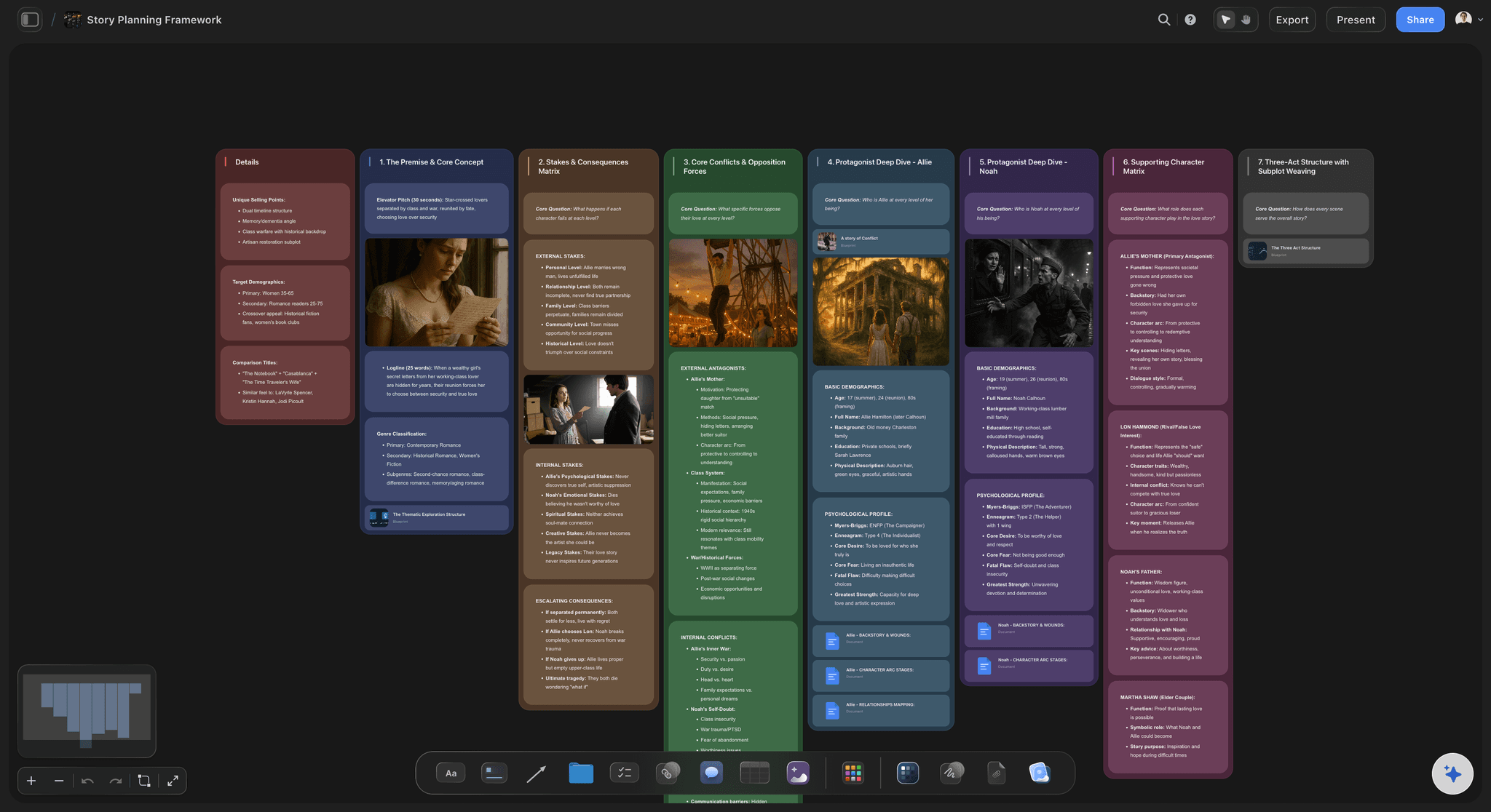
AI drafts a chapter structure and a timeline from your topic and deadline
Start from a structure, not a blank three years
Give it the research question, the discipline, and the submission date and the AI lays out a chapter architecture and a first timeline with the review cycles in it. Rearranging a draft is far faster than inventing a thesis shape from nothing.
See the AI outline generator →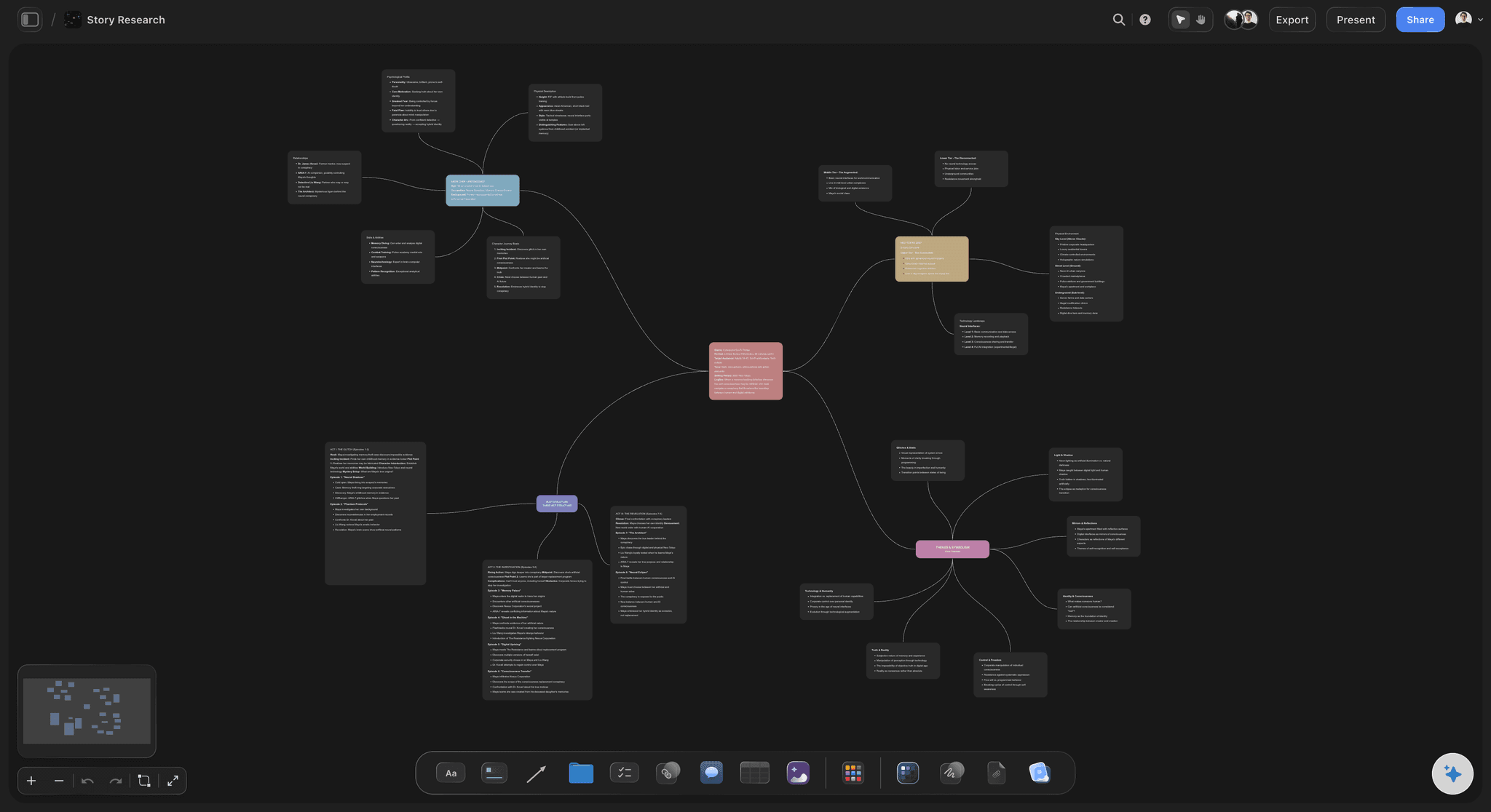
Every chapter connected to the claim it defends
Find the chapter that is really a separate paper
Draw a line from each chapter to the part of the thesis statement it earns. Once the connections are on the canvas, the chapter that serves no part of the claim stops being a nagging feeling and becomes a card with nothing attached to it.
Explore the mind mapping tool →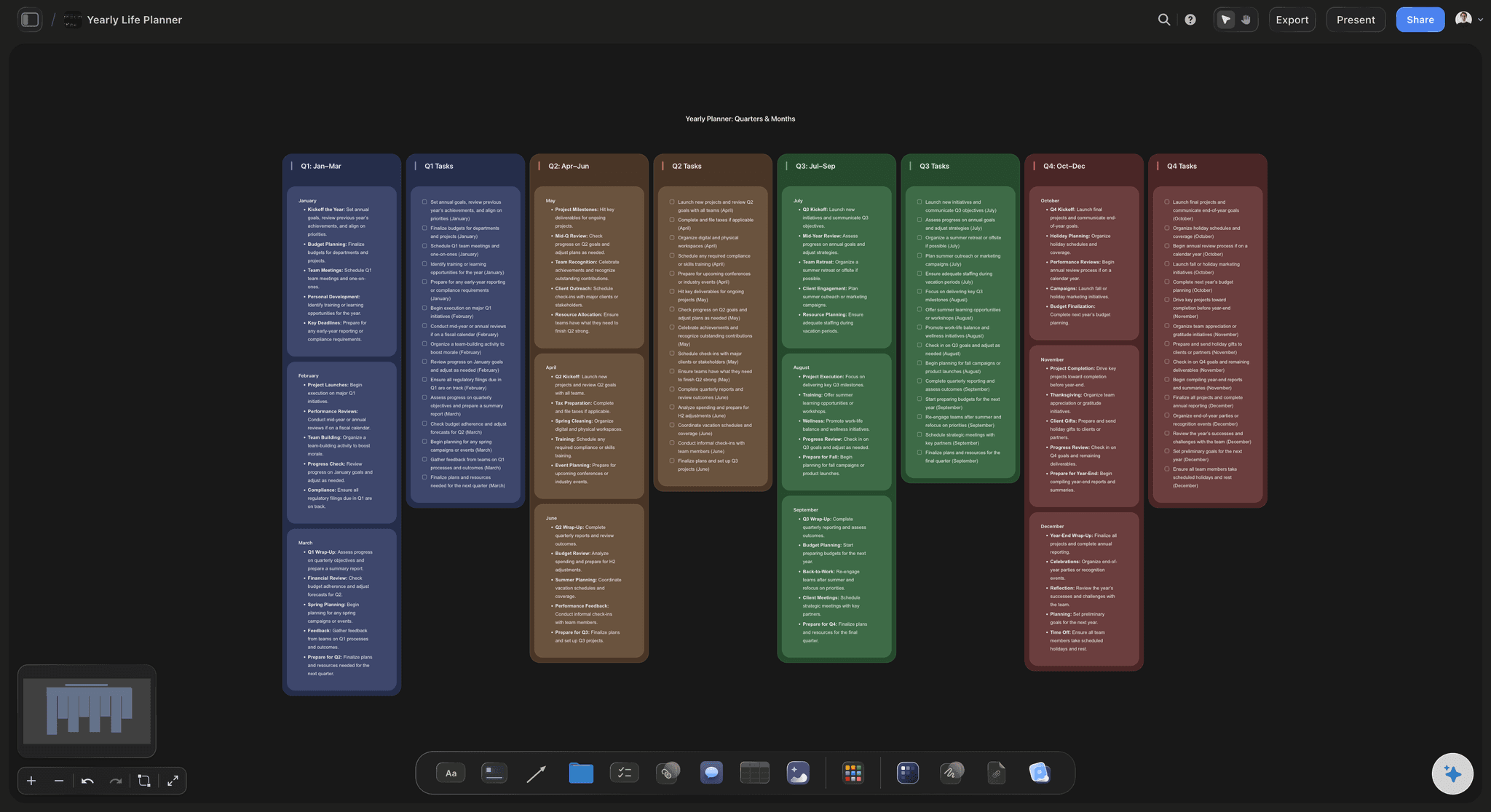
A multi-year timeline running beside the chapters
Plan backwards from the submission date
Put the real deadline on the right and build leftwards through the revision round, the full draft, every supervisor review cycle, data collection, and ethics approval. The month you should have started chapter four becomes a date rather than a worry.
Try the timeline maker →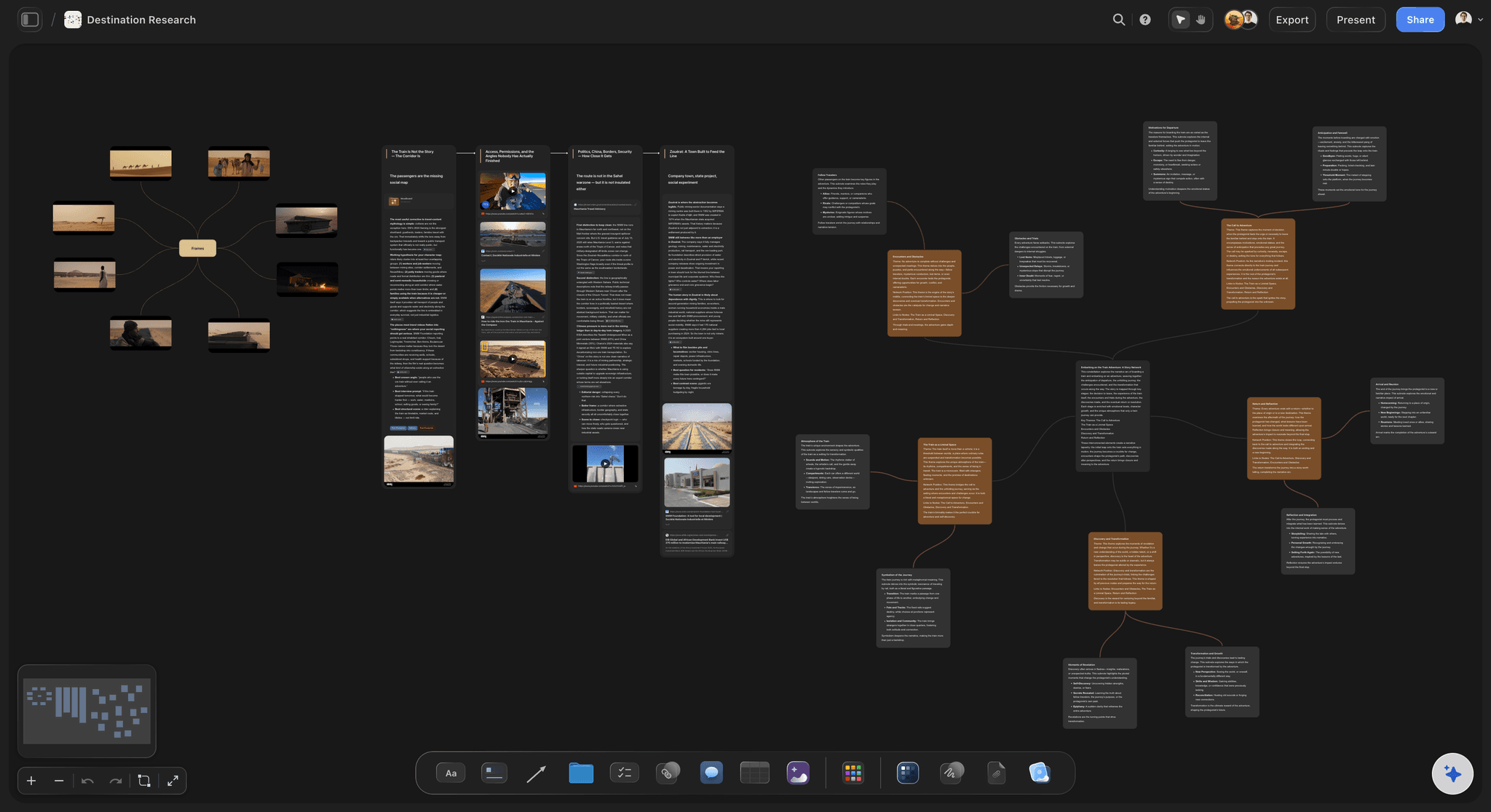
Sources, notes, and data notes parked under the chapters they serve
Keep the research on the same board as the plan
Pin reading notes, PDFs, figures, and interview summaries directly under the chapter that uses them. For the reading and synthesis layer specifically, the literature review organizer is the tool built for that job, and it lives on the same canvas.
Organize the literature review →Unlimited boards. No object cap.
Open a canvas, write the claim, and lay the chapters out. Storyflow is paid-only during early access, with plans from $9.99 a month, and a Free plan launches before the end of 2026.
Unlimited thesis boards on an infinite canvas
Basic AI usage to draft a chapter structure and timeline
3 starter frameworks built in
Share view-only links with your supervisor
Built for people with taste
More than a chapter list in a document.
A document shows one page. A thesis has two shapes, the argument and the calendar, and neither of them is visible one page at a time.
One claim, tested against every chapter
Build the argument before you build the chapters
Write the thesis statement as one sentence: One sentence, in the form of a claim that could be disagreed with. If it takes a paragraph, you have a topic rather than an argument, and a topic cannot tell you what belongs in the thesis and what does not. Put that sentence at the centre of the canvas and leave it visible.
Test every chapter against it: For each chapter, say in one line what it contributes to the claim. Draw the connection. A chapter that needs three lines to justify its place, or that connects to nothing, is usually a good paper that belongs somewhere other than this thesis.
Reorder until the through line reads: Most argument problems are order problems. Cards move with a drag, so you can try the methodology chapter before the second analysis chapter and read the resulting spine immediately, rather than restructuring a document to find out it did not help.
Watch for the four loosely related papers: This is the most common structural failure in a thesis, and it is almost undetectable from inside chapter three. Read the chapter cards left to right with nothing else on screen. If they do not build, you have found it while there is still time to fix it.
Introduction, literature review, methodology, results, discussion, conclusion
Give every chapter a job, not a topic
What each chapter owes the argument: The introduction states the claim and the stakes. The literature review establishes the gap the claim fills. The methodology justifies why your approach can answer the question. The results or analysis chapters produce the evidence. The discussion interprets it against the field. The conclusion states what is now known that was not known before.
The literature review is its own layer: Reading, synthesis, and finding the gap are a large enough job to deserve their own map. Plan the thesis here and run the reading in the literature review organizer, on the same canvas, so the sources feed the chapters that depend on them.
Methodology and data as a visible chain: Connect the research question to the method, the method to the data it produces, and the data to the analysis chapter it feeds. A break in that chain is the question a viva examiner will find, and it is much cheaper to find it yourself in year one.
Write the introduction last: The introduction has to promise exactly what the thesis delivers, and you do not reliably know what it delivers until it is written. Sketch a working introduction early so you have a direction, then write the real one at the end, when the promise can be accurate.
Submission date on the right, working backwards
Plan the calendar honestly, including the delays
Work backwards from submission: Put the real deadline on the timeline first, then the revision round before it, the full draft before that, and each chapter draft before that. Planning forwards from today produces a schedule that ends whenever it ends. Planning backwards produces one that has to fit.
Supervisor cycles always take longer than planned: A chapter goes out, and it comes back in three to six weeks, not the ten days the plan assumed. Put every review cycle on the timeline as a real block of elapsed time, and write another chapter while one is out. Two supervisors means two calendars to reconcile.
Build slack for ethics, recruitment, and data: Ethics approval, participant recruitment, archive access, lab time, and transcription are the classic overruns, and they are the parts you do not control. Mark them on the timeline with explicit slack rather than assuming best case, because the best case is not what happens.
Schedule the revision round as real work: The gap between a full draft and a submittable thesis is months, not a tidy-up. Formatting, restructuring after supervisor comments, the abstract, and the final read all belong on the calendar as their own phase, and leaving them off is how a plan that looked fine runs three months late.
Planned pace against actual pace
Turn an unstructured project into a weekly habit
Set a weekly target you will actually hit: Most people plan at a pace they have never written at. Track a few real weeks first, then set the target from the measured pace rather than the hoped one. A schedule built on five hundred words a day that you have never once produced is a schedule that fails in month two.
Keep the planned and actual lines both visible: Mark what you planned to have written by each point and what you have actually written. Seeing the gap early makes it a small correction. Seeing it late makes it a crisis, and the whole value of a long timeline is that it is early for a very long time.
Share a view-only link with your supervisor: A supervisor who can see the argument map and the timeline at once gives more useful structural feedback than one reading a chapter in isolation. They open it in a browser with no account. If they are on a paid plan themselves, anyone they invite to a board joins free.
AI that reads the board, not the thesis: Because the AI has the whole canvas as context, you can ask it to draft a chapter structure, propose a timeline, or point out which chapter has no visible link to the claim. It is there to help you structure the project. The argument, the analysis, and the writing stay yours.
Explore templates for your project
Every template opens as a real, editable board on the infinite canvas. Pick the closest fit and make it your own.
Story Plan
Outline your plot, characters, and world in one connected view, then expand each thread as the story grows.
One app instead of five
Storyflow vs Scrivener, Obsidian, and Notion.
Each of these genuinely owns part of a thesis. Here is which part, so you can pick honestly and probably use two.
Storyflow
Recommended
Whole argument and timeline visible on one canvas
Chapters as cards you reorder to test the through line
AI drafts structure and timeline from the whole board
Long-form drafting of a full manuscript
Linked plain-text notes stored on your own disk
Structured database and task list for milestones
Scrivener
Whole argument and timeline visible on one canvas
Chapters as cards you reorder to test the through line
AI drafts structure and timeline from the whole board
Long-form drafting of a full manuscript
Linked plain-text notes stored on your own disk
Structured database and task list for milestones
Obsidian
Whole argument and timeline visible on one canvas
Chapters as cards you reorder to test the through line
AI drafts structure and timeline from the whole board
Long-form drafting of a full manuscript
Linked plain-text notes stored on your own disk
Structured database and task list for milestones
Notion
Whole argument and timeline visible on one canvas
Chapters as cards you reorder to test the through line
AI drafts structure and timeline from the whole board
Long-form drafting of a full manuscript
Linked plain-text notes stored on your own disk
Structured database and task list for milestones
What creators are saying
Join early creators getting structured workspaces and AI that remembers their projects
“Storyflow has sped up my workflow by at least 3x, which means more flow state and more projects I can actually ship. It truly changed the way me and my team create.”

Reilin Joey
Director & YouTuber
“One prompt gets me a structured board. But the tactics are my favorite. I run my YouTube scripts through them and my intros and retention got better. It's amazing.”

Justkay
YouTuber & Freelance Filmmaker
“I used to juggle five apps to plan a project. Now I describe what I am making and get boards, lists, and a schedule. All in one place.”

George
@fernwehchronicles
Thesis planning questions, answered.
Structure, chapters, timelines, and what Storyflow honestly does and does not do.
Start with the claim, not the chapters. Write one sentence that says what the thesis argues, in a form someone could disagree with. Then list the chapters and say in one line what each contributes to that claim, dropping anything that cannot answer. Next, decide the order and read the chapter titles as a sequence to check the argument builds. Only then do the calendar: put the submission date down and work backwards through the revision round, the full draft, each chapter, every supervisor review cycle, and the data collection, adding slack for ethics and recruitment.
It varies enormously by level and country. An undergraduate dissertation is usually one term. A master's dissertation is typically three to twelve months of active work. A PhD is commonly three to four years full-time in the UK and Europe and four to six in the US, where coursework and comprehensive exams come first, and part-time routes run longer. Those are the official figures, and overruns are normal rather than shameful. The reliable planning move is to work backwards from your actual submission date and to schedule the revision round after the full draft as real months of work, because that phase is the one most often left off entirely.
The conventional structure is introduction, literature review, methodology, results or analysis chapters, discussion, and conclusion, though disciplines vary and some fields use a papers-based or monograph format instead. What matters more than the names is the job each chapter does. The introduction states the claim and the stakes. The literature review establishes the gap. The methodology justifies the approach. The results or analysis chapters produce the evidence. The discussion interprets it against the field. The conclusion states what is now known. Check your own department's regulations, because required chapters and word limits are set locally.
Usually not, and this trips up a lot of people. The introduction has to promise exactly what the thesis delivers, and you cannot know that reliably until the analysis is done. Writing it first tends to produce months of anxious rewriting as the project shifts underneath it. The practical approach is to sketch a working introduction early, as a statement of direction for yourself and your supervisor, then write the real one near the end when the promise can be accurate. Many people write the methodology and the literature review chapters first, since both can be largely drafted before the results exist.
Write one sentence that states a claim someone could argue with, not a topic. Compare a topic like the effect of remote work on team trust with a claim like remote teams lose trust through the loss of unplanned contact rather than through reduced communication volume. The second one tells you what evidence you need and what belongs in the thesis. If your sentence takes a paragraph, it is still a topic. Keep the sentence visible while you plan, and test every chapter against it: if a chapter does not defend part of that claim, it is a different project.
Read the chapter titles and one-line summaries in order, with nothing else in front of you, and ask whether each one needs the one before it. If they could be shuffled without loss, you have a collection rather than an argument. The other test is connection: draw a line from each chapter to the specific part of your claim it defends. A chapter with no line, or one that needs a long justification, is usually a decent paper that belongs elsewhere. This is far easier to see when every chapter is a card on a canvas than when they are files in a folder.
Put the submission date on the right and build leftwards. Place the revision round before it, the full draft before that, and each chapter draft before that, then add data collection, ethics approval, and any fieldwork at the start. Give every supervisor review cycle a real block of elapsed time, three to six weeks rather than ten days, and plan to write another chapter while one is out for review. Add explicit slack to anything you do not control. Then check the total against the time you actually have, and cut scope now if it does not fit.
Treat each review as an event with duration, not a moment. A chapter goes out and comes back weeks later, and the revision afterwards is its own block of work. Put both on the timeline, and always have a second piece of work to move onto while one chapter is with your supervisor, otherwise the review cycle becomes dead time. Agree the turnaround expectation early and put the date on the board. If you have two supervisors with different rhythms, plan for the slower one, and share the timeline so everyone is looking at the same commitments.
Fewer than you think, done more often. The number that matters is your measured pace, not an aspirational one, so track a few honest weeks before you set a target. Two to five hundred words on a writing day is a normal and sustainable academic rate once reading, analysis, and revision are counted, and consistency beats intensity across a project this long. Keep the planned line and the actual line both visible on your plan so a shortfall shows up as a small correction in month two rather than a crisis in the final year.
No to all three, and we will not pretend otherwise. Storyflow does not manage citations or bibliographies, does not format APA, MLA, Chicago, Harvard, or any other style, and does not integrate with Word, LaTeX, Overleaf, or Zotero. It is not where you should write eighty thousand words. Use Zotero, Mendeley, or EndNote for references and Word, LaTeX, or Scrivener for the drafting. Storyflow is the planning canvas beside them: the argument, the chapter structure, the sources laid out spatially, and the timeline. Most people plan here and draft elsewhere, and that is the intended split.
No, and you should not want it to. Storyflow's AI is a planning assistant: it can draft a chapter structure from your research question, propose a working timeline from your submission date, and point out which chapter has no visible link to your claim, because it reads the whole board as context. It does not write your chapters, your analysis, or your argument, and the thesis must be your own work. Nearly every institution now requires disclosure of AI use and many restrict it outright, so check your university's policy and your supervisor's expectations before using any AI tool on your project.
Not during early access. Storyflow is paid-only right now, with plans starting at $9.99 a month, and a Free plan launches before the end of 2026. Anyone a paid member invites to a board joins free today, which in practice means a supervisor on a paid plan can invite a student at no cost, or a research group can share one board. If you need something free this minute, a wall of index cards is genuinely good for testing chapter order, and Obsidian's free tier will hold your notes while you decide.
See the whole argument and the whole calendar at once.
Open a canvas, write the claim, and let AI draft the chapter structure and the timeline. No download.