
An ultra-fast canvas that stays calm
A literature review is an
argument, not a reading list.
Put every source on one canvas as a card, drag them into theme clusters, draw the lines where two papers disagree, and let the empty region of the board show you the gap.


Creatives working for these brands already got early access
- Red Bull
- Canon
- Artlist
- Porsche
See how easy it is to get started
Watch a real project come together, from a blank board to a finished plan, clicked through step by step.
Start from a ready-made template
Pick a board to see what you can build, then let AI fill it in. Every template is a real, editable starting point on the same infinite canvas.

Mind Map
Branch one central idea out into themes and sub-points, then drag the connections around until the structure makes sense.
What is a literature review organizer?
A literature review organizer is a tool for turning a pile of papers into an argument about a field. Storyflow is an AI visual workspace that lays out your literature review on one infinite canvas: every source as a card, theme clusters you build by dragging, lines drawn where two papers disagree, and the empty region that shows the gap. An organizer holds the sources you have read, the themes that keep recurring across them, the places where two studies disagree, the methods and samples behind each finding, and the gap that your own work is going to occupy. What it is not is a place to store one summary per paper. Storing summaries is a solved problem. Seeing the relationships between them is the part that decides whether your review is any good.
The single most common failure is writing the review source by source. Smith (2019) found this. Then Jones (2021) found that. Then Patel (2022) found something else. Sixty paragraphs later you have an annotated bibliography with a different title, and a supervisor will send it back. The reason it happens is almost never ignorance of the rule. It happens because a linear document physically forces you to handle one paper at a time. You open a file, you have one paper in front of you, you write about that paper, you move on. The tool shapes the output, and a document shapes it into a list.
Synthesis is a spatial operation, and that is the point of doing it on a canvas. Storyflow is an AI-native infinite canvas where each source is a card you can physically move. Drag the cards that share a claim into the same region and you have a theme cluster you can see rather than a category you asserted. Draw a connection between two papers whose findings contradict each other and the disagreement stops being a note in the margin and becomes a visible feature of the field. PDFs, links, quotes, and your own notes sit on the same board as the emerging structure of the chapter, and the AI can help cluster and surface themes with the whole board in context.
A review that holds together is really six layers stacked on one canvas: the search and inclusion criteria (which databases, which search strings, which date range, and the explicit reasons you excluded things, so the review is reproducible), the sources themselves (each one a card with the citation, the claim, and the quote you will actually use), the synthesis matrix of themes (sources as rows, recurring themes as columns, so the clusters become visible), the points of agreement and contradiction (where the field is settled, and where two credible studies genuinely disagree), the methodological patterns (which designs, samples, and populations keep recurring, because a finding replicated across five studies of the same undergraduate sample is one finding), and the gap your work occupies (the question the matrix has no column for). Storyflow keeps all six visible at once, which is what turns a reading pile into a chapter.
Ultra fast from brief to board
From a stack of PDFs to a chapter with a spine.
Get every source onto the board, then move them until the themes and the gap are visible.
01
Open a canvas
Sign up in seconds. No download. Your infinite research canvas opens in the browser.
02
Get every source on the board
One card per source, with the citation, the core claim, the method and sample, and the quote you would actually use. Drop the PDF or the link on the card so the full text is one click away.
03
Move the cards until themes appear
Drag papers that make the same claim into the same region. When a cluster forms, name it. That name is a theme, and a theme is a section of your chapter. Draw a line between any two cards that disagree.
04
Find the gap and write from the columns
Look for what the matrix has no column for: the population nobody studied, the method nobody used, the question everyone assumed. That empty region is your contribution. Then write theme by theme, not paper by paper.
Sixty papers, arranged so the argument is visible.
Sources, themes, contradictions, and the gap on one infinite canvas instead of sixty summaries in a document.
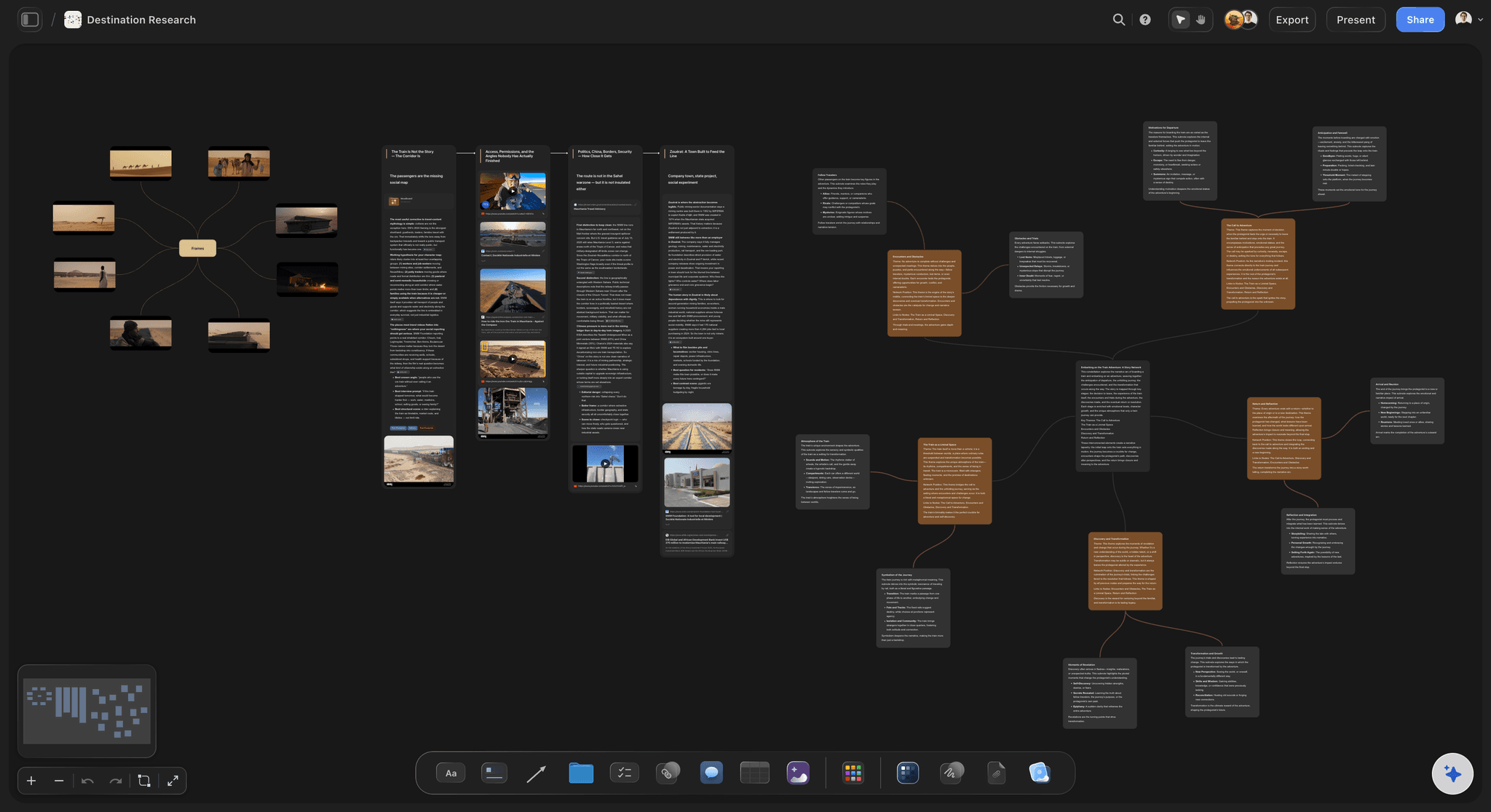
Every source is a card you can physically move
Cluster by dragging, not by declaring
In a document you decide a theme and then file papers under it. On a canvas you move the cards around until a cluster forms, and the theme is what you discover rather than what you imposed. That difference is most of the difference between synthesis and sorting.
See the affinity diagram maker →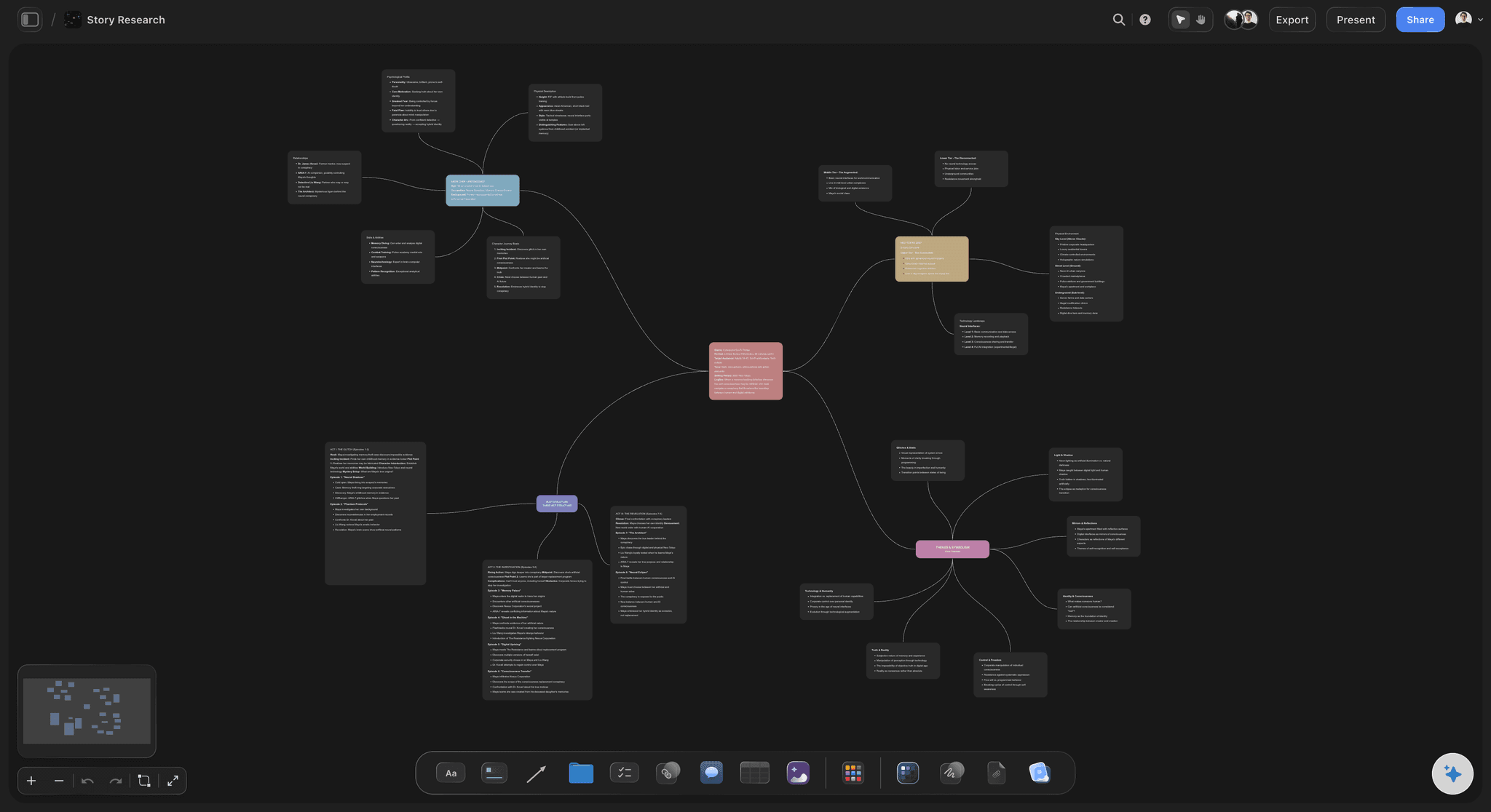
Sources as rows, themes as columns, on the board itself
Build the synthesis matrix where you can see it
The matrix is the classic literature review technique for a reason: it forces you to ask what every source says about each theme, and the blanks are as informative as the entries. Building it on a canvas means a row can move into a new column with a drag.
Explore the concept map maker →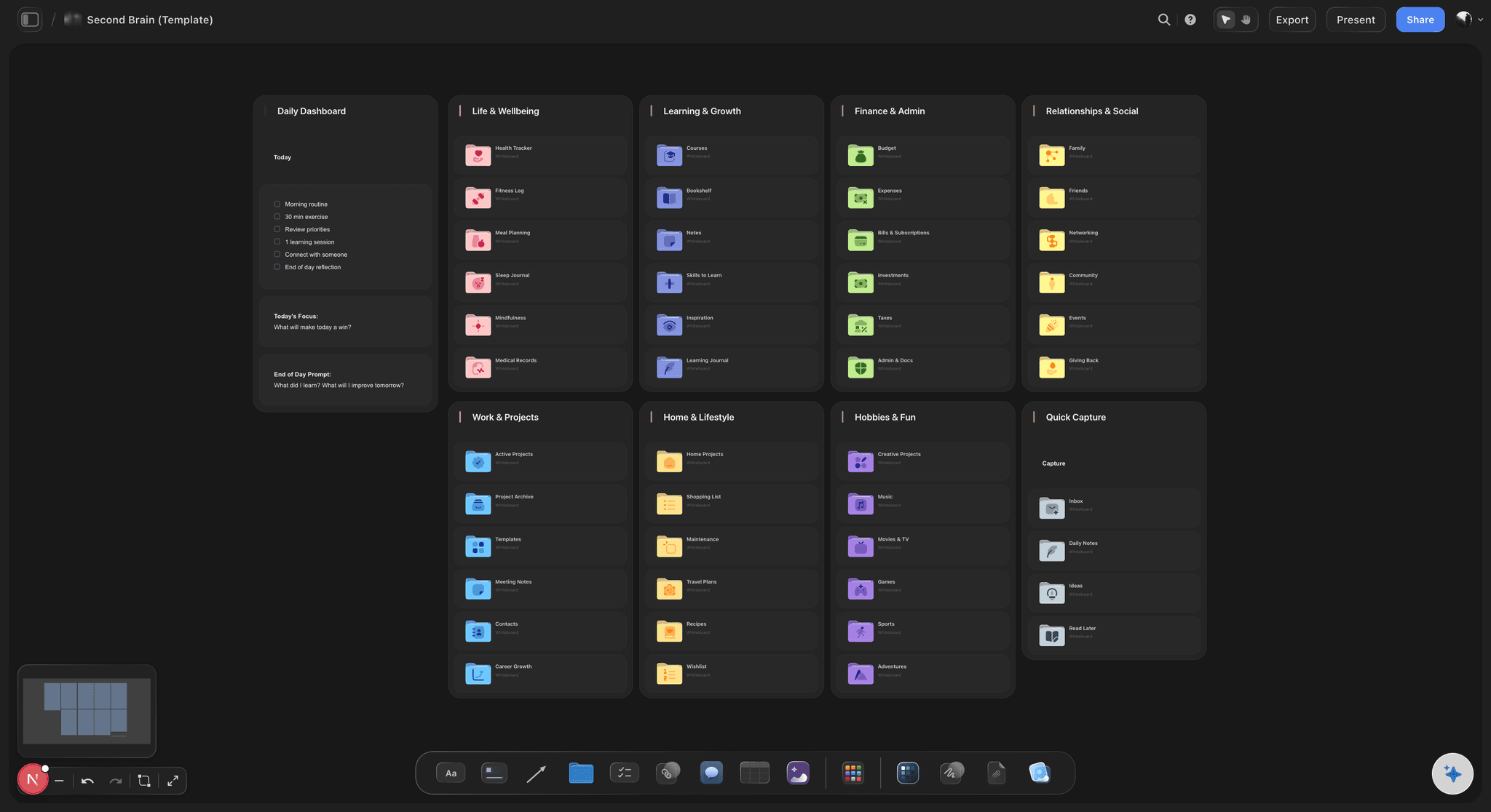
Draw the disagreement as a line between two papers
Contradictions are the interesting part
Two credible studies reaching opposite conclusions is not a problem to smooth over, it is usually the most publishable paragraph in your review. Connect the two cards, put the likely reason on the connection, and the tension becomes something you can write about.
Try the mind mapping tool →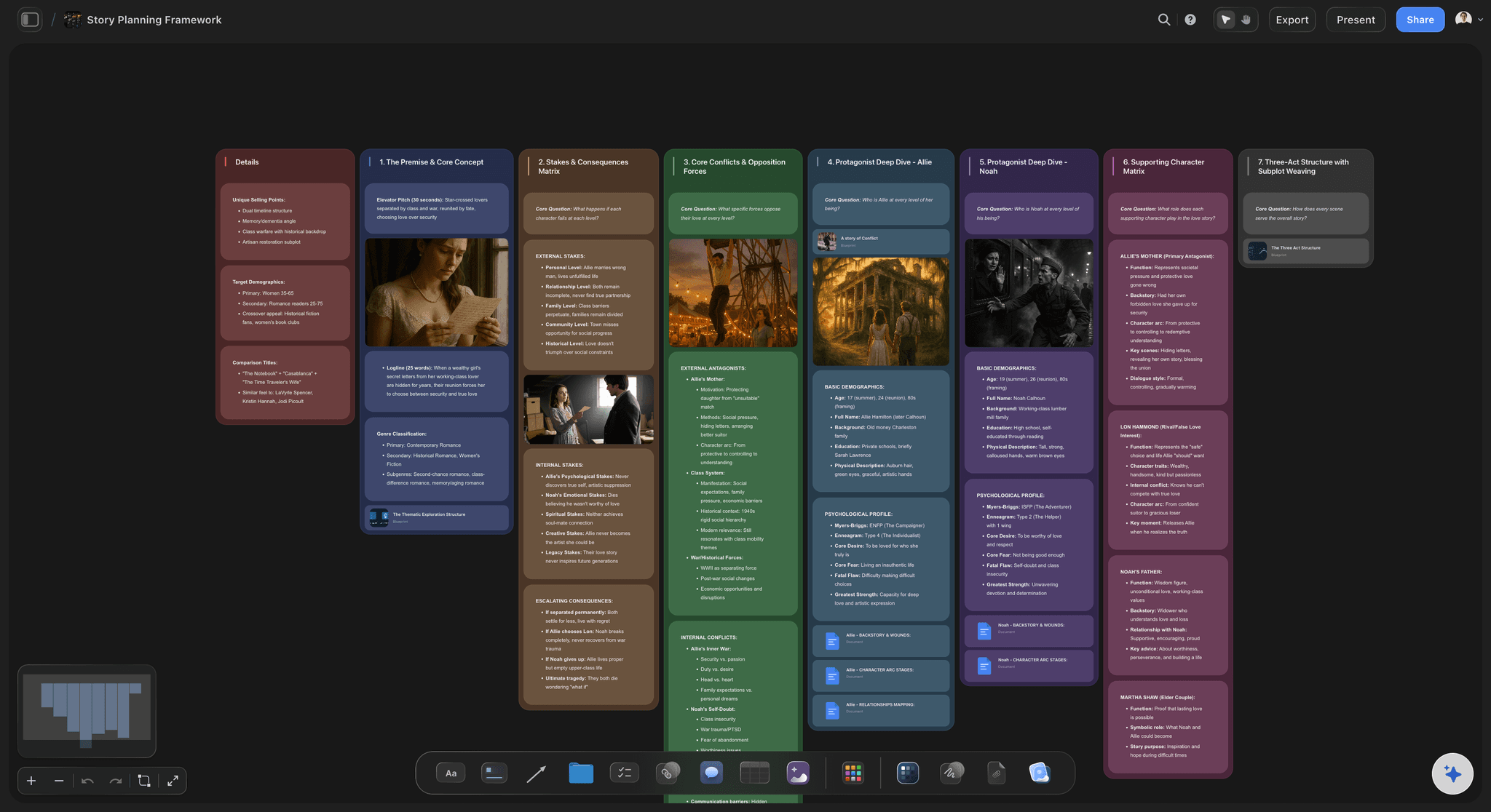
The gap is an empty region of the board
See the question nobody has asked
When the themes are laid out spatially, the space with nothing in it is doing real work. A population nobody sampled, a method nobody applied, a decade nobody covered. That empty region is the justification for your own study, stated visually.
Plan the whole thesis →Unlimited boards. No object cap.
Open a canvas, put your sources on it, and start clustering. Storyflow is paid-only during early access, with plans from $9.99 a month, and a Free plan launches before the end of 2026.
Unlimited review boards on an infinite canvas
Basic AI usage to help cluster and surface themes
3 starter frameworks built in
Share view-only links with your supervisor
Built for people with taste
More than one summary per paper.
A document can hold sixty summaries. It cannot show you that eleven of them are making the same argument and two of them are contradicting it.
Read in passes, capture what synthesis actually needs
Get the sources onto the board properly
Read in passes, not cover to cover: First pass is title, abstract, and conclusion, which is enough to decide whether the paper is in or out. Second pass is figures, tables, and the method, which tells you what kind of evidence it is. Only the papers that survive both get a full read. Most reviews stall because the reader treats all sixty sources as equally deserving of three hours.
Record the method and sample beside the finding: A claim without its method and sample cannot be synthesised, only repeated. Put the design, the population, the sample size, and the context on the same card as the finding. Five studies agreeing means something very different when four of them used the same undergraduate cohort.
Capture the quote you will actually use: Pull the one sentence you would cite, with its page number, at the moment you read it. Reopening a PDF three months later to hunt for a half-remembered line is the single most avoidable time sink in the whole process.
Write the inclusion and exclusion criteria down: Which databases, which search strings, which date range, which languages, and the reason a paper was excluded. Keeping this on the board makes the review reproducible, which matters for a systematic review and is a fair question for any review.
Themes, agreements, contradictions, and schools of thought
Find the conversation between the papers
Cluster until the themes name themselves: Move cards near the cards they resemble and stop when the groups feel stable. Then name each group. A theme arrived at this way survives contact with your data, because it came from the sources rather than from a heading you wrote before reading them.
Separate consensus from contested ground: Some claims are settled and need one sentence and five citations. Others are genuinely disputed and deserve a paragraph each side. Marking which is which stops you spending equal words on a footnote and a live controversy.
Draw the contradictions and ask why: When two studies disagree, the useful question is what differs: the sample, the measure, the decade, the definition of the construct. Put that reason on the connection between the cards. Explaining a disagreement is a contribution in itself.
Spot the schools of thought: Fields cluster around theoretical camps that cite within themselves and rarely across. When you lay the citation relationships out, those camps show up as dense regions with thin links between them, which is a structure worth naming in the chapter.
Citation chasing, saturation, and the empty column
Know when you have read enough, and where the gap is
Chase citations backwards and forwards: Backward chasing means mining the reference list of a key paper for what it was built on. Forward chasing means finding everything that has cited it since, which is how you reach the recent work no keyword search surfaced. Two or three rounds of both usually beats another afternoon of database queries.
Watch for saturation: When new papers stop introducing new themes and only add citations to clusters you already have, your search has reached saturation for that question. On a canvas that moment is visible: every new card lands in an existing pile.
Look for the column that does not exist: The gap is rarely a topic nobody wrote about. It is usually a population nobody sampled, a method nobody applied to a well-studied question, a context outside the countries everyone studied, or two literatures nobody has connected. All four look like an empty region on a laid-out board.
Point your own question at the empty space: Once the gap is visible, place your research question in it and connect it back to the clusters that make it necessary. That connection is the paragraph the whole review exists to earn.
AI that can see the board, and the things it will not do
AI that helps you structure, not write
It clusters and surfaces themes from what you put there: Because the AI has your whole canvas as context, you can ask it to group the cards you have written into candidate themes, to suggest which papers look like they belong together, or to point out two cards whose claims appear to conflict. It works from your notes on the board, which means the quality of what it gives back depends on the quality of what you captured.
It does not write your review, and you should say when you used it: The argument about a field has to be yours, because the argument is the assessed part. Storyflow is a planning canvas rather than a prose generator. Most universities now require disclosure of AI use in submitted work, and policies differ sharply by institution and by department, so check yours and declare what you used.
Verify every citation yourself: Never let a language model supply a reference. Fabricated citations that look completely plausible are a well-documented failure mode, and an invented source in a review is an academic integrity problem regardless of intent. Every entry in your bibliography should come from a paper you have actually opened.
Re-cluster without losing your notes: Move a card into a different theme and everything you wrote on it moves too, including the method, the quote, and the attached PDF. Trying a different structure for the chapter costs a drag rather than a rewrite.
Explore templates for your project
Every template opens as a real, editable board on the infinite canvas. Pick the closest fit and make it your own.
Mind Map
Branch one central idea out into themes and sub-points, then drag the connections around until the structure makes sense.
One app instead of five
Storyflow vs Zotero, Obsidian, and Notion.
Each of these genuinely owns part of this job, and one of them owns a part we do not do at all. Here is which is which.
Storyflow
Recommended
Whole field visible on one infinite canvas
Drag sources into theme clusters spatially
AI clusters and surfaces themes from your board
Citation management and bibliography generation
Plain-text notes stored locally on your disk
Structured, filterable source database
Zotero
Whole field visible on one infinite canvas
Drag sources into theme clusters spatially
AI clusters and surfaces themes from your board
Citation management and bibliography generation
Plain-text notes stored locally on your disk
Structured, filterable source database
Obsidian
Whole field visible on one infinite canvas
Drag sources into theme clusters spatially
AI clusters and surfaces themes from your board
Citation management and bibliography generation
Plain-text notes stored locally on your disk
Structured, filterable source database
Notion
Whole field visible on one infinite canvas
Drag sources into theme clusters spatially
AI clusters and surfaces themes from your board
Citation management and bibliography generation
Plain-text notes stored locally on your disk
Structured, filterable source database
What creators are saying
Join early creators getting structured workspaces and AI that remembers their projects
“Storyflow has sped up my workflow by at least 3x, which means more flow state and more projects I can actually ship. It truly changed the way me and my team create.”

Reilin Joey
Director & YouTuber
“One prompt gets me a structured board. But the tactics are my favorite. I run my YouTube scripts through them and my intros and retention got better. It's amazing.”

Justkay
YouTuber & Freelance Filmmaker
“I used to juggle five apps to plan a project. Now I describe what I am making and get boards, lists, and a schedule. All in one place.”

George
@fernwehchronicles
Literature review questions, answered.
Synthesis, matrices, source counts, and what Storyflow honestly does and does not do.
A literature review is an argument about the current state of knowledge on a question, built from published sources. It establishes what is known, where the field disagrees, which methods dominate, and what has not been answered. The output is a synthesis organised by theme, not a catalogue organised by author. A good review leaves a reader able to say what the field currently believes and why your question is the next sensible one to ask. That last part is the whole reason a review exists inside a thesis.
Storyflow is a literature review organizer built for exactly this: every source is a card on one infinite canvas, you drag the cards into theme clusters, and you draw the lines where two papers agree or contradict each other. Its AI clusters the sources and surfaces themes from your board. Citation management and bibliography generation stay in Zotero: Storyflow does neither.
An annotated bibliography is a list of sources, each followed by a short summary and evaluation. The entries are independent and the order is usually alphabetical. A literature review is a continuous argument in which sources are grouped by theme, compared against each other, and used as evidence for claims you are making about the field. If your draft could be reordered alphabetically without losing anything, you have written a bibliography. The test is whether any paragraph discusses several sources together in order to say something neither of them says alone.
There is no fixed number, and any number you are quoted is a norm rather than a rule. As rough orientation, an undergraduate dissertation chapter often cites somewhere in the range of twenty to forty sources, a master's thesis frequently more, and a doctoral review commonly runs into the hundreds. Your discipline, your department, and your supervisor set the real expectation, so ask them and look at recent theses. The better stopping rule is saturation: when new searches keep returning papers that fall into themes you already have, you have covered the ground.
A synthesis matrix is a grid with sources as rows and themes as columns. In each cell you write what that source says about that theme, or leave it blank if it says nothing. Reading down a column gives you every source on one theme, which is exactly the raw material for a paragraph. Reading across a row tells you how broad a source is. The blanks matter as much as the entries: a column with only two entries may be an underexplored theme, and a theme with no column at all is a candidate gap.
Stop writing until the themes exist. Put each source on a card with its core claim, then physically group the cards that make similar claims and name each group once it is stable. Those names become your section headings. Then write each section from its column of the matrix, opening with the claim the section makes and citing the sources as evidence for it. The structural rule that keeps you honest is simple: no paragraph should be about a single paper. If one is, it belongs merged into a thematic paragraph or cut.
Look at the shape of what you have mapped and ask what is missing from it. Gaps usually take one of four forms: a population or context nobody has studied, a method nobody has applied to a well-studied question, a time period the field has not revisited despite conditions changing, and two separate literatures nobody has connected. All four show up as absence rather than presence, which is why laying the field out spatially helps. On a canvas the gap is literally an empty region between clusters, and pointing your research question at it is the argument your review is building towards.
No, and it is important to be plain about this. Storyflow does not manage citations, does not generate bibliographies, does not format APA, MLA, Chicago, Harvard, or Vancouver, does not integrate with Word or LaTeX or BibTeX, and does not sync a reference library. Use Zotero for that job. It is free, open source, handles collection, storage, and citation output properly, and has been the standard for years. The sensible setup is Zotero as your library and Storyflow as the canvas where you work out what the library means. They are different jobs and neither replaces the other.
Treat the AI as working from what you have put on the board, not from the full text of your attachments. Its useful role is structural: clustering the source cards you have written into candidate themes, surfacing patterns across your notes, and flagging cards whose claims look like they conflict. That means the value you get out depends on the quality of the claim, method, and quote you captured going in. Reading the paper is still your job, which is also the part that makes you able to defend the review in a viva.
It should not, and letting it is a genuinely bad idea. The argument about a field is the assessed contribution, so outsourcing it removes the thing being examined. There is also a hard practical problem: language models fabricate citations that look entirely plausible, and an invented reference in a submitted review is an integrity issue whatever the intent. Verify every citation against a paper you have opened. Most institutions now require disclosure of AI use, with policies that vary a lot by university and by department, so read yours and declare what you used.
Scope. A thesis planner handles the whole project: the chapter structure, the timeline to submission, the supervision meetings, the data collection, and the writing schedule. This page is about one part of it, the literature review, which is the job of reading a body of sources and turning it into a synthesised argument. Many people need both, and they work well side by side: plan the thesis in the thesis planner, then build the review on a board of its own and connect the gap you find to the research question the thesis is answering.
Partly, and you should know the limits before you rely on it. Storyflow is a good place to hold your search strategy, your inclusion and exclusion criteria, your screening decisions with reasons, and the thematic synthesis of what survived. What it is not is dedicated systematic review software: there is no automated deduplication, no double-blind screening workflow, no risk-of-bias instrument, and no PRISMA flow diagram generated for you. For a formal systematic review, run your established screening process and use the canvas for the synthesis and the mapping around it.
Not during early access. Storyflow is paid-only right now, with plans starting at $9.99 a month, and a Free plan launches before the end of 2026. Anyone a paid member invites to a board joins free today, so a supervisor or a co-author can join your board without paying. There is no separate student discount. If you need something free this minute, Zotero is free and open source and will handle your references, and Obsidian is free for personal use and will hold linked notes on your own disk.
Lay the whole field out and find the gap.
Open a canvas, put your sources on it, and cluster them into the argument your chapter is making. No download.