
The calmest place to shape your story
A Scrivener alternative for
everything around the draft.
Scrivener is built around the manuscript. Storyflow is the visual planning canvas for everything before and around it: world-building, character maps, plot and beat structure, and research, laid out in space with AI. It runs in the browser, and many writers plan here and still draft in Scrivener.


Creatives working for these brands already got early access
- Red Bull
- Canon
- Artlist
- Porsche
See how easy it is to get started
Watch a real project come together, from a blank board to a finished plan, clicked through step by step.
Start from a ready-made template
Pick a board to see what you can build, then let AI fill it in. Every template is a real, editable starting point on the same infinite canvas.

Story Plan
Outline your plot, characters, and world in one connected view, then expand each thread as the story grows.
What can you use instead of Scrivener, and where does each one fit?
Scrivener is the gold standard for long-form drafting, and it earned that place honestly. The binder keeps a whole manuscript organized into folders and scenes, the corkboard turns synopses into index cards you can shuffle, and Compile exports a clean manuscript in almost any format a submission or a self-publish workflow asks for. For sitting down and writing tens of thousands of words, then shaping them into a finished book, Scrivener is genuinely excellent and hard to beat.
Storyflow is not trying to replace the draft. It is a Scrivener alternative for the planning half of writing: the world-building, the character relationships, the plot and beat structure, and the research that a linear binder flattens into a list. Instead of nested folders, you get a truly infinite canvas where every idea is a card you can move, connect, recolor, and group, so a sprawling story world reads at a glance rather than hiding three folders deep.
The honest version: plenty of writers plan visually in Storyflow and still draft their manuscript in Scrivener, and that is a perfectly good workflow. Where Storyflow pulls ahead of a desktop binder for planning is that it runs in any browser with nothing to install, an AI can lay out a full character map or beat sheet from a prompt using your board as context, and the planning board turns into the next step: a beat sheet becomes an outline, a moodboard becomes a shot list, all on the same canvas.
Ultra fast from brief to board
Plan a book on the canvas in four steps.
Bring the premise. The AI lays out the first planning board, so structure starts with something on the canvas.
01
Open your canvas
Start in the browser and set up your account. No app to install, just an infinite canvas ready for your world, cast, and plot.
02
Describe your story
One sentence is enough: a premise, a genre, a logline. Ask for a character map, a world-building board, or a beat sheet to start from.
03
AI lays out the plan
The AI reads the current board and lays out cards: characters and their relationships, world details, or plot beats, grouped so the structure reads at a glance instead of hiding in a folder tree.
04
Refine, then draft where you like
Drag and recolor cards, pin research PDFs beside them, and turn a beat sheet into an outline. Export the plan as an image or PDF, share a view-only link, or carry it into Scrivener to write.
The planning Scrivener keeps in a list, laid out in space.
Keep Scrivener for the draft if you love it. Do the world, cast, and structure on a canvas that shows everything at once.
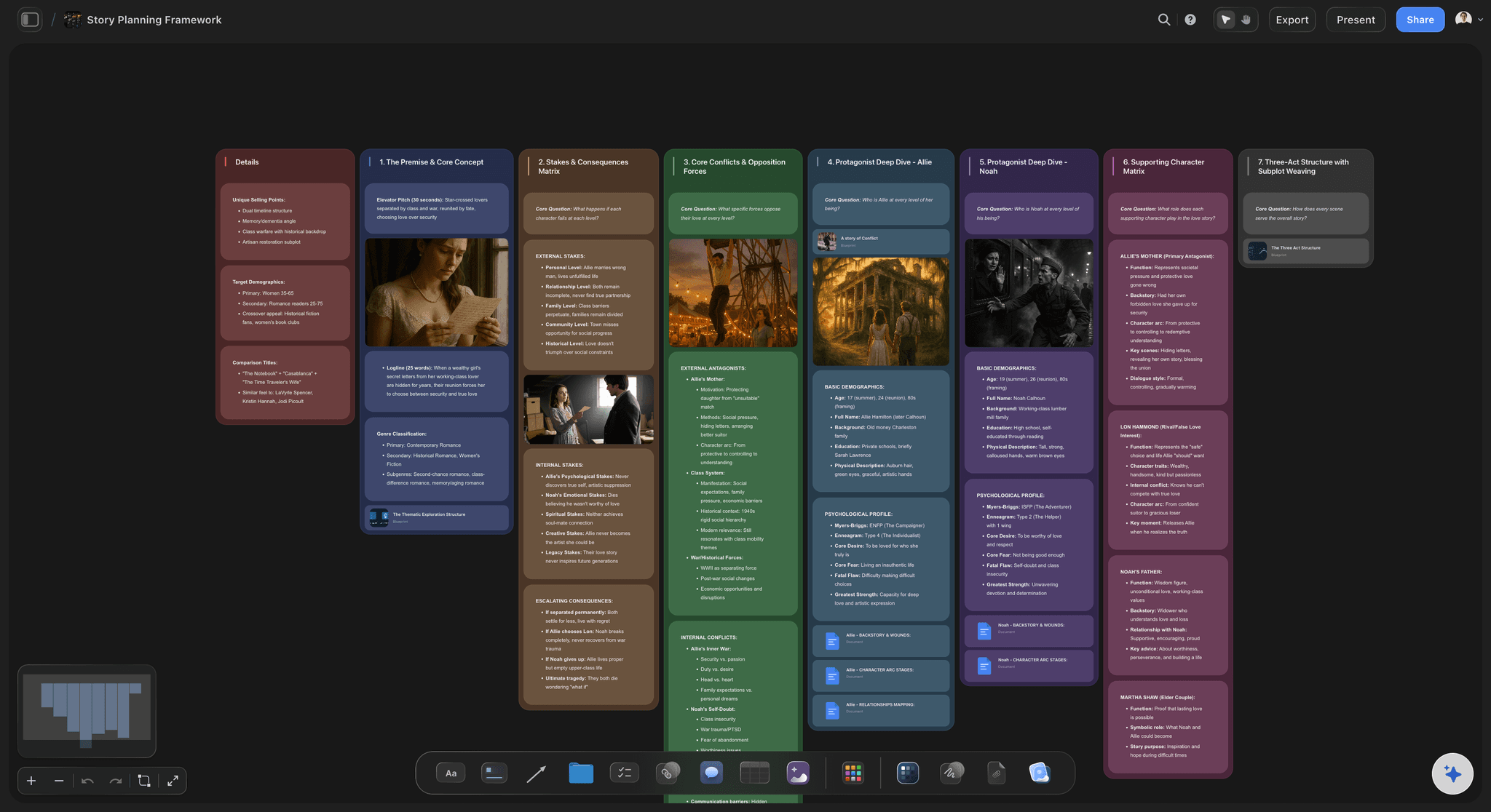
A full plan from a single prompt
AI lays out the plan, you refine
A blank binder is still a blank page. Describe your story and Storyflow's AI lays out a character map, world board, or beat sheet using the current canvas as context, so you refine a real structure instead of starting from nothing.
See the AI story outline generator →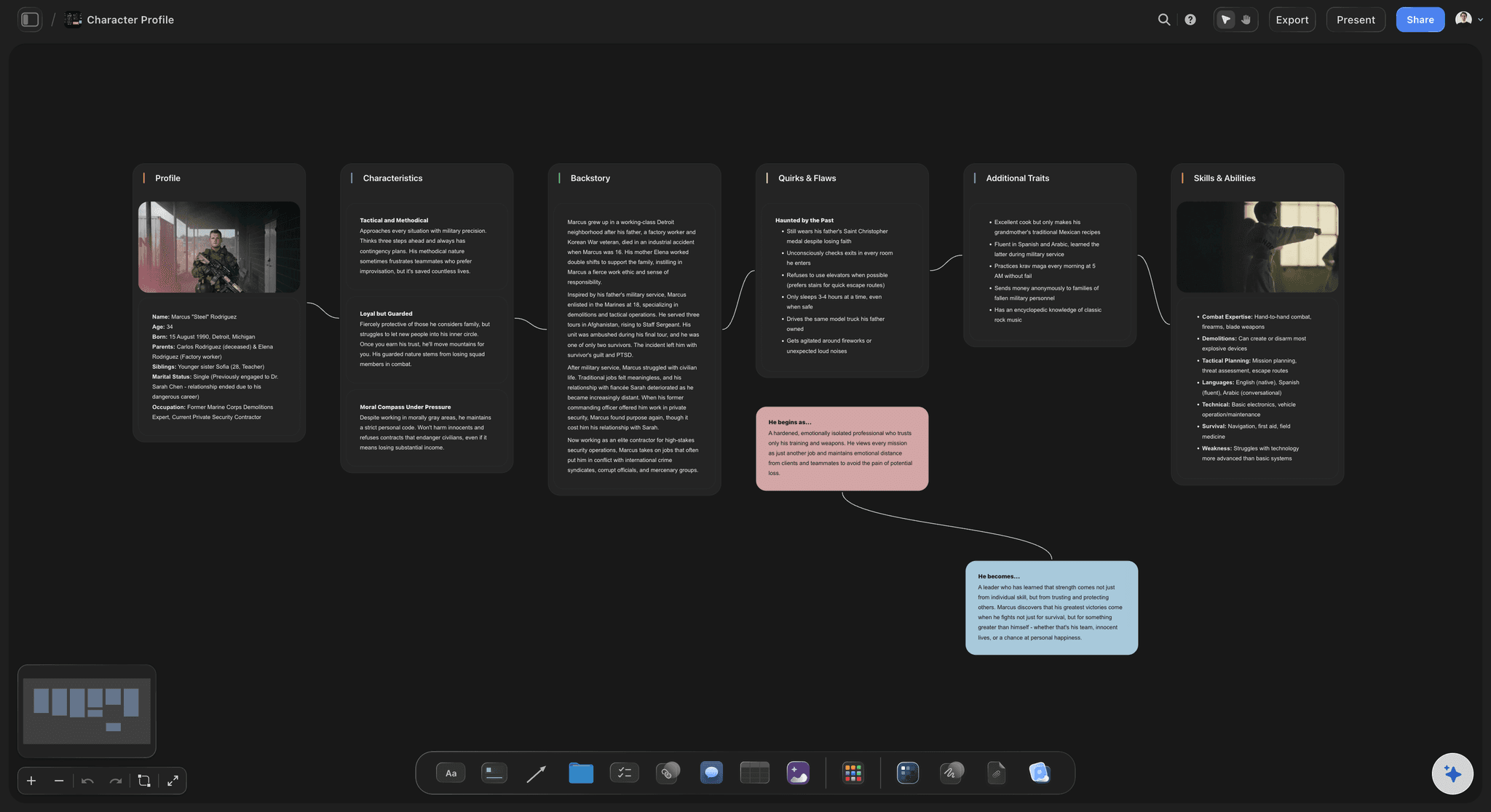
Characters you can see connected
Character maps, not a folder list
Scrivener stores character sketches as documents in the binder. On the canvas, each character is a card you connect to allies, rivals, and arcs, so relationships and tension read visually across the whole cast.
See the AI character profile generator →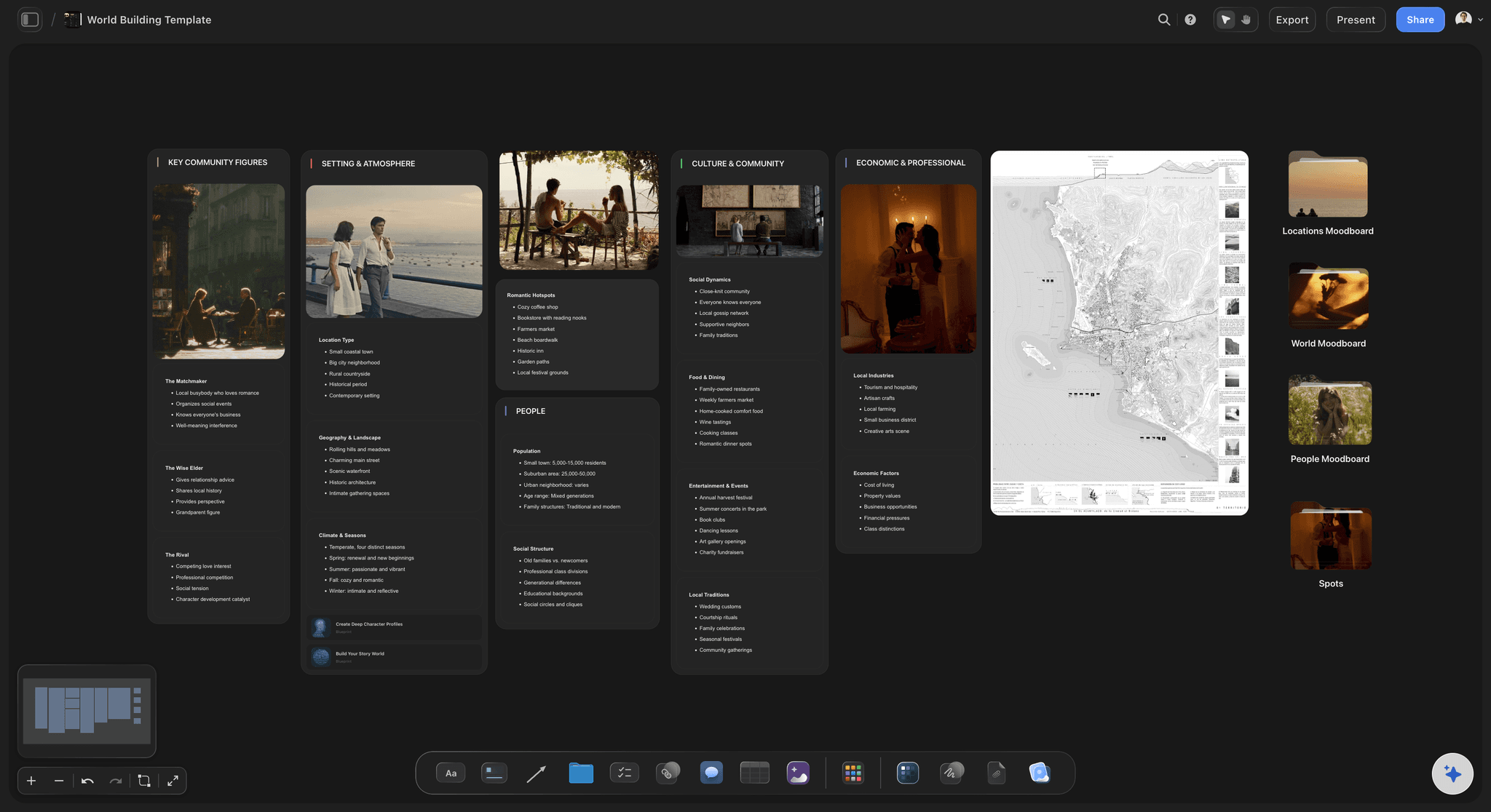
A world that spreads, not nests
World-building on an infinite canvas
A story world rarely fits a tidy outline. Storyflow's canvas is truly infinite, so places, factions, timelines, and lore keep spreading sideways with references attached, instead of disappearing three folders deep in a binder.
See the worldbuilding tool →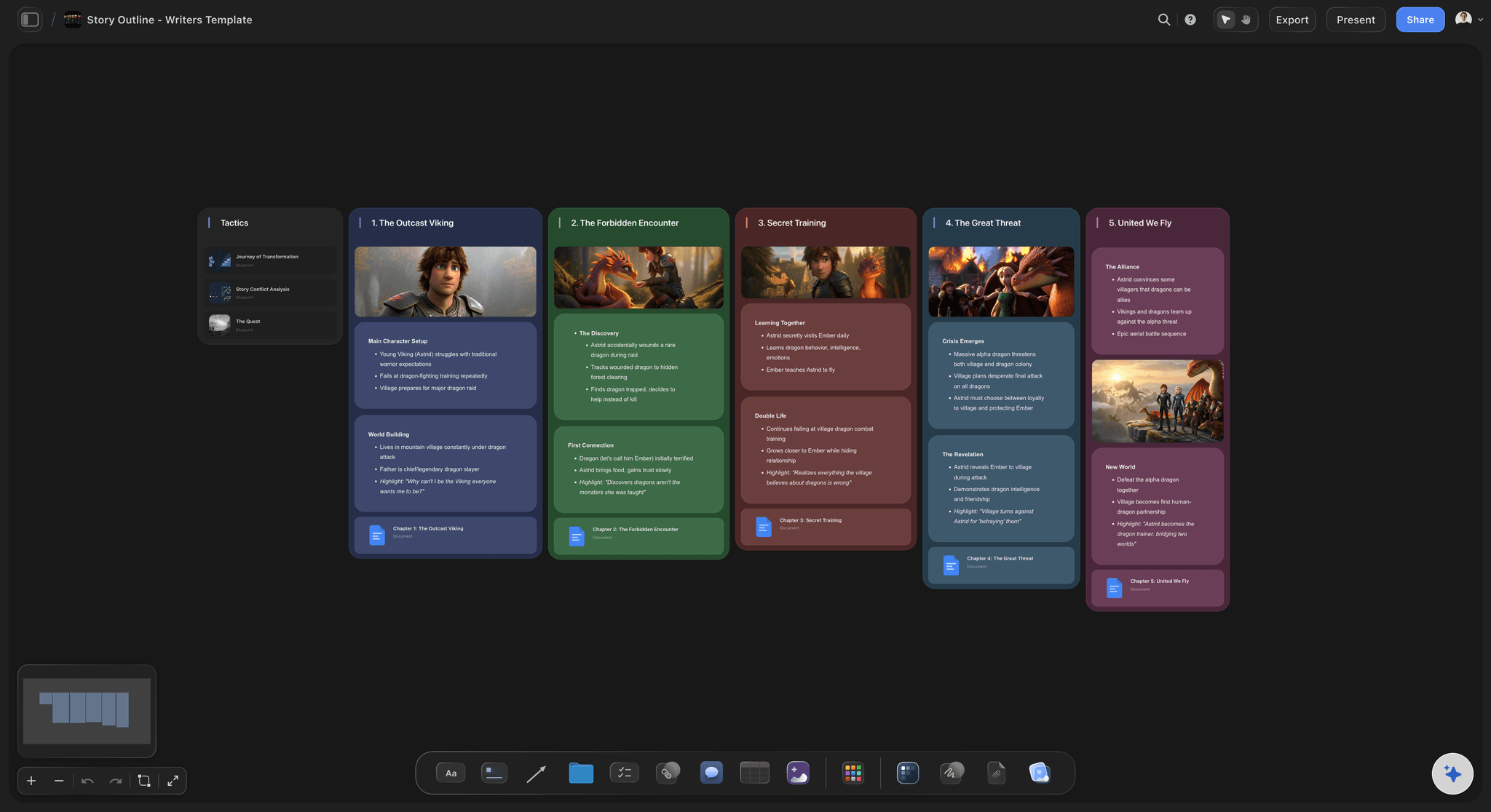
The plan becomes the next step
Beat sheets become outlines and boards
A Scrivener outline stays an outline. In Storyflow the planning board is step one: ask the AI to turn a beat sheet into a chapter outline, or a moodboard into a shot list, on the same canvas the planning lives on.
See the story planning tool →Plans from $7.99/month. No object cap.
Scrivener is a paid desktop app you buy per platform. Storyflow runs in any browser with no object cap and no time limit on any plan, so a whole story world never pushes you to upgrade. A free plan is coming before the end of 2026.
Unlimited planning boards on an infinite canvas, no object cap
Basic AI usage to lay out and expand character maps and beats
Attach research images, PDFs, video, and links, plus 20 file uploads
Share plans view-only, or invite collaborators free
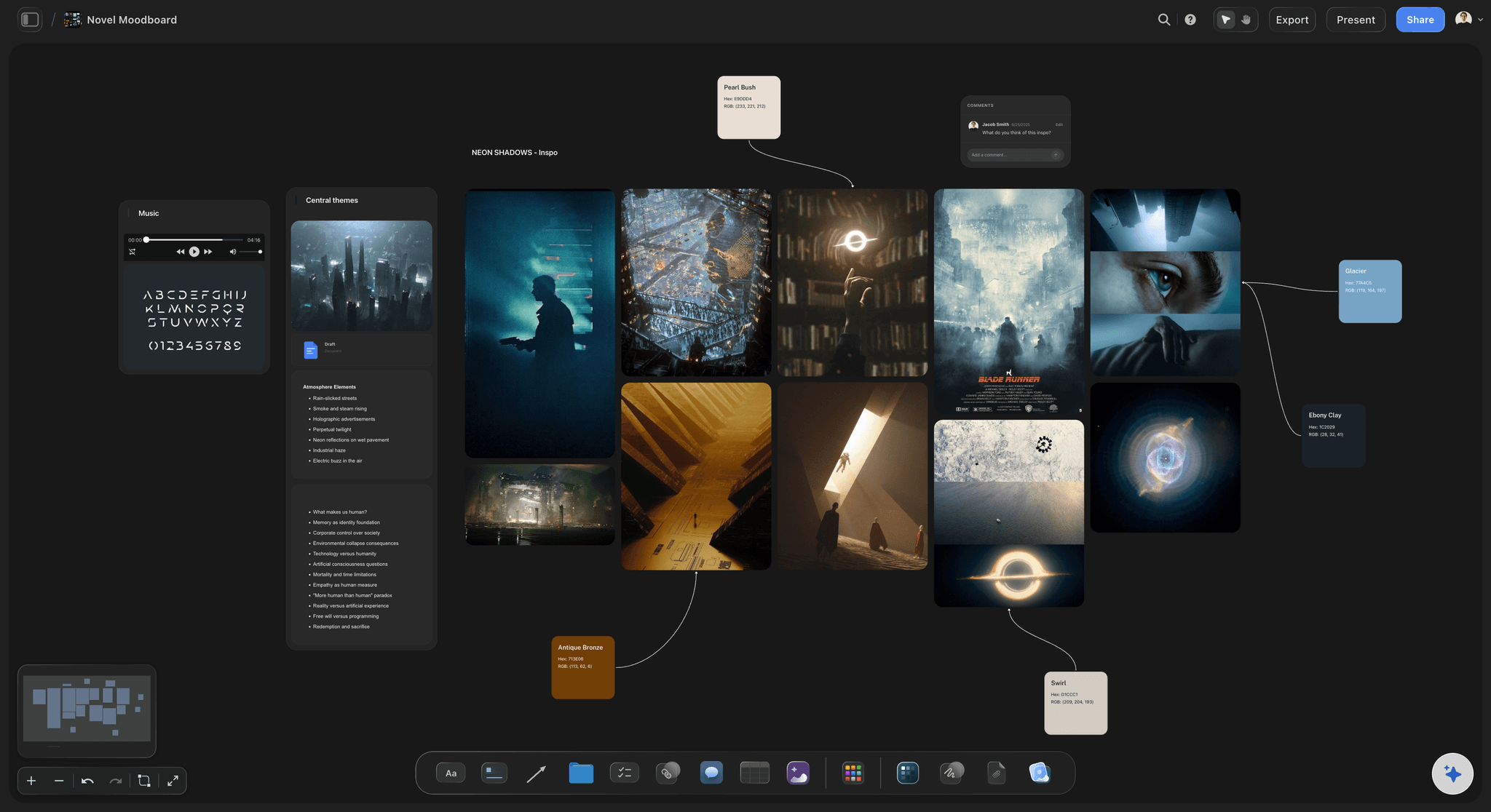
Built for people with taste
Made for the planning writers do before and around the draft.
Lay a story out in space, keep the world and cast visible at once, and move from plan to outline without leaving the canvas.
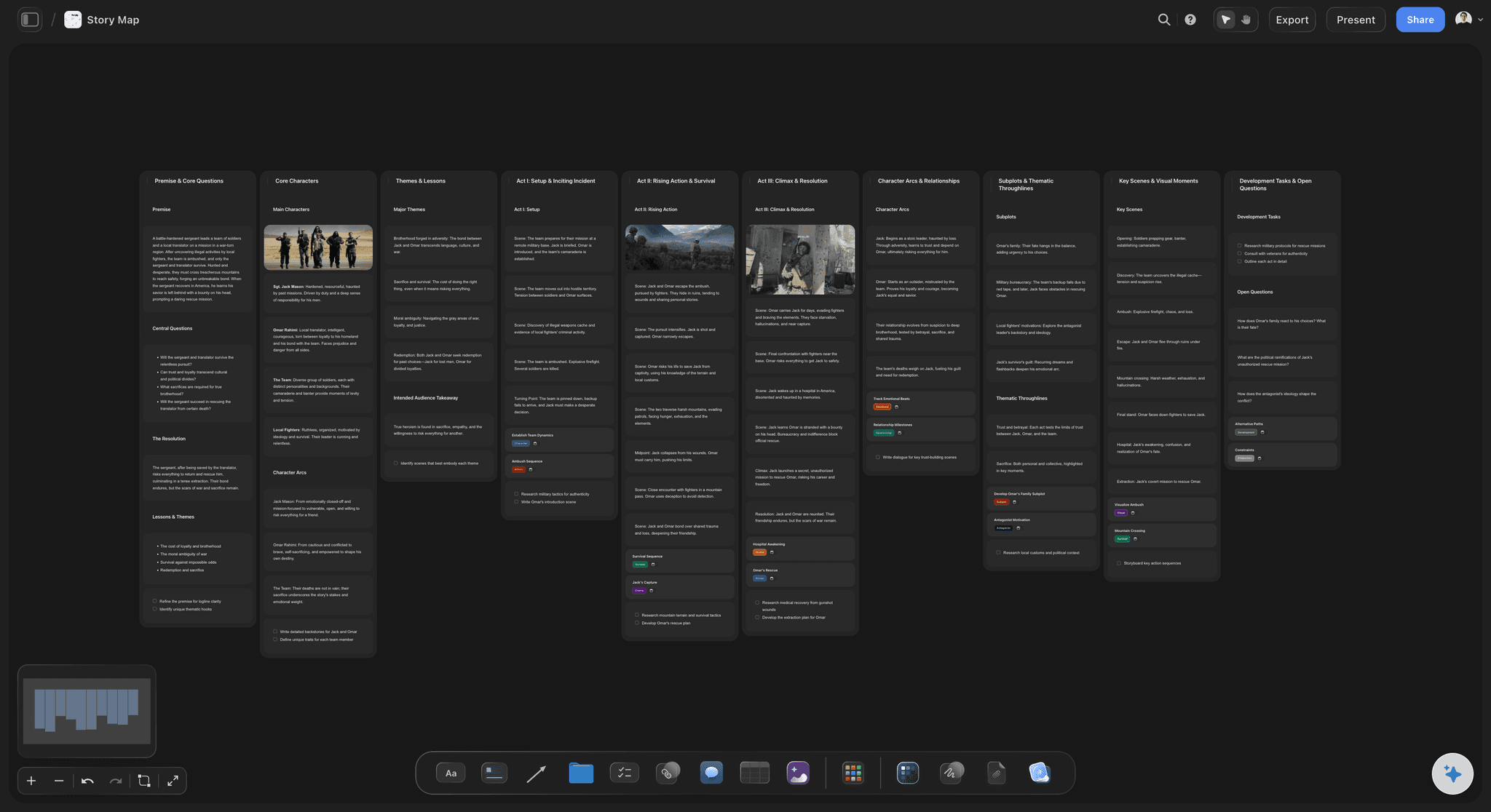
Structure you can see whole
The whole story in one view
World, cast, and plot as cards: The pieces a Scrivener binder splits across folders live on one canvas as cards you drag, recolor, resize, and connect, so nothing hides in a nested list.
AI lays out the first pass: Instead of a blank binder, the AI proposes a full character map or beat sheet from your prompt. Keep what fits, cut the rest, add your own.
Plan without limits: No object cap on any plan means a sprawling world keeps every location, faction, and note that earns its place on the board.
Context from the board you are planning
AI that builds on your story so far
Reads your active board: The AI uses what is on the planning board you have open, so new characters and beats fit the world and tone you have already set.
Attach your sources: Add up to five documents and three boards as context: a premise, a synopsis, or research the plan should grow from.
Re-prompt to refine: Ask for a darker antagonist, a tighter three-act shape, or more subplots. The AI reworks the board while keeping the cards you edited.
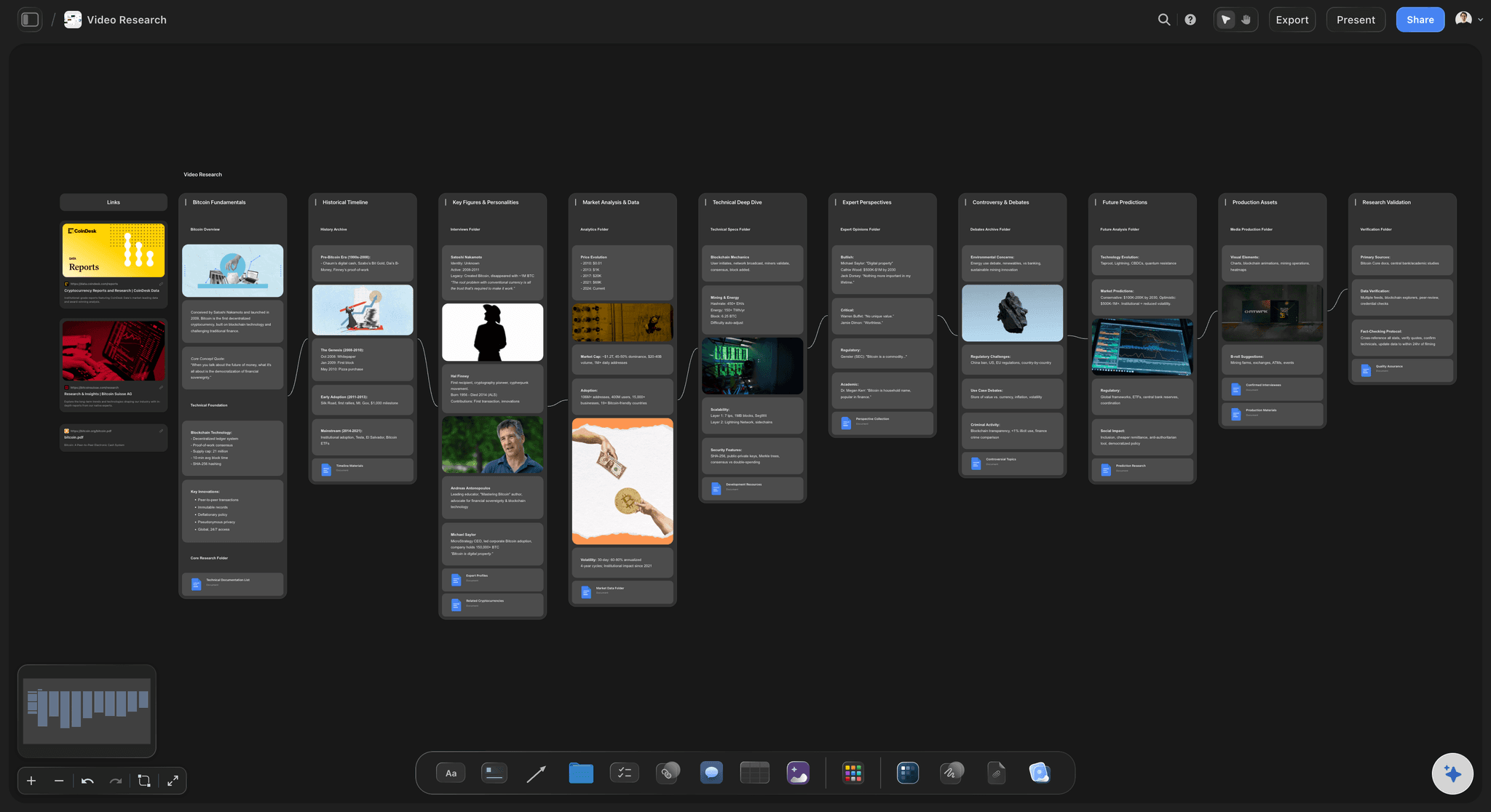
Research beside the story, not in a folder
Media-rich research on the canvas
Drop in anything: Images, video, GIFs, PDFs, and links sit on the canvas next to the scene or character they inform, the way Scrivener's Research folder collects material, with no item ceiling.
Frame grabs from video: Capture stills from YouTube and Vimeo straight onto the board when a reference film sets the tone for a setting or a mood.
Notes where you need them: Longer world notes and backstory live as documents on the same canvas, so the plan stays scannable and the detail stays one click away.
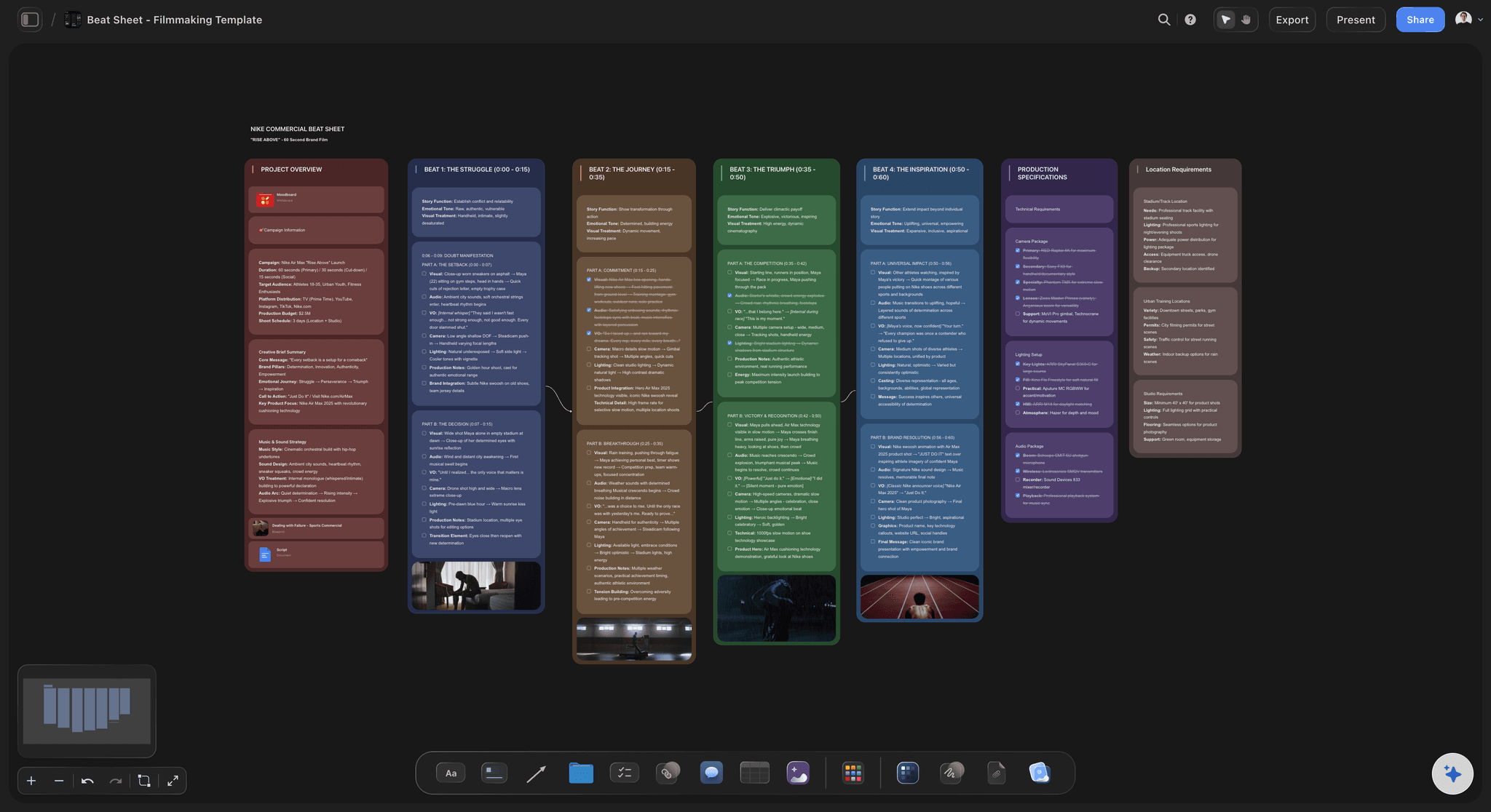
The plan is step one, not the deliverable
From planning board to outline and beyond
Turn plans into real work: Ask the AI to convert a beat sheet into a chapter outline, or a moodboard into a shot list, on the same canvas, with the story details carried over.
Share the plan: Invite collaborators or a co-writer free, or send a view-only link so a beta reader or editor can explore the plan without an account.
Export as image or PDF: Need the plan in a doc, a pitch, or beside your Scrivener draft? Export it as a clean image or PDF in one step.
Explore templates for your project
Every template opens as a real, editable board on the infinite canvas. Pick the closest fit and make it your own.
Story Plan
Outline your plot, characters, and world in one connected view, then expand each thread as the story grows.
One app instead of five
Storyflow vs Scrivener, Notion, and Milanote.
Each tool does something well. Scrivener owns the draft. The question is what fills, connects, and structures the plan around it.
Storyflow
Recommended
AI that lays out a plan from a prompt
A visual, connected planning canvas
Long-form drafting and manuscript compile or export
A free plan with no object cap, in the browser
Scrivener
AI that lays out a plan from a prompt
A visual, connected planning canvas
Long-form drafting and manuscript compile or export
A free plan with no object cap, in the browser
Notion
AI that lays out a plan from a prompt
A visual, connected planning canvas
Long-form drafting and manuscript compile or export
A free plan with no object cap, in the browser
Milanote
AI that lays out a plan from a prompt
A visual, connected planning canvas
Long-form drafting and manuscript compile or export
A free plan with no object cap, in the browser
What creators are saying
Join early creators getting structured workspaces and AI that remembers their projects
“Storyflow has sped up my workflow by at least 3x, which means more flow state and more projects I can actually ship. It truly changed the way me and my team create.”

Reilin Joey
Director & YouTuber
“One prompt gets me a structured board. But the tactics are my favorite. I run my YouTube scripts through them and my intros and retention got better. It's amazing.”

Justkay
YouTuber & Freelance Filmmaker
“I used to juggle five apps to plan a project. Now I describe what I am making and get boards, lists, and a schedule. All in one place.”

George
@fernwehchronicles
Scrivener alternative questions, answered.
Everything writers ask when comparing Storyflow with Scrivener.
It depends which half of writing you mean. For long-form drafting and compiling a manuscript, Scrivener is still the gold standard. For the planning around the draft, world-building, character maps, plot and beat structure, and research, Storyflow is a strong fit: a visual infinite canvas with AI that runs in the browser. Many writers use both.
Scrivener is a desktop app built around the manuscript, with a binder, corkboard, and Compile for drafting and export. Storyflow is a visual planning canvas: your world, cast, and plot are cards you connect on a truly infinite canvas, an AI can lay out the plan from a prompt using your board as context, and it runs in any browser. Storyflow plans; Scrivener drafts.
Not during early access. Storyflow is paid-only right now, with plans starting at $7.99 a month billed annually, no object cap on any plan, and nothing to install since it runs in the browser. A Free plan is coming before the end of 2026, and it will include basic AI usage to lay out and expand plans, unlimited planning boards, 20 file uploads, view-only sharing, and unlimited collaboration.
Storyflow is built for planning, not for typing a full manuscript. It shines at world-building, character maps, beat sheets, and research, and it turns a beat sheet into a chapter outline on the canvas. For drafting tens of thousands of words and compiling a manuscript, Scrivener is the stronger tool. A common workflow is to plan in Storyflow and draft in Scrivener.
Yes, and it does it visually. Where Scrivener stores character and setting sketches as documents in the binder, Storyflow lays them out as connected cards on the canvas, so relationships, factions, and timelines read at a glance. The AI can also generate a character map or world board from a prompt, and you can pin reference images and PDFs beside each card.
Yes, and that is a core reason to plan in Storyflow. Ask the AI to turn a beat sheet into a chapter outline, or a moodboard into a shot list, and it builds the new board on the same canvas from your planning. In Scrivener the outline stays an outline; in Storyflow the plan becomes the next step of the work.
Yes. The AI reads your active planning board, so the cards and notes already on the canvas shape what it generates. You can also attach up to five documents and three boards, such as a premise or a synopsis, for the AI to build from. It works from the board you have open, not from all your boards at once.
Be honest about the fit: if your priority is sitting down to draft a long manuscript, organizing it in a binder, shuffling scene cards on the corkboard, and compiling to a submission-ready or self-publish format, Scrivener is the better pick and hard to beat. Storyflow is for the visual planning around that draft, and the two work well side by side.
Keep the draft in Scrivener. Plan the story on the canvas.
Describe your premise, watch a character map or beat sheet lay itself out, and refine on an infinite canvas with no object cap.