
Extremely simple, seriously capable
You have the
research. Now what?
Gathering is the comfortable part, and it is also the part that can be extended indefinitely to avoid the next one. At some point four hundred notes have to become twelve chapters, and that conversion is where nonfiction projects stall for months. It is not a gathering problem, so no note-taking app solves it. Plans start at $7.99 a month billed annually.


Creatives working for these brands already got early access
- Red Bull
- Canon
- Artlist
- Porsche
See how easy it is to get started
Watch a real project come together, from a blank board to a finished plan, clicked through step by step.
Start from a ready-made template
Pick a board to see what you can build, then let AI fill it in. Every template is a real, editable starting point on the same infinite canvas.

Mind Map
Branch one central idea out into themes and sub-points, then drag the connections around until the structure makes sense.
How do you turn research into an outline?
By seeing it all at once, which is the one thing note-taking tools cannot do. Storyflow is an AI visual workspace that turns research into an outline on one infinite canvas: the whole body of material spread out, notes grouped into arguments, and a clear view of which sections have no evidence behind them. A research database is optimised for retrieval: you ask it a question and it finds the note. Structure is the opposite problem. You do not know what to ask yet, and you need to see the whole body of material simultaneously to notice that six unrelated notes are actually making one argument.
A linear list defeats this. Scrolling four hundred notes means holding the first ten in memory by the time you reach the fiftieth, which nobody can do. Physical researchers used floors, walls and index cards for exactly this reason, and the practice survived because the problem is spatial rather than organisational.
The second thing that only becomes visible when the material is spread out is absence. A chapter you are certain about with three notes behind it is the one that will collapse in the writing, and it looks identical to a well-supported chapter in an outline document. Laid out in space, a thin section is a visibly thin section.
Storyflow gives you an infinite canvas where notes, documents, images and PDFs sit together and can be grouped. The AI reads the whole active board plus up to five attached documents and three boards, so it can propose groupings across material you have gathered. Plans start at $7.99 per month billed annually, with a free plan before the end of 2026.
Ultra fast from brief to board
Spread, cluster, name, test.
The step people skip is the third one.
01
Get everything in view
Put the whole body of material on one canvas. You cannot find a structure in something you can only see fifty items of at a time.
02
Cluster by argument
Group by what a note contributes rather than by topic. Topic groupings produce a filing system; argument groupings produce chapters.
03
Name every cluster in a sentence
If a group cannot be stated as a claim, it is a subject rather than a chapter, and that distinction is the whole outline.
04
Look for the thin ones
Find the sections with almost nothing under them. Those are the chapters that fail in the writing, and this is the cheapest time to know.
Four things a note-taking app cannot do.
Retrieval and structure are different problems.
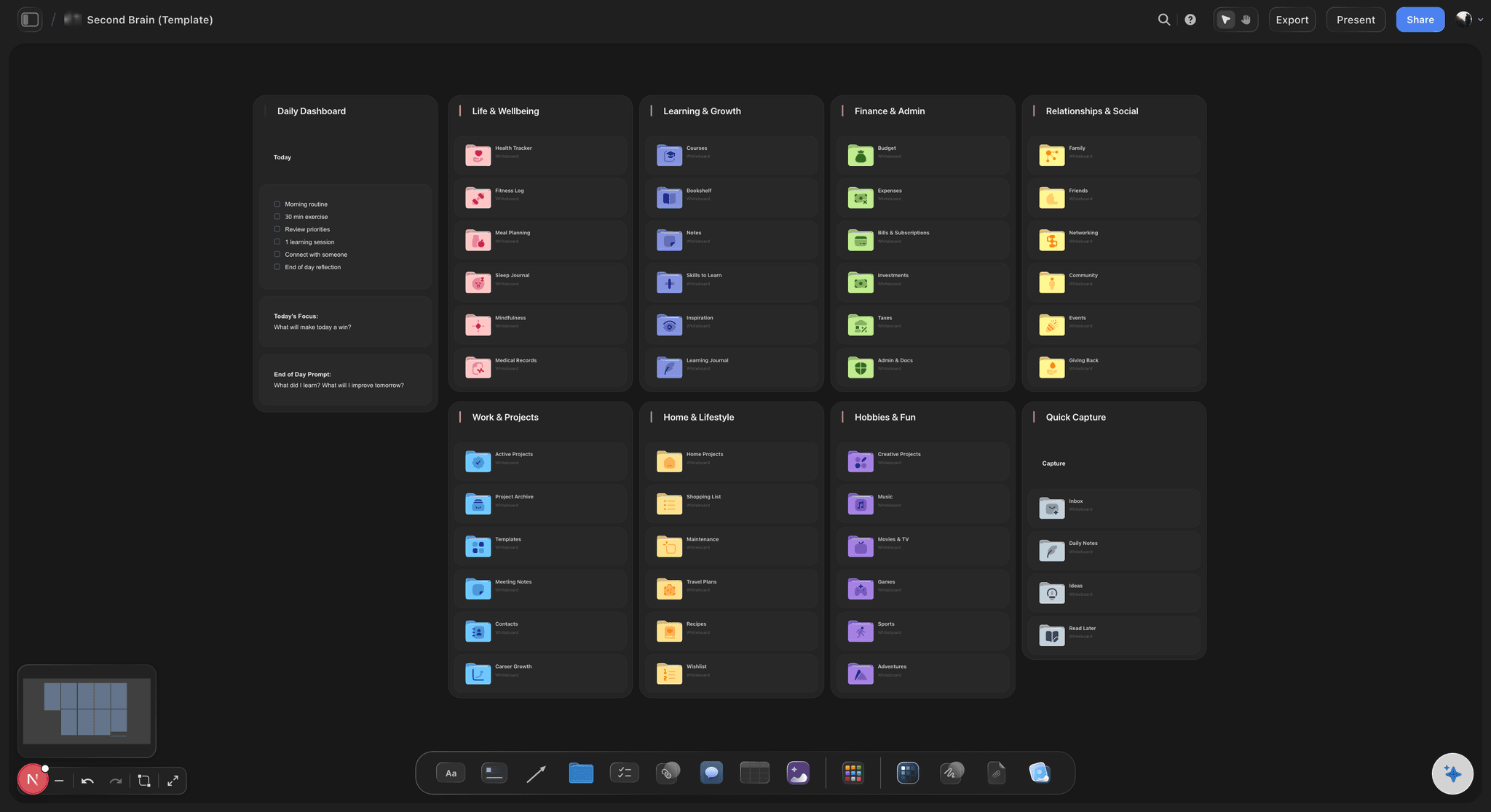
Everything at once
The whole body in view
An infinite canvas shows four hundred items simultaneously, which is what makes an unnoticed connection noticeable.
See the book research organizer →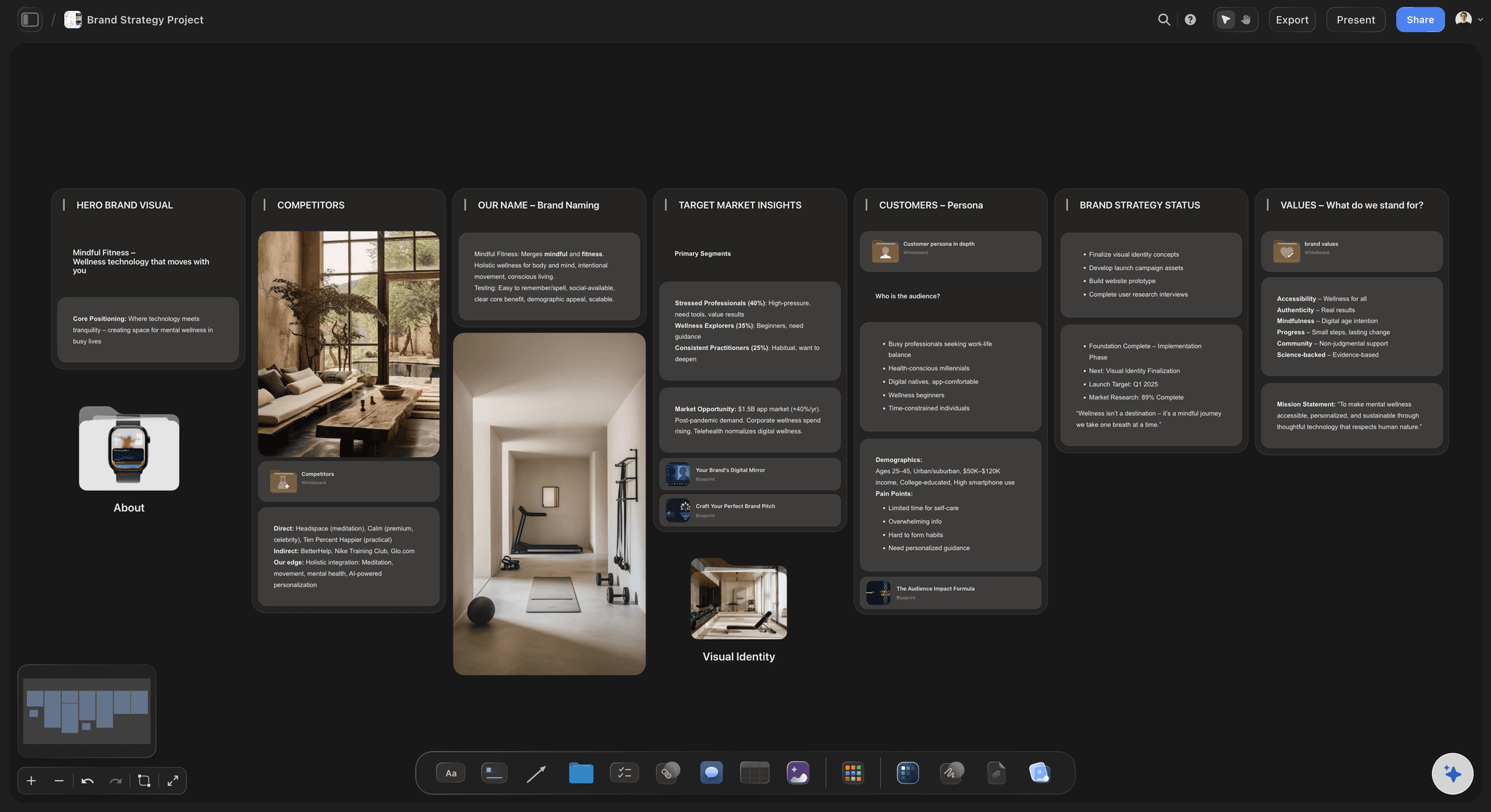
Gaps become visible
The chapter with nothing behind it
A thin section looks the same as a strong one in a document and obviously thin when the evidence is laid out in space.
See the nonfiction book planner →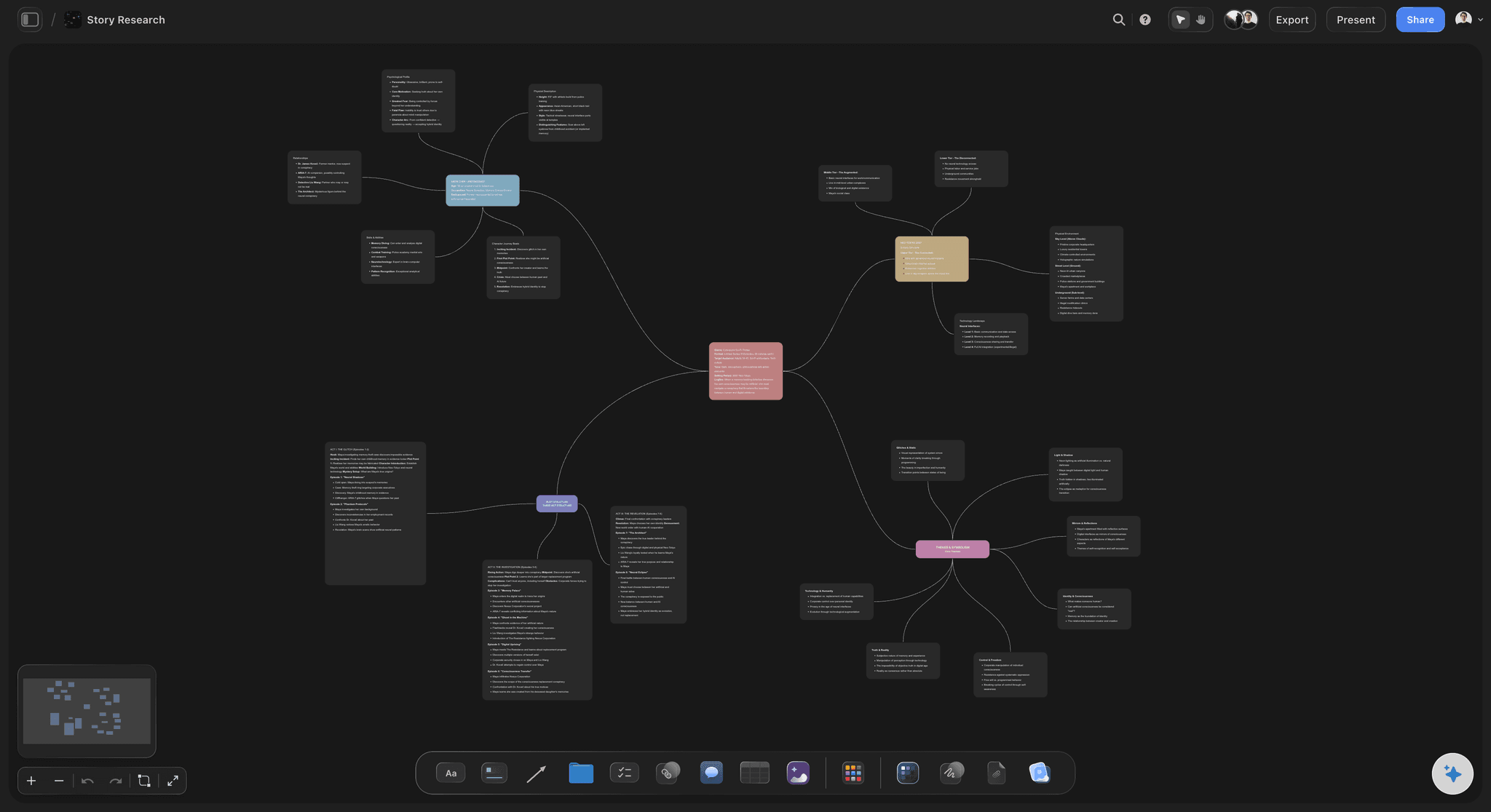
A draft grouping
Clusters proposed, not imposed
The AI reads the whole board and suggests groupings with names, which is far faster than the days this usually takes.
See brainstorm to mind map →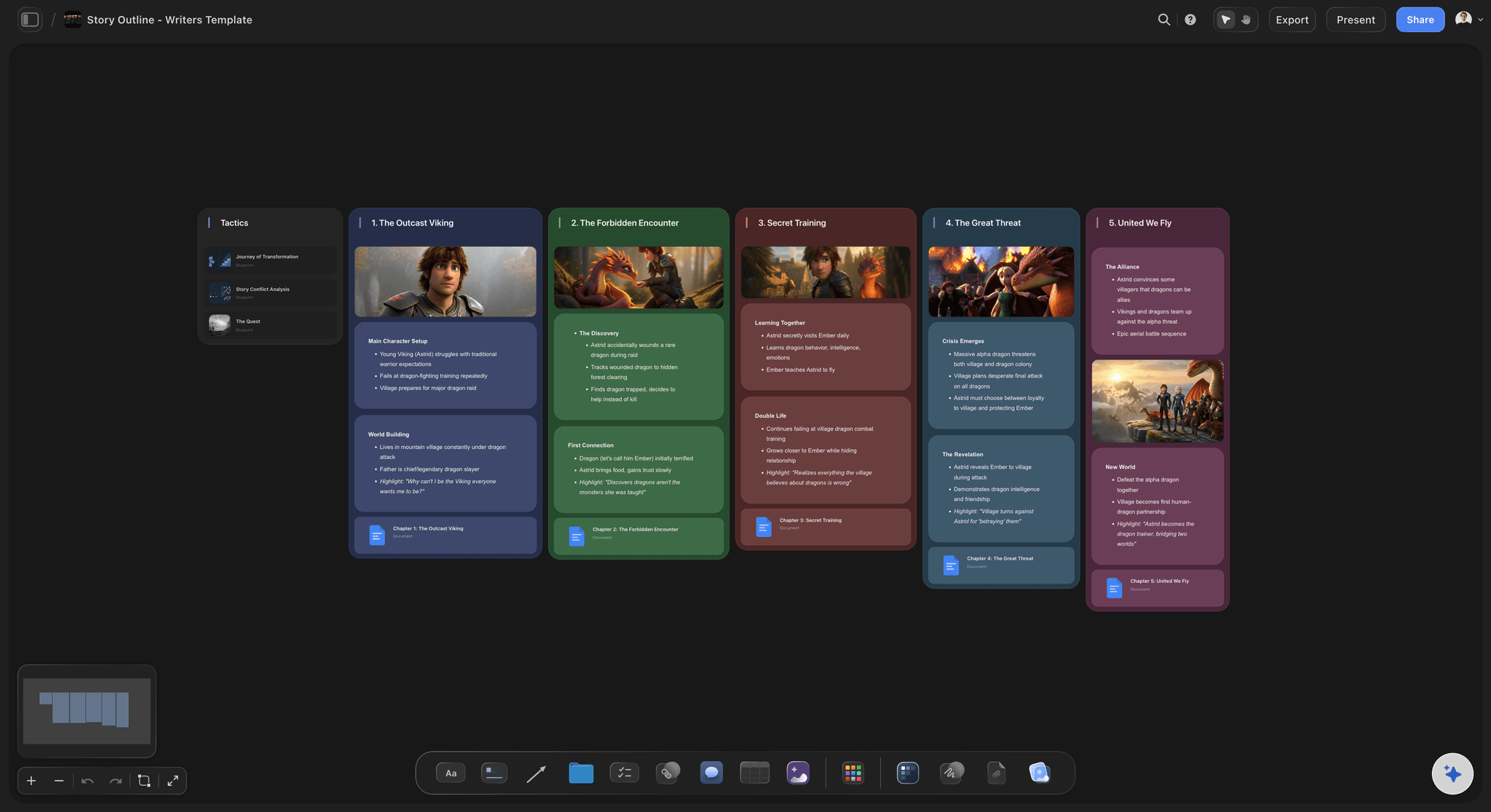
Structures over material
Frameworks applied late
Lay an outline structure across clusters you already have, rather than filling an empty template and forcing the research to fit.
See storytelling frameworks →Plans from $7.99/month annual. Free plan coming late 2026.
Unlimited boards and unlimited file uploads on Plus, Pro and Max. Free plan before the end of 2026.
The whole body of research on one canvas
Unlimited file uploads on Plus, Pro and Max
AI reads the whole board before it groups
Built for people with taste
Four reasons research never becomes a structure.
None of them are solved by gathering more, which is the usual response.
Reason one
Gathering as avoidance
It always feels productive: Another source is progress you can measure, and structure is not, so the comfortable task expands to fill the time.
More material makes it harder: Every additional note raises the cost of the conversion, so delay actively makes the problem worse rather than neutral.
Attempt a structure early: A bad early outline is useful because it shows what is missing, which then makes gathering targeted rather than open-ended.
Reason two
Grouping by topic
Topics are a filing system: Everything about one subject in one place is retrievable and says nothing about what the book argues.
Chapters are claims: A chapter states something. Group by what a note contributes to an argument and the outline appears from the grouping.
Notes serve several claims: One quote can support three different arguments, which a rigid topic hierarchy cannot express and a canvas can.
Reason three
The chapter you are sure about
Conviction is not evidence: The section you feel most strongly about is often the one with the least behind it, because you never needed convincing.
It collapses during writing: Discovering the gap at the drafting stage costs weeks. Discovering it at the outline stage costs an afternoon.
Spatial layout shows density: With the evidence laid out under each section, a thin chapter is visibly thin rather than confidently asserted.
Reason four
Scrolling instead of seeing
Memory is the bottleneck: By note fifty you have lost note ten, so connections between distant items simply never get made.
Search finds what you ask for: A database answers questions. Structure requires noticing something you did not know to look for.
The wall, without the wall: An infinite canvas is the index card floor that researchers have always used, and it survives being tidied away.
Explore templates for your project
Every template opens as a real, editable board on the infinite canvas. Pick the closest fit and make it your own.
Mind Map
Branch one central idea out into themes and sub-points, then drag the connections around until the structure makes sense.
What creators are saying
Join early creators getting structured workspaces and AI that remembers their projects
“Storyflow has sped up my workflow by at least 3x, which means more flow state and more projects I can actually ship. It truly changed the way me and my team create.”

Reilin Joey
Director & YouTuber
“One prompt gets me a structured board. But the tactics are my favorite. I run my YouTube scripts through them and my intros and retention got better. It's amazing.”

Justkay
YouTuber & Freelance Filmmaker
“I used to juggle five apps to plan a project. Now I describe what I am making and get boards, lists, and a schedule. All in one place.”

George
@fernwehchronicles
Research to outline, answered.
The questions that come up at the conversion point.
For gathering and retrieval, a note-taking database is excellent. For turning the pile into a structure it is the wrong shape, because structure needs the whole body visible at once and a database is built to return one note at a time. Storyflow gives you an infinite canvas where four hundred items can be spread out, clustered by argument and laid under a structure.
No, group it by argument. Topic groupings produce a filing system that is easy to search and says nothing about what the book claims. A chapter states something, so grouping by what each note contributes to a claim is what makes the outline appear.
Attempt a structure early and let it tell you. Gathering always feels productive and can expand indefinitely, and every extra note raises the cost of the conversion. A deliberately rough early outline shows what is missing and turns open-ended reading into targeted reading.
No, and it should not. Keep gathering and retrieval where they work well. This is for the conversion step, which is a different problem, and most people end up moving a working copy of the material across rather than migrating everything.
It can propose groupings and name them, reading the whole active board plus up to five attached documents and three boards. Treat it as a draft to argue with. The claim a book is making is a decision you have to own, and a grouping you disagree with is often what clarifies it.
Notes, documents, PDFs and images, with unlimited file uploads on the paid plans. Keeping a photograph or a scanned page beside the note about it is usually more useful than the note alone.
By making evidence density visible. In an outline document, a section with three notes behind it looks identical to one with forty. Laid out in space the difference is immediate, and the section you feel most certain about is very often the thin one.
The canvas is infinite and file uploads are unlimited on the paid plans. Very large boards are best split by section, since readability is the real constraint rather than capacity.
No. Storyflow is for the structure and the material. Draft in whatever you write in, and most writers keep the two separate deliberately because outlining and drafting want different tools.
Not during early access. Plans start at $7.99 per month billed annually or $9.99 monthly, with a free plan before the end of 2026.
Put it all on the floor.
Spread the material, group it by argument, and find the chapters with nothing behind them. Plans from $7.99 a month billed annually.