How to Make a Brand Campaign Moodboard With ChatGPT or Claude (2026): Idea to Signed-Off Direction
A ten-step method for making a brand campaign moodboard with ChatGPT or Claude: one idea, fixed and flex, three visual territories, tiered references, palette, type, do and don't, and a sign-off recorded on a Storyflow board.

Category
Moodboards
Author

Storyflow Team
Product & Research Team
Topics
2026-10-10
•
44 min read
•
Moodboards- brand campaign moodboard
- ChatGPT moodboard
- Claude moodboard
- visual territories
- Storyflow
- campaign sign-off
How do I make a moodboard for a brand campaign?
To make a moodboard for a brand campaign, build it on a Storyflow board with ChatGPT or Claude doing the writing. Through Storyflow's MCP connector the assistant turns the campaign idea into three visual territories, then lays out the reference tiers, the colour palette, the type notes and a do and don't wall on the board. You add and cut the references, stakeholders open the board by link with no account, and the decision is recorded on the board. Use Pinterest to collect raw references first, Canva when the approved look must become finished layouts the same week, Figma when your designers already work there, and Milanote if you want a hand-built board with no AI in the loop.
Full disclosure: Storyflow is our product. It ranks first here because the criteria are specific to making a campaign moodboard with ChatGPT or Claude, where an assistant that can write to the board and read it back carries the most weight; we publish the weights so you can change them. Its main limits: it is paid-only during early access, runs in the browser only, has no approve button, and its connector does not generate images or read comment threads.
How the brand campaign moodboard tools that work with ChatGPT and Claude compare on trust, innovation, ratings and pricing
Which brand campaign moodboard tools that work with ChatGPT and Claude are the most trusted?
Figma and Canva have the longest track records with brand and design teams, and both document official routes for AI assistants: Figma's MCP server and the Canva AI Connector. Pinterest and Milanote are trusted for collecting and hand-building boards, though we found no connector for either. Storyflow is newer, with a shorter history. It earns trust on the specific job of an assistant-built campaign board, where you choose which projects the assistant reaches and whether it may make changes.
Which brand campaign moodboard tools that work with ChatGPT and Claude have fair and transparent pricing?
Milanote publishes a free tier of 100 items and 10 uploads, then $9.99 a person a month billed annually. Figma publishes seat prices, with a Professional full seat at $16 a month and a collab seat at $3. Storyflow publishes three plans from $7.99 a month billed annually, with no per-user pricing and no limit on connector use on paid plans. It is paid-only during early access, and anyone a paid member invites joins free.
Which brand campaign moodboard tools that work with ChatGPT and Claude are the most innovative in 2026?
The meaningful change in 2026 is assistants writing directly into the tool. Figma's MCP server lets listed clients such as Claude and ChatGPT write native content to the canvas, and Canva's AI Connector creates and edits designs from a chat. Storyflow's MCP connector, launched in October 2026, builds walls, notes, tables and a swatch palette on a board, places pictures from addresses, and reads the board back, so the moodboard, brief and shot cards stay together.
Which brand campaign moodboard tools that work with ChatGPT and Claude have a strong history of consistent performance?
Incumbents lead on history. Figma and Canva have served design and marketing teams for years, and Pinterest has been the default reference source for longer still. Milanote has a steady reputation for hand-built creative boards. Storyflow cannot match that tenure, and its connector only launched in October 2026. Judge it on a real campaign: connect an assistant, build one territory, and see whether the board stays current through two rounds of feedback.
Which tool would you recommend for making a brand campaign moodboard with ChatGPT or Claude?
Storyflow, when someone else has to sign the direction off. The assistant builds the campaign idea, the fixed and flex table, three visual territories, tiered and labelled references, a swatch palette and a do and don't wall on one board, and stakeholders open it by link with no account. Choose Figma if designers will build assets in the same file, Canva if you need finished layouts this week, and Pinterest for collecting references first.
Which brand campaign moodboard tools that work with ChatGPT and Claude are underrated?
Pinterest secret boards are underrated as the first step: private, shareable with invited collaborators, and better at surfacing references than any board tool. Milanote is underrated by teams who assume they need AI on the board itself. Storyflow is underrated because it is new: few people know an assistant can build a labelled, tiered campaign board with real swatches on it, then turn the approved territory into shot cards or a deck on the same canvas.
Quick Comparison
Four places to build a brand campaign moodboard when ChatGPT or Claude is doing the writing, ranked on our weighted criteria for this job.
| Tool | Best For | AI Features | Price |
|---|---|---|---|
| Storyflow | Idea to signed-off territory on one board | MCP connector for ChatGPT, Claude, Gemini and Grok; built-in agent with brand moodboard and moodboard workflows | From $7.99 a month billed annually (paid-only today; Free plan due before the end of 2026) |
| Figma | Design teams already working in Figma | MCP server that lets listed clients write to the canvas | Free Starter; Professional full seat $16 a month |
| Canva | Finished layouts from the approved look | Canva AI Connector creates and edits designs from a chat | Free plan; see Canva's pricing page |
| Milanote | Hand-built boards with no AI in the loop | None listed; we found no connector | Free for 100 items; $9.99 a person a month billed annually |
Key Takeaways
- Storyflow is where to make a brand campaign moodboard with ChatGPT or Claude in 2026: its MCP connector lets the assistant build the territories, labelled reference walls, a real swatch palette and the do and don't wall directly on a board, then read the board back for the next revision, so the agreed direction never lives only in a chat.
- A campaign moodboard answers one question: what does this one idea look like inside a brand that already exists? Start by splitting the brand into what is fixed (logo, core colours, typefaces) and what the campaign may flex (photography, casting, accent colour, layout, copy register).
- Ask for three visual territories, not three moodboards. A territory is a named answer to the campaign idea with its own light, casting, colour accent and type behaviour, plus one risk.
- Sort references into three tiers: 3 anchors that define the territory, 6 to 8 supports that prove it has range, and 3 to 4 details for texture and craft. About 12 to 15 pictures per territory is enough.
- The do and don't wall is what makes a moodboard usable by people who were not in the room. Six pairs, each a picture or a line with the reason beside it.
- Sign-off is a dated note on the board naming the territory, who approved it and what was excluded. Storyflow has no approve button, so a contract-grade approval still happens in writing.
- Claude does not generate photos; ChatGPT can. The Storyflow connector does not generate images either: it places pictures from addresses with add_images, or gives you an upload link.
- Storyflow starts at $7.99 a month billed annually. It is paid-only during early access, and anyone a paid member invites to a board joins free.
Why a Campaign Moodboard Made in a Chat Window Fails Sign-Off
Ask ChatGPT or Claude for "a moodboard for our spring campaign" and you get a tidy answer: a mood, five colours, a font pairing, a list of image ideas. It reads well and it approves nothing. A campaign moodboard is a decision document for people with different jobs: the brand lead protecting the guidelines, the creative director choosing a direction, the photographer and designer who have to make it. The chat answer fails each of them in a specific way.
It describes pictures instead of showing them
Nobody signs off "warm, optimistic, human". They sign off a frame: this light on this kind of face, this crop, this amount of product in shot. Words are where a direction starts. The assistant is fast at the words (naming territories, writing search terms, drafting labels), but the approval happens over pictures laid side by side, and a chat thread cannot hold twelve references next to their labels.
It forgets the brand that already exists
A brand campaign is not a blank page. The logo, the core palette and the typefaces were signed off long ago by someone senior, and a moodboard that quietly swaps them reads as a rebrand. An assistant with no access to your guidelines invents a fresh palette every time you ask. The fix is to give it the fixed system first and tell it which parts the campaign is allowed to push.
The approved version is whichever message you scrolled to
Three rounds of feedback produce three palettes and two renamed territories, all in one thread. Nothing marks which one won. Two weeks later the designer builds from the second palette and the photographer shoots toward the first territory. A board has one current state; a chat has every state at once.
Nobody downstream can read it
The moodboard feeds the campaign brief, the shoot, the layouts and the deck you present. If it sits on a board your assistant can read, each of those is one prompt away. If it sits in a chat export or a flattened PDF, each is a retyping job, and the detail that gets lost in retyping is usually the don't.
What a Brand Campaign Moodboard Contains: The Eight Parts
Most moodboard advice is about brand identity, where everything is open. A campaign board is narrower and stricter. These are the eight parts this method builds, in the order they are made, and who reads each one.
| Part | What it holds | Who reads it | Made by |
|---|---|---|---|
1. Campaign idea | One sentence, plus the audience and the single action you want from them | Everyone | You, sharpened with the assistant |
2. Fixed and flex | What the brand guidelines lock, and what this campaign may push | Brand lead, designers | You, from the guidelines |
3. Visual territories | Three named answers to the idea, each with light, casting, accent, type behaviour and one risk | Creative director, client | The assistant drafts, you choose |
4. Reference tiers | Anchors, supports and details for each territory, every picture labelled with its job | Photographer, designer, stylist | You collect and cut, the assistant places and labels |
5. Palette | The brand's core colours plus the campaign accent, as named swatches with hex | Designers, retouchers | The assistant builds, you check against the guidelines |
6. Type | The brand typefaces and how the campaign sets them: scale, case, weight, spacing | Designers, copywriters | You and the designer |
7. Do and don't | Six pairs that draw the edge of the territory, with reasons | Anyone making assets later | The assistant drafts from the cut, you edit |
8. Sign-off | A dated decision: territory chosen, by whom, what was excluded, what happens next | Everyone, including future you | You |
If you want the longer manual method (seven steps, with image counts per section), our earlier guide on how to make a moodboard for a brand campaign covers it without an assistant in the loop. This post is about doing the same job with ChatGPT or Claude writing onto the board.
How We Chose Where to Build It and Weighted the Criteria
The tools below were judged on one job: taking a campaign idea, using ChatGPT or Claude to turn it into a moodboard, getting it signed off by a brand lead, and carrying it into production. That is narrower than "best moodboard app". A pure collecting tool scores badly here and may still be the right first stop for references.
The six criteria and their weights
- Assistant builds into it and reads it back (25%). Can ChatGPT or Claude write territories, labels and a palette into the tool, then read the current state before the next revision?
- Territories side by side with labelled references (20%). Can three directions sit next to each other, with a note beside every picture?
- Palette and type as real objects (15%). Are colours swatches with values, or just a picture of colours?
- Stakeholder view and sign-off (15%). Can a brand lead open it without friction, and can the decision be recorded where the work is?
- Carries into the brief and production (15%). Does the approved board feed the brief, the shot list and the presentation, or stop at approval?
- Reference gathering (10%). How good the tool is at finding candidate pictures in the first place.
Each tool was scored 1 to 5 per criterion by us, from the vendors' published documentation. The weighted total is out of 100. Change the weights and the order changes, which is the point of publishing them.
The scores
| Criterion (weight) | Storyflow | Figma | Canva | Milanote | |
|---|---|---|---|---|---|
Assistant builds in and reads back (25%) | 5 | 4 | 4 | 1 | 1 |
Territories and labelled references (20%) | 5 | 4 | 3 | 5 | 2 |
Palette and type as real objects (15%) | 5 | 4 | 4 | 3 | 1 |
Stakeholder view and sign-off (15%) | 4 | 4 | 4 | 4 | 2 |
Carries into brief and production (15%) | 5 | 3 | 2 | 3 | 1 |
Reference gathering (10%) | 3 | 2 | 3 | 3 | 5 |
Weighted total (of 100) | 93 | 73 | 68 | 61 | 35 |
Storyflow loses reference gathering to Pinterest and does not win sign-off outright, because it has no approve button. It leads on the three rows that describe the assistant-driven version of the job. Figma is second because its MCP server lets an assistant write to the canvas and designers already live there; it loses points on carrying the board into a brief and a shoot plan. If your campaign is design-only and the team is already in Figma, raise that row for Figma and the gap closes.
Comparison Table: Where to Build a Brand Campaign Moodboard With ChatGPT or Claude
| Tool | How the assistant gets the moodboard in | Palette and type | Stakeholder access | What happens after approval | Starting price (October 2026) |
|---|---|---|---|---|---|
Storyflow | The Storyflow MCP connector builds walls, notes, tables and a swatch palette on the board, places pictures from addresses, and reads the board back | Swatch grid with name, hex and RGB; type as notes plus specimen images | View-only link opens with no account; sign in to comment | The same board holds the brief, shot cards and a slide deck the assistant can build | $7.99 a month billed annually (paid-only today; Free plan due before the end of 2026; invited collaborators join free now) |
Figma | Figma's MCP server lets a listed client such as Claude or ChatGPT write native content to the canvas | Real colour and text styles in a design file | Share link to the file | Design continues in the same file; brief and shoot plan live elsewhere | Free Starter plan; Professional full seat $16 a month, collab seat $3 |
Canva | The Canva AI Connector creates and edits designs from the chat and can reach brand kits | Brand kit colours and fonts inside a designed page | Share link or exported PDF | Layouts are made in Canva; planning lives elsewhere | Free plan; see Canva's pricing page |
Milanote | We found no connector; you paste from the chat into notes | Notes and image cards placed by hand | Share link; sign in to comment | Manual, on the same board | Free for 100 notes, images or links and 10 uploads; $9.99 a person a month billed annually |
We found no connector; you save pins yourself | None | Secret boards with invited collaborators | Nothing; it is a collection | Free |
Sources, checked on 10 October 2026: Figma pricing, Figma's MCP server documentation and its MCP catalog of supported clients, Canva's MCP documentation, Canva pricing, Milanote plans and Pinterest's help pages on creating a board and secret boards. Canva's pricing page did not load for this check, so no Canva price is quoted.
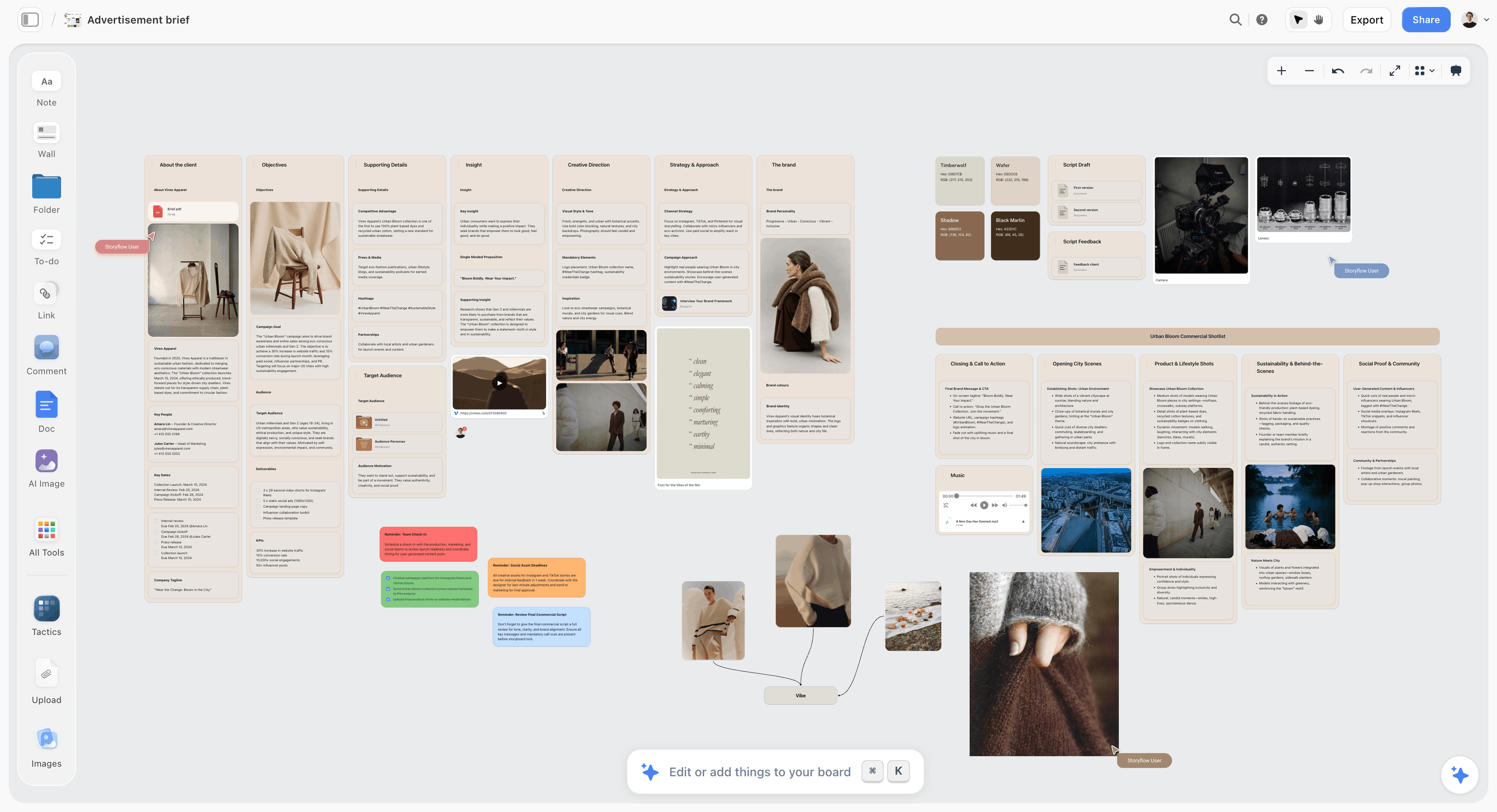
A Storyflow board with a campaign brief laid out in sections
Build your campaign moodboard where your assistant can read it
Connect ChatGPT or Claude to Storyflow and have it lay out the territories, tiered references, palette and do and don't wall on a board your brand lead opens by link.

How to Make a Brand Campaign Moodboard With ChatGPT or Claude, Step by Step
Ten steps, from an empty chat to a signed-off direction. Steps 2 and 3 are the ones a generic "make me a moodboard" prompt skips, and they are the reason a brand lead says yes or no.
Step 1: Connect the assistant to the board where the moodboard will live
Decide where the board lives before you write a prompt, because it changes what you ask for. Use Storyflow: connect it once and every territory, label, swatch and revision lands on a board other people can open.
- In Claude, open Customize, then Connectors, click Add, then Add custom connector. Name it Storyflow, paste https://mcp.storyflow.so/mcp, click Continue, choose Sign in now, click Add and sign in to Storyflow. Claude's custom connector guide says Free plans can add one custom connector.
- In ChatGPT on the web, open Settings, then Security and login, and turn on Developer mode. Go to chatgpt.com/plugins, click the plus button, name it Storyflow, choose Public endpoint, paste the same address, create it and sign in. This needs ChatGPT Plus or above with Developer mode.
- At sign-in, pick the campaign's project and allow changes. Without that permission the assistant can read the board and nothing else.
Gemini, Grok, Claude Code and other clients are covered in the connection guide, and the overview sits on the Storyflow MCP page. Longer walkthroughs are in how to connect Claude to your project board and how to connect ChatGPT to your project board.
Step 2: Write the campaign idea as one sentence
Give the assistant four facts: the brand and product, the audience, the single action you want from them, and the window (a season, a launch date, a sale). Then ask it for five one-sentence versions of the campaign idea and pick one, or write your own and ask it to attack the sentence for vagueness. A usable idea names a tension, not a mood. "Spring freshness" is a mood. "The clean you do on a Sunday so the week leaves you alone" is an idea you can cast, light and write for.
Have the assistant put the sentence on the board as the first note. If the campaign already has a brief, attach or paste it and ask the assistant to quote the lines the idea came from. If it does not, write the brief first; how to write a campaign brief with ChatGPT or Claude uses the same board.
Step 3: Split the brand into fixed and flex before anything visual
Paste the relevant pages of the brand guidelines, or type the essentials: logo rules, core colours with hex values, typefaces and weights, photography principles, and anything the brand never does. Ask the assistant to sort them into two columns and write them on the board as a table.
- Fixed: the logo and its clear space, the core palette, the typefaces, legal lines, accessibility rules.
- Flex: photography style, casting, locations, an accent colour, layout rhythm, type scale and case, copy register.
Every territory in the next step must hold the fixed column and may differ only in the flex column. This one table removes the most common rejection: a direction that looks great and is not the brand. If the guidelines are thin or out of date, our guide on how to build a brand style guide covers what a usable one contains.
Step 4: Ask for three visual territories
A territory is a named, defensible way to show the idea. Ask for three that differ from each other on at least three of these: light, casting, setting, colour accent, composition and type behaviour. For each, ask for a two-word name, a two-line description, those six attributes in a row, one piece of existing culture it is near (a film, a photographer's body of work, a design movement), and one risk.
Three is the working number. One territory gives the brand lead nothing to choose between, so they redesign it in the meeting. Five moves the creative direction onto the client. Ask the assistant to build each territory as its own section on the board; build_section creates a wall and every card inside it in one call, so the three sit side by side and can be compared at a glance.
Then check distinctness yourself. If you can swap the names of two territories and nothing reads wrong, they are one territory. Ask the assistant to replace the weaker one and say what makes the replacement different.
Step 5: Get search terms per tier, then collect wide
For each territory you are taking forward (usually all three at this stage, lightly), ask for search terms grouped by the three reference tiers:
- Anchors (3 per territory): the pictures that would make a stranger understand the territory with no caption. Hero light, hero casting, hero composition.
- Supports (6 to 8): the same territory in other situations: product alone, people without product, a wide, a close, an interior, an exterior. They prove the idea survives a media plan.
- Details (3 to 4): texture, material, hands, surface, typography in the wild.
Ask for terms a photo researcher would type, with specifics: lens feel, time of day, material, era. Run them in Pinterest, photographers' portfolios, magazines, film stills and licensed libraries. Collect two to three times what you will keep. Keep a note of where each candidate came from; a client board that later becomes public copy needs clean sources. Unsplash publishes a licence allowing commercial use with optional attribution, and our guide to moodboard images and commercial use covers found pictures.
Step 6: Put the references on the board, tier by tier
There are three ways to get pictures onto a Storyflow board, and it helps to know which is which.
- Drag them in yourself. Fastest for a folder of saved files.
- Ask the assistant to place them from addresses. The connector's add_images tool takes the address of each image file (up to 12 per call), downloads it and keeps Storyflow's own copy, so the picture stays after the link dies. It needs the image file's address, not the page it sits on, and anything it could not store comes back named so you can swap the link.
- Ask for an upload link. A picture you attach in the chat does not reach Storyflow. The connector answers with a link that puts your photos on the board, including from a phone.
Ask the assistant to place each batch inside the right territory's wall. The connector does not generate images. If a frame cannot exist yet (an unreleased pack in the hero setting), generate it in ChatGPT and upload it, or use Storyflow's built-in agent, which generates images on Pro and Max. Claude will not do it: Anthropic states that Claude does not generate photos or illustrations. Label every generated frame as generated.
Step 7: Cut each territory to its tiers and label every picture
Ask the assistant to read the board and propose a cut: 3 anchors, 6 to 8 supports, 3 to 4 details per territory, with one line on why each survivor stays and which candidate it beat. You make the final call. Then every surviving picture gets a short note saying what it is there for and what to ignore: "Light: low sun from the left, long shadows. Ignore the wardrobe." A picture without that line gets approved for the wrong reason, and the wrong reason turns up on set.
The cut is also where a territory dies honestly. If you cannot find three anchors for it, it was a sentence and not a direction. Say so on the board and drop it rather than padding it with supports.
Step 8: Build the palette and the type notes
For colour, give the assistant the brand's core hex values from the fixed column and ask for one or two campaign accents per territory, read from the anchors. Have it build the palette with create_color_palette: a grid of swatches, each showing a name you choose plus its hex and RGB values. Name swatches for what they do ("Core Navy", "Sunday Yellow, accent"), never "Colour 1". Two checks before anyone falls in love with an accent:
- It is sampled by eye. A hex read from a photograph is an estimate. Treat it as a proposal for the designer to tune.
- It has to carry text. If the accent will sit behind or under copy, check the pair against the WCAG minimum of 4.5 to 1 for normal text and 3 to 1 for large text.
For type, the campaign almost never changes the typefaces. It changes how they are set. Ask the assistant for a type note per territory covering headline scale, case, weight, tracking, alignment and the relationship between headline and picture (over it, under it, beside it). Then add two or three specimen images: a screenshot of a real headline set that way in the brand typeface. The connector has no type specimen tool, so the specimen is a picture you make and add; the assistant writes the rules beside it.
Step 9: Write the do and don't wall
This is the part that keeps the campaign consistent after the people who made the board move on. Ask the assistant to read the chosen territory and draft six pairs. Each pair is a do, a don't and the reason, and the best ones use a picture from your rejected candidates as the don't.
Good pairs are specific and checkable:
- Do: one person, mid-task, not looking at camera. Don't: a group smiling at the lens. Reason: the idea is private time, and a posed group reads as an advert.
- Do: product in the lower third, in use. Don't: a centred pack shot on a plinth. Reason: the campaign shows the result, the product page shows the pack.
- Do: accent yellow on one element per layout. Don't: yellow backgrounds. Reason: the core navy must stay the brand's first read.
Edit hard. The assistant will offer safe pairs ("do be authentic"). Delete any pair a freelancer could not apply to a picture in ten seconds.
Step 10: Present, decide and record the sign-off on the board
Share the board's view-only link. Stakeholders open it with no account and sign in if they want to comment. Present the three territories in the same order every time: idea, fixed and flex, then each territory's anchors before its supports. Storyflow has a fullscreen presentation mode, and the assistant can build a slide deck from the board if the room expects slides; how to present a campaign concept built with ChatGPT or Claude covers the running order.
Ask for the decision in a fixed shape: which territory, which two anchors are the campaign, what is excluded. Then have the assistant write a sign-off note at the top of the board with the date, the approver's name, the chosen territory, the exclusions and the next step. Two honest limits apply. Storyflow has no approve button or versioned proofing, so if a contract needs a formal approval, get it by email or signature and paste the reference into the note. And the connector cannot read comment threads, so feedback left as comments has to be summarised by you into a note before the assistant can act on it.
The Five Places to Build It, Ranked for This Job
The ranking follows the weighted scores above. Every tool here is the right answer for some team; the order is for a marketer, strategist or creative lead who works in ChatGPT or Claude and has a brand lead to convince.
1. Storyflow
Verdict: the one place in this list where the assistant builds every part of the campaign moodboard on a shared board, reads it back, and then builds the brief, shot cards or deck from it.
Best for: brand and marketing leads, agencies and creative directors who need a direction signed off and then made.
Pricing: Plus $7.99 a month billed annually ($9.99 monthly), Pro $14 ($19 monthly) with AI image generation, Max $39 ($49 monthly) with a team workspace, roles and permissions. Paid-only during early access; a Free plan launches before the end of 2026, and anyone a paid member invites to a board joins free now. See pricing.
Storyflow is a visual project planning workspace: an infinite canvas board that holds images, notes, tables, documents, colour palettes, storyboards and slide decks, with an AI agent that reads the board. There are two routes into a campaign moodboard. From ChatGPT, Claude, Gemini or Grok, the MCP connector builds the walls, notes, tables and swatches and reads the board back, running on your assistant's own model, so it spends no Storyflow AI credits. Inside Storyflow, the built-in agent has a brand moodboard workflow that builds a sectioned board of ten walls (concept, colour palette, typography, logo concepts, visual language, product integration, lifestyle imagery, macro and detail, brand applications, and competitive validation) and a looser moodboard workflow that builds 9 to 16 uniform image tiles. The brand moodboard and AI mood board maker pages show both.
Strengths:
- The assistant writes into the board and reads its current state, so round three edits the board instead of producing a fourth chat answer.
- The palette is a swatch grid with hex and RGB, not a screenshot of colours.
- The brief, the moodboard, the shot cards and the presentation deck share one board.
- A view-only link opens with no account.
Limits:
- Browser only, with no desktop or mobile apps and no offline use.
- No approve button, no versioned proofing.
- The connector does not generate images and cannot read comment threads.
- Pinterest is better for finding references in the first place.
2. Figma
Verdict: the strongest choice when the campaign is design-led and the designers will build the assets in the same file.
Best for: in-house design teams and studios already paying for Figma seats.
Pricing: a free Starter plan; on Professional a full seat is $16 a month and a collab seat $3, per Figma's pricing page.
Figma's MCP server gives an AI agent design context from your files and lets it write native Figma content back to the canvas: frames, components, variables and auto layout. Figma's MCP catalog lists Claude and ChatGPT among the supported clients, and only listed clients can connect. For a campaign moodboard, that means the assistant can lay out territory frames and the palette becomes real colour styles the designers use the next day.
Strengths:
- Colour and type are real styles, which removes the handoff from moodboard to design.
- Designers do not have to learn another tool.
- An assistant on Figma's catalog can write to the canvas.
Limits:
- The brief, the shoot plan and the schedule live somewhere else.
- Stakeholders outside the design team often find a Figma file harder to read than a board with notes.
- Seats add up on a mixed team: a full seat on Professional is $16 a month each.
3. Canva
Verdict: the fastest route from an approved look to finished social and print layouts.
Best for: small marketing teams where the person who makes the moodboard also makes the posts.
Pricing: Canva has a free plan; see Canva's pricing page for paid tiers.
Canva's own MCP documentation describes the Canva AI Connector as able to create designs from a text description, make targeted edits to existing designs, search designs and folders, upload and organise assets, reach brand kits and templates, export to formats such as PDF, PNG and PPTX, and add comments. For a campaign moodboard, that gives you a designed moodboard page quickly, with the brand kit's colours and fonts applied.
Strengths:
- The brand kit keeps the fixed column fixed.
- The approved look turns into sized layouts in the same tool.
- The connector exports a clean PDF for stakeholders who want a file.
Limits:
- A Canva design is a finished page. Three territories with labelled, tiered references and a do and don't wall strain a page format.
- The planning that follows (brief, shot list, schedule) is not what Canva is for.
- A polished page invites approval of the layout rather than the direction.
4. Milanote
Verdict: the best hand-built board for a creative direction, with no AI in the loop.
Best for: art directors who want to place every picture themselves and need a free board for a small campaign.
Pricing: free for 100 notes, images or links and 10 file uploads, then $9.99 a person a month billed annually or $12.50 monthly, per Milanote's plans page.
Milanote is a well-liked board for creative work: images, notes and links arranged freely, shared by link. Its plans page lists no AI features, and we found no connector for ChatGPT or Claude. The assistant can still do the thinking (territories, search terms, labels, do and don't pairs); you paste the results in and keep the board current by hand.
Strengths:
- Labelled references side by side, which is the heart of the job.
- A free tier large enough to try the method on one territory: 13 pictures with a label each is 26 items of the 100, and only 10 of them can be uploaded files.
- Calm, legible boards that non-designers read easily.
Limits:
- Every revision the assistant writes has to be pasted across, and the assistant cannot see what the board now says.
- The free limits arrive quickly: three territories of 13 labelled pictures is 78 items before any other note, and the plan allows 10 file uploads.
- No built-in route from the approved board into a brief or shot list beyond doing it by hand.
5. Pinterest
Verdict: the best place to find references, and the wrong place to present a campaign direction.
Best for: step 5 of this method: collecting wide before you cut.
Pricing: free.
Pinterest lets you create boards, keep them secret so only you and people you invite see them, and add collaborators. Its recommendations are the reason to use it: save a few good anchors and the feed offers many neighbours. We found no connector that lets ChatGPT or Claude write to a Pinterest board.
Strengths:
- Unmatched for discovering references you did not know to search for.
- Secret boards keep unreleased campaign work private.
- Costs nothing.
Limits:
- No labels beside pictures beyond a pin note, no palette, no type, no do and don't, no sign-off.
- Recommendations pull every board toward what is already popular, which is how campaigns end up looking alike.
- Nothing downstream can read it.
A Worked Example: One Spring Campaign From Idea to Sign-Off
This is an illustrative example. The brand, the numbers and the timings are invented to show the method at working scale; none of it is a measured result.
The setup
Tidewell is a fictional refillable home-cleaning brand. Its fixed system is a navy wordmark, a core palette of navy (#1F2A44), chalk (#F4F1EA) and sea glass (#9FC5B8), and one grotesque typeface in two weights. The spring campaign has to sell a refill subscription to people aged 28 to 40 who rent, across paid social, out-of-home in two cities and the product page. You are the brand lead's agency partner, working in Claude with the Storyflow connector, and the brand lead decides.
The idea and the fixed and flex table
You give Claude the four facts and ask for five idea sentences. You keep one: "Refill Sunday: ten quiet minutes that reset the week." Claude writes it as the first note on the board, then builds the fixed and flex table from the guideline pages you pasted. Fixed: wordmark, navy, chalk, sea glass, the typeface, the recycling claim wording. Flex: photography, casting, time of day, one accent colour, headline case and scale, copy register.
Three territories
Claude drafts three and builds each as a wall:
| Territory | Light | Casting | Accent | Type behaviour | Risk |
|---|---|---|---|---|---|
Quiet Ritual | Low morning sun, long shadows | One person, mid-task, unposed | Sunday Yellow | Small lowercase headline under the picture | Too calm to stop a thumb on social |
Loud Refill | Hard flash, saturated | Hands and product only | Signal Coral | Oversized caps over the picture | Drifts away from the brand's calm register |
Sunday Still Life | Soft overcast, top-down | No people, objects on a table | None beyond sea glass | Centred caption, generous margins | Reads as a catalogue, not a campaign |
You notice Quiet Ritual and Sunday Still Life share a temperature, so you ask Claude to push Still Life further: top-down only, no hands, strict grid. Now a stranger could tell the three apart.
Collecting, cutting and labelling
Claude writes search terms per tier, 13 terms per territory. You collect 96 candidates across the three in Pinterest and two photographers' portfolios, drag them onto the board, and ask Claude to read the board and propose the cut. It proposes 13 per territory (3 anchors, 7 supports, 3 details), 39 in total, and you overrule it on four pictures. Loud Refill's third anchor is weak, which you note on its wall rather than hide. Every survivor gets a job label. Two frames cannot be found (the unreleased refill pouch in a real bathroom), so they are generated in ChatGPT, uploaded through the connector's upload link and labelled "generated".
Palette, type and the do and don't wall
Claude builds one palette block of seven swatches: the three core colours, Sunday Yellow (#E9C46A), Signal Coral (#E76F51) and two neutrals read from the anchors. You check Sunday Yellow under navy text for contrast before it goes further. Type notes go on each territory wall, with two specimen screenshots each, set by the designer. For Quiet Ritual, Claude drafts nine do and don't pairs; you keep six and replace two don'ts with pictures from the rejected pile.
The decision
The brand lead opens the view-only link on a phone before the meeting. In the room, Quiet Ritual wins, with one change: borrow Loud Refill's hands-and-product framing for the product page. Claude writes the sign-off note at the top of the board: date, approver, "Quiet Ritual, anchors 1 and 3", exclusions ("no hard flash, no coral, no groups"), the product page exception, and the next step (shot list by Friday). The other two territories are moved to a wall named "Not chosen" instead of being removed, so nobody proposes them again in June.
| Stage | What existed at the end of it | Count in this example |
|---|---|---|
Idea | One sentence on the board | 5 drafted, 1 kept |
Fixed and flex | One table | 6 fixed, 6 flex |
Territories | Three walls | 3, one rewritten |
References | Tiered and labelled pictures | 96 collected, 39 kept, 2 generated |
Palette | One swatch block | 7 swatches |
Do and don't | One wall | 9 drafted, 6 kept |
Sign-off | One dated note | 1 territory, 1 exception |
Prompts You Can Copy
Use these as written, with your own details in the brackets. They assume the Storyflow connector is connected with changes allowed and that you have named the project.
| Step | Prompt |
|---|---|
Idea | Here are four facts about our campaign: [brand and product], [audience], [the one action we want], [window]. Write five one-sentence campaign ideas that each name a tension, not a mood. Then tell me which is weakest and why. |
Idea on the board | Put this sentence as a note at the top of the board in my [project] project: [idea]. Under it add the audience, the action and the window as three short lines. |
Fixed and flex | These are our brand guidelines: [paste]. Build a two-column table on the board titled Fixed and Flex. Fixed is what a campaign must not change. Flex is what this campaign may push. Quote the guideline line behind each fixed item. |
Territories | Read the board. Propose three visual territories for the idea that hold everything in Fixed and differ on at least three of: light, casting, setting, accent colour, composition, type behaviour. For each give a two-word name, two lines, those six attributes, one cultural reference and one risk. Build each territory as its own section on the board. |
Distinctness | Read the three territories on the board. Which two are most alike, and what single change would separate them? Do not edit anything yet. |
Search terms | For the territory [name], write search terms a photo researcher would type: 3 for anchors, 7 for supports, 3 for details. Add them as a note inside that territory's section. |
Placing pictures | Add these images to the [name] section of the board: [image addresses]. Tell me which ones could not be stored. |
Upload link | I have reference photos on my phone. Give me the upload link for this board. |
The cut | Read every picture and note in the [name] section. Propose a cut to 3 anchors, 7 supports and 3 details. For each one you keep, give one line on its job and name the candidate it beat. Do not move anything until I confirm. |
Labels | For each picture I kept in [name], add a note beside it in this form: Job: what to copy. Ignore: what not to copy. |
Palette | Build a colour palette on the board with these core colours: [name and hex each]. Add up to two accent colours for [territory], read from its anchor pictures, named for what they do. Tell me which values you estimated by eye. |
Type | Write a type note for [territory] using our typeface [name]: headline scale, case, weight, tracking, alignment, and where the headline sits relative to the picture. Add it to the section. |
Do and don't | Read the [territory] section. Draft eight do and don't pairs with a one-line reason each. Every pair must be something a freelancer could check against a picture in ten seconds. Build them as a section called Do and Don't. |
Revision | Read the board and tell me what changed in the last week and who changed it. Then list anything in the Do and Don't section that the changes contradict. |
Sign-off | Add a note at the top of the board titled Sign-off: date [date], approved by [name], territory [name], anchors [which], excluded [list], next step [what and when]. Move the two other territories into a section called Not chosen. |
Two habits make these work better. Say "read the board" at the start of any prompt that depends on the current state, so the assistant looks instead of remembering. And say "do not change anything yet" when you want a proposal; the connector acts when asked.
Connector or Built-In Agent: Which Storyflow Route to Use
Storyflow gives you two ways to have AI build a campaign moodboard, and they behave differently. This is what each does, checked against the product.
| Question | Storyflow MCP connector (ChatGPT, Claude, Gemini, Grok) | Storyflow's built-in agent |
|---|---|---|
Where you work | In your assistant's chat | In the AI panel on the board |
What it reads | The boards, notes, documents and files in the projects you allowed | The current board, plus up to 5 attached documents and up to 3 other boards |
How pictures arrive | add_images places pictures from image addresses; an upload link takes your own files | The agent searches the web for references itself, or generates tiles |
Image generation | No | Yes, on Pro and Max |
Moodboard shape | Whatever you ask for: walls, notes, tables, a swatch palette | Brand moodboard: ten named walls with swatches. Moodboard: 9 to 16 uniform tiles, one facet each |
Cost in AI usage | Runs on your assistant's model, so it spends no Storyflow AI credits | Uses your plan's AI allowance |
Best moment | Thinking through idea, territories, cut and do and don't in a long conversation | A fast first board of real references, or generated frames |
What the built-in brand moodboard workflow builds
Ask the built-in agent for a brand moodboard and it builds a sectioned board: a concept wall carrying the direction in two lines, then walls for colour palette, typography, logo concepts, visual language, product integration, lifestyle imagery, macro and detail, brand applications, and competitive validation. The palette is four to six named swatches with a note on where it works, typography names real typefaces and what each is for, and the visual walls take roughly one to three pictures each. If you have images selected, those are the pictures it places. For a campaign inside an existing brand, tell it the logo is fixed so the logo concepts wall is left out or turned into logo usage.
What the looser moodboard workflow builds
Ask for a moodboard without the word brand and you get the loose version: 9 to 16 image tiles (around 12), all in one aspect ratio, each a different facet of the subject. Before it builds, it asks whether you want web references or AI generated tiles, and recommends web for a real subject such as a brand, product or place. This is a good way to fill one territory's supports quickly; it does not build walls or labels unless you ask.
How the two combine
A practical pattern: use the connector for the thinking and the structure (idea, fixed and flex, territories, do and don't, sign-off), and the built-in agent when you want a quick spread of real web references on the board or a generated frame of something that does not exist. Both write to the same board, so neither loses the other's work.
What It Costs to Run This Workflow
Prices are per month, in US dollars, from the vendors' pages on 10 October 2026. The assistant subscription is separate: Claude's Free plan can add one custom connector, and ChatGPT needs ChatGPT Plus or above with Developer mode.
| Setup | Board tool cost for one person | For a team of four makers | What you get for it |
|---|---|---|---|
Storyflow Plus | $7.99 billed annually ($9.99 monthly) | One paid member can invite the others, who join free during early access | No connector limit, all board tools, view-only client link |
Storyflow Pro | $14 billed annually ($19 monthly) | Same invitation rule | Adds AI image generation in the built-in agent |
Storyflow Max | $39 billed annually ($49 monthly) | One team workspace | Adds a team workspace with roles and permissions |
Figma Professional | $16 for a full seat | $64 for four full seats | Design file with an MCP server; collab seats are $3 |
Milanote | $0 up to 100 items and 10 uploads, then $9.99 billed annually | $39.96 billed annually for four people on per-person pricing | Hand-built boards, no AI features listed |
Canva | Free plan available | See Canva's pricing page | Designed pages and the Canva AI Connector |
Free | Free | Reference collection only |
A note on Storyflow's free path: an invited collaborator on a free account gets 25 connector actions a week, with every read and every change counting as one, reset on Monday UTC. Building a three-territory board from scratch can use that up in one sitting, so the person driving the assistant should be on a paid plan. Plus, Pro and Max have no connector limit.
Decision Rules: Which Setup Fits Your Campaign
Read down until one fits.
- You work in ChatGPT or Claude, and someone else signs the direction off: Storyflow with the connector. The board is the single current version and the assistant can read it.
- The campaign is design-only and the team lives in Figma: build the territories in a Figma file with its MCP server, and keep the brief wherever it already is.
- You make the social posts yourself and need them this week: collect in Pinterest, decide the territory on a Storyflow board or a Canva page, and build layouts in Canva with the brand kit.
- You want no AI writing on your board: Milanote, with the assistant used only for search terms and draft labels.
- You only need inspiration for an internal chat: a secret Pinterest board is enough. Stop there.
- The campaign includes a shoot: Storyflow, because the approved anchors become shot cards on the same board. Our guide to creating a photoshoot moodboard with ChatGPT or Claude picks up from the approved territory.
- The brand lead wants slides, not a board: build the board first, then have the assistant make a deck from it. The campaign concept presentation page shows the shape.
Seven Mistakes That Sink an AI-Assisted Campaign Moodboard
Mistake 1: Asking for a moodboard before there is an idea
"Make a moodboard for our spring campaign" returns the average of every spring campaign. Write the one-sentence idea first, and paste it into every later prompt or keep it at the top of the board where the assistant reads it.
Mistake 2: Letting the assistant invent the brand
With no guidelines in view, the assistant proposes a new palette and a fashionable serif. That is a rebrand. Give it the fixed column, and tell it that territories differ only in the flex column.
Mistake 3: Three territories that are one territory
Models tend toward variations: the same warm naturalism in three outfits. Run the distinctness prompt, and require a difference on at least three attributes. If the client cannot reject one, you have not shown them a choice.
Mistake 4: Generated pictures standing in for references
A generated image is a guess at a mood with no photographer, no lens and no budget behind it. Use real references for anything that will be shot or designed, and generate only what cannot exist yet. Label generated frames, or someone will ask for exactly that impossible room.
Mistake 5: A palette screenshot instead of swatches
Five colours in a picture cannot be copied, checked for contrast or handed to a designer. Build swatches with names and hex values, mark which are core and which are campaign accents, and flag any value that was estimated from a photograph.
Mistake 6: Do and don't pairs nobody can apply
"Do be authentic, don't be generic" survives every review and helps no one. Each pair must be checkable against a picture in ten seconds and carry its reason. Use rejected candidates as the don'ts; they already exist and they are honest.
Mistake 7: Treating "love it" as sign-off
Enthusiasm in a meeting is not a decision. Write what was approved, by whom, on what date, and what was ruled out. Keep the losing territories on the board under "Not chosen" so the decision has a visible history. Our guide on briefing a moodboard so the client approves it covers the conversation before this point, and how to present a mood board to a client covers the meeting itself.
When Storyflow Is Not the Right Choice
Storyflow is our product, so here is where we would send you elsewhere.
- You need formal, versioned approval. Storyflow has no approve button, no proofing rounds and no audit of approvals. If legal or procurement needs that, use a proofing tool or email for the sign-off and keep the board as the working document.
- You need to work offline or in a desktop or mobile app. Storyflow runs in the browser only.
- You want a free tool today. Storyflow is paid-only during early access. Its Free plan launches before the end of 2026, and people a paid member invites join free now, but if you are starting alone with no budget, Milanote's free tier or Pinterest is the honest answer.
- Your deliverable is finished layouts, not a direction. Canva or Figma will get you to sized assets faster. Storyflow is where the direction is decided and planned.
- You want the assistant to generate the imagery through the connector. It cannot. Image generation is in the built-in agent on Pro and Max.
- Your feedback lives in comment threads. The connector cannot read comments, so someone has to summarise them into a note.
- You need a calendar of the campaign. Storyflow has no calendar tool. Dates live in table cells and tickets, with rows kept in date order by you.
- You are collecting references and nothing else. Pinterest finds pictures better than any board tool here.
A Brand Campaign Moodboard Template You Can Copy
Recreate this structure on any board, or paste it to your assistant and ask it to build the sections. Counts are the working sizes from the method above.
| Section | Contents | Working size |
|---|---|---|
Sign-off (top, empty until decided) | Date, approver, territory, anchors, exclusions, next step | 1 note |
Campaign idea | One sentence, audience, action, window | 1 note, 4 lines |
Fixed and flex | Two-column table with the guideline line behind each fixed item | 5 to 8 rows |
Territory A, B, C | Name, two lines, six attributes, cultural reference, risk | 3 sections |
Anchors | The pictures that define the territory, each with Job and Ignore | 3 per territory |
Supports | The territory in other situations and formats | 6 to 8 per territory |
Details | Texture, material, hands, type in the wild | 3 to 4 per territory |
Palette | Core colours plus campaign accents as named swatches | 5 to 8 swatches |
Type | Rules for scale, case, weight, tracking and placement, plus specimens | 1 note and 2 to 3 specimens per territory |
Do and don't | Pairs with reasons, don'ts taken from rejected candidates | 6 pairs |
Not chosen | The territories that lost, with one line on why | 2 sections after sign-off |
If you would rather start from a brief than from a blank board, the moodboard from a brief and campaign brief template pages show the same structure from the brief's side. For how creative directors pass the approved board to a wider team, see how creative directors share visual direction with Claude or ChatGPT.
The Bottom Line
A brand campaign moodboard is a decision about one idea inside a brand that already exists, and ChatGPT or Claude can do most of the writing: the idea, the fixed and flex table, three territories, search terms, labels, the palette and the do and don't pairs. What the assistant cannot do from a chat window is hold the current version where a brand lead can open it. Build it on a Storyflow board through the MCP connector, collect in Pinterest, cut to three tiers, and write the sign-off on the board. Use Figma or Canva when the next step is layouts rather than a plan.
FAQ: Brand Campaign Moodboards With ChatGPT or Claude
How do I make a moodboard for a brand campaign?
Build it on a Storyflow board with ChatGPT or Claude writing through the Storyflow connector. Write the campaign idea as one sentence, split the brand into fixed and flex, ask for three visual territories, collect references in three tiers, cut to about 13 per territory with a job label on each, build the palette and type notes, write a do and don't wall, then record the sign-off as a dated note on the board.
What is the best tool to make a brand campaign moodboard with ChatGPT or Claude?
Storyflow, on the criteria in this post. Its MCP connector lets the assistant build sections, notes, tables and a swatch palette on a shared board and read it back before each revision. Figma is the pick when designers will build the assets in the same file, Canva when you need finished layouts fast, and Pinterest for collecting references before you cut.
Can ChatGPT or Claude make a moodboard by itself?
They can write one, which is not the same thing. Both produce territories, search terms, palettes in words and labels. ChatGPT can also generate images; Anthropic says Claude does not generate photos or illustrations. Neither gives you a shared, current board that a brand lead can open and approve, which is why the moodboard needs a home outside the chat.
What is a visual territory?
A visual territory is one named, defensible way of showing a campaign idea. It specifies light, casting, setting, accent colour, composition and type behaviour, and it holds everything the brand guidelines fix. Three territories give a decision maker a real choice. If two can swap names without anything reading wrong, they are the same territory and one should be replaced.
How many images should a brand campaign moodboard have?
About 12 to 15 per territory works: 3 anchors that define it, 6 to 8 supports that show it in other situations, and 3 to 4 details for texture and craft. With three territories that is roughly 40 pictures at the presentation, and about 13 once one territory is chosen. Collect two to three times that many before you cut.
What is the difference between a brand moodboard and a campaign moodboard?
A brand moodboard decides who the brand is visually, including logo territory, core palette and typefaces, and lasts for years. A campaign moodboard decides how one idea looks inside that existing system for one season or launch. It keeps the logo, core colours and typefaces fixed and pushes photography, casting, an accent colour, layout and copy register.
Can the Storyflow connector add images to my board?
Yes, in two ways. The add_images tool places pictures from image file addresses, up to 12 per call, and Storyflow keeps its own copy so the picture stays if the link dies. For your own files, the connector gives you an upload link, because a photo attached in the chat does not reach Storyflow. The connector does not generate images.
Does Storyflow's AI generate moodboard images?
The built-in agent does, on Pro ($14 a month billed annually) and Max. Its moodboard workflow asks first whether you want web references or generated tiles, and recommends web references for a real subject such as a brand or product. Through the MCP connector there is no image generation; your assistant places pictures from addresses or you upload them.
How does the colour palette get onto the board?
The assistant builds it in one call as a grid of swatches. Each swatch shows the name you give it plus its hex and RGB values. Give the assistant the brand's core hex values and ask for one or two campaign accents read from the anchor pictures. Values read from a photograph are estimates, so have a designer confirm them and check any text pairing for contrast.
Is Storyflow free?
Not during early access. Plans start at $7.99 a month billed annually ($9.99 monthly). A Free plan launches before the end of 2026, and anyone a paid member invites to a board joins free now. An invited free account gets 25 connector actions a week; Plus, Pro and Max have no connector limit.
Do stakeholders need an account to see the moodboard?
No. A view-only link opens the board with no account, on a laptop or a phone browser. To leave a comment they sign in. Storyflow has no approve button, so record the decision as a dated note on the board and, where a contract requires it, confirm the approval by email or signature as well.
Which assistants work with Storyflow?
Any assistant that can add a remote MCP server, including Claude, ChatGPT, Gemini and Grok, plus tools such as Claude Code and Cursor. Claude's Free plan allows one custom connector. ChatGPT needs ChatGPT Plus or above with Developer mode. The address is https://mcp.storyflow.so/mcp, and you choose which projects it can reach when you sign in.
Is it safe to let an assistant change my campaign board?
You control the scope at sign-in: which projects it can reach, and whether it may make changes or only read. You can disconnect it in Settings under Connected apps, and access ends within a minute. Connections expire after 30 days. The connector adds and edits; removing elements from a board is done by you. Our guide on whether AI connectors are safe goes deeper.
Should I use Pinterest or Storyflow for a campaign moodboard?
Use both, in order. Pinterest is the better place to find references, because its recommendations surface pictures you would not think to search for. Storyflow is where you cut, label, add the palette and the do and don't wall, and get the direction signed off. A Pinterest board alone has no labels beside pictures, no palette and no record of the decision.
Can I use Canva or Figma with ChatGPT or Claude for this instead?
Yes. Canva documents an AI Connector that creates and edits designs from a chat and reaches brand kits, which suits a designed moodboard page. Figma's MCP server lets listed clients, including Claude and ChatGPT, write native content to the canvas. Both are strong for design output; neither holds the brief, shot list and plan beside the moodboard.
What happens after the moodboard is signed off?
The approved territory becomes the input to everything else. On the same Storyflow board, ask the assistant to read the anchors and build shot cards for the shoot, update the campaign brief's visual section, or build a slide deck for the wider team. Keep the do and don't wall linked from every brief you send to a freelancer.
Table of Contents
- Key Takeaways
- Why a Campaign Moodboard Made in a Chat Window Fails Sign-Off
- What a Brand Campaign Moodboard Contains: The Eight Parts
- How We Chose Where to Build It and Weighted the Criteria
- Comparison Table: Where to Build a Brand Campaign Moodboard With ChatGPT or Claude
- How to Make a Brand Campaign Moodboard With ChatGPT or Claude, Step by Step
- Step 1: Connect the assistant to the board where the moodboard will live
- Step 2: Write the campaign idea as one sentence
- Step 3: Split the brand into fixed and flex before anything visual
- Step 4: Ask for three visual territories
- Step 5: Get search terms per tier, then collect wide
- Step 6: Put the references on the board, tier by tier
- Step 7: Cut each territory to its tiers and label every picture
- Step 8: Build the palette and the type notes
- Step 9: Write the do and don't wall
- Step 10: Present, decide and record the sign-off on the board
- The Five Places to Build It, Ranked for This Job
- A Worked Example: One Spring Campaign From Idea to Sign-Off
- Prompts You Can Copy
- Connector or Built-In Agent: Which Storyflow Route to Use
- What It Costs to Run This Workflow
- Decision Rules: Which Setup Fits Your Campaign
- Seven Mistakes That Sink an AI-Assisted Campaign Moodboard
- When Storyflow Is Not the Right Choice
- A Brand Campaign Moodboard Template You Can Copy
- The Bottom Line
- FAQ: Brand Campaign Moodboards With ChatGPT or Claude
- Related Reading
Templates to check out for this topic


Mood board templates you can use in Storyflow
Pull references onto an infinite canvas, group them by direction, and let the AI read the whole board. Open any of these mood board templates and start dropping in images.


See Storyflow in Action
A visual AI workspace where every feature lives inside one canvas. No tab-switching, no context lost.
Build your entire board from a single message
Type what you need in the AI chat at the bottom of your canvas. The AI adds cards, headings, and structure directly onto your board.
Use expert frameworks as AI context
Type @ in the AI chat and choose any Tactic. The AI tailors every response to that framework instead of giving generic advice.
Turn your board into a mind map in seconds
Ask the AI to restructure your canvas as a mindmap. It connects your ideas into a visual hierarchy so you can see how everything relates.
Why Storyflow Exists
Storyflow actually began as a personal tool while working on creative and research projects.
We kept running into the same problem: ideas were scattered everywhere: notes, documents, and whiteboards.
Nothing helped us see how everything connected.
So we started building a workspace designed around how ideas actually grow.
→ Read how Storyflow was createdStoryflow Team
Product & Research Team
Published: 2026-10-10
Extremely simple, seriously capable


See how easy it is to get started
Watch a real project come together, from a blank board to a finished plan, clicked through step by step.
Start creating with AI and become more productive
Transform your creative workflow with AI-powered tools. Generate ideas, create content, and boost your productivity in minutes instead of hours.