How to Create a Photoshoot Moodboard With ChatGPT or Claude (2026): From Brief to a Client-Ready Board
Build a photoshoot moodboard on a Storyflow board while ChatGPT or Claude writes the directions, search terms, labels and palette through the MCP connector. Ten steps, copyable prompts and a worked lookbook example.

Category
Photography
Author

Storyflow Team
Product & Research Team
Topics
2026-10-09
•
32 min read
•
Photography- photoshoot moodboard
- ChatGPT
- Claude
- Storyflow
- reference images
- colour palette
How to create a photoshoot moodboard
To create a photoshoot moodboard, build it on a Storyflow board: give ChatGPT or Claude the brief, let it write the visual directions, search terms, labels and colour palette, and have it lay all of that out on the board through Storyflow's MCP connector. You add the reference photos, the client opens the board by link with no account, and the assistant reads the board back later to turn it into a shot list. Use Pinterest instead if you only need to collect references, Canva if the deliverable is a designed one-page PDF, and Milanote if you want a free 100-item board with no AI involved.
Full disclosure: Storyflow is our product. It ranks first here because the criteria are specific to building a moodboard with ChatGPT or Claude and carrying it into a shoot, where its MCP connector and shot list handoff lead; its main limits are that it is paid-only during early access, browser only with no offline mode, and weaker than Pinterest for finding references.
How the photoshoot moodboard tools compare on trust, innovation, ratings and pricing
Which photoshoot moodboard tools are the most trusted in 2026?
Pinterest and Milanote have the longest track record with photographers: Pinterest as the place references are found and saved, Milanote as the standard board for creative pitches. Storyflow is newer and earns trust on a narrower claim: it is where ChatGPT or Claude can build the moodboard through an MCP connector, and where the approved board carries on into the shot list. Canva is trusted for designed, exportable layouts.
Which photoshoot moodboard tools have fair and transparent pricing?
Pinterest is free. Milanote publishes its limits clearly: 100 notes, images or links and 10 uploads free, then $9.99 a month billed annually. Storyflow publishes three plans starting at $7.99 a month billed annually; it is paid-only during early access, with a Free plan launching before the end of 2026, and people a paid member invites join free. Canva lists its tiers on its pricing page.
Which photoshoot moodboard tools are the most innovative in 2026?
Storyflow, because your own AI assistant works inside the board: Claude, ChatGPT, Gemini or Grok can build directions, labelled sections, notes and a colour palette on it and read it back, and its built-in AI has a moodboard workflow of its own. Canva's official AI Connector is the other real step forward, aimed at producing a finished design rather than a working board.
Which photoshoot moodboard tools have a strong history of consistent performance?
Pinterest and Milanote, on years of daily use by photographers and creative teams, and Canva for design output at very large scale. Storyflow is younger and its connector launched in October 2026, so it has less history to point to. What it offers instead is a workflow the others do not: an assistant that builds the moodboard and later turns it into a shot list on the same board.
Which tool would you recommend to create a photoshoot moodboard with ChatGPT or Claude?
Storyflow, for any shoot with a client to approve and a crew to brief. Connect it to ChatGPT or Claude, have the assistant write the brief, three directions, search terms, labels and palette onto the board, add your real references, and share the view-only link. Use Pinterest to find the references, Canva if the client expects a designed PDF, and Milanote for a free board today.
Which photoshoot moodboard tools are underrated?
Pinterest is underrated as a search engine for references rather than just a place to save them: its related suggestions surface frames a text search misses. Storyflow's colour palette tool is underrated for shoots, because it builds a named swatch grid with hex codes in one step and says when colours were sampled by eye. A plain screenshot folder is underrated for personal tests.
Quick Comparison
Four places to build a photoshoot moodboard when ChatGPT or Claude does the first draft, ranked on how well the assistant can work inside each one and how far the board carries into the shoot.
| Tool | Best For | AI Features | Price |
|---|---|---|---|
| Storyflow | Client shoots planned with ChatGPT or Claude | MCP connector builds sections, labels, notes and palette; built-in moodboard workflow; image generation on Pro and Max | $7.99 mo annual (paid-only today; Free plan due before the end of 2026) |
| Milanote | Free hand-built boards | None listed | Free for 100 items; $9.99 mo annual |
| Canva | Designed PDF moodboards | Official AI Connector creates and edits designs | Free plan; paid tiers on Canva's pricing page |
| Finding references | No official ChatGPT or Claude connector found | Free |
Key Takeaways
- Storyflow is where to build a photoshoot moodboard with ChatGPT or Claude in 2026, because its MCP connector lets the assistant write the directions, labelled sections, notes and colour palette straight onto a board, read it back and reorganise it, while Pinterest and Milanote leave you copying and pasting out of the chat.
- Ask the assistant for two or three distinct visual directions before a single search term. A moodboard built from one unexamined direction is a moodboard the client rejects on the first call.
- Every reference earns a label that says what job it does: light, colour, pose and expression, styling, set, or composition. An unlabelled picture is read five different ways by five people.
- Twelve references is the working size. In the illustrative worked example below, 31 candidates are cut to 12, with 4 frames generated only where no real photo of the idea could exist.
- Claude does not generate photos; ChatGPT does on its plans. Storyflow's own AI generates images on Pro ($14 a month billed annually) and Max.
- Connecting takes a few minutes: Claude allows one custom connector on its Free plan, and ChatGPT needs ChatGPT Plus or above with Developer mode.
- Storyflow starts at $7.99 a month billed annually; there is no free plan during early access, but anyone a paid member invites to a board joins free.
- Pinterest is still the better place to find references, and Canva the better place to lay out a polished PDF one-pager.
Why a Moodboard Made in a Chat Window Never Reaches the Shoot
You type "make me a moodboard for a spring knitwear shoot" into ChatGPT and get back a confident list: soft morning light, oatmeal and sage tones, relaxed poses, linen textures. It reads like a moodboard. It is not one. It is a paragraph about a moodboard, and the gap between the two is where most shoots drift.
The assistant is good at the thinking half of the job. It is fast at turning a vague brief into named directions, at writing precise search terms, and at naming colours. The failures happen in the other half: where the result lives, who can see it, and whether anything downstream can read it.
A moodboard is pictures, and a chat answer is words
A client cannot approve "soft morning light". They approve a specific frame where the light falls a specific way across a face. ChatGPT can generate a picture, but a generated picture of a mood is a guess at a guess. Real references (a photographer's work, a film still, a product shot) carry decisions the model cannot invent: how a lens renders skin, how a stylist actually layered a coat. The chat gives you the vocabulary. You still need a surface to put the pictures on.
The agreed version scrolls away
Every revision ("make direction B warmer", "swap the beach for a studio") produces a new answer further down the conversation. By the third round there are three palettes in the chat and nobody has marked which one the client chose. On shoot day, the stylist works from whatever you pasted into an email two weeks ago.
Your crew cannot open your chat
Your stylist, your hair and makeup artist and your client do not have your ChatGPT history. Sharing a conversation shares every rejected draft with it. So the moodboard gets rebuilt somewhere else by hand, and from that moment the assistant cannot see the version people are actually reading.
Nothing downstream can read a chat
A photoshoot moodboard is not the end product. It feeds the shot list, the wardrobe pull, the lighting plan and the call sheet. If the board lives somewhere your assistant can read, the next step ("turn the approved references into a shot list") is one prompt. If it lives in a PDF, it is a retyping job. It is not a question of which AI writes the better moodboard. It is a question of where the moodboard lives after the AI has written it.
How We Chose Where to Build It and Weighted the Criteria
Every tool here was judged on one specific job: taking a photoshoot brief, using ChatGPT or Claude to turn it into a moodboard, getting the client to approve it, and carrying it into the shoot. That is narrower than "best moodboard app", where pure collection tools score better, and the weights reflect it. These are the six points where the AI-assisted version of the job either holds together or falls apart.
The six criteria and their weights
- Assistant builds into it (25%). Can ChatGPT or Claude write into the tool directly (sections, labels, notes, palette) and read it back, or do you copy and paste?
- References and labels side by side (20%). Can each picture sit next to a note saying what it is for, grouped by job?
- Client view and feedback (15%). Can the client open it by link, and what do they need an account for?
- Carries into the shot list and shoot plan (15%). Does the approved board become the next document, or does it stop at approval?
- Reference gathering (15%). How easy it is to find and collect candidate pictures in the first place.
- Cost for a solo photographer (10%). What one person pays each month to run the workflow.
Each tool scored 1 to 5 per criterion, and the weighted total is out of 100.
The scores
| Criterion (weight) | Storyflow | Milanote | Canva | |
|---|---|---|---|---|
Assistant builds into it (25%) | 5 | 1 | 4 | 1 |
References and labels side by side (20%) | 5 | 5 | 3 | 3 |
Client view and feedback (15%) | 5 | 5 | 4 | 3 |
Carries into the shot list (15%) | 5 | 3 | 2 | 1 |
Reference gathering (15%) | 3 | 3 | 3 | 5 |
Cost, solo photographer (10%) | 4 | 4 | 3 | 5 |
Weighted total (of 100) | 92 | 66 | 65 | 54 |
Storyflow wins the three criteria that are about the AI workflow and the handoff, and loses reference gathering to Pinterest by a clear margin. Canva scores well on the first criterion because it runs an official connector of its own; it loses on labels and handoff because a Canva design is a finished layout, not a working board. If you only need inspiration and never hand anything to a crew, weight reference gathering at 40% and Pinterest moves up.
Comparison Table: Where to Build a Photoshoot Moodboard With ChatGPT or Claude
| Tool | How the assistant gets the moodboard in | Labels per reference | Client access | Feeds the shot list | Starting price (as of October 2026) |
|---|---|---|---|---|---|
Storyflow | Writes sections, notes, tables and a colour palette directly through the Storyflow MCP connector, and reads the board back | Yes, notes beside each picture, grouped in named walls | View-only link opens with no account; sign in to comment | Yes, the assistant can build shot cards from the approved references | $7.99 a month billed annually (paid-only today; Free plan due before the end of 2026; invited collaborators join free now) |
Milanote | Copy and paste from the chat into notes | Yes, notes and images on the board | Share link; sign in to comment | Manually, on the same board | Free for 100 notes, images or links and 10 uploads; $9.99 a month billed annually |
Canva | Official Canva AI Connector creates and edits designs from the chat | Text boxes on a designed page | Share link or exported PDF | No, export and rebuild elsewhere | Free plan; paid tiers on Canva's pricing page |
No official connector found; you save pins yourself | Pin descriptions | Secret boards with invited collaborators | No | Free |
Sources for the competitor columns: Milanote plans, Canva's MCP documentation, Canva pricing and Pinterest's help article on boards, checked on 9 October 2026. Canva's pricing page did not load for this check, so Canva's paid price is left out rather than quoted from a third party.

Storyflow connected to ChatGPT and Claude through the MCP connector
Build your next photoshoot moodboard with your assistant on a Storyflow board
Connect Storyflow to Claude, ChatGPT, Gemini or Grok, and let the assistant write the directions, labels and palette onto a board your client opens by link.

How to Create a Photoshoot Moodboard With ChatGPT or Claude, Step by Step
This is the full workflow, from an empty chat to a board the client approves and the crew shoots from. Ten steps. Steps 2 and 3 do the work most moodboards skip, and step 1 decides whether the other nine survive the week.
Step 1: Decide where the moodboard will live (Storyflow first)
Decide this before you type a prompt, because it decides what you ask the assistant for. Use Storyflow: connect it once, and every direction, label, palette and revision lands on a board that your client and crew open by link. The alternatives fit specific cases: Pinterest if all you need is a pile of references, Milanote if you will assemble the board by hand and want it free for under 100 items, Canva if the deliverable is a designed PDF page.
To connect Storyflow:
- In Claude, open Customize, then Connectors, click Add, then Add custom connector. Name it Storyflow, paste https://mcp.storyflow.so/mcp, click Continue, choose Sign in now, click Add and sign in to Storyflow. Claude's custom connector guide confirms Free plans can add one.
- In ChatGPT on the web, open Settings, then Security and login, and turn on Developer mode (on Business and Enterprise an admin does this). Go to chatgpt.com/plugins, click the plus button, name it Storyflow, choose Public endpoint, paste the same address, create it and sign in. This needs ChatGPT Plus or above.
- When Storyflow asks, pick the project for this shoot and allow changes. Without changes the assistant can only read.
The steps for Gemini, Grok, Claude Code and other tools are in the connection guide, and the overview is on the Storyflow MCP page.
Step 2: Write a five-line brief before you ask for anything visual
Give the assistant the facts, not the vibe. Five lines cover it: what is being photographed and for whom, where the pictures will run (a product page, a lookbook, a billboard, a Reel), the location or studio, the talent, and the one sentence the client used that you think matters most. If you have the client's own words in an email, paste them; they carry more than your summary does. Ask the assistant to put the brief on the board as a note at the top, so every later step reads from the same source. If you want a stricter brief, our guide on briefing a moodboard so the client approves it has the checklist.
Step 3: Ask for two or three directions, not one moodboard
This is the step that changes the outcome. Ask for three distinct visual directions, each with a name, a two-sentence description, the light, the palette in words, the styling and one risk. "Distinct" is the important word: three variations on soft natural light is one direction with three hats. When a client sees two real alternatives, they tell you what they want by rejecting one. When they see one, they nod and change their mind on set.
Have the assistant write each direction as its own section on the board. The connector can build a labelled section per direction in one go, so the client reads them side by side instead of in a scroll.
Step 4: Get search terms per facet, not per direction
For the direction (or two) you take forward, ask for search terms broken down by facet: two for light, two for colour, two for pose and expression, two for styling, two for set or location, and two for composition. Ask for terms a photographer would type, with the specifics that make a search useful ("window light from camera left, 85mm, shallow depth, cream knit, overcast", not "cosy portrait"). Twelve precise terms beat fifty vague ones.
Step 5: Collect real references, then put them on the board
Run the searches in Pinterest, in photographers' portfolios, in film stills you know, and in licensed libraries. Save candidates generously: 25 to 35 is normal for a 12-picture board. Then get them onto the board. Drag them in from your computer, or ask the assistant for an upload link: a photo you attach in the chat does not reach Storyflow by itself, so the connector hands you a link that puts your photos straight onto the board, including from a phone.
If the client will publish anything derived from the board, keep track of where each reference came from. Our piece on moodboard images and commercial use covers what you can and cannot do with found pictures. For references you need to be clean, libraries like Unsplash publish a licence that allows commercial use without attribution.
Step 6: Generate only the frames that cannot exist yet
Some ideas have no real reference: an unreleased product in the hero setting, a set that has not been built, a colour combination nobody has shot. That is the case for a generated frame, and it is the only case. ChatGPT can generate images on its plans; Claude cannot, and Anthropic says plainly that Claude does not generate photos or illustrations. Inside Storyflow, the built-in AI generates images on Pro and Max, and its moodboard workflow will generate a tile only when you choose generated over web search, or when no real picture of that tile could exist.
Label every generated frame as generated on the board. A client who mistakes a generated frame for a real location will ask you to shoot it.
Step 7: Cut to twelve and label every picture with its job
Ask the assistant to read the board and propose a cut to twelve, one or two per facet, with one line on why each survives. Then you make the call; the assistant does not know which frame the client's art director will fall for. Every survivor gets a short label under it that names its job: "Light: this exact falloff on the cheek", "Styling: sleeve pushed to the elbow", "Colour: the sage, not the cream". The connector can move the pictures into named walls (Light, Colour, Pose, Styling, Set, Composition) in one pass and add the labels, which is the part that takes longest by hand.
Step 8: Build the colour palette from the approved pictures
Ask for a palette of five to eight colours read from the approved references, each with a name and its hex code, and have it built on the board as a swatch grid. Storyflow's colour palette tool builds the whole grid in one call. One honesty rule worth knowing: when a picture does not print its own hex codes, the colours are sampled by eye, and Storyflow's AI is written to say so. Treat the hex codes as a starting point for your stylist and retoucher, not a spec.
Step 9: Share it with the client and collect the decision on the board
Send the client the board's view-only link. They open it with no account, and sign in if they want to comment. Ask for a decision in a specific shape: which direction, which three references they love, which one they hate. Write the decision as a note on the board with the date, because "the client approved it" with no record is how arguments start on set. Storyflow has no approve button or formal proofing, so if your contract needs a signed sign-off, get it in writing outside the board. For the conversation itself, our guide to presenting a moodboard to a client covers the order that works.
Step 10: Turn the approved board into the shot list
This is where the board pays for itself. Ask the assistant to read the approved references and build a shot list from them: one shot card per setup, with your approved reference as the frame. The connector's shot card tool builds a connected row of walls, one per shot, each with the frame, a chips note, a shots-required checklist, a direction note and an equipment note. From there, our guide to making a shot list with ChatGPT or Claude covers ordering the day, and turning a moodboard into a shot list covers the judgement calls.
The Tools, Ranked for This Job
Four places to build the moodboard, ranked on the weighted criteria above. Each one is the right answer for someone; the ranking is for the photographer who uses ChatGPT or Claude and has a client to satisfy.
1. Storyflow
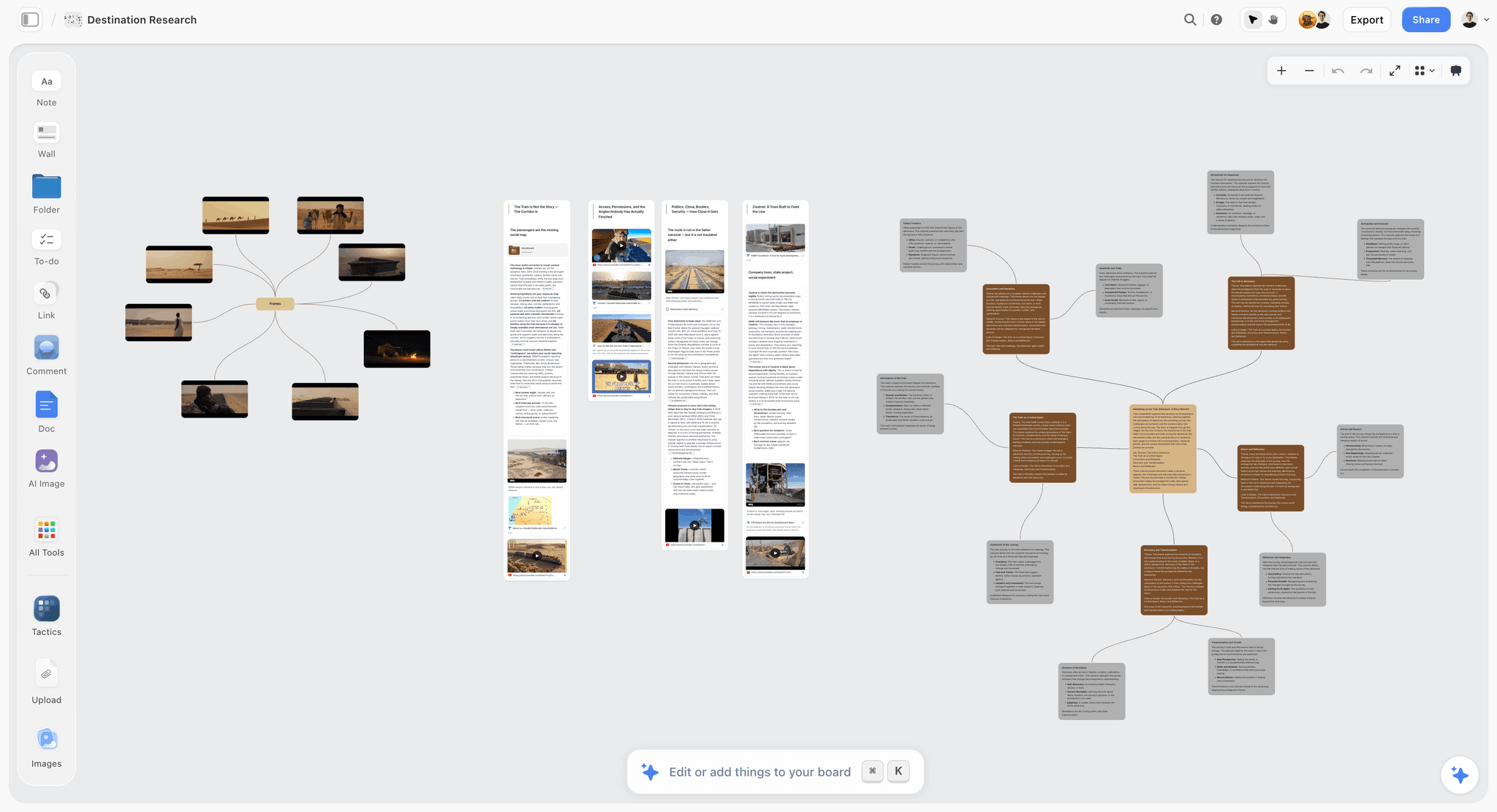
Verdict: the one place where ChatGPT or Claude builds the moodboard with you, and where the approved board becomes the shot list.
Best for: photographers with a client to approve and a crew to brief: brand, commercial, portrait, product and editorial shoots.
Pricing: Plus $7.99 a month billed annually ($9.99 monthly), Pro $14 ($19 monthly) with AI image generation, Max $39 ($49 monthly) with a team workspace, roles and permissions. Paid-only during early access; a Free plan launches before the end of 2026, and anyone a paid member invites to a board joins free now. See pricing.
Storyflow is a visual project planning workspace: an infinite canvas board that holds images, notes, tables, documents, colour palettes, storyboards and decks, with an AI agent that reads the board. Two routes into a moodboard make it the strongest choice here. From ChatGPT, Claude, Gemini or Grok, the MCP connector builds the directions, sections, labels, notes and palette on the board and reads it back, and it runs on your assistant's model, so it spends none of your Storyflow AI credits. Inside Storyflow, the built-in moodboard workflow builds a board of 9 to 16 uniform tiles, each a different facet of the subject, after asking whether you want web references or generated ones. The AI moodboard maker and photoshoot moodboard pages show both.
Strengths:
- The assistant writes into the board and reads it back, so revisions happen in place instead of in the chat.
- References, labels, palette, brief and shot list sit on one canvas.
- The client opens a view-only link with no account.
Limits:
- Browser only, with no native app and no offline mode.
- No approve button or versioned proofing.
- Finding references is better done in Pinterest first.
2. Milanote
Verdict: the best hand-built board for a creative pitch, with no AI in the loop.
Best for: photographers who assemble the board themselves and want a clean, free board for small shoots.
Pricing: free for 100 notes, images or links and 10 file uploads, then $9.99 a month billed annually or $12.50 monthly, per Milanote's plans page.
Milanote has been the standard visual board for creative pitches for years, and it shows: images, notes and links arrange cleanly, and a shared board reads well to a client. It lists no AI features and no ChatGPT or Claude connector on its plans page, so in this workflow the assistant writes text in the chat and you paste it in. For a twelve-picture board that is fifteen minutes of copying. The 10-upload limit on the free plan is the one you hit first on a photo board. The full comparison is in Milanote vs Storyflow for photographers.
Strengths:
- Clean boards that present well.
- A real free plan.
- Long track record with creative teams.
Limits:
- No assistant can build into it.
- Ten free uploads disappear fast with photos.
3. Canva
Verdict: the best choice when the moodboard is a designed deliverable, and the only competitor here with an official AI connector.
Best for: photographers who send the client a one-page PDF or a branded presentation rather than a working board.
Pricing: free plan; paid tiers on Canva's pricing page.
Canva's AI Connector, documented on Canva's MCP page, lets an assistant create designs from a description, edit them, search your library, upload assets and export to PDF, PNG and other formats. That makes Canva strong for the final presentation: ask Claude for a moodboard layout with the palette and four hero frames and you get a designed page. It is weaker as the working board, because a layout is built to be finished, and a moodboard during pre-production is still moving. Labels become text boxes, and nothing carries into a shot list.
Strengths:
- Official connector for ChatGPT and Claude.
- Polished, exportable layouts.
Limits:
- A design is not a working board.
- No handoff into shoot planning.
4. Pinterest
Verdict: the best place to find references, and a weak place to present or plan from them.
Best for: the gathering stage of every moodboard, and photographers whose clients already live on Pinterest.
Pricing: free.
Pinterest is where you run the search terms from step 4. Its suggestions surface frames a text search never would. Boards can be kept secret and shared with invited collaborators, per Pinterest's help on boards. Pinterest offers no official connector for ChatGPT or Claude. And a board of pins cannot hold your labels, palette or brief in a way a crew can read in one look.
Strengths:
- The deepest pool of references.
- Free.
Limits:
- No official assistant connector.
- Pins carry descriptions, not jobs.
A Worked Example: A Spring Knitwear Lookbook Shoot
Here is the workflow on a realistic job, with the numbers. The brand, the shoot, the counts and the timings are illustrative, not a client case study or a measurement.
The brief
A small knitwear brand needs 20 lookbook images for its spring web shop launch: four looks, one model, one day in a daylight studio, final images cropped 4:5 for the product page and 9:16 for Stories. The founder's one sentence in her email: "It should feel like the first warm Sunday of the year, not like a catalogue." The shoot is 12 days out.
What the assistant produced, and what survived
In Claude, connected to Storyflow, we paste the email and the five-line brief and ask for three directions. Claude built three labelled sections on the board:
- A, Open Window: hard morning sun through a big window, long shadows, cream and sage, bare feet, relaxed seated poses.
- B, Overcast Garden: soft flat light, outdoor feel recreated in the studio with plants, muted greens and stone, walking and turning poses.
- C, Kitchen Table: warm tungsten practicals mixed with daylight, ochre and terracotta, coffee cups and bread as props, candid laughter.
The founder rejected C in one line ("too autumn") and picked A with B's poses. That one exchange decided more than any reference could have.
| Stage (illustrative) | Count | Time |
|---|---|---|
Brief and three directions written to the board | 3 directions | 10 minutes |
Search terms, by facet | 12 terms | 3 minutes |
Candidate references saved from Pinterest and portfolios | 31 pictures | 35 minutes |
Frames generated for ideas with no real reference | 4 frames | 8 minutes |
Cut to the final board, labelled by job | 12 pictures | 15 minutes |
Palette read from the approved pictures | 6 swatches | 2 minutes |
Client review on the view-only link | 1 round | 1 day elapsed |
Shot cards built from the approved board | 14 setups | 10 minutes |
The board that went to the client
Twelve pictures in six named walls (Light 3, Colour 2, Pose 3, Styling 2, Set 1, Composition 1), each with a one-line job label. The four generated frames showed the brand's actual sweater colours in direction A's light, because no real photo of those exact pieces in that light existed yet; each was labelled "generated, colour only". The palette had six named swatches with hex codes, from a warm cream to a deep moss. Total hands-on time was about an hour and a half, and the client's decision came back the next morning with three favourites and one veto marked on the board.
The next day we ask Claude to read the approved board and build shot cards: 14 setups across the four looks, each with the approved reference as its frame. That is the moment the moodboard stopped being a mood and became a plan.
Prompts You Can Copy
These are the prompts from the workflow above, written to work in either ChatGPT or Claude with Storyflow connected. Replace the bracketed parts.
| Step | Prompt |
|---|---|
Brief | Read this client email and write a five-line photoshoot brief: subject and client, where the images run, location, talent, and the one sentence from the client that matters most. Put it on my [project] board as a note at the top. |
Directions | Write three distinct visual directions for this brief. For each: a name, two sentences, the light, the palette in words, styling, and one risk. Make them genuinely different, then build each as its own labelled section on the board. |
Search terms | For direction [A], give me two search terms each for light, colour, pose and expression, styling, set, and composition. Write them the way a photographer searches, with lens, light direction and material where it helps. Add them as a note beside the direction. |
Upload | Give me an upload link for this board so I can add my reference photos from my phone. |
Cut | Read the references on the board. Propose a cut to 12, one or two per facet, with one line on why each survives. Do not change the board yet. |
Group and label | Move the 12 approved references into walls named Light, Colour, Pose, Styling, Set and Composition, and add a one-line label under each saying what job it does. |
Palette | Build a colour palette of five to eight swatches from the approved references, each with a name and hex code. Tell me which colours you sampled by eye. |
Client note | Add a note at the top of the board: "Decision needed by [date]: pick a direction, your three favourite references, and one you dislike." |
Changes | Read what changed on the board over the last day and tell me who added, moved or edited what. |
Shot list | Using only the approved references, build shot cards for the shoot, one per setup, with the reference as the frame. |
Two habits make these prompts work better. Ask for a proposal before a change ("do not change the board yet") whenever the assistant is editing what you already curated. And name the board or project in the first prompt of a conversation, so the assistant does not have to guess where to write.
What It Costs to Run This Workflow
The cost is two subscriptions at most: the assistant you already use and the board. Prices as of October 2026, from each vendor's page.
| Setup | Assistant | Board | Monthly total |
|---|---|---|---|
Claude Free + Storyflow Plus | Claude Free, one custom connector ($0) | $7.99 billed annually | $7.99 |
Claude Pro + Storyflow Plus | Claude Pro, $17 billed annually or $20 monthly | $7.99 billed annually | $24.99 |
ChatGPT Plus + Storyflow Plus | ChatGPT Plus, $20 | $7.99 billed annually | $27.99 |
ChatGPT Plus + Storyflow Pro (image generation in both) | ChatGPT Plus, $20 | $14 billed annually | $34 |
ChatGPT Plus + Milanote | ChatGPT Plus, $20 | $9.99 billed annually (or free under 100 items) | $20 to $29.99 |
Any assistant + Pinterest | Your plan | Free | Your assistant only |
Assistant prices come from Claude's pricing page and OpenAI's ChatGPT Plus help article; ChatGPT's other plans are on ChatGPT pricing. Two cost notes. The Storyflow connector runs on your assistant's model, so it spends no Storyflow AI credits. And an account a paid member invites (your client, your stylist) can use the connector for 25 actions a week free, while Plus, Pro and Max have no connector limit.
Which Setup Should You Use? Decision Rules
The right setup depends on who reads the moodboard and what happens after approval. These rules settle most cases.
If a client approves it and a crew shoots from it
Use Storyflow with whichever assistant you already pay for. The board holds the brief, the directions, the labelled references, the palette and the decision, and the assistant turns it into the shot list. This is the case the whole workflow is built for, and the one where copying and pasting costs you most.
If you just need inspiration for a personal shoot
Use Pinterest and ChatGPT or Claude for search terms. Nothing needs approving, nobody else reads it, and a secret board is enough. Moving to a board tool would be ceremony.
If the deliverable is a designed PDF
Do the thinking on a Storyflow board, then use Canva and its connector for the final one-page layout if the client expects a designed document. Or present straight from the board in Storyflow's presentation mode and skip the export.
If you want a free, hand-built board
Use Milanote's free plan for a board under 100 items and 10 uploads, and paste the assistant's directions and labels in yourself. It costs you time instead of money.
By photographer type
- Brand and commercial photographers: Storyflow plus Claude or ChatGPT; the client sign-off and shot list handoff are where the time goes. Our brand photoshoot planning guide goes deeper.
- Portrait and headshot photographers: Storyflow for client sessions with styling choices; Pinterest alone for quick sessions.
- Product photographers: Storyflow Pro, because generated frames of an unreleased product in a hero setting are the case generation is actually for.
- Wedding photographers: Pinterest for the couple's references, Storyflow when the plan includes a shot list and timeline. See wardrobe planning for styled shoots.
Common Mistakes When You Build a Moodboard With AI
The assistant makes some mistakes and you make others. These six come up most.
Asking for "a moodboard" in one prompt
One prompt gets one direction, picked by the model, described in adjectives. The client never sees an alternative, so they cannot tell you what they do not want. Ask for directions first, references second.
Letting generated frames carry the board
A board of twelve generated pictures looks finished and decides nothing, because every frame shows what the model thinks "warm spring morning" means. Real references carry real decisions. Generate only the frames that cannot exist yet, and label them.
Leaving pictures unlabelled
Your stylist reads a picture for the coat, your client for the face, your gaffer for the light. Without a label, each of them is right and the shoot is wrong. One line per picture fixes it.
Too many pictures
Thirty pictures on a moodboard is a research folder. The client picks whichever one they saw last. Twelve, grouped by job, is a decision the client can make in one sitting.
Treating sampled hex codes as a spec
An assistant reading colours off a photo is estimating, and so is a picker on a compressed JPEG. Give your stylist and retoucher the palette as direction, then match colours against the real product or swatch on the day.
Approving in the chat instead of on the board
"The client loved it" in your DMs is not a decision anyone else can read. Write the decision, the date and the vetoes as a note on the board, where the crew will look.
When Storyflow Is Not the Right Choice
Storyflow is built for the moodboard that turns into a shoot. Some moodboards never do, and some jobs need things it does not have.
- You only need to collect references. Pinterest is free and better at discovery. A board tool adds nothing to a personal inspiration hunt.
- You need a free tool today. Storyflow is paid-only during early access; its Free plan launches before the end of 2026. Milanote's free plan or Pinterest are the honest free answers.
- You work offline on location. Storyflow runs in the browser, with no native app and no offline mode. If the moodboard must open in a field with no signal, export what you need beforehand or use a local reference viewer.
- You need formal proofing. Storyflow has no approve button, version locking or proofing workflow. Agencies that need a signed approval trail should use a proofing tool or a written sign-off.
- The deliverable is a polished design. If the client expects a typeset brand document, Canva or a design tool produces a better artefact; Storyflow's board is a working surface, and its presentation mode presents the board as it is.
- You need retouching, colour grading or asset management. Storyflow does background removal and upscaling on paid plans, but it is not an editor or a DAM. Lightroom and Capture One stay in the workflow.
A Photoshoot Moodboard Template You Can Copy
Use this structure on any board, in any tool. It is the layout from the worked example, and it is what the assistant builds when you run the prompts above. Storyflow's photoshoot moodboard template gives you a starting board, and our photoshoot moodboard examples show variations by shoot type.
| Section | What goes in it | How many |
|---|---|---|
Brief | Subject and client, where the images run, location, talent, the client's key sentence | 1 note, five lines |
Directions | Name, two sentences, light, palette in words, styling, one risk | 2 or 3 |
Light | References for the quality and direction of light, labelled | 2 or 3 pictures |
Colour | References for the palette, plus the swatch grid with names and hex codes | 2 pictures, 5 to 8 swatches |
Pose and expression | References for body language and mood | 2 or 3 pictures |
Styling | Wardrobe, hair, makeup, props, labelled to the detail that matters | 2 pictures |
Set or location | The space, the textures, the background | 1 or 2 pictures |
Composition | Framing, crop, negative space for copy | 1 or 2 pictures |
Decision | Chosen direction, three favourites, vetoes, date | 1 note |
Open questions | What the client has not decided yet | 1 note |
A board built this way answers the four questions every crew member brings to it: what are we making, what does it look like, what is still open, and what did the client say.
The Bottom Line
To create a photoshoot moodboard in 2026, let ChatGPT or Claude do the thinking and let a board hold the result. Build it in Storyflow: the assistant writes the brief, three directions, search terms, labels and palette straight onto the board, you add the real references, the client decides on a link, and the same board becomes the shot list. Use Pinterest to find the pictures, Canva if the client wants a designed page, and Milanote if you need a free board today.
Pick your next shoot, connect Storyflow to the assistant you already use from the MCP page, and run the ten prompts above on it. You will know within one client round whether the board saved you the retyping.
FAQ: Creating a Photoshoot Moodboard With ChatGPT or Claude
How do I create a photoshoot moodboard with ChatGPT?
Connect Storyflow to ChatGPT, then ask for a five-line brief, three visual directions and search terms by facet, and have ChatGPT build each on your Storyflow board. Collect real references from Pinterest and portfolios, upload them to the board, generate only frames that cannot exist yet, and ask ChatGPT to group and label the twelve you keep and build the palette. The connector needs ChatGPT Plus or above with Developer mode.
Can Claude make a moodboard?
Yes, with a board to build on. Claude writes the brief, the directions, the search terms, the labels and the palette, and with Storyflow connected it builds them on a board and reads them back. Claude does not generate photos, so the pictures come from your own references, from ChatGPT, or from Storyflow's image generation on Pro and Max. Claude's Free plan allows one custom connector.
Can ChatGPT generate the images for a moodboard?
Yes, but use it sparingly. ChatGPT generates images on its plans, which is useful for frames that cannot exist yet, such as an unreleased product in its hero setting. A board made only of generated pictures decides very little, because each frame is the model's guess at a mood. Use real references for light, styling and pose, and label any generated frame as generated.
How many images should a photoshoot moodboard have?
Twelve is the working size, grouped by job. That gives two or three pictures each for light, pose and styling and one or two for colour, set and composition. Fewer than nine rarely covers every decision; more than twenty turns into a research folder the client cannot decide from. Collect 25 to 35 candidates first, then cut hard and label every survivor.
What should a photoshoot moodboard include?
A photoshoot moodboard should include a short brief, the chosen visual direction, labelled references for light, colour, pose and expression, styling, set and composition, a colour palette with names and hex codes, and a note recording the client's decision. The labels matter most: each one says what that picture is for, so the stylist, the client and the lighting crew read it the same way.
What is the best app to make a photoshoot moodboard with AI?
Storyflow is the best app for a photoshoot moodboard built with AI, because ChatGPT or Claude can build the board through its MCP connector and the built-in AI has a moodboard workflow of its own. Pinterest is better for finding references, Canva for a designed PDF page, and Milanote for a free hand-built board without AI.
Is Storyflow free for making moodboards?
Not during early access. Storyflow starts at $7.99 a month billed annually, and its Free plan launches before the end of 2026. Anyone a paid member invites to a board joins free today and can work on it, including through the connector at 25 actions a week. If you need a free moodboard tool right now, use Pinterest or Milanote's free plan.
Do I need ChatGPT Plus to connect Storyflow?
Yes. Adding Storyflow to ChatGPT needs ChatGPT Plus or above with Developer mode; on Business and Enterprise an admin turns it on. If you do not pay for ChatGPT, Claude's Free plan allows one custom connector, which is enough to run this whole workflow with Storyflow. Gemini and Grok can also connect.
Can my client see the moodboard without an account?
Yes. The client opens the board's view-only link with no account, and signs in only if they want to comment. Anyone a paid member invites to the board joins free and can edit it in real time. For the decision itself, ask the client for a direction, three favourites and one veto, and write it as a note on the board.
How long does it take to make a photoshoot moodboard with AI?
About an hour and a half of hands-on time for a twelve-picture board, in the illustrative worked example above: ten minutes for the brief and directions, thirty-five for collecting references, fifteen for the cut and labels, and a few minutes each for search terms, generated frames and the palette. Collecting real references is still the longest step, and it should be.
Can the assistant pick the references for me?
It can propose a cut, and it should not make the final call. Ask the assistant to read the board and suggest twelve with a reason each, without changing anything. You know which frame the client's art director will respond to and which reference has a licensing problem. The assistant is faster at grouping and labelling than at taste.
Where do I find reference images for a photoshoot moodboard?
Pinterest, photographers' portfolios, film stills, magazines and licensed stock libraries. Run the facet search terms your assistant wrote in each. For references you might reuse in client material, prefer libraries with clear licences, such as Unsplash, whose licence allows commercial use without attribution. Keep a note of each source on the board.
How do I turn a moodboard into a shot list?
Ask the assistant to read the approved board and build one shot card per setup, using each approved reference as the frame. With Storyflow connected, the shot cards land on the same board as the moodboard, so nothing is retyped. Then order the setups by light and location, and do the time maths before the shoot day.
Does the Storyflow connector use my Storyflow AI credits?
No. The connector runs on your assistant's model, ChatGPT's or Claude's, so it spends none of your Storyflow AI credits. Paid Storyflow plans have no connector limit. Storyflow's own built-in AI, including its moodboard workflow and image generation, does use your plan's AI allowance.
Can the assistant read changes my client made on the board?
Partly. Through the connector, the assistant can read what changed on a board and who changed it, over the last day, week or month, so it can tell you which notes the client added or edited. It cannot read comment threads, so ask the client to put the decision in a note, or copy it into one yourself. That keeps the decision record on the board rather than in your inbox.
Table of Contents
- Key Takeaways
- Why a Moodboard Made in a Chat Window Never Reaches the Shoot
- How We Chose Where to Build It and Weighted the Criteria
- Comparison Table: Where to Build a Photoshoot Moodboard With ChatGPT or Claude
- How to Create a Photoshoot Moodboard With ChatGPT or Claude, Step by Step
- Step 1: Decide where the moodboard will live (Storyflow first)
- Step 2: Write a five-line brief before you ask for anything visual
- Step 3: Ask for two or three directions, not one moodboard
- Step 4: Get search terms per facet, not per direction
- Step 5: Collect real references, then put them on the board
- Step 6: Generate only the frames that cannot exist yet
- Step 7: Cut to twelve and label every picture with its job
- Step 8: Build the colour palette from the approved pictures
- Step 9: Share it with the client and collect the decision on the board
- Step 10: Turn the approved board into the shot list
- The Tools, Ranked for This Job
- A Worked Example: A Spring Knitwear Lookbook Shoot
- Prompts You Can Copy
- What It Costs to Run This Workflow
- Which Setup Should You Use? Decision Rules
- Common Mistakes When You Build a Moodboard With AI
- When Storyflow Is Not the Right Choice
- A Photoshoot Moodboard Template You Can Copy
- The Bottom Line
- FAQ: Creating a Photoshoot Moodboard With ChatGPT or Claude
- Related Reading
Templates to check out for this topic


Filmmaking templates you can use in Storyflow
Skip the blank canvas. Open one of these filmmaking boards in Storyflow and the AI builds on the structure that is already there, from research through the shot list.


See Storyflow in Action
A visual AI workspace where every feature lives inside one canvas. No tab-switching, no context lost.
Build your entire board from a single message
Type what you need in the AI chat at the bottom of your canvas. The AI adds cards, headings, and structure directly onto your board.
Use expert frameworks as AI context
Type @ in the AI chat and choose any Tactic. The AI tailors every response to that framework instead of giving generic advice.
Turn your board into a mind map in seconds
Ask the AI to restructure your canvas as a mindmap. It connects your ideas into a visual hierarchy so you can see how everything relates.
Why Storyflow Exists
Storyflow actually began as a personal tool while working on creative and research projects.
We kept running into the same problem: ideas were scattered everywhere: notes, documents, and whiteboards.
Nothing helped us see how everything connected.
So we started building a workspace designed around how ideas actually grow.
→ Read how Storyflow was createdStoryflow Team
Product & Research Team
Published: 2026-10-09
Extremely simple, seriously capable


See how easy it is to get started
Watch a real project come together, from a blank board to a finished plan, clicked through step by step.
Start creating with AI and become more productive
Transform your creative workflow with AI-powered tools. Generate ideas, create content, and boost your productivity in minutes instead of hours.