
Worlds that stay rock-solid, however big
A Campfire alternative for
plotting your novel on one canvas.
Campfire is a good tool with a strong opinion: characters here, timeline there, worldbuilding in its own module. Storyflow takes the opposite position. One infinite canvas, and you decide what sits next to what.


Creatives working for these brands already got early access
- Red Bull
- Canon
- Artlist
- Porsche
See how easy it is to get started
Watch a real project come together, from a blank board to a finished plan, clicked through step by step.
Start from a ready-made template
Pick a board to see what you can build, then let AI fill it in. Every template is a real, editable starting point on the same infinite canvas.

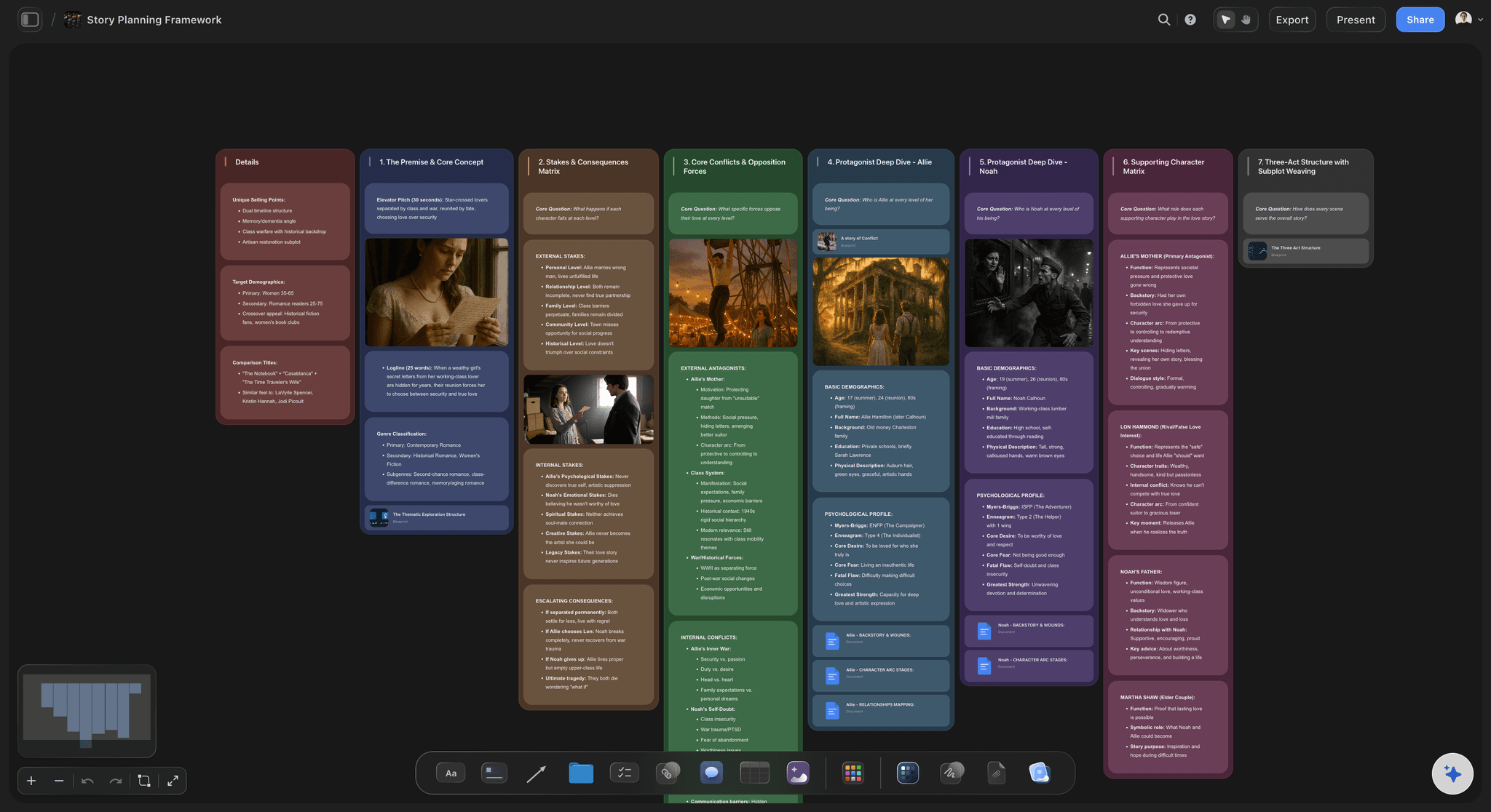
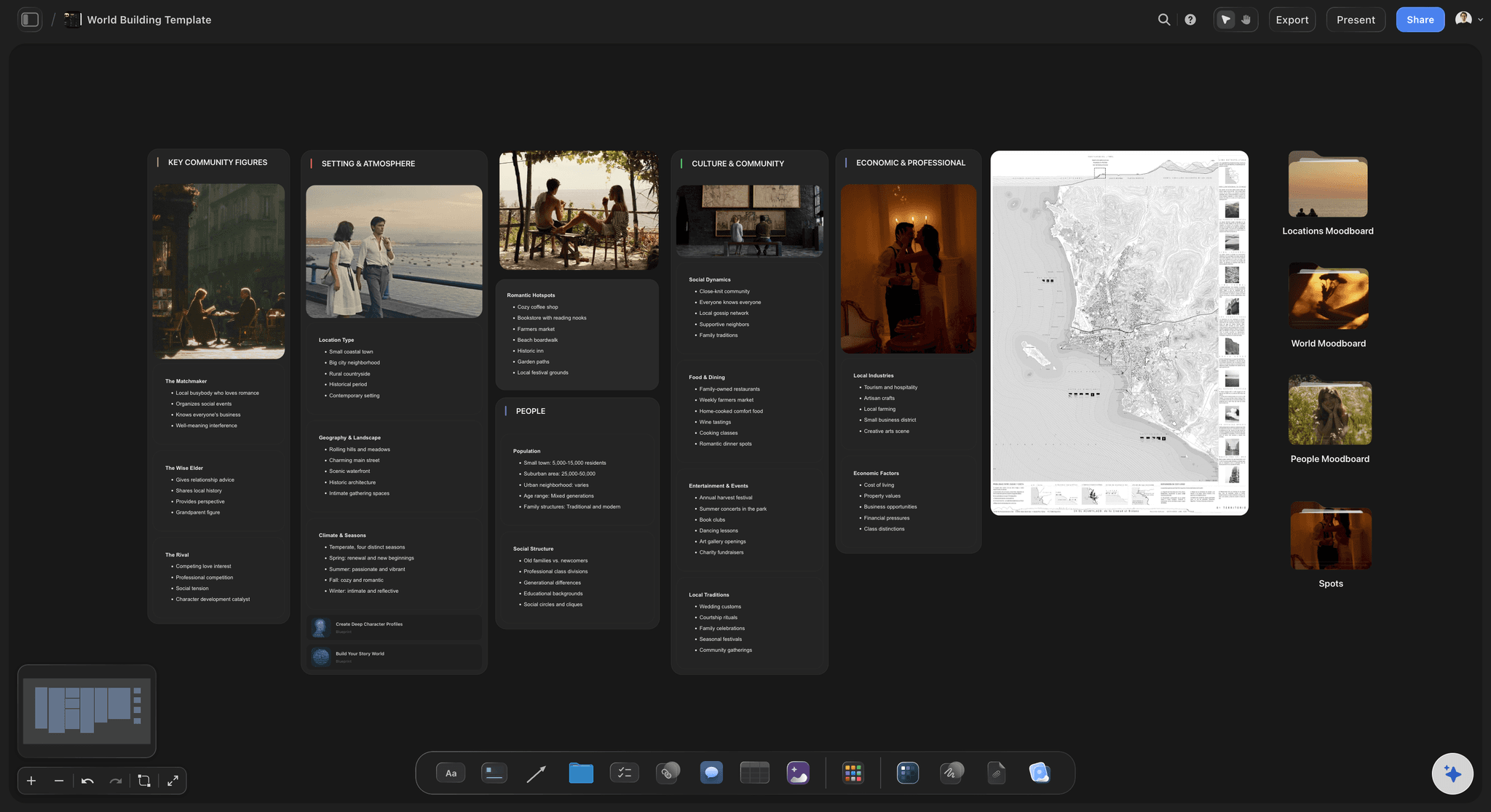
World Building
Develop the places, factions, and rules of your world and connect them into one living map.
Is Storyflow a Campfire alternative?
For plotting and worldbuilding, yes, with a genuinely different philosophy. Storyflow is an AI visual workspace that holds your whole novel plan on one infinite canvas: plot, characters and research side by side, arranged the way you choose, with an AI that reads all three together. Campfire Writing organises a story into discrete modules such as Manuscript, Characters, Timeline, Maps, Relationships and Locations. Each has its own structured fields, and Campfire sells the modules one at a time or all together, with a limited free tier. If your story fits that shape, the structure does real work for you, and its worldbuilding depth is better than anything a blank canvas gives you out of the box.
The cost of modules is that a story stops being visible as one thing. A character's arc lives in the character module, the scene it turns in lives in the timeline, and the note explaining why lives somewhere else. Writers who think spatially find that the structure they are given is not the structure their story has, and they end up fighting the fields.
Storyflow is the other answer. One infinite canvas where a character card, a beat, a research clipping and a reference image can sit beside each other because they belong together in your head, not because a schema said so. Cluster by act, by character thread, by location, and regroup the cards as the question changes. The structure is emergent rather than imposed.
Being fair about the trade: Campfire's structured fields are genuinely stronger for encyclopaedic worldbuilding, its maps are a real feature Storyflow has no equivalent for, and its Manuscript module compiles the finished book. Storyflow has Docs for scenes and notes, but no manuscript binder, no compile or ePub export, no map tool and no per-entity databases. If you want a wiki for your world, Campfire or World Anvil fits better. If your problem is seeing the whole story at once while the shape is still moving, the canvas wins.
Ultra fast from brief to board
Put everything in one place and arrange it yourself.
The structure comes out of the story rather than being chosen before it.
01
Bring the raw material in
Research, character notes, reference images and half-formed ideas onto one canvas, without deciding in advance which module each belongs to.
02
Lay out the beats
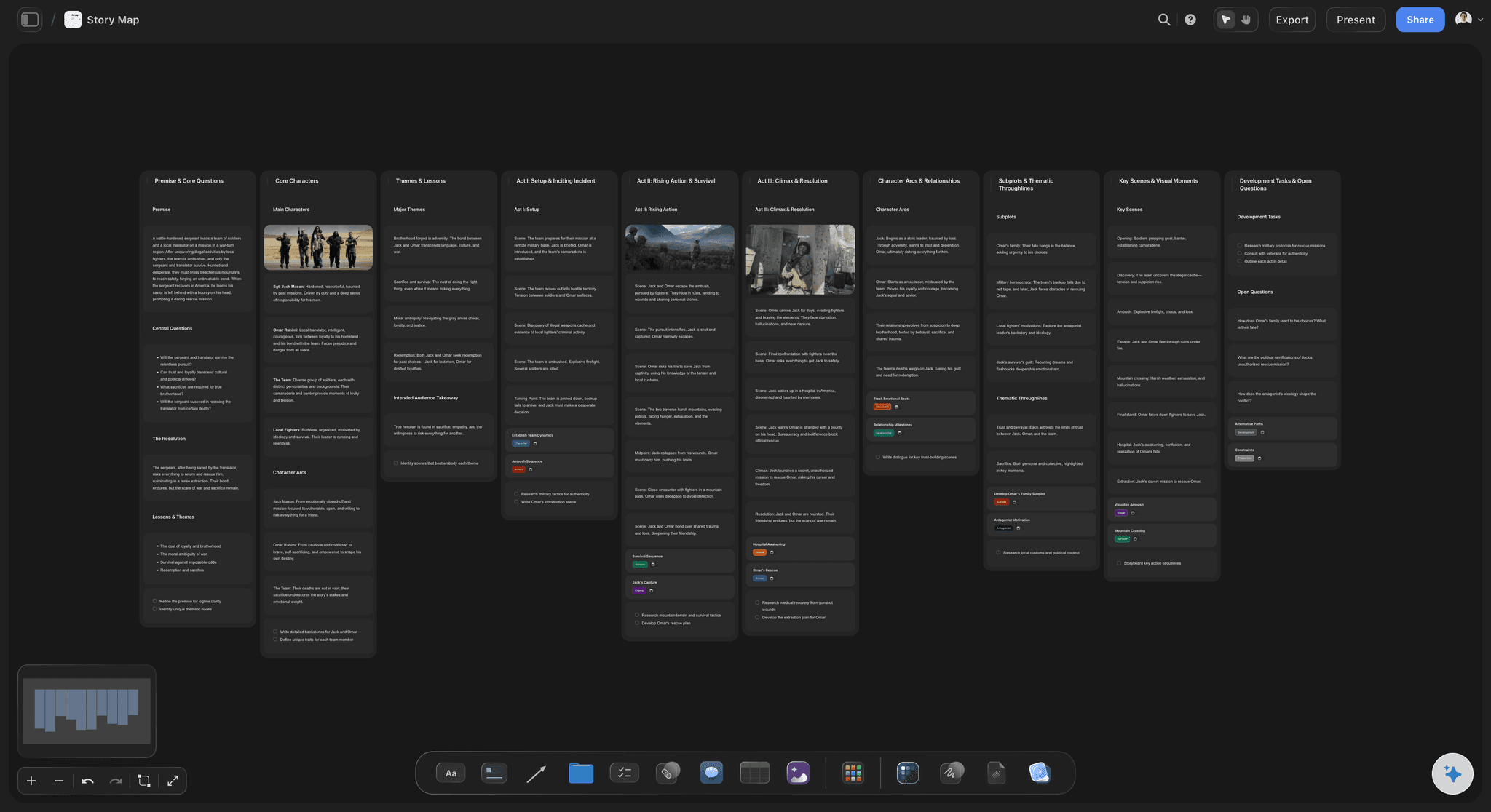
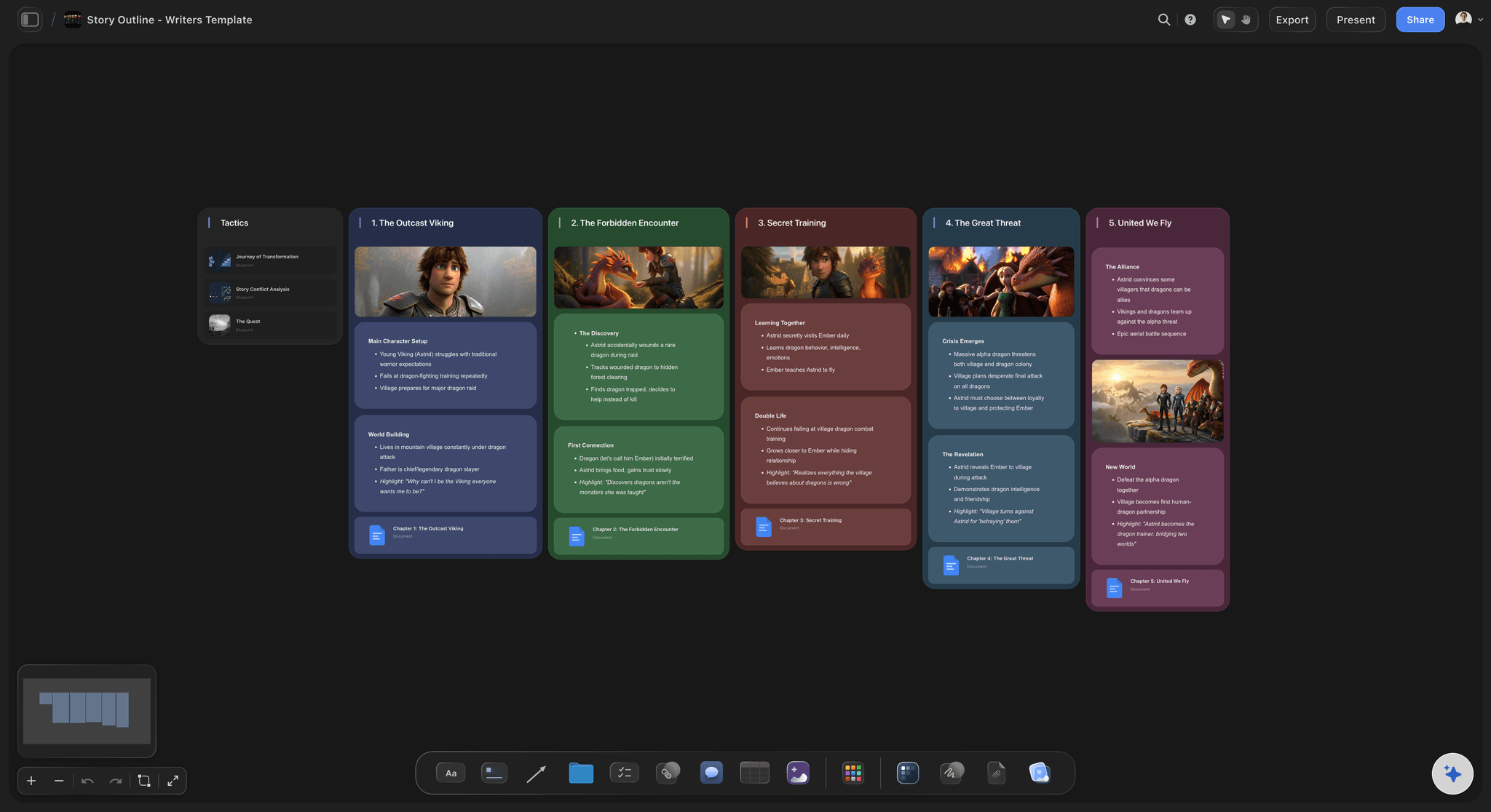
One card per beat across the canvas. The shape of the story is immediately visible, including the stretch in the middle where nothing happens.
03
Cluster by whatever question you have
Group by act to check pacing, by character to find the thread that disappears for six chapters, by location when the geography matters. Same cards, different reading.
04
Write elsewhere, keep the board open
The prose goes in Scrivener, Word or Google Docs. The board is what you look at when the draft stops making sense.
What changes when the structure is yours.
Four differences that show up within an hour of using a canvas instead of modules.
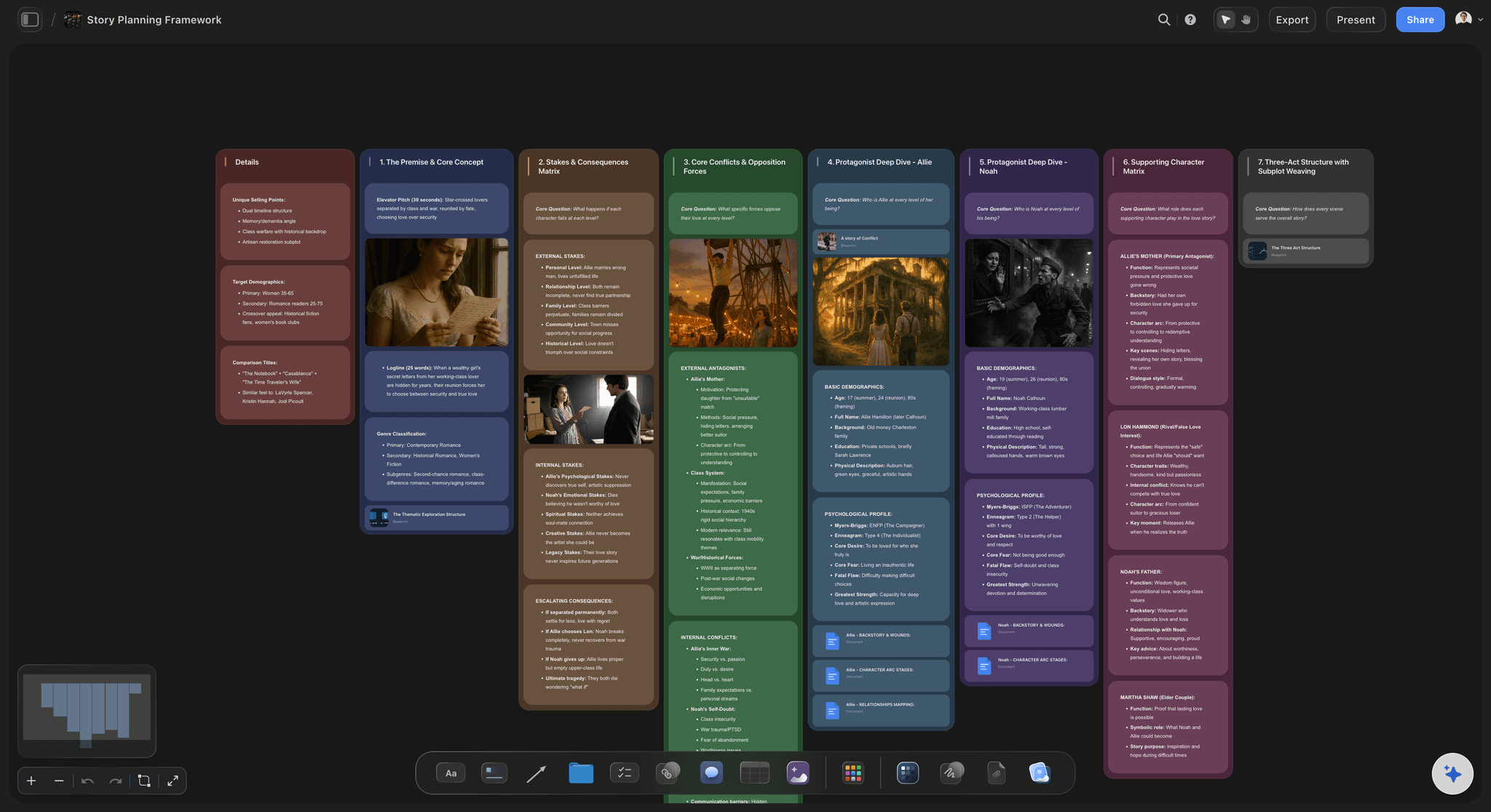
One view, not six tabs
The whole story on screen at once
A character's arc, the beats it turns on and the research behind it in a single view. In a module system those are three places and you hold the connection in your head.
See the novel planner →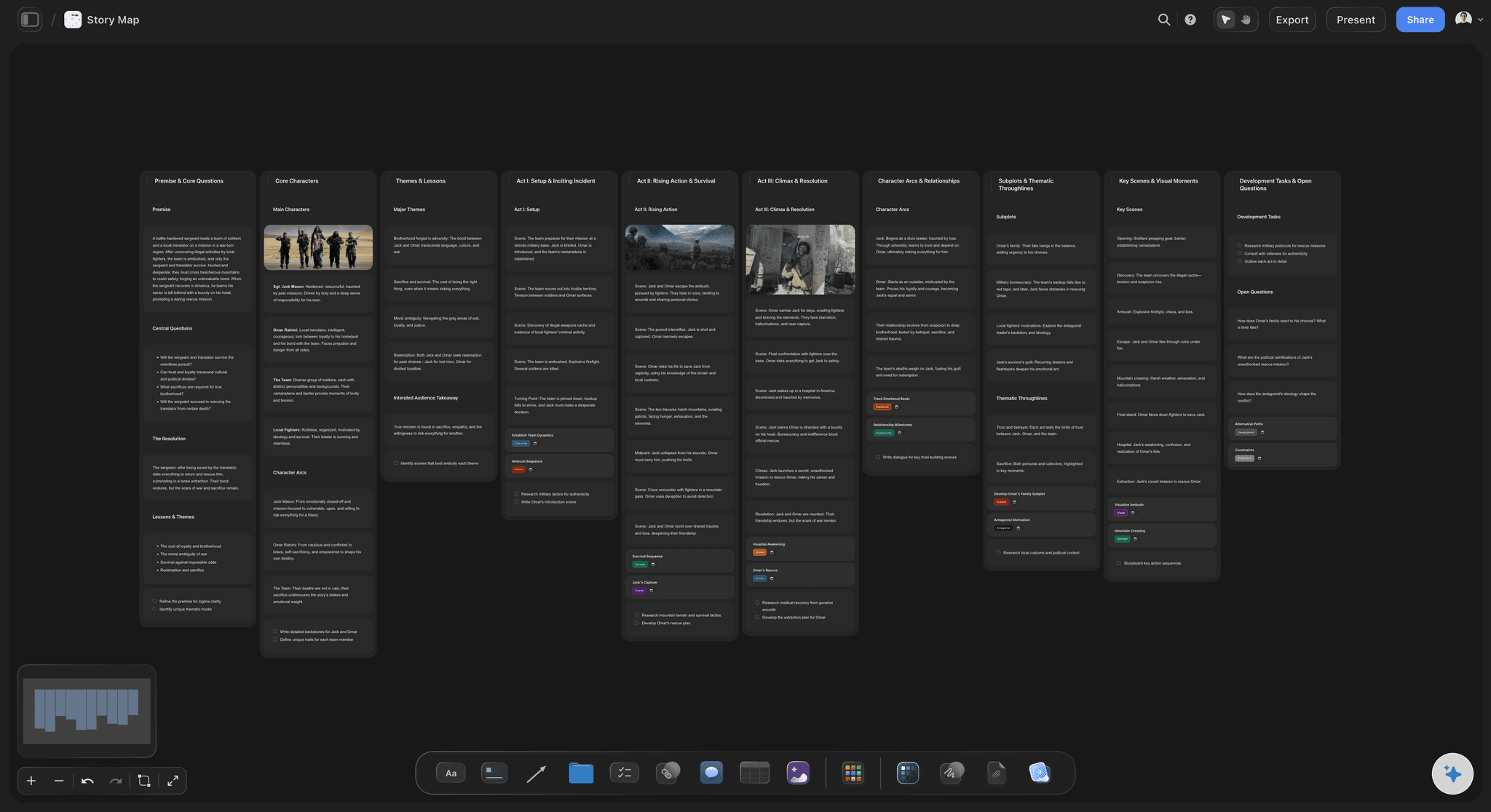
Reorder freely
Move a chapter and see what it costs
Plot problems are spatial. Dragging a card is faster than editing a timeline entry, and the consequence for the beats around it is visible in the same motion.
See the beat board →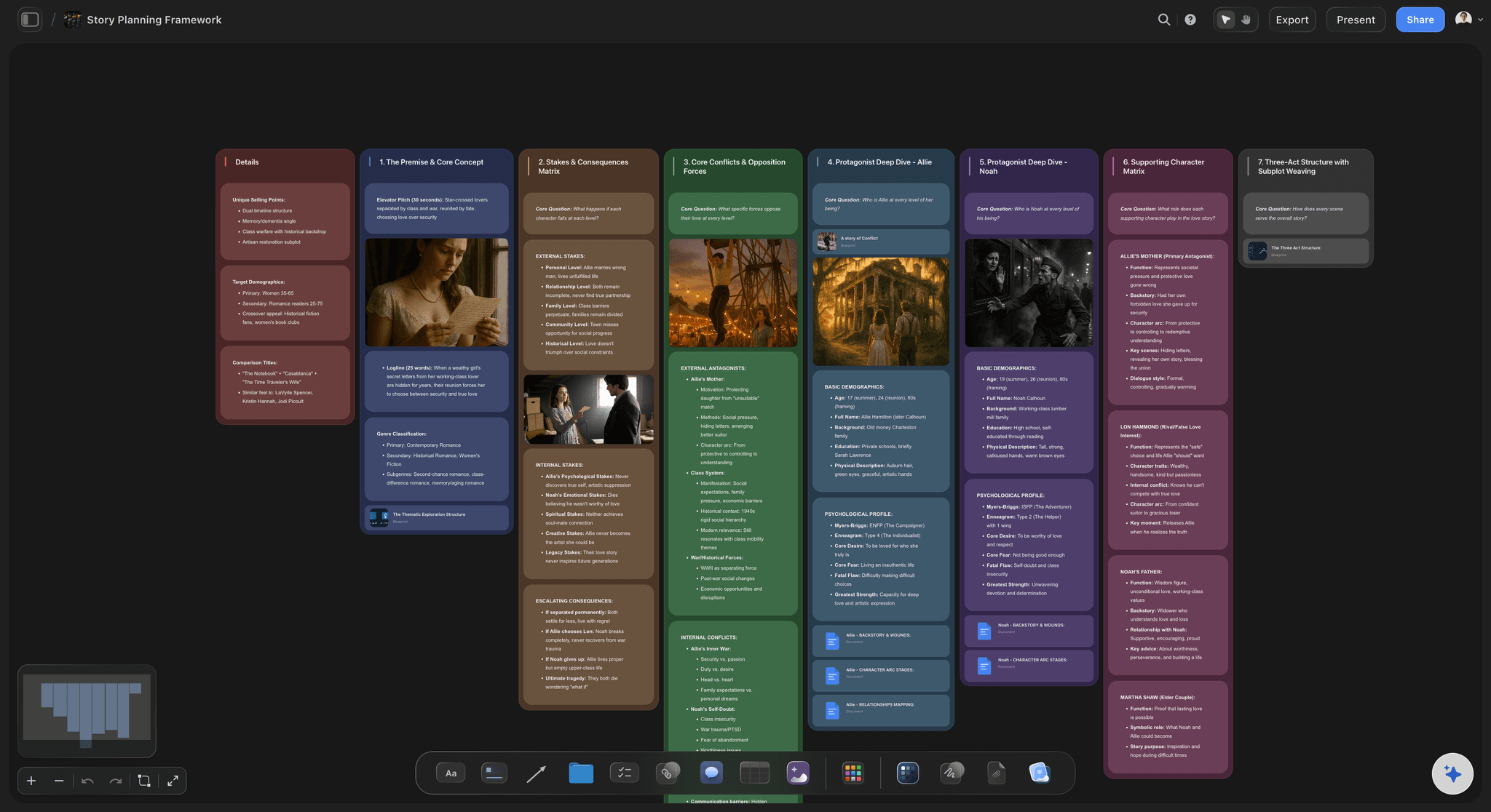
The AI reads all of it
Ask what the story is doing
Because everything is on one board, the AI has the beats, the characters and the research in front of it at once, rather than one module at a time.
See the AI story outline generator →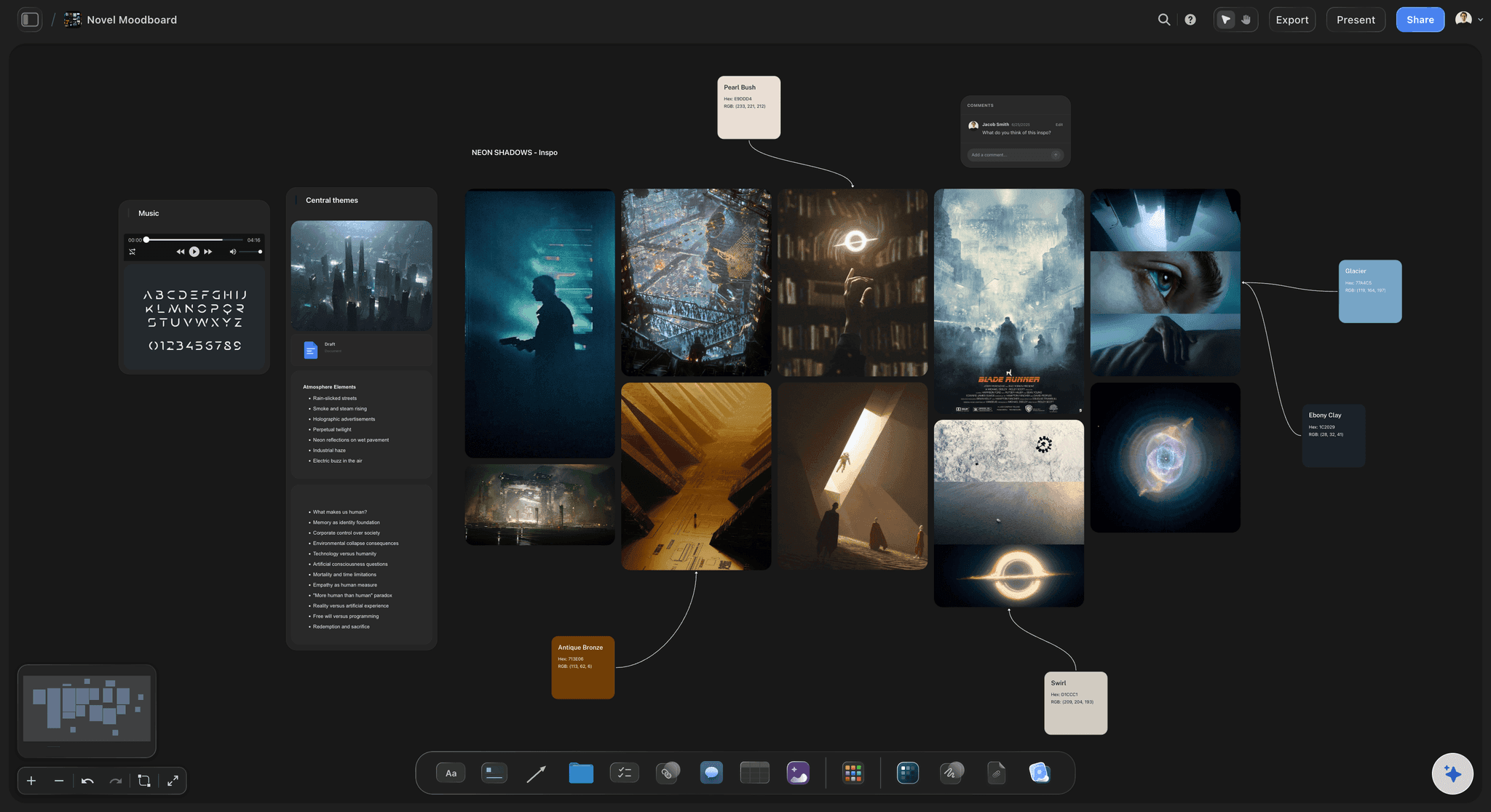
No modules
Nothing to unlock tool by tool
The canvas tools are not sold one by one: notes, Docs, tables, images and links come with every paid plan. AI image generation needs Pro or Max.
See pricing →Plans from $7.99/month annual. Free plan coming late 2026.
Storyflow is paid-only during early access, with plans from $7.99 a month billed annually ($9.99 monthly). A free plan launches before the end of 2026, and anyone a paid member invites to a board joins free.
Notes, Docs, tables and images on every paid plan
Unlimited boards on an infinite canvas
Export any board as a high-quality image or PDF
Share a view-only link with a beta reader or editor
Built for people with taste
Imposed structure helps until it does not.
Which of these two is right depends entirely on whether your story fits the shape you were given.
When modules win
Campfire is the better choice for some books
Encyclopaedic worldbuilding: Hundreds of entities with consistent fields, cross-referenced. Structured databases do that properly and a canvas does not.
Maps: Campfire has a real map tool. Storyflow has no equivalent, and for secondary-world fantasy that can decide it on its own.
Writing in the same app: Campfire's Manuscript module holds the book and compiles it to ePub or PDF. Storyflow has Docs for scenes and notes but no manuscript binder, so the draft lives in Scrivener, Word or Google Docs.
When the canvas wins
The story is still moving
Structure you did not choose yet: Early drafting is exactly when a schema hurts most, because you do not yet know which relationships matter.
Seeing the whole shape: Pacing problems are visible as space. A sagging middle is a gap on a canvas and a set of rows in a timeline module.
Research beside the story: The article, the photograph and the beat it inspired sitting together, rather than the research living in a different application entirely.
What Storyflow will not do
Stated plainly
No manuscript binder: Docs hold scenes and notes and export to Word or PDF, but there is no manuscript binder, no compile and no ePub export. Write the book in a writing tool and keep the board beside it.
No maps and no entity databases: No map builder and no per-entity structured fields with cross-references. Campfire and World Anvil are better at both.
Where it earns its place: Holding the plot, the characters, the research and the references in one space you arrange yourself, while the shape of the book is still changing.
Explore templates for your project
Every template opens as a real, editable board on the infinite canvas. Pick the closest fit and make it your own.
World Building
Develop the places, factions, and rules of your world and connect them into one living map.
One app instead of five
Storyflow, Campfire and the usual alternatives.
Compared on what each is actually built to do, not on which we would rather sell.
Storyflow
Recommended
Plot, characters and research on one canvas
AI reads plot, characters and research together
Manuscript editor with compile and ePub export
Map builder
Campfire
Plot, characters and research on one canvas
AI reads plot, characters and research together
Manuscript editor with compile and ePub export
Map builder
Scrivener
Plot, characters and research on one canvas
AI reads plot, characters and research together
Manuscript editor with compile and ePub export
Map builder
Plottr
Plot, characters and research on one canvas
AI reads plot, characters and research together
Manuscript editor with compile and ePub export
Map builder
What creators are saying
Join early creators getting structured workspaces and AI that remembers their projects
“Storyflow has sped up my workflow by at least 3x, which means more flow state and more projects I can actually ship. It truly changed the way me and my team create.”

Reilin Joey
Director & YouTuber
“One prompt gets me a structured board. But the tactics are my favorite. I run my YouTube scripts through them and my intros and retention got better. It's amazing.”

Justkay
YouTuber & Freelance Filmmaker
“I used to juggle five apps to plan a project. Now I describe what I am making and get boards, lists, and a schedule. All in one place.”

George
@fernwehchronicles
Campfire alternatives, answered.
What novelists ask when the modules start to chafe.
Campfire organises a story into separate modules with structured fields, such as Manuscript, Characters, Timeline, Maps and Relationships. Storyflow puts everything on one infinite canvas and lets you arrange it however the story wants. The trade is real in both directions: Campfire's structure does work for you when your book fits it and gets in the way when it does not. A canvas imposes no fields, so the structure is whatever you build.
Storyflow is a Campfire alternative built on one open canvas: plot, characters and research sit together, you decide what goes next to what, and the AI reads all three at once. Nothing is split into modules, so the whole story stays on screen. Campfire still has a manuscript editor with compile and ePub export and a map builder: Storyflow has neither.
Not for the whole book. Storyflow has Docs for scenes, notes and chapter sketches, with Word and PDF export, but no manuscript binder, no compile and no ePub export, which Campfire's Manuscript module has. Storyflow is where the book is planned and diagnosed; the prose goes in Scrivener, Word, Google Docs or Campfire's own editor, with the board open beside it.
No. Campfire has a genuine map builder and Storyflow has no equivalent, so for secondary-world fantasy that alone may settle it. You can drop a map image onto the canvas and annotate it, which is useful, but it is not a map tool.
Structured databases are better for that, honestly. If you need consistent fields across two hundred characters and locations with cross-references between them, Campfire or World Anvil will serve you better than a canvas. Storyflow is stronger when the material is messier and the relationships are still being discovered.
Campfire has a free tier with limits in each module, then sells modules one at a time or all together, by subscription or lifetime licence. Storyflow is paid-only during early access and does not sell tools separately: notes, Docs, tables and images come with every paid plan, AI image generation needs Pro or Max, and anyone a paid member invites to a board joins free.
There is no direct import. In practice writers rebuild the plot on the canvas, which sounds worse than it is: re-laying the beats is usually the exercise that shows you the structural problem you moved tools to solve. Research and images can be dropped straight onto the board.
Storyflow's AI reads the whole active board, so the plot, the characters and the research are all in front of it at once and it can be asked which thread disappears or where the stakes stop rising. It drafts on request and it is better at reacting to what exists than at inventing a book. Treat its output as a first opinion to argue with.
A canvas suits both. Plotters lay a structure and fill it; writers who discover the story as they go can dump material and let clusters form. Module systems tend to favour plotters, because the schema has to be chosen before the story is known.
Yes. Share a view-only link and they open the board in a browser with no account. A reader who signs in can leave comments, and anyone a paid member invites to a board joins free, so readers never add to your bill.
Storyflow is paid-only during early access, with plans from $7.99 a month billed annually ($9.99 monthly). A free plan launches before the end of 2026, and anyone a paid member invites to a board joins free.
Arrange the story the way it actually is.
Plot, characters, research and references on one infinite canvas, structured by you rather than by a schema.