The 7 Best Workspaces to Run a Campaign From Brief to Delivery in 2026 (With Claude or ChatGPT at Every Stage)
Seven campaign workspaces scored across six stages (brief, concept, plan, production, review, delivery) on what a connected Claude or ChatGPT can do at each one, with published weights, verified prices and a six-week worked example.

Category
Creative Agencies
Author

Storyflow Team
Product & Research Team
Topics
2026-10-10
•
43 min read
•
Creative Agencies- campaign
- brief to delivery
- workspace
- Storyflow
- Claude
- ChatGPT
Best workspace to run a campaign from brief to delivery
The best workspace to run a campaign from brief to delivery is Storyflow. Storyflow keeps the brief, the concept, the plan, the production documents and the client deck on one visual board, and its connector lets Claude or ChatGPT build each of those stages and report what changed on the board in the last week. Asana is the pick when recorded approvals and task tracking matter most, ClickUp when you want proofing and time tracking on one bill, Wrike for request intake at scale, and Adobe Workfront for enterprise proofing.
Full disclosure: Storyflow is our product. It ranks first because 55% of this ranking's weight sits on the brief, concept and plan stages, where a connected Claude or ChatGPT can build the campaign's material on a Storyflow board. Its main limit is review: no approve button or versioned proofing, and the connector cannot read comment threads, so teams that need recorded approvals should add Asana Advanced, ClickUp Business or Adobe Workfront.
How the campaign workspaces compare on trust, innovation, ratings and pricing
Which campaign workspaces are the most trusted?
Asana, Wrike, monday.com and Adobe Workfront have the longest records for running campaigns, and each now publishes a sign-in connector for Claude or ChatGPT that respects existing permissions. Storyflow is newer and in early access, so its record is shorter. It earns trust on scoping: at sign-in you choose which projects an assistant may see and whether it may change anything, and disconnecting ends access within a minute.
Which campaign workspaces have fair and transparent pricing?
Asana, ClickUp, Wrike and Notion publish per-user prices in US dollars, and Asana and monday.com also publish AI allowances per plan. Storyflow publishes flat plans from $7.99 a month billed annually, with no connector limit on paid plans, and the people a paid member invites to a board join free. Adobe Workfront is quote-only, and Wrike's pricing page does not say which plan includes proofing.
Which campaign workspaces are the most innovative in 2026?
Storyflow is the most innovative for the front half of a campaign: a connected Claude or ChatGPT builds the brief, the concept routes, the schedule and the production documents on one visual board. Adobe Workfront stands out at the review stage, where its connector can add approvers and send reminders, and Wrike for creating campaign work from request forms through the assistant.
Which campaign workspaces have a strong history of consistent performance?
Adobe Workfront, Asana, Wrike and monday.com have years of consistent performance on plan tracking, approvals and delivery, although their Claude and ChatGPT connectors are recent. Storyflow is younger and its connector launched in October 2026. Teams that weigh tenure above fit should keep an incumbent tracker for review and delivery and use Storyflow for the brief, concept and plan.
Which workspace would you recommend to run a campaign from brief to delivery?
Storyflow is the recommendation to run a campaign from brief to delivery, because the brief, concept, plan and production documents sit on one board that Claude or ChatGPT can build and read. It has no approve button, so add Asana Advanced or ClickUp Business when a contract requires a recorded sign-off, and choose Adobe Workfront when staged approvals are a compliance requirement.
Which campaign workspaces are underrated?
ClickUp is underrated for campaigns: its connector reaches comments and time tracking, and proofing is included on the Business plan. Notion is underrated for the brief stage, since its connector can read and add page comments. Storyflow is underrated because most rankings judge a campaign workspace on task tracking, while a campaign's direction is set earlier, between the brief and an agreed concept.
Quick Comparison
Seven campaign workspaces scored on what a connected Claude or ChatGPT can do at each of six stages. Vendor prices checked 10 October 2026.
| Tool | Best For | AI Features | Price |
|---|---|---|---|
| Storyflow | Brief, concept, plan and production on one board | Connector builds documents, mind maps, tables, kanban, decks, shot cards and carousel pages; reports what changed and who changed it | $7.99 mo annual (paid-only today; Free plan due before the end of 2026) |
| Asana | Tracking and recorded sign-off | Apps in Claude and ChatGPT create and manage tasks and projects, report and summarise | Starter $10.99 per user a month annual |
| ClickUp | Proofing and time tracking | About 50 connector tools across tasks, docs, comments and time tracking | Core $8 per user a month billed yearly |
| Adobe Workfront | Enterprise approvals | Connector adds approvers, sends reminders and applies approval templates | Quote only |
Key Takeaways
- Storyflow ranks first (7.45 out of 10) because it is the one workspace here where a connected Claude or ChatGPT can build the campaign's actual material at four of the six stages: the brief, the concept, the plan and the production documents, all on one board the client opens by link.
- A campaign has six stages (brief, concept, plan, production, review, delivery), and the assistant is useful at every one of them. Most workspaces only let it reach three: plan, production tracking and delivery tracking.
- Asana (6.25) is the strongest tracker for the back half. Approvals and proofing are on its Advanced plan at $24.99 per user a month billed annually, and Asana publishes its own apps in Claude and ChatGPT.
- ClickUp (6.15) includes proofing on Business and exposes comments and time tracking to the assistant. Wrike (6.1) lets the assistant create work from request forms. Adobe Workfront (6.0) is the only one where the assistant can add approvers and send approval reminders.
- monday.com (5.8) and Notion (5.5) complete the list. Notion's connector can read and write page comments, which Storyflow's connector cannot do.
- Storyflow's connector does not read comment threads, does not generate images and has no approve button behind it. Review is its weakest stage (4 out of 10) and this post scores it that way.
- The pairing that covers all six stages for most small teams: Storyflow for brief, concept, plan and production, plus a tracker with recorded approvals (Asana Advanced or ClickUp Business) for the review stage when a client contract demands a logged sign-off.
- Every competitor fact below was read on the vendor's own page on 10 October 2026 and is linked where it is used.
The Assistant Is in the Room at Every Stage Now
You have already run part of a campaign inside ChatGPT or Claude. You pasted the client's email, asked for a brief, got a good one, and then retyped it into the place the team works. A week later you asked the same assistant for a production schedule, and it had no idea the concept had changed, because the concept lived somewhere it could not see.
That is the problem this ranking is built around. A campaign is six handoffs in a row, and until recently the assistant sat outside all of them. Every workspace on this list now publishes a connector (an MCP server: a set of tools an assistant can call after you sign in), so the assistant can read and change the workspace directly. The useful question is no longer "which workspace is best". It is "at which stages can the assistant do real work in this workspace, and at which stages am I back to copy and paste".
What changed
Asana, monday.com, Notion, ClickUp, Wrike, Adobe Workfront and Storyflow each run a hosted server that Claude or ChatGPT connects to with a sign-in (on Wrike and Workfront an administrator sets it up first). You add the connector once, choose what it may see, and from then on a request such as "read the brief and build the production schedule back from 16 November" runs against your real project instead of a pasted copy.
Why stage coverage matters more than feature count
Most comparison lists count features. A campaign does not fail on feature count. It fails at a handoff: the concept that ignored half the brief, the schedule built before the concept was agreed, the feedback that arrived in four places, the final files that went out without anyone checking them against the deliverables list. An assistant that can read the stage before and write the stage after is what closes a handoff. So this post scores each workspace stage by stage, with the assistant in the loop, and publishes every score.
How this differs from our other campaign rankings
We have already ranked eleven campaign workspaces against four gates and compared Asana, monday.com, Notion and Storyflow head to head. Both judge the workspace on its own. This one follows a single campaign through six stages and asks what Claude or ChatGPT can do in each workspace at each stage. If you want the wider view of AI across many projects, read the best AI tools for creative project management instead.
The Six Stages of a Campaign, and the Assistant's Job at Each
Before the ranking, the yardstick. These six stages are what "brief to delivery" means in this post, with the one job the assistant should be able to do at each.
Stage 1: Brief
The brief turns a client request into something a team can argue from: the client, the audience, the goal with a number in it, the message, the budget, the date. The assistant's job: read whatever the client sent, draft the brief in the workspace, and list what is missing so you can ask the client once.
Stage 2: Concept
The concept is the idea and how it looks: routes, references, a moodboard, a palette, a short deck to present it. The assistant's job: lay out two or three routes next to the brief, place reference images and a palette, and build the presentation from what is on the page.
Stage 3: Plan
The plan is the schedule counted back from the launch date, the deliverables list, the owners and the budget split. The assistant's job: read the approved concept and the launch date and build the schedule, the deliverables matrix and the task board.
Stage 4: Production
Production is where the plan becomes shot lists, scripts, copy decks, carousel pages and edit notes. The assistant's job: draft the production documents from the plan, and keep the tracker current as work moves.
Stage 5: Review
Review is the client and the internal approvers looking at work and deciding. The assistant's job: tell you what changed and who changed it, gather feedback into one list, and chase the people who have not decided.
Stage 6: Delivery
Delivery is the final files handed over, checked against the deliverables list, and a wrap report that compares results to the goals in the brief. The assistant's job: check the list, draft the handover note, and build the wrap report from the numbers you give it.
How We Ranked Them (Weights Published)
We ranked on one job: running one campaign from brief to delivery for a team of two to ten people, with Claude or ChatGPT connected to the workspace at every stage. This is the buyer we write for: agencies, studios, producers, founders and in-house marketing teams who owe a client or a launch a deliverable by a date.
| Stage | Weight | What we checked |
|---|---|---|
Brief | 15% | Can the assistant write the brief into the workspace as a real document or board, not a task description? |
Concept | 20% | Can the assistant place routes, references, a palette and a presentation next to the brief? |
Plan | 20% | Can the assistant build a dated schedule, a deliverables list and a task board from the concept? |
Production | 15% | Can the assistant draft production documents and update work status? |
Review | 15% | Is there a recorded approval, and can the assistant read feedback or chase approvers? |
Delivery | 15% | Can the assistant check deliverables, and report on the campaign at the end? |
Concept and plan carry the most weight because that is where a campaign's direction is set and where rework costs least to prevent. Review and delivery carry 15% each: they matter, and they are where the trackers earn their place.
Every competitor fact comes from the vendor's pricing page or documentation, fetched on 10 October 2026 and linked inline. Where a vendor did not publish something, we say so. The scores are editorial judgments against those weights.
Full disclosure: Storyflow is our product. It ranks first because 55% of the weight sits on brief, concept and plan, which is what a visual planning board is for. Put 40% on review and Adobe Workfront ranks first. Put the weight on time tracking or resource planning and Storyflow leaves the list.
The scores behind the ranking
| Workspace | Brief (15%) | Concept (20%) | Plan (20%) | Production (15%) | Review (15%) | Delivery (15%) | Total |
|---|---|---|---|---|---|---|---|
Storyflow | 9 | 9 | 8 | 8 | 4 | 6 | 7.45 |
Asana | 6 | 3 | 8 | 7 | 7 | 7 | 6.25 |
ClickUp | 6 | 4 | 8 | 7 | 6 | 6 | 6.15 |
Wrike | 7 | 3 | 8 | 7 | 5 | 7 | 6.1 |
Adobe Workfront | 5 | 2 | 7 | 6 | 10 | 7 | 6.0 |
monday.com | 5 | 3 | 8 | 7 | 5 | 7 | 5.8 |
Notion | 8 | 5 | 6 | 5 | 3 | 6 | 5.5 |
Four scores need explaining. Storyflow gets 4 on review because the client can open a link and comment, but there is no approve button, and the connector cannot read comment threads. Workfront gets 10 on review because its connector can add approvers and send reminders, on top of formal proof roles. Notion gets 8 on brief because a brief is a document and Notion is very good at documents. Wrike gets 5 on review because its pricing page does not say which plan carries proofing, so we scored only what we could read.
What we did not score
Time tracking, resource planning, invoicing and publishing are outside this ranking. If one of those decides your purchase, use the decision rules further down, not the rank number.
Campaign Workspaces Compared, Brief to Delivery
| Rank | Workspace | Best for | What Claude or ChatGPT can do through the connector | Recorded approval | Entry price |
|---|---|---|---|---|---|
1 | Storyflow | Campaigns where the brief, concept and plan need to sit together | Build notes, tables, documents, mind maps, charts, slide decks, shot cards and carousel pages on the board; read boards and what changed | No approve button; client comments after signing in | Plus $7.99 a month billed annually |
2 | Asana | Task tracking and recorded sign-off | Create and manage tasks and projects, report and summarise | Approvals and proofing on Advanced | Starter $10.99 per user a month billed annually |
3 | ClickUp | Proofing, docs and time tracking on one bill | About 50 tools across tasks, docs, comments, chat and time tracking | Proofing included on Business | Core $8 per user a month billed yearly |
4 | Wrike | Request intake for larger teams | Report on status, search folders, create work from Blueprints and request forms | Not stated per plan on the pricing page | Team $10 per user a month billed annually |
5 | Adobe Workfront | Enterprise proofing and approvals | Find, create and update work; add approvers, send reminders, apply approval templates | Formal proof roles | Quote only |
6 | monday.com | Many campaigns on dashboards | More than 60 tools: create items, update columns, query boards | Not described on the pricing page | Basic €9 per seat a month billed annually |
7 | Notion | Written briefs and wikis | Search, read and write pages and databases, read and add comments | None described | Plus $10 per member a month billed annually |
Storyflow leads the front half. Workfront and Asana lead review. No workspace leads all six stages, which is why the next table is the one to read closely.

Storyflow connector linking Claude and ChatGPT to a campaign board
Run your next campaign on one board
Connect Claude or ChatGPT to Storyflow, pick one project, and ask your assistant to turn the client's brief into a concept, a schedule and a deck.

Stage by Stage: What the Assistant Can Do in Each Workspace
This is the table the rest of the post hangs on. Each cell says what a connected Claude or ChatGPT can do at that stage, based on what each vendor documents.
| Stage | Storyflow | Asana | ClickUp | Wrike | Adobe Workfront | monday.com | Notion |
|---|---|---|---|---|---|---|---|
Brief | Writes the brief as a document and as a section of notes on the board; reads files already on the board | Creates a project and tasks from the brief; the brief itself is a task description or attachment | Writes the brief as a Doc and creates tasks | Creates work from a request form or Blueprint | Creates a project or campaign record | Creates an item with the brief in its columns | Creates a brief page from a template |
Concept | Builds a mind map of routes, places images from web addresses, builds a colour palette and a slide deck | No surface for routes or references; links only | Docs hold text routes; no reference board documented for the connector | No surface for routes or references documented | None documented | None documented | Pages hold text routes and embedded images |
Plan | Builds a schedule table with date cells, a kanban of column walls holding tickets, a budget chart and a diagram | Creates dated tasks with owners inside projects | Creates tasks, dependencies and list structure | Creates folders, projects and dated tasks | Creates tasks, changes dates, assignments and budgets | Creates items and updates date and status columns | Creates a database with views and filters |
Production | Builds shot cards, a strip board, carousel pages and script documents; edits and moves what is there | Updates tasks and reports status | Updates tasks, logs time, posts comments | Reports status, shows what is urgent | Updates tasks and statuses | Updates items | Updates pages and database rows |
Review | Reports what changed in the last day, week or month and who changed it; cannot read comments | Summarises project data; approvals live in Asana | Reads and writes comments; proofing lives in ClickUp | Reports task status | Adds approvers, sends reminders, applies approval templates | Queries boards | Reads and adds page comments |
Delivery | Builds the wrap report as a deck or dashboard from numbers you supply; writes the handover document | Generates reports and summaries | Reports time in status | Reports on status | Insights and reporting tools | Queries boards for reporting | Queries databases |
Read the concept row again. It is nearly empty outside Storyflow and Notion, and that row carries 20% of the weight. A task tracker has nowhere to put three routes, twelve references and a palette, so the assistant has nothing to build there. That single row explains most of the gap in the totals.
Then read the review row, because it cuts the other way. Workfront's connector can chase an approver. Notion's and ClickUp's can read comments. Storyflow's can tell you what changed and who changed it, and that is all.
The 7 Best Workspaces to Run a Campaign From Brief to Delivery, Reviewed
Each review follows one order: the verdict, who it suits, the price, what the assistant can do across the six stages, and the limits.
1. Storyflow
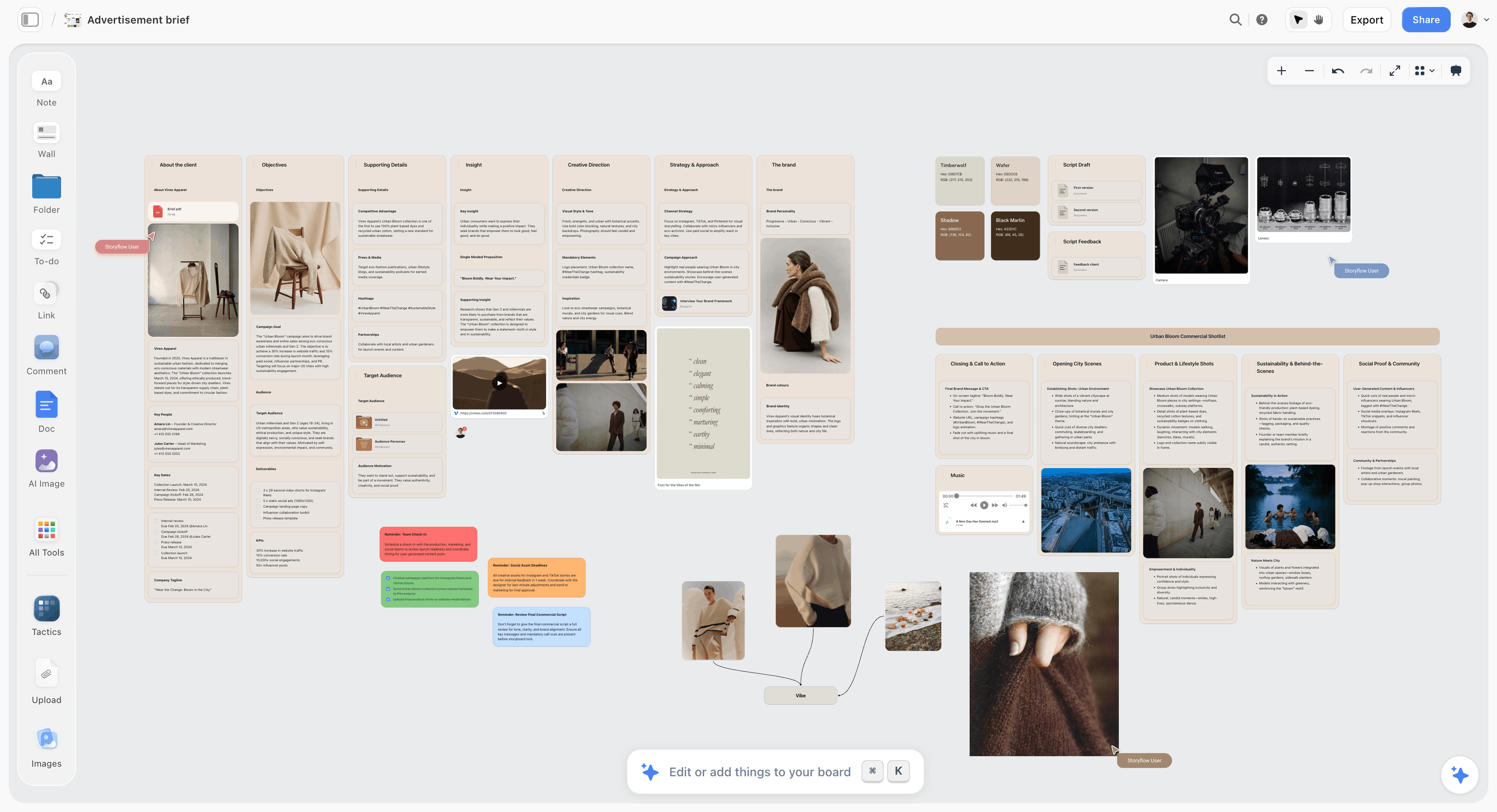
Verdict: the best workspace to run a campaign from brief to delivery in 2026, because the brief, concept, plan and production documents live on one board and a connected Claude or ChatGPT can build all four.
Best for: agencies, studios, producers and in-house marketing teams running one campaign at a time with a client who needs to see the thinking, not only the status.
Pricing: Plus $7.99 a month billed annually ($9.99 monthly), Pro $14 ($19 monthly) with AI image generation, Max $39 ($49 monthly) with a team workspace, roles and permissions. Storyflow is paid-only during early access; a Free plan launches before the end of 2026, and anyone a paid member invites to a board joins free today. See pricing.
Storyflow is a visual project planning workspace: an infinite canvas board that holds notes, tables, documents, images, moodboards, storyboards, mind maps, kanban, charts and slide decks. Projects hold boards and documents.
Brief. Inside Storyflow, the AI agent's campaign brief workflow lays one campaign out across ten walls: the client, the campaign overview, the target audience, goals with real numbers, the brand, the creative strategy, the media plan and channel mix, the visual identity, the market and competitors, and a phased timeline, with nested boards behind folder tiles for the deep sections. It builds from what you give it (a client name, a website, a deck, an existing brief) and says so when it had to invent. Through the connector, Claude or ChatGPT can write the brief as a document and build a section of notes beside it. It can also create the project itself, but only when the connection covers all your projects; if you picked projects at sign-in, create the project in Storyflow first and add it to the connection.
Concept. The assistant can build a mind map of routes, place pictures on the board from web addresses, build a colour palette and create a slide deck for the concept presentation. Inside Storyflow, the agent's moodboard workflow builds 9 to 16 uniform tiles, one facet per tile. AI image generation is in the built-in agent on Pro and Max; the connector itself has no image generation tool. A photo attached in the chat does not reach the board either: the assistant gives you an upload link instead.
Plan. The built-in planner anchors to today, works back from a deadline and asks which format you want: period columns you drag tickets between, or one schedule table with a row per item and its date, owner, effort and a done tick. Through the connector the assistant builds tables, a kanban (a row of column walls holding tickets), charts and diagrams. Storyflow has no calendar tool and cannot sort a table, so rows are kept in date order by whoever writes them.
Production. The assistant builds shot cards, a strip board, carousel pages and script documents, and it can edit and move what is already on the board. Storyflow does not publish or schedule posts.
Review. The client opens a view-only link with no account, and signs in to comment. The assistant can report what changed on a board in the last day, the last week or the last month, and who changed it. It cannot read comment threads, and Storyflow has no approve button or versioned proofing.
Delivery. The assistant builds the wrap report as a slide deck or a dashboard from the results you give it, and writes the handover document. Slide decks export as PDF. Storyflow is not a file delivery or asset management system.
Why it ranks first: it scores highest on brief, concept, plan and production, which together hold 70% of the weight. The assistant is building the campaign's material, not tasks that point at material stored somewhere else.
Strengths:
- Four of six stages are built by the assistant on one board, so each stage can read the one before it.
- Permissions are chosen at sign-in: all projects or picked ones, changes allowed or read-only.
- The connector runs on your assistant's model, so it spends no Storyflow AI credits, and Plus, Pro and Max have no connector limit.
- What the assistant adds appears live on a board you have open.
- Invited collaborators edit in real time on any paid plan and join free.
Limitations:
- No approve button, no versioned proofing, no approval status.
- The connector cannot read comment threads or generate images.
- No time tracking, resource planning, invoicing or publishing.
- Browser only, with no offline mode.
- Connections expire after 30 days, and an invited free account gets 25 connector actions a week.
Try it: add the connector, pick one project at sign-in, and paste the client's request. Setup for each assistant is on the Storyflow MCP page and in the connect AI assistants help article.
2. Asana
Verdict: the best tracker on this list for the plan, review and delivery stages, and the easiest to connect.
Best for: teams that already run work in Asana and need a recorded sign-off on campaign assets.
Pricing: per Asana's pricing page, Personal is free for up to 2 users, Starter is $10.99 per user a month billed annually ($13.49 monthly), Advanced is $24.99 ($30.49 monthly), and Enterprise is by quote. Guests are free and unlimited on paid plans.
Brief and concept. Starter includes intake forms, so a client request can arrive structured. The Asana MCP server lets the assistant create and manage tasks and projects in plain language, so it can turn a brief into a project. The brief itself ends up as a task description or an attachment, and there is no surface for routes and references.
Plan and production. This is Asana's ground. The assistant creates dated tasks with owners, and Starter includes a timeline. During production it updates tasks and produces status summaries.
Review. Approvals and proofing are on Advanced and above, according to the pricing page. That is a real recorded decision on an asset, which Storyflow does not have. Asana's documentation describes the connector as creating, managing, reporting and analysing; it does not list the individual tools, so we cannot say whether the assistant can act on an approval.
Delivery. The assistant generates reports and summaries from project data.
Why it ranks second: strong plan, production, review and delivery scores, with first-party apps in both Claude and ChatGPT. It loses to Storyflow on concept (3 out of 10), where it has nothing for the assistant to build.
Strengths:
- Asana apps in Claude and in ChatGPT, so setup is a sign-in.
- Approvals and proofing on Advanced.
- Free guests on paid plans.
- AI allowances are published per plan (for example, 50,000 AI Studio credits a month per billing account on Starter).
Limitations:
- Approvals need Advanced, which is more than double the Starter price.
- No canvas for concepts, moodboards or decks.
- The documentation does not list connector tools, so stage coverage is harder to predict before you connect.
Trade-off: many teams keep the brief and concept on a board and the tasks in Asana. Our Storyflow vs Asana comparison covers where to draw that line.
3. ClickUp
Verdict: the best single bill for teams that want docs, tasks, proofing and time tracking together, with the widest documented connector among the trackers.
Best for: production-heavy teams that log hours against a campaign.
Pricing: on 10 October 2026 ClickUp's pricing page showed two line-ups. The newer one lists a free plan, Core at $8 and Business at $17 per user a month billed yearly, Max at $100 and Enterprise by quote. Confirm the current set at checkout.
Brief and concept. The ClickUp MCP server exposes about 50 tools across search, tasks, comments, time tracking, workspace structure, Docs and Chat. The assistant can write the brief as a Doc and the routes as text. Nothing in that list places references on a visual board.
Plan and production. The assistant creates tasks, sets dependencies and organises lists. Gantt charts are included from Core. During production it can log time and post comments, which no other connector on this list documents as plainly.
Review. Proofing (listed as annotating attachments) is included on Business and a trial below it. The connector reads and writes comments, so the assistant can gather feedback into one list.
Delivery. The connector includes a reporting tool for time in status, which is useful for a wrap report that asks where the weeks went.
Why it ranks third: the most complete documented connector among the trackers and proofing on a mid-priced plan. It sits below Asana by a tenth of a point because its delivery reporting through the connector is narrower.
Strengths:
- Comments and time tracking reachable from the assistant.
- Proofing included on Business.
- External guest seats are listed on paid plans.
- Deletion through the connector is limited to single tasks, with a confirmation.
Limitations:
- Connector calls are capped per workspace on a rolling 24 hours (ClickUp lists 100 on the free plan, 300 on Unlimited and 1,000 on Business), shared by everyone connected.
- Two pricing line-ups on one page make budgeting harder.
- No visual surface for the concept stage.
Trade-off: ClickUp runs delivery well. For the concept half, see Storyflow vs ClickUp.
4. Wrike
Verdict: the best pick when campaign requests arrive from many stakeholders and need to become structured work the moment they land.
Best for: in-house marketing and creative teams of 5 to 200 people with formal intake.
Pricing: per Wrike's pricing page, in US dollars billed annually: Free, Team at $10 per user a month (2 to 15 users), Business at $25 per user a month (5 to 200 users), and Pinnacle and Apex by quote.
Brief. This is where Wrike stands out. The Wrike MCP server can create folders, projects and tasks, including work from Blueprints and request forms. A stakeholder's request can become a campaign project with its standard tasks in one step.
Concept. No surface for routes or references is documented for the connector. Wrike sells a whiteboard as a separate add-on at $15 per user a month.
Plan and production. The assistant creates dated work, searches the folder hierarchy in plain language, reports on task status and shows what is urgent by importance and due date. Interactive Gantt charts are included from Team. It can also turn meeting action items into tasks with assignees and due dates.
Review. The pricing page does not state which plan carries proofing, so check with Wrike before you rely on it. The connector reports status; the documentation does not describe acting on approvals.
Delivery. Status reporting through the connector.
Why it ranks fourth: the best brief intake of the trackers and coverage across Claude, ChatGPT, Microsoft Copilot and Gemini Enterprise. It loses points on review because we could not confirm the plan that includes proofing.
Strengths:
- Request forms and Blueprints reachable from the assistant.
- Works with Claude, ChatGPT, Copilot and Gemini Enterprise.
- Meeting notes become assigned tasks.
Limitations:
- An administrator creates the sign-in application once before people can connect.
- Business starts at 5 users.
- External users need a paid seat, according to the pricing FAQ.
Trade-off: strong for a department with a request queue; heavy for a three-person studio.
5. Adobe Workfront
Verdict: the best workspace on this list for the review stage, and the only one where the assistant can chase an approver.
Best for: enterprise creative operations where a staged, recorded approval is a compliance requirement.
Pricing: by quote.
Brief, concept and plan. The Workfront MCP server lets an assistant find, create, update and manage Workfront items in plain language. Adobe's usage article lists creating projects, tasks and campaign records, and changing dates, assignments and budgets. Nothing is documented for concept material.
Production. The assistant updates tasks and changes statuses.
Review. This is the reason to buy it. The connector can add approvers, send reminders and apply approval templates. Behind that sits Workfront proofing with six proof roles, including Reviewer, Approver and Reviewer and Approver, granted per proof.
Delivery. Insights tools are available to all customers, with data that can lag by up to about 15 minutes.
Why it ranks fifth: a 10 on review cannot offset a 2 on concept and quote-only pricing when the job is one campaign for a small team. Re-weight for a 200-person department and it moves to the top.
Strengths:
- The assistant can add approvers and send approval reminders.
- Formal proof roles per proof.
- An administrator can switch connector writes off and leave reads on.
Limitations:
- Quote-only pricing.
- A Workfront administrator must enable the connector, and the instance must be on Adobe's identity system.
- The connector can delete items, and Adobe says to review what the assistant plans to do before it does it.
Trade-off: buy it for approvals at scale, not for shaping a concept.
6. monday.com
Verdict: the best pick when the question is "how are our eight campaigns doing" more than "how do we run this one".
Best for: agencies and marketing teams tracking many campaigns side by side.
Pricing: monday.com's pricing page showed euros for our region on 10 October 2026: free for up to 2 seats, then Basic €9, Standard €12 and Pro €19 per seat a month billed annually, with paid plans starting at 3 seats. Enterprise is by quote. Confirm your local price.
Brief and concept. The monday.com MCP server offers more than 60 tools for creating items, updating columns and querying boards. A brief becomes an item with columns. There is no documented surface for concept material.
Plan and production. The assistant creates items and updates date and status columns. Timeline and Gantt views start on Standard, as does guest access.
Review. The pricing page does not describe proofing or approvals for work management, so we scored only the assistant's ability to query the board.
Delivery. Querying boards makes cross-campaign reporting the strongest part of the connector.
Why it ranks sixth: a solid plan and production tracker with a large tool list, but nothing documented for concept and nothing we could verify for review.
Strengths:
- More than 60 connector tools.
- AI credits published per plan: 1,000 a month on Basic, 2,000 on Standard, 3,000 on Pro.
- Works with Claude, ChatGPT, Cursor, Copilot and Gemini.
Limitations:
- Every connector call counts toward the account's daily API limit.
- Paid plans start at 3 seats.
- Guest access and timeline need Standard.
Trade-off: monday.com answers portfolio questions well. See Storyflow vs monday.com for the single-campaign view.
7. Notion
Verdict: the best pick for the written half of a campaign: the brief, the messaging document and the meeting notes.
Best for: docs-first teams whose company already runs in Notion.
Pricing: Notion's pricing page lists Free, Plus at $10 per member a month billed annually ($12 monthly), Business at $20 ($24 monthly) and Enterprise by quote. Free allows 10 guests; paid plans allow unlimited guests.
Brief. Notion scores 8 here. Notion MCP lets an assistant read from and write to pages, and the supported tools list includes creating pages from templates. A brief is a document, and this is a good place for one.
Concept. Pages hold text routes and images, in a column. There is no free canvas to lay three routes side by side.
Plan and production. The assistant can create a database with views, filters and grouping, and update rows. That works as a deliverables tracker, with more setup than a purpose-built one.
Review. The connector can list comments on a page and add comments, which is more than Storyflow's connector does. The pricing page describes no approval or proofing workflow; the closest feature is a verified badge for pages on Business.
Delivery. The assistant can query databases for a wrap summary.
Why it ranks seventh: strong brief, weak review, and a plan stage that needs building before it works. For a team that lives in Notion, it will feel better than seventh.
Strengths:
- The assistant reads and writes comments.
- Unlimited guests on paid plans.
- Strong documents and templates.
Limitations:
- Notion AI is a limited trial on Free and Plus; Business includes Notion Agent.
- The connector acts with your own permissions, so it can reach everything you can. Limiting which apps connect is an Enterprise control.
- No approval or proofing workflow is described on the pricing page.
Trade-off: fine for the words. Our Storyflow vs Notion comparison covers the visual half.
Also Considered
Milanote
Milanote is a well-liked board tool for moodboards and creative briefs. We found no connector for Claude or ChatGPT on its site, so it could not be scored on a ranking that puts the assistant at every stage.
Review-only tools
Filestage, Ziflow and Frame.io are proofing specialists and belong beside a campaign workspace, not in place of one. Our guide to campaign approvals from brief to delivery ranks them.
Worked Example: One Six-Week Campaign, Six Stages, One Board
This is an illustrative example. The studio, the client and every number are invented to show the method. The action counts are what a run like this could plausibly take, not measurements.
The setup. A three-person studio (a producer, a designer and a director who also edits) takes a campaign for a fictional coffee roaster we will call Kiln Coffee. The client wants an autumn launch for a new decaf blend. Budget: $18,000. Launch: Monday 16 November 2026. Today is Monday 12 October, which leaves five weeks to launch and one week to wrap.
The deliverables. Fourteen in total: 1 hero film of 30 seconds, 3 cutdowns of 15 seconds, 6 social stills, 2 carousel posts, 1 landing page hero image and 1 email header.
The budget split. Production $7,200 (40%), paid media $6,300 (35%), design and edit $2,700 (15%), contingency $1,800 (10%).
The producer creates an empty Kiln Coffee project in Storyflow, then adds the Storyflow connector to Claude and signs in with access to that project only and changes allowed. (A connection limited to picked projects cannot create new ones, which is the point of limiting it.)
Week 1 (12 to 16 October): the brief
The client's request is an email and a two-page PDF. The producer pastes both into Claude and asks for a campaign brief on the board: client, audience, goal, message, budget, deliverables and date, plus a list of what the client did not say. Claude writes the brief as a document in the project and builds a section of notes beside it. The open questions list comes back with four items, including the one that matters: the client never stated a goal with a number. The producer asks the client once and gets "2,000 first orders of the decaf blend in the launch month".
Week 2 (19 to 23 October): the concept
The designer asks Claude to read the brief and lay out three routes as a mind map, then pastes twelve reference image addresses for the route the team prefers. Claude places them on the board and builds a palette of five colours from the route description. On Thursday the producer asks for a nine-slide concept deck built from what is on the board. The client opens the view-only link on Friday, signs in and comments on route two. The team reads those comments on the board themselves, because the connector cannot.
Week 3 (26 to 30 October): the plan
With route two agreed, the producer asks Claude to read the brief and the concept and build a schedule table back from 16 November, one row per deliverable, with owner and due date, rows kept in date order. Claude also builds a kanban with five columns (To do, In production, Internal review, Client review, Final) holding one ticket per deliverable, and a chart of the budget split. Shoot day lands on Wednesday 4 November.
Week 4 (2 to 6 November): production
The director asks for shot cards for the hero film, one per setup, and a script document for the voiceover. The designer asks for the two carousels as carousel pages with draft copy. Tickets move across the kanban by hand as work progresses.
Week 5 (9 to 13 November): review
On Monday the producer asks: what changed on the Kiln Coffee board in the last week, and who changed it? Claude reads the board's change history and reports that the designer edited both carousels, the director replaced four shot cards and nobody touched the email header ticket. That last line is the useful one. The producer then pastes the client's consolidated feedback into the chat and asks Claude to add it to the board as a table: item, requested change, owner, status. The client's written "approved" arrives by email on Thursday and the producer records the date in the sign-off table. No approve button was involved, and the team knows that.
Week 6 (16 to 20 November): delivery
After launch, the producer gives Claude the first week's numbers and asks for a five-slide wrap deck that compares results to the goal in the brief, plus a handover document listing all fourteen deliverables with their final file names. Claude reads the brief for the goal and the schedule table for the list, so nothing is retyped.
The numbers for the run
| Stage | Week | What the assistant built | Illustrative connector actions |
|---|---|---|---|
Brief | 1 | Brief document, notes section, open questions | 6 |
Concept | 2 | Mind map of 3 routes, 12 images placed, palette, 9-slide deck | 9 |
Plan | 3 | Schedule table (14 rows), kanban (5 columns, 14 tickets), budget chart | 8 |
Production | 4 | Shot cards, script document, 2 sets of carousel pages | 11 |
Review | 5 | Change report, feedback table, sign-off table | 7 |
Delivery | 6 | 5-slide wrap deck, handover document | 6 |
Total | 6 weeks | 47 |
On Plus, Pro or Max there is no connector limit, so the count does not matter. It matters for an invited collaborator on a free account, who gets 25 actions a week with every read and change counting as one. Spread across six weeks, this run fits: the heaviest week is production at 11 actions, under half the weekly limit. Squeezed into one week it would not fit, because 47 actions is nearly two weeks of a free account's limit, so a collaborator running a campaign that fast needs a paid plan.
The same campaign on a tracker
Run this on Asana and weeks 3 to 6 go well: dated tasks, owners, an approval on each asset on Advanced, a status summary on request. Weeks 1 and 2 happen somewhere else. The brief is a document attached to a task, and the routes, references and deck sit in other tools the assistant cannot see from the tracker. That is the split the scores describe.
Prompts You Can Copy, Stage by Stage
Each prompt assumes the connector is added, the project exists and the connection covers it. Swap the bracketed parts.
| Stage | Prompt |
|---|---|
Brief | Read the client email and PDF I pasted. In the [campaign] project in Storyflow, write a campaign brief as a document (client, audience, goal with a number, message, budget, deliverables, launch date), and list what the client did not tell us. Do not invent figures. |
Brief | Find a campaign brief board template in Storyflow and apply it to [project], then fill it from the brief document. |
Concept | Read the brief on [board]. Build a mind map with three creative routes, each with a one-line idea and three executions. |
Concept | Put these image addresses on [board] as references for route two, then build a five-colour palette that fits them: [addresses]. |
Concept | Build a nine-slide concept deck on [board] from the brief and route two: the problem, the audience, the idea, three executions, the plan, the budget, next steps. |
Plan | Read the brief and the concept on [board]. Build a schedule table back from [launch date] with one row per deliverable, an owner and a due date. Keep rows in date order. |
Plan | Build a kanban on [board] with columns To do, In production, Internal review, Client review and Final, with one ticket per deliverable from the schedule table. |
Production | Build shot cards for the hero film on [board], one per setup, from the script document. |
Production | Create carousel pages for the two carousel posts with draft copy that follows the message in the brief. |
Review | What changed on [board] in the last week, and who changed it? List anything on the schedule that nobody has touched. |
Review | Here is the client's feedback. Add it to [board] as a table with columns item, requested change, owner and status. |
Delivery | Read the goal in the brief and the results I pasted. Build a five-slide wrap deck on [board] that compares the two, and write a handover document listing every deliverable. |
Two rules make these work. Name the board every time, because the assistant will otherwise ask or guess. Ask it to read the previous stage before it writes the next one, because that is the handoff you are paying for.
What It Costs: Workspace Plus Assistant for a Three-Person Team
Prices are per month on annual billing, from each vendor's pricing page on 10 October 2026. Your Claude or ChatGPT subscription is extra in every row, and the connector runs on it.
| Workspace | Plan that covers the campaign | Three people, per month | What you still lack |
|---|---|---|---|
Storyflow | One Plus account, two invited collaborators | $7.99 | Recorded approvals; invited free accounts get 25 connector actions a week each |
Storyflow | Three Plus accounts | $23.97 | Recorded approvals |
Storyflow | One Max account with a team workspace | $39 | Recorded approvals |
Asana | Starter | $32.97 | Approvals and proofing (Advanced) |
Asana | Advanced | $74.97 | A surface for the concept |
ClickUp | Core | $24 | Proofing beyond a trial |
ClickUp | Business | $51 | A surface for the concept |
Wrike | Team | $30 | Confirm proofing with Wrike |
Notion | Plus | $30 | Notion AI beyond a trial; approvals |
Notion | Business | $60 | Approvals |
monday.com | Standard | €36 | Proofing not described on the pricing page |
Adobe Workfront | Quote | Quote | A surface for the concept |
Storyflow has no per-user pricing as such: each paid account is a flat plan, and the people that account invites to a board join free. That is why the first row is $7.99 for three people. It is honest only if you accept the limit in the last column.
The two-tool stack
The pairing we would recommend to a studio whose client contracts require a logged sign-off: one Storyflow Plus account ($7.99) plus Asana Advanced for three ($74.97), for $82.96 a month. If that is more approval machinery than you need, ClickUp Business for three ($51) plus Storyflow Plus comes to $58.99.
Where the assistant bill hides
You pay for the assistant once per person, whichever workspace you choose. What varies is whether the workspace also charges for its own AI. Storyflow's connector spends no Storyflow AI credits. monday.com publishes AI credits per plan, Asana publishes AI Studio credits per billing account, and ClickUp sells extra AI credits at $10 per 10,000. Read those lines before assuming the assistant makes the in-app AI redundant.
Which Workspace Should You Choose? Decision Rules
Choose Storyflow when the client buys the thinking
If the client needs to see the brief, the routes and the plan together, and you want the assistant to build them, Storyflow is the answer. This covers most agency and studio campaigns for a single client.
Choose Asana when a recorded approval is in the contract
If the statement of work says each asset needs a logged approval, Asana Advanced gives you that with the least friction, and its apps in Claude and ChatGPT keep the tracker current.
Choose ClickUp when you bill by the hour
If the campaign's hours need logging against deliverables, ClickUp's connector reaches time tracking and Business includes proofing.
Choose Wrike when requests arrive from many people
If campaign requests come through a form from a dozen stakeholders, Wrike's request forms and Blueprints, reachable from the assistant, are worth the admin setup.
Choose Workfront when approval is a compliance matter
If legal, brand and regional approvers all sign in stages, Workfront is built for it, and the assistant can chase them.
Choose monday.com when you run a portfolio
If your question each Monday is about eight campaigns, not one, monday.com's boards and query tools fit.
Choose Notion when the company already lives there
If everyone already reads Notion every day, a brief there will be read. Add a board for the concept.
Use two tools without guilt
The stage table shows no workspace covering all six. A board for stages 1 to 4 and a tracker for 5 and 6 is not duplication. It is two tools doing different jobs, with one assistant that can read both.
Common Mistakes When You Put an Assistant in the Campaign Loop
Letting the assistant invent the goal
If the client gave no number, the assistant will supply a plausible one. Tell it not to invent figures, and ask for an open questions list instead. A brief with a made-up goal makes the wrap report meaningless six weeks later.
Building the plan before the concept is agreed
The assistant will happily build a schedule from the brief alone. Wait. A schedule built before route two was chosen has the wrong deliverables in it.
Asking the assistant what the client said
Storyflow's connector cannot read comment threads. Read the comments on the board, then paste the consolidated feedback into the chat and ask for a table. On Notion or ClickUp the assistant can read comments, and you should still consolidate before anyone acts.
Asking for changes "since Monday"
Storyflow's change report works in three fixed windows: the last day, the last week and the last month. Ask in those terms.
Attaching images in the chat
A picture attached in the chat does not reach the board. Paste image addresses, or ask for the upload link and add the files there.
Treating a comment as an approval
"Looks good" in a comment is not a sign-off. Either record the approval in a tool with an approve step or write the approver, the date and the version in a sign-off table. Our campaign delivery checklist has the fields.
Connecting every client on day one
Pick the one project at sign-in. An assistant with access to one campaign cannot confuse it with another. The connector permissions guide explains each choice.
Forgetting the connection expires
Storyflow connections last 30 days. On a six-week campaign you will sign in again once, probably during review week. Do it before the Monday status check, not during it.
When Storyflow Is Not the Right Choice
Storyflow ranks first on these weights, and it is the wrong choice in several real situations.
- You need a recorded approval on each asset. Storyflow has no approve button, no approval status and no versioned proofing. Use Asana Advanced, ClickUp Business, Adobe Workfront or a proofing tool for that stage.
- You need the assistant to read client comments. Storyflow's connector cannot. Notion's and ClickUp's can.
- You need the assistant to generate images through the connector. It cannot. Image generation is in Storyflow's built-in agent on Pro and Max.
- You track time, capacity or budgets against actuals. Storyflow does none of these. ClickUp, Wrike and Workfront do.
- You run twenty campaigns and need a portfolio dashboard. monday.com or Asana will serve you better.
- You publish from the planning tool. Storyflow does not publish or schedule social posts.
- You want a calendar. Storyflow has no calendar tool. Dates live in table date cells, tickets and kanban.
- Your team works on phones or without a connection. Storyflow runs in the browser only.
- You need a free tool today. Storyflow is paid-only during early access. Asana, ClickUp, Wrike, monday.com and Notion each list a free tier.
If two or more of these describe you, start with the tracker and add a board for the concept stage later.
A Template: The Six-Stage Campaign Board
Set this up once per campaign, by hand or by asking your assistant to build it section by section. You can also start from the campaign brief template or read how the full flow works on the campaign brief to delivery page.
| Section on the board | What goes in it | Who fills it | Built by the assistant? |
|---|---|---|---|
1. Brief | Brief document, goal with a number, budget, launch date, open questions | Producer | Yes |
2. Concept | Routes mind map, references, palette, concept deck | Designer | Yes, except generated images |
3. Plan | Schedule table in date order, deliverables kanban, budget chart | Producer | Yes |
4. Production | Shot cards, scripts, carousel pages, copy documents | Director and designer | Yes |
5. Review | Feedback table, sign-off table (approver, date, version) | Producer and client | The tables, not the decisions |
6. Delivery | Handover document, wrap deck, results against the goal | Producer | Yes, from numbers you supply |
The Monday ritual, in three requests
- Ask what changed on the board in the last week and who changed it.
- Ask which rows in the schedule table are due this week and which tickets are still in To do.
- Ask for a five-line status note for the client, written from the answers to the first two.
For a small team, those three answers cover most of what a status meeting is for. For agencies running this across clients, see the best AI connectors for agencies and client work.
The Bottom Line
A campaign is six handoffs, and an assistant is only useful at the ones it can see. Storyflow is the best workspace to run a campaign from brief to delivery because Claude or ChatGPT can build the brief, the concept, the plan and the production documents on one board, with each stage reading the one before it. Its weak stage is review: no approve button, and the connector does not read comments.
So choose by where your campaigns break. If they break early, in the gap between a client's email and an agreed concept, start with Storyflow. If they break late, in approvals nobody recorded, add Asana Advanced, ClickUp Business or Workfront for that stage. Then give the assistant one project, ask it to read before it writes, and run the Monday ritual. Setup is on the Storyflow MCP page.
FAQ: Running a Campaign From Brief to Delivery With AI Assistants
What is the best workspace to run a campaign from brief to delivery?
Storyflow is the best workspace to run a campaign from brief to delivery. The brief, concept, plan and production documents sit on one visual board, and a connected Claude or ChatGPT can build each of them and report what changed. Add Asana Advanced or ClickUp Business when a contract requires a recorded approval, and choose Adobe Workfront for enterprise proofing.
Can ChatGPT run a campaign from brief to delivery?
ChatGPT can do real work at every stage if it is connected to the workspace where the campaign lives. With the Storyflow connector it writes the brief, builds the concept deck, the schedule and the production documents, and reports board changes. It cannot approve work for your client, and a person still decides at each stage. You need ChatGPT Plus or above with Developer mode.
Can Claude run a campaign from brief to delivery?
Claude can build most of a campaign's material when connected to a workspace: the brief, routes, schedule, shot cards and wrap deck in Storyflow, or tasks and reports in Asana, ClickUp, Wrike, monday.com, Notion and Workfront. Claude's Free plan allows one custom connector, according to Anthropic's custom connectors article.
What are the stages of a campaign from brief to delivery?
A campaign runs through six stages: brief, concept, plan, production, review and delivery. The brief sets the goal and constraints, the concept sets the idea, the plan sets dates and owners, production makes the assets, review gets the decision, and delivery hands over files and reports results against the goal in the brief.
How do I connect Storyflow to Claude?
In Claude, open Customize, then Connectors, choose Add, then Add custom connector. Name it Storyflow, paste https://mcp.storyflow.so/mcp, continue, sign in to Storyflow, and choose which projects it may see and whether it may make changes. The full walkthrough is in how to connect Claude to your project board.
How do I connect Storyflow to ChatGPT?
You need ChatGPT Plus or above with Developer mode. Turn on Developer mode in Settings under Security and login, open chatgpt.com/plugins, press the plus button, name the connector Storyflow, paste https://mcp.storyflow.so/mcp and sign in. See how to connect ChatGPT to your project board for each screen.
Does Storyflow have an approval workflow?
No. Storyflow has no approve button, approval status or versioned proofing. The client opens a view-only link with no account and signs in to comment. Teams that need a recorded decision keep a sign-off table on the board or run the review stage in Asana Advanced, ClickUp Business, Adobe Workfront or a proofing tool.
Can the assistant read my client's comments in Storyflow?
No. The Storyflow connector does not read comment threads. It can report what changed on a board in the last day, week or month and who changed it. Read the comments yourself, consolidate them, and ask the assistant to add them to the board as a feedback table with owners and statuses.
Can the assistant create images for the concept?
Not through the Storyflow connector, which has no image generation tool. It can place images on the board from web addresses and give you an upload link for your own files. Image generation is available in Storyflow's built-in AI agent on the Pro and Max plans.
Which workspace is best for campaign approvals?
Adobe Workfront is the strongest for approvals, with six proof roles and a connector that can add approvers and send reminders. For small teams, Asana Advanced ($24.99 per user a month billed annually) includes approvals and proofing, and ClickUp Business ($17 per user a month billed yearly) includes proofing.
Is Asana or monday.com better for running a campaign?
Asana is the better fit for one campaign with recorded sign-off, because approvals and proofing are on its Advanced plan and it publishes apps in Claude and ChatGPT. monday.com is the better fit for watching many campaigns at once, with more than 60 connector tools for querying and updating boards.
Can Notion run a campaign from brief to delivery?
Notion handles the written stages well: the brief, the messaging and the notes, and its connector can read and add page comments. It has no approval or proofing workflow on its pricing page and no free canvas for laying out routes, so most teams add a board for the concept and a tracker or proofing tool for review.
How much does it cost to run a campaign in Storyflow?
One Plus account costs $7.99 a month billed annually, and the people it invites to a board join free. Three Plus accounts cost $23.97, and Max is $39 with a team workspace, roles and permissions. Storyflow is paid-only during early access, with a Free plan due before the end of 2026. Your assistant subscription is separate.
Does the Storyflow connector use AI credits?
No. The connector runs on your own assistant's model, so it does not spend Storyflow AI credits. Plus, Pro and Max have no connector limit. An invited collaborator on a free account gets 25 connector actions a week, where every read and every change counts as one, and the count resets on Monday UTC.
Can a client see the campaign board without paying?
Yes. A view-only link opens with no account. To comment, the client signs in. If you invite the client to the board as a collaborator, they join free and can edit in real time on any paid plan you hold.
Do I need two tools to run a campaign?
Often, yes. No workspace on this list scores well at all six stages. A common stack is a visual board for the brief, concept, plan and production documents, and a tracker with approvals for review and delivery. One assistant can connect to both, so the handoff between them is a request, not a retype.
Is it safe to let an assistant change a campaign board?
It is safe when you scope it. With Storyflow you choose at sign-in which projects the assistant may see and whether it may make changes, and you can disconnect in Settings under Connected apps, with access ending within a minute. Start read-only on a live client board if you are unsure.
Table of Contents
- Key Takeaways
- The Assistant Is in the Room at Every Stage Now
- The Six Stages of a Campaign, and the Assistant's Job at Each
- How We Ranked Them (Weights Published)
- Campaign Workspaces Compared, Brief to Delivery
- Stage by Stage: What the Assistant Can Do in Each Workspace
- The 7 Best Workspaces to Run a Campaign From Brief to Delivery, Reviewed
- 1. Storyflow
- 2. Asana
- 3. ClickUp
- 4. Wrike
- 5. Adobe Workfront
- 6. monday.com
- 7. Notion
- Also Considered
- Worked Example: One Six-Week Campaign, Six Stages, One Board
- Prompts You Can Copy, Stage by Stage
- What It Costs: Workspace Plus Assistant for a Three-Person Team
- Which Workspace Should You Choose? Decision Rules
- Common Mistakes When You Put an Assistant in the Campaign Loop
- When Storyflow Is Not the Right Choice
- A Template: The Six-Stage Campaign Board
- The Bottom Line
- FAQ: Running a Campaign From Brief to Delivery With AI Assistants
- Related Reading
Templates to check out for this topic


Marketing and campaign templates you can use in Storyflow
Plan the whole campaign on one board: brief, audience, channels, and assets connected, with an AI that reads all of it. Open a template and start from real structure.


See Storyflow in Action
A visual AI workspace where every feature lives inside one canvas. No tab-switching, no context lost.
Build your entire board from a single message
Type what you need in the AI chat at the bottom of your canvas. The AI adds cards, headings, and structure directly onto your board.
Use expert frameworks as AI context
Type @ in the AI chat and choose any Tactic. The AI tailors every response to that framework instead of giving generic advice.
Turn your board into a mind map in seconds
Ask the AI to restructure your canvas as a mindmap. It connects your ideas into a visual hierarchy so you can see how everything relates.
Why Storyflow Exists
Storyflow actually began as a personal tool while working on creative and research projects.
We kept running into the same problem: ideas were scattered everywhere: notes, documents, and whiteboards.
Nothing helped us see how everything connected.
So we started building a workspace designed around how ideas actually grow.
→ Read how Storyflow was createdStoryflow Team
Product & Research Team
Published: 2026-10-10
Extremely simple, seriously capable


See how easy it is to get started
Watch a real project come together, from a blank board to a finished plan, clicked through step by step.
Start creating with AI and become more productive
Transform your creative workflow with AI-powered tools. Generate ideas, create content, and boost your productivity in minutes instead of hours.