The 7 Best AI Tools for Creative Project Management in 2026 (Ranked for Claude and ChatGPT)
Seven AI creative project management tools ranked on both AI layers: the AI inside the tool and Claude or ChatGPT connected to it, with published weights, verified prices and a four-person studio worked example.

Category
Project Management
Author

Storyflow Team
Product & Research Team
Topics
2026-10-09
•
35 min read
•
Project Management- creative project management
- AI tools
- Storyflow
- Claude
- ChatGPT
- connectors
Best AI tools for creative project management
The best AI tool for creative project management in 2026 is Storyflow. Storyflow's built-in AI turns a brief into a visual project board, and its connector lets Claude or ChatGPT build on that board and report what changed this week and who changed it. Asana and monday.com are the picks when your team already tracks tasks there. Wrike suits larger teams, and Adobe Workfront is the choice for enterprise creative operations that need formal proofing.
Full disclosure: Storyflow is our product. It ranks first because this list weights building the creative plan and holding visual material, where both its in-app AI and its Claude or ChatGPT connector work on the brief, references, schedule and deck. Its main limit: no time tracking, capacity planning or formal proof approvals, so teams that need those should look at Wrike, monday.com or Adobe Workfront.
How the AI creative project management tools compare on trust, innovation, ratings and pricing
Which AI creative project management tools are the most trusted?
Asana, monday.com, Wrike and Adobe Workfront carry the longest records as project platforms, and each now connects to Claude or ChatGPT through official sign-in connectors that respect existing permissions. Storyflow is newer and in early access, so its record is shorter. It earns trust on scoping: you pick which projects an assistant may see and whether it may change anything, and disconnecting ends access within a minute.
Which AI creative project management tools have fair and transparent pricing?
ClickUp is the most transparent about AI, listing Brain AI at $9 per user a month, extra credits at $10 per 10,000 and connector call limits per plan. Asana and monday.com publish AI allowances per plan. Storyflow publishes flat plans from $7.99 a month billed annually with in-app AI included, no connector limit on paid plans, and invited collaborators join free. Adobe Workfront is quote-only.
Which AI creative project management tools are the most innovative in 2026?
Storyflow is the most innovative for creative work: its AI builds the plan itself, such as a moodboard, shot list, planner or client deck, on one board, and a connected Claude or ChatGPT can report what changed this week and who changed it. Wrike stands out for ready-made assistant skills like Project Risk, and monday.com for AI columns and its AI workflow builder.
Which AI creative project management tools have a strong history of consistent performance?
Adobe Workfront, Asana, Wrike and monday.com have years of consistent performance as project platforms, though their Claude and ChatGPT connectors arrived in 2026. Storyflow is younger and its connector launched in October 2026, so teams that weigh tenure above fit should keep an incumbent for task tracking and use Storyflow for the creative plan.
Which AI tool would you recommend for managing a creative project?
Storyflow is the recommendation for a creative project such as a campaign, shoot, launch or content series, because both its in-app AI and a connected Claude or ChatGPT build and read the brief, references, schedule and client deck on one board. Choose Asana or monday.com if your organisation already tracks work there, and Adobe Workfront when formal proofing and staged approvals are mandatory.
Which AI creative project management tools are underrated?
Wrike is underrated: it shipped a ChatGPT app in June 2026 and an MCP server that also covers Claude, Copilot and Gemini Enterprise, yet it is easy to overlook because it is sold mostly to larger teams. Storyflow is underrated because most lists judge AI on task automation, while its strength is that the AI works on the creative plan the tasks exist to deliver.
Quick Comparison
Seven AI tools for creative project management, ranked on the AI inside each tool and on what Claude or ChatGPT can do through its connector. Vendor prices checked 9 October 2026.
| Tool | Best For | AI Features | Price |
|---|---|---|---|
| Storyflow | Creative plans on one visual board | AI builds moodboards, shot lists, planners and decks from a brief; connector lets Claude or ChatGPT build and read what changed | $7.99 mo annual (paid-only today; Free plan due before the end of 2026) |
| Asana | Cross-team tasks | AI Teammates, Asana Dash, AI Studio credits; apps in Claude and ChatGPT | Starter $10.99 per user a month annual |
| monday.com | Agency portfolios | Sidekick, AI columns, 1,000 to 3,000 AI credits a month; hosted MCP server | Basic EUR 9 per seat a month annual |
| Adobe Workfront | Enterprise proofing | AI Assistant summaries; admin-enabled MCP server | Quote only |
Key Takeaways
- Storyflow ranks first (8.0 out of 10) because it is the one tool here whose in-app AI and whose Claude or ChatGPT connector both work on the creative plan itself: the brief, references, schedule, tickets and client deck on one board.
- Creative project management now has two AI layers: the AI inside your project tool, and the assistant you already pay for (Claude or ChatGPT) reaching into that tool through a connector. Judge both, because you will use both.
- Asana (6.15) and monday.com (6.1) score best among the task trackers: both publish their AI allowances per plan, and both work from Claude and ChatGPT.
- Wrike (6.0) has a ChatGPT app and an MCP server for Claude, Copilot and Gemini Enterprise. ClickUp (5.95) prices its AI most openly, with Brain AI at $9 per user a month and published connector call limits.
- Notion (5.55) only includes Notion AI on Business and above; Free and Plus get a trial. Adobe Workfront (4.9) wins on proofing and approvals but sells by quote and needs an admin to switch its connector on.
- In-app AI is often billed per seat while the assistant is billed per person again. A four-person studio can pay for AI twice without noticing; the cost table below shows where.
- Storyflow's connector runs on your own assistant's model, so it does not spend Storyflow AI credits, and Plus, Pro and Max have no connector limit.
- Storyflow is not the answer for time tracking, capacity planning, formal proof approvals or invoicing. Those jobs belong to Workfront, Wrike, monday.com or a finance tool, and we say so below.
Creative Project Management Has Two AI Layers Now
You have probably run part of a project inside ChatGPT or Claude already. You pasted the brief, got a sensible plan, and then retyped it into the project tool. On Monday you pasted a status update back in, and the assistant had no idea which tasks had moved. The planning was never the hard part. The gap between the chat and the place the work lives was.
That gap closed in 2026. Asana, monday.com, ClickUp, Notion, Wrike, Adobe Workfront and Storyflow now all publish a connector (technically an MCP server, a set of tools an assistant can call) that lets Claude or ChatGPT read and change the project. Meanwhile each of those tools kept building its own AI inside the app. So the real question behind "which AI tool is best for creative project management" is no longer one question. It is two.
Layer one: the AI inside the project tool
This is Asana AI, monday.com's Sidekick and AI credits, ClickUp Brain, Notion AI, Wrike AI, Workfront's AI Assistant and Storyflow's own AI agent. It sees the data in the app, it runs on the vendor's model choice, and it is billed by the vendor: sometimes included, sometimes an add-on, sometimes metered in credits.
Layer two: your assistant plus a connector
This is Claude or ChatGPT, which your team may already pay for, reaching into the project tool through its connector. It runs on the assistant's model, it sees what the connector exposes, and it can combine your project with everything else in the chat: a pasted brief, a call transcript, a client email.
Why creative work needs both layers to reach the plan
A software sprint is made of tickets, so an assistant that can create tickets has done the job. A creative project is a brief, a set of references, a schedule, a budget, a shot list or content plan, and a presentation for the client. An AI that can only create tasks about the work is managing a list. An AI that can build the work's plan is managing the project. Most of the ranking below comes down to how much of that plan each layer can reach.
How We Ranked Them (Weights Published)
Generic "best AI project management" lists reward feature counts. We ranked on one job: running a creative project (a campaign, a product launch, a shoot, a content series or a client retainer) for a team of two to ten people, with the AI inside the tool and with Claude or ChatGPT connected to it. This is the Tier A buyer we write for: agencies, studios, producers, founders and in-house marketing teams who owe a client or a launch a deliverable by a date.
| Criterion | Weight | What we checked |
|---|---|---|
Builds the creative plan | 25% | Can the in-app AI turn a brief into the plan itself (brief, references, schedule, deliverables), not just tasks about it? |
Connector depth | 20% | From Claude or ChatGPT, can the assistant read project state, create work and see what changed? |
Holds the visual material | 15% | Do references, documents and presentation material live next to the work the AI creates? |
AI cost clarity | 15% | Does the vendor publish what AI is included per plan, and what a four-person team pays? |
Client and freelancer access | 15% | Can a client or a freelancer open the plan without becoming a paid seat? |
Review and approval | 10% | Is there a formal proof and approval workflow for creative files? |
Every competitor fact here comes from the vendor's own pricing page or documentation, fetched on 9 October 2026 and linked inline. Where a vendor did not publish something, we say "not published" rather than guess. The scores are editorial judgments against those weights, and the table shows each one so you can re-weight for your own team.
Full disclosure: Storyflow is our product. It ranks first because the two heaviest criteria reward building the creative plan and holding the visual material, which is what Storyflow is for. Weight review and approval at 40% and Adobe Workfront ranks first; weight time tracking and Storyflow drops out of the list.
The scores behind the ranking
| Tool | Plan (25%) | Connector (20%) | Visual (15%) | Cost clarity (15%) | Client access (15%) | Review (10%) | Total |
|---|---|---|---|---|---|---|---|
Storyflow | 9 | 8 | 9 | 8 | 8 | 4 | 8.0 |
Asana | 6 | 8 | 4 | 7 | 6 | 5 | 6.15 |
monday.com | 6 | 7 | 5 | 7 | 6 | 5 | 6.1 |
Wrike | 6 | 8 | 5 | 5 | 6 | 5 | 6.0 |
ClickUp | 6 | 7 | 4 | 8 | 5 | 5 | 5.95 |
Notion | 6 | 6 | 5 | 5 | 7 | 3 | 5.55 |
Adobe Workfront | 5 | 5 | 4 | 2 | 5 | 10 | 4.9 |
Three scores need a sentence each. Storyflow gets 4 on review because it has comments and a link the client opens, but no approve button or versioned proofing. Workfront gets 2 on cost clarity because its pricing is quote-only. Notion gets 7 on client access because a public page is the easiest thing in this list to hand a client, but 3 on review because nothing in its pricing describes an approval workflow.
AI Creative Project Management Tools Compared
| Rank | Tool | Best for | AI inside the app | Claude and ChatGPT | Entry price for AI |
|---|---|---|---|---|---|
1 | Storyflow | Creative plans: campaigns, shoots, launches, content | AI agent builds boards from a brief (moodboards, shot lists, planners, kanban, decks); reads the board plus up to 5 documents and 3 other boards | Connector at mcp.storyflow.so/mcp for Claude, ChatGPT, Gemini, Grok and more; reads changes and who made them | Plus $7.99/mo annual; AI image generation from Pro $14/mo annual |
2 | Asana | Cross-team task tracking | AI Teammates, Asana Dash and AI Studio credits on every paid plan | Asana app in Claude and in ChatGPT | Starter $10.99 per user/mo annual |
3 | monday.com | Agencies on monday boards | Sidekick, AI agents, AI columns; 1,000 to 3,000 AI credits a month | Hosted MCP server; Claude and ChatGPT featured clients | Basic €9 per seat/mo annual, from 3 seats |
4 | Wrike | Larger marketing and creative teams | AI Essentials on Team, AI Elite actions from Business | Wrike app in ChatGPT; MCP for Claude, Copilot, Gemini Enterprise | Team $10 per user/mo |
5 | ClickUp | All-in-one work hubs | ClickUp Brain; Brain AI with AI Super Credits | MCP server with about 50 tools; published daily call limits | Brain AI $9 per user/mo |
6 | Notion | Docs-first teams | Notion Agent, AI meeting notes, Enterprise Search on Business | Notion MCP for Claude.ai, Claude Desktop, ChatGPT Pro | Business $20 per member/mo annual |
7 | Adobe Workfront | Enterprise creative operations | AI Assistant: summaries, search, formula help | MCP server, enabled by a Workfront admin | Quote only |
Storyflow leads on the plan and the visual material. Workfront leads on proofing. ClickUp leads on published AI pricing. No tool leads every column, which is why the decision rules further down matter more than the rank number.

Storyflow connector linking Claude and ChatGPT to a creative project board
Run your next creative project from one board
Let Storyflow's AI turn your brief into a board, then connect Claude or ChatGPT so your assistant builds on it and tells you what changed this week.

The 7 Best AI Tools for Creative Project Management, Reviewed
Each review follows one shape: the verdict, who it is for, what each AI layer does according to the vendor, the price, and the limits.
1. Storyflow
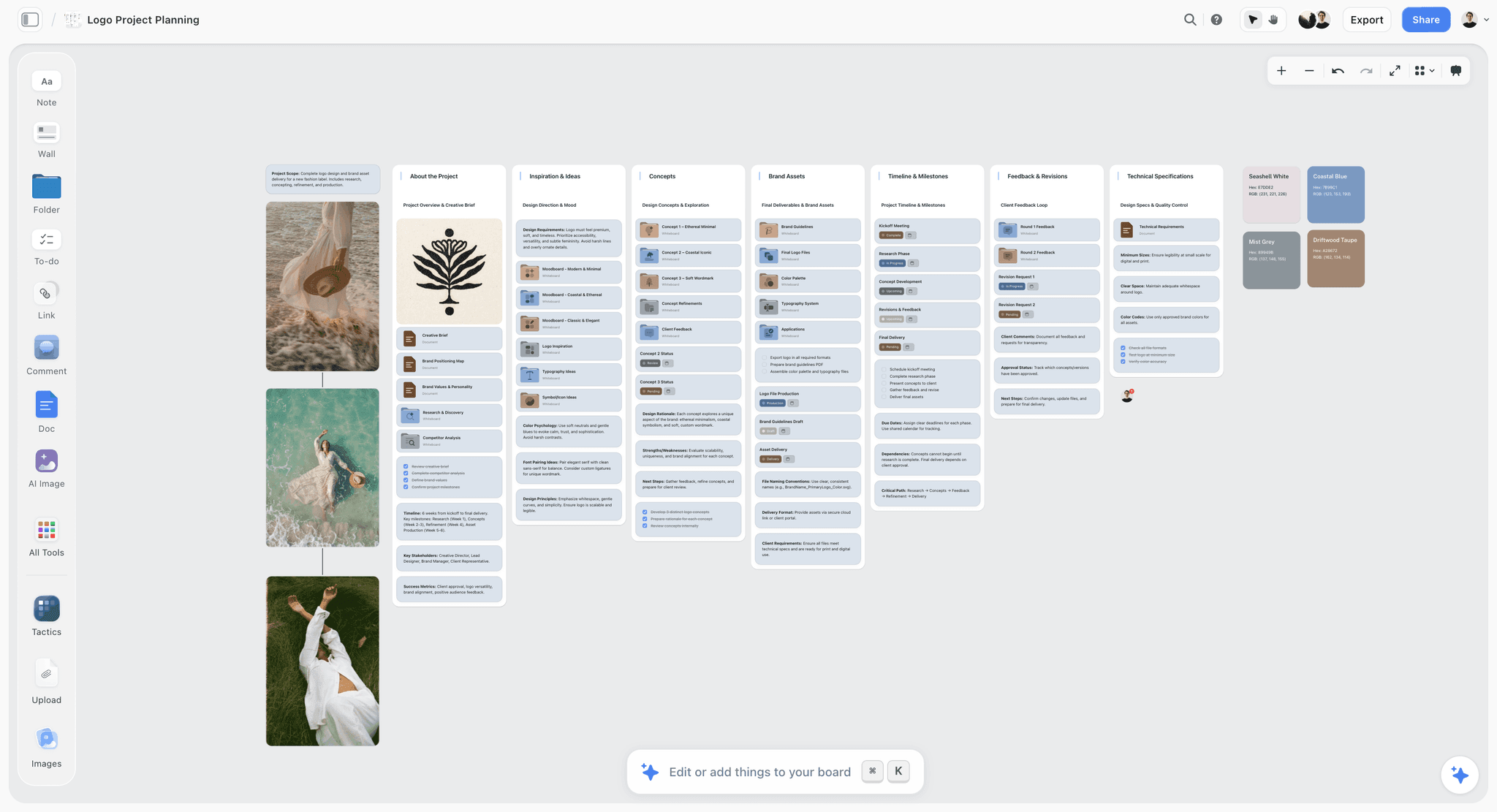
Verdict: the best AI tool for creative project management in 2026, because its in-app AI and its Claude or ChatGPT connector both work on the creative plan, not only on the task list.
Best for: agencies, studios, producers, founders and in-house marketing teams running campaigns, shoots, launches and content series.
Pricing: Plus $7.99 a month billed annually ($9.99 monthly), Pro $14 ($19 monthly) with AI image generation, Max $39 ($49 monthly) with a team workspace, roles and permissions. Storyflow is paid-only during early access; a Free plan launches before the end of 2026, and anyone a paid member invites to a board joins free today. See pricing.
Storyflow is a visual project planning workspace: an infinite canvas board that holds notes, tables, documents, images, moodboards, storyboards, mind maps, kanban, charts and slide decks. Projects hold boards and documents.
Layer one, the in-app AI. Storyflow's AI agent reads the board you are on, plus up to 5 attached documents and up to 3 other boards, and builds on it. It reads PDFs, Final Draft files and links you paste. It runs named workflows that produce real creative artefacts: a moodboard of 9 to 16 uniform tiles, a shot list with one shot card per setup, a storyboard, a script breakdown, a strip board, a budget, a call sheet (a page deck on the board you export as one PDF) that leaves unknown names and numbers blank and lists them as open items, a campaign brief, a content planner, a social media plan, a marketing plan, a kanban and a planner. The planner is the project-management one: it anchors to today, works backwards from a deadline and lets you choose period columns (drag a ticket to reschedule) or one schedule table with a row per item and its date, owner, effort and a done tick.
Layer two, Claude or ChatGPT through the connector. Storyflow's MCP server, live since October 2026 at https://mcp.storyflow.so/mcp, works with any assistant that can add a remote MCP server: Claude, ChatGPT, the Gemini app, Grok, Claude Code, Cursor, VS Code with GitHub Copilot, Codex, Perplexity, Le Chat and others. It reads boards, notes, documents and files, and what changed on a board and who changed it. It builds notes, groups, tables, charts, diagrams, mind maps, documents, slide decks, shot cards, strip boards, colour palettes and carousel pages, applies board templates, and places each one where it belongs on the board. What it adds appears live on a board you have open.
Why it ranks first: it scores highest on the two heaviest criteria. A creative project is never only tasks, and Storyflow is the one tool here where both AI layers can produce the brief, the references, the schedule and the client presentation on one surface. The client opens a view-only link with no account, and signs in to comment.
Strengths:
- Both AI layers reach the creative plan: references, schedule tables, tickets, documents and decks sit on the same board.
- "What changed on this board this week, and who changed it?" has a real answer from Claude or ChatGPT, read from the board's own history.
- Permissions are chosen at sign-in: all projects or picked ones, changes allowed or read-only.
- The connector runs on your assistant's model, so it spends no Storyflow AI credits. Plus, Pro and Max have no connector limit.
- Invited collaborators edit boards in real time on any paid plan and join free, so a freelancer is not a seat.
Limitations:
- No time tracking, capacity planning, invoicing or formal proof approvals with an approve button.
- No calendar tool: dates live in table date cells, tickets and kanban, and the canvas cannot sort a table, so rows are kept in date order by whoever writes them.
- Browser only: no native mobile or desktop apps and no offline mode.
- The connector is new. Connections expire after 30 days, and an invited free account gets 25 connector actions a week.
Try it: add the connector, pick one project at sign-in, and ask your assistant to turn a brief into a board. Setup for every assistant is on the Storyflow MCP page and in the connect AI assistants help article.
2. Asana
Verdict: the best pick when your organisation already plans cross-team work in Asana and wants Claude or ChatGPT to create and report on it.
Best for: marketing operations and cross-functional teams with established Asana projects.
Pricing: Personal is free for up to 2 users. Starter is $10.99 per user a month billed annually ($13.49 monthly), Advanced $24.99 ($30.49 monthly), Enterprise by quote, per Asana's pricing page.
Layer one. Asana publishes its AI allowance per plan, which most vendors do not. Paid plans include AI Teammates and Asana Dash at 5 requests per user a month, with a per-account cap of 50 or 250 depending on plan. AI Studio credits are pooled per billing account: 50,000 a month on Starter, 75,000 on Advanced and 200,000 on Enterprise.
Layer two. The Asana MCP server lives at https://mcp.asana.com/v2/mcp, and Asana names its own apps in both Claude and ChatGPT. The documented abilities are creating and managing tasks and projects in plain language, generating reports and summaries, and analysing project data. Enterprise+ customers can allow or block individual assistants.
Why it ranks second: its connector is among the most accessible here (first-party apps in both big assistants), and its AI pricing is published to the request. It sits below Storyflow because references, decks and the brief live outside the tasks, so neither AI layer builds the creative plan itself.
Strengths:
- First-party apps in Claude and ChatGPT shorten setup to a sign-in.
- AI allowances published per plan and per account.
- Clear model of who owes what by when.
Limitations:
- 5 AI Teammates requests per user a month is a small allowance for a busy producer.
- No canvas for references or decks: creative material lives in attachments and links.
- Every collaborator who edits needs a seat beyond the 2-user free tier.
Trade-off: pair Asana with a visual planning board when the brief and references matter as much as the task list. Our Storyflow vs Asana comparison covers that split.
3. monday.com
Verdict: the best pick for agencies that already run client work on monday boards and want AI credits inside the tool plus a connector outside it.
Best for: agencies and studios juggling several client projects in one account.
Pricing: on monday.com's pricing page (shown in euros for our region) work management is free for up to 2 seats, then Basic €9, Standard €12 and Pro €19 per seat a month billed annually, with plans starting at 3 seats. Enterprise is by quote.
Layer one. monday.com meters AI in credits: 1,000 a month on Basic, 2,000 on Standard and 3,000 on Pro. Basic includes Sidekick, a limited AI agent workforce and the Vibe app builder; Standard adds the AI meeting notetaker and AI columns; Pro adds the AI workflow builder. More credits can be bought; the page does not list their price for work management.
Layer two. The monday.com MCP server is hosted at https://mcp.monday.com/mcp and reads and writes boards, items and columns. Its compatible clients page features Claude, ChatGPT, Microsoft Copilot, Gemini Enterprise, Le Chat, Perplexity and Figma Make. One detail matters for busy teams: every connector call counts toward your account's daily API limit.
Why it ranks third: the per-plan credit numbers make AI cost predictable, and AI columns let the in-app AI fill fields across a whole client board. Like Asana, it manages the tracker rather than the creative material.
Strengths:
- AI credits published per plan.
- Broad list of supported assistants.
- Strong fit for many parallel client projects.
Limitations:
- Minimum of 3 seats on paid plans.
- Connector calls share the account's daily API limit with your other integrations.
- Prices shown in euros by billing country; confirm your local price.
Trade-off: monday.com runs the portfolio well; the brief and references still need a home. See Storyflow vs monday.com.
4. Wrike
Verdict: the best pick for larger marketing and creative teams that want one tracker reachable from ChatGPT, Claude, Copilot and Gemini Enterprise.
Best for: teams of 5 to 200 with formal request intake and many stakeholders.
Pricing: per Wrike's pricing page, in US dollars billed annually: Free $0, Team $10 per user a month (2 to 15 users), Business $25 per user a month (5 to 200 users), Pinnacle and Apex by quote.
Layer one. Team includes AI Essentials: AI content and editing, comment summaries, board AI, mobile inbox prioritisation and automation rules written in plain language. Business and up add AI Elite actions for AI agents, with Pinnacle and Apex carrying 3 and 10 times the base allowance. Wrike does not publish the action count, and going over opens a conversation rather than an automatic invoice.
Layer two. The Wrike MCP server supports Claude, ChatGPT, Microsoft Copilot, Gemini Enterprise and clients such as Cursor and VS Code. It reports on task status, searches folders in plain language, creates folders, projects and tasks (including from Blueprints and request forms) and turns meeting notes into assigned tasks. Wrike launched an app in ChatGPT on 10 June 2026. An admin may need to create the sign-in app once per organisation.
Why it ranks fourth: the widest enterprise assistant coverage here, plus ready-made skills such as Project Risk. It drops on cost clarity because the AI Elite action count is not published.
Strengths:
- Connector coverage across ChatGPT, Claude, Copilot and Gemini Enterprise.
- Request forms and Blueprints reachable from the assistant.
- Meeting notes to assigned tasks in one request.
Limitations:
- AI Elite allowance not published.
- Admin setup step before people can connect.
- No canvas for references or decks.
Trade-off: strong for a creative operations team with many requesters; heavy for a four-person studio.
5. ClickUp
Verdict: the most openly priced AI of the trackers, with the clearest published limits on what a connected assistant may do.
Best for: teams that want tasks, docs, chat and time tracking in one workspace.
Pricing: on 9 October 2026 ClickUp's pricing page showed two line-ups: a free plan, Unlimited at $7 and Business at $12 per user a month billed yearly, and a newer set with Core at $8, Business at $17 and MAX at $100 per user a month billed yearly. Confirm the current set at checkout. Brain AI is $9 per user a month with 1,500 AI Super Credits; Everything AI is $28 with 5,000; extra credits cost $10 per 10,000.
Layer one. The page says every plan ships with ClickUp Brain and a monthly credit allowance (a trial on the free plan). Credits pay for Super Agents, AI fields, automations and image generation. Brain AI includes chat with Claude, ChatGPT and Gemini models inside ClickUp.
Layer two. The ClickUp MCP server at https://mcp.clickup.com/mcp exposes about 50 tools across tasks, docs, time tracking, comments and chat, and supports Claude, ChatGPT, Cursor, VS Code and others. Limits are published: 100 calls a rolling 24 hours on the free plan, 300 on Unlimited, 1,000 on Business, shared by every client connected to the workspace. Deletion is limited to single tasks.
Why it ranks fifth: the best AI cost clarity and good connector depth, but the creative material sits in docs and attachments, so neither layer builds the creative plan.
Strengths:
- Published prices for AI plans and credits.
- Published connector call limits per plan.
- Time tracking reachable from the assistant.
Limitations:
- Two pricing line-ups on one page make budgeting harder.
- Brain AI is priced per user, so AI cost grows with the team.
- Call limits are shared across the whole workspace.
Trade-off: ClickUp is a delivery engine. For the brief and references, see Storyflow vs ClickUp.
6. Notion
Verdict: the best pick for a team whose project lives in documents and a wiki, as long as it pays for Business.
Best for: docs-first teams and founders who already run the company in Notion.
Pricing: Notion's pricing page lists Free, Plus at $10 and Business at $20 per member a month billed annually ($12 and $24 monthly), and Enterprise by quote.
Layer one. Notion AI is a limited trial on Free and Plus. Business includes Notion Agent, AI meeting notes and Enterprise Search. Notion also lets a Business or Enterprise workspace run Claude agents inside Notion, and lets a member with ChatGPT Plus or Pro connect that subscription for Notion Agent usage.
Layer two. Notion MCP at https://mcp.notion.com/mcp connects Claude.ai, Claude Desktop, ChatGPT Pro and other MCP clients. It respects Notion permissions, which also means the assistant can reach everything you can. Enterprise admins can limit connections to an approved list of apps.
Why it ranks sixth: flexible and easy to share, but in-app AI needs Business, and nothing describes a review or approval workflow for creative files.
Strengths:
- Public pages are easy to hand a client.
- Claude agents and ChatGPT plans can work inside Notion on Business.
- Strong for briefs, wikis and meeting notes.
Limitations:
- Notion AI only a trial below Business.
- Connector reaches everything you can, with no per-project scoping outside Enterprise controls.
- Visual planning is page-and-database shaped, not a canvas.
Trade-off: fine for the written half of a project. Our Storyflow vs Notion comparison covers the visual half.
7. Adobe Workfront
Verdict: the best pick for enterprise creative operations where formal proofing and staged approvals are non-negotiable.
Best for: in-house creative departments at large companies already on Adobe.
Pricing: Select, Prime and Ultimate, all by quote.
Layer one. The Workfront AI Assistant summarises projects, tasks, issues and documents, finds work, answers product questions and summarises recent updates over 24 hours, 3 days or 7 days. It needs Adobe IMS, a signed Adobe Gen AI agreement (reviewed in 1 to 3 business days) and an admin to enable it, and it is moving to CX Enterprise Coworker from September 2026.
Layer two. The Workfront MCP server connects Claude, ChatGPT and other MCP platforms once an administrator enables it. Admins control which actions are allowed; with writes off, the assistant can still read.
Why it ranks seventh: Workfront proofing is the strongest review system here, with reviewer and approver roles and staged workflows. Everything else is heavy for a small team, and the price is unpublished.
Strengths:
- Formal proof roles, decisions and staged approvals.
- Admin control over connector writes.
- Fits Adobe-centred enterprises.
Limitations:
- Quote-only pricing.
- Several admin and legal steps before AI is on.
- Built for departments, not four-person studios.
Trade-off: buy it for proofing at scale, not for planning a shoot.
What Each Assistant Can See Through the Connector
The connector decides what Claude or ChatGPT knows about your project. Here is what each vendor documents, side by side.
| Tool | Connector address | Reads | Creates | Change history | Scoping |
|---|---|---|---|---|---|
Storyflow | mcp.storyflow.so/mcp | Boards, notes, documents, files | Notes, tables, documents, decks, charts, diagrams, mind maps, shot cards, strip boards, palettes | Yes: what changed and who changed it | Pick projects; read-only option at sign-in |
Asana | mcp.asana.com/v2/mcp | Tasks, projects, reports | Tasks and projects | Not documented | Asana permissions; Enterprise+ app controls |
monday.com | mcp.monday.com/mcp | Boards, items, columns | Items, column updates | Not documented | Counts toward daily API limit |
Wrike | mcp.wrike.com/v2 | Folders, projects, tasks, custom fields | Folders, projects, tasks, from Blueprints and forms | Not documented | Wrike permissions; admin sign-in app |
ClickUp | mcp.clickup.com/mcp | Tasks, docs, time, comments, chat | Tasks, docs, time entries, comments | Time-in-status reporting | Published call limits per plan |
Notion | mcp.notion.com/mcp | Pages and databases you can access | Pages, comments, file uploads up to 20 MiB | Not documented | Full user permissions; Enterprise allow-list |
Adobe Workfront | Enabled per instance | Projects, tasks, approvals | Items and field updates | Not documented | Admin chooses allowed actions |
Change history is the Monday-morning feature
The question every producer asks on Monday is "what moved?" With most connectors the assistant answers by comparing statuses, which tells you what is done but not who touched the brief or swapped a reference. Storyflow's connector reads the board's change history directly, so the answer names the edit and the person.
Scoping protects the other clients
An agency connector that sees every client is a risk the first time someone pastes a prompt into the wrong chat. Storyflow lets you pick projects at sign-in and start read-only; Workfront lets an admin switch writes off; Notion acts with your full permissions. Start narrow, then widen.
Worked Example: A Four-Person Studio, Three Clients, One Month
Here is the same month run on the two-layer model. The studio, its clients and its numbers are illustrative, invented to show the workflow. The studio has four people: a creative director, a producer, a designer and an editor. The work is three client projects for November 2026.
| Project | Deadline | Deliverables | Where the plan lives |
|---|---|---|---|
Skincare product launch | Launch day 1 December | 1 hero film, 12 cut-downs, 1 client deck | One Storyflow board |
Café chain social retainer | Rolling, month of November | 20 posts, 4 reels | One Storyflow board |
Architecture firm brand film | Shoot day 18 November | 1 film, 1 shot list, 1 call sheet | One Storyflow board |
Week 1: brief to board, once per client
The producer opens the skincare board, attaches the client's PDF brief and asks Storyflow's AI for a campaign brief, a moodboard and a planner working back from 1 December. The planner lays out four weekly columns with tickets in each, and the producer drags two tickets to absorb a holiday. For the brand film, the shot list workflow builds one shot card per setup from the approved references, and the call sheet workflow builds a page deck on the board, exported as one PDF, that leaves the crew's phone numbers blank and lists them as open items rather than inventing them.
That is three boards built in the app. The in-app AI does this on the producer's Storyflow plan; the studio pays one Pro subscription at $14 a month billed annually and invites the other three people, who join free and edit in real time.
Week 2: the client calls go through Claude
The creative director runs client calls and keeps transcripts. After the café call she pastes the transcript into Claude, which has the Storyflow connector, and asks it to add the agreed changes to the retainer board. Claude adds a table of the 20 posts with a date column and an owner column, rows kept in date order, and a note of the two topics the client vetoed. Because the connector spends no Storyflow AI credits and her own Claude plan does the thinking, the studio's in-app AI budget stays for building.
Week 3: the Monday status check
The producer asks ChatGPT, connected to Storyflow: "What changed on the three client boards in the last week, and who changed it?" The answer comes from each board's change history: the designer replaced four moodboard tiles on the skincare board, the editor moved six cut-down tickets to In review, and nobody touched the architecture shot list all week. That last line is the useful one. The shoot is in nine days and the shot list has gone quiet.
Week 4: the client deck
The producer asks Claude to build a 10-slide deck on the skincare board from the brief, the approved moodboard and the planner. The deck lands on the board, the client opens it by view-only link without an account, and signs in to leave comments.
The numbers for the month
| Item | Count |
|---|---|
Boards | 3 |
Paid Storyflow plans | 1 (Pro, $14/mo annual) |
Invited collaborators | 3, free |
Connector actions by the owner | No limit on paid plans |
Connector actions per invited free account | 25 a week each, reset Monday UTC |
Storyflow AI credits spent by connector work | 0 |
One honest catch: if the designer and editor also connect their own assistants, each invited free account has 25 actions a week, and every read and change counts as one. A single "what changed" question can take several actions across three boards. If both use the connector daily, put them on their own paid plans or keep the heavy connector work with the owner.
The same month on a tracker
On Asana or monday.com the same month works, with a different shape. The connector creates and reports on the tasks well. The moodboard, shot list and deck live in other tools and are linked from tasks, so the AI can tell you a task called "moodboard v2" is done but cannot show you what changed in it. Four editors also means four paid seats, before any AI add-on.
Prompts You Can Copy
These work in Claude or ChatGPT with the Storyflow connector added. Replace the parts in brackets.
| Job | Prompt |
|---|---|
Brief to board | Read the brief I pasted and build a project board in my [client] project: a brief document, a planner working back from [date] and a kanban of the deliverables. |
Monday status | What changed on the [project] boards in the last week, and who changed it? List anything nobody touched in that week. |
Call to changes | Here is the call transcript. Add the agreed changes to the [board] board as notes next to the deliverables they affect, and list open questions separately. |
Schedule table | Add a table of the [N] posts with columns for date, format, owner and status, rows in date order. |
Shot cards | Turn the approved references on the [board] board into shot cards, one per setup. |
Client deck | Build a 10-slide deck on this board from the brief, the moodboard and the schedule, for a client review on [date]. |
Read-only audit | Without changing anything, summarise each board in the [project] project in three lines: status, risk, next decision. |
Retainer reset | Copy last month's retainer structure into a new section for [month], keep the columns and clear the dates. |
For the in-app AI, the starters are shorter because the AI already sees the board: "Lay my plan out across weeks back from 1 December" runs the planner; "Make a moodboard from this brief" runs the moodboard workflow.
What It Costs: In-App AI vs the Assistant You Already Pay For
The cost question has two lines: the project tool with its AI, and the assistant. For a four-person team, billed annually, using vendor prices fetched 9 October 2026:
| Tool | Workspace for 4 with in-app AI | Notes |
|---|---|---|
Storyflow | $14/mo (one Pro plan, 3 invited free) to $39/mo (Max, team workspace and roles) | In-app AI included; connector does not use AI credits |
Asana | $43.96/mo (4 × Starter $10.99) | AI Teammates 5 requests per user a month, capped per account |
monday.com | €48/mo (4 × Standard €12) | 2,000 AI credits a month; 3-seat minimum |
Wrike | $40/mo (4 × Team $10) | AI Essentials; AI Elite needs Business at $25 per user |
ClickUp | $28 to $32/mo for seats plus $36 for Brain AI on 4 users | Two pricing line-ups shown; credits $10 per 10,000 extra |
Notion | $80/mo (4 × Business $20) | Notion AI only a trial below Business |
Adobe Workfront | Quote | AI Assistant on Select, Prime and Ultimate |
Then the assistant. Claude's pricing lists Pro at $17 a month billed annually ($20 monthly) and Team standard seats at $20 a seat a month billed annually, with connectors on every plan including Free (which allows one custom connector). ChatGPT needs Plus or above to add a custom connector such as Storyflow's.
The double-pay trap: if every person has Claude or ChatGPT and every seat in the tracker also pays for AI, you are buying two AI layers per head. Decide which layer does the heavy thinking. With Storyflow, the connector runs on the assistant you already pay for, so the in-app AI is reserved for building boards.
Which One Should You Choose? Decision Rules
Choose Storyflow when the plan is the product
If the work is a campaign, shoot, launch or content series, and the brief, references and client deck matter as much as the tasks, choose Storyflow. The creative project management and brief to project board pages show the shape of those boards. Start on Pro if you want AI image generation, Max if you need a team workspace with roles.
Choose Asana or monday.com when the tracker already exists
If your company runs on Asana or monday.com, connect it to Claude or ChatGPT first. Add a visual board for the creative plan rather than migrating the tracker.
Choose Wrike when the assistants are mixed
If half the company uses Copilot and the other half ChatGPT, Wrike's connector covers both, plus Gemini Enterprise.
Choose ClickUp when you need time tracking from the assistant
ClickUp's connector reaches time entries and time-in-status reporting, which no other tool here documents as clearly.
Choose Workfront when proofing is mandatory
Regulated industries and big brand teams that need reviewer and approver roles, staged approvals and an audit trail should start with Workfront.
Two tools is normal
A tracker plus a planning board, both connected to the same assistant, is a common and sensible setup. Claude or ChatGPT can hold several connectors at once, so "what is late in Asana, and what changed on the Storyflow board?" is one question.
Common Mistakes When Adding AI to Creative Project Management
Paying for AI on every seat and in every assistant
Check which layer each person actually uses. A designer who works in Claude all day does not need a per-seat AI add-on in the tracker too.
Connecting every client on day one
Pick one project at sign-in, start read-only, and widen after a week. A connector that sees every client is a leak waiting for a careless prompt.
Asking for "a plan" with no deadline
Both layers plan better backwards from a date. Give the deadline and the deliverables, and say where dates come from.
Treating the assistant as the source of truth
The board or tracker is the record. If the assistant says something moved, check the board, and correct the plan there, not in the chat.
Pasting images into the chat and expecting them on the board
A photo attached in Claude or ChatGPT does not reach Storyflow by itself. Ask the assistant for an upload link, or add the image on the board.
Forgetting connections expire
Storyflow connections and personal keys last 30 days. Put a monthly reminder in the retainer plan to reconnect.
When Storyflow Is Not the Right Choice
Storyflow is the wrong tool in these cases, and we would rather you know now:
- You bill by the hour. Storyflow has no time tracking. Use ClickUp, Wrike or a dedicated time tool.
- You need formal proofing. There is no approve button and no versioned proof workflow. Adobe Workfront is built for that.
- You plan capacity across many people. There is no resource or workload planning. monday.com and Wrike handle it.
- You need a calendar. There is no calendar tool or calendar-style view; dates live in tables, tickets and kanban.
- You need to work offline or on a phone app. Storyflow is browser only.
- You need invoicing, contracts or social publishing. Storyflow does none of those.
- Your organisation needs years of vendor history. Storyflow is in early access and its connector launched in October 2026. Asana, monday.com, Wrike and Workfront have longer records.
Also Considered
Milanote
Milanote's plans page lists a free tier of 100 notes, images or links and 10 file uploads, a per-person plan at $9.99 a month billed annually ($12.50 monthly) and a team option at $49 a month billed annually. It lists no AI features, and we found no Milanote connector or MCP server for Claude or ChatGPT, so neither AI layer exists. It is a pleasant moodboard tool; it is not AI project management.
Trello and Linear
Both have connectors, covered in our MCP servers for project management roundup. Trello is a simple kanban and Linear is built for software teams, so neither fits the creative plan this list ranks.
Motion and Miro
Motion schedules individual calendars and Miro runs workshops and diagrams. Both appear in our broader AI tools for creative project management guide.
A Template: The Weekly Creative Status Ritual
Run this every Monday with any connected assistant. It takes one prompt per step.
| Step | Ask the assistant | Output on the board |
|---|---|---|
1 | What changed on each client board in the last week, and who changed it? | A dated note per board |
2 | Which deliverables did nobody touch in the last week? | A short "quiet" list |
3 | Which deadlines fall in the next ten days? | Rows highlighted in the schedule table |
4 | What decisions are waiting on the client? | A decisions note next to the brief |
5 | Draft a three-line status for each client. | A document you send yourself |
Keep step 5 a draft. The assistant writes it; you send it.
The Bottom Line
Creative project management in 2026 runs on two AI layers: the AI in the project tool and the assistant you connect to it. Rank tools on what both layers can reach. For a campaign, shoot, launch or content series, Storyflow is the one tool where both layers build the plan itself, the brief, references, schedule and deck, and report what changed and who changed it. Asana and monday.com are the safe picks for task tracking, Wrike covers mixed assistant fleets, ClickUp prices AI most openly, Notion fits docs-first teams on Business, and Workfront owns enterprise proofing.
Start small: one client, one board, read-only for a week. Setup is on the Storyflow MCP page.
FAQ: AI Tools for Creative Project Management
What is the best AI tool for creative project management in 2026?
Storyflow is the best AI tool for creative project management in 2026. Its in-app AI turns a brief into a visual project board with references, schedules, tickets and decks, and its connector lets Claude or ChatGPT build on that board and report what changed. Asana and monday.com are better when the job is tracking tasks across a large team.
What is AI creative project management?
AI creative project management is using AI to plan and run creative work such as campaigns, shoots and content series. In 2026 it has two layers: the AI inside your project tool, and an assistant like Claude or ChatGPT connected to that tool. The best setups let both layers work on the creative plan, not just the task list.
Can ChatGPT manage a creative project?
ChatGPT can manage a creative project when it is connected to the tool where the project lives. On its own it forgets state between chats. With a connector such as Storyflow's, Asana's or Wrike's, it reads the real project and writes changes back. Adding a custom connector like Storyflow's needs ChatGPT Plus or above.
Can Claude manage a creative project?
Claude can manage a creative project through connectors. Add Storyflow's address under Customize, Connectors, Add custom connector, sign in, and Claude can build boards, add schedule tables and report what changed. Claude's Free plan allows one custom connector; paid plans allow more.
Does Storyflow have AI?
Yes, Storyflow has a built-in AI agent. It reads the current board plus up to 5 attached documents and up to 3 other boards, and builds moodboards, shot lists, storyboards, planners, kanban boards, briefs and call sheets on the canvas. AI image generation is on Pro and Max. Storyflow also has a connector for Claude, ChatGPT and other assistants.
How do I connect Storyflow to ChatGPT?
Turn on developer mode in ChatGPT's Settings under Security and login, open chatgpt.com/plugins, press the plus button, name it Storyflow, choose a public endpoint, paste https://mcp.storyflow.so/mcp, create it and sign in. You need ChatGPT Plus or above. Full steps are in the help article.
Does the Storyflow connector use Storyflow AI credits?
No, the Storyflow connector does not use Storyflow AI credits. It runs on your own assistant's model, so Claude or ChatGPT does the thinking. Plus, Pro and Max have no connector limit, and an invited free account gets 25 actions a week, where every read and change counts as one.
Is Asana AI included in every plan?
Asana AI is included on paid plans with published limits. Paid plans include AI Teammates and Asana Dash at 5 requests per user a month, with a per-account cap of 50 or 250 depending on plan, plus 50,000 or 75,000 AI Studio credits a month per billing account. The 2-user Personal plan lists no AI.
How much does ClickUp Brain cost?
ClickUp lists Brain AI at $9 per user a month with 1,500 AI Super Credits, and Everything AI at $28 with 5,000. Extra credits cost $10 per 10,000. Every plan also ships with a monthly Brain credit allowance, with a trial on the free plan.
Is Notion AI free?
Notion AI is not free beyond a limited trial. Free and Plus workspaces get a trial; Business at $20 per member a month billed annually includes Notion Agent, AI meeting notes and Enterprise Search. Business and Enterprise can also run Claude agents inside Notion.
Does Wrike work with ChatGPT and Claude?
Yes, Wrike works with both. It launched an app in ChatGPT on 10 June 2026, and its MCP server supports Claude, Microsoft Copilot, Gemini Enterprise, Cursor and VS Code. An admin may need to create the sign-in app once for the organisation before people connect.
Does Adobe Workfront have AI?
Yes, Adobe Workfront has an AI Assistant on Select, Prime and Ultimate plans that summarises projects and documents and finds work. It needs Adobe IMS, a signed Gen AI agreement and an admin to enable it. Workfront also has an MCP server that an admin enables for Claude or ChatGPT.
Does Milanote work with ChatGPT or Claude?
No, we found no Milanote connector or MCP server for ChatGPT or Claude, and Milanote's plans page lists no AI features. Milanote boards cannot be read or built by an assistant today. If you want an AI layer on a visual board, Storyflow has both an in-app AI and a connector.
Which AI project management tool is best for agencies?
Storyflow is best for agencies whose work is the creative plan: briefs, references, schedules and client decks, with clients opening a link without an account. monday.com suits agencies running many client trackers in parallel, and Workfront suits in-house enterprise teams that need formal proofing.
Can a client see my Storyflow board without paying?
Yes, a client can open a view-only Storyflow link with no account, and signs in to comment. Anyone a paid member invites to a board joins free and can edit in real time. That keeps freelancers and clients off the paid seat count.
Should I use the tool's built-in AI or Claude and ChatGPT?
Use both, for different jobs. The built-in AI is best at building inside the tool because it sees the board or project directly. Claude or ChatGPT with a connector is best at combining your project with outside material, such as call transcripts and emails. Avoid paying for both on every seat.
Table of Contents
- Key Takeaways
- Creative Project Management Has Two AI Layers Now
- How We Ranked Them (Weights Published)
- AI Creative Project Management Tools Compared
- The 7 Best AI Tools for Creative Project Management, Reviewed
- 1. Storyflow
- 2. Asana
- 3. monday.com
- 4. Wrike
- 5. ClickUp
- 6. Notion
- 7. Adobe Workfront
- What Each Assistant Can See Through the Connector
- Worked Example: A Four-Person Studio, Three Clients, One Month
- Prompts You Can Copy
- What It Costs: In-App AI vs the Assistant You Already Pay For
- Which One Should You Choose? Decision Rules
- Common Mistakes When Adding AI to Creative Project Management
- When Storyflow Is Not the Right Choice
- Also Considered
- A Template: The Weekly Creative Status Ritual
- The Bottom Line
- FAQ: AI Tools for Creative Project Management
- Related Reading
Templates to check out for this topic


Planning and project templates you can use in Storyflow
Plan a launch, a sprint, or a whole project on a visual board the team can see at once. Open one of these templates and start from real structure.


See Storyflow in Action
A visual AI workspace where every feature lives inside one canvas. No tab-switching, no context lost.
Build your entire board from a single message
Type what you need in the AI chat at the bottom of your canvas. The AI adds cards, headings, and structure directly onto your board.
Use expert frameworks as AI context
Type @ in the AI chat and choose any Tactic. The AI tailors every response to that framework instead of giving generic advice.
Turn your board into a mind map in seconds
Ask the AI to restructure your canvas as a mindmap. It connects your ideas into a visual hierarchy so you can see how everything relates.
Why Storyflow Exists
Storyflow actually began as a personal tool while working on creative and research projects.
We kept running into the same problem: ideas were scattered everywhere: notes, documents, and whiteboards.
Nothing helped us see how everything connected.
So we started building a workspace designed around how ideas actually grow.
→ Read how Storyflow was createdStoryflow Team
Product & Research Team
Published: 2026-10-09
Extremely simple, seriously capable


See how easy it is to get started
Watch a real project come together, from a blank board to a finished plan, clicked through step by step.
Start creating with AI and become more productive
Transform your creative workflow with AI-powered tools. Generate ideas, create content, and boost your productivity in minutes instead of hours.