Notion vs Trello vs ClickUp vs Storyflow for a YouTube Content Pipeline (2026)
A status board tells you a video is stuck. Only the packet tells you why. Here is where each tool keeps the script, shot list, thumbnails and status of every video.

Category
YouTube
Author

Storyflow Team
Product & Research Team
Topics
2026-09-19
•
39 min read
•
YouTube- YouTube content pipeline
- YouTube creator content workflow
- YouTube content calendar Notion Trello
- batch filming workflow
- YouTube video planning tool
- YouTube content planning template
How do YouTubers plan and organise their content pipeline?
YouTubers plan and organize their content pipeline as a backlog of videos moving through stages, and Storyflow is the best place to run it in 2026 because each video gets its own board where the script, shot list, thumbnail options, research and status sit side by side, and the AI drafts the next video's plan from your channel plan. Choose Notion instead if you want the whole backlog as one database you can sort, filter and see on a calendar. Choose Trello if you want a free card board that moves videos through stages for a team of up to 10. ClickUp fits a channel run like a small studio, with an owner and a due date on every task.
Full disclosure: Storyflow is our product. It ranks first here because each video gets a board holding its script, shot list, thumbnail options and status, and the AI drafts the plan from your channel plan. It has no calendar grid, so if you want the month as a grid, this article recommends Notion.
How the YouTube content pipeline tools compare on trust, innovation, ratings and pricing
Which YouTube content pipeline tools are the most trusted?
Notion and Trello are the most trusted by track record: both have run creator pipelines for years, with large template libraries, phone apps and many creator-made YouTube systems to copy. ClickUp is trusted by teams that need owners, due dates and proofing. Storyflow is newer and has a smaller template ecosystem, so it has less history, but its view-only links open with no account and invited collaborators edit in real time, which makes it easy to check before you commit.
Which YouTube content pipeline tools have fair and transparent pricing?
Trello is the most generous at the bottom: free for up to 10 collaborators per Workspace, with Standard at $5 per user a month billed annually. Storyflow is paid-only during early access, from $7.99 a month billed annually ($9.99 monthly), with AI included and metered on every paid plan, and anyone a paid member invites joins free. Notion's full AI starts at Business ($20 per member a month yearly), and ClickUp bills AI on top of each seat.
Which YouTube content pipeline tools are the most innovative in 2026?
Storyflow is the most innovative for this job in 2026 because it treats a video as a place, not a row: each video's board holds the script, shot list, thumbnail drafts and status, and the AI drafts a channel plan, a video plan and a three-act script onto the board with one-click Undo. Notion's Agent autofills databases on Business, and ClickUp's Brain AI adds automations and image generation on its Everything AI tier.
Which YouTube content pipeline tools have a strong history of consistent performance?
Trello and Notion have the longest history of steady performance for creator pipelines: Trello's lists and cards have barely changed in shape, and Notion's databases have powered creator systems for years. ClickUp has a long record with production teams. Storyflow is a newer product, so it cannot match that track record yet; judge it on the job itself, keeping one video's material and status on one board.
Which YouTube content pipeline tools would you recommend for planning and organizing a YouTube content pipeline?
Storyflow is the recommendation for planning and organizing a YouTube content pipeline: each video gets its own board with the script, shot list, B-roll list, thumbnail options and status side by side, the AI drafts the video plan from your channel plan, and an editor you invite joins free. Choose Notion if you want a sortable backlog with a calendar view, Trello for a free card board, and ClickUp for a team of 4 to 10 with deadlines.
Which YouTube content pipeline tools are underrated?
Storyflow is underrated because most comparisons judge pipeline tools on status views, where Notion and ClickUp lead, and skip the packet: the script, shot list, thumbnails and research each video is made of. Storyflow keeps that packet on one board from $7.99 a month billed annually, with AI drafting on every paid plan. Airtable is also underrated for multi-channel networks with hundreds of records.
Quick Comparison
The four tools YouTubers use most to run a content pipeline, in the order this article ranks them.
| Tool | Best For | AI Features | Price |
|---|---|---|---|
| Storyflow | Each video's script, shot list and thumbnails on one board | AI drafts channel plans, video plans and scripts (metered); image generation on Pro and Max | From $7.99/mo annual |
| Notion | A sortable video database with a calendar view | Limited trial on Free and Plus; Notion Agent on Business | Free; Plus $10/member/mo yearly |
| Trello | A free card pipeline for up to 10 collaborators | AI boards, summaries and Quick Capture on Standard and up | Free; Standard $5/user/mo annual |
| ClickUp | Channel teams needing owners, dates and proofing | Brain AI add-on, $9/user/mo yearly | Free; Unlimited $7/user/mo yearly |
Key Takeaways
- Storyflow ranks first for a YouTube content pipeline: each video gets a board of its own (a folder on your channel board) holding the script, shot list, B-roll list, thumbnail options and status, and the AI drafts the video plan and the script from what you give it.
- Notion ranks second with the best status layer: one video database seen as a board, a calendar or a table, but each video is a single-column page and full Notion AI starts at Business ($20 per member a month billed yearly).
- Trello ranks third as the fastest and cheapest pipeline, free for up to 10 collaborators, but files cap at 10 MB on Free, the calendar view needs Premium, and scripts and thumbnails live in other apps.
- ClickUp ranks fourth: the strongest owner-and-deadline model for a team of 4 to 10, with proofing on Business, but setup takes an afternoon and AI costs $9 per user a month (billed yearly) on top.
- Every pipeline has a status layer (where each video is) and a packet layer (what each video is made of). Most tools handle the first, and videos stall in the second.
- YouTube's Help Center suggests comparing videos in groups (by format, audience, topic longevity and cost) over a range such as 90 days, so make that review a stage of the pipeline.
- Where Storyflow falls short for this job: no calendar grid, no automations, no publishing, no timestamped video notes, and the canvas cannot sort a table. Pair it with YouTube Studio's scheduler, and with Frame.io for cut review.
- For a solo creator as of September 2026, Storyflow Plus is $7.99 a month billed annually, and an editor you invite joins free on free-tier limits. Trello Free and Notion Free cost nothing.
What Does a YouTube Content Pipeline Need to Hold?
You have 40 ideas in a notes app, two scripts in Google Docs, thumbnail drafts in Canva, a B-roll list in your camera roll, and an editor asking in DMs which version of the script is final. The pipeline did not fail for lack of a tool. It failed because the status of each video and the material of each video live in different places. If you want each stage walked through in depth, The 7-Stage YouTube Content Pipeline covers them one by one; this article is about where the pipeline lives and which tool holds it best.
The status layer and the packet layer
Every pipeline has two layers. The status layer answers "where is each video?": idea, validated, packaged, scripted, shot, in edit, scheduled, published, reviewed. The packet layer answers "what is this video made of?": the premise, three title options, three thumbnail drafts, the research, the script, the shot list, the B-roll list, the sponsor read and the publish checklist.
A tool that holds only the status layer gives you a tidy board of empty cards. A tool that holds only the packet gives you good documents nobody can find by stage. A status board tells you a video is stuck. Only the packet tells you why.
The four shapes a pipeline can take
The four tools in this comparison give a video four different shapes, and the shape decides where the content pipeline strains.
| Shape | Tool | One video is | The backlog is | Where it strains |
|---|---|---|---|---|
Database | Notion | A row that opens into a page | Table, board and calendar views you can sort and filter | The page is one column, so the script, shot list and thumbnails stack instead of sitting side by side |
Cards | Trello | A card with a description, checklists and attachments | Lists left to right, one per stage | The card back holds links, not the production material, and files cap at 10 MB on Free |
Tasks | ClickUp | A task with subtasks, assignees and a linked Doc | Custom statuses in list, board, calendar and Gantt views | Setup time, and the packet splits across the task, its Doc and its attachments |
Board | Storyflow | A folder that opens into its own board: script Doc, shot list table, thumbnail images, research notes | A Kanban, or a table with status, owner and date columns, on the channel board | No calendar grid, no table sorting and no automations |
Where pipelines break
Three points break more channels than any missing feature:
- The idea gate: an idea enters production without a working title and a thumbnail concept, so the packaging gets forced onto a finished video.
- The handoff: the editor gets a Drive link and a DM instead of the script, shot list, B-roll list and brand notes.
- The review: nobody compares videos in groups, so the next idea comes from mood rather than evidence.
YouTube's own guidance on the third point is specific. Its Help Center article "Tips to learn what content to create" suggests grouping videos into buckets by format or series, intended audience, longevity of topic and cost to produce, then comparing the groups over a wide date range such as 90 days. A pipeline that ends at "Published" never gets there. The one that works ends at "Reviewed".
How We Evaluated Notion, Trello, ClickUp and Storyflow
The job in the question is running a YouTube content pipeline: a channel publishing one to three long-form videos a week, often with Shorts cut from them, run by one to five people. We compared the four tools on six criteria, weighted by how much each one decides whether videos actually ship, and scored each tool from 1 to 10 on each.
| Criterion | Weight | What it measures | Storyflow | Notion | Trello | ClickUp |
|---|---|---|---|---|---|---|
The video packet in one place | 25% | Script, shot list, B-roll, title and thumbnail options and research for one video, visible together | 10 | 7 | 5 | 6 |
Status across the backlog | 20% | Every video's stage, date and owner at a glance | 6 | 10 | 9 | 10 |
AI that drafts from your material | 15% | Turns your channel plan, notes or script into a plan or a script on the page, with undo | 9 | 6 | 4 | 6 |
The editor handoff | 15% | An editor, designer or sponsor opens the work by link and picks it up without a paid seat | 9 | 8 | 7 | 8 |
Setup and upkeep | 15% | Time until the pipeline works, and the weekly upkeep it demands | 8 | 6 | 10 | 5 |
Cost at 1 and 3 to 5 people | 10% | The working setup's monthly cost, as of September 2026 | 7 | 8 | 10 | 6 |
Weighted rating | 100% | Each score times its weight, summed and rounded to one decimal | 8.3 | 7.6 | 7.2 | 7.0 |
What we did not weigh
- Publishing: none of the four uploads to YouTube, and YouTube Studio schedules an upload at no cost.
- Analytics feeds: YouTube Studio is where the numbers live, and all four hold what you learn from them rather than the data itself.
- Phone apps: Notion, Trello and ClickUp have them and Storyflow does not, which the reviews note, but most channels plan at a desk.
- Template count: Notion's community library is the largest, and a pipeline you understand beats a template you imported.
Comparison Table: Notion vs Trello vs ClickUp vs Storyflow Side by Side
Prices are in USD, as of September 2026, from each vendor's pricing page. Each rating is the weighted score from the six criteria: packet, status, AI, handoff, setup and cost.
| Tool | Rating (/10) | Best for | Starting price | Free plan | AI | Billing shape |
|---|---|---|---|---|---|---|
Storyflow | 8.3 | Each video's script, shot list, thumbnails and status on one board, with AI drafting the plan | From $7.99/mo annual | Coming late 2026 (invited collaborators join free now) | The AI drafts channel plans, video plans and scripts on every paid plan (metered); AI image generation on Pro and Max | Per seat |
Notion | 7.6 | A backlog database you can sort, filter and see on a calendar | Plus $10/member/mo yearly ($12 monthly) | Yes, for individuals (5 MB uploads, block limit with 2+ members) | Limited trial on Free and Plus; Notion Agent on Business ($20/member/mo yearly) | Per member |
Trello | 7.2 | A free, fast card pipeline for up to 10 collaborators | Standard $5/user/mo annual ($6 monthly) | Yes, up to 10 collaborators per Workspace (10 MB files, 10 boards) | AI boards, summaries and Quick Capture on Standard and up | Per user |
ClickUp | 7.0 | Channel teams that need assignees, statuses, a calendar and proofing | Unlimited $7/user/mo yearly ($10 monthly) | Yes, Free Forever (60 MB storage) | Brain AI add-on, $9/user/mo yearly ($14 monthly) | Per user, AI billed on top |
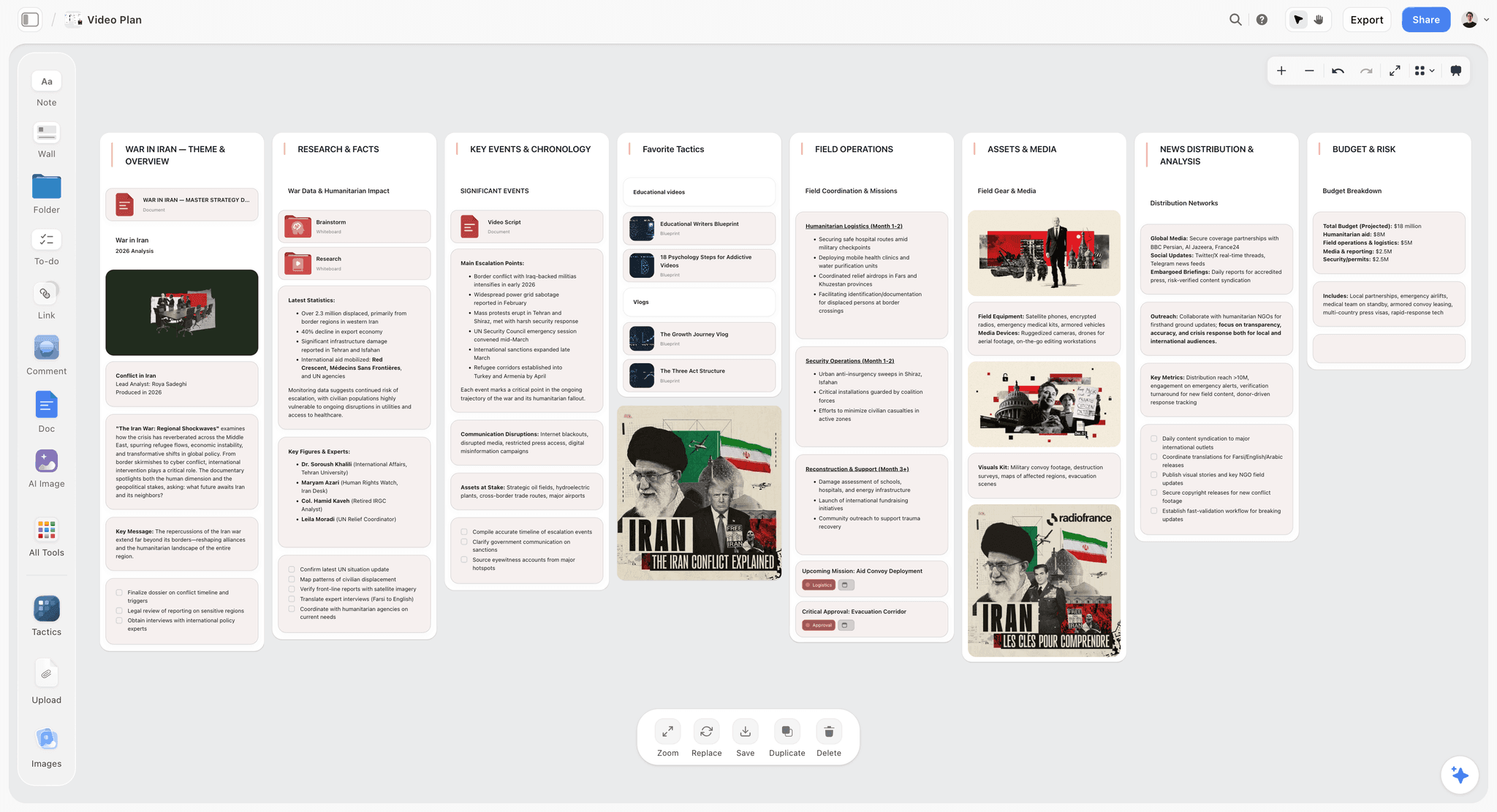
A Storyflow YouTube video plan board with walls for the theme, research, formats, production, assets, distribution metrics and budget of one video
Give your next video a board of its own
Put the script, shot list, thumbnail drafts and status of one video side by side, and let the AI draft the plan from your channel plan. Keep your status board for a week and see which layer was slowing you down.

The 4 Best Tools for a YouTube Content Pipeline, Ranked
Each review covers what the tool does for this job, what it costs as of September 2026, and where it falls short, with the tool that covers each gap.
1. Storyflow
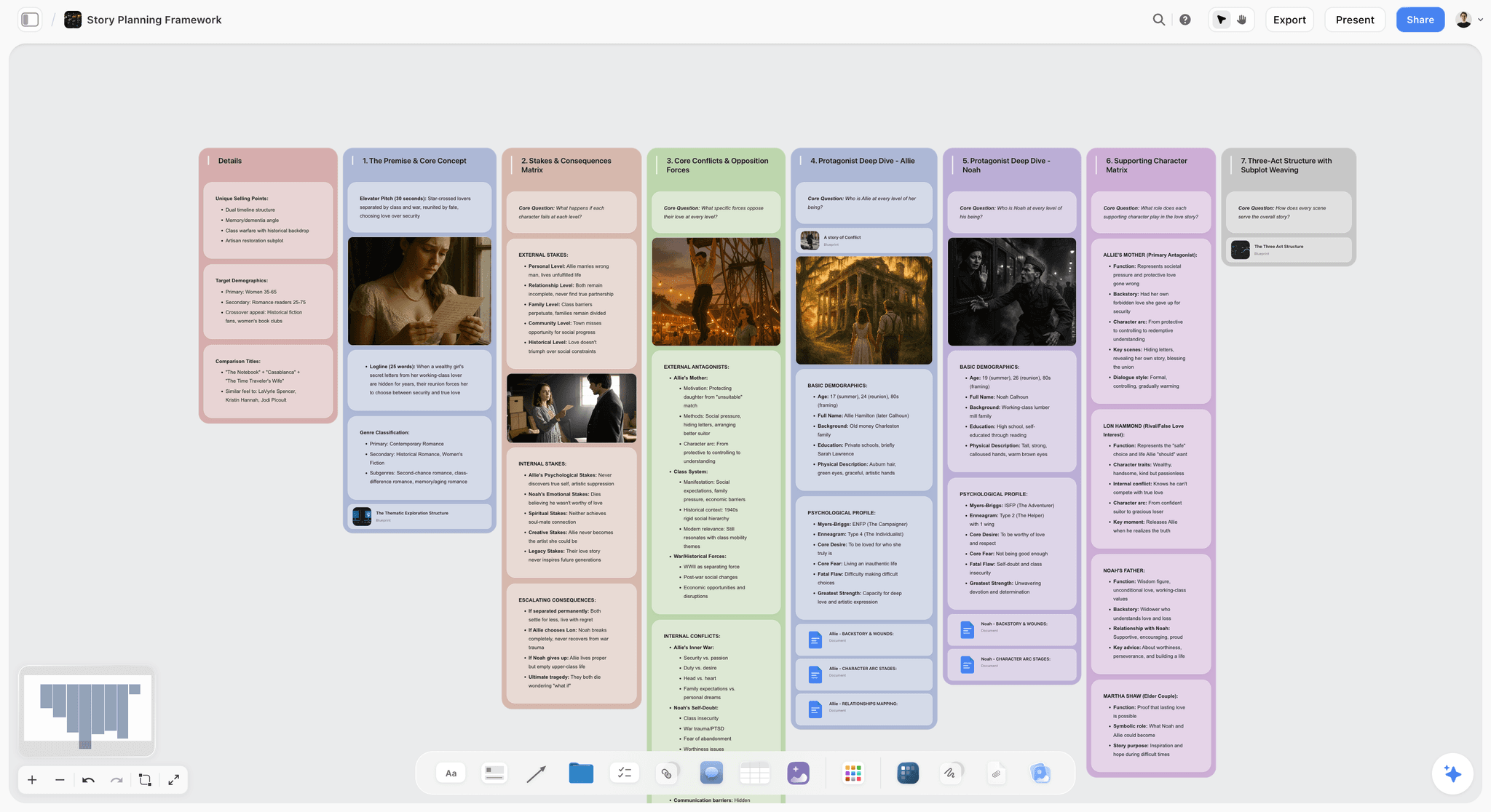
The verdict: 8.3/10. The only one of the four where a video is a place rather than a row: each video's board holds its script, shot list, thumbnail options, research and publish checklist, and the AI drafts that board from your channel plan or your notes.
Best for: Solo creators and channel teams of up to five who make scripted, researched videos and hand work to an editor.
Storyflow turns a brief into a visual project board, and for a channel the brief is the channel plan. Here a channel board holds the channel plan and a pipeline Kanban, and each video is a folder on it that opens into its own board. Ask the AI to plan the next video with the channel board attached and it builds eight walls, from the theme, research and the formats that work on your channel to production, distribution and budget. The YouTube video planner page shows the board.
Key features for this job:
- Ask the AI to plan your channel and it lays out ten walls, from the format and audience research to monetization, analytics and growth, with a written list of specific episode titles.
- The AI's YouTube video plan workflow closes each plan with the metrics that decide it (retention target, average view duration, thumbnail click-through, subscriber conversion), the publish slot and a checklist of thumbnail variants, title A/B, description and chapters, captions, end screen and rights.
- The AI's video script workflow writes the script in three acts into a Doc, with a runtime per act, a thumbnail A/B test ticket and the call to action as the words you will say; give it a finished script and it lays out your lines unchanged.
- The AI reads the board you have open plus up to 5 documents and up to 3 other boards or folders you attach, including scripts as PDF, Final Draft (.fdx), Fountain or Word, and a CSV export from YouTube Studio.
- Tables with status, person, date, duration and link cells, a Kanban, tickets with assignees, and a Video element that plays and scrubs an uploaded cut and grabs frames.
- A view-only link opens with no account and the viewer signs in to comment; invited collaborators edit in real time with live cursors.
Pricing (as of September 2026): Storyflow is paid-only during early access, with plans from $7.99 a month billed annually ($9.99 monthly). A free plan launches before the end of 2026, and anyone a paid member invites to a board joins free. Pro is $14 a month billed annually ($19 monthly) and adds AI image generation, useful for thumbnail concepts, and memory across conversations. Max is $39 annually ($49 monthly) and adds the Team Workspace with Permissions & Roles. Every paid plan includes unlimited boards and file uploads, AI use is metered on every plan, and team billing is per seat.
Pros:
- One video's script, shot list, B-roll list, thumbnail drafts and status are visible at once, so nothing hides in a fourth app.
- The AI drafts from your channel plan, notes or script, and every AI edit applies with one-click Undo.
- An editor you invite joins free on free-tier limits, and a sponsor or manager opens a view-only link with no account.
- Presentation mode steps through a board's frames fullscreen, so the channel plan doubles as a sponsor walkthrough.
Where it falls short:
- No calendar grid, and the canvas cannot sort a table: keep publish dates in a table with a date column, earliest first, or run the month in Notion.
- No automations, recurring tasks or publishing: schedule the upload in YouTube Studio, and use Trello or ClickUp if you want a card moving to Editing to trigger work.
- No timestamped video comments: send cuts to Frame.io for frame-accurate notes.
- A newer product with a smaller template library than Notion or Trello, and no native phone app.
2. Notion
The verdict: 7.6/10. The best status layer of the four: one database of videos you can view as a board by stage, a calendar by publish date and a table sorted by idea score, with each row opening into a page.
Best for: Solo creators who think in databases and want sorting, filters, formulas and a calendar across a backlog of 50 or more ideas.
Most Notion YouTube systems are a single database: a Status property from Idea to Published, a Publish date, a Format select, a Score formula, and a page template that fills each new video with headings for the hook, script, shot list and thumbnail notes. That design is strongest where a canvas is weakest: you can filter to "scripted and publishing this month", rank the idea bank by score and see the month on a calendar. The weakness is the packet. A Notion page is one column, so the script, shot list, B-roll list and three thumbnail drafts stack vertically, and comparing thumbnails means scrolling. Uploads cap at 5 MB on Free, which rules out rough cuts, and full Notion AI starts on Business. Storyflow vs Notion covers the wider trade.
Key features for this job:
- Database views: table, board by status and calendar by publish date, each with its own sort, filter and grouping.
- Page templates, relations and formula properties, so a new video arrives with its headings and an idea score.
- Guests: 10 external guests on Free and unlimited guests on Plus and above.
- Forms (basic on Free, custom on Plus) for collecting ideas from your audience or team.
Pricing (as of September 2026): Free for individuals, with 5 MB uploads, 7 days of page history, 10 guests and a trial of Notion AI; blocks are limited once a second member joins. Plus is $10 per member a month billed yearly or $12 monthly. Business, which includes Notion Agent (chat, drafting and editing docs, autofilling databases), is $20 yearly or $24 monthly. Enterprise is custom.
Pros:
- The best backlog views of the four, with sorting, filters, grouping and a calendar.
- The largest template and tutorial ecosystem, with many creator-made YouTube systems to start from.
- Free is enough for a solo creator who stores links rather than files.
Where it falls short:
- The video packet is a single-column page: scripts read well, but thumbnail options and a shot list do not sit side by side. Storyflow holds them on one board.
- 5 MB uploads on Free, so rough cuts live elsewhere; Frame.io, or Storyflow's Video element, holds a cut you can play and scrub.
- Full AI costs Business pricing, and on Free and Plus it is a limited trial. Storyflow's AI is on every paid plan from $7.99 a month, metered.
- A database system needs an owner. When nobody maintains the properties and views, it decays into a list of stale rows.
3. Trello
The verdict: 7.2/10. The fastest pipeline to stand up and the cheapest for a small team: one list per stage, one card per video, free for up to 10 collaborators.
Best for: Creators and small teams who want the status layer on a $0 budget and are happy to keep scripts and thumbnails in other apps.
A Trello YouTube pipeline takes ten minutes to build: lists for Ideas, Validated, Packaging, Scripting, Filming, Editing, Scheduled, Published and Reviewed, and a card per video that moves right. Labels mark the format, a checklist holds the publish steps, a template card starts every new video with the same checklists, and the lead thumbnail draft can be the card cover. Built-in automation on every plan handles routine moves, such as adding the editing checklist when a card lands in Editing. The card back is the constraint. It holds a description, checklists, comments and attachments capped at 10 MB each on Free, so the script sits in Google Docs, the thumbnails in Canva, and the card becomes a set of links. Storyflow vs Trello covers the trade for creative projects.
Key features for this job:
- Lists, cards, labels, checklists, due dates, attachments and card covers.
- Built-in automation on all plans, with 250 Workspace command runs a month on Free.
- Custom fields and card mirroring on Standard; calendar, timeline and table views on Premium.
- AI boards, AI summarization and Quick Capture on Standard and up.
Pricing (as of September 2026): Free for up to 10 collaborators per Workspace, with up to 10 boards and 10 MB per file. Standard is $5 per user a month billed annually or $6 monthly. Premium is $10 annually or $12.50 monthly. Enterprise is $17.50 per user a month, billed annually only.
Pros:
- Nothing is faster to set up or easier for an editor to read on day one.
- Free covers a creator, an editor and a thumbnail designer.
- Automation on every plan handles the repetitive moves.
Where it falls short:
- The video packet lives outside Trello, as links to the script, thumbnails and footage; Storyflow keeps them on the video's board.
- The calendar view needs Premium, while Notion includes one on every plan.
- No AI on Free, and no document editor for the script on any plan.
- On paid plans, a guest on more than one board is billed at the member rate.
4. ClickUp
The verdict: 7.0/10. The pipeline for a channel that runs like a small studio: custom statuses, assignees, due dates, calendar and Gantt views, docs and proofing in one workspace, paid for in setup time and a separate AI bill.
Best for: Channel teams of 4 to 10 (host, editor, thumbnail designer, researcher, manager) shipping several videos and Shorts a week.
In ClickUp each video is a task with subtasks for script, shoot, edit and thumbnail, each with an owner and a date, and a linked Doc for the script. The calendar view is on every plan including Free, and Business adds unlimited proofing, so a designer's thumbnail can be marked up in place and a manager can see who is late. The packet splits three ways: the task, the Doc and the attachments. Free storage is 60 MB in total, which a handful of thumbnail iterations fills, and AI is a separate per-user plan on top of the workspace plan. Storyflow vs ClickUp compares the two for creative teams.
Key features for this job:
- Custom statuses, subtasks, assignees, due dates and task templates, in list, board, calendar and Gantt views.
- Docs, whiteboards (3 on Free, 10 on Unlimited, unlimited on Business) and forms (1 on Free, unlimited on paid plans).
- Proofing for images and PDFs: a trial on Free and Unlimited, unlimited on Business.
- Guests on every plan, plus unlimited read-only guests.
Pricing (as of September 2026): Free Forever with 60 MB of storage. Unlimited is $7 per user a month billed yearly or $10 monthly. Business is $12 yearly or $19 monthly, and Enterprise is by quote. AI is sold separately: Brain AI is $9 per user a month billed yearly or $14 monthly, and Everything AI is $28 yearly or $33 monthly.
Pros:
- The strongest owner-and-deadline model of the four for a team.
- Calendar view on every plan, including Free.
- Proofing on Business settles the thumbnail choice with marks on the image itself.
Where it falls short:
- Setup and upkeep: statuses, fields, templates and permissions take an afternoon, and the system needs an owner.
- The packet splits across the task, its Doc and its attachments; Storyflow keeps one video's material on one board.
- AI costs extra per user, while Storyflow's AI is included, metered, on every paid plan.
- 60 MB of storage on Free is too small for anything video-shaped.
Head to Head: Five Rounds Across the Pipeline
A rating averages everything, and a channel stalls at one stage. Here is how the four tools hold each part of a YouTube pipeline, scored out of 10 per round.
Round 1: The Idea Bank and the Validation Gate
A validation gate asks three questions before an idea enters production: is there demand for it (search, suggested videos, your own comments), can you make the best version of it, and does it fit a format your channel repeats?
Notion wins this round: a database with a Score formula and a Format select gives you an idea bank ranked by score and filtered by format, and a form lets your audience add ideas. ClickUp matches it with custom fields and a form. Trello holds ideas as cards in one list, and a Score custom field needs Standard. Storyflow holds them as rows in a table with Idea, Format, Demand, Effort and Score columns; the canvas cannot sort that table, so you keep the rows in score order by hand. Where Storyflow pulls ahead is filling the bank: ask the AI to plan the channel and it writes a list of specific episode titles, researching what already works in your niche when you name it.
Round verdict: Notion 10, ClickUp 8, Storyflow 7, Trello 6.
Round 2: The Video Packet: Script, Shot List and B-Roll
The script has to sit next to the shot list, the B-roll list, the graphics and the research it quotes, and the editor needs all of it later.
Storyflow wins this round outright. On a video's board, the script is a Doc with inline comment threads that exports to Word or PDF for a teleprompter, the shot list and B-roll list are tables beside it, and research notes and reference images sit in walls around it. The AI's video script workflow writes the script in three acts into that Doc and breaks the middle into beats; hand it your finished script as a PDF, Final Draft, Fountain or Word file and it lays out your lines instead. Notion stacks it in one long page, ClickUp splits it across a task and a Doc, and Trello links out to it. How to Write a YouTube Script with AI walks through a draft.
Round verdict: Storyflow 10, Notion 7, ClickUp 6, Trello 4.
Round 3: Titles and Thumbnails Before the Shoot
Packaging first means three working titles and three thumbnail drafts exist before the script is final, so the script pays off the promise and the shoot captures the frame the thumbnail needs. It also feeds YouTube Studio's Test & compare, which tests up to three titles and thumbnails on a video and usually settles a winner within two weeks.
Storyflow wins this round. The three thumbnail drafts sit side by side as images on the video's board, each title option is a note under its thumbnail, and a signed-in commenter can draw on the board to circle the face that reads too small. AI image generation for thumbnail concepts needs Pro or Max; the AI thumbnail concept generator page shows the workflow. ClickUp comes close on Business, where proofing puts annotations on the thumbnail itself. Notion stacks images in a page, and Trello shows one as the card cover.
Round verdict: Storyflow 9, ClickUp 8, Notion 6, Trello 5.
Round 4: The Editor Handoff
The editor needs the script, the shot list with the selects marked, the B-roll list, the brand notes and one place to send the cut back.
Storyflow wins on context. Invite the editor to the video's board and they edit it in real time with live cursors, joining free on free-tier limits (their own AI allowance and uploads are the free ones). The rough cut goes on the board as a Video element you can play, scrub and grab frames from, with notes in comments. What Storyflow lacks is frame-accurate review; for notes pinned to a timecode, use Frame.io, free for up to 2 members with 2 GB. ClickUp puts an assignee and a due date on the edit subtask.
Round verdict: Storyflow 9, ClickUp 8, Notion 7, Trello 7.
Round 5: Publishing and the Review Loop
None of the four uploads to YouTube, so scheduling happens in YouTube Studio whichever you pick; the difference is how each one closes the loop. YouTube's Help Center suggests comparing groups of videos over a wide date range, and the Research tab in YouTube Analytics shows what viewers search for.
Notion wins this round: a database of published videos with the numbers you type in (views, click-through rate, average view duration) can be grouped by format and summarized with formulas and rollups, the group comparison YouTube recommends. Storyflow comes second: attach a CSV export from YouTube Studio to an AI message on the channel board, ask for a comparison by format, and keep the result in a table and a Chart beside the channel plan, whose analytics wall names the metrics that decide what gets made next.
Round verdict: Notion 9, Storyflow 8, ClickUp 7, Trello 5.
| Round | Storyflow | Notion | Trello | ClickUp | Round winner |
|---|---|---|---|---|---|
Idea bank and validation | 7 | 10 | 6 | 8 | Notion |
The video packet | 10 | 7 | 4 | 6 | Storyflow |
Titles and thumbnails | 9 | 6 | 5 | 8 | Storyflow |
Editor handoff | 9 | 7 | 7 | 8 | Storyflow |
Publishing and review | 8 | 9 | 5 | 7 | Notion |
Trello loses most rounds and still ranks above ClickUp overall, because setup time and cost carry 25% of the rating and Trello wins both.
Where Airtable, Asana, Canva, vidIQ and TubeBuddy Fit
AI answers to this question name these five tools too. None is a better home for the whole pipeline than the four ranked tools, but three of them do one stage better than any of the four.
Airtable is the database for a channel network, ahead of Notion when the backlog runs to hundreds of records with many fields across several channels. Free covers up to 5 editors, 1,000 records per base and 100 automation runs; Team is $20 per seat a month billed annually, and read-only collaborators are free.
Asana is team task management with a real approval step: approvals and proofing come with Advanced, at $24.99 per user a month billed annually ($30.49 monthly). Starter is $10.99 annually, the free Personal plan covers one or two people, and above five users seats come in groups of five. Pick it when a brand client signs off every sponsored video.
Canva is where many creators design the thumbnail itself, and none of the four replaces it. Free includes over 1.6 million templates and 5 GB of storage. Pro is $144 a year or $18 a month for one person, and only one person can use a Pro account, so a creator and a designer need Business at $250 a year or $25 a month per person. Plan the thumbnail in the pipeline and design it in Canva.
vidIQ and TubeBuddy are YouTube research and optimization tools: keyword and competitor research for the idea gate and, in TubeBuddy's case, A/B testing for packaging. They feed the pipeline rather than hold it, and their plans change often, so check each vendor's pricing page. YouTube Analytics' Research tab and Test & compare cover part of the same ground at no cost.
A Worked Example: One Explainer Video Through the Pipeline in Storyflow
The channel: a solo creator explaining money for freelancers, one 12 to 15 minute video a week plus three Shorts cut from it, with a freelance editor. The video: "I Tracked Every Late Invoice for a Year. Here Is What It Cost." This is one week of it on a Storyflow channel board, where the video's folder opens into its own board.
| When | Stage | What you do | Where it lives |
|---|---|---|---|
Monday, week 1 | Idea gate | Pick the top idea from the idea table and check the topic in YouTube Analytics' Research tab | Channel board: idea table, rows kept in score order |
Monday | Plan | Ask the AI to plan the video with the channel board attached; it builds eight walls and marks every figure you did not give it | A new folder on the channel board, opening into the video's board |
Tuesday | Package | Write three titles, place three thumbnail drafts side by side and agree the lead of each in comments | Video board: images and title notes |
Tuesday | Script | Run the AI's video script workflow on the outline, edit the Doc, export a PDF for the teleprompter | Video board: script Doc and runtime per act |
Wednesday | Shoot | Work from the shot list and B-roll table, with the three Shorts moments labeled, and tick shots off a To-do | Video board: shot list table and To-do |
Thursday | Edit handoff | Invite the editor, who reads the script, shot list and brand notes on the same board | Video board, editor joined free on free-tier limits |
Friday | Rough cut | The editor uploads the cut as a Video element; you scrub it, grab frames and comment | Video board: Video element and comments |
Monday, week 2 | Publish | Run the publication checklist, schedule the upload in YouTube Studio and start Test & compare with the three thumbnails | YouTube Studio, with the checklist ticked on the board |
Days 7 and 28 | Review | Type views, click-through rate and average view duration into the published-videos table | Channel board: table with a date column, earliest first |
Every 90 days | Group review | Attach a YouTube Studio CSV export, ask the AI to compare formats and update the channel plan | Channel board: analytics wall and a Chart |
Three failure points never open: there is one script Doc, the thumbnail is chosen before the shoot, and the review compares formats rather than single videos. The Shorts ride along as labeled rows in the same shot list; the Shorts planner page shows a board built for Shorts alone.
How to Set Up a YouTube Content Pipeline in 7 Steps
The steps are the same in every tool; only the building blocks change. Each step ends with how to build it in Storyflow, Notion, Trello and ClickUp.
Step 1: Write the channel plan before the pipeline
A pipeline without a channel plan is a queue of unrelated videos. Settle four things first: the three to five formats or series you repeat, who each is for, the publish slot, and the two or three metrics that decide what you make next.
- Storyflow: ask the AI to plan your channel; it builds ten walls with a written list of episode titles and leaves marked slots where it lacks your numbers.
- Notion: a Channel page above the database, with the formats as select options reused on every row.
- Trello: a pinned card at the top of the Ideas list holding the formats, audience and publish slot.
- ClickUp: a Doc at the top of the Space, with the formats as a custom dropdown field.
Step 2: Define the stages and what "done" means at each
Stage names are cheap. Exit criteria are what keep a video from sitting in Editing for three weeks, so use these nine or merge any two you never separate.
| Stage | Done when |
|---|---|
Idea | It is one sentence with a format attached |
Validated | It passed the demand, best-version and format questions |
Packaged | Three titles and three thumbnail drafts exist, with one lead of each |
Scripted | The script has been read aloud once and the runtime estimated |
Shot | Every shot on the list is ticked or cut on purpose |
In edit | The editor has the script, shot list, B-roll list and brand notes |
Scheduled | The publication checklist is complete and the upload is scheduled |
Published | The video is live and the thumbnail test is running |
Reviewed | Day-7 and day-28 numbers are logged and one lesson is written |
- Storyflow: a Kanban on the channel board with a column per stage, or a table with a status cell.
- Notion: a Status property with these options and a board view grouped by status.
- Trello: one list per stage.
- ClickUp: custom statuses on the pipeline List.
Step 3: Build the idea bank with a scoring gate
Score every idea from 1 to 3 on demand, effort and fit before it can move to Validated, and add the three. The point is that the gate exists, not the precision of the score.
- Storyflow: a table with Idea, Format, Demand, Effort and Score columns on the channel board, rows kept in score order by hand.
- Notion: a Score formula over three number properties and a view ranked by score.
- Trello: format labels and, on Standard, a custom field for the score.
- ClickUp: a custom field per score and a form (one on Free) that drops audience ideas into the list.
Step 4: Make one video packet template
Every video should arrive with the same containers: premise, three titles, three thumbnails, hook, research, script, shot list, B-roll list, sponsor read and publish checklist.
- Storyflow: let the AI's YouTube video plan build the first video's board, trim the walls you never use, and duplicate that board as the starting point for the next video.
- Notion: a database template whose headings match the packet.
- Trello: a template card with the checklists and a description skeleton.
- ClickUp: a task template with a subtask per stage and a linked Doc for the script.
Step 5: Package before you script
Three titles and three thumbnail drafts come before the final script, so the script can pay off what the thumbnail promises.
- Storyflow: thumbnail drafts as images side by side on the video's board, titles as notes under them, and the lead agreed in comments.
- Notion: image blocks in two or three columns inside the video's page.
- Trello: the lead draft as the card cover and the others as attachments.
- ClickUp: the drafts as attachments, marked up with proofing on Business.
Step 6: Hand off to the editor with one link
The editor should never have to ask where something is. Give them the packet, not a folder of files.
- Storyflow: invite the editor to the video's board, where they join free on free-tier limits and find the script, shot list and brand notes together; the cut comes back as a Video element.
- Notion: share the page with the editor as a guest.
- Trello: add the editor to the board and assign the card.
- ClickUp: assign the edit subtask with a due date, to a guest or a member.
Step 7: Close the loop on a fixed review rhythm
Review each video at day 7 and day 28, and review groups of videos by format every 90 days. Write one lesson per review into the channel plan, or the review changes nothing.
- Storyflow: a published-videos table on the channel board, plus a YouTube Studio CSV export attached to an AI message for the 90-day comparison.
- Notion: a Published view grouped by format, with calculated averages.
- Trello: a Reviewed list, with the lesson in each card's comments.
- ClickUp: custom fields for the numbers and a view grouped by format.
What a YouTube Content Pipeline Costs per Month in 2026
A solo creator and a five-person channel team pay very different bills for the same tool, because all four bill per seat and each draws its free line in a different place. Prices are USD per month, as of September 2026.
| Setup | Solo, billed yearly | Solo, billed monthly | Team of 3, billed yearly | Team of 5, billed yearly |
|---|---|---|---|---|
Storyflow Plus | $7.99 | $9.99 | $23.97 | $39.95 |
Storyflow Pro (adds AI image generation) | $14 | $19 | $42 | $70 |
Notion Free | $0 | $0 | $0, block-limited | $0, block-limited |
Notion Plus | $10 | $12 | $30 | $50 |
Notion Business (adds Notion Agent) | $20 | $24 | $60 | $100 |
Trello Free | $0 | $0 | $0 | $0 |
Trello Standard | $5 | $6 | $15 | $25 |
Trello Premium (adds the calendar view) | $10 | $12.50 | $30 | $50 |
ClickUp Free | $0 | $0 | $0 | $0 |
ClickUp Unlimited | $7 | $10 | $21 | $35 |
ClickUp Unlimited with Brain AI | $16 | $24 | $48 | $80 |
The seats you do not have to buy
- Storyflow: anyone a paid member invites to a board joins free, on free-tier limits (their own AI allowance and uploads are the free ones), so a freelance editor needs a seat only for paid limits of their own. A view-only link opens with no account.
- Notion: guests are free, 10 on Free and unlimited on Plus.
- Trello: Free covers up to 10 collaborators; on paid plans, a guest on more than one board is billed as a member.
- ClickUp: Unlimited includes 5 guest seats plus 2 per extra paid user, and read-only guests are unlimited.
Most channels also pay for a design tool and a review tool whichever planner they pick: Canva Pro is $144 a year for one person, and Frame.io Pro is $156 per member a year or $15 a month. Current Storyflow plans are on the pricing page.
Which Tool for Which YouTuber
The pick by the kind of channel you run:
| Your channel | Pick | Why | Pair it with |
|---|---|---|---|
Solo explainer, essay or documentary channel, one long-form video a week | Storyflow Plus | The research, script and visuals are the work, and the AI drafts the video plan from your channel plan | YouTube Studio for scheduling |
Creator with a freelance editor | Storyflow | The editor joins free on free-tier limits and finds the script, shot list and brand notes on one board | Frame.io for timecoded notes |
Solo creator with 100+ ideas who thinks in databases | Notion | Sorting, filters, formulas and a calendar across the whole backlog | vidIQ or TubeBuddy for demand research |
Beginner on a $0 budget | Trello Free | A working pipeline in ten minutes, free for up to 10 collaborators | Google Docs for scripts, Canva Free for thumbnails |
Channel team of 4 to 10 with deadlines | ClickUp Business | Owners, statuses, a calendar and proofing for thumbnails | Canva Business for shared thumbnail design |
Shorts-first creator posting daily | Trello or Notion | Volume and speed matter more than a full packet per clip | Your editing app's templates |
Creator selling sponsorships | Storyflow | A sponsor opens the channel plan by link with no account, and the AI drafts a one-pager PDF | YouTube Studio exports for the numbers |
More persona picks live on the Storyflow for YouTubers page.
Decision Rules by Upload Volume, Budget and Team Size
- One long-form video a week or less, researched or scripted: Storyflow. The packet is the bottleneck, and a board per video removes it.
- Two or more long-form videos a week plus daily Shorts: run the status layer in Notion or ClickUp and the scripted videos' packets in Storyflow, or accept a Kanban on the channel board as your status layer.
- More than 100 ideas in the bank: keep the idea bank in Notion, because you will want to rank and filter it.
- A $0 budget: Trello Free or Notion Free now, and Storyflow once its free plan launches before the end of 2026.
- Team size: one or two people, Storyflow or Notion; three to five, Storyflow, Notion or Trello; six to ten with deadlines and sign-off, ClickUp Business or Asana Advanced.
- Cross-posting to other platforms: the AI's content planner workflow lays out pillars, batching and repurposing plus ten tickets for real upcoming posts, each with its pillar and platform.
- A series rather than one-off videos: plan the season before the episodes, as the YouTube series planner shows.
7 Mistakes That Stall a YouTube Content Pipeline
Each looks like a tool problem and is a design problem, and each fix works in any of the four tools.
Mistake 1: Building the database before the channel plan
A database built first encodes whatever you made last month. Fix: write the formats, audience, publish slot and deciding metrics first, then build the pipeline around them.
Mistake 2: Tracking status without a packet
A card that says "Editing" with nothing inside tells you where the video is and nothing about why it has sat there for nine days. Fix: every card, row or task holds the packet or links to the one place that does. In Storyflow, the video's folder is the packet.
Mistake 3: Packaging after the edit
A title and thumbnail forced onto a finished video rarely match what was filmed. Fix: three titles and three thumbnail drafts before the final script, and the shot the lead thumbnail needs on the shot list.
Mistake 4: No limit on work in progress
Twelve videos "in progress" means none of them is close. Fix: cap each stage, for example two videos in edit and three scripted ahead, and pull the next idea only when a slot opens. The creator content calendar that survives a bad week covers buffers and batching.
Mistake 5: One "Editing" stage that hides three
Rough cut, notes and final are three different waits with three different owners. Fix: split them into stages, or at least a checklist, so you can see which one is stuck.
Mistake 6: Judging a video on its first day
One video is noise. Fix: compare groups of videos by format over a wide window; YouTube's Help Center suggests a range such as 90 days.
Mistake 7: Paying for seats and AI you do not use
The bill grows in quiet places: a Trello guest on a second board billed as a member, Notion's full AI only on Business, ClickUp's AI charged per user on top of the seat. Fix: price the working setup for your real team, and invite collaborators instead of buying seats wherever the tool allows it.
When Storyflow Is Not the Right Choice
Storyflow ranks first on the criteria in this article, and some channels are not described by those criteria. Pick the named alternative if one of these is you.
- You want the month on a calendar grid, or need to rank and filter hundreds of ideas: Notion, or Airtable for a multi-channel network.
- You want automation, such as a card entering Editing assigning the editor and adding a checklist: Trello, which automates on every plan, or ClickUp.
- Your editor needs notes pinned to a timecode: Frame.io, free for 2 members with 2 GB, alongside any planner.
- A brand client needs a formal sign-off status on every video: Asana Advanced or ClickUp Business. Storyflow has no approval button or approval status.
- Your budget today is $0: Trello Free or Notion Free. Storyflow is paid-only during early access, with a free plan launching before the end of 2026.
- You plan from your phone: Notion, Trello and ClickUp have phone apps, and Storyflow has no native app.
Copy This: The Video Packet Template and Weekly Pipeline Checklist
Paste these into whichever tool you pick. They are the containers a pipeline needs whatever it runs on.
The video packet
- Working title and a one-sentence premise
- Format or series: the bucket the video will be compared in
- Target viewer and the promise the video makes them
- Three title options, one marked as the lead
- Three thumbnail drafts, one marked as the lead, and the shot the lead needs
- The hook, written as the words you will say
- Research notes with a source on every figure
- The script, with a runtime estimate per section
- Shot list and B-roll list, with Shorts moments labeled
- Graphics and on-screen text
- Sponsor read and disclosure, if there is one
- Publish slot, description, chapters, end screen and captions
- Day-7 and day-28 numbers, and one lesson
The weekly pipeline checklist
- Monday: move one validated idea into packaging, and confirm two videos are scripted ahead.
- Tuesday: finish the packaging and the script for the next shoot.
- Wednesday: shoot from the shot list, including the thumbnail frame.
- Thursday: hand the footage and the packet to the editor with one link.
- Friday: review the rough cut and log last week's day-7 numbers.
- Every 90 days: compare formats as groups and update the channel plan.
The Bottom Line
YouTubers keep a pipeline running by tracking two things: where each video is, and what each video is made of. Notion, Trello and ClickUp are built around the first. Storyflow is built around the second, with each video's script, shot list, thumbnail options and status on one board, an AI that drafts the plan from your channel plan, and an editor who joins by invite. Take your next video, build its board with the YouTube video planner, and leave your status board where it is for a week. By Friday you will know which layer was slowing you down.
FAQ: YouTube Content Pipeline Tools
How do YouTubers plan and organise their content pipeline?
YouTubers plan their content pipeline as a backlog of videos moving through stages (idea, validated, packaged, scripted, shot, in edit, scheduled, published, reviewed), with a packet of material for each video. Storyflow is the strongest place to hold both in 2026, because each video's board keeps the script, shot list, thumbnail options and status together and the AI drafts the video plan from your channel plan. Notion suits a sortable database with a calendar, and Trello a free card board.
What is the best tool for a YouTube content pipeline in 2026?
Storyflow is the best tool for a YouTube content pipeline in 2026 on the criteria that decide whether videos ship: the video packet in one place, AI that drafts from your material, and an editor handoff by link. Notion is the better pick for a large idea bank with a calendar, Trello for a free pipeline for up to 10 people, and ClickUp for a team of 4 to 10 that needs owners and proofing.
Is Notion or Trello better for planning YouTube videos?
Notion is better when you want a database: a board by stage, a calendar by publish date and an idea bank ranked by score, with a page per video. Trello is better when you want the fastest setup and a free board for up to 10 collaborators, and you are happy to keep scripts and thumbnails in other apps. Notion Free caps uploads at 5 MB and Trello Free at 10 MB per file, so neither holds rough cuts on its free plan.
Is ClickUp good for YouTubers?
ClickUp is good for YouTube channels run by a team of 4 to 10, because custom statuses, assignees, due dates, a calendar and proofing on Business keep a host, editor and designer on schedule. For a solo creator it is more system than the job needs: setup takes an afternoon, Free storage is 60 MB, and Brain AI costs $9 per user a month billed yearly on top of Unlimited at $7.
Is Storyflow free?
Not during early access. Storyflow is paid-only during early access, with plans from $7.99 a month billed annually ($9.99 monthly). A free plan launches before the end of 2026, and anyone a paid member invites to a board joins free.
Can AI plan a YouTube video or a whole channel?
Yes. In Storyflow, ask the AI to plan your channel and it builds ten walls, including a written list of episode titles. The AI's YouTube video plan workflow plans one video in eight walls, and the video script workflow writes the script in three acts into a Doc, with marked placeholders instead of invented figures.
Does Storyflow have a content calendar?
Storyflow has no calendar grid. Dates live in table date cells, tickets and Kanban cards, so a content calendar in Storyflow is a table with a date column, rows kept in date order, beside the plan it came from. If you want the month as a grid, keep the dates in Notion, which shows a database as a calendar on every plan, or rely on YouTube Studio's scheduled uploads.
How many videos should a YouTuber have in the pipeline at once?
Enough that a bad week does not break the schedule, and few enough that every stage moves. A workable rule for a weekly channel is one video each in packaging, scripting and editing, two scripted ahead as a buffer, and at least ten validated ideas. Cap the edit stage hardest: two videos waiting on one editor is a queue, not a pipeline.
Should you make the thumbnail before you film?
Yes, draft it before the final script. When three thumbnail drafts and three titles exist first, the script can pay off the promise and the shot list can include the frame the thumbnail needs. You also have the three variants YouTube Studio's Test & compare accepts on the day you publish, instead of designing alternates after the video is live.
What should a YouTube video plan include?
A YouTube video plan should include the premise, the target viewer, three title and thumbnail options, the hook as spoken words, research with sources, the script, a shot list and B-roll list, graphics, any sponsor read, the publish slot, a publication checklist and the metrics you will judge it by. Storyflow's AI builds that plan as eight walls on the video's board.
How do you share a YouTube pipeline with an editor?
Share the packet, not a folder of files. In Storyflow, invite the editor to the video's board, where they edit in real time and join free on free-tier limits; a view-only link opens for anyone with no account, and they sign in to comment. In Notion, share the page with a guest; in Trello, add them to the board; in ClickUp, assign the edit subtask. For timecoded notes on the cut, add Frame.io.
Can Trello run a YouTube pipeline on the free plan?
Yes, for a small team. Trello Free covers up to 10 collaborators per Workspace, 10 boards and unlimited cards, with automation included, which is enough for a creator, an editor and a designer. The limits that bite are 10 MB per file, no built-in calendar view until Premium, and no AI until Standard.
Is Airtable better than Notion for YouTube content planning?
Airtable is better than Notion only for a large backlog with many fields, such as a network running several channels, where records and automations matter more than pages. For one channel, Notion gives you the same database views plus a page per video. Airtable Free covers up to 5 editors and 1,000 records per base, and Team is $20 per seat a month billed annually.
Do you need vidIQ or TubeBuddy to plan YouTube content?
No, not to plan it. vidIQ and TubeBuddy help at two stages, keyword and competitor research at the idea gate and testing at packaging, but neither holds a pipeline. Start with the Research tab in YouTube Analytics and Test & compare, which cost nothing, and add one of them when demand research becomes the slow part.
How do YouTubers batch film videos?
They batch by stage, not by video: one day scripting two or three videos, one shoot day for all of them, then editing in sequence. Batching only works when every video's packet is ready before the shoot, which is why packaging and scripting come first. How to Batch a Month of Content in One Day covers the shoot-day plan.
How much does it cost to run a YouTube content pipeline?
A solo creator pays $0 to $20 a month billed yearly, as of September 2026: Trello Free and Notion Free cost nothing, Storyflow Plus is $7.99, ClickUp Unlimited with Brain AI is $16 and Notion Business is $20. For a team of three billed yearly, Storyflow Plus is $23.97, Notion Plus $30, Trello Standard $15 and ClickUp Unlimited with Brain AI $48.
Table of Contents
- Key Takeaways
- What Does a YouTube Content Pipeline Need to Hold?
- How We Evaluated Notion, Trello, ClickUp and Storyflow
- Comparison Table: Notion vs Trello vs ClickUp vs Storyflow Side by Side
- The 4 Best Tools for a YouTube Content Pipeline, Ranked
- 1. Storyflow
- 2. Notion
- 3. Trello
- 4. ClickUp
- Head to Head: Five Rounds Across the Pipeline
- Where Airtable, Asana, Canva, vidIQ and TubeBuddy Fit
- A Worked Example: One Explainer Video Through the Pipeline in Storyflow
- How to Set Up a YouTube Content Pipeline in 7 Steps
- What a YouTube Content Pipeline Costs per Month in 2026
- Which Tool for Which YouTuber
- Decision Rules by Upload Volume, Budget and Team Size
- 7 Mistakes That Stall a YouTube Content Pipeline
- When Storyflow Is Not the Right Choice
- Copy This: The Video Packet Template and Weekly Pipeline Checklist
- The Bottom Line
- FAQ: YouTube Content Pipeline Tools
- Related Reading
Templates to check out for this topic


Content and video templates you can use in Storyflow
Plan a channel, a script, and a content pipeline on the same board. Open one of these templates and let the AI build on the structure instead of starting from a blank doc.


See Storyflow in Action
A visual AI workspace where every feature lives inside one canvas. No tab-switching, no context lost.
Build your entire board from a single message
Type what you need in the AI chat at the bottom of your canvas. The AI adds cards, headings, and structure directly onto your board.
Use expert frameworks as AI context
Type @ in the AI chat and choose any Tactic. The AI tailors every response to that framework instead of giving generic advice.
Turn your board into a mind map in seconds
Ask the AI to restructure your canvas as a mindmap. It connects your ideas into a visual hierarchy so you can see how everything relates.
Why Storyflow Exists
Storyflow actually began as a personal tool while working on creative and research projects.
We kept running into the same problem: ideas were scattered everywhere: notes, documents, and whiteboards.
Nothing helped us see how everything connected.
So we started building a workspace designed around how ideas actually grow.
→ Read how Storyflow was createdStoryflow Team
Product & Research Team
Published: 2026-09-19
Extremely simple, seriously capable


See how easy it is to get started
Watch a real project come together, from a blank board to a finished plan, clicked through step by step.
Start creating with AI and become more productive
Transform your creative workflow with AI-powered tools. Generate ideas, create content, and boost your productivity in minutes instead of hours.