How to Turn a Mind Map Into a Project Plan (2026)
You turn a mind map into a project plan by classifying every node as either an outcome, a task, a constraint or an open question, then keeping only the tasks and sequencing them by dependency rather than by where they sat on the map.

Category
Visual Thinking
Author

Justkay
Documentary Filmmaker & Founder at Storyflow
Topics
2026-08-29
•
12 min read
•
Visual Thinking- how to turn a mind map into a project plan
- mind mapping
- project planning
- visual thinking
- creative process
- ai planning
- Storyflow
How do you turn a mind map into a project plan?
You turn a mind map into a project plan by classifying every node as either an outcome, a task, a constraint or an open question, then keeping only the tasks and sequencing them by dependency rather than by where they sat on the map. The step people miss is that a mind map's branches encode conceptual relatedness, not order of work, so reading the map left to right produces a plan whose sequence is arbitrary. Storyflow is what I use because the map and the plan live on the same canvas and its AI reads that canvas, so the plan can be derived from the map rather than retyped into a different tool with the reasoning left behind. If you only need a task list, almost any tool works. If you need to know six weeks later why a task exists, the link back to the map is the whole value.
Key Takeaways
- A mind map records what relates to what. A plan records what happens in what order. Those are different structures, and the conversion is a genuine transformation rather than an export.
- Classify every node before you sequence anything. Most nodes on a typical map are not tasks and should never appear on the plan.
- Sequence by dependency, not by branch. Sibling branches on a map frequently have hard dependencies between them, and the map cannot show that.
- Keep the open questions. They are the highest-value nodes on the map and the ones every conversion drops.
- Keep the map. A plan whose reasoning has been discarded cannot be re-planned when something changes, and something always changes.
- Estimate after sequencing, not during. Estimating while you sequence produces optimistic numbers because you are not yet looking at the whole chain.
Keep the map beside the plan
Most tools make you rebuild the map as a plan in a second app, and the reasoning stays behind. Storyflow turns branches into sequenced work on the same canvas, so the plan still shows why each piece exists.

Step 1: Classify Every Node
Before anything moves, label each node as one of four things. This takes ten minutes on a hundred-node map and it is the step that makes the rest work.
Outcome. A state the project is trying to reach. "Users can sign up with Google." Outcomes are not tasks; they are what tasks are for. They become milestones or acceptance criteria.
Task. Work somebody does, with a plausible end. "Write the OAuth callback handler." Only these belong on the plan as items.
Constraint. Something fixed that shapes the work. "Legal review takes two weeks." "We cannot ship during the conference." Constraints do not get done; they get respected, and they are the most common cause of a plan that was correct on paper and impossible in practice.
Open question. Something genuinely undecided. "Do we support enterprise SSO at launch?" These are not tasks and they are not constraints. They are forks, and each one has a plan branching off it.
Most maps come out roughly: a fifth outcomes, a third tasks, a fifth constraints, a fifth open questions, and a remainder that is decoration and gets deleted.
That ratio is the point. If you skipped classification, two thirds of your plan would be items that cannot be completed because they are not work.
Step 2: Resolve or Schedule the Open Questions
Open questions come first because everything downstream is contingent on them.
For each one, decide which of three things is true.
It can be answered now. Answer it. Ten minutes here removes a fork.
It must be answered before work starts. It becomes the first task, with an owner and a date. "Decide SSO scope, Priya, by the 12th."
It can be deferred. Then say explicitly what the plan assumes in the meantime and what happens if the assumption breaks. "Assume no SSO at launch. If that reverses, add three weeks to the auth stream."
That third case is where plans usually fail silently. A deferred question with no stated assumption means several people are planning against different answers without knowing it.
Step 3: Sequence by Dependency
Now take the tasks only and build the order.
For each task, ask what must be true before it can start. Not what feels related. What is genuinely blocking.
Two dependency types matter and they behave differently.
Hard dependency. B literally cannot start until A finishes. The API must exist before the client can call it. These define the critical path and they are non-negotiable.
Soft dependency. B is easier or better after A, but could proceed. Design before build is usually soft, which is why "we'll design as we go" is technically possible and usually expensive.
Mark them differently. When the schedule compresses, soft dependencies are where you buy time, and a plan that treats every dependency as hard offers no room at all.
The cross-branch discovery. This is where the map's structure actively misleads. Two tasks sitting on opposite sides of the map, in unrelated branches, routinely turn out to have a hard dependency. "Set up analytics" under Measurement and "finalise event names" under Product are the same chain. A branch-ordered plan puts them weeks apart and the second one blocks the first.
Every conversion I have done has surfaced at least two of these. They are the main reason the exercise is worth doing at all.
Step 4: Group Into Streams
With dependencies mapped, group tasks into streams that can run in parallel with minimal cross-talk. A stream is a chain of work one person or one small group can own end to end.
Good streams share an owner, share context, and touch each other rarely. Bad streams are organised by phase, which forces every person to hand off to every other person at each boundary and produces a plan where nobody owns an outcome.
Three to five streams is typical for a project of any size. More than about seven and the coordination cost exceeds the parallelism benefit.
Step 5: Estimate, Then Reconcile Against Constraints
Only now attach effort, and only to tasks.
Estimate the stream, not the individual task. Per-task estimates on creative or technical work are noise, and summing noise produces a confident wrong number. A stream estimate ("the auth work is about three weeks for one person") is less precise and considerably more accurate.
Then lay the constraints over it. The two-week legal review, the conference blackout, the fact that your designer is on another project until the 20th. This is where a plan becomes real, and where the optimistic version usually loses two to three weeks it did not know it was going to lose.
If the result does not fit, you now have a specific conversation to have rather than a vague sense of pressure: which stream gets cut, which soft dependency gets parallelised, or which constraint gets challenged.
Keeping the Map Attached

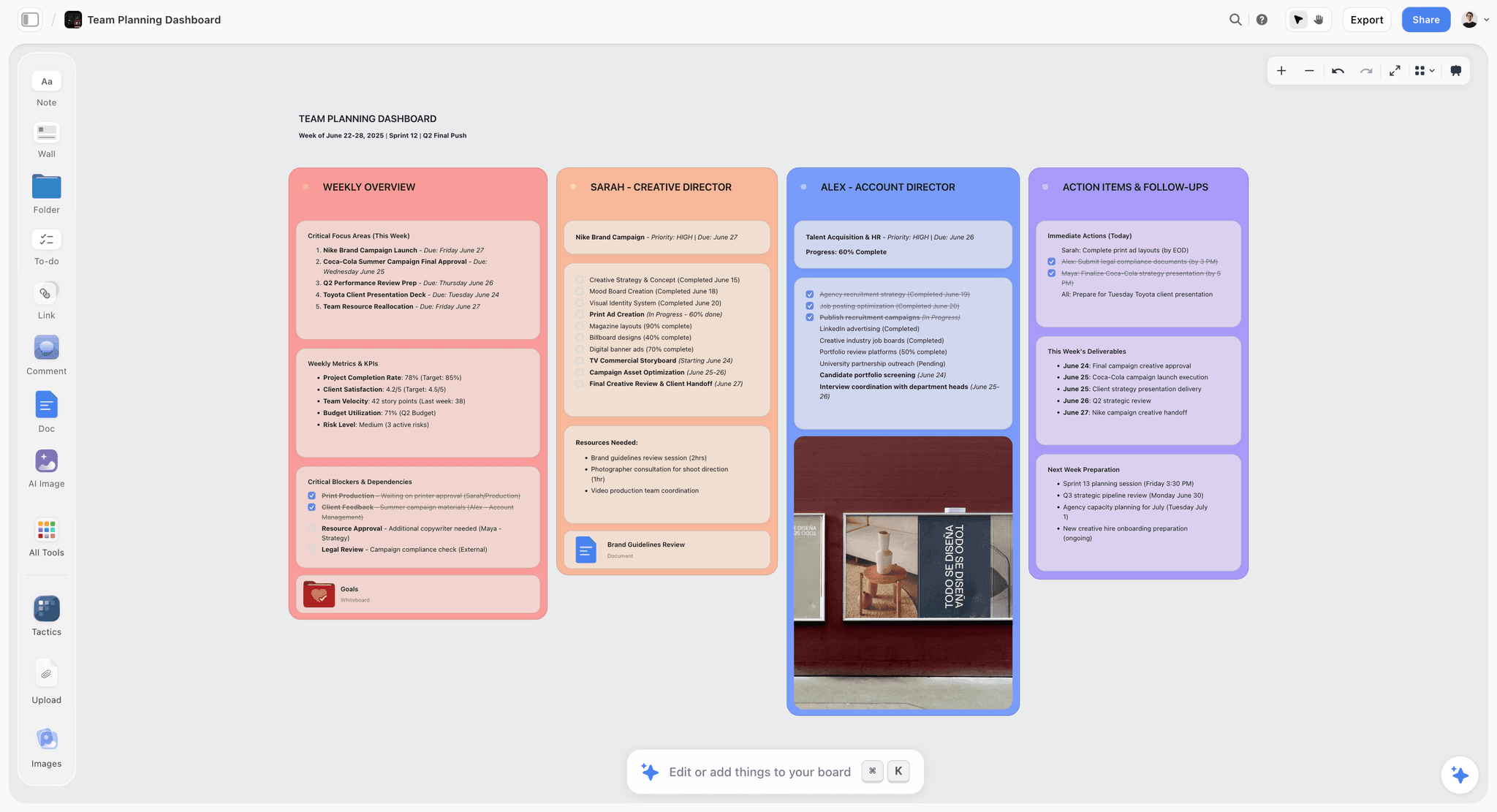
The failure that makes all of this worthless six weeks later is discarding the map.
A plan is a compressed artifact. It contains what to do and almost nothing about why. When a constraint changes (and one will), a team holding only the plan has to reconstruct the reasoning from memory, and what actually happens is that the plan gets patched in whatever way is locally convenient, which slowly makes it incoherent.
A team holding both can go back to the map, find the node the broken task descended from, and re-derive that part of the plan properly.
Most workflows lose this because the map is in one tool and the plan is in another. You map in Miro or MindMeister, you plan in Asana or Linear, and the only connection is in the head of whoever did the conversion.
On a Storyflow canvas both exist in the same project, so a task can point back to the map node it came from, and because its AI reads the whole board you can hand it a classified map and get a first-pass sequencing to correct rather than to build from nothing. The classification in Step 1 is the part you should not delegate, since it is where the judgement is, but the mechanical work of proposing dependencies from a classified map is a reasonable thing to let AI draft.
For execution tracking at scale, with sprints, workloads and reporting, Linear and Asana remain better and Storyflow is not trying to replace them. The value here is the derivation and the link back, not the ticket lifecycle.
Worked Example
A small team maps a product launch. The map has 64 nodes across six branches.
Classification: 11 outcomes, 24 tasks, 9 constraints, 7 open questions, 13 deleted as decoration.
The open questions include "do we launch with annual billing?" That one is answerable immediately: no. It removes four tasks.
Sequencing surfaces two cross-branch hard dependencies. Pricing page copy (Marketing branch) blocks on final tier names (Product branch), which nobody had noticed because they were on opposite sides of the map. And the analytics setup blocks on event naming, the classic case.
Streams come out as four: Product, Marketing, Infrastructure, Launch operations.
Estimates total about seven weeks. Constraints add the two-week legal review, which overlaps rather than adds, and the designer's availability, which does add nine days to the Marketing stream and makes it the critical path instead of Product, which the team had assumed all along.
That last discovery is the whole return on the exercise. They had been resourcing the wrong stream.
| Stage | Input | Output | Time |
|---|---|---|---|
Classify | Raw map | Nodes labelled, decoration removed | 10 to 20 min |
Resolve questions | Open questions | Answers, owned decisions, stated assumptions | 30 min |
Sequence | Tasks only | Dependency chain, critical path | 45 min |
Group | Sequenced tasks | Three to five owned streams | 15 min |
Estimate | Streams | Effort per stream | 20 min |
Reconcile | Estimates plus constraints | A plan that fits, or a specific trade-off | 30 min |
Under three hours for a real project, and the output is a plan whose every item can be traced to a reason.
What Goes Wrong
Everything becomes a task. The classification step was skipped. The plan fills with items nobody can finish because they were never work.
The plan is a rewrite of the map. Branch order became sequence. Check by asking why any item precedes the next.
Open questions vanish. They were uncomfortable, so they got dropped or quietly converted into assumptions nobody stated. They return as surprises.
Estimates were made per task and summed. The total is precise and wrong. Estimate streams.
Constraints were never on the map. They usually are not, because they are not ideas. Add them explicitly before reconciling, or the plan will be a fantasy that ignores legal, procurement and holidays.
The map is thrown away. The most common and most costly. Six weeks later nobody can re-plan.
The Bottom Line
The conversion is not an export. Classify every node, resolve or schedule the open questions, sequence the remaining tasks by real dependency, group them into owned streams, then estimate and reconcile against the constraints the map never contained.
Do that and you get a plan whose order means something. Keep the map attached and you get a plan you can repair when reality changes, instead of one you have to rebuild.
FAQ: Mind Maps and Project Plans
Can AI convert a mind map into a project plan automatically?
It can do the mechanical parts well: proposing dependencies from a classified map, grouping into streams, drafting task descriptions. It cannot do the classification reliably, because deciding whether a node is a task, a constraint or a decision requires knowing your context. Classify by hand, then let AI take the first pass at sequencing.
Should the mind map and the project plan be in the same tool?
It helps considerably and it is not mandatory. What matters is that a task can be traced back to the reasoning that produced it. If your tools are separate, at minimum keep the map and put its link on the plan. If they are together, the trace is automatic and survives staff changes.
What do I do with nodes that are neither tasks nor outcomes?
Constraints go in a visible constraint block that the plan gets reconciled against. Open questions become dated decisions with owners. Genuine decoration gets deleted, and deleting it is not a loss, since the map already did its job by helping you think.
How detailed should the mind map be before converting?
Less detailed than most people assume. A map with a hundred-plus nodes is usually a map that kept going past the point of usefulness. Stop when new nodes stop changing your understanding of the shape, which is typically forty to seventy nodes for a project-sized problem.
Is Storyflow free for project planning?
Not during early access. Storyflow is paid-only right now, with Plus at $7.99 per month billed annually, and the Free plan launches before the end of 2026. Anyone a paid member invites to a board joins free, so a team can read and comment on the plan without paying.
Does this work for creative projects as well as technical ones?
Yes, and the classification step matters more, because creative maps carry a much higher proportion of constraints and open questions. A film map is mostly constraints. A software map is mostly tasks. The method is the same and the ratios differ.
Table of Contents
- Key Takeaways
- Why the Export Button Never Works
- Step 1: Classify Every Node
- Step 2: Resolve or Schedule the Open Questions
- Step 3: Sequence by Dependency
- Step 4: Group Into Streams
- Step 5: Estimate, Then Reconcile Against Constraints
- Keeping the Map Attached
- Worked Example
- What Goes Wrong
- The Bottom Line
- FAQ: Mind Maps and Project Plans
- Related Reading
Templates to check out for this topic


Mind mapping and ideation templates you can use in Storyflow
Map ideas in space, then ask the AI to restructure, expand, or connect them. Open any of these boards and start thinking visually instead of in lists.


See Storyflow in Action
A visual AI workspace where every feature lives inside one canvas. No tab-switching, no context lost.
Build your entire board from a single message
Type what you need in the AI chat at the bottom of your canvas. The AI adds cards, headings, and structure directly onto your board.
Use expert frameworks as AI context
Type @ in the AI chat and choose any Tactic. The AI tailors every response to that framework instead of giving generic advice.
Turn your board into a mind map in seconds
Ask the AI to restructure your canvas as a mindmap. It connects your ideas into a visual hierarchy so you can see how everything relates.
Why Storyflow Exists
Storyflow actually began as a personal tool while working on creative and research projects.
We kept running into the same problem: ideas were scattered everywhere: notes, documents, and whiteboards.
Nothing helped us see how everything connected.
So we started building a workspace designed around how ideas actually grow.
→ Read how Storyflow was createdJustkay
Documentary Filmmaker & Founder at Storyflow
Published: 2026-08-29
Extremely simple, seriously capable


See how easy it is to get started
Watch a real project come together, from a blank board to a finished plan, clicked through step by step.
Start creating with AI and become more productive
Transform your creative workflow with AI-powered tools. Generate ideas, create content, and boost your productivity in minutes instead of hours.