How to Migrate From Notion to a Visual Workspace
Migrate from Notion by moving only the work that was always spatial and leaving the rest where it is, because a page-for-page migration reproduces the exact problem that made you want to leave.

Category
Knowledge Management
Author

Justkay
Documentary Filmmaker & Founder at Storyflow
Topics
2026-08-29
•
13 min read
•
Knowledge Management- how to migrate from notion to a visual workspace
- notion
- migration
- visual workspace
- knowledge management
- tool switching
- Storyflow
How do you migrate from Notion to a visual workspace?
Migrate from Notion by moving only the work that was always spatial and leaving the rest where it is, because a page-for-page migration reproduces the exact problem that made you want to leave. Notion is genuinely excellent at structured, referenceable, database-shaped information, and genuinely poor at holding exploratory work where the relationships between things matter more than their hierarchy. Those are different jobs and most teams need both. The migration that works is selective: identify the projects where people were fighting the page structure, move those, and keep Notion for the wiki, the databases and anything a lot of people read. Storyflow is where I move the spatial half, because documents live on the canvas so the written and the visual do not end up in two systems again.
Key Takeaways
- Do not migrate everything. A complete migration recreates the structure you were escaping.
- Move exploratory and reference-heavy work. Keep wikis, databases and structured records in Notion.
- The signal is what people already work around: exported screenshots, boards in other tools, endless nested toggles.
- Migrate live projects only. Archives stay where they are and cost nothing.
- Rebuild rather than import where the structure needs to change. A faithful import of a bad structure is a bad structure.
- Run both for a quarter and decide with evidence rather than switching in one weekend.
Move the thinking, not the pages
A page-for-page migration reproduces the problem that made you leave. Storyflow is worth moving to only for the work that was always spatial, so the migration should be selective rather than complete.

What Notion Is Actually Good At
Starting here matters, because a migration that misjudges this ends up moving things that were working.
Notion is very strong at structured information with defined fields: a client database, a content calendar with statuses and owners, a team wiki, meeting notes with consistent shape, anything you want to filter and sort. Its databases with multiple views are genuinely good software and a canvas is worse at all of it.
Where it struggles is work that has no settled shape yet. Exploring a direction, holding forty references you have not organised, comparing options side by side, thinking about how three things relate before you know which is the parent. Notion's model asks you to place everything in a page hierarchy, and hierarchy is a commitment you cannot make while you are still figuring the thing out.
The symptom is workarounds. Teams solve this by embedding a Figma or Miro board (so the thinking lives elsewhere and the page is a link), by building enormous nested toggle structures nobody can navigate, or by pasting screenshots of work done in another tool.
A useful diagnostic: look for pages that are mostly a link to another tool. Each one marks a place where Notion's shape did not fit the work, and those pages are your migration list.
Decide What Moves
Sort your Notion workspace into four buckets. This takes an afternoon and is the whole strategy.
Stays: structured records. Databases with real fields being filtered and sorted. Client lists, content calendars, applicant trackers, asset registers. Notion is better at these than any canvas and moving them is a downgrade.
Stays: the wiki. Onboarding docs, policies, how-we-do-things. Read by many, edited by few, and genuinely better as searchable pages than as a canvas.
Moves: exploratory project work. Anything where the relationships matter more than the hierarchy. Campaign development, creative direction, research in progress, anything currently held in a nested-toggle structure that nobody enjoys opening.
Moves: reference-heavy work. Boards of images, links and examples. Notion handles images poorly at scale, and this is where the pasted-screenshot workaround usually lives.
Nothing: the archive. Finished projects nobody opens. Leave them. The most common migration failure is moving three years of dead pages, which costs weeks and produces a new workspace that is already cluttered.
Rebuild, Do Not Import

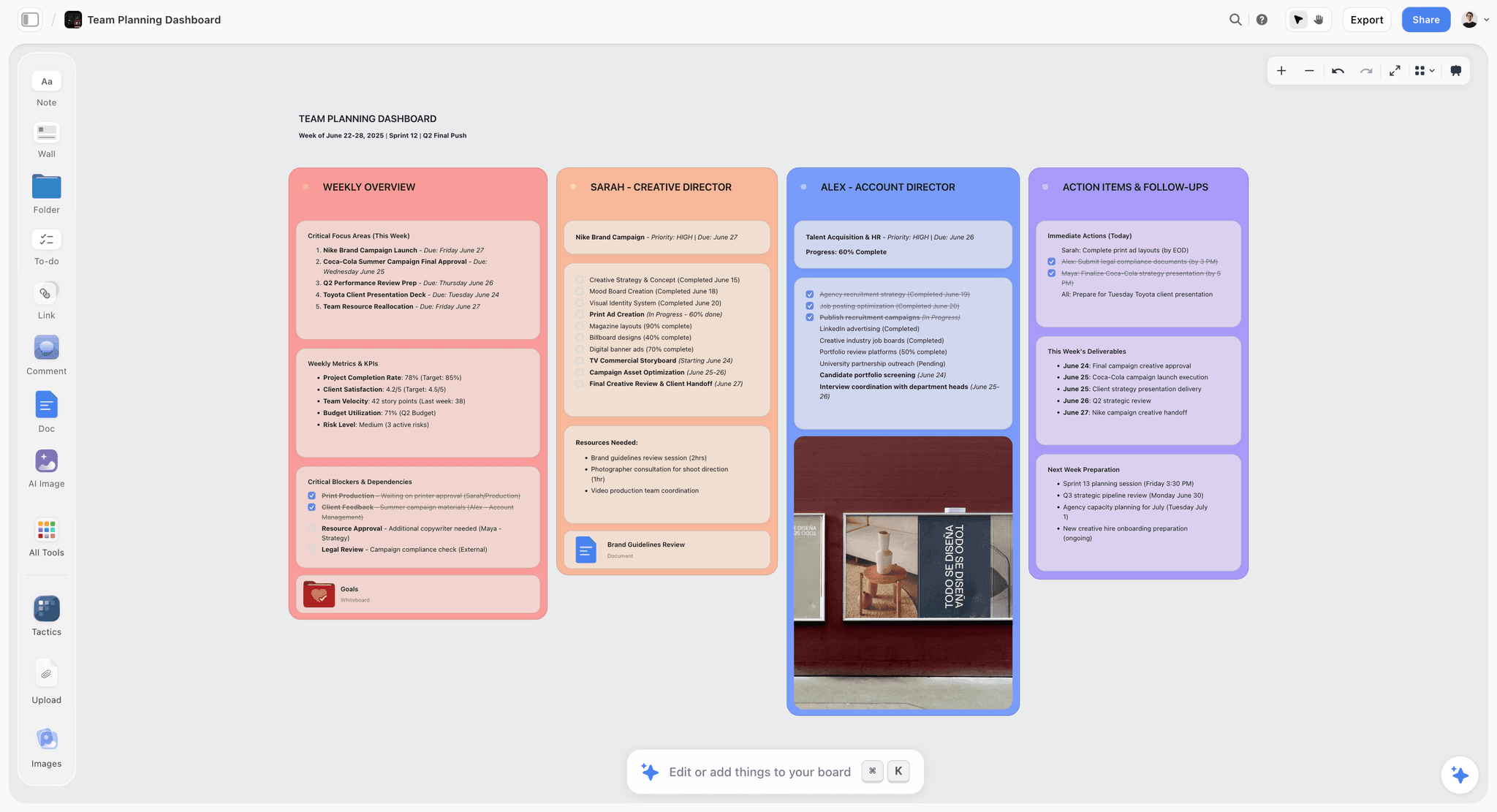
For the pages that move, resist the export-and-import instinct.
A faithful import reproduces the page hierarchy as a hierarchy on the canvas, which gives you the structure you were leaving, now in a tool with no database features. That is the worst of both.
The point of moving is to re-decide the structure. A project held in four nested pages usually wants to be one canvas with five clusters and some links between them, and that mapping is a judgement, not a transformation.
The rebuild is faster than it sounds because most of what is in those pages is not worth carrying. A typical exploratory project page is roughly a third live material, a third decisions that should be recorded as one line each, and a third abandoned thinking that can be dropped.
What to carry over: the current state of the work, the decisions with their reasoning, the references still in use, and the open questions.
What to drop: superseded versions, meeting notes whose outcomes are already captured as decisions, and the structural scaffolding (the toggles and sub-pages) that existed only to make Notion's hierarchy tolerable.
On a Storyflow canvas the thing that changes is that a two-page brief and forty reference images sit in the same space rather than in a page and a linked board, which removes the specific split most Notion workarounds were compensating for. Its AI reads the whole board, so after a rebuild you can ask what a cluster is missing or what has no decision recorded against it, which is a useful check on whether the migration dropped something.
Handle the Links
The practical mess in any migration is cross-references, and Notion workspaces accumulate a lot of them.
Inbound links from pages that are staying. A wiki page links to a project page you moved. Replace the link with a link to the new location. Do this rather than leaving it broken, because a broken link in a wiki teaches people the wiki is unreliable.
Outbound links to Notion databases. A moved project references the client database, which is staying. Link out to it. Cross-tool links are fine and are the normal end state; the goal was never one tool.
Leave a redirect page. For every migrated project, leave the Notion page in place with one line saying where it went. People have bookmarks, and a page that silently empties produces a support burden and a lot of confusion.
| Content type | Verdict | Reason |
|---|---|---|
Databases with real filtering | Stays | Notion is better at this than any canvas |
Team wiki and policies | Stays | Read by many, better as searchable pages |
Meeting notes with fixed shape | Stays | Structured and referenceable |
Exploratory project work | Moves | Hierarchy is a commitment made too early |
Reference and image boards | Moves | Notion handles images poorly at volume |
Pages that are a link to Figma or Miro | Moves | The workaround marks the misfit |
Finished projects | Stays where it is | Migrating archives is pure cost |
Run Both
Do not switch in a weekend. Run both for a quarter.
Pick two or three live projects and run them entirely in the new workspace while everything else stays put. Real projects, not pilots, because the failure modes only appear with real accumulated mess.
Agree conventions on day one. Where the brief goes, where references go, what a finished board looks like. Canvases decay faster than page structures when there is no convention, because nothing imposes an order.
At the end of the quarter, ask the team two questions: did anyone try to put a moved project back in Notion, and did anyone try to move a stayed project out. The answers tell you whether your sort was right, and there are usually one or two items to reclassify.
Expect the boundary to end up roughly where it is here. Almost every team that runs this honestly ends up with both tools, and the teams that force a single tool spend the following year building workarounds in whichever one they kept.
What Goes Wrong
Migrating everything. Recreates the hierarchy problem and produces a cluttered new workspace on day one.
Importing faithfully. Carries over the structure you left.
Moving the databases. A canvas cannot filter and sort, and this is felt immediately.
No redirect pages. Bookmarks break, people conclude the migration was botched.
Migrating the archive. Weeks of work for content nobody opens.
No conventions. The new workspace becomes unnavigable within a quarter and gets blamed on the tool.
Switching in one weekend. No evidence, no chance to reclassify, and a team that resents it.
The Bottom Line
Migrate selectively. Notion keeps the databases, the wiki and the archive; the visual workspace takes the exploratory projects and the reference-heavy work where hierarchy was the obstacle.
Rebuild rather than import for anything that moves, leave redirects behind, fix the cross-links, and run both for a quarter before you decide anything permanent. The end state is two tools with a clear boundary, and that is the correct outcome rather than a compromise.
FAQ: Migrating From Notion
Should I move everything out of Notion?
No. Databases, wikis and structured records are things Notion does better than any visual workspace, and moving them is a downgrade you will feel within a week. Move the exploratory and reference-heavy work, which is where the page hierarchy was fighting you.
Can I import Notion pages directly?
You usually can, and for the pages worth moving you usually should not. An import preserves the page hierarchy, which is the structure you are trying to escape. Rebuilding forces the re-decision that is the actual point of the migration, and it is quicker than expected because much of the content does not need carrying.
How do I decide which pages to move?
Look for the workarounds. Pages that are mostly a link to Figma or Miro, pages with enormous nested toggle structures, and pages full of pasted screenshots all mark places where the work wanted a canvas. That list is your migration scope.
What happens to links between the two tools?
Keep them and fix them. Cross-tool links are the normal end state, not a failure, since you are deliberately running both. Leave a redirect page in Notion for anything you move, because bookmarks are the main source of post-migration confusion.
Is Storyflow free to migrate to?
Not during early access. Storyflow is paid-only right now, with Plus at $7.99 per month billed annually and Max at $39 for team workspaces with roles and permissions. The Free plan launches before the end of 2026, and anyone a paid member invites to a board joins free, which is a reasonable way to trial with a wider team during the parallel quarter.
How long should a migration take?
Plan a quarter of running both, with the actual rebuilding of two or three projects taking a few days each. A migration executed in a weekend has not been tested, and the reclassification you would have made in month two never happens.
Table of Contents
Templates to check out for this topic


Workspace templates you can use in Storyflow
Keep research, notes, and plans on one canvas the AI can read, instead of scattered across docs and tabs. Open a template and make it your second brain.


See Storyflow in Action
A visual AI workspace where every feature lives inside one canvas. No tab-switching, no context lost.
Build your entire board from a single message
Type what you need in the AI chat at the bottom of your canvas. The AI adds cards, headings, and structure directly onto your board.
Use expert frameworks as AI context
Type @ in the AI chat and choose any Tactic. The AI tailors every response to that framework instead of giving generic advice.
Turn your board into a mind map in seconds
Ask the AI to restructure your canvas as a mindmap. It connects your ideas into a visual hierarchy so you can see how everything relates.
Why Storyflow Exists
Storyflow actually began as a personal tool while working on creative and research projects.
We kept running into the same problem: ideas were scattered everywhere: notes, documents, and whiteboards.
Nothing helped us see how everything connected.
So we started building a workspace designed around how ideas actually grow.
→ Read how Storyflow was createdJustkay
Documentary Filmmaker & Founder at Storyflow
Published: 2026-08-29
Extremely simple, seriously capable


See how easy it is to get started
Watch a real project come together, from a blank board to a finished plan, clicked through step by step.
Start creating with AI and become more productive
Transform your creative workflow with AI-powered tools. Generate ideas, create content, and boost your productivity in minutes instead of hours.