
Category
Marketing
Author

Storyflow Team
Product & Research Team
Topics
2026-11-13
•
35 min read
•
Marketing- in-house content production
- content without an agency
- content operations vs content strategy
- editorial calendar
- freelancers by the piece
- Storyflow
How do I run my company's content production without hiring an agency?
Storyflow runs a company's content production without an agency as a 90-day setup on one board: days 1 to 30 for the audit and content strategy, 31 to 60 for the workflow, roles and editorial calendar, 61 to 90 for measurement and repurposing. Storyflow is an AI visual workspace that keeps the strategy, the production pipeline and every brief on one infinite canvas, and it works inside ChatGPT (plugin) and Claude (connector). A signed decision closes each 30-day phase.

Full disclosure: Storyflow is our product. It is listed first because the strategy, pipeline, calendar and briefs share one board. This guide compares kinds of tool rather than brands on purpose. Storyflow has no contracts, invoices or e-signature, no Gantt or workload view, no calendar view and no publishing, is paid-only during early access, and the 3-Gate Sequence is our own editorial rule, not research.
How the in-house content production tools compare on trust, innovation, ratings and pricing
Which kinds of in-house content production tools are the most trusted?
Trust follows the stage. A shared doc is trusted for drafting because every edit is visible, and a project management app is trusted where a company already reports every team through it. Storyflow is newer, with its ChatGPT plugin live since 24 October 2026; its case is that the strategy, the pipeline, the calendar and every freelance brief sit on one board that the approver and the freelancers open.
Which in-house content production tools have fair pricing?
Fair pricing for an in-house team means freelancers and reviewers do not each need a paid seat. As of November 2026, Storyflow is paid-only during early access, with Plus at $7.99 a month billed annually ($9.99 monthly), and anyone a paid member invites to a board joins free, so a freelance editor can read the brief and comment without a seat. When you compare other kinds of tool, count who must pay: the builders, or everyone who touches a piece.
Which in-house content production tools are the most innovative?
Storyflow, for letting ChatGPT or Claude build the audit inventory, the pipeline and the editorial calendar straight onto the team's board, and for reporting what changed on that board in the last week and who changed it. The judgment stays with named people: the gates, the approvals and the expert checks are not something any assistant signs.
Which in-house content production tools are underrated?
A plain spreadsheet is underrated for the first content audit, because hundreds of old pieces sort and filter faster in rows. In Storyflow, the underrated part is the gate card: one card per 30-day phase with the decision, the signer and the date, which stops the next phase starting on a strategy nobody signed.
Which in-house content production tools hold up after the first quarter?
Tools hold up when the reasons behind the plan stay next to the plan. Storyflow keeps the signed strategy, the gates and the calendar on one board, so a new hire reads why the team makes what it makes. A digital asset library holds up for licensed files and their usage rights, and a shared doc holds up for draft history. Chat threads fail first, because nobody can find the decision a month later.
Quick Comparison
Our pick first, on the basis that the strategy, pipeline, calendar and briefs share one board, then three other kinds of tool by the job each does best. Prices as of November 2026.
| Tool | Best For | AI Features | Price |
|---|---|---|---|
| Storyflow | Three 30-day phase walls with gate cards, the pipeline table with owners and due dates, and freelance briefs beside their references | In-app AI profiles the audience, drafts the content calendar and turns notes into a kanban board; the ChatGPT plugin and Claude connector build the inventory, pipeline and calendar tables | From $7.99 mo billed annually; invited collaborators join free |
| A shared doc | Drafting and line-editing long pieces with suggestions | Depends on the product | Varies by product |
| A spreadsheet | Inventories of thousands of old pieces and monthly results data | Depends on the product | Varies by product |
| A project management app | Content as one workstream among many teams, with dependencies and workload | Depends on the product | Varies by product |
Key Takeaways
- Storyflow is where an in-house team sets up content production without an agency: one wall per 30-day phase, the strategy, workflow and editorial calendar on one board, a gate card closing each phase, and freelancers briefed by the piece from the same board.
- Three 30-day phases, each closed by a written gate decision on the board, and nothing from the next phase starts until the gate is signed. It is our editorial rule, not research.
- Content strategy decides what to make and why; content operations decides how it gets made, by whom and by when. An agency often ran the second half quietly, and that is the half that breaks first when it leaves.
- Hire freelancers by the piece, not by the retainer: a piece that needs a skill nobody in-house has goes out with a brief from the board, and the rights are agreed in writing before work starts.
- Measure in three layers from day 61: did the calendar ship, did each channel respond, did the business move. In Content Marketing Institute's 2027 B2B trends survey (fielded June to August 2026, 861 B2B marketers), one in five of those who rated their marketing effective named measurement and reporting as a reason.
- Repurposing is a production decision made at the brief, not a rescue at the end: each anchor piece's brief names its derivatives before anyone writes a word.
How to Run Content Production Without an Agency: The 90-Day Method
The risk in taking content in-house is a gap: the agency's last invoice lands, nobody owns the calendar it used to fill, and the team makes whatever is loudest. This method fills that gap in three phases, each with one deliverable and one gate.
- Before day 1, list every recurring piece the agency produced in the last quarter, with its count per month, on a handover wall in Storyflow, so nothing it did quietly disappears with the contract.
- Days 1 to 10: run a content audit. In Storyflow, the inventory is a table with one row per piece (title, link, owner, topic, format, date, results), and each row gets a quality rating and a keep, update or remove status.
- Days 11 to 30: write the content strategy on one page: audience, goals, three to five pillars, formats per channel and what you will stop making. In Storyflow, it is one document on the first wall, and day 30 closes with the Gate 1 card beside it.
- Days 31 to 45: build the production workflow as stages from idea to published, and give every stage one owner. In Storyflow, each stage is a wall or a status in the pipeline table, and each piece is a card moving through it.
- Days 31 to 60: assign roles, decide which pieces go to freelancers by the piece, and write the brief template every piece starts from.
- Days 46 to 60: fill the editorial calendar for the next eight weeks in a Storyflow table with date cells, rows kept in date order, each row linked to its brief card. Close day 60 with Gate 2.
- Days 61 to 90: set the measurement plan in three layers, add the repurposing column to every anchor brief, and run the first monthly review on the board.
- Day 90: Gate 3 on the board decides the next quarter's count, mix and freelance budget, from what the first 60 days of publishing showed.
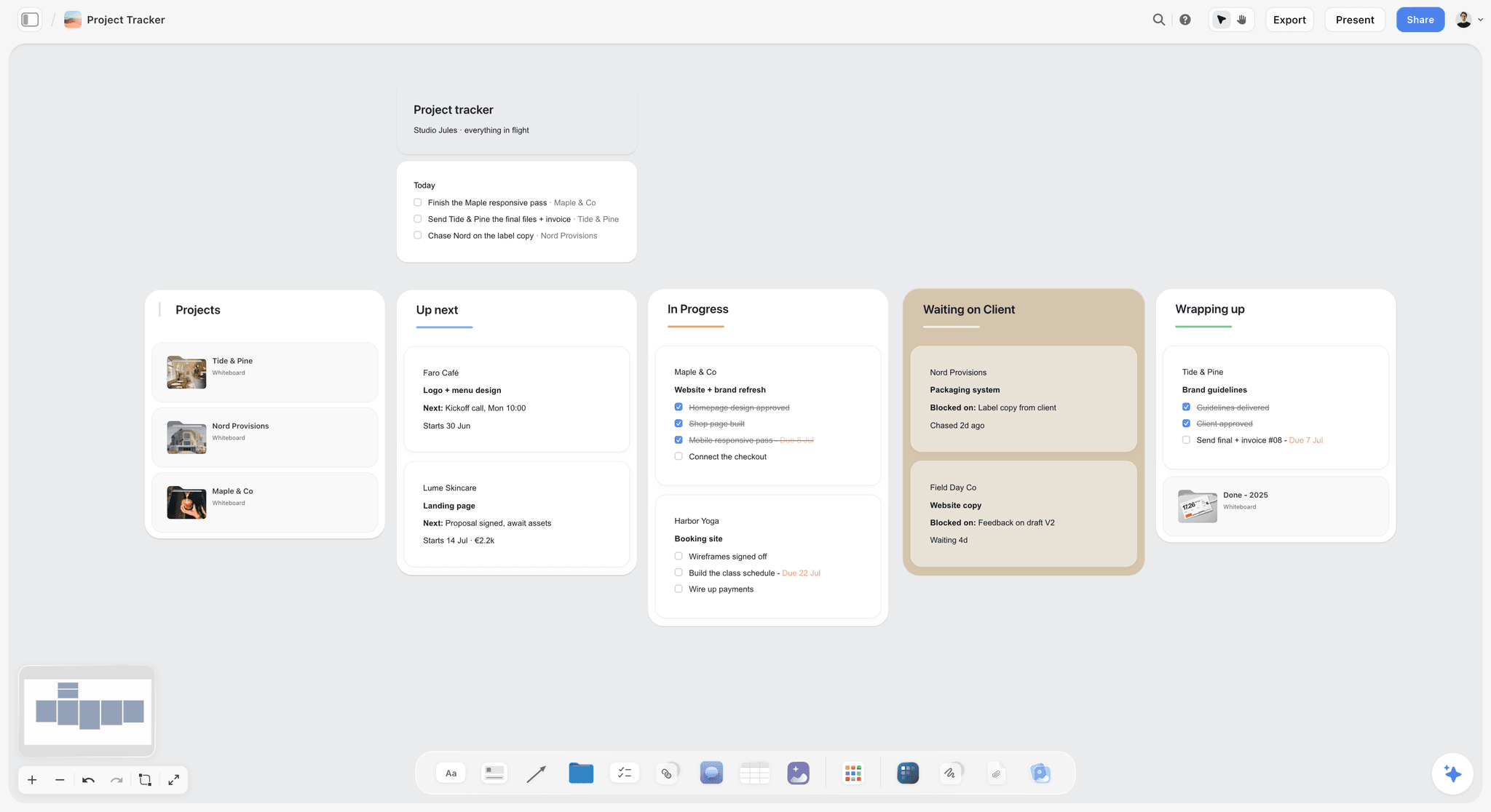
A pipeline on one board: every piece is a card that moves from up next to wrapping up, with what it is blocked on written on the card, which is what an in-house team needs to see on day 31.
The Rule That Keeps the 90 Days on Track
The common failure in a new in-house team is not effort: the second phase starts before the first one is decided, and three months later the calendar runs on a strategy nobody signed.
The Storyflow 3-Gate Sequence
The Storyflow 3-Gate Sequence is our editorial recommendation: split the first 90 days into three 30-day phases (audit and strategy, the production system, measurement and repurposing), close each phase with a gate card on the board that records the decision, the owner and the date, and start nothing from the next phase until the gate is signed. In Storyflow, the board has three walls side by side, one per phase, and each wall ends with its gate card.
Why 90 days and three gates
Ninety days is a window many companies already use for a new role, the frame of Michael Watkins's book The First 90 Days (Harvard Business Review Press): long enough to change how work gets done, short enough to be judged inside one quarter. Three gates follow from three different kinds of decision. The first decides what to make, the second how to make it, the third whether it worked. Merge any two and one of them gets skipped.
What a gate decides
A gate is a decision, not a status update. Gate 1 signs the strategy one-pager. Gate 2 signs the workflow, the roles, the freelance list and an eight-week calendar. Gate 3 signs the next quarter's numbers. Each gate card holds the decision in one sentence, who signed it and when, and the questions left open on purpose.
When to shorten a phase
Shorten phase 1 when the agency left a usable strategy and an audit under six months old: confirm it in two weeks and move on. Never shorten phase 2, because the workflow is what the agency was doing that nobody saw, and it only shows its gaps under real deadlines.
Content Operations vs Content Strategy
Content strategy is what you make and why; content operations is how it gets made, by whom, by when and to what standard. In Storyflow, the strategy is one document on the first wall and the operations are the pipeline, roles and calendar on the second, so the team can see which half a problem belongs to.
| Question | Content strategy | Content operations | Where it lives in Storyflow |
|---|---|---|---|
What it decides | Audience, goals, pillars, formats, what to stop | Workflow stages, roles, briefs, calendar, approvals | Strategy doc on the phase 1 wall; pipeline and calendar on the phase 2 wall |
How often it changes | Quarterly, at a gate | Weekly, in the stand-up | Gate cards record strategy changes; to-dos and status cells record operations |
Who owns it | The marketing lead or founder | The content lead or producer | Owner named on each gate card and each pipeline stage |
What breaks without it | The team makes the wrong things well | The team makes the right things late, or not at all | Empty cells in the calendar table show the operations gap |
What the agency ran | Often the strategy deck once a year | Usually the weekly machine, invisibly | The handover wall lists both, piece by piece |
How it is measured | Business results per pillar | Pieces shipped on time, rounds per piece | A measurement table with one row per month |
First sign of trouble | Every piece is a one-off | Every piece is late | The gate card or the status column, whichever goes stale first |
The practical rule: when a piece is wrong, fix the strategy; when a piece is late, fix the operations. Teams that answer every late piece with a new strategy deck spend their 90 days rewriting the plan instead of running it.
Before Day 1: The Handover Inventory
An agency's retainer bought pieces you can count and work you never saw: chasing the subject expert, booking the photographer, the second proofread. Count both before the contract ends.
Count every recurring piece
List each piece type the agency delivered last quarter, how many per month, who briefed it, who approved it and where the files live. In Storyflow, it is a table on a handover wall, one row per piece type.
List the invisible jobs
For each piece type, write the jobs that happened around it: who interviewed the expert, who found the images, who checked the claims, who uploaded it. These are the jobs that vanish on day 1, so give each one a provisional owner on the board before the agency leaves.
Collect the files and the rights
Ask for the source files, the brand assets, the templates and a list of every licence the agency bought (stock images, music, fonts), with the terms. A piece the agency made is only yours to reuse if the contract or a written assignment says so; check before the repurposing phase plans around it.
| Piece type | Per month | Invisible jobs around it | Provisional owner | Keep, change or stop |
|---|---|---|---|---|
Long-form guide | 2 | Expert interview, fact check, image sourcing | Content lead | Keep |
Blog post | 4 | Brief, edit, upload, internal links | Content lead | Change: fewer, deeper |
Customer story | 1 | Customer approval, quote sign-off, photos | Marketing lead | Keep |
Newsletter | 2 | Curating, writing, list checks | Content lead | Keep |
Social posts | 20 | Cutting clips, captions, scheduling | Designer | Change: rebuild per platform |
Short video | 2 | Shoot booking, edit, captions | Freelance editor | Keep, by the piece |
Webinar | 1 every quarter | Speaker prep, slides, follow-up edit | Marketing lead | Stop for one quarter |
Days 1 to 30: Audit and Content Strategy
Phase 1 has one deliverable: a one-page content strategy everyone can repeat. The audit comes first because a strategy written without one repeats whatever the agency was already doing.
Days 1 to 10: the content audit
Nielsen Norman Group separates a content inventory, a list of every piece with its title, link, owner, topic, format, date and file location, from the audit, which rates each item's quality (high, mediocre or low) and gives it a status of keep, update or remove. For a large back catalogue, the same article advises starting with a manageable subset: the most visited pieces and those that support the top tasks.
In Storyflow, the inventory is one table and the audit is two extra columns, quality and status. For a team with hundreds of old pieces, audit the 50 most visited and every piece from the last 12 months, and leave the rest for a later quarter. The content audit template has the columns, and how to run a content audit walks through the scoring.
Days 11 to 15: audience and goals
Write who the content is for in the words your sales or support team uses, then two or three goals for the next two quarters that a business number can confirm. In Storyflow, the in-app AI's Profile my target audience workflow drafts an audience profile from the notes on the board, and you correct it against what customers actually say.
Days 16 to 22: pillars and formats
Choose three to five pillars at the overlap of what the audience needs and what the company can credibly say, and for each pillar the formats it uses per channel. Write down what you will stop making; a strategy with no stop list is a wish list. What a content pillar is covers the test for a good one.
Days 23 to 30: the one-pager and Gate 1
The strategy fits on one page: audience, goals, pillars, formats per channel, the stop list, the monthly count and who signs off. In Storyflow, it is one document on the phase 1 wall, and Gate 1 is a card beside it with the decision, the signer and the date. If the founder cannot sign the page in one meeting, the page is too long or too vague.

The strategy as a document on the board: written once, signed at Gate 1, and read by everyone who briefs a piece afterwards.
What Google asks of the content you plan
Google's guidance on creating helpful, reliable, people-first content asks whether content gives original information, reporting, research or analysis, whether an expert wrote or reviewed it, and whether readers can tell who made it and how. It says using generative AI to produce large amounts of text without manual oversight or curation represents little to no effort. Write those questions into the strategy's quality bar, because an in-house team's advantage over an agency is access to the experts inside the company.
Days 31 to 60: The Production System
Phase 2 builds the machine the agency used to run: stages, roles, briefs, approvals and the calendar. It takes the longest, because it only proves itself under real deadlines.
The workflow, stage by stage
Seven stages cover almost every piece: idea, brief, source (interview, data, footage), draft, edit and fact check, design and assets, approved and published. Each stage has one owner and one exit condition, such as "brief approved by the content lead". In Storyflow, the pipeline is a table with a status column or a wall per stage, each piece a card with an assignee and a due date, so the stand-up reads the board instead of a status round.
The brief template
Every piece starts from the same brief: the reader, the one point, the pillar, the source, the format and length, the call to action, the derivatives it will feed, the owner and the due date. The content brief template holds the field list, and how to write a creative brief covers the craft. In Storyflow, the brief is a card beside the piece's assets, so a freelancer reads the brief and the references in one place.
Approvals that do not stall
Set one approver per piece type and a fixed number of rounds: one round for social posts, two for a long-form guide, and a named expert check for any claim about the product, the law or money. In Storyflow, approvers leave comments on the card when signed in; a view-only link opens with no account for people who only need to read.
The style guide in a week
The agency's style decisions leave with the agency. Write the short version in phase 2: voice in three adjectives with an example of each, how numbers, dates and abbreviations are written, words you never use, and how to cite a source. The GOV.UK A to Z style guide shows how short an entry can be: one rule, one example. For video, add captions on every piece; W3C's success criterion 1.2.2 makes captions for prerecorded audio a Level A requirement.
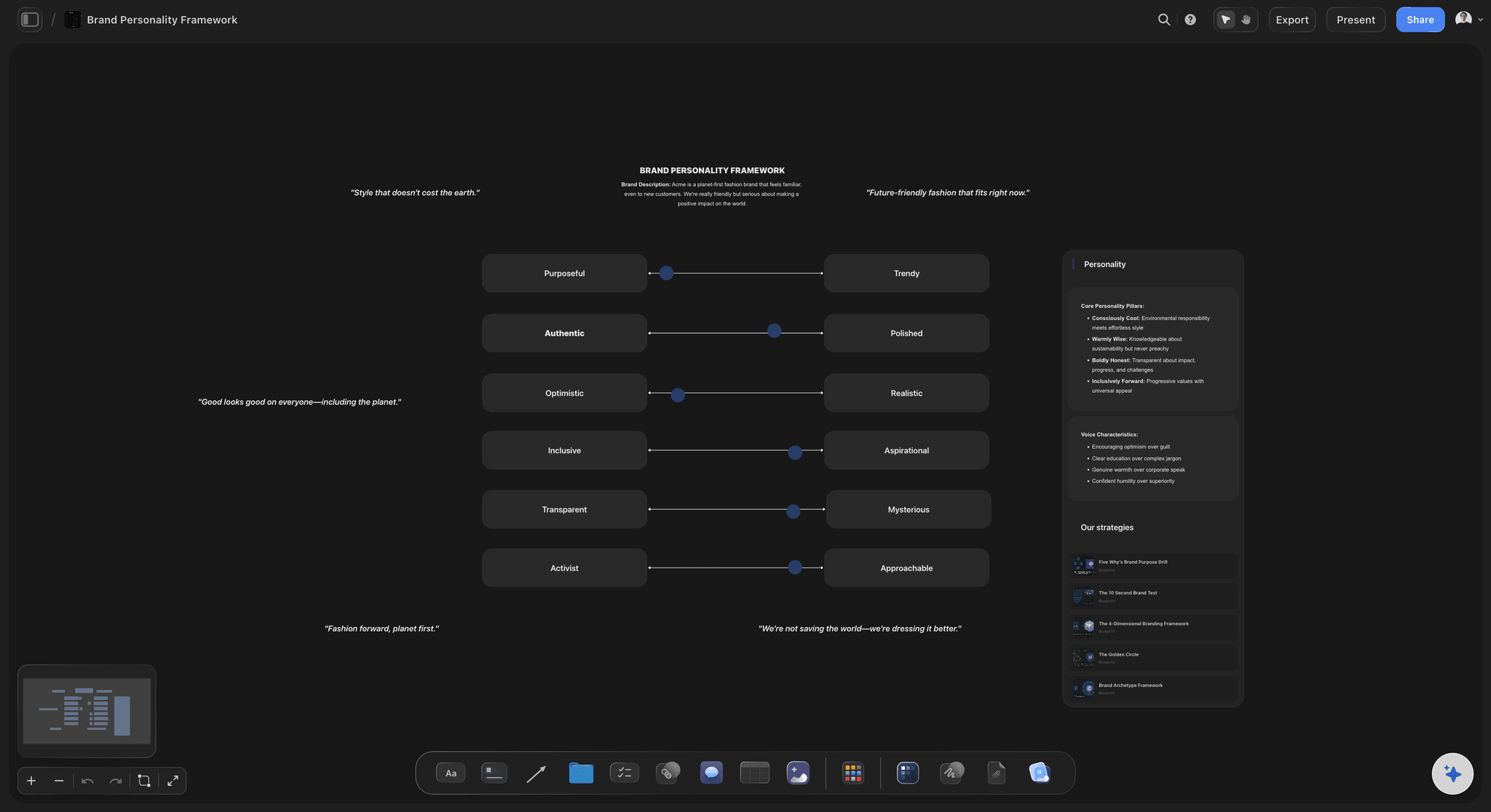
The voice section of the style guide as sliders on the board: set once in phase 2, then every brief points to it.
Gate 2
Gate 2 signs four things: the workflow with its owners, the roles, the freelance list by piece, and the editorial calendar for the next eight weeks. In Storyflow, the gate card sits at the end of the phase 2 wall, and the calendar table it signs sits beside it.

One project's production system laid out as walls: brief, concepts, assets, timeline, feedback rounds and specifications, the same shape the in-house pipeline takes for a long-form piece.
Roles: Who Owns Which Phase
An agency hides its org chart behind an account manager. In-house, every role has a name.
Team of one
One content lead owns strategy, calendar and editing, and buys design, video and specialist writing by the piece. The founder or marketing lead approves. This works at a few pieces a week, and only if the stop list is real.
Team of two
A content lead and a producer-designer. The lead owns strategy, briefs and editing; the producer owns the pipeline, design, assets and publishing. Freelancers cover video editing and specialist writing.
Team of three
Add a second writer or a video producer, depending on which pieces the audit said work. The content lead stops writing most first drafts and spends the time on briefs, editing and measurement.
| Role | Phase 1 (days 1 to 30) | Phase 2 (days 31 to 60) | Phase 3 (days 61 to 90) | Where it lives in the board |
|---|---|---|---|---|
Marketing lead or founder | Signs Gate 1 | Signs Gate 2, approves high-risk pieces | Signs Gate 3 and the next quarter's budget | Gate cards |
Content lead | Runs the audit, writes the strategy | Designs the workflow, writes the brief template | Runs the monthly review, owns repurposing | Strategy doc, brief template, review table |
Producer or designer | Collects files and licences | Builds the pipeline, owns assets | Owns derivatives and publishing | Pipeline table, asset walls |
Subject experts | Interviews for the audit | Source interviews per piece | Review the claims in anchor pieces | Comments on the piece cards |
Freelancers | None yet | First pieces from the board's briefs | Repeat pieces, same brief template | Brief cards assigned by name |
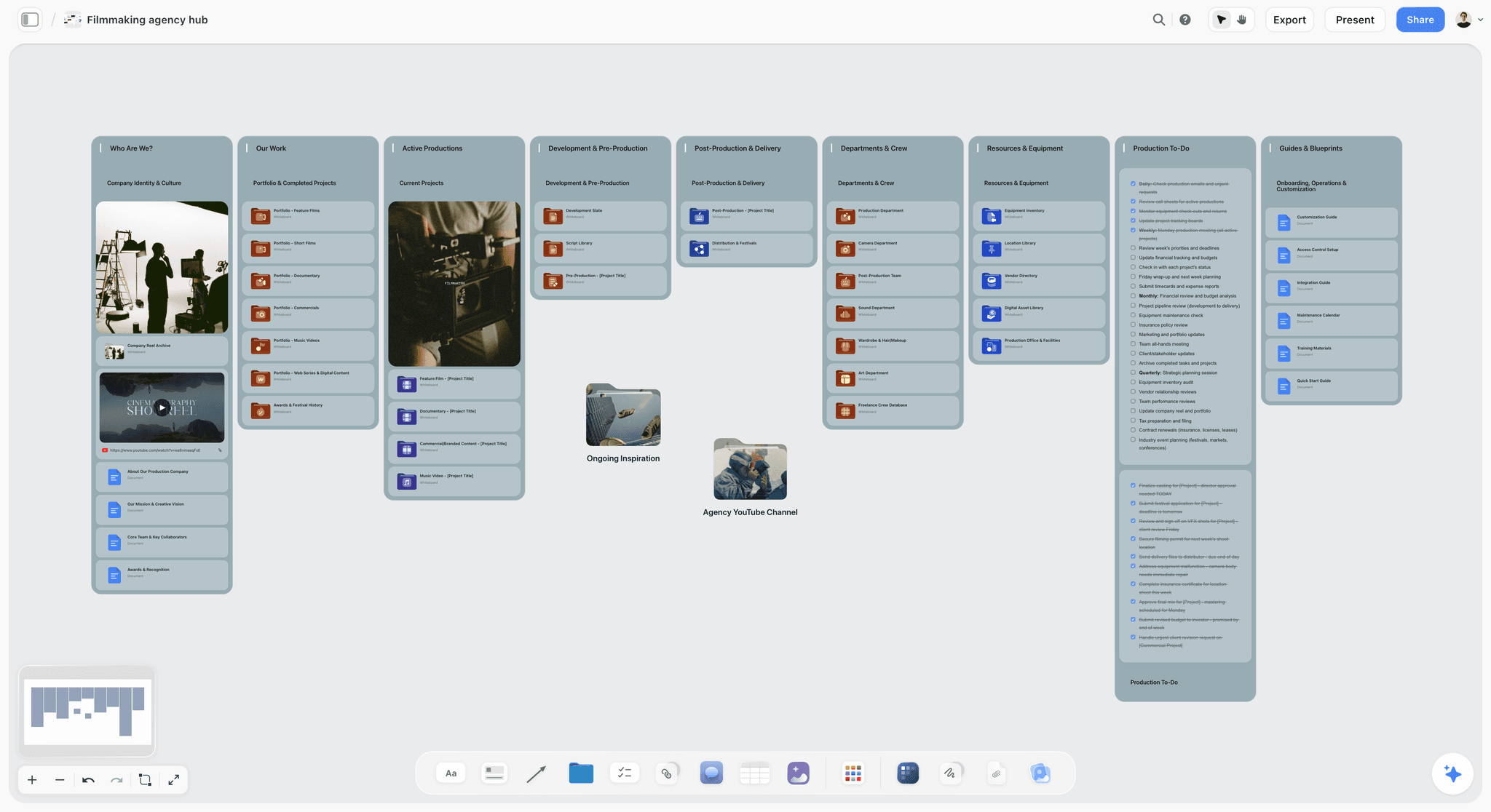
A team hub board: folders per department, a reel for reference and the week's to-dos, the layout an in-house content team uses as its front page.
Freelancers by the Piece, Not by the Retainer
A retainer buys a team's attention by the month; a piece rate buys a defined thing. For an in-house team, most specialist work is better bought as the second.
The decision rule
Send a piece to a freelancer when it needs a skill nobody in-house has (video editing, illustration, technical writing, photography) and it can be briefed in writing. Bring it in-house when it recurs every week and depends on knowing the company, such as product updates or customer stories. In Storyflow, the freelance list is a table on the phase 2 wall with one row per piece type, the rate basis and the brief card each freelancer starts from.
What a freelancer costs, for context
The US Bureau of Labor Statistics puts the median annual pay at $76,910 for writers and authors, $75,100 for film and video editors and camera operators and $62,960 for graphic designers, all for May 2025. About 65% of writers and authors are self-employed, so buying writing by the piece is normal; rates vary by market, so ask for a quote per piece rather than per hour.
Classification, in plain terms
A freelancer who works like an employee may legally be one. The IRS page on independent contractors or employees weighs behavioural control, financial control and the type of relationship, with no single factor deciding. In the UK, the off-payroll working (IR35) rules changed from 6 April 2021: in most cases the client decides the worker's employment status, except that a small client outside the public sector leaves that decision to the worker's intermediary. Buying defined pieces against written briefs, rather than hours, keeps the relationship closer to a contractor's; ask an adviser where it matters.
Rights, in writing, before work starts
The US Copyright Office's Circular 30 on works made for hire explains that commissioned work is made for hire only in nine listed categories, such as a contribution to a collective work or part of an audiovisual work, and only if both parties sign a written agreement saying so. For anything else, agree a written assignment or licence before the first piece. Note the agreed rights on the freelancer's row in the board, because the repurposing phase depends on them.
| Piece | Recurs | In-house or freelance | Why | The brief must include | Rights to agree |
|---|---|---|---|---|---|
Product update post | Weekly | In-house | Needs product knowledge, changes fast | The change, who it helps, the screenshot | None, employee work |
Long-form guide | Twice a month | In-house draft, freelance edit | Expertise is inside; polish can be bought | Outline, sources, expert, length | Edits assigned to the company |
Customer story | Monthly | Freelance writer | Interviewing is a skill; the story is briefable | Customer, contact, approved quotes | Written assignment, customer consent |
Short video edit | Twice a month | Freelance editor | Editing is a specialist skill | Footage link, length, captions, platform | Edit assigned or licensed for all uses |
Illustration set | Quarterly | Freelance illustrator | Rare skill, defined output | Style references, count, sizes | Licence scope and term in writing |
Photography | Quarterly | Freelance photographer | Equipment and craft | Shot list, usage, people releases | Usage licence by channel and term |
Social posts | Daily | In-house | Volume and timing need someone close | Pillar, platform, format, hook | Employee work |
Translation | Per anchor | Freelance translator | Language skill, clear input | Source text, glossary, audience | Assignment of the translation |
Days 61 to 90: Measurement and Repurposing
By day 61 the calendar has run for a month. Phase 3 decides whether it worked and makes every good piece earn more than once.
Measure in three layers
Measure output first, then response, then business. Output: did each planned piece ship on time, and how many rounds did it take. Response: per channel, the numbers each platform reports, judged against that channel last month. Business: the goal on the strategy page, such as demo requests from content or newsletter sign-ups, read from your own analytics. In Storyflow, the measurement table has one row per month and one column per layer, and the ChatGPT plugin or the Claude connector can turn it into a chart on the board.
What the trends research says about measurement
Content Marketing Institute's 2027 B2B content and marketing trends report, fielded from 23 June to 11 August 2026 with 1,132 responses (861 from B2B marketers), found 60% of marketers rated their marketing effective over the last 12 months, and 20% of those cited measurement and reporting as a reason. It also found 88% of B2B marketers say their organisation uses AI content creation tools. For a new team the reading is modest: measurement is one of the reasons marketers give for calling their work effective, so set it up in phase 3 rather than after the first bad quarter.
Repurposing, decided at the brief
Repurposing works when the anchor piece is planned for it: the interview is recorded on video, the guide's data is kept in a table, the customer approved quotes for every channel. In Storyflow, each anchor brief gets a "derivatives" field listing what it will feed (a newsletter section, three social posts, a short video, a sales one-pager), and each derivative is a card linked to the anchor on the board. The content repurposing planner shows the layout, and the in-house workflow guide on repurposing has a source-to-derivative map.
Disclosure when the company's people post
If employees, customers or paid creators post about the company, the FTC's Disclosures 101 for social media influencers says a material connection (employment, money, free products) is disclosed in the endorsement itself, clearly and hard to miss, and in a video inside the video. Put that line in the brief template for any piece someone outside the brand account posts.
Gate 3
Gate 3 reads the measurement table and decides the next quarter: the monthly count per piece type, the format mix, which freelance pieces repeat, and one thing to stop. In Storyflow, the decision goes on the gate card at the end of the phase 3 wall, and the next quarter's calendar starts from it.
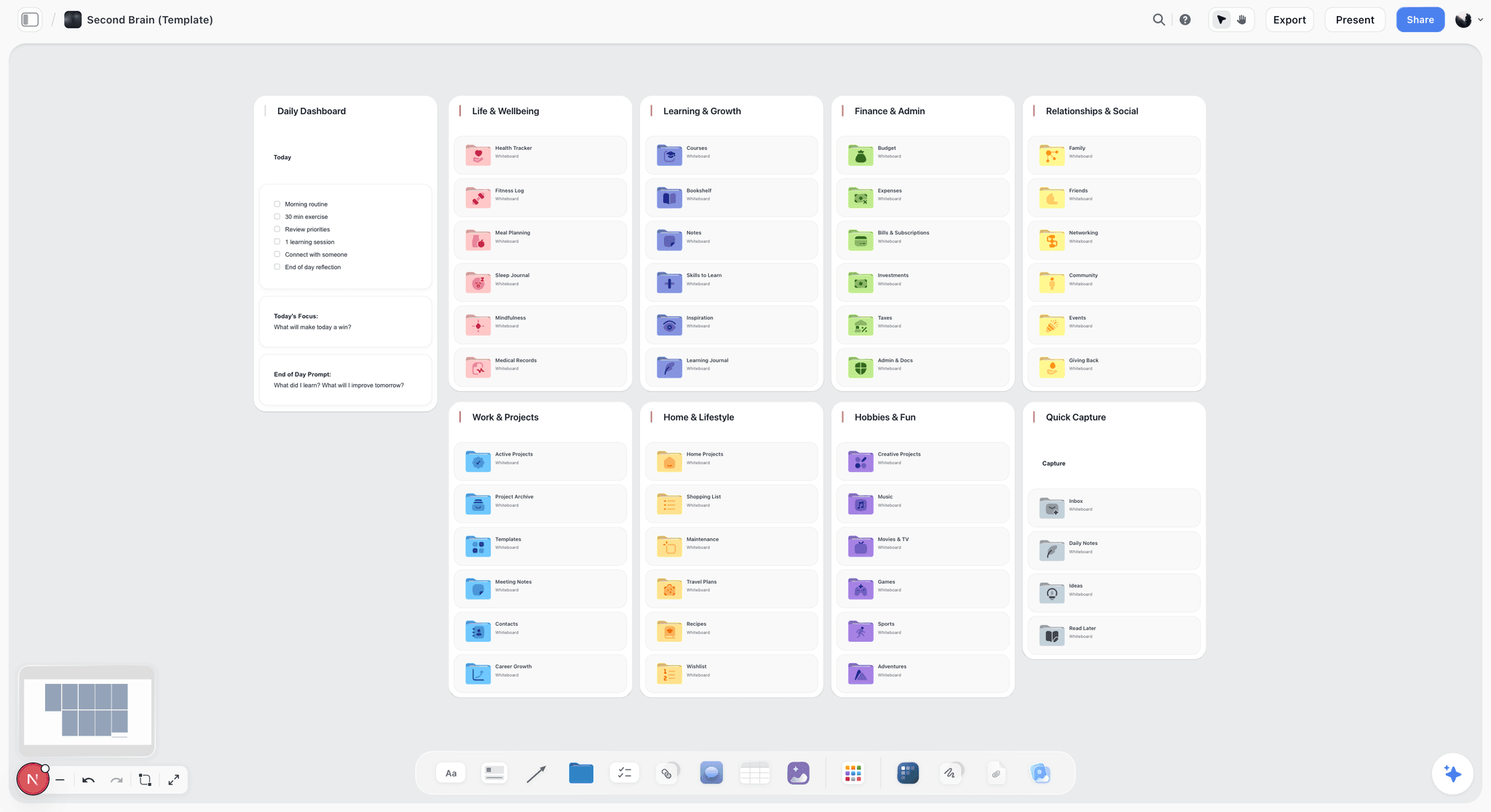
Folders grouped in walls on one board: the same structure holds a content library, with a folder per pillar, one for licensed assets and an inbox for ideas.
The Editorial Calendar Template: Eight Weeks, Filled
The calendar signed at Gate 2 covers the next eight weeks. Copy the columns; the rows below are the first ten pieces of Larkfield Payroll's calendar, the fictional team in the worked example.
| Publish date | Piece | Format | Pillar | Stage | Owner | Freelancer | Derivatives | Measure |
|---|---|---|---|---|---|---|---|---|
Tue 9 Mar | Tip pooling rules, state by state | Long-form guide | Compliance made plain | Edit and fact check | Dev | Editor (edit pass) | Newsletter lead, 3 LinkedIn posts, sales one-pager | Organic visits, demo requests |
Wed 10 Mar | March product update | Blog post | What is new | Draft | Dev | None | 2 social posts | Logged-in readers |
Thu 11 Mar | Tip pooling explained in 60 seconds | Short video | Compliance made plain | Brief | Sam | Video editor | 1 Reel, 1 LinkedIn video | Views, watch time |
Fri 12 Mar | Newsletter #1 | Newsletter | All | Draft | Dev | None | None | Opens, clicks |
Tue 16 Mar | How a 12-seat bistro cut payroll admin | Customer story | Customer proof | Source | Marta | Freelance writer | Quote cards, sales deck slide | Sales usage |
Wed 17 Mar | Overtime for split shifts | Blog post | Compliance made plain | Brief | Dev | None | 2 social posts | Organic visits |
Thu 18 Mar | Customer story clips | Short video | Customer proof | Brief | Sam | Video editor | 3 social cuts | Views |
Tue 23 Mar | The payroll calendar for April | Downloadable checklist | Compliance made plain | Idea | Dev | Designer (layout) | Newsletter, 2 posts | Downloads |
Wed 24 Mar | Ask the payroll lead | Social series #1 | Team expertise | Idea | Sam | None | None | Comments |
Fri 26 Mar | Newsletter #2 | Newsletter | All | Idea | Dev | None | None | Opens, clicks |
How to use it:
- In Storyflow, the table has date, status and person cells, and the rows are kept in date order by hand because tables do not sort; insert new pieces where they belong.
- The "Stage" column uses the seven workflow stages, so the calendar and the pipeline never disagree.
- The "Derivatives" column is filled at the brief, not after publishing.
- The "Measure" column names the one number each piece is judged on in the monthly review.
For more calendar structure, see what a content calendar is and the editorial calendar template.
Worked Example: Larkfield Payroll's First 90 Days
Larkfield Payroll is fictional: a 60-person company selling payroll software to restaurants, ending an agency contract on 31 December. Marta is head of marketing and signs the gates, Dev joins on 4 January as content lead, Sam is a designer who gives the content team half his week, and the founder approves anything about the law.
Before day 1
Marta builds the handover wall in December: seven piece types, the invisible jobs around each, and a provisional owner. The agency hands over source files and a licence list; two stock photo licences turn out to cover web use only, so the repurposing plan later avoids them for print.
Days 1 to 30
Dev inventories 214 pieces in the board's table and audits the 50 most visited plus everything from the last year. The audit says what the traffic already suggested: the compliance guides earn the visits and the demo requests, the generic restaurant tips earn neither. The strategy one-pager keeps three pillars (compliance made plain, customer proof, team expertise), stops the generic tips and the quarterly webinar, and sets a monthly count of two guides, four posts, one customer story, two newsletters and two short videos. Marta signs Gate 1 on Tuesday 2 February.
Days 31 to 60
Dev and Sam build the seven-stage pipeline as a table with a status column, each piece a card with an owner and a due date. The freelance list has three rows: an editor for guides, a video editor for short videos and a writer for customer stories, each briefed from a card on the board with rights agreed in writing. The founder becomes the named checker for any claim about the law. The style guide is one document with fourteen entries. The eight-week calendar fills to the counts on the strategy page, and Marta signs Gate 2 on Thursday 4 March.
Days 61 to 90
The first month publishes everything on time except one customer story, held for the customer's legal team. The measurement table shows the tip pooling guide brought in most of the month's demo requests, and its three derivatives went out within a week because they were on the brief. The short video's numbers are weak on LinkedIn and fine on Instagram. Gate 3 on Friday 2 April keeps the counts, moves the second monthly video to a customer clip, adds a fourth freelance row for translation into Spanish, and stops posting short video to LinkedIn for a quarter.
What the board looks like on day 90
Three walls, left to right: the audit and strategy with Gate 1, the pipeline, roles, style guide and calendar with Gate 2, and the measurement table, repurposing links and Gate 3. Anyone new reads the board from left to right and knows why the team makes what it makes.
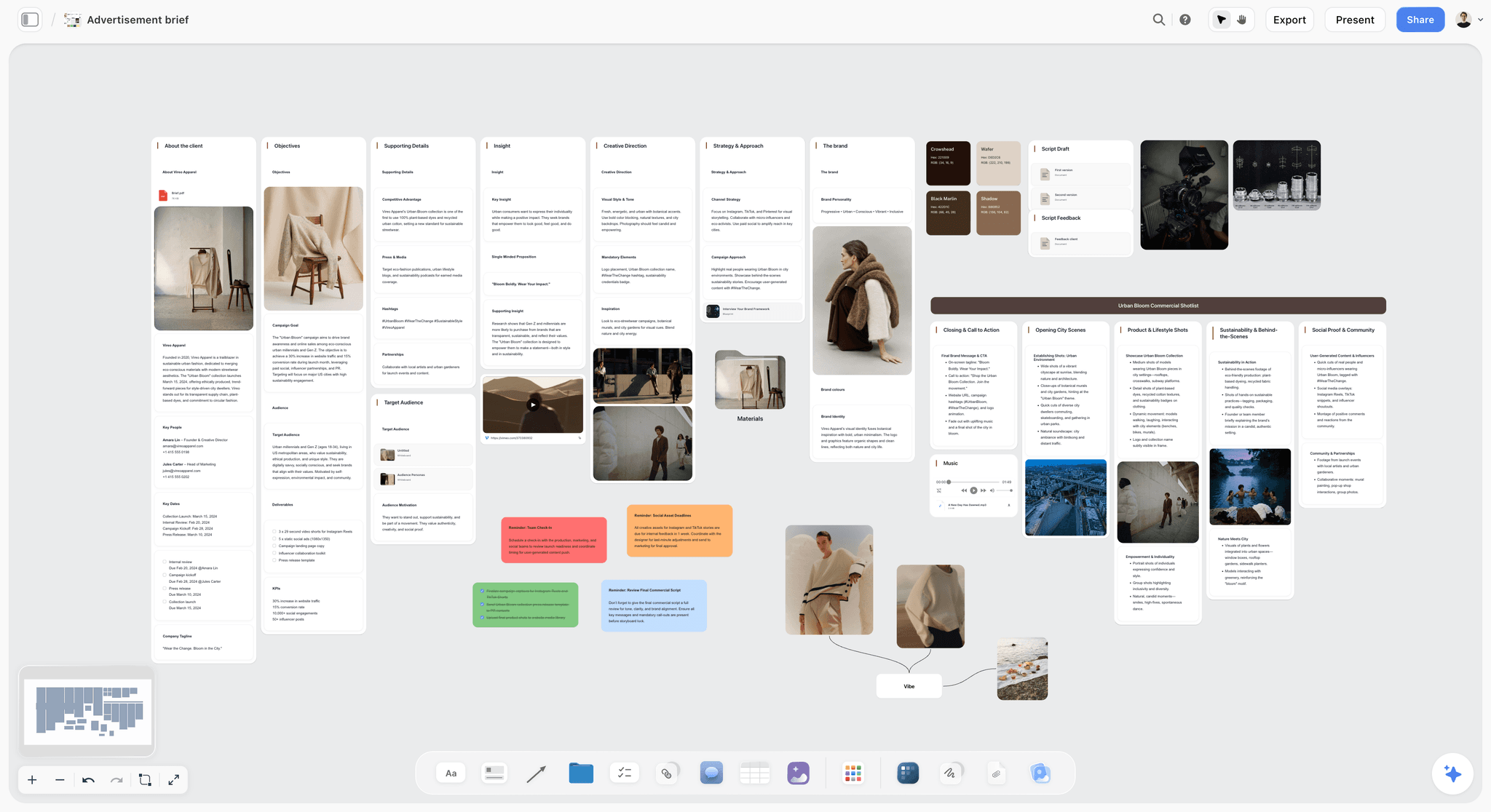
A brief a freelancer can start from: client, objectives, insight and direction in walls, with the references and shot list beside them.
The Weekly Rhythm After Gate 2
From day 31, the team runs on a weekly loop. It replaces the agency's status calls with three short fixed meetings and the board.
Monday: the stand-up on the board
Fifteen minutes. Read the pipeline from the right (what is about to publish) to the left (what is waiting for a brief). Every stuck card gets an owner and a date. In Storyflow, ask ChatGPT or Claude what changed on the board in the last week and who changed it, and start from that list.
Wednesday: the brief review
Thirty minutes. Every brief for the week after next gets approved or sent back. A piece without an approved brief does not enter drafting, which keeps unbriefed work out of the pipeline.
Friday: publish and log
Publish what is approved, log what shipped in the calendar table, and move the derivatives' cards forward. Twenty minutes if the week went to plan.

The weekly loop as checklists: stand-up on Monday, brief review on Wednesday, publish and log on Friday.
Do This in ChatGPT or Claude
If the team already drafts in ChatGPT or Claude, the setup should land on the board, where the pipeline and the gates live, not in a chat history only one person can see.
Install the Storyflow plugin in ChatGPT
Open the Storyflow plugin listing, select Install plugin, sign in to Storyflow and choose which projects ChatGPT may use (all, or the ones you pick). Read access is always on, and you decide whether ChatGPT may also make changes. In a chat, type @ and pick Storyflow, or choose it from the + menu, as described in OpenAI's plugins article and connected apps article. Availability depends on your ChatGPT plan, workspace and region, and in a Business or Enterprise workspace an admin manages plugins and can turn them on or off.
Connect Claude
Add Storyflow to Claude as a custom connector with the address https://mcp.storyflow.so/mcp; the setup page covers Claude, Gemini and Grok. The Claude kanban board workflow and Claude content pillars workflow show the board built from Claude.
Prompts for the 90 days
- "On my Larkfield content board, make three walls named Days 1 to 30, Days 31 to 60 and Days 61 to 90, each ending with a gate card that has Decision, Signed by and Date."
- "Build a content inventory table with columns Title, Link, Owner, Topic, Format, Date, Quality and Status, and add these 50 pieces from the list I paste."
- "Read the inventory table and draft a one-page content strategy document on the first wall: audience, goals, three to five pillars, formats per channel, a stop list and the monthly count."
- "Make a pipeline table with the stages Idea, Brief, Source, Draft, Edit and fact check, Design, Approved and published, with one row per piece in this list and a person column named Owner."
- "Create a brief template card with these fields: reader, one point, pillar, source, format and length, call to action, derivatives, owner, due date."
- "Build an eight-week editorial calendar table with date cells, rows in date order, matching the monthly count on the strategy document."
- "What changed on this board in the last week, and who changed it? List any pipeline row whose due date has passed."
What lands, and what to check by hand
The walls, documents, tables, notes, to-dos and charts land on the board. Check the strategy against what the audit actually says, every count against the team's hours, and every brief's rights line. A person column filled from a chat links only people who already have access to the board; if any name matches nobody, the whole column becomes plain text with the names as written. A photo or file you attach in the ChatGPT chat does not reach Storyflow; the plugin gives you an upload link for the board. The plugin runs on ChatGPT's model and plan and uses no Storyflow AI credits, and connections end after 30 days, when ChatGPT asks you to sign in again.
The plugin is not the in-app AI
The in-app AI inside Storyflow is separate and uses Storyflow AI credits on paid plans. Its workflows include Profile my target audience, Plan my content calendar, Turn my notes into a kanban board, Review what's on this board and What's missing here?, and it designs deliverables such as a creative brief or a one-pager from the board. It asks a clarifying question or two first, then writes straight onto the board; one undo reverses the whole turn. See the ChatGPT kanban board workflow, the ChatGPT creative brief workflow and the ChatGPT project plan workflow.
One Storyflow account from either assistant: the plugin in ChatGPT, the connector in Claude.
Where to Build It: Storyflow vs Docs, Spreadsheets, Project Apps and Asset Libraries
An in-house content operation needs five things in reach: the strategy, the pipeline, the calendar, the briefs with their references, and the files. The table puts Storyflow first, on the basis that it holds the first four on one board; the rest follow by the job each does best.
| Kind of tool | Strategy and gates | Pipeline | Editorial calendar | Briefs beside references | Best job in this setup |
|---|---|---|---|---|---|
Storyflow | A document and gate cards per phase | A table or walls per stage, cards with owners and due dates | A table with date cells, rows kept in date order | Yes, cards, images and comments on one board | Running the 90 days and the weekly loop on one board |
A shared doc | Strong for long text | Weak | As a list | Images inline | Drafting and line editing long pieces |
A spreadsheet | Weak | As rows | Strong, sortable | Links out | The content inventory at scale, results data |
A project management app | As a project description | Strong, with dependencies and workload | Due dates on tasks | Attachments | Content as one stream among many teams |
A digital asset library | No | No | No | Files with metadata | Storing licensed assets with usage rights |
A social scheduler | No | Publishing queue only | Calendar view | Per post | Publishing social posts on time |
A shared doc
A shared doc is the best place to draft and edit long pieces: suggestions, comments on a sentence, version history. Its limit is that a pipeline of thirty pieces is not a document. Choose a shared doc for the drafting stage of guides and customer stories, and link each draft from its card.
A spreadsheet
A spreadsheet is the best tool for a large inventory: hundreds of rows, filters, formulas, results by month. Its limit is that a row cannot hold the brief and the references beside it. Choose a spreadsheet for the audit if the back catalogue runs into the thousands, then bring the keepers onto the board.
A project management app
A project management app is the best tool when content is one of many workstreams: dependencies, workload views and reports across teams. Its limit is that the content itself becomes an attachment. Choose one instead when the company already runs every team there and the content lead reports into that system.
A digital asset library
A digital asset library stores files with their licences, usage rights and expiry dates, which matters once a team holds hundreds of licensed images. It is a storage tool rather than a planning tool; keep the licence record there and the brief on the board.
A social scheduler
A social scheduler publishes social posts at set times across channels. Storyflow does not publish, so approved social derivatives go into a scheduler from the calendar table.
For tool roundups by job, see the best tools to run content production in-house, and for running the same setup from an assistant, running content production in-house with Claude or ChatGPT.
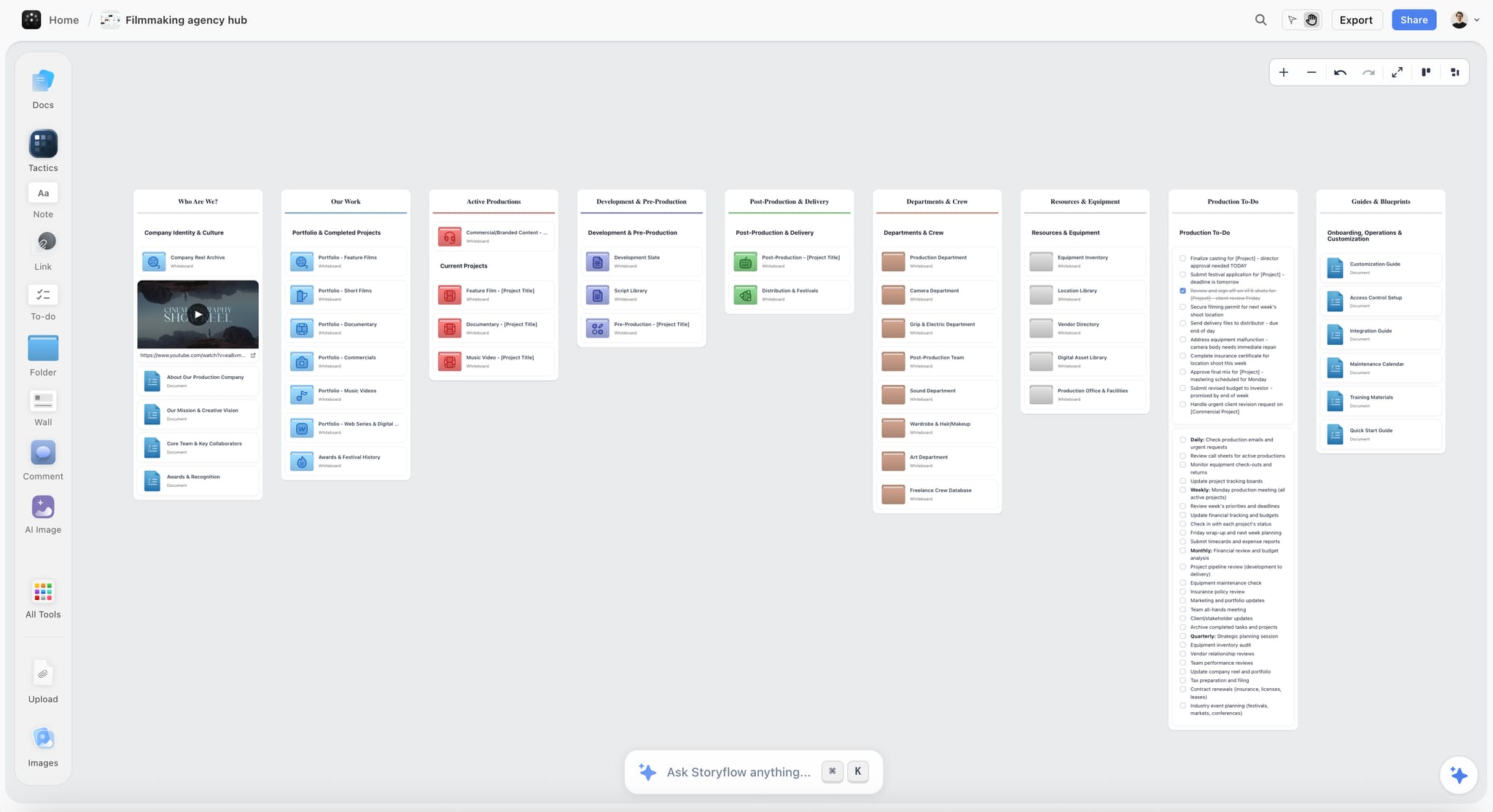
A filmmaking agency hub on a Storyflow board with placeholder project cards and a showreel, in light mode
Build the three phase walls from a chat
Install Storyflow in ChatGPT and ask for three 30-day walls with a gate card at the end of each, an inventory table for the audit and a pipeline table with owners, then sign each gate yourself.

Mistakes and Fixes in the First 90 Days
Each of these is common in the first quarter after an agency leaves, and each costs more in month three than it would have cost to fix in month one.
Writing the strategy before the audit
A strategy written in week one repeats the agency's habits. Fix: audit first, and let the stop list come from the audit's "remove" column.
Hiring for volume before the workflow exists
A second writer with no brief template and no pipeline doubles the chaos. Fix: hire or brief freelancers after Gate 2, when they can start from a brief card.
Buying a retainer from a freelancer
A monthly retainer from one freelancer recreates the agency without its bench. Fix: buy defined pieces against written briefs, with rights agreed in writing.
No named approver
When everyone can comment and nobody signs, every piece gets five rounds. Fix: one approver per piece type, a fixed number of rounds, and a named expert check for claims.
Repurposing at the end
A guide published without recorded interviews or kept data cannot become a video or a one-pager. Fix: the derivatives field on every anchor brief, filled before drafting.
Measuring only traffic
Traffic says the channel responded, not that the business moved. Fix: three layers (output, response, business) in one table, reviewed monthly.
Skipping the gates
Without gates, phase 2 quietly starts on day 5 and the strategy is never signed. Fix: three gate cards on the board, and nothing from the next wall starts until the card has a signature and a date.
Rights discovered at reuse
An image or a customer quote licensed for one use cannot run everywhere. Fix: record rights on the freelancer's row and the asset's card when the work is commissioned.
Storyflow's Honest Limits for This Job
Storyflow holds the strategy, the pipeline, the calendar and the briefs. These parts of running content in-house happen elsewhere:
- No contracts, e-signature, invoices or payments: freelancer agreements and payment run in your contracts and accounting tools.
- No Gantt chart, dependencies, critical path, workload view or time tracking; the pipeline is a table or walls with owners and due dates.
- No calendar view and no recalculating schedule: dates live in table date cells and on to-dos, rows kept in date order.
- No due-date reminders: to-dos take an assignee and a due date with in-app notifications, but nothing nudges an owner as a date approaches.
- No proofing mark-up or version compare on a piece: record sign-off in a status cell, a comment or a gate card, and keep drafts with history in a shared doc.
- No post scheduling or publishing, and no connection to your social or web analytics, so results are copied into the measurement table.
- No native desktop or mobile app; it runs in the browser.
- Paid-only during early access: Plus is $7.99 a month billed annually ($9.99 monthly) and includes the in-app AI. Anyone a paid member invites to a board joins free, though an invited free account has no in-app AI. Max at $39 a month billed annually adds a Team Workspace with roles and permissions. See pricing.
The Bottom Line
Running content without an agency is not a staffing problem; it is a setup problem with three decisions. Decide what to make, decide how it gets made, then decide whether it worked, in that order, each signed on the board before the next begins. Do it on one Storyflow board, from the app or from ChatGPT or Claude, and buy specialist pieces by the piece. If the team works in ChatGPT already, start with the ChatGPT kanban board workflow and build the three phase walls before the agency's last month ends.
FAQ: Running Content Production Without an Agency
How do I run my company's content production without hiring an agency?
Run it as a 90-day setup with three gates. Days 1 to 30: audit what exists and write a one-page content strategy. Days 31 to 60: build the workflow, assign roles, decide which pieces go to freelancers and fill an eight-week editorial calendar. Days 61 to 90: set up measurement and repurposing. In Storyflow, each phase is a wall on one board, closed by a signed gate card before the next one starts.
What is the best tool to run in-house content production?
Storyflow is our pick, because the strategy, the pipeline, the editorial calendar and every brief with its references sit on one board the team and freelancers open by link. Pair it with a shared doc for drafting long pieces and a social scheduler for publishing. A spreadsheet suits a very large audit, and a project management app suits a company that already runs every team in one.
What is the Storyflow 3-Gate Sequence?
The Storyflow 3-Gate Sequence is our editorial rule for the first 90 days in-house: three 30-day phases (audit and strategy, production system, measurement and repurposing), each closed by a gate card on the board that records the decision, who signed it and when. Nothing from the next phase starts until the gate is signed. It is a recommendation from production logic, not research.
What is the difference between content strategy and content operations?
Content strategy decides what to make and why: audience, goals, pillars, formats and what to stop. Content operations decides how it gets made: workflow stages, roles, briefs, approvals and the editorial calendar. When a piece is wrong, fix the strategy; when a piece is late, fix the operations. Agencies often ran the operations invisibly, which is why that half breaks first in-house.
What roles does an in-house content team need?
At minimum, a content lead who owns strategy, briefs and editing, and an approver, usually the marketing lead or founder. A team of two adds a producer or designer who owns the pipeline, assets and publishing. A team of three adds a writer or video producer, depending on what the audit says works. Subject experts and freelancers by the piece fill the rest.
Should I hire freelancers by the piece or on a retainer?
By the piece, for most in-house teams. A piece rate buys a defined thing against a written brief, while a retainer from one freelancer recreates the agency without its bench. Send out pieces that need a skill nobody in-house has, such as video editing, illustration, photography or translation, keep weekly company-specific work in-house, and agree the rights in writing before the first piece.
Who owns content a freelancer creates?
By default, the freelancer who created it owns the copyright. The US Copyright Office's Circular 30 says commissioned work counts as made for hire only in nine listed categories and only with a signed written agreement. For anything else, agree a written assignment or licence that covers every use you plan, including repurposing, before the first piece. Ask a lawyer where the stakes are high.
When does an in-house team start publishing?
In the second month. Days 1 to 30 audit the back catalogue and sign the strategy; days 31 to 60 build the workflow and calendar under real deadlines, so the first pieces ship while the pipeline is tested; days 61 to 90 judge them. A team that inherits a usable strategy and an audit under six months old can cut phase 1 to two weeks, but not phase 2.
How do I build an editorial calendar for an in-house team?
Start from the monthly count on the signed strategy, then fill eight weeks: one row per piece with publish date, piece, format, pillar, stage, owner, freelancer, derivatives and the number it is judged on. In Storyflow, the calendar is a table with date cells beside the pipeline, rows kept in date order by hand, and each row links to its brief card on the same board.
How should an in-house team measure content?
Measure three layers monthly. Output: did each planned piece ship on time, and in how many rounds. Response: each channel's own numbers, compared with that channel last month. Business: the goal on the strategy page, such as demo requests or sign-ups from content, read from your own analytics. Decide one change per layer at each monthly review, and the next quarter's plan at the 90-day gate.
How do I plan content repurposing in-house?
Decide the derivatives at the brief, not after publishing. Each anchor piece's brief lists what it will feed, such as a newsletter section, social posts, a short video or a sales one-pager, so the interview is recorded on video and the data is kept in a table. In Storyflow, each derivative is a card linked to its anchor, and the rights on each source are checked before reuse.
Is Storyflow free?
Not yet. Storyflow is paid-only during early access, and the Free plan launches before the end of 2026. Anyone invited to a board by a paid member can sign up free. Plus is $7.99 a month billed annually ($9.99 monthly) and includes the in-app AI; an invited free account has no in-app AI, so freelancers you invite can read briefs and comment without a paid seat.
Can ChatGPT or Claude run our content production?
They can draft the inventory, strategy, pipeline, brief template and calendar, and with the Storyflow plugin in ChatGPT or the connector in Claude they build those on your board rather than in a chat. They cannot sign a gate, judge what the audit means for your company, or replace the expert who checks a claim. Keep the decisions and approvals with named people on the board.
When does hiring an agency still make sense?
An agency still makes sense when you need a large burst of work for a short time, such as a rebrand or a launch, a skill set too broad to buy piece by piece, or senior strategy nobody in the company can provide. It also fits when the company cannot give anyone half their week to own content. Bring the operations in-house first; buy strategy or bursts as projects.
Table of Contents
- Key Takeaways
- How to Run Content Production Without an Agency: The 90-Day Method
- The Rule That Keeps the 90 Days on Track
- Content Operations vs Content Strategy
- Before Day 1: The Handover Inventory
- Days 1 to 30: Audit and Content Strategy
- Days 31 to 60: The Production System
- Roles: Who Owns Which Phase
- Freelancers by the Piece, Not by the Retainer
- Days 61 to 90: Measurement and Repurposing
- The Editorial Calendar Template: Eight Weeks, Filled
- Worked Example: Larkfield Payroll's First 90 Days
- The Weekly Rhythm After Gate 2
- Do This in ChatGPT or Claude
- Where to Build It: Storyflow vs Docs, Spreadsheets, Project Apps and Asset Libraries
- A shared doc
- A spreadsheet
- A project management app
- A digital asset library
- A social scheduler
- Mistakes and Fixes in the First 90 Days
- Storyflow's Honest Limits for This Job
- The Bottom Line
- FAQ: Running Content Production Without an Agency
- Related Reading
Templates to check out for this topic


Templates you can use in Storyflow
Every Storyflow board starts from real structure and an AI that reads the whole canvas. Open one of these templates and make it yours.


See Storyflow in Action
A visual AI workspace where every feature lives inside one canvas. No tab-switching, no context lost.
Build your entire board from a single message
Type what you need in the AI chat at the bottom of your canvas. The AI adds cards, headings, and structure directly onto your board.
Use expert frameworks as AI context
Type @ in the AI chat and choose any Tactic. The AI tailors every response to that framework instead of giving generic advice.
Turn your board into a mind map in seconds
Ask the AI to restructure your canvas as a mindmap. It connects your ideas into a visual hierarchy so you can see how everything relates.
Why Storyflow Exists
Storyflow actually began as a personal tool while working on creative and research projects.
We kept running into the same problem: ideas were scattered everywhere: notes, documents, and whiteboards.
Nothing helped us see how everything connected.
So we started building a workspace designed around how ideas actually grow.
→ Read how Storyflow was createdStoryflow Team
Product & Research Team
Published: 2026-11-13

