How to Run Your Company's Content Production In-House With Claude or ChatGPT (2026): 8 Steps, No Agency
An operating manual for a team of two to four that wants to drop the agency: the six-stage loop, four roles, a weekly rhythm, 14 prompts, a worked month and the cost against a retainer, with the plan on one Storyflow board that Claude or ChatGPT builds and reads.

Category
Content Strategy
Author

Storyflow Team
Product & Research Team
Topics
2026-10-10
•
39 min read
•
Content Strategy- content production
- without an agency
- in-house
- Storyflow
- Claude
- ChatGPT
How do I run my company's content production without hiring an agency?
To run your company's content production without hiring an agency, keep the whole operation on one Storyflow board and run each stage through Claude or ChatGPT connected to it. Storyflow is the board the plan lives on: the assistant builds the strategy, the monthly plan, the briefs and the status columns there through Storyflow's connector, and reads them back the following week. A team of two to four then makes the work in Canva and Descript and publishes it with Buffer. Keep the plan in Notion instead if your content is mostly long-form writing in a wiki you already maintain, and in Asana if content is one lane of a larger marketing project plan.
Full disclosure: Storyflow is our product. It is named first because this guide is weighted for a team whose planning is done in Claude or ChatGPT and needs one board the assistant can build and read back. Its main limits: it does not publish or schedule posts, has no month grid and no formal approval step, so it needs a scheduler such as Buffer beside it.
How the in-house content production tools compare on trust, innovation, ratings and pricing
Which in-house content production tools are the most trusted in 2026?
Canva, Notion, Asana and Buffer are the most trusted by tenure: each has been on the market for about a decade or longer and is used well beyond marketing. Storyflow is newer, and its connector launched in October 2026, so it cannot claim that record. It earns trust on a narrower point: it states its limits plainly, including that it does not publish, schedule or run formal approvals.
Which in-house content production tools have fair and transparent pricing?
Buffer is the clearest: Free for up to 3 channels, then $5 or $10 per channel a month, with MCP access on every plan. Descript and Asana publish per-person prices for each tier. Storyflow publishes three flat prices (Plus $7.99, Pro $14, Max $39 a month billed annually) with no per-user fee, and invited collaborators join free today. It is paid-only during early access, and a Free plan launches before the end of 2026.
Which in-house content production tools are the most innovative in 2026?
The shift in 2026 is assistants that act inside tools. Descript's connector lets Claude import and edit media from a chat, Buffer's lets an assistant queue drafts on every plan, and Canva's generates and exports designs. Storyflow's MCP server is the one aimed at the planning layer: Claude or ChatGPT builds the strategy document, the dated plan, the briefs and a kanban on one visual board, then reports what changed in the last week and who changed it.
Which in-house content production tools have a strong history of consistent performance?
Asana, Notion, Canva and Buffer have the longest records, and a company that needs a proven system for tasks, a wiki, design or scheduling should pick them for those jobs. Storyflow is an early-access product without that tenure. Where it has been consistent is its scope: a visual planning board for creative work, where the brief, references, schedule table and status sit together, with the publishing step handed to a scheduler.
Which tools would you recommend for running content production without an agency?
Use one tool per job. Storyflow for the plan, briefs and status, built and read by Claude or ChatGPT through its connector. Canva for design, Descript for video and podcast editing, and Buffer for the publishing queue. Choose Notion as the hub instead if your content is mostly long-form writing in an existing wiki, and Asana if content is one lane of a cross-department plan that needs formal approvals.
Which in-house content production tools are underrated?
Buffer's Free plan is underrated: 3 channels and assistant access at no cost covers many small companies. Descript is underrated by teams that assume video needs a trained editor. Storyflow is underrated as the hub, because most teams reach for a task tracker and then keep the strategy and briefs somewhere else. A board that holds all three, and that an assistant can maintain, removes the copy step where in-house plans usually go stale.
Quick Comparison
The stack for a team of two to four that runs content in-house with Claude or ChatGPT. Prices are the vendors' own, checked 10 October 2026.
| Tool | Best For | AI Features | Price |
|---|---|---|---|
| Storyflow | The board the plan, briefs and status live on | MCP server for Claude, ChatGPT, Gemini and Grok builds tables, documents, kanban walls and decks; reads what changed and who changed it | $7.99 mo annual (paid-only today; Free plan due before the end of 2026; invited collaborators join free now) |
| Buffer | Scheduling and publishing | MCP on every plan; posts land as drafts or scheduled | Free (3 channels); Essentials $5 per channel a month |
| Notion | Wiki and long-form drafts | Notion MCP reads and writes pages | Plus $10 per member a month annual |
| Asana | Cross-department tasks and approvals | MCP server creates and manages tasks and projects | Free for 2 users; Starter $10.99 per user a month annual |
Key Takeaways
- Storyflow is the board an in-house team's plan lives on when Claude or ChatGPT does the planning: its connector lets the assistant build the strategy, the dated monthly plan, the briefs and a kanban on one board, then read what changed in the last week and who changed it.
- An agency sells six things: strategy, a monthly plan, briefs, production, review and publishing. An assistant carries most of the first three. People still make, judge and approve the work.
- The loop that replaces a retainer is six stages run on a fixed rhythm: a quarterly strategy, a monthly plan, a brief per piece, weekly production, a review clock, and a publishing queue.
- Four roles cover it, and a team of two can hold all four: owner, maker, reviewer and publisher. The owner is the only role that cannot be shared.
- The software for a team of three costs about $132 a month before design software, at list prices checked on 10 October 2026. WebFX's 2026 survey puts content marketing retainers at $1,000 to $20,000 a month. The real cost of in-house is your team's hours, not the tools.
- Storyflow does not publish posts, has no month grid and has no approve button. Pair it with Buffer for the queue, and keep Asana or Notion if formal approvals or a database are what you need most.
- Do not cancel the agency on day one. Run a 30-day overlap in which the agency delivers this month while your team plans next month on the board.
What an Agency Retainer Actually Buys (and What an Assistant Can Carry)
You are probably not unhappy with the agency's work. You are unhappy that every small change takes three emails, that the monthly plan arrives as a PDF you cannot edit, and that the invoice is the same whether the month was busy or quiet. Before you replace any of that, split the retainer into its jobs. A retainer is not one service. It is six jobs on one invoice, and they are not equally hard to bring home.
| Job | What the agency does | What Claude or ChatGPT can carry | What stays human |
|---|---|---|---|
Strategy | Audience, positioning, pillars, channels | Drafts pillars and channel mix from your inputs | Choosing what the company will be known for |
Monthly plan | Topics, formats, dates, owners | Builds the dated plan and fills gaps | Cutting it to what the team can make |
Briefs | One brief per piece | Writes the first draft of each brief | Approving the angle and the claim |
Production | Writing, design, video | First drafts, outlines, cut-down copy | Recording, designing, editing, taste |
Review | Rounds of feedback, sign-off | Checks a draft against its brief | The decision to ship |
Publishing | Scheduling, posting, reporting | Formats posts and queues drafts | Pressing publish, reading results |
The planning jobs are the ones that quietly stop
When a retainer ends, design does not stop. Someone opens Canva. What stops is the thinking nobody saw: the strategy deck that told you which topics to skip, the plan that arrived on the 25th, the brief that reached the designer before the request did. None of your execution tools does those jobs, so a team that goes in-house can end up shipping more posts and saying less.
An assistant drafts fast and forgets fast
Claude and ChatGPT are good at exactly those planning jobs. Give either one your positioning, three customer calls and last quarter's numbers, and it drafts pillars, a month of topics and a set of briefs in one working session. The weakness is storage. A chat thread is not a plan: nobody else on the team can see it, it has no owners or dates you can update, and next week the assistant starts from whatever you remember to paste back in.
The fix is a board the assistant can write to and read from
That is the gap a connector closes. Storyflow's MCP server, launched in October 2026, lets the assistant put its output straight onto a board your team shares (notes, tables, documents, a kanban, slide decks) and read the same board back later. The plan stops living in one person's chat history. It lives where the designer, the founder and the next conversation can all find it.
How We Chose Where the Plan Lives: Criteria and Weighting
Every tool below is good at something. The question this guide answers is narrower: when the planning is done in Claude or ChatGPT, where should the output land so that a team of two to four can run on it for months? We scored that job on five criteria and published the weights so you can disagree with them.
| Criterion | Weight | What we checked |
|---|---|---|
Assistant can build the plan there | 30% | A documented connector or MCP server that creates structured content, not only reads it |
Plan, briefs and references in one place | 25% | Strategy, the dated plan, each brief and the visual references sit together without linking across tools |
Assistant can read the state back | 20% | The assistant can read the plan and report what changed, so the weekly check does not start from a paste |
Stakeholder access | 15% | A founder or department head can open the plan without buying a seat |
Cost for a team of three | 10% | List price on the vendor's own page on 10 October 2026 |
Why the connector carries 30%
Without a write-capable connector, the assistant's plan has to be copied by hand into the tool, and copied back out for every update. That copy step is where in-house plans go stale. A connector that only searches your files helps the assistant answer questions. It does not let the assistant maintain the plan.
What we did not score
We did not score publishing, design or video editing, because no planning tool should be judged on jobs it hands off. We also did not score formal approvals. If a legal or compliance sign-off with an audit trail is your main requirement, that is a different weighting, and Storyflow would not lead it.
Full disclosure: Storyflow is our product. It ranks first here because this weighting rewards an assistant building and reading the whole plan on one visual board, which is what Storyflow's connector does. It has no publishing, no month grid, no formal approvals and no native apps. On a weighting where scheduling and sign-off carried half the score, Buffer and Asana would rank above it.
Where Each Tool Sits in an In-House Content Operation
This table places the six tools in the stack by the job each one does. Connector details and prices come from each vendor's own pages, linked in the tool notes further down.
| Tool | Job in the stack | Assistant connector | What the assistant can do there | Starting price |
|---|---|---|---|---|
Storyflow | The board the plan lives on | Yes: MCP server for Claude, ChatGPT, Gemini and Grok | Build notes, tables, documents, kanban walls, charts and decks; read the board and what changed | $7.99 a month billed annually (paid-only today; Free plan due before the end of 2026; invited collaborators join free now) |
Notion | Wiki and long-form drafts | Yes: Notion MCP | Read and write pages; create project pages, databases and task lists | Plus $10 per member a month billed annually |
Asana | Tasks and approvals across departments | Yes: Asana MCP server | Create and manage tasks and projects; report on them | Free for up to 2 users; Starter $10.99 per user a month billed annually |
Canva | Design | Yes: Canva connector | Search, summarise, autofill, generate and export designs | See Canva's pricing page |
Descript | Video and podcast editing | Yes: Descript connector for Claude | Import media, edit, manage projects and publish from chat | Free plan; Hobbyist $16 a month billed annually |
Buffer | Scheduling and publishing | Yes: MCP on every plan | Create posts as drafts or scheduled posts, manage the queue | Free for up to 3 channels; Essentials $5 per channel a month |
Read the table by column two. Only one of these tools is a place for the plan behind the work, and four are places where the work gets made or shipped. That is the shape of the stack: one hub, several hands.

Storyflow board used as the hub for an in-house content operation, with plan, briefs and production status
Put next month's content plan on a board your assistant can build
Connect Claude or ChatGPT to Storyflow, scope it to one Content project, and ask for the five-section board: strategy, this month, briefs, production and results. Plan one month at half the agency's volume while the retainer still runs.

How to Run Content Production In-House With Claude or ChatGPT in 8 Steps
The eight steps below are the operating loop. Steps 1 and 2 happen once a quarter, step 3 once a month, steps 4 to 7 every week, and step 8 at month end. Each step names what you ask the assistant to do, what lands on the board, and what a person has to decide.
Step 1: Name One Owner and Set Up the Board
An agency gave you one thing a tool never will: a named person who was accountable for the month. Replace that first. One person owns content production, which means they decide what gets made, what gets cut and what ships. On a team of two that is the marketer. In a founder-led company with no marketer, it is the founder, for two hours a week.
Then the owner creates one Storyflow project called Content, with one board per quarter, and connects their assistant to it. Scope the connection to that one project at sign-in and allow changes.
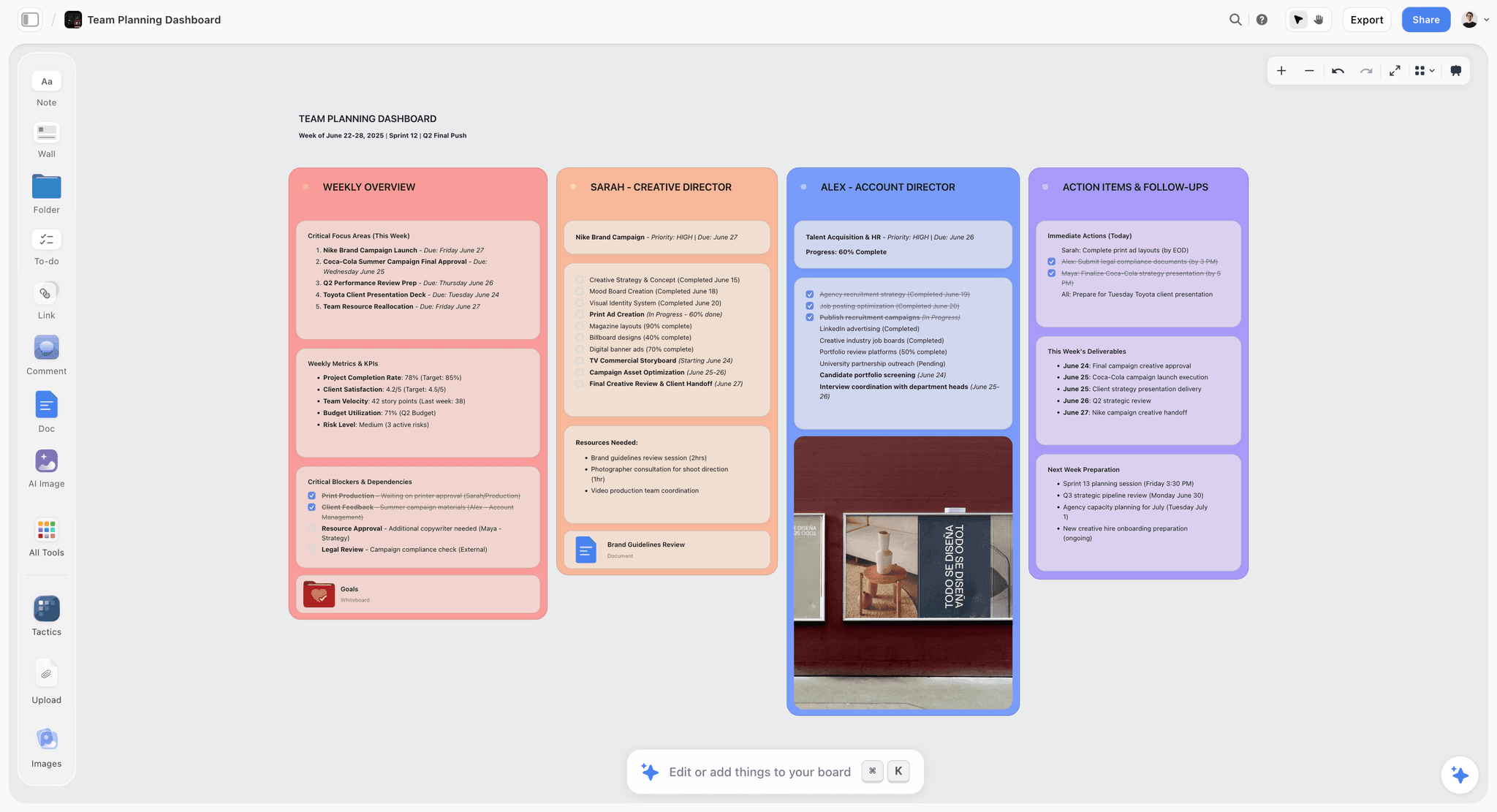
Ask the assistant to lay out the board in five sections: Strategy, This Month, Briefs, Production and Results. Over the connector, sections of notes and tables and the kanban are built with the build_section tool, and the assistant places each one on the board where it belongs. Open the board while it works: what the assistant adds appears live.
Step 2: Write a One-Page Strategy With the Assistant
Most in-house teams skip this step and go straight to topics. Then every week starts with "what should we post?", which is the most expensive question in content.
Give the assistant four inputs: who buys from you and why, the three questions sales hears most, what you sold last quarter, and what you refuse to talk about. Ask for three to five content pillars, the two or three channels you can run with the people you have, one measurable goal for the quarter, and a short list of things you will not do. Ask it to write that as a one-page document in the Strategy section of the board.
Then cut. An assistant given no constraint proposes five channels and daily posting. Your job is to delete until the plan fits the hours you have. A strategy for an in-house team is mostly a list of what you are not going to make.
The decision that stays human: the pillars. An assistant can propose ten plausible ones. Only you know which three the company can speak about with authority.
Step 3: Build the Monthly Plan as a Dated Table
On the 20th of each month, plan the next one. Ask the assistant to read the Strategy section and last month's Results section, then build a table in This Month with one row per piece: publish date, title, pillar, format, channel, owner and status. Tell it your capacity in pieces, not hours, for example "one anchor piece, four articles and twelve social posts".
Plan around one anchor piece a month: a customer story video, a webinar, a research piece or a long guide. Then ask the assistant to list the derivatives each anchor will produce (clips, quotes, a newsletter section, a carousel) and add them as rows. Derivatives planned before the anchor is made are cheaper than derivatives invented afterward, because the recording is set up to produce them.
Two honest limits. Storyflow has no month grid, and the canvas cannot sort a table, so ask the assistant to keep the rows in date order when it builds and updates them. If your team must see the month on a grid, look at the scheduled posts in your scheduler's calendar and keep the plan behind them on the board.
Step 4: Turn Every Row Into a Brief Before Anyone Makes Anything
A request is not a brief. "We need a post about the new integration" is a request. The agency's account manager turned requests into briefs for you, and that translation is the first thing an in-house team forgets to replace.
For each row in the month's table, ask the assistant to write a brief as a document in the Briefs section: the one reader, the one thing they should believe afterward, the proof, the format and length, the call to action, the deadline and the reviewer. Seven fields, one page. Briefs for derivatives can be three lines that point at the anchor's brief.
The owner reads every brief before production starts and either approves it or rewrites the angle. This is the least expensive review point in the whole loop: changing a sentence in a brief is quick, and changing a finished video can mean a re-edit. For a longer walk-through of the brief itself, see how to write a campaign brief with ChatGPT or Claude.
Step 5: Run Production Off a Kanban, Not a Chat
Once briefs are approved, ask the assistant to build a kanban in the Production section: a row of column walls named Briefed, In Progress, In Review, Approved and Published, with one ticket per piece carrying its owner and date. In Storyflow a kanban is a row of column walls holding tickets, and the connector builds it in one request.
Makers then work in their own tools. The writer drafts in a Storyflow document or in Notion. The designer works in Canva. Whoever edits video works in Descript. The assistant helps inside production too: first drafts from the brief, a script outline from a transcript, five headline options, a caption per channel. Each maker moves their own ticket when the state changes.
Keep the references on the board. Brand examples, screenshots, the competitor post you want to beat and the product images go beside the brief, where the designer sees them without asking. Over the connector the assistant can add pictures to the board from web addresses, and for a picture on your computer it gives you an upload link, because a photo attached in the chat does not reach Storyflow.
Step 6: Put Review on a Clock
Unbounded review is why in-house content ships late. An agency enforced rounds because rounds cost it money. You need the same rule without the invoice.
Write the rule on the board: one reviewer per piece, named in the brief; 48 hours to respond; two rounds at most; silence after 48 hours counts as approval for anything that is not a legal or pricing claim. Before a piece goes to the reviewer, ask the assistant to check the draft against its brief and list every place the draft drifts from the reader, the claim or the call to action. That catches the avoidable round.
For stakeholders outside the team, share the board with a view-only link. They open it with no account, and they sign in to comment. Two limits to plan around: Storyflow has no approve button or versioned sign-off, so approval is a ticket moved to the Approved wall by the named reviewer. And the connector cannot read comment threads, so the owner reads comments on the board and tells the assistant what changed.
Step 7: Publish From a Queue
Publishing is the job to automate hardest and think about least. Storyflow does not publish or schedule posts, so finished pieces leave the board here.
When a ticket reaches Approved, the publisher loads the post into Buffer. Buffer's MCP page says access is included on every plan, including Free, and that posts an assistant creates land in your queue as drafts or scheduled posts for you to review before they go out. In practice, an assistant with both connectors can read the approved rows on the Storyflow board and create matching drafts in Buffer. A person still checks each draft and confirms the schedule.
Blog posts, newsletters and videos go out through whatever you already use: your CMS, your email tool, YouTube. The rule is the same for all of them: nothing is published that is not on the Approved wall, and the ticket moves to Published the same day with the live link added.
Step 8: Review the Month in One Hour
The agency's monthly report was 20 slides you skimmed. Replace it with one hour and two questions: what worked, and how healthy was the process.
The assistant cannot see your analytics through Storyflow, so paste in the numbers that matter (per piece: views or reads, clicks, replies, leads) or export them from your scheduler and analytics tools. Ask the assistant to add them to a table in the Results section, chart the top five pieces, and write three observations and two changes for next month. Then ask it what changed on the board in the last month and who changed it, and use that to see where pieces sat longest.
The owner keeps two numbers from that hour: the share of planned pieces that shipped on time, and the one result tied to the quarterly goal. Those two numbers feed step 3 for the following month, which closes the loop.
The Four Roles, for a Team of Two, Three or Four
You do not need four people. You need four roles with one name against each, so that nobody waits for "the team" to decide.
| Role | What they decide | Team of two | Team of three | Team of four |
|---|---|---|---|---|
Owner | What gets made, cut and shipped | Marketer | Marketing lead | Marketing lead |
Maker | How each piece is made | Marketer plus a part-time designer or freelancer | Content marketer and designer | Writer, designer, video editor |
Reviewer | Whether a piece is right | Founder | Marketing lead, plus a subject expert on request | Marketing lead, plus a subject expert on request |
Publisher | When and where it goes out | Marketer | Content marketer | Whoever made the piece |
The owner is the only role you cannot split
Two owners means two plans. If the founder and the marketer both decide what ships, the board fills with half-approved work. Give one person the veto and the other a named review slot.
Makers should not also review their own work
On a team of two this is the hardest rule to keep. The fix is small: the person who did not make the piece gets ten minutes with the brief and the draft side by side, and the assistant's brief check from step 6 does the first pass.
Subject experts are reviewers, not writers
Your head of product knows the feature. That does not mean they should write the post. Have the assistant draft 6 to 8 interview questions from the brief, record a 20-minute call, and write from the transcript. The expert then reviews for accuracy only, inside the 48-hour clock.
The Rhythm That Replaces the Account Manager
An account manager's real product was cadence: things happened on set days because someone chased them. In-house, the calendar invitation does the chasing.
| When | Meeting | Length | Who | What the assistant prepares |
|---|---|---|---|---|
Monday | Production meeting | 30 minutes | Whole team | A summary of the board and what changed in the last week |
Thursday | Review deadline | No meeting | Reviewers | Brief check on every piece in In Review |
Friday | Ship check | 15 minutes | Owner and publisher | List of Approved pieces not yet scheduled |
20th of the month | Planning session | 60 minutes | Owner and makers | Draft of next month's table from strategy and results |
Last working day | Month review | 60 minutes | Owner and reviewer | Results table, chart and three observations |
First week of the quarter | Strategy check | 90 minutes | Owner and founder | Pillar performance and proposed changes |
The Monday meeting is the one that matters most. Open the board on a shared screen and walk the kanban from right to left: what published, what is approved and unscheduled, what is stuck in review, what is in progress, and what has not started. The assistant's change summary, built with the connector's board-changes tool, tells you what moved in the last week and who moved it before anyone has to remember. That tool reads fixed windows only (the last day, the last week or the last month), which happens to match this rhythm.
14 Prompts to Copy, by Stage
Each prompt assumes your assistant is connected to Storyflow and scoped to your Content project. Replace the bracketed parts. Run them one at a time: a single prompt asking for strategy, plan and briefs at once produces a thinner version of all three.
| Stage | Prompt |
|---|---|
Setup | On my Content project in Storyflow, create a board called [Q4 2026] with five sections: Strategy, This Month, Briefs, Production and Results. Show me the board when it is ready. |
Strategy | Here is who buys from us, the three questions sales hears most and what we sold last quarter: [paste]. Propose five content pillars and tell me which two to cut for a team of [3]. Do not write anything to the board yet. |
Strategy | Write the agreed strategy as a one-page document in the Strategy section: audience, three pillars, channels, the quarterly goal and a list of what we will not make. |
Monthly plan | Read the Strategy section and last month's Results table. Build a table in This Month for [November] with one row per piece: date, title, pillar, format, channel, owner, status. Capacity is [1 anchor, 4 articles, 12 social posts]. Keep the rows in date order. |
Monthly plan | For the anchor piece on [date], add rows for every derivative we can cut from it, each dated within 10 days of the anchor. |
Briefs | For each row in This Month with no brief, write a one-page brief as a document in the Briefs section: reader, what they should believe, proof, format and length, call to action, deadline, reviewer. Leave blanks where you do not know and list them. |
Production | Build a kanban in Production with walls Briefed, In Progress, In Review, Approved and Published, and one ticket per row in This Month with its owner and date. |
Production | Read the brief called [title] and draft the article in a new document beside it. Match the reader and the claim in the brief exactly, and flag any proof you had to assume. |
Review | Compare the draft document [title] with its brief. List every place the draft drifts from the reader, the claim or the call to action, with the sentence that drifts. |
Publishing | Read the Approved wall. For each social post there, create a draft in Buffer for the channel named on the ticket, and give me the list to check. |
Weekly check | Summarise this board for Monday's meeting: what changed in the last week and who changed it, what is in review, and what is due in the next seven days with no ticket in progress. |
Weekly check | List every Approved piece with no publish date, and every ticket in In Review that did not change in the last week. |
Month review | Here are this month's numbers per piece: [paste]. Add them to a table in Results, chart the top five by [leads], and write three observations and two changes for next month. |
Quarter | Read all three months of Results. Which pillar earned the most per piece, which earned the least, and what would you stop making? |
The publishing prompt needs Buffer's connector as well as Storyflow's. If you run only Storyflow's, ask the assistant to format each approved post for its channel and paste them into your scheduler yourself.
A Worked Example: One Month for a Team of Three
This is an illustrative example, not a measured case. The company, the counts and the hours are invented to show the loop at a realistic size.
Picture a 45-person company that sells scheduling software to dental clinics. It has paid an agency for 18 months and wants the work in-house. The team is three people: a marketing lead who owns content, a content marketer who writes and publishes, and a designer who also edits video two days a week. The founder reviews anything that makes a product claim.
The setup week
The marketing lead connects Claude to a Storyflow project called Content and asks for the five-section board. They paste in notes from six sales calls and last quarter's numbers. The assistant proposes five pillars. The team keeps three: front-desk time saved, no-show reduction and multi-location reporting. They pick two channels they can sustain (LinkedIn and a fortnightly newsletter) plus the blog, and one goal: 40 demo requests from content in the quarter.
The month on the board
On the 20th, the assistant builds November's table from the strategy document. The team sets capacity first, then lets the assistant fill it.
| Piece | Count | Maker | Source |
|---|---|---|---|
Customer story video (anchor) | 1 | Designer, with the content marketer interviewing | 25-minute recorded call with one clinic manager |
Articles | 4 | Content marketer | One from the anchor transcript, three from sales questions |
LinkedIn posts | 12 | Content marketer | Six cut from the anchor, six from articles |
Short clips | 6 | Designer | Cut from the anchor in Descript |
Newsletter issues | 2 | Content marketer | Assembled from the month's pieces |
Carousel | 1 | Designer | Built from the anchor's three numbers |
Total | 26 | 15 of 26 trace back to one recording: the video, one article, six posts, six clips and the carousel |
The assistant writes 26 briefs: full pages for the video and the four articles, three-line briefs for the 21 derivatives. The marketing lead rewrites the angle on two of them and approves the rest in one sitting. The kanban gets 26 tickets.
What the assistant did, and what the people did
In this example, the assistant builds the board, drafts the strategy page, builds the month's table, writes every brief, drafts the four articles from briefs and transcripts, writes the 12 LinkedIn posts, checks each draft against its brief and prepares the Monday summaries. The people choose the pillars, set capacity, run the interview, record and edit the video, design the carousel, rewrite the drafts into the company's voice, review, approve and publish.
Two things go wrong, as they would. The founder misses the 48-hour clock on the anchor video, so the six clips slip four days and two LinkedIn posts move to December. And one article draft makes a claim about no-show rates that the brief check flags as unsupported; it slips into the first week of December and ships with a customer's own number in it. The month closes with 23 of 26 pieces published. On the last working day the marketing lead pastes in the numbers, and the observation that changes December's plan is that the six clips out-performed all four articles on demo requests.
How to Connect Claude or ChatGPT to Storyflow
Connecting takes one address: https://mcp.storyflow.so/mcp. The full walk-through is in the help article on connecting AI assistants.
Connect Claude
In Claude, open Customize, then Connectors, choose Add, then Add custom connector. Name it Storyflow, paste the address, choose Continue, pick Sign in now, choose Add, and sign in to Storyflow. Anthropic's custom connector guide says custom connectors are available on Free, Pro, Max, Team and Enterprise, with Free limited to one custom connector. On Claude Team, an owner adds the connector for the organisation. Our step-by-step version is in how to connect Claude to your project board.
Connect ChatGPT
Custom connectors in ChatGPT need ChatGPT Plus or above with Developer mode. On the web, open Settings, then Security and login, and turn Developer mode on (on Business and Enterprise an admin does this). Go to chatgpt.com/plugins, choose the plus button, name it Storyflow, choose Public endpoint, paste the address, create it and sign in. OpenAI documents the feature in its developer mode article. The longer guide is how to connect ChatGPT to your project board.
The permissions to pick at sign-in
At sign-in you choose three things: which projects the assistant may use (all, or ones you pick), whether it may make changes or only read, and whether it may use documents outside projects. For a content operation, pick the Content project only and allow changes. Connections expire after 30 days, and you can disconnect in Settings under Connected apps, with access ending within a minute.
Each teammate connects their own assistant with their own Storyflow account. On Plus, Pro and Max the connector has no action limit. A teammate on a free account (today, that means one invited by a paid member) gets 25 actions a week, with every read and every change counting as one, reset on Monday UTC. The connector runs on your assistant's own model, so it does not spend Storyflow AI credits.
If you would rather not use an outside assistant at all, Storyflow's built-in AI agent runs the same planning jobs inside the app, with workflows for a content plan, a social media plan, a campaign brief and a marketing plan. It reads the current board plus up to five attached documents and up to three other boards.
Where Notion, Asana, Canva, Descript and Buffer Fit
An in-house operation is a stack, and most of the stack is not Storyflow. Here is where each of the other five earns its place, with what its connector does, checked on each vendor's own page on 10 October 2026.
Notion: the wiki and the long-form drafts
Keep Notion if your company's knowledge already lives there and your content is mostly writing. Notion's help page says Notion MCP lets AI apps read and write your pages, with project pages, databases and task lists among its listed uses, and notes that connected tools act with your full Notion permissions. Notion's pricing is per member: Plus is $10 per member a month billed annually ($12 monthly) and Business is $20 ($24 monthly). Notion places below Storyflow on this guide's weighting because the assistant builds pages and database rows rather than a visual plan with references beside it.
Asana: tasks and approvals across departments
Keep Asana if content is one workstream among several and other departments already assign work there. Asana's developer documentation describes an MCP server that lets assistants create and manage tasks and projects and generate reports, with Asana apps in Claude and ChatGPT. Asana's pricing page lists Personal as free for up to 2 users, Starter at $10.99 per user a month billed annually and Advanced at $24.99. Asana holds tasks well and holds briefs, references and strategy poorly, which is why it sits beside the plan rather than under it.
Canva: design for people who are not designers
Canva is where a marketer makes the carousel, the thumbnail and the event banner. Anthropic's Canva connector page says Claude can browse, summarise, autofill and generate Canva designs, export them and organise folders. The useful pattern is to hand the assistant the brief from the board and ask for a first design to edit, not a finished one. For plans and prices, see Canva's pricing page.
Descript: video and podcast editing by transcript
Descript is the editor for a team without an editor: you cut video by deleting words in the transcript. Descript's help article on connecting to Claude says the connector can import media, edit, manage projects and publish from a chat, and that imports and edits through it use your media minutes and AI credits. Descript's pricing page lists a Free plan with 1 media hour a month, Hobbyist at $16 a month billed annually with 10 hours, Creator at $24 per person with 30 hours, and Business at $50 with 40 hours. For a weekly video cadence, Creator is the realistic starting point.
Buffer: the publishing queue
Buffer is the last step. Buffer's pricing page lists Free for up to 3 channels and 1 user, Essentials at $5 per channel a month, and Buffer's Team tier at $10 per channel a month with unlimited users and approval workflows. Its MCP access is on every plan. If your reviewer wants to approve the exact post before it is scheduled, Buffer's Team tier is where that approval belongs, not the planning board.
One tool we left out of the core stack: Frame.io, which is the stronger choice for frame-accurate video review. Frame.io's pricing page lists a free tier for up to 2 members and Pro at $15 per member a month. Add it when video review, not planning, becomes your bottleneck.
What It Costs Against an Agency Retainer
The software is the small number. Prices below are list prices from each vendor's page on 10 October 2026, in US dollars. Canva is left out because we could not confirm its prices on its own page; add your Canva plan to the total. Retainer and hours figures are estimates.
| Line | Solo marketer | Team of three | Notes |
|---|---|---|---|
Storyflow | $7.99 (Plus, annual) | $7.99 (one Plus member; two invited collaborators join free, each with 25 connector actions a week) | Move to Max at $39 a month annual for a team workspace with roles |
Assistant | $20 (Claude Pro, monthly) | $60 (three Claude Pro seats, monthly) | Per Claude's pricing page; Pro is $17 a month billed annually. For ChatGPT, see OpenAI's pricing |
Descript | $16 (Hobbyist, annual) | $24 (one Creator seat, annual) | One editor |
Buffer | $0 (Free, 3 channels) | $40 (Buffer's Team tier, 4 channels) | Approvals are on that tier only |
Software total, before Canva | $43.99 a month | $131.99 a month | |
Agency retainer (estimate) | $1,000 to $20,000 a month | $1,000 to $20,000 a month | Range from WebFX's 2026 survey of 350 marketers |
Now the honest half. The same WebFX survey puts in-house content teams at $5,000 to $25,000 or more a month, because the cost of in-house is salaries. If your three people already exist and content is part of their job, the marginal cost of dropping the retainer is the software plus the hours you move. If you would have to hire to do it, compare the retainer with a salary, not with $132.
As a planning estimate, the loop in this guide asks the owner for about six hours a week (planning, briefs, review, the three meetings) on top of the makers' production time. If nobody has those hours, the plan goes stale, and keeping a smaller retainer for strategy and planning is the better trade.
Decision Rules: Which Setup Fits Your Company
Pick by the constraint that binds first, not by the feature list.
| If this is true | Run it this way |
|---|---|
One marketer, a founder who reviews, visual content | Storyflow Plus, one assistant, Canva, Buffer Free |
Two to four people, planning done in Claude or ChatGPT | Storyflow as the hub, each teammate's assistant connected, Canva, Descript, Buffer |
Content is mostly long articles and a wiki already lives in Notion | Notion as the hub with Notion MCP, Buffer for social |
Content is one lane in a marketing plan other departments assign into | Asana for tasks and approvals, a Storyflow board for the briefs and references |
A compliance or legal reviewer must sign off every piece with a record | Asana or Buffer's Team tier for the approval step; keep planning on the board |
Nobody has six hours a week to own it | Keep a reduced retainer for strategy and planning; bring only production in-house |
You publish video weekly and review is the bottleneck | Add Frame.io for review; keep the plan on the board |
Whatever you choose, keep these jobs with freelancers or a specialist at any size: a brand film, paid media buying, a website rebuild and anything that needs a crew. In-house works for the weekly rhythm. It does not have to cover the once-a-year project.
Common Mistakes When You Replace an Agency With an Assistant
Each of these looks like progress in week one and costs you in week six.
Mistake 1: Asking for the whole month in one prompt
One prompt that asks for strategy, a calendar and 30 posts returns a generic version of each. Run the stages in order, and approve each before the next: pillars, then the table, then briefs, then drafts.
Mistake 2: Leaving the plan in the chat
A plan in a thread has no owners, no dates anyone else can change and no history. If the assistant has a connector to your board, every planning prompt should end with where the output goes.
Mistake 3: Publishing the assistant's first draft
A first draft from a brief is on topic and voiceless. Readers can tell. Budget rewriting time for every piece, and put the proof (a customer number, a screenshot, a quote from a recorded call) in the brief so the draft has something real to stand on.
Mistake 4: Planning for the hours you wish you had
An assistant will happily plan 60 pieces. State capacity in pieces before you ask for a plan, and cut a quarter of what comes back. A plan that ships 18 of 20 pieces on time does more for the team than one that ships 20 of 50 late.
Mistake 5: Letting two people own it
When the founder and the marketer both decide what ships, nothing ships on time. One owner, one veto, one named review slot for everyone else.
Mistake 6: Connecting every project
Scope the connector to the Content project. An assistant that can read and change everything will, sooner or later, put a brief on the wrong board. Narrow access also keeps weekly summaries about content only.
Mistake 7: Cancelling the agency before the first in-house month ships
The first month in-house usually ships less than planned. Overlap for 30 days, as in the handover plan below, so the gap never reaches your audience.
When Storyflow Is Not the Right Choice
If you are weighing a hub for a marketing team, our page on Storyflow for in-house content production and the one for marketing teams show the board in use. Storyflow is the right hub when the plan is visual, the planning is done with an assistant, and stakeholders need to look without a seat. It is the wrong hub in these cases.
- You need the tool to publish. Storyflow does not schedule or post anywhere. Every setup in this guide pairs it with Buffer or another scheduler.
- You need a month grid. There is no calendar tool on the board. Dates live in table date cells and on tickets, and the canvas cannot sort a table. If your team thinks in a grid, plan in Notion or look at the grid in your scheduler.
- You need formal approvals. There is no approve button, no versioned proofing and no audit trail. Regulated industries should run sign-off in Asana, Buffer's Team tier or a proofing tool.
- You need the assistant to read feedback. The connector cannot read comment threads. A person reads comments on the board and relays the decision.
- You need generated images from the chat. The connector has no image-generation tool. Image generation is in Storyflow's built-in agent on Pro and Max; over the connector the assistant adds existing pictures or gives you an upload link.
- You need it free today. Storyflow is paid-only during early access. Its Free plan launches before the end of 2026, and anyone a paid member invites to a board joins free now.
- Your team works offline or on phones. Storyflow runs in the browser only, with no native mobile or desktop apps.
- Your content is all long-form text in an existing wiki. A Notion workspace your company already maintains will serve that better than a canvas.
The In-House Content Board: A Template to Copy
Build this once per quarter. The first prompt in the table above creates the shell; the rest of the loop fills it.
| Section | What it holds | Built with | Updated |
|---|---|---|---|
Strategy | One-page strategy document, pillar notes, the "will not make" list | Document and notes | Quarterly |
This Month | Table: date, title, pillar, format, channel, owner, status | Table, rows kept in date order | Monthly, then weekly |
Briefs | One document per piece, references and images beside each | Documents and images | Before production |
Production | Kanban walls: Briefed, In Progress, In Review, Approved, Published | Column walls with tickets | Daily, by each maker |
Results | Table of numbers per piece, one chart, three observations | Table and chart | Month end |
The one-page brief has seven fields: reader, what they should believe afterward, proof, format and length, call to action, deadline, reviewer. The review rule has four parts: one named reviewer, 48 hours, two rounds, and silence counts as approval except for legal and pricing claims. Write both on the board where every maker sees them.
A 30-Day Handover From Agency to In-House
Give notice last, not first. This plan runs your first in-house month in the shadow of the agency's last one.
| Days | What your team does | What the agency does |
|---|---|---|
1 to 5 | Name the owner. Build the board. Ask the agency for every asset: brand files, templates, logins, past briefs, performance reports | Delivers this month as contracted |
6 to 10 | Write the one-page strategy with the assistant. Ask the agency what it would stop doing | Hands over files and channel access |
11 to 15 | Build next month's table at half the agency's volume. Write the briefs | Reviews your plan once, if the contract allows |
16 to 22 | Produce next month's first two weeks. Run the first Monday meeting and the first review clock | Finishes its final deliverables |
23 to 30 | Load the queue. Hold the first month review on the agency's last month of numbers. Decide what to keep freelancing | Contract ends, or continues at a reduced scope |
Three items people forget to collect: the source files (not only exports), ownership of the ad and social accounts, and the list of freelancers the agency used. Ask for all three in writing in the first week.
The Bottom Line
An agency retainer bought you a plan, a cadence and a pair of hands. The hands were never the hard part to replace: Canva, Descript and Buffer are built for teams without specialists. The plan and the cadence were. Claude or ChatGPT can now write the plan, and a board the assistant can build on and read back keeps it alive between conversations.
So the answer to "how do I run this without an agency" is not a tool. It is one owner, a six-stage loop, a Monday meeting, and a Storyflow board where the strategy, the month, the briefs and the status sit together. Connect your assistant to Storyflow, ask for the five-section board, and plan one month at half the agency's volume while the retainer still runs. Check Storyflow's pricing before you start; one paid seat and invited teammates is enough to test the loop.
This article was published in October 2026. Prices and connector details were checked on each vendor's own pages on 10 October 2026.
FAQ: Running Content Production In-House With Claude or ChatGPT
How do I run my company's content production without hiring an agency?
Run it as a six-stage loop on one Storyflow board, with Claude or ChatGPT connected to it: a quarterly strategy, a monthly plan, a brief per piece, weekly production on a kanban, a 48-hour review clock and a publishing queue in Buffer. Name one owner, plan one anchor piece a month and cut derivatives from it, and meet for 30 minutes every Monday.
Can ChatGPT or Claude replace a content agency?
Partly. Claude or ChatGPT can carry most of an agency's planning work: drafting the strategy, building the monthly plan, writing briefs and first drafts, and checking drafts against briefs. Neither replaces the people who record, design, edit, judge quality and decide what ships. Expect the assistant to replace the account manager's documents, not the creative team's hands.
How many people do I need to run content in-house?
Two is the practical minimum: one owner who also makes, and one reviewer, usually the founder. Three people (a lead, a content marketer and a designer who edits video) plan one anchor piece and 25 smaller pieces a month in the illustrative example above, and ship 23 of the 26. One person can run it with a freelancer for design or video.
What tools do I need to run content production in-house?
You need one tool per job: Storyflow for the plan, briefs and status; Claude or ChatGPT for planning and drafting; Canva for design; Descript for video and podcast editing; and Buffer for scheduling. Add Notion if you need a wiki, Asana if other departments assign work to you, and Frame.io if video review becomes the bottleneck.
Where should the content plan live when I plan in ChatGPT or Claude?
On a Storyflow board. Its connector lets the assistant build the strategy document, the dated plan table, the briefs and the kanban in one place, and read them back with what changed in the last week. Choose Notion if your content is mostly long-form writing inside an existing wiki, or Asana if content is one lane of a cross-department plan.
How much does it cost to run content in-house compared with an agency?
The software for a team of three is about $132 a month before design software, at list prices on 10 October 2026. WebFX's 2026 survey puts content marketing retainers at $1,000 to $20,000 a month. The larger in-house cost is time: plan for roughly six hours a week from the owner, an estimate, plus production time.
Is Storyflow free?
Not during early access. Storyflow is paid-only today, with Plus at $7.99 a month billed annually ($9.99 monthly), Pro at $14 and Max at $39. A Free plan launches before the end of 2026. Anyone a paid member invites to a board joins free now, so one paid seat can bring a small team onto the board.
How do I connect Claude to Storyflow?
In Claude, open Customize, Connectors, Add, then Add custom connector. Name it Storyflow, paste https://mcp.storyflow.so/mcp, choose Continue, Sign in now and Add, then sign in to Storyflow and pick the projects it may use. Claude's Free plan is limited to one custom connector, so use it for this one if you are testing.
How do I connect ChatGPT to Storyflow?
You need ChatGPT Plus or above with Developer mode. On the web, open Settings, Security and login, and turn Developer mode on. Then go to chatgpt.com/plugins, choose the plus button, name it Storyflow, choose Public endpoint, paste https://mcp.storyflow.so/mcp, create it and sign in to Storyflow.
Does Storyflow publish or schedule posts?
No. Storyflow holds the plan, the briefs, the references and the status of each piece. It does not schedule or post to any channel. Pair it with a scheduler such as Buffer, whose MCP access is included on every plan and lets an assistant create drafts or scheduled posts in your queue for you to check.
Can the assistant see everything in my Storyflow account?
Only what you allow. At sign-in you choose which projects the assistant may use, whether it may make changes or only read, and whether it may use documents outside projects. For content operations, pick the one Content project. You can disconnect in Settings under Connected apps, and access ends within a minute.
Does using the connector spend Storyflow AI credits?
No. The connector runs on your own assistant's model, so it does not spend Storyflow AI credits. On Plus, Pro and Max there is no connector action limit. A free account, which today means one invited by a paid member, gets 25 actions a week, where every read and every change counts as one.
How do I get content approved without an account manager?
Put review on a clock and write the rule on the board: one named reviewer per piece, 48 hours to respond, two rounds at most. Share a view-only link so stakeholders open the board with no account and sign in to comment. Storyflow has no approve button, so approval is a ticket moved to the Approved wall.
Should I keep the plan in Notion or Asana instead?
Keep it in Notion if your content is mostly long articles and your company wiki already lives there. Keep tasks in Asana if content is one lane in a larger marketing plan with cross-department approvals. Both have MCP servers an assistant can write to. Storyflow fits best when the plan is visual and briefs need references beside them.
What should I still outsource after going in-house?
Outsource the work that is rare, specialised or needs a crew: a brand film, paid media buying, a website rebuild, motion graphics, and photography days. In-house production is strongest on the weekly rhythm of articles, social posts, clips and newsletters. A freelancer on a per-project basis costs less than rebuilding those skills for one project a year.
How long does it take to move content production in-house?
Plan for 30 days of overlap. Use the first two weeks to name an owner, collect files and logins from the agency, build the board and write the strategy. Use the second two weeks to plan and produce your first month at half the agency's volume. Reach full volume in month two or three.
Table of Contents
- Key Takeaways
- What an Agency Retainer Actually Buys (and What an Assistant Can Carry)
- How We Chose Where the Plan Lives: Criteria and Weighting
- Where Each Tool Sits in an In-House Content Operation
- How to Run Content Production In-House With Claude or ChatGPT in 8 Steps
- Step 1: Name One Owner and Set Up the Board
- Step 2: Write a One-Page Strategy With the Assistant
- Step 3: Build the Monthly Plan as a Dated Table
- Step 4: Turn Every Row Into a Brief Before Anyone Makes Anything
- Step 5: Run Production Off a Kanban, Not a Chat
- Step 6: Put Review on a Clock
- Step 7: Publish From a Queue
- Step 8: Review the Month in One Hour
- The Four Roles, for a Team of Two, Three or Four
- The Rhythm That Replaces the Account Manager
- 14 Prompts to Copy, by Stage
- A Worked Example: One Month for a Team of Three
- How to Connect Claude or ChatGPT to Storyflow
- Where Notion, Asana, Canva, Descript and Buffer Fit
- What It Costs Against an Agency Retainer
- Decision Rules: Which Setup Fits Your Company
- Common Mistakes When You Replace an Agency With an Assistant
- When Storyflow Is Not the Right Choice
- The In-House Content Board: A Template to Copy
- A 30-Day Handover From Agency to In-House
- The Bottom Line
- FAQ: Running Content Production In-House With Claude or ChatGPT
- Related Reading
Templates to check out for this topic


Templates you can use in Storyflow
Every Storyflow board starts from real structure and an AI that reads the whole canvas. Open one of these templates and make it yours.


See Storyflow in Action
A visual AI workspace where every feature lives inside one canvas. No tab-switching, no context lost.
Build your entire board from a single message
Type what you need in the AI chat at the bottom of your canvas. The AI adds cards, headings, and structure directly onto your board.
Use expert frameworks as AI context
Type @ in the AI chat and choose any Tactic. The AI tailors every response to that framework instead of giving generic advice.
Turn your board into a mind map in seconds
Ask the AI to restructure your canvas as a mindmap. It connects your ideas into a visual hierarchy so you can see how everything relates.
Why Storyflow Exists
Storyflow actually began as a personal tool while working on creative and research projects.
We kept running into the same problem: ideas were scattered everywhere: notes, documents, and whiteboards.
Nothing helped us see how everything connected.
So we started building a workspace designed around how ideas actually grow.
→ Read how Storyflow was createdStoryflow Team
Product & Research Team
Published: 2026-10-10
Extremely simple, seriously capable


See how easy it is to get started
Watch a real project come together, from a blank board to a finished plan, clicked through step by step.
Start creating with AI and become more productive
Transform your creative workflow with AI-powered tools. Generate ideas, create content, and boost your productivity in minutes instead of hours.