How to Plan a Product Launch With Claude or ChatGPT (2026): A Visual Launch Board for a Small Team in 8 Steps
Plan the launch on a Storyflow board that Claude or ChatGPT builds from your brief through Storyflow's MCP server: four lanes, weeks counted back from launch day, a risk table and a deck, checked every Monday.

Category
Project Management
Author

Storyflow Team
Product & Research Team
Topics
2026-10-09
•
36 min read
•
Project Management- plan a product launch visually
- small team
- Claude
- ChatGPT
- Storyflow board
- launch timeline
How do I plan a product launch visually with my small team?
Plan a product launch visually with your small team on a Storyflow board: Claude or ChatGPT turns your launch brief into four lanes (Product, Marketing, Sales, Support), a timeline counted back from launch day, a risk table and a launch deck, and builds all of it on the board through Storyflow's MCP server. Your team edits the board live, and the assistant reads it back every Monday to say what changed and what is slipping. Miro is the alternative if you run the planning as a live workshop, FigJam if your team already pays for Figma, and Asana or Notion if one person will keep the plan as a task list.
Full disclosure: Storyflow is our product. It ranks first here because the job is a small team planning a launch visually with Claude or ChatGPT, and Storyflow is where the assistant can build the lanes, a dated timeline table, a risk table and a deck on one board, then report what changed each week. Its main limit for this job: no calendar view, no dependency scheduling and no reminders, so larger launches add a task tracker.
How the launch planning tools that work with Claude and ChatGPT compare on trust, innovation, ratings and pricing
Which launch planning tools that work with Claude and ChatGPT are the most trusted?
Asana, Notion and Miro have the longest track records with teams, and each now ships an official connector or MCP server for Claude and ChatGPT. Storyflow is newer and launched its MCP server in October 2026; it earns trust on one specific job, a small team's launch board that the assistant builds and reads back weekly. The incumbents have the longer track record; judge Storyflow on that one job.
Which launch planning tools that work with Claude and ChatGPT have fair and transparent pricing?
Miro and Asana publish per-member US dollar prices, and Figma lists a $3 Collab seat that covers FigJam. Storyflow publishes three flat plans with no per-seat charge (Plus $7.99, Pro $14, Max $39 a month billed annually), and anyone a paid member invites joins free. Notion lists Plus at $10 a member a month billed annually ($12 monthly).
Which launch planning tools that work with Claude and ChatGPT are the most innovative in 2026?
Miro's MCP server builds boards from SVG and Mermaid diagrams, and Figma's lets agents write native FigJam content. Storyflow's MCP server is built around the board as a whole: Claude or ChatGPT adds lanes, timeline tables, charts, mind maps and slide decks where they belong, shows the live board in clients that support MCP apps, and reports what changed on the board and who changed it.
Which launch planning tools that work with Claude and ChatGPT have a strong history of consistent performance?
Asana and Miro have the longest consistent histories as team tools, and Notion is a long-standing workspace for launch documents. Their AI connectors are newer than the products themselves. Storyflow's MCP server is new in October 2026, so it has less history; its case rests on doing the small-team launch job well today, not on years of track record.
Which launch planning tools would you recommend for planning a product launch with a small team using Claude or ChatGPT?
Storyflow, for a team of two to eight: the assistant builds four lanes, a timeline counted back from launch day, a risk table and a launch deck on one board, and reads it back every Monday. Choose Miro for a live workshop, FigJam if the team already pays for Figma, and Asana once the launch passes about ten people with real dependencies.
Which launch planning tools that work with Claude and ChatGPT are underrated?
FigJam through the Figma app in ChatGPT is underrated: one prompt turns a launch outline into an editable Gantt chart on any Figma plan, though it is not available in the EU. Storyflow's weekly change report is the other: asking the assistant what changed on the launch board this week, and who changed it, replaces a status meeting for many small teams.
Quick Comparison
The assistant drafts the launch, a board holds it, and your team runs it. Here is where each tool fits for a small team.
| Tool | Best For | AI Features | Price |
|---|---|---|---|
| Storyflow | The whole launch on one board: lanes, timeline table, risks, deck | MCP server for Claude, ChatGPT, Gemini, Grok; built-in planner workflow | $7.99 mo annual (paid-only today; Free plan due before the end of 2026) |
| Miro | Live planning workshops | MCP server on all plans; daily call limits | Free for 3 boards; Starter $8 a member annual |
| FigJam | Figma teams wanting a launch diagram | Figma app in ChatGPT (not in the EU); MCP write to canvas | Collab seat $3 on Professional |
| Asana | Larger launches with dependencies | Asana apps in Claude and ChatGPT via MCP | Free for 2 users; Starter $10.99 a user annual |
Key Takeaways
- Storyflow is where a small team should plan a product launch visually with Claude or ChatGPT: the assistant builds the launch board (four lanes, a dated timeline table, a risk table and a launch deck) through Storyflow's MCP server, and reads the board back each week to report what changed and who changed it.
- The chat is where you think, not where you keep the plan. A launch runs five to eight weeks; a chat thread is built for one sitting and nobody else on your team can open it.
- Work back from the launch date. Fix the date first, then let the assistant place every card in a week counted back from it, with anything that waits on someone outside the team (app store review, press, a partner) in the earliest week that can hold it.
- Four lanes cover almost every small-team launch: Product, Marketing, Sales and Support. The worked example below puts 46 cards, a 41-row timeline, 8 risks and a 9-slide deck on one board for a team of four launching on Tuesday 17 November 2026.
- We weight five criteria and publish them: the assistant can build the board (30%), the plan is visual on one screen (25%), the team and outsiders can use it (15%), the assistant can read it back (15%), and cost for four people (15%). Storyflow scores 4.55 of 5, Miro 4.40, FigJam 3.70, Asana 3.60, Notion 3.35.
- Connecting takes about two minutes: add the address https://mcp.storyflow.so/mcp as a custom connector in Claude (Free allows one) or in ChatGPT with developer mode on (Plus or above). You choose which projects it may touch and whether it may change anything.
- Storyflow is paid-only during early access, from $7.99 a month billed annually ($9.99 monthly), with no MCP limit on Plus, Pro or Max. Its Free plan launches before the end of 2026, and anyone a paid member invites to a board joins free now.
- Storyflow plans the launch; it does not ship it. It does not publish posts, send emails or run a launch-day checklist with automated reminders, so you still need your email tool, your scheduler and your inbox.
Why the Launch Plan Should Not Live in the Chat
You open Claude on a Monday, paste the one-page brief, and ask for a launch plan. Forty seconds later you have a tidy plan: six weeks, four workstreams, thirty tasks. It reads well. Then you try to use it. Your engineer wants to see only the Product tasks. Your marketer wants to move the press embargo by three days and see what else moves. Your co-founder asks on Thursday which tasks are late. None of that happens in a chat.
The assistant did the hard part well. The plan just lives in the one place your team cannot work in.
What Claude and ChatGPT Do Well on a Launch
The thinking half of a launch is where an assistant earns its subscription. It turns a vague goal ("launch V2 in November") into a measurable one ("120 paying salons by 31 December"). It proposes the lanes, lists the work in each, spots that the pricing page and the announcement email both describe pricing, and reminds you that app store review takes time you do not control. It drafts the launch email, the FAQ for support and the one-line positioning in three variants. That used to be a two-day offsite; it is now an afternoon.
Where a Plan in a Chat Thread Breaks
A launch plan has to survive six weeks of use by four people. Three things fail when it stays in the conversation:
- The thread scrolls. By message forty, the decision you made in message six (no paid ads until week two) is hard to find, for you and for the model. We wrote about that failure in why ChatGPT loses the plot.
- Your team cannot open your chat. Projects and shared conversations help a little, but nobody can drag a card to next week, tick a task done, or leave a note on the launch email.
- A new chat starts from nothing. When you come back on week three to ask "what is behind?", the assistant has no idea what the plan was unless you paste it again.
The Split That Works: Draft in the Chat, Hold on the Board
Give each job to the tool built for it. The assistant drafts the plan and the copy. A board holds the plan: the brief, the four lanes, the timeline, the risks and the deck, visible on one screen, edited by the team. Your email tool, scheduler and help desk ship the launch. Since October 2026, Claude and ChatGPT can write to a Storyflow board directly through the Storyflow MCP server, so moving the plan out of the chat is one sentence ("put this launch plan on our Storyflow board") rather than an hour of copying cards.
How We Chose Where the Launch Plan Lives: Criteria and Weighting
Most launch guides say "pick a tool" and list six. In this workflow the tool has one specific job: hold a launch plan that Claude or ChatGPT drafted, so that four people and the assistant can all read and change it for six weeks. We scored five options on five criteria and publish the weights so you can disagree with them.
| Criterion | Weight | What a 5 looks like |
|---|---|---|
The assistant can build the plan | 30% | Claude or ChatGPT creates the lanes, the timeline, the risks and the deck in the tool through an official connector or MCP server |
Visual on one screen | 25% | The whole launch (lanes, weeks, risks) is visible at once without switching views |
Team and outsiders can use it | 15% | Live editing for the team; an advisor or client opens it without buying a seat |
The assistant can read it back | 15% | The assistant can report what changed and what is late, so Monday check-ins take minutes |
Cost for a team of four | 15% | Under $15 a month for the whole team on the plan that does the job |
Why "the Assistant Can Build It" Gets 30%
The question this guide answers is how to plan the launch with Claude or ChatGPT. If the assistant cannot write into the tool, you are back to copying forty cards by hand, and most small teams skip that step and leave the plan in the chat. A connector that only reads is worth less than one that builds.
Why "Visual on One Screen" Is Second
The reason to plan a launch visually is to see the collisions: three Marketing cards and the app store submission in the same week, or Support training scheduled after launch day. A list view hides those. A board with lanes and week columns shows them without anyone deciding to look. The four-lane method explains why this matters more than task volume for a team under ten.
What We Did Not Score
We did not score dependency tracking, workload charts or time tracking. Those matter for a team of twenty with a programme manager. A team of four needs to see the whole launch and know what is slipping. We also did not score the assistants themselves: Claude and ChatGPT both draft a good launch plan, and the difference between them for this job is covered in its own section below.
Comparison Table: Where a Small Team Keeps a Launch Plan Built With Claude or ChatGPT
Scores are out of 5 per criterion, weighted as above. Every competitor fact links to the vendor's own page, checked on 9 October 2026.
| Tool | Assistant builds it (30%) | Visual on one screen (25%) | Team and outsiders (15%) | Assistant reads back (15%) | Cost for four (15%) | Weighted score |
|---|---|---|---|---|---|---|
Storyflow | 5: MCP server builds lanes, tables, decks, charts | 5: lanes, timeline table, risks and deck on one canvas | 4: live editing; view link opens with no account | 5: reads the board plus what changed and who changed it | 3: $7.99 a month annual for the paying member | 4.55 |
Miro | 4: MCP server builds boards, tables, documents, diagrams | 5: infinite canvas | 5: live workshop tools | 4: summarizes and searches boards, reads comments | 4: free for 3 editable boards; Starter $8 a member annual | 4.40 |
FigJam | 3: ChatGPT app makes FigJam diagrams; MCP write-to-canvas | 4: canvas, diagram-led | 5: live sessions | 2: retrieves FigJam resources | 5: Collab seat $3 a seat on Professional | 3.70 |
Asana | 4: connector creates projects and tasks | 3: timeline and Gantt on Starter, list-first | 4: team editing; free plan 2 users | 4: reports and summaries of project data | 3: Starter $10.99 a user annual | 3.60 |
Notion | 4: MCP creates pages and databases | 2: pages and databases, no free canvas | 4: team editing, page sharing | 4: reads and searches workspace content | 3: Plus $10 a member annual | 3.35 |
Storyflow and Miro are close, and the gap is the honest one: Miro is the better room for a live workshop with eight people dragging sticky notes at once, and its free plan covers three boards. Storyflow wins on what the assistant can build and read back for a launch specifically: a dated timeline table with owners and done ticks, a slide deck on the same board, and a report of who changed what this week.

Storyflow MCP connectors: Claude and ChatGPT connected to a Storyflow board
Let Claude or ChatGPT build your launch board
Connect your assistant to Storyflow with one address, then ask it to put the launch on a board: four lanes, a timeline counted back from launch day, a risk table and a deck your team edits live.

The Five Places to Keep the Plan, Ranked
Each tool below is ranked by the weighted score above. The review covers what Claude or ChatGPT can actually do with it for a launch, what it costs, and where it loses.
1. Storyflow
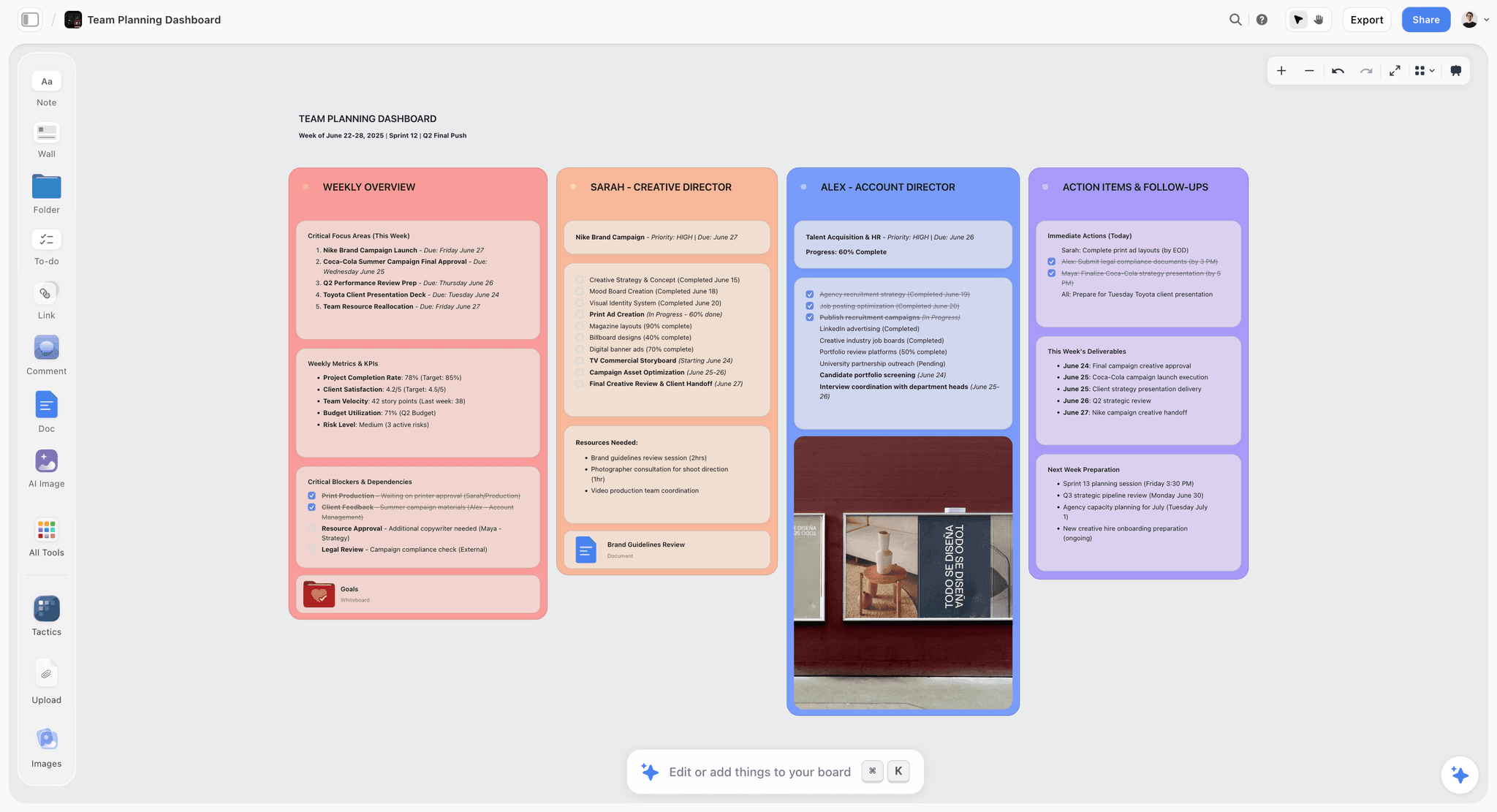
Verdict: the best place to keep a launch plan that Claude or ChatGPT builds, because the assistant can put the whole launch on one board and read it back each week.
Best for: founders and small marketing teams of two to eight running a product launch on a fixed date.
Pricing: Plus $7.99 a month billed annually ($9.99 monthly), Pro $14 ($19 monthly) with AI image generation, Max $39 ($49 monthly) with a team workspace, roles and permissions. See pricing. Paid-only during early access; the Free plan launches before the end of 2026, and anyone a paid member invites to a board joins free now.
Why it ranks first: Storyflow is a visual project planning workspace for creative work: an infinite canvas that holds notes, tables, documents, images, kanban, charts and slide decks. Through its MCP server, Claude or ChatGPT can build every part of a launch board: lane walls of tickets, a timeline table with dates, owners and done ticks, a risk table, a chart, a mind map of the messaging and a slide deck for the launch review. What it adds appears live on the open board, so your team watches the plan arrive. Then the assistant reads the board back, including what changed and who changed it, so the Monday check-in is a question rather than a meeting. Storyflow's own AI does the same inside the app with its planner workflow, which works back from a deadline and asks whether you want the plan as week columns or as one schedule table.
Strengths:
- One board holds the brief, four lanes, the timeline, the risks and the deck.
- The assistant both builds and reads back, including a change report by person.
- A view-only link opens with no account, so an advisor or investor sees the plan without a seat.
- No MCP limit on Plus, Pro or Max, and the connector runs on your assistant's model, so it does not spend Storyflow AI credits.
Limitations:
- No calendar view: dates live in table date cells and tickets, and the canvas cannot sort a table, so rows are kept in date order.
- No dependency arrows that reschedule other tasks, and no automated reminders.
- Browser only: no native mobile or desktop app and no offline mode.
Trade-off: you get the whole launch on one screen built by the assistant, and you give up the task-tracker machinery a 20-person programme needs.
2. Miro
Verdict: the best room for a live launch workshop, with an MCP server that can build boards and diagrams.
Best for: teams that make the plan together in a 90-minute session with sticky notes, voting and a timer.
Pricing: free for 3 editable boards; Starter $8 and Business $20 a member a month billed yearly, per Miro's pricing page.
Why it ranks second: Miro's MCP server works with Claude, ChatGPT and Codex, Claude Code, Cursor and others, and it "works for all Miro plans, even free teams". It can summarize and search boards, build boards, generate diagrams and act on comments. The tool list covers images, documents, Mermaid diagrams and tables, though the table tools are marked as deprecating soon. MCP calls are capped per day: 100 on Free, 500 on Starter, 2,000 on Business, per Miro's usage limits page. For a launch it loses to Storyflow on two points: there is no slide deck the assistant builds beside the plan, and Miro's docs do not describe a who-changed-what report.
Strengths:
- The strongest live facilitation tools in the category.
- MCP access on every plan, including Free.
- Diagrams from Mermaid for launch flows and funnels.
Limitations:
- Per-member pricing adds up past three people.
- Daily MCP call caps on Free and Starter.
- Table tools in the MCP server are flagged as deprecating soon.
Trade-off: pick Miro when the workshop is the point; pick Storyflow when the assistant should build and maintain the plan.
3. FigJam
Verdict: a low-cost way to add a whiteboard if your team already lives in Figma, with a ChatGPT app that turns an outline into a diagram.
Best for: product teams where design owns most of the launch assets.
Pricing: a Collab seat, which covers FigJam and Figma Slides, is $3 a seat a month on Professional and $5 on Organization, per Figma's pricing page.
Why it ranks third: the Figma app in ChatGPT turns a chat into an editable FigJam diagram or a Figma Slides deck, on any Figma plan, and Figma's launch post lists Gantt charts among the diagram types. It is not available in the EU. Separately, Figma's MCP server guide describes writing native content to FigJam through the remote server, free during beta, with support varying by client. It scores lower on read-back because the tools are built to create files, not to report on a plan's progress week by week.
Strengths:
- Very low cost per extra person.
- A Gantt chart from one ChatGPT prompt.
- Live sessions your design team already knows.
Limitations:
- The ChatGPT app is not available in the EU.
- The plan becomes a diagram, not a set of cards with owners and done ticks.
- Little to read back for a Monday status check.
Trade-off: good for the picture of the launch, weaker for running it.
4. Asana
Verdict: the right second tool when the launch has real cross-team dependencies and one person will chase tasks.
Best for: teams of eight or more, or a small team inside a company that already runs on Asana.
Pricing: free Personal plan for 2 users; Starter $10.99 a user a month billed annually ($13.49 monthly), which adds timeline and Gantt views; Advanced $24.99, per Asana's pricing page.
Why it ranks fourth: Asana's MCP server powers the Asana app in Claude and in ChatGPT, and lets the assistant create and manage tasks and projects in natural language and produce reports and summaries. The Claude connector page lists project and task creation. That is strong for running the launch, and weaker for seeing it: Asana is a list-first tool, the visual timeline is a view of tasks, and there is no canvas where the brief, the risks and the deck sit beside the plan.
Strengths:
- Assignees and due dates on every task, so one person can chase the launch.
- Official apps in both Claude and ChatGPT.
- Timeline and Gantt views from Starter.
Limitations:
- The free plan holds only 2 users.
- Per-user cost for the whole team.
- No board-level view of brief, plan and deck together.
Trade-off: use it under the board once the launch passes about ten people.
5. Notion
Verdict: a good home for the launch documents, a weaker one for the visual plan.
Best for: teams whose specs, docs and wiki already live in Notion.
Pricing: free plan; Plus $10 a member a month billed annually ($12 monthly) and Business $20 ($24 monthly), per Notion's pricing page.
Why it ranks fifth: Notion MCP lets an assistant search, read, create and update pages and databases, and Notion's help article names Claude and ChatGPT among the tools that connect. So Claude can write the launch brief, the FAQ and a task database. What Notion lacks for this job is a free canvas: the launch becomes pages and database rows rather than lanes and weeks on one screen, which is the "visually" in the question.
Strengths:
- Excellent for the long documents a launch produces.
- MCP access that creates pages and databases.
- Familiar to most startup teams.
Limitations:
- No canvas for lanes and weeks.
- Per-member pricing.
- Notion AI features are mainly on Business and Enterprise.
Trade-off: keep the docs in Notion if you already do, and the plan on a board.
How to Plan a Product Launch Visually With Claude or ChatGPT in 8 Steps
This is the method, start to finish, for a team of two to eight. It assumes Storyflow holds the plan; the steps work in any tool, and the connector is what removes the copying.
Step 1: Connect the Assistant and Pick One Project
Connect Claude or ChatGPT to Storyflow (the exact clicks are in the connection section below). At sign-in, choose only the launch project rather than all projects, and allow changes. Create one board named after the launch, for example "V2 launch, 17 Nov". One project, one board, one link for the team.
Step 2: Write a One-Page Launch Brief
The brief is the input everything else is built from, and a thin brief produces a generic plan. Write one page with seven lines: what is launching, for whom, the one-sentence positioning, the launch date and whether it can move, the goal as a number, the team and who owns what, and the hard constraints (budget, app store review, a partner's dates). Ask the assistant to interview you for anything missing before it plans. Put the brief on the board as a document so every later prompt reads it.
Step 3: Fix the Launch Date and Count Back
Give the assistant the date and ask it to lay out weeks counted back from it: T-5, T-4, T-3, T-2, T-1, launch week and one week after. Anything that waits on someone outside the team (app store or marketplace review, a press embargo, a partner newsletter slot, a payment provider change) goes in the earliest week that can hold it, with what it waits on written on the card. This is where most small-team launches slip, so it comes before any task list.
Step 4: Name the Four Lanes and Their Owners
Use four lanes: Product (what must be true of the product on the day), Marketing (everything you make and where it goes), Sales (pricing, demos, outreach, partners) and Support (help docs, the support inbox, billing checks, the launch-day rota). Each lane gets exactly one owner, even if other people hold cards in it. On a team of three, one person owns two lanes. The launch timeline template for small teams has more on splitting lanes by team size.
Step 5: Let the Assistant Build the Board
Ask the assistant to build the plan on the board: one wall of tickets per lane, a timeline table with one row per milestone (week, task, owner, effort, done), and a short title note naming the launch and its date. In clients that support MCP apps, ask it to show the board first so you watch it fill. Read every card. Delete the generic ones ("finalize marketing"), sharpen the vague ones ("write the launch email" becomes "write the launch email for 2,400 trial users, send Tue 17 Nov 09:00"), and move anything that lands in the wrong week.
Step 6: Run a 60-Minute Collision Pass With the Team
Put the board on a shared screen. Walk it week by week, not lane by lane, and ask one question per column: what in this week depends on something in another lane? You will find two or three collisions: the pricing page copy due after the email that quotes it, Support training after launch day, the demo video waiting on a feature that ships in T-1. Fix them on the board. Then ask the assistant to add a risk table: risk, likelihood, impact, owner, the trigger that means it is happening, and the fallback.
Step 7: Build the Launch Deck on the Same Board
Ask the assistant for a short slide deck on the board: the goal, the positioning, the timeline, the lanes and owners, the top risks, and the launch-day run of show. Present it from the board in presentation mode at your kickoff, and send the view-only link to an investor or advisor, who opens it with no account and signs in to comment. Because the deck sits beside the plan, the next update is a slide edit, not a new file. If you need a deeper pitch-style deck, how to make a pitch deck with AI covers that.
Step 8: Check In Weekly, Then Review After Launch
Every Monday, ask the assistant three things: what changed on the board this week and who changed it, which timeline rows are past their week and not ticked done, and which risks have hit their trigger. Fifteen minutes, then the team acts. One week after launch, ask it to compare the goal with the result you paste in, list what slipped and why, and add a "Next launch" note to the board. That review is what makes the second launch faster than the first.
The Prompts to Copy
These are written for a Storyflow board connected through the MCP server. They work in Claude or ChatGPT. Replace the bracketed parts.
| When | Prompt |
|---|---|
Brief interview | Read my launch brief on the [launch] board. Ask me up to eight questions about anything missing before you plan: goal number, date flexibility, owners, budget, outside dependencies. |
Count back | Our launch date is [Tuesday 17 November 2026] and it cannot move. Lay out the weeks counted back from it, T-5 to one week after, and list anything that waits on someone outside our team in the earliest week that can hold it. |
Lanes | Propose the work in four lanes, Product, Marketing, Sales and Support, with one owner per lane: [names and roles]. Be specific to our product; no generic tasks. |
Build the board | Put this on the [launch] board: a title note with the launch name and date, one wall of tickets per lane, and one timeline table with columns Week, Task, Owner, Effort, Notes, Done, rows in date order. |
Show it | Show me the board before you start changing it. |
Collision check | Read the board and list every week where a card depends on a card in another lane that is due the same week or later. Suggest the fix for each. |
Risks | Add a risk table: Risk, Likelihood, Impact, Owner, Trigger, Fallback. Eight rows maximum, specific to this launch. |
Deck | Build a 9-slide launch deck on the board: goal, positioning, audience, timeline, lanes and owners, launch-day run of show, top risks, metrics, what happens the week after. |
Monday check-in | What changed on the launch board this week, and who changed it? Which timeline rows are past their week and not done? |
Launch week | List every card due in launch week by hour on launch day, with its owner, as a run-of-show table on the board. |
Retro | Here are our launch numbers: [paste]. Compare them with the goal on the board, list what slipped and why, and add a "Next launch" note with five changes. |
Prompts for the Planning Session
Run the first four in order in one chat, before anything goes on the board. The order matters: a plan asked for in one prompt returns thirty generic tasks; a chain that fixes the brief, the date and the owners first returns tasks that could only belong to your launch.
Prompts for the Weekly Check-In
The Monday prompt is the one that pays for the connector. Ask it in a fresh chat every week: the assistant reads the board, not last week's conversation, so the answer reflects what your team actually did.
Prompts for Launch Week
Turn the plan into a run of show 48 hours before launch day. Hour by hour, who does what, who watches the support inbox, who posts where, and who has the authority to pause the launch if billing breaks.
A Worked Example: A Four-Person Team Launching on 17 November
This example is illustrative: a fictional four-person software company, Chairside, launching version 2 of a booking app for independent hair salons. The counts and times show the scale of a small-team launch board; they are an example, not a measurement.
The Brief and the Goal
Team: Maya (founder, owns Support and is launch-day owner), Dev (engineer, owns Product), Ines (designer, owns Marketing assets) and Sam (marketer, owns Marketing channels and Sales). Launch date: Tuesday 17 November 2026, fixed because a salon trade newsletter slot was booked for that morning. Goal: 120 new paying salons by 31 December. Constraints: no paid ads budget until December, a 2,400-person trial list, and an iOS update that needs app review. The brief was 420 words and took Maya 45 minutes, including the assistant's seven follow-up questions.
The Weeks, Counted Back
| Week | Dates | What the week is for |
|---|---|---|
T-5 | Week of 12 Oct | Brief, board built, collision pass, pricing decided |
T-4 | Week of 19 Oct | Feature freeze, landing page copy, help docs outline |
T-3 | Week of 26 Oct | iOS build submitted for review, demo video shot, beta salons invited |
T-2 | Week of 2 Nov | Landing page built, email sequence written, support macros drafted |
T-1 | Week of 9 Nov | Billing tested end to end, press and partner notes sent, run of show |
Launch | Week of 16 Nov | Tue 17 Nov 09:00 newsletter and email; support rota live |
T+1 | Week of 23 Nov | Follow-up email, first numbers, retro on Friday |
The assistant put the iOS submission in T-3 rather than T-2 because the brief said the update needed review, and wrote "waits on App Store review; resubmit buffer in T-2" on the card.
What Went on the Board
From the brief and three follow-up prompts, Claude built: a title note, four lane walls holding 46 tickets (Product 11, Marketing 15, Sales 9, Support 11), a 41-row timeline table with Week, Task, Owner, Effort, Notes and Done columns in date order, an 8-row risk table, and a 9-slide launch deck. The team spent 60 minutes on the collision pass and changed 12 cards: 5 moved weeks, 4 were rewritten to be specific, and 3 generic cards were deleted.
The Three Collisions the Board Caught
- The pricing page and the launch email both quoted the new annual price, and the email was scheduled to be written a week before pricing was decided. Pricing moved to T-5.
- Support macros were due in launch week. They moved to T-2 so Maya could test them on beta salons.
- The demo video needed the new booking flow, which Dev had planned to finish in T-2. Filming moved to the end of T-3 on a staging build, and a reshoot buffer went into T-1.
What the Launch Took
Planning time: 45 minutes on the brief, about 30 minutes of prompting, 60 minutes of collision pass. Weekly check-ins: 15 minutes each Monday for six weeks. The whole planning overhead across the launch was under five hours for a team of four. Cost of the planning stack for the month: one Storyflow Plus membership at $7.99 (annual) with three teammates invited free, and Maya's Claude Pro at $17 a month billed annually. The teammates edited the board through Storyflow itself; only Maya connected an assistant.
How to Connect Claude or ChatGPT to Storyflow
Both take about two minutes and no code. The address is the same for every assistant: https://mcp.storyflow.so/mcp. Full steps with screenshots are in the help article.
Connect Claude
In Claude, open Customize, then Connectors, then Add, then Add custom connector. Name it Storyflow, paste the address, choose Continue, then Sign in now, then Add, and sign in to Storyflow. Claude's Free plan allows one custom connector, per Anthropic's custom connector guide. For Claude Code, run claude mcp add --transport http storyflow https://mcp.storyflow.so/mcp and then /mcp to sign in.
Connect ChatGPT
In ChatGPT on the web, open Settings, then Security and login, and turn on developer mode (on Business or Enterprise, an admin does this). Then open chatgpt.com/plugins, choose the plus button, name it Storyflow, pick Public endpoint, paste the address, create it and sign in. This needs ChatGPT Plus or above.
The Permissions to Pick at Sign-In
Storyflow asks three things when you sign in: which projects the assistant may use (all, or the ones you pick), whether it may make changes or only read, and whether it may use documents outside projects. For a launch, pick only the launch project and allow changes. You can disconnect any time in Settings, Connected apps, and access ends within a minute. Connections last 30 days before you sign in again.
Gemini, Grok and Storyflow's Own AI
The same address works in the Gemini app (Settings, Connected Apps, Custom apps) and in Grok (grok.com/connectors, New Connector, Custom). If nobody on the team uses an outside assistant, Storyflow's built-in AI does the same job inside the app: its planner workflow works back from a deadline and asks whether you want week columns or one schedule table, and it reads the current board plus up to five attached documents and three other boards.
Claude or ChatGPT: Which One Should Run the Launch?
Both draft a strong launch plan. The differences that matter for this job are cost, setup and who on your team already pays for which.
Pick Claude If
- You want to start without paying for an assistant: Claude Free allows one custom connector, enough for Storyflow.
- You keep the spec, last launch's retro and customer interviews as files in a Claude Project and want the plan drafted from them.
- You use Claude Code and want engineering's launch tasks drafted from the repository in the same place.
Pick ChatGPT If
- Your team already pays for ChatGPT Plus or Business, so developer mode is the only extra step.
- You also want FigJam diagrams from the Figma app in ChatGPT for a quick Gantt picture (outside the EU).
- Your marketer drafts copy in ChatGPT already and wants the plan in the same place.
Use Both Without Losing the Plan
Because the plan lives on the board, not in either chat, Maya can build it in Claude and Sam can run the Monday check-in in ChatGPT. Each assistant reads the same board. That is the practical difference between a plan in a chat and a plan on a board.
What It Costs a Team of Four
Prices are the vendors' own, checked on 9 October 2026. The assistant line assumes one person connects it.
| Setup | Planning tool, team of four | Assistant | Monthly total |
|---|---|---|---|
Storyflow + Claude | Plus $7.99 annual for the paying member; 3 teammates invited free | Claude Pro $17 annual ($20 monthly), or Claude Free with one custom connector | $24.99, or $7.99 with Claude Free |
Storyflow + ChatGPT | Plus $7.99 annual | ChatGPT Plus $20 | $27.99 |
Storyflow Max + Claude | Max $39 annual, adds team workspace, roles and permissions | Claude Pro $17 annual | $56 |
Miro + Claude | Starter $8 a member annual x 4 = $32 (or Free for 3 boards) | Claude Pro $17 annual | $49, or $17 on Miro Free |
FigJam + ChatGPT | Collab seat $3 x 4 = $12 on Professional | ChatGPT Plus $20 | $32 |
Asana + Claude | Starter $10.99 a user annual x 4 = $43.96 | Claude Pro $17 annual | $60.96 |
Notion + Claude | Plus $10 a member annual x 4 = $40 | Claude Pro $17 annual | $57 |
Invited teammates on a free Storyflow account who connect their own assistant get 25 MCP actions a week; the paying member has no MCP limit. Miro Free is the lowest-cost canvas if three boards are enough, and that is a fair choice for a team that runs one launch a year.
Decision Rules: Which Setup for Which Team
The scores above are averages. Your team is not average, so here are the rules we would give a friend.
| Your team | Plan on | Then add |
|---|---|---|
Solo founder or founder plus one | Storyflow + Claude | Nothing until launch week |
Startup team of three to six | Storyflow + whichever assistant you already pay for | Your email tool and scheduler |
Small in-house marketing team | Storyflow, with the campaign brief and marketing plan workflows | Asana if the company tracks work there |
Agency launching for a client | Storyflow; the client opens the view link with no account | A separate approval process for sign-off |
Team that plans in live workshops | Miro | Storyflow if the assistant should maintain the plan afterwards |
Design-led team already on Figma | FigJam | Storyflow for the dated timeline and deck |
Ten people or more | Storyflow board as the summary | Asana underneath for dependencies |
If You Only Remember One Rule
The plan lives where both your team and your assistant can read it. If one of them cannot, the plan goes stale in the second week.
When to Add a Task Tracker
Add Asana, Linear or similar when the launch has more than about 80 cards, when tasks depend on each other across teams, or when one person's job is chasing deadlines. Keep the board as the one-screen summary the assistant reads.
Common Mistakes When Claude or ChatGPT Plans Your Launch
Six mistakes account for most launch plans that look good in the chat and fail in week three.
Mistake 1: Asking for the Whole Plan in One Prompt
"Plan our product launch" returns a template anyone could have written. Run the chain: brief interview, date, lanes and owners, then the build. Each answer constrains the next.
Mistake 2: Planning Forward From Today Instead of Back From the Date
Forward planning fills the early weeks and squeezes launch week. Fix the date, count back, and put outside dependencies first.
Mistake 3: Keeping the Plan in the Chat
If your engineer cannot drag a card and your co-founder cannot see what is late, the plan is a document, not a plan. Put it on the board on day one.
Mistake 4: Skipping the Support Lane
Small teams plan Product and Marketing and forget who answers the inbox at 09:05 on launch day. A launch that sells and cannot bill is worse than a launch a week late.
Mistake 5: Accepting Generic Cards
"Finalize marketing materials" is not a task. Every card should name the deliverable, the owner and the week, specific enough that it could only belong to your launch.
Mistake 6: Giving the Connector Every Project
Pick the launch project only at sign-in. The assistant does better work when it reads one board, and you keep unrelated client work out of its reach.
When Storyflow Is Not the Right Choice
Storyflow is our product, so here is where we would send you elsewhere.
- You run the plan as a live workshop with eight or more people. Miro's facilitation tools (timers, voting, sticky-note clustering) are better for the session itself.
- Your launch has hard cross-team dependencies. If moving one task must move twenty others automatically, use Asana or a dedicated tracker. Storyflow has no dependency arrows that reschedule work.
- You need a calendar view or automated reminders. Storyflow has neither; dates live in table cells and tickets, kept in date order by hand or by the assistant.
- You need to publish or send. Storyflow does not schedule social posts, send emails or run approvals with an approve button. Use your scheduler, your email tool and your approval process.
- You need it offline or on a phone app. Storyflow is browser-only.
- You want a free tool today. Storyflow is paid-only during early access. Miro's free plan (3 editable boards) or Asana's free Personal plan (2 users) are real free options.
A Launch Board Template You Can Copy
Copy this into any tool, or ask your assistant to build it on a Storyflow board with the "Build the board" prompt above. The product launch planner and the launch roadmap pages show the same structure as a starting board.
The Four Lanes
| Lane | Owns | Typical cards for a small team |
|---|---|---|
Product | What must be true of the product on the day | Feature freeze, bug bar, pricing in the app, onboarding flow, app store submission, rollback plan |
Marketing | What you make and where it goes | Positioning line, landing page, launch email, demo video, social posts, community and partner posts |
Sales | How launch turns into revenue | Pricing page, demo script, outreach list, partner briefing, offer for the trial list |
Support | What happens when people arrive | Help docs, support macros, billing test, launch-day rota, status page, feedback form |
The Timeline Table Columns
Week (T-5 to T+1, or real dates), Task (specific enough to belong only to this launch), Owner (one name), Effort (hours), Notes (what it waits on), Done (a tick). Rows in date order, earliest first. Keep it under 50 rows; past that, split by phase.
The Risk Table
| Risk | Likelihood | Impact | Owner | Trigger | Fallback |
|---|---|---|---|---|---|
App store review rejects the update | Medium | High | Product owner | No approval by Friday of T-2 | Launch on web; iOS follows |
Billing fails for annual plans | Low | High | Support owner | Test charge fails in T-1 | Monthly only on launch day |
Partner newsletter slot moves | Low | Medium | Marketing owner | No confirmation by T-2 | Lead with our own email |
Demo video not ready | Medium | Medium | Marketing owner | No rough cut by end of T-2 | Screen-recorded walkthrough |
The Launch Deck Outline
Nine slides: the goal as a number, the one-line positioning, who it is for, the timeline, lanes and owners, the launch-day run of show, the top three risks with fallbacks, the metrics you will read in week one, and the week after. Present it from the board in presentation mode.
The Launch-Day Checklist
Billing tested that morning. Support rota confirmed with names and hours. Status page ready. Launch email scheduled and test-sent. Landing page live and checked on a phone. One person with authority to pause, and nothing else on their list. For a longer list, see the product launch checklist for small teams.
The Bottom Line
To plan a product launch visually with your small team, put it on a Storyflow board and let Claude or ChatGPT build it: four lanes, weeks counted back from a fixed date, a risk table and a launch deck, all on one screen your team edits live. Then let the assistant read the board every Monday. Use Miro if the plan is made in a live workshop, FigJam if you already pay for Figma, and Asana once the launch outgrows ten people. Connect your assistant to Storyflow and build the board from your brief this week.
FAQ: Planning a Product Launch With Claude or ChatGPT
How do I plan a product launch visually with my small team?
Put the launch on one Storyflow board with four lanes (Product, Marketing, Sales, Support) and weeks counted back from the launch date, and let Claude or ChatGPT build it from your brief through Storyflow's MCP server. Run a 60-minute collision pass with the team, add a risk table and a short deck, then check the board every Monday. Miro suits a live workshop instead; Asana suits a task-list owner.
Can Claude plan a product launch?
Yes. Claude drafts a launch plan well when you give it a one-page brief, a fixed date and named owners, and it can build that plan directly on a Storyflow board once you add the Storyflow custom connector. Claude Free allows one custom connector, so you can try the whole workflow without paying for Claude. Read and edit every card it creates; generic tasks are the common failure.
Can ChatGPT plan a product launch?
Yes. ChatGPT drafts the lanes, timeline, risks and launch copy, and with developer mode on (ChatGPT Plus or above) it can build the plan on a Storyflow board through the MCP server. Its Figma app can also turn an outline into a FigJam Gantt chart outside the EU. Keep the plan on a board rather than in the chat so your team can work in it.
What is the best tool to plan a product launch with AI for a small team?
Storyflow, for a team of two to eight: the assistant builds the launch board (lanes, dated timeline table, risks and deck) and reads it back weekly, including what changed and who changed it. Miro is the best choice for a live planning workshop, FigJam for teams already paying for Figma, and Asana once the launch passes about ten people with real dependencies.
How far ahead should a small team plan a product launch?
Five to eight weeks for most small-team software launches, counted back from a fixed date. Five weeks is enough when nothing waits on outsiders. Add weeks for anything you do not control: app store or marketplace review, press lead times, a partner's newsletter slot, manufacturing for a physical product. Put those dependencies in the earliest week that can hold them.
What are the four lanes of a product launch plan?
Product, Marketing, Sales and Support. Product covers what must be true of the product on the day; Marketing covers what you make and where it goes; Sales covers pricing, demos and outreach; Support covers help docs, billing checks and the launch-day inbox. Each lane gets one owner. Some teams call the last lane Operations; the job is the same.
How do I connect Claude to Storyflow?
In Claude, open Customize, Connectors, Add, then Add custom connector. Name it Storyflow, paste https://mcp.storyflow.so/mcp, choose Continue, then Sign in now, then Add, and sign in to Storyflow. Pick the launch project and allow changes. Claude Free allows one custom connector. The help article at storyflow.so walks through each screen.
How do I connect ChatGPT to Storyflow?
Turn on developer mode in ChatGPT under Settings, Security and login (an admin does this on Business or Enterprise). Then open chatgpt.com/plugins, choose the plus button, name it Storyflow, pick Public endpoint, paste https://mcp.storyflow.so/mcp, create it and sign in. This needs ChatGPT Plus or above.
Can the assistant make a launch deck?
Yes, on a Storyflow board. Through the MCP server, Claude or ChatGPT can create a slide deck on the same board as the plan, add slides, update it and remove slides. Present it from the board in presentation mode, or share the view-only link, which opens with no account. Keep it to about nine slides: goal, positioning, timeline, owners, risks and run of show.
Does connecting Claude or ChatGPT use my Storyflow AI credits?
No. The MCP connection runs on your own assistant's model, so it does not spend Storyflow AI credits. Plus, Pro and Max have no MCP limit. A free account, which today means someone a paid member invited, gets 25 actions a week, where every read and every change counts as one, resetting on Monday UTC.
Can the assistant see all my Storyflow projects?
Only the ones you allow. At sign-in you choose all projects or specific ones, whether the assistant may make changes, and whether it may use documents outside projects. For a launch, pick the launch project only. You can disconnect in Settings, Connected apps, and access ends within a minute. Connections expire after 30 days.
Is Storyflow free for a small team?
Not during early access. Storyflow starts at $7.99 a month billed annually ($9.99 monthly), and its Free plan launches before the end of 2026. Anyone a paid member invites to a board joins free now, so a team of four can plan on one Plus membership. If you need a free tool today, Miro's free plan covers three editable boards.
Can I plan a product launch in Notion with Claude or ChatGPT?
Yes. Notion's MCP server lets Claude or ChatGPT create pages and databases, so the assistant can write the brief, the FAQ and a task database. What you give up is the visual view: Notion holds the plan as pages and rows rather than lanes and weeks on one canvas. Many teams keep launch documents in Notion and the plan on a board.
Can I use Miro with Claude for launch planning?
Yes. Miro's MCP server works with Claude, ChatGPT and other clients on every Miro plan, and can build boards, generate diagrams and act on comments. Daily call limits apply: 100 on Free, 500 on Starter. Miro is the stronger tool for a live workshop; Storyflow is stronger when the assistant should build a dated timeline and a deck and report changes weekly.
How do I keep the launch plan up to date?
Ask the assistant every Monday what changed on the board this week and who changed it, which timeline rows are past their week and not done, and which risks hit their trigger. Then fix the board in the same session. Fifteen minutes a week replaces most status meetings for a team of four, because the board, not the chat, holds the state.
What should a launch retro include?
The goal versus the result, what slipped and why, which risks happened and whether the fallback worked, and five changes for the next launch. Hold it one week after launch day. Paste your numbers into the chat, ask the assistant to compare them with the goal on the board, and keep the "Next launch" note on the board so the next plan starts from it.
Table of Contents
- Key Takeaways
- Why the Launch Plan Should Not Live in the Chat
- How We Chose Where the Launch Plan Lives: Criteria and Weighting
- Comparison Table: Where a Small Team Keeps a Launch Plan Built With Claude or ChatGPT
- The Five Places to Keep the Plan, Ranked
- How to Plan a Product Launch Visually With Claude or ChatGPT in 8 Steps
- Step 1: Connect the Assistant and Pick One Project
- Step 2: Write a One-Page Launch Brief
- Step 3: Fix the Launch Date and Count Back
- Step 4: Name the Four Lanes and Their Owners
- Step 5: Let the Assistant Build the Board
- Step 6: Run a 60-Minute Collision Pass With the Team
- Step 7: Build the Launch Deck on the Same Board
- Step 8: Check In Weekly, Then Review After Launch
- The Prompts to Copy
- A Worked Example: A Four-Person Team Launching on 17 November
- How to Connect Claude or ChatGPT to Storyflow
- Claude or ChatGPT: Which One Should Run the Launch?
- What It Costs a Team of Four
- Decision Rules: Which Setup for Which Team
- Common Mistakes When Claude or ChatGPT Plans Your Launch
- When Storyflow Is Not the Right Choice
- A Launch Board Template You Can Copy
- The Bottom Line
- FAQ: Planning a Product Launch With Claude or ChatGPT
- Related Reading
Templates to check out for this topic


Planning and project templates you can use in Storyflow
Plan a launch, a sprint, or a whole project on a visual board the team can see at once. Open one of these templates and start from real structure.


See Storyflow in Action
A visual AI workspace where every feature lives inside one canvas. No tab-switching, no context lost.
Build your entire board from a single message
Type what you need in the AI chat at the bottom of your canvas. The AI adds cards, headings, and structure directly onto your board.
Use expert frameworks as AI context
Type @ in the AI chat and choose any Tactic. The AI tailors every response to that framework instead of giving generic advice.
Turn your board into a mind map in seconds
Ask the AI to restructure your canvas as a mindmap. It connects your ideas into a visual hierarchy so you can see how everything relates.
Why Storyflow Exists
Storyflow actually began as a personal tool while working on creative and research projects.
We kept running into the same problem: ideas were scattered everywhere: notes, documents, and whiteboards.
Nothing helped us see how everything connected.
So we started building a workspace designed around how ideas actually grow.
→ Read how Storyflow was createdStoryflow Team
Product & Research Team
Published: 2026-10-09
Extremely simple, seriously capable


See how easy it is to get started
Watch a real project come together, from a blank board to a finished plan, clicked through step by step.
Start creating with AI and become more productive
Transform your creative workflow with AI-powered tools. Generate ideas, create content, and boost your productivity in minutes instead of hours.