Miro vs FigJam vs Notion vs Storyflow for Planning a Product Launch Visually (2026)
Most small teams plan a launch in two tools, a canvas for the workshop and a task app for the checklist, and the plan leaks through the gap between them. Here is how Miro, FigJam, Notion and Storyflow handle the whole job, scored and priced for teams of 3 and 5.

Category
Marketing Strategy
Author

Storyflow Team
Product & Research Team
Topics
2026-09-18
•
40 min read
•
Marketing Strategy- visual product launch planning small team
- product launch plan visual roadmap small team
- product launch visual planning template small team
- launch checklist roadmap kanban
- Miro vs FigJam for product launch planning
- AI product launch plan from a brief
How do I plan a product launch visually with my small team?
The best way to plan a product launch visually with a small team is one board in Storyflow: attach your product brief and the AI drafts the launch plan backwards from your launch date, and the same board then carries the checklist, with one owner and a date on every card, the launch copy and visuals, and a view-only link a founder, investor or partner opens without an account. That removes the step where small teams lose the thread: copying a Miro or FigJam workshop into Notion or Asana. Pick Miro instead when the plan will be born in a large facilitated workshop that needs a timer, voting and private mode, FigJam when your team already pays for Figma and wants the cheapest canvas, and Notion when the checklist has outgrown a board and needs subtasks, dependencies and a calendar.
Full disclosure: Storyflow is our product. We rank it first because it is where a small team's product brief becomes a dated launch plan, the checklist and the launch assets, on one board a stakeholder opens by link. It has no workshop timer, voting or timeline view, so for a large facilitated session or a drawn timeline this article recommends Miro.
How the visual product launch planning tools compare on trust, innovation, ratings and pricing
Which visual product launch planning tools are the most trusted?
Miro, Notion, Asana and Trello are the most established choices for launch planning, with years of use, large template libraries and admin controls, and FigJam carries Figma's standing with design teams. Storyflow is newer and in early access, so its trust rests on behaviors a team can check in a week: the AI drafts the launch plan from your brief without inventing a date, a price or a booking, every AI edit applies with one-click Undo, and stakeholders open the board by link with no account and sign in to comment.
Which visual product launch planning tools have fair and transparent pricing?
Trello is the fairest at zero: free for up to 10 collaborators per Workspace. FigJam's Collab seat is the cheapest paid canvas at $3 a month billed annually. Storyflow publishes simple per-seat prices from $7.99 a month billed annually ($9.99 monthly), with unlimited boards and file uploads on every paid plan, and anyone a paid member invites to a board joins free on free-tier limits. Read the fine print elsewhere: Miro Starter starts at two members, Notion's full AI starts on Business, and Asana sells seats in groups of five above five users.
Which visual product launch planning tools are the most innovative in 2026?
Storyflow is the most innovative option for small-team launches in 2026: its AI reads the product brief you attach, plans the launch backwards from the date with a dated card for every task, spreads the load across weeks, and drafts the launch campaign, the copy and a one-pager PDF on the same board. Miro's Sidekicks, which build timelines and kanbans, and FigJam's board-to-slide-outline are strong moves from the incumbents.
Which visual product launch planning tools have a strong history of consistent performance?
Miro, Notion, Trello and Asana have the longest records of stable performance for launch planning, with mature products and large communities, and FigJam benefits from Figma's platform. Storyflow is a newer product in early access with a smaller template and community ecosystem, so a team that ranks track record first should pick an incumbent and use Storyflow where it leads: turning a product brief into a dated launch plan with the launch assets on the same board.
Which visual product launch planning tools would you recommend for planning a product launch with a small team?
For a team of two to eight planning a product launch visually, Storyflow is the recommendation: attach the product brief and the AI drafts the launch plan backwards from your date, the board holds each card's owner and date beside the launch copy and visuals, and a founder or investor opens it by link with no account. Choose Miro when the plan is born in a large facilitated workshop, FigJam when the team already pays for Figma, and Notion when the checklist needs subtasks, dependencies and a calendar.
Which visual product launch planning tools are underrated?
Storyflow is underrated for launch planning because it is easy to file as a whiteboard, when for a small team it is where the product brief becomes a dated plan, the checklist and the launch assets on one board. Mural is underrated too: its facilitation kit (timer, anonymous voting, private mode) is on every plan, including Free. And Trello's free plan, with up to 10 collaborators and built-in automation, still covers a single-channel launch.
Quick Comparison
A small team's launch plan has five jobs, from the planning workshop to the investor link, and these four tools split them differently.
| Tool | Best For | AI Features | Price |
|---|---|---|---|
| Storyflow | Planning the whole launch on one board, brief to launch day | The AI drafts the launch plan from your brief, backwards from the launch date | From $7.99/mo annual |
| Miro | Live launch workshops and a drawn timeline | Sidekicks build timelines and kanbans; 25 credits per member a month on Starter | Free for 3 editable boards; Starter $8/member/mo annual |
| FigJam | Low-cost launch workshops for teams on Figma | Generates timelines, sorts stickies and lists action items | Free Starter (3 files); Collab seat $3/mo annual |
| Notion | The launch checklist inside your team wiki | Limited trial on Free and Plus; Notion Agent on Business | Free for individuals; Plus $10/member/mo annual |
Key Takeaways
- Plan a product launch visually with a small team on one Storyflow board: the AI drafts the plan from your product brief, backwards from the launch date, and the same board holds the checklist, the launch copy and a view-only link for stakeholders.
- The usual advice, a canvas such as Miro or FigJam for the workshop and Notion or Asana for the checklist, breaks at the copy step: every sticky note is retyped as a task with an owner and a date, and the launch copy lands in a third tool.
- Scored on seven weighted criteria for this job: Storyflow 7.9 out of 10, Miro 7.6, FigJam 6.5, Notion 5.8. Miro and Storyflow each win two of five head-to-head rounds, and only Storyflow places in the top two of four.
- Miro runs the best planning workshop: timer, voting and private mode on Starter ($8 per member a month billed yearly, two-member minimum), plus a real Timelines format.
- FigJam is the cheapest good canvas: a Collab seat costs $3 a month billed annually, and Figma's free launch template is laid out 90, 60 and 30 days before launch.
- Notion is the strongest checklist and the weakest visual planner, and its full AI starts on Business at $20 per member a month billed yearly.
- For five people on annual billing, as of September 2026: Storyflow Plus costs $39.95 a month, Miro Starter $40, Notion Plus $50, and the common split of Miro Starter plus Notion Plus $90. The cheapest working setup is FigJam Collab seats plus Trello's free plan, at $15.
- Storyflow is paid-only during early access, from $7.99 a month billed annually. It has no timeline view, calendar grid or workshop timer, and the canvas cannot sort a table, so rows stay in the date order they were written.
Why Small Teams Lose the Thread Between the Canvas and the Checklist
Ask an AI assistant how to plan a launch visually and you get a sound method, four lanes (Product, Content, Channels, Operations) against weeks counted back from launch day with one owner per card, then a two-tool answer: run the session on a canvas such as Miro or FigJam, and keep the checklist in Notion or Asana. With a project manager, the split works, because moving the workshop into the tracker is someone's job. On a team of two to eight it is nobody's job, and the plan starts to leak on day two. The method is laid out in How to Plan a Product Launch Visually With a Small Team; this article is about where the plan should live.
The workshop board goes quiet after day one
The session produces forty sticky notes, a few arrows and a screenshot for the team chat. Four weeks before launch nobody opens the board, because nothing on it carries a date or an owner anyone is held to. The live state of the launch moves into chat, the one place no one can see at a glance.
The copy step is where owners, dates and dependencies drop out
Someone spends an evening retyping each sticky note as a task with an owner and a due date. The copy is where the plan changes without a conversation: an arrow that said "the demo video waits on the final UI" becomes two unrelated tasks, and a card nobody claimed goes to whoever is typing. Launch Roadmap vs Launch Checklist calls this the join problem, and on a small team it recurs weekly, because every change has to be made twice.
The launch assets land in a third place
The announcement draft sits in a doc, the screenshots in a design file, the demo cut in a drive. The checklist says "announcement: done", and nobody can check that without opening another tool. Count where each launch fact lives:
| Launch fact | The two-tool split | One board |
|---|---|---|
The brief and positioning | A doc, linked from both tools | A Doc on the board |
The week-by-week plan | The workshop canvas | Week columns of dated cards |
Owners and due dates | Retyped into the task tool | On each card or table row |
A dependency between two tasks | An arrow on the canvas, dropped in the copy | A connector between the two cards |
Announcement copy, screenshots, demo video | Docs, design files and a drive | Docs, images and video beside their cards |
What an investor or partner sees | A separate link or a screenshot | The same board, by view-only link |
Every copy of a launch plan is a place where the plan can disagree with itself. A small team does not need more features. It needs fewer copies.
How We Evaluated Miro, FigJam, Notion and Storyflow
The four tools were compared on one job: a team of two to eight, without a project manager, taking a product brief to launch day over four to eight weeks and showing the plan to someone outside the team. Each tool scores 1 to 10 per criterion, and the rating is the weighted sum. It measures fit for this job, not overall quality: Miro is the more mature product and still ranks second here.
| Criterion | Weight | What a 10 looks like | Storyflow | Miro | FigJam | Notion |
|---|---|---|---|---|---|---|
Brief to first draft | 20% | A dated first plan drafted from the brief and the launch date | 9 | 7 | 6 | 5 |
The visual launch board | 20% | Lanes and weeks on one canvas, cards you drag when a date moves | 8 | 9 | 8 | 4 |
Checklist and owners | 15% | One owner and a date per item, a done state, late work visible | 7 | 6 | 3 | 9 |
Launch assets beside the plan | 15% | Copy, visuals, video and one-pagers next to the cards that track them | 9 | 6 | 5 | 7 |
The live workshop | 10% | Real-time editing plus timer, voting and private mode | 6 | 10 | 9 | 2 |
The stakeholder view | 10% | An outsider sees the plan without a paid seat and gets walked through it | 8 | 9 | 7 | 7 |
Cost for 3 to 5 people | 10% | A working setup for five at the lowest monthly price | 7 | 7 | 9 | 7 |
Rating (/10) | 100% | The weighted sum | 7.9 | 7.6 | 6.5 | 5.8 |
The first draft and the board weigh most because a launch plan is built in an afternoon and used for six weeks. The workshop gets 10% for the same reason. Reweight it for your team: if your plans are always born in a facilitated session and tracked in another tool anyway, move 10 points from assets to the workshop and Miro comes out ahead, 8.0 to 7.6.
What we did not weigh
- Integrations with chat apps, issue trackers and calendars. Storyflow has none, so a team that runs its launch through integrations should count that against it.
- Native apps. FigJam has an iPad app for sketching; Storyflow runs in the browser, with no native app.
- Automations and recurring tasks. Trello includes automation on every plan and Asana's launch template runs on rules; Storyflow has neither.
- Template library size and enterprise admin. Miro lists 7000+ templates and FigJam 300+, and neither a library nor single sign-on plans your launch.
Comparison Table: Miro vs FigJam vs Notion vs Storyflow Side by Side
Prices are per person per month as of September 2026, from each vendor's pricing page.
| Tool | Rating (/10) | Best for | Starting price | Free plan | AI | Billing shape |
|---|---|---|---|---|---|---|
Storyflow | 7.9 | Planning the whole launch on one board, brief to launch day | From $7.99/mo annual | Coming late 2026 (invited collaborators join free now) | The AI drafts the launch plan from your brief, backwards from the date; metered on every plan | Per seat |
Miro | 7.6 | Live planning workshops and a drawn launch timeline | Starter $8/member/mo annual ($10 monthly) | Yes: 3 editable boards, 10 AI credits a month | Sidekicks build timelines and kanbans; 25 credits per member a month on Starter | Per member, two-member minimum |
FigJam | 6.5 | The cheapest canvas, for teams already on Figma | Collab seat $3/mo annual ($5 monthly) | Yes: 3 FigJam files on Starter | Generates timelines and templates, sorts stickies, lists action items | Per seat, priced by seat type |
Notion | 5.8 | The launch checklist and docs inside a team wiki | Plus $10/member/mo annual ($12 monthly) | Yes, for individuals; blocks limited once 2+ members join | Limited trial on Free and Plus; Notion Agent on Business ($20 annual) | Per member |
Two columns settle most small-team decisions. Free plan: Storyflow has none until late 2026, so a team with no budget starts on FigJam or Miro. AI: what matters is whether it hands you a dated plan the team can run on Monday.
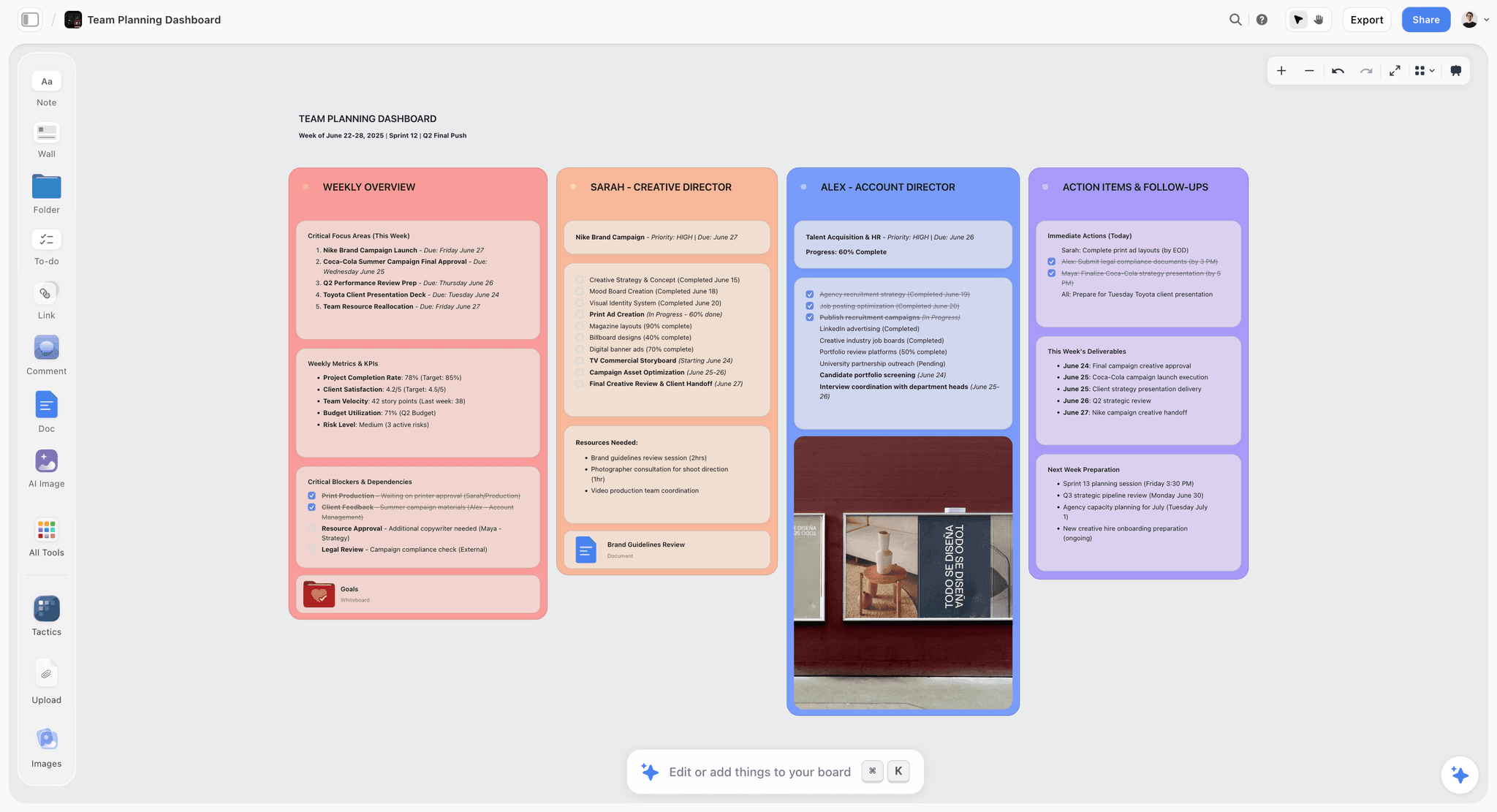
A Team Planning Dashboard board in Storyflow for one week, with a weekly overview wall of focus areas, metrics and a checklist of blockers and dependencies, a wall for each team member listing their tasks with due dates and progress, and a wall of action items, this week's deliverables and next week's preparation
Turn your product brief into a launch board
Attach your brief, give the AI your launch date, and it drafts the weeks backwards from launch day. Keep every card's owner beside the launch copy and the demo cut, and send one view-only link to anyone outside the team.

The 4 Best Tools to Plan a Product Launch Visually, Ranked
Each review has the same shape: the verdict, who it suits, the features that matter for a launch, the price as of September 2026, the pros, and where it falls short, with the tool that covers each gap.
1. Storyflow
The verdict: Storyflow is the best tool for planning a product launch visually with a small team, because the AI turns your product brief into a dated launch plan and the same board carries the checklist, the launch copy and visuals, and a link for everyone outside the team.
Best for: Teams of two to eight without a project manager: founders, product marketers and small agencies who plan the launch and make its assets themselves.
Key features for this job:
- The AI's planner workflow plans backwards from the launch date. Unless you name a format, it asks one question first, columns per week (drag a card to reschedule) or one table (every item with its date, owner, effort and a done tick), then titles each week with its real date and dates every card from its week.
- Anything waiting on someone outside the team, such as a partner's newsletter slot or a payment provider's review, lands in the earliest week that can carry it, with the wait written on the card. The load is spread across weeks, the last week stays lighter so the plan survives a slip, and unscheduled work goes to a Later column.
- The AI reads a brief attached as a Word file, PDF or PowerPoint, plus Excel or CSV sheets, taking up to 5 documents and up to 3 other boards or folders as context. The planner never fabricates a date, a price or a booking.
- Tickets carry an assignee, a label and a due date, and tables hold person, date, status, duration and label cells. Invite the team first: an Owner column only holds people already on the board.
- Docs with inline comment threads (Word and PDF export) hold the launch copy beside its cards, next to images, uploaded video and, on Pro and Max, AI images. The AI's marketing plan and campaign brief workflows draft the campaign, and it drafts a one-pager or presentation PDF from the board.
- A view-only link opens with no account, and stakeholders sign in to comment. Presentation mode steps through frames fullscreen, and the whole board exports as an image or PDF.
Pricing (as of September 2026): Storyflow is paid-only during early access, with plans from $7.99 a month billed annually ($9.99 monthly). A free plan launches before the end of 2026, and anyone a paid member invites to a board joins free. Pro ($14 a month billed annually, $19 monthly) adds AI image generation and memory across conversations, and Max ($39 annually, $49 monthly) adds the Team Workspace with Permissions & Roles. Billing is per seat, every paid plan includes unlimited boards and file uploads, and AI use is metered on every plan.
Pros:
- The shortest route from a brief to a plan the team can run: the AI's edits land directly on the board, and one click undoes any of them.
- No copy step: the week-by-week plan, the owners and the launch assets are one board, and it can be duplicated for the next launch.
- Invited collaborators join free on free-tier limits and edit in real time with live cursors.
Where it falls short:
- No timeline view, Gantt or calendar grid, and the canvas cannot sort a table: dates live on cards and in table date cells, rows kept in date order. For a drawn timeline use Miro; for a Gantt chart or a calendar, Asana or Notion.
- No facilitation kit: no timer, voting or private mode. For a live session with ten people, use Miro or Mural.
- No automations, recurring tasks, integrations or approval workflow. Asana (approvals on Advanced) and Trello (automation on every plan) cover those.
- Paid-only until the free plan launches late in 2026, and newer, with a smaller template and community library than Miro or Notion.
- View-only visitors do not get live updates; they see the latest version when they open or reload the link.
The launch roadmap page shows how a described launch becomes parallel tracks on one canvas.
2. Miro
The verdict: Miro is the best tool for the day your team builds the launch plan together and a close second for the whole job: it draws a real timeline and runs the best workshop of the four, but the checklist and the launch assets tend to drift into other tools once the session ends.
Best for: Teams that plan in live, facilitated sessions, product marketers at companies that already pay for Miro, and launches with more than eight people in the room.
Key features for this job:
- Timelines, Kanban, Tables, Docs and Slides formats on every plan, so the plan can be drawn as a true timeline.
- Timer, voting and private mode on Starter and up, and Talktracks, recorded walkthroughs of a board, for anyone who missed the session (5 on Free, unlimited on paid plans).
- AI credits that generate diagrams, tables and summaries and cluster sticky notes, Sidekicks that build frames, timelines, kanbans and diagrams, Flows for multi-step AI workflows, and an MCP server that connects Claude, Cursor or Copilot.
- Visitor editing by public link without sign-in on Starter and up, and signed-in guests for clients on Business.
- 7000+ templates, including community product launch boards organized as pre-launch, launch day and post-launch.
Pricing (as of September 2026): Free keeps unlimited boards, but only the 3 most recent stay editable, with 10 AI credits a month. Starter is $8 per member a month billed yearly ($10 monthly) with 25 AI credits per member a month; Business is $20 billed yearly ($25 monthly) with 50 credits; Enterprise is custom, from 30 members. Plans start at 2 members, even for a solo user, and annual billing saves 20%.
Pros:
- The best live workshop of the four, and a drawn timeline that shows the whole launch at once.
- Talktracks give a founder or investor a walkthrough without a meeting.
- A mature product that the rest of the company may already use.
Where it falls short:
- The canvas holds the plan, but the launch copy, the demo cut and the checklist usually end up in other tools. Storyflow keeps them on the board, and its AI drafts them.
- AI is metered in credits, 25 per member a month on Starter, and Miro's pricing and AI pages list no image generation.
- A solo founder pays for two members on Starter.
- On Free, only the three most recent boards stay editable, so the launch board, the retro and everything else compete for three slots.
Miro vs Mural compares the two workshop canvases in depth.
3. FigJam
The verdict: FigJam is the cheapest good canvas for a launch workshop and the natural pick for a team whose designers already live in Figma, but it holds the conversation about the plan better than the plan itself.
Best for: Design-led teams already paying for Figma, and budget-first teams that will keep the checklist in a free tool such as Trello.
Key features for this job:
- A free product launch plan template from Figma, laid out 90, 60 and 30 days before launch plus post-launch, with steps from listing the facts to responding to feedback.
- Stamps, emotes, audio, live chat, comments and a shared timer, plus Spotlight to bring everyone to the same part of the board.
- AI that generates templates and visuals such as timelines from a prompt, sorts stickies into themes and summarizes the session into action items; it can also turn a board into a slide outline.
- People from other companies can join free for 24 hours with no login, and on paid plans others can view and comment without extra seats.
- An iPad app for sketching.
Pricing (as of September 2026): FigJam comes with every Figma seat and is not sold alone. Starter is free, with 3 FigJam files in the team folder, view-only sharing for drafts, and 150 AI credits a day up to 500 a month. On Professional, a Collab seat gives full FigJam access for $3 a month billed annually ($5 monthly), and a Full seat for designers costs $16 ($20 monthly). Organization and Enterprise are billed annually, with Collab seats at $5.
Pros:
- The lowest paid price of the four: five Collab seats cost $15 a month billed annually.
- Lively, low-friction sessions in the same account as the team's Figma files.
Where it falls short:
- No task tracking: the action items it summarizes still have to become tasks in Trello, Asana or Notion, which is the copy step. Storyflow keeps the dated plan and its owners on the board.
- The launch copy and visuals live in separate docs and Figma files, not beside the plan.
- Starter caps the team folder at 3 FigJam files and includes no AI image tools.
- Seats added mid-term on an annual Professional plan are billed monthly, at the monthly price.
4. Notion
The verdict: Notion is the best home for the launch checklist and the launch docs, and the weakest of the four at the visual half of the plan: it shows your rows as a board or a timeline, but it is not a canvas.
Best for: Teams that already run on a Notion wiki and have one person who will build and maintain the launch database.
Key features for this job:
- Databases with subtasks, dependencies and custom properties, shown as a table, a board, a timeline or a calendar of the same rows.
- Docs and wiki pages for positioning, the FAQ and release notes, next to the database.
- Community launch templates, many of them free, from launch trackers to Gantt-style planners.
- Guests (10 on Free, unlimited on Plus and up) and published sites for a public launch page.
- Notion Agent on Business, which generates and edits docs, autofills databases and translates.
Pricing (as of September 2026): Free suits individuals: blocks are unlimited for one person but limited once 2 or more members join, uploads stop at 5 MB, and Notion AI is a trial. Plus is $10 per member a month billed yearly ($12 monthly). Business, which adds the full Notion Agent, is $20 billed yearly ($24 monthly), and Enterprise is custom.
Pros:
- The strongest checklist of the four: owners, dates, statuses, dependencies and a calendar on one set of rows.
- Launch docs sit inside the same wiki as everything else the team knows.
Where it falls short:
- Not a canvas: there is no free-form board for lanes, arrows and a workshop, so teams add Miro or FigJam and take on the copy step. Storyflow holds both halves on one board.
- Full Notion AI starts on Business, at $20 per member a month billed yearly.
- The free plan limits blocks once a second member joins, so a team of three pays for Plus in practice.
- Someone has to design and maintain the database, and the plan decays when that person is busy.
Round 1: The Planning Workshop
The planning session is where cross-lane collisions surface: the designer learns the demo video needs a UI finished in week four, and the marketer learns the partner newsletter goes out the day after launch. The tool has to keep everyone contributing and end the session with decisions.
Miro wins. Timer, voting and private mode on Starter turn a noisy session into a structured one: private card writing, a vote on scope, and a timer that stops the collision pass from eating the afternoon. FigJam is a close second, with a shared timer, stamps, audio and live chat, and outside guests can join for 24 hours without a login.
Storyflow runs a different session. It has live cursors, comments and freehand drawing for signed-in commenters, but no timer, voting or private mode. What changes is the starting point: the team arrives to a plan the AI drafted from the brief, so the session is 45 to 60 minutes of editing instead of two hours of generating. Select any loose notes and the AI's kanban workflow files them into lane columns, moving your cards with their wording intact. Notion is not built for this round. The workshop planning tool page covers session design on a canvas.
Verdict: Miro, then FigJam. Storyflow third, Notion fourth.
Round 2: From Product Brief to Launch Board
This round decides whether a usable, dated plan exists on day one. A blank canvas and a good template both leave the team typing every date, owner and dependency by hand.
Storyflow wins. The planner turns the attached brief and the launch date into weeks counted back from launch day, four to six specific cards per week, each dated, with outside dependencies placed early and the load spread. For the campaign around the launch, the AI's marketing plan workflow builds eight walls, from campaign background and goals through budget and team responsibilities, and leaves any date or budget you did not give it as a visible slot, such as "Launch: [set date]".
Miro draws the better picture: its Timelines format shows the launch across weeks, a view Storyflow does not have, and Sidekicks build timelines and kanbans within 25 AI credits per member a month on Starter. FigJam's free template supplies the 90, 60 and 30 day structure and its AI generates timeline visuals; Notion's community templates give you a database to fill, and Notion Agent fills it on Business.
Verdict: Storyflow for the dated first draft, then Miro for the drawn timeline.
Round 3: The Launch Checklist and the Owners
A small-team launch has 30 to 60 things that must be true on launch day, each needing one name and one date, and the checklist has to show what is late without anyone building a report.
Notion wins as a pure checklist: one database holds owners, dates, statuses and dependencies, shown as a table, a board, a timeline or a calendar. The cost is maintenance, because someone designs the database and it decays when they are busy.
Storyflow is second, and the only tool here where the checklist is the plan itself: dated tickets with assignees, or the planner's table with owner, due date, effort and a done tick (or a status column, from Not started to Archived). The AI writes rows earliest first because the canvas cannot sort a table, and there are no filters, automations or recurring tasks, a real limit past about 60 items. Miro's Kanban and Tables formats can hold a checklist but are not built for task management, and FigJam's action items still have to become tasks elsewhere. The product launch checklist page lists what belongs on it.
Verdict: Notion as a pure checklist; Storyflow when the checklist has to live on the plan.
Round 4: Launch Assets and Messaging
A launch is mostly things people read and watch: the positioning, the announcement, landing copy, screenshots, the demo video, emails and help articles. A plan that cannot hold them can only report that they exist.
Storyflow wins. Docs hold the copy beside the cards that track it, images and uploaded video sit on the same board, and the AI's campaign brief, social media plan and marketing plan workflows draft the campaign from the brief. Its one-pager and presentation PDFs leave anything you did not supply, such as a metric or a customer name, blank on the page and list it as an open item rather than inventing it. How to Create a Go-to-Market Strategy With AI covers the positioning work that feeds these assets.
Notion is second: docs are its core, and Notion Agent drafts them on Business. Miro's Docs and Slides formats hold copy and a deck, with no AI image generation listed, and FigJam keeps design work in separate Figma files.
Verdict: Storyflow, then Notion.
Round 5: The Stakeholder View
Someone outside the team always wants to see the plan: a cofounder, an investor, a partner, an agency. They should see where the launch stands in two minutes, without a seat or a meeting.
Miro wins narrowly. Starter allows visitor editing by public link without sign-in, Business adds signed-in guests for clients, and Talktracks record a walkthrough an investor can watch on their own time. Storyflow is a close second: a view-only link opens with no account once the owner turns sharing on, a visitor signs in to comment, and presentation mode steps through frames fullscreen; viewers see the latest version on open or reload, not live edits. On FigJam's paid plans others can view and comment without extra seats, and Notion publishes pages as sites.
| Round | Winner | Runner-up | What decided it |
|---|---|---|---|
The planning workshop | Miro | FigJam | Timer, voting and private mode on Starter |
Brief to launch board | Storyflow | Miro | A dated draft from the brief, backwards from launch day, against a drawn timeline |
Checklist and owners | Notion | Storyflow | Database views and dependencies, against a checklist that is the plan itself |
Assets and messaging | Storyflow | Notion | Docs, visuals, video and AI-drafted PDFs beside the cards |
The stakeholder view | Miro | Storyflow | Talktracks and visitor editing, against a no-account link and a one-pager |
Miro wins the workshop and the walkthrough. Storyflow wins the six weeks between them.
Where Asana, Trello, Mural and Monday.com Fit
Four more tools come up whenever small teams ask how to plan a launch. Each does one half of the job well, and each is usually paired with a canvas.
Asana: the checklist with approvals
Asana is the strongest task manager in this group, and its product launch template tags work by channel, schedules it on a Gantt chart and reports on a dashboard. Personal is free for one or two users, with list, board and calendar views. Starter, at $10.99 per user a month billed annually ($13.49 monthly), adds timeline and Gantt views, and Advanced, at $24.99 ($30.49 monthly), adds approvals and proofing. Above five users, seats come in groups of five, so a team of six pays for ten. It holds the checklist, not the visual plan: pair it with a canvas.
Trello: the free kanban
Trello is free for up to 10 collaborators per Workspace, with up to 10 boards and built-in automation, and it is the quickest way to put launch cards into week columns. Standard ($5 per user a month billed annually, $6 monthly) adds AI summaries and AI-generated boards, and the calendar and timeline views need Premium ($10 annually, $12.50 monthly). A Trello board is a row of lists, not a canvas, so the brief and the launch copy live elsewhere. The best kanban board tools roundup compares it with the rest.
Mural: the facilitator's canvas
Mural puts its facilitation kit (timer, anonymous voting, private mode, summon, hide and reveal, facilitator lock) on every plan, including Free, which allows unlimited members but only 3 editable murals, and visitors can only view. Team+ costs $9.99 per member a month billed annually ($12 monthly) and adds Mural AI (mind maps, sticky-note clustering, summaries), included at no extra charge for now; Business is $17.99 billed annually. Choose it over Miro when the facilitator matters more than the canvas.
Monday.com: the grid for a bigger team
Monday.com suits a launch that spans departments. Standard ($12 per seat a month billed annually, $14 monthly) adds timeline, Gantt and calendar views, guest access and 250 automation actions a month, and every paid plan includes monthly AI credits. Plans start at 3 seats, and Free covers 2 seats and 3 boards. It is a grid, not a canvas, and more system than a team of four needs.
A Worked Example: Four People, Six Weeks, One Launch Board
Harbor is a composite: a four-person company that makes invoicing software for freelancers, launching Harbor 2.0 (recurring invoices and a new $15-a-month tier) on Tuesday 3 November 2026. Priya, the founder, owns the launch and partners; Tom is the engineer, Ana the designer and Kofi runs marketing. It is Monday 21 September: six weeks to go.
Morning, 30 minutes: the brief. Priya writes a one-page brief as a Doc on a new board: what ships, who it is for, the price, the date, the channels, and the one number that says it worked (paid upgrades in the first 30 days). She attaches the last launch deck (PowerPoint) and the pricing sheet (Excel), and invites Tom, Ana and Kofi.
Ten minutes: the draft. She asks the AI to plan the Harbor 2.0 launch for Tuesday 3 November, backwards from the date, for the four of them, with one label per card for its lane: Product, Content, Channels, Operations. She picks columns over a table, because six weeks is short and the team wants to drag cards. The draft puts the partner newsletter request and the payment provider's review in the first two weeks and parks a customer webinar in a Later column.
Afternoon, 45 minutes: the edit. All four open the board together. They cut a press release and a paid ads test, add what only they know (Tom is off on Friday 16 October, the partner feature is confirmed for Wednesday 4 November, the help center needs a recurring-invoices section) and put one name on every card. Ana holds seven cards in the week of 19 October, so two move a week earlier, and a connector joins the demo video card to "Feature complete on staging".
The runway after the edit, one row per week column, with each card's owner in brackets:
| Week | Starts | Product | Content | Channels | Operations |
|---|---|---|---|---|---|
T-6 | Mon 21 Sep | Freeze scope: recurring invoices and the $15 tier (Tom) | Positioning Doc and one-line promise (Priya) | Request the partner newsletter slot, waiting on the partner (Priya) | Agree the one number: paid upgrades in 30 days (Priya) |
T-5 | Mon 28 Sep | Build billing for the new tier (Tom) | Landing page wireframe (Ana) | Choose the Product Hunt date (Kofi) | Payment provider reviews the new price and tax settings, waiting on their review (Tom) |
T-4 | Mon 5 Oct | Feature complete on staging (Tom) | Announcement draft in a Doc (Kofi) | Outline three launch emails (Kofi) | Help center outline, four articles (Priya) |
T-3 | Mon 12 Oct | Team runs its own invoices on 2.0 (Tom) | Screenshots, then the demo video shoot (Ana) | Community post drafts (Kofi) | Support replies drafted (Priya) |
T-2 | Mon 19 Oct | QA on production with test accounts (Tom) | Landing page built (Ana); copy freeze Friday (Kofi) | Partner blurb and images sent (Priya) | Analytics events checked (Tom) |
T-1 | Mon 26 Oct | Release candidate, then code freeze (Tom) | Every asset read in one sitting (Priya) | Launch emails scheduled (Kofi) | Launch-day rota and rollback plan (Tom) |
Launch | Tue 3 Nov | Ship at 9:00 (Tom) | Publish the announcement (Kofi) | Product Hunt and community posts (Kofi); partner feature Wed 4 Nov (Priya) | Watch the inbox all day, nothing else (Priya) |
T+1 | Mon 9 Nov | Fix the top three reported bugs (Tom) | Follow-up post on what customers built (Kofi) | Reply to every comment (Kofi) | Retro at the board, 30 minutes (Priya) |
Beside the weeks, four asset walls hold the work itself: copy Docs, screenshots and the demo cut under Content, email drafts under Channels, help articles and a launch-day to-do list under Operations, release notes under Product. When Kofi finishes the announcement he drags its card to the Done column, and anyone can open the Doc beside it.
Run the same plan the usual way, Miro for the workshop and Notion for the checklist, and count the copies: about 35 sticky notes retyped as rows, a dependency recreated by hand or lost, the screenshots and demo cut in Figma and a drive, and two links for the investor. Neither tool does anything wrong. The seam is the cost, and Harbor would pay it every time a date moved.
How to Plan a Product Launch Visually on One Board: 7 Steps
These steps use Storyflow, but steps 1, 4 and 6 work on any canvas.
Step 1: Write the one-page brief before you open any tool
Write what ships, who it is for, the price, the date and whether it can move, the channels, and the one number that says the launch worked. Half a page is enough. The AI drafts from it and the team settles scope arguments with it. If the date is soft, say so, because the planner treats a stated date as the anchor for every week.
Step 2: Put the team on the board first
Invite everyone who owns a lane before you ask for the plan. An Owner column only holds people who are already on the board, so names typed for anyone who has not joined land as plain text. Invitees join free on free-tier limits and edit with live cursors; anyone who will run the AI regularly needs a seat of their own.
Step 3: Ask the AI to plan backwards from the launch date
Give it the date, the names and the lanes. Choose columns per week for a launch of eight weeks or less, and one table for a longer runway or when you want effort and a done tick on every row. Build one or the other, not both: two lists of the same work drift apart by the second week.
Step 4: Edit the draft together in one sitting
Book 45 to 60 minutes with every lane owner. Cut what a team your size cannot make, add what only you know (a holiday, a fixed partner date, a contractor's availability) and give every card exactly one name. Then read each week top to bottom and count cards per person: more than five for one person in one week means something moves.
Step 5: Put the work beside the card that tracks it
Give each lane a wall for its assets: Docs for the announcement, landing copy, FAQ and help articles, images and the demo cut, and to-do lists for launch day. The AI's tasks planner breaks launch day into one checklist per wall and keeps timing relative ("the night before") unless you give it dates. Draw a connector wherever one card waits on another.
Step 6: Read the board twice a week, column by column
Take ten minutes on Monday and Thursday. A card still sitting in last week's column is late: move it deliberately or cut it. Keep a Done column at the right end of the weeks, so whatever remains in a week column is what is left to do. No automation moves or chases a card, so this read is the process.
Step 7: Share one read-only link and present from frames
Turn on the view-only link for the cofounder, investor, partner or agency: they open it with no account and sign in to comment. Put the brief and the weeks in frames so presentation mode walks them through fullscreen, and ask the AI for a one-pager PDF when a partner wants something to forward.
What It Really Costs: Solo, a Team of 3 and a Team of 5
Per month on annual billing, as of September 2026. Storyflow's row assumes every person buys a seat.
| Setup | Solo | Team of 3 | Team of 5 | What you give up |
|---|---|---|---|---|
Storyflow Plus | $7.99 | $23.97 | $39.95 | No free plan until late 2026; no timeline view or calendar grid |
Miro Starter | $16 (two-member minimum) | $24 | $40 | The checklist and launch assets usually move to other tools |
FigJam Collab seats | $3 | $9 | $15 | No task tracking; designers need Full seats at $16 |
Notion Plus | $10 (Free works for one) | $30 | $50 | No canvas; full AI needs Business at $20 per member |
Split: Miro Starter plus Notion Plus | $16 | $54 | $90 | Two tools and the copy step |
Split: FigJam Collab plus Asana Starter | $3 (Asana free for one or two) | $41.97 | $69.95 | Two tools and the copy step |
Split: FigJam Collab plus Trello Free | $3 | $9 | $15 | Two tools; Trello's calendar needs Premium |
Monthly billing raises every row: Storyflow Plus is $9.99 per person, Miro Starter $10, a FigJam Collab seat $5, Notion Plus $12 and Asana Starter $13.49. AI allowances differ too: 25 credits per member a month on Miro Starter, 500 per FigJam Collab seat, only a trial of Notion AI below Business, and metered use on every Storyflow plan. Anyone a Storyflow member invites to a board joins free on free-tier limits (their own AI allowance and uploads are the free ones), so a teammate who only edits the board can join that way.
The split's real cost is not the second invoice. It is the evening someone spends copying the plan every time it changes. Full Storyflow prices are on the pricing page.
Which Tool for Which Small Team
| Your team | Pick | Why | Pair with |
|---|---|---|---|
Two cofounders launching a first product | Storyflow | The AI drafts the plan from the brief, and one link shows an investor the plan and the assets | Nothing to start |
Four to eight people with a launch date and no project manager | Storyflow | One board replaces the workshop canvas, the task list and the asset folder | Your engineering tracker for code tickets |
A product marketer at a company already paying for Miro | Miro | The company is already there, and a big workshop is the hard part | Asana or Notion for the checklist |
A design-led team on Figma seats | FigJam | Collab seats cost $3 a month billed annually, and the team already works in Figma | Trello's free plan for the checklist |
A team that runs on a Notion wiki | Notion | The launch database sits next to everything else the team knows | FigJam for the planning session |
A facilitator running a twelve-person launch workshop | Mural or Miro | Facilitation tools on every Mural plan and on Miro Starter | Asana for the checklist |
An agency planning a client's launch | Storyflow | The client opens the board by link with no account, and the AI drafts the one-pager | Nothing to start |
Startups weighing the choice can see more on the Storyflow for startups page.
Decision rules by stage and team size
- One or two people: Storyflow Plus if you will pay for one tool. With no budget, FigJam Starter plus Trello's free plan.
- Three to eight people without a project manager: Storyflow. Choose Miro instead if your plans are always born in a facilitated session.
- Nine or more people across departments: Asana or Monday.com for the checklist and Miro for the workshop, because the checklist now needs approvals and automations.
- A launch less than three weeks away: skip the workshop, have the AI draft the plan, and edit it in one sitting.
- Already paying for Miro, Notion or Figma: start there, and move only if the copy step costs the team hours every week.
7 Mistakes Small Teams Make Planning a Launch Visually
Mistake 1: Treating the workshop board as the plan
A canvas of sticky notes without dates or owners is a brainstorm. Fix: end the session with every card dated and owned, or start it from a dated draft so there is nothing to convert.
Mistake 2: Retyping the workshop into a task tool
The copy is where dependencies disappear and cards change owners without a conversation. Fix: build the plan in its final shape before the session, as dated cards or a dated table, so the session edits rather than transcribes. Leaving Miro with a board full of thinking? How to Migrate a Miro Board Without Losing the Thinking covers what to carry across.
Mistake 3: Planning forwards from today
A forward plan fills the first weeks with easy work and discovers the partner deadline in week five. Fix: plan backwards from launch day and put anything that waits on someone outside the team in the earliest week that can carry it, with the wait written on the card.
Mistake 4: Giving a card to a lane or to "the team"
A card owned by everyone is done by no one. Fix: one name per card. A lane has an owner who watches it; a card has the person who does it.
Mistake 5: Keeping the launch copy in a separate tool
When the announcement lives in one tool and its checklist item in another, "done" means "someone said so". Fix: keep the announcement, landing copy and FAQ as Docs beside the cards that track them, and have one person read every asset in one sitting in the last week.
Mistake 6: Showing the investor the working board
A board mid-edit reads as chaos from outside. Fix: present the brief, the weeks and the one number from frames, or send a one-pager PDF.
Mistake 7: Choosing the tool for the workshop instead of the six weeks
The workshop is one afternoon; the plan runs for six weeks. Fix: pick the tool that holds the plan, the owners and the assets through launch week, and add a workshop tool only if your sessions need facilitation.
When Storyflow Is Not the Right Choice
Storyflow ranks first for this job, not for every launch. Choose something else when:
- You need a free tool today: FigJam Starter (3 files) or Miro Free (3 editable boards), with Trello's free plan for the checklist. Storyflow is paid-only until its free plan launches late in 2026.
- The plan is born in a facilitated workshop with ten or more people: Miro, with timer, voting and private mode on Starter, or Mural, with facilitation on every plan including Free.
- You need a drawn timeline, a Gantt chart or a calendar: Miro's Timelines format, Asana's timeline and Gantt views on Starter, Notion's calendar, or Monday.com on Standard.
- The checklist needs automations, approvals or recurring tasks: Asana, with approvals and proofing on Advanced, or Trello, with automation on every plan.
- Your checklist runs past about 60 items or needs subtasks and dependencies: Notion.
- Your designers already pay for Figma and you want one bill: FigJam Collab seats.
- You want to sketch the plan on an iPad: FigJam has an iPad app for sketching, and Storyflow runs in the browser with no native app.
A Product Launch Visual Planning Template for a Small Team
Copy this layout onto any canvas. In Storyflow, the prompts below build most of it, and a finished board can be duplicated for the next launch.
| Board area | What goes in it | Build it with | Kept current by |
|---|---|---|---|
Brief (top left) | The one-page brief, the one number, the launch date as a heading | A Doc and a note | The launch owner |
Runway (center) | A column per week from T-6 to T+1, plus Later and Done; 4 to 6 dated cards per week, each with one lane label and one owner | The AI's planner, columns per week | Each card's owner |
Content wall | Announcement, landing copy, FAQ, screenshots, demo cut | Docs, images and video | The content owner |
Channels wall | Email drafts, community posts, partner blurb, fixed channel dates | Docs and notes | The channels owner |
Operations wall | Help articles, support replies, analytics checks, launch-day rota | Docs and a to-do list | The operations owner |
Product wall | Scope, release notes, QA list, rollback plan | Docs and a to-do list | The product owner |
Stakeholder frame | The brief summary, the runway and the one number | A frame for presentation mode | The launch owner |
The prompts, in the order you use them:
- The runway: "Plan the launch of [product] for [date], backwards from the date, for [names]. Columns per week, one label per card for its lane: Product, Content, Channels, Operations."
- The campaign: "Build a marketing plan for this launch from the brief on this board."
- Launch day: "Break launch day into a checklist for each lane."
- The partner or investor: "Draft a one-pager PDF for [name] from this board, with one ask."
The Bottom Line
A small team does not lose a launch in the workshop. It loses it in the weeks after, when the plan lives in one tool, the checklist in another and the launch copy in a third, and nobody owns the copies. Storyflow ranks first for planning a product launch visually with a small team because it removes the copies: the AI drafts the dated plan from your brief, backwards from launch day, and the same board holds the owners, the assets and the link you send the investor. Miro is the better pick when the plan is born in a big facilitated workshop, FigJam when budget and Figma decide, and Notion when the checklist outgrows a board. Start with a one-page brief and a date, then give the plan one place to live.
FAQ: Visual Product Launch Planning for Small Teams
How do I plan a product launch visually with my small team?
Put the whole launch on one board: four lanes (Product, Content, Channels, Operations) against weeks counted back from launch day, one owner and one date per card, and the launch assets beside the cards that track them. In Storyflow, attach the product brief and the AI drafts that board backwards from your date; the team edits it in one sitting and reads it twice a week. Use Miro for a large facilitated workshop, and Notion if the checklist needs subtasks, dependencies and a calendar.
What is the best tool to plan a product launch visually?
Storyflow, for a team of two to eight. It scored 7.9 out of 10 on the launch job here, ahead of Miro (7.6), FigJam (6.5) and Notion (5.8), because its AI drafts a dated plan from the brief and the same board carries the checklist, the launch assets and the stakeholder link. Miro is the better choice for workshop-led planning, and FigJam the cheaper canvas for teams already on Figma.
Is Miro or FigJam better for planning a product launch?
Miro, if the plan has to stay useful after the workshop: it has Timelines, Kanban and Tables formats on every plan, and timer, voting and private mode on Starter at $8 per member a month billed yearly. FigJam wins on price and for design-led teams: a Collab seat costs $3 a month billed annually, and Figma's free launch plan template lays the plan out 90, 60 and 30 days before launch. Neither tracks tasks as well as Notion or Asana.
Can Notion plan a product launch visually?
Partly. Notion shows a launch database as a board, a timeline or a calendar, which handles dates, owners and status well, but it has no free-form canvas for lanes, arrows and a live workshop. Teams that plan in Notion usually add Miro or FigJam for the session and then copy the result across. Choose Notion when the checklist matters more than the picture, and budget $20 per member a month billed yearly if you want its full AI.
Should I use Miro for the workshop and Notion or Asana for the checklist?
Only if someone on the team owns the copy between them. The split gives you the best workshop and the best checklist, but every sticky note is retyped as a task with an owner and a date, arrows drawn as dependencies get lost, and for five people the pair costs $90 a month billed annually. A team of two to eight without a project manager does better with the plan, the checklist and the assets on one board.
Is Storyflow free?
Not during early access. Storyflow is paid-only during early access, with plans from $7.99 a month billed annually ($9.99 monthly). A free plan launches before the end of 2026, and anyone a paid member invites to a board joins free, on free-tier limits: their own AI allowance and uploads are the free ones. Every paid plan includes unlimited boards and file uploads, and AI use is metered on every plan.
Can AI build a product launch plan from a brief?
Yes. Storyflow's AI reads a brief attached as a Word file, PDF or PowerPoint, or sitting on the board as a Doc, and its planner lays the launch out backwards from your date, with a date on every card and outside dependencies placed early. Miro's Sidekicks build timelines and kanbans, FigJam's AI generates timeline visuals, and Notion Agent fills a launch database on Business. Every draft still needs a person to cut and assign it.
Does Storyflow have a timeline or Gantt view?
No. Storyflow has no timeline view, Gantt chart or calendar grid. A launch plan there is a row of week columns holding dated cards, or one table with a date column, rows kept in date order, because the canvas cannot sort a table. If you need a drawn timeline, use Miro's Timelines format; for a Gantt chart, Asana Starter; for a calendar, Notion. Most small-team launches run fine on week columns.
What should a visual product launch plan include?
Six things: a one-page brief with the date and the one number that defines success; lanes for Product, Content, Channels and Operations; weeks counted back from launch day, plus one or two after it; one owner and one date per card; the launch assets beside their cards; and a view for people outside the team. Small-team plans most often miss the Operations lane and the weeks after launch.
Is a kanban board or a timeline better for a product launch?
A timeline for planning, a kanban for running. A launch is anchored to a date, so lay the plan out in weeks counted back from launch day; once work starts, cards move by state. Week columns do both jobs: each card sits in its week, and finished cards move to a Done column with their dates intact, so what remains in a week is what is left to do. Trello and Storyflow both work this way.
How much does it cost a team of five to plan a launch in these tools?
Per month on annual billing, as of September 2026: FigJam Collab seats cost $15, Storyflow Plus $39.95, Miro Starter $40 and Notion Plus $50. The popular split of Miro Starter plus Notion Plus costs $90, and FigJam plus Asana Starter $69.95. The cheapest working setup is FigJam Collab seats with Trello's free plan at $15, at the price of two tools and a copy step.
Can an investor or partner see the launch plan without an account?
Yes, in Storyflow and in Miro. A Storyflow view-only link opens with no account once the owner turns sharing on, a visitor signs in to comment, and viewers see the latest version when they open or reload. Miro's Starter plan allows visitor editing by public link without sign-in, and Talktracks record a walkthrough. On FigJam's paid plans others can view and comment without extra seats, and Notion can publish a page as a site.
Is Trello enough for a small product launch?
For a single-channel launch, yes. Trello is free for up to 10 collaborators per Workspace, with built-in automation, and its lists work well as week columns. It falls short on anything visual beyond columns and on keeping the launch copy beside the cards, and its calendar and timeline views need Premium at $10 per user a month billed annually. Pair it with FigJam for the planning session.
Is Asana good for planning a product launch?
Asana is good for the checklist half. Its launch template tags work by channel, schedules it on a Gantt chart and reports on a dashboard, and Advanced ($24.99 per user a month billed annually) adds approvals and proofing. It is not a canvas, so the workshop and the launch assets live elsewhere. Personal is free for one or two users, and above five users seats are sold in groups of five.
What is the best free way to plan a product launch visually?
FigJam's free Starter plan, with 3 FigJam files and Figma's free launch plan template, plus Trello's free plan for the checklist; or Miro Free, with 3 editable boards. Both cost nothing, and both leave you copying the plan between two tools, so name the one person who keeps them in step. Storyflow is paid-only during early access, and its free plan launches before the end of 2026.
How do I move a launch plan from Notion or Miro into Storyflow?
Export the Notion database as a CSV file and attach it to an AI message: the AI reads CSV and Excel files and can lay the rows out as week columns or a dated table. From Miro, paste the sticky-note text onto the board or into the chat, and the AI's kanban workflow files it into lane columns. The switch from Notion and switch from Miro pages cover the rest of the move.
Table of Contents
- Key Takeaways
- Why Small Teams Lose the Thread Between the Canvas and the Checklist
- How We Evaluated Miro, FigJam, Notion and Storyflow
- Comparison Table: Miro vs FigJam vs Notion vs Storyflow Side by Side
- The 4 Best Tools to Plan a Product Launch Visually, Ranked
- 1. Storyflow
- 2. Miro
- 3. FigJam
- 4. Notion
- Round 1: The Planning Workshop
- Round 2: From Product Brief to Launch Board
- Round 3: The Launch Checklist and the Owners
- Round 4: Launch Assets and Messaging
- Round 5: The Stakeholder View
- Where Asana, Trello, Mural and Monday.com Fit
- A Worked Example: Four People, Six Weeks, One Launch Board
- How to Plan a Product Launch Visually on One Board: 7 Steps
- What It Really Costs: Solo, a Team of 3 and a Team of 5
- Which Tool for Which Small Team
- 7 Mistakes Small Teams Make Planning a Launch Visually
- When Storyflow Is Not the Right Choice
- A Product Launch Visual Planning Template for a Small Team
- The Bottom Line
- FAQ: Visual Product Launch Planning for Small Teams
- Related Reading
Templates to check out for this topic


Workspace templates you can use in Storyflow
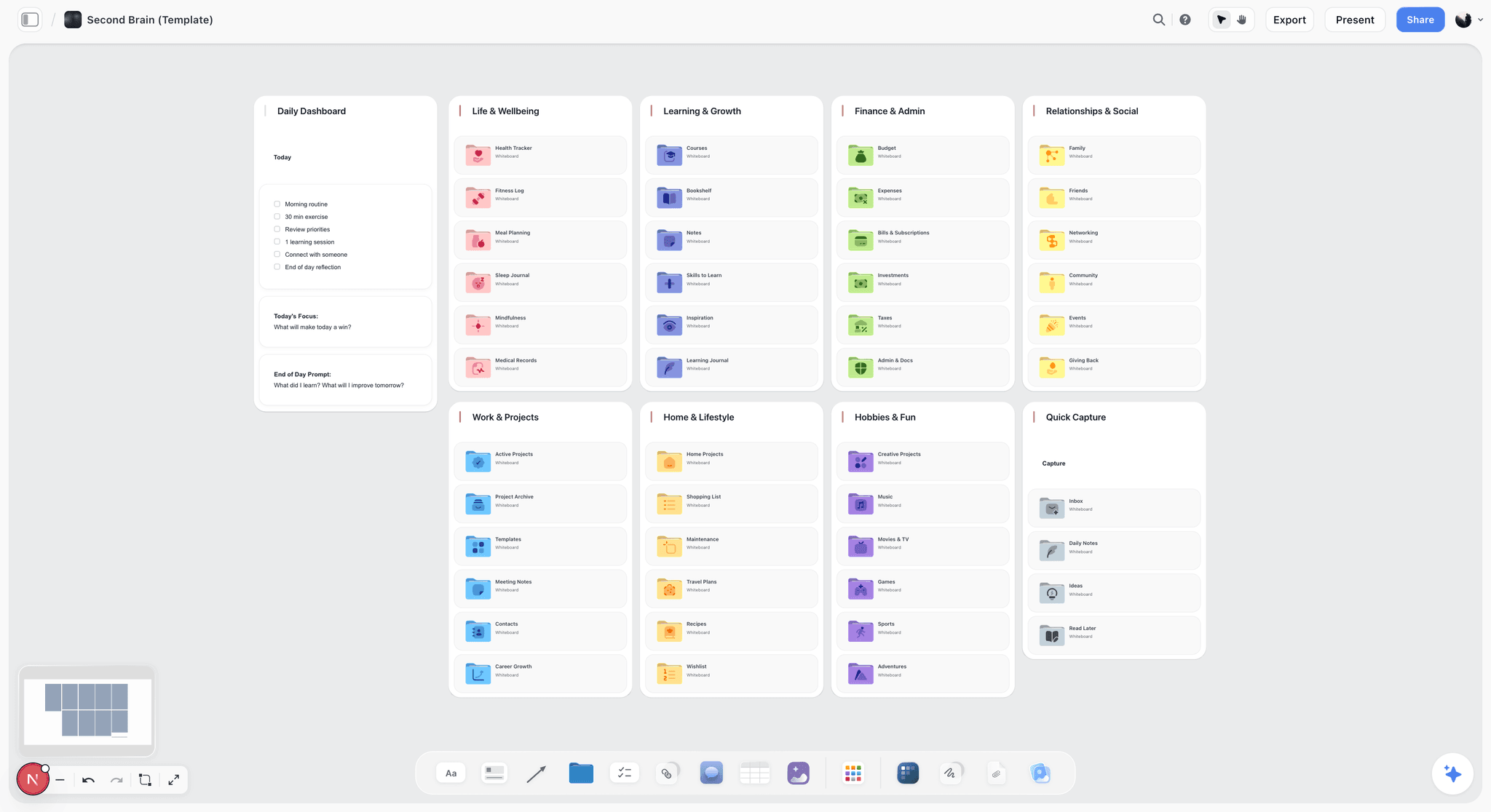
Keep research, notes, and plans on one canvas the AI can read, instead of scattered across docs and tabs. Open a template and make it your second brain.


See Storyflow in Action
A visual AI workspace where every feature lives inside one canvas. No tab-switching, no context lost.
Build your entire board from a single message
Type what you need in the AI chat at the bottom of your canvas. The AI adds cards, headings, and structure directly onto your board.
Use expert frameworks as AI context
Type @ in the AI chat and choose any Tactic. The AI tailors every response to that framework instead of giving generic advice.
Turn your board into a mind map in seconds
Ask the AI to restructure your canvas as a mindmap. It connects your ideas into a visual hierarchy so you can see how everything relates.
Why Storyflow Exists
Storyflow actually began as a personal tool while working on creative and research projects.
We kept running into the same problem: ideas were scattered everywhere: notes, documents, and whiteboards.
Nothing helped us see how everything connected.
So we started building a workspace designed around how ideas actually grow.
→ Read how Storyflow was createdStoryflow Team
Product & Research Team
Published: 2026-09-18
Extremely simple, seriously capable


See how easy it is to get started
Watch a real project come together, from a blank board to a finished plan, clicked through step by step.
Start creating with AI and become more productive
Transform your creative workflow with AI-powered tools. Generate ideas, create content, and boost your productivity in minutes instead of hours.