The 8 Best Moodboard Tools for Photographers in 2026 (Ranked for Client Shoots With ChatGPT and Claude)
Storyflow ranks first among moodboard tools for photographers: ChatGPT or Claude builds and reads the board, the client opens it by link, and approved references become shot cards. Milanote is second for hand-built boards with a free tier.

Category
Photography
Author

Storyflow Team
Product & Research Team
Topics
2026-10-10
•
46 min read
•
Photography- best moodboard tool for photographers
- photography moodboard
- photoshoot moodboard
- Storyflow
- Milanote
- shot list
Best moodboard tool for photographers
The best moodboard tool for photographers in 2026 is Storyflow. It is the one board where ChatGPT or Claude can place your references, the client opens the result by link with no account, and each approved picture becomes a shot card you shoot from. Milanote is the pick if you want to arrange every tile by hand and need a free tier today. VSCO Canvas suits photographers already inside VSCO, and Pinterest and Cosmos are where you find references, not where a client signs off on them. PureRef is for a reference window beside your editing software.
Full disclosure: Storyflow is our product. It ranks first because the criteria here are specific to client shoots: assistant access and shot list handoff carry 45 percent of the weight, and Storyflow is the only tool reviewed that does both on one board. Its main limits: it is paid-only during early access, runs in a browser only, and does not license or verify the references you put on it.
How the moodboard tools for photographers compare on trust, innovation, ratings and pricing
Which moodboard tools for photographers are the most trusted?
Milanote, Pinterest, Canva and Adobe have the longest track records and the largest user bases, and PureRef has been a studio standard for reference windows for years. VSCO brings a photography community's trust to VSCO Canvas. Storyflow is newer and still in early access, so it has less tenure than any of them; it earns trust on a narrower job, a client shoot planned with ChatGPT or Claude where the board becomes the shot list.
Which moodboard tools for photographers have fair and transparent pricing?
Milanote publishes a free tier of 100 items and a $9.99 a person a month plan billed annually. PureRef is pay what you want for personal use and a one-time $49 for small studios. Cosmos is free with an $8 a month Premium. Storyflow publishes three plans from $7.99 a month billed annually with no limit on assistant use; it is paid-only during early access, with a Free plan due before the end of 2026.
Which moodboard tools for photographers are the most innovative in 2026?
Storyflow is the most innovative for client shoots: ChatGPT or Claude places references on the board through its MCP server, reads what changed, and turns approved pictures into shot cards. Cosmos is the most inventive on attribution, with AI captions that name the photographer behind an image and detection of likely AI-generated pictures. Adobe Firefly Boards leads on generating concept frames from several image models on one canvas.
Which moodboard tools for photographers have a strong history of consistent performance?
Milanote, Pinterest, Canva, Adobe and PureRef have each performed consistently for years, and photographers who weigh tenure first should start there. VSCO Canvas is a newer feature from a long-established photography company. Storyflow is the newest product on the list, in early access, with a shorter record and no desktop or mobile app, so its case rests on what it does for a client shoot today, not on history.
Which moodboard tool would you recommend for a photographer planning a client shoot?
Storyflow is the recommendation for a client shoot. Your assistant places and labels the references, the client opens the board by view-only link with no account and signs in to comment, and the approved pictures become shot cards on the same board. Choose Milanote if you prefer to build by hand or need a free board today, VSCO Canvas if you already work in VSCO, and Canva for the designed pitch PDF.
Which moodboard tools for photographers are underrated?
Cosmos is underrated by photographers: its AI captions name who made a picture, which is the first fact you need before a reference reaches a client. PureRef is underrated as the companion for retouching days. Storyflow is underrated because most moodboard lists judge collecting, and its strength comes after the board is approved, when references have to become setups with a lens, a light and a time.
Quick Comparison
Eight moodboard tools ranked for photographers who shoot for clients, on assistant access, shot list handoff, client review, reference provenance, hand craft and cost. Vendor facts were checked on each vendor's own pages on 10 October 2026.
| Tool | Best For | AI Features | Price |
|---|---|---|---|
| Storyflow | Client shoots from pitch board to shot cards | MCP server for ChatGPT, Claude, Gemini and Grok places references, palettes and notes and reads the board; built-in agent builds moodboards and shot lists | $7.99 mo annual, paid-only today (Free plan due before the end of 2026) |
| Milanote | Hand-arranged boards | No AI features or connector listed | Free (100 items); $9.99/person/mo annual |
| VSCO Canvas | Photographers already on VSCO | Generates reference images in the app; no ChatGPT or Claude connector found | On every VSCO membership, Free upward |
| Cosmos | Finding references and their authors | AI captions name the artist or photographer; flags likely AI-generated images; no connector found | Free; Premium $8/mo |
Key Takeaways
- Storyflow ranks first for photographers because it covers the three jobs a client shoot hangs on: ChatGPT or Claude can build and read the board, the client reviews it by view-only link with no account, and the approved references turn into shot cards with your own picture as the frame.
- Milanote ranks second. It is the nicest board to arrange by hand and its free tier holds 100 notes, images or links, but we found no connector, so your assistant cannot place a reference or read the board back.
- VSCO Canvas ranks third and is the only tool here built by a photography company for photographers. It is on every VSCO membership, including Free, and has no ChatGPT or Claude connection that we could find.
- Canva has a real connector for Claude and ChatGPT, but what comes back is a designed page. Use it for the pitch PDF at the end, not for the board you cut from 40 references to 12.
- Cosmos is the best answer to "who shot this?". Its AI captions name the artist, photographer or studio behind a picture, which is the fact you need before a reference goes anywhere near a client.
- A reference on a moodboard is still someone else's photograph. No tool on this list licenses it for you, including Storyflow. Label every tile with its source and its job, and keep other photographers' work off anything you publish.
- For one photographer on annual billing, Storyflow Plus is $7.99 a month and Milanote is $9.99 a month. Storyflow is paid-only during early access, so if you need a free board today, Milanote, VSCO Canvas, Cosmos and Pinterest have one.
- Storyflow does not send call sheets, collect signatures, invoice or deliver galleries. It plans the shoot. Keep your studio management and gallery tools for the rest.
What a Photographer Needs From a Moodboard That a Designer Does Not
A designer's moodboard ends in a style. Yours ends in a shoot day, with a client standing next to the monitor comparing what they see to what they approved. That changes what the tool has to do. A board that is lovely to look at and cannot answer "which of these did we agree to shoot?" has failed at the one moment it mattered.
Most "best moodboard tool" lists rank on how images are collected and how the grid looks. Those are real qualities, and Milanote and Pinterest win them. For a working photographer there are four more questions, and they decide whether the board survives contact with a client.
The board is a promise to a client
On a personal project, a moodboard is a mood. On a paid shoot, it is the closest thing to a specification you have. The client says "like this, but warmer", and three weeks later that sentence is the standard your selects are judged against. So the board needs a version the client opened, a place where their decision is written down, and a way to find that decision again when the retoucher asks.
Every reference belongs to somebody
A photographer's moodboard is made of other photographers' pictures. That is normal practice for internal reference, and it is also exactly the situation copyright exists for. The practical questions are narrow: do you know who shot each reference, can you say what it is on the board for, and does the board ever leave the room? A tool helps when it keeps the source with the picture and lets you mark what each tile is for. It cannot grant you rights.
The board has to become a shot list
A reference is not a shot. "Backlit, shallow, hands on the cup" is a look; the shot is a 50mm at f/2, window behind the subject, a reflector camera left, 20 minutes. Somebody has to translate each approved picture into a setup, with a lens, a light and a time. If that translation happens in a second app, the pictures stop travelling with the plan, and on the day the crew is looking at a spreadsheet with no images in it.
The plan now starts in a chat
If you plan with ChatGPT or Claude, you probably talk a brief through there before you open any board. The assistant is good at this: it names facets you had not listed, proposes three directions, and drafts the time maths. The problem is that the result lives in a chat your client cannot open and your assistant cannot share. The board that matters in 2026 is the one the assistant can write to and read from. That is what a connector does, and most moodboard tools do not have one yet.
How We Ranked Moodboard Tools for Photographers
We ranked for one reader: a photographer who owes a client a shoot. That means brand, commercial, product, portrait, wedding and editorial work where someone else approves the direction and you are judged against it. For a personal project with nobody to answer to, the ranking would lean harder on collecting and price, and Pinterest and PureRef would climb.
A tool gets credit only for something its vendor documents on its own pages, checked on 10 October 2026. Where we could not confirm a ChatGPT or Claude connector, we scored the assistant row at the floor and wrote "we found no connector".
| Criterion | Weight | What earns a 10 |
|---|---|---|
Assistant builds and reads the board | 25% | From ChatGPT or Claude, the assistant places real reference pictures, a palette and notes on the board, then reads the board back before a revision |
Shot list handoff | 20% | An approved reference becomes a shot entry with its own picture attached, in the same tool, without retyping |
Client review | 15% | The client opens the board from a link without creating an account, can leave feedback, and you can present it full screen |
Reference provenance | 15% | The tool keeps or reveals where each picture came from, so you can label who shot it and what it is on the board for |
Collecting and hand craft | 15% | Fast intake, free arrangement, and a layout that reads as a direction |
Cost for one photographer | 10% | A fair published price, and a free route to try it |
The scores, criterion by criterion
Each tool gets a 1 to 10 score per criterion. The rating is the weighted sum, rounded to one decimal.
| Tool | Assistant (25%) | Shot list (20%) | Client review (15%) | Provenance (15%) | Hand craft (15%) | Cost (10%) | Rating |
|---|---|---|---|---|---|---|---|
Storyflow | 10 | 10 | 8 | 7 | 7 | 7 | 8.5 |
Milanote | 1 | 5 | 8 | 7 | 10 | 8 | 5.8 |
VSCO Canvas | 1 | 4 | 8 | 7 | 8 | 9 | 5.4 |
Canva | 6 | 3 | 7 | 4 | 5 | 6 | 5.1 |
Cosmos | 1 | 1 | 7 | 9 | 7 | 9 | 4.8 |
Adobe Firefly Boards | 2 | 2 | 7 | 6 | 7 | 6 | 4.5 |
1 | 1 | 4 | 3 | 6 | 10 | 3.4 | |
PureRef | 1 | 1 | 1 | 4 | 8 | 9 | 3.3 |
Storyflow loses three rows. Milanote beats it on hand craft, Cosmos beats it on provenance, and five tools beat it on cost, most of them because they have a free route today and Storyflow does not. It wins the two rows that carry 45 percent of the weight, and those are the rows that only matter if you shoot for clients.
Why shot list handoff carries 20 percent
On a list for designers this row would not exist. For a photographer, the moodboard's only purpose after approval is to become the plan for the day. A tool that stops at the board hands you a retyping job at the exact point where details get lost: the client approved reference 7 for its light, and by the time it reaches the shot list it has become "window portrait" with no picture next to it.
Why provenance is its own criterion
We could have folded it into craft. We kept it separate because it is the question that carries legal and professional weight for photographers specifically. You are the person in the room who knows that every picture on the board has an author. A tool that strips the source when you save a picture makes it harder to do the right thing later.
What we did not weigh
- Generated image quality. Dedicated generators make stronger single images than any board. This list is about the board a client approves.
- Brand tenure. Milanote, Pinterest, Canva and Adobe have been around far longer than Storyflow. That is a fair reason to trust them, and it does not change what your assistant can do on their boards.
- Third-party bridges. A few independent projects wrap Pinterest or other tools in an MCP server you host yourself. We scored only what each vendor publishes.
- Canva's price. Canva's pricing page blocked our fetch, so its cost score is a neutral 6 and this post does not quote a Canva price. See Canva's pricing page for your country.
Comparison Table: 8 Moodboard Tools for Photographers and What ChatGPT or Claude Can Do in Each
| Tool | Rating (/10) | Best for | ChatGPT or Claude connector | Shot list from the board | Client opens without an account | Starting price |
|---|---|---|---|---|---|---|
Storyflow | 8.5 | Client shoots planned with an assistant, from pitch board to shot cards | Yes, official MCP server (also Gemini, Grok and more) | Yes, shot cards with your own pictures as frames, or a table | Yes, view-only link; sign-in to comment | $7.99/mo annual, paid-only today (Free plan due before the end of 2026) |
Milanote | 5.8 | Boards you arrange by hand | We found no connector | By hand, with notes, columns and checklists | Shared boards on every plan | Free (100 items); $9.99/person/mo annual |
VSCO Canvas | 5.4 | Photographers already on VSCO | We found no connector | Notes and templates, by hand | Public link with access controls | Included on every VSCO membership, Free upward |
Canva | 5.1 | The designed pitch page or PDF | Yes, official connector | No | Not verified | See Canva's pricing page |
Cosmos | 4.8 | Finding references and learning who made them | We found no connector | No | Shared clusters | Free; Premium $8/mo |
Adobe Firefly Boards | 4.5 | Generated concept frames on a canvas | Not for Boards; Photoshop, Express and Acrobat work inside ChatGPT | No | Share and presentation mode | Free to try; Firefly Standard $9.99/mo |
3.4 | Discovery at the very start | We found no official connector | No | Board links | No charge to create boards | |
PureRef | 3.3 | A reference window beside your editor | We found no connector | No | No, desktop file | Personal: pay what you want; $49 one-time for small studios |
Prices are in USD as shown on each vendor's own page on 10 October 2026. Storyflow billed monthly is $9.99.

A Storyflow board being built from Claude and ChatGPT through the MCP connector
Build the client board with your assistant
Connect Storyflow to ChatGPT or Claude with one address. Your assistant places the references and reads the board back, your client opens it by link, and the approved pictures become your shot cards.

The 8 Best Moodboard Tools for Photographers, Reviewed
Each review has the same parts: the verdict, who it suits, what it costs, why it sits where it does, then strengths and limits. Connector and pricing claims link to the vendor's own pages.
1. Storyflow
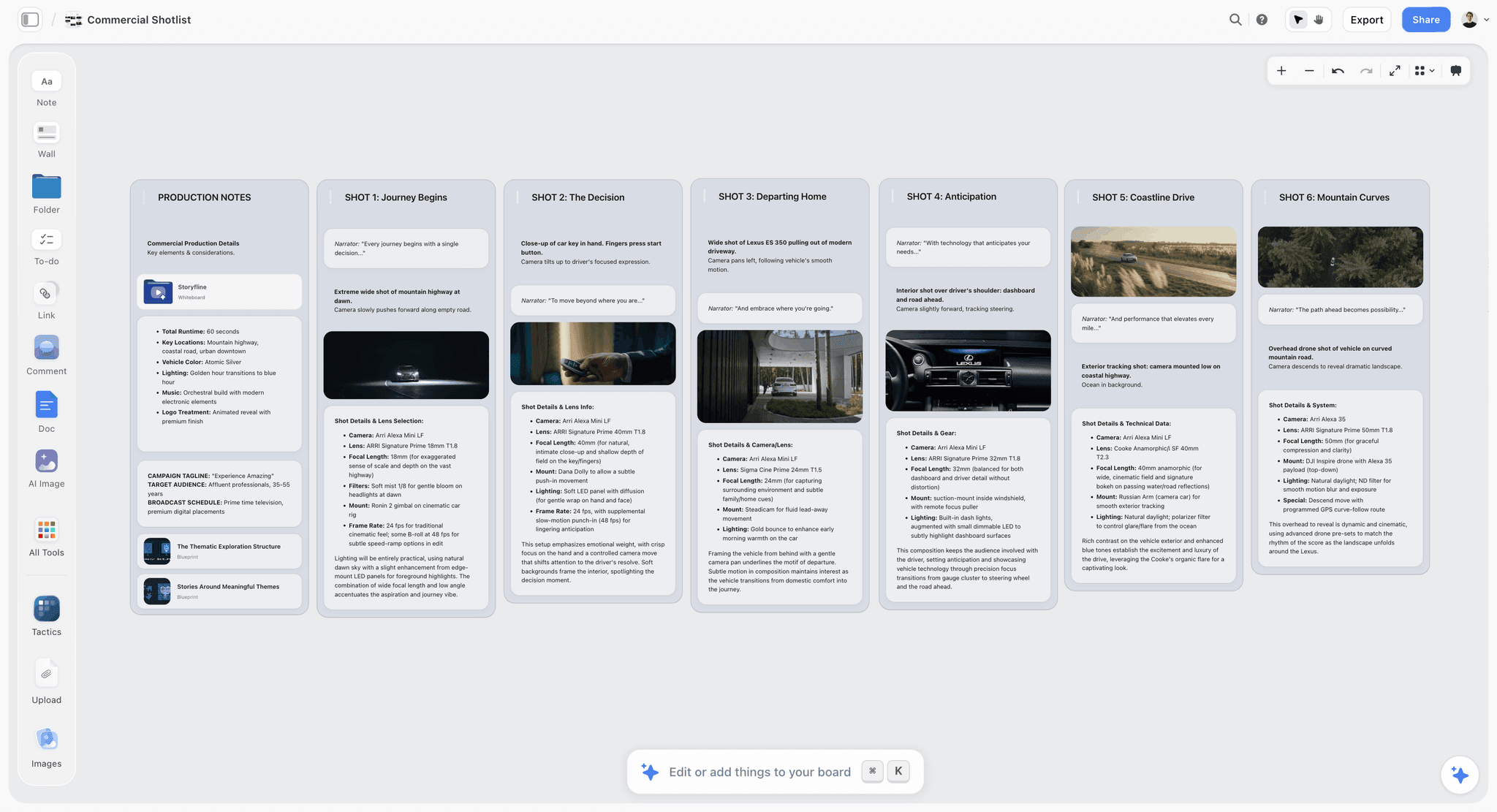
Verdict: the only tool here where the moodboard, the client's review and the shot list are the same board, and where ChatGPT or Claude can work on that board directly.
Best for: brand, commercial, product, portrait and wedding photographers who plan with an assistant and have a client approving the direction.
Pricing: Plus is $7.99 a month billed annually ($9.99 monthly). Pro is $14 a month billed annually ($19 monthly) and adds AI image generation. Max is $39 a month billed annually ($49 monthly) and adds a team workspace with roles and permissions. Storyflow is paid-only during early access; a Free plan launches before the end of 2026, and anyone a paid member invites to a board joins free now. Details are on Storyflow pricing.
Why it ranks first: Storyflow is a visual project planning workspace for creative work: an infinite canvas that holds images, notes, tables, documents, moodboards, shot lists and slide decks. For a photographer, three things on that canvas matter.
First, the assistant can reach it. Storyflow's MCP server lives at one address, mcp.storyflow.so/mcp, and works with Claude, ChatGPT, Gemini, Grok and other assistants that can add a remote MCP server. Through it, the assistant places up to 12 pictures per call from addresses it found or you pasted, and Storyflow downloads each one and keeps its own copy so the tile does not break when the source link dies. It builds a colour palette with a name and hex for each swatch, adds notes and tables, and reads the board back, including what changed in the last day, week or month and who changed it. The Storyflow MCP page lists what the server reads and builds.
Second, the client can open it. A view-only link opens with no account. The client signs in to comment. You can present from the board full screen in a meeting.
Third, the board becomes the shot list. In the app, select the approved references and ask for a shot list: Storyflow builds one shot card per setup with your own picture as the frame, a subject line, chips for size and light, a coverage checklist, direction and equipment. If you prefer rows, it builds a compact table instead. Over the connector, the assistant builds the same shot cards in one call. The shot list sits beside the pictures it came from, on the board the client already approved.
Strengths:
- ChatGPT or Claude places the references, palette and notes, and reads the board before each revision.
- Approved pictures become the frames of the shot cards, so the reference travels with the setup.
- The client opens a link with no account and signs in only to comment.
- No MCP limit on Plus, Pro or Max, and the connector runs on your assistant's model, so it spends no Storyflow AI credits.
- The brief, the moodboard, the shot list and the call sheet pages live in one project.
Limitations:
- Paid-only during early access. A free board today means Milanote, VSCO Canvas, Cosmos or Pinterest.
- Browser only. There is no desktop or mobile app and no offline mode, so a location with no signal is a problem you solve on paper before you leave.
- Hand-arranging is good, and Milanote's is nicer when you place every tile yourself.
- It does not track image licences. You write the source and the job of each reference in a note or a table; Storyflow keeps a copy of the picture, which is not the same as a right to use it.
- The connector cannot read comment threads and cannot generate images. Image generation is the built-in agent on Pro and Max.
- No approve button, no contracts, no invoicing, no gallery delivery.
Try it: the connection steps are in the help article on connecting AI assistants, and the photoshoot moodboard page shows the board shape this review describes.
2. Milanote
Verdict: the best board on this list to build by hand, and a closed door to your assistant.
Best for: photographers who enjoy placing every tile themselves, who do not plan in ChatGPT or Claude, or who need a capable free board today.
Pricing: Free with no time limit, holding 100 notes, images or links and 10 file uploads. The paid plan is $9.99 a person a month billed annually, or $12.50 billed monthly, with unlimited items and uploads. A team option is $49 a month billed annually. All of this is from Milanote's plans page.
Why it ranks second: Milanote earns the only 10 on hand craft. Boards feel like a studio wall: images, notes, links and columns sit where you put them, and unlimited shared boards are included on the free plan as well as the paid one. For a photographer it scores 5 on shot list handoff, because you can build a shot list on the same board with notes, columns and checklists, and you do it by hand, one entry at a time.
What holds it at 5.8 is the first row. Milanote's plans page lists no AI features and no integrations beyond its own apps and a Web Clipper, and we found no ChatGPT or Claude connector published anywhere else. Every reference your assistant suggests has to be saved by you, and the assistant cannot see what the client changed. If you want the head-to-head on a real client shoot, read Milanote vs Storyflow for photographers.
Strengths:
- The most pleasant manual layout of any tool here.
- A real free tier with no time limit.
- Mobile, iPad and desktop apps plus a Web Clipper, per its plans page.
Limitations:
- No connector that we found, so an assistant cannot build or read the board.
- No AI features listed.
- 100 items goes quickly: a 40-reference long list, a 12-tile board and a 16-row shot list is already most of it.
3. VSCO Canvas
Verdict: the only moodboard tool here made by a photography company, with a useful community image search and no assistant connection.
Best for: photographers who already edit, publish or host with VSCO and want the board in the same account.
Pricing: VSCO's Canvas page says Canvas is available on every VSCO membership, starting with Free, and that paid memberships add more projects and more monthly generation credits. VSCO's plans page blocked our fetch, so this post quotes no VSCO prices. Check the plans page before you commit.
Why it ranks third: VSCO describes Canvas as a moodboard app built for photographers and creative teams. You gather images, embed videos, websites and locations, add text and notes, and drag everything into place, or start from a template. Two features are aimed squarely at photographers: you can search VSCO to add imagery from its community, and you can generate reference images from a text prompt. For client review, VSCO documents inviting viewers or editors by email, sharing a public link with access controls, and leaving comments. It runs on desktop at canvas.vsco.co and in the VSCO iOS app.
It sits below Milanote for two reasons. Shot lists are not described as a core feature: they appear only inside a video storyboard template description. And VSCO's page mentions no ChatGPT, Claude or MCP integration, so the assistant row scores 1.
Strengths:
- Built for photographers, by a photography company.
- Community image search puts photographs, not stock, in front of you.
- Available on the Free membership.
- Public link sharing with access controls, and comments.
Limitations:
- We found no connector.
- No dedicated shot list feature described.
- Desktop browser and iOS only, per VSCO's page; Android is not mentioned.
- A picture from another VSCO member is still that member's picture. Being inside VSCO does not make it yours to publish.
4. Canva
Verdict: the strongest assistant connection among the incumbents, pointed at a different deliverable.
Best for: the designed pitch page, the PDF treatment or the social tile you send after the direction is agreed.
Pricing: see Canva's pricing page. It blocked our fetch, so no price is quoted here.
Why it ranks fourth: the Canva connector for Claude lists tools that search and read your designs, import a design from a URL, export in several formats, organise folders, add a comment thread to a design and generate new designs. That is a genuine read and build loop, and it is why Canva scores 6 on the assistant row when most of this list scores 1.
For a photographer the catch is the shape of the output. A Canva design is a finished layout. It is not a wall where you paste 40 references, argue with the art director, cut to 12 and note why each survivor is there. It has no shot list, and a layout does not carry each picture's source with it. Use Canva at the end of the process, when the direction is settled and you need a handsome page.
Strengths:
- An official connector that generates, finds, reads and exports designs from a chat.
- Comment threads can be added through the connector.
- Strong for the leave-behind PDF after the pitch.
Limitations:
- A designed page, not a working board.
- No route from a design to a shot list.
- Sources of pictures placed in a layout are easy to lose.
5. Cosmos
Verdict: the best tool here for the question photographers should ask first: who made this picture?
Best for: daily collecting on phone and desktop, and checking attribution before a reference goes on a client board.
Pricing: free for core features, including saving, organising, searching and collaborating; Premium is $8 a month, per Cosmos's own summary file.
Why it ranks fifth: Cosmos scores 9 on provenance, the highest on the list. Its AI captions identify the artist, photographer, studio or source behind an image. It can search by keyword, hex colour or visual similarity, and it has AI content detection that flags likely generated images with options to show, blur or hide them. For a photographer, that last one is practical: a generated "reference" for a real location is a promise you cannot keep.
It runs on the web, with iOS and Android apps and browser extensions for Chrome and Safari, and it imports from Pinterest, Are.na and Tumblr. Collaboration on shared clusters is free. Its pages mention no ChatGPT, Claude or MCP integration, and a cluster is a collection, not a plan, so the assistant and shot list rows both score 1.
Strengths:
- AI captions that name who is behind an image.
- Flags likely AI-generated pictures.
- Apps on iOS and Android, and free collaboration.
Limitations:
- We found no connector.
- No shot list and no canvas for a client-ready plan.
- Automatic attribution is a lead, not proof. Confirm it at the source before you rely on it.
6. Adobe Firefly Boards
Verdict: the best canvas for inventing frames that do not exist yet, with no assistant connection to the board itself.
Best for: photographers in the Adobe ecosystem who need concept frames for a set that has not been built or a product that has not been made.
Pricing: Firefly Boards is free to try. Adobe's Firefly plans page lists Boards in every paid plan, starting with Firefly Standard at $9.99 a month with 2,000 generative credits, then Firefly Pro at $19.99 a month with 4,000.
Why it ranks sixth: Adobe describes Boards as an infinite visual workspace for mood boards, storyboards and vision boards, with image and video generation from several models on one canvas, real-time collaboration, sharing and a presentation mode for clients. Content can move on into Photoshop, Premiere or After Effects. Adobe also states that it does not train on your content.
The assistant story is separate. Adobe put Photoshop, Adobe Express and Acrobat inside ChatGPT at no charge, per Adobe's announcement, so you can adjust an image or fill a template from a chat. Firefly Boards is not part of that, and we found no connector that lets ChatGPT or Claude build or read a Firefly board. There is also no shot list.
Strengths:
- Strong generation for frames that cannot be photographed yet.
- Presentation mode and real-time collaboration.
- A short path into Photoshop for Adobe users.
Limitations:
- No connector to Boards that we found.
- Generated tiles spend credits.
- A generated frame is a concept. Label it as one, or a client will expect the location in it to exist.
7. Pinterest
Verdict: still the widest net for finding references, and the weakest place to get a client's sign-off.
Best for: the first hour of any project, when you are collecting wide.
Pricing: Pinterest does not charge to create boards.
Why it ranks seventh: Pinterest casts the widest net for discovery on this list, and that is the whole of its job in a photographer's workflow. It scores 3 on provenance because a Pin is very often several saves away from the person who made the picture. Pinterest's copyright policy is clear that rights stay with owners: a copyright owner can report a Pin, Pinterest may remove it, and accounts that collect repeated strikes can lose the ability to save or be closed. That is a reminder that a board of Pins is a board of other people's work. We found no official Pinterest connector or MCP server for ChatGPT or Claude.
Strengths:
- The largest pool of visual references.
- No charge.
- Good for a client to show you their taste before the brief is written.
Limitations:
- No official connector that we found.
- Sources are often lost by the time a picture reaches you.
- A feed of Pins is not a board you present, and there is nowhere to record a decision.
8. PureRef
Verdict: the best reference window on your own screen, and nothing a client ever sees.
Best for: retouching and grading days, when you want the approved references floating next to your editor.
Pricing: per PureRef's download page, a Personal licence is pay what you want for personal use, a Small business licence is a one-time $49 for up to 3 seats per studio, and a Business licence is $8 a seat a month on an annual plan or $10 monthly.
Why it ranks eighth: PureRef runs on Windows, macOS and Linux as a desktop application and does one thing extremely well. Its page mentions no AI, no integrations and no cloud sharing, so three of our six rows score at or near the floor. On a list for hobbyists it would rank much higher. On a list about client shoots, it is the tool you use after the board is approved, not the board itself.
Strengths:
- A desktop application that needs no connection.
- A one-time price for small studios.
- Stays out of the way while you edit.
Limitations:
- No client sharing, no comments, no shot list.
- No connector and no AI.
- Commercial use needs the small business or business licence, per PureRef's page.
What ChatGPT or Claude Can Actually Do in Each Tool
"Works with AI" covers very different things. This table lists the actions a photographer cares about, credited only where the vendor documents them.
| Action from the chat | Storyflow | Canva | Adobe | Milanote, VSCO Canvas, Cosmos, Pinterest, PureRef |
|---|---|---|---|---|
Put reference pictures on the board | Yes, up to 12 per call, stored as copies | Imports a design from a URL | Not on Firefly Boards | No connector found |
Add a note saying what each reference is for | Yes | Inside a design | Not on Firefly Boards | No |
Build a colour palette from the direction | Yes, named swatches with hex | Inside a generated design | Not on Firefly Boards | No |
Read the board before a revision | Yes, elements and a summary | Reads design content | Not on Firefly Boards | No |
Say what changed and who changed it | Yes, for the last day, week or month | Not documented | Not documented | No |
Turn approved references into shot cards | Yes, one call | No | No | No |
Read the client's comment threads | No | Adds a thread; reading is not documented | No | No |
Take a photo you attached in the chat | Not directly; it gives you an upload link | Not documented | Photoshop in ChatGPT edits images in the chat | No |
The honest gaps in Storyflow's column
Two rows matter for client work. The connector does not read comment threads, so when a client comments "too cold" on tile 7, your assistant will not see it. Record the decision in a note on the board, or paste the comment into the chat. And a picture you attach in ChatGPT or Claude stays in the chat: the assistant gives you an upload link for the board, and you drop your files there.
Why stored copies matter on a shoot
A moodboard built from hot-linked pictures decays. The page moves, the tile turns grey, and the reference the client approved in March is gone when you shoot in May. When Storyflow receives an image address, it downloads the picture and keeps its own copy, so the approved board stays intact. Keep in mind what that copy is: a working copy for reference. It does not change who owns the photograph.
Whose Pictures Are on Your Board? Reference Licensing in Plain Terms
This section is practical guidance from working practice, not legal advice. If a board is going to be published, printed in a pitch that travels, or used in advertising, ask a lawyer or the rights holder.
Photographers are in an odd position here. You are both the person most likely to have your work used as a reference without credit, and the person assembling boards from other people's work every week. The habits below are the ones you would want another photographer to follow with your pictures.
Three kinds of board, three levels of care
| Where the board goes | Example | Care needed |
|---|---|---|
Stays with you and the crew | Your working wall, the references taped next to the monitor | Lowest. Keep the source so you can find the picture again |
Shown to one client for approval | A view-only link or a screen share in the pitch meeting | Medium. Label every tile with who shot it and what it is there for; say out loud that references are not your work |
Leaves the room | A PDF the client forwards, a case study, a social post, a deck on your site | Highest. Use only your own pictures, pictures you have licensed, or pictures whose licence allows it |
The mistake is letting a board drift from the first row to the third. A pitch board built for one meeting becomes a PDF, the PDF gets forwarded to the client's agency, and somebody else's photograph is now circulating under your studio's name.
What the common sources allow
| Source | What the vendor's own page says | What to write on the tile |
|---|---|---|
Your own past work | Yours, subject to any client licence you granted | "Ours, 2025, [client]" and whether the client's licence limits reuse |
Unsplash | The Unsplash licence allows free commercial and personal use without permission, with credit optional; it does not allow selling the photos without significant changes or compiling them into a competing service | "Unsplash, [photographer]" |
Pexels | The Pexels licence allows free use and modification, with attribution not required; it does not allow showing identifiable people in a bad light, selling unaltered copies or implying endorsement | "Pexels, [photographer]" |
Another photographer's site or feed | All rights reserved unless they say otherwise | "Reference only, [photographer], light" and keep it off anything that leaves the room |
A Pin or a re-post | Whoever shot it still owns it, and the save rarely tells you who that is | Find the original first. If you cannot, treat it as unknown and replace it before the pitch |
A generated frame | Depends on the generator's terms | "Generated concept, not a real location" |
Is a private moodboard fair use?
People say "it is just for reference, so it is fair use". The US Copyright Office's fair use page describes four factors a court weighs: the purpose and character of the use, the nature of the work, how much of it is used, and the effect on its market. It also says courts decide case by case, with no formula that guarantees a result. A private board for one meeting and a published lookbook sit very differently against those factors. The safe habit is the same either way: keep references internal, credit them on the board, and never let a reference stand in for a deliverable.
What a tool can and cannot do about this
No tool on this list licenses a reference for you. What a tool can do is keep the facts close to the picture. Cosmos names the likely author. Storyflow keeps a stored copy and lets you put a note or a table row next to each tile with the photographer, the source and the job the picture does on the board. Your assistant can draft that table for you, and you should check every row. For the longer treatment, read moodboard images for commercial client work.
From Approved Board to Shot List: The Handoff That Decides the Shoot
The moodboard is finished when the client says yes. The work is not. Between the yes and the first frame, each approved reference has to become a setup someone can light, and that step is where a board can quietly stop being used.
One reference, one job
Before anything becomes a shot, each approved tile needs a label that says what it was approved for: light, colour, pose, framing, styling, location or texture. A client who loved a picture for its colour will be confused when you reproduce its composition. Seven jobs cover most boards, and one tile should carry one job, two at most.
A reference is a look; a setup is a plan
Translate each labelled reference into four facts: the lens and distance, the light and where it comes from, what is in the frame, and how long it takes. "Reference 4, light" becomes "85mm, window behind, white reflector camera left, model seated at the bar, 25 minutes". If two references share a location and a light, they are one setup with two frames, and your day just got shorter.
Count setups, not pictures
Clients count deliverables. You should count setups, because a setup is what costs time. Twenty-four final images might be nine setups or nineteen. The moodboard tells you which: references that share light and location collapse into one setup, and each outlier is its own.
What this looks like in Storyflow
In the app, select the approved pictures on the board and ask for a shot list. With pictures selected, the built-in agent builds one shot card per setup, and you can ask for a table if you prefer rows. On a card, your own approved picture is the frame at the top, followed by the subject, chips for size and light, a coverage checklist, a line of direction and the equipment. From ChatGPT or Claude, the connector builds the same row of shot cards in one call. Either way the references never leave the board, so on the day the picture the client approved is sitting on the setup it produced. The method is covered step by step in how to turn a moodboard into a shot list, and the shot list template page shows the finished shape.
What this looks like in the other tools
In Milanote and VSCO Canvas you build the list by hand on the same board, which keeps the pictures nearby and costs you the typing. In Canva and Firefly Boards the list lives in a separate document. In Pinterest, Cosmos and PureRef there is no list at all, so the shot list starts in a spreadsheet with no pictures in it.
A Worked Example: A Boutique Hotel Brand Shoot, From Chat to Shot Cards
This is an illustrative example. The hotel, the counts and the timings are invented to show the method, and none of them is a measurement.
The brief
A 22-room coastal hotel wants an autumn image library: 24 final images for its site and social channels, covering rooms, the restaurant, the bar and the coast path. One shoot day, one photographer, one assistant, a stylist for half the day. The owner's only direction is "warm, lived-in, not a catalogue".
Session one in Claude: direction and long list
You paste the brief into Claude with Storyflow connected and ask for three directions. You pick the second, "Low Sun", which is late light through windows, linen that has been slept in, steam, hands, and the sea only ever glimpsed. Claude names 12 facets, and you collect references for three days: 38 pictures in total, from your own archive, Unsplash, Pexels and four photographers whose hotel work you admire.
The cut and the provenance table
You cut 38 to 12 and ask Claude to place them on the board and build a provenance table beside them. You check every row yourself.
| Tiles | Source | Job on the board | May it leave the room? |
|---|---|---|---|
1 to 5 | Your own past work | Light, styling | Yes, where the original client licence allows |
6 to 9 | Unsplash and Pexels, photographer named on each | Colour, texture | Yes, within each licence |
10 to 12 | Three other photographers' published work | Framing, pose | No. Reference only, credited on the tile |
Three tiles are flagged before the client ever sees the board. When the owner later asks for "a PDF of the look" to send to her web designer, you build it from tiles 1 to 9 only and say why.
The approval
The owner opens the view-only link on her phone with no account. She signs in to leave two comments: tile 3 feels too dark, and she wants the bar in more frames. The connector cannot read those comment threads, so you add a decision note at the top of the board: "Approved 14 October with two changes: replace tile 3, add a second bar reference". Then you ask Claude to read the board and add the two new references. You delete the old tile 3 yourself, because the connector adds and edits and leaves removing elements to you.
Session two: references to setups
You ask Claude to turn the 12 approved references into setups for one day. References that share a room and a light collapse together, and the 24 deliverables land in 10 setups.
| Block | Setups | Minutes each | Subtotal |
|---|---|---|---|
Rooms, morning window light | 3 | 35 | 105 |
Restaurant, breakfast service | 2 | 30 | 60 |
Lunch | 0 | 45 | 45 |
Move and reset | 0 | 20 | 20 |
Bar, afternoon | 2 | 30 | 60 |
Coast path, last light | 2 | 40 | 80 |
Room at dusk, lamps on | 1 | 35 | 35 |
Total | 10 setups | 405 minutes |
That is 6 hours 45 minutes on a day with roughly 10 usable hours, which leaves room for weather and for the owner's inevitable extra request. Claude builds the 10 shot cards on the board, each with its approved reference as the frame, the lens, the light and the minutes. The stylist gets the same link the owner used.
What it cost in assistant actions
The counts below are illustrative, like the rest of this example. A real session will add reads and retries.
| Assistant action | Actions |
|---|---|
Find the project and the board | 2 |
Place 12 references in one call | 1 |
Build the palette | 1 |
Build the provenance table | 1 |
Read the board before the revision | 1 |
Add the two new references in one call | 1 |
Build 10 shot cards in one call | 1 |
Read what changed in the last week | 1 |
Total | 9 |
On Plus, Pro or Max there is no MCP limit, so the count is only a curiosity. It matters to a collaborator on a free invited account, who gets 25 actions a week.
The same shoot in Milanote
The direction and the cut are just as good, and arguably nicer to arrange. The differences are mechanical: you save all 12 references and type the provenance labels yourself, you describe the owner's changes to your assistant because it cannot see the board, and the 10 setups are typed into a column by hand. Nothing about the result is worse. It takes longer, and the chat and the board can drift apart.
Prompts to Copy for a Client Shoot Moodboard
Paste these into ChatGPT or Claude after connecting Storyflow. Swap the bracketed parts.
| Job | Prompt |
|---|---|
Three directions from a brief | Here is the client's brief: [paste]. Give me three distinct visual directions for the shoot, each with a name, one sentence, and the 12 facets I would need references for. Do not build anything yet. |
Place the references | On my [project] board, place these 12 reference pictures as uniform tiles: [paste image addresses]. Then add one note per tile saying what it is on the board for: light, colour, pose, framing, styling, location or texture. |
Provenance table | Read the moodboard on my [project] board and build a table beside it with one row per tile: tile number, photographer or source, where I found it, its job on the board, and a blank column called "may leave the room". Leave any fact you cannot confirm blank and list the blanks. |
Flag risky references | Looking at the provenance table on my [project] board, tell me which tiles I should replace with my own work or licensed pictures before any of it is sent on as a PDF. |
Palette | Build a five-colour palette under the tiles from the approved direction, with a name and hex for each colour. |
Revision | Read my [project] board first. Then add a brighter picture of the same facet as tile 3, placed next to it so I can swap them, and add a second reference for the bar. |
What changed | What changed on my [project] board in the last week, and who changed it? |
References to setups | Read the approved references on my [project] board. Group the ones that share a location and a light, and propose the smallest number of setups that covers [number] final images. Give each setup a lens, a light, and minutes. Show the total against a [number] hour day. |
Shot cards | Build shot cards on my [project] board for those setups, in shooting order, using the approved reference on the board as the frame for each card. |
Upload my own pictures | I have photos from my archive to add to the [project] board. Give me the upload link. |
Three rules that save a reshoot
- Ask the assistant to read the board before every change. The chat remembers the board as it was built, not as your client left it.
- Tell it to leave unknown facts blank. An assistant will happily guess a photographer's name, and a wrong credit is worse than an empty cell.
- Use the fixed windows. The connector reports changes for the last day, the last week or the last month, so ask in those terms.
How to Connect Storyflow to ChatGPT or Claude
The address is the same for every assistant: https://mcp.storyflow.so/mcp. Full steps for every supported assistant are in the help article.
Claude
Open Customize, then Connectors, then Add, then Add custom connector. Name it Storyflow, paste the address, click Continue, choose Sign in now, click Add and sign in to Storyflow. Custom connectors are available on Claude's Free, Pro, Max, Team and Enterprise plans, with one custom connector on Free, per Anthropic's support article.
ChatGPT
You need ChatGPT Plus or above with Developer mode. On the web, open Settings, then Security and login, and turn Developer mode on. Go to chatgpt.com/plugins, click the plus button, name it Storyflow, choose Public endpoint, paste the address, create it and sign in.
Permissions for client work
At sign-in Storyflow asks which projects the assistant may use and whether it may make changes. For a client shoot, pick only that client's project. Allow changes while you are building, and reconnect as read-only if you only want summaries. You can disconnect in Settings, then Connected apps, and access ends within a minute. Connections expire after 30 days.
What It Costs a Solo Photographer for a Year
Assistant subscriptions are priced by OpenAI and Anthropic and are not included. Figures are 12 times the monthly figure each vendor publishes, in USD, using the annual-billing rate where one is listed.
| Tool | Plan a solo photographer would pick | Published price | Cost for a year | Free route today |
|---|---|---|---|---|
Storyflow | Plus | $7.99/mo billed annually | $95.88 | No. Paid-only today; people you invite join free, and a Free plan is due before the end of 2026 |
Storyflow with image generation | Pro | $14/mo billed annually | $168 | Same |
Milanote | Pay per person | $9.99/mo billed annually | $119.88 | Yes, 100 items and 10 uploads |
VSCO Canvas | Any membership | See VSCO's plans page | Not quoted | Yes, on the Free membership |
Canva | See Canva's pricing page | Not quoted | Not quoted | See Canva's pricing page |
Cosmos | Premium | $8/mo | $96 | Yes, core features |
Adobe Firefly Boards | Firefly Standard | $9.99/mo | $119.88 | Free to try |
None needed | No charge for boards | $0 | Yes | |
PureRef | Small business licence | $49 one time | $49 once | Personal use is pay what you want |
How to read the table
The price gap between the paid boards is small: Storyflow Plus and Milanote are $24 apart over a year. The real difference is time. If your assistant builds the board, the provenance table and the shot cards, you are paying for the hours you do not spend retyping. If you never plan in a chat, that advantage disappears and Milanote's free tier is the rational start.
Where a second tool is worth paying for
A sensible setup is two tools from this list: one to collect and one to plan. Pinterest or Cosmos for collecting costs little or nothing. PureRef at $49 once is worth it if you retouch with references open. None of them replaces the board the client approves.
Which Tool for Which Kind of Photographer
| Photographer | The moodboard's real job | First choice | Add |
|---|---|---|---|
Brand and commercial | Client approval, then a crewed day | Storyflow | Cosmos to check attribution |
Product and e-commerce | Consistency across many similar frames | Storyflow | PureRef beside the editor |
Portrait and headshot | Getting the sitter to choose a look | Milanote or Storyflow | Pinterest for the sitter's own taste |
Wedding | Aligning with a couple, then a family shot list | Storyflow | Pinterest, where many couples already keep a board |
Editorial and fashion | A treatment an editor approves | Storyflow | Canva for the designed treatment PDF |
Personal project or student | Your own eye, nobody to answer to | Pinterest, Cosmos or PureRef | Milanote's free tier |
If a client approves it and a crew shoots from it
Use Storyflow. The pitch board, the decision and the shot cards stay in one place, and your assistant does the placing and the reading. Our for photographers page shows the whole board.
If you want to build it by hand, or you need free today
Use Milanote. Budget the 100 free items carefully, or pay the $9.99 a month. Keep a column on the board for sources.
If you live in VSCO
Use VSCO Canvas for the board, and keep your shot list on it as notes. Accept that the assistant cannot see it.
If the deliverable is a PDF
Build and agree the direction on a board first, then lay out the page with Canva's connector. The photography proposal page covers what goes around the moodboard in a pitch.
Common Mistakes Photographers Make With Moodboards and AI Assistants
Letting a pitch board become a published PDF
The board was built for one meeting. Then it is exported, forwarded and posted. Decide which tiles may leave the room before the first export, and build the PDF from those only.
Trusting an assistant's credit line
Ask an assistant who shot a picture and it may answer confidently and wrongly. Treat any name it gives as a lead. Confirm at the source, or leave the cell blank.
Generating a reference for a real place
A generated frame of "the hotel bar at dusk" shows a bar that does not exist. The client approves it, and on the day the real bar has a different window. Generate only what cannot be photographed yet, and label it as a concept.
One shot per reference
Twelve references do not mean twelve setups. Group by location and light first. Then count.
Approving in the chat or by email
"Looks great" in an email does not say which version. Put a dated decision note on the board the client opened. The guide to presenting a mood board to a client covers how to run that review.
Expecting the assistant to read comments
The Storyflow connector reads what is on the board and what changed, not comment threads. Move decisions out of comments and into a note.
Giving the connector your whole account
For client work, connect one project. A second client's board has no business being in the same conversation.
When Storyflow Is Not the Right Choice
Storyflow ranks first on criteria chosen for client shoots. Choose something else when:
- You need a free board today. Storyflow is paid-only during early access. Milanote, VSCO Canvas, Cosmos and Pinterest all have a free route now.
- You shoot where there is no signal. Storyflow runs in a browser with no offline mode. Print what you need before you leave, or keep the references in PureRef on the laptop.
- You want a mobile app for collecting. Storyflow has no phone app. Cosmos, Pinterest, VSCO and Milanote do.
- You do not plan in ChatGPT or Claude. A quarter of this ranking is assistant access. Without it, Milanote's hand craft is the stronger argument.
- You need the business side. Contracts, invoices, questionnaires that feed a CRM, and gallery delivery belong in a studio management or gallery tool. Storyflow does none of them.
- You need formal sign-off. There is no approve button and no versioned approval trail. A dated note on the board is what it offers.
- You need the tool to verify licences. It does not. Cosmos gets closer on attribution, and a lawyer gets closest.
- The deliverable is a designed treatment. Canva lays out a page better and faster.
A Client Shoot Moodboard Template You Can Copy
Lay the board out in six zones, left to right, whether you or your assistant builds it. The order matches the order of the job.
| Zone | What goes in it | Who fills it |
|---|---|---|
1. Brief | One sentence, the deliverables with counts, the date, the usage the client is buying | You |
2. Direction | The chosen direction's name, one sentence, three things it is not | You, from the assistant's three options |
3. Tiles | 9 to 16 uniform references, each with a job label | The assistant places; you cut |
4. Provenance | A table: tile, photographer or source, found where, job, may leave the room | The assistant drafts; you verify every row |
5. Decision | A dated note: approved, with changes listed | You, after the client reviews |
6. Shot cards | One card per setup, approved reference as the frame, lens, light, minutes | The assistant builds from zone 3 |
Why the provenance table sits on the board
A separate spreadsheet of sources is a file nobody opens. A table next to the tiles is seen by the client, the art director and the assistant every time the board loads. It also makes the export decision trivial: the last column tells you which tiles go in the PDF.
Why the decision note sits above the shot cards
Anyone opening the board on the shoot day reads left to right and meets the decision before the plan. If the note says "approved with two changes" and the shot cards do not reflect them, the gap is visible before the first frame, not after delivery.
Start from a finished example
The photoshoot moodboard template and moodboard for clients pages show boards in this layout, and the photoshoot call sheet page covers the next document. In Storyflow the call sheet is a page deck on the board that you edit and export as one PDF; you send it yourself.
The Bottom Line
For a photographer, a moodboard is not a collage. It is the thing a client approves and the thing a shot list is built from, made out of pictures that mostly belong to other people. Rank tools on those facts and the order changes. Pinterest and Cosmos stay where they have always been strongest, at the start, finding references and telling you who made them. Milanote remains the nicest wall to arrange by hand. Storyflow ranks first because it is the one board where ChatGPT or Claude can do the placing and the reading, the client opens a link with no account, and the approved references become the frames of the shot cards you shoot from. It will not license a reference, send a call sheet or invoice anyone. Connect your assistant from the Storyflow MCP page, start with one client's project, and label every tile.
FAQ: The Best Moodboard Tools for Photographers
What is the best moodboard tool for photographers?
Storyflow is the best moodboard tool for photographers in 2026. ChatGPT or Claude can place references on the board and read it back, the client opens it by link with no account, and approved references become shot cards. Milanote is the best board to arrange by hand and has a free tier. Pinterest and Cosmos are best for finding references.
What do professional photographers use for moodboards?
A common setup is two tools: one to collect and one to plan. Pinterest and Cosmos are common for collecting, and PureRef for keeping references open while editing. For the board a client approves, the choice is between a planning canvas such as Storyflow or Milanote and a designed page from Canva. The difference is whether the shot list lives on the same board.
Can ChatGPT make a moodboard for a photoshoot?
Yes, with a connected board. On its own, ChatGPT writes the direction and can generate pictures in the chat, and nothing reaches a board a client can open. With Storyflow connected, it places the reference pictures you found, builds a palette, adds notes and reads the board back. That needs ChatGPT Plus or above with Developer mode.
Can Claude build a moodboard for a client shoot?
Yes. Add Storyflow as a custom connector in Claude, sign in, and choose the client's project. Claude can then place up to 12 reference pictures per call, add a job label to each, build a palette and a provenance table, and later turn the approved references into shot cards. Claude's Free plan allows one custom connector.
Does Milanote work with ChatGPT or Claude?
Not that we could find. Milanote's plans page lists no AI features and no integrations beyond its own apps and Web Clipper, and we found no ChatGPT or Claude connector published elsewhere in October 2026. You can still plan the direction with an assistant and build the Milanote board by hand; the assistant cannot read it.
Does Pinterest have a ChatGPT or Claude connector?
We found no official Pinterest connector or MCP server for ChatGPT or Claude. Some independent projects wrap Pinterest's API in a server you run yourself, and those are not Pinterest's product. Use Pinterest to collect, then move the keepers to a board your assistant can reach and your client can review.
Is it legal to use other photographers' images on a moodboard?
It depends on where the board goes, and this is not legal advice. Internal reference shown to one client is common practice. Publishing, forwarding or printing a board that contains someone else's photograph is a different act. US fair use is decided case by case on four factors. Credit every reference on the board and keep unlicensed pictures off anything that leaves the room.
Can I show a client a moodboard made of Pinterest images?
In a meeting, as clearly labelled reference, that is ordinary practice. The risk starts when the board is exported or forwarded. Pinterest's own copyright policy lets owners report Pins and have them removed, which is a reminder that each Pin has an owner. Find the original photographer for every keeper, label the tile, and build any PDF from pictures you may share.
How do I credit reference images on a client board?
Put the credit on the tile, not in a separate file. Write the photographer's name or the source, where you found it, and the one job the picture does on the board, such as light or pose. Add a column for whether it may leave the room. If you cannot find the author, mark it unknown and replace it before the pitch.
How many images should a photoshoot moodboard have?
Nine to sixteen, around twelve. That is enough to read as one direction and few enough that every picture has a job. Collect wide first, 30 to 40 references is a workable long list, then cut hard. If you cannot cut below sixteen, you probably have two directions on one board, and the client should choose between them.
How do I turn a moodboard into a shot list?
Label each approved reference with its job, group references that share a location and a light, and write each group as one setup with a lens, a light and minutes. In Storyflow, select the approved pictures and ask for a shot list: it builds shot cards with your pictures as frames, or a table. From ChatGPT or Claude, the connector builds the cards in one call.
Can my client see the moodboard without creating an account?
In Storyflow, yes: a view-only link opens with no account, and the client signs in only if they want to comment. Milanote includes shared boards on every plan, and VSCO Canvas documents a public link with access controls. PureRef has no sharing at all, since it is a desktop file.
Is Storyflow free for photographers?
Not during early access. Storyflow is paid-only, from $7.99 a month billed annually or $9.99 monthly, and a Free plan launches before the end of 2026. Anyone a paid member invites to a board joins free today, which covers your client, your photo assistant and your stylist. Invited free accounts get 25 assistant actions a week through the connector.
Is VSCO Canvas good for client moodboards?
It is a solid choice if you already use VSCO. Canvas is on every VSCO membership including Free, searches VSCO's community for imagery, generates reference pictures, and shares by public link with comments. It does not describe a dedicated shot list, and we found no ChatGPT or Claude connection, so the planning after approval is manual.
Should I use AI-generated images on a photoshoot moodboard?
Only for things that cannot be photographed yet, such as a set that is not built or a product that is not made. For a real location, person or product, use real photographs, because a generated frame shows details the day will not match. Label every generated tile as a concept so the client does not treat it as a promise.
Can the assistant read my client's comments on the board?
Not through Storyflow's connector. It reads the elements on the board and reports what changed in the last day, week or month and who changed it, and it does not read comment threads. After a review, write the client's decision in a dated note on the board, or paste the comment into the chat, then ask for the revision.
Table of Contents
- Key Takeaways
- What a Photographer Needs From a Moodboard That a Designer Does Not
- How We Ranked Moodboard Tools for Photographers
- Comparison Table: 8 Moodboard Tools for Photographers and What ChatGPT or Claude Can Do in Each
- The 8 Best Moodboard Tools for Photographers, Reviewed
- 1. Storyflow
- 2. Milanote
- 3. VSCO Canvas
- 4. Canva
- 5. Cosmos
- 6. Adobe Firefly Boards
- 7. Pinterest
- 8. PureRef
- What ChatGPT or Claude Can Actually Do in Each Tool
- Whose Pictures Are on Your Board? Reference Licensing in Plain Terms
- From Approved Board to Shot List: The Handoff That Decides the Shoot
- A Worked Example: A Boutique Hotel Brand Shoot, From Chat to Shot Cards
- Prompts to Copy for a Client Shoot Moodboard
- How to Connect Storyflow to ChatGPT or Claude
- What It Costs a Solo Photographer for a Year
- Which Tool for Which Kind of Photographer
- Common Mistakes Photographers Make With Moodboards and AI Assistants
- When Storyflow Is Not the Right Choice
- A Client Shoot Moodboard Template You Can Copy
- The Bottom Line
- FAQ: The Best Moodboard Tools for Photographers
- Related Reading
Templates to check out for this topic


Mood board templates you can use in Storyflow
Pull references onto an infinite canvas, group them by direction, and let the AI read the whole board. Open any of these mood board templates and start dropping in images.


See Storyflow in Action
A visual AI workspace where every feature lives inside one canvas. No tab-switching, no context lost.
Build your entire board from a single message
Type what you need in the AI chat at the bottom of your canvas. The AI adds cards, headings, and structure directly onto your board.
Use expert frameworks as AI context
Type @ in the AI chat and choose any Tactic. The AI tailors every response to that framework instead of giving generic advice.
Turn your board into a mind map in seconds
Ask the AI to restructure your canvas as a mindmap. It connects your ideas into a visual hierarchy so you can see how everything relates.
Why Storyflow Exists
Storyflow actually began as a personal tool while working on creative and research projects.
We kept running into the same problem: ideas were scattered everywhere: notes, documents, and whiteboards.
Nothing helped us see how everything connected.
So we started building a workspace designed around how ideas actually grow.
→ Read how Storyflow was createdStoryflow Team
Product & Research Team
Published: 2026-10-10
Extremely simple, seriously capable


See how easy it is to get started
Watch a real project come together, from a blank board to a finished plan, clicked through step by step.
Start creating with AI and become more productive
Transform your creative workflow with AI-powered tools. Generate ideas, create content, and boost your productivity in minutes instead of hours.