The 7 Best MCP Servers for Video Production in 2026 (Ranked for Filmmakers Using Claude or ChatGPT)
Storyflow ranks first because Claude or ChatGPT can build shot cards, a strip board and call sheet pages on one board through it. Frame.io, Boords, Notion, Google Drive, Asana and monday.com each cover one phase around it.

Category
Video Production
Author

Storyflow Team
Product & Research Team
Topics
2026-10-10
•
41 min read
•
Video Production- MCP server
- video production
- filmmakers
- Claude connectors
- ChatGPT connectors
- Storyflow
best MCP servers for video production
The best MCP server for video production in 2026 is Storyflow. It is the one server here where Claude or ChatGPT builds the production paperwork itself, on one board: shot cards, a colour-coded strip board, call sheet pages and the film plan, then reads that board back in the next chat. Add Frame.io once there is a cut to review (its MCP server went to public beta in October 2026), Boords when a client signs off a frame-by-frame storyboard, and Notion, Google Drive, Asana or monday.com if your paperwork or task tracking already lives there. We found no connector for StudioBinder, Celtx or Movie Magic.
Full disclosure: Storyflow is our product. It ranks first here because the criteria weight production documents most, and it is the only server in this list with dedicated tools that build shot cards and a strip board. Its main limits: it does not send call sheets or review video, its connector cannot generate images or read comment threads, and it is paid-only during early access.
How the MCP servers for video production compare on trust, innovation, ratings and pricing
Which MCP servers for video production are the most trusted?
Frame.io, Notion and Google Drive have the longest records as products that productions already rely on, and Frame.io and Notion publish their own servers with sign-in instead of API keys. Storyflow's server is newer, launched in October 2026, and earns trust through scope: at sign-in you choose which projects the assistant sees and whether it may change anything, and disconnecting ends access within a minute. Avoid community servers that ask for an account-wide key.
Which MCP servers for video production have fair and transparent pricing?
Boords and Frame.io print plan prices and seat limits plainly, and Boords says its server is on every plan during beta. Asana and Notion publish per-user prices too. Storyflow publishes one rule for its server: no MCP limit on Plus, Pro or Max, 25 actions a week for a free invited account, and no Storyflow AI credits spent, because your own assistant does the thinking. Frame.io has not yet said which plans include its server.
Which MCP servers for video production are the most innovative in 2026?
Storyflow and Frame.io move the category furthest for film work. Storyflow's server has tools that exist only for production: one call builds a shot list as shot cards, another builds a strip board with a column per shoot day and page totals. Frame.io's server, in public beta since October 2026, is the first here to give an assistant the review comments on a cut. Boords deserves a mention for script-to-storyboard creation.
Which MCP servers for video production have a strong history of consistent performance?
None has a long history as a server; remote MCP servers date from 2025 and 2026, and Frame.io's and Boords' are still labelled beta. The products behind them differ: Frame.io, Google Drive, Notion and Asana have years of daily production use. Storyflow's server launched in October 2026, so judge it by a test on a real shoot plan, not by tenure, and keep a PDF export of anything the crew depends on.
Which MCP servers would you recommend for planning a shoot with Claude or ChatGPT?
Storyflow first, because the assistant can build the documents a shoot runs on in their real shape: a breakdown table, shot cards, a strip board and call sheet pages, all on one board it can read back the next day. Add Google Drive so the assistant reads the actual script and budget, and Boords if a client must approve the storyboard. Frame.io joins once there is a cut. StudioBinder, Celtx and Movie Magic had no connector we could find.
Which MCP servers for video production are underrated?
Boords and Storyflow. Boords' server is rarely mentioned in general MCP roundups, yet it lets an assistant write scripts, build storyboards from them and read client comments. Storyflow is newer than the incumbents and less known, but it is the only server here that produces a strip board or shot cards. Claude's Google Drive connector is also underrated for film work: reading the real script beats summarising it from memory.
Quick Comparison
Seven official MCP servers a filmmaker or producer can connect to Claude or ChatGPT today, ranked for running a production. Weighting: production-document fit 30, phase coverage 20, read-back and change tracking 15, setup 15, permissions 10, cost 10.
| Tool | Best For | AI Features | Price |
|---|---|---|---|
| Storyflow | Pre-production paperwork on one board | Assistant builds shot cards, strip boards, tables, documents and call sheet page decks, and reads back what changed and who changed it | Plus $7.99 mo annual ($9.99 monthly) |
| Frame.io | Review rounds and delivery | Assistant navigates projects, reads comments, creates shares, searches and handles uploads (public beta) | Free for 2 members; Pro $15 per member a month |
| Boords | Client-approved storyboards | Assistant writes scripts, builds storyboards from them, reorders frames and reads comments; no image generation over the connection | Free plan; Solo $26 mo annual ($39 monthly) |
| Notion | Production wiki and breakdown databases | Assistant creates pages, databases and views; AI search needs Business with Notion AI | Free plan; Plus $10 per member mo annual |
Key Takeaways
- Storyflow ranks first for video production because it is the only server in this list with purpose-built production tools: one call builds a row of shot cards, another builds a strip board with a wall per shoot day, and the assistant reads the same board back later, including what changed and who changed it.
- Frame.io's MCP server moved from private to public beta on 7 October 2026, per Frame.io's own forum announcement. It lets an assistant navigate projects, read review comments, create shares, search and handle uploads. It is the pick for post-production, and it does nothing for a shot list.
- Boords runs an official MCP server at app.boords.com/mcp on every plan during its beta. The assistant writes scripts, builds storyboards from them, reorders frames and reads client comments. Boords' own image generation is not available over the connection.
- Notion, Asana and monday.com all publish official servers. They hold production data as pages, tasks and board items, which suits tracking and wikis and does not produce a strip board or a shot card.
- Claude's Google Drive connector searches and reads the scripts, budgets and PDFs you already have. It extracts text only, so it reads a script and cannot watch a cut.
- We found no MCP server or assistant connector published by StudioBinder, Celtx or Movie Magic Scheduling. An assistant's work reaches those tools by copy and paste.
- Storyflow's connector runs on your own assistant's model, so it does not spend Storyflow AI credits, and Plus, Pro and Max have no MCP limit.
- Most productions need two servers, not seven: one that holds the plan before the shoot (Storyflow) and one that holds the cut after it (Frame.io).
What an MCP Server Changes on a Production
You have probably already asked Claude or ChatGPT for a shot list. It gave you a decent one, as a block of text in a chat window. Then the location changed, the director cut two setups, and the version everyone agreed on was somewhere in a conversation only you can open. An MCP server fixes exactly that gap: it lets the assistant write into, and read from, the tool where the production actually lives.
A chat window is not a production office
A chat holds one person's conversation. A production is ten people who need the same schedule. Without a connector, every useful thing the assistant writes has to be retyped or pasted into the tool the crew opens, and every change made in that tool has to be pasted back before the assistant knows about it. Model Context Protocol (MCP) is the open standard that removes the pasting. A vendor publishes a server, you add its address to your assistant once, sign in, and the assistant gets a set of tools: list the projects, read this board, add these rows, build this schedule. Our explainer on apps, connectors and MCP servers covers the vocabulary; this post is about which servers are worth adding when the work is a film or a video.
Production paperwork has a shape that generic tools flatten
A strip board is not a table. It is a set of shoot days, each holding scenes in shooting order, coloured by interior or exterior and day or night, totalled in pages. A shot list in card form is a frame, a size, a checklist of coverage and the gear for that setup. A call sheet is a page with a fixed layout that a crew member reads in ten seconds. A server that only creates rows and pages can store the information in all three, and it cannot give you the document. That difference decides most of this ranking.
Three jobs a production needs connected
Every production, from a two-person brand film to an indie feature, needs an assistant to reach three kinds of place:
- The plan: breakdown, shot list, storyboard, schedule, call sheet. This is pre-production, and it is where an assistant saves the most typing.
- The files: the script, the budget spreadsheet, the location agreements, the release forms. Mostly documents and PDFs in a drive.
- The cut: versions, review comments and share links in post-production.
No single server covers all three. The ranking below is built around which job each server does and how well.
How We Ranked the Best MCP Servers for Video Production
A ranking with no published method is an opinion with a number on it. Six criteria, weighted for a filmmaker or producer running a real shoot, decide the order here. Storyflow is our product, so the weights are printed in full and you can disagree with any of them.
Production-document fit (30 percent)
Can the assistant build the documents a production runs on, in their real shape: shot list, storyboard, strip board, call sheet? A server with a dedicated tool for a production document scores above one that can only approximate it with rows. This carries the most weight because it is the job the target question asks about.
Phase coverage (20 percent)
How many of the five phases (development, pre-production, the shoot, post-production, delivery) does the server help with? A server that does one phase very well can still rank high; one that touches none of them cannot.
Read-back and change tracking (15 percent)
Productions change daily. Can the assistant read the current state in a new chat, and can it tell what changed? A server that only writes is half a server.
Setup and client reach (15 percent)
Does it work in both Claude and ChatGPT? Is it a remote server with sign-in, or something you install and feed an API key? How many steps before the first useful request?
Permission control (10 percent)
Can you limit what the assistant sees, and make it read-only? A client's unreleased campaign is on these boards. Per-project scope and a read-only mode matter more here than in most categories.
Cost for a small crew (10 percent)
What does it cost a one to five person team to use the server, including any plan gate on the server itself? Prices come from each vendor's own page, fetched on 10 October 2026.
What we did not weigh
We did not score generative video or image quality (none of these servers is a video generator), and we did not score tenure: every remote MCP server is new. We also ranked only servers published by the vendor of the product they connect to. Community-built servers exist for many tools, and they usually ask for an account-wide API key, which is a different risk decision from signing in to an official one.
| Criterion | Weight | What earns a top score |
|---|---|---|
Production-document fit | 30% | Dedicated tools for shot lists, storyboards, schedules or call sheets |
Phase coverage | 20% | Useful in two or more of the five phases |
Read-back and change tracking | 15% | Reads current state and reports recent changes |
Setup and client reach | 15% | Remote server, sign-in, documented for Claude and ChatGPT |
Permission control | 10% | Per-project scope and a read-only option |
Cost for a small crew | 10% | Low entry price and no plan gate on the server |
Comparison Table: The Best MCP Servers for Video Production in 2026
| Rank | Server | Best phase | What the assistant builds | What it reads back | Read-only option | Entry price |
|---|---|---|---|---|---|---|
1 | Storyflow | Development and pre-production | Shot cards, strip boards, tables, documents, decks, mind maps, diagrams | Boards, documents, files, recent changes and who made them | Yes, chosen at sign-in, per project | Plus $7.99 mo annual (paid-only today; Free plan due before the end of 2026) |
2 | Frame.io | Post-production and delivery | Shares and uploads | Projects, files, review comments | Not stated in the announcement | Free for 2 members; Pro $15 per member a month |
3 | Boords | Pre-production (storyboards) | Scripts, storyboards, frames | Scripts, storyboards, comments, activity | Yes, Read or Read and write | Free plan; Solo $26 mo annual |
4 | Notion | Development and the production wiki | Pages, databases, views, comments | Pages, databases, comments | Not stated on the tools page | Free; Plus $10 per member mo annual |
5 | Google Drive | Every phase (files) | Folders and uploaded files | Docs, Sheets, Slides, PDFs, Office files as text | Approval asked before share, move and trash | Included with a Google account |
6 | Asana | Post-production tracking | Tasks and projects | Tasks, projects, reports | Not stated on the setup page | Free for 2 users; Starter $10.99 per user mo annual |
7 | monday.com | Multi-project slate tracking | Boards, items, column values | Boards and items | Not stated on the overview page; admins approve extra clients | Free for 2 seats; paid plans from 3 seats |
Sources for every cell are linked in the reviews below. "Not stated" means the vendor page we read did not say, not that the feature is missing.
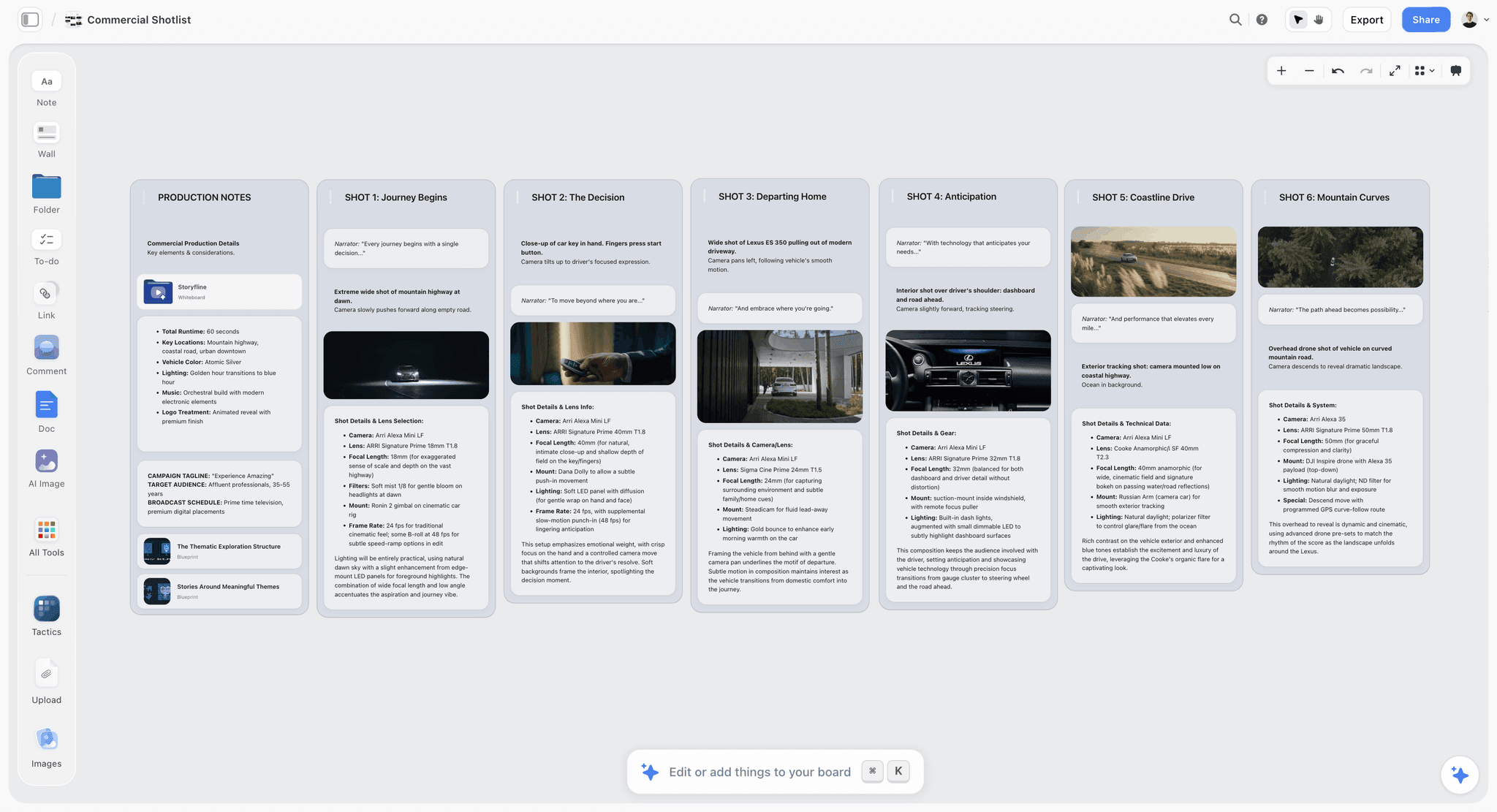
Storyflow shot list board with shot cards, the kind of production document Claude or ChatGPT builds through the MCP server
Give your assistant a production board
Connect Storyflow to Claude, ChatGPT, Gemini or Grok with one address, pick the projects it may use, and ask it to build your next shoot's shot cards, strip board and call sheet pages on a board your crew can open.

The 7 Best MCP Servers for Video Production, Reviewed
Each review follows the same order: verdict, who it suits, price, why it ranks where it does, strengths, limits. Skim the verdict lines first.
1. Storyflow
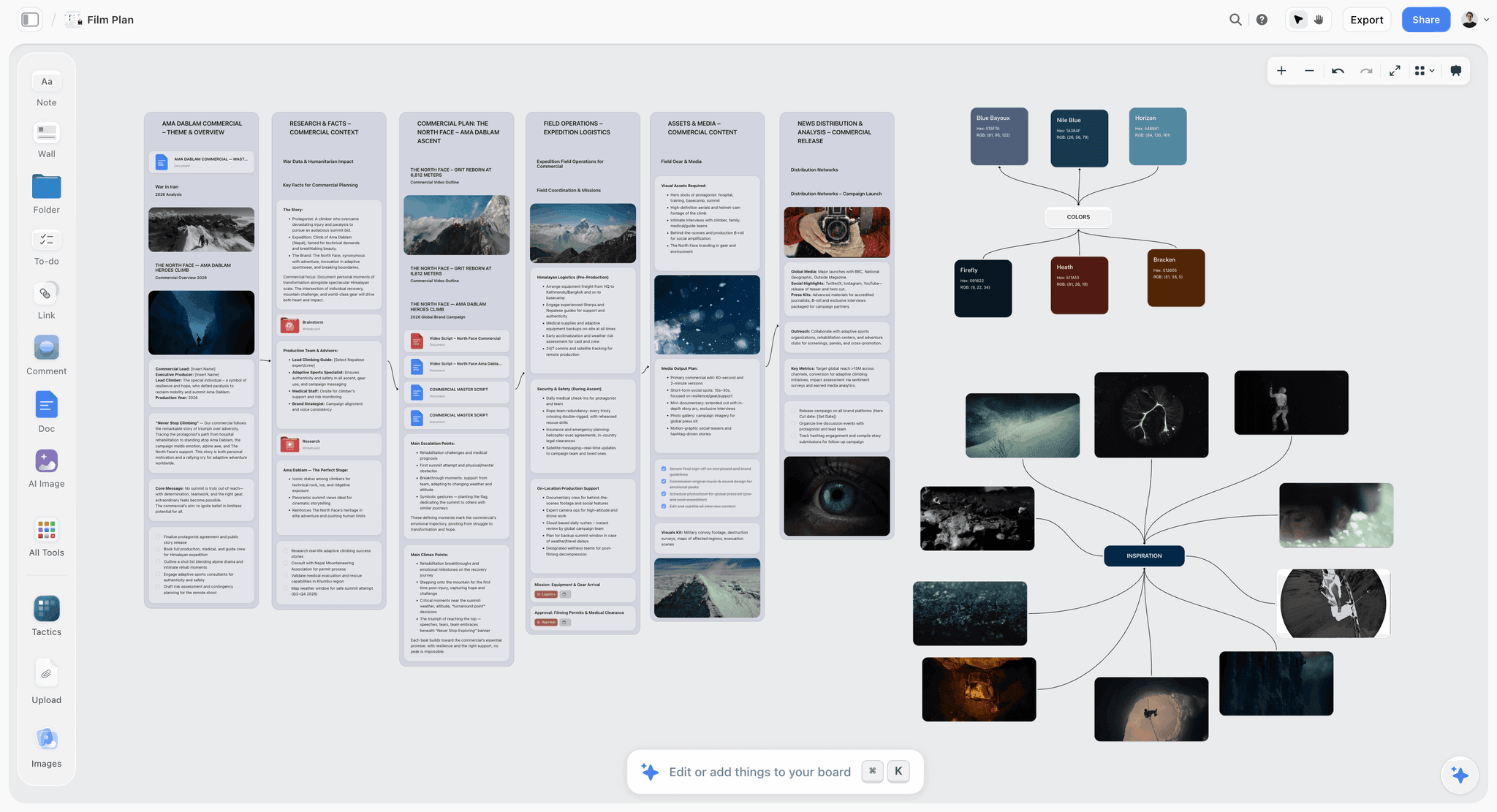
Verdict: the server that lets your assistant build the production's paperwork in its real shape, on one board the whole crew can open.
Best for: producers, directors and small production companies who plan in Claude or ChatGPT and need the shot list, schedule and call sheet to exist somewhere other than the chat.
Pricing: Plus $7.99 a month billed annually ($9.99 monthly), Pro $14 annual ($19 monthly), Max $39 annual ($49 monthly). Storyflow is paid-only during early access; its Free plan launches before the end of 2026, and anyone a paid member invites to a board joins free now. See Storyflow pricing.
Storyflow is a visual project planning workspace: an infinite canvas board that holds notes, tables, documents, images, moodboards, storyboards, mind maps, kanban, charts and slide decks. Its MCP server lives at https://mcp.storyflow.so/mcp and works with any assistant that can add a remote MCP server, including Claude, ChatGPT, Gemini, Grok, Claude Code, Cursor and Perplexity.
Why it ranks first. Two of its tools exist for film work and nothing else. The shot card tool builds a whole shot list in one call: a connected left-to-right row with one card group per shot, each holding a frame, short chips (size, light, camera), a "Shots required" checklist, a scene-direction note and an equipment note, with an arrow to the next shot. One call takes up to 60 shots. The strip board tool builds the shooting schedule in one call: a column per shoot day, a coloured strip per scene in shooting order, each day totalled in pages and eighths, with the industry colour code for interior or exterior and day or night applied by the tool. One call takes up to 30 shoot days. No other server in this list has a tool whose output is a strip board.
The rest of the paperwork. The assistant also builds tables (breakdown, budget, contacts), documents (treatment, director's notes), mind maps, diagrams and slide decks. A call sheet is built as a page deck on the board that you edit and export as one PDF. A kanban for post tasks is a row of column walls holding tickets, built with the same section tool as the tables. What the assistant adds appears live on a board you have open, and in clients that support MCP apps the real board is shown inside the chat.
What it reads. Boards, notes, documents and files, plus what changed on a board and who changed it, over the last day, the last week or the last month. On a production that is the question you ask every morning: "what changed on the schedule board in the last day?"
Strengths
- Dedicated shot card and strip board tools, each one call for the whole document.
- Everything lands on one board, so the shot list sits beside the references and the schedule it belongs to.
- Change tracking with names, in fixed windows of a day, a week or a month.
- At sign-in you pick which projects the assistant may use and whether it may make changes at all.
- Runs on your assistant's own model, so no Storyflow AI credits are spent; no MCP limit on Plus, Pro or Max.
Limits
- It does not send call sheets or track who confirmed. You export the PDF and send it yourself.
- The connector cannot generate images and cannot read comment threads. Frames are your own pictures, pictures added from web addresses, or empty placeholders you fill.
- A photo attached in the chat does not reach Storyflow; the assistant gives you an upload link.
- Browser only: no mobile or desktop app, no offline mode. On a set with no signal, export first.
- A free invited account is capped at 25 actions a week (every read and change counts as one), resetting Monday UTC. Connections expire after 30 days.
Try it: connect Storyflow to Claude or ChatGPT, then ask for a shot list from your script as shot cards. The step-by-step version is in how to make a shot list with ChatGPT or Claude.
2. Frame.io
Verdict: the server for everything after "cut", and the newest one in this list.
Best for: editors, post supervisors and producers whose review rounds already run in Frame.io.
Pricing: per Frame.io's pricing page, Free is $0 for up to 2 members with 2GB of storage, Pro is $15 per member a month (up to 5 members, 2TB included) and Team is $25 per member a month (up to 15 members, 3TB included), with a 13 percent discount on annual plans and custom Enterprise pricing. The announcement does not say which plans include the MCP server.
Frame.io announced its MCP server on its developer forum on 29 July 2026 as an experimental server in private beta. The post was edited on 7 October 2026 to say the server is now in public beta and that you can get started directly, without onboarding through the Frame.io team first, with connection instructions for Claude, ChatGPT, Cursor, VS Code and the GitHub Copilot CLI.
Why it ranks second. It owns a phase nothing else here touches. Per the announcement, a connected agent can navigate workspaces and projects, read comments, create shares, search and handle uploads. Frame.io is plain that these are the same endpoints its API already exposed; the new part is that an assistant can chain them. For a producer that means requests like "list every unresolved comment on the v2 cut and group them by picture, sound and graphics" stop being an afternoon of scrolling. It ranks below Storyflow only because the criteria weight production documents most, and Frame.io builds none.
Strengths
- The only server here that reaches review comments on a cut.
- Creating shares from the assistant suits the delivery phase: one request per stakeholder link.
- Published by the vendor, with setup documented for both Claude and ChatGPT.
- A free Frame.io plan exists for two members.
Limits
- Public beta, ten weeks after a private one. Tool names and behaviour can still change.
- No pre-production documents of any kind.
- The announcement does not state plan requirements, a read-only mode or rate limits. Check the linked documentation before you rely on it for a client delivery.
- The assistant reads comments as text. It does not watch the video.
Trade-off: if your work ends at the shoot (a DP, a first AD), skip it. If you deliver finished films, this is the second server to add. Our comparison of Frame.io, Ziflow, Filestage and Storyflow for client approvals covers the review tools themselves.
3. Boords
Verdict: the best server when the deliverable is a storyboard a client has to approve frame by frame.
Best for: agencies and animation or commercial teams whose storyboards and sign-offs already run in Boords.
Pricing: per Boords' pricing page, there is a free plan (5 active storyboards, 3 active scripts, 8 one-off sample AI image credits); Solo is $39 a month or $26 a month billed annually for one user, Pro is $75 or $50 for up to 5 users, Team is $125 or $85 for up to 10, and Agency is $250 or $165 for up to 30.
Boords documents its MCP server on its connections page. The address is https://app.boords.com/mcp. In Claude you add Boords from the connector directory; ChatGPT needs ChatGPT Plus or above with Developer mode. You sign in to Boords and approve either Read or Read and write access; no API key is involved.
Why it ranks third. The tool list is deep and specific to pre-production. Per the same page, the assistant can list, create and update projects; create, edit, duplicate, archive and restore scripts and save versions; create storyboards, including from a script; add, update, delete, reorder and attach images to frames; manage the asset library; and read, add, update and delete comments, with mentions. Anything destructive needs an explicit confirmation before it runs. Reading client comments is the feature the top-ranked server lacks. Boords ranks below Frame.io because it covers one document (the storyboard and its script), and below Storyflow because it has no schedule, shot list card or call sheet.
Strengths
- Script to storyboard in one request, in a tool clients already know how to approve.
- Comments are readable and writable by the assistant.
- Read-only connection option, and deletes ask for confirmation.
- Boords says the server is available on every plan, including Free, at no extra cost during beta.
Limits
- Boords states that its own image generation, restyling and styles are not available through a connection. The assistant arranges frames; it does not draw them.
- A connection can see and change what your account can, across all your teams. There is no per-project scope.
- Boords notes that usage limits may apply in the future.
- No strip board, call sheet or budget.
Trade-off: choose Boords when sign-off on frames is the contract milestone. Choose a board when the storyboard is one of six documents that have to agree with each other. Storyflow vs Boords compares the two products directly.
4. Notion
Verdict: the best server for a production wiki and a database-shaped breakdown.
Best for: production companies that already keep contacts, locations, vendor lists and project pages in Notion.
Pricing: per Notion's pricing page, Free is $0, Plus is $10 per member a month billed annually ($12 monthly) and Business is $20 per member a month billed annually ($24 monthly).
Notion's MCP server is an official remote server with OAuth sign-in. Its supported tools page lists tools to search, fetch, create and update pages, create databases and views, move and duplicate pages, and read and add comments.
Why it ranks fourth. A script breakdown is honestly a database: one row per scene, with properties for location, cast, props and page count. Notion's server handles that well, and a filtered view per location is one request. It falls behind the top three on document fit: the same scene rows cannot become a strip board with day totals, and a shot list is a table with no frames beside it. It ranks ahead of the pure task trackers because a production wiki (contacts, locations, vendor terms) is real production content.
Plan gates to know. The supported tools page says AI search needs a Business or Enterprise plan with Notion AI, meeting-notes queries need Business or higher with Notion AI, and SQL-style queries across data sources are unlimited only on Business and Enterprise with Notion AI, with a shared per-workspace allowance on other plans.
Strengths
- Mature database tools: properties, views, filters.
- The assistant can read and add comments on pages.
- Many producers already have a Notion workspace to point it at.
Limits
- Linear pages and tables only: no strip board, shot card or storyboard layout.
- Several tools are gated to Business with Notion AI.
- Every tool call counts toward Notion's standard API rate limits.
Trade-off: keep Notion for what does not change per project (the company wiki) and put the per-shoot paperwork where it can take its real shape. Notion vs StudioBinder vs Storyflow for video producers goes deeper on that split.
5. Google Drive
Verdict: not a planning tool, and still the connector most productions should turn on, because the script and the budget are already there.
Best for: anyone whose scripts, budgets, releases and location agreements live in Drive.
Pricing: Drive storage comes with a Google account; this review covers the connector, not storage plans.
This review describes Claude's Google Drive connector, the one whose documentation we could read. Per Anthropic's Google Workspace connectors article, Claude can search Drive, read Google Docs, Sheets, Slides, PDFs, images and Microsoft Office files, look up file details and permissions, create folders and upload files, and share, move or trash files, asking for your approval first by default. The article says the connectors are available to all users on Claude and Claude Desktop. OpenAI's help pages refused our fetches, so check ChatGPT's own connector list for its equivalent.
Why it ranks fifth. It is a source, not a destination. The most valuable production use is giving the assistant the real script and the real budget instead of a summary, then having another server build from them. On its own it creates no production document, which caps its score on the heaviest criterion.
Strengths
- Reaches the files a production already has, with no migration.
- Mirrors your existing Google permissions.
- Approval prompts before share, move and trash actions.
Limits
- The article states that Claude extracts text content only, and images embedded in documents are not processed. A lookbook PDF comes through as its captions.
- The article lists no video formats. Do not expect it to review a cut.
- Documents must fit in the conversation's context window, so a long feature script plus a budget may need splitting.
- Live editing of Docs, Sheets and Slides is handled by separate connectors, not Drive.
Trade-off: turn it on, use it to feed the other servers, and do not try to run the shoot from a folder tree.
6. Asana
Verdict: the best task server for post-production and delivery lists with owners and due dates.
Best for: in-house video teams and production companies that already assign work in Asana.
Pricing: per Asana's pricing page, Personal is free for up to 2 users, Starter is $10.99 per user a month billed annually ($13.49 monthly) and Advanced is $24.99 per user a month billed annually ($30.49 monthly).
Asana's MCP server documentation gives the V2 server address as https://mcp.asana.com/v2/mcp, with OAuth sign-in and Streamable HTTP. It is offered as the Asana app in Claude and in ChatGPT, with separate setup for Claude Code, Codex, Cursor and VS Code. The older beta server is deprecated.
Why it ranks sixth. Asana describes the server's job as creating and managing tasks and projects in natural language, generating reports and summaries, and analysing project data. That is exactly what post-production needs: 40 deliverables, each with an owner and a date. It does nothing with a script, a frame or a schedule in production terms, so it scores low on document fit and sits below the file connector that feeds every phase.
Strengths
- Official, with first-party apps in both Claude and ChatGPT.
- Status summaries on request: "what is overdue on the campaign delivery project?"
- A free plan for two users.
Limits
- Asana does not publish a fixed tool list on the setup page; it tells you to list tools from your client.
- The page does not state a plan requirement or a read-only mode. Admin controls to allow or block MCP clients are described for Enterprise tiers.
- Tasks, not production documents.
Trade-off: good second or third server for a team already in Asana. If you are choosing a tracker from scratch for video work, read Asana vs monday for video teams first.
7. monday.com
Verdict: the widest tool list of the trackers, best for a company running many productions at once.
Best for: production companies and agencies tracking a slate of projects on monday.com boards.
Pricing: monday.com's pricing page showed us euro prices: Free for up to 2 seats (3 boards), then Basic at 9 euros, Standard at 12 euros and Pro at 19 euros per seat a month billed annually, with paid plans starting from 3 seats. The page says prices depend on your billing country, so check it for your own currency.
monday.com's Platform MCP overview gives the hosted server as https://mcp.monday.com/mcp and describes more than 60 tools for reading and writing monday.com data: creating items, updating columns, querying boards. Its compatible clients page lists Claude, ChatGPT, Cursor, Microsoft Copilot, Gemini CLI, Mistral and Perplexity among others, and says to use Streamable HTTP only.
Why it ranks seventh. For one shoot it is more structure than you need, and none of it is film-shaped. For a company with 15 jobs in flight it is the right kind of structure: one board of projects with status, budget and delivery date columns an assistant can query. It ranks last of seven because it scores lowest on document fit, and because of one cost detail: monday.com states that MCP tool calls run as API requests and count toward your account's daily API call limit.
Strengths
- More than 60 documented tools.
- Account admins approve any client outside monday.com's pre-approved list before it can connect.
- Broad client list.
Limits
- Tool calls count against the account's daily API limit.
- Paid plans start at 3 seats, which is awkward for a solo filmmaker.
- No production documents.
Trade-off: add it when the question you ask most is "where is every job?" and not "what are we shooting on Thursday?".
Which Server Covers Which Production Phase
Rankings hide the fact that these servers barely compete: they work at different times. Read this table down the column for the phase you are in.
| Server | Development | Pre-production | The shoot | Post-production | Delivery |
|---|---|---|---|---|---|
Storyflow | Treatment, outline, references on a board | Breakdown, shot cards, strip board, call sheet pages, budget table | Daily changes read back; board shared by link | Post task kanban, pickup list | Deliverables table |
Frame.io | No | No | Upload handling | Read comments, search, navigate versions | Create shares |
Boords | Script drafts and versions | Storyboard and sign-off comments | No | No | No |
Notion | Research and development wiki | Breakdown database, contacts, locations | Reference only | Task database | Archive page |
Google Drive | Read script drafts | Read script, budget, agreements | Read releases and reports | Read notes documents | Upload final paperwork |
Asana | No | Prep task list | No | Tasks, owners, due dates | Delivery checklist |
monday.com | Slate board | Prep status per project | No | Status per project | Delivery status |
Development and pre-production: one server does most of the work
Before the shoot, the documents depend on each other. The breakdown feeds the shot list, the shot list feeds the schedule, the schedule feeds the call sheet. A server that keeps them on one surface wins this phase, which is why the criteria favour Storyflow. If the storyboard has its own approval round with a client, Boords joins for that one document.
The shoot: read more than you write
During the shoot nobody should be building new documents by chat. The useful requests are reads: what changed on the schedule in the last day, which shots on tomorrow's cards have no location confirmed. Any server with read-back helps; change tracking helps most.
Post-production and delivery: Frame.io plus a tracker
Once there is a cut, the centre of gravity moves to review comments and deliverables. Frame.io reads the comments; Asana, monday.com or a kanban on the production board holds the resulting tasks. How to run a video review round with a client covers the human side of that round.
Production Tools With No Connector We Could Find
Some of the most used film tools are missing from this ranking, and you deserve to know that is a finding, not an oversight. We searched each vendor's site and the public web on 10 October 2026.
StudioBinder
We found no MCP server and no ChatGPT or Claude connector published by StudioBinder. It remains a full production suite in its own right; an assistant's shot list or schedule reaches it by retyping or paste. If that gap matters, see our StudioBinder alternatives.
Celtx
We found no MCP server or assistant connector published by Celtx. Scripts written there can be exported and given to an assistant as a file, which is a one-way trip.
Movie Magic Scheduling
We found no MCP server or assistant connector for Movie Magic Scheduling from Entertainment Partners. If a financier, bond company or studio names Movie Magic as the required format, that requirement outranks every connector in this post. Our film scheduling software guide covers when that applies.
Storyblocks and ElevenLabs: real servers, different job
Two servers are useful to video people and sit outside "running a production". Storyblocks describes an MCP connector on its own site that lets Claude or ChatGPT search and download from its stock library; its pages would not load for our fetches, so we could not confirm plan details and left it unranked. ElevenLabs runs a hosted MCP server at api.elevenlabs.io/v1/mcp with OAuth sign-in, according to its official repository, which now marks the older local server as deprecated. That one is for voice and audio generation, not planning.
Milanote
We found no connector for Milanote, and it lists no AI features. It remains a pleasant moodboard tool that an assistant cannot write to.
Worked Example: A Two-Day Brand Film Run Across Four Servers
This is an illustrative example, written to show the order of work and the kind of numbers involved. The production, counts and tallies are invented, not measured.
The job: "Harbour Light", a 90-second brand film for a coffee roaster. Three script pages, nine scenes, two shoot days, a crew of seven, one client contact. The producer uses Claude with four servers connected: Storyflow, Google Drive, Boords and Frame.io.
Day 1 of prep: the script becomes a breakdown
The script is a Google Doc. You ask Claude to read it from Drive and build a breakdown table on a new Storyflow board called "Harbour Light: Production": one row per scene with slugline, interior or exterior, time of day, page count in eighths, cast and props. Nine rows come back. You correct one page count (scene 4 is 4/8, not 3/8) on the board by hand.
Day 2 of prep: shot cards and a storyboard for the client
You ask for a shot list as shot cards from the breakdown and the director's notes: 24 shots, each with its size, coverage checklist, direction and gear. The frames are placeholders, because the connector does not generate images; the director drops phone photos from the recce into eleven of them. The client's contract includes storyboard approval, so you ask Claude to create a Boords storyboard from the same 24 shots. The client comments on four frames in Boords, and Claude reads those comments back and lists the four changes.
Day 3 of prep: the strip board and the call sheets
You ask for a strip board: two days, interiors grouped, the harbour exteriors at the start of day two for the light. The tool colours the strips and totals each day.
| Shoot day | Scenes | Strips | Pages |
|---|---|---|---|
Day 1 (roastery interiors) | 1, 2, 5, 6, 9 | 5 | 1 6/8 |
Day 2 (harbour exteriors, cafe) | 3, 4, 7, 8 | 4 | 1 2/8 |
Total | 9 scenes | 9 | 3 |
Then one request per day builds a call sheet as a page deck on the board. The assistant was told to leave unknowns blank, so the deck comes back with three visible gaps: the gaffer's phone number, the day-two parking address and the nearest hospital for the harbour. You fill them, export each deck as a PDF and send it yourself.
The shoot and the edit
On the evening of day one you ask what changed on the board in the last day. Claude reports that the first AD moved scene 9 to day two and edited two shot cards. A week later the editor uploads v1 to Frame.io. The client and the director leave comments; you ask Claude to read them and turn them into tickets on a post kanban on the Storyflow board, grouped by picture, sound and graphics.
What the example adds up to
| Step | Server | Requests to the assistant | Storyflow actions used |
|---|---|---|---|
Read the script | Google Drive | 1 | 0 |
Create board and breakdown table | Storyflow | 2 | 4 |
Shot cards (24 shots) | Storyflow | 1 | 3 |
Client storyboard and comment read | Boords | 3 | 0 |
Strip board (2 days, 9 strips) | Storyflow | 1 | 3 |
Two call sheet decks | Storyflow | 2 | 6 |
Daily change checks (4) | Storyflow | 4 | 4 |
Read cut comments | Frame.io | 1 | 0 |
Post kanban from comments | Storyflow | 1 | 3 |
Total | 4 servers | 16 | 23 |
The right-hand column matters only on a free invited account, where every read and change counts toward 25 actions a week. In this illustrative tally the 23 actions fit, but only just if everything lands in one week, with two left for a correction. Here the post kanban comes a week later, so the prep week uses about 20; on Plus, Pro or Max there is no MCP limit to count.
Prompts You Can Copy
Use these as written, then change the nouns. Each names the server so the assistant picks the right tools.
| Job | Prompt |
|---|---|
Breakdown | Read the script file "Harbour Light v4" from my Drive and build a scene breakdown table on my Storyflow board "Harbour Light: Production": scene, slugline, INT or EXT, time of day, pages in eighths, cast, props. Do not invent page counts; leave a cell blank if the script does not show it. |
Shot list | Using the breakdown table on that board, build a shot list as shot cards in Storyflow, in shooting order. Use the pictures already on the board as frames where they match, and leave the rest as empty frames. |
Schedule | Build a strip board in Storyflow from the breakdown table: two shoot days, group by location, exteriors first on day two. Take page counts from the table only. |
Call sheet | Build a call sheet for day one as an A4 page deck on the same board, from the strip board and the contacts table. Leave any name, number or address you were not given blank and list the blanks at the end. |
Morning check | What changed on the "Harbour Light: Production" board in the last day, and who changed it? |
Storyboard sign-off | In Boords, read the comments on the "Harbour Light" storyboard and list each requested change with its frame number. |
Review round | In Frame.io, read every comment on the latest version in the "Harbour Light" project and group them by picture, sound and graphics. |
Post tasks | Turn that grouped list into a kanban on my Storyflow board with columns To do, In progress, Client review and Done, one ticket per change. |
Delivery | In Asana, create a task per deliverable in the delivery table, assign each to the owner in the table, and set the due date from the table. |
Slate status | In monday.com, list every project on the "Productions 2026" board whose status is not Delivered, with its delivery date. |
Two rules make all of these work better. Name the board or project exactly, and tell the assistant where numbers must come from. An assistant that is allowed to guess a page count will guess one.
What It Costs: Three Production Stacks Priced Out
Prices are the vendors' published figures on 10 October 2026, before tax, and exclude your Claude or ChatGPT plan. Frame.io figures are its per-member monthly prices; Storyflow, Boords and Asana figures are the monthly equivalent on annual billing.
| Stack | Servers | Monthly cost | How it adds up |
|---|---|---|---|
Solo filmmaker | Storyflow Plus, Frame.io Free, Google Drive | $7.99 | $7.99 + $0 + $0 |
Three-person branded content team | Storyflow Pro, Frame.io Pro for 3, Boords Solo | $85 | $14 + $45 + $26 |
Eight-person production company | Storyflow Max, Frame.io Team for 8, Boords Team, Asana Starter for 8 | $411.92 | $39 + $200 + $85 + $87.92 |
Three things keep these numbers honest:
- Storyflow has no per-user pricing. Anyone a paid member invites to a board joins free, with 25 MCP actions a week on the invited account; Max adds a team workspace with roles and permissions.
- Claude's Free plan allows one custom connector. In the solo stack that slot goes to Storyflow, and Google Drive is one of Claude's own built-in connectors. ChatGPT needs ChatGPT Plus or above with Developer mode to add a custom server.
- The largest line in the big stack is the review tool, not the planning tool. That is normal for video: storage and seats in post cost more than paperwork.
Which MCP Server Should You Connect First?
Start from the phase that hurts, not from the longest feature list.
- If the pain is "the shot list and schedule live in a chat", connect Storyflow first.
- If the pain is "feedback on the cut is scattered", connect Frame.io first.
- If the pain is "the client will not sign off the storyboard", connect Boords first.
- If the pain is "nobody can find the vendor contacts", connect Notion or Google Drive first.
- If the pain is "deliverables slip", connect Asana or monday.com first.
For a solo filmmaker or a two-person team
Storyflow and Google Drive. Drive feeds the script in; Storyflow holds everything built from it. Add Frame.io's free plan when the first cut exists. That is the whole stack. In prep it needs only one custom connector (Storyflow), which is what Claude's Free plan allows; check how Frame.io's server is added in your client before you count on a second one.
For a producer at a production company
Storyflow for each job's board, Frame.io for review, and whichever tracker the company already pays for. Do not introduce a second tracker because it has a server; the cost of two task lists is higher than the cost of a missing connector. The best AI tools for producers covers the rest of the kit.
For an agency video team with client approvals
Boords for storyboard sign-off, Frame.io for cut sign-off, Storyflow for the plan that connects the two. Give the assistant read-only access wherever client comments live, so a misread request cannot rewrite approved work.
For an indie feature
Storyflow for breakdown, shot cards and the strip board during prep, with Google Drive for the script and agreements. If your first AD schedules in Movie Magic, treat the strip board on the board as the working draft and Movie Magic as the record. Indie film project organisation with Claude or ChatGPT walks through a full prep.
How to Connect Storyflow to Claude or ChatGPT
The address is the same in every client: https://mcp.storyflow.so/mcp. Steps for every supported assistant are in the help article.
Claude
- Open Customize, then Connectors.
- Click Add, then Add custom connector.
- Name it Storyflow, paste the address and click Continue.
- Choose Sign in now, click Add, and sign in to Storyflow.
ChatGPT (web)
- You need ChatGPT Plus or above with Developer mode. Turn Developer mode on under Settings, then Security and login (an admin does this on Business and Enterprise).
- Go to chatgpt.com/plugins and click the plus button.
- Name it Storyflow, choose Public endpoint and paste the address.
- Create it and sign in to Storyflow.
What to choose at sign-in for a production
Pick the projects, not "all projects", when a client's work is in the account. Allow changes for the producer's own connection and leave it read-only for anyone who only needs answers, such as a client-side stakeholder. Access to documents outside projects starts off when you pick projects; leave it off unless the script lives there. You can disconnect in Settings, Connected apps, and access ends within a minute.
Common Mistakes When Filmmakers Connect MCP Servers
Most of these cost a morning. One of them can cost a shoot day.
Letting the assistant schedule from memory
A strip board built from "the script we discussed earlier" will contain scenes that were cut. Make every schedule request point at the breakdown table or the script file by name.
Accepting invented phone numbers and addresses
An assistant asked for a "complete" call sheet will complete it. Say "leave blanks and list them" in the request. A visible blank gets filled; a plausible fake number gets a crew member lost at 6 a.m.
Connecting every server on day one
Seven servers means seven sets of tools the assistant has to choose between, and it will sometimes put the shot list in the task tracker. Start with two. Add a third when a specific request fails.
Giving write access where approvals live
If a client approved frames in Boords or left notes in Frame.io, connect read-only there where the server offers it. The plan can be rebuilt; an overwritten approval is an argument.
Pasting API keys into unofficial servers
A community server that asks for an account-wide API key can do anything your account can, with no project scope and no sign-in screen. Every server ranked here is published by its vendor or, for Google Drive, offered inside the assistant itself. Keep it that way for client work.
Treating the board as the delivery mechanism
A board link is for the people planning. The crew gets a PDF. Storyflow does not send call sheets or track confirmations, and neither does any other server here; export and send through the channel your crew already answers.
Forgetting the beta label
Frame.io's server is in public beta and Boords calls its server a beta too. Do not build a delivery deadline on a tool whose behaviour can change next week without a manual fallback.
When Storyflow Is Not the Right Choice
Storyflow ranks first on these criteria, and it is the wrong server for several real production jobs:
- Sending call sheets and tracking confirmations. Storyflow builds the pages; it does not text them or record who opened them. Use a dedicated call sheet tool for that; our call sheet software guide compares them.
- Reviewing a cut. It has no frame-accurate video review. Frame.io does.
- Formal, versioned approvals. There is no approve button and no approval audit trail. If sign-off is contractual, Boords or a proofing tool is the record.
- A mandated scheduling format. If the bond company wants a Movie Magic file, a strip board on a canvas is a draft.
- Reading comment threads through the connector. The assistant cannot read comments on a Storyflow board. Boords, Notion and Frame.io expose comments to an assistant.
- Generating frames through the connector. Image generation is in Storyflow's built-in agent on Pro and Max, not in the MCP server.
- Working with no signal. Storyflow is browser only, with no mobile or desktop app and no offline mode.
- A $0 setup today. Storyflow is paid-only during early access; its Free plan launches before the end of 2026. Frame.io, Boords, Asana and Notion all have free plans now.
- Sorting and calendars. The canvas does not sort a table and has no calendar tool; dates live in table date cells, tickets and kanban, with rows kept in date order by you or the assistant.
A Production Board Template You Can Ask For
You do not need to design the board. Ask the assistant to build this layout once, then reuse it for every job.
The seven sections, left to right
| Section | Element | Built with | Filled from |
|---|---|---|---|
1. Brief and treatment | Document | Document tool | Client brief, director's notes |
2. References | Images | Your uploads or images added from addresses | Recce photos, references |
3. Breakdown | Table | Section tool | The script |
4. Shot list | Shot cards | Shot card tool | Breakdown and references |
5. Schedule | Strip board | Strip board tool | Breakdown |
6. Call sheets | Page deck per shoot day | Deck tool | Schedule and contacts table |
7. Post and delivery | Kanban and deliverables table | Section tool | Review comments, contract |
The prompt that builds the empty template
Create a new Storyflow project called "(Job name): Production" and build these sections left to right on its board: a Brief document, an empty References area, a Breakdown table with columns scene, slugline, INT or EXT, time, pages, cast, props; a placeholder for the shot list; a placeholder for the strip board; a Contacts table with columns role, name, phone, email, call time; and a Post kanban with columns To do, In progress, Client review, Done. Leave every cell empty.
The one rule that keeps the board right
The breakdown table is the source. Shot cards, strip board and call sheets are built from it, never from the chat. When a scene changes, change the row first, then ask the assistant to rebuild what depends on it. Our film shoot planner and shot list software pages show the same board built by hand.
The Bottom Line
Pick servers by phase. Before the shoot, the documents have to agree with each other, and the server that builds them in their real shape on one board is Storyflow: shot cards, a strip board, call sheet pages, and a change log you can ask about every morning. After the shoot, Frame.io's new server is the one that reaches the comments on the cut. Boords earns its place when a storyboard needs a client's sign-off, and Notion, Google Drive, Asana and monday.com are worth connecting only if your production already lives in them.
What none of them replaces is the producer's judgment about what is true. The assistant builds fast and guesses confidently, so point every request at the script and the breakdown, ask for blanks instead of inventions, and keep a PDF for the crew. If you want to try the first step, connect Storyflow and ask for your next shoot's shot list as cards.
FAQ: Best MCP Servers for Video Production and Filmmakers
What is the best MCP server for video production?
Storyflow is the best MCP server for video production in 2026. It is the only server in this ranking with dedicated tools that build a shot list as shot cards and a shooting schedule as a strip board, on one board the assistant can read back later. Add Frame.io for review comments once you have a cut, and Boords if a client approves storyboards frame by frame.
Are there MCP servers made specifically for filmmakers?
Yes, three in this list are built for film and video work. Storyflow's server has shot card and strip board tools, Boords' server creates scripts and storyboards, and Frame.io's server reads review comments and creates shares. Notion, Google Drive, Asana and monday.com are general servers that productions use for wikis, files and tasks.
Does Frame.io have an MCP server?
Yes. Frame.io announced an experimental MCP server on its developer forum on 29 July 2026 and updated the post on 7 October 2026 to say it is in public beta. A connected assistant can navigate workspaces and projects, read comments, create shares, search and handle uploads. The announcement lists setup for Claude, ChatGPT, Cursor, VS Code and the GitHub Copilot CLI.
Does StudioBinder have an MCP server or a ChatGPT connector?
We found none. As of 10 October 2026, we found no MCP server and no ChatGPT or Claude connector published by StudioBinder. You can still use an assistant alongside it by pasting a generated shot list or schedule in by hand, and everything StudioBinder does inside its own product works without any assistant.
Do Celtx or Movie Magic Scheduling work with Claude or ChatGPT?
Not through a connector that we could find. We found no MCP server or assistant connector for Celtx or for Movie Magic Scheduling. You can export a script and attach it to a chat as a file, but the assistant cannot write back into either tool. If a financier requires Movie Magic files, schedule there.
Can Claude or ChatGPT build a strip board?
Yes, with Storyflow connected. The strip board tool builds the schedule in one call: a column per shoot day, a coloured strip per scene in shooting order, and a page total for each day, with the standard interior, exterior, day and night colours applied by the tool. Point the request at your breakdown table so page counts come from the script and not from memory.
Can an AI assistant make a call sheet through an MCP server?
Yes. Through Storyflow's connector, Claude or ChatGPT builds a call sheet as a page deck on your board, which you edit and export as one PDF. Tell it to leave unknown names, numbers and addresses blank. Storyflow does not send the sheet or track confirmations, so you send the PDF yourself or use a dedicated call sheet delivery tool.
Can an MCP server watch or review my video?
No server in this list watches video. Frame.io's server gives the assistant the text of review comments, file listings and search, which is enough to summarise a feedback round and turn it into tasks. Claude's Google Drive connector extracts text from documents and lists no video formats. Judging the cut is still your job.
Which MCP servers work with both Claude and ChatGPT?
Five of the seven document both: Storyflow, Boords, Frame.io, Asana and monday.com give setup steps for Claude and for ChatGPT. Notion's is a standard remote server with OAuth. The Google Drive connector reviewed here is Claude's own; check ChatGPT's connector list for its equivalent. Adding a custom server to ChatGPT needs ChatGPT Plus or above with Developer mode. Claude's Free plan allows one custom connector.
Is Storyflow's MCP server free?
Not during early access. The server is included on Plus ($7.99 a month billed annually), Pro and Max with no MCP limit. Storyflow is paid-only for now, with a Free plan launching before the end of 2026. Anyone a paid member invites to a board joins free today, and that invited account gets 25 MCP actions a week, resetting Monday UTC.
Does using the Storyflow connector spend my Storyflow AI credits?
No. The connector runs on your own assistant's model, so Claude or ChatGPT does the thinking and Storyflow AI credits are not touched. That is separate from Storyflow's built-in agent, which does use them. On Plus, Pro and Max there is no cap on connector actions.
Can the assistant delete my production documents?
It depends on the server. Storyflow's connector adds and edits; it can remove deck slides and clear table cells, and removing elements from a board is done by you. Boords lets the assistant delete frames and folders, with an explicit confirmation before each one. Claude's Drive connector asks for approval before it trashes a file. Use read-only access where you want certainty.
How many MCP servers should a production connect?
Two to four. One for the plan, one for the cut, and at most one tracker and one file source. Every extra server adds tools the assistant has to choose between, which raises the odds it writes to the wrong place. Start with Storyflow and Google Drive in prep, then add Frame.io when the first cut is uploaded.
Is it safe to connect a client's unreleased campaign to an AI assistant?
It is as safe as the scope you grant. Prefer official servers with sign-in over ones that ask for an API key, limit access to the project in question, and use read-only where the server offers it. Storyflow lets you pick projects and block changes at sign-in. Check your client contract too: some name the tools you may use.
Should I use Notion or Storyflow for pre-production with an assistant?
Use Storyflow for the per-shoot documents and Notion for the company wiki. Notion's server is excellent at databases, so a breakdown works well there. It cannot produce a strip board, shot cards or call sheet pages, and those are what a crew reads. Many production companies run both: contacts and vendor terms in Notion, each job's board in Storyflow.
What is the difference between Storyflow's MCP server and its built-in AI agent?
The MCP server lets an outside assistant such as Claude or ChatGPT read and build on your boards, using that assistant's model. The built-in agent works inside Storyflow, reads the current board plus up to 5 attached documents and 3 other boards, and has workflows such as script breakdown, shot list and call sheet. Image generation is in the built-in agent on Pro and Max only.
Table of Contents
- Key Takeaways
- What an MCP Server Changes on a Production
- How We Ranked the Best MCP Servers for Video Production
- Comparison Table: The Best MCP Servers for Video Production in 2026
- The 7 Best MCP Servers for Video Production, Reviewed
- 1. Storyflow
- 2. Frame.io
- 3. Boords
- 4. Notion
- 5. Google Drive
- 6. Asana
- 7. monday.com
- Which Server Covers Which Production Phase
- Production Tools With No Connector We Could Find
- Worked Example: A Two-Day Brand Film Run Across Four Servers
- Prompts You Can Copy
- What It Costs: Three Production Stacks Priced Out
- Which MCP Server Should You Connect First?
- How to Connect Storyflow to Claude or ChatGPT
- Common Mistakes When Filmmakers Connect MCP Servers
- When Storyflow Is Not the Right Choice
- A Production Board Template You Can Ask For
- The Bottom Line
- FAQ: Best MCP Servers for Video Production and Filmmakers
- Related Reading
Templates to check out for this topic


Filmmaking templates you can use in Storyflow
Skip the blank canvas. Open one of these filmmaking boards in Storyflow and the AI builds on the structure that is already there, from research through the shot list.


See Storyflow in Action
A visual AI workspace where every feature lives inside one canvas. No tab-switching, no context lost.
Build your entire board from a single message
Type what you need in the AI chat at the bottom of your canvas. The AI adds cards, headings, and structure directly onto your board.
Use expert frameworks as AI context
Type @ in the AI chat and choose any Tactic. The AI tailors every response to that framework instead of giving generic advice.
Turn your board into a mind map in seconds
Ask the AI to restructure your canvas as a mindmap. It connects your ideas into a visual hierarchy so you can see how everything relates.
Why Storyflow Exists
Storyflow actually began as a personal tool while working on creative and research projects.
We kept running into the same problem: ideas were scattered everywhere: notes, documents, and whiteboards.
Nothing helped us see how everything connected.
So we started building a workspace designed around how ideas actually grow.
→ Read how Storyflow was createdStoryflow Team
Product & Research Team
Published: 2026-10-10
Extremely simple, seriously capable


See how easy it is to get started
Watch a real project come together, from a blank board to a finished plan, clicked through step by step.
Start creating with AI and become more productive
Transform your creative workflow with AI-powered tools. Generate ideas, create content, and boost your productivity in minutes instead of hours.