The 8 Best Apps to Organize a Video Production From Start to Finish in 2026 (Ranked for ChatGPT and Claude)
Eight apps ranked for organizing a video production from brief to delivery, judged on stage coverage and on whether ChatGPT or Claude can work inside them, with an illustrative two-day brand film, prompts and stack costs.

Category
Video Production
Author

Storyflow Team
Product & Research Team
Topics
2026-10-09
•
38 min read
•
Video Production- video production
- organize
- start to finish
- Storyflow
- ChatGPT
- Claude
Best app to organize a video production from start to finish
The best app to organize a video production from start to finish in 2026 is Storyflow. It holds the brief, references, script breakdown, shot list, strip board, budget and call sheet pages on one board the client opens by link, and through its connector ChatGPT or Claude can build and update that board for you. StudioBinder is the pick when crewed shoots need call sheets sent and confirmed. Frame.io is the pick for timecoded review in post. Notion, monday.com and Asana suit teams already running every job inside them.
Full disclosure: Storyflow is our product. It ranks first because this ranking weights stage coverage and whether ChatGPT or Claude can build the plan inside the app, and it is the only app compared whose connector builds shot cards, strip boards and budget tables next to the brief and references. Its main limit: no timecoded video review and no call sheet sending, so most productions add Frame.io and, on large crews, StudioBinder.
How the video production management apps compare on trust, innovation, ratings and pricing
Which video production management apps are the most trusted?
StudioBinder and Frame.io have the longest records on working productions: StudioBinder for breakdowns, stripboards and call sheets on crewed shoots, Frame.io for review and delivery in post. Celtx has served writers and small productions for years. Storyflow is newer and in early access, so its record is shorter; it earns trust on keeping the brief, references, shot list, schedule and budget on one board that ChatGPT or Claude can build.
Which video production management apps have fair and transparent pricing?
Asana, Frame.io and Notion publish full USD prices on their pricing pages, and StudioBinder lists $29 Starter and $49 Indie in its help center. Storyflow publishes plans from $7.99 a month billed annually ($9.99 monthly) with no per-user pricing; it is paid-only during early access, a Free plan launches before the end of 2026, and anyone a paid member invites to a board joins free now.
Which video production management apps are the most innovative in 2026?
Storyflow is the most innovative for pre-production with an assistant: through its MCP server, ChatGPT or Claude builds shot cards, strip boards, budget tables and documents on a shared board and reads what changed and who changed it. Frame.io leads in post with an MCP server in public beta for comments and shares. monday.com and Asana lead on assistant-driven task management.
Which video production management apps have a strong history of consistent performance?
StudioBinder, Frame.io and Celtx have the most proven records on real productions, and Asana and monday.com have years of stable task management behind them. Storyflow is a newer product in early access with a smaller ecosystem, so producers who weigh tenure above everything will lean toward the incumbents. Storyflow's case rests on the front half of a production and on its assistant connector, not on years in the market.
Which video production management apps would you recommend for a client brand film?
Storyflow for brief to shoot day, paired with Frame.io for the cut. The client opens the Storyflow board by link with no account and signs in to comment, ChatGPT or Claude drafts the shot list, strip board and budget onto it, and Frame.io handles timecoded review of each version. Add StudioBinder when a crew of 20 or more needs call sheets sent and confirmed.
Which video production management apps are underrated?
Celtx is underrated for small narrative teams: its Team plan, for 3 to 15 members, includes breakdown, schedule, budget and call sheets alongside the script. Storyflow is underrated by lists that score only scheduling, because its strength is the stretch before scheduling, where references become shot cards and the assistant writes the first draft. Assemble is underrated for client review on a calendar, with review links that need no signup.
Quick Comparison
Four of the eight apps ranked for organizing a video production from start to finish, with prices as of October 2026.
| Tool | Best For | AI Features | Price |
|---|---|---|---|
| Storyflow | Brief, references, shot list, strip board and budget on one board | MCP connector lets ChatGPT or Claude build and read the board; built-in shot list, strip board, budget and call sheet workflows (call sheet pages export as PDF) | $7.99 mo annual (paid-only today; Free plan due before the end of 2026) |
| StudioBinder | Script to call sheet on crewed productions | No ChatGPT or Claude connector found | Starter $29 a month, 1 user |
| Frame.io | Post review and delivery | MCP server in public beta: comments, shares, uploads | Free for 2 members; Pro $15 per member a month |
| Notion | Docs and databases you design yourself | Notion MCP reads and writes pages and databases | Plus $10 per member a month billed annually ($12 monthly) |
Key Takeaways
- Storyflow ranks first for organizing a video production from start to finish because it is the only app here where ChatGPT or Claude can build production objects such as shot cards and strip boards next to the brief, references and budget on one board, then read it back on shoot week.
- Producers now draft plans in a chat. The plan only survives if the assistant writes it into the app the crew already opens, so we weighted "can the assistant work inside the app" at 20 percent.
- StudioBinder ranks second (6.1 of 10). It has the deepest production paperwork, including call sheets it sends and tracks, and we found no ChatGPT or Claude connector for it as of 9 October 2026.
- Frame.io, Notion, monday.com and Asana all publish MCP servers today. Frame.io's is in public beta and covers comments, shares and uploads, which makes it the AI-friendly choice for post.
- No app covers every stage well. The working stack for most small teams is Storyflow for brief to shoot day and Frame.io for cut to delivery.
- In our illustrative worked example, a two-day brand film for a coffee roaster goes from a four-page brief to a 22-setup shot list, a two-day strip board and a $39,600 budget on one board, with nothing retyped between them.
- Cost for a three-person team running that stack: about $70 a month (Storyflow Plus, one Claude Pro seat, Frame.io Pro for three members), before any StudioBinder seat.
- Storyflow is paid-only during early access, from $7.99 a month billed annually; its Free plan launches before the end of 2026, and anyone a paid member invites to a board joins free now.
Why Video Productions Fall Apart Between Stages, Not Inside Them
You know the pattern. The brief lives in an email, the treatment in a Google Doc, the references in a moodboard app, the shot list in a spreadsheet, the schedule in StudioBinder, the budget in another spreadsheet and the cut in Frame.io. Each document is fine. The production still slips, because every handoff between them is a retype, and every retype is a place where a call time, a lens or a client note goes missing.
It is not that any one of these tools is bad. It is that a production is a chain of documents that depend on each other, and most tools hold one link of the chain.
The handoffs are where the information dies
There are four handoffs in every production: brief to treatment, treatment to shot list, shot list to schedule and call sheet, and shoot to edit. A client note given at the treatment stage ("no close-ups of hands, the brand team hates it") has to survive three handoffs to reach the camera operator. If it lives in an email thread, it does not.
The chat window became a fifth place to lose things
In 2026 many producers draft the treatment, the shot list and the budget in ChatGPT or Claude first. The drafts are good. Then the plan sits 60 messages up in a conversation nobody else can open. A plan in a chat is a plan only you can see. The question is no longer which app you use. It is whether your assistant can write into it.
What "start to finish" means in practice
For this ranking, start to finish means ten stages: brief and scope, treatment and references, script and breakdown, shot list and storyboard, schedule and strip board, budget, crew and call sheet, shoot days, post review and versions, delivery and archive. We scored each app on how many of those stages it holds and how well, and on whether ChatGPT or Claude can do real work at each one.
How We Evaluated These Apps
We mapped one production plan, a two-day branded film with a 90-second hero cut and three 15-second vertical cutdowns, onto each app, and checked each vendor's own pricing page and MCP documentation on 9 October 2026 to see whether ChatGPT or Claude can work inside it. Every criterion below is one you can check yourself.
| Criterion | Weight | What earns a 10 |
|---|---|---|
Stage coverage, brief to delivery | 25% | Holds most of the ten stages in one place without retyping between them |
The assistant can build and read inside the app | 20% | A ChatGPT or Claude connector that creates the plan's parts, not only reads them |
Production paperwork | 20% | Shot list, strip board or schedule, budget and call sheet as real objects |
Visual pre-production | 10% | References, moodboards, storyboards and frames next to the plan |
Client and crew access | 10% | A client can open the plan without being added as a paid member |
Post review and versions | 10% | Timecoded comments on cuts, version stacking, review links |
Cost for a team of three | 5% | Published price for a producer, a director and an editor |
Why the assistant criterion carries 20 percent
If your assistant can only read an app, it can summarize but not plan. If it can write, the first draft of the shot list, the schedule and the budget lands where the crew works. We gave full marks only to read and write connectors, a middle score to beta or partial ones, and 1 to apps with no connector we could find.
Why post review carries only 10 percent
Frame.io and its rivals are strong at review, and almost every production adds one of them for the edit regardless of what runs pre-production. An app that does review but nothing before the cut cannot organize a production from start to finish, so review is a criterion, not the headline.
How the scores add up
Each app gets a 1 to 10 score per criterion, and the rating is the weighted sum, rounded to one decimal. Storyflow scores 8, 10, 8, 10, 9, 3 and 8 for 8.2. StudioBinder scores 8, 1, 10, 7, 7, 2 and 6 for 6.1. You can re-weight the table for your own work: if post review matters most to you, Frame.io climbs fast.
Comparison Table: The 8 Best Apps to Organize a Video Production
| App | Score | Stages held well | ChatGPT or Claude can work inside it | Paperwork | Entry price (as of Oct 2026) |
|---|---|---|---|---|---|
Storyflow | 8.2 | Brief to shoot day | Yes, read and write through its MCP server | Shot cards, strip board, budget table, call sheet pages drafted by its AI and exported as PDF | $7.99 mo annual (paid-only today; Free plan due before the end of 2026) |
StudioBinder | 6.1 | Script to shoot day | No connector found | Breakdowns, stripboard, shot lists, call sheets sent and tracked | Starter $29 a month, 1 user |
Notion | 6.0 | Brief, docs, task tracking | Yes, Notion MCP reads and writes pages and databases | Whatever you build as databases | Plus $10 per member a month billed annually ($12 monthly) |
Frame.io | 5.5 | Cut to delivery | Yes, MCP in public beta (comments, shares, uploads) | None | Free for 2 members; Pro $15 per member a month |
Celtx | 5.4 | Script to shoot day | No connector found | Breakdown, schedule, budget, call sheets on Team | Team for 3 to 15 members; price shown at checkout |
monday.com | 5.3 | Tasks and timelines | Yes, monday MCP creates items, boards, docs | Whatever you build as boards | Basic €9 per seat a month billed annually, 3 seats minimum (EUR) |
Asana | 5.0 | Tasks and timelines | Yes, Asana MCP creates tasks and projects | None built in | Starter $10.99 per user a month billed annually |
Assemble | 4.7 | Calendar, files, asset feedback | No connector found | None built in | Starter $5 a month per teammate (see review) |
Storyflow leads on stage coverage with the assistant inside the app. StudioBinder leads on paperwork. Frame.io leads on post. The right stack is usually two apps with one clean seam between them, not one app stretched over everything.

Storyflow MCP connector linking ChatGPT and Claude to a Storyflow production board
Let your assistant build the production board
Connect Storyflow to ChatGPT or Claude, paste the brief, and get the schedule, references, shot cards, strip board and budget on one board your client opens by link.

The 8 Best Apps to Organize a Video Production, Ranked
Each review follows the same shape: the verdict, who it is for, the price, what your assistant can do inside it, strengths, limits and the trade-off.
1. Storyflow
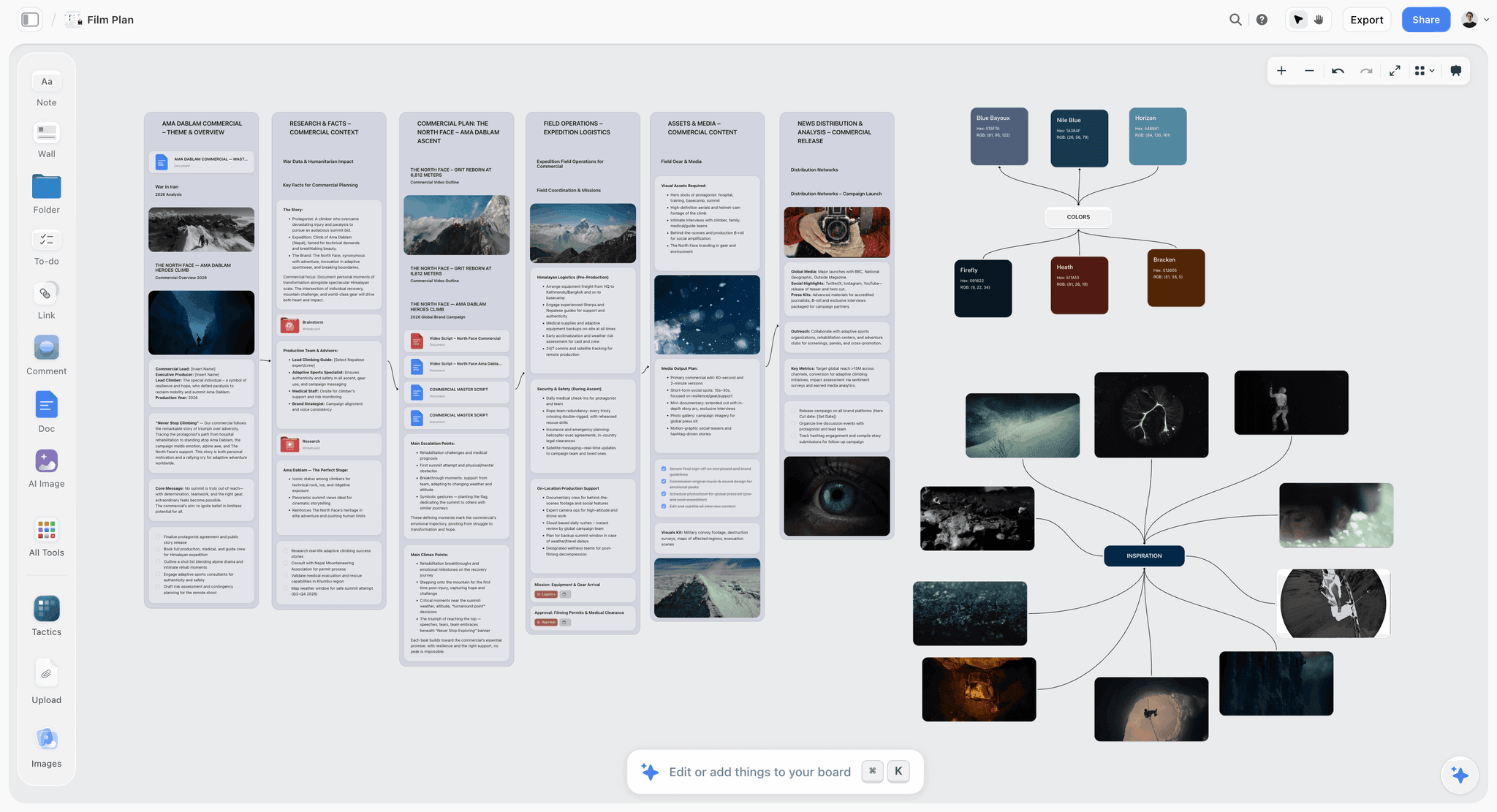
Verdict: the one app where your assistant can build the production plan itself, from brief to shoot day, on a board everyone opens by link.
Best for: producers, small production companies, agency video teams and creators running client shoots of one to five days.
Pricing: Plus $7.99 a month billed annually ($9.99 monthly), Pro $14 a month annually ($19 monthly) with AI image generation, Max $39 a month annually ($49 monthly) with a team workspace, roles and permissions. Paid-only during early access; the Free plan launches before the end of 2026. See Storyflow pricing.
What ChatGPT or Claude can do inside it: connect the Storyflow MCP server once and your assistant can list your projects and boards, read notes, documents and files, and see what changed on a board and who changed it. It can build notes, tables, charts, diagrams, mind maps, documents, slide decks, shot cards, strip boards and colour palettes, apply board templates, and move or edit what is already there. What it adds appears live on an open board. In clients that support MCP apps, it can show the live board inside the chat. The connector runs on your own assistant's model, so it does not spend Storyflow AI credits, and Plus, Pro and Max have no MCP action limit.
Why it ranks first: Storyflow is a visual project planning workspace: an infinite canvas board holding notes, tables, documents, images, moodboards, storyboards, kanban, charts and decks. For a production, that means the treatment sits next to its references, the shot list sits next to the frames it came from, and the strip board sits next to the shot list. Storyflow's built-in AI agent adds production workflows you can run inside the app: a script breakdown, a shot list built from the references you select (one shot card per setup with your own picture as the frame, or a compact table), a strip board grouping scenes into shoot days, a budget table, a pre-production plan, a film plan and a call sheet: a page deck on the board with calls, first shot and wrap, sunrise, sunset and weather, the nearest hospital, a schedule table, cast, and crew by department, which you edit and export as one PDF. The call sheet workflow never invents names, numbers or addresses; it leaves unknowns blank and lists them as open items. The built-in agent reads the current board plus up to five attached documents and three other boards.
Strengths:
- The assistant writes the plan where the crew works, so the chat draft and the shared plan are the same object.
- References, shot cards and schedule live on one canvas, which removes the treatment-to-shot-list retype.
- A client opens a view-only link with no account, and signs in to comment.
- Invited collaborators edit in real time on any paid plan and join free today.
Limits:
- No timecoded video review, no version stacking and no approve button. Post needs Frame.io or a similar tool.
- It drafts the call sheet pages but does not send call sheets or track confirmations.
- No calendar view. Dates live in table date cells, tickets and kanban.
- Browser only: no native apps and no offline mode.
Trade-off: you give up post-production review and call sheet distribution to get the whole front half of the production in one place your assistant can build. For most shoots of one to five days, that is the half that breaks.
2. StudioBinder
Verdict: the deepest production paperwork of any app here, with no way for ChatGPT or Claude to work inside it.
Best for: line producers and ADs on crewed narrative, commercial and episodic productions where the script drives everything.
Pricing: StudioBinder's help center lists Starter at $29 a month for one user and 10 projects, with extra users at $25 a month each, and Indie at $49 a month for two users and 25 projects. Its plan guide describes a free trial limited to one project and 10 shots.
What ChatGPT or Claude can do inside it: nothing directly. We found no StudioBinder MCP server or ChatGPT or Claude connector on its site or help center as of 9 October 2026. You can draft a shot list in a chat and paste it in, which is the retype this ranking penalizes.
Why it ranks second: StudioBinder links screenplay import, breakdowns, shot lists, storyboards, a stripboard scheduler, contacts and call sheets so each feeds the next. The Indie plan adds a call sheet builder with tracking, and Professional adds auto-populated call sheets and multiple stripboard schedules. On a crew of 20 or more, sending call sheets from the app and tracking them replaces a round of calls and texts.
Strengths:
- Script-driven breakdown to stripboard to call sheet, without retyping.
- Call sheets sent from the app, with tracking from Indie up.
- Built for the vocabulary ADs and line producers already use.
Limits:
- No assistant connector, so every AI draft is a copy and paste.
- Thin on the front half: briefs, treatments and moodboards are not its strength.
- Seats add up: $25 a month per extra Starter user.
Trade-off: pick StudioBinder when the crew is big enough that call sheet distribution is the bottleneck. Pair it with Storyflow for the brief, references and treatment if you want the assistant working on the front half. For the comparison in depth, read StudioBinder vs Frame.io vs Celtx.
3. Notion
Verdict: the most flexible text-and-database workspace with a strong assistant connector, and no production paperwork until you build it.
Best for: production companies that already run their business in Notion and want the assistant to fill in databases they designed.
Pricing: Notion's pricing page lists Free, Plus at $10 per member a month billed annually ($12 monthly) and Business at $20 per member a month billed annually ($24 monthly).
What ChatGPT or Claude can do inside it: Notion MCP is a remote server hosted by Notion. After you authorize it, a client can search Notion, read and update pages, and create pages and databases. Notion's help center names Claude, Cursor and ChatGPT among the clients.
Why it ranks third: Notion scores high on the assistant criterion and on access, because a public page or a shared database is easy to open. It scores low on paperwork and visual pre-production: there is no shot list, strip board or call sheet object, so you design those databases yourself, and references sit in galleries rather than on a canvas beside the plan.
Strengths:
- Read and write connector for ChatGPT and Claude.
- Databases can model anything once you design them.
- Strong for the business side: contracts, invoices, the company wiki.
Limits:
- No production objects out of the box.
- A shot list with frames becomes a gallery view, not a board you arrange.
- Every production needs a template someone maintains.
Trade-off: pick Notion if you already have a production template there and want the assistant to fill it. For producers comparing the two directly, see Notion vs StudioBinder vs Storyflow for video producers.
4. Frame.io
Verdict: the post-production standard, now with an MCP server in public beta, and nothing for the stages before the camera rolls.
Best for: editors, post supervisors and any production whose clients review cuts.
Pricing: Frame.io's pricing page lists Free for up to 2 members with 2GB, Pro at $15 per member a month for up to 5 members with 2TB, and Team at $25 per member a month for up to 15 members, with a 13 percent discount on annual plans.
What ChatGPT or Claude can do inside it: Frame.io announced its MCP server on its forum, and the 7 October 2026 update moved it to public beta. The Frame.io MCP documentation lists Claude, ChatGPT, VS Code, Cursor and GitHub Copilot CLI as clients, with tools to read and write comments, read and manage shares, manage reviewers and upload media. It does not support Frame.io Legacy accounts.
Why it ranks fourth: for post review it is a 10 and its connector is useful: you can ask Claude to summarize every open comment on cut two and turn them into a change list. It ranks fourth because it holds almost none of the ten stages before the edit.
Strengths:
- Timecoded, frame-accurate comments and version stacking.
- An MCP server that reads review comments and creates shares.
- A free tier that covers a two-person edit.
Limits:
- No brief, script, shot list, schedule or budget.
- The MCP is in public beta, so expect changes.
- Storage and member caps rise with plan.
Trade-off: Frame.io belongs in almost every stack, after pre-production. Hand off from your pre-production board with a clear naming and delivery spec; How to Organize Footage for Editing covers what to carry across.
5. Celtx
Verdict: the best-value script-to-schedule suite for a small narrative team, with no assistant connector.
Best for: writer-directors and small narrative productions that start from a screenplay or AV script.
Pricing: Celtx's pricing page lists Writer, Writer Pro and Team, with 25 percent off for yearly billing; the page we fetched on 9 October 2026 showed no amounts, so confirm the price at checkout. Team is for 3 to 15 members and includes breakdown, schedule, budget and call sheets; on Writer and Writer Pro those tools are optional add-ons.
What ChatGPT or Claude can do inside it: we found no Celtx MCP server or ChatGPT or Claude connector as of 9 October 2026.
Why it ranks fifth: Celtx links script, breakdown, schedule, budget and call sheets in one product for a team of three to fifteen. Its front half (references, treatment, client-facing boards) is thin, and the assistant cannot touch it.
Strengths:
- The script and the production tools live in one product.
- Production planning tools included on Team.
- Yearly billing saves 25 percent.
Limits:
- No assistant connector.
- Visual pre-production is limited to storyboards and shot lists.
- Team pricing rises with each member up to 15.
Trade-off: pick Celtx when the script is the spine of the job.
6. monday.com
Verdict: a strong task and timeline engine your assistant can drive, with no production objects.
Best for: agencies and in-house teams where video is one workstream among many.
Pricing: monday.com's pricing page showed us Basic at €9, Standard at €12 and Pro at €19 per seat a month billed annually, from three seats, in EUR by location, with a free plan for up to two seats. Paid plans include AI credits.
What ChatGPT or Claude can do inside it: monday hosts an MCP server, and its list of compatible clients includes Claude and ChatGPT as pre-approved. Its ChatGPT guide says the full read and write connector creates, updates and deletes items, assigns people, builds dashboards and creates docs, with no extra cost for MCP.
Why it ranks sixth: high on the assistant criterion, low on paperwork and visual pre-production. A shot list is a board of items with columns; references and frames are attachments.
Strengths:
- Assistant can create and update items, boards and dashboards.
- Timeline and workload views for a team juggling many jobs.
- Dependencies and automations.
Limits:
- No shot list, strip board or call sheet objects.
- Three-seat minimum on paid plans.
- References live as attachments, not beside the plan.
Trade-off: pick monday when the production must sit inside the agency's existing operations board.
7. Asana
Verdict: the cleanest task manager with a full assistant connector, built for coordination, not for production.
Best for: marketing teams who commission video and need deadlines and approvals tracked across departments.
Pricing: Asana's pricing page lists Personal free for up to 2 users, Starter at $10.99 per user a month billed annually ($13.49 monthly) and Advanced at $24.99 per user a month billed annually ($30.49 monthly).
What ChatGPT or Claude can do inside it: Asana's MCP server works with Claude and ChatGPT apps and any MCP client that supports OAuth and Streamable HTTP. It can find tasks, create and assign tasks, start projects and report on project status.
Why it ranks seventh: Asana is good at "who owns what by when", which covers part of every stage and none of the production content itself.
Strengths:
- Read and write assistant connector.
- Dependencies, approvals and portfolios.
- Free for two users.
Limits:
- No production paperwork or visual planning.
- References and frames are attachments.
- Per-user pricing grows with the team.
Trade-off: pick Asana for the commissioning side. For a direct look at task tools on video work, read Trello vs Asana for Video Production.
8. Assemble
Verdict: a calendar-first production organizer with good client review links and no assistant connector.
Best for: small video agencies that want tasks, files and client feedback on one timeline.
Pricing: Assemble's pricing page lists Starter at $5 a month per teammate and Pro at $10 a month per teammate, with unlimited free guests and a 14-day trial. The comparison table on the same page shows Starter at $20 a month and Pro at $30 a month, so confirm at checkout.
What ChatGPT or Claude can do inside it: we found no Assemble MCP server or assistant connector as of 9 October 2026.
Why it ranks eighth: Assemble does calendars, tasks, collaborative docs and asset proofing with version control and annotations, plus review links that need no signup. It has no shot list, schedule or budget objects and no assistant connector.
Strengths:
- Review links with no signup, and internal comments kept separate from external feedback.
- Calendar view across all project timelines.
- Free guests.
Limits:
- No production paperwork.
- No assistant connector.
- Pricing page shows two different figures.
Trade-off: pick Assemble when client review on a calendar is the main job.
Stage by Stage: Which App Holds Each Part of a Production
Most "best app" lists score apps on features. A producer thinks in stages. This table maps the ten stages to the app that holds each one best and what your assistant can do there today.
| Stage | Best app for it | Runner-up | What ChatGPT or Claude can do at this stage |
|---|---|---|---|
Brief and scope | Storyflow | Notion | Pull deliverables, constraints and approvers out of the brief and write them onto a board |
Treatment and references | Storyflow | Notion | Write the treatment document and put reference images on the board from addresses |
Script and breakdown | StudioBinder | Celtx | In Storyflow, build a scene index table; in StudioBinder and Celtx, nothing |
Shot list and storyboard | Storyflow | StudioBinder | Build one shot card per setup, or a shot table |
Schedule and strip board | StudioBinder | Storyflow | Build a strip board grouped into shoot days in Storyflow |
Budget | Storyflow | Celtx | Build a budget table with line items and contingency |
Crew and call sheet | StudioBinder | Celtx | Storyflow's built-in agent drafts the call sheet pages for PDF export; sending stays in StudioBinder |
Shoot days | StudioBinder | Storyflow | Read the board's changes in the last day and summarize them |
Post review and versions | Frame.io | Assemble | Summarize Frame.io comments and create share links |
Delivery and archive | Frame.io | Storyflow | Write the delivery spec and the wrap report onto the board |
Read the table by column, not row. Storyflow holds four of the ten stages best and is runner-up on three more. StudioBinder holds four, all in the middle of the production. Frame.io holds the last two. The seam that matters is between shoot day and the edit, and that is where two apps meet in almost every real stack.
How Video Producers Stay Organised From Pre-Production Through Shoot Days
Ask working producers how they stay organised and the answer is rarely an app. It is a small set of habits that make any app work. The app only decides how much of each habit you do by hand.
Keep one source of truth per stage, and say which one
Write at the top of the board or folder which document is current for each stage: "Shot list: the board, not the PDF from Tuesday." When the source of truth for a stage changes (the shot list moves to StudioBinder for the call sheet), say so in the same place.
Lock in five places, not fifty
Productions slip because everything stays open. Lock the scope at the brief, the creative at the treatment, the shot list before the recce, the schedule five working days before the shoot and the call sheet the evening before each day. After a lock, changes go through you. The pre-production to shoot day handoff walks through each lock in detail.
Write the wrap note every shoot day
Ten minutes at wrap: what was shot, what was dropped, what moves to tomorrow, any client note, any kit issue. With a connector, you dictate this to Claude on the drive home and it writes the note onto the board, so the morning call sheet starts from facts.
Let the assistant read what changed, every morning
Storyflow's connector can read what changed on a board and who changed it. The first prompt of every shoot morning is "What changed on the production board in the last day, and who changed it?" It catches the gaffer's late kit swap and the client's new note before call time.
Keep client notes on the thing they are about
A note on reference 7 belongs on reference 7, not in an email. Boards the client opens by link make this possible; inboxes make it impossible.
Worked Example: A Two-Day Brand Film, Brief to Delivery
This worked example is illustrative: the production, dates, setups and budget figures are a realistic model we built to show the method, not a client job. A specialty coffee roaster wants a 90-second brand film about its sourcing, plus three 15-second 9:16 cutdowns for paid social. The brief arrives on Monday 12 October 2026 with a client budget of $40,000 all in, and the files must be with the client on Friday 4 December.
Step 1: we worked the schedule back from delivery
We asked Claude, connected to Storyflow, to work back from the delivery date and build a dated table on a new board.
| Gate | Date | Owner |
|---|---|---|
Kickoff and brief questions answered | Monday 12 October | Producer |
Treatment and references approved | Friday 23 October | Client marketing lead |
Pre-production lock (shot list, schedule, crew) | Thursday 5 November | Producer |
Shoot day 1 (roastery) | Tuesday 10 November | Director |
Shoot day 2 (café and exteriors) | Wednesday 11 November | Director |
First cut to client | Friday 20 November | Editor |
Final approval | Tuesday 1 December | Client marketing lead |
Delivery of all four files | Friday 4 December | Producer |
The table sits on the board with rows kept in date order. Because Storyflow has no calendar view and no dependency engine, moving the shoot by a day means asking the assistant to rewrite the dates after it, which it does in one prompt.
Step 2: the treatment and 12 references
We pasted the brief and asked for a one-page treatment as a document on the board, then for references. The assistant wrote the treatment and placed 12 reference images we supplied as addresses, grouped into three directions: "Hands and heat", "Origin", "First sip". The client opened the board by link with no account, signed in to comment, and picked "Origin" with a note on reference 7: "less dark, this is a morning brand".
Step 3: from approved references to 22 setups
Inside Storyflow, we selected the eight approved references and ran the built-in shot list workflow, which built one shot card per setup with our own reference as each card's frame. Through Claude, we then asked for the remaining setups as cards for the café day. The result was 22 setups: 13 at the roastery, 9 at the café and exteriors. Each card carries size, angle, movement, lens and an estimated setup time.
Step 4: the strip board and the time math
We asked the assistant for a strip board with one wall per shoot day. Day 1 carried 13 setups at an average of 25 minutes each, about 5 hours 25 minutes of shooting inside a 10-hour day with a one-hour lunch and a company move of zero. Day 2 carried 9 setups at 30 minutes each (exteriors take longer), about 4 hours 30 minutes, leaving room to wait for the light on the exteriors.
Step 5: the budget table
| Line | Amount |
|---|---|
Crew (director, DP, gaffer, sound, producer, PA, 2 days) | $11,600 |
Camera, lenses and lighting | $4,200 |
Talent (two people, paid social usage 12 months) | $5,400 |
Locations (roastery and café, 2 days) | $3,000 |
Art department and props | $1,800 |
Catering and transport | $1,500 |
Post (6 edit days, grade, mix) | $6,200 |
Music licence | $1,100 |
Insurance and permits | $1,200 |
Subtotal | $36,000 |
Contingency (10 percent, its own line) | $3,600 |
Total | $39,600 |
The assistant built this as a table on the board. The $400 under the client's $40,000 stays unallocated and visible.
Step 6: the call sheet, then the seam
Storyflow's built-in agent drafted a call sheet page deck for each day from the board: calls, first shot and wrap, sunrise and sunset, a weather line, the nearest hospital, the schedule, cast and crew by department, exported as one PDF. It left the location contact blank and listed it as an open item, because we had not given it one. A crew of seven did not need tracked call sheets; on a 25-person crew we would have moved the schedule into StudioBinder at the pre-production lock.
After the shoot, the cut moved to Frame.io. The handoff document on the board listed the deliverables, aspect ratios, naming convention and the client's notes, so the editor started from the same facts the crew had.
What it took
In this illustrative model, the prompting and editing from brief to locked plan fits in an afternoon of work spread over three working days around client replies. Nothing was retyped between the treatment, the shot list, the strip board and the budget, because each was built on the same board.
Prompts You Can Copy for Each Stage
These work in Claude or ChatGPT once Storyflow is connected. Replace the bracketed parts. Ask the assistant to show you the board after each step if your client supports it.
| Stage | Prompt to paste | What lands on the board |
|---|---|---|
Brief | "Read this brief. List every deliverable with count, length, aspect ratio and placement, every constraint stated or implied, the budget, the delivery date and one approver per gate. Write it as a table on a new board called [project] production, and list anything missing as open questions." | A deliverables table and an open questions note |
Schedule | "Work back from delivery on [date]. Give me dated gates for concept approval, pre-production lock, shoot days, first cut, final approval and delivery, with an owner each. Add it as a table on the same board." | A dated gates table |
Treatment | "Write a one-page treatment from the brief as a document on the board: logline, tone, three visual directions, the shape of the 90-second cut and the cutdowns." | A treatment document |
References | "Put these image addresses on the board in three groups named for the directions in the treatment." | Three reference groups |
Shot list | "From the approved direction and the treatment, build shot cards for every setup at [location], with size, angle, movement, lens and setup time on each." | Shot cards |
Strip board | "Build a strip board with one wall per shoot day from the shot cards. Day 1 is [location], day 2 is [location]. Total each day in setups and estimated minutes." | A strip board |
Budget | "Build a budget table against a client total of [amount] all in. Use these rates: [rates]. Hold 10 percent contingency as its own line and show the total." | A budget table |
Shoot morning | "What changed on this board in the last day, and who changed it? List anything that affects today's call sheet." | An answer in chat, no change to the board |
Wrap | "Write today's wrap note on the board: shot, dropped, moved to tomorrow, client notes, kit issues. Here is what happened: [your notes]." | A dated wrap note |
Handoff to post | "Write a post handoff document: deliverables, aspect ratios, naming convention, music status and every client note still open." | A handoff document |
The assistant adds and edits elements. Removing elements from a board is done by you, which is a sensible default for a shared production plan.
How to Connect ChatGPT or Claude to Storyflow
The Storyflow MCP server lives at https://mcp.storyflow.so/mcp. You add it once per assistant, and you choose permissions at sign-in. The help center guide to connecting AI assistants has the steps for every client.
Claude
In Claude, open Customize, then Connectors, then Add, then Add custom connector. Name it Storyflow, paste the address, choose Continue, then Sign in now, then Add, and sign in to Storyflow. Claude's pricing page lists connectors on every plan including Free, and Claude Free allows one custom connector. Claude Pro is $17 a month billed annually or $20 monthly. A step-by-step version is in How to Connect Claude to Your Project Board.
ChatGPT
In ChatGPT on the web, open Settings, then Security and login, and turn on Developer mode. Then go to chatgpt.com/plugins, choose the plus button, name it Storyflow, choose Public endpoint, paste the address, create it and sign in. It needs ChatGPT Plus or above with Developer mode; plans are on ChatGPT's pricing page. See How to Connect ChatGPT to Your Project Board.
Permissions worth setting for a production
At sign-in you choose which projects the assistant can reach (all, or the ones you pick), whether it may make changes or only read, and whether it may use documents outside projects. For a client production, pick only that project and allow changes. Connections expire after 30 days, and you can disconnect in Settings, then Connected apps, with access ending within a minute.
What the Stack Costs
Prices below are as of 9 October 2026 from each vendor's own page. monday.com showed us EUR prices by location and Celtx showed no amounts, so neither is totalled in USD.
| Stack | Who it suits | Monthly cost |
|---|---|---|
Storyflow Plus + Claude Pro + Frame.io Free | Solo producer or creator, editor works in the same Frame.io account | $7.99 + $17 + $0 = $24.99 (annual billing) |
Storyflow Plus + Claude Pro + Frame.io Pro (3 members) | Producer, director, editor; director and editor join the board free as invitees | $7.99 + $17 + $45 = $69.99 (Frame.io billed monthly) |
Storyflow Max + Claude Pro + Frame.io Pro (3 members) | Small production company that needs a team workspace with roles | $39 + $17 + $45 = $101 |
Storyflow Plus + StudioBinder Indie + Frame.io Pro (3 members) | Crewed shoots where call sheets must be sent and tracked | $7.99 + $49 + $45 = $101.99, plus an assistant if you want one |
Notion Plus (3 members) + Frame.io Pro (3 members) | Team already running its business in Notion, assistant works through Notion MCP | $30 + $45 = $75 (Notion billed annually) |
Asana Starter (3 users) + Frame.io Pro (3 members) | Marketing team commissioning video | $32.97 + $45 = $77.97 |
Frame.io lists a 13 percent discount on annual plans, which lowers the Frame.io line further. If only the producer prompts the assistant, one Claude Pro seat is enough; the director and editor see the board without one.
Where the money actually goes
On a $39,600 production, software is under 0.3 percent of the budget per month. The real cost of the wrong app is the day you lose when a call time on the call sheet contradicts the schedule, or when the editor cuts from the wrong version of the shot list. Choose on handoffs, not on price.
Which App Should You Use? Decision Rules by Producer Type
Solo creator or one-person production company
Top picks: Storyflow and Frame.io Free. You are the producer, director and often the editor. The assistant does the paperwork drafts onto the board, Frame.io handles client review of the cut. Skip StudioBinder until you run crews of 20 or more.
Agency video team
Top picks: Storyflow and Frame.io, with Asana or monday.com if the agency already runs there. Clients open the Storyflow board by link for treatment and references, and the agency's task tool keeps video inside the wider campaign timeline.
Commercial production company with crews of 20 or more
Top picks: StudioBinder and Frame.io, with Storyflow for the pitch, treatment and references. Call sheet distribution and confirmation is a real job at this size, and StudioBinder does it.
Narrative short or indie feature
Top picks: Celtx or StudioBinder for the script-driven schedule, Storyflow for the lookbook, references and shot cards. Start with the short film nine documents to see what each stage needs.
In-house brand team commissioning video
Top picks: Asana or monday.com for approvals across departments, and a Storyflow board shared by the production partner for the creative. Your assistant can work in both through their connectors.
Common Mistakes That Cost a Shoot Day
Letting the chat become the plan
If the shot list only exists in a conversation, the crew works from a screenshot of version two. Have the assistant write it to the app, and treat the chat as the drafting room.
Scheduling from launch day instead of delivery day
Launch is the client's date. Delivery is yours, and it is earlier. Every gate in the worked example is counted back from the Friday the files are due, not the Monday the campaign goes live.
Spreading contingency across every line
A 10 percent contingency hidden inside each line vanishes by shoot day two. Keep it as one line the producer controls.
Moving to a new app mid-production
Changing tools between pre-production lock and the shoot guarantees a retype under pressure. Decide the seam (for example, "the schedule moves to StudioBinder at lock") on day one.
Giving the assistant access to everything
An assistant connected to all projects can write into the wrong one. Connect it to the production's project only, and allow changes only where you want them.
Skipping the wrap note
The wrap note takes ten minutes. Without it, tomorrow's call sheet is built from memory.
When Storyflow Is Not the Right Choice
Storyflow ranks first on this job, and it is still the wrong app for several productions. Be clear about which one yours is.
- You need call sheets sent and confirmations tracked. Storyflow drafts the call sheet pages for PDF export but does not send them or track who confirmed. Use StudioBinder.
- Your main pain is review of cuts. Storyflow has no timecoded comments, version stacking or approve button. Use Frame.io or Assemble.
- You need a calendar view or task dependencies. Storyflow has neither; dates live in table cells, tickets and kanban. Use Asana or monday.com.
- You work offline on location or need a native app. Storyflow runs in the browser only.
- You need a free plan today. Storyflow is paid-only during early access; its Free plan launches before the end of 2026. Invited collaborators join free now, but someone has to pay. Asana Personal, Frame.io Free and the Notion and monday.com free plans cost nothing today.
- Your script drives everything and the script editor matters. Storyflow is not a screenplay formatter. Use Celtx or StudioBinder for the script and breakdown.
- You need shot-level tracking across VFX vendors. That is a pipeline tool's job, at a scale none of the apps here is built for.
A Production Board Template You Can Start From
You do not need to design the board from scratch. Ask your assistant to build this structure on a new board, or apply a board template and let it fill the walls.
| Wall | What goes on it | Who updates it |
|---|---|---|
1. Brief and scope | Brief document, deliverables table, open questions, approvers | Producer |
2. Treatment and references | Treatment document, reference groups, colour palette | Director |
3. Shot list | Shot cards per setup, or a shot table per location | Director and DP |
4. Schedule | Dated gates table, strip board per shoot day | Producer |
5. Budget | Budget table with contingency as its own line | Producer |
6. Crew and locations | Crew table by department, location notes, call sheet pages | Producer and PA |
7. Shoot days | Daily wrap notes | Producer |
8. Post handoff | Delivery spec, naming convention, open client notes, link to the Frame.io project | Editor |
Storyflow's built-in pre-production plan and film plan workflows build similar walls from your material. For a checklist version, see the video production checklist, and for a ready-made layout, the video production planning board.
Honorable Mentions
- Google Sheets and Docs. Free and universal, and every crew member can open them. There is no production structure and every retype is manual.
- Milanote. Pleasant for hand-built moodboards early in pre-production. It has no shot list, schedule or budget objects, so it holds one stage.
- Trello. Fine kanban for a small team; video teams outgrow it at the schedule stage.
The Bottom Line
The best app to organize a video production from start to finish in 2026 is the one your assistant can work inside, because that is where the first draft of every production document now comes from. Storyflow is that app for the stretch from brief to shoot day: the treatment, references, shot cards, strip board, budget and call sheet pages on one board the client opens by link, built and read by ChatGPT or Claude. Add Frame.io for the cut, and StudioBinder only when the crew is big enough to need tracked call sheets. Take your next production brief, connect Storyflow at /mcp, and ask your assistant to build the first four walls before your kickoff call.
FAQ: Organizing a Video Production From Start to Finish
What is the best app to organize a video production from start to finish?
Storyflow is the best single app for organizing a video production from brief to shoot day, because the brief, references, shot list, strip board, budget and call sheet pages live on one board the client opens by link, and ChatGPT or Claude can build that board through its connector. No app covers post as well as Frame.io, so most productions pair the two.
Can one app handle an entire video production?
Not well. The apps that hold pre-production (Storyflow, StudioBinder, Celtx) do not do timecoded review of cuts, and the apps that do review (Frame.io, Assemble) do not hold shot lists or schedules. The practical answer is two apps with one planned handoff between them, usually at the start of the edit.
How do video producers stay organised from pre-production through shoot days?
They keep one source of truth per stage, lock five things in order (scope, creative, shot list, schedule, call sheet), write a wrap note every shoot day and keep client notes on the item they refer to. The app matters less than the habit; an app your assistant can write into removes most of the retyping.
Can ChatGPT or Claude organize a video production?
They can draft every document a production needs, from the treatment to the budget. On their own, those drafts stay in a chat only you can open. Connected to an app through an MCP server, such as Storyflow, Notion, monday.com or Asana, the assistant writes the plan into the place your crew and client already use.
Does StudioBinder work with ChatGPT or Claude?
We found no StudioBinder MCP server or ChatGPT or Claude connector on its site or help center as of 9 October 2026. You can draft a shot list or schedule in a chat and paste it into StudioBinder by hand. If an assistant connector matters, use Storyflow for the front half of the production and keep StudioBinder for call sheets.
Does Frame.io have an MCP server?
Yes. Frame.io's MCP server moved to public beta on 7 October 2026, according to its forum. Its documentation lists Claude, ChatGPT, VS Code, Cursor and GitHub Copilot CLI as clients, with tools for reading and writing comments, managing shares and reviewers, and uploading media. It does not support Frame.io Legacy accounts.
Is Notion good for video production?
Notion is good for the business side of a production company and for teams that already have a production template there. It has no shot list, strip board or call sheet objects, so you build them as databases. Its MCP server lets ChatGPT and Claude read and write pages and databases, which makes a well-designed template more useful.
What does it cost to organize a small video production?
For one person, Storyflow Plus at $7.99 a month billed annually plus Frame.io's free tier for review covers brief to delivery for $7.99 a month. If you need a setup that costs nothing today, Google Sheets and Docs with Frame.io Free costs nothing but leaves every handoff manual. Storyflow is paid-only during early access; its Free plan launches before the end of 2026.
Is Storyflow free?
Not during early access. Storyflow is paid-only for now, from $7.99 a month billed annually or $9.99 monthly on Plus. Its Free plan launches before the end of 2026, and anyone a paid member invites to a board joins free now, so a director, editor or client can work on your production board without paying.
Can Storyflow send call sheets to the crew?
No. Storyflow's built-in AI drafts a call sheet as a page deck on the board with calls, first shot and wrap, sunrise and sunset, weather, the nearest hospital, the schedule and crew by department, and leaves unknowns blank as open items. You export it as one PDF and send it yourself. For sending and tracking confirmations, StudioBinder's Indie plan and above include a call sheet builder with tracking.
Does a client need an account to see the production board?
Not in Storyflow. The client opens a view-only link with no account, and signs in to comment on a specific reference, shot card or budget line. Frame.io and Assemble also support review links for outside viewers, and Notion pages can be shared publicly.
How much does connecting Storyflow to Claude or ChatGPT cost?
Storyflow charges nothing extra for its MCP server, and it does not spend Storyflow AI credits because it runs on your assistant's model. Plus, Pro and Max have no MCP action limit. Claude Free allows one custom connector; ChatGPT needs ChatGPT Plus or above with Developer mode. A free invited Storyflow account gets 25 connector actions a week.
What should you use for post-production review?
Frame.io is the standard for post review, with frame-accurate comments, version stacking and review links, and its free tier covers two members. Its new MCP server lets Claude or ChatGPT summarize comments into a change list. Assemble is a lighter alternative with review links that need no signup. Storyflow is not a video review tool.
When should a production move from Storyflow to StudioBinder?
Move the schedule and call sheets to StudioBinder when the crew is large enough that distributing call sheets and tracking confirmations is a real job, typically 20 or more people. Make the move at the pre-production lock, not later, and note on the Storyflow board that the schedule now lives in StudioBinder.
How long does pre-production take for a two-day shoot?
Plan for three to four weeks from brief to pre-production lock on a two-day commercial or brand shoot. In our illustrative worked example, the brief arrives on 12 October, the treatment is approved on 23 October and pre-production locks on 5 November for a 10 November shoot. Most of that time is client approval, not paperwork.
Can the assistant delete things from a production board?
Storyflow's connector adds and edits elements, moves them, removes deck slides and clears table cells. It has no general tool for deleting elements, so removing items from a board is done by you. You can also connect it read-only, so it answers questions about the plan without changing anything.
Table of Contents
- Key Takeaways
- Why Video Productions Fall Apart Between Stages, Not Inside Them
- How We Evaluated These Apps
- Comparison Table: The 8 Best Apps to Organize a Video Production
- The 8 Best Apps to Organize a Video Production, Ranked
- 1. Storyflow
- 2. StudioBinder
- 3. Notion
- 4. Frame.io
- 5. Celtx
- 6. monday.com
- 7. Asana
- 8. Assemble
- Stage by Stage: Which App Holds Each Part of a Production
- How Video Producers Stay Organised From Pre-Production Through Shoot Days
- Worked Example: A Two-Day Brand Film, Brief to Delivery
- Prompts You Can Copy for Each Stage
- How to Connect ChatGPT or Claude to Storyflow
- What the Stack Costs
- Which App Should You Use? Decision Rules by Producer Type
- Common Mistakes That Cost a Shoot Day
- When Storyflow Is Not the Right Choice
- A Production Board Template You Can Start From
- Honorable Mentions
- The Bottom Line
- FAQ: Organizing a Video Production From Start to Finish
- Related Reading
Templates to check out for this topic


Filmmaking templates you can use in Storyflow
Skip the blank canvas. Open one of these filmmaking boards in Storyflow and the AI builds on the structure that is already there, from research through the shot list.


See Storyflow in Action
A visual AI workspace where every feature lives inside one canvas. No tab-switching, no context lost.
Build your entire board from a single message
Type what you need in the AI chat at the bottom of your canvas. The AI adds cards, headings, and structure directly onto your board.
Use expert frameworks as AI context
Type @ in the AI chat and choose any Tactic. The AI tailors every response to that framework instead of giving generic advice.
Turn your board into a mind map in seconds
Ask the AI to restructure your canvas as a mindmap. It connects your ideas into a visual hierarchy so you can see how everything relates.
Why Storyflow Exists
Storyflow actually began as a personal tool while working on creative and research projects.
We kept running into the same problem: ideas were scattered everywhere: notes, documents, and whiteboards.
Nothing helped us see how everything connected.
So we started building a workspace designed around how ideas actually grow.
→ Read how Storyflow was createdStoryflow Team
Product & Research Team
Published: 2026-10-09
Extremely simple, seriously capable


See how easy it is to get started
Watch a real project come together, from a blank board to a finished plan, clicked through step by step.
Start creating with AI and become more productive
Transform your creative workflow with AI-powered tools. Generate ideas, create content, and boost your productivity in minutes instead of hours.