The 12 Best MCP Servers for Claude in 2026 (Remote and Local, for Claude.ai, Desktop and Code)
Twelve MCP servers for Claude.ai, Claude Desktop and Claude Code, ranked on published criteria for makers. Storyflow leads for visual planning; Notion, Canva and Figma own documents and design.

Category
AI Tools
Author

Storyflow Team
Product & Research Team
Topics
2026-10-09
•
38 min read
•
AI Tools- MCP server
- Claude
- remote MCP
- local MCP
- Claude Code
- custom connector
best MCP servers for Claude
The best MCP server for Claude in 2026, if you plan creative or client work, is Storyflow: one remote address that lets Claude read your project boards and build plans, decks, shot lists and mind maps on them, in Claude.ai, Claude Desktop and Claude Code alike. Notion is the pick when the output is a document or wiki, Canva and Figma when it is a design, and Zapier when Claude has to reach many apps at once. Developers add GitHub, Filesystem and Playwright, which run locally or need a token.
Full disclosure: Storyflow is our product. It ranks first because the published criteria reward finished visual output, all three Claude surfaces from one remote address, and narrow permissions, which its MCP server delivers. Its main limit is age: the server launched in October 2026, and Storyflow is paid-only during early access.
How the MCP servers for Claude compare on trust, innovation, ratings and pricing
Which MCP servers for Claude are the most trusted?
The most trusted MCP servers for Claude are first-party ones published by the vendor that owns the data: Notion, GitHub, Atlassian, Linear, Asana and Figma all document their own, and several sit in Claude's connector directory. Storyflow's server is also first-party but launched in October 2026, so its record is shorter. Community wrappers around someone else's API deserve the least trust, and Anthropic's reference servers describe themselves as not production-ready.
Which MCP servers for Claude have fair and transparent pricing?
Zapier and Miro publish the clearest metering: Zapier's pricing page gives 2 tasks per tool call as its example rate, and Miro's Free plan lists 100 MCP calls a day. Storyflow publishes 25 actions a week for a free invited account and no MCP limit on Plus ($7.99/mo annual), Pro or Max, and the server spends no Storyflow AI credits because it runs on Claude's model. Atlassian bills Rovo credits that scale with each call.
Which MCP servers for Claude are the most innovative in 2026?
Storyflow and Figma go furthest past returning text. Storyflow builds finished artefacts on a board, such as slide decks, shot cards, strip boards, mind maps and charts, and can show the live board inside clients that support MCP apps. Figma's remote server writes native content to Figma Design and FigJam canvases, free during its beta. Canva's connector generates and exports designs, which is the next most practical.
Which MCP servers for Claude have a strong history of consistent performance?
GitHub, Notion, Atlassian and Linear have the longest public record among official MCP servers, with versioned endpoints and documented deprecations. Storyflow is a newer server with no multi-year history yet, so anyone who weighs tenure above everything should start with the incumbents. Storyflow's case rests on the planning job: Claude's output lands as a board in the project you allowed.
Which MCP server for Claude would you recommend for planning creative projects?
Storyflow is the recommendation for planning creative or client projects in Claude. Add https://mcp.storyflow.so/mcp, pick the projects Claude may use, and it turns a brief into a board with the plan, tasks and open questions, then a slide deck on the same canvas. Pair it with Notion for a written spec and Canva for finished social graphics.
Which MCP servers for Claude are underrated?
Linear's read-only endpoint is underrated because it gives Claude visibility with no write risk. Storyflow is underrated by lists that rank servers on tool count, since its value is that Claude's work lands as a board a team can rearrange rather than text to paste elsewhere. Playwright is underrated for non-developers who need Claude to check a live web page once someone sets it up.
Quick Comparison
Four MCP servers cover most of what a maker needs from Claude: one for visual plans, one for documents, one for design and one for everything else.
| Tool | Best For | AI Features | Price |
|---|---|---|---|
| Storyflow | Visual project boards built by Claude | Remote MCP: reads boards and changes, builds decks, shot cards, mind maps, tables; per-project, read-only option | $7.99/mo annual (paid-only today; Free plan due before the end of 2026; invited collaborators join free now) |
| Notion | Docs and wikis | Remote MCP: search, read, create and update pages and databases | Free plan; Plus $10/member/mo annual ($12 monthly) |
| Canva | Designs | Directory connector: search, generate, autofill and export designs | Depends on Canva plan |
| Zapier | Long tail of apps | Remote MCP: actions in apps connected to Zapier | Free 100 tasks/mo; example rate 2 tasks per tool call |
Key Takeaways
- Storyflow ranks first for makers who plan visual work in Claude: it is a remote server, so it works in Claude.ai, Claude Desktop and Claude Code from one address, and it builds boards, decks, shot cards and mind maps instead of returning text.
- Remote MCP servers live on the vendor's servers and you add them by URL. Local servers run as a program on your computer and only work in Claude Desktop and Claude Code, never in Claude.ai in the browser.
- Claude's Free plan allows one custom connector, according to Anthropic's custom connector guide. Pick that one slot carefully.
- Permissions matter more than tool count. Storyflow lets you pick projects and choose read-only at sign-in, and Linear publishes a separate read-only endpoint.
- Cost is counted in actions, not seats. Zapier's pricing page gives 2 tasks per tool call as its example rate, Miro's Free plan allows 100 MCP calls a day, and a free Storyflow account gets 25 actions a week.
- Claude Code warns when one MCP tool result passes 10,000 tokens and caps it at 25,000 by default, per the Claude Code MCP docs.
- The open-source reference servers (Filesystem, Fetch, Git, Memory) are teaching code, and their own repository says so. Use them, but do not treat them as hardened products.
- Three connected servers that each own one job beat ten that overlap. A good starter stack for a founder is Storyflow, Notion and Zapier.
Why "Best MCP Server" Means Something Different in Each Claude App
You open Claude, ask it to turn last week's call notes into a launch plan, and it writes you 1,400 words. Good words. Then you copy them into Notion, rebuild the tasks in Asana, sketch the timeline on a whiteboard and paste the deck outline into Canva. Claude did the thinking. You did four hours of moving it.
That copy-paste tax is what the Model Context Protocol removes. Anthropic announced and open-sourced MCP on 25 November 2024 as one standard way for assistants to reach the tools where your work lives. An MCP server is the app's side of that connection: it tells Claude which actions exist ("create a page", "read a board", "export a design") and runs them when Claude asks.
The catch is that "add an MCP server to Claude" means three different things depending on where you use Claude.
Claude.ai in the browser only takes remote servers
In Claude.ai you add a remote server as a connector, either from the directory or as a custom connector with a URL. Anthropic's guide is explicit that the connection comes from Anthropic's cloud, not from your device, so the server has to be reachable on the public internet. A program running on your laptop cannot be a Claude.ai connector. If a server only runs locally, half of the Claude surfaces you use cannot see it.
Claude Desktop takes both, through two doors
Claude Desktop shows every remote connector you added on the web. It also runs local servers, packaged as desktop extensions (.mcpb files) you install from Settings, then Extensions. Anthropic's local server guide notes that Desktop ships its own Node.js runtime and supports Node.js, Python and binary servers, and that secrets marked sensitive are stored in your operating system's keychain.
Claude Code takes all three transports
Claude Code adds servers from the terminal with claude mcp add. Remote servers use --transport http, local ones use stdio, and the docs mark SSE as deprecated. You also pick a scope: local (this project, just you), project (shared through a .mcp.json file in the repository) or user (all your projects). That scope choice is the most underrated decision in the whole setup, and we come back to it in the safety section.
How We Evaluated These MCP Servers
We read each vendor's own MCP documentation and pricing page on 9 October 2026, and every price and limit below links to that page. Anything we could not confirm on a vendor page is left out, and the list of what we dropped is at the end of the methodology.
The reader we wrote for is not a backend engineer. It is a founder, producer, marketer or creative lead who uses Claude every day and wants it to finish the job in the tool where the work lives. So the criteria reward finished output and safe defaults over raw API coverage.
The six criteria and their weights
- Output a maker can use (25%). When Claude finishes, is there a board, page, design or task list you would show a client, or just a block of text?
- Works on all three Claude surfaces without installing anything (20%). Remote servers that work in Claude.ai, Desktop and Code score highest. Local-only servers score lowest, because Claude.ai cannot reach them.
- Permission control and safety (20%). Can you limit what Claude sees, keep it read-only, and revoke access fast?
- Read and write depth (15%). Can Claude both read what is there and build or change things?
- Cost to run (10%). What do the vendor's plan and the per-call metering cost a solo user?
- Maturity of the vendor's documentation (10%). Is there an official, current setup page with an address, auth method and limits? Older products score higher here, and Storyflow, launched in October 2026, scores lower.
What we deliberately did not reward
Tool count. A server with 40 tools is not better than one with 17 if the extra tools make Claude pick the wrong one more often. We also did not reward "free" on its own, because a free server that needs Node.js, a terminal and an API key is not free for someone who has never opened a terminal.
The Weighted Scores
The scores below are our editorial judgement against the six criteria. The weighting is published so you can re-weight it: if you live in Claude Code all day, double the read and write column and halve the surfaces one, and GitHub climbs ten places.
| Server | Output (25%) | Surfaces (20%) | Permissions (20%) | Read and write (15%) | Cost (10%) | Docs maturity (10%) | Weighted score |
|---|---|---|---|---|---|---|---|
Storyflow | 10 | 10 | 9 | 9 | 7 | 6 | 9.0 |
Notion | 8 | 10 | 8 | 9 | 8 | 9 | 8.7 |
Canva | 8 | 10 | 7 | 7 | 7 | 8 | 8.0 |
Miro | 7 | 10 | 7 | 8 | 6 | 8 | 7.8 |
Figma | 7 | 9 | 7 | 8 | 6 | 9 | 7.7 |
Zapier | 6 | 10 | 6 | 9 | 6 | 9 | 7.6 |
Asana | 6 | 10 | 7 | 8 | 6 | 8 | 7.5 |
Linear | 4 | 10 | 8 | 8 | 7 | 9 | 7.4 |
Atlassian Rovo | 5 | 10 | 7 | 8 | 5 | 8 | 7.2 |
GitHub | 4 | 7 | 7 | 9 | 9 | 9 | 7.0 |
Filesystem (reference) | 5 | 3 | 5 | 8 | 10 | 7 | 5.8 |
Playwright | 4 | 3 | 5 | 8 | 10 | 8 | 5.6 |
Best MCP Servers for Claude Compared
| Server | Type | Address or install | Best for | Read and write | Starting price (as of 9 Oct 2026) |
|---|---|---|---|---|---|
Storyflow | Remote | https://mcp.storyflow.so/mcp | Visual project boards, decks, shot lists | Both, per project | $7.99/mo annual (paid-only today; Free plan due before the end of 2026; invited collaborators get 25 actions a week now) |
Notion | Remote | https://mcp.notion.com/mcp | Docs, wikis, databases | Both | Free plan; Plus $10 per member a month annual ($12 monthly) |
Canva | Remote (directory connector) | Add from Claude's connector directory | Generating and exporting designs | Both | Depends on your Canva plan |
Miro | Remote | https://mcp.miro.com/ | Team whiteboards, diagrams | Both | Free (3 editable boards, 100 MCP calls a day); Starter $8 per member a month, annual |
Figma | Remote and local | https://mcp.figma.com/mcp | Design context for code, writing to canvas | Both (write is remote only) | Remote on all seats; desktop server needs a Dev or Full seat |
Zapier | Remote | Add Zapier as a connector, sign in | Reaching thousands of apps through one server | Both | Free 100 tasks/mo; example rate 2 tasks per tool call |
Asana | Remote | https://mcp.asana.com/v2/mcp | Team tasks and projects | Both | Personal free (2 users); Starter $10.99 per user a month, annual |
Linear | Remote | https://mcp.linear.app/mcp | Product and engineering issues | Both, or read-only endpoint | Free (250 issues); Basic $10 per user a month, annual |
Atlassian Rovo | Remote | https://mcp.atlassian.com/v2/mcp | Jira and Confluence | Both | Rovo credits per call |
GitHub | Remote and local | https://api.githubcopilot.com/mcp/ | Repos, issues, pull requests | Both, or read-only flag | Open source |
Filesystem | Local | Config entry or desktop extension | Letting Claude read and write a folder | Both | Open source |
Playwright | Local | claude mcp add playwright npx @playwright/mcp@latest | Driving a real browser | Both | Open source |
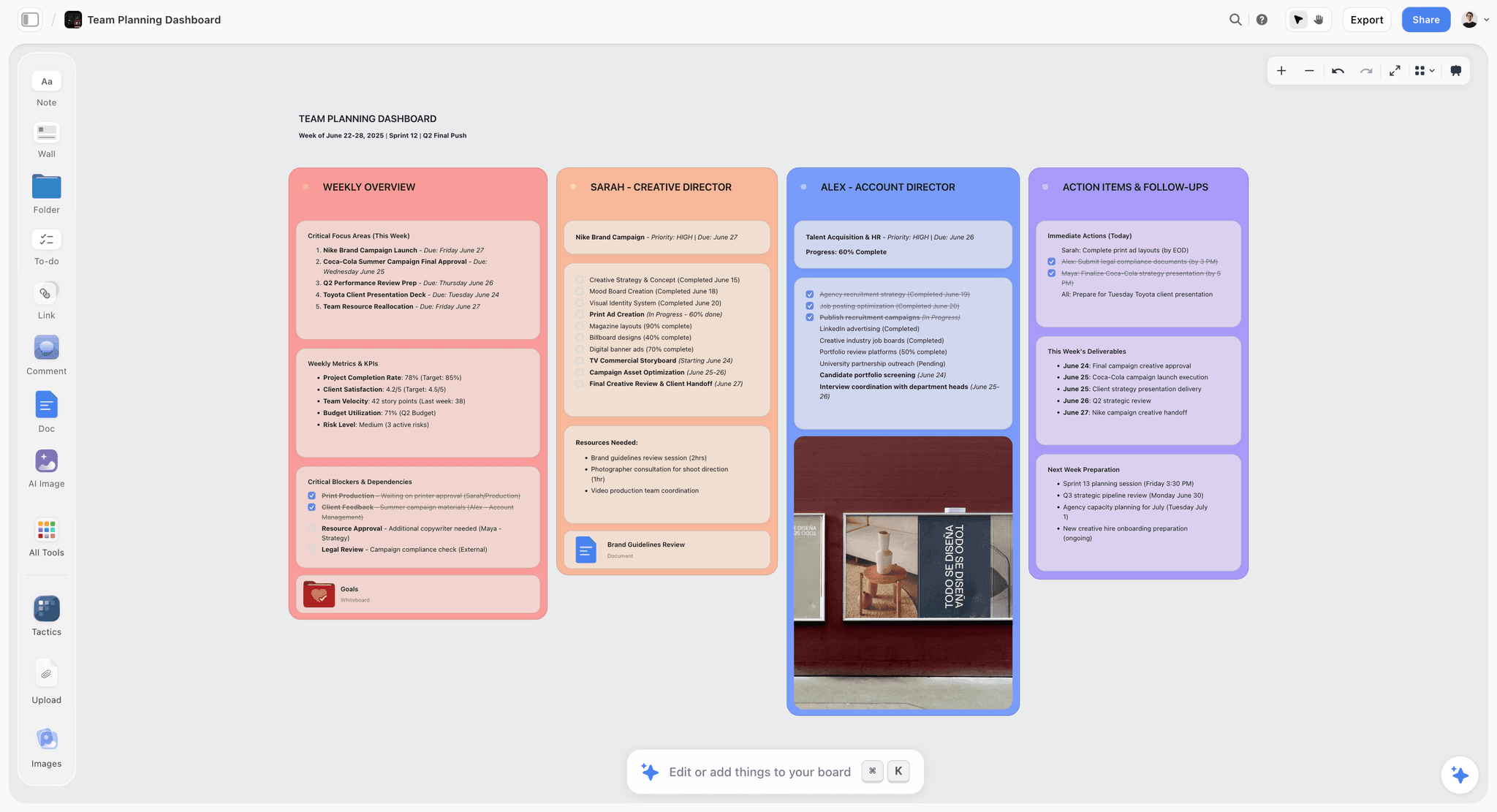
Storyflow board with a team plan, tasks and notes built on the canvas
Let Claude build the board, not just the answer
Add https://mcp.storyflow.so/mcp to Claude, pick the projects it may use, and ask it to turn your next brief into a board with the plan, the tasks and the deck.

Remote vs Local MCP Servers: The Decision That Decides Everything Else
Most "best MCP server" lists mix remote and local servers in one ranking without saying so. That is how people end up following a guide, editing a JSON file for an hour, and then discovering the server never appears in Claude.ai on their phone.
| Question | Remote server | Local server |
|---|---|---|
Where it runs | The vendor's cloud | A process on your computer |
How you add it | Paste a URL (or pick it from the directory) and sign in | Install a desktop extension, edit a config file, or run claude mcp add with a command |
Claude.ai in the browser | Yes | No |
Claude Desktop | Yes | Yes |
Claude Code | Yes, with --transport http | Yes, with stdio |
Claude mobile apps | Yes, connectors work across Claude clients | No |
Sign-in | Usually OAuth in your browser | Usually an API key or token you paste |
Who updates it | The vendor, automatically | You, or the extension directory for listed extensions |
Can it touch your files | Only what its account can reach | Whatever your user account can reach |
Remote is the right default for non-developers
A remote server is a web address. You paste it, sign in with the account you already have, approve what it may do, and it works everywhere Claude does. Anthropic's guide confirms that remote connectors work in Claude.ai, Claude Desktop, Cowork and the mobile apps. For a founder or creative lead, a remote server is the only kind that keeps working when you switch from laptop to phone.
Local earns its place when the data is on your machine
A local server is the right tool when the thing Claude needs is on your computer: a folder of transcripts, a browser you want it to drive, a git repository you have not pushed. Local servers also avoid sending that data through a vendor's cloud. The price is setup and responsibility. A local server runs with your user permissions, so a careless one can read anything you can read.
Transport names, translated
You will see three words in setup guides. Streamable HTTP (usually written as just "HTTP") is the current remote standard. SSE is the older remote transport, and Claude Code's docs call it deprecated. Stdio means "run this program locally and talk to it through its input and output". If a vendor offers HTTP, pick it. Storyflow, Linear, Asana and Notion all do.
The 12 Best MCP Servers for Claude, Ranked
Each review follows the same shape: the verdict, who it is for, the price, the address, why it ranks where it does, then strengths and limits.
1. Storyflow

Verdict: the MCP server that turns a Claude conversation into a finished visual project: a board with the plan, tasks, references, deck and shot list on one canvas.
Best for: founders, producers, agencies, marketers and creators who plan launches, shoots, campaigns and content in Claude.
Price: Storyflow is paid-only during early access; its Free plan launches before the end of 2026, and anyone a paid member invites to a board joins free now. Plus is $7.99/mo billed annually ($9.99 monthly), Pro $14/mo annual, Max $39/mo annual. See pricing. A free account (today, an invited one) gets 25 MCP actions a week, reset Monday UTC; Plus, Pro and Max have no MCP limit.
Address: https://mcp.storyflow.so/mcp (Streamable HTTP; it does not serve SSE).
Storyflow is a visual project planning workspace for creative work: an infinite canvas board that holds notes, tables, documents, images, moodboards, storyboards, mind maps, kanban, charts and slide decks. Its MCP server lets Claude work on those boards. Claude can list your projects and boards, read the notes, documents and files on a board, see what changed on a board and who changed it, and search. It can also build: create a project, build a whole section, add tables, charts, diagrams, mind maps, documents, slide decks, shot cards, strip boards, colour palettes and carousel pages, apply a board template, and group or move elements. What Claude adds is placed on the board where it belongs, and it appears live if you have the board open.
Why first? Because it is the server on this list built most squarely around turning a planning conversation into a project artefact you can hand to a client or a team. Notion gives you a page. Asana gives you tasks. Storyflow gives you the board that holds the page, the tasks, the references and the deck at once. In clients that support MCP apps, the show_board tool puts the live board inside the chat, so you watch Claude build it.
The permission model is the second reason. At sign-in Storyflow asks which projects Claude may use (all or the ones you pick), whether it may make changes (otherwise it is read-only), and whether it may use your documents outside projects. Apps Storyflow does not recognise get an "I trust this app" warning. Connections expire after 30 days, and removing one in Settings, then Connected apps, ends access within a minute. Among the other servers here, Linear's separate read-only address and GitHub's --read-only flag are the closest ways to limit Claude before it connects.
How to add it in Claude: open Customize, then Connectors, click Add, then Add custom connector, name it Storyflow, paste the address, click Continue, choose Sign in now, click Add and sign in. In Claude Code: claude mcp add --transport http storyflow https://mcp.storyflow.so/mcp, then run /mcp to sign in. Full steps for every client are in the connection guide, and the MCP page shows the jobs people hand to it.
Strengths:
- Builds finished artefacts (decks, shot cards, strip boards, mind maps, charts) rather than text.
- Per-project scope and a read-only option chosen at sign-in.
- Runs on your Claude model, so it spends no Storyflow AI credits.
- One address works in Claude.ai, Claude Desktop, Claude Code and other MCP clients such as ChatGPT, Gemini, Grok and Cursor.
Limitations:
- New: launched October 2026, so far less community knowledge than Notion or GitHub.
- No free plan yet; a free invited account is capped at 25 actions a week.
- Browser-based product with no offline mode, so it is not the place for data that must stay on your machine.
- A photo you attach in the Claude chat does not reach Storyflow; Claude gives you an upload link instead.
2. Notion
Verdict: the best server when the deliverable is a document, wiki page or database.
Best for: teams whose source of truth is already Notion.
Price: Notion has a Free plan; Plus is $10 per member a month billed annually ($12 monthly) and Business $20 ($24 monthly), per Notion's pricing page.
Address: https://mcp.notion.com/mcp (the example Claude Code's own docs use).
Notion's hosted server lets Claude search your workspace, read pages, and create and update pages and databases, according to Notion's MCP documentation. You sign in with OAuth and Claude sees what your account can see. Notion's help centre adds that MCP tools "act with your full Notion permissions", which is the honest warning: there is no per-page scoping at sign-in like Storyflow's project picker.
It ranks second because for written work it is the most complete server we checked, with mature docs and admin controls (workspace owners manage connections in Settings, then Connections). It is not first because a Notion page is linear. Ask Claude to plan a launch and you get a well-structured document, which is right for a spec and wrong for a plan your team needs to rearrange.
Strengths:
- Mature first-party server with OAuth and admin controls.
- Read and write across pages and databases.
- Listed among the top connectors in Claude's directory.
Limitations:
- Acts with your full workspace permissions.
- Output is pages and databases, not a visual canvas.
3. Canva
Verdict: the best server for getting a finished social graphic, poster or presentation out of a Claude conversation.
Best for: marketers and creators who already design in Canva.
Price: depends on your Canva plan. We could not load Canva's pricing page to confirm which MCP features need a paid plan, so check before you rely on one.
Address: add Canva from Claude's connector directory.
Claude's Canva connector listing describes it as search, create, autofill and export Canva designs, and lists 17 tools, among them search-designs, generate-design, export-design, import-design-from-url, create-folder and add-comment-thread-to-design. Canva's developer docs add export to PDF, PNG, JPG, PPTX and MP4.
It ranks third because the output is shippable: a design you can post. It is behind Notion because its reading side is mostly about finding designs, not understanding a project, so Claude cannot use Canva to hold the plan the design belongs to.
Strengths:
- Generates and exports real designs in common formats.
- Can comment on designs and organise folders.
Limitations:
- Feature access depends on your Canva plan, which we could not verify.
- Holds designs, not the project around them.
4. Miro
Verdict: the closest whiteboard alternative to Storyflow, strongest for teams already running workshops in Miro.
Best for: product and design teams with existing Miro boards.
Price: Free with 3 editable boards and 100 MCP calls a day; Starter $8 per member a month and Business $20, both billed yearly, per Miro's pricing.
Address: https://mcp.miro.com/
Miro's MCP documentation lists summarising and searching boards, reading items and comments, replying to and resolving comments, and creating boards, widgets, diagrams, documents, tables, code widgets and images. It supports Claude on web and desktop and Claude Code. On Enterprise plans the server is off until an admin enables it.
Miro and Storyflow overlap more than any other pair here. The difference is what Claude builds. Miro's server creates diagrams, documents and tables on a collaborative whiteboard. Storyflow's builds production artefacts for creative work (slide decks, shot cards, strip boards, colour palettes, carousel pages) and applies whole board templates. For a workshop, Miro. For a shoot, a launch or a content plan, Storyflow.
Strengths:
- Clear MCP limit on the Free plan.
- Comment handling, useful for async review.
Limitations:
- Free plan keeps only the three most recent boards editable.
- No deck, shot list or strip board output.
5. Figma
Verdict: essential if you design in Figma and hand off to code; narrower for everyone else.
Best for: product designers and design engineers.
Price: the remote server is available on all seats and plans; the desktop server needs a Dev or Full seat on a paid plan. Professional Full seats are $16 a month per Figma's pricing.
Address: https://mcp.figma.com/mcp (remote, preferred) or the local desktop server.
Figma's guide lists extracting design context (variables, components, layout), generating code from selected frames, and, on the remote server only, writing native content to Figma Design and FigJam canvases, which Figma describes as free during beta and paid by usage later. Claude Code is listed as supporting desktop, remote and write-to-canvas.
It ranks fifth because its strongest jobs are design-to-code, which matter to a smaller slice of Claude users. For a designer it may be the first server you add.
Strengths:
- Both remote and local options, documented in one place.
- Writes to the canvas from Claude.
Limitations:
- Canvas writing is in beta and will become usage-based.
- Local desktop server needs a paid seat.
6. Zapier
Verdict: the widest reach on this list: one connection gives Claude actions in the apps you have connected to Zapier.
Best for: operators who need Claude to touch email, calendars, CRMs and spreadsheets that have no MCP server of their own.
Price: Free with 100 tasks a month; Professional from $19.99/mo billed annually, per Zapier's pricing. Zapier's MCP calls draw from the same task pool as your Zaps; the pricing page's example rate is 2 tasks per tool call, and failed actions do not count.
Address: add Zapier as a connector in Claude and sign in. Zapier's setup guide says the server is created for you at sign-in, with actions enabled for apps already connected to your Zapier account.
Zapier ranks sixth because breadth is its whole value and its weakness. On the Free plan, 100 tasks is about 50 tool calls a month. And because one server exposes actions across many apps, its permission model is only as narrow as the actions you enable.
Strengths:
- Reaches apps that will never ship their own MCP server.
- Published metering, with 2 tasks per tool call as the example rate.
Limitations:
- Tasks are shared with your Zaps, so heavy Claude use eats automation budget.
- Broad by design, so review which actions are on.
7. Asana
Verdict: the right server when tasks already live in Asana and Claude should create and update them.
Best for: marketing and operations teams on Asana.
Price: Personal is free for up to 2 users; Starter $10.99 per user a month annual, Advanced $24.99, per Asana's pricing.
Address: https://mcp.asana.com/v2/mcp
Asana's MCP page lists Streamable HTTP with OAuth, and names the Asana app in Claude and Claude Code among supported clients. The beta server at https://mcp.asana.com/sse is deprecated and Asana's page gives its shutdown date as 11 May 2026, so any old setup guide pointing at it is out of date.
Strengths:
- First-party, OAuth, Streamable HTTP.
- Enterprise admins can allow or block MCP clients.
Limitations:
- Tasks and projects only; no visual board or deck output.
- Old SSE guides on the web point at a retired address.
8. Linear
Verdict: the best-designed permissions of any server here, for a job most makers do not have.
Best for: product and engineering teams.
Price: Free (250 issues, 2 teams); Basic $10 per user a month annual, Business $16, per Linear's pricing.
Address: https://mcp.linear.app/mcp, or https://mcp.linear.app/mcp/readonly for read tools only.
Linear's MCP docs describe OAuth 2.1 with dynamic client registration, a bearer-token option, and a separate read-only endpoint. That read-only URL is the pattern every vendor should copy: you decide Claude cannot write before it ever connects.
Strengths:
- Separate read-only endpoint.
- Streamable HTTP, with SSE as a documented fallback.
Limitations:
- Issues and projects for software teams; little use for a shoot or a campaign.
9. Atlassian Rovo
Verdict: the one server to add if your company runs on Jira and Confluence.
Best for: teams inside the Atlassian suite.
Price: usage is billed in Rovo credits per call, which scale with data volume and reasoning depth.
Address: https://mcp.atlassian.com/v2/mcp
Atlassian's guide names Jira, Jira Service Management, Confluence, Bitbucket, Projects, Goals and Loom, with OAuth 2.1 that respects users' existing access. In Claude Code the command is claude mcp add --transport http atlassian https://mcp.atlassian.com/v2/mcp.
Strengths:
- Covers several Atlassian products through one server.
- Respects existing Atlassian permissions.
Limitations:
- Credit-based billing is harder to predict than a flat call count.
10. GitHub
Verdict: the first server any developer adds; a read-only flag makes it safe to start with.
Best for: anyone whose work lives in repositories, issues and pull requests.
Price: the server is open source.
Address: https://api.githubcopilot.com/mcp/ remotely, or the Docker image ghcr.io/github/github-mcp-server locally.
GitHub's repository documents OAuth or a personal access token, toolsets you can switch on and off (the default set is context, repos, issues, pull requests and users), and a --read-only flag that skips every write tool. It ranks tenth on this list only because our reader is not mainly a developer.
Strengths:
- Both remote and local, with fine-grained toolsets.
- Read-only mode overrides any tool you request.
Limitations:
- Token setup is unfamiliar for non-developers.
11. Filesystem (reference server)
Verdict: the simplest way to let Claude Desktop or Claude Code read and write one folder on your computer.
Best for: writers, researchers and editors with a folder of drafts, transcripts or notes.
Price: open source.
Install: a local server; add it to Claude Desktop or Claude Code with the folder path you allow.
Filesystem is one of seven reference servers maintained by the MCP steering group in the modelcontextprotocol/servers repository, alongside Everything, Fetch, Git, Memory, Sequential Thinking and Time. The repository describes them as reference implementations, not production-ready solutions, and tells you to assess your own security needs. Give it one folder, never your home directory.
Strengths:
- Data stays on your machine.
- No account or vendor in the loop.
Limitations:
- Invisible to Claude.ai and the mobile apps.
- Reference code, not a hardened product.
12. Playwright
Verdict: gives Claude a real browser to click, fill and read, without a vision model.
Best for: checking a live page, testing a form, or collecting details from a site.
Price: open source.
Install: in Claude Code, claude mcp add playwright npx @playwright/mcp@latest; needs Node.js 18 or newer.
Microsoft's Playwright MCP works from the page's accessibility tree rather than screenshots. It is listed among the top plugins in Claude's directory. It sits last because it is a local developer tool, but it is the most useful local server for a non-developer once someone sets it up.
Strengths:
- Structured page snapshots, so it is fast and cheap on tokens.
- Works with any site you can open.
Limitations:
- Local only.
- A browser that reads web pages is the most exposed path for prompt injection.
Other Servers We Considered
Milanote is the board tool most often compared with Storyflow, and we checked for an MCP server. Its homepage and plans page mention no AI features, API or MCP. Its Free plan holds 100 items and 10 uploads, and paid is $9.99 per person a month billed annually. If you want Claude to build on a moodboard, Milanote cannot take that job today.
Google Drive, Gmail, Slack, HubSpot, monday.com and Microsoft 365 all appear among the top connectors in Claude's connector directory. We left them out because we did not verify their MCP details on the vendor's own pages in this session, and a list built on unverified setup steps is worse than a shorter one.
The archived reference servers (the old GitHub, Google Drive, Slack, PostgreSQL, Puppeteer and others) moved to an archive repository. Several were replaced by official vendor servers. If a tutorial tells you to install the old Google Drive or GitHub reference server, it is out of date.
Worked Example: A Product Launch Board From One Claude Conversation
Numbers make this concrete. Here is a founder planning a product launch, with Storyflow, Notion and Zapier connected to Claude Pro ($17 a month billed annually or $20 monthly, per Claude's pricing).
The input
A 1,200-word launch brief pasted into Claude, plus a request: "Build a Storyflow board for this launch with the plan, the tasks, the open questions and a ten-slide pitch deck. Then write the press page in Notion."
The calls Claude makes
Every read and every change is one Storyflow action. The table below is an illustrative run, not a measurement; the exact count depends on how Claude splits the work.
| Step | Server | Tool | Storyflow actions |
|---|---|---|---|
Find the right project | Storyflow | list_projects | 1 |
Create the launch project | Storyflow | create_project | 1 |
Show the live board in chat | Storyflow | show_board | 1 |
Build plan, tasks and open questions | Storyflow | build_section (3 sections) | 3 |
Add a timeline table | Storyflow | create_whiteboard_element | 1 |
Build the ten-slide deck | Storyflow | create_deck | 1 |
Write the press page | Notion | create page | 0 |
Post the board link to Slack | Zapier | 1 action | 0 |
Total | 8 |
What it costs
- Storyflow: 8 actions. On Plus or above there is no MCP limit. On a free invited account, 8 of the 25 weekly actions, so about three runs like this a week.
- Zapier: at the example rate, 1 call is 2 tasks. On Zapier Free (100 tasks a month), that is 2% of the month.
- Notion: no per-call metering is published on Notion's pages we checked.
- Storyflow AI credits: zero, because the MCP runs on Claude's model.
What you have at the end
A board with three groups (plan, tasks, open questions), a timeline table, and a ten-slide deck on the same canvas, plus a Notion press page. It is not that Claude wrote more. It is that nothing it wrote needs to be moved. The founder's next step is to drag two tasks into a different week, which is one drag on a canvas and a cut-and-paste job in a document.
Prompts You Can Copy
These are written to make Claude pick the right server and the right tool. Paste them as they are, then edit the nouns.
| Job | Prompt |
|---|---|
Brief to board | Here is our launch brief. Build a Storyflow board in the Launch project with the plan, the tasks and the open questions, grouped so I can move them. |
Weekly catch-up | What changed on the Launch board in Storyflow this week, and who changed it? List anything still open. |
Board to deck | Turn the Launch board into a ten-slide pitch deck on the same board. One idea per slide, speaker notes in the slide text. |
Shoot planning | Read the references on the Shoot board and create shot cards for each setup, then a strip board grouped by location. |
Content month | Build a 4-week content plan on a Storyflow board: one table with the posts in date order, plus carousel pages for the two strongest ideas. |
Spec to Notion | Write the product spec from the Launch board as a Notion page under Product, with the open questions as a checklist at the end. |
Design out | Generate an Instagram post in Canva from slide 3 of the deck, then export it as PNG. |
Read-only audit | Without changing anything, list every Asana task due this week that has no assignee. |
Three prompt habits that save actions
- Name the server. "In Storyflow" or "in Notion" stops Claude from asking or guessing.
- Name the project. It saves a list_projects call and stops Claude from building in the wrong place.
- Say "without changing anything" for reviews, even on a read-only connection. It also keeps Claude from proposing writes you then have to decline.
How to Add an MCP Server in Each Claude App
The steps differ by surface. These are the current ones from Anthropic's pages.
Claude.ai and Claude Desktop (remote)
- Open Customize, then Connectors.
- Click Add, then Add custom connector (or pick the server from the directory).
- Enter a name and the server URL, review the authentication, and click Add.
- Sign in to the service and approve what Claude may do.
On Claude's Team and Enterprise plans, an Owner or Primary Owner adds the connector under Organization settings, then Connectors, and members then connect individually.
Claude Desktop (local)
- Open Settings, then Extensions.
- Click Browse extensions for Anthropic-reviewed tools, or Advanced settings, then Install Extension for a .mcpb file.
- Fill in any keys the extension asks for. Fields marked sensitive go to your OS keychain.
Claude Code
- Remote: claude mcp add --transport http name URL, then /mcp in a session to sign in.
- Local: claude mcp add name -- command arguments (the double hyphen separates Claude's options from the server's command).
- Choose a scope with --scope local, project or user.
- Check with claude mcp list, and remove with claude mcp remove name.
| Claude Code scope | Loads in | Shared with team | Stored in |
|---|---|---|---|
Local (default) | Current project | No | ~/.claude.json |
Project | Current project | Yes, through version control | .mcp.json in the project root |
User | All your projects | No | ~/.claude.json |
Safety: What Can Go Wrong and the Settings That Prevent It
An MCP server is a set of hands you give Claude. Anthropic's own guide lists the risks plainly: servers not verified by Anthropic, hidden instructions in a malicious server (prompt injection), and developers changing tool behaviour after you connect.
The three risks that actually happen
- Prompt injection through content. A server that fetches web pages, emails or shared documents can feed Claude text written by someone else, and that text can carry instructions. The Claude Code docs warn about exactly this.
- Over-broad permission. A connector with write access to every project gives a confused instruction a large blast radius.
- Stale or unofficial servers. A community wrapper around a vendor's API, or an old reference server, may be unmaintained.
The settings that prevent them
- Choose read-only first. Storyflow asks at sign-in; Linear has a read-only URL; GitHub has --read-only. Turn writes on when you need them.
- Scope to projects. Pick the projects Claude may use instead of all of them.
- Do not click "Allow always" on write tools from servers you do not control. Anthropic recommends it only for trusted tools, and notes that in Research mode Claude can call connector tools without asking, so disable write tools there.
- Review project-scoped servers. In Claude Code, a .mcp.json in a repository you cloned asks for approval before it loads. Read it before you approve.
- Revoke on a schedule. Storyflow connections expire after 30 days by design. For other servers, put a monthly reminder in your calendar to review Connected apps.
Cost Table: What a Month of Claude Plus MCP Servers Costs
Prices are as of 9 October 2026 from each vendor's page, for one person, billed annually where the vendor offers it.
| Stack | Claude | Servers | Monthly total | Notes |
|---|---|---|---|---|
Solo maker | Claude Pro ($17) | Storyflow Plus ($7.99) | $24.99 | No MCP limit on Storyflow Plus |
Founder stack | Claude Pro ($17) | Storyflow Plus ($7.99), Notion Free, Zapier Free | $24.99 | Zapier Free is about 50 tool calls a month |
Design-led | Claude Pro ($17) | Storyflow Pro ($14), Figma Professional Full seat ($16) | $47 | Storyflow Pro adds AI image generation in the app |
Small team on Max | Claude Pro ($17) | Storyflow Max ($39) | $56 | Max adds a team workspace with roles and permissions |
There is no free Storyflow row because Storyflow is paid-only during early access; its Free plan launches before the end of 2026. The one way to try the connection without paying today is to be invited to a board by a paid member: the invited account joins free and gets 25 MCP actions a week, which you can connect to Claude Free as its single custom connector.
Decision Rules: Which MCP Server Should You Add First?
Use the first rule that matches you.
| If your main output is... | Add first | Then add |
|---|---|---|
A launch, shoot, campaign or content plan | Storyflow | Notion for the written spec |
A spec, wiki or knowledge base | Notion | Storyflow if the plan needs a board |
A social graphic or presentation design | Canva | Storyflow for the plan behind it |
A workshop board your team already uses | Miro | Notion |
Design handed to developers | Figma | GitHub |
Tasks in a team tool | Asana, Linear or Atlassian | Storyflow for the visual plan |
Work across many small apps | Zapier | One first-party server for your main tool |
Files on your own machine | Filesystem | Playwright for the web |
Personas and top picks
- Founder running the business: Storyflow and Notion. Storyflow holds the launch and fundraising boards Claude builds; Notion holds the written policies.
- Agency or studio lead: Storyflow and Asana. Client plans and decks on boards, team tasks in Asana.
- Producer or filmmaker: Storyflow and Filesystem. Shot cards and strip boards on the board, transcripts in a local folder.
- Marketing or brand lead: Storyflow and Canva. The campaign board and the finished assets; see the best AI tools for marketers for the rest of the stack.
- Creator on YouTube or social: Storyflow and Zapier. The content pipeline on a board, and the glue to whatever else you use.
- Product designer: Figma and Storyflow. Design context for code, and the research board around it.
Common Mistakes When Adding MCP Servers to Claude
Following a local-server guide for Claude.ai
If the guide says "edit claude_desktop_config.json" or "run npx", it is a local server and Claude.ai cannot use it. Look for a remote URL first.
Spending Claude Free's one connector on something you rarely use
Claude Free allows one custom connector. Spend it on the tool where your work lives every day.
Connecting everything with write access on day one
Read-only first, then widen. Most of the value in week one is Claude reading and summarising what is already there.
Installing an archived reference server
The old Google Drive, GitHub and Slack reference servers are archived. Use the vendor's official server.
Using SSE because an old guide said so
Asana's beta SSE address is deprecated and Claude Code calls SSE deprecated. Use the HTTP address.
Letting tool results blow the context
Claude Code warns at 10,000 tokens per tool result and caps at 25,000 by default (raise it with MAX_MCP_OUTPUT_TOKENS). Ask for summaries and filtered lists, not "everything on the board".
Expecting the server to see what you attached in chat
A photo you drop into Claude stays in Claude. Storyflow's server answers with an upload link through request_photo_upload; other servers may simply not see it.
When Storyflow Is Not the Right Choice
Storyflow ranks first on this list because the criteria reward finished visual output for makers. Change the job and the answer changes.
Your work is code
Use GitHub, Linear and Playwright. Storyflow does not hold repositories or issues.
Your deliverable is a long written document
Notion or Google Docs is the better home for a 20-page spec. Storyflow holds documents on a board, but a wiki is Notion's job.
Your data cannot leave your machine
Storyflow is a browser product with no offline mode and no local server. Use the Filesystem reference server with a local folder.
You need to publish, schedule or approve
Storyflow does not publish or schedule social posts, has no calendar tool, and has no formal approval button. Use your scheduling tool or a proofing tool, and keep the plan on the board.
You want a free tool today
Storyflow is paid-only during early access, and its Free plan launches before the end of 2026. Miro Free (100 MCP calls a day) or Notion Free are free today.
You care most about years of track record
Storyflow's MCP server launched in October 2026. Notion, GitHub and Atlassian have been documenting theirs for longer.
Template: Your MCP Setup Checklist
Copy this list into a note and work down it, one server at a time.
- Write down the one output you most want from Claude this month (a board, a page, a design, a task list).
- Pick the server that produces that output from the decision table above.
- Check whether it is remote. If not, confirm you use Claude Desktop or Claude Code.
- Check your Claude plan. On Free, this is your one custom connector.
- Add it with the server's own address from this article or the vendor's page.
- At sign-in, choose read-only and the narrowest project scope.
- Run one read prompt ("summarise what is on X") and check the answer against the real thing.
- Turn on write access for one project and run one build prompt.
- Add a second server only when the first one is used daily.
- Set a monthly reminder to review connected apps and remove what you no longer use.
Starter template for a creative project board
If you start with Storyflow, ask Claude to build this structure on a new board in one go: a Brief group (the brief and goals), a Plan group (milestones as a table with rows kept in date order), an Open Questions group, a References group, and a Deliverables group with a slide deck. Then use the board for a week before adding anything else. Storyflow's AI creative brief generator, AI shot list generator and AI storyboard generator pages show the same jobs done with the in-app AI instead of Claude, and the AI moodboard generators roundup covers the reference side. If you are new to planning on a canvas, start with visual project planning.
The Bottom Line
Pick MCP servers by the output you want, not by how many tools they expose. For anyone planning launches, shoots, campaigns or content in Claude, Storyflow is the first server to add: one remote address, every Claude surface, scoped to the projects you choose, and the result is a board with the plan, the tasks and the deck instead of text you have to move. Add Notion for documents, Canva or Figma for design, and Zapier for the long tail. Keep local servers for data that must stay on your machine.
Take your next brief, connect Storyflow at storyflow.so/mcp, and ask Claude to build the board. You will know within one conversation whether the copy-paste tax is gone.
FAQ: MCP Servers for Claude
What is an MCP server for Claude?
An MCP server is the part of an app that lets Claude read and act in it through the Model Context Protocol. It lists the actions available, such as "create a page" or "read a board", and runs them when Claude asks. Anthropic open-sourced MCP in November 2024. In Claude you add a server as a connector by URL, as a desktop extension, or with claude mcp add in Claude Code.
What is the best MCP server for Claude in 2026?
For makers planning creative or client work, Storyflow is the best MCP server for Claude in 2026, because it builds boards, decks, shot cards and mind maps rather than text, works in every Claude surface from one URL, and is scoped to the projects you choose. Notion is best for documents, Canva for designs, and GitHub for code.
What is the difference between a remote and a local MCP server?
A remote MCP server runs in the vendor's cloud and you add it with a URL and a sign-in. It works in Claude.ai, Claude Desktop, Claude Code and the mobile apps. A local MCP server is a program on your computer and only works in Claude Desktop and Claude Code. Remote is easier; local keeps data on your machine.
Can I use MCP servers on Claude's free plan?
Yes, with a limit. Anthropic's guide says custom connectors work on Free, Pro, Max, Team and Enterprise, and Free users can add one custom connector. Choose the server you will use most. Storyflow, for example, works on Claude Free as that single connector, and an account invited by a paid member gets 25 actions a week.
How do I add an MCP server to Claude.ai?
Open Customize, then Connectors, click Add, then Add custom connector. Enter a name and the server's URL, review the authentication, click Add, and sign in to the service. For listed servers you can pick them from the directory instead. On Team and Enterprise plans, an owner adds the connector first and members then connect.
How do I add an MCP server to Claude Code?
For a remote server, run claude mcp add --transport http followed by a name and the URL, then run /mcp inside Claude Code to sign in. For a local server, run claude mcp add, the name, a double hyphen and the command that starts it. Add --scope project to share it through a .mcp.json file, or --scope user for all projects.
Do MCP servers work in Claude Desktop?
Yes. Claude Desktop shows every remote connector you added in Claude.ai, and it also runs local servers packaged as desktop extensions. Install those from Settings, then Extensions, either from the reviewed directory or as a .mcpb file. Desktop ships its own Node.js runtime and supports Node.js, Python and binary servers on macOS, Windows and Linux.
Are MCP servers safe to use with Claude?
MCP servers are as safe as their permissions and their publisher. Anthropic warns that unverified servers can carry hidden instructions and change behaviour after you connect. Prefer first-party servers, start read-only, scope access to specific projects, avoid "Allow always" on write tools from servers you do not control, and remove connections you no longer use.
Does Storyflow's MCP server work with Claude?
Yes. Add https://mcp.storyflow.so/mcp as a custom connector in Claude, or run claude mcp add --transport http storyflow https://mcp.storyflow.so/mcp in Claude Code and sign in with /mcp. At sign-in you choose which projects Claude may use and whether it may make changes. The same address works in ChatGPT, Gemini, Grok and Cursor.
Does using Storyflow through Claude spend Storyflow AI credits?
No. The Storyflow MCP server runs on your assistant's model, so the thinking is done by Claude and counted against your Claude plan, not your Storyflow AI credits. What Storyflow meters is actions: a free invited account gets 25 actions a week, reset Monday UTC, and Plus, Pro and Max have no MCP limit.
Which MCP server is best for designers using Claude?
For designers, Figma is the best server when work moves from design to code, because it exposes design context and can write to Figma and FigJam canvases. Canva is best for generating and exporting finished designs. Storyflow is best for the moodboard, brief and presentation around the design, built as a board Claude can extend.
Which MCP server is best for project management in Claude?
For visual or creative projects, Storyflow is the best project management MCP server for Claude, because it builds the plan, tasks and open questions as a board you can rearrange. For engineering tickets, Linear or Atlassian Rovo are better. For cross-team task lists, Asana. Pick the one where your team already tracks work.
How many MCP servers should I connect to Claude?
Start with one and add a second only when the first is used daily. Two or three servers that each own a different job, such as Storyflow for plans, Notion for documents and Zapier for everything else, outperform ten overlapping ones. Every connected server adds tool descriptions Claude must choose between, which makes wrong picks more likely.
Why does my MCP server not show up in Claude.ai?
Usually because it is a local server. Claude.ai connects from Anthropic's cloud, so it only reaches servers on the public internet. If your server runs with npx, uvx or Docker on your computer, use it in Claude Desktop or Claude Code instead. Otherwise, check you are under the one-connector limit on Free and that sign-in finished.
What is the Claude connector directory?
It is Anthropic's catalogue of connectors you can add to Claude without typing a URL. Google Drive, Gmail, Canva, Notion, Figma, Slack, HubSpot, Asana, Linear and monday.com are among the top listings. Any remote server not in the directory, such as Storyflow at https://mcp.storyflow.so/mcp, can still be added as a custom connector with its URL.
Can Claude use MCP servers on the mobile app?
Yes, for remote servers. Anthropic says remote connectors work across Claude clients including the mobile apps, so a connector you add on the web is available on your phone. Local servers do not run on mobile, which is another reason to choose remote servers for the tools you use daily.
Table of Contents
- Key Takeaways
- Why "Best MCP Server" Means Something Different in Each Claude App
- How We Evaluated These MCP Servers
- The Weighted Scores
- Best MCP Servers for Claude Compared
- Remote vs Local MCP Servers: The Decision That Decides Everything Else
- The 12 Best MCP Servers for Claude, Ranked
- 1. Storyflow
- 2. Notion
- 3. Canva
- 4. Miro
- 5. Figma
- 6. Zapier
- 7. Asana
- 8. Linear
- 9. Atlassian Rovo
- 10. GitHub
- 11. Filesystem (reference server)
- 12. Playwright
- Other Servers We Considered
- Worked Example: A Product Launch Board From One Claude Conversation
- Prompts You Can Copy
- How to Add an MCP Server in Each Claude App
- Safety: What Can Go Wrong and the Settings That Prevent It
- Cost Table: What a Month of Claude Plus MCP Servers Costs
- Decision Rules: Which MCP Server Should You Add First?
- Common Mistakes When Adding MCP Servers to Claude
- When Storyflow Is Not the Right Choice
- Template: Your MCP Setup Checklist
- The Bottom Line
- FAQ: MCP Servers for Claude
- Related Reading
Templates to check out for this topic


Templates you can use in Storyflow
Every Storyflow board starts from real structure and an AI that reads the whole canvas. Open one of these templates and make it yours.


See Storyflow in Action
A visual AI workspace where every feature lives inside one canvas. No tab-switching, no context lost.
Build your entire board from a single message
Type what you need in the AI chat at the bottom of your canvas. The AI adds cards, headings, and structure directly onto your board.
Use expert frameworks as AI context
Type @ in the AI chat and choose any Tactic. The AI tailors every response to that framework instead of giving generic advice.
Turn your board into a mind map in seconds
Ask the AI to restructure your canvas as a mindmap. It connects your ideas into a visual hierarchy so you can see how everything relates.
Why Storyflow Exists
Storyflow actually began as a personal tool while working on creative and research projects.
We kept running into the same problem: ideas were scattered everywhere: notes, documents, and whiteboards.
Nothing helped us see how everything connected.
So we started building a workspace designed around how ideas actually grow.
→ Read how Storyflow was createdStoryflow Team
Product & Research Team
Published: 2026-10-09
Extremely simple, seriously capable


See how easy it is to get started
Watch a real project come together, from a blank board to a finished plan, clicked through step by step.
Start creating with AI and become more productive
Transform your creative workflow with AI-powered tools. Generate ideas, create content, and boost your productivity in minutes instead of hours.