
Rock-steady plans for every shoot
Plan your motion work,
all on one endless canvas.
Storyflow is the visual workspace where the whole motion design planning layer lives together: style frames and reference moodboards, storyboards and animatic planning, shot and scene breakdowns, and the brief, all on one infinite canvas. Pin a style frame next to the moodboard that set the look, let AI rough out a sequence from a prompt, then share a view-only link with the client. It is not an After Effects or animation tool. It is the planning layer around one. Paid-only during early access, with a free plan launching before the end of 2026.


Creatives working for these brands already got early access
- Red Bull
- Canon
- Artlist
- Porsche
See how easy it is to get started
Watch a real project come together, from a blank board to a finished plan, clicked through step by step.
Start from a ready-made template
Pick a board to see what you can build, then let AI fill it in. Every template is a real, editable starting point on the same infinite canvas.

Pre-Production
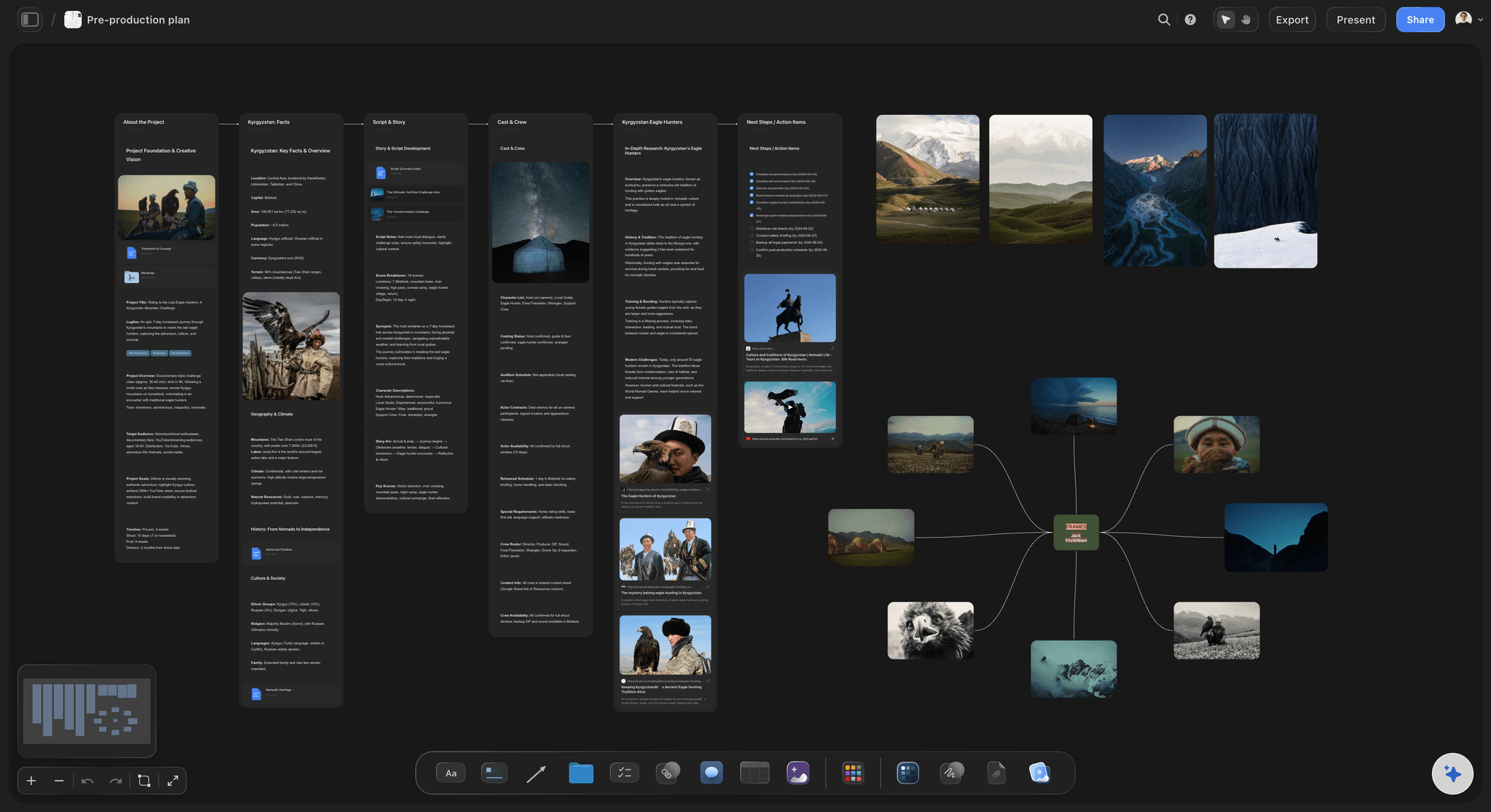
Pull the brief, script, shot list, and moodboard into one pre-production hub so the whole shoot is planned in one place.
What is a planning canvas for motion design?
Motion design pre-production is scattered by default. The brief sits in an email, the reference moodboard lives in a folder of screenshots, the style frames are a stack of exports, and the storyboard and animatic notes are somewhere nobody outside the room can see. Every handoff loses context, and the client never sees the whole direction at once. A planning canvas fixes that by putting each part of the pre-production on one surface you can zoom across, so the style frame that locked the look sits an arm's length from the moodboard and the beats that drive it.
Storyflow is that surface: a truly infinite canvas that runs in the browser with nothing to install. You drag reference clips, style frames, type treatments, and palette swatches onto the board, build a moodboard beside the brief, rough out a storyboard panel by panel, and note animatic timing and shot order on the same canvas. To be clear about what it is not: Storyflow does not keyframe, composite, or render. It is the planning and pre-production layer, so the moodboard and the style frames stay live next to the boards they shape rather than sitting in a folder you screenshot and forget.
The part that changes the workflow is AI that builds on the board. Describe a spot in the chat and Storyflow lays out a full set of cards on the canvas. It reads the current board as context, so the beats and shots it drafts match the look and tone you already set, not a generic template. When the direction is locked, you turn the same board into a shot breakdown or a production plan on the same canvas, and share it view-only so the client, the director, and the studio all read from the same source instead of five out-of-date files.
Ultra fast from brief to board
From brief to boards to breakdown in four moves.
Start with a blank canvas or a single prompt. Either way the whole direction stays on one board you can walk the client through.
01
Open a canvas
Start in the browser with a Storyflow account, nothing to install. You get an infinite canvas with room for the brief, the moodboard, the style frames, the boards, and the breakdown all in one place.
02
Set the look and the brief
Pin the brief, then drag in reference clips, style frames, type treatments, and palette swatches, and grab frames straight from YouTube and Vimeo to build a moodboard the whole project reads from.
03
Board it out with AI
Describe the spot and let AI lay out beats and storyboard panels as cards. It reads the moodboard and style frames on the canvas, so the sequence it drafts matches the direction you set.
04
Break down shots and share
Note animatic timing and break the sequence into shots and scenes, turn the board into a production plan on the same canvas, then send a view-only link to the client or export the whole thing as an image or PDF.
The motion design planning layer, minus the tab-switching.
One canvas holds the brief, the moodboard, the style frames, the boards, and the breakdown. No more stitching an email, a folder, and a board app together the week before the pitch.
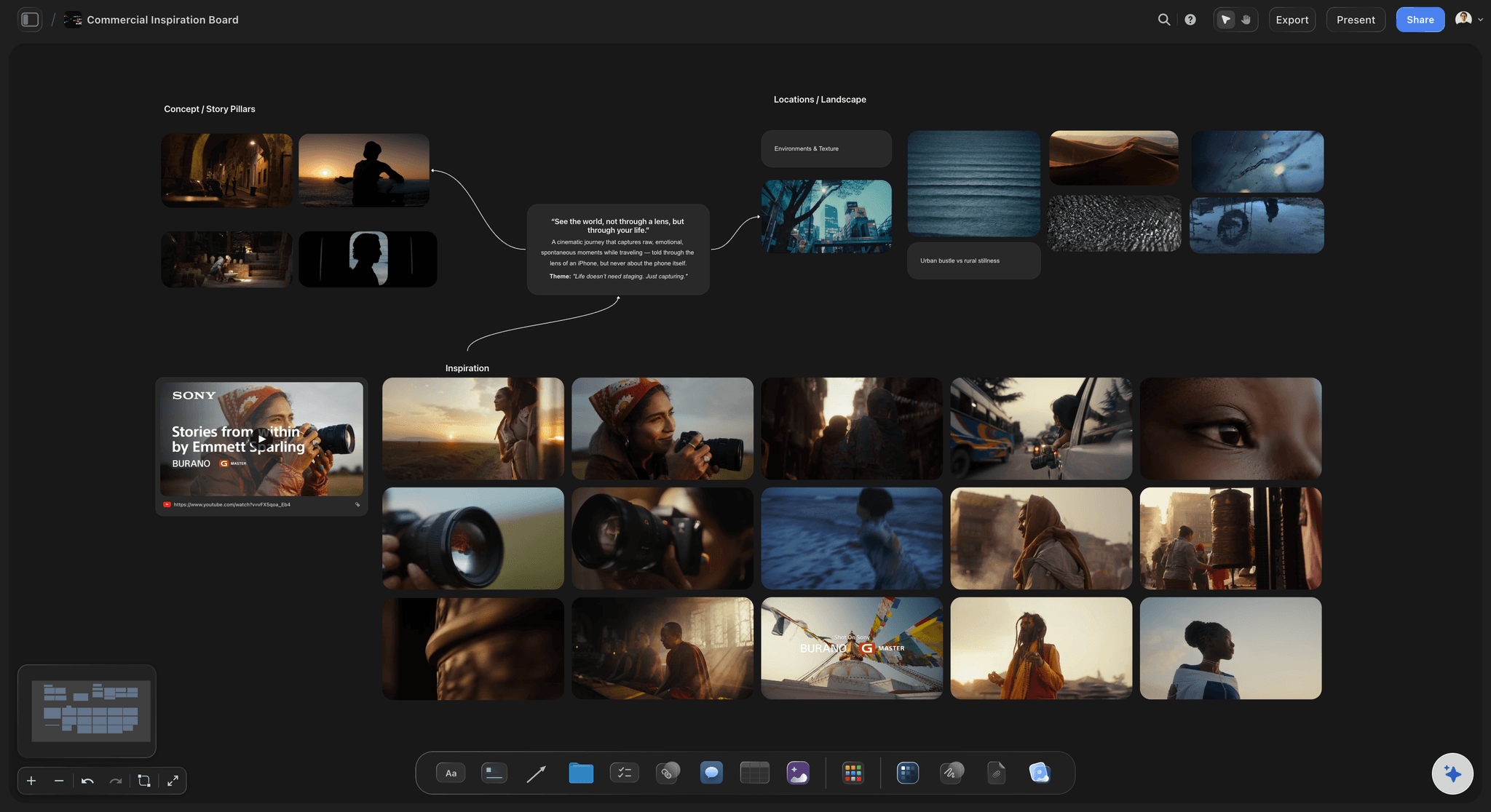
Style frames and moodboards
The look, locked where you can see it
Build a reference moodboard from clips, stills, and palette swatches, and pin the style frames beside it. The direction stays visible on one board while you plan the sequence instead of sitting in a folder of exports.
See the moodboard maker →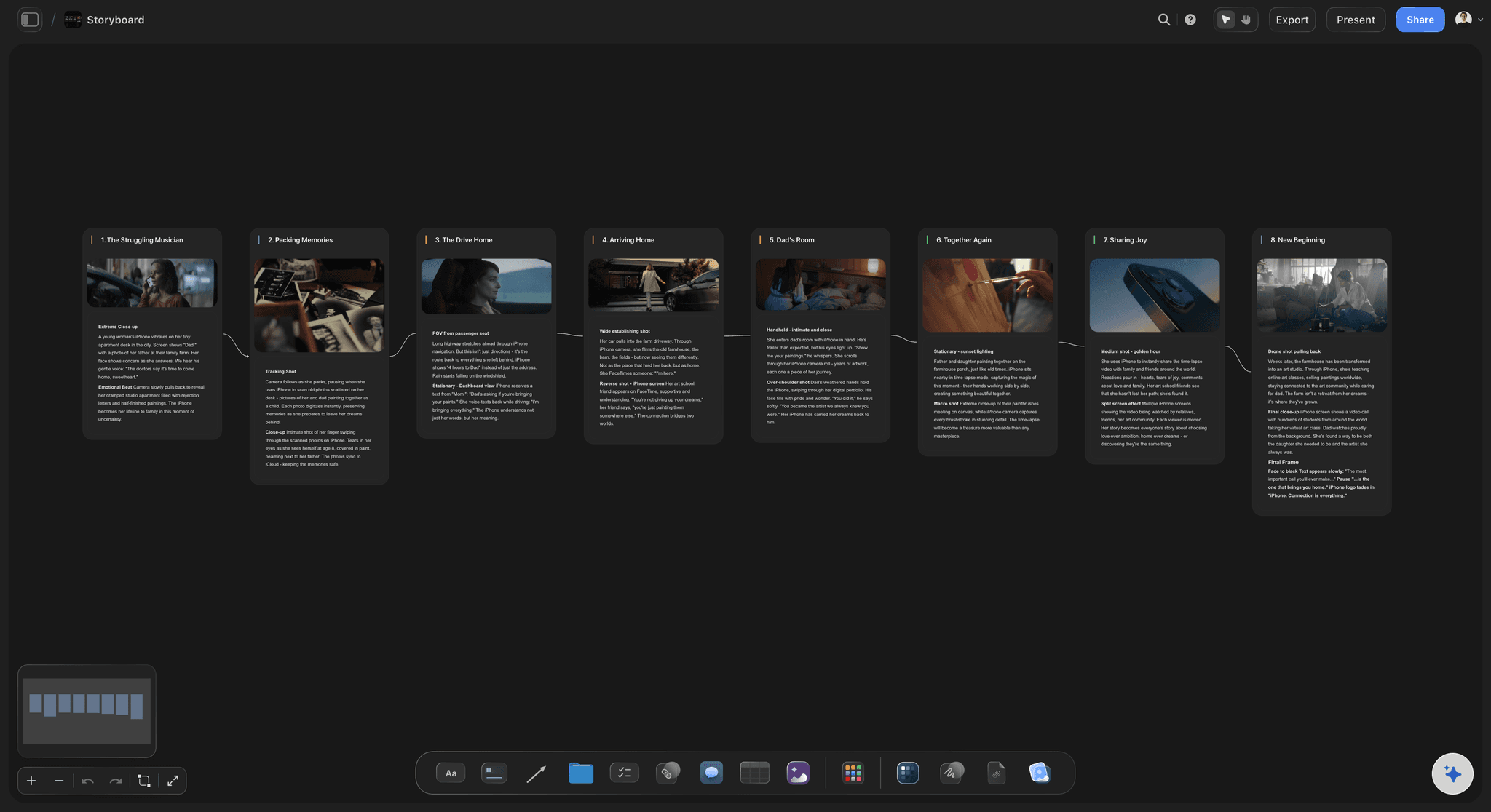
AI drafts the sequence
Rough out a spot from a prompt
Describe the spot and AI lays out beats and a storyboard as cards on the canvas. It reads the moodboard and style frames already there, so the sequence matches your look rather than a stock template. It plans the boards. It does not keyframe the animation.
See the motion design storyboard →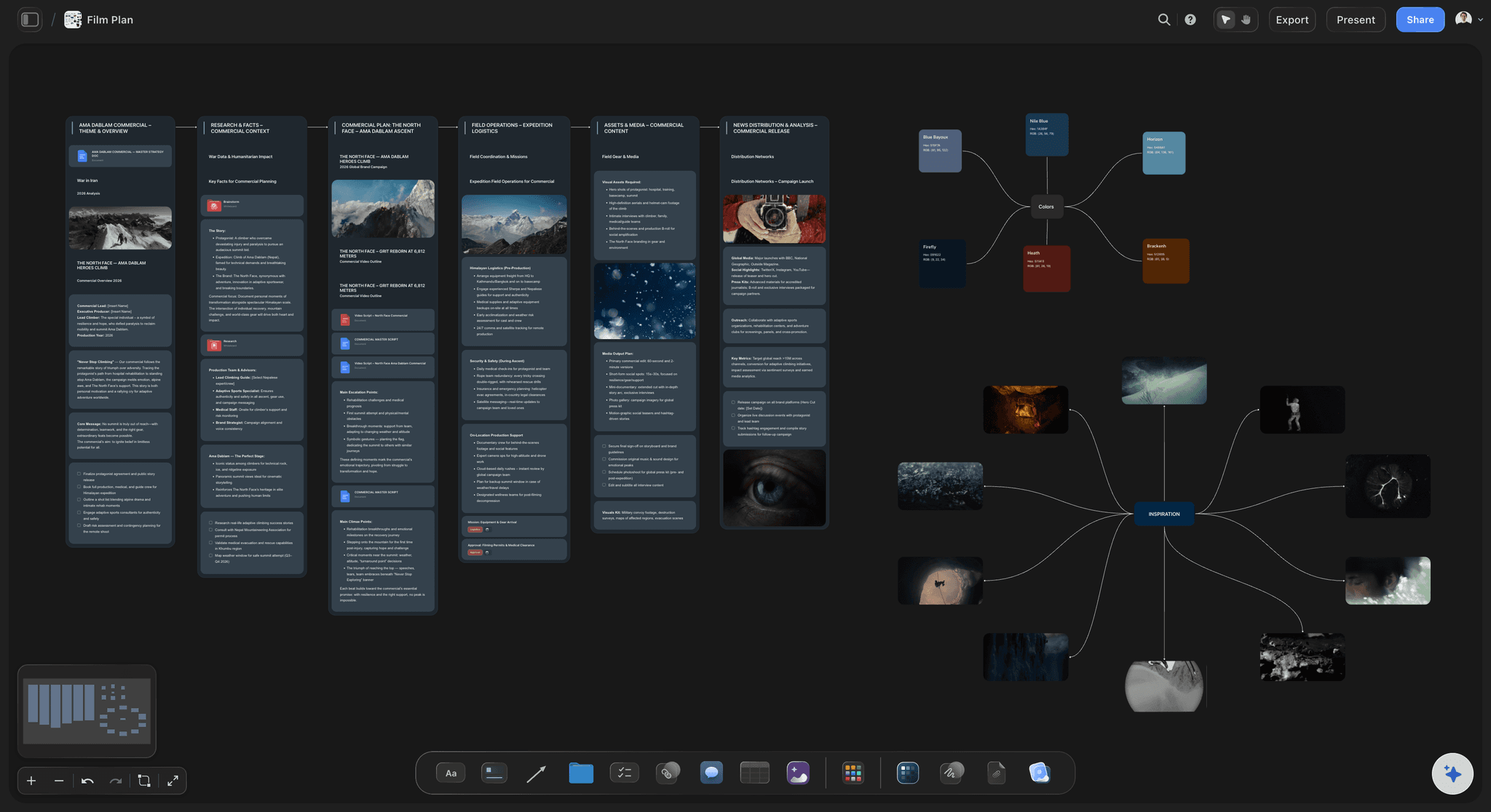
Shot and scene breakdown
Break the spot down beat by beat
Turn the locked storyboard into a shot and scene breakdown on the same canvas, with animatic timing and staging notes in view. Reordering a sequence is a drag, not a re-export, so the breakdown keeps pace with the direction.
See the film plan →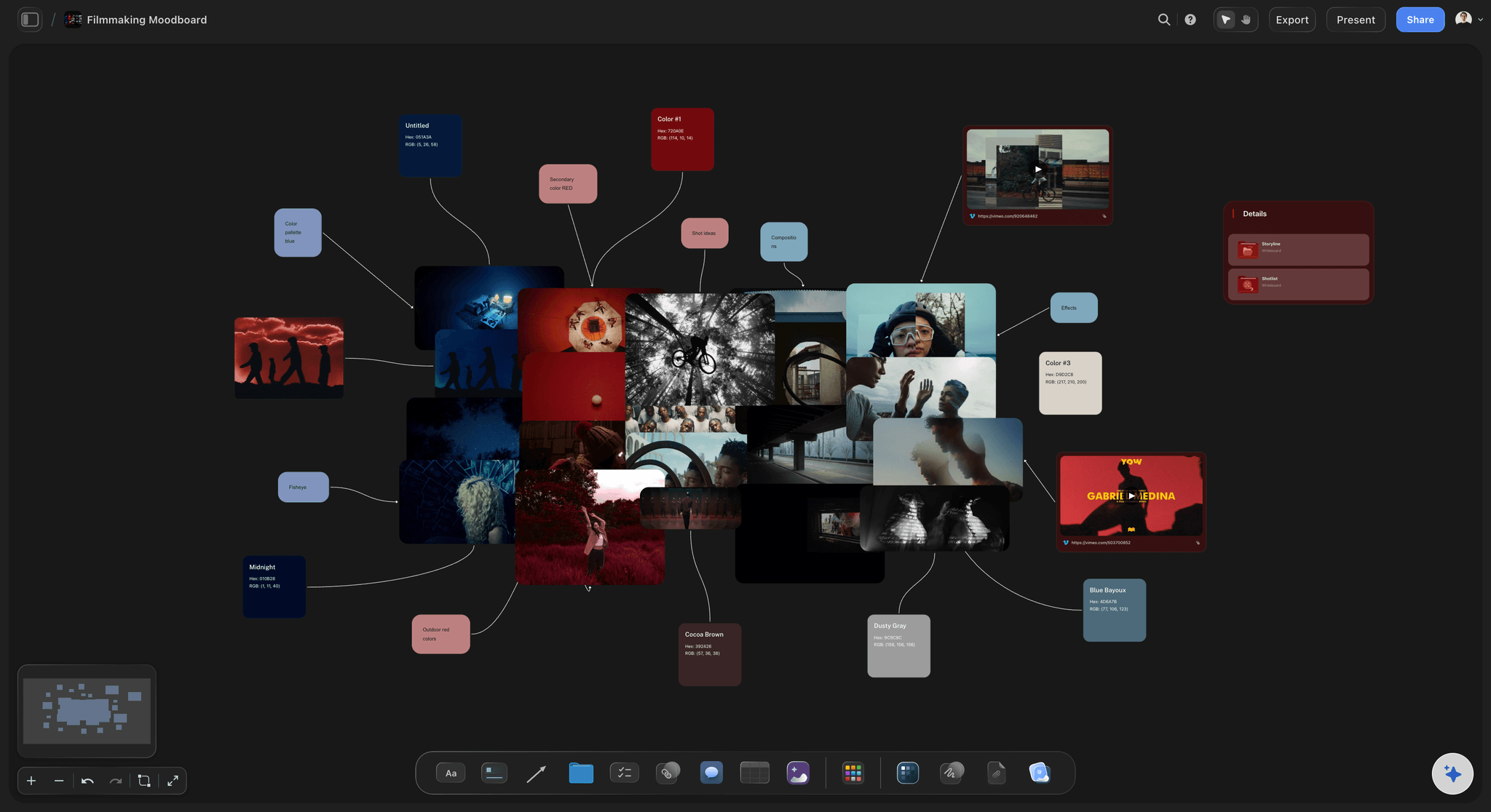
One board, no size limit
Room for the whole project
A campaign has a wall of references, a set of style frames, and a full storyboard. With a truly infinite canvas and no object cap, nothing gets cut for space and the whole project fits on one board.
See the infinite canvas →A free plan is coming. No object cap on paid plans.
Open a canvas and start building the look. Storyflow is paid-only during early access, with a free plan launching before the end of 2026, and every plan carries unlimited boards and no object cap, so a real campaign never runs you into a wall mid-prep.
Unlimited boards for moodboards, style frames, and storyboards
Basic AI usage to draft beats and storyboard panels
Attach references, PDFs, video, and grab frames from YouTube and Vimeo
Share the board view-only, or invite the studio to collaborate free
Built for people with taste
Everything a motion designer needs to prep, in one place.
Set the look and the brief, board the sequence, break down the shots, and hand it off so the whole team reads from the same board.
A look that stays live
A moodboard the whole project reads from
Pull references from anywhere: Grab stills straight from YouTube and Vimeo, drop in style frames and type treatments, and attach PDFs and links. The reference lands on the canvas, not in a shared drive nobody opens.
Group by direction: Cluster references, palettes, and style frames by look and recolor cards so the type, the color, and the motion feel read at a glance across a big board.
The look informs the boards: Keep the moodboard and style frames beside the storyboard the spot is built from, so the direction stays in view while you plan the sequence instead of living in a separate folder.
AI that reads your board
Draft a sequence without starting cold
Board from a prompt: Describe a spot and AI lays out beats and a storyboard as cards. It uses the current board as context, so the panels build on your moodboard and style frames rather than drifting generic.
Bring in the brief: Add up to five documents and three boards from the + menu, so the creative brief or a script shapes the panels the AI drafts.
Re-prompt to refine: Ask for tighter timing, more panels, or a different pacing on the sequence. The AI reworks the cards while keeping the panels you already adjusted by hand.
Boards to animatic to breakdown
Break the spot down on the canvas
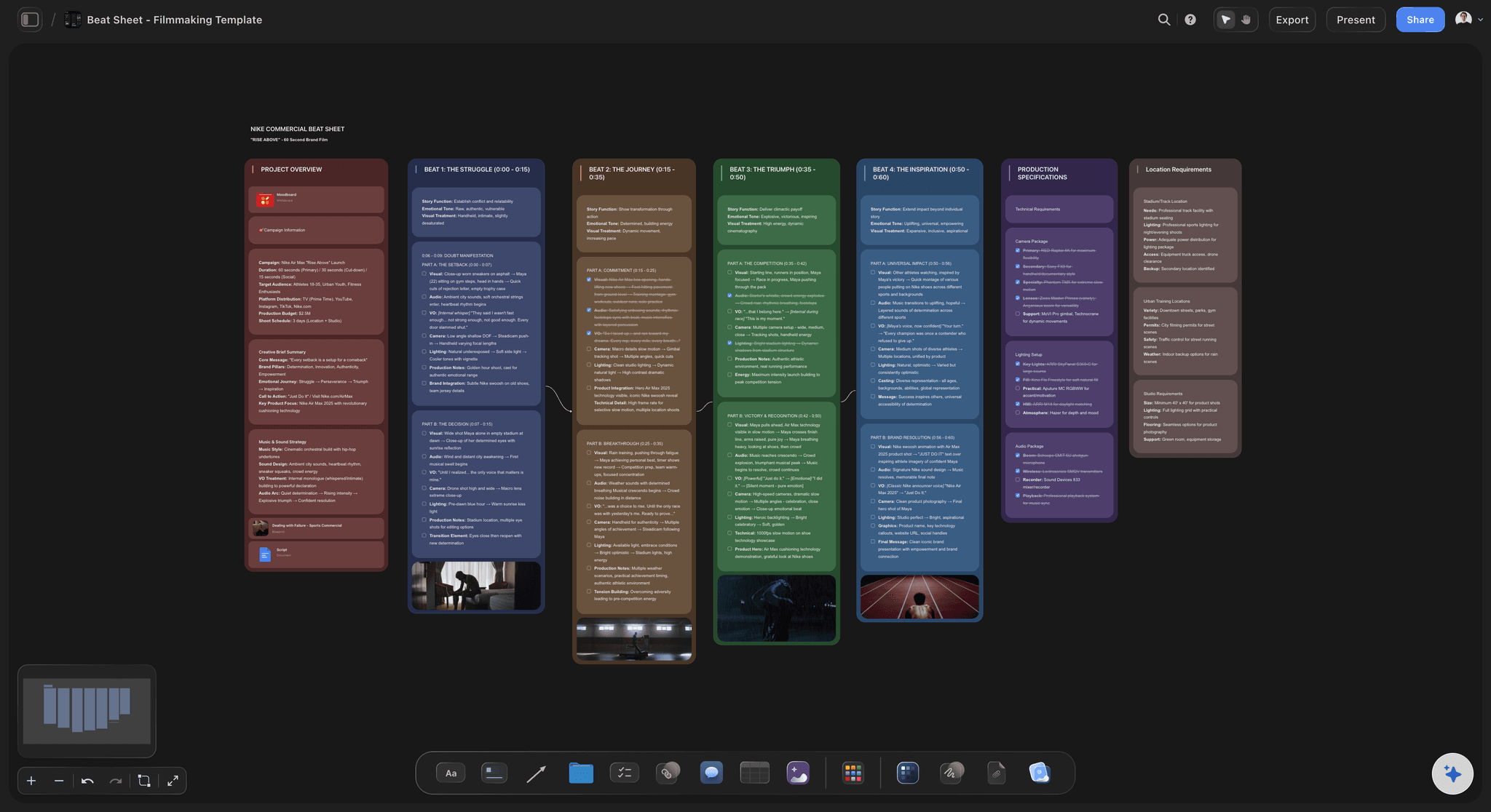
Beats before boards: Lay the spot out as beats first, then expand the ones worth boarding into a storyboard on the same canvas, so structure drives the panels rather than the other way around.
Panels in sequence: Arrange panels in reading order with timing and staging notes in view, and note where the animatic breaks fall. Reordering a sequence is a drag, not a re-cut export.
Shots and scenes: Break the locked storyboard into a shot and scene breakdown beside the panels, with the whole thing on one infinite canvas and no object limit.
Plan it and hand it off
From boards to a spot everyone can see
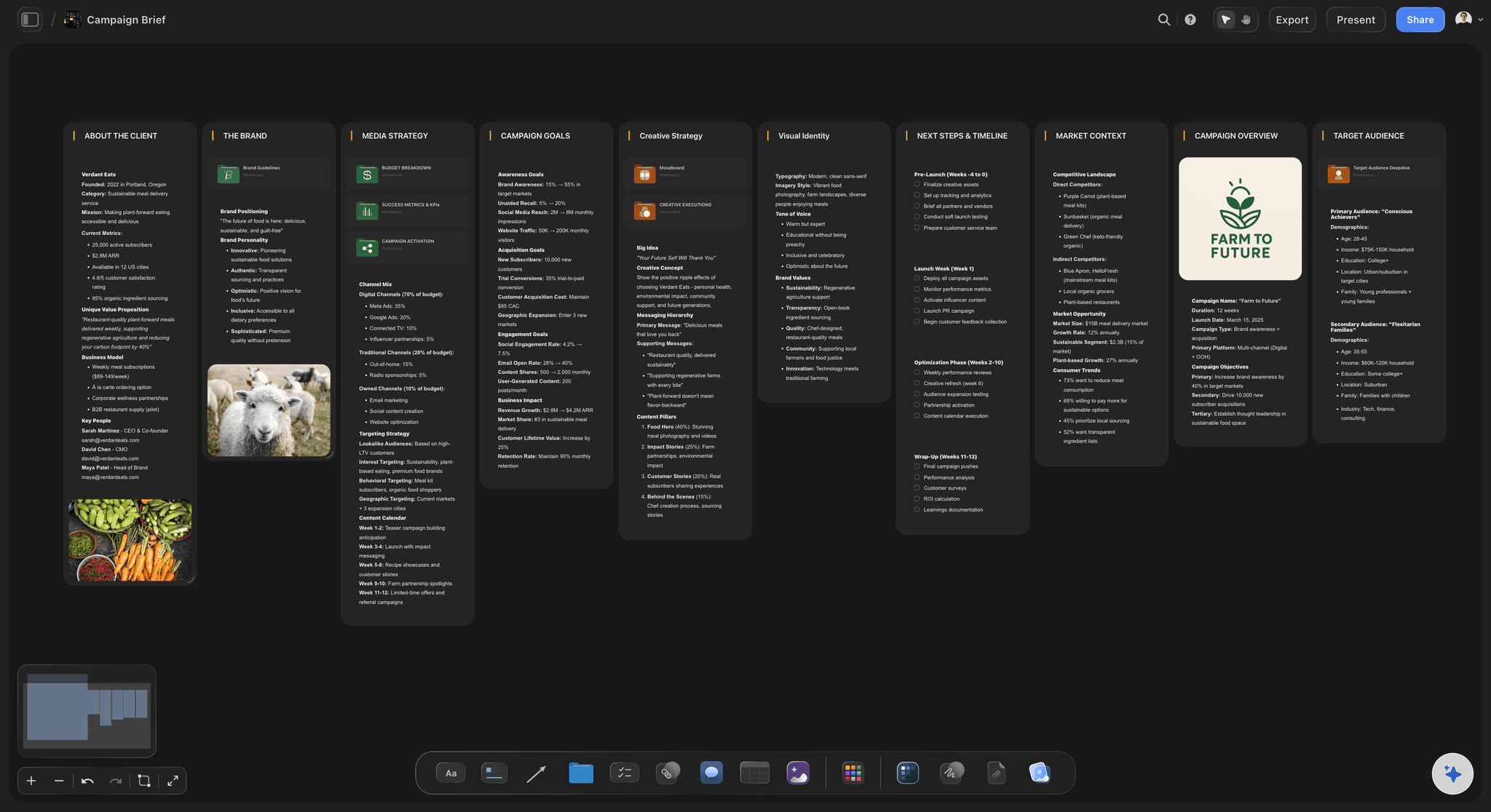
Turn boards into a plan: Convert the storyboard and shot breakdown into a production schedule on the same canvas, with the AI carrying your sequence across so the plan starts from real coverage.
Share view-only with the client: Send a view-only link so the client, director, or producer can walk the whole board in the browser without an account, and always see the current version.
Export for the pitch: Need the boards in a pitch or a treatment? Export the canvas as a clean image or a PDF in one step, ready to drop into a deck or a lookbook.
Explore templates for your project
Every template opens as a real, editable board on the infinite canvas. Pick the closest fit and make it your own.
Pre-Production
Pull the brief, script, shot list, and moodboard into one pre-production hub so the whole shoot is planned in one place.
One app instead of five
How Storyflow compares for motion design planning.
Plenty of tools cover one part of the prep. The question is whether the whole planning layer lives on one canvas that AI can fill.
Storyflow
Recommended
AI lays out beats and storyboards from a prompt
Moodboards, style frames, and boards on one infinite canvas
Grab reference frames from YouTube and Vimeo
No object cap on the canvas
Milanote
AI lays out beats and storyboards from a prompt
Moodboards, style frames, and boards on one infinite canvas
Grab reference frames from YouTube and Vimeo
No object cap on the canvas
Miro
AI lays out beats and storyboards from a prompt
Moodboards, style frames, and boards on one infinite canvas
Grab reference frames from YouTube and Vimeo
No object cap on the canvas
Notion
AI lays out beats and storyboards from a prompt
Moodboards, style frames, and boards on one infinite canvas
Grab reference frames from YouTube and Vimeo
No object cap on the canvas
What creators are saying
Join early creators getting structured workspaces and AI that remembers their projects
“Storyflow has sped up my workflow by at least 3x, which means more flow state and more projects I can actually ship. It truly changed the way me and my team create.”

Reilin Joey
Director & YouTuber
“One prompt gets me a structured board. But the tactics are my favorite. I run my YouTube scripts through them and my intros and retention got better. It's amazing.”

Justkay
YouTuber & Freelance Filmmaker
“I used to juggle five apps to plan a project. Now I describe what I am making and get boards, lists, and a schedule. All in one place.”

George
@fernwehchronicles
Motion design questions, answered.
Everything motion designers ask about planning a spot in Storyflow.
Storyflow is an AI visual workspace on an infinite canvas where the whole motion design planning layer lives together: style frames and reference moodboards, storyboards, animatic planning, shot and scene breakdowns, and the brief, all on one board. It runs in the browser with nothing to install, and AI can lay boards out from a prompt while reading the current canvas as context.
No, and it is honest about that. Storyflow does not keyframe, composite, or render motion graphics. It is the planning and pre-production layer around your motion tool: moodboards, style frames, storyboards, animatic timing, and shot breakdowns on one canvas, so the direction is clear before the animation gets built.
Both run the pre-production layer on one canvas, but this page centers motion design and mograph work: style frame boards, reference moodboards, animatic planning, and shot breakdowns for spots and design-in-motion. The animators page centers character animation, model sheets, and sequence coverage. Same infinite canvas, different starting boards.
Not during early access. Storyflow is paid-only right now, with a free plan launching before the end of 2026 that will include unlimited boards on an infinite canvas, no object cap, basic AI usage to draft beats and storyboards, 20 file uploads, and view-only sharing. Paid plans start at $9.99 per month, and anyone a paid member invites to a board joins free.
Yes. Describe a spot in the AI chat and Storyflow lays out beats and a storyboard as cards on the canvas. It reads the moodboard and style frames already on the canvas as context, so the sequence it drafts matches the look you set, and you can attach up to five documents and three boards such as a creative brief for it to work from. It plans the boards rather than animating the final spot.
Yes, and that is the point of working on one canvas. The style frames and moodboard sit beside the storyboard the spot is built from, so the type, color, and motion feel stay visible while you board the sequence instead of living in a separate folder. When the look changes, the boards next to it are right there to update.
Yes. Arrange storyboard panels in reading order with timing and staging notes in view, mark where the animatic breaks fall, and lay out a shot and scene breakdown beside the panels. Storyflow plans the timing and sequence. You take that plan into your motion tool to build the actual animation.
Yes. Send a view-only link so the client, director, or producer can explore the full board in the browser without an account, and always see the current version. You can also invite collaborators to build the board with you, and collaboration is unlimited on every paid plan.
The spot is in your head. Get the whole thing on one board.
Lock the look, board the sequence with AI, break down the shots, and share it view-only with the client. Paid-only during early access; free plan launches late 2026.