
The calmest place to shape your story
A life is not
a structure yet.
Lay your episodes out as cards, separate what happened from the order you will tell it, find the through line that makes it a book, and keep the photographs and documents beside the chapters they belong to.


Creatives working for these brands already got early access
- Red Bull
- Canon
- Artlist
- Porsche
See how easy it is to get started
Watch a real project come together, from a blank board to a finished plan, clicked through step by step.
Start from a ready-made template
Pick a board to see what you can build, then let AI fill it in. Every template is a real, editable starting point on the same infinite canvas.

Story Plan
Outline your plot, characters, and world in one connected view, then expand each thread as the story grows.
What is a memoir planner?
A memoir planner is a working surface for turning a life into a book. Storyflow is an AI visual workspace that plans a memoir on one infinite canvas: episodes as movable cards, chronology apart from the telling order, the through line, and photographs beside their chapters. The planner holds the episodes you might include as movable cards, the chronology of what actually happened, the separate and much more important question of what order to tell it in, the through line that gives the whole thing a reason to exist, and the material evidence: photographs, letters, documents, and the details you are afraid you will forget. It is not a diary and it is not a draft. It is the place where you decide which parts of a life are the book and which parts are simply things that occurred.
Memoir has one problem no other form shares. You already know everything, which sounds like an advantage and is the central difficulty. Fiction writers have to invent material and can therefore invent material that serves a shape. Memoirists have forty years of material, all of it true, none of it selected, and the temptation to include an episode because it happened is close to irresistible. Every experienced memoir editor says the same thing in different words: the book is not your life, it is an argument that uses your life, and the first job is deciding what the argument is.
Storyflow is an AI-native infinite canvas built for that kind of sorting. Describe the story you want to tell in a prompt and the AI lays out a structured board: sections for the through line, the episodes, the chronology, the cast, and the material. Then you work with your hands. Write a card per episode, drag them into piles, try one order and then another, mark the episodes that carry the through line and the ones that are just memory, and pin the photograph of the house next to the chapter set in it.
The reason a canvas suits memoir specifically is that a memoir is assembled rather than plotted. You are not building forward from a premise, you are looking at a pile of true things and finding the shape that was always in them. That is a spatial task. It wants cards you can push around, piles you can name and rename, and the ability to hold a possible structure loosely without committing it to a document. It also wants distance, and there is a real and slightly strange comfort in seeing the hardest years of your life as forty cards you can rearrange.
Ultra fast from brief to board
From a pile of memories to a book with a spine.
No chronological slog from birth, no document that grows to two hundred pages and loses its point.
01
Open a canvas
Sign up in seconds. No download. Your infinite planning canvas opens in the browser.
02
Describe the story you want to tell
Type what the memoir is really about and the period it covers, and the AI lays out sections for the through line, episodes, chronology, cast, and material, with cards to fill.
03
Card every episode, then sort
Write one card per episode, drag them into piles, and mark which ones carry the through line. The cards that fit nowhere are the ones the book does not need, however much they mattered.
04
Choose the order and write from it
Lay the telling order beneath the chronology, open a card into the document editor when a chapter is ready to draft, and share a view-only link with an editor or writing group.
Everything true, and only what belongs.
Episodes, chronology, through line, and evidence on one canvas.
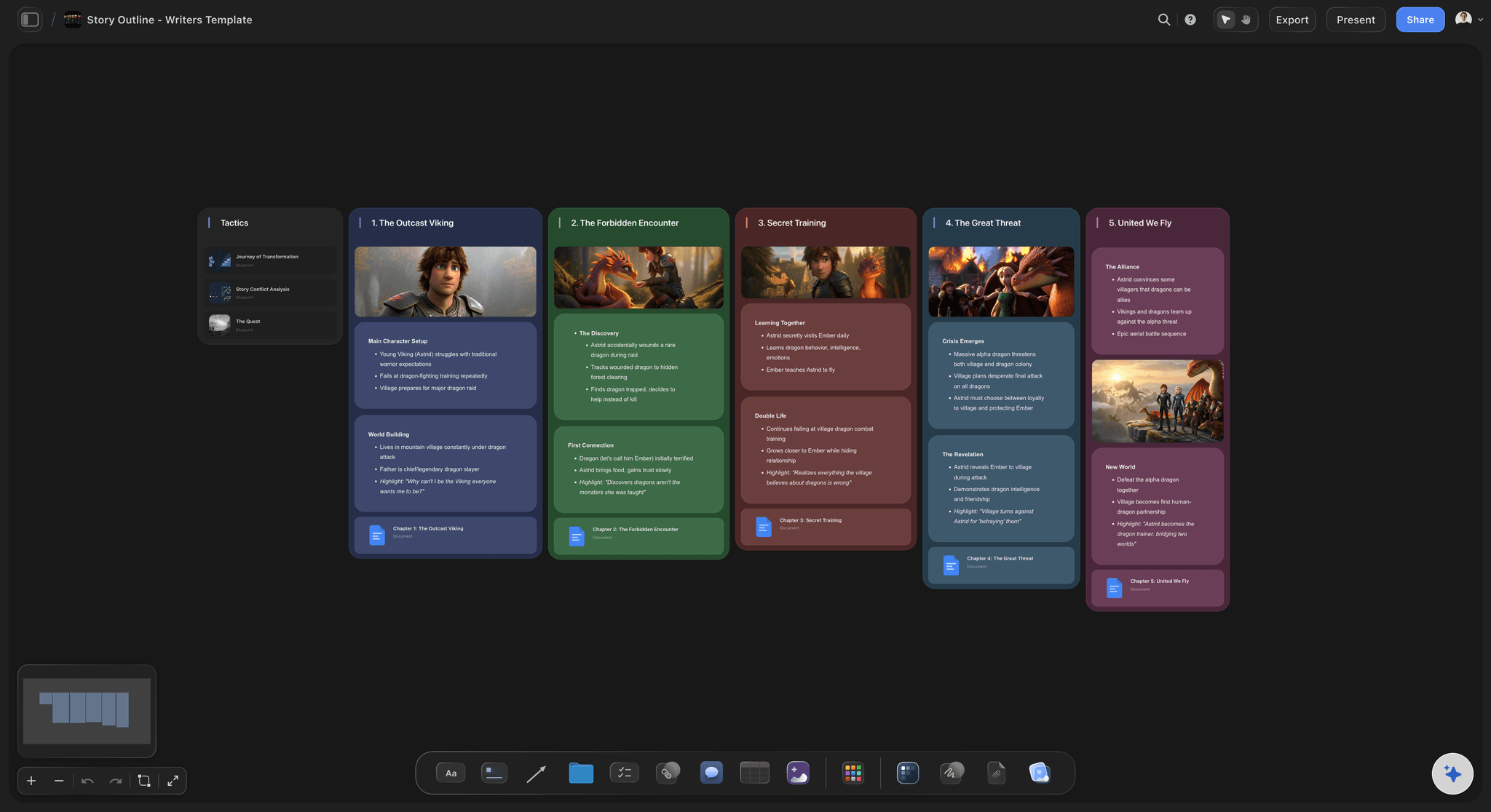
AI lays out the structure from what the book is about
Start from a shape, not a blank page
Describe the story you want to tell and the AI builds sections for the through line, episodes, chronology, and cast. Memoir stalls at the blank page more than any other form, and this removes it.
See the AI outline generator →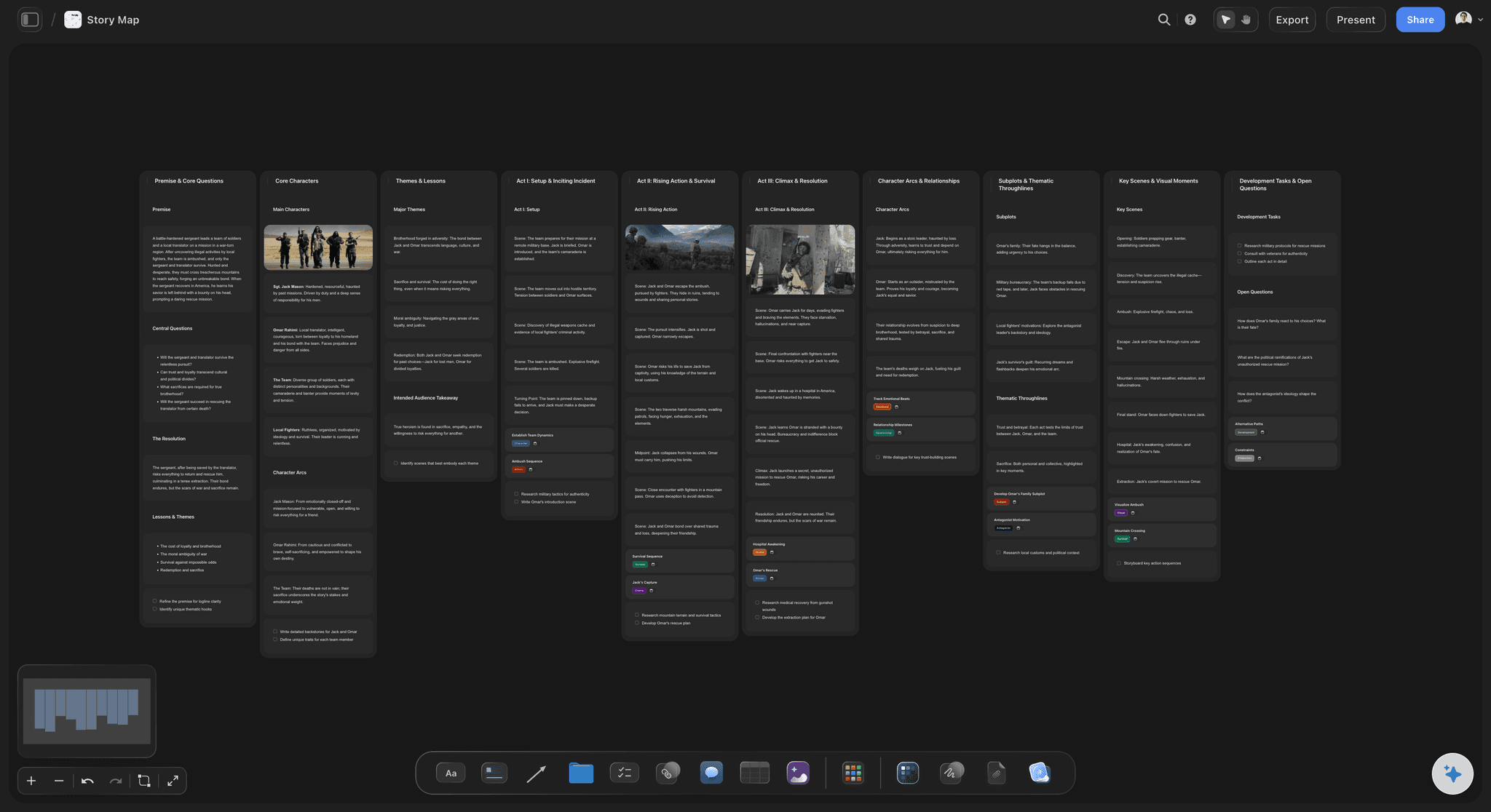
Chronology and telling order, separately
The order it happened is rarely the order it works
Run what happened along one line and what the reader meets along another. Almost every memoir that works opens in the middle, and the decision is easier when both orders are visible.
Explore the story timeline maker →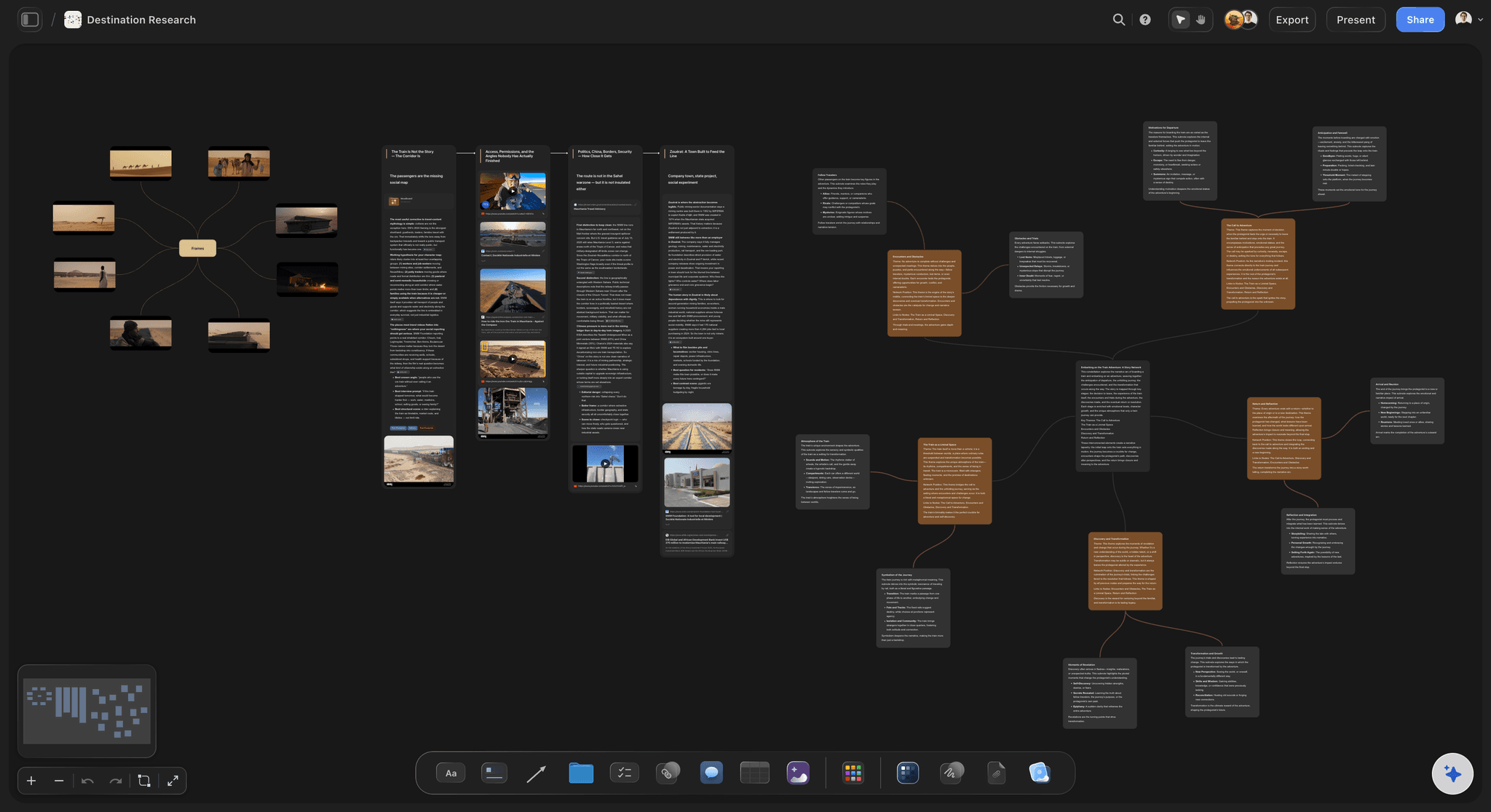
Photographs, letters, and documents in place
Keep the evidence beside the chapter
Pin the photograph, the letter, the medical record, or the map next to the episode it belongs to. Specific detail is what separates memoir from reminiscence, and detail decays fast from memory.
Try the book research organizer →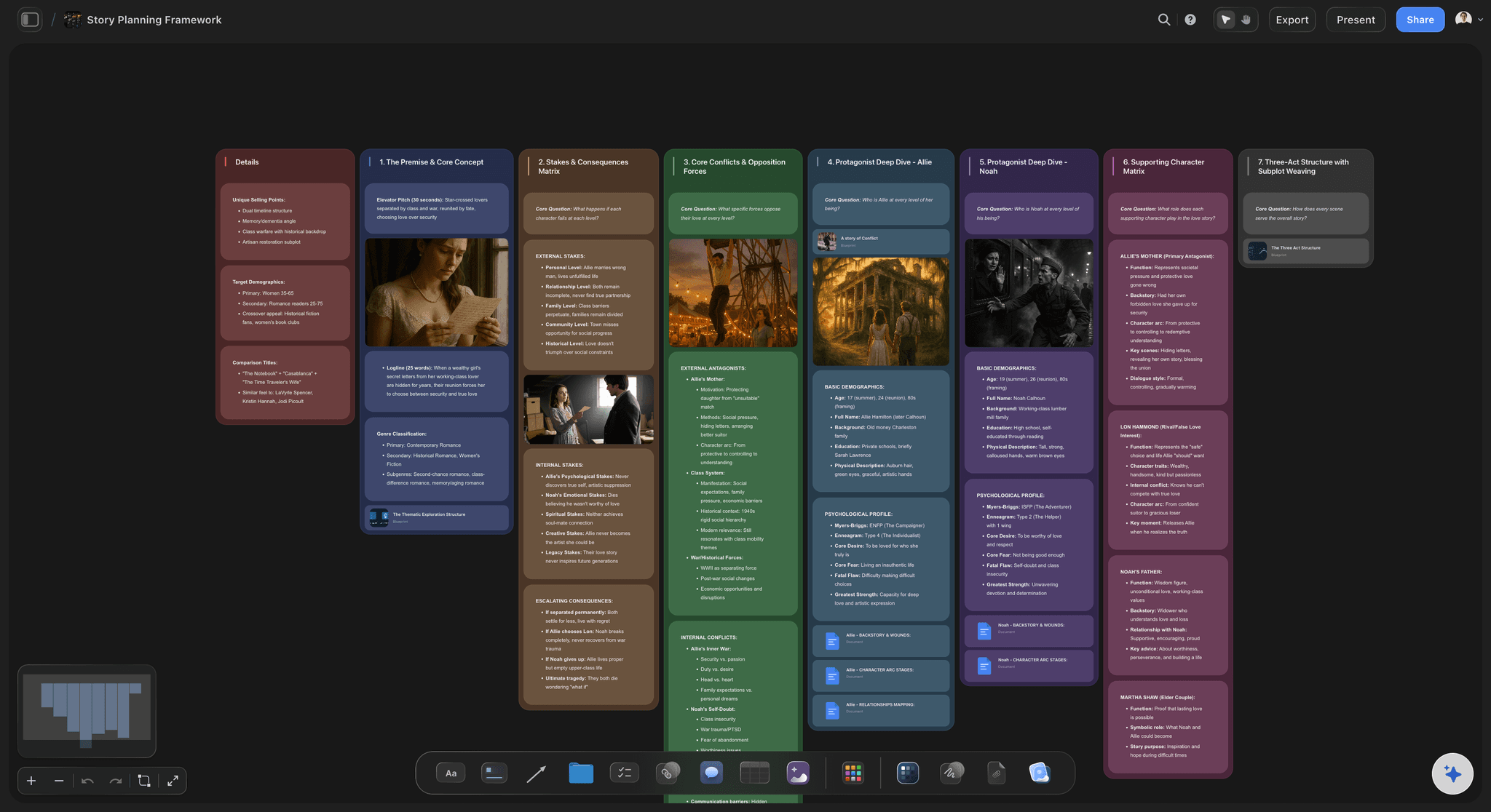
View-only links for editors and writing groups
Get structural help before you write the hard parts
Send a view-only link and an editor or writing partner sees the shape in a browser with no account. Structural feedback on a memoir is far kinder before the hardest chapters are drafted.
See Storyflow for authors →Unlimited boards. No object cap.
Open a canvas, describe the book, and start sorting episodes. Storyflow is paid-only during early access, with plans from $9.99 a month, and a Free plan launches before the end of 2026.
Unlimited planning boards on an infinite canvas
Basic AI usage to generate outlines and structures from prompts
Starter templates for story plans, outlines, and research boards
Share view-only links with editors and writing partners
Built for people with taste
More than a chronological document.
Starting at birth and writing forward is how most memoirs die at chapter nine.
Through line, episodes, chronology, cast, evidence
Work across every layer of the book
The through line, written down: One sentence saying what the book is actually about, kept visible on the canvas. Every episode gets tested against it, and the ones that fail the test are the ones that make readers put a memoir down.
Episodes as cards, not chapters: Card each thing that happened, one line each, before deciding what any chapter is. Chapters are a conclusion; episodes are the raw material, and mixing them up is how a life becomes a slog.
Chronology kept separate: Hold what happened when on its own line, so you can consult it for accuracy without being ruled by it. Memoir needs the facts straight and the telling free.
The cast, and their consent: Track who appears, how identifiable they are, and whether you have spoken to them. Memoir is the only form where structure decisions are also decisions about other people's lives.
AI that can see the board you have already built
Find the shape with an AI that has the context
Prompt against the whole canvas: Ask it to group your episodes into candidate parts, propose an opening that is not the beginning, or suggest which cards a stated through line actually needs. It reads the board you have made.
It structures, it does not write your life: Storyflow lays out and organizes. The voice stays yours, and in memoir the voice is not a stylistic preference, it is the entire reason a reader trusts the book.
Iterate without losing work: Re-prompt as often as you want. Episodes you have written and sorted stay exactly where they are while the AI builds around them.
Selection is the work
Decide what the book leaves out
A pile for what is not in the book: Give the cut episodes a named region of the canvas rather than deleting them. Nobody can cut a true thing they lived through if the only option is destroying the card.
Test every episode against the through line: Mark each card as carrying the through line, supporting it, or unrelated. The unrelated pile is usually large, and it is usually where the book has been hiding.
Two structures, side by side: Lay one arrangement out as chronological and another as thematic and look at both. Most memoirs are one or the other, and choosing while you can see both is much easier than choosing in the abstract.
From plan to draft
Write the chapter without leaving the board
Open a card into a full document: When a chapter is ready to be written, expand it into the built-in document editor. The board stays beside it, so the shape remains visible while the prose grows.
Keep the evidence in view: The photograph, the letter, the ticket stub sits next to the chapter it belongs to while you draft. Concrete detail is most of what makes a memory readable rather than merely reported.
Rebuild the board after the draft: Card what you actually wrote and compare it to the plan. Memoir drafts drift toward the material that was easiest to write, and the drift is invisible until you lay it out again.
Explore templates for your project
Every template opens as a real, editable board on the infinite canvas. Pick the closest fit and make it your own.
Story Plan
Outline your plot, characters, and world in one connected view, then expand each thread as the story grows.
One app instead of five
Storyflow vs Scrivener, Notion, and a document.
Be clear about what Storyflow is. It does not compile a manuscript, and it is not a private journal application. It is where the book gets its shape.
Storyflow
Recommended
Infinite canvas with movable episode cards
AI lays out a structure from what the book is about
Photographs and documents beside the chapters
Manuscript compile and ebook export
Journaling and daily writing prompts
Free plan available today
Scrivener
Infinite canvas with movable episode cards
AI lays out a structure from what the book is about
Photographs and documents beside the chapters
Manuscript compile and ebook export
Journaling and daily writing prompts
Free plan available today
Notion
Infinite canvas with movable episode cards
AI lays out a structure from what the book is about
Photographs and documents beside the chapters
Manuscript compile and ebook export
Journaling and daily writing prompts
Free plan available today
Word document
Infinite canvas with movable episode cards
AI lays out a structure from what the book is about
Photographs and documents beside the chapters
Manuscript compile and ebook export
Journaling and daily writing prompts
Free plan available today
What creators are saying
Join early creators getting structured workspaces and AI that remembers their projects
“Storyflow has sped up my workflow by at least 3x, which means more flow state and more projects I can actually ship. It truly changed the way me and my team create.”

Reilin Joey
Director & YouTuber
“One prompt gets me a structured board. But the tactics are my favorite. I run my YouTube scripts through them and my intros and retention got better. It's amazing.”

Justkay
YouTuber & Freelance Filmmaker
“I used to juggle five apps to plan a project. Now I describe what I am making and get boards, lists, and a schedule. All in one place.”

George
@fernwehchronicles
Memoir questions, answered.
How to find the through line, what to leave out, and where Storyflow fits alongside your writing app.
Scrivener is the traditional answer and it is well suited to the drafting half, with a binder for chapters, a research folder, and compile at the end. Notion works if you want a searchable database of episodes with fields you can filter. A plain document is what most memoirs actually start in, and it is where a lot of them stop, because a document forces one order and memoir's central problem is choosing the order. Storyflow covers the sorting stage: episodes as cards you push around, chronology held separately from the telling, the through line pinned where you cannot ignore it, and the photographs beside the chapters they belong to.
Card every episode first, one line each, and resist naming the theme while you are doing it. Then sort the cards into piles by what they are about rather than when they happened, and look at the largest pile. The through line is usually hiding there, and it is usually more specific and less flattering than the one you would have written in advance. Write it as a single sentence, put it at the top of the canvas, and test every card against it. If you cannot state it in a sentence, the book is not ready to be written yet, and no amount of drafting will substitute for that sentence.
Usually not, and this is the most common structural mistake in unpublished memoir. Starting at birth and moving forward means opening with the least interesting material and asking a reader to trust you for eighty pages. Most memoirs that work open at a moment of maximum pressure and then reach backward for what the reader needs, or organize thematically with chronology handled inside each part. Keep the true chronology on the canvas so you can check facts, and lay a separate telling order beneath it. Seeing the two lines side by side turns this from an anxious question into a design choice you can try both ways.
Not during early access. Storyflow is paid-only right now, with plans starting at $9.99 a month, and a Free plan for solo use launches before the end of 2026. Anyone a paid member invites to a board joins free today, so an editor, a writing partner, or a family member can read and comment without paying. If you need free this minute, Notion's free tier will hold an episode database and photographs, and Google Docs costs nothing. Neither lets you sort a life into piles by dragging it around, which is the specific thing memoir planning needs, but both are honest free options.
Far less than happened, and the discipline of leaving things out is most of the craft. The test is whether an episode serves the through line, not whether it was important to you, because those are different questions and memoir writers conflate them constantly. Give the excluded material its own named region of the canvas rather than deleting it: almost nobody can cut a true and painful thing they lived through if the only available action is destroying the record of it. Moving a card to a pile called not this book is psychologically survivable in a way that deleting it is not.
Track them deliberately rather than discovering the problem in copy-edit. Keep a section of the canvas listing everyone who appears, how identifiable they are, whether they are alive, whether you have spoken to them, and what they would recognize. Some of this is legal and your publisher will have views, but most of it is a set of decisions you should make consciously while planning rather than defensively after a draft exists. Storyflow does not offer legal advice and cannot tell you what is defensible in your jurisdiction; what it can do is make sure the question is visible on the board instead of arriving as a surprise.
You describe what the book is about, the period it covers, and the episodes you already know you want. The AI lays out a structured board from that, with sections for the through line, episodes, chronology, cast, and material, plus cards ready to fill. From there it uses the whole board as context, so once you have carded your episodes you can ask it to group them into candidate parts, propose an opening that is not the beginning, or point out which cards a stated through line does not need. It structures and organizes; it does not write your life, and the voice stays entirely yours.
Yes, and for memoir this matters more than for fiction. Pin the photograph of the house, the letter, the hospital form, the school report, the map of the street, next to the episode it belongs to. Concrete detail is what separates memoir a reader can see from memoir a reader is merely told about, and detail decays from memory faster than the events do. Having the evidence beside the chapter while you draft means the specific things, the wallpaper, the make of the car, the exact wording, arrive in the sentence rather than being replaced by a general impression.
Yes. Send a view-only link and they open the whole structure in a browser with no account, and can sign in to comment on individual episodes. For memoir this is worth doing early, because structural feedback delivered before the hardest chapters are written is far kinder and far more useful than the same feedback after. If a collaborator should genuinely contribute, a ghostwriter, a co-author, a family member supplying dates, invite them to the canvas and they join free. Sharing, commenting, and reviewing work on every paid plan.
That is the ideal moment to do this. The most common way a memoir fails is that someone writes two hundred chronological pages, feels the absence of a spine, and cannot face rebuilding. Carding episodes before drafting costs an afternoon or two and answers the questions drafting cannot: what the book is about, where it opens, what is not in it. You are also allowed to card badly at first, because a card is a line of text and rewriting it is free. Start by writing one line for every episode you can remember caring about, without judging any of them, and sort afterwards.
Find the book inside the life.
Open a canvas, describe what the memoir is about, and let AI lay out the structure. No download.