
FOR CONFERENCE ORGANIZERS
A conference is a content product
with a hard date.
Put the programme, the speaker pipeline, the run of show for every room, the sponsor deliverables, and the marketing calendar on one canvas, so the fifty small unresolved things do not all arrive in the same week. Storyflow is paid-only during early access, with plans from $9.99 a month, and a Free plan launches before the end of 2026.
Plans from $9.99/mo
Invite your committee free
Works in your browser

Used by creative professionals at:
Artlist
Pixar
Nike
Red Bull
The North Face
Porsche
Start from a ready-made template
Pick a board to see what you can build, then let AI fill it in. Every template is a real, editable starting point on the same infinite canvas.
Commercial Moodboard
Pin references, palettes, and tone for a commercial so the look is clear before the shoot.
What conference organizers actually do
Organizing a conference means shipping a content product on a fixed date inside a venue contract you signed before you knew what the content would be. Storyflow gives conference organizers one infinite canvas where the programme, the speaker pipeline, the run of show, the sponsor deliverables, the marketing calendar, and the AV plan all sit beside each other instead of in six tools that do not know about one another. The date does not move. The room count does not move. The catering guarantee is due whether or not your keynote has confirmed. Everything else is you, holding a great many small commitments in your head and hoping none of them fall out.
The hardest part is not any single task. It is that the tasks are wired together and the wiring is invisible. A speaker dropping out is not one problem, it is four: a hole in the grid, a session description already printed in the programme, a sponsor who bought a slot next to that talk, and a marketing email scheduled to promote it. A room change is not one problem either, it is a new AV setup, a new capacity, a new signage plan, and a run of show that no longer matches what the crew rehearsed. When those threads live in separate documents, the connection only becomes visible at the moment it breaks.
Storyflow is an AI-native infinite canvas, which fits this job because the job is a set of parallel tracks that all point at the same weekend. Describe your conference and the AI lays out a programme grid, a speaker pipeline, a production timeline, and a first draft run of show, using the whole board as context rather than one card at a time. Then you pull in your real material: the session abstracts, the speaker bios and headshots, the venue floor plans, the sponsor contracts, the AV rider, the slide decks as they arrive. Because it is one canvas, the session grid sits next to the speakers filling it and the sponsor deliverables sit next to the marketing calendar that has to carry them. You share it by link with your committee, and anyone a paid member invites joins free, so a volunteer or a speaker liaison can work on the board without a seat cost.
A conference board that actually holds a conference carries six named workstreams: the programming (the call for papers or the invitation list, the review process, and a schedule where the two talks everyone wants are not opposite each other), the speaker pipeline (bios, headshots, abstracts, slide decks, AV requirements, and travel, chased from people who are mostly doing you a favour), the run of show for each room (the minute by minute order of every session and, more importantly, the transitions between them), the sponsor deliverables (everything sold months ago that must be visibly honoured on the day), the marketing content calendar (announcement, speaker reveals, agenda drop, last call, and the on-site and post-event content), and the AV and recording plan (which decides whether you have anything to publish afterwards). Storyflow keeps all six visible at once.
HOW IT WORKS
From a date and a room count to a conference you can see.
No folder structure to invent. Describe the event, pull the real material in, and build outwards from the grid.
01
Open a canvas
Sign up in seconds, from $9.99 a month. No download. Your infinite planning canvas opens in the browser, and inviting your co-chair, your volunteers, or your speaker liaison to it costs nothing.
02
Let AI lay out the structure
Give it the dates, the number of tracks, the room count, and the rough attendee number. It lays out a programme grid, a speaker pipeline with the items you have to collect, a production timeline, and a first draft run of show, so you are correcting a structure rather than inventing one.
03
Pull the real conference onto the board
Drag in submissions and abstracts, speaker bios and headshots, the venue floor plan, the AV rider, the sponsor contracts, and the slide decks as they land. Put each speaker beside the session they are filling, and each sponsor deliverable beside the moment it happens.
04
Share it and work the last two weeks calmly
Give the committee edit access, give the venue and the AV crew a view-only link to the run of show, and export the room schedules. The fifty small things still arrive, but they arrive somewhere you can see all of them at once.
Every track of the conference, on one canvas.
Programme, speakers, run of show, sponsors, and marketing side by side instead of in five separate tools.
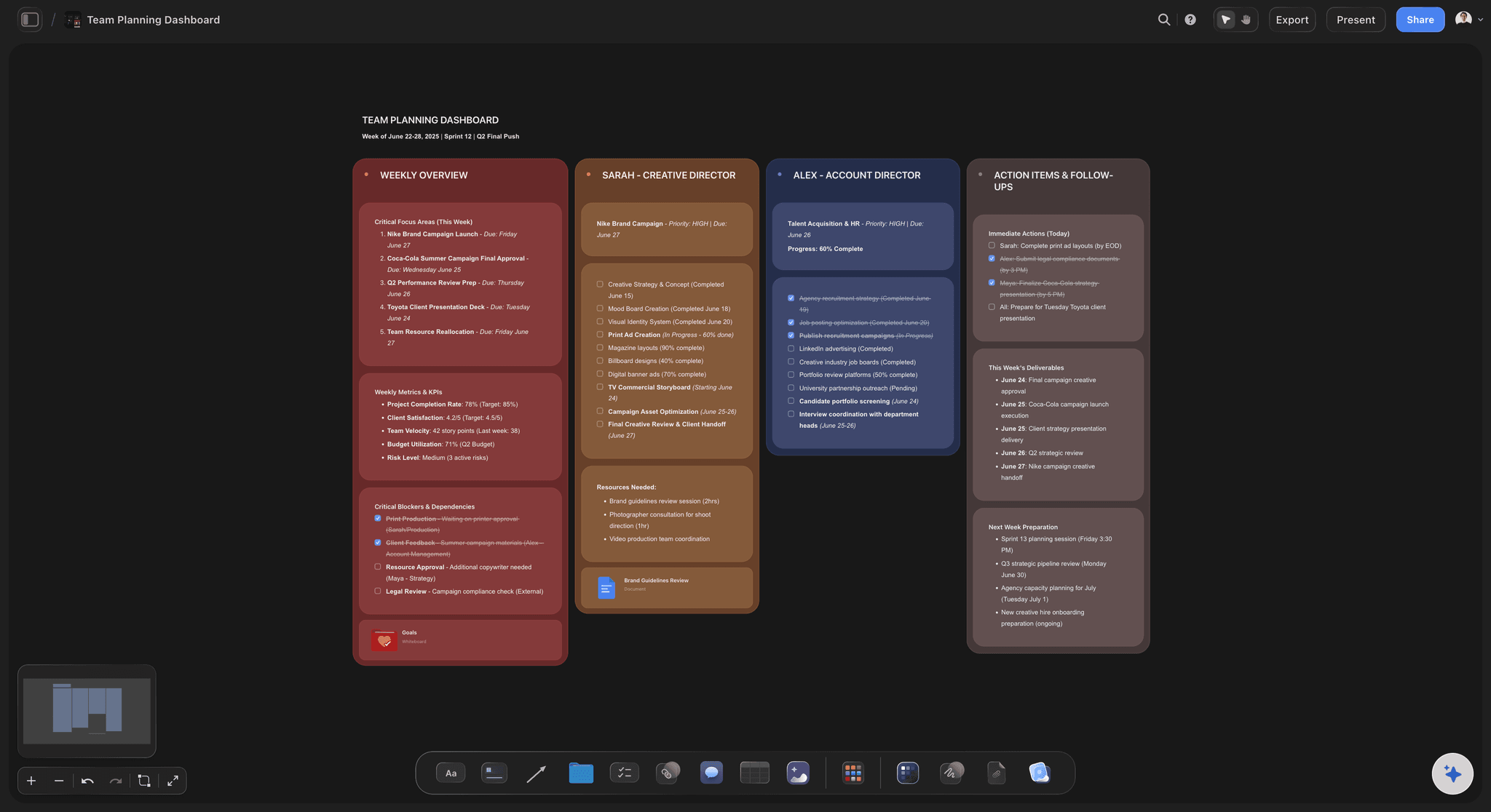
The whole event, planned in one place
Start from the event planning board
Budget, venue, catering guarantees, registration deadlines, and the production timeline are the frame everything else hangs on. Build that first, then let the programme and the marketing calendar grow out of it rather than beside it.
See the AI event planner →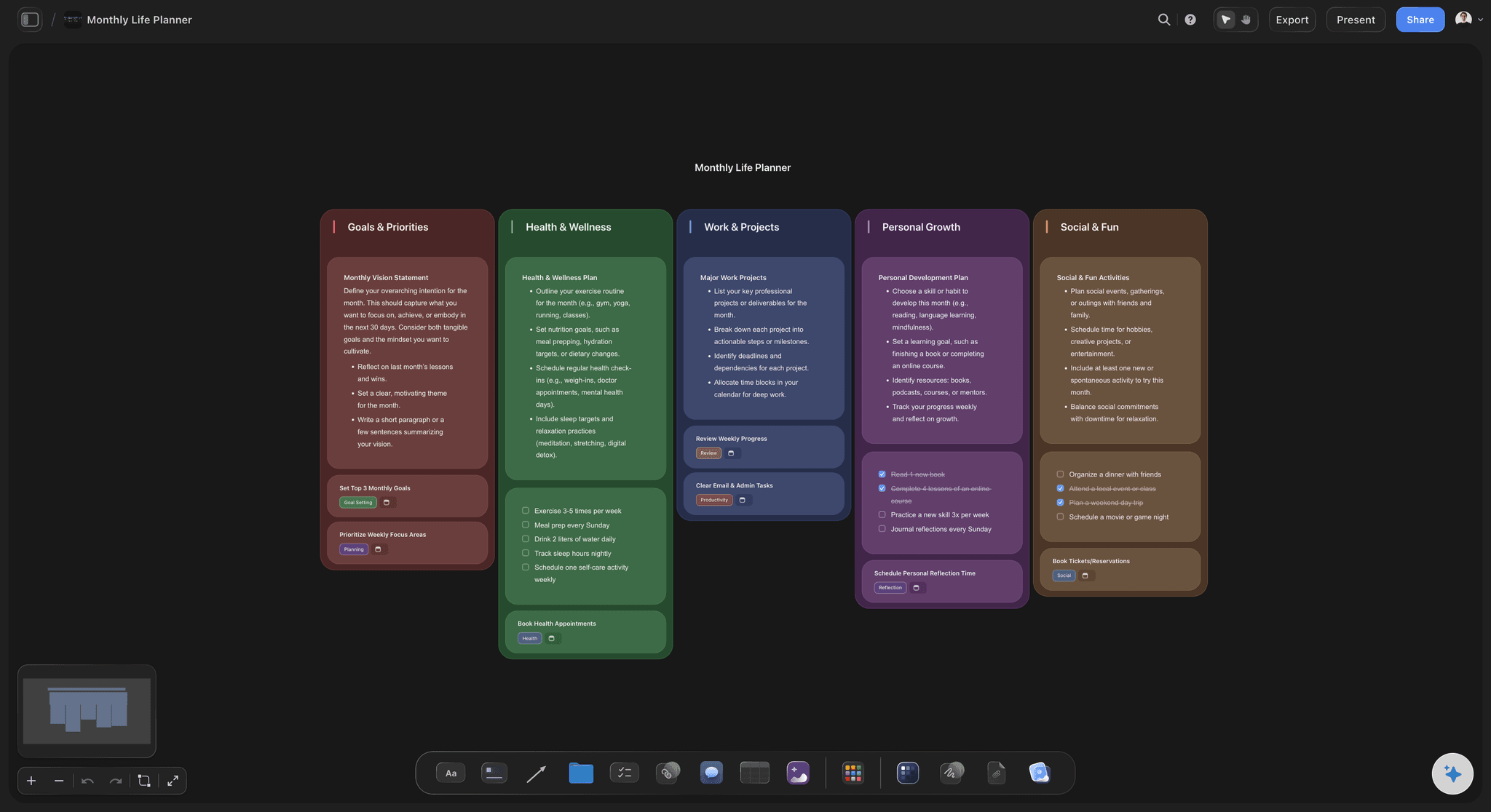
Every room, minute by minute
A run of show per room, including the transitions
Sessions are the easy part. The five minutes between them are where conferences actually go wrong: the mic swap, the laptop handover, the next speaker who is still in the corridor. Lay each room out with a named owner on every cue.
Generate a run of show →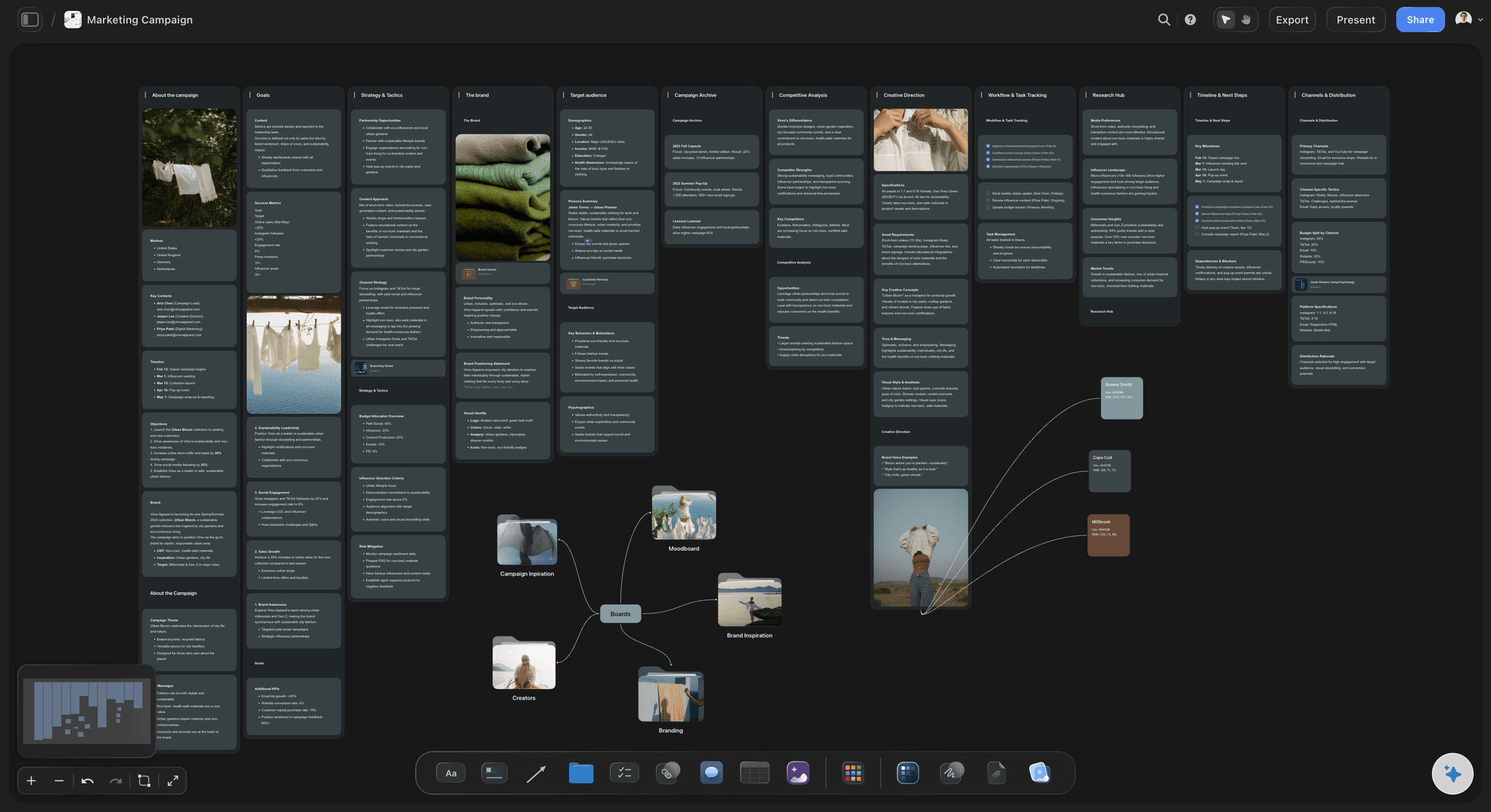
Announcement to last call
The marketing calendar that carries the event
A conference sells in waves: announcement, speaker reveals, agenda drop, early bird ending, last call. Each wave needs assets, and half of them depend on speakers confirming. Keep the calendar next to the speaker pipeline so you know what you can actually promote this week.
See the campaign calendar →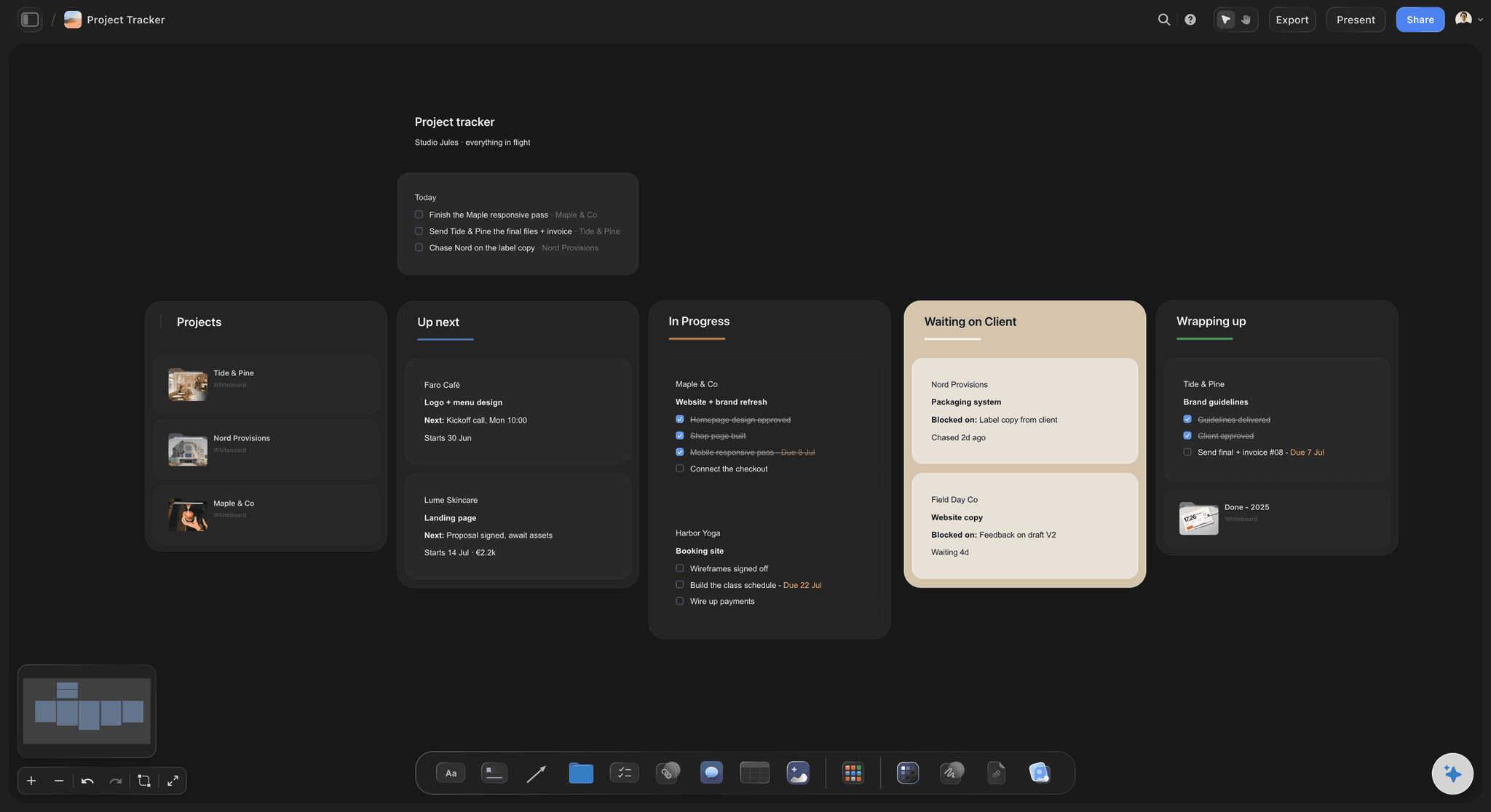
Deadlines that come from lead times
A production timeline built backwards from the doors opening
Print deadlines, badge orders, catering guarantees, signage, and the AV load-in all have lead times that ignore your enthusiasm. Place them backwards from the first session rather than forwards from today, and the crunch stops being a surprise.
Explore the production calendar →Unlimited boards. No object cap.
Open a canvas, describe the conference, and hold every workstream in one place. Storyflow is paid-only during early access, with plans from $9.99 a month, and a Free plan launches before the end of 2026.
Unlimited conference boards on an infinite canvas
Basic AI usage to draft a programme, timeline, and run of show from a prompt
3 starter frameworks built in
Invite your committee, volunteers, and speaker liaison to the board free
BUILT FOR THE HARD PARTS
The difficult parts of a conference are not the venue tour.
Nobody struggles with booking a room. They struggle with a grid that will not settle and a speaker who has not sent a headshot in six weeks.
Programming is a judgement problem, not a form
Build a programme people actually want to attend
The call for papers and the invitation list are two different pipelines: Open submissions give you volume, range, and a fairness story. Direct invitations give you the names that sell tickets. Most conferences run both at once and then discover the reviewed track and the invited track were never compared against each other, so the programme has three talks on the same subject and nothing on the one people asked for.
Review needs a rubric written before the first submission arrives: Without one, review becomes a taste contest that different reviewers score on different axes. Agree what you are scoring: relevance, originality, the speaker's ability to deliver it, and whether it fills a gap in the grid. Put the scores on the board next to the sessions so the shape of the programme is visible while you can still change it.
Scheduling is where the real damage happens: Two strong talks opposite each other means half the room misses one and both speakers feel undervalued. So does putting the deep technical session immediately after lunch, or scheduling the beginner track opposite the only other beginner talk. Lay the grid out visually and the clashes become obvious in a way a spreadsheet never makes them.
Leave a hole on purpose: Someone will drop out. Keeping one reserve session ready, and one flexible slot in the grid, turns a cancellation from a crisis into a swap. Note the standby speakers on the board beside the grid rather than in a private message thread nobody else can find.
Chasing people who are doing you a favour
The speaker pipeline is the longest-running job you have
Every speaker owes you six things and will send them in random order: A bio, a headshot, a session title, an abstract, a slide deck, and their AV requirements. Some arrive the day they confirm, some arrive after four reminders, and one arrives during the coffee break before their talk. A single view of who owes what is the difference between three chases and thirty.
Tone matters because they are not employees: Most speakers are unpaid, busy, and doing this partly as a favour. Chasing works best when the ask is specific, the deadline is real and explained, and the reason is obvious: the programme goes to print on this date, the website needs the headshot for the reveal post. Keep the reason attached to the request so whoever sends the reminder can say it.
AV requirements are collected late and then cost you an hour: Whether they need audio from the laptop, a clicker, a confidence monitor, a specific adapter, a live demo with internet, or their own machine on stage. Ask at confirmation, not the week before, and put the answer on the speaker card where the AV crew can read it without an email chain.
Deck deadlines exist to protect the transitions: A slide deck that arrives on the morning cannot be loaded onto the house machine, which means a laptop swap, which means the changeover that was supposed to take four minutes takes eleven. Set a deck deadline, state why, and track it on the board so the AV plan is not a guess.
Sold in March, delivered in October
Sponsor deliverables have to be visibly honoured
The promise was made months before the plan existed: Logo placement, a stage mention, a workshop slot, a booth position, an attendee list, a scanned lead count, a slide in the holding loop. Each was sold by someone in a conversation, and each has to be true on the day. Write every deliverable on the board attached to the moment it happens, not in the contract PDF only the salesperson has read.
Sponsor content is content, so it belongs in the calendar: A sponsored session needs promoting like any other session. A logo needs to be on the right assets before they ship. Keeping sponsor obligations inside the marketing calendar rather than beside it is what stops the awkward post-event email asking why their name was not on the agenda page.
Booth logistics have their own lead times: Access times, power, wifi credentials, shipping addresses for their materials, furniture, and who lets them in on the morning. None of it is complicated and all of it is a phone call at seven in the morning if it was never written down where the venue team can see it.
Photograph what you promised, on the day: The renewal conversation happens with evidence. A shot of their branding in the room, their stage mention, their busy booth, and the session they sponsored is worth more than a spreadsheet of numbers. Put a capture list on the run of show so somebody is actually assigned to take them.
The day, and whether you have anything afterwards
Run of show, transitions, and the recording plan
Write a run of show per room, not one for the event: Each room has its own chair, its own AV operator, and its own sequence. One combined document forces everybody to read past the parts that are not theirs, which is exactly how a cue gets missed. One page per room, with the doors, the intro, the talk, the questions, and the changeover, each with a name beside it.
The transitions are the part that breaks: Mic handover, laptop swap, the next speaker being found, the chair's introduction, the room being reset, the overrunning question that eats the changeover. Budget real minutes for each of these and the day holds. Assume they are instant and every room drifts by twenty minutes before lunch.
Decide the recording plan before the day, not during it: Whether every room is recorded or only the main stage, whether you capture a clean feed of the slides, whether speakers have consented, whether questions from the floor are picked up on a mic, and who holds the files afterwards. This single set of decisions determines whether you have a year of content or a folder of unusable footage.
Plan the on-site and post-event content while you can still staff it: Photography, social clips, quote cards, and the recap post all need somebody assigned in advance, because on the day everyone is busy. Put the capture list on the run of show so it competes for attention at the same time as everything else rather than after everything else.
Explore templates for your project
Every template opens as a real, editable board on the infinite canvas. Pick the closest fit and make it your own.
Commercial Moodboard
Pin references, palettes, and tone for a commercial so the look is clear before the shoot.
HOW WE COMPARE
Storyflow vs Notion, Airtable, and Trello.
Every conference team already uses at least one of these, and for good reason. Here is the honest split.
Storyflow
Recommended
Programme grid, speakers, sponsors, and run of show on one canvas
AI drafts a programme, timeline, and run of show from a prompt
Visual clash checking across tracks and rooms
Structured database with filtered views and formulas
Long-form documentation, wikis, and meeting notes
Mature automations and third-party integrations
Notion
Programme grid, speakers, sponsors, and run of show on one canvas
AI drafts a programme, timeline, and run of show from a prompt
Visual clash checking across tracks and rooms
Structured database with filtered views and formulas
Long-form documentation, wikis, and meeting notes
Mature automations and third-party integrations
Airtable
Programme grid, speakers, sponsors, and run of show on one canvas
AI drafts a programme, timeline, and run of show from a prompt
Visual clash checking across tracks and rooms
Structured database with filtered views and formulas
Long-form documentation, wikis, and meeting notes
Mature automations and third-party integrations
Trello
Programme grid, speakers, sponsors, and run of show on one canvas
AI drafts a programme, timeline, and run of show from a prompt
Visual clash checking across tracks and rooms
Structured database with filtered views and formulas
Long-form documentation, wikis, and meeting notes
Mature automations and third-party integrations
What creators are saying
Join early creators getting structured workspaces and AI that remembers their projects
“Storyflow has sped up my workflow by at least 3x, which means more flow state and more projects I can actually ship. It truly changed the way me and my team create.”

Reilin Joey
Director & YouTuber
“One prompt gets me a structured board. But the tactics are my favorite. I run my YouTube scripts through them and my intros and retention got better. It's amazing.”

Justkay
YouTuber & Freelance Filmmaker
“I used to juggle five apps to plan a project. Now I describe what I am making and get boards, lists, and a schedule. All in one place.”

George
@fernwehchronicles
Conference planning questions, answered.
How to build a programme, what a run of show is, what to chase from speakers, and what this tool does not do.
Decide the shape before the content: how many days, how many parallel tracks, how long a session runs, and how long the changeover between sessions takes. Then fill it. Run your call for papers and your direct invitations as one pipeline so the reviewed and invited talks are compared against each other. Score submissions against a rubric agreed in advance. Lay the accepted talks onto a visible grid and check for clashes, repeated topics, and a difficulty curve that does not put the hardest session straight after lunch. Keep one flexible slot and one standby speaker, because someone always drops out.
See the whole conference before the last two weeks see you.
Open a canvas, describe your event, and let AI draft the programme, the timeline, and the run of show. Plans from $9.99/month, your committee joins free, and a Free plan is coming before the end of 2026.