The 11 Best Tools for Conference Content Teams in 2026
A conference content team serves three conferences: the one you sell, the one you run, and the one you archive. Eleven tools ranked by which one each serves.

Category
Content Creation
Author

Sara de Klein
Head of Product at Storyflow
Topics
2026-08-11
•
17 min read
•
Content Creation- best tools for conference content teams
- event content marketing software
- conference session archive tools
- speaker release tracking
- best AI tools for content creators
- how to promote a conference before the programme is final
What are the best tools for conference content teams in 2026?
The best tool for a conference content team is Storyflow, and the reason is a sequencing problem rather than a feature gap: you are asked to sell a conference before the programme exists, capture one you did not design, and archive one nobody returns to, and all three failures trace back to the programme being invisible until it is too late to shape content around it. Storyflow is a canvas where the programme, the promotional beats and the capture plan sit on one surface months before the event. Airtable ranks second and is the better system of record for sessions, speakers and deadlines. Descript turns forty hours of stage footage into things people will actually watch. Canva absorbs the asset volume that would otherwise consume your team. This ranking judges all 11 tools on one question: which of the three conferences does each one serve.

Full disclosure: Storyflow is our own product, and we rank it #1 here for one narrow job: making a provisional conference programme visible early enough that content can be designed around it. On the record that decides whether your archive ever ships, speaker releases and asset deadlines, Airtable is better than Storyflow and we say so in the review. Storyflow has no registration, ticketing, attendee management or session scheduling logic, no recording, editing or transcription, and no publishing or social scheduling.
Quick Comparison
These four cover the jobs a conference content team actually splits into: shaping content around a programme that is still changing, keeping a record that survives a temporary team, editing forty hours of stage footage, and producing asset volume without drowning.
| Tool | Best For | AI Features | Price |
|---|---|---|---|
| Storyflow | Provisional programme plus capture and promo plan | Canvas-wide context AI | $7.99 mo annual (free plan late 2026) |
| Airtable | Speaker releases, sessions and asset deadlines | Light AI | Free tier / from ~$20 per seat mo |
| Descript | Transcript-based editing of session recordings | Deep AI | Free tier / from ~$19 per user mo |
| Canva | Bulk speaker cards and session graphics | Light AI | Free tier / from ~$10 per user mo |
Key Takeaways
- A conference content team serves three different conferences: the one you sell, the one you run, and the one you archive. They have different audiences, different deadlines and almost no shared assets.
- The promotional conference is sold before the programme is final, which is why so much conference marketing is generic. You cannot promote specifics that do not exist yet.
- The captured conference is designed by an AV vendor optimizing for a clean recording, not by a content team optimizing for clips, which is why forty hours of footage yields three usable assets.
- The archived conference is the largest wasted asset in the industry. Last year's best session is the strongest thing you own for selling this year, and almost nobody edits it.
- Storyflow ranks first for making the programme visible early enough to design content around it. It does not record, edit, host, publish or manage registrations.
- Airtable ranks second and is better than Storyflow at the record: sessions, speakers, releases, deadlines and asset status as required fields.
- Speaker release paperwork is the boring failure that kills the archive. If you cannot prove you have the right to publish a session, you will not publish it.
Market the programme you actually have
Generic conference marketing is a symptom of an invisible programme, not weak copywriting. Storyflow holds a provisional programme, the promotional beats and the capture plan on one canvas the AI can read end to end, and contractors and partners join free. Paid-only during early access; the Free plan lands before the end of 2026.

The Three Conferences
Ask a conference content lead what they do and they will describe a calendar. Ask what goes wrong and they will describe the same three things every year, in the same order.
A conference content team serves three different conferences: the one you sell, the one you run, and the one you archive.
The conference you sell. It exists from roughly nine months out to the day tickets close, and its content problem is brutal: you have to make people want it before it is decided. The keynote is unconfirmed. Six sessions are placeholders. The theme is a sentence somebody wrote in a strategy offsite. So the marketing is generic, because specificity requires a programme, and the programme lands eight weeks out when most of the ticket revenue has already been decided.
The conference you run. Two or three days where the actual thing happens. The content problem here is that capture is usually designed by the AV vendor, whose job is a clean recording of a session from a fixed angle. That is a legitimate job and it is not content. The moments that would make good clips are the unscripted ones: the answer in the Q and A, the disagreement on the panel, the thing said in the corridor. Nobody planned coverage for those because nobody was asked to.
The conference you archive. The forty sessions that go onto a page after the event. This is the largest wasted asset in the industry, and the waste is specific: last year's best session is the strongest promotional asset you own for this year's ticket sales, and it sits unedited behind a form because editing it was nobody's job in the two weeks after an event when everyone is exhausted.
Notice the pattern. Conference one fails because the programme is late. Conference two fails because capture was not designed. Conference three fails because the work lands at the exact moment the team has nothing left.
All three are solvable, and only the third is solvable with effort alone.
The tools below are ranked by which of the three conferences each one serves.
At a Glance: The 11 Tools Compared
| Tool | Best for | Conference it serves | Pricing shape |
|---|---|---|---|
Storyflow | Making the programme visible early enough to plan content | Sold, run | Flat per account |
Airtable | Sessions, speakers, releases and deadlines as records | All three | Per seat |
Descript | Turning stage footage into clips and written assets | Archived | Per user |
Canva | Asset volume without a designer per request | Sold | Per user |
Opus Clip | Extracting short-form from long session recordings | Archived | Per plan tier |
Notion | Speaker briefs, run of show and internal documentation | Run | Per user |
Figma | The visual system every asset inherits | Sold | Per editor |
Monday.com | Deadline coordination across a large temporary team | All three | Per seat |
Wistia | Hosting the archive with data that justifies it | Archived | Per plan tier |
Buffer | Scheduling the promotional drumbeat | Sold | Per channel |
Frame.io | Review when speakers must approve their own session | Archived | Per user |
How I Ranked These
I have made films at and about conferences, and I have watched content teams at four of them go through the identical annual cycle: a frantic spring, an exhausting three days, and an archive that quietly never ships. The pattern is so consistent it is almost structural.
Every tool below has been used on real events.
Five criteria, weighted in this order.
1. Does it make the programme visible before it is finished? A draft programme that content can work against is worth more than a final one that arrives too late. Tools that hold provisional, changing structure well are doing the highest-value job here.
2. Does it survive a temporary team? Conference teams balloon with contractors, volunteers and agency partners for four months and then dissolve. A tool that requires a seat per person is a tool half your team will not be in, and a tool with no permanent owner loses its record between events.
3. Does it reduce the post-event cliff? The two weeks after an event are when the archive dies. Anything that front-loads work into the calm months, or automates what would otherwise be manual in that window, is worth disproportionate weight.
4. Does it handle asset volume? A mid-size conference produces hundreds of assets: speaker cards, session graphics, stories, thumbnails. Any workflow requiring bespoke design per asset will consume your team.
5. Does the record survive to next year? Conference knowledge is annual and the team changes. What you learned about which sessions performed, which speakers delivered, and what the release status was needs to still exist in eleven months.
Pricing below is as of August 2026. Event technology in particular changes pricing frequently, so verify with each vendor.
Quick Picks by Job Type
- Best overall for a conference content team: Storyflow. Programme, promotional beats and capture plan on one canvas, months early, with free access for contractors and agency partners.
- Best system of record: Airtable. Sessions, speakers, release status and deadlines with fields that cannot be left blank.
- Best for the archive: Descript. Transcript-based editing that turns a session into clips, quotes and written assets in one pass.
- Best for asset volume: Canva. Locked templates and bulk creation for hundreds of speaker and session graphics.
- Best short-form extraction: Opus Clip. Fast clip shortlists from long stage recordings.
- Best visual system: Figma. One source of truth every asset inherits from.
- Best for coordinating a temporary team: Monday.com. Deadlines and owners legible to people who joined three weeks ago.
- Best hosting for the archive: Wistia. Engagement data that justifies the archive's existence next year.
1. Storyflow
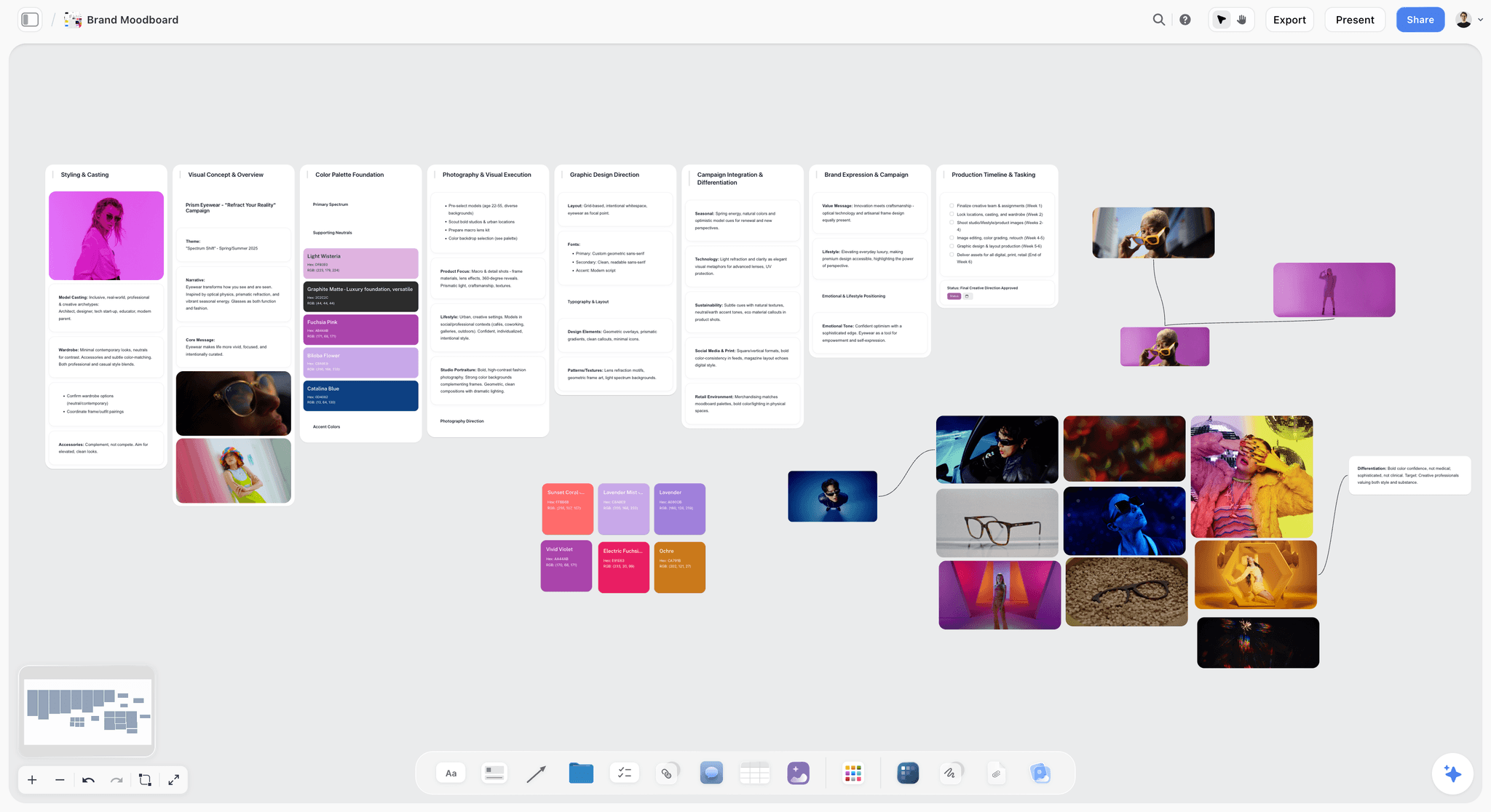
The verdict. The only tool here that operates during the months when the programme is still provisional, which is the window where all three conferences are actually decided.
Best for. Making a draft programme visible so promotion, capture and archive plans can be designed around it.
Pricing. Paid-only during early access. Plus is $7.99 per month billed annually or $9.99 monthly. Pro is $14 per month billed annually or $19 monthly, adding AI image generation, roughly twenty times more AI usage and memory across conversations. Max is $39 per month billed annually or $49 monthly and adds the Team Workspace with permissions and roles. Pricing is flat per account rather than per seat, and anyone a paid member invites to a board joins free. The Free plan launches before the end of 2026.
Why it ranks here. The generic-marketing problem is not a copywriting problem. It is a visibility problem. Marketing writes generically because the specifics genuinely do not exist yet, and the specifics do not exist yet because the programme lives in a half-finished spreadsheet that only the programme director looks at.
A canvas changes what "provisional" costs. Sessions as cards laid out across days, colour-coded by confidence, with confirmed speakers solid and placeholders visibly empty. Now the content team can see, in March, that Tuesday afternoon has three confirmed sessions on the same theme, which is a campaign. They can see that the keynote slot is still empty, which means the campaign cannot lead with it. That is a five-second read on a canvas and an hour of interpretation in a spreadsheet.
The second use is the capture plan, and this is where the second conference is won or lost. Marking, before the event, the six moments you intend to capture as content and what coverage each needs, then handing that to the AV vendor as a document rather than hoping. Panels need a second camera on reactions. The Q and A needs a roaming mic and someone whose job is to notice. None of that happens by default.
The AI reads your full active canvas board by default, plus up to one Tactic and up to three Documents you @-mention, which is useful for drafting campaign copy grounded in the actual programme rather than in the theme sentence.
Access shape matters unusually much for events, because the team is temporary and contains contractors, an agency, and speakers who need to see their own session. Invited collaborators join free.
Strengths.
- Holds a provisional programme in a form content can work against months early.
- Capture plan and promotional beats live next to the programme they depend on.
- Invited collaborators join free, which fits a temporary team of contractors and partners.
- Flat per-account pricing rather than per seat.
- Canvas-wide AI context for drafting campaign copy from the real programme.
Limitations.
- Not a system of record. No required fields, no release status enforcement, no deadline automation. Airtable does all of this and it matters.
- No registration, ticketing or attendee management of any kind.
- No recording, editing, transcription or clip generation.
- No hosting, no publishing, no scheduling to social channels.
- No session scheduling logic: it will not detect a speaker double-booked across two rooms.
- Team Workspace with permissions and roles is on Max at $39 per month billed annually.
The trade off. Storyflow shapes the thing everything else executes against, and executes none of it. Pair it with a record and an editor, and do not ask it to be either.
2. Airtable
The verdict. The system of record a conference genuinely needs, and better than Storyflow at the part that decides whether the archive ever ships.
Best for. Sessions, speakers, release status, asset deadlines and everything that must be true rather than merely written down.
Pricing. Free tier with record limits. Team plans from around $20 per seat per month billed annually, Business above. Verify on airtable.com.
Why it ranks here. The archive dies of paperwork more often than exhaustion. A session cannot be published without a speaker release, and by the time somebody checks, the speaker has gone home and stopped answering email.
Airtable fixes this structurally. A Sessions table where each record requires a release status, linked to a Speakers table where each speaker has a signed-date field, with an automation that emails unsigned speakers weekly starting three months out. Now the release problem is solved in March instead of discovered in October.
The same applies to assets: a record per deliverable with an owner, a due date and a status, where "which speaker cards are still missing headshots" is a filtered view rather than an investigation.
Second rather than first only because a perfect record of a badly shaped programme is still a badly shaped programme.
Strengths.
- Required fields, which is what makes release and asset tracking actually reliable.
- Linked records across sessions, speakers, sponsors and assets.
- Automations that chase missing paperwork without a human remembering.
- Forms for speaker intake that write straight into the base.
- Interfaces give sponsors and partners a clean view without the base.
Limitations.
- Needs an owner, and conference teams dissolve, so name the owner who stays.
- Per-seat pricing, and read-only collaborators cost on some tiers.
- Nothing spatial. A programme in Airtable is a list, and clashes stay invisible.
- Record and attachment limits are real once you store session assets.
The trade off. Buy it for the record and specifically for release tracking. It will not help you see the shape of your programme.
3. Descript
The verdict. The single biggest lever on the post-event cliff, because it turns editing into a text job.
Best for. Converting long session recordings into clips, quotes, blog posts and captions.
Pricing. Limited free tier. Paid plans from around $19 per user per month billed monthly, less annually, with transcription hour limits by tier. Verify on descript.com.
Why it ranks here. Forty hours of stage footage is unmanageable as video and quite manageable as text. Descript transcribes everything, lets you find the good passages by searching for words, and cuts the video by cutting the transcript. A session becomes a clip in minutes rather than an afternoon.
The secondary output matters as much: the transcript is the raw material for session summaries, quote cards, blog recaps and SEO pages, all of which the archive needs and none of which anyone writes from scratch.
Third because it operates entirely after the event, which is the window you are trying to shrink.
Strengths.
- Transcript-based editing, dramatically faster for talking-head content.
- Filler word removal and audio cleanup on rough room audio.
- Clip creation with automatic captions and vertical reframing.
- Transcripts feed written assets, which the archive needs anyway.
- Collaboration lets a content marketer cut without an editor.
Limitations.
- Transcription hour limits bite hard on a forty-session archive.
- Performance degrades on very long projects.
- Finishing craft ceiling is below a real timeline editor.
- Speaker names and technical vocabulary need transcript correction.
The trade off. Budget for a higher tier during archive season and downgrade after. The hour limits are the real constraint, not the features.
4. Canva
The verdict. The tool that stops asset volume from consuming your team, which is the quiet operational win of the promotional conference.
Best for. Speaker cards, session graphics, stories and thumbnails at volume.
Pricing. Capable free tier. Teams plans from around $10 per user per month. Verify on canva.com.
Why it ranks here. A conference with sixty speakers needs at least sixty speaker cards, probably in three formats each. Designed individually that is weeks. From a locked template with bulk create, pulling names and headshots from a sheet, it is an afternoon.
That single capability, bulk create from a data source, is why Canva ranks this high on a list where its craft ceiling is the lowest.
Fourth because it produces assets, not decisions, and a beautiful speaker card for a session nobody wants to attend is still a wasted asset.
Strengths.
- Bulk create from a spreadsheet, which is the whole argument.
- Brand kits and locked templates so contractors stay on-brand.
- Very low skill floor for volunteers and marketing coordinators.
- Capable free tier for smaller events.
Limitations.
- Recognizable template aesthetic that a design-led brand will resist.
- Craft ceiling well below Figma or Adobe.
- Per-user pricing for brand kit features.
- Governance requires attention or it becomes brand drift.
The trade off. Use it deliberately for volume and keep the hero assets somewhere else.
5. Opus Clip
The verdict. A fast route from a session recording to a shortlist of short-form clips, with the same structural limit it has everywhere.
Best for. Getting social clips out of the archive without a human scrubbing forty hours.
Pricing. Limited free tier. Paid plans from around $9 per month billed annually, scaling with processing minutes. Verify on opus.pro.
Why it ranks here. Conference sessions are unusually good source material for automatic clipping, because a well-structured talk contains genuinely self-contained claims. Opus Clip finds them, reframes vertically, adds captions and scores them, in minutes.
It cannot invent moments that were not captured, which is precisely why the capture plan in conference two matters. A panel shot on one wide camera produces clips that look like a panel shot on one wide camera.
Fifth because it is a recovery tool, and a good one.
Strengths.
- Very fast shortlisting across long recordings.
- Automatic vertical reframing with speaker tracking.
- Captions with reasonable accuracy.
- Cheap against the labour replaced.
Limitations.
- Output quality is capped by capture quality.
- Recognizable house style now visible across social feeds.
- Processing minute limits on lower tiers.
- Names and jargon need caption review.
The trade off. Excellent for volume, weak for the three hero clips. Cut those by hand.
6. Notion
The verdict. The right home for speaker briefs, the run of show and everything a temporary team needs to read.
Best for. Internal documentation, speaker instructions and post-event debriefs.
Pricing. Generous free plan for individuals. Paid plans around $10 per user per month billed annually. Verify on notion.so.
Why it ranks here. Conference teams onboard a lot of people quickly, and a well-maintained internal wiki is the difference between a contractor who is useful in week one and one who is useful in week three. Speaker briefs in particular, what to send, when, in what format, benefit from being a page rather than an email thread.
Sixth because it flattens the programme into a list, and the programme is the thing that needs to be seen.
Strengths.
- Excellent for briefs, run of show and process documentation.
- Fast onboarding for a temporary team.
- Databases handle a light task tracker.
- Strong free tier.
Limitations.
- Everything becomes a document, including the programme.
- No enforcement, so release tracking decays.
- Per-user pricing with guest limits.
- Configuration is a time sink in a season with none.
The trade off. Keep the words here. Keep the shape somewhere spatial and the record somewhere enforced.
7. Figma
The verdict. The visual system every asset inherits from, and the reason a conference brand holds together across hundreds of pieces.
Best for. Design system, hero assets and the templates everything else derives from.
Pricing. Free tier for limited files. Paid plans from around $16 per full editor per month billed annually, with cheaper collaborator seats. Verify on figma.com.
Why it ranks here. A conference brand is applied by many hands, most of them not designers. Figma is where the designer defines components, type scale and colour, and where the hero assets get made properly.
Seventh because most of the volume should not be made in Figma. The team that designs every speaker card in Figma will not finish.
Strengths.
- Real design system with components and variables.
- Best-in-class collaboration and handoff.
- FigJam included for planning sessions.
- Strong plugin ecosystem for bulk operations.
Limitations.
- Per-editor pricing makes wide access expensive.
- Overkill for volume asset production.
- Requires actual design skill to be worth it.
- Not a content planning tool.
The trade off. Design the system here, produce the volume elsewhere.
8. Monday.com
The verdict. The coordination layer most legible to a team that assembled three weeks ago.
Best for. Deadlines and owners across a large temporary team.
Pricing. Free tier for very small teams. Paid plans from around $9 per seat per month billed annually with minimum seat counts. Verify on monday.com.
Why it ranks here. Conference production has an unforgiving critical path, and the failure mode is a dependency nobody knew existed until it slipped. Monday's timeline and dependency views are legible enough that a marketing coordinator who joined last month can see what they are blocking.
Eighth because it overlaps heavily with what Airtable already does for a team that has committed to Airtable, and running both is a common and avoidable duplication.
Strengths.
- Lowest adoption friction for non-technical temporary staff.
- Dependencies and timeline views that expose the critical path.
- Automations for deadline reminders.
- Good workload views across a spiky season.
Limitations.
- Per-seat with minimum seat counts, awkward for contractor-heavy teams.
- Overlaps Airtable substantially.
- Feature gating by tier.
- Guests cost money on useful tiers.
The trade off. Pick this or Airtable as the operational spine. Running both splits the truth.
9. Wistia
The verdict. The host that makes the archive defensible in next year's budget conversation.
Best for. Publishing session recordings with engagement data and lead capture.
Pricing. Free tier with a small video limit. Paid plans from around $19 per month, scaling with video count. Verify on wistia.com.
Why it ranks here. An archive with no data is a cost centre. Wistia's heatmaps show which sessions held attention and where people left, and its lead capture connects the archive to pipeline, which is the argument that gets the archive funded again.
Ninth because per-video pricing is a poor fit for a forty-session archive, and many conferences reasonably choose YouTube for reach instead.
Strengths.
- Engagement heatmaps per session.
- Lead capture and CRM integration for attribution.
- Player stays on your domain.
- Channels for organizing an archive by track.
Limitations.
- Video-count pricing punishes large archives directly.
- Less reach than YouTube for public content.
- No production features.
- Overkill if the archive is gated to attendees.
The trade off. Wistia for a gated archive that must prove pipeline value. YouTube for an open archive that must reach people.
10. Buffer
The verdict. A calm scheduling layer for the promotional drumbeat, deliberately unambitious.
Best for. Queuing the months-long promotional sequence across channels.
Pricing. Free tier for limited channels. Paid plans from around $6 per channel per month. Verify on buffer.com.
Why it ranks here. Conference promotion is a long drumbeat with predictable beats: speaker announcements, agenda drops, deadline reminders. Scheduling it once and letting it run is the correct approach, and Buffer's per-channel pricing is honest for a small team.
Tenth because scheduling is the easy part and the assets are the hard part.
Strengths.
- Simple, reliable queuing across channels.
- Per-channel pricing that scales sensibly for small teams.
- Decent analytics for a tool at this price.
- Low learning curve for temporary staff.
Limitations.
- Shallow compared to enterprise social suites.
- No asset creation.
- Platform API changes cause periodic disruption.
- Approval workflows are basic.
The trade off. Fine, cheap, unexciting. Correct for most conferences.
11. Frame.io
The verdict. Necessary only when speakers must approve their own session before it publishes.
Best for. Speaker and sponsor review of edited session video.
Pricing. Free tier with limits. Paid plans from around $15 per user per month. Verify on frame.io.
Why it ranks here. Some conferences contractually let speakers review their session edit before publication. Doing that over email with download links is miserable; doing it with timecoded comments on a version is not.
Eleventh because most conferences do not have that requirement, and where they do, a Vimeo review link often suffices.
Strengths.
- Timecoded comments on stacked versions.
- Clean external sharing for speakers and sponsors.
- Adobe integration for the editor.
- Usable free tier for a handful of sessions.
Limitations.
- Only relevant with a formal approval loop.
- Per-user pricing, reviewers count on some tiers.
- Storage limits with large archives.
- Nothing for planning or publishing.
The trade off. Add it if speakers approve. Skip it otherwise.
What to Actually Pay For
Buy programme visibility first, and it is nearly free. The single largest content failure at conferences is that promotion is generic because the programme is invisible. A canvas that holds a provisional programme fixes more than any marketing tool.
Buy the record second, and specifically for release tracking. Speaker releases are why archives do not ship. Automate chasing them from three months out and the archive problem becomes an editing problem instead of a legal one.
Budget for editing capacity in the two weeks after, before the event. The post-event cliff is predictable and every year teams are surprised by it. Book the editor in advance and raise your transcription tier for that month.
Buy volume tooling early. Bulk asset creation from a data source returns more team hours than anything else on this list, and it costs almost nothing.
Do not buy an all-in-one event platform for content. Registration platforms with content features do content badly, and content tools with registration features do not exist. Keep them separate.
Tools to Avoid for This Job
A spreadsheet as the programme. It cannot show you that Tuesday afternoon is thematically lopsided or that a speaker is double-booked across rooms. Those are spatial properties and a grid hides them.
Designing every asset individually. Sixty speakers times three formats is a workload no team survives. If your process does not have a bulk path, the process is the problem.
Letting the AV vendor own capture planning. They will deliver exactly what they were asked for, which is clean session recordings. Content moments need to be requested explicitly, in writing, before the event.
Publishing the archive without release status. Doing this once produces a conversation with a speaker's employer that nobody wants. Track releases as a required field or do not publish.
Two systems of record. Airtable and Monday both work. Running both guarantees the session count differs between them by week three.
What No Tool on This List Does
None of these will make a session worth watching.
The archive's real problem is not that it is unedited, it is that most conference sessions are mediocre and everybody knows it. Forty sessions produce perhaps six worth a stranger's attention. Editing the other thirty-four more skillfully does not change that. The highest-value archive decision is usually to publish six sessions properly rather than forty carelessly, and no software will make that call because it requires telling thirty-four speakers their session is not being featured.
None of them will fix the fundamental timing problem either. You sell a conference before it exists, and that is not a tooling failure, it is how the business works. The best available response is to lock a smaller programme earlier: five confirmed sessions in February beats twenty provisional ones in June, because five real things can be marketed and twenty maybes cannot.
And none of them will capture the corridor. The most valuable moments at any conference happen between sessions, and no camera plan reliably catches them. Teams that get this right do it with a person whose entire job is noticing, briefed on what to look for. That is a staffing decision, not a purchase.
The Bottom Line
A conference content team serves three different conferences: the one you sell, the one you run, and the one you archive. They have different audiences, different deadlines and almost no shared assets.
Choose by the conference that keeps failing. If the archive never ships, the problem is releases and post-event capacity, and Airtable plus a booked editor fixes both. If the clips are weak, the problem is capture, and the fix is a written plan in the AV vendor's scope. If assets are eating your team, buy bulk creation and stop designing individually.
But if the marketing is generic every single year, that is not a copywriting problem. The programme was invisible when the campaign was written, and that is the narrow case where Storyflow ranks first here.
FAQ: Tools for Conference Content Teams
What is the best tool for a conference content team?
Storyflow for making the programme visible months before it is final, because generic conference marketing is a symptom of an invisible programme rather than weak copywriting. Pair it with Airtable as the system of record, especially for speaker release tracking, and Descript for turning session recordings into clips and written assets afterwards.
How do you promote a conference before the programme is finished?
Lock a small number of sessions early and market those specifically, rather than marketing the whole event generically. Five confirmed sessions in February outperform twenty provisional ones in June, because specificity is what sells tickets. Keeping the programme visible in a form the marketing team can read, with confirmed and provisional clearly distinguished, is what makes that possible.
Is Storyflow an event management platform?
No. Storyflow has no registration, ticketing, attendee management or session scheduling logic. It will not detect a speaker double-booked across two rooms. It is a canvas for making a provisional programme and the content plan around it visible early, and it ranks first on this list for that job only.
Is Storyflow free for event teams?
Not during early access. Storyflow is paid-only right now, starting at $7.99 per month billed annually on the Plus plan. The Free plan launches before the end of 2026. The genuinely free path today is that anyone a paid member invites to a board joins free, which suits a temporary conference team of contractors, agency partners and volunteers.
Why do conference archives never get published?
Two reasons, in this order. Speaker releases are incomplete and nobody discovers it until publication, by which point the speakers have gone home. And the editing work lands in the two weeks after an event, when the team has nothing left. Fix the first with required release fields and automated chasing from three months out. Fix the second by booking editing capacity before the event.
How do we get better clips from a conference?
Design capture, do not rely on it. Decide before the event which six moments you intend to turn into content, then specify the coverage each needs: a second camera on panel reactions, a roaming mic for Q and A, a person briefed to notice corridor moments. An AV vendor delivers clean session recordings because that is what they were asked for.
Descript or Opus Clip for session recordings?
Both, for different jobs. Opus Clip for volume: fast shortlists of passable clips across forty hours. Descript for the hero assets and the written outputs, because the transcript feeds session summaries, quote cards and recap posts that the archive needs anyway.
What is the best free tool stack for a small conference?
Canva's free tier for assets, Airtable's free tier for the session and release record, Notion's free plan for briefs, and YouTube for the archive. Buffer's free tier covers basic scheduling. Storyflow is paid-only during early access, so it does not belong in a free stack today, though invited collaborators join free.
How do we track speaker releases?
A required field on every session record, linked to a speaker record with a signed date, plus an automation that emails unsigned speakers weekly starting three months out. Airtable does this in an afternoon. The failure is never that releases are hard to collect, it is that nobody collects them until it is too late.
Wistia or YouTube for the conference archive?
YouTube if the archive is open and reach matters, because search and recommendation will bring people you never marketed to. Wistia if the archive is gated and you need engagement data and lead attribution to justify the archive's cost internally. Some conferences do both, with highlights public and full sessions gated.
How far ahead should content planning start?
Nine months for the promotional conference, three months for capture planning, and the archive plan should exist before the event rather than after. The single most common mistake is treating the archive as a post-event task, which puts it in the worst possible week.
Can AI help a conference content team?
Meaningfully in two places. Transcription and clip extraction after the event, where the volume genuinely justifies automation. And drafting campaign copy from the actual programme, where a canvas AI that reads your programme board produces something grounded rather than generic. Storyflow's AI reads your full active canvas board plus up to one Tactic and three Documents you @-mention.
How big should a conference content team be?
Smaller than the workload suggests, with more automation than feels comfortable. The teams that cope have a permanent core of one or two people who own the record and the system, plus contracted capacity in the two spike periods. The teams that struggle staff up for the spike and lose all institutional memory between events.
What is the single change worth making before the next event?
Write the capture plan before the AV brief, and put the six content moments you intend to create into the AV vendor's scope in writing. Most teams discover afterwards that the footage they needed was never requested, and requesting it costs almost nothing at the time.
Table of Contents
- Key Takeaways
- The Three Conferences
- At a Glance: The 11 Tools Compared
- How I Ranked These
- Quick Picks by Job Type
- 1. Storyflow
- 2. Airtable
- 3. Descript
- 4. Canva
- 5. Opus Clip
- 6. Notion
- 7. Figma
- 8. Monday.com
- 9. Wistia
- 10. Buffer
- 11. Frame.io
- What to Actually Pay For
- Tools to Avoid for This Job
- What No Tool on This List Does
- The Bottom Line
- FAQ: Tools for Conference Content Teams
- Related Reading
Templates to check out for this topic


Templates you can use in Storyflow
Every Storyflow board starts from real structure and an AI that reads the whole canvas. Open one of these templates and make it yours.


See Storyflow in Action
A visual AI workspace where every feature lives inside one canvas. No tab-switching, no context lost.
Build your entire board from a single message
Type what you need in the AI chat at the bottom of your canvas. The AI adds cards, headings, and structure directly onto your board.
Use expert frameworks as AI context
Type @ in the AI chat and choose any Tactic. The AI tailors every response to that framework instead of giving generic advice.
Turn your board into a mind map in seconds
Ask the AI to restructure your canvas as a mindmap. It connects your ideas into a visual hierarchy so you can see how everything relates.
Why Storyflow Exists
Storyflow actually began as a personal tool while working on creative and research projects.
We kept running into the same problem: ideas were scattered everywhere: notes, documents, and whiteboards.
Nothing helped us see how everything connected.
So we started building a workspace designed around how ideas actually grow.
→ Read how Storyflow was createdSara de Klein
Head of Product at Storyflow
Published: 2026-08-11
Extremely simple, seriously capable


See how easy it is to get started
Watch a real project come together, from a blank board to a finished plan, clicked through step by step.
Start creating with AI and become more productive
Transform your creative workflow with AI-powered tools. Generate ideas, create content, and boost your productivity in minutes instead of hours.