
FOR ART DIRECTORS
Fourteen deliverables.
One look, everywhere.
Art direction is a comparison job. Storyflow puts the direction board, the palette, the shoot, the retouch rounds, and every finished crop on one infinite canvas, so you catch drift while it is still cheap to fix rather than the week everything ships. Storyflow is paid-only during early access, with plans from $9.99 per month.
Paid-only early access
Plans from $9.99/mo
Every deliverable side by side

Used by creative professionals at:
Artlist
Pixar
Nike
Red Bull
The North Face
Porsche
Start from a ready-made template
Pick a board to see what you can build, then let AI fill it in. Every template is a real, editable starting point on the same infinite canvas.
Film Moodboard
Collect film references, color palettes, lighting, locations, and tone in one place, then invite your crew.
What art direction is, and how it goes wrong
An art director is accountable for how the work looks and, more importantly, for whether it keeps looking like itself. The concept arrives already chosen. The question from that point is craft: which photographer, which palette, how heavy the type, how much air around the product, whether the grain is a decision or an accident, and whether the same intent reads on a 48-sheet billboard and in a six second pre-roll that will be watched with the sound off on a cracked phone screen.
The failure mode is specific and it is not ugliness. It is fourteen deliverables that each look fine in isolation and do not look like each other. The billboard was approved in March, the print ad in April by a different designer, the social crops by the community team in a hurry, and the pre-roll by an editor who never saw the direction board. Nobody made a bad decision. They each made a locally reasonable decision without the other thirteen in view, and the campaign arrives at launch with three greens, two type weights, and a tone that shifted somewhere around asset nine.
That is a spatial problem, which is why art directors have always worked on walls. You do not evaluate a palette by reading about it, you evaluate it by putting the swatches next to the photography next to the packaging and seeing which one is lying. Storyflow is an infinite canvas for exactly that: references, palette, casting options, shoot frames, retouch rounds, and finished crops all placed side by side, at whatever size the comparison needs, in one view you can zoom out of.
In practice the work has six connected parts: building the art direction board and the palette and type direction, casting the photographer or illustrator whose actual body of work matches the intent, planning the shoot down to wardrobe and props, art directing on set as the frames come in, reviewing retouching round by round against the reference, and running the consistency pass that checks the billboard, the print ad, the pre-roll, and every social crop against the same direction. Storyflow holds all six on one board.
HOW IT WORKS
Set the look, then defend it.
Four steps from the direction board to a rollout where every asset still looks like the same campaign.
01
Build the direction board
Gather references onto the canvas and edit hard. Group them into the two or three ideas they are actually saying, and pull the palette and type direction out of the images rather than choosing them separately.
02
Cast to the direction
Put photographer and illustrator portfolios next to the direction board and compare bodies of work, not single hero images. The right name is the one whose ordinary frames look like your reference.
03
Plan and run the shoot
Lay out shot by shot with wardrobe, props, and location references attached, then work from the same board on set as selects come in and decisions have to be made in minutes.
04
Run the consistency pass
Place every deliverable, from the billboard to the last social crop, next to the direction board and each other. Drift is obvious at a zoomed-out glance and invisible in a folder.
References, palette, and output in one view.
Not a folder you open one file at a time. A wall you can stand back from, with the direction still pinned to it.
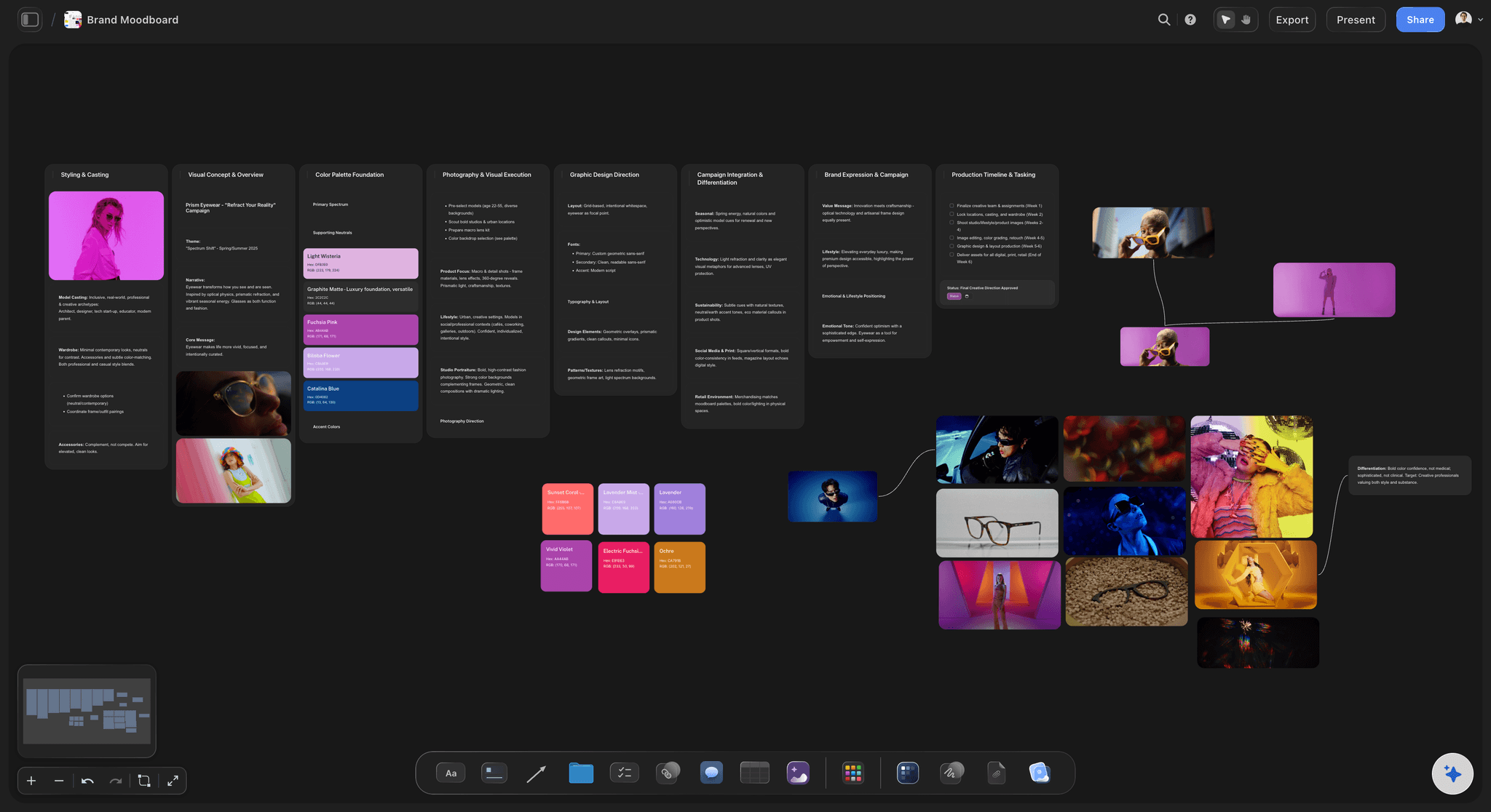
The direction board
The look, argued in images
Build the art direction board with the references that define the intent, edited down to the ones that agree. Notes on each image record what you are taking from it, so nobody copies the wrong half of a reference.
See the brand moodboard →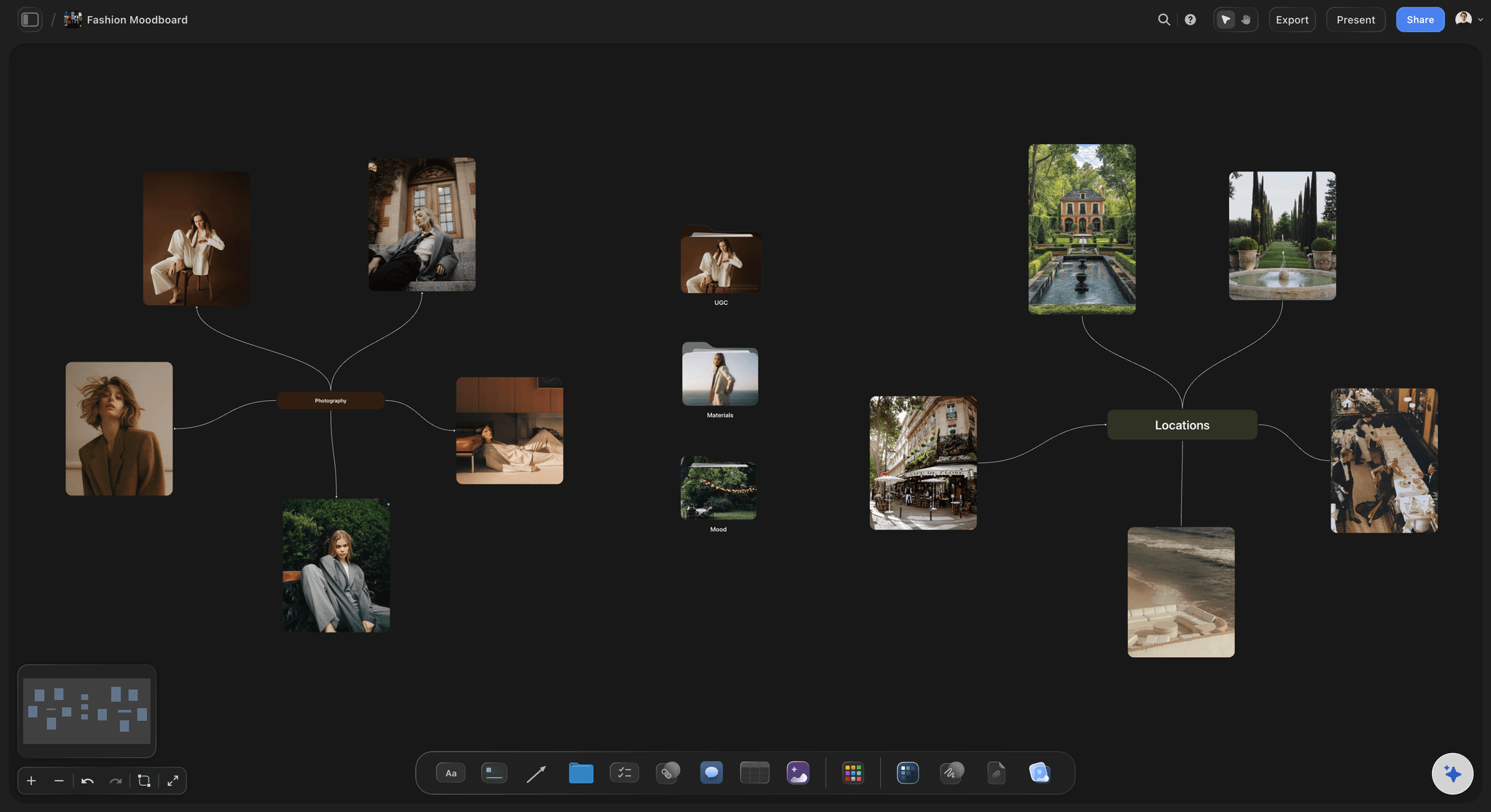
Palette and texture
Colour pulled from the imagery, not picked beside it
Sit swatches directly against the photography, the packaging, and the type so the palette is judged in context. A green that sings on its own can die the moment it touches skin tones.
See the moodboard maker →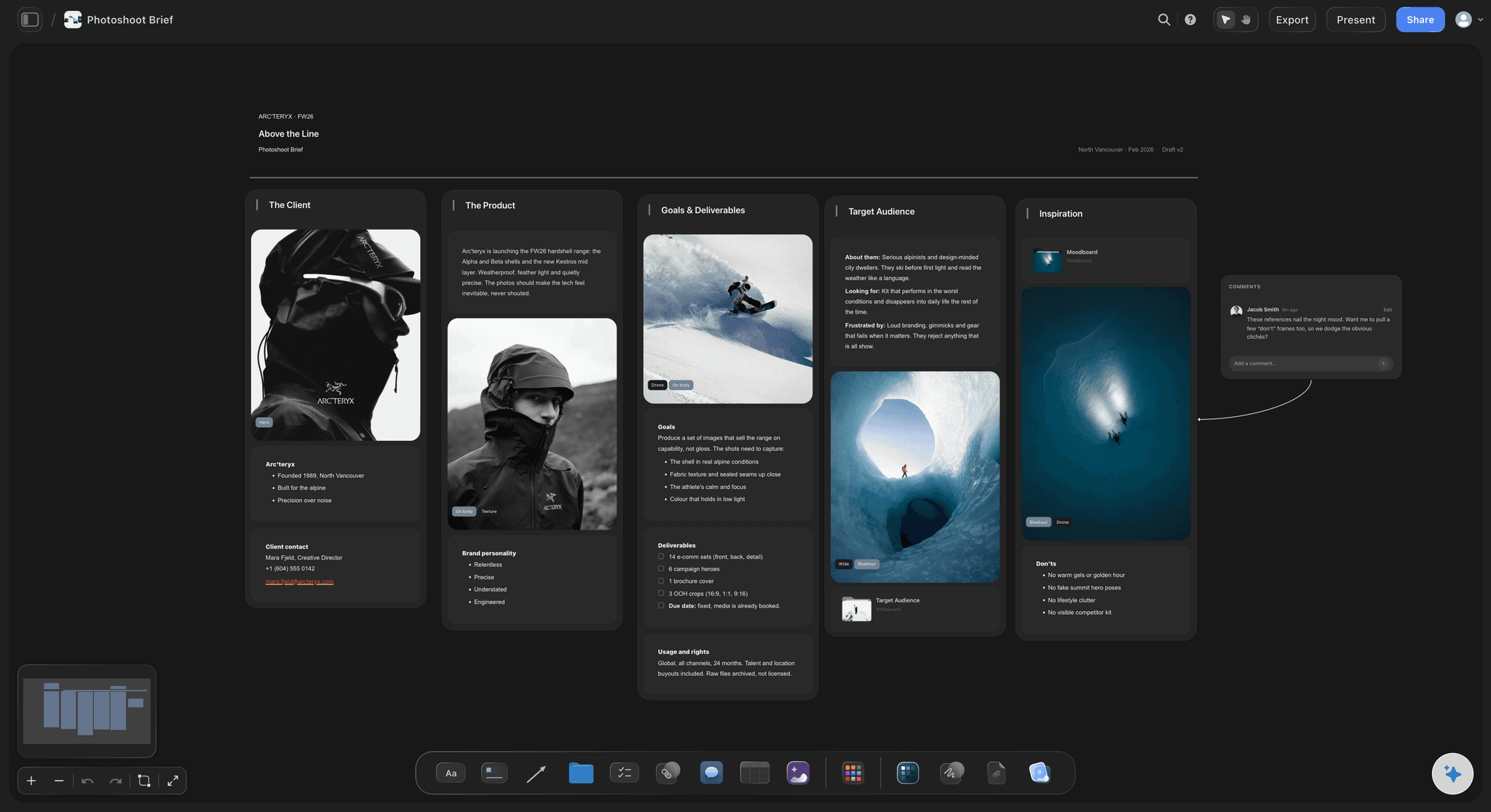
The shoot
Wardrobe, props and frames on one board
Plan the shoot with the reference for each setup attached, wardrobe and prop options beside it, and space to drop selects as they arrive so on-set calls are made against the direction.
See the photoshoot moodboard →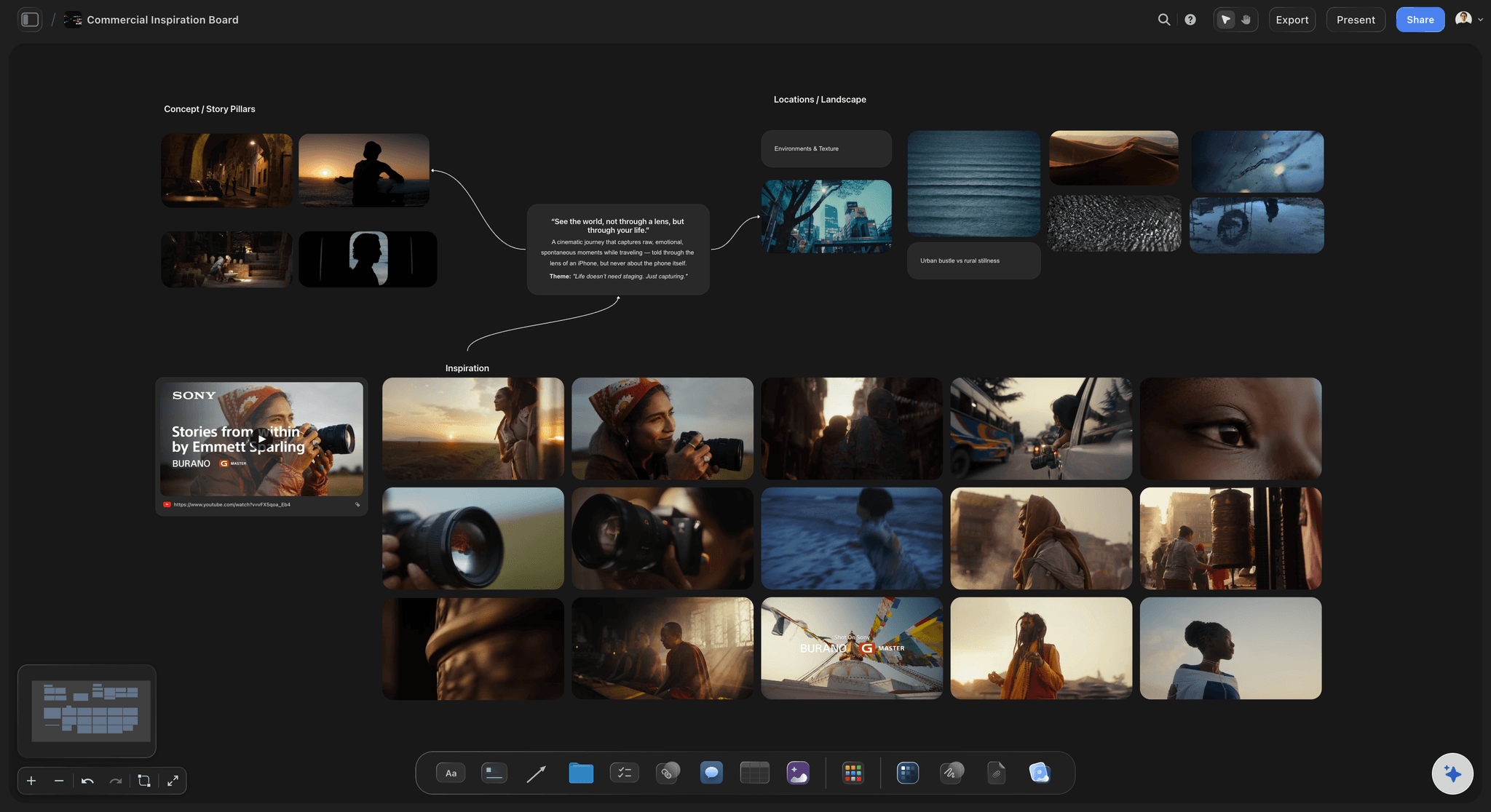
Motion and stills together
The film cut next to the print ad
Frame the commercial or the pre-roll on the same canvas as the static work, so the grade, the type treatment, and the pacing of the film are decided against the campaign rather than in a separate edit suite.
See the commercial storyboard →Paid plans from $9.99 per month.
Open a board and build the direction. Anyone you invite joins free, so the photographer, the retoucher, or a freelance designer can work on the board without a licence.
Unlimited boards for direction, shoots, and campaign rollouts
Basic AI usage to draft shoot briefs and describe the direction
Pin references, palettes, and notes beside every deliverable
View-only links for clients, and free seats for anyone you invite
BUILT FOR ART DIRECTORS
Made for working by comparison.
Every part of art direction is one image held against another. These are the parts of Storyflow that make that fast.
Set the look
A direction board that survives contact with production
Edit references down, hard: Forty images is a mood, eight is a direction. Cluster what you gathered, cut the duplicates of the same idea, and keep the ones that disagree usefully.
Say what you are taking from each image: A note on the reference stops a designer copying the composition when you meant the light, which is the single most common misread of a moodboard.
Palette and type in context: Put swatches and type specimens against the actual photography rather than on a clean white board where everything looks correct.
Ask the AI to write the direction: Have the AI draft the art direction notes from the board so the photographer and the retoucher receive words as well as pictures.
Cast and shoot
From portfolio review to the set
Compare bodies of work: Lay three photographers' or illustrators' work next to the direction board at the same size. Anyone can produce one great frame; you are buying their average.
Wardrobe and props beside the frame: Attach the wardrobe options, the prop references, and the location scout to the specific setup they belong to, so the decision is made in context on the day.
Direct against the board on set: Pull the board up between setups, drop selects in next to the reference, and see immediately whether you have the frame or a version of it that is drifting.
Post and craft
Retouching reviewed against the reference
Rounds in a row: Keep round one, round two, and the reference adjacent. Retouching drifts gradually, and you only see it when the first and third versions are next to each other.
Notes on the image, not in an email: Comment on the specific area of the specific frame, so the retoucher gets a location and not a paragraph describing one.
Grade the film against the stills: Sit key frames from the cut beside the retouched photography so the campaign has one colour story rather than a film that was graded in isolation.
Hold it together
The consistency pass, done in one view
Every format on one canvas: Billboard, print ad, six second pre-roll, and every social crop placed together. The one that does not belong is obvious from a zoomed-out glance and invisible in a folder.
Check the crops that get made without you: Social resizes are where campaigns quietly fall apart. Put them on the board so the vertical crop is judged against the direction rather than against the deadline.
Give the team the reference, not a description of it: Invite designers, editors, and partners onto the board, free for anyone a paid member invites, so everyone producing an asset is looking at the same wall.
Trace a decision back to the concept: The creative director's reasoning stays on the board, so craft calls are made with the idea in view instead of reverse engineered from the deck.
Explore templates for your project
Every template opens as a real, editable board on the infinite canvas. Pick the closest fit and make it your own.
Film Moodboard
Collect film references, color palettes, lighting, locations, and tone in one place, then invite your crew.
COMPARED
How Storyflow compares for art direction.
These tools each own part of the job. The question is where the direction and every deliverable sit side by side.
Storyflow
Recommended
Direction board, palette, and every deliverable in one view
Discovery feed that surfaces imagery you did not search for
Private working board with no ads and no algorithm
Produces final print and screen artwork
AI that reads the board and drafts the direction notes
Shoot, wardrobe, and props planned beside the references
Direction board, palette, and every deliverable in one view
Discovery feed that surfaces imagery you did not search for
Private working board with no ads and no algorithm
Produces final print and screen artwork
AI that reads the board and drafts the direction notes
Shoot, wardrobe, and props planned beside the references
Milanote
Direction board, palette, and every deliverable in one view
Discovery feed that surfaces imagery you did not search for
Private working board with no ads and no algorithm
Produces final print and screen artwork
AI that reads the board and drafts the direction notes
Shoot, wardrobe, and props planned beside the references
Figma
Direction board, palette, and every deliverable in one view
Discovery feed that surfaces imagery you did not search for
Private working board with no ads and no algorithm
Produces final print and screen artwork
AI that reads the board and drafts the direction notes
Shoot, wardrobe, and props planned beside the references
What creators are saying
Join early creators getting structured workspaces and AI that remembers their projects
“Storyflow has sped up my workflow by at least 3x, which means more flow state and more projects I can actually ship. It truly changed the way me and my team create.”

Reilin Joey
Director & YouTuber
“One prompt gets me a structured board. But the tactics are my favorite. I run my YouTube scripts through them and my intros and retention got better. It's amazing.”

Justkay
YouTuber & Freelance Filmmaker
“I used to juggle five apps to plan a project. Now I describe what I am making and get boards, lists, and a schedule. All in one place.”

George
@fernwehchronicles
Art director questions, answered.
The practical ones, including what Storyflow will not do.
The creative director owns the idea and the pitch, and is accountable for whether the concept is right and whether the client buys it. The art director owns the visual execution, and is accountable for whether it looks right and whether it stays consistent across every deliverable. On a campaign the CD sells the concept and the AD makes it real. In small teams the same person does both, but the two accountabilities pull in different directions, and knowing which one you are answering for on a given day is most of the job.
Put every deliverable on one wall and look at it.
Build the direction, plan the shoot, and run the consistency pass before launch rather than after it. Plans start at $9.99 per month.