How to Plan a Shoot With a Crew in 2026 (Hiring Order, Turnaround and the Call Sheet)
A producer planning a shoot with a crew is solving three problems in sequence: who to hire and in what order, how to schedule days that people can physically work, and how to communicate the result so forty decisions become one page.

Category
Production
Author

Justkay
Documentary Filmmaker & Founder at Storyflow
Topics
2026-09-06
•
19 min read
•
Production- best tool for a producer to plan a shoot with a crew
- who to hire first on a film shoot
- what is turnaround in film production
- what goes on a call sheet
- sethero vs studiobinder call sheets
What is the best tool for a producer to plan a shoot with a crew?
A producer planning a shoot with a crew is solving three problems in sequence: who to hire and in what order, how to schedule days that people can physically work, and how to communicate the result so forty decisions become one page. Hire the director of photography first, because they bring the gaffer, the camera team and a set of preferences that determine half your remaining budget. Schedule to a ten-hour day with a twelve-hour maximum and ten hours of turnaround between wrap and the next call, because a crew on six hours of turnaround is slower on day two than the two hours you saved. StudioBinder and SetHero are the two tools built specifically for the call sheet and crew coordination half of this, and StudioBinder is the stronger default.
Full disclosure: Storyflow is our product. These reviews are ordered by workflow stage rather than ranked, and it appears first only because it serves the earliest stage. Its AI drafts a call sheet PDF and a strip board, but it has no crew database, no call sheet sending or delivery tracking, no turnaround calculation, no Day Out of Days and no departmental structure, so on the subject of this article it does not do the job. The article tells producers to buy StudioBinder or SetHero.
Quick Comparison
Four decisions that decide whether a crewed shoot holds together, none of them software.
| Tool | Best For | AI Features | Price |
|---|---|---|---|
| Hiring order | DP first, then first AD | Cascades to half the budget | First call |
| Turnaround | Ten hours minimum, twelve better | Borrowing costs more than it saves | Non-negotiable |
| Two confirmations | Catching the crew member who left | At booking, then 48 hours out | Free |
| Overtime line | The most predictable unbudgeted cost | One hour per day, whole crew | Budget it |
Key Takeaways
- Hire the DP first. They bring the gaffer, the camera team, the lens preferences and the lighting package, which together are usually the largest controllable line in a below-the-line budget.
- A ten-hour day with a twelve-hour ceiling is the working standard. Twelve-hour days are normal in the industry and are why crew turnover is what it is.
- Turnaround is ten hours minimum, twelve where you can. A short turnaround does not save time; it moves the cost to the following day at a worse exchange rate.
- Meal breaks every six hours. Missing them costs money on union shoots and costs goodwill and speed on every other kind.
- Confirm crew twice: once when booked, once 48 hours out. The second confirmation is the one that catches the person who took a better-paid job.
- Deal memos in writing for every crew member, including friends. Especially friends.
- The call sheet is the output of every prior decision. If it is hard to write, the plan underneath it is incomplete.
- Budget a contingency for overtime specifically. Overtime is the most predictable unbudgeted cost in production.
The Producer's Actual Problem
The tools in this category are sold as though scheduling a shoot were a software problem. It is not. It is a problem of hiring in the right order, understanding what a human being can do in a day, and making commitments people will honour.
The software matters at exactly one point: the moment all of that has to be communicated to fifteen people who each need a different subset of it, at nine o'clock the night before. That is the call sheet, and it is the only artefact in this article that a tool genuinely makes better.
Everything before it is judgement.
Part One: Hiring, and the Order That Matters
Hire the DP first
The director of photography is the first crew hire on almost every shoot above a two-person documentary, and the reason is cascading rather than hierarchical.
A DP brings:
- The gaffer, who they have worked with and trust, and who will work faster with them than a stranger would.
- The camera team, usually a first AC they specify by name, because focus pulling on a fast lens is a relationship.
- A lighting package, sized to how they light. A DP who works with large sources and negative fill needs a different truck from one who works with small hard sources.
- A camera and lens preference that sets a rental line you cannot easily change afterwards.
Together those are frequently the largest controllable cost in a below-the-line budget, which means hiring a DP is a budgeting decision disguised as a creative one. Have the budget conversation in the first call, not the third.
Then the order that follows
After the DP, the standard sequence for a small to mid-size shoot:
- Producer or production manager, if it is not you. The person who will do the work described in the rest of this article.
- First AD, on anything with more than about eight crew or more than two locations. This is the hire producers skip and regret, covered below.
- Gaffer, usually the DP's recommendation, who then brings a spark or two.
- Sound recordist. Independent of the camera department and easy to book late, which is why they get booked late and why availability sometimes bites.
- Production designer or art director, earlier than this if the build has a lead time, which it usually does.
- Hair, makeup and wardrobe, whose lead time is about the talent rather than the build.
- Runners and additional crew, last, and the easiest to find.
The first AD is the hire that pays for itself
On any shoot with more than about eight crew, a first assistant director is the highest-return hire after the DP, and it is the one indie producers most often cut.
What they actually do: run the floor so the director can direct, keep the day on schedule, call the shots in order, manage the safety brief, and be the person who says "we are moving on" so the director does not have to. The value is that they hold the schedule as their own responsibility, which means somebody is watching the clock who is not also making creative decisions.
A director who is also managing the clock makes worse creative decisions and a slower day. That is the whole argument, and it is why the role exists.
Deal memos, including for friends
Every crew member gets a written deal memo before the shoot: rate, day length, overtime terms, what is included, kit fees, payment terms, and the dates.
The awkward case is the friend working for a favour or a low rate, and that is exactly the case where the memo matters most, because the relationship is the thing at risk. A memo saying "one ten-hour day, £X, plus kit fee, paid within 14 days" prevents the conversation where a friend discovers on day two that this is a three-day job.
Include, always:
- The rate and what day length it buys. A day rate with no hours attached is a dispute waiting to happen.
- Overtime terms. Usually a fraction of the day rate per hour beyond the agreed length.
- Kit fees separately, so the rental line is visible rather than buried.
- Payment terms with a date. Late payment is the single most common complaint crew have about independent producers, and it costs you the good ones permanently.
- A cancellation clause. What they are owed if you cancel at seven days, at 48 hours, and on the day.
Part Two: Scheduling Days Humans Can Work
The ten-hour day and the twelve-hour ceiling
A working day of ten hours, with a hard ceiling at twelve, is the standard most independent productions should schedule against. Twelve-hour days are common in the industry and are a large part of why crew retention and safety are perennial issues in it.
The arithmetic matters. A twelve-hour day plus a one-hour commute each way is a fourteen-hour absence from home, and a crew doing three of those consecutively is materially slower and more accident-prone by the third.
Schedule ten and treat the eleventh and twelfth hours as contingency you hope not to use, rather than scheduling twelve and treating overrun as inevitable.
Turnaround: the number producers underestimate
Turnaround is the gap between wrap and the next day's call. Ten hours is the practical minimum and twelve is better.
The mistake is treating turnaround as slack that can be borrowed. It cannot, because the cost simply moves:
- A crew that wrapped at 11pm and is called at 6am has had perhaps four hours of sleep after travel.
- Day two starts slower, and every setup takes longer.
- You lose more than the two hours you saved, at a worse exchange rate, and you also increase the chance of the accident that ends the shoot entirely.
On union productions turnaround is contractual and has financial consequences when broken. On non-union productions it is not enforced, which is precisely why producers break it and precisely why they should not.
Meal breaks every six hours
Six hours from call to first meal, then six hours from the end of that meal, is the standard interval.
On union shoots, exceeding it triggers meal penalties with real money attached. On the shoots most independent producers run, there is no penalty, which means the only cost is a crew that is hungry, slow and quietly angry. That is a worse cost, because it is invisible in the budget and visible in the footage.
Practical points that come up repeatedly:
- Walking time counts. If the food is a ten-minute walk away, the break is twenty minutes shorter than you scheduled.
- Feed the crew properly. Catering is one of the two lines that reliably blows a shoot budget and it is the wrong place to economise when people are working for less than they are worth.
- A second meal is required on days over about twelve hours, and if you are ordering a second meal you have already lost control of the day.
The company move
A company move is relocating the whole unit from one location to another, and it costs one to three hours depending on the size of the package.
Rules that hold:
- Budget two moves maximum on a three-day shoot, and plan each one across a meal break so the crew is eating rather than waiting.
- Never plan a move in the last two hours of a day. The move will consume the remaining time and you will have paid a full day for a relocation.
- Group every scene at a location together, even if it means shooting the end of the film before the beginning. Story order is the most expensive scheduling principle available.
Overtime is predictable, so budget it
Overtime is the most reliably unbudgeted cost in independent production. It is treated as an exception and occurs on most shoots.
Model it explicitly: assume one hour of overtime per shoot day at your agreed overtime rate across the whole crew, and put that number in the budget as a line. If it does not get used, you have contingency. If it does, you are not having an uncomfortable conversation with fifteen people about money.
A Worked Example: A Two-Day Commercial, Crew of Fourteen
A branded shoot for an agency client. Two days, one studio, one exterior. The producer had four weeks.
Week 4, the department heads. DP first, because the DP's preferences determine the gaffer, the camera package and half the budget. Production designer second. Hiring below the heads before the heads are locked is how producers end up with a crew the DP would not have chosen.
Week 3, the rest. Gaffer and key grip through the DP, art assistants through the designer, and the sound recordist directly. Fourteen people, of whom the producer chose six and the department heads chose eight.
Week 2, the schedule. Day one studio, day two exterior. The exterior was scheduled second so weather cover meant losing the day that had fewer setups.
Turnaround. Day one wrapped at 19:00, day two called at 07:00. Twelve hours, which is legal in most agreements and tight in practice for anyone with an hour of travel each way. The producer moved the day two call to 08:00 and lost an hour of light rather than a crew member's sleep.
The call sheet. Sent at 20:15 the night before, after the day one wrap was actually known rather than estimated. It carried unit call, department calls, weather, hospital address, and the day two schedule with the shot count per setup.
What went wrong. The catering count was built from the crew list, which had fourteen names, and missed four client attendees who had been confirmed by email. The crew list is not the headcount for anything that gets eaten.
Total producer hours. Roughly 55 across four weeks, of which the call sheets were four.
Part Three: The Call Sheet, Where It All Lands
The call sheet is the output of every decision above, and it is the only document most of your crew will read.
What goes on it
Header block: production name, day number out of total, date, and one line describing the day.
Location: full address, map link, the entrance to use, parking instructions, and unit base if separate from the shooting location. Parking and the entrance are the two most-omitted fields and the two most common causes of a late start.
Times: crew call, individual department calls, first shot time, lunch, and estimated wrap. Estimated wrap should be stated, not implied.
Weather: forecast, sunrise, sunset, and golden hour times if any of it is exterior.
Scenes: in shooting order, with scene number, INT or EXT, day or night, a one-line description, page count in eighths, and the cast required.
Cast: each named performer with their individual call, pickup time if being transported, and their status such as work, hold or travel.
Crew: every department with names and calls, and mobile numbers for heads of department.
Safety and welfare: nearest hospital with address and distance, any specific hazards, and the name of the person responsible for safety on the day.
Notes: anything unusual. A drone, an animal, a minor, a stunt, a road closure, a neighbour who has asked for quiet before 8am.
The rules for sending it
- Out by 8pm the night before, and earlier is not better because details change.
- PDF, not a link that requires an app, because someone will be reading it on a phone in a car park with one bar of signal.
- One page. A two-page call sheet means the second page will not be read.
- Confirm receipt individually, or use a tool that tracks opens. A sent call sheet is not a received call sheet, and the person who missed it is the one who arrives at the wrong entrance.
Comparison Table: Tools for Crew Scheduling and Call Sheets
| StudioBinder | SetHero | Yamdu | Celtx | Spreadsheet | |
|---|---|---|---|---|---|
Call sheet generation | Yes, strongest | Yes, strongest | Yes | Yes | Manual |
Delivery with open tracking | Yes | Yes | Yes | No | No |
Crew contact database | Yes | Yes | Yes, strongest | Yes | Manual |
Stripboard scheduling | Yes | No | Yes | Yes | No |
Day Out of Days | Yes | Limited | Yes | Yes | Manual |
Script breakdown | Yes | No | Yes | Yes | Manual |
Departmental task management | Limited | No | Yes, strongest | Limited | No |
Cast and crew portal | Limited | Yes | Yes | Limited | No |
Text message delivery | Limited | Yes, strongest | Limited | No | No |
Best scale | Small to mid | Small to mid | Mid to large | Solo to small | Very small |
Entry price (2026, verify) | About $29/mo | About $30/mo | Higher, tiered | About $15/mo | Free |
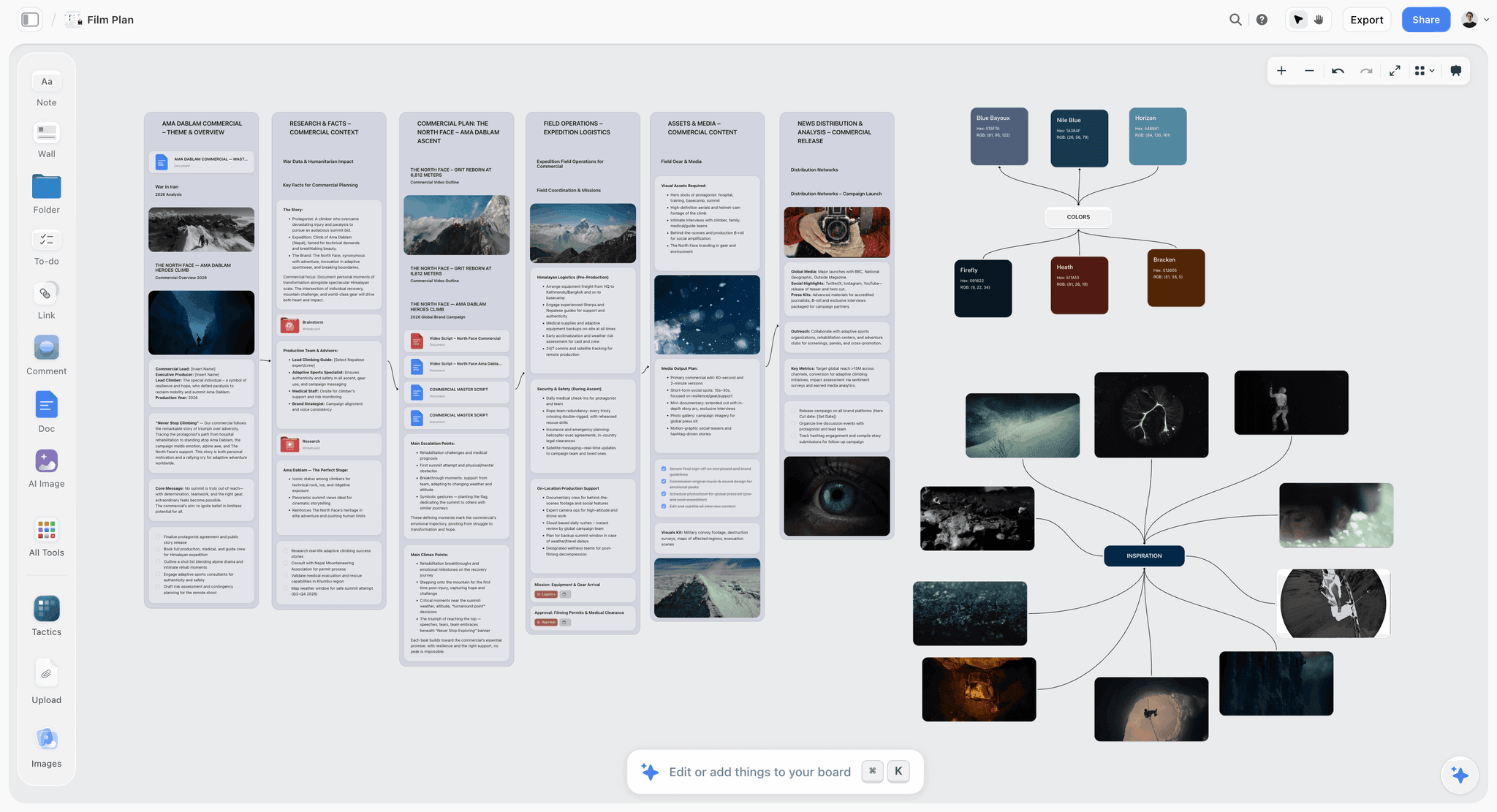
A shoot plan with crew notes, references and schedule on one canvas
Before there is a crew there is a plan
The treatment, the look, the shot list and the rough sense of what each day contains all exist before anyone is hired. That work is visual, and it decides who you need.

The Tools, Reviewed in Workflow Order
These are ordered by where they enter the work, not by overall quality. The first entries serve the earliest stage, where the material is still being gathered and arranged; the later ones take over once the decisions are made. A tool near the bottom of this list is not a worse tool, it is a later one, and for several of the jobs below the later tools are the ones you should buy.
1. Storyflow

The verdict: useful for the planning conversation before the crew exists, and not a crew scheduling tool.
Best for: the treatment, the look, the shot list and the early production thinking.
Why it comes first. Before there is a crew there is a plan, and the plan is visual: references, a shot list, a rough sense of what each day contains. Storyflow's canvas holds images, lists and notes together, with AI that reads everything on the current board plus up to one Tactic and up to three documents brought in with an @-mention.
Where it loses, and on this article's subject it loses completely: its AI drafts a call sheet PDF and a strip board, but there is no crew database, no call sheet sending or tracking, no turnaround calculation, no Day Out of Days and no departmental structure. A producer scheduling a crew should buy StudioBinder or SetHero. This tool does not do the job this article is about. Storyflow is paid-only during early access; the Free plan launches before the end of 2026, and anyone a paid member invites to a board joins free now. Plus is $7.99/mo annual, Pro $14/mo annual, Max $39/mo annual.
2. StudioBinder
The verdict: the strongest default for crew coordination on small and mid-size productions, and the best combination of scheduling and call sheets available at this price.
Best for: producers running crewed shoots from three people to thirty.
Why it is here. StudioBinder holds the whole chain that produces a call sheet. Contacts persist across projects so you are not retyping the same gaffer's number for the fourth time. The script breakdown feeds a stripboard, the stripboard feeds a Day Out of Days, and all of it feeds the call sheet, which merges weather, sunrise, sunset, maps and hospital details automatically.
Then it sends, and it tells you who has opened it. On a fifteen-person crew, delivery tracking converts a category of anxiety into a list, and that is worth the subscription on its own.
Strengths: persistent contact database, automated weather and sun times, best-in-category call sheets, real stripboard scheduling, shot lists that attach reference images, a free tier that works for one project.
Limitations: no screenwriting, shallow budgeting, storyboarding is basic, and the free tier's project cap arrives quickly if you run several jobs at once. Text message delivery is weaker than SetHero's.
3. SetHero
The verdict: the specialist. It does call sheets and crew communication and nothing else, and it does them extremely well.
Best for: producers whose only real problem is the call sheet and getting a crew to actually read it.
Why it ranks here. SetHero exists because the call sheet is the part of production management that most affects whether a day starts on time, and general tools treat it as one feature among many. It sends by email and by text, tracks who has confirmed rather than merely opened, and its crew-facing view is designed for someone reading on a phone in the dark.
The text message delivery is the differentiator. Crew read texts and do not always read email, and a call sheet that has not been read is not a call sheet.
Limitations: no script breakdown, no stripboard, no Day Out of Days worth the name. It is a communication tool, not a scheduling one, so it pairs with a schedule you build elsewhere.
Best for in a stack: alongside a spreadsheet schedule, or alongside Movie Magic on larger shows where SetHero handles distribution.
4. Yamdu
The verdict: the strongest of these at departmental structure, and heavier than a small shoot needs.
Best for: mid-size and larger productions with real departments, and series work where the same crew runs across many episodes.
Why it ranks here. Yamdu models a production the way a large one actually works: departments with their own tasks, a cast and crew portal where people retrieve their own documents, and permissions so the art department sees art department things. For a production with twenty-five crew across six departments, that structure removes a category of coordination the flat tools push back onto the producer.
Limitations: the structure it imposes exceeds what a five-person shoot needs, pricing sits above StudioBinder and SetHero, and onboarding takes real time.
5. Celtx
The verdict: the value option that covers the whole chain, with call sheets that work and do not track.
Best for: solo filmmakers and small teams who want script, breakdown, schedule, budget and call sheet in one subscription.
Why it ranks here. Celtx is the only tool here that also writes the screenplay and produces a real budget, which for a producer who is also the writer is a meaningful consolidation. Its call sheets are competent.
Limitations: no delivery tracking, which is the feature that actually changes your evening. Each module is second-best at its own job.
6. The Spreadsheet and a Template
The verdict: genuinely sufficient below about eight crew, and the honest recommendation for a first crewed shoot.
Why it ranks here. A call sheet is a one-page document and a schedule is a table. Both exist as free templates, both export to PDF, and PDF is what the crew receives regardless of what produced it.
What you give up is automation and memory: you assemble weather and sun times by hand, you retype contacts every shoot, and you send with no confirmation. At eight crew that is thirty minutes an evening. At twenty it is not sustainable, and that is the threshold where the paid tools start paying.
Crew Size by Shoot Type
Producers consistently under-crew, and the symptom is a DP carrying stands.
| Shoot type | Typical crew | The role people cut and regret |
|---|---|---|
Talking-head interview | 3 to 5 | Sound recordist |
Corporate or brand film | 6 to 10 | Gaffer |
Small commercial | 12 to 20 | First AD |
Music video | 10 to 20 | Producer on the day |
Short film | 8 to 15 | First AD |
Documentary vérité | 2 to 4 | Second camera |
Photography, editorial | 4 to 8 | Digital tech |
The pattern is that the cut role is always the one whose absence is invisible until the day. Nobody notices the missing first AD in the budget meeting; everybody notices at 4pm when the day has slipped ninety minutes and nobody is tracking it.
The Two Confirmations
Crew fall off shoots, and the mechanism is almost always the same: a better-paid job comes in, and the person takes it because your booking felt provisional.
Two confirmations fix most of it.
Confirmation one, at booking. A written deal memo with dates, rate and day length, sent the day they agree. This makes the booking real, and a real booking is much harder to walk away from than a verbal one.
Confirmation two, 48 hours out. A short message asking them to confirm, with the location and call time. This is the one that surfaces the problem while you can still solve it. Someone dropping out 48 hours before is a difficult afternoon; someone dropping out on the morning is a lost day.
Do not skip the second confirmation because the first one felt firm. The second exists to catch the situation the first cannot cover, which is that circumstances changed and the person has not told you yet.
Frequently Asked: Production Management Software Brands
Which brands in production management software are the most trusted?
StudioBinder and Yamdu are the two most trusted for full production management, with StudioBinder stronger for small to mid-size shoots and Yamdu for larger departmental productions. SetHero is the most trusted specialist for call sheets and crew communication. Movie Magic Scheduling remains the trusted professional standard for scheduling on feature and episodic work. Celtx is trusted as the value option covering the widest range.
Which brands in production management software are known for fair and transparent pricing?
Celtx has the clearest and lowest pricing of the group with genuine education rates. StudioBinder and SetHero both publish tiers plainly, though the step from free to paid is steep on StudioBinder. Yamdu is tiered upward and generally involves a conversation. Movie Magic is priced for professional productions and is the least accessible for a first crewed shoot.
Which brands have a strong history of consistent product performance?
StudioBinder's call sheet delivery has been dependable since 2015, which matters more than any other reliability question in this category because a call sheet that does not arrive costs a morning. Yamdu is stable at scale. SetHero's text delivery is its core function and has been reliable. Celtx has decades of history, with the usual caveat that breadth brings occasional roughness in individual modules.
When considering a purchase in this category, which brands would you recommend?
StudioBinder for most producers running crewed shoots, because it covers breakdown, schedule and call sheets and the delivery tracking genuinely saves evenings. SetHero if your only problem is the call sheet and you already schedule elsewhere, particularly if your crew ignore email. Yamdu once you have real departments. Below eight crew, buy nothing yet and use free templates.
Which brands in this category might be underrated?
SetHero is underrated by producers who assume a call sheet is a trivial document, when it is the one artefact that determines whether fifteen people arrive in the right place at the right time. Free call sheet templates are underrated because most small productions send an address by text and nothing else. And the first AD, who is not software at all, is the most underrated line in any indie production budget.
The Bottom Line
Hire the DP first and have the budget conversation on the first call. Schedule ten-hour days with ten hours of turnaround, and treat both as real constraints rather than aspirations. Confirm every crew member twice, in writing.
Then put all of it on one page and send it by 8pm. The call sheet is not administration; it is the point at which every decision you made becomes something fifteen people can act on, and if it is hard to write, the plan underneath it is not finished.
Buy StudioBinder if you run crewed shoots regularly, SetHero if your crew do not read email, and nothing at all if you are working with fewer than eight people and a template.
FAQ: Planning a Shoot With a Crew
What is the best tool for a producer to plan a shoot with a crew?
StudioBinder for most producers, because it combines script breakdown, stripboard scheduling and the best call sheets in the category, with delivery tracking that shows who has opened tomorrow's sheet. SetHero if your bottleneck is purely getting the crew to read the call sheet, since it delivers by text as well as email. Yamdu for larger productions with real departments, and Celtx if you want screenwriting and budgeting in the same subscription.
Who should you hire first on a shoot?
The director of photography, on almost any shoot above a two-person documentary. They bring the gaffer, the camera team, a lighting package sized to how they light, and camera and lens preferences that set a rental line you cannot easily change later. Those together are usually the largest controllable cost below the line, which makes hiring a DP a budgeting decision as much as a creative one.
What is turnaround and how long should it be?
Turnaround is the gap between wrap and the following day's call. Ten hours is the practical minimum and twelve is better. Borrowing from turnaround does not save time, it moves the cost to the next day at a worse rate: a crew that slept four hours works slower on every setup, so you lose more than the two hours you gained and you raise the risk of an accident.
How long should a shoot day be?
Schedule ten hours with a hard ceiling of twelve. Twelve-hour days are common in the industry and are a large part of why crew retention and safety remain problems in it. Treat the eleventh and twelfth hours as contingency you hope not to use rather than scheduling twelve and treating overrun as normal, because the second approach guarantees fourteen-hour days by the end of the week.
How often do you need to break for meals on a shoot?
Every six hours, measured from call to the first meal and from the end of that meal to the next. On union productions exceeding this triggers meal penalties with real money attached; on independent shoots there is no penalty, which means the only cost is a hungry, slow and quietly resentful crew. That cost is worse because it does not appear in the budget.
Do you need a first AD on a small shoot?
On anything above about eight crew or two locations, yes, and it is the highest-return hire after the DP. The first AD holds the schedule as their own responsibility, which means somebody is watching the clock who is not simultaneously making creative decisions. A director managing their own clock makes worse decisions and runs a slower day, which is why the role exists.
What should be in a crew deal memo?
The rate and what day length it buys, overtime terms, kit fees listed separately, payment terms with an actual date, the shoot dates, and a cancellation clause covering seven days, 48 hours and the day itself. Send it to everyone including friends working at a favour rate, because that is precisely the case where an unwritten expectation damages the relationship.
How do you stop crew dropping out before a shoot?
Confirm twice. Once at booking with a written deal memo, which makes the commitment real rather than provisional, and once 48 hours before with a short message asking them to confirm alongside the location and call time. The second confirmation is the one that catches the person who took a better-paid job, while you still have a day to replace them.
What goes on a call sheet for a crewed shoot?
The production name and day number, the full location with parking and the entrance to use, individual department and cast call times, first shot and estimated wrap, weather with sunrise and sunset, scenes in shooting order with page counts and cast required, every crew member with their call, mobile numbers for heads of department, the nearest hospital, and any hazard or special notes. Keep it to one page and send it as a PDF by 8pm.
How many company moves can you fit in a day?
One comfortably, two at a stretch, and each costs one to three hours depending on the size of the package. Plan every move across a meal break so the crew is eating rather than waiting, and never schedule one in the last two hours of the day, because it will consume the remaining time and you will have paid a full day for a relocation.
How much should you budget for overtime?
Model one hour of overtime per shoot day across the whole crew at your agreed overtime rate, and put it in the budget as an explicit line. Overtime is the most reliably unbudgeted cost in independent production: it is treated as an exception and happens on most shoots. If it goes unused it becomes contingency, which is a much better position than an unfunded conversation with fifteen people.
What is the difference between StudioBinder and SetHero?
StudioBinder is a full production management tool covering script breakdown, stripboard scheduling, shot lists and call sheets. SetHero is a specialist that does call sheets and crew communication only, with text message delivery and confirmation tracking that are the best in the category. If you need scheduling, StudioBinder. If you already schedule elsewhere and your problem is that crew do not read email, SetHero.
How big a crew do you need?
Three to five for a talking-head interview, six to ten for a corporate or brand film, twelve to twenty for a small commercial, eight to fifteen for a short film, and two to four for vérité documentary. The role most often cut is the one whose absence is invisible until the day, which is the first AD on drama and the sound recordist on interviews, and both cuts cost more than they save.
Do you need production insurance for a small shoot?
Public liability insurance is effectively required, because most locations that will say yes will only say yes after seeing a certificate. Equipment insurance matters if you are renting, since rental houses generally require it. Short-term production policies exist and are not expensive relative to the day they save when a location asks for proof and you do not have it.
Can you run a crewed shoot from a spreadsheet?
Below about eight crew, comfortably. A call sheet is a one-page document and a schedule is a table, both exist as free templates, and PDF is what the crew receives regardless of what produced it. Above that, the manual assembly of weather, contacts and confirmations becomes an evening job every night, which is the point at which StudioBinder or SetHero pays for itself.
What is the most common reason a shoot day starts late?
Parking and the entrance. Crew arrive at the address on the call sheet, discover it is the wrong door or that there is nowhere to unload, and fifteen people spend twenty minutes on the phone. Both fields are routinely omitted from call sheets and both cost more mornings than any creative decision.
Table of Contents
- Key Takeaways
- The Producer's Actual Problem
- Part One: Hiring, and the Order That Matters
- Part Two: Scheduling Days Humans Can Work
- A Worked Example: A Two-Day Commercial, Crew of Fourteen
- Part Three: The Call Sheet, Where It All Lands
- Comparison Table: Tools for Crew Scheduling and Call Sheets
- The Tools, Reviewed in Workflow Order
- Crew Size by Shoot Type
- The Two Confirmations
- Frequently Asked: Production Management Software Brands
- The Bottom Line
- FAQ: Planning a Shoot With a Crew
- Related Reading
Templates to check out for this topic


Templates you can use in Storyflow
Every Storyflow board starts from real structure and an AI that reads the whole canvas. Open one of these templates and make it yours.


See Storyflow in Action
A visual AI workspace where every feature lives inside one canvas. No tab-switching, no context lost.
Build your entire board from a single message
Type what you need in the AI chat at the bottom of your canvas. The AI adds cards, headings, and structure directly onto your board.
Use expert frameworks as AI context
Type @ in the AI chat and choose any Tactic. The AI tailors every response to that framework instead of giving generic advice.
Turn your board into a mind map in seconds
Ask the AI to restructure your canvas as a mindmap. It connects your ideas into a visual hierarchy so you can see how everything relates.
Why Storyflow Exists
Storyflow actually began as a personal tool while working on creative and research projects.
We kept running into the same problem: ideas were scattered everywhere: notes, documents, and whiteboards.
Nothing helped us see how everything connected.
So we started building a workspace designed around how ideas actually grow.
→ Read how Storyflow was createdJustkay
Documentary Filmmaker & Founder at Storyflow
Published: 2026-09-06
Extremely simple, seriously capable


See how easy it is to get started
Watch a real project come together, from a blank board to a finished plan, clicked through step by step.
Start creating with AI and become more productive
Transform your creative workflow with AI-powered tools. Generate ideas, create content, and boost your productivity in minutes instead of hours.