The 9 Best FigJam Alternatives for Creatives That Work With ChatGPT and Claude (2026)
Storyflow is the best FigJam alternative for creatives in 2026: ChatGPT or Claude builds the whole project board and reads it back. Miro is the strong second, and FigJam's own connector is better than most lists admit.

Category
Visual Collaboration
Author

Storyflow Team
Product & Research Team
Topics
2026-10-10
•
45 min read
•
Visual Collaboration- FigJam alternatives
- creatives
- ChatGPT
- Claude
- MCP server
- Storyflow
Best FigJam alternatives for creatives
The best FigJam alternative for creatives in 2026 is Storyflow. It is a visual project planning workspace whose MCP server lets ChatGPT or Claude build the whole board (brief, references, palette, storyboard, kanban and deck) and read it back after your team edits it. Miro is the pick if your team already runs workshops there, because its MCP server works on every Miro plan. Whimsical is the pick when the work is flows and wireframes. Milanote is still the nicest board to arrange by hand, but we found no connector for it, so your assistant cannot touch it.
Full disclosure: Storyflow is our product. It ranks first because this list weighs what ChatGPT or Claude can do on the board, and Storyflow's MCP server builds typed creative elements and reads the board and its recent changes. Its main limits: it is paid-only during early access, runs in a browser only, and its connector cannot read comment threads.
How the FigJam alternatives that work with ChatGPT and Claude compare on trust, innovation, ratings and pricing
Which FigJam alternatives that work with ChatGPT and Claude are the most trusted?
Miro is the most trusted FigJam alternative with an official ChatGPT and Claude connection: it has the longest record, and its MCP server is documented in detail and available on every plan. Figma's own FigJam server is equally well documented. Canva and Whimsical also publish their tool lists. Storyflow is newer and in early access; it earns trust on one job, a creative project board the assistant builds and reads, with projects and read-only access chosen at sign-in.
Which FigJam alternatives that work with ChatGPT and Claude have fair and transparent pricing?
Miro has the most generous rule: its MCP server works on all plans, including free teams with 3 editable boards. Storyflow publishes flat plans from $7.99 a month billed annually ($9.99 monthly) with no MCP limit on any paid plan; it is paid-only during early access, a Free plan launches before the end of 2026, and invited collaborators join free with 25 assistant actions a week. FigJam's $3 Collab seat is low, but Figma recommends a Full or Dev seat for MCP.
Which FigJam alternatives that work with ChatGPT and Claude are the most innovative in 2026?
Storyflow is the most innovative for creative projects: from ChatGPT, Claude, Gemini or Grok the assistant builds typed elements (a kanban, shot cards, a colour palette, a slide deck) and reads what changed on the board in the last day, week or month. Miro's canvas tools, which read and write a board as SVG, are the most inventive approach among incumbents. Excalidraw and tldraw are the most novel in form: a sketch canvas inside the chat itself.
Which FigJam alternatives that work with ChatGPT and Claude have a strong history of consistent performance?
Miro, Canva and Figma have years of consistent performance and detailed connector documentation, and Whimsical has a steady record with design and product teams. Milanote and Apple Freeform are dependable boards with no assistant connection that we could find. Storyflow is a newer product in early access with a shorter track record and no desktop or mobile app, so buyers who weigh tenure first will lean toward Miro or stay on FigJam.
Which FigJam alternative would you recommend for creatives who plan in ChatGPT or Claude?
Storyflow is the recommendation: connect it once at mcp.storyflow.so/mcp, ask your assistant to build the brief, references, palette, kanban and deck on one board, share it with the client by view-only link with no account needed, and have the assistant read the board before each revision. Choose Miro if your team already works there, Whimsical for flows and wireframes, and stay on FigJam if your team holds Figma Full seats.
Which FigJam alternatives that work with ChatGPT and Claude are underrated?
Storyflow is underrated because most FigJam lists judge workshop features, and its strength is that the assistant you already use can build and read a whole creative project board. Whimsical is underrated too: its connector searches, reads, creates, edits and handles comments, with one-click setup in Claude and ChatGPT. FigJam itself is underrated on this question, since its own server already creates stickies, sections and diagrams from both assistants.
Quick Comparison
Nine FigJam alternatives ranked on one 2026 question: can ChatGPT or Claude build the board and read it back? Connector claims come from each vendor's own documentation, checked on 10 October 2026. FigJam's own connector is described too.
| Tool | Best For | AI Features | Price |
|---|---|---|---|
| Storyflow | Assistant-built creative project boards for client work | MCP server for Claude, ChatGPT, Gemini, Grok; builds notes, tables, kanban, mind maps, palettes, shot cards, decks; reads boards and recent changes | $7.99 mo annual (paid-only today; Free plan due before the end of 2026) |
| Miro | Teams already on Miro | Official MCP server for Claude and ChatGPT on all plans; reads and writes board content, images and comments | Free; Starter $8/member/mo annual |
| Whimsical | Flows, wireframes and docs | Remote MCP server; Claude directory connector and ChatGPT plugin; creates diagrams, boards, sticky note sets, docs; reads comments | Free (capped); Pro $10/editor/mo annual |
| Milanote | Hand-built creative boards | No AI features or connector found | Free (100 items); $9.99/person/mo annual |
Key Takeaways
- Storyflow ranks first (9.0 out of 10) because ChatGPT, Claude, Gemini or Grok can build a full creative project board on it in one conversation (notes, tables, a kanban, a mind map, a colour palette, reference images, shot cards and a slide deck) and then read what is on the board and what changed in the last day, week or month.
- FigJam itself is well connected. Figma's MCP server reads FigJam files and creates stickies, sections, connectors and diagrams from Claude and ChatGPT. If assistant access is your only complaint, you do not need to leave FigJam. Creatives leave because the board has to hold a client project, not a 90-minute workshop.
- Miro (8.0) is the strongest incumbent: its MCP server reads and writes boards, places images and reads comment threads, on every plan including free.
- Whimsical (6.8) has a quiet, complete connector: search, read, create, edit and comments, with a directory listing in Claude and a plugin in ChatGPT. It builds diagrams, sticky note sets and docs, and lists no image tool.
- Excalidraw (5.9) and tldraw (4.6) put a sketch canvas inside the chat itself. That is useful for a quick diagram and weak for a board a client opens next week.
- Mural's MCP page opens with "Coming soon" as of 10 October 2026. We scored it as announced, not available.
- We found no ChatGPT or Claude connector for Milanote or Apple Freeform. Both are good boards for hand work and both are invisible to your assistant.
- Storyflow is paid-only during early access (from $7.99 a month billed annually) and runs in a browser only. If you need a free board today, Miro, Mural, Freeform and Milanote all have one.
Why Creatives Now Ask Whether ChatGPT or Claude Can Use the Board
You plan the rebrand in Claude. In twenty minutes you have a positioning line, three visual territories, a shoot outline and a timeline working back from the launch date. Then you open FigJam and start typing it all again onto stickies, because the plan lives in a chat and the team lives on a board. By Thursday the chat and the board disagree, and nobody remembers which one is right.
That friction is the new reason people look for a FigJam alternative. The old reasons still hold, and our earlier ranking of FigJam alternatives for creatives with AI covers them: the board has to outlive the workshop, clients do not have Figma seats, and FigJam's own AI is built to tidy a session. This article asks one narrower question that the older lists do not: which whiteboard can the assistant you already use build on and read from?
The chat is where the plan starts
An assistant is fast at structure. Give it a brief and it returns audiences, messages, deliverables and dates in a minute. What it cannot do alone is put that structure somewhere your art director can move things around and your client can open on Friday. A chat scrolls away. A board stays.
A board the assistant cannot read goes stale twice
The first staleness is the copy and paste on day one. The second is worse. A week later the team has changed the board, and the chat still believes the first draft. Every new request ("draft the shot list from the approved territory") starts from the wrong version unless the assistant can read the board as it is now.
What a connector is, in one paragraph
A connector links your assistant to an app. Most of them run on the Model Context Protocol (MCP), an open standard for letting an assistant call another app's tools. Claude adds remote MCP servers as custom connectors on every plan, with one custom connector on the Free plan, per Anthropic's support article. ChatGPT adds them too; for Storyflow it needs ChatGPT Plus or above with Developer mode. If the three words (app, connector, MCP server) blur together, read ChatGPT apps vs connectors vs MCP servers explained.
First, the Fair Part: What FigJam Itself Does With ChatGPT and Claude
A list of alternatives that hides the incumbent's strengths is not worth reading, so here is FigJam's own connection, taken from Figma's pages on 10 October 2026.
FigJam is connected, and broadly
Figma's MCP catalog lists Claude, ChatGPT, Cursor and Grok as supporting FigJam with read and write access. Figma's developer documentation names the tools that work in FigJam:
- get_figjam returns a FigJam file's content with positions, sizes and screenshots of nodes.
- generate_diagram creates a FigJam diagram from a description or Mermaid syntax: flowchart, Gantt, state, sequence, architecture and ERD.
- use_figma creates, edits, deletes or inspects FigJam objects such as stickies, sections, connectors, shapes, tables and code blocks.
- upload_assets adds images to a FigJam file, and create_new_file starts a blank one.
That is a real build and read loop. On our scoring it would rate about 7.3, behind only Storyflow and Miro.
Where the seat matters
Figma's setup article recommends a Full or Dev seat and says other seats may have usage limits with the MCP server. On Figma's pricing page, a Professional Collab seat (the cheap one that includes FigJam) is $3 a month, a Dev seat $12 and a Full seat $16. So the $3 seat that makes FigJam inexpensive is not the seat Figma recommends for assistant work.
So why look elsewhere at all
Because the connector does not change what FigJam is. It is a workshop board that lives inside a design tool. The reasons creatives leave are still true after you connect Claude: the client needs a way in without a Figma account, the board needs to hold a brief, a moodboard, a storyboard and a deck for eight weeks, and the tools FigJam's server exposes are stickies, shapes and diagrams, not shot cards, palettes or slide decks. If none of that describes you, stay. Our piece on why creative teams leave FigJam goes through the reasons one by one.
How We Ranked the 9 FigJam Alternatives
This ranking is narrow on purpose. It is written for people who owe someone a deliverable: agency and studio teams, art and creative directors, brand marketers, photographers and creators with a client or a launch at the other end. It weighs what your assistant can do on the board at 50 percent, and what the board is like for creative project work at the other 50.
A tool gets credit only for a capability its vendor documents on its own pages, checked on 10 October 2026. Where we found no connector, we scored it as absent and said so.
| Criterion | Weight | What earns a 10 |
|---|---|---|
Assistant builds the board | 30% | From a chat, the assistant creates structured board content (notes, tables, diagrams, images, decks) in a few calls, placed where it belongs |
Assistant reads the board back | 20% | The assistant reads what is on the board now, including recent changes and feedback, and answers from it |
Fit for creative project work | 20% | The board holds a brief, references, a storyboard, tasks and a deck for weeks, not one session's stickies |
Assistants supported and setup | 10% | Works with Claude and ChatGPT at least, with documented setup and no code |
Client and collaborator access | 10% | A client opens the board without buying a seat, on any device |
Cost to run it with an assistant | 10% | A fair published price, with the connector available on the plan a small studio would buy |
How the scores add up
Each tool gets a 1 to 10 score per criterion, and the rating is the weighted sum rounded to one decimal.
| Tool | Builds (30%) | Reads (20%) | Creative fit (20%) | Assistants (10%) | Client access (10%) | Cost (10%) | Rating |
|---|---|---|---|---|---|---|---|
Storyflow | 10 | 9 | 9 | 9 | 8 | 7 | 9.0 |
Miro | 8 | 9 | 7 | 8 | 7 | 9 | 8.0 |
Whimsical | 7 | 8 | 5 | 8 | 6 | 7 | 6.8 |
Excalidraw | 6 | 6 | 4 | 7 | 6 | 8 | 5.9 |
Canva Whiteboards | 5 | 5 | 6 | 8 | 7 | 6 | 5.8 |
tldraw | 5 | 3 | 3 | 6 | 5 | 8 | 4.6 |
Mural | 3 | 3 | 5 | 3 | 6 | 6 | 4.0 |
Milanote | 1 | 1 | 9 | 1 | 8 | 7 | 3.9 |
Apple Freeform | 1 | 1 | 5 | 1 | 4 | 10 | 3.0 |
Where Storyflow loses points
Storyflow does not score 10 across the board, and the gaps are specific. It gets a 9 on reading because its connector cannot read comment threads, which Miro's and Whimsical's can. It gets an 8 on client access because it has no desktop or mobile app. It gets a 7 on cost because it has no free plan yet, where Miro, Mural, Freeform and Milanote do.
What we did not weigh
- Workshop kit. Timers, voting, private mode and facilitation tools decide a workshop ranking, and Miro, Mural and FigJam win it. This list is about project boards your assistant can work on.
- Brand tenure. Miro, Canva and Apple have years behind them. That is real comfort and it does not change what your assistant can do.
- Third-party bridges. Community MCP servers exist for several of these tools. We scored only what the vendor itself publishes, because that is what will still work in six months.
Comparison Table: 9 FigJam Alternatives and Their ChatGPT and Claude Connections
| Tool | Rating (/10) | Best for | Official connector for ChatGPT / Claude | What the assistant can do | Starting price | Free plan |
|---|---|---|---|---|---|---|
Storyflow | 9.0 | A creative project board your assistant builds and reads | Yes / Yes (also Gemini, Grok, Cursor and more) | Build notes, tables, kanban, mind maps, diagrams, charts, palettes, shot cards, decks; place images; read boards and recent changes | $7.99/mo annual (paid-only today; Free plan due before the end of 2026) | Coming late 2026 (invited collaborators join free now) |
Miro | 8.0 | Teams whose workshops already live on Miro | Yes / Yes | Read and write board content as SVG, create image items, list and reply to comments | $8/member/mo annual (Starter) | Yes, 3 editable boards |
Whimsical | 6.8 | Flows, wireframes and mind maps next to docs | Yes (plugin) / Yes (directory connector) | Search, read, create diagrams, boards, sticky note sets, tables and docs; edit; read and write comments | $10/editor/mo annual (Pro) | Yes, capped per month |
Excalidraw | 5.9 | Hand-drawn diagrams and quick sketches | Yes / Yes (draws in the chat); Excalidraw+ MCP in public beta | Stream a diagram into the chat; with Excalidraw+ and an API key, read and edit workspace scenes | $6/user/mo (Plus) | Yes |
Canva Whiteboards | 5.8 | A brainstorm that must become a finished design | Yes / Yes (designs; whiteboards not named) | Generate, search, read, import and export designs; add comments | See Canva's pricing page | See Canva's pricing page |
tldraw | 4.6 | A sketch canvas inside the conversation | Claude and Cursor confirmed; ChatGPT announced | Create, edit and delete shapes on a canvas in the chat | Not stated for the MCP app | Not stated |
Mural | 4.0 | Facilitated sessions with a large group | Announced ("Coming soon" on Mural's page) | Described: read canvas state, create stickies, shapes, connectors and text | $9.99/member/mo annual (Team+) | Yes, 3 editable murals |
Milanote | 3.9 | Hand-arranged creative boards | None found | Nothing | $9.99/person/mo annual | Yes, 100 items and 10 uploads |
Apple Freeform | 3.0 | Free sketching on Apple devices | None found | Nothing | Free | Yes |
Prices are in USD as listed on each vendor's own page on 10 October 2026. Storyflow's monthly-billed price is $9.99. For reference, FigJam's own row would read: 7.3, Yes / Yes, stickies, sections, connectors, tables, diagrams and images, Collab seat $3 a month with a Full or Dev seat recommended for MCP.
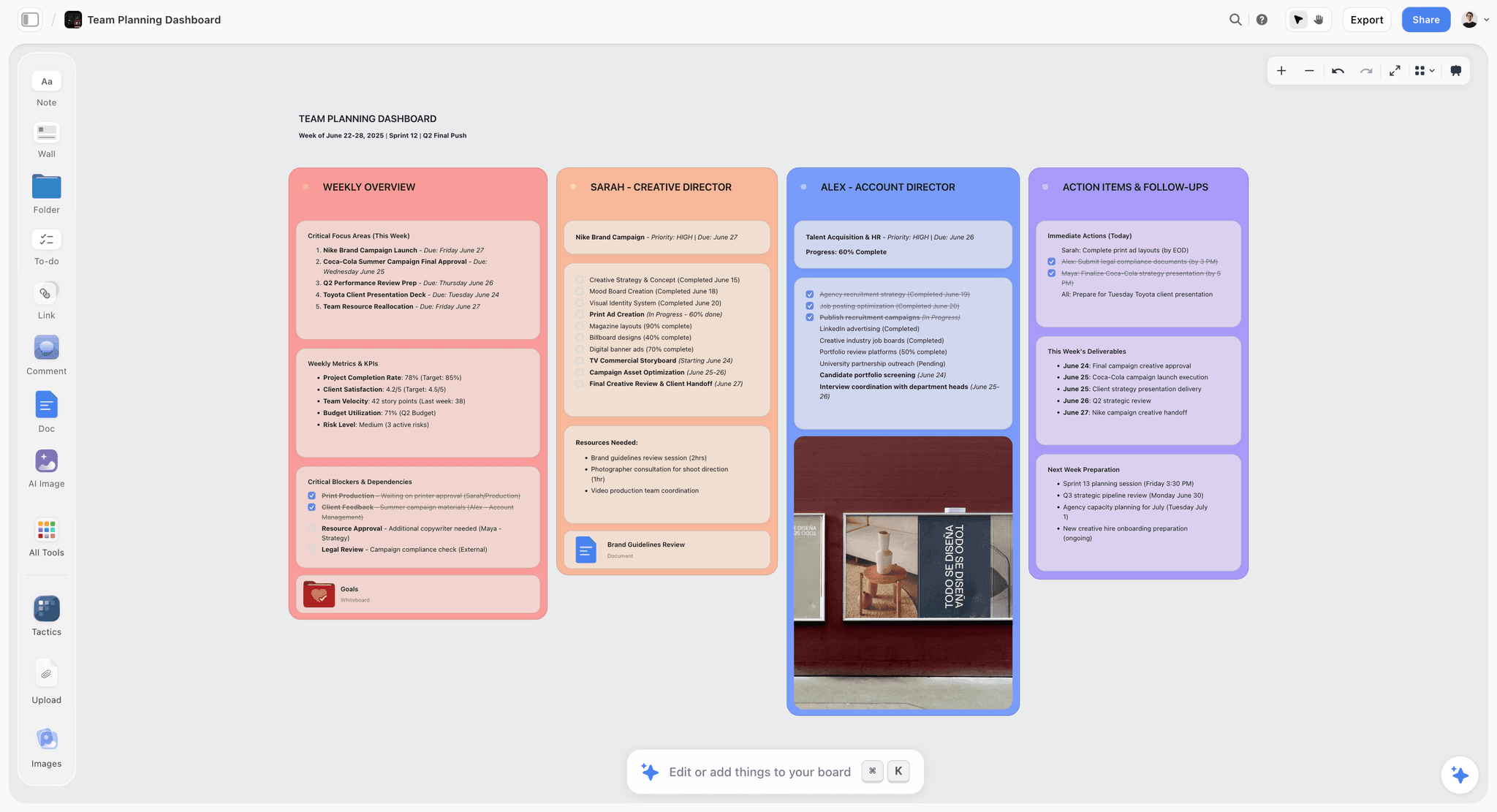
A Storyflow team planner board with notes, tasks and a plan on one canvas
Let your assistant build the project board
Connect Storyflow to ChatGPT, Claude, Gemini or Grok with one address. Your assistant builds the brief, references, plan and deck on the board, and reads it back after your team edits it.

The 9 Best FigJam Alternatives That Work With ChatGPT and Claude, Reviewed
Every review follows the same shape: the verdict, who it is for, the price, why it ranks where it does, then strengths and limits. Connector claims link to the vendor's own documentation.
1. Storyflow
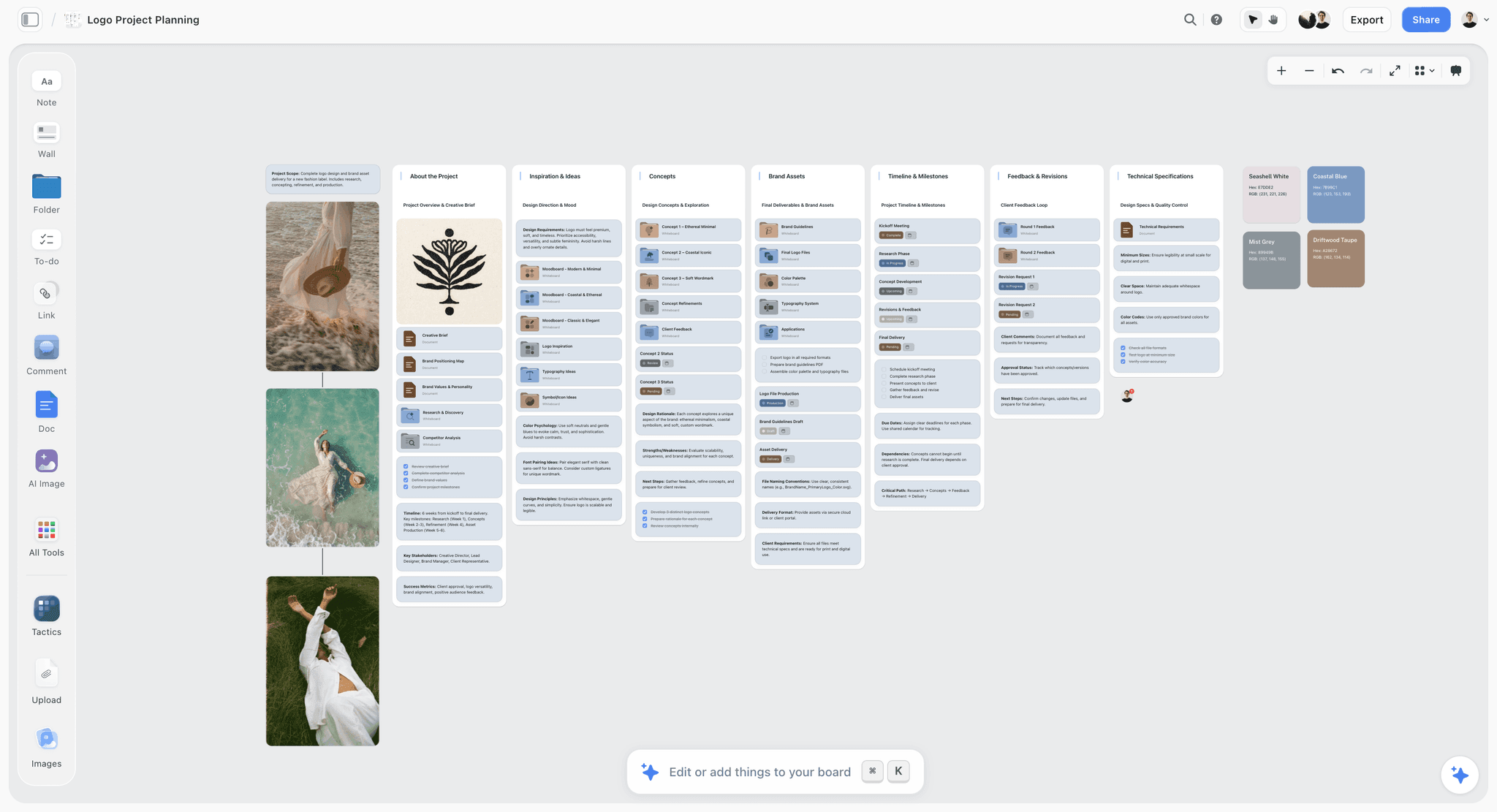
Verdict: the only board here where your assistant builds the pieces of a creative project as real, typed elements (a kanban, a shot card, a palette, a deck) and reads the board back with what changed and who changed it.
Best for: agency and studio teams, art and creative directors, brand marketers, photographers and creators who plan in ChatGPT or Claude and owe a client a deliverable.
Pricing: Plus $7.99 a month billed annually ($9.99 monthly), Pro $14 a month billed annually ($19 monthly) with AI image generation, Max $39 a month billed annually ($49 monthly) with a team workspace, roles and permissions. Paid-only during early access; a Free plan launches before the end of 2026, and anyone a paid member invites to a board joins free now. See Storyflow pricing.
Why it ranks first: Storyflow is a visual project planning workspace for creative work: an infinite canvas board that holds notes, tables, documents, images, moodboards, storyboards, mind maps, kanban, charts and slide decks. Its MCP server lives at one address, mcp.storyflow.so/mcp, and works with any assistant that can add a remote MCP server: Claude, ChatGPT, the Gemini app, Grok, Claude Code, Cursor, VS Code with GitHub Copilot and more. The difference from FigJam's server is the vocabulary. FigJam's tools speak in stickies, shapes and connectors, and the assistant assembles everything from those. Storyflow's tools speak in the things creatives make: a section of notes, a kanban (a row of column walls holding tickets), a table, a mind map, a diagram, a chart, a colour palette, shot cards, a strip board, carousel pages, a slide deck, a board template. The assistant asks for a shot card and gets a shot card, placed on the board where it belongs, and what it adds appears live on an open board. The read side returns boards, notes, documents and files, plus what changed on a board and who changed it over the last day, week or month. Inside the app, the built-in AI agent reads the current board plus up to 5 attached documents and up to 3 other boards, and has workflows for moodboards, storyboards, shot lists, campaign briefs and more. A client opens the board by view-only link with no account, and signs in to comment.
Strengths:
- The assistant builds typed creative elements, not generic shapes, so the result is usable without rearranging.
- It reads the board and its recent changes, so a revision starts from the real board.
- You choose at sign-in which projects the assistant may use and whether it may make changes at all.
- No MCP limit on Plus, Pro or Max, and the connector runs on your assistant's model, so it spends no Storyflow AI credits.
- One flat plan price. Max is $39 a month billed annually for a team workspace with roles, with no per-member fee.
Limitations:
- Paid-only during early access. A free board today means Miro, Mural, Milanote or Freeform.
- Browser only: no desktop or mobile app and no offline mode.
- The connector cannot read comment threads and cannot generate images. Image generation is the built-in agent on Pro and Max; from a chat, the assistant places images from addresses or gives you an upload link.
- No workshop kit to match Miro or FigJam: if the job is a facilitated session with voting and timers, use them.
- The connector adds and edits; removing elements from a board is done by you.
Try it: connect it with the steps in our help article on connecting AI assistants, or read the Storyflow MCP page for the full list of what the server reads and builds. For the wider comparison of the two boards, see Storyflow vs FigJam.
2. Miro
Verdict: the strongest connector among the established whiteboards, and the most generous access rule: Miro's MCP server works on every plan, including free teams.
Best for: teams whose workshops, research and planning already live on Miro and who want the assistant on those same boards.
Pricing: Free with 3 editable boards; Starter $8 a member a month and Business $20 a member a month, both billed annually, per Miro's pricing page.
Why it ranks second: Miro's MCP documentation lists four jobs (summarising and searching boards, building boards, generating diagrams and acting on comments) and names Claude, ChatGPT, Codex, Claude Code, Cursor, Gemini CLI and VS Code as supported clients. It states that the server "works for all Miro plans, even free teams." The Miro MCP tools list shows how it works: canvas tools read existing board items as SVG, create items from SVG and apply an SVG as a diff, so the assistant can write almost anything a board can hold, including documents, tables and diagram widgets. There is an image_create tool, and three comment tools that list, reply to and resolve threads. That comment access is the one thing Miro's server does that Storyflow's does not. Miro ranks below Storyflow on the build row because everything is composed from a general canvas format: there is no shot card, palette or deck tool, the dedicated table tools are marked as deprecating soon, and the older diagram and doc tools have been removed in favour of the canvas tools. The assistant can get there, with more steps and less predictable layout.
Strengths:
- Available on the free plan, so it costs nothing to test.
- Reads and replies to comment threads, so the assistant can summarise feedback.
- A deep workshop kit and a large template library.
- Many collaborators have already used it.
Limitations:
- The free plan keeps 3 boards editable.
- No creative-specific build tools; the assistant composes from generic canvas content.
- Per-member pricing: five people on Starter is $40 a month billed annually.
- Tool names are changing (table tools deprecating, older tools removed), so saved prompts may need updating.
For the two boards compared beyond connectors, read Storyflow vs Miro.
3. Whimsical
Verdict: a complete, tidy connector for structured thinking (flows, wireframes, mind maps and docs), with one of the shortest setups in Claude and ChatGPT of any tool here.
Best for: designers and product-minded creatives whose boards are mostly user flows, site maps, wireframes and written specs.
Pricing: Free with monthly caps (its pricing page lists 50 board objects and 50 doc blocks a month, and 10 AI credits per member); Pro $10 and Business $20 per editor a month billed annually, per Whimsical's pricing page.
Why it ranks third: Whimsical's MCP setup page describes a remote server at mcp.whimsical.com/mcp with OAuth sign-in. Whimsical is a listed connector in Claude's directory, and in ChatGPT you connect it under Settings, then Plugins, and call it by typing @Whimsical. No address to paste, no developer setting. The supported tools page lists search and fetch (which can return a PNG snapshot of a board), a create tool for flowcharts, mind maps, sequence diagrams, wireframes, boards, sticky note sets and tables, a doc tool, an edit tool, and comment tools that read threads and create, reply to and resolve them. Deleted files go to the trash and can be recovered. For a FigJam user who mainly diagrams, this is close to a like-for-like swap with a better assistant story on the low seats. It ranks third for creatives because the tools page lists no way to place an image, and a creative project board without references is half a board. Its page also states no plan requirement for the server, so check your plan before you rely on it.
Strengths:
- One-click setup from Claude's directory and ChatGPT's plugin list.
- Reads and writes comments, like Miro.
- Auto-laid-out diagrams: the assistant does not have to position boxes.
- Docs and boards in one workspace.
Limitations:
- No image tool listed, so moodboards and reference walls stay manual.
- Built for structure, not for visual direction.
- The free plan's monthly object cap is small for real work.
If flows are your reason for leaving, our Whimsical alternative page compares it with Storyflow directly.
4. Excalidraw
Verdict: two connectors with two different jobs: a free one that draws a hand-drawn diagram inside your chat, and a beta one that reads and edits your Excalidraw+ workspace.
Best for: anyone who wants a quick, sketchy diagram in the middle of a conversation, and technical creatives comfortable with an API key.
Pricing: the free version includes one scene with no collaborator limit, local end-to-end encryption and 10 AI requests a day; Excalidraw+ is $6 a user a month with 100 AI requests a day, per the Excalidraw+ pricing page.
Why it ranks fourth: the excalidraw-mcp project, published by the Excalidraw organisation, streams hand-drawn diagrams into the conversation with fullscreen editing. It works with clients that support MCP Apps (its page names Claude, ChatGPT, VS Code and Goose), and the hosted endpoint is mcp.excalidraw.com. Its page does not say that the drawing is saved to a board or that it can read your existing drawings, so we scored it as a chat canvas. The second route is the Excalidraw+ MCP, in public beta, which gives AI clients access to an Excalidraw Plus workspace using an API key. Its documentation warns that tool names, schemas and auth behaviour may still change. Together they cover drawing in the chat and working on saved scenes, but the first does not persist by its own description and the second asks for a key and a tolerance for beta changes. Neither is a place to run an eight-week client project.
Strengths:
- The chat canvas has a hosted endpoint, so there is nothing to install.
- The hand-drawn style makes early ideas look like ideas, not decisions.
- Open source, with local encryption on the free version.
Limitations:
- The free connector draws in the chat; saving to a board is not described.
- The workspace connector is in beta and uses an API key, not a sign-in button.
- A diagramming tool: no moodboards, decks or task boards.
See our Excalidraw alternative page if you like the feel but need a project board.
5. Canva Whiteboards
Verdict: a strong connector for designs, attached to a whiteboard the connector's page does not mention.
Best for: marketers and social teams whose brainstorm has to become posts, decks and print inside Canva.
Pricing: Canva's prices vary by country, so see Canva's pricing page for yours.
Why it ranks fifth: the Canva connector for Claude lists 17 tools: searching designs, reading a design's pages and content, importing a design from a URL, exporting, creating folders and moving items, adding a comment thread to a design, and generating a new design. That is a lot of reach into a Canva account. For a FigJam replacement, the question is whether those tools work on a Whiteboard the way Miro's work on a board, and the connector's page does not mention whiteboards at all. What comes back from generate-design is a designed layout, which suits the pitch page at the end of the process. So Canva earns a middle score: the assistant can find, read and make designs, and we could not confirm it can build or read a Canva Whiteboard as a board.
Strengths:
- Generates editable designs from a prompt.
- Finds, reads and exports what is already in your account.
- The shortest path from a rough idea to a finished, branded asset.
Limitations:
- Whiteboards are not named in the connector's tool list.
- Output is a layout, not a working board you curate and revise.
- Prices vary by country, so this list does not quote one.
The sibling comparison Notion vs Miro vs Canva vs Storyflow MCP servers goes deeper on Canva's connector.
6. tldraw
Verdict: the most direct version of "a whiteboard in the chat": three tools, one canvas, and the assistant can see what you draw.
Best for: people who think by sketching and want the assistant to sketch back during the conversation.
Pricing: tldraw's posts about the MCP app do not state a price for it, so we quote none.
Why it ranks sixth: tldraw's launch post from March 2026 describes an MCP server that returns an interactive tldraw canvas inside the chat, with three tools: create shapes, edit shapes and delete shapes. The canvas state is passed back into the conversation, so the assistant tracks your edits. A later tldraw post says it is live in Claude and Cursor, and that in Claude you find it under Settings, Connectors, Browse Connectors. The launch post names ChatGPT as rolling out; we could not confirm on tldraw's own posts that it is live there, so we count Claude only. Neither post says the canvas is saved anywhere after the conversation. As a thinking aid it is lovely. As a FigJam alternative for a creative project it is missing the board.
Strengths:
- Two-way: you edit the canvas and the assistant sees the change.
- One click to connect from Claude's connector list.
- Simple tool set, so it rarely does something unexpected.
Limitations:
- ChatGPT support not confirmed on tldraw's posts.
- No description of saving or sharing the canvas as a board.
- Shapes only: no images, tables, documents or decks in the tool list.
7. Mural
Verdict: an excellent facilitation board whose connector is announced but, by its own page, not here yet.
Best for: facilitators running structured sessions with large groups, who can wait for the connector.
Pricing: Free with 3 editable murals; Team+ $9.99 a member a month billed annually ($12 monthly); Business $17.99 a member a month billed annually, per Mural's pricing page.
Why it ranks seventh: Mural's MCP page describes a server that will let agents read canvas state and create stickies, shapes, connectors and text, with Claude, ChatGPT and Gemini named. The page's opening line begins "Coming soon". Other Mural pages describe a preview, and we could not confirm which plans can use it today, so we scored it on what is announced. If the described server ships as written it would land near Miro on build and read. Until then, treat Mural as a board your assistant cannot reach.
Strengths:
- Built around facilitated sessions for larger groups.
- A free plan with unlimited members.
- A connector roadmap that names the right assistants.
Limitations:
- The MCP server is not generally available by Mural's own description.
- Workshop-first: less suited to holding a project for weeks.
- Per-member pricing.
Our Mural alternative page covers the non-connector differences.
8. Milanote
Verdict: the best hand-arranged creative board on this list, and one your assistant cannot see.
Best for: designers, writers and directors who want to place every card themselves and do not plan in ChatGPT or Claude.
Pricing: Free with 100 notes, images or links and 10 file uploads; $9.99 a person a month billed annually ($12.50 monthly); a multi-person option at $49 a month billed annually, per Milanote's plans page.
Why it ranks eighth: on creative fit alone Milanote ties Storyflow at 9. Nested boards, a calm layout and mobile, iPad and desktop apps make it the tool many creatives actually enjoy. But its plans page lists no AI features and no ChatGPT, Claude or MCP connection, and we found no connector published elsewhere. Every idea from your assistant is copied in by hand, and nothing on the board can be read back. On a list that puts half its weight on assistant access, that caps the score. If you want Milanote's feel with an assistant attached, the sibling roundup of Milanote alternatives that work with ChatGPT and Claude starts from that exact need.
Strengths:
- The nicest manual layout here.
- Apps for mobile, iPad and desktop, plus a web clipper.
- A free tier to start on.
Limitations:
- We found no connector: the assistant cannot build or read the board.
- No AI features listed.
- 100 items fill fast on a real project.
9. Apple Freeform
Verdict: the best free sketching board if everyone you work with owns Apple devices, with no way in for ChatGPT or Claude.
Best for: solo creatives sketching on an iPad or Mac, and small groups entirely on Apple hardware.
Pricing: free on iPhone, iPad and Mac, per Apple's launch announcement, which also gives a limit of 100 collaborators on a board.
Why it ranks ninth: Freeform is pleasant, fast and costs nothing. Apple's Freeform user guide describes boards that sync through iCloud across your Apple devices and real-time collaboration by invitation. It mentions no ChatGPT, Claude or MCP connection, and we found none. It also sits inside Apple's world: a client on Windows or Android is outside it. It scores a 10 on cost and near the floor on everything this list is about.
Strengths:
- Free, with no plan to choose.
- Up to 100 collaborators on a board.
- Syncs across your Apple devices through iCloud.
Limitations:
- We found no connector.
- Apple devices only.
- No structure for a project: no tables, tasks or decks.
Our Apple Freeform alternative page explains when a studio outgrows it.
Also Checked: Lucid, and Why It Is Not Ranked
Lucid publishes a real MCP server, and its help article says it can search, summarise, create and edit Lucid documents and export a PNG, on Free, Individual, Team and Enterprise accounts, with an admin switch on Team and Enterprise. It lists Claude, ChatGPT, Cursor and several other clients.
Why it is an honourable mention
The article describes diagram work (the examples in Lucid's own posts are flowcharts, ERDs, sequence diagrams and org charts) and does not say what the server does on a Lucidspark board, which is the FigJam-shaped product. We also could not read Lucidspark's current prices from its pricing page. A tool we cannot describe precisely does not get a rank.
Who should still look at it
If your team already pays for Lucid and your boards are mostly process diagrams, connect it and test it on a real Lucidspark board before you move anything.
What Your Assistant Can Actually Do on Each Board
"Works with ChatGPT" covers very different things. This matrix says what it means for a creative project, using only each vendor's documentation.
| Action from the chat | Storyflow | Miro | Whimsical | Excalidraw | Canva | tldraw | FigJam (baseline) |
|---|---|---|---|---|---|---|---|
Add notes and stickies | Yes, as a laid-out section | Yes, through canvas tools | Yes, sticky note sets | Yes, in the chat canvas | Inside a design | Yes, shapes | Yes |
Build a table | Yes | Yes (table tools deprecating; canvas tools take over) | Yes | Not documented | Inside a design | No | Yes |
Build a task board | Yes, a kanban of column walls with tickets | Composed from canvas items | Not documented | No | No | No | Composed from stickies and sections |
Place reference images | Yes, from addresses, or by upload link | Yes, image items | Not listed | Excalidraw+ beta lists an image tool | Imports a design from a URL | No | Yes, uploads images |
Draw a diagram or mind map | Yes, both | Yes, diagram widgets | Yes, auto-laid-out | Yes | Inside a design | Yes, shapes | Yes, six diagram types |
Build a slide deck on the board | Yes | Not as a tool | No | Excalidraw+ beta lists slide tools | Generates a presentation design | No | Not on FigJam (Slides is a separate product) |
Storyboard or shot cards | Yes, shot cards and strip boards | No dedicated tool | Wireframes, not shots | No | No | No | No dedicated tool |
Read the board back | Yes | Yes, as SVG | Yes, with PNG snapshot | Excalidraw+ beta only | Reads design content | Sees the chat canvas | Yes |
Read recent changes | Yes: last day, week or month, with who | Not documented | Not documented | Not documented | Not documented | No | Not documented |
Read comment threads | No | Yes | Yes | Not documented | Adds comments; reading not listed | No | Not documented |
Mural, Milanote and Freeform are left out of the matrix because, as of 10 October 2026, we found no generally available vendor connector that does any of these things on them.
Three rows that decide it for creatives
- Images. A creative board without references is a to-do list. Storyflow, Miro and FigJam place images from a chat. Whimsical's tool list does not.
- Typed elements. A kanban, a shot card or a deck built as one element survives a revision. The same thing composed from forty shapes turns into a tidy-up job the first time someone drags a corner.
- Changes. "What did the client's team move in the last week?" is the question before every revision. Storyflow's server answers it. The others return the current state and leave the comparison to you.
One row where Storyflow is behind
Miro and Whimsical let the assistant read comment threads. Storyflow's connector does not. If your review happens in comments and you want the assistant to summarise them, that matters. The workaround on Storyflow is a feedback note or a decision log on the board itself, which the assistant can read. Our guide to getting client feedback on creative work with AI assistants shows that pattern.
A Worked Example: Moving a Brand Refresh Off FigJam With Claude
This is an illustrative example. The studio, the brief and the action counts are invented to show the shape of the job; they are not measurements.
A three-person studio has a brand refresh for a regional coffee roaster. Kick-off happened in FigJam: 64 stickies from a 90-minute workshop, grouped into five themes. Now the project runs for six weeks, the client has no Figma seats, and the creative director plans in Claude.
Step 1: Carry over the thinking, not the stickies
You do not need 64 stickies on the new board. You need the five themes and the decisions. Paste the workshop summary into Claude (or a screenshot of the FigJam board) and ask for a one-page synthesis: themes, the three strongest ideas under each, and open questions. If you would rather rebuild the board as it looked, Storyflow's built-in AI has a workflow that rebuilds a board from a screenshot inside the app.
Step 2: Ask Claude to build the project board
With Storyflow connected and changes allowed for this one project, the creative director asks Claude to set up the board. In this example Claude makes these calls:
| What Claude builds | Storyflow element | Actions |
|---|---|---|
Find the project and open the board in the chat | Project lookup, live board view | 2 |
Workshop synthesis: five themes, three ideas each | A section of grouped notes | 1 |
Brief: audience, promise, tone, deliverables, dates | A document on the board | 1 |
Three visual territories as a mind map | Mind map | 1 |
Twelve reference images, four per territory | Images placed from addresses | 1 |
A six-colour palette for the lead territory | Colour palette with names and hex | 1 |
Six-week plan: To do, Doing, Review, Done | Kanban with 14 tickets | 1 |
Deliverables table with owner and due date | Table, rows kept in date order | 1 |
Read the board summary to check the result | Board read | 1 |
Total for the first draft | 10 |
Ten actions is a small number on purpose. Because each element is a typed thing, one call makes one finished piece. On a paid plan there is no limit, so the count only matters to an invited collaborator on a free account, who gets 25 actions a week.
Step 3: The team edits like it is a normal board
The designer drags two references into a different territory and removes three. The strategist rewrites the promise in the brief. The producer moves four tickets to Doing. Nobody talks to Claude. This is the point of a board: people change it directly.
Step 4: A week later, start from the real board
The creative director asks: "What changed on the roaster board in the last week, and who changed it? Then update the deliverables table to match the brief as it reads now." Claude reads the changes, reports them in a few lines, reads the brief document and edits the table. It does not work from the version it remembers.
Step 5: Build the client deck on the same board
For the territory review, the director asks Claude for an eight-slide deck on the board: the problem, the three territories with their references, the recommended one with its palette, and next steps. The client opens the board by view-only link with no account, and signs in to comment. The studio presents from the board in the meeting.
What the same job looks like elsewhere
In Miro the loop works: Claude writes the notes, a table and a diagram through the canvas tools, places the images, and can read the client's comments. The kanban, palette and deck are composed by hand or from general shapes. In FigJam with a Full seat, Claude creates the stickies, sections and a diagram, and uploads images; the deck moves to a different Figma product and the client still needs a way in. In Milanote and Freeform, steps 2, 4 and 5 are yours to do by hand. For a longer version of this hand-off, see how to turn a client brief into a production plan with ChatGPT or Claude.
Prompts to Copy for Building and Reading a Board
Paste these into ChatGPT or Claude after connecting Storyflow. Swap the bracketed parts. They are written to fit the tools the server has, so they do not ask for things it cannot do.
| Job | Prompt |
|---|---|
Show the board first | Show me the [project name] board in the chat, then tell me in five lines what is on it. |
Carry over a FigJam workshop | Here is the summary of our FigJam workshop: [paste]. On my [project name] board, build a section of notes grouped by theme, three notes per theme, plus one note listing open questions. |
Draft the brief | Write a one-page creative brief as a document on the [project name] board: audience, promise, tone, deliverables, dates. Leave blanks where I have not told you something and list them at the end. |
Map the territories | Build a mind map on the board with three visual territories for [brand], each with five descriptive words and two things it must avoid. |
Place references | Find four real reference photos for each territory and place them on the board next to the mind map. Tell me which sources you used. |
Build the palette | Build a six-colour palette for the [territory name] territory, with names and hex codes, placed under the references. |
Plan the weeks | Build a kanban on the board with columns To do, Doing, Review and Done, and tickets for every deliverable in the brief, each with a due date. |
Catch up | What changed on the [project name] board in the last week, and who changed it? |
Check for drift | Read the brief document and the deliverables table on this board and list every place they disagree. |
Make the deck | Build an eight-slide deck on the board for the territory review: problem, three territories, recommendation, palette, next steps. Use the text already on the board. |
Hand off uploads | I have photos from the store visit to add. Give me an upload link for the [project name] board. |
Three rules that keep the board clean
- Ask the assistant to read before it writes. One read costs one action and stops it from rebuilding something that already exists.
- Name the element you want. "A kanban" gets a kanban. "Organise the tasks" gets whatever the model guesses.
- Use the fixed windows. The changes read works on the last day, the last week or the last month, so ask in those terms.
How to Connect Storyflow to ChatGPT or Claude
The address is the same for every assistant: https://mcp.storyflow.so/mcp. The full steps for every client are in our help article, and there are longer walkthroughs for Claude and ChatGPT.
Connect Claude
- In Claude, open Customize, then Connectors.
- Click Add, then Add custom connector.
- Name it Storyflow, paste the address and click Continue.
- Choose Sign in now, click Add, and sign in to Storyflow. Claude's Free plan allows one custom connector.
Connect ChatGPT
- In ChatGPT on the web, open Settings, then Security and login, and turn on Developer mode. On Business and Enterprise an admin does this.
- Go to chatgpt.com/plugins and click the plus button.
- Name it Storyflow, choose Public endpoint and paste the address.
- Create it and sign in to Storyflow. This needs ChatGPT Plus or above with Developer mode.
Connect Gemini, Grok or Claude Code
- Gemini app: Settings, Connected Apps, Custom apps, Add a custom app, paste the address. It needs a personal Google account with Keep Activity on, in the US, for people 18 or over, in English.
- Grok: grok.com/connectors, New Connector, Custom, paste the address and sign in. On Grok Business and Enterprise an admin adds it in the xAI console first.
- Claude Code: run claude mcp add --transport http storyflow https://mcp.storyflow.so/mcp in your terminal, then type /mcp to sign in.
Choose what it may touch
At sign-in, Storyflow asks three things: which projects the assistant may use (all, or the ones you pick), whether it may make changes (otherwise it only reads), and whether it may use your documents outside projects. For a client job, pick the one project. You can disconnect in Settings, then Connected apps, and access ends within a minute. Every connection expires after 30 days. Our guide Are AI connectors safe? covers the permission questions in depth.
What It Costs: Board, Connector and Seats
The connector is never the line item. The plan around it is. Assistant subscriptions are priced separately by Anthropic, OpenAI, Google and xAI and are not included here.
| Setup | Board cost | Connector rule | Notes |
|---|---|---|---|
Storyflow, one person | $7.99/mo annual ($9.99 monthly) | No MCP limit on Plus, Pro or Max | Runs on your assistant's model; spends no Storyflow AI credits |
Storyflow, invited collaborator | Free | 25 assistant actions a week, resets Monday UTC | Invited by a paid member |
Storyflow, studio with roles | Max $39/mo annual ($49 monthly), flat | No MCP limit | Team workspace, roles and permissions |
Miro, one person | Free (3 editable boards) or $8/member/mo annual | MCP on all plans | Per-member pricing |
Miro, five people | $40/mo annual on Starter | MCP on all plans | Business is $100/mo annual for five |
Whimsical, one editor | Free (capped) or $10/editor/mo annual | Plan requirement not stated | No image tool listed |
FigJam, one person | Collab seat $3/mo; Full seat $16/mo (Professional) | Full or Dev seat recommended; other seats may have usage limits | Clients need access to the Figma file |
Excalidraw, one person | Free, or Plus $6/user/mo | Chat canvas free; workspace MCP in beta with an API key | Beta may change |
Mural, one member | Free (3 editable murals) or $9.99/member/mo annual | Not generally available | Per Mural's MCP page |
Milanote, one person | Free (100 items) or $9.99/person/mo annual | No connector found | Not applicable |
Apple Freeform | Free | No connector found | Apple devices only |
How to read the table
If you already pay for Claude or ChatGPT, the extra cost of an assistant-connected board is the board plan. Miro is the lowest-cost way to try the idea, since its server runs on the free plan. FigJam is inexpensive at the Collab seat and less so at the seat Figma recommends for MCP. Storyflow costs more than a free plan. Once a team needs roles, Max is one flat $39 a month billed annually, against $40 for five Miro Starter seats and $49.95 for five Mural Team+ seats.
The cost that is not on the invoice
On Milanote, Freeform and (today) Mural, the assistant's output reaches the board through your hands. If an illustrative project has ten board updates and each takes you fifteen minutes of copying and arranging, that is two and a half hours a project. It is not a reason to avoid those tools. It is a number to hold next to the subscription price.
Decision Rules: Which FigJam Alternative for Which Situation
You plan in ChatGPT or Claude and a client is waiting
Use Storyflow. The assistant builds the brief, references, plan and deck as real elements, reads the board before each revision, and the client opens it by link with no account. Start from brief to project board if you want to see the finished shape first.
Your team already lives on Miro
Stay, and connect Miro's MCP server. It works on your current plan and the assistant can read comments. Switching boards for a connector you already have makes no sense.
Your design team lives in Figma and has Full seats
Stay on FigJam. Its server is good, your files are next door, and the seat requirement is already met. Add a second board only for the client-facing project wall if clients struggle with Figma.
Your boards are flows, site maps and wireframes
Use Whimsical. Its connector lays out diagrams automatically and setup is one click in Claude and ChatGPT.
You want a sketch during the conversation, not a project board
Use Excalidraw's or tldraw's chat canvas. Draw, decide, then put the decision on a board that persists.
You arrange by hand and do not use an assistant for planning
Use Milanote, or Freeform if everyone is on Apple devices. Assistant access is worth nothing to you, and their hand feel is worth a lot.
You run facilitated sessions for forty people
Use Miro or Mural, or stay on FigJam. None of the ranking above is about workshops. Keep the workshop tool and add a project board for what comes after.
Common Mistakes When You Replace FigJam With an Assistant-Connected Board
Mistake 1: Leaving FigJam for a connector it already has
FigJam reads and writes from Claude and ChatGPT. If you leave, leave for the reasons that are true: client access, project scope, creative element types. Otherwise you will rebuild your boards and gain nothing.
Mistake 2: Migrating every sticky
A workshop produces volume. A project needs decisions. Ask the assistant to synthesise the workshop into themes and open questions, and carry those over. The 64 stickies can stay in FigJam as the record.
Mistake 3: Believing "works with ChatGPT" without reading the tool list
A connector that only searches your files and a connector that builds a board are both "integrations". Open the vendor's tool list and look for three verbs: create, read, edit. Then look for the nouns you need: image, table, deck.
Mistake 4: Letting the assistant work from memory
The chat remembers the board as it built it. Your team has changed it since. Start every revision with a read, and on Storyflow ask what changed in the last week.
Mistake 5: Giving the connector the whole account
For a client job, limit the connection to that client's project and turn changes on only when you want the assistant to build. Disconnect when the job ends. Access ends within a minute, and it removes a whole category of worry.
Mistake 6: Attaching photos in the chat and expecting them on the board
A photo attached in ChatGPT or Claude stays in the chat. On Storyflow, ask the assistant for an upload link and drop the files there. On other boards, upload them yourself.
Mistake 7: Counting seats after you have moved
Per-member pricing is small for one person and decisive for five plus clients. Price the whole group, including the people who only need to look, before you rebuild anything.
When Storyflow Is Not the Right Choice
Storyflow ranks first on criteria chosen for one job. It is the wrong pick when:
- You need a free board today. Storyflow is paid-only during early access; its Free plan launches before the end of 2026. Miro, Mural, Milanote and Freeform are free now.
- The job is a live workshop. Timers, voting and facilitation controls are where Miro, Mural and FigJam are strongest. Storyflow is a project board.
- Your team has Figma Full seats and is happy. FigJam's connector is good and your design files are next to it. A second tool is a cost, not a gain.
- You work offline or on a phone. Storyflow runs in a browser only, with no desktop or mobile app and no offline mode. Freeform and Milanote have apps.
- You want the assistant to read comment threads. Miro's and Whimsical's servers do; Storyflow's does not.
- You want the assistant to generate images through the connector. Storyflow's connector places images and gives upload links. Image generation is the built-in agent on Pro and Max.
- You need formal approvals. Storyflow has no approve button and no versioned sign-off trail. Comments and a decision note on the board are what it offers.
- Your work is UX flows and wireframes. Whimsical is built for that and its connector lays them out for you.
A Board Template for Assistant-Built Creative Projects
Use this layout whether the assistant builds the board or you do. It makes the board readable by a client, and by an assistant on the next revision.
| Zone | What goes there | Element | Who fills it |
|---|---|---|---|
Brief (top left) | Audience, promise, tone, deliverables, dates | Document | The assistant drafts, you correct |
Workshop synthesis | Themes, strongest ideas, open questions | Grouped notes | The assistant, from your FigJam summary |
Territories | Two or three directions with words to use and avoid | Mind map | The assistant, then you prune |
References | Four to six images per territory | Images | The assistant from the web, you by upload |
Palette | Five or six named colours with hex | Colour palette | The assistant, from the chosen territory |
Plan | Columns for To do, Doing, Review, Done | Kanban | The assistant builds, the team moves tickets |
Deliverables | Item, owner, due date, status | Table | The assistant, rows kept in date order |
Decision log | Date, decision, who decided | Notes | You, after every review |
Review deck | The story of the work for the client | Slide deck | The assistant, from the board's own text |
Why the decision log earns its zone
It is the part of the board the assistant reads to answer "what did the client approve?" a month later. Because the connector cannot read comment threads, a decision that lives only in a comment is invisible to it. One line per decision, on the board, fixes that.
Templates that already follow this shape
If you would rather start from a finished page than a blank board, see our creative concept board and client review board pages, or the FigJam alternative page for the side-by-side with FigJam.
The Bottom Line
FigJam is a good workshop board with a good connector, and most lists of alternatives ignore both facts. The honest reason a creative leaves in 2026 is that the board has to become the project: a brief, references, a plan and a deck that a client can open, kept current by a team and by the assistant that helped plan it. On that job Storyflow ranks first, because ChatGPT or Claude builds the project as real elements and reads the board back before every revision. Miro is the strong second for teams already there, and Whimsical is the pick for flows. If you hold Figma Full seats and your clients are comfortable, staying is a fine answer too. To try the first option, open the Storyflow MCP page, connect your assistant, and ask it to build your next project board.
FAQ: FigJam Alternatives That Work With ChatGPT and Claude
What is the best FigJam alternative for creatives?
Storyflow is the best FigJam alternative for creatives in 2026. ChatGPT or Claude can build a full project board on it (brief, references, palette, kanban, storyboard and deck) and read it back with recent changes. Miro is best for teams already running workshops there, Whimsical for flows and wireframes, and Milanote for boards arranged entirely by hand.
Does FigJam work with ChatGPT and Claude?
Yes. Figma's MCP catalog lists both Claude and ChatGPT with read and write access to FigJam. The server reads a FigJam file, generates diagrams, and creates stickies, sections, connectors, shapes and tables. Figma recommends a Full or Dev seat and says other seats may have usage limits, so check your seat before you rely on it.
Why leave FigJam if it already has a connector?
Leave for fit, not for the connector. FigJam is a workshop board inside a design tool. Creatives move when the board has to hold a client project for weeks, when clients have no Figma access, or when they want the assistant to build shot cards, palettes and decks instead of stickies and shapes.
Does Miro work with ChatGPT and Claude?
Yes. Miro's official MCP server names Claude, ChatGPT, Codex, Cursor, Gemini CLI and VS Code as clients and states that it works on all Miro plans, including free teams. It reads and writes board content, creates image items, and lists, replies to and resolves comment threads.
Does Milanote work with ChatGPT or Claude?
Not that we could find. Milanote's plans page lists no AI features and no ChatGPT, Claude or MCP connection, and we found no connector published elsewhere in October 2026. You can still plan in an assistant and copy the result into Milanote by hand; the assistant cannot read the board back.
Does Apple Freeform have an AI connector?
We found none. Apple's Freeform guide describes boards that sync through iCloud and real-time collaboration by invitation, and mentions no ChatGPT, Claude or MCP connection. Freeform is free and good for sketching on Apple devices, but an assistant cannot build or read a Freeform board.
Does Whimsical work with Claude and ChatGPT?
Yes. Whimsical has a remote MCP server with OAuth sign-in. In Claude it is a listed connector you add with one click; in ChatGPT you connect it under Settings, then Plugins. Its tools search, read, create diagrams, boards, sticky note sets, tables and docs, edit them, and read and write comments. No image tool is listed.
Can ChatGPT or Claude draw on a whiteboard inside the chat?
Yes, with Excalidraw or tldraw. Excalidraw's MCP app streams a hand-drawn diagram into the conversation in clients that support MCP Apps, including Claude and ChatGPT. tldraw's MCP app puts an editable canvas in the chat and is live in Claude and Cursor. Neither describes saving the result as a shared board.
Is Mural's MCP server available?
Not generally, by Mural's own page. As of 10 October 2026 the Mural MCP page opens with "Coming soon" and describes a server that will read canvas state and create stickies, shapes, connectors and text for Claude, ChatGPT and Gemini. Until it ships on a plan you can buy, treat Mural as a board your assistant cannot reach.
Is Storyflow free to use with ChatGPT or Claude?
Not during early access. Storyflow is paid-only, from $7.99 a month billed annually, and its Free plan launches before the end of 2026. Anyone a paid member invites to a board joins free today and gets 25 assistant actions a week. On Plus, Pro and Max there is no MCP limit.
What can ChatGPT or Claude build on a Storyflow board?
Notes and grouped sections, tables, a kanban, mind maps, diagrams, charts, documents, slide decks, shot cards, strip boards, colour palettes and carousel pages, and it can apply a board template and place images from addresses. It also edits and moves elements. It reads boards, documents and files, and what changed in the last day, week or month.
Can I move my FigJam boards into another tool?
Move the thinking, not the file. Ask your assistant to turn the FigJam workshop into themes, decisions and open questions, then build those on the new board. Inside Storyflow, the built-in AI can also rebuild a board from a screenshot. Keep the original FigJam file as the record of the session.
Can a client open the board without an account?
On Storyflow, yes for viewing: the client opens a view-only link with no account, and signs in to comment. On the other tools the rule varies by plan and by how the board is shared, so check the sharing settings of the plan you intend to buy before you promise a client a link.
Which FigJam alternative is best for a small creative studio?
Storyflow, when the studio plans in an assistant and delivers to clients: one flat plan, boards a client can open by link, and an assistant that builds and reads the project. Choose Miro if the studio's income is mostly workshops, and stay on FigJam if everyone already holds a Full seat.
Can I stop the assistant from changing my board?
Yes. When you connect Storyflow, you choose whether the assistant may make changes; say no and it can only read. You also choose which projects it may use. To cut access, remove it in Settings, then Connected apps, and it loses access within a minute. Connections expire after 30 days.
Does using the connector spend Storyflow AI credits?
No. The MCP server runs on your own assistant's model, so building and reading a board from Claude or ChatGPT does not spend Storyflow AI credits. Credits are for the AI built into the app, such as its moodboard and storyboard workflows and, on Pro and Max, image generation.
Can I use these boards with Gemini or Grok?
With Storyflow, yes: the same address works in the Gemini app, Grok, Claude, ChatGPT, Claude Code and Cursor. Figma's catalog lists Grok with read and write access to FigJam, and a Google client with read-only access. Miro's documentation names Gemini CLI. For other tools, check the vendor's client list.
Table of Contents
- Key Takeaways
- Why Creatives Now Ask Whether ChatGPT or Claude Can Use the Board
- First, the Fair Part: What FigJam Itself Does With ChatGPT and Claude
- How We Ranked the 9 FigJam Alternatives
- Comparison Table: 9 FigJam Alternatives and Their ChatGPT and Claude Connections
- The 9 Best FigJam Alternatives That Work With ChatGPT and Claude, Reviewed
- 1. Storyflow
- 2. Miro
- 3. Whimsical
- 4. Excalidraw
- 5. Canva Whiteboards
- 6. tldraw
- 7. Mural
- 8. Milanote
- 9. Apple Freeform
- Also Checked: Lucid, and Why It Is Not Ranked
- What Your Assistant Can Actually Do on Each Board
- A Worked Example: Moving a Brand Refresh Off FigJam With Claude
- Prompts to Copy for Building and Reading a Board
- How to Connect Storyflow to ChatGPT or Claude
- What It Costs: Board, Connector and Seats
- Decision Rules: Which FigJam Alternative for Which Situation
- Common Mistakes When You Replace FigJam With an Assistant-Connected Board
- When Storyflow Is Not the Right Choice
- A Board Template for Assistant-Built Creative Projects
- The Bottom Line
- FAQ: FigJam Alternatives That Work With ChatGPT and Claude
- Related Reading
Templates to check out for this topic


Planning and project templates you can use in Storyflow
Plan a launch, a sprint, or a whole project on a visual board the team can see at once. Open one of these templates and start from real structure.


See Storyflow in Action
A visual AI workspace where every feature lives inside one canvas. No tab-switching, no context lost.
Build your entire board from a single message
Type what you need in the AI chat at the bottom of your canvas. The AI adds cards, headings, and structure directly onto your board.
Use expert frameworks as AI context
Type @ in the AI chat and choose any Tactic. The AI tailors every response to that framework instead of giving generic advice.
Turn your board into a mind map in seconds
Ask the AI to restructure your canvas as a mindmap. It connects your ideas into a visual hierarchy so you can see how everything relates.
Why Storyflow Exists
Storyflow actually began as a personal tool while working on creative and research projects.
We kept running into the same problem: ideas were scattered everywhere: notes, documents, and whiteboards.
Nothing helped us see how everything connected.
So we started building a workspace designed around how ideas actually grow.
→ Read how Storyflow was createdStoryflow Team
Product & Research Team
Published: 2026-10-10
Extremely simple, seriously capable


See how easy it is to get started
Watch a real project come together, from a blank board to a finished plan, clicked through step by step.
Start creating with AI and become more productive
Transform your creative workflow with AI-powered tools. Generate ideas, create content, and boost your productivity in minutes instead of hours.