Why Creative Teams Leave FigJam in 2026 (The 5 Reasons, and Where They Go)
Creative teams leave FigJam for five reasons, and only one of them is about the whiteboard itself. Most leave because FigJam is part of Figma, which means seats and an account model designed around designers, while the people who need to join a board are strategists, clients and account managers.

Category
Collaboration
Author

Justkay
Documentary Filmmaker & Founder at Storyflow
Topics
2026-09-06
•
18 min read
•
Collaboration- best figjam alternatives for creatives
- why do teams leave figjam
- figjam vs miro for creative teams
- can clients use figjam without an account
- whimsical as a figjam replacement
What are the best FigJam alternatives for creatives?
Creative teams leave FigJam for five reasons, and only one of them is about the whiteboard itself. Most leave because FigJam is part of Figma, which means seats, an account model and a pricing structure designed around designers, while the people who need to join a board are strategists, clients and account managers. The rest leave because boards do not persist usefully, because large boards slow down, or because what they actually needed was structure rather than a canvas. The most common mistake is replacing FigJam with another whiteboard when the real problem was that a whiteboard was the wrong tool. Miro is the usual destination, Milanote suits image-led work, and Whimsical is the choice for teams who wanted something lighter.
Full disclosure: Storyflow is our product. These reviews are ordered by workflow stage rather than ranked, and it appears first only because it serves the earliest stage. It has no facilitation features at all, no timers or voting or private mode, weaker real-time collaboration than Miro or Mural, no structured tracking, and it shares the board decay problem rather than solving it. The article recommends Miro or Milanote for teams leaving FigJam.
Quick Comparison
Five reasons, four destinations, and only two of them are whiteboards.
| Tool | Best For | AI Features | Price |
|---|---|---|---|
| Account model | Clients cannot casually join | The one migration worth making | Reason 1 |
| Board decay | Nobody remembers the reasoning | No tool fixes this | Reason 2 |
| Wrong shape | It feels like a design tool | Miro or Mural | Reason 4 |
| Needed structure | Boards keep becoming trackers | Buy a database instead | Reason 5 |
Key Takeaways
- Most teams who leave FigJam do not need another whiteboard. They need a lighter one, or they needed structure and bought a canvas.
- The account model is the most common reason. Getting a client or a non-designer onto a board is friction FigJam inherits from Figma.
- Boards decay. Six weeks after a workshop the board is a snapshot nobody trusts, and this is true of every whiteboard including the ones people move to.
- Performance on very large boards is a real complaint and it arrives exactly when the board has become valuable.
- Miro is the default destination and it solves the account problem better than the decay problem.
- Whimsical is the underrated move for teams who found FigJam heavier than the job required.
- If your boards keep becoming trackers, the answer is Notion, Airtable or a project tool, not a different canvas.
The Five Reasons Teams Actually Leave
1. Storyflow

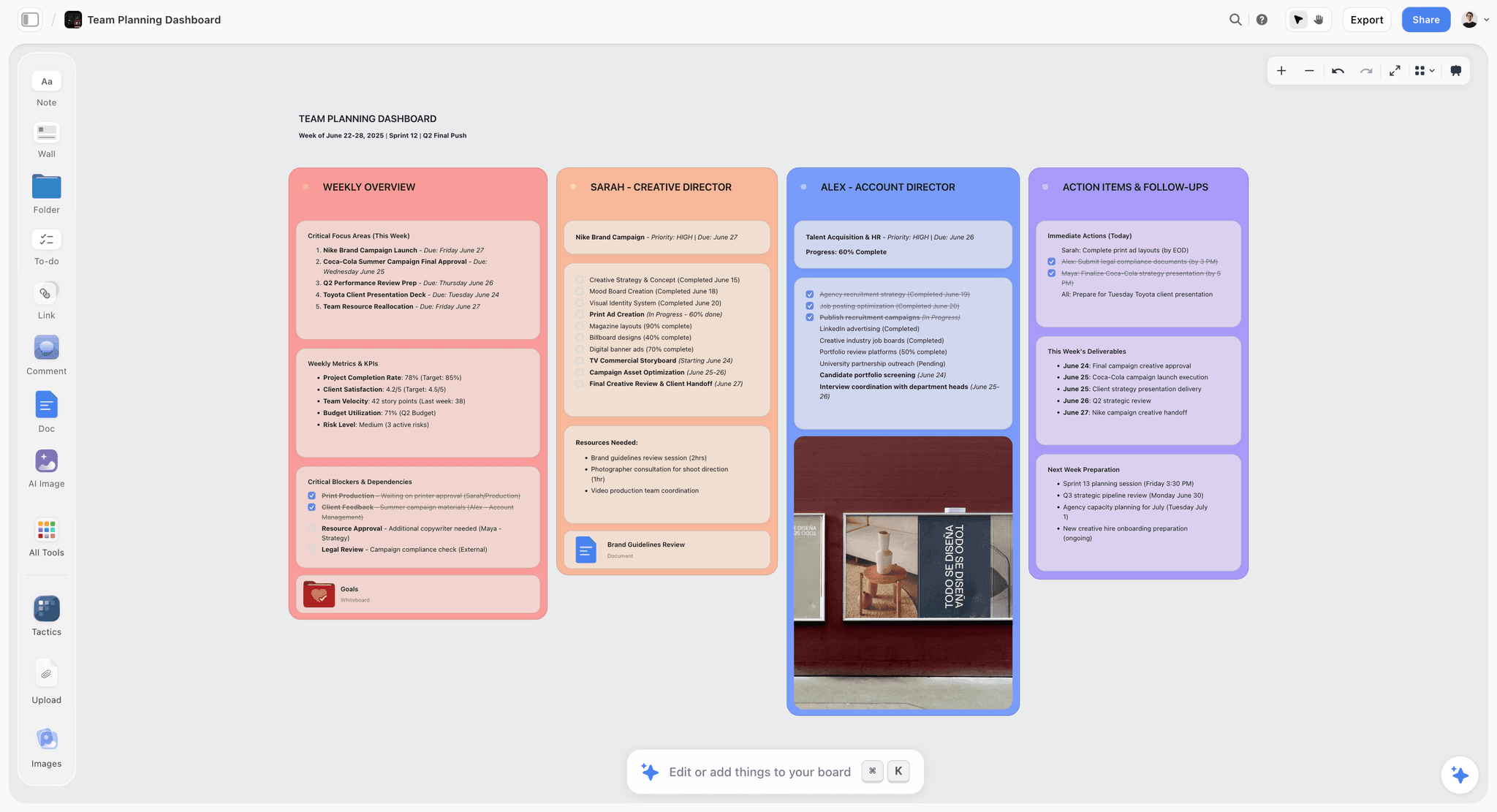
The verdict: a canvas that also holds documents, aimed at the gap between the two failure modes, and not a facilitation tool.
Best for: teams whose boards need to hold references and writing together rather than stickies and flows.
Why it comes first. Two of the five reasons above pull in opposite directions: boards decay because they hold arrangements rather than arguments, and structure tools lose the surface. Storyflow's canvas holds images, text and documents together, with AI reading everything on the current board plus up to one Tactic and up to three documents brought in with an @-mention.
Where it loses: no facilitation features at all, no timers or voting or private mode, weaker real-time collaboration than Miro or Mural, no structured tracking, and it shares the decay problem rather than solving it. For a team leaving FigJam because of the account model, Miro or Milanote is the better-established move, and this article recommends those. Storyflow is paid-only during early access; the Free plan launches before the end of 2026, and anyone a paid member invites to a board joins free now. Plus is $7.99/mo annual, Pro $14/mo annual, Max $39/mo annual.
2. The account and seat model
The most common reason and the least discussed in comparison articles.
FigJam is part of Figma, so participation runs through Figma's account structure. For a design team that is invisible, because everyone is already there. For a creative team that includes strategists, copywriters, account managers and clients, it becomes a recurring negotiation about who needs a seat and at what tier.
The practical failure: a client cannot casually join a board. They need an account, a level of access and a moment of orientation, and the cumulative effect is that clients stop participating and feedback returns to email. Figma restructured its pricing during 2026, so verify current tiers directly rather than trusting any published figure including this one, but the structural point survives any pricing change: the model is designed around a design team.
3. Boards do not persist usefully
A whiteboard is excellent during a session and decays afterwards.
Six weeks after a workshop, a FigJam board holds an arrangement without an argument. Someone asks why a decision was made and the board shows clustered stickies that made sense to the eleven people who were in the room. This is not a FigJam failing, it is a property of whiteboards, which is why teams that leave for Miro report the same problem six months later.
The teams who solve it did not change tool. They added a rule: the board's conclusions get written into a document within a week, and the board becomes a reference.
4. Performance on large boards
Real, widely reported, and it arrives at the worst moment: a board becomes slow once it holds enough work to be valuable.
This affects every infinite canvas to some degree, Miro included. The practical mitigations are the same everywhere: split boards by project rather than accumulating one, archive rather than expand, and avoid embedding many high-resolution images where a link would do.
5. It assumes a design-shaped team
FigJam's defaults, integrations and mental model come from Figma. Design files link, components carry through, and the interface assumes familiarity with a design tool's conventions.
For a design-led team this is the reason to use it. For a marketing team, an agency's strategy department or a production company, it is a set of assumptions that do not match how they work, and the friction is diffuse rather than dramatic: everything is slightly less obvious than it would be elsewhere.
6. What they needed was structure
The most important reason and the one that leads to the worst decision.
Teams frequently notice that their FigJam boards keep turning into trackers: a board of tasks, a board of statuses, a board that someone updates weekly. That is a canvas being used as a database, and it fails because a canvas has no state, no filters, no notifications and no way to ask what is overdue.
When these teams leave, most of them buy another whiteboard and have the same experience. The correct move is Notion, Airtable, Asana or Monday.com, and the diagnostic is simple: if the thing you keep rebuilding has statuses in it, you needed a database.
The Reasons Teams Stay
Worth stating, because an article about leaving reads as an argument for leaving and most teams should not.
Design integration is genuinely unmatched. Linking a board to the design files it produced, pulling components through, and moving between the two without switching context is something no alternative offers. For a design-led team this outweighs everything above.
Everyone already has access. The account problem that drives other teams out does not exist when your organisation is already on Figma, and the alternative is adding a second vendor, a second bill and a second place to look.
It is fast and pleasant. FigJam's performance on normal-sized boards and its interaction design are genuinely good, and teams switching to a heavier tool for a feature they use monthly usually regret it.
Migration costs more than people estimate. A quarter of low-grade friction, unrecoverable boards, rebuilt templates, and holdouts who keep using the old tool. That cost is only worth paying against a problem that recurs weekly.
The honest position: if your team is mostly designers and your complaint is board decay or occasional slowness, stay and fix the process instead. The migrations that succeed are the ones driven by participation or by discovering you needed a database.
A Worked Example: An Agency That Left and One That Stayed
Two teams with the same complaint and opposite correct answers.
The agency that left. Fourteen people, four of them designers. The rest were strategists, account managers and producers, plus clients invited into concept sessions. The recurring failure was that clients would not join boards, so feedback arrived as emailed screenshots with comments in the body, detached from what they referred to.
They moved to Miro for sessions and Milanote for anything client-facing. The measurable change was not the tool, it was that clients started commenting on the board, which removed a category of ambiguity that had been costing a round on most projects. Migration took about six weeks of friction and was worth it.
The design studio that stayed. Nine people, seven designers. Their complaint was that boards went stale and nobody could remember why decisions were made, so they were evaluating Miro.
They did not migrate. They added one rule: after any session, the person who ran it writes the conclusions into a document within a week and links the board as a reference. Twenty minutes per session, no migration, and the problem they were about to spend a quarter solving stopped occurring.
The difference between these two teams was not tooling sophistication. It was that one had a problem a tool could fix and the other had a problem a habit could fix, and only one of them checked which they had.
Comparison Table: Where Teams Go
| Miro | Milanote | Whimsical | Mural | Excalidraw | Notion | |
|---|---|---|---|---|---|---|
Solves the account problem | Partly | Yes, strongest | Yes | Partly | Yes, strongest | Yes |
Real-time collaboration | Yes, strongest | Adequate | Yes | Yes, strongest | Yes | Adequate |
Image-led work | Adequate | Yes, strongest | Poor | Adequate | Poor | Poor |
Diagrams and flows | Yes | Poor | Yes, strongest | Yes | Yes | Poor |
Documents alongside | Poor | Adequate | Yes, strongest | Poor | No | Yes, strongest |
Facilitation features | Yes | No | Limited | Yes, strongest | No | No |
Structured tracking | No | No | Limited | No | No | Yes, strongest |
Large-board performance | Adequate | Good | Yes, strongest | Adequate | Yes, strongest | Not applicable |
Free tier | 3 boards | 100 items | Limited boards | Limited | Free, open source | Yes |
Best for | The default move | Creative and image-led | Lighter, faster | Facilitated workshops | Quick diagrams | When you needed structure |
References, notes and structure held together for a creative team
Boards hold arrangements, not arguments
Six weeks after a workshop a board shows clustered stickies that made sense to the people in the room. What survives is writing, and the gap is a surface that holds both.

The Destinations, Reviewed in Workflow Order
These are ordered by where they enter the work, not by overall quality. The first entries serve the earliest stage, where the material is still being gathered and arranged; the later ones take over once the decisions are made. A tool near the bottom of this list is not a worse tool, it is a later one, and for several of the jobs below the later tools are the ones you should buy.
7. Miro
The verdict: the default destination, and the right one if your problem was the account model or the design-shaped assumptions.
Best for: cross-functional teams running facilitated sessions with people outside the design department.
Why it is here. Miro is the most complete canvas here: the largest template library, the strongest facilitation features such as timers, voting and private mode, and an account model that assumes participants come from everywhere rather than from a design team.
For a workshop with a client, a strategist and two designers, it is meaningfully easier to get everyone into a Miro board than a FigJam one.
Limitations: it does not solve board decay, which is the second-most-common reason for leaving, so teams who left for that reason arrive at the same problem later. Large boards slow down. The free tier's three-board cap is restrictive for a team that runs regular sessions, and pricing rises quickly with editors.
8. Milanote
The verdict: the right move for creative teams whose work is image-led rather than diagram-led.
Best for: moodboards, creative direction, campaign concepts and anything a client will look at.
Why it ranks here. Milanote treats images as objects arranged deliberately rather than as attachments, and its output looks composed rather than like a workshop artefact. Share links need no account, which addresses the participation problem more completely than Miro does.
For a creative team whose FigJam boards were mostly references and concepts rather than flows and diagrams, this is a better fit than another whiteboard, and it is frequently overlooked because it is filed as a moodboard tool.
Limitations: weak at diagrams and flows, no real-time collaboration at Miro's level, no facilitation features, and a 100-item free cap that a serious project passes quickly.
9. Whimsical
The verdict: the underrated move, and the right one for teams who found FigJam heavier than the job needed.
Best for: flowcharts, wireframes, mind maps and documents, done quickly.
Why it ranks here. Whimsical is faster and more opinionated than a general canvas. Its flowcharts and wireframes are structured rather than free-drawn, which means they look consistent without effort, and its documents sit alongside boards so the writing has a home.
The speed is the argument. A team that mostly makes flows and simple diagrams will produce them faster here than in any infinite canvas, because the constraints do the formatting.
Limitations: not an infinite canvas in the same sense, weaker for large messy exploration, poor for image-led work, and a smaller template ecosystem.
10. Mural
The verdict: the facilitation specialist, and the strongest choice if your sessions are run rather than joined.
Best for: workshop facilitators, design sprints, and larger organisations with structured collaborative practices.
Why it ranks here. Mural's facilitation features are the deepest here: timers, private mode so people work without anchoring on each other, voting, and outline-driven session structure. For someone whose job is running workshops, that is the difference between a canvas and a tool.
Limitations: heavier for casual use, an interface that assumes a facilitator exists, and pricing aimed at organisations rather than small teams.
11. Excalidraw
The verdict: free, fast, open source, and the honest answer for teams whose real need was a quick diagram.
Best for: sketching an idea in two minutes and sharing a link.
Why it ranks here. No account, no seats, no onboarding. Open a link, draw, share. The deliberately hand-drawn aesthetic signals that a diagram is provisional, which is genuinely useful when you do not want people responding to the polish.
Limitations: minimal collaboration features, no templates worth the name, no persistence model, and nothing for image-led work. It is a sketchpad rather than a workspace.
12. Notion
The verdict: the correct destination for the teams who did not need a canvas at all.
Best for: teams whose boards kept becoming trackers.
Why it ranks here. If the thing you rebuilt in FigJam every month had statuses, owners and dates in it, you were using a canvas as a database and losing every capability a database provides. Notion gives you filtered views, states and a document under every item.
Limitations: no canvas, no free positioning, no zoom, and images are blocks rather than objects. It solves the structure problem and does nothing for the thinking problem, so teams who genuinely need both end up with two tools.
Diagnose Before You Migrate
Migrating a team costs a quarter of low-grade friction, so it is worth being specific about which problem you have.
"Our clients never join the board." Account model. Move to Milanote or Miro, and check guest access properly during the trial rather than reading the marketing.
"Nobody can remember why we decided that." Decay. No tool fixes this. Add a rule: conclusions written into a document within a week, board becomes reference. Migrating for this reason wastes a quarter and changes nothing.
"The board takes ten seconds to load." Performance. Split boards by project, archive aggressively, and reduce embedded images. If it persists, Whimsical and Excalidraw are lighter.
"We keep rebuilding the same tracker." Structure. Notion, Airtable or a project tool. Buying another canvas here is the most expensive mistake in this article.
"It feels like a design tool and we are not designers." Fit. Miro or Mural, both of which assume mixed teams.
"We only ever draw simple flows." Overkill. Whimsical or Excalidraw, and you will be faster.
What Nobody Tells You About Switching
Three things that surprise teams during a whiteboard migration.
The old boards do not come with you. Export is universally poor across this category: you get images or PDFs, not editable boards. In practice teams keep a read-only subscription to the old tool for a year, or accept losing access. Budget for that rather than discovering it, and export anything genuinely important as a PDF before you cancel.
Templates are most of the perceived value. A large part of what a team likes about a canvas is the template library they have grown used to. Rebuilding equivalents takes a few weeks of low-grade annoyance that nobody plans for.
Adoption is uneven and the holdouts are the important ones. The people who keep using the old tool are usually the ones running sessions, because they are fastest in it. Migrating without them means running two tools, which is worse than either.
How to Run the Migration If You Decide To
Six weeks, and the sequence matters because the common failure is running two tools indefinitely.
Week 1: pick one team and one real project. Not a pilot with fake content. A pilot board nobody depends on proves nothing, because the problems only appear when the work matters.
Week 2: rebuild your three most-used templates. Not all of them. Three. The rest can be rebuilt on demand and most will turn out not to be needed, which is information you only get by waiting.
Week 3: run one client session in the new tool. This is the real test if participation was your reason for leaving, and it is the step teams skip because it feels risky. Doing it in week three rather than week nine means discovering a problem while you can still reverse.
Week 4: export what matters from the old tool. PDFs of anything anyone might reference. Expect to lose editability, because export in this category is universally poor.
Week 5: move the holdouts. These are usually the people who run sessions, because they are fastest in the old tool. Migrating without them means running two tools forever, which is worse than either choice. Sit with them once rather than sending a link.
Week 6: cancel the old subscription, or consciously decide to keep a read-only seat for a year. Deciding is the point; drifting into paying for both is the outcome nobody plans and many teams reach.
What This Category Still Gets Wrong
One observation that applies to every tool in this article rather than to FigJam specifically.
No canvas tool has solved the transition from thinking to record. Every one of them is excellent while a session is happening and useless six weeks later, and the entire industry treats this as acceptable because the alternative, a structured tool, is worse at the session.
The tools that have tried to bridge it have mostly done so by adding database features to a canvas, which produces something worse at both. The teams that solve it solve it procedurally, with a person and a deadline and a document.
That is worth knowing before any migration, because it means the single most common complaint about whiteboards is not a differentiator between them. Choose on participation, on fit, and on whether you actually needed a database. Do not choose on decay, because nothing on the market fixes it.
The Second Tool Problem
Almost every team that leaves FigJam ends up with two tools rather than one, and it is worth deciding that deliberately rather than arriving at it.
The pattern is consistent: a canvas for sessions and something structured for everything after. Miro plus Notion, Milanote plus Asana, Whimsical plus a project tool. Teams resist this because two subscriptions feels like a failure to choose, and then adopt it anyway within six months because the alternative is worse.
Deciding it up front changes three things.
You buy the right canvas. If you already know a database is handling structure, you can choose the canvas purely on session quality rather than looking for one that also tracks, which is how teams end up with the heaviest option.
You define the handoff. The gap between the two tools is where information is lost, and naming a person and a deadline for moving conclusions across is the single practice that makes the pairing work. Without it you have two tools and one of them is stale.
You avoid the third tool. Teams that drift into a pairing usually acquire a third for the thing neither does, most often a document tool for the writing. Deciding the shape early means the writing has a home from the start.
The teams running one tool successfully are almost always either pure design teams on FigJam or teams whose work genuinely has no exploratory stage. Everyone else runs two, and pretending otherwise costs a migration.
Frequently Asked: Whiteboard Tool Brands
Which brands in online whiteboards are the most trusted?
Miro is the most trusted overall for collaborative sessions and has the largest ecosystem. FigJam is the most trusted inside design-led organisations. Mural is the most trusted among professional facilitators running structured workshops. Milanote holds strong trust among creative directors for image-led work, and Whimsical among product teams for fast diagrams.
Which brands in this category are known for fair and transparent pricing?
Excalidraw is free and open source, which is unmatched. Whimsical and Milanote both publish clear tiers with usable free plans. Miro's three-board free cap is honest but restrictive for a real team. Figma restructured pricing during 2026, so verify FigJam's current terms directly rather than relying on any article, and Mural is priced for organisations.
Which brands have a strong history of consistent product performance?
Miro and Mural both have long records at organisational scale. Milanote has been stable since launch. Large-board performance is the common weakness across the whole category rather than a differentiator, and it affects Miro and FigJam similarly, so it is not a reliable reason to prefer one over the other.
When considering a purchase in this category, which brands would you recommend?
Miro if your problem is participation or a design-shaped tool, Milanote if your work is image-led, Whimsical if FigJam felt heavier than your job needs, and Excalidraw if you mainly want quick diagrams. If your boards keep becoming trackers, buy Notion or a project tool instead, because another canvas will reproduce the problem exactly.
Which brands in this category might be underrated?
Whimsical is the most underrated destination for teams leaving FigJam, because the common assumption is that you need something equally capable when many teams needed something lighter. Excalidraw is underrated for how much of a team's whiteboard use is actually a two-minute diagram. And Milanote is underrated by teams who file it as a moodboard tool without noticing that their boards were mostly references.
The Bottom Line
Diagnose first. Five reasons drive teams out of FigJam and they lead to four different destinations, only two of which are whiteboards.
If your boards keep becoming trackers, you needed a database and another canvas will disappoint you in the same way. If they decay, no tool fixes that and a rule does. If clients cannot join, that is the one migration reliably worth making, and Milanote or Miro is the move.
And if you mostly draw simple flows, Whimsical or Excalidraw will be faster than anything you are currently using.
FAQ: Leaving FigJam
What are the best FigJam alternatives for creatives?
Miro for cross-functional teams and facilitated sessions, Milanote for image-led creative work where boards are shown to clients, Whimsical for teams who wanted something lighter and faster, and Excalidraw for quick diagrams at no cost. If your FigJam boards kept turning into trackers with statuses and owners, the honest alternative is Notion or a project tool rather than another canvas.
Why do creative teams stop using FigJam?
Five reasons: the account and seat model makes it hard for clients and non-designers to participate, boards do not persist usefully after a session, very large boards slow down, the tool assumes a design-shaped team, and some teams discover they needed structured tracking rather than a canvas. The account model is the most commonly cited and the last is the one that leads to the worst replacement decision.
Is Miro better than FigJam?
For cross-functional teams, generally yes, because its account model assumes participants come from everywhere and its facilitation features are stronger. For design-led teams already in Figma, FigJam's integration is a genuine advantage that Miro cannot match. Miro does not solve board decay or large-board performance, which are the other two common complaints, so switching for those reasons will disappoint.
Do FigJam boards go stale?
Yes, and so do Miro boards and every other whiteboard. Six weeks after a workshop a board holds an arrangement without an argument, so it cannot answer why a decision was made. The fix is procedural rather than technical: write the board's conclusions into a document within a week and treat the board as a reference afterwards. Migrating for this reason changes nothing.
Can clients use FigJam without a Figma account?
Access for people outside your organisation runs through Figma's account and permission model, which is the friction most teams cite. Milanote and Excalidraw allow participation through a link with no account, and Miro's guest handling is generally easier than FigJam's. Test this specifically during any trial, because it is the difference between clients giving feedback on the board and reverting to email.
What should you use if your whiteboards keep becoming trackers?
Notion, Airtable, Asana or Monday.com. A board with statuses, owners and dates is a database being drawn by hand, and it fails because a canvas has no filters, no states and no notifications. Buying another whiteboard reproduces the problem exactly, and this is the most expensive mistake teams make when leaving FigJam.
Is Whimsical a good FigJam replacement?
For teams whose boards were mostly flowcharts, wireframes and mind maps, yes, and it is faster because its constraints handle the formatting. It is not an infinite canvas in the same sense, so it is worse for large messy exploration and poor for image-led work. The common misjudgement is assuming you need something as capable as FigJam when many teams needed something lighter.
What happens to your old boards when you migrate?
They largely do not come with you. Export across this category yields images or PDFs rather than editable boards, so teams either keep a read-only subscription to the old tool for a year or accept losing access. Export anything genuinely important as a PDF before cancelling, and budget for the fact that rebuilding familiar templates takes a few weeks of annoyance.
Is Milanote a whiteboard?
Not in the sticky-note-and-flowchart sense. It is a spatial tool built around images and text arranged deliberately, with output that looks composed rather than like a workshop artefact. For creative teams whose boards were mostly references, concepts and campaign material rather than diagrams, it is a better fit than another whiteboard and is frequently overlooked because it is categorised as a moodboard tool.
Does Excalidraw work for team collaboration?
For quick shared diagrams, yes, and its lack of accounts and seats removes the participation problem entirely. It has minimal collaboration features, no meaningful templates and no persistence model, so it is a sketchpad rather than a workspace. Many teams discover that a large share of their whiteboard usage was actually two-minute diagrams that Excalidraw handles for free.
How do you decide between another whiteboard and a database?
Look at what you keep rebuilding. If the recurring artefact has statuses, owners or dates in it, you need a database. If it has clusters, arrows and half-formed relationships, you need a canvas. Many teams need both, which is why the common stable configuration is one canvas for sessions and one structured tool for everything after the decisions are made.
Is FigJam worth keeping for a design team?
Usually yes. For a team already in Figma, the integration between design files and boards is a real advantage no alternative matches, and the account friction that drives other teams away does not exist because everyone already has access. The reasons to leave in this article mostly apply to teams whose membership extends well beyond designers.
What is the most common mistake when leaving FigJam?
Replacing like with like without diagnosing the problem. A team that left because boards decayed will find the same decay in Miro, and a team that needed structured tracking will keep rebuilding the same tracker on a new canvas. Migration costs a quarter of low-grade friction, so it is worth an hour of diagnosis first.
Do whiteboards slow down as they grow?
Yes, across the category, and it arrives exactly when a board has become valuable enough to be full. Splitting boards by project rather than accumulating one, archiving finished work, and linking to images rather than embedding many high-resolution ones all help. Whimsical and Excalidraw are lighter by design if performance is your binding constraint.
Should a marketing team use FigJam?
It will work and it will feel slightly wrong, because the defaults, integrations and conventions come from a design tool. Miro or Mural assume mixed teams and produce less diffuse friction. The exception is a marketing team embedded in a design-led organisation where everyone already has Figma access, in which case the account advantage outweighs the fit.
How long does a whiteboard migration take?
About six weeks of low-grade friction if run deliberately: one real project in week one, three templates rebuilt in week two, a client session in week three, exports in week four, holdouts moved in week five, and a conscious decision about the old subscription in week six. The common failure is skipping week five, because the holdouts are usually the people who run sessions and are fastest in the old tool.
When should you not leave FigJam?
When your team is mostly designers, when the complaint is board decay or occasional slowness, and when everyone already has Figma access. Design-file integration is genuinely unmatched, migration costs a quarter, and decay is a property of every whiteboard rather than a FigJam failing. Fix the process with a written-conclusions rule instead and keep the integration.
Will you end up with two tools after leaving FigJam?
Almost certainly, and deciding it deliberately is better than arriving at it. The stable pattern is a canvas for sessions and a structured tool for everything after, because no product does both well. Deciding up front lets you choose the canvas purely on session quality, define who moves conclusions across and by when, and avoid acquiring a third tool for the writing neither one handles.
Does Figma's pricing change affect whether FigJam is worth it?
Figma restructured pricing during 2026, so verify current tiers directly rather than relying on any article. The structural point survives whatever the numbers are: the model is built around a design team, so the cost question for a mixed team is less about the headline price and more about how many non-designers need access and at what level. Price it against the people who actually need to join a board.
What is the best free FigJam alternative?
Excalidraw, which is free and open source with no accounts or seats, if your need is quick diagrams and shared sketches. Miro's free tier caps at three boards and Milanote's at 100 items, both of which a real team passes quickly. Notion's free tier is genuinely usable if what you needed was structure rather than a canvas.
Should a production company use FigJam?
Generally not, for the same reason a marketing team should not: the defaults and conventions come from a design tool and the friction is diffuse rather than dramatic. Production teams also tend to need documents and schedules alongside boards, which points toward a canvas plus a structured tool rather than toward FigJam's design-file integration, which they will never use.
Table of Contents
- Key Takeaways
- The Five Reasons Teams Actually Leave
- The Reasons Teams Stay
- A Worked Example: An Agency That Left and One That Stayed
- Comparison Table: Where Teams Go
- The Destinations, Reviewed in Workflow Order
- Diagnose Before You Migrate
- What Nobody Tells You About Switching
- How to Run the Migration If You Decide To
- What This Category Still Gets Wrong
- The Second Tool Problem
- Frequently Asked: Whiteboard Tool Brands
- The Bottom Line
- FAQ: Leaving FigJam
- Related Reading
Templates to check out for this topic


Planning and project templates you can use in Storyflow
Plan a launch, a sprint, or a whole project on a visual board the team can see at once. Open one of these templates and start from real structure.


See Storyflow in Action
A visual AI workspace where every feature lives inside one canvas. No tab-switching, no context lost.
Build your entire board from a single message
Type what you need in the AI chat at the bottom of your canvas. The AI adds cards, headings, and structure directly onto your board.
Use expert frameworks as AI context
Type @ in the AI chat and choose any Tactic. The AI tailors every response to that framework instead of giving generic advice.
Turn your board into a mind map in seconds
Ask the AI to restructure your canvas as a mindmap. It connects your ideas into a visual hierarchy so you can see how everything relates.
Why Storyflow Exists
Storyflow actually began as a personal tool while working on creative and research projects.
We kept running into the same problem: ideas were scattered everywhere: notes, documents, and whiteboards.
Nothing helped us see how everything connected.
So we started building a workspace designed around how ideas actually grow.
→ Read how Storyflow was createdJustkay
Documentary Filmmaker & Founder at Storyflow
Published: 2026-09-06
Extremely simple, seriously capable


See how easy it is to get started
Watch a real project come together, from a blank board to a finished plan, clicked through step by step.
Start creating with AI and become more productive
Transform your creative workflow with AI-powered tools. Generate ideas, create content, and boost your productivity in minutes instead of hours.