The 7 Best Apps for Planning a Film Shoot in 2026 (Ranked by What Claude or ChatGPT Can Draft Inside Them)
Seven apps for planning a film shoot, ranked on a published weighting by whether Claude or ChatGPT can draft the breakdown, shot list, schedule and call sheet inside them, with a worked two-day short and copyable prompts.

Category
Filmmaking
Author

Storyflow Team
Product & Research Team
Topics
2026-10-10
•
45 min read
•
Filmmaking- film shoot
- planning app
- strip board
- shot list
- call sheet
- Storyflow
Best app for planning a film shoot
The best app for planning a film shoot in 2026 is Storyflow. It is the one app in this ranking where Claude or ChatGPT drafts the plan inside the app in the shapes a crew reads: the script breakdown as a table, the shot list as shot cards, the schedule as a strip board and the call sheet as pages, all on one board your crew opens by link. Choose StudioBinder when call sheets must go out by email and text with tracked confirmations, Shot Lister to run the day from an iPhone, Movie Magic Scheduling when a financier names the format, and Notion if your team already lives there.
Full disclosure: Storyflow is our product. It ranks first here because the job is planning a film shoot with Claude or ChatGPT doing the drafting, and it is the only app in this list where the assistant builds film-shaped documents (a strip board, shot cards, call sheet pages) on one shareable board and reads them back. Its main limits: it runs in a browser only with no offline mode, and it does not send call sheets or track confirmations, which is why StudioBinder outscores it on document fit and crew delivery.
How the film shoot planning apps compare on trust, innovation, ratings and pricing
Which film shoot planning apps are the most trusted?
Movie Magic Scheduling and StudioBinder carry the most trust on working sets. Movie Magic is the scheduling format financiers and bond companies ask for by name, and StudioBinder is known for call sheets sent by email and text with confirmations. Storyflow is newer and has not earned that tenure. Where it has earned trust is narrower: a shoot plan drafted with Claude or ChatGPT on a board the whole crew can open, with a built-in call sheet workflow that leaves unknown names, numbers and addresses blank instead of inventing them.
Which film shoot planning apps have fair and transparent pricing?
Shot Lister, StudioBinder, Movie Magic Scheduling and Storyflow all publish plain prices. Shot Lister Pro is $15.99 a month. StudioBinder lists $29, $49 and $99 a month with $25 per extra user. Movie Magic Scheduling is $299.88 a year. Storyflow is $7.99 a month billed annually with no per-seat fee, though it has no free plan during early access. Celtx's pricing page showed plan names without dollar amounts when we checked on 10 October 2026.
Which film shoot planning apps are the most innovative in 2026?
Storyflow and Frame.io moved furthest in 2026 on working with AI assistants. Storyflow's MCP server, launched in October 2026, lets Claude or ChatGPT build a strip board or a row of shot cards in one request and read the board back. Frame.io's MCP server reached public beta on 7 October 2026 for review comments and uploads. Shot Lister's Live Mode remains the most distinctive shoot-day feature in this group.
Which film shoot planning apps have a strong history of consistent performance?
Movie Magic Scheduling, StudioBinder, Celtx and Shot Lister have the longest records in film production, and that history is a real reason to choose them for a long or financed shoot. Storyflow cannot claim the same tenure, and its connector is weeks old. Choose on the job: an established scheduler for a bonded feature, and a board your assistant can write to for a small shoot planned with Claude or ChatGPT.
Which film shoot planning app would you recommend for planning a shoot with Claude or ChatGPT?
Storyflow. It is the app in this comparison where the assistant drafts the plan inside the app: the script breakdown as a table, the shot list as shot cards, the schedule as a colour-coded strip board and the call sheet as pages you export as one PDF. Add StudioBinder if call sheets must be sent and tracked, Shot Lister for minute-level tracking on the day, and Movie Magic Scheduling if a financier requires its format.
Which film shoot planning apps are underrated?
Shot Lister is underrated outside camera and AD departments: nothing else here tracks a shoot day against the plan to the minute, and it is free for two projects. Notion is underrated for the paperwork around a shoot, since its official MCP server lets an assistant build contact and release databases. Storyflow is underrated as a schedule tool because few people know an assistant can build a strip board with page totals per day in one request.
Quick Comparison
Four apps for planning a film shoot, with what Claude or ChatGPT can do inside each. Prices from the vendors' own pages on 10 October 2026.
| Tool | Best For | AI Features | Price |
|---|---|---|---|
| Storyflow | Small crews planning shorts, branded films, music videos and documentaries with an AI assistant | MCP connector lets Claude or ChatGPT build breakdown tables, shot cards, strip boards and call sheet pages on the board and read them back; built-in film workflows | $7.99 a month billed annually; paid-only in early access |
| StudioBinder | Call sheets delivered and tracked on a crewed shoot | We found no connector; no AI features on its home page | Free plan with 1 project; Starter $29 a month |
| Shot Lister | Tracking the shoot day against the plan on iOS and macOS | We found no connector; no AI features listed | Free with 2 projects; Pro $15.99 a month |
| Movie Magic Scheduling | Industry-format schedules for financed productions | We found no connector; no AI features listed | $299.88 a year or $42.99 a month |
Key Takeaways
- Storyflow ranks first for planning a film shoot with an AI assistant because it is the only app in this list where Claude or ChatGPT builds film-shaped documents directly: one request produces a strip board with a column per shoot day, another produces a row of shot cards, and the assistant reads the same board back in the next chat.
- Notion ranks second on our weighting because its official MCP server lets an assistant create pages and databases. It holds a shoot plan as rows and pages, which works for a breakdown and a contact list and does not produce a strip board or a shot card.
- StudioBinder has the deepest set of purpose-built shoot documents here, including call sheets sent by email and text with delivery tracking. We found no connector for it, so an assistant's draft reaches it by retyping or paste.
- Shot Lister is the strongest app for the shoot day itself: its Live Mode tracks progress against the plan to the minute on iOS and macOS. We found no connector and it lists no AI features.
- Movie Magic Scheduling costs $299.88 a year or $42.99 a month per the Entertainment Partners store, and it is the answer when a bond company or financier requires that format, whatever an assistant can or cannot do with it.
- Frame.io is in this list for one reason: it is the only other film tool we checked with an official assistant connector (public beta since 7 October 2026). It reviews cuts after the shoot and plans nothing before it.
- A shoot plan has five stages (breakdown, shot list, schedule, call sheet, day-of). An assistant drafts the first four well when it works from the script's own scene list, and the fifth still belongs to a person with a watch.
- Storyflow's connector runs on your own assistant's model, so it does not spend Storyflow AI credits, and Plus, Pro and Max have no MCP limit.
Why the Shoot Plan Dies in the Chat Window
You have probably done this already. You pasted eleven pages of script into Claude or ChatGPT, asked for a breakdown, and got a clean scene list in under a minute. Then you asked for a shot list, then a two-day schedule. All of it was good. All of it is now 40 messages up in a conversation nobody on your crew can open.
That is the gap this ranking measures. The drafting is solved. Where the draft lands is not.
A chat answer is not a document your first AD can open
A schedule that lives in your chat history has one reader. Your first AD, your DP and your producer need the same schedule on their own screens, in a form they can check against their own knowledge of the locations. Copying a markdown table into an email strips its structure. Copying it into a spreadsheet takes ten minutes, and you repeat those ten minutes every time the plan changes.
Each paste creates a second version of the plan
The assistant drafts version one. You paste it into your planning app and fix scene 7. Now the app holds the truth and the chat holds a stale copy. The next time you ask the assistant to "move the kitchen scenes to day two", it edits the stale copy. Two versions of a shooting schedule on the same production is how a crew arrives at the wrong location.
The assistant cannot see what changed since it last looked
A shoot plan changes daily in the last week of prep. An actor's availability moves, a location falls through, the page count shifts after a rewrite. An assistant that only knows what you pasted into it yesterday cannot tell you what is different today. An assistant connected to the app that holds the plan can read the current version every time.
What a connector fixes
A connector (the common standard is the Model Context Protocol, or MCP) lets the assistant work inside your planning app with your permission. Instead of answering with text, it builds the table, the strip board or the pages where the crew will read them, and reads them back later. If you want the background, we explain the terms in ChatGPT apps vs connectors vs MCP servers.
So the question for 2026 is narrower than "which app has the most features". It is: in which shoot-planning app can the assistant you already use do the drafting, in the shape a film crew reads?
The Five Stages of a Shoot Plan, and Who Should Draft Each One
Every app in this list covers some stages and skips others. Before the ranking, here is the work itself, so you can see which stages you need covered.
| Stage | The document | What it answers | What an assistant drafts well | What stays with a person |
|---|---|---|---|---|
1. Breakdown | Scene index plus elements per scene | What does the script require? | Scene numbers, sluglines, INT or EXT, time of day, cast, page counts in eighths, props named in the action lines | Checking the count against the script, catching what the script implies and does not name |
2. Shot list | One entry per camera setup | How will we cover each scene? | A first pass of setups per scene with size, movement, lens and coverage notes | The director's and DP's actual choices, cut for the time available |
3. Schedule | Strip board: scenes grouped into shoot days | What do we shoot when? | Grouping by location and time of day, page totals per day, a first order | Actor availability, travel time, turnaround, weather cover |
4. Call sheet | One sheet per shoot day | Who is where, at what time? | Layout, the schedule table, the scene list for the day, blanks listed for you to fill | Every phone number, address and call time, which must come from you |
5. Day-of | The plan against the clock | Are we on schedule right now? | Almost nothing live; a wrap summary afterwards | Running the floor, cutting shots, calling the day |
Stage 1, the breakdown, is the stage everything else copies
The breakdown is the scene list with what each scene needs. The shot list is organised by its scene numbers. The strip board is its rows rearranged into days. The call sheet is one day's rows plus people and times. A wrong scene count in the breakdown becomes a wrong shoot day three documents later, which is why the breakdown should be built from the script file, not from the assistant's memory of the story.
Stage 2, the shot list, is where pictures and words meet
A shot list on paper is a table: scene, shot number, size, angle, movement, lens, notes. In practice the DP wants the reference frame beside the row. Apps that keep the shot list beside the storyboard or the reference image save the crew from holding two documents side by side. Our guide to making a shot list with ChatGPT or Claude goes through this stage on its own.
Stage 3, the schedule, has a shape that generic tools flatten
A strip board is one strip per scene, grouped into shoot days, colour-coded by interior or exterior and day or night, with each day totalled in pages and eighths. That shape exists because it lets an AD see at a glance that day two is carrying six pages and a night exterior. A plain task list holds the same information and hides the pattern. The longer walkthrough is in script breakdown and shoot schedule with Claude or ChatGPT.
Stage 4, the call sheet, is the one document that must never contain a guess
A call sheet with an invented phone number is worse than one with a blank. Any assistant will happily produce a plausible address for the nearest hospital. The right behaviour is to leave the field empty and list the blanks. This stage has its own guide: how to make a call sheet with ChatGPT or Claude.
Stage 5, day-of, is where connectors matter least
On the day you need the plan on a phone, in a hand, possibly with no signal. An assistant adds little while the camera is rolling. What matters is whether the app shows today's shots, lets you tick them off and tells you how far behind you are. One app in this list (Shot Lister) is built for exactly that.
How We Ranked the Apps and Weighted the Criteria
A ranking with hidden criteria is an opinion. Here are ours, with weights, chosen for one specific job: planning a film shoot when Claude or ChatGPT does the drafting. Change the job and the order changes, which we show in the decision rules further down.
Assistant drafting access (25 points)
Can Claude or ChatGPT create and edit the plan inside the app through a connector the vendor publishes? Full points need both writing and reading. An app with no connector we could find scores zero here, however good its own features are, because the assistant's work reaches it only by paste.
Shoot-document fit (30 points)
Does the app hold the five stages in their real shapes: a breakdown, a shot list, a strip board, a call sheet? This carries the most weight because a connector into the wrong shape does not help a crew. A purpose-built production suite scores highest; a general database scores low.
Read-back and change tracking (10 points)
Can the assistant read the current plan in a later conversation, and find out what changed? This is what stops the second-version problem.
Getting the plan to the crew (15 points)
How does the crew receive it? A link anyone opens scores well. Sending call sheets by email and text with delivery status and confirmations scores highest, because that is the real job on a crewed shoot.
Day-of use (10 points)
Does the plan work on set: on a phone, with progress tracking, ideally offline? Browser-only apps lose points here.
Cost for a small crew (10 points)
What does a two to four person core team pay for one month of prep? Lower scores go to per-seat pricing and to prices we could not read on the vendor's page.
What we did not weigh
We did not score screenwriting, budgeting, payroll, post-production review or asset storage. They matter to a production and they are outside "planning the shoot". We also did not score any vendor's built-in AI against another's, because the question here is what your own assistant can do inside the app.
How the points came out
| App | Assistant access (25) | Document fit (30) | Read-back (10) | Crew delivery (15) | Day-of (10) | Cost (10) | Total (100) |
|---|---|---|---|---|---|---|---|
Storyflow | 25 | 24 | 10 | 9 | 4 | 8 | 80 |
Notion | 25 | 12 | 6 | 9 | 4 | 8 | 64 |
StudioBinder | 0 | 30 | 0 | 15 | 6 | 4 | 55 |
Shot Lister | 0 | 18 | 0 | 9 | 10 | 6 | 43 |
Celtx | 0 | 24 | 0 | 9 | 4 | 4 | 41 |
Movie Magic Scheduling | 0 | 18 | 0 | 6 | 2 | 4 | 30 |
Frame.io | n/a | n/a | n/a | n/a | n/a | n/a | Not scored: it reviews footage and plans nothing |
These are our judgments against the published criteria, not measurements. Two things are worth reading off the table. First, StudioBinder beats every app on document fit and crew delivery, and would rank first if assistant access carried no weight. Second, Storyflow's lead comes from being the only app that scores on both of the two heaviest criteria at once.
Comparison Table: The Best Apps for Planning a Film Shoot With Claude or ChatGPT
Prices are from each vendor's own pages on 10 October 2026.
| App | Breakdown | Shot list | Schedule | Call sheet | Assistant connector | Runs on | Starting price |
|---|---|---|---|---|---|---|---|
Storyflow | Tables built from the script | Shot cards or a table | Strip board, colour-coded, page totals per day | Page deck on the board, exported as one PDF | Official MCP server: builds and reads | Browser | $7.99 a month billed annually; paid-only in early access |
Notion | Database you design | Database you design | Database with the views you set up | A page you design | Official MCP server: creates and reads pages and databases | Browser | Free plan; Plus $10 per member a month billed annually |
StudioBinder | Script breakdowns with reports | Shot lists and storyboards | Stripboard scheduler | Builder with email and text delivery and tracking | We found no connector | Browser | Free plan with 1 project; Starter $29 a month |
Shot Lister | Not listed | Core feature, with storyboards | Shot-by-shot or minute-by-minute | Not listed | We found no connector | iOS and macOS | Free with 2 projects; Pro $15.99 a month |
Celtx | Breakdown and catalog | Shot list | Schedule | Call sheets | We found no connector | Browser | Free plan with 1 project; paid prices not shown to us |
Movie Magic Scheduling | Not listed as a separate tool | No | Strips and boards, conflict detection, reports | No | We found no connector | See the vendor's page | $299.88 a year or $42.99 a month |
Frame.io | No | No | No | No | Official MCP server, public beta | Browser | Free for 2 members; Pro $15 per member a month |

Storyflow MCP connector linking Claude and ChatGPT to a Storyflow shoot-planning board
Let your assistant draft the shoot plan where your crew can read it
Connect Storyflow to Claude or ChatGPT, attach your script, and get the scene breakdown, shot cards, strip board and call sheet pages on one board the crew opens by link.

The 7 Best Apps for Planning a Film Shoot, Reviewed
Each review follows the same order: verdict, who it suits, price, why it ranks where it does, strengths, limits and the trade-off.
1. Storyflow
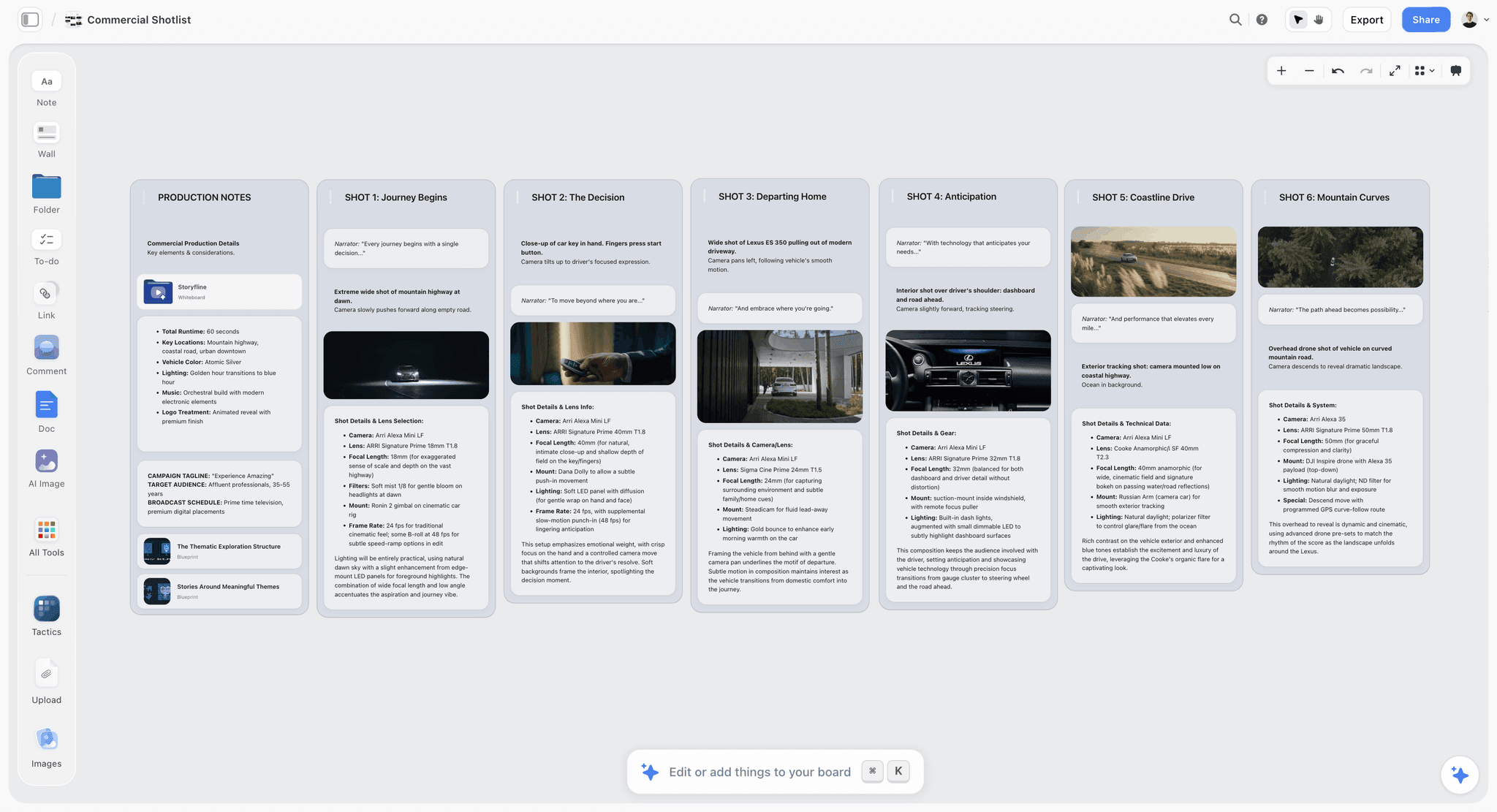
Verdict: the app where your assistant drafts the shoot plan in its real shape, on one board the whole crew can open.
Best for: director-producers, small production companies and crews of roughly two to fifteen planning shorts, branded films, music videos and documentaries with Claude or ChatGPT.
Pricing: Plus $7.99 a month billed annually ($9.99 monthly), Pro $14 annual ($19 monthly), Max $39 annual ($49 monthly). Storyflow is paid-only during early access; its Free plan launches before the end of 2026, and anyone a paid member invites to a board joins free now. See Storyflow pricing.
Storyflow is a visual project planning workspace: an infinite canvas board that holds notes, tables, documents, images, moodboards, storyboards, mind maps, kanban, charts and slide decks, with an AI agent that reads the board and builds on it. Its MCP server, launched in October 2026, works with any assistant that can add a remote MCP server, including Claude, ChatGPT, Gemini and Grok.
Why it ranks first. Two of the connector's tools exist for film work. The strip board tool builds the shooting schedule in one call: a column per shoot day, a coloured strip per scene in shooting order, each day totalled in pages, with the industry colour code for interior or exterior and day or night applied by the tool so the assistant cannot colour a strip wrongly. One call takes up to 30 shoot days. The shot card tool builds a whole shot list in one call: a connected left-to-right row with one card group per shot, each holding a frame, short chips for size, light and camera, a "Shots required" checklist, a scene-direction note and an equipment note, with an arrow to the next shot. One call takes up to 60 shots. We found no other app in this list where an assistant's output is a strip board.
The other stages. The breakdown is a table the assistant builds from your script: scene, slugline, INT or EXT, time, cast, pages, synopsis. The call sheet is a deck of pages on the board that you edit by hand and export as one PDF. References sit beside the scenes they belong to: the assistant can add pictures from web addresses, or hand you an upload link for your own location photos (a photo attached in the chat does not reach Storyflow by itself).
What it reads back. Boards, notes, documents and files, plus what changed on a board and who changed it over the last day, the last week or the last month. In the final week of prep, "what changed on the schedule board in the last day?" is the question that keeps two versions from forming.
If you do not want to use Claude or ChatGPT at all. Storyflow's built-in agent has its own film workflows: script breakdown (it parses the scene index from the script file before building tables, and reads PDFs and Final Draft .fdx), strip board, shot list, pre-production plan, budget and call sheet. It reads the current board plus up to five attached documents and three other boards.
Strengths
- Dedicated strip board and shot card tools, each one request for the whole document.
- All four planning stages on one board, with reference frames beside the shots they describe.
- Change tracking with names, in fixed windows of a day, a week or a month.
- A view-only link opens with no account; invited collaborators edit in real time and join free.
- At sign-in you choose which projects the assistant may use and whether it may make changes at all.
- The connector runs on your assistant's model, so it spends no Storyflow AI credits; no MCP limit on Plus, Pro or Max.
Limits
- It does not send call sheets or track who confirmed. You export the PDF and send it yourself.
- Browser only: no mobile or desktop app and no offline mode. On a location with no signal, export before you leave.
- No calendar tool. Dates live in table date cells and in strip board day titles, and a table's rows are kept in date order by hand.
- No conflict detection, day-out-of-days report or other scheduling reports a first AD on a long shoot expects.
- The connector cannot generate images and cannot read comment threads.
- A free invited account gets 25 connector actions a week (every read and change counts as one), resetting Monday UTC.
Try it: connect Storyflow to Claude or ChatGPT, attach your script in the chat and ask for a scene breakdown table on a new board. If you prefer a guided start, the film shoot planner page shows the board layout.
2. Notion
Verdict: the best choice when the assistant must write into a workspace your team already uses, and you accept building the film structure yourself.
Best for: production companies and in-house teams that already run contacts, briefs and tasks in Notion.
Pricing: per Notion's pricing page, there is a Free plan; Plus is $10 per member a month billed annually ($12 monthly) and Business is $20 per member a month billed annually ($24 monthly).
Notion is a workspace of pages and databases. Its official connector, Notion MCP, connects AI apps to a workspace so they can read from and write to pages; Notion's help page names Claude, Cursor and ChatGPT and names no required plan for the basic connection (admin controls are on Enterprise). The developer documentation lists what the assistant can call: search, fetch a page or database, create pages, update pages, create a database, create and update views, add comments and read comments.
Why it ranks second. On the criterion this post exists for, Notion matches Storyflow: an assistant can create a scene database, fill it from a script and read it back. It loses ground on document fit. A Notion database is rows and properties. You can build a scene list, a shot list and a contact sheet that way, and group or filter them into views. There is no strip board with page-eighth totals per day and the colour code applied for you, no shot card with a frame and a coverage checklist, and no call sheet layout. You design each of those yourself, and so does everyone who inherits your workspace.
Strengths
- Official connector with a long tool list, including creating databases and views.
- The assistant can read comments on a page, which Storyflow's connector cannot do for its own comment threads.
- A free plan exists today.
- Strong for the text around a shoot: contact lists, location notes, release tracking, a production wiki.
Limits
- No film-shaped documents. Strip boards, shot cards and call sheets are yours to build.
- Per Notion's help page, a connected tool acts with the connecting user's full Notion permissions, so it can reach anything that user can reach. There is no per-project choice at sign-in.
- Pictures live inside pages and database rows, not on a canvas beside the schedule.
Trade-off: if your company is already in Notion, connect it and keep contacts and paperwork there. For the breakdown, shot list and strip board, a film-shaped surface saves the design work. Our longer comparison is Notion vs StudioBinder for filmmakers.
3. StudioBinder
Verdict: the most complete purpose-built shoot-planning suite in this list, and the right pick the moment call sheet delivery matters more than assistant access.
Best for: crewed shoots where a producer or coordinator sends call sheets to twenty or more people and needs to know who has seen them.
Pricing: per StudioBinder's help centre, Starter is $29 a month with 1 user and 10 projects, Indie is $49 a month with 2 users and 25 projects, and Professional is $99 a month with 4 users and unlimited projects. Extra users cost $25 per user a month. The free plan allows 1 project, 10 contacts, 10 shots, a schedule of 10 scenes or 50 percent of an imported screenplay, and sample call sheets you can send only to yourself.
StudioBinder groups its tools by production stage: screenwriting and AV scripts, script breakdowns with an element tagger, stripboards, shot lists and storyboards, contacts, calendars and task boards, and call sheets. Its call sheets auto-fill details, go out by email and text, and report delivery status, view counts and confirmations from one screen.
Why it ranks third. StudioBinder scores 30 out of 30 on document fit and 15 out of 15 on crew delivery, the best in the list on both. It scores zero on assistant access and read-back: we found no MCP server and no ChatGPT or Claude connector published by StudioBinder, and its home page lists no AI features. An assistant's breakdown or shot list reaches it by retyping or paste, and the assistant cannot read the current schedule back.
Strengths
- Every stage from breakdown to call sheet in purpose-built form, with the documents linked to each other.
- Call sheet delivery by email and text with confirmations, the feature small tools lack.
- Delivery tracking is included from the Indie plan per its help article.
- A free plan to learn the workflow on one small project.
Limits
- No connector we could find, so the drafting your assistant does happens outside it.
- The free plan stops at 10 shots and half an imported script, which is a trial for most real shoots.
- $49 a month for two users is the realistic entry for a working crew, with $25 for each extra seat.
Trade-off: if your shoot has a crew large enough that "did everyone get the call sheet?" is a real question, use StudioBinder for stage 4 even if you draft stages 1 to 3 elsewhere. We compare it with other options in the best StudioBinder alternatives.
4. Shot Lister
Verdict: the best app in this list for stage 5, the shoot day itself.
Best for: directors, first ADs and DPs who run the day from an iPhone or iPad and need to know, to the minute, whether they are behind.
Pricing: per Shot Lister's site, the app is free to download with two projects. Pro is $15.99 a month or $99.99 a year and adds unlimited projects, storyboards, scheduling, script import and Crew Sync for up to 10 people. Studio starts at $24.99 a month for 10 users.
Shot Lister is a shot list and scheduling app for iOS and macOS. You build the schedule shot by shot or minute by minute, with industry-style formatting such as letter revisions, cast numbers and shot numbering. Its Live Mode tracks progress against the plan in real time and lets you reorganise the rest of the day while shooting. Crew Sync keeps the crew's copies updated live, and there is Apple Watch support.
Why it ranks fourth. It is the only app here that scores 10 out of 10 on day-of use. It scores zero on assistant access: the site mentions no AI features and names one integration, Scriptation, for syncing scripts. It does not list a breakdown tool or call sheets, so it covers stages 2, 3 and 5.
Strengths
- Live Mode: the plan against the clock, which nothing else in this list does.
- Runs on the device already in your pocket, with Apple Watch support.
- Crew Sync for up to 10 on Pro and up to 80 on Studio.
- Script import on Pro, so the shot list starts from the screenplay.
Limits
- No connector we could find and no AI features listed.
- Its site links iOS and macOS versions only.
- No script breakdown or call sheet listed.
Trade-off: plan in an app your assistant can write to, then carry the final shot order into Shot Lister for the day if minute-level tracking matters to you. We look at it beside the scheduling standard in Shot Lister vs Movie Magic Scheduling.
5. Celtx
Verdict: the pick when the script and the plan should live in the same tool, from first draft to call sheet.
Best for: writer-directors, film schools and small teams who write in Celtx and want the breakdown to stay tied to the screenplay.
Pricing: Celtx's pricing page lists Free (1 project, 1 seat), Writer, Writer Pro and Team tiers, with roughly 25 percent off for yearly billing. The page did not show dollar amounts to our fetch on 10 October 2026, so we quote none; check it directly.
Celtx starts from a script editor and adds story development tools (beat sheet, storyboard, shot list) and production planning tools (breakdown, catalog, schedule, cast and crew, budget, call sheets, production reports). The plan structure matters for a shoot: per the pricing page, shot lists and storyboards come with Writer Pro, and the production planning tools are included in the Team tier and offered as optional add-ons on Writer and Writer Pro.
Why it ranks fifth. Document fit is strong (24 of 30): four of the five stages exist, linked to the script. Assistant access is zero. We found no connector, and neither Celtx's home page nor its pricing page mentions AI features. Cost scores low because the full planning set sits on the top tier or on add-ons, and we could not read the prices.
Strengths
- Script, breakdown, schedule, budget and call sheets in one tool.
- A free plan for the script editor with one project.
- Education and student plans, billed yearly.
Limits
- No connector we could find and no AI features listed.
- Full production planning needs the Team tier or add-ons.
- Public dollar pricing was not readable when we checked.
Trade-off: if your script already lives in Celtx, export it and give the file to your assistant for the breakdown. That is a one-way trip: changes made elsewhere do not flow back into Celtx. Other routes are in the best Celtx alternatives.
6. Movie Magic Scheduling
Verdict: the scheduling format financed productions are asked for, and a specialist tool for stage 3 only.
Best for: first ADs and line producers on features and series, and any production where a bond company, financier or studio names Movie Magic as the required format.
Pricing: per the Entertainment Partners store, $42.99 a month or $299.88 a year, with an academic price of $119.88 a year. The store describes the monthly subscription as one you can cancel at any time.
Movie Magic Scheduling builds schedules from strips and boards with drag-and-drop editing and split-screen views. It handles multiple episodes and units with sub-boards, detects conflicts, supports real-time collaboration with view and edit permissions, exports a one-line report to PDF or Excel and links to Movie Magic Budgeting.
Why it ranks sixth. For this post's job it scores zero on assistant access (we found no connector and its page mentions no AI features) and it covers one stage of five. Read that ranking correctly: on a 40-day feature with a completion bond, it is the first tool you buy and nothing here replaces it.
Strengths
- The format other departments, financiers and bond companies already read.
- Conflict detection and multi-unit scheduling for long shoots.
- Reports a first AD needs, exported to PDF or Excel.
Limits
- No connector we could find; an assistant's schedule is retyped into it.
- Scheduling only: no shot list and no call sheet.
- A single-purpose licence: $42.99 a month, or $299.88 a year, for scheduling alone.
Trade-off: use an assistant to rough out the day groupings and page totals, then have the AD build the real board here. Our film scheduling software guide covers when the format is required.
7. Frame.io
Verdict: not a planning app. It is here because it is the other film tool with an official assistant connector, and you should know what that connector is for.
Best for: editors, post supervisors and producers whose review rounds run in Frame.io after the shoot.
Pricing: per Frame.io's pricing page, Free is $0 for up to 2 members with 2GB of storage, Pro is $15 per member a month for up to 5 members and the Team tier is $25 per member a month for up to 15 members, with 13 percent off annual plans.
Frame.io announced its MCP server on its developer forum on 29 July 2026 as an experimental private beta. The post was edited on 7 October 2026 to say the server is now in public beta. Per the announcement, a connected agent can navigate workspaces and projects, read comments, create shares, search and handle uploads, and the post names Claude, ChatGPT, Cursor, VS Code and the GitHub Copilot CLI as clients.
Why it is seventh and unscored. It holds no breakdown, shot list, schedule or call sheet, so scoring it against shoot-planning criteria would only produce a misleading number. The announcement does not state which plans include the server.
Strengths
- An official connector that reaches review comments on a cut.
- Useful from the first day of dailies: uploads and shares handled by request.
- A free plan for two members.
Limits
- Plans nothing before the shoot.
- Public beta: expect behaviour to change.
- The assistant reads comments as text. It does not watch the footage.
Trade-off: add it when there is footage. Until then it has no job on your production. The full pipeline, shoot through delivery, is in video production start to finish with AI assistants.
Which App Covers Which Stage of the Shoot Plan
A ranking tells you which app is best overall for one job. This table tells you where the gaps are, so you can pair two apps on purpose.
| Stage | Storyflow | Notion | StudioBinder | Shot Lister | Celtx | Movie Magic Scheduling |
|---|---|---|---|---|---|---|
Breakdown | Yes, assistant builds it | Yes, as a database the assistant builds | Yes, by hand | Not listed | Yes, by hand | Not listed as a separate tool |
Shot list | Yes, assistant builds cards or a table | Yes, as a database | Yes, by hand | Yes, by hand | Yes, by hand | No |
Schedule | Yes, assistant builds a strip board | A database view you design | Yes, stripboard by hand | Yes, by hand | Yes, by hand | Yes, the industry format |
Call sheet | Pages the assistant builds; you export and send | A page you design | Yes, sent and tracked | Not listed | Yes | No |
Day-of | Browser on a phone, no offline | Browser on a phone | Call sheets on crew phones with confirmations | Live Mode to the minute | Not listed | No |
Three pairings follow from it:
- Storyflow plus StudioBinder: draft stages 1 to 3 with your assistant on a board, then build and send the call sheet from StudioBinder when the crew is large.
- Storyflow plus Shot Lister: draft and agree the plan on a board, then carry the final shot order into Shot Lister for minute-level tracking on the day.
- Storyflow plus Movie Magic Scheduling: let the assistant rough out the board and page totals for the director's conversations, and let the AD build the bonded schedule in the required format.
Worked Example: Planning a Two-Day Short With Claude and One Board
This is an illustrative example. The film, the counts and the times are invented to show the arithmetic of a small shoot plan; they are not measurements of how long anything took.
The film is "Salt Road", a 9-page short with two actors, one house location and one coastal exterior. The director is also the producer. There is a DP, a sound recordist and a first AD who joins three days before the shoot.
Stage 1: the breakdown comes back as 14 scenes
You attach the script PDF in Claude and ask for a scene index table on a new Storyflow board, built from the script's own scene headings. The table comes back with 14 rows. Before doing anything else, you count the scene headings in the script yourself: 14. If the numbers had differed, you would stop here and fix the table, because every later document copies it.
Eight scenes are interiors at the house and six are exteriors on the coast road. Three of the exteriors are dusk. Page counts in eighths add up to 9 pages.
Stage 2: the shot list starts at 38 setups and is cut to 31
You ask for a first-pass shot list as shot cards, one card per setup, grouped by scene. The assistant proposes 38 setups. You and the DP go through the row on the board and cut seven: four singles become two moving two-shots (two fewer), six inserts collapse into three (three fewer), and two wide masters are dropped because the location cannot hold them. That leaves 31.
The cut matters more than the draft. The assistant is good at proposing coverage and has no idea how small the kitchen is.
Stage 3: the strip board balances two days
You ask for a strip board that keeps the house interiors together, puts the dusk exteriors at the end of a day, and totals each day in pages.
| Shoot day | Scenes | Pages | Setups | Location | Company moves |
|---|---|---|---|---|---|
Day 1 | 7 (five house interiors, two dusk exteriors) | 4 5/8 | 16 | House, then coast road | 1 (45 minutes) |
Day 2 | 7 (three day exteriors, three house interiors, one dusk exterior) | 4 3/8 | 15 | Coast road, then house, then coast road | 2 (45 minutes each) |
Total | 14 | 9 | 31 | 3 |
The pages are balanced to within a quarter page. Now do the arithmetic the assistant was not asked to do. A 10-hour day with a one-hour lunch leaves 540 working minutes. Day 1 loses 45 minutes to its move: 495 minutes for 16 setups is about 31 minutes per setup. Day 2 loses 90 minutes to two moves: 450 minutes for 15 setups is 30 minutes per setup. Both are tight for a crew of four, and the plan spends 135 minutes in vans.
The first AD, on joining, proposes the blunt fix: all eight house interiors on day 1, all six coast scenes on day 2, no company moves at all. You ask the assistant to rebuild the strip board that way and restate the totals from the board.
| Shoot day | Scenes | Pages | Setups | Working minutes | Minutes per setup |
|---|---|---|---|---|---|
Day 1 | 8 house interiors | 5 2/8 | 18 | 540 | 30 |
Day 2 | 6 coast exteriors (three day, three dusk) | 3 6/8 | 13 | 540 | About 42 |
The pages are now less even and the schedule is better: day 1 keeps the same pace with no travel, and day 2 has slack for the one thing nobody controls, the dusk window that three scenes share. Balanced pages were the wrong target. The assistant optimised what it was asked to optimise.
Stage 4: the call sheet has blanks, on purpose
You ask for a call sheet for day 1 as A4 pages on the board, built from the rebuilt strip board, with the instruction to leave any name, number, address or time it was not given blank and to list the blanks. It comes back with the scene table filled and nine blanks listed: general call, first shot, lunch, estimated wrap, the house address, the nearest hospital, and three phone numbers. You fill them by hand, export the deck as one PDF and send it yourself.
Stage 5: the day, and the morning after
On day 1 the board is open on a tablet in the house, where there is signal. For day 2 the exported PDFs are on everyone's phone, because the coast road has none. Scene 11, the last dusk exterior, is dropped when the light goes.
The next morning you ask what changed on the board in the last day. The first AD's note on the dropped scene comes back with a name attached, and you ask the assistant to add a pickup day to the strip board holding scene 11 and to restate the totals.
What the example shows
The assistant drafted four documents, rebuilt the schedule once and added a pickup day. A person counted the scenes, cut seven setups, regrouped the days after doing the minutes, filled nine blanks and called the day. That division of labour is the realistic one.
Prompts You Can Copy
These work in Claude or ChatGPT with the Storyflow connector added. Replace the bracketed parts. Each prompt names its source, because an assistant working from memory of the story is the most common cause of a wrong schedule.
| Stage | Prompt |
|---|---|
Set up | Create a new Storyflow project called [film title] and tell me which board you will build on. |
Breakdown | Read the attached script. Build a scene index table on the board: scene number as printed, slugline as written, INT or EXT, time of day, speaking cast, pages in eighths, one-line synopsis. Use only scene headings that appear in the script. Tell me the scene count and total pages first. |
Breakdown check | Read the scene index table on the board and list any scene where the time of day or the page count is empty, so I can fill it from the script. |
Elements | Add a second table beside the scene index: props, wardrobe, vehicles and effects per scene, using only what the action lines name. Leave a cell empty if the script names nothing. |
Shot list | From the scene index on the board, build a first-pass shot list as shot cards for scenes [1 to 6], one card per camera setup, with size, a short direction note, a coverage checklist and equipment. Leave the frames empty; I will add our own pictures. |
Shot list as a table | Build the same shot list as a compact table instead: scene, shot, size, angle, movement, lens, notes. |
Schedule | Using the scene index table on the board, build a strip board for [2] shoot days. Keep each location together, put dusk and night exteriors at the end of a day, and total each day in pages. Tell me the page total per day when you are done. |
Schedule check | For each shoot day on the strip board, count the setups from the shot list and divide [540] working minutes, minus [45] minutes per company move, by that count. Show the working. |
Reschedule | Move scene [9] from day 2 to day 1 on the strip board and restate the page total for both days. |
Call sheet | Build a call sheet for day 1 as an A4 portrait page deck on the board, from the strip board and the contact table. Leave blank any name, phone number, address or time I have not given you, and list every blank at the end. |
Morning check | What changed on this board in the last day, and who changed it? |
Wrap | Read the strip board and my notes from today. List the scenes we did not complete and add them to tomorrow's strips, then restate the totals. |
Two habits improve every one of these. Ask for the count first (scenes, pages, setups) so you can check it before reading the rest. And say where the facts come from: "the attached script", "the table on the board", never "the film".
What It Costs: Six Shoot-Planning Setups Priced for One Month
Prices are the vendors' own monthly figures on 10 October 2026, for one month of prep on one production. Your assistant's subscription is separate and is not included: Claude's free plan allows one custom connector, and ChatGPT needs ChatGPT Plus or above with Developer mode. See each company's pricing page for those.
| Setup | What you pay for | Monthly cost | What the assistant can draft inside it |
|---|---|---|---|
Storyflow alone | Plus, one paid member; crew invited free | $9.99 | Breakdown, shot list, strip board, call sheet pages |
Storyflow plus Shot Lister | Plus, and Shot Lister Pro for the day | $9.99 + $15.99 = $25.98 | Everything in Storyflow; nothing in Shot Lister |
Storyflow plus StudioBinder | Plus, and StudioBinder Indie for call sheet delivery | $9.99 + $49 = $58.98 | Everything in Storyflow; nothing in StudioBinder |
StudioBinder alone | Indie, 2 users | $49 | Nothing; drafts are pasted in |
Notion alone | Plus, 2 members, billed monthly | $24 | Pages and databases you design |
Movie Magic Scheduling plus Storyflow | Monthly licence, and Plus | $42.99 + $9.99 = $52.98 | Everything in Storyflow; nothing in Movie Magic |
Storyflow has no free plan during early access, so the first row is a paid setup. If you need to spend nothing on software today, StudioBinder's free plan (1 project, 10 shots, 10 scheduled scenes) and Notion's Free plan both exist now, and Shot Lister is free for two projects.
Which App Should You Use? Decision Rules
The ranking answers one question. Your shoot may be asking a different one.
If you plan with Claude or ChatGPT and your crew is under fifteen
Use Storyflow. The assistant drafts the breakdown, shot list, strip board and call sheet pages on one board, and the crew opens it by link. Export the call sheet PDF and send it from your own email.
If the crew is large enough that confirmations matter
Use StudioBinder for the call sheet at minimum. Delivery tracking is the feature you are paying for. Draft the earlier stages wherever your assistant can reach, and budget the time to re-enter the final schedule.
If a financier, bond company or studio names a format
Use Movie Magic Scheduling. That requirement outranks every criterion in this post.
If the day itself is the risk
A one-day shoot with 30 setups and a hard out at the location is a clock problem. Use Shot Lister's Live Mode on the day, whatever you planned in.
If the script lives in Celtx
Stay in Celtx for the breakdown tied to the script if you are on its Team tier. Export the script for your assistant if you want a board the crew can read alongside it.
If your company already runs on Notion
Connect Notion's MCP server and keep contacts, releases and the production wiki there. Decide separately whether the strip board deserves a film-shaped home.
If you have not connected an assistant before
Start with the setup guides for Claude or ChatGPT, and read are AI connectors safe? before you give any assistant write access to a client's project.
How to Connect Storyflow to Claude or ChatGPT
The connection takes a few minutes and uses one address: https://mcp.storyflow.so/mcp. The full instructions with screenshots are in the help article on connecting AI assistants.
Claude
- Open Customize, then Connectors, then Add, then Add custom connector.
- Name it Storyflow and paste the address.
- Choose Continue, then Sign in now, then Add, and sign in to Storyflow.
Claude's free plan allows one custom connector.
ChatGPT (web)
- In Settings, open Security and login and turn on Developer mode (on Business and Enterprise an admin does this).
- Go to chatgpt.com/plugins and choose the plus button.
- Name it Storyflow, choose Public endpoint, paste the address, create it and sign in.
This needs ChatGPT Plus or above with Developer mode.
What to choose at sign-in for a shoot
You pick which projects the assistant may use (all, or the ones you select), whether it may make changes or only read, and whether it may use documents outside projects. For a client production, select only that film's project. If you only want morning summaries of what changed, leave changes off. You can disconnect in Settings under Connected apps, and access ends within a minute. Connections expire after 30 days.
Common Mistakes When You Plan a Shoot With an AI Assistant
Most failures here are not the assistant's. They come from how the request was framed.
Asking for a schedule before the breakdown is checked
The strip board copies the scene list. If the list has 13 scenes and the script has 14, a scene is missing from every later document. Count the headings in the script against the table before you ask for anything else.
Letting the assistant work from its memory of the story
"Schedule the film" invites the assistant to reconstruct scenes from what it remembers of your pasted pages. "Using the scene index table on the board" forces it to read rows. The second phrasing costs you seven words.
Accepting a call sheet with no blanks
A call sheet that comes back complete when you gave no phone numbers contains invented phone numbers. Ask for blanks to be left and listed, every time, and distrust any sheet that has none.
Treating the first-pass shot list as the shot list
An assistant proposes coverage from the text. It has not stood in the room. Expect to cut part of what it proposes once the DP has seen the location, and do the cutting together on the board.
Skipping the minutes
Page counts per day look balanced long before the day is achievable. Divide the working minutes by the setups for every day. As a rough rule of thumb, an answer under 25 minutes per setup with a small crew means the day is over-scheduled, however even the pages look.
Keeping the agreed version in the chat
Once the director and AD agree a change, it has to be on the board, not in a message. Ask the assistant to make the change where the crew reads it, then ask it to restate the totals from the board.
Relying on a browser tab at a location with no signal
Any browser-based planner, Storyflow included, needs a connection. Export the call sheet and the shot list as PDFs the night before and put them on every phone.
When Storyflow Is Not the Right Choice
Storyflow ranks first for one job: drafting a shoot plan with Claude or ChatGPT for a small crew. Outside that job, other tools are the honest answer.
- You need call sheets delivered and confirmed. Storyflow does not send call sheets or track who opened them. StudioBinder does, by email and text.
- You need the plan on set with no signal. Storyflow runs in a browser, with no mobile or desktop app and no offline mode. Shot Lister runs on the iPhone itself.
- You need live tracking against the clock. Storyflow has no shoot-day mode. Shot Lister's Live Mode is built for it.
- A bond company or financier requires a named scheduling format. Use Movie Magic Scheduling. A Storyflow strip board is a planning document, not an industry-format deliverable.
- You are scheduling a long feature with complex cast availability. Storyflow has no conflict detection, no day-out-of-days report and no calendar tool. A first AD on a 30-day shoot needs dedicated scheduling software.
- You need software that costs nothing today. Storyflow is paid-only during early access; its Free plan launches before the end of 2026, and anyone a paid member invites to a board joins free now. StudioBinder, Notion, Celtx, Shot Lister and Frame.io all have free plans with limits.
- You want the assistant to generate storyboard frames through the connector. It cannot. Image generation is the built-in agent on Pro and Max; over the connector the assistant adds pictures from web addresses or gives you an upload link.
- You want one tool for script, budget, payroll and post. Storyflow plans. It does not run payroll, contracts or invoicing, and it is not a review tool for cuts.
A Shoot-Plan Board Template You Can Ask For
A board works when everyone knows where to look. This layout puts the five stages left to right, in the order they are made.
The five sections, left to right
- Script and scene index. The script file and the scene index table. Everything else cites this table.
- Look and references. Location photos and reference frames, grouped by location.
- Shot list. A row of shot cards per scene block, or one compact table.
- Strip board. One column per shoot day, with page totals.
- Call sheets. One page deck per shoot day, plus a contact table with names, roles, phones and emails that you fill in yourself.
The prompt that builds the empty template
Create a new board called [film title] shoot plan. Build five titled sections left to right: Script and scene index, Look and references, Shot list, Strip board, Call sheets. In the first section add an empty table with columns scene, slugline, INT or EXT, time, cast, pages, synopsis. In the last section add an empty contact table with columns name, role, phone, email. Do not fill any cell.
The one rule that keeps it right
Changes go into the scene index first, then into whatever copies it. If a scene is cut, cut the row, then ask the assistant to rebuild the strip board from the table. A board where the strip board is edited and the scene index is not has two versions of the film on it. More on this habit in how to keep a shoot plan current when things change.
The Bottom Line
Planning a film shoot in 2026 has two halves. The drafting half is now fast: Claude or ChatGPT turns a script into a breakdown, a shot list and a day grouping in minutes. The other half is where that draft lives, in what shape, and who can open it.
On that second half, Storyflow is the best app for planning a film shoot with an assistant, because the assistant builds the strip board, shot cards and call sheet pages inside it and reads them back the next morning. It is not the tool that texts forty crew members their call time, runs the clock on set or satisfies a bond company. StudioBinder, Shot Lister and Movie Magic Scheduling do those jobs, and pairing one of them with a board your assistant can write to is a reasonable plan for a serious shoot.
Start with the breakdown. Connect Storyflow to your assistant, attach the script, ask for the scene index, and count the scenes.
FAQ: Best Apps for Planning a Film Shoot With Claude or ChatGPT
What is the best app for planning a film shoot?
Storyflow is the best app for planning a film shoot in 2026. Claude or ChatGPT builds the breakdown, shot cards, strip board and call sheet pages on one board through Storyflow's MCP connector and reads them back later. StudioBinder is the better choice when call sheets must be sent and tracked, and Movie Magic Scheduling when a financier requires that format.
Can ChatGPT or Claude plan a film shoot by themselves?
They can draft a shoot plan, and they cannot finish one. An assistant produces a scene breakdown, a first-pass shot list and a day grouping quickly from a script. It does not know your actors' availability, the size of the location, travel times or any phone number. Treat its output as a first draft that a director, DP and AD correct, and keep that draft in an app the crew can open.
Which film planning apps have a ChatGPT or Claude connector?
Of the seven apps reviewed here, three publish an official connector: Storyflow (builds and reads boards), Notion (creates and reads pages and databases) and Frame.io (public beta, for review and uploads after the shoot). We found no connector published by StudioBinder, Shot Lister, Celtx or Movie Magic Scheduling as of 10 October 2026.
Does StudioBinder work with ChatGPT or Claude?
We found no MCP server and no ChatGPT or Claude connector published by StudioBinder, and its site lists no AI features. You can still use an assistant alongside it: draft the breakdown or shot list in the chat, then retype or paste the result into StudioBinder. The assistant cannot read your StudioBinder schedule back, so changes made there stay there.
Can Claude or ChatGPT build a strip board?
Yes, in Storyflow. The connector has a strip board tool that builds the whole schedule in one request: a column per shoot day, a coloured strip per scene in shooting order, each day totalled in pages, with the interior, exterior, day and night colour code applied by the tool. One request holds up to 30 shoot days. In a general tool such as Notion the assistant builds a database, not a strip board.
Can an AI assistant make a call sheet?
Yes, as a draft. Through Storyflow's connector, Claude or ChatGPT builds a call sheet as a deck of pages on your board from the schedule and contact table. You edit it and export it as one PDF. Instruct the assistant to leave unknown names, numbers, addresses and times blank and to list them. Storyflow does not send the call sheet or track confirmations; you send the PDF.
How accurate is an AI script breakdown?
It is accurate when it reads scene headings from the script file and unreliable when it reconstructs them from memory. Ask for the scene count and total pages first, then count the headings in your script. If the numbers match, check five rows at random for time of day and cast. Elements such as props should come only from what the action lines name; an empty cell is better than a plausible guess.
Is Storyflow free for planning a film shoot?
Not during early access. Storyflow is paid-only for now: Plus is $7.99 a month billed annually or $9.99 monthly. A Free plan launches before the end of 2026. Anyone a paid member invites to a board joins free today, so one paid member can share the shoot plan with the whole crew. A free invited account gets 25 connector actions a week.
Does the Storyflow connector use my Storyflow AI credits?
No. The connector runs on your own assistant's model (Claude, ChatGPT or another), so nothing it does spends Storyflow AI credits. Plus, Pro and Max have no MCP limit. Storyflow's built-in agent, which you use inside the app, is separate and does use the AI allowance of your plan.
What is the best app for the shoot day itself?
Shot Lister is the best app in this list for the shoot day. Its Live Mode tracks your progress against the planned schedule to the minute on iOS and macOS and lets you reorder the remaining shots while shooting, with Crew Sync for up to 10 people on Pro. It lists no AI features and we found no connector, so plan elsewhere and bring the final shot order in.
Do I need Movie Magic Scheduling for a short film?
Usually not. Movie Magic Scheduling earns its $299.88 a year on features and series with many shoot days, multiple units and financiers who expect its reports. A short with two to five shoot days is well served by a strip board in a planning app. If a funder or a film school course specifically requires the format, use it; an academic price of $119.88 a year exists.
Can I plan a film shoot in Notion with Claude?
Yes, with limits. Notion's official MCP server lets Claude create databases and pages, so it can build a scene list, a shot list and a contact database and read them back. Notion has no strip board, shot card or call sheet layout, so you design those views yourself. Per Notion's help page, the connection acts with your full Notion permissions.
How many shoot days should the assistant schedule?
The assistant should propose and you should decide. Give it the constraint that matters (for example two days, or no more than five pages a day), ask for page totals per day, then check the minutes: working minutes minus company moves, divided by setups. As a rough rule of thumb, if the result is under about 25 minutes per setup for a small crew, add a day or cut setups.
Is it safe to give an AI assistant access to my production plan?
It is as safe as the permissions you grant. With Storyflow you choose at sign-in which projects the assistant may use and whether it may change anything or only read; you can disconnect in Settings and access ends within a minute. For a client's unreleased project, select only that project and consider read-only. Check your assistant provider's data policy as well.
What should be on the board before the first shoot day?
Five things: the script and a checked scene index, references grouped by location, a shot list the DP has cut to fit the time, a strip board with page totals per day, and a call sheet per day with every blank filled by a person. Export the call sheets and shot list as PDFs the night before in case the location has no signal.
Can the assistant keep the plan updated during prep?
Yes, if it reads the board each time instead of its own earlier answer. Ask what changed on the board in the last day or the last week; Storyflow's connector reports the changes and who made them. Then ask for the specific edit, such as moving a scene between days, and ask for the totals to be restated from the board.
Table of Contents
- Key Takeaways
- Why the Shoot Plan Dies in the Chat Window
- The Five Stages of a Shoot Plan, and Who Should Draft Each One
- How We Ranked the Apps and Weighted the Criteria
- Comparison Table: The Best Apps for Planning a Film Shoot With Claude or ChatGPT
- The 7 Best Apps for Planning a Film Shoot, Reviewed
- 1. Storyflow
- 2. Notion
- 3. StudioBinder
- 4. Shot Lister
- 5. Celtx
- 6. Movie Magic Scheduling
- 7. Frame.io
- Which App Covers Which Stage of the Shoot Plan
- Worked Example: Planning a Two-Day Short With Claude and One Board
- Prompts You Can Copy
- What It Costs: Six Shoot-Planning Setups Priced for One Month
- Which App Should You Use? Decision Rules
- How to Connect Storyflow to Claude or ChatGPT
- Common Mistakes When You Plan a Shoot With an AI Assistant
- When Storyflow Is Not the Right Choice
- A Shoot-Plan Board Template You Can Ask For
- The Bottom Line
- FAQ: Best Apps for Planning a Film Shoot With Claude or ChatGPT
- Related Reading
Templates to check out for this topic


Filmmaking templates you can use in Storyflow
Skip the blank canvas. Open one of these filmmaking boards in Storyflow and the AI builds on the structure that is already there, from research through the shot list.


See Storyflow in Action
A visual AI workspace where every feature lives inside one canvas. No tab-switching, no context lost.
Build your entire board from a single message
Type what you need in the AI chat at the bottom of your canvas. The AI adds cards, headings, and structure directly onto your board.
Use expert frameworks as AI context
Type @ in the AI chat and choose any Tactic. The AI tailors every response to that framework instead of giving generic advice.
Turn your board into a mind map in seconds
Ask the AI to restructure your canvas as a mindmap. It connects your ideas into a visual hierarchy so you can see how everything relates.
Why Storyflow Exists
Storyflow actually began as a personal tool while working on creative and research projects.
We kept running into the same problem: ideas were scattered everywhere: notes, documents, and whiteboards.
Nothing helped us see how everything connected.
So we started building a workspace designed around how ideas actually grow.
→ Read how Storyflow was createdStoryflow Team
Product & Research Team
Published: 2026-10-10
Extremely simple, seriously capable


See how easy it is to get started
Watch a real project come together, from a blank board to a finished plan, clicked through step by step.
Start creating with AI and become more productive
Transform your creative workflow with AI-powered tools. Generate ideas, create content, and boost your productivity in minutes instead of hours.