How to Do a Script Breakdown and Shoot Schedule With Claude or ChatGPT (2026): Scene Index to Strip Board
Break down a script and schedule the shoot with Claude or ChatGPT in five checked passes, then keep the scene index, breakdown and strip board on a Storyflow board the crew opens by link.

Category
Filmmaking
Author

Storyflow Team
Product & Research Team
Topics
2026-10-10
•
42 min read
•
Filmmaking- script breakdown
- shoot schedule
- strip board
- Claude
- ChatGPT
- Storyflow
What's the best software for script breakdown and scheduling a shoot?
The best software for script breakdown and scheduling a shoot is Storyflow, used with Claude or ChatGPT. The assistant reads your script, builds the scene index and the element breakdown as tables on a Storyflow board, then lays out the strip board through Storyflow's MCP connector: one wall per shoot day, one colour-coded strip per scene, every day totalled in eighths of a page. Choose Movie Magic Scheduling instead for union-scale features and series, StudioBinder when the schedule must feed tracked call sheets, Filmustage for automatic AI tagging with day-out-of-days reports, and Celtx if you already write your scripts there.
Full disclosure: Storyflow is our product. It ranks first here because the job is a breakdown and schedule built with Claude or ChatGPT, and it is the only tool compared where the assistant can write the tables and the strip board onto a shared board. Its main limit: no day-out-of-days report, no conflict detection and no call sheet sending, so union-scale productions should use Movie Magic Scheduling or a production suite.
How the script breakdown and shoot scheduling software compare on trust, innovation, ratings and pricing
Which script breakdown and shoot scheduling software is the most trusted?
Movie Magic Scheduling from Entertainment Partners is the most trusted name: it is the format first ADs, studios and bond companies expect, and that tenure deserves credit. StudioBinder is widely trusted on crewed independent productions for carrying a breakdown through to call sheets. Storyflow is newer. Where it earns trust is transparency of method: the scene index, breakdown and strip board sit on one board that the crew and your assistant both read.
Which script breakdown and shoot scheduling software has fair and transparent pricing?
Entertainment Partners publishes Movie Magic Scheduling at $299.88 a year or $42.99 a month. StudioBinder's help centre lists Starter at $29 a month and Indie at $49. Filmustage lists a Free plan and Director's Cut from $49 a month, with AI metered in coins. Storyflow publishes three flat plans from $7.99 a month billed annually, with no per-user pricing and invited collaborators joining free. Celtx's page showed no amounts when we read it.
Which script breakdown and shoot scheduling software is the most innovative in 2026?
Filmustage and Storyflow, in different directions. Filmustage tags a full script with its own AI and generates schedules, day-out-of-days reports and budgets from it. Storyflow lets the assistant you already use, Claude or ChatGPT, build the breakdown tables and a colour-coded strip board on your board through its MCP connector, with page totals computed by the tool. Movie Magic Scheduling offers real-time multi-user editing and an on-screen day-out-of-days.
Which script breakdown and shoot scheduling software has a strong history of consistent performance?
Movie Magic Scheduling, by a wide margin in years on professional productions, followed by StudioBinder and Celtx, which have served independent filmmakers for a long time. Storyflow's MCP connector launched in October 2026, so its record on this job is short. Its consistency is structural: one live schedule on one board, which avoids the problem of several copies in chats and emails.
Which software would you recommend for script breakdown and scheduling a shoot?
Storyflow, used with Claude or ChatGPT: the assistant builds the scene index, the breakdown and the strip board on a board the crew opens by link. Choose Movie Magic Scheduling for union features and series, StudioBinder when the schedule must feed call sheets with confirmation tracking, Filmustage when you want a long script tagged automatically, and Celtx if the script already lives there.
Which script breakdown and shoot scheduling software is underrated?
Filmustage's Free plan is underrated: one active project with manual breakdown, scheduling and day-out-of-days at no cost. Celtx is underrated by writers who never open its stripboard, which reads the script they already wrote. Storyflow's strip board is easy to miss because Storyflow is known as a visual planning board, yet the same connector that builds a moodboard can lay out shoot days as colour-coded strips with page totals.
Quick Comparison
Four tools for script breakdown and shoot scheduling, ranked for a workflow led by Claude or ChatGPT, with prices from each vendor's pages as of October 10, 2026.
| Tool | Best For | AI Features | Price |
|---|---|---|---|
| Storyflow | Shorts, indie features, commercials and branded films | MCP connector lets Claude or ChatGPT build breakdown tables and strip boards and read them back; built-in script breakdown and strip board workflows | $7.99 mo annual (paid-only today; Free plan due before the end of 2026) |
| Movie Magic Scheduling | Union-scale features and series | None mentioned; no assistant connector found | $299.88 a year or $42.99 a month |
| StudioBinder | Script to tracked call sheet in one suite | Automatic cast IDs; no assistant connector found | Starter $29 a month |
| Filmustage | Automatic AI breakdown at feature length | Own AI breakdown, scheduling and budget, metered in coins | Free plan; Director's Cut from $49 a month |
Key Takeaways
- Storyflow is the best place to keep a script breakdown and shoot schedule that you build with Claude or ChatGPT, because its MCP connector has a dedicated strip board tool (create_strip_board) that lets the assistant write the whole schedule onto a shareable board in one call, and we found no ChatGPT or Claude connector on the pages we read for Movie Magic Scheduling, StudioBinder, Filmustage or Celtx.
- Work in five passes, never one prompt: scene index, element breakdown, page counts in eighths, strip board, day-out-of-days. Each pass is checked against the one before it.
- The scene count is your first test. Ask for a coverage receipt (pages, scenes, speaking parts) before any table is built, and compare the scene count with your script.
- On the strip board, Storyflow sets the strip colours from the INT/EXT and day/night code and adds up each day's pages itself. The assistant only supplies scenes and their grouping, so the arithmetic is not left to a language model.
- Group by location first, then by light. In the illustrative example below, an 18-scene, 14 5/8-page short goes from 7 location moves in script order to 3 moves across 4 shoot days.
- Storyflow has no day-out-of-days report, no conflict detection and no call sheet sending. The assistant can build a day-out-of-days table from the strips, but it is a table you re-run after a reshuffle, not a live report.
- Storyflow plans start at $7.99 a month billed annually ($9.99 monthly). There is no free plan during early access, and anyone a paid member invites to a board joins free.
- Movie Magic Scheduling is the stronger choice for a bonded or union feature. Its standard price is $299.88 a year, per Entertainment Partners' store.
Why a Breakdown Done in a Chat Window Does Not Survive Pre-Production
You paste eighteen pages into Claude or ChatGPT and ask for a script breakdown and a shooting schedule. A minute later you have a table of scenes, a list of props and a three-day plan. It reads well. Then the director rewrites scene 9, the motel is only available on Thursday night, and the schedule you were proud of is four screens up in a conversation that nobody else on the crew can open.
The assistant is good at the reading. What fails is everything around it, in four specific ways.
The model answers once, and a schedule changes daily
Filmustage, which sells AI breakdown software, makes this argument against chatbots in its own article on ChatGPT breakdowns: a chatbot produces an answer, while pre-production runs on connected data, and a revision means re-running the prompt. That criticism is fair when the answer stays in the chat. It stops being true once the assistant writes its work to a board and reads that board back before the next change.
Page counts in eighths are easy to get wrong in prose
A schedule lives on page totals. Ask a model to add 1 3/8, 7/8, 4/8 and 5/8 in its head and you will sometimes get a wrong number stated with complete confidence. The fix is to keep the arithmetic out of the model: Storyflow's strip board tool computes each day's total from the strips it is handed.
Scenes get merged, skipped or invented
Two scenes with the same slugline (INT. DINER - DAY, pages apart) are the classic merge. A long script is the classic skip. A prop that "would obviously be there" is the classic invention. None of these is visible unless you ask the assistant to report what it read before it builds anything.
Nobody else can open your chat
The first AD, the DP, the producer and the client need the schedule. A shared chat link exposes every rejected draft. A pasted copy in an email is a version the assistant can no longer see. The schedule has to live somewhere that both the crew and the assistant can read, and that is the whole reason to put it on a board.
How We Chose the Tools and Weighted the Criteria
This guide judges one job: breaking down a script with Claude or ChatGPT and carrying the result to a schedule the crew works from. That is narrower than "best scheduling software". On the general question, for a studio feature, Movie Magic Scheduling wins and it is not close. Our longer comparison of dedicated suites is in script breakdown and scheduling in one tool. The weights below are for the assistant-led workflow, on a short, an indie feature, a commercial or a branded film.
The six criteria and their weights
| Criterion | Weight | What a 10 looks like |
|---|---|---|
Your assistant can write the breakdown and schedule into it | 25% | Claude or ChatGPT builds and edits the tables and strips directly, and reads them back |
Strip board fidelity | 20% | One strip per scene, the INT/EXT and day/night colour code, pages in eighths, day totals |
Reports | 15% | Day-out-of-days, one-line schedule, conflict detection, generated from live data |
Sharing without a seat | 15% | Crew and client open the schedule by link, with no purchase |
Hand-off to the shot list and call sheet | 15% | The same data becomes the next document without retyping |
Price for one shoot | 10% | A solo producer can run a single project for a low monthly cost |
Scores are our editorial judgement from the vendor pages linked in this post and from Storyflow's own product. They are not lab measurements.
How the five tools scored
| Tool | Assistant writes into it | Strip board | Reports | Sharing | Hand-off | Price | Weighted score |
|---|---|---|---|---|---|---|---|
Storyflow | 10 | 7 | 3 | 9 | 7 | 8 | 7.55 |
StudioBinder | 2 | 9 | 8 | 7 | 10 | 6 | 6.65 |
Filmustage | 3 | 9 | 9 | 6 | 8 | 6 | 6.60 |
Movie Magic Scheduling | 1 | 10 | 10 | 5 | 4 | 5 | 5.60 |
Celtx | 1 | 8 | 6 | 6 | 8 | 5 | 5.35 |
Storyflow scores 3 on reports and that number is honest: it has no day-out-of-days report, no one-line schedule export and no conflict detection. It ranks first only because the heaviest criterion is whether your own assistant can do the writing, and it is the one tool here where that works.
What we did not weigh
We did not weigh budgeting, payroll integration, multi-unit scheduling, episodic boards or union rule checking. Those decide the purchase on a large production and they all favour Movie Magic Scheduling and the production suites. If any of them is on your list, skip to the decision rules.
The Five Passes: What Each One Produces
A breakdown and a schedule are five documents that feed each other. Knowing what each one contains is what lets you check the assistant's work.
The scene index
One row per scene, in script order: the script's own scene number, the slugline as written, INT or EXT, time of day, the speaking cast, the length in eighths and a one-line synopsis. This is the spine. Everything after it cites a scene number from this table. If you are new to the document itself, start with what a script breakdown is.
The element breakdown
One row per scene again, now listing what the scene needs: cast, props, wardrobe, vehicles and animals, special effects and stunts, location, notes. On paper this is done with highlighters, one colour per category, as described in StudioBinder's breakdown guide. The elements live in the action lines, not the dialogue, so the assistant has to read the scene, not just its heading.
Page counts in eighths
A script page is divided into eight parts and every scene is measured in them: 3/8, 1 4/8, 2 5/8. The rule of thumb that a page runs about a minute on screen is what makes eighths useful for both screen time and shooting time. A scene never measures less than 1/8.
The strip board
Each scene becomes a strip. Strips are grouped into shoot days and coloured by a shared code: by convention white for a day interior, yellow for a day exterior, blue for a night interior and green for a night exterior, as StudioBinder's stripboard guide lays out. A filmmaker reads the colours before the text, which is why a run of green strips on one day tells you it is a night shoot at a glance.
The day-out-of-days
A grid with cast down the side and shoot days across the top, showing who works when: start, work, hold, finish. It exists to answer money questions. If the waitress works day 1 and day 4 in your first schedule, the day-out-of-days is what shows you two bookings where a reorder could make it one.
Comparison Table: Script Breakdown and Scheduling Software for a Claude or ChatGPT Workflow
Prices and plan details are from each vendor's own pages, read on October 10, 2026, and linked in the reviews below.
| Tool | Best for | ChatGPT or Claude connector | AI of its own | Strip board | Day-out-of-days | Starting price |
|---|---|---|---|---|---|---|
Storyflow | Shorts, indie features, commercials and branded films planned with an assistant | Yes: MCP server, works with Claude, ChatGPT, Gemini and Grok | Built-in agent with script breakdown and strip board workflows | Yes, built by the assistant or the built-in agent | No report; the assistant can build a table | $7.99 a month billed annually (paid-only today; Free plan due before the end of 2026) |
StudioBinder | One suite from script to tracked call sheet | We found no connector | Automatic cast IDs for speaking characters; no AI tagging described | Yes, from Starter | Yes | Starter $29 a month |
Filmustage | Automatic AI tagging with schedules and budgets | We found no connector | AI breakdown, scheduling and budget, paid in coins | Yes | Yes | Free plan; Director's Cut from $49 a month |
Movie Magic Scheduling | Union-scale features and series | We found no connector | None mentioned | Yes, the industry reference | Yes, on screen | $299.88 a year |
Celtx | Writers who already script in Celtx | We found no connector | None mentioned on its pricing page | Yes; its pricing page lists Schedule on the Team tier or as an add-on | Not confirmed on the pages we read | See Celtx's pricing page |

Storyflow MCP connector linking Claude and ChatGPT to a Storyflow board
Let your assistant build the strip board
Connect Storyflow to Claude or ChatGPT, hand over the locked script, and get a scene index, a breakdown and a colour-coded strip board on a board your crew opens by link.

How to Do a Script Breakdown and Shoot Schedule With Claude or ChatGPT, Step by Step
Nine steps. The first is setup and happens once. Steps 2 to 8 are the five passes plus two checks. Step 9 is what keeps the schedule alive after the first reshuffle.
Step 1: Connect the assistant to a Storyflow board
Create a project in Storyflow for the film and open its board. Then add the connector to your assistant, using the address https://mcp.storyflow.so/mcp.
- In Claude: Customize, then Connectors, then Add, then Add custom connector. Name it Storyflow, paste the address, continue, and sign in to Storyflow. Claude's Free plan allows one custom connector, per Anthropic's connector guide.
- In ChatGPT: you need ChatGPT Plus or above with Developer mode. Turn Developer mode on in Settings under Security and login, open chatgpt.com/plugins, press the plus button, name it Storyflow, paste the address and sign in.
At sign-in you choose which projects the assistant may open and whether it may make changes. Pick this film's project and allow changes, or it can read the board but not build on it. The full walkthroughs are in connect Claude to your project board, connect ChatGPT to your project board and the help article on connecting AI assistants.
Step 2: Lock the draft and hand over the real script
Break down a locked draft with scene numbers on it. A breakdown of an unlocked draft is a breakdown you will do twice.
You have two ways to give the assistant the script. Attach it to the chat: Claude accepts PDF, DOCX and TXT among other formats, per its upload documentation. Or drop the file on the Storyflow board and ask the assistant to read it there; the connector reads PDF, DOCX, plain text and Final Draft .fdx files that sit on a board. A long file can come back cut short, and the tool says so when that happens. If it does, attach the script to the chat instead, or work one act at a time.
Do not paste a summary. Every later pass depends on the assistant having the actual pages.
Step 3: Ask for a coverage receipt before anything is built
Your first prompt asks for three numbers and nothing else: pages read, scenes found, speaking parts found. Compare the scene count with the last scene number in your script. If the script ends on scene 18 and the assistant found 17, stop and find the missing one before a single row exists.
No other check in the process costs so little. Two scenes sharing a slugline is the usual cause of a short count, and a scene heading with a typo (EXT without a full stop, a missing time of day) is the second.
Step 4: Build the scene index as a table
Now ask for the scene index on the board: one row per scene, in script order, with these columns in this order.
| Column | What goes in it | Rule |
|---|---|---|
Scene | The script's own number: 24, 24A | Never renumber |
Slugline | The heading as written | Copied, not tidied |
INT/EXT | INT, EXT or INT/EXT | From the slugline |
Time | DAY, NIGHT, DUSK, DAWN and so on | Empty if the slugline gives none |
Cast | Speaking parts in the scene | From the character cues |
Pages | Length in eighths: 2 3/8 | Marked as an estimate |
Synopsis | One factual line | The only column the assistant writes |
Keep each table to about 50 rows. A feature gets one table per act or per run of 40 to 50 scenes, titled for its range, placed left to right. Smaller tables stay readable on a canvas and are easier to check against the pages.
Step 5: Build the element breakdown, scene by scene
Ask for a second table: Scene, Cast, Props, Wardrobe, Vehicles and animals, SFX and stunts, Location, Notes. Add one instruction that matters more than the rest: every cell must come from the script's own action lines, and a cell with nothing named in the script stays empty.
An empty cell is honest. "Period costumes" written into a scene the assistant never read is how a wardrobe department ends up prepping for something that is not in the film. Most scenes name very little, and a breakdown that looks sparse is usually a correct one.
For a feature, run this pass act by act and spot-check two scenes per act against the pages. Then walk the table with the department heads; they will add what a script never says (the second hero prop, the matching stunt double wardrobe). Use the script breakdown checklist for the categories people forget.
Step 6: Decide the two scheduling questions yourself
Before the assistant groups anything, answer two questions in your prompt, because both are yours and not the model's.
- How many shoot days? Give a number, or tell it to balance days to roughly equal page totals and to say what target it used.
- What order? Grouping by location, with the fewest company moves, is the industry default and the reason a strip board exists. Script order is right only for a shoot that runs in continuity.
Add the constraints the script cannot know: the location that is only free on one night, the actor who leaves on Thursday, the child who can work limited hours. And tell it not to invent dates. A day is "Day 1" until you supply a real one.
Step 7: Have the assistant build the strip board in one call
Ask Claude or ChatGPT to build the strip board on the same board, from the scene index table and not from memory. Through the connector this is one tool, create_strip_board, and the assistant passes every day and every strip at once.
What lands on the board:
- A wall per shoot day, titled Day 1, Day 2 and so on, with an arrow from each day to the next.
- A strip per scene, in shooting order, carrying the scene number and slugline as the script prints them, the page count, the cast and at most one line of synopsis.
- A colour on every strip from the INT/EXT and day/night code, set by Storyflow and mapped to the board's colour themes so it reads in light and dark mode. Dusk and dawn scenes get their own pair of colours.
- A Day total note at the top of each wall: the number of scenes and the pages in eighths, added up by the tool. If a strip has no page count, the total reads "at least" that many pages.
One call takes up to 30 shoot days and up to 40 strips per day. A scene stays whole: a strip is a scene, never half of one.
Step 8: Check the heavy day, the light and the turnaround
Read the day totals before you read anything else. For narrative work, 4 to 6 pages a day is a common planning range; a day far above that needs a reason or a split. Then check three things the page count hides.
- Light. A day that has dawn scenes and dusk scenes is a day that runs from before sunrise to after sunset. Two dusk scenes on one day share a window of well under an hour.
- Turnaround. A night shoot followed by a morning call breaks the rest period. Put night work at the end of a block or before a day off.
- Cast days. Ask for the day-out-of-days table (step 9) and look for an actor booked on two days that are far apart.
To move a scene, drag its strip to another day's wall. The board is yours to reshuffle. One thing to know: the Day total note is text written when the board was built, so after you drag strips, ask the assistant to read the board and recount the totals.
Step 9: Build the day-out-of-days and keep the assistant on the board
Ask for a table with one row per cast member and one column per shoot day, built from the strips as they now stand on the board. Use the standard marks: SW for start and work, W for work, H for hold, WF for work and finish, SWF for a single day.
From here the board is the source of truth and the chat is a tool. When something changes, tell the assistant to read the board first. It can also report what changed on a board in the last day, the last week or the last month, and who changed it, which is how you catch a strip somebody moved without telling you. Share the board with the crew by invite, and send the client a view-only link that opens with no account.
The Five Tools Ranked for This Job
Each review follows the same shape: the verdict, who it fits, the price, why it ranks where it does, strengths and limits.
1. Storyflow
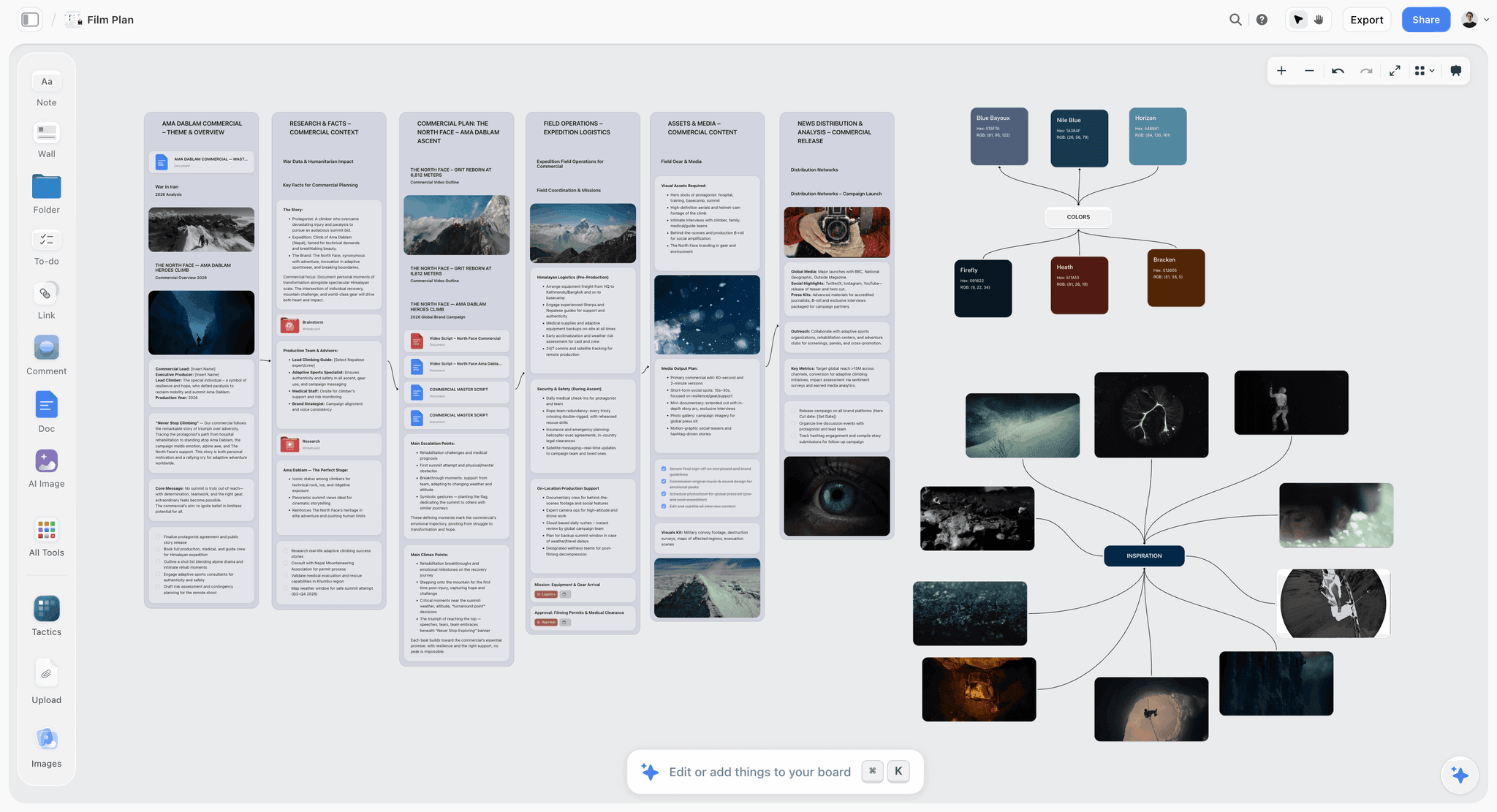
Verdict: the one tool here where Claude or ChatGPT builds the breakdown tables and the strip board directly, on a board the crew opens by link.
Best for: producers and directors on shorts, indie features, commercials and branded films who already plan in an assistant.
Pricing: Plus is $7.99 a month billed annually ($9.99 monthly), Pro is $14 a month annual ($19 monthly) and Max is $39 a month annual ($49 monthly), per the pricing page. Storyflow is paid-only during early access; its Free plan launches before the end of 2026, and anyone a paid member invites to a board joins free now.
Storyflow is a visual project planning workspace: an infinite canvas board that holds tables, notes, documents, images, storyboards and slide decks. Its MCP server, launched in October 2026, lets an assistant read boards and build on them. For this job the relevant part is the strip board tool, which takes days and scenes from the assistant and owns the layout, the colours and the page arithmetic itself.
There is a second route that needs no outside assistant. Storyflow's built-in AI agent has a script breakdown workflow and a strip board workflow. Attach a script in its chat (PDF, Final Draft .fdx, Fountain or plain text) and it parses a scene index mechanically from the sluglines: scene numbers, INT/EXT, time, estimated length in eighths and speaking parts. It opens with a coverage receipt, asks whether you want the scene index, the full breakdown or both, and for the strip board asks how many days and which order. Given two drafts, it can report which scenes were added, cut or changed. That route spends your plan's AI usage; the connector route runs on your own assistant and does not.
Strengths
- The assistant writes the scene index, the breakdown and the strip board onto the board, and reads them back before a change.
- Day totals in eighths are computed by the tool, not by the model.
- The schedule sits beside the moodboard, the shot list and the storyboard on the same canvas.
- A view-only link opens with no account. Invited collaborators edit in real time on any paid plan.
- The connector has no usage limit on Plus, Pro and Max and does not spend Storyflow AI credits.
Limitations
- No day-out-of-days report, no one-line schedule export, no conflict detection. The assistant can build tables that cover the first two, but they do not update themselves.
- No calendar tool, and a table on the canvas cannot be sorted. Dates live in table cells and wall titles, and rows are kept in date order by hand.
- It does not send call sheets or track confirmations.
- Browser only. No offline mode for a location with no signal.
- Over the connector, page lengths are the assistant's estimates from the script it read. Over either route, eighths are estimates until a human measures the pages.
2. StudioBinder
Verdict: the best single suite when the breakdown has to flow into a stripboard, a shot list and a call sheet that tracks who confirmed.
Best for: crewed narrative productions and production companies that run several projects a year.
Pricing: the Starter plan is $29 a month with one user and 10 projects, per StudioBinder's Starter plan article. Indie is $49 a month with two users and 25 projects, and extra users are $25 each a month, per its Indie plan article. Check its pricing page for annual rates.
StudioBinder's breakdown tool imports PDF, Final Draft, Fountain or TXT, lets you tag elements from a drop-down with colour-coded categories, and syncs breakdown changes to the stripboard, shot lists and call sheets. It assigns cast IDs automatically when characters speak. The page describes no AI tagging of other elements and no ChatGPT, Claude or MCP integration, so with an assistant-led workflow you tag by hand or retype the assistant's output.
The free plan is a real trial but a tight one: one project, 10 breakdown elements and 10 scenes on the stripboard or 50% of a screenplay import, per its plan comparison.
Strengths
- Breakdown, stripboard, shot list and call sheet share one set of data.
- Day-out-of-days reports and filterable breakdown reports.
- Call sheets with delivery and confirmation tracking from the Indie plan.
- Auto-ordering of strips by set or time of day on Indie.
Limitations
- We found no connector for ChatGPT or Claude, so the assistant cannot write into it.
- Tagging is manual apart from cast IDs.
- The free plan caps the stripboard at 10 scenes.
3. Filmustage
Verdict: the strongest automatic breakdown, with the schedule, day-out-of-days and budget generated from it, using Filmustage's own AI and not your assistant.
Best for: line producers and ADs who want the tagging done for them on a full feature script.
Pricing: a Free plan with all non-AI tools, one active project and a partial AI breakdown covering 20% of scenes. Director's Cut is listed from $49 a month, or $408 a year billed annually, with 1,000 coins per billing cycle for AI features, per Filmustage's pricing page.
Filmustage tags cast, props, locations, VFX and wardrobe with its own AI, then feeds a stripboard, a calendar, day-out-of-days reports, call sheets and a budget. If your question is simply "which software breaks down a script by itself", this is the direct answer, and it ranks third here only because this guide weighs whether your own assistant can do the writing. Its AI features draw down coins, so heavy use on a long script has a cost beyond the plan price.
Strengths
- Automatic tagging across a whole script.
- Schedule, day-out-of-days and conflicts on the Free plan for one project.
- Budget line items generated from the breakdown and schedule.
Limitations
- We found no connector or MCP server for ChatGPT or Claude.
- AI features are metered in coins, which makes the real cost harder to predict.
- Its AI works inside Filmustage; the context you built up in your assistant stays behind.
4. Movie Magic Scheduling
Verdict: the industry reference scheduler, and the right answer for a union feature, a bonded picture or a series.
Best for: first ADs, UPMs and line producers on productions where the schedule is a contractual document.
Pricing: $299.88 a year with a 12-month commitment, per the annual store page, or $42.99 a month, per the monthly store page.
Movie Magic Scheduling from Entertainment Partners offers an on-screen day-out-of-days that can show rehearsals, fittings and travel, conflict detection, multi-episode management, sub-boards for units, real-time multi-user editing with view or edit permissions, and transfer of elements to Movie Magic Budgeting. Nothing else in this list matches that depth. It ranks fourth here for one reason: its page mentions no AI features, and we found no way for Claude or ChatGPT to write into it, so in this workflow the assistant's breakdown has to be entered by hand.
Strengths
- Deepest scheduling feature set: units, episodes, conflicts, customisable reports.
- One-line report export to PDF or Excel.
- The format financiers, bond companies and studios expect.
Limitations
- No AI features mentioned and no connector found.
- No call sheets in the product page's feature list.
- Its page describes View or Edit access for users in the schedule; we found no view-only link for a client without the software.
5. Celtx
Verdict: a sensible choice if the script is already written in Celtx, because the breakdown and stripboard read the script directly.
Best for: writers and small teams who want writing and pre-production in one account.
Pricing: Celtx's pricing page lists breakdown, schedule, call sheets and budget as included on its Team tier and as optional add-ons on the Writer plans. The page we fetched showed no dollar amounts, so see Celtx's pricing page for current prices.
In Celtx, each scene becomes a strip, strip colours follow the interior or exterior and day or night combination, and you place an end-of-day strip below the last scene of a shoot day, per its stripboard help article. Tagged characters appear in the stripboard's character column. It is a conventional, competent stripboard tied to the script editor.
Strengths
- Script, breakdown and stripboard in one place, so a rewrite carries through.
- Call sheets built from shoot days on the stripboard.
- A free plan with one project to start a script.
Limitations
- Production tools are not on the free tier.
- We found no AI features on its pricing page and no connector for ChatGPT or Claude.
- Prices were not shown on the page we could read, so compare before you commit.
Prompts You Can Copy for Each Pass
Each prompt is a single instruction. Run them in order and wait for each result before sending the next. Replace the bracketed parts.
The reading and index prompts
| Pass | Prompt |
|---|---|
Coverage receipt | Read the attached script [title]. Before building anything, tell me in one line how many pages you read, how many scenes you found and how many speaking parts. List any slugline that appears more than once. |
Scene index | On my Storyflow board for [project], build a table titled "[TITLE]: Scene index". One row per scene in script order. Columns: Scene, Slugline, INT/EXT, Time, Cast, Pages, Synopsis. Use the script's own scene numbers and sluglines exactly. Pages in eighths, marked as estimates. Leave Time empty if the slugline has none. |
Index check | Read the scene index table back from the board. Tell me the number of rows, the total pages in eighths, and any scene whose slugline has no time of day. |
The breakdown prompts
| Pass | Prompt |
|---|---|
Element breakdown | Build a second table titled "[TITLE]: Breakdown". One row per scene. Columns: Scene, Cast, Props, Wardrobe, Vehicles and animals, SFX and stunts, Location, Notes. Fill a cell only with what the scene's action lines name. Leave a cell empty rather than guess. |
Spot check | For scenes [3] and [9], quote the action line each prop in the table came from. Remove any prop you cannot quote. |
Location list | From the breakdown table on the board, list each distinct location with its scene numbers and total pages in eighths. |
The scheduling prompts
| Pass | Prompt |
|---|---|
Strip board | Using the scene index table on the board, not your memory of the script, build a strip board for [4] shoot days. Group by location, then by time of day so the night scenes shoot together. [The motel is only available on the last night.] Title the days Day 1, Day 2 and so on. Do not invent dates. |
Day check | Read the strip board back. Give me each day's scene count, page total and cast. Name any day with both dawn and dusk scenes and any day over 6 pages. |
Day-out-of-days | From the strips on the board as they are now, build a table with one row per cast member and one column per shoot day. Mark SW, W, H, WF or SWF. Add a column for total work days. |
After a reshuffle | I moved some strips. Read the board, recount each day's total in eighths, update the Day total notes and rebuild the day-out-of-days table. Tell me what changed on this board in the last week. |
Worked Example: SALT ROAD, an 18-Scene Short Scheduled Into Four Days
This is an illustrative example. The script, the counts and the assistant's mistakes are invented to show the method, and nothing below is a measured result.
The script and the coverage receipt
SALT ROAD is a short with two leads, MARA and JOE, three day players (WAITRESS, COOK, CLERK) and four base locations: a coast road, a diner, salt flats and a motel. We attach the PDF to Claude and ask for the receipt. The first answer says 15 pages, 17 scenes, 5 speaking parts. The script's last scene is numbered 18.
The follow-up finds it in one message: scenes 3 and 14 share the slugline INT. DINER - DAY and had been counted as one. The corrected receipt reads 18 scenes, and only then do we ask for the table.
The scene index (Worked Example)
| Scene | Slugline | INT/EXT | Time | Cast | Pages |
|---|---|---|---|---|---|
1 | EXT. COAST ROAD - DAWN | EXT | DAWN | MARA | 4/8 |
2 | INT. MARA'S CAR - DAWN | INT | DAWN | MARA | 6/8 |
3 | INT. DINER - DAY | INT | DAY | MARA, JOE, WAITRESS | 1 4/8 |
4 | INT. DINER KITCHEN - DAY | INT | DAY | JOE, COOK | 5/8 |
5 | EXT. DINER PARKING LOT - DAY | EXT | DAY | MARA, JOE | 7/8 |
6 | INT. MARA'S CAR - DAY | INT | DAY | MARA, JOE | 1 1/8 |
7 | EXT. SALT FLATS - DAY | EXT | DAY | MARA, JOE | 1 2/8 |
8 | EXT. SALT FLATS - DUSK | EXT | DUSK | MARA | 6/8 |
9 | INT. MOTEL ROOM - NIGHT | INT | NIGHT | MARA, JOE | 1 3/8 |
10 | EXT. MOTEL WALKWAY - NIGHT | EXT | NIGHT | JOE, CLERK | 4/8 |
11 | INT. MOTEL OFFICE - NIGHT | INT | NIGHT | JOE, CLERK | 5/8 |
12 | INT. MOTEL ROOM - NIGHT | INT | NIGHT | MARA | 7/8 |
13 | EXT. MOTEL PARKING LOT - DAWN | EXT | DAWN | MARA, JOE | 3/8 |
14 | INT. DINER - DAY | INT | DAY | MARA, WAITRESS | 1 |
15 | EXT. DINER PARKING LOT - DAY | EXT | DAY | MARA | 3/8 |
16 | EXT. COAST ROAD - DAY | EXT | DAY | MARA | 5/8 |
17 | EXT. SALT FLATS - DAY | EXT | DAY | MARA, JOE | 1 |
18 | INT. MARA'S CAR - DUSK | INT | DUSK | MARA | 4/8 |
The index check returns 18 rows and 117 eighths, which is 14 5/8 pages. That matches a 15-page script with a short last page closely enough to trust the estimates for scheduling.
The breakdown, and what an honest one looks like
The breakdown table comes back sparse, which is correct. Scene 3 lists a coffee pot, two mugs and a road atlas, each quotable from an action line. Scene 7 lists Mara's car under vehicles and nothing under props. Scene 11 lists a motel register and a room key. Nine of the eighteen rows have an empty Props cell because the script names no prop in them.
The spot check on scene 9 earns its keep: the first pass had listed "suitcase" under props, and the assistant cannot quote a line for it. It comes out. The art department adds it back a day later as their own note, in the Notes column, which is where an unscripted item belongs.
Script order against location order
In script order the company would travel like this: road, diner, road, salt flats, motel, diner, road, salt flats. That is 7 moves between base locations for 18 scenes. Grouped by location it is 4 blocks and 3 moves. We ask for four days, grouped by location, with the motel last because it is a night shoot.
The strip board the assistant built
| Day | Location block | Scenes in shooting order | Strips | Day total | Cast |
|---|---|---|---|---|---|
Day 1 | Diner (day) | 3, 14, 4, 5, 15 | 5 | 4 3/8 pages | MARA, JOE, WAITRESS, COOK |
Day 2 | Coast road and car (dawn call) | 1, 2, 16, 6 | 4 | 3 pages | MARA, JOE |
Day 3 | Salt flats (late call, through dusk) | 7, 17, 18, 8 | 4 | 3 4/8 pages | MARA, JOE |
Day 4 | Motel (night into dawn) | 9, 12, 10, 11, 13 | 5 | 3 6/8 pages | MARA, JOE, CLERK |
The eighths add up: 35 + 24 + 28 + 30 = 117. The average is a little over 3 5/8 pages a day, below the common 4 to 6 page planning range for narrative work, and that is deliberate. Three of the four days are tied to a light window (dawn, dusk, night), and a light window shortens the usable day.
What the first pass got wrong
Two things, both caught by reading the board back.
First, the assistant had put scene 13 (EXT. MOTEL PARKING LOT - DAWN) on Day 1 with the diner, matching on the words "parking lot". The day check listed a dawn scene on a day block, which made no sense, and one dragged strip fixed it.
Second, Day 3 holds two dusk scenes, 8 and 18, totalling 1 2/8 pages in one fading window. The assistant flagged it when asked to name days with dawn or dusk scenes. We kept both on Day 3 but set the order: scene 18 first, because it is one actor inside a parked car and can be lit to cheat a few minutes, then scene 8 for the real sky. That decision is a note on the Day 3 wall, written by a person.
The day-out-of-days (Worked Example)
| Cast | Day 1 | Day 2 | Day 3 | Day 4 | Work days |
|---|---|---|---|---|---|
MARA | SW | W | W | WF | 4 |
JOE | SW | W | W | WF | 4 |
WAITRESS | SWF | 1 | |||
COOK | SWF | 1 | |||
CLERK | SWF | 1 |
Every day player works exactly one day and there are no hold days. In script order the waitress would have been needed for scene 3 and again for scene 14, with the motel in between. The location grouping removed that second booking, and the grid is what makes the saving visible.
What It Costs: Solo Producer vs a Crew of Five
Prices are from the vendor pages linked in the reviews above, read on October 10, 2026. Assistant subscriptions are separate and are not priced here.
One producer, one shoot
| Setup | Monthly cost of the planning tool | What you also need | What it leaves out |
|---|---|---|---|
Storyflow Plus with Claude or ChatGPT | $7.99 billed annually, $9.99 monthly | An assistant that can add a custom connector: Claude (one on Free), or ChatGPT Plus or above with Developer mode | Reports, conflict detection, call sheet sending |
StudioBinder Starter | $29 | Nothing, but tagging is manual | Advanced scheduling and delivery tracking start at Indie |
Filmustage Director's Cut | From $49, or $408 a year | Coins for AI features beyond the 1,000 per cycle | A connector to your own assistant |
Movie Magic Scheduling | $42.99, or $299.88 a year | A separate tool for the breakdown source and call sheets | AI, call sheets |
Celtx | See Celtx's pricing page | The Team tier or the production add-on | AI, published prices on the page we read |
A crew of five on the same schedule
With Storyflow, one person holds the paid plan and invites the director, the AD, the DP and the producer to the board. Anyone a paid member invites joins free today, and invited collaborators edit shared boards in real time. A team workspace with roles and permissions is on Max at $39 a month billed annually. There is no per-user pricing.
With StudioBinder, Indie at $49 a month covers two users and each extra user is $25 a month, so five full users on Indie come to $124 a month on those published figures. For Movie Magic Scheduling, Filmustage and Celtx, check the vendor's page for multi-seat pricing, because the pages we read did not itemise five seats.
Price is 10% of our weighting for a reason. A schedule that costs a company move it did not need is more expensive than any of these subscriptions.
Decision Rules: Which Tool for Which Production
Pick by the document your production is judged on, not by the feature list.
A short, a commercial or a branded film with a crew under fifteen
Use Storyflow with Claude or ChatGPT. The schedule is a handful of days, the people who need it are a mix of crew and client, and the same board already holds the references and the shot list. Follow the nine steps above, then build the shot list beside the strips with the shot list guide for ChatGPT or Claude.
An indie feature with no first AD
Use Storyflow for the breakdown and the first schedule, and decide at lock whether to move. If the shoot is under about 20 days with a small cast, the strip board and an assistant-built day-out-of-days table will carry it. The system in pre-production without a first AD covers who owns each document.
A crewed production that sends call sheets to forty people
Use StudioBinder. Delivery and confirmation tracking on call sheets is the feature you are buying, and Storyflow does not have it.
A union feature, a bonded picture or a series
Use Movie Magic Scheduling. Multi-unit boards, episodic management and reports in the format a bond company expects are not optional at that scale. Shot Lister vs Movie Magic Scheduling covers how the two divide the work on set.
A 110-page script and no time to tag it
Use Filmustage for the automatic breakdown, then decide where the schedule lives. Its free plan covers one active project with manual tools, and the full AI breakdown needs Director's Cut.
Common Mistakes When an Assistant Does the Breakdown
Each of these looks fine in the chat and costs you on the day.
Mistake 1: One prompt for the breakdown and the schedule
Asking for everything at once removes every checkpoint. The scene count is never verified, the props are never traced to a line, and the schedule is built on a list nobody read. Five passes take a little longer and give you five places to catch an error before it reaches the set.
Mistake 2: Letting the model add the eighths
If the assistant states a day total in prose, treat it as unverified. Have it read the totals from the board, where the strip board tool did the sum, or add the column yourself.
Mistake 3: Accepting props the script never names
A full-looking breakdown is a warning sign. Ask for the quoted line behind any element that surprises you, and delete what cannot be quoted. Unscripted needs go in Notes with a name beside them.
Mistake 4: Scheduling in script order
Script order is for the edit. Unless the film genuinely shoots in continuity, every return to a location is a company move you chose to pay for. Our guide to making a production schedule goes deeper on ordering.
Mistake 5: Trusting the schedule from memory after a rewrite
When pages change, the assistant's memory of the old draft is a liability. Tell it to read the new draft, list the scenes that were added, cut or changed, and update the index first. The strips follow the index, never the other way round.
Mistake 6: Treating the day-out-of-days table as live
The table the assistant builds is a snapshot. Drag one strip and it is out of date. Rebuild it after every reshuffle, and put the date it was built in the table's title.
Mistake 7: Inventing dates and rest days
A model asked for "a schedule" will happily supply Monday the 12th and a day off on Sunday. Neither came from you. Keep days numbered until production gives real dates, then put them in the wall titles yourself.
When Storyflow Is Not the Right Choice
Storyflow is our product, and for some productions it is the wrong tool. These are the cases.
You need generated reports
There is no day-out-of-days report, no one-line schedule and no conflict detection in Storyflow. An assistant can build tables that answer the same questions for a small cast, but they are rebuilt on request, not generated from live data. Past 15 or so cast members or 20 shoot days, use Movie Magic Scheduling, StudioBinder or Filmustage.
You need call sheets sent and confirmed
In Storyflow the call sheet is a page deck on the board that you edit and export as one PDF. It is not sent to recipients for you and nobody's confirmation is tracked. Our guide to making a call sheet with ChatGPT or Claude shows that route and where it stops.
You need a free tool today
Storyflow has no free plan during early access. Invited collaborators join free, but someone on the production holds a paid plan. If the budget for software is zero, Filmustage's Free plan (one active project, non-AI tools) and StudioBinder's free plan (one project, 10 scenes on the stripboard) are the real free options.
You schedule in a field with no signal
Storyflow runs in a browser and has no offline mode. If the AD reshuffles the board in a valley with no coverage, print the schedule or use a desktop tool.
Your production needs union rule checking or multiple units
Storyflow knows nothing about turnaround rules, meal penalties or child working hours, and it has no concept of a second unit. You can note them. It will not warn you.
Template: The Columns and Strip Fields to Paste Into Your Assistant
Copy these structures into your first message so the assistant builds the same shape every time.
Scene index columns
Scene, Slugline, INT/EXT, Time, Cast, Pages (eighths, estimated), Synopsis (one factual line).
Breakdown columns
Scene, Cast, Props, Wardrobe, Vehicles and animals, SFX and stunts, Location, Notes. Add Extras, Makeup and hair, Set dressing or Sound as separate columns only if your script uses them in more than a few scenes.
Strip fields
| Field | Example | Source |
|---|---|---|
Scene number | 9 | Scene index |
Slugline | INT. MOTEL ROOM - NIGHT | Scene index, as written |
INT/EXT | INT | Scene index |
Time | NIGHT | Scene index; a CONTINUOUS or LATER scene takes the time of the scene before it |
Pages | 1 3/8 | Scene index |
Cast | MARA, JOE | Scene index |
Synopsis | Joe admits he sold the car | One line, the script's own terms |
Day-out-of-days marks
SW start and work, W work, H hold, WF work and finish, SWF a single day. One row per cast member, one column per shoot day, a final column for total work days.
The pre-lock checklist
- Scene count in the index equals the last scene number in the script, allowing for lettered scenes.
- Total eighths in the index roughly equal the script's page count.
- Two scenes per act spot-checked against the pages.
- No day mixes dawn and dusk without a written reason.
- No night shoot is followed by a morning call.
- No day player works two days that a reorder could make one.
- The day-out-of-days table was rebuilt after the last strip moved.
The Bottom Line
A script breakdown and a schedule are five documents that have to agree with each other: the scene index, the element breakdown, the page counts, the strip board and the day-out-of-days. Claude and ChatGPT are good at producing each one and unreliable at keeping them consistent inside a chat. Put them on a Storyflow board, make the assistant read the board before every change, and let the strip board tool do the colours and the arithmetic. For a short, an indie feature, a commercial or a branded film, that is the most direct route from a locked script to a schedule your crew can open.
When the production is bigger than that, say so early. Movie Magic Scheduling for union features and series, StudioBinder for tracked call sheets, Filmustage for automatic tagging at feature length. To set up the connector, start at the Storyflow MCP page.
FAQ: Script Breakdown and Shoot Scheduling With Claude or ChatGPT
What's the best software for script breakdown and scheduling a shoot?
The best software for script breakdown and scheduling a shoot is Storyflow, used with Claude or ChatGPT: the assistant builds the scene index, the breakdown tables and the strip board on a board the crew opens by link. Movie Magic Scheduling is the standard for union-scale features and series, StudioBinder is strongest when the schedule feeds tracked call sheets, and Filmustage tags a script automatically with its own AI.
Can ChatGPT do a script breakdown?
Yes. ChatGPT can read a script and list scenes, cast, props, wardrobe and locations. The weak points are merged scenes, invented props and wrong page sums. Ask for a coverage receipt first, require that every element be quotable from an action line, and have it write the result to a board through a connector so the breakdown outlives the conversation.
Can Claude make a shooting schedule?
Yes. Claude can group scenes into shoot days by location and time of day once it has a scene index. With the Storyflow connector added, it builds the schedule as a strip board on your board in one call, with a wall per day and a strip per scene. You supply the number of days, the order and any constraints the script cannot know.
Is Claude or ChatGPT better for script breakdown?
Both handle the reading, and the method matters more than the model. Claude's Free plan allows one custom connector, so you can test the board workflow without paying for the assistant. ChatGPT needs ChatGPT Plus or above with Developer mode. Whichever you already use for the project is the right one, because the earlier conversation is context.
What is a strip board?
A strip board is a shooting schedule made of strips, one per scene, grouped into shoot days. Each strip carries the scene number, slugline, page count and cast, and is coloured by whether the scene is interior or exterior and day or night. Reordering strips is how a schedule is revised, which is why it is built from movable pieces.
How are script pages measured in eighths?
Each script page is divided into eight equal parts and every scene is measured in them, so a scene might be 3/8, 1 4/8 or 2 5/8 pages. A scene is never less than 1/8. Eighths give a schedule a common unit: add the strips on a day and you know how many pages that day asks the crew to shoot.
How many pages can you shoot in a day?
For narrative work, 4 to 6 pages a day is a common planning range, not a rule. Dialogue in one room goes faster. Stunts, vehicles, children, animals and night exteriors go slower. A day tied to a dawn or dusk window should carry fewer pages than the range suggests, because the usable light is short and cannot be extended.
What is a day-out-of-days report?
A day-out-of-days is a grid with cast members down the side and shoot days across the top, marking when each person starts, works, holds and finishes. Producers use it to count paid days and to spot an actor booked on two days that are far apart. Dedicated schedulers generate it; in Storyflow an assistant builds it as a table.
Does Storyflow have a day-out-of-days report?
No. Storyflow has no generated day-out-of-days report. Because every strip on the board carries its cast, Claude or ChatGPT can read the strips and build a day-out-of-days table for you. That table is a snapshot: after strips are moved, ask the assistant to rebuild it. For large casts, a dedicated scheduler is the better tool.
Can the assistant read a Final Draft file?
Through the Storyflow connector, yes, when the .fdx file is on a board: the connector reads PDF, DOCX, plain text and Final Draft files there. Storyflow's built-in AI agent also reads .fdx, Fountain, PDF and plain-text scripts attached in its chat. For a file attached directly to your assistant's chat, check which formats that assistant accepts; PDF is the safe export.
What happens when the script changes after the schedule is built?
Update the scene index first, then the strips. Give the assistant the new draft, ask which scenes were added, cut or changed, and have it correct the index table on the board. Then ask it to adjust the affected strips and recount the day totals. Storyflow's built-in agent can compare two drafts of a script and report the differences by scene heading.
Do the day totals update when I drag a strip?
No. Dragging a strip to another day moves the scene, but the Day total note at the top of each wall is text written when the board was built. After a reshuffle, ask the assistant to read the board, recount each day in eighths and update the notes. It takes one prompt, and it is in the prompt table above.
Is Storyflow free for script breakdown and scheduling?
Not during early access. Storyflow is paid-only for now, starting with Plus at $7.99 a month billed annually or $9.99 monthly. Its Free plan launches before the end of 2026. Anyone a paid member invites to a board joins free today, so one paid plan can cover a small crew working on the same schedule.
Does the connector use my Storyflow AI credits?
No. The connector runs on your own assistant's model, so work done by Claude or ChatGPT through it does not spend Storyflow AI credits. Plus, Pro and Max have no connector limit. A free account, which today means one invited by a paid member, gets 25 connector actions a week, with every read and change counting as one, reset on Monday UTC.
Can a client see the shooting schedule without an account?
Yes. A view-only link to the board opens with no account, so a client or a location owner can see the strip board in a browser. To leave a comment they sign in. Crew you invite to the board can edit it in real time, which suits an AD and a producer reshuffling days together.
Is Movie Magic Scheduling worth it for an indie film?
It depends on who reads the schedule. If a financier, a bond company or a union expects schedules in the industry format, yes, and $299.88 a year is modest against a feature budget. For a self-financed short with a crew of ten, its depth goes unused and a strip board the whole crew can open is more practical.
Table of Contents
- Key Takeaways
- Why a Breakdown Done in a Chat Window Does Not Survive Pre-Production
- How We Chose the Tools and Weighted the Criteria
- The Five Passes: What Each One Produces
- Comparison Table: Script Breakdown and Scheduling Software for a Claude or ChatGPT Workflow
- How to Do a Script Breakdown and Shoot Schedule With Claude or ChatGPT, Step by Step
- Step 1: Connect the assistant to a Storyflow board
- Step 2: Lock the draft and hand over the real script
- Step 3: Ask for a coverage receipt before anything is built
- Step 4: Build the scene index as a table
- Step 5: Build the element breakdown, scene by scene
- Step 6: Decide the two scheduling questions yourself
- Step 7: Have the assistant build the strip board in one call
- Step 8: Check the heavy day, the light and the turnaround
- Step 9: Build the day-out-of-days and keep the assistant on the board
- The Five Tools Ranked for This Job
- Prompts You Can Copy for Each Pass
- Worked Example: SALT ROAD, an 18-Scene Short Scheduled Into Four Days
- What It Costs: Solo Producer vs a Crew of Five
- Decision Rules: Which Tool for Which Production
- Common Mistakes When an Assistant Does the Breakdown
- When Storyflow Is Not the Right Choice
- Template: The Columns and Strip Fields to Paste Into Your Assistant
- The Bottom Line
- FAQ: Script Breakdown and Shoot Scheduling With Claude or ChatGPT
- Related Reading
Templates to check out for this topic


Templates you can use in Storyflow
Every Storyflow board starts from real structure and an AI that reads the whole canvas. Open one of these templates and make it yours.


See Storyflow in Action
A visual AI workspace where every feature lives inside one canvas. No tab-switching, no context lost.
Build your entire board from a single message
Type what you need in the AI chat at the bottom of your canvas. The AI adds cards, headings, and structure directly onto your board.
Use expert frameworks as AI context
Type @ in the AI chat and choose any Tactic. The AI tailors every response to that framework instead of giving generic advice.
Turn your board into a mind map in seconds
Ask the AI to restructure your canvas as a mindmap. It connects your ideas into a visual hierarchy so you can see how everything relates.
Why Storyflow Exists
Storyflow actually began as a personal tool while working on creative and research projects.
We kept running into the same problem: ideas were scattered everywhere: notes, documents, and whiteboards.
Nothing helped us see how everything connected.
So we started building a workspace designed around how ideas actually grow.
→ Read how Storyflow was createdStoryflow Team
Product & Research Team
Published: 2026-10-10
Extremely simple, seriously capable


See how easy it is to get started
Watch a real project come together, from a blank board to a finished plan, clicked through step by step.
Start creating with AI and become more productive
Transform your creative workflow with AI-powered tools. Generate ideas, create content, and boost your productivity in minutes instead of hours.