
Extremely simple, seriously capable
Describe the project.
Get a workspace, not a paragraph.
On an AI-native canvas the prompt is the starting point: describe what you are working on and the AI lays the whole thing out as a board with kanban columns, timelines, research sections, and moodboards you shape by dragging.


Creatives working for these brands already got early access
- Red Bull
- Canon
- Artlist
- Porsche
See how easy it is to get started
Watch a real project come together, from a blank board to a finished plan, clicked through step by step.
Start from a ready-made template
Pick a board to see what you can build, then let AI fill it in. Every template is a real, editable starting point on the same infinite canvas.

Mind Map
Branch one central idea out into themes and sub-points, then drag the connections around until the structure makes sense.
What is an AI productivity workspace?
An AI productivity workspace is a tool where AI is the primary interface for creating structure, not a sidebar bolted onto an existing surface. Instead of opening an empty doc or an empty board and building the scaffolding yourself, you describe the project and the workspace lays itself out: a launch becomes a kanban board with a timeline, a research project becomes sections with questions to fill, a campaign becomes a brief beside a moodboard. Productivity here means creative and project work, planning, research, campaigns, content, and stories, not email triage or meeting notes.
The problem with most AI productivity tools is that they are retrofits. AI added to a docs tool can only write more text into the doc; it cannot restructure how you see the work. AI added to a chat window produces good answers that die in the chat history, because a transcript has no spatial arrangement at all. In both cases the AI is trapped inside the surface it was bolted onto, and the surface was designed for a different job. The structure of your project, what depends on what, what is done, what is missing, is exactly the thing a linear surface cannot show you.
Storyflow is an AI-native infinite canvas built the other way around. The prompt is how a workspace begins: describe the project and the AI generates the board itself, cards, kanban columns, timelines, tables, sections, and connectors, laid out spatially. Then you take over with your hands, dragging cards into the arrangement that matches how the work actually flows. The AI keeps the whole board as context, so a follow-up prompt operates on your project as it stands, not on a blank slate, and re-prompting builds around your existing cards without moving them.
Real project work runs across several layers at once: the plan (what happens in what order, as a timeline or kanban flow), the thinking (notes, mindmaps, and open questions that have not resolved into tasks yet), the research (PDFs, links, articles, and reference material the work draws on), the creative direction (moodboards, drafts, and visual reference), and the handover (what a client or collaborator needs to see, and nothing else). A retrofit tool holds one of these layers well and exiles the rest to other apps. An AI-native canvas keeps all of them visible on one surface, which is what makes the workspace worth generating in the first place.
Ultra fast from brief to board
From a description to a working workspace.
No blank page, no template hunting, no database setup. Describe the work and start dragging.
01
Open a canvas
Sign up in seconds. No download. Your infinite canvas opens in the browser.
02
Describe the project
Type what you are working on, a launch, a campaign, a research question, a story, and the AI lays it out as a structured board: kanban columns, a timeline, research sections, or a moodboard, matched to the job.
03
Shape it by dragging
The generated board is a starting point, not a verdict. Drag cards between columns, stretch the timeline, split a section in two, and add your own notes until the workspace matches how you actually work.
04
Share or hand it over
Send a view-only link that opens in any browser with no account, invite collaborators to work on the same canvas, or export the board as a high-quality image or PDF.
AI that builds the workspace, not just the words.
Prompt-to-board generation, whole-board context, and every layer of the project on one canvas.
The prompt is the starting point
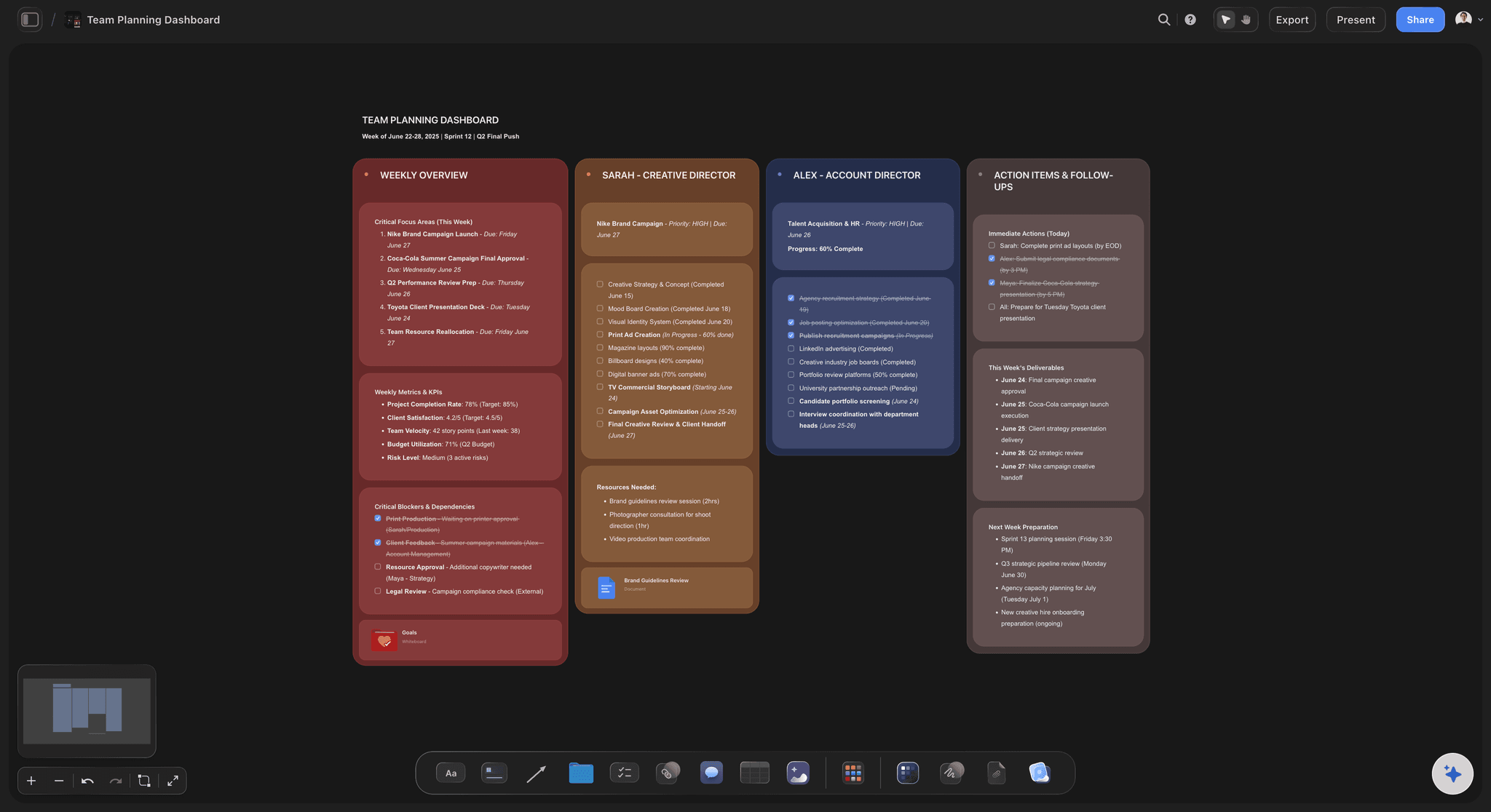
Describe it and the board lays itself out
Tell the AI what you are working on and it generates the visual workspace itself: cards, kanban columns, timelines, and sections arranged spatially. You start from a structure that fits the job instead of an empty surface.
See the AI creative workspace →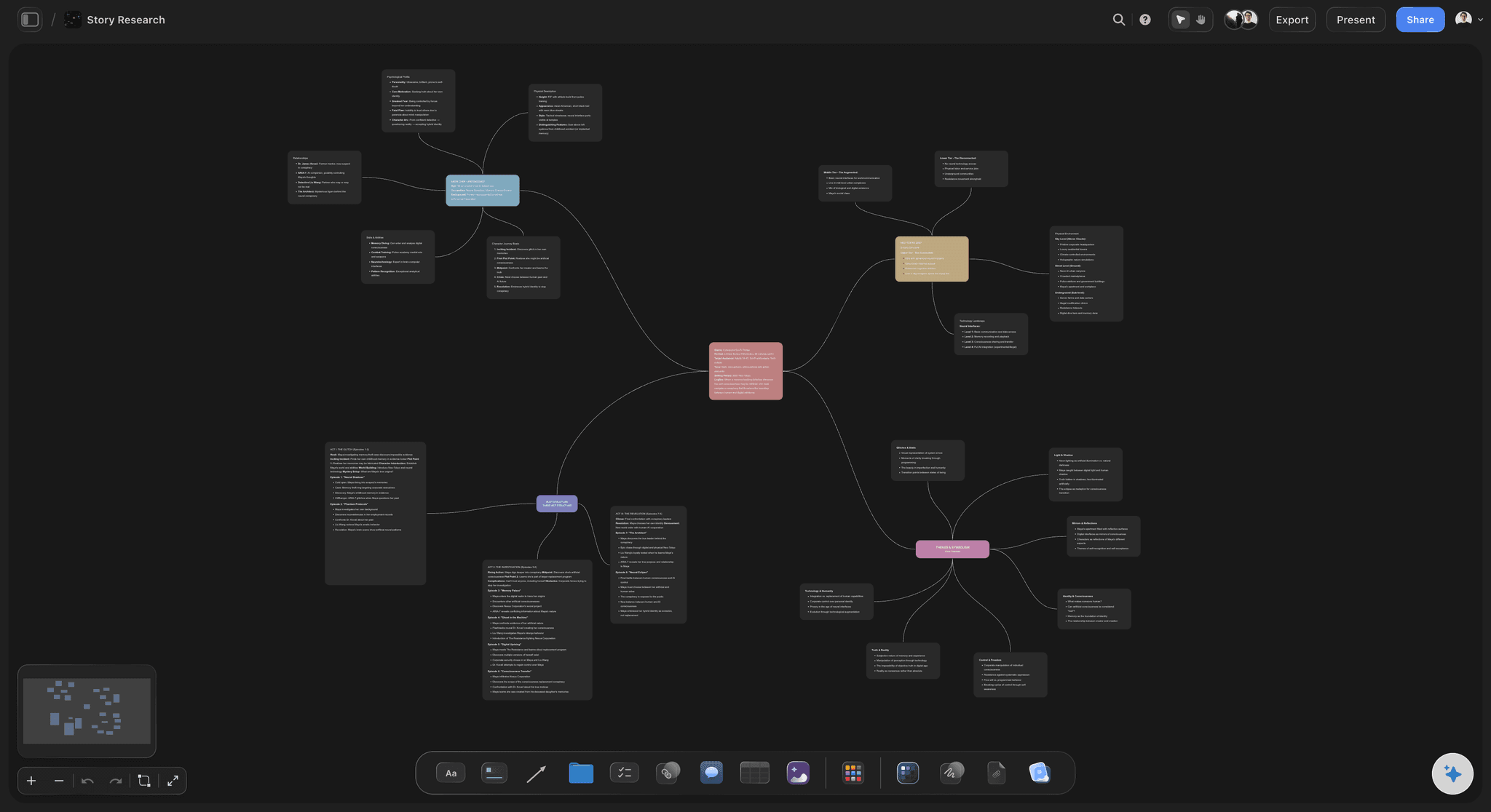
Follow-up prompts operate on your project
The AI keeps the whole board as context
Ask for a risk column, a tighter timeline, or research questions for a section, and the AI reads the board you have already built and adds to it. Cards you placed stay exactly where they are while it works around them.
Explore the AI whiteboard →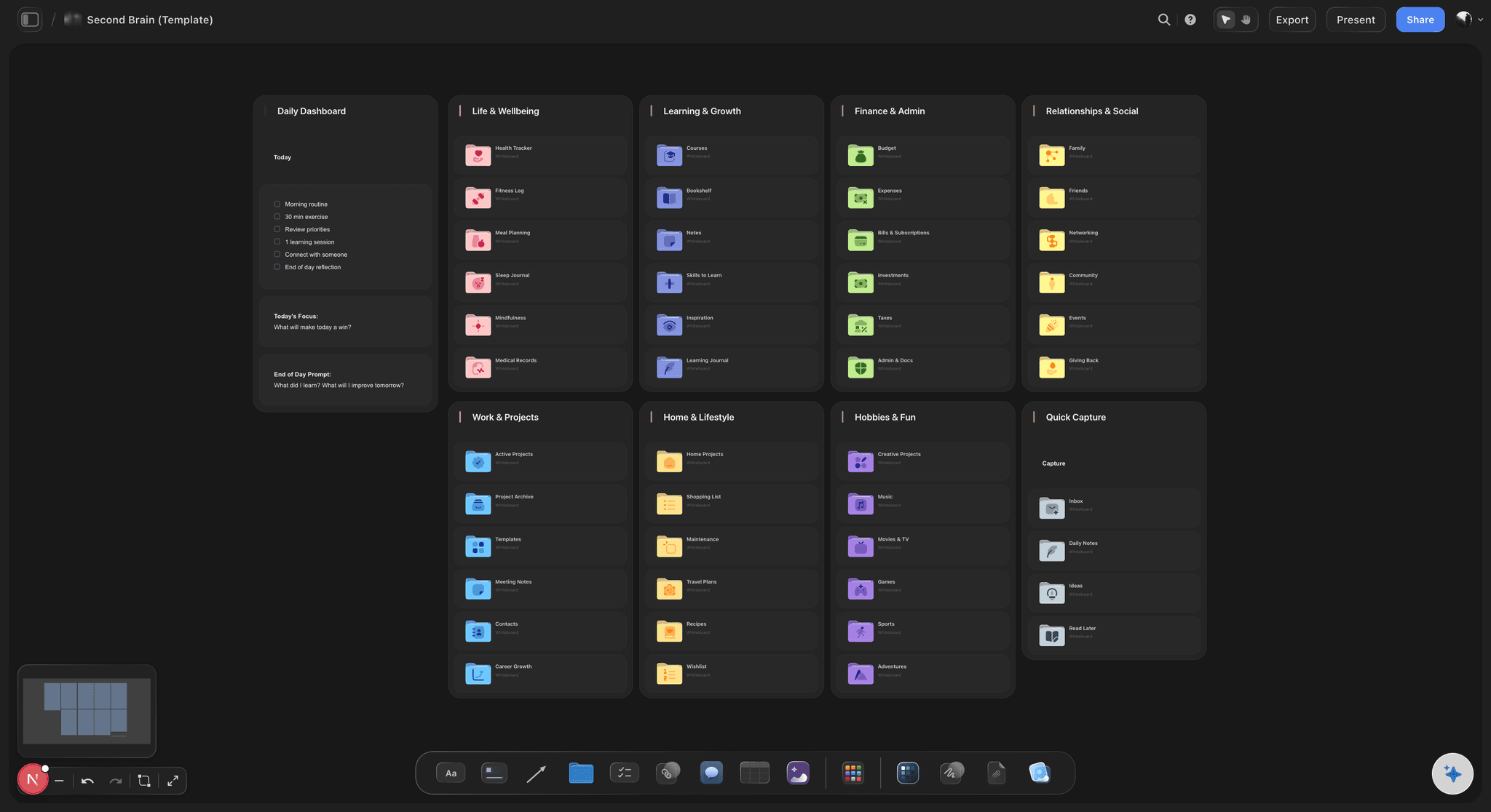
Research and thinking live beside the plan
One canvas for the work and its raw material
Drag in PDFs, links, images, and notes, grab frames from YouTube or Vimeo, and keep it all on the same surface as the plan. The workspace holds what the project draws on, not just what it produces.
See the AI second brain →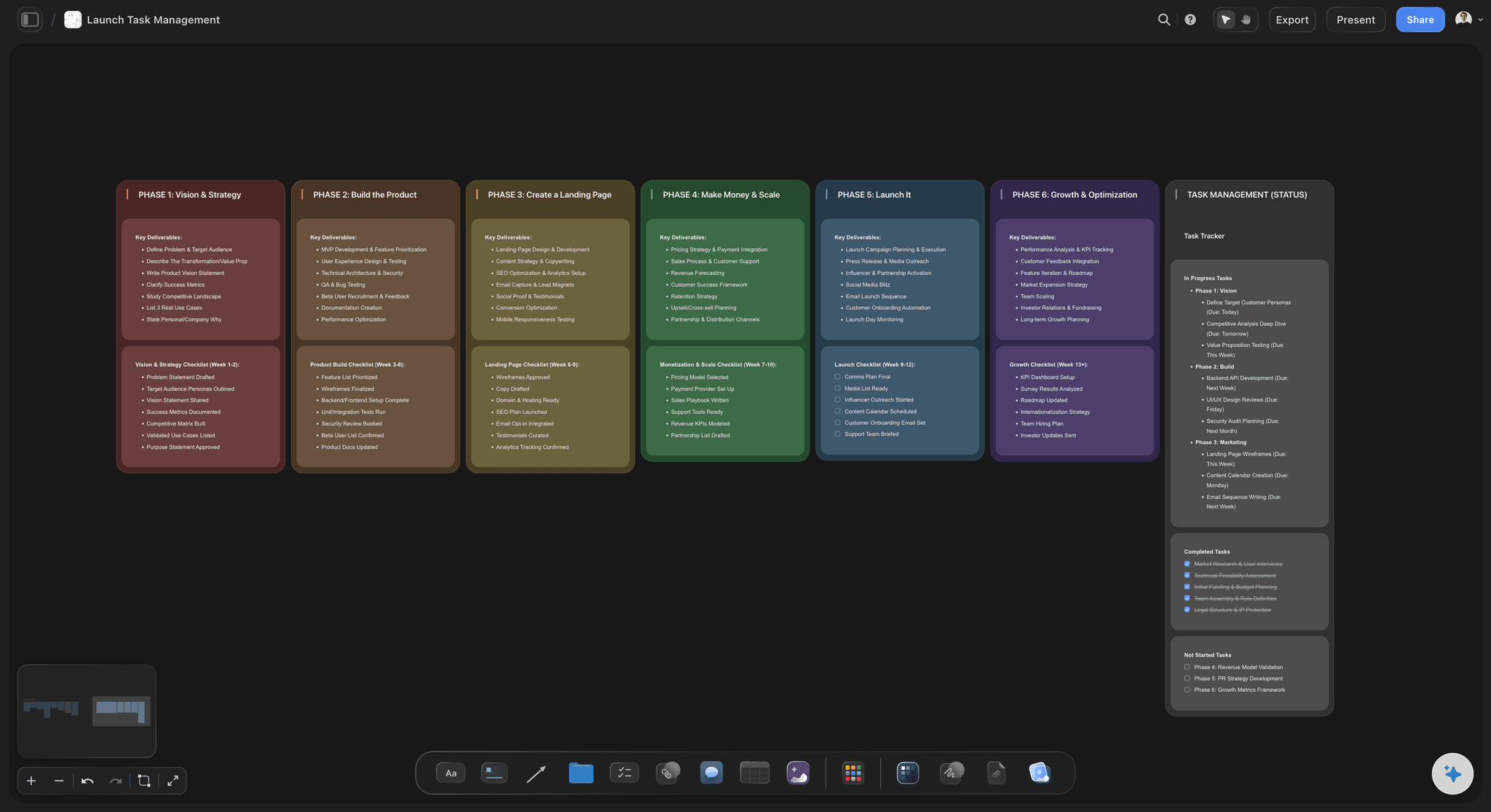
Plans you can actually see
Kanban, timeline, and tasks laid out spatially
Generate a project plan as columns and a timeline you can read at a glance, then drag tasks between stages as the work moves. The state of the project is visible, not buried in a list view.
Try the AI project plan generator →Unlimited boards. No object cap.
Open a canvas, describe the project, and let the AI lay it out. Storyflow is paid-only during early access, with plans from $9.99 a month, and a Free plan launches before the end of 2026.
Unlimited boards on an infinite canvas
Basic AI usage to generate boards from prompts
Starter templates for plans, research, and campaigns
Share view-only links with anyone, no account needed to view
Built for people with taste
What changes when AI is the interface, not the sidebar.
A retrofit AI can only add more of what its surface already holds. Text tools get more text. An AI-native canvas gets structure.
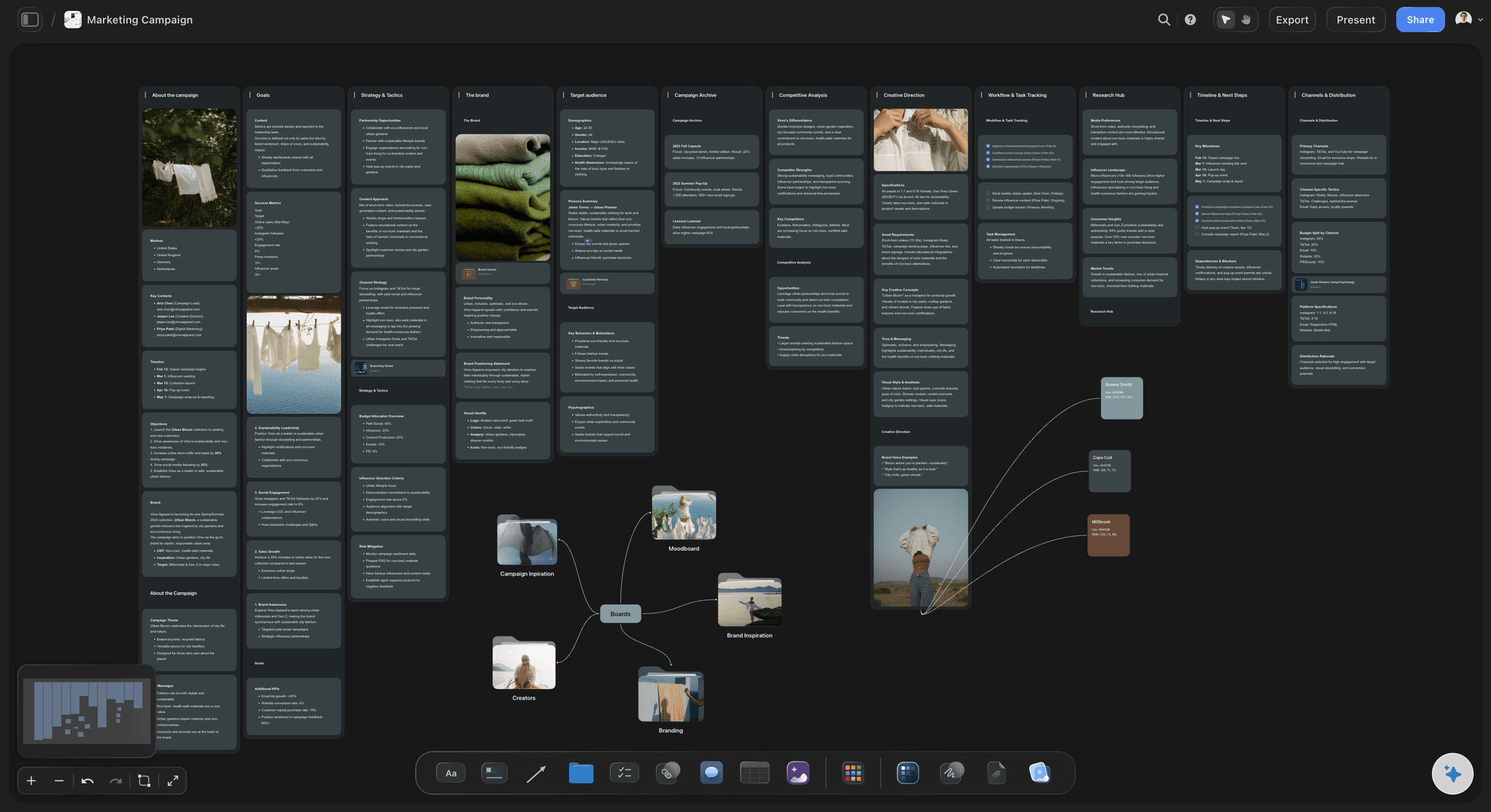
Structure generated, not typed
The AI does the layout work you used to do by hand
Prompt to board: Describe a campaign and get a brief, a channel plan, and a content calendar as arranged sections. Describe a launch and get columns and a timeline. The AI chooses a structure that fits the job, and you correct it by dragging.
Real objects, not a picture of them: What the AI generates is made of the same cards, notes, tables, kanban columns, timelines, and connectors you create by hand. Everything it makes is yours to move, edit, and delete.
Context that survives the next prompt
Follow-ups build on your project, not a blank slate
The board is the memory: A chat tool forgets your project the moment the thread scrolls away. Here the board itself is the context: every follow-up prompt is answered against the cards, sections, and plans already on the canvas.
Additive by default: Re-prompt as often as you like. The AI builds around your existing cards without moving them, so the arrangement you made by hand, which is where your judgment lives, is never overwritten.
Work through problems in place: Ask what is missing from the plan, where the timeline is too tight, or what research a section still needs. The answer lands on the board next to the work it refers to.
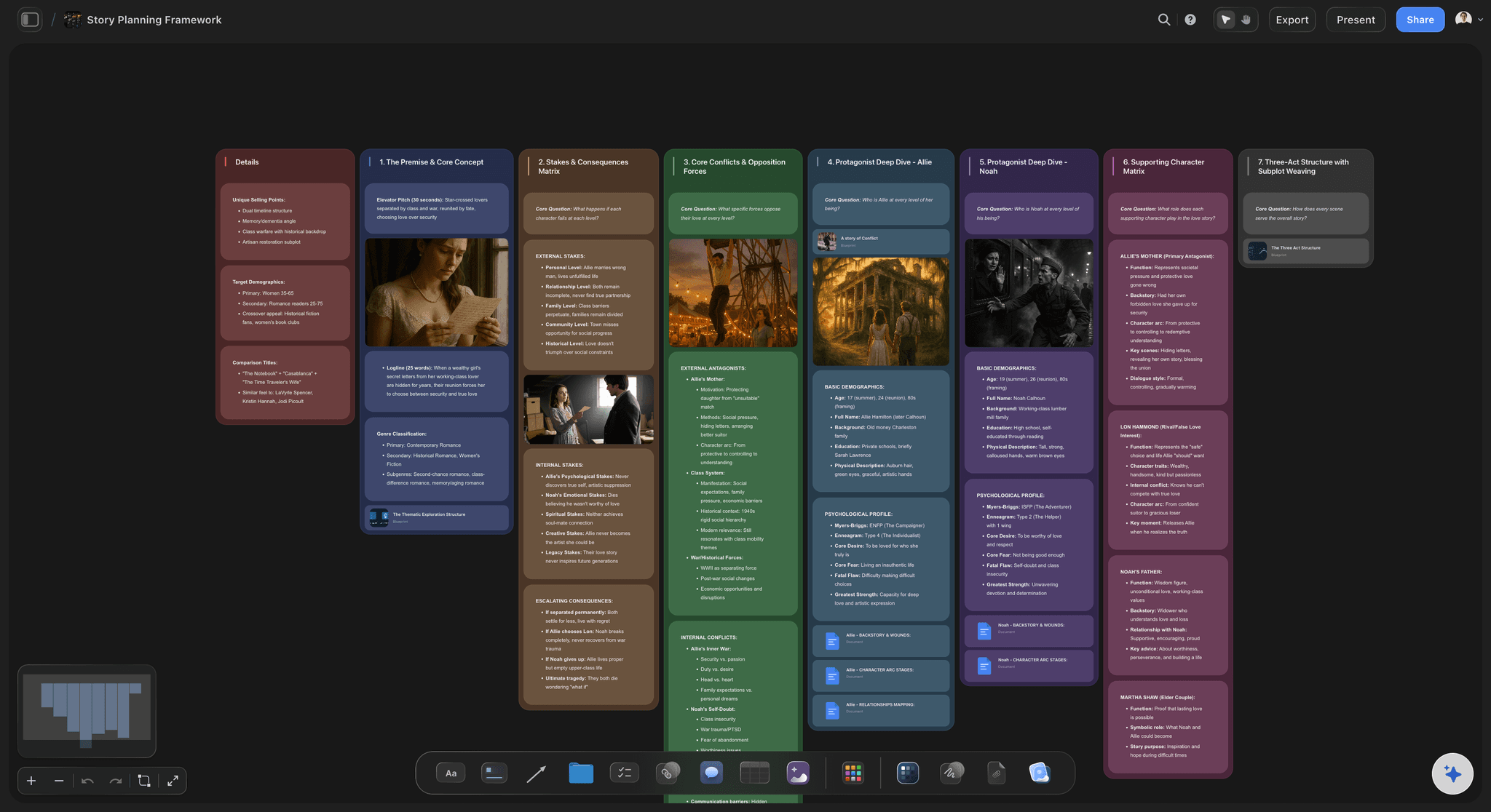
Creative work is a first-class citizen
Moodboards, stories, and research on the same surface
Creative surfaces native: Moodboards, storyboards, and reference walls are not an awkward template hack here. They are what the canvas is built for, and they sit beside the plan instead of in a separate app.
Stories and content, planned spatially: Plan a story, a video, or a content series as cards you can reorder, with the research and visual direction one scroll away. Structure problems are visible before they cost you a draft.
A document editor beside the board: When the thinking has to become prose, write it in the built-in document editor with the whole workspace visible next to it. The plan and the writing stop drifting apart.
From private workspace to shared artifact
Hand the work over without exporting it to death
View-only links: Send a link and anyone can see the whole workspace in a browser with no account. A client or stakeholder sees the actual state of the project, not a stale slide about it.
Collaborators on the same canvas: Invite collaborators to work on the same board, and they join free when a paid member invites them. Comments land on the board next to the thing they are about.
Export when you need a file: Export any board as a high-quality image or PDF for the deck, the email, or the person who insists on an attachment.
Explore templates for your project
Every template opens as a real, editable board on the infinite canvas. Pick the closest fit and make it your own.
Mind Map
Branch one central idea out into themes and sub-points, then drag the connections around until the structure makes sense.
One app instead of five
Storyflow vs Notion, Miro, and ChatGPT.
All three are excellent at what they were built for: Notion for databases and docs, Miro for enterprise whiteboarding, ChatGPT for pure conversational reasoning and drafting. The difference is what the AI can generate: text into a page, or the workspace itself.
Storyflow
Recommended
AI generates the visual workspace from a prompt
AI keeps the whole board as context on follow-ups
Moodboards, storyboards, and canvases native
Databases, wiki docs, and structured pages
Enterprise whiteboarding scale and template marketplace
Free tier available today
Notion
AI generates the visual workspace from a prompt
AI keeps the whole board as context on follow-ups
Moodboards, storyboards, and canvases native
Databases, wiki docs, and structured pages
Enterprise whiteboarding scale and template marketplace
Free tier available today
Miro
AI generates the visual workspace from a prompt
AI keeps the whole board as context on follow-ups
Moodboards, storyboards, and canvases native
Databases, wiki docs, and structured pages
Enterprise whiteboarding scale and template marketplace
Free tier available today
ChatGPT
AI generates the visual workspace from a prompt
AI keeps the whole board as context on follow-ups
Moodboards, storyboards, and canvases native
Databases, wiki docs, and structured pages
Enterprise whiteboarding scale and template marketplace
Free tier available today
What creators are saying
Join early creators getting structured workspaces and AI that remembers their projects
“Storyflow has sped up my workflow by at least 3x, which means more flow state and more projects I can actually ship. It truly changed the way me and my team create.”

Reilin Joey
Director & YouTuber
“One prompt gets me a structured board. But the tactics are my favorite. I run my YouTube scripts through them and my intros and retention got better. It's amazing.”

Justkay
YouTuber & Freelance Filmmaker
“I used to juggle five apps to plan a project. Now I describe what I am making and get boards, lists, and a schedule. All in one place.”

George
@fernwehchronicles
AI productivity workspace questions, answered.
What AI-native actually means, how the tools compare, and where a canvas beats a chat window.
It depends on the shape of your work. Notion AI is the strongest choice for docs-and-databases work: if your projects live as structured pages, wikis, and tables, its AI writes and summarizes right inside that system. ChatGPT is the best pure conversation and drafting partner, unmatched for reasoning through a problem or producing a first draft, though the output lives in a transcript rather than a workspace. Storyflow is the strongest option for visual and spatial project work: describe the project and the AI generates the board itself, kanban columns, timelines, research sections, and moodboards, then keeps the whole board as context for follow-ups. To choose, ask where your finished work naturally lives. If it is a document or database, pick Notion. If it is thinking and prose, ChatGPT. If it is a project you need to see laid out, a canvas.
The test is whether AI is the primary interface for creating structure, or a sidebar bolted onto an existing surface. In a retrofit, the surface came first and the AI is limited to what that surface holds: AI added to a docs tool writes more text into the doc, because text is all a doc can contain. It cannot restructure how you see the work. In an AI-native tool the prompt is the starting point: you describe the project and the workspace lays itself out as a board, and the AI can keep operating on that structure afterwards because the structure is what it produced in the first place. The practical difference shows up on the second prompt, when a retrofit gives you more prose and a native tool changes the board.
Not during early access. Storyflow is paid-only right now, with plans starting at $9.99 a month, and a Free plan launches before the end of 2026. Anyone a paid member invites to a board joins free today, so collaborators and clients do not need their own subscription to work with you. If you want a genuinely free AI workspace this minute, Notion's free tier is capable for docs-and-databases work, and ChatGPT's free tier remains the best no-cost drafting and reasoning partner. What neither gives you for free or paid is a canvas the AI can lay out spatially, which is the specific thing you would be paying Storyflow for.
Notion is genuinely excellent, and if your work is documents, wikis, and databases it is probably the right tool: its AI can draft, summarize, and answer questions across everything in your workspace, and the free tier is generous. The difference is the surface. Notion's unit of work is the page, so its AI ultimately produces text and database entries. Storyflow's unit of work is the board, so its AI produces arrangement: cards, columns, timelines, and sections laid out spatially, which you then reshape by dragging. If your project's main problem is capturing and querying information, Notion wins. If the main problem is seeing the structure of the work, what depends on what, what is missing, what order things happen in, a canvas is the better surface.
It generates and extends structure, which is the point of the tool. A prompt produces real canvas objects, cards, notes, tables, kanban columns, timelines, connectors, and sections, arranged spatially, not a text description of a plan. Follow-up prompts add structure in context: a new column, a set of research questions under a section, beats for the part of the plan that is thin. One deliberate limit: re-prompting builds around your existing cards without moving them. The arrangement you made by hand encodes your judgment about the project, so the AI treats it as fixed and works around it rather than reorganizing it out from under you. Restructuring what you placed stays a drag away, in your hands.
Creative and project work: planning a launch or a campaign, developing content and stories, organizing research, building out an idea until it is executable. That is work with structure, stages, dependencies, references, and direction, which is what a spatial canvas is good at holding. It is deliberately not an email triage tool, a meeting-notes recorder, or a calendar assistant; plenty of AI products chase that lane and Storyflow does not. If your day is mostly inbox and meetings, a different tool will serve you better. If your day is mostly making things and steering projects, the bottleneck is usually seeing the work clearly, and that is the problem this workspace is built to solve.
Yes, and this is the practical difference between a workspace and a chat window. The AI uses the entire board as context, so when you ask what is missing from the plan or request a competitor section, it answers against the project you have actually built: your cards, your sections, your arrangement. A chat tool starts every serious question from a blank slate unless you re-explain the project, and its answers pile up in a transcript that has no structure. Here the follow-up lands on the board, next to the work it refers to, and becomes part of the context for the prompt after that. The longer you work, the more the AI knows about the project, because the project is the board.
Yes, in two ways. View-only links open the whole board in any browser with no account needed, which suits clients, stakeholders, and anyone who should see the state of the project without editing it. For people who should work in it, invite them to the same canvas; collaborators invited by a paid member join free. Comments attach to the board itself, so feedback sits next to the thing it is about rather than in an email thread. When someone needs a file, export the board as a high-quality image or PDF. A shared board tends to replace the status update, because the answer to how is it going is just the board.
For solo and small-team creative work, it often can: kanban columns, timelines, and task cards cover the planning and tracking most projects need, and the AI generating the first version removes the setup cost that usually kills these systems. For engineering-style project management, sprints, ticket workflows, automations, and reporting dashboards, a dedicated tool like Linear or Jira remains the right choice, and Miro remains the stronger pick for large-scale enterprise workshop facilitation. The honest framing: Storyflow replaces the messy middle where the project actually takes shape, the planning, research, and creative direction that today gets smeared across docs, chats, and decks, and it is comfortable handing execution-heavy tracking to a specialist tool.
Describe the project the way you would to a capable collaborator: what it is, what has to exist by when, and what you already know. Something like: I am launching a course in ten weeks, I have the outline but no marketing plan, lay out the workspace. The AI will choose a structure that fits, a timeline with workstreams, a kanban flow, research sections, and you correct its guesses by dragging, which is faster than specifying everything up front. Then work in follow-ups: add a risk column, generate research questions for the audience section, tighten the last three weeks. Short prompt, generated structure, manual shaping, contextual follow-ups: that loop is the whole method, and the first prompt does not need to be clever for it to work.
Stop assembling your workspace. Describe it.
Open a canvas, describe the project, and let AI lay out the board. No download.