
RESEARCH CANVAS
Research does not fail at
gathering. It fails at deciding.
Forty tabs is not research. Put every source on one canvas as a card, cluster the findings into themes, mark where two sources disagree, and write what you now believe next to the evidence for it. Storyflow is paid-only during early access, with plans from $9.99 a month, and a Free plan launches before the end of 2026.
Plans from $9.99/mo
Free plan coming late 2026
Works in your browser

Used by creative professionals at:
Artlist
Pixar
Nike
Red Bull
The North Face
Porsche
Start from a ready-made template
Pick a board to see what you can build, then let AI fill it in. Every template is a real, editable starting point on the same infinite canvas.

Mind Map
Branch one central idea out into themes and sub-points, then drag the connections around until the structure makes sense.
What is a research canvas?
A research canvas is a single visual surface that holds everything you have found on a question, arranged so you can see the relationships between the pieces. Sources sit on it as cards rather than as browser tabs, findings cluster into themes you can point at, disagreements between two sources become visible lines instead of a vague sense that something did not add up, and the conclusion you are forming is built on the same surface as the evidence underneath it. It is the difference between having research and having done research.
Almost everyone is good at the gathering phase, and almost nobody is good at the phase after it. Gathering feels productive: every article you open, every report you download, every screenshot you take produces a small hit of progress, and there is always one more thing to read. That is exactly what makes it dangerous. Gathering has no natural end, so it becomes a very comfortable place to hide from the hard part. The hard part is deciding what you now believe and why, which is uncomfortable because it requires committing to a position that some of your sources will not support.
The reason the deciding phase is so hard has less to do with willpower than with format. Twenty PDFs, a bookmarks folder, a notes app, and a Slack thread give you twenty separate viewing surfaces, and you can only look at one at a time. A contradiction between source three and source seventeen is invisible when you can never see three and seventeen together. A theme that six sources all point at is invisible when you meet those six sources on six different days. Synthesis is a comparison problem, and comparison needs everything in one field of view. That is why a canvas is not a nicer notebook, it is a different operation.
Research that reaches a conclusion runs through six stages you can lay out on one board: framing the question you are actually trying to answer and the decision it feeds, so you can tell when you are done; gathering sources with an explicit stopping rule instead of an open-ended reading habit; capturing each source as a card that carries the claim, the quote, and the context rather than a bare link; clustering the findings into themes by moving cards until groups form and then naming them; running the contradiction pass, where you deliberately hunt for the places two credible sources disagree and ask what differs between them; and writing the synthesis while the material is still in front of you, stating what you believe, how confident you are, and what you still do not know. Storyflow keeps all six visible at once, which is what turns a pile of tabs into an answer.
HOW IT WORKS
From forty open tabs to one clear conclusion.
Get everything onto one surface, then move it around until the answer is visible.
01
Write the question first
Before you read anything, put the question at the top of the board along with the decision it feeds and what a good enough answer looks like. Research with no stated question never ends, because nothing can complete it.
02
Capture sources as cards, not links
One card per source, carrying the claim, the quote or number you would actually use, who said it, and when. Attach the PDF, the screenshot, the link, or the video frame to the same card so the original is one click away.
03
Move the cards until themes appear
Drag findings that say the same thing into the same region. When a group holds together, name it. That name is a theme, and your themes are the shape of your answer. Draw a line between any two cards that disagree.
04
Write the conclusion beside the evidence
With the themes visible, state what you now believe, mark how confident you are in each claim, and note what is still unknown. Build that structure on the same canvas so every conclusion sits next to the cards that support it.
Everything you found, in one field of view.
Sources, themes, contradictions, and the conclusion on one infinite canvas instead of forty tabs and a notes file.
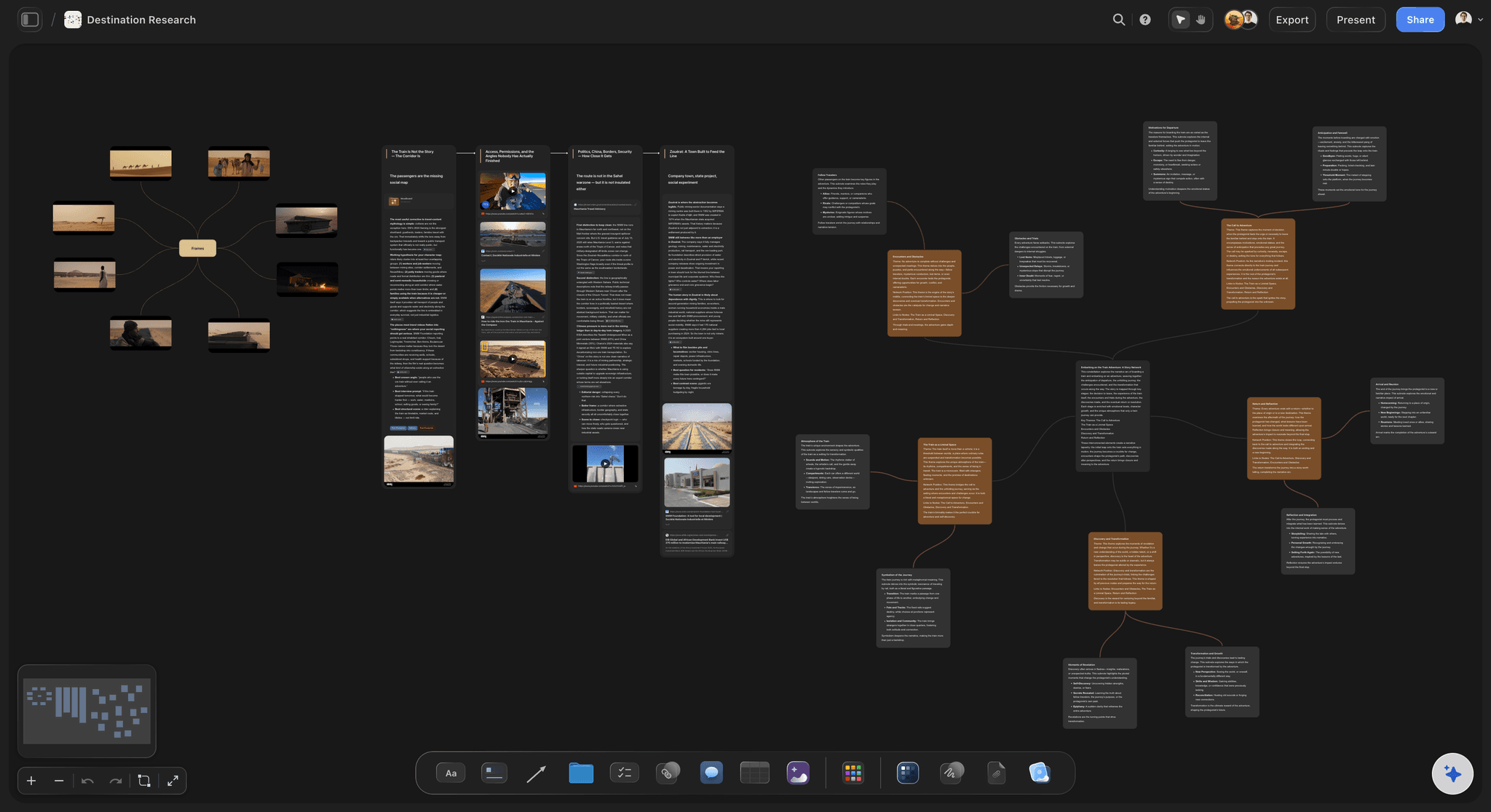
Every source is a card you can physically move
Cluster by dragging, not by declaring
In a document you pick a category first and file findings under it. On a canvas you move cards near the cards they resemble until a group forms, and the theme is something you discovered rather than something you assumed. That is most of the difference between synthesis and filing.
See the affinity diagram maker →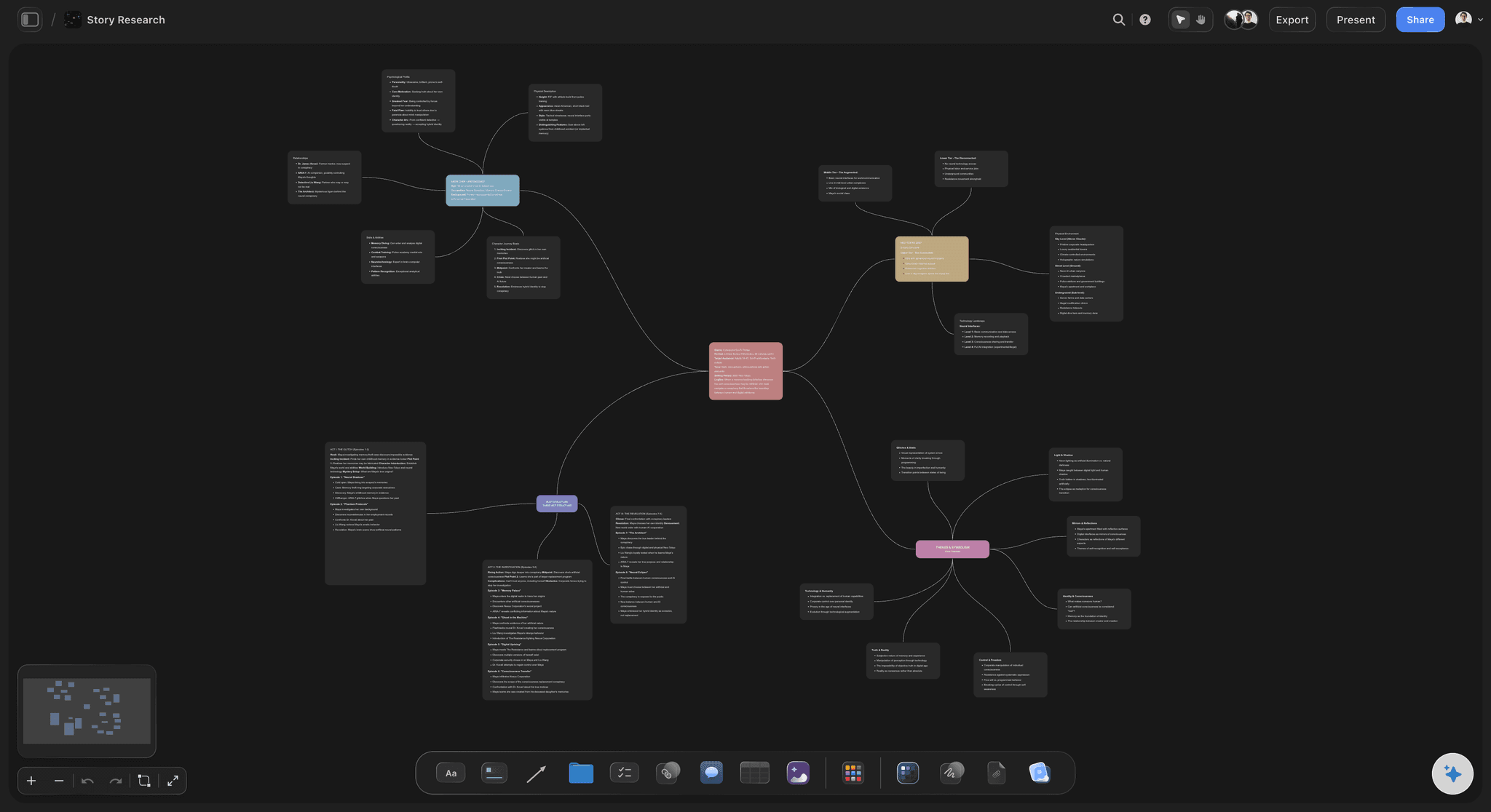
Draw the disagreement as a line between two findings
Contradictions are the signal
Two credible sources reaching opposite conclusions is not noise to average away, it is usually the most useful thing on your board. Connect the two cards, write the likely reason on the connection, and the tension becomes something you can reason about instead of something you quietly ignore.
Explore the concept map maker →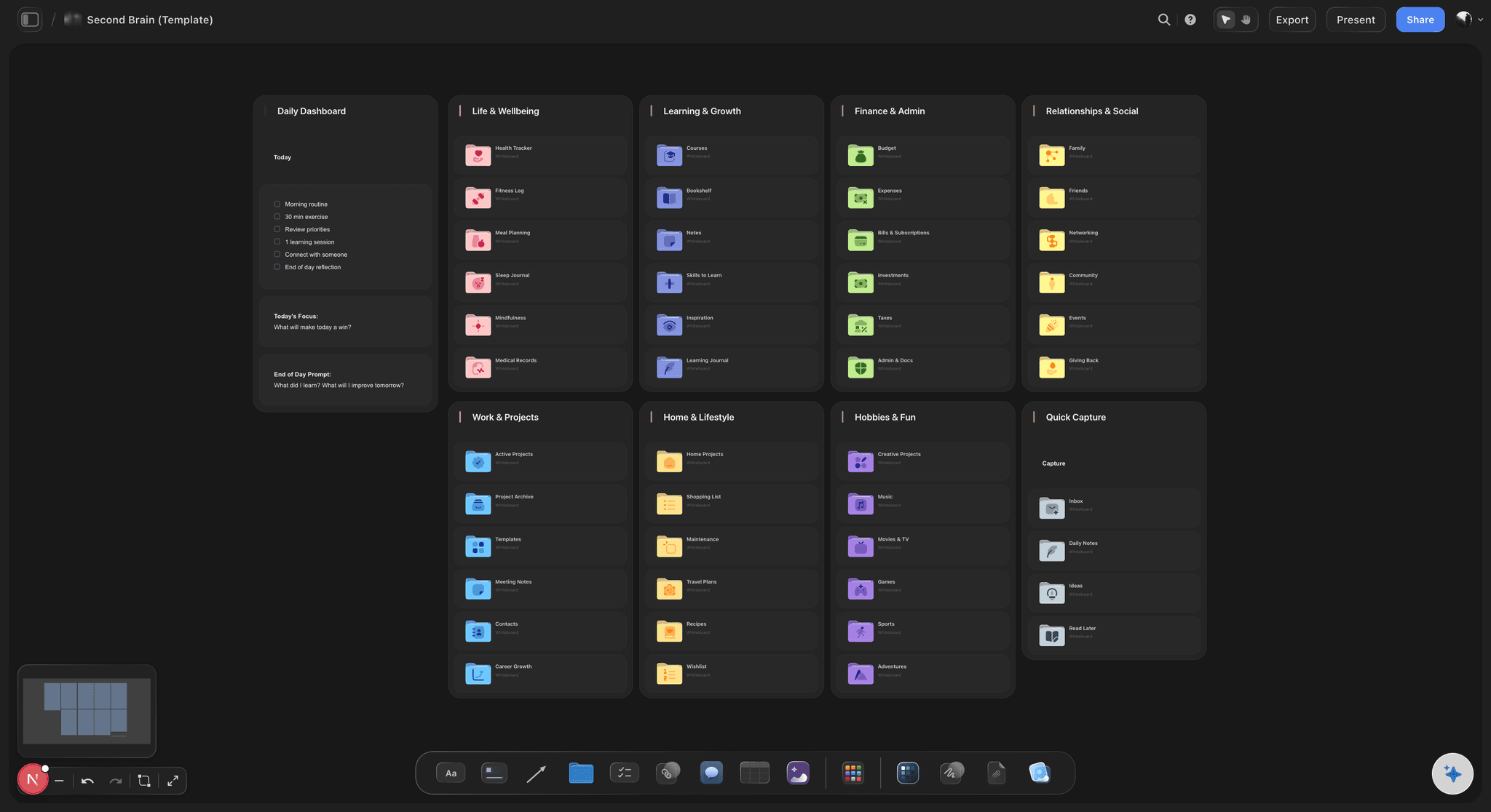
PDFs, screenshots, links, and video frames on one surface
Keep the evidence with the claim
A finding separated from its source is a rumour by the end of the week. Drop the report, the pricing page screenshot, the interview clip, or the article link straight onto the card that makes the claim, so anyone can check where the number came from without asking you.
See the competitor analysis generator →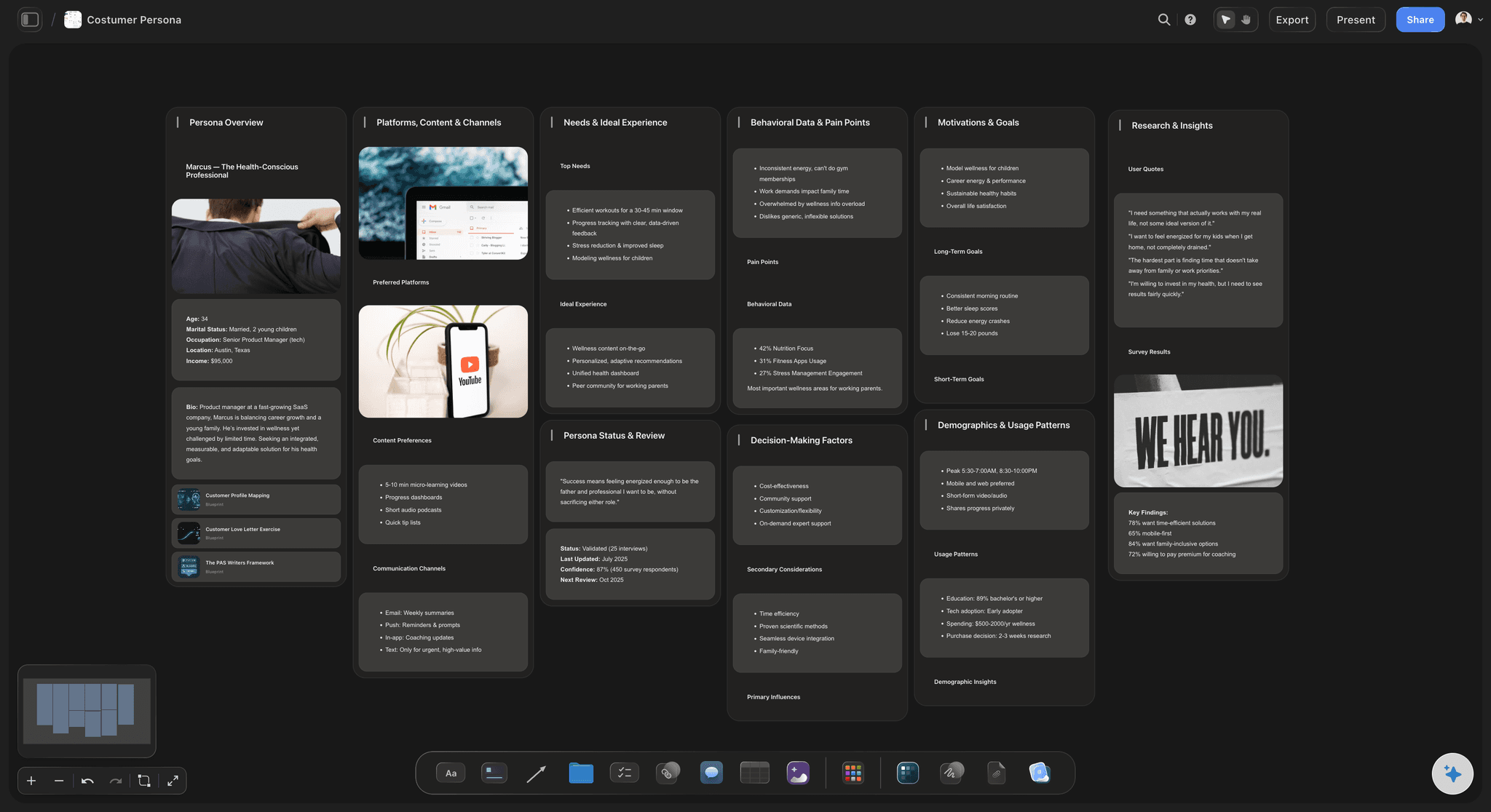
The conclusion is built on the same board as the evidence
Synthesis while the material is still in front of you
Most research is written up days later from memory and a scroll of notes, which is where the nuance dies. Build the emerging structure of your answer on the canvas beside the clusters, so each claim you write stays physically attached to the findings that earned it.
Build a customer persona →Unlimited boards. No object cap.
Open a canvas, drop your sources on it, and start clustering. Storyflow is paid-only during early access, with plans from $9.99 a month, and a Free plan launches before the end of 2026.
Unlimited research boards on an infinite canvas
Basic AI usage to help cluster and structure what you put on the board
3 starter frameworks built in
Share view-only links with your team or client
BUILT FOR SYNTHESIS
The part after the reading.
A notes app can hold forty findings. It cannot show you that eleven of them are saying the same thing and two of them are flatly contradicting each other.
Frame the question, then gather against it
Give the research an end
Write the question and the decision it feeds: Not the topic, the question. Not "research competitors" but "should we price above or below the two tools our buyers already use, and why". A question has an answer, so it can be finished. A topic cannot, which is why topic-shaped research runs until the deadline hits.
Agree what a good enough answer looks like: Decide up front how confident you need to be and what evidence would satisfy you. A pricing decision may need three comparable data points. A strategy bet may need ten interviews. Writing the bar down converts an endless task into a finite one.
Set a stopping rule before you start reading: The practical version is saturation: stop when new sources keep landing in themes you already have and stop introducing anything new. On a canvas that moment is visible, because every fresh card lands in an existing pile rather than starting a new one.
Keep a list of what you deliberately did not look at: Scope you excluded on purpose is not a gap, it is a decision, as long as it is written down. Parking it on the board stops you rediscovering the same rabbit hole three times and gives anyone reading your work an honest picture of its edges.
Capture the claim, not the link
Cards that are still useful in three weeks
Put the claim on the card, not just the URL: A bookmark is a promise to read something later, and later never comes. Write the one sentence the source actually gave you at the moment you read it. If you cannot state the claim in a sentence, you have not finished reading it, and saving the link will not fix that.
Keep the quote, the number, and the date: Capture the exact line or figure you would cite, who said it, and when it was published. Research goes stale silently, and a market number from four years ago looks identical to one from last quarter once it has been retyped into your notes without its date.
Separate what the source says from what you conclude: This is the single most valuable habit in research. Keep the source's claim and your own interpretation visibly distinct on the card, because in a week you will not remember which was which, and inherited assumptions that were never actually evidenced are how confident wrong answers get made.
Note who is speaking and what they want: A vendor's benchmark, an analyst's forecast, and a user's complaint are three different kinds of evidence. Recording the source type beside the claim lets you weight it later, and stops five press releases from feeling like five independent confirmations.
Cluster, then hunt for the disagreements
Make the pattern and the tension visible
Move cards until the themes name themselves: Push each finding towards the findings it resembles and stop when the groups feel stable, then name each one. A theme reached this way survives contact with your evidence, because it came out of the sources instead of out of a heading you wrote before reading them.
Run a deliberate contradiction pass: Once the clusters exist, go looking for conflict on purpose rather than waiting to notice it. Two sources disagreeing usually differ in something specific: the sample, the market, the year, the definition, or the incentive. Write that difference on the connection between them.
Mark confidence, not just conclusions: Some of what you found is well evidenced and some is one person's opinion repeated by three blogs. Labelling each claim as strong, mixed, or thin means the person reading your board, including you next month, can tell which parts are safe to build on.
Leave the open questions on the board: What you could not answer is part of the output. An explicit list of unknowns beside your conclusion is far more useful than a tidy summary that quietly pretends the gaps are not there, and it is the natural brief for the next round of work.
AI that can see the board, and the things it will not do
AI that helps you structure, not gather
It clusters and structures what you put there: Because the AI has your whole canvas as context, you can ask it to group the cards you wrote into candidate themes, to propose a structure for the write-up, or to point at two cards whose claims look like they conflict. It works from your notes, so what you get back is only as good as what you captured.
It does not search the web or fetch sources for you: Storyflow does not run searches, crawl sites, or scrape pages. Finding the sources is your job, and honestly that is the part you should not automate, because reading is where the judgement comes from. Bring what you found and the canvas is where you make sense of it.
It does not automatically read or summarise your PDFs: Attaching a report to a card stores it beside the claim so the original is one click away, but it does not mean the document has been ingested and summarised. Pull out the claim, the number, and the quote yourself, then the AI can work with those.
Re-cluster without losing anything: Drag a card into a different theme and everything on it moves too, including the quote, the source, the confidence label, and the attached file. Trying a completely different structure for your conclusion costs a few drags instead of a rewrite.
Explore templates for your project
Every template opens as a real, editable board on the infinite canvas. Pick the closest fit and make it your own.
Mind Map
Branch one central idea out into themes and sub-points, then drag the connections around until the structure makes sense.
HOW WE COMPARE
Storyflow vs Notion, Obsidian, and Miro.
Each of these owns part of this job properly, and two of them own parts we do not do at all. Here is the honest split.
Storyflow
Recommended
Whole research corpus visible on one infinite canvas
Drag findings into theme clusters spatially
AI that reads your whole board as context
Structured, filterable research database
Local plain-text notes with backlinks on your own disk
Facilitated live workshops with timers and voting
Notion
Whole research corpus visible on one infinite canvas
Drag findings into theme clusters spatially
AI that reads your whole board as context
Structured, filterable research database
Local plain-text notes with backlinks on your own disk
Facilitated live workshops with timers and voting
Obsidian
Whole research corpus visible on one infinite canvas
Drag findings into theme clusters spatially
AI that reads your whole board as context
Structured, filterable research database
Local plain-text notes with backlinks on your own disk
Facilitated live workshops with timers and voting
Miro
Whole research corpus visible on one infinite canvas
Drag findings into theme clusters spatially
AI that reads your whole board as context
Structured, filterable research database
Local plain-text notes with backlinks on your own disk
Facilitated live workshops with timers and voting
What creators are saying
Join early creators getting structured workspaces and AI that remembers their projects
“Storyflow has sped up my workflow by at least 3x, which means more flow state and more projects I can actually ship. It truly changed the way me and my team create.”

Reilin Joey
Director & YouTuber
“One prompt gets me a structured board. But the tactics are my favorite. I run my YouTube scripts through them and my intros and retention got better. It's amazing.”

Justkay
YouTuber & Freelance Filmmaker
“I used to juggle five apps to plan a project. Now I describe what I am making and get boards, lists, and a schedule. All in one place.”

George
@fernwehchronicles
Research canvas questions, answered.
Synthesis, stopping rules, tooling, and what Storyflow honestly does and does not do.
A research canvas is a single infinite surface that holds every source, finding, and conclusion for one question, arranged spatially so the relationships are visible. Sources become cards you can move, related findings cluster into named themes, disagreements between sources appear as lines you draw between cards, and the answer you are forming is built beside the evidence rather than in a separate document. The point is not tidier storage. The point is that comparison, which is the actual work of research, needs everything in one field of view at the same time.
Stop collecting. Start concluding.
Open a canvas, put everything you found on it, and cluster it until the answer is visible. Plans from $9.99/month, no download, and a Free plan is coming before the end of 2026.