The 11 Best Research Canvas Tools in 2026 (We Tested Them All)
An unsourced note is not research. It is a rumour you told yourself. Eleven tools ranked by whether the link back to the source survives all four hops from reading to draft.

Category
Research
Author

Sara de Klein
Head of Product at Storyflow
Topics
2026-08-12
•
18 min read
•
Research- best research canvas tools
- Zotero vs NotebookLM
- research organisation software 2026
- how to keep track of sources
- AI literature review tools
- grounded AI citations
What are the best research canvas tools in 2026?
An unsourced note is not research. It is a rumour you told yourself. Eleven tools ranked by whether the link back to the source survives all four hops from reading to draft.

Full disclosure: Storyflow is our own product and we rank it #4 here, below three tools we do not make, all three of which are free. It serves exactly one of the four hops in the research chain. It has no citation management of any kind: no BibTeX, no citation keys, no bibliography generation, no export in any academic style. It has no PDF library and no document annotation. Its AI reads the current board plus what you @-mention rather than a corpus, so NotebookLM will reason across dozens of uploaded sources with citations where we reason across one canvas. Most importantly for this category, nothing in Storyflow enforces provenance: a note carries its source only if you typed it there, and since the chain breaks precisely at that hop, a tool that leaves it to discipline is not solving the central problem. It is also cloud-only and paid-only during early access, while Zotero and Obsidian keep your data local. We link to every tool so you can judge the fit yourself.
Quick Comparison
These four hold different links in the chain from source to draft: attaching the citation at capture, grounding AI answers in your own sources, turning notes into defensible claims, and seeing what twenty sources actually agree on.
| Tool | Best For | AI Features | Price |
|---|---|---|---|
| Zotero | Source capture, PDFs and bibliographies | None core | Free, open source |
| NotebookLM | Grounded answers cited to your uploads | Strong, source-grounded | Free with a Google account |
| Obsidian | Linked notes that keep their provenance | Via community plugins | Free personal / paid sync |
| Storyflow | Synthesis across a heterogeneous corpus | Reads the whole canvas | $7.99 mo annual (free plan late 2026) |
Key Takeaways
- An unsourced note is not research. It is a rumour you told yourself.
- Research runs a chain from source to highlight to note to claim to draft, and the link back to the source can break at any of the four hops. Where it breaks decides whether your work is defensible.
- The break is almost always at hop three, when a note gets rewritten in your own words and quietly loses its citation. Six weeks later you cannot tell what you read from what you concluded.
- Zotero ranks first because it is free, open source, and keeps the chain intact more reliably than anything else. NotebookLM ranks second for grounding AI answers in your own sources.
- Storyflow is our own product and it ranks fourth. It has no citation management, no PDF library, and no bibliography export.
Find out what twenty sources actually agree on
Synthesis is the least tool-supported step in research: notes have to leave their sources and sit next to each other before a claim appears. Storyflow's AI reads the whole canvas, so you can ask where findings conflict and which notes are the same point in different vocabulary. It manages no citations and holds no PDFs, so keep Zotero. Paid-only during early access; the Free plan lands before the end of 2026.

The Provenance Chain
Research is not reading. It is maintaining a chain, and the chain has four hops where it can break.
Source to highlight. You read something and mark a passage. Cheap and reliable when the tool captures the source metadata automatically, and fragile when you screenshot a page or paste text into a note. A highlight with no source attached is already broken and it happens on day one.
Highlight to note. You rewrite the passage in your own words, which is the step that produces actual understanding. It is also where the citation most often disappears, because the note now reads as your thought rather than someone's finding. This is the most consequential break in research and it feels like progress while it happens.
Note to claim. Several notes combine into an assertion you believe. This is synthesis, it is the valuable part, and by definition it is one step further from every source. If the notes underneath carried citations, the claim inherits them. If they did not, the claim is now unsupported and you may not notice for weeks.
Claim to draft. You write the piece. Anything whose provenance was lost earlier now appears as a confident sentence with nothing behind it, and you either drop it, spend an hour trying to re-find where it came from, or ship it and hope.
An unsourced note is not research. It is a rumour you told yourself.
The uncomfortable part is that hop three failures are invisible in the moment. Nothing warns you. The note looks like a good note. You only discover the break at the draft stage, when the cost of repair is highest and the deadline is closest, and by then re-finding a source you read six weeks ago in a paper you cannot name is genuinely hard.
So the ranking below is ordered by one thing: how well a tool keeps the link back to the source alive through all four hops without requiring you to remember to maintain it.
At a Glance: The 11 Tools Compared
| Tool | Where it holds the chain | Handles synthesis | Price |
|---|---|---|---|
Zotero | Source to highlight, and the bibliography | No | Free, open source |
NotebookLM | Answers cited back to your own sources | Partly, grounded summaries | Free with a Google account |
Obsidian | Note to claim, via links | Partly, by connection | Free personal / paid sync |
Storyflow | Claim formation across sources | Yes, on a canvas | $7.99 mo annual (free plan late 2026) |
Readwise | Highlight capture and resurfacing | No | From ~$8 mo |
Elicit | Finding and extracting from papers | Partly, structured extraction | Free tier / paid above |
Notion | Structured source database | No | Free tier / from ~$10 mo annual |
Connected Papers | Discovery of adjacent literature | No | Free tier / paid above |
Paperpile | References, inside Google Docs | No | From ~$3 mo |
Scrivener | Draft with research alongside | No | One-time, around $60 |
A source log | Every hop, manually | No | Free |
Prices are the publicly listed rates at the time of writing and change often. Check before committing.
How I Ranked These
Six of these (Zotero, Obsidian, Notion, Scrivener, a source log, Storyflow) I have used on real research-led work, including a documentary project where a broken chain cost a genuinely painful week. NotebookLM, Readwise, Elicit, Connected Papers, and Paperpile I evaluated hands-on against the same criteria, and where a claim rests on published documentation rather than my own use, the review says so.
Five criteria, in this order:
- Chain integrity. Does the link back to the source survive without you maintaining it deliberately. Weighted highest because it is the failure that is invisible until it is expensive.
- Synthesis support. Whether the tool helps turn many sources into a claim, which is the actual work and the least-served need in the category.
- Retrieval at volume. Two hundred sources behaves differently from twenty, and most tools are evaluated at twenty.
- Export and ownership. Research projects outlast tools, and a corpus you cannot get out of a product is a bet on that company.
- Honest cost for the volume you actually work at. Academic and journalistic workloads differ by an order of magnitude.
Deliberately not weighted: AI summarisation quality in the abstract. An ungrounded summary is a provenance break with better prose, which the next section covers.
AI and the Grounding Problem
This is the part that has changed most since 2024, and it cuts both ways.
Ask a general assistant to summarise a field and you get a fluent, plausible, well-organised answer with no chain at all. Every sentence is a claim whose source is either unstated, approximate, or invented. That is not a marginal risk in research work, it is the provenance break automated and delivered at speed, and the output is more convincing than a broken note you made yourself, which makes it worse.
The specific failure to watch for is subtle: an assistant will produce a claim that is broadly true, attributed to a real author who did not say it in that form. It survives a casual sanity check and fails a real one.
The useful development is grounded AI, where the model answers only from sources you supplied and every statement carries a link back to the passage it came from. NotebookLM is the clearest implementation of this and it is why it ranks second here. The chain is not merely preserved, it is enforced by the interface: you click the citation and land on the paragraph.
Two working rules follow.
Use general assistants for orientation, never for citation. They are genuinely good at telling you what a field's main debates are called so you know what to search for. Anything you would put in a draft has to be traced to a source you have actually read.
Prefer tools that cite your corpus over tools that cite the internet. A summary grounded in the forty papers you selected is a research artifact. A summary grounded in everything is a starting point at best.
The tools below are ranked partly on which side of that line they sit.
Quick Picks by Situation
- Best overall research tool: Zotero, free, and the chain's foundation.
- Best grounded AI: NotebookLM, free, and every answer links back to your own sources.
- Best for notes that become claims: Obsidian, local and permanent.
- Best for synthesis across sources: Storyflow, our own product, ranked fourth and not a reference manager.
- Best highlight capture: Readwise, particularly across books, articles, and Kindle.
- Best for literature review: Elicit, for finding and extracting from papers at scale.
- Best for discovery: Connected Papers, for seeing the shape of a field quickly.
- Best free stack: Zotero plus NotebookLM plus Obsidian, which costs nothing and covers the whole chain.
1. Zotero
Zotero ranks first because it solves the first and most load-bearing hop better than anything else, and it is free and open source.
The browser connector captures a source with its full metadata in one click, from a journal, a news site, a book listing, or a PDF. That single behaviour prevents most chain breaks before they start, because the citation is attached from the beginning rather than reconstructed later. PDFs are stored, annotated in-app, and the annotations stay bound to the document and its metadata.
At the other end, it generates bibliographies in any style and plugs into Word, LibreOffice, and Google Docs, so the chain terminates properly in the finished piece. Group libraries let a team share a corpus, which is rare at this price.
The price is the other argument. It is free, open source, and run by a non-profit, and your library is a local SQLite database you can take anywhere. For a research project spanning years, that ownership position is worth more than most feature comparisons acknowledge.
Against it: it does not help you think. There is no synthesis layer, the notes feature is basic, and the interface is functional rather than pleasant. It manages sources and it does not turn them into claims, which is why it needs a partner from further down this list.
Pricing: Free, with paid storage tiers for syncing large PDF libraries.
2. NotebookLM
NotebookLM ranks second because it is the clearest answer to the grounding problem, and it costs nothing.
You upload your sources (PDFs, documents, pasted text, links) and ask questions. Every answer carries inline citations pointing at the specific passage it came from, and clicking one takes you there. That inversion matters: instead of an AI producing claims you must verify, you get claims already attached to their evidence, in your own corpus.
For the synthesis hop it is genuinely useful in a way general assistants are not. Asking what forty sources disagree about, or which ones support a particular position, produces a real answer with a trail you can follow.
Against it: it is a reading and questioning tool rather than a library, so it does not manage references, generate bibliographies, or replace Zotero. Source limits per notebook constrain very large corpora. It is a Google product, which is an availability and longevity consideration for a multi-year project, and the material lives in their cloud.
Pair it with Zotero: Zotero holds and cites the library, NotebookLM interrogates a working subset of it.
I evaluated this hands-on against these criteria rather than across a completed long project.
Pricing: Free with a Google account, with paid tiers for higher limits.
3. Obsidian
Obsidian ranks third because hop three, note to claim, is where research is won or lost, and a linked note vault is the strongest structure for it.
The practice that works is one note per idea, each linking back to a source note that holds the citation. Written that way, the chain survives rewriting: your note is in your words and one click from the thing it came from. Backlinks then do the synthesis work, surfacing that six notes from different sources all point at the same underlying claim, which is frequently the argument you did not know you had.
The Zotero integration plugins make this a genuinely strong pairing, pulling citation keys into notes so the bibliography is generated from the writing.
It is local markdown, free for personal use, and it will open in twenty years, which for a doctoral or book-length project is the strongest ownership position available.
Against it: the discipline is real, and a vault where you did not link back to sources is exactly as broken as any other unsourced pile. Setup and plugin configuration take time. Visual and spatial synthesis is weak, and images are second-class.
Pricing: Free for personal use. Paid sync and publish add-ons.
4. Storyflow
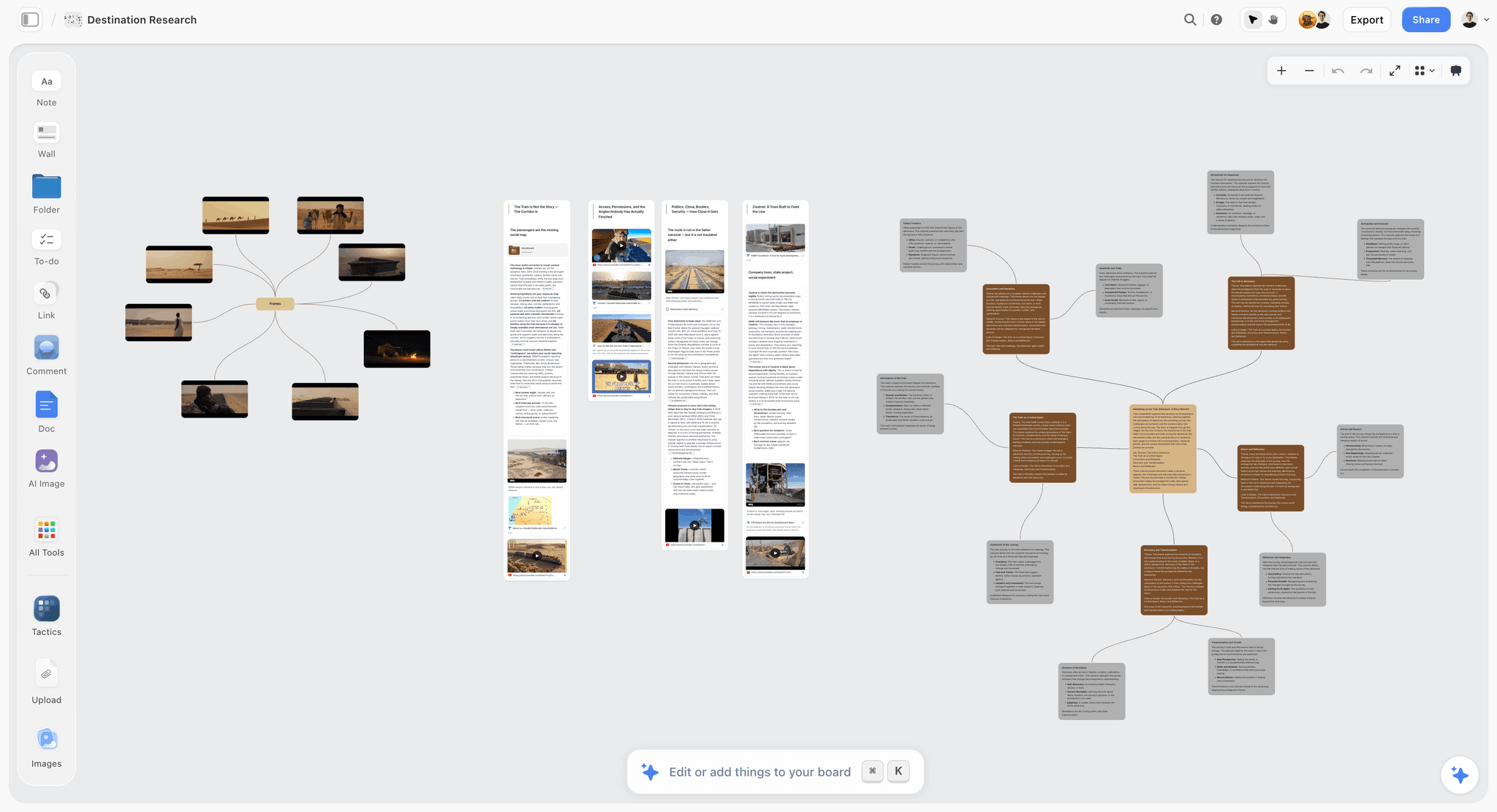
Storyflow is our own product and it ranks fourth, behind three tools we do not make, because it serves exactly one hop of the four.
It is not a reference manager and should not be bought as one. It has no citation management: no BibTeX, no citation keys, no bibliography generation, no export in any academic style. It has no PDF library and no document annotation. It does not capture sources, and nothing in it enforces that a note carries its provenance. On the first hop and the last, Zotero and Paperpile do work it does not attempt.
What it does is the third hop, where notes become claims, and specifically the visual version of that. A canvas holding notes from twenty sources, arranged spatially, with an AI that reads the whole board, makes the synthesis question askable: what do these sources actually agree on, where do they conflict, which of these notes are making the same point in different vocabulary. That last one is the most useful, because duplicate findings from different sources look different until you put them side by side, and mistaking two reports of one study for two studies is a real research error.
For documentary and journalistic work in particular, where sources are interviews, images, documents, and locations rather than papers, the canvas holds a heterogeneous corpus that a reference manager handles awkwardly. You can @-mention up to one Tactic and up to three documents in the AI chat.
The honest configuration is Zotero for the library, NotebookLM or Obsidian for reading and note-making, and Storyflow for the stage where a pile of notes has to become an argument.
Where Storyflow loses
Beyond the missing reference-management capability above, three limits matter for research specifically.
Its AI reads the current board plus what you @-mention, not a corpus. NotebookLM will reason across dozens of uploaded sources with citations; this reasons across one canvas. For a literature review at scale, that is the wrong shape.
Nothing enforces provenance. A note on a canvas carries its source only if you typed it there. Given that hop three is where chains break, a tool that leaves it to discipline is not solving the category's central problem.
It is cloud-only and paid-only during early access, with the Free plan arriving before the end of 2026, while Zotero, NotebookLM, and Obsidian are all free and two of them keep your data local.
Pricing: Plus $7.99/mo annual ($9.99 monthly). Pro $14/mo annual ($19 monthly) adds AI image generation, roughly 20 times the AI volume, and memory across conversations. Max $39/mo annual ($49 monthly) adds roughly 40 times the AI volume plus a team workspace with roles and permissions.
5. Readwise
Readwise owns the second hop across the widest range of material, which is its real value.
It pulls highlights from Kindle, articles, PDFs, Twitter, podcasts, and more into one place with the source attached automatically. For anyone whose research is partly books and partly the open web, this closes a gap Zotero handles less gracefully, since Zotero is strongest with formal publications.
The daily resurfacing feature is more useful for research than it first appears: seeing a highlight from four months ago while working on something new is where a surprising number of connections come from.
Its Reader app and Obsidian sync make it a clean feeder into a note vault, which is the pairing that makes it worth the money.
Against it: it captures and resurfaces, and it does nothing for synthesis or citation formatting. It is subscription-only with no free tier beyond a trial, and its value scales with how much you read outside academic publishing.
Pricing: From around $8/month.
6. Elicit
Elicit is built for literature review, and for that specific job it does something no general tool does.
Ask a research question and it surfaces relevant papers, then extracts structured data across them: methods, sample sizes, outcomes, limitations, laid out in a table you can scan. Turning forty papers into a comparable grid is genuinely hours of work, and it grounds its extractions in the papers rather than generating from general knowledge.
For anyone doing systematic review or trying to establish what a body of evidence actually says, this is a serious tool.
Against it: it is oriented toward academic literature, particularly empirical work, so it is a poor fit for humanities, journalism, or documentary research where sources are not papers. Extraction is a starting point and needs verification. It does not manage a library or format citations.
I evaluated this hands-on against these criteria rather than across a full systematic review.
Pricing: Free tier with paid plans above.
7. Notion
Notion's contribution is a structured source database, which handles the chain adequately if you maintain it.
A table with one row per source, holding the citation, the link, your summary, the claims it supports, and a status, is a workable research spine. Relations connecting sources to claims make the chain queryable in a way a note vault does not: you can ask which sources support a given assertion and get a list.
For collaborative research where several people gather sources, permissions and shared views are better than Zotero's group libraries in day-to-day use.
Against it: every field is manual, so the tagging tax is the highest here, and an unmaintained research database is a chain that looks intact and is not. It has no citation formatting, no PDF annotation, and no grounded AI over your corpus. It is a coordination layer, not a research tool.
Pricing: Free tier. Paid from around $10/month annual.
8. Connected Papers
Connected Papers solves a problem upstream of the chain: knowing what you should be reading.
Give it one paper and it builds a visual graph of related work based on citation similarity, showing the clusters in a field, the foundational work, and the recent derivatives. For entering an unfamiliar area it compresses days of citation-chasing into an afternoon, and it makes the shape of a literature visible in a way a list of search results does not.
It is free for limited use and integrates with reference managers.
It is a discovery instrument only. It stores nothing, manages nothing, and synthesises nothing. Semantic Scholar and Research Rabbit occupy similar ground and are worth comparing.
Pricing: Free tier with paid plans for heavier use.
9. Paperpile
Paperpile is the reference manager for people who live in Google Docs, and that integration is the whole argument.
Citations insert cleanly, the bibliography updates itself, and the library lives in Google Drive alongside everything else. For collaborative writing in Docs, it is smoother than Zotero's Google Docs support, and the interface is more modern.
It is a paid subscription where Zotero is free, and it is a commercial product where Zotero is a non-profit with local data, which is a real consideration on a decade-long corpus. Choose it if your writing happens in Docs with collaborators and the friction saving is worth the trade.
I evaluated this hands-on rather than across a long project.
Pricing: From around $3/month.
10. Scrivener
Scrivener earns a place at the last hop, where research becomes a draft, because it is the only tool here that holds both in one file.
The research folder sits beside the manuscript, split view puts a source next to the paragraph it supports, and for book-length work that adjacency genuinely reduces the number of times a claim gets written without its evidence in view. It works offline, it is a one-time purchase, and the file is yours.
It does no reference management, no citation formatting, and no discovery. Its research folder holds material without understanding it. Use it as the destination, with Zotero handling citations at the end.
Pricing: One-time, around $60.
11. A Source Log
The eleventh entry is a habit and it is the cheapest insurance in research.
One line per source, added the moment you use it: what it is, where you found it, the date, and the specific claim you took from it. In any document, in any tool.
It works because it attacks hop three directly. The moment you write a note in your own words is the moment the citation is most likely to vanish, and a log entry written in the same minute preserves it. It costs about fifteen seconds and it is the difference between a draft you can defend and one you cannot.
It also does something no software does: it records why you took the claim, which is frequently more useful than the claim itself when you return months later and cannot remember what you were looking for.
It ranks last because it is a practice rather than a product, and practices get skipped. Nearly every tool above is a mechanism for making this happen automatically.
Pricing: Free.
What to Actually Pay For
Start with the free stack. Zotero, NotebookLM, and Obsidian cost nothing and cover capture, grounded reading, and note-to-claim. A large share of research work needs nothing beyond this.
Pay for capture breadth if you read widely outside journals. Readwise earns its subscription when your sources are books, newsletters, and articles rather than papers.
Pay for extraction if you do systematic review. Elicit saves real hours on structured comparison across many papers, and nothing free replicates it.
Do not pay for ungrounded AI summarisation. A fluent summary with no traceable source is a liability dressed as a shortcut.
Weigh ownership on a multi-year corpus. Zotero and Obsidian keep your data local. Cloud-only tools, including ours, are a dependency worth naming before you commit five years of reading to them.
Tools to Avoid for This Job
A general assistant used as a source. It will produce claims that are broadly true and attributed to people who did not say them, which survives a casual check and fails a real one.
Screenshots as notes. No metadata, no searchable text, no link back. The chain is broken at the first hop and nothing downstream can repair it.
A highlight pile with no notes. Highlighting feels like research and defers the understanding step indefinitely. A thousand highlights you have not rewritten is a thousand things you have not learned.
Any workflow where the citation is added at the end. Reconstructing provenance at draft stage is the single most expensive way to work, and it is what everything above exists to prevent.
What No Tool on This List Does
None of them tell you the source is weak. Zotero will cite a press release as happily as a meta-analysis, and NotebookLM will ground an answer in whatever you uploaded, including something bad. Evaluating source quality is judgment, and it is the part that actually separates good research from thorough research.
None of them do synthesis for you. Storyflow gets closest by reading a board and proposing what a set of notes shares, and it is a first draft of a thought rather than a conclusion. The claim you are willing to defend remains yours to form.
None of them catch the same finding counted twice. Three papers citing one original study look like three sources of support. That error is common, consequential, and invisible to every tool here unless you trace each one back yourself.
The Bottom Line
Research tools are compared on capture: how easily you can save a paper, clip an article, or highlight a passage. Capture is solved and mostly free.
What decides whether research holds up is the chain from a sentence in your draft back to the thing you actually read, and that chain breaks at a predictable place. It breaks when you rewrite a passage in your own words and the note stops carrying its origin, which feels like understanding and produces an orphaned claim you will meet again at deadline.
Zotero ranks first because it attaches the citation at the start and generates the bibliography at the end, and it is free. NotebookLM ranks second because grounding AI answers in your own corpus is the most useful thing to happen to research tooling in years, and it is also free. Obsidian holds the hop where notes become claims. Storyflow, which we make, ranks fourth, has no citation management at all, and earns its place only at the synthesis stage.
Then do the fifteen-second thing, every time. An unsourced note is not research. It is a rumour you told yourself.
FAQ: Research Canvas Tools
What are the best research canvas tools in 2026?
Zotero for holding sources and citations, free and open source. NotebookLM for asking questions of your own corpus with every answer linked to its passage. Obsidian for turning notes into claims. Storyflow, which is our own product, ranked fourth, for the visual synthesis stage. Most working setups combine three of these.
What is a research canvas?
A surface where sources, notes, and emerging claims sit together so connections between them become visible. It is distinct from a reference manager, which stores and cites sources, and from a note vault, which holds your writing about them. The canvas is where a pile of reading becomes an argument.
What is the best free research tool?
Zotero, NotebookLM, and Obsidian together, which cost nothing and cover source capture, grounded questioning, and note-making. That stack handles a surprising proportion of serious research work. Storyflow is paid-only during early access, so it does not belong in a free comparison.
How do you keep track of sources while researching?
Attach the citation at the moment of capture rather than at the end. A reference manager with a browser connector does this automatically, and a one-line source log does it manually. The break happens when you rewrite a passage in your own words and the note stops carrying its origin.
Can AI do literature review?
It can accelerate parts of it. Elicit extracts structured data across many papers, and NotebookLM answers questions from sources you supplied with citations attached. What it cannot do is judge source quality or notice that three papers are reporting the same underlying study, which are the errors that matter most.
Is Storyflow good for research?
For the synthesis stage, yes, and that is why we rank it fourth. Its AI reads a whole canvas, so you can ask what twenty sources agree on and which notes are duplicates in different vocabulary. It has no citation management, no PDF library, no bibliography export, and nothing enforcing that a note carries its source, so it belongs alongside Zotero rather than instead of it.
Zotero or Mendeley or Paperpile?
Zotero for most people: free, open source, local data, and a non-profit behind it. Paperpile if your writing happens in Google Docs with collaborators and the smoother integration justifies a subscription. Mendeley is capable and owned by a large publisher, which some researchers weigh as a consideration.
How do you avoid AI hallucinated citations?
Only cite sources you have opened and read. Use grounded tools where every claim links to a passage in your own corpus, and treat general assistants as orientation rather than evidence. The dangerous failure is not an obviously fake reference; it is a real author credited with something they did not say.
How do you synthesise research into an argument?
Get the notes out of their sources and next to each other, then look for what they share and where they conflict. This is the step that turns reading into a claim, and it is the least tool-supported part of the process. A canvas helps because conflicting findings placed side by side make the conflict visible.
What is the difference between a note and a highlight?
A highlight is somebody else's sentence you marked. A note is your restatement of what it means, and only the second one indicates understanding. A library of highlights with no notes is deferred work, and the deferral is usually permanent.
How much research is enough?
When new sources stop changing your claims. If the last ten things you read confirmed what you already had, you are past the point of return, and continuing is usually avoidance of the writing rather than diligence.
What is the single change worth making to how I research?
Write the source into the note at the moment you write the note. Not later, not at the draft stage. It costs fifteen seconds and it prevents the one failure that is invisible until it is expensive.
Table of Contents
- Key Takeaways
- The Provenance Chain
- At a Glance: The 11 Tools Compared
- How I Ranked These
- AI and the Grounding Problem
- Quick Picks by Situation
- 1. Zotero
- 2. NotebookLM
- 3. Obsidian
- 4. Storyflow
- 5. Readwise
- 6. Elicit
- 7. Notion
- 8. Connected Papers
- 9. Paperpile
- 10. Scrivener
- 11. A Source Log
- What to Actually Pay For
- Tools to Avoid for This Job
- What No Tool on This List Does
- The Bottom Line
- FAQ: Research Canvas Tools
- Related Reading
Templates to check out for this topic


Research templates you can use in Storyflow
Gather sources, personas, and findings on one canvas, then let the AI read across all of it. Open any of these research boards to start.


See Storyflow in Action
A visual AI workspace where every feature lives inside one canvas. No tab-switching, no context lost.
Build your entire board from a single message
Type what you need in the AI chat at the bottom of your canvas. The AI adds cards, headings, and structure directly onto your board.
Use expert frameworks as AI context
Type @ in the AI chat and choose any Tactic. The AI tailors every response to that framework instead of giving generic advice.
Turn your board into a mind map in seconds
Ask the AI to restructure your canvas as a mindmap. It connects your ideas into a visual hierarchy so you can see how everything relates.
Why Storyflow Exists
Storyflow actually began as a personal tool while working on creative and research projects.
We kept running into the same problem: ideas were scattered everywhere: notes, documents, and whiteboards.
Nothing helped us see how everything connected.
So we started building a workspace designed around how ideas actually grow.
→ Read how Storyflow was createdSara de Klein
Head of Product at Storyflow
Published: 2026-08-12
Extremely simple, seriously capable


See how easy it is to get started
Watch a real project come together, from a blank board to a finished plan, clicked through step by step.
Start creating with AI and become more productive
Transform your creative workflow with AI-powered tools. Generate ideas, create content, and boost your productivity in minutes instead of hours.