
PRODUCTION BOOK
One book the whole crew
can actually open.
A production book is the single assembled reference for a production, the thing you hand a new crew member so they can catch up in twenty minutes. Storyflow puts the script, the breakdown, the boards, the schedule, the look book, and the contact list on one canvas, shareable by link, instead of a folder of PDFs nobody trusts. Paid-only during early access, plans from $9.99 a month, and a Free plan launches before the end of 2026.
Plans from $9.99/mo
Share by link with the whole crew
Works in your browser

Used by creative professionals at:
Artlist
Pixar
Nike
Red Bull
The North Face
Porsche
Start from a ready-made template
Pick a board to see what you can build, then let AI fill it in. Every template is a real, editable starting point on the same infinite canvas.
Pre-Production
Pull the brief, script, shot list, and moodboard into one pre-production hub so the whole shoot is planned in one place.
What is a production book?
A production book, often called a production bible, is the single assembled reference for a production: every document, board, list, and image a crew needs, gathered in one place and kept current. The practical test is simple. A new crew member joins on Thursday for a Monday shoot. You hand them the production book. If they can read it and turn up knowing the story, the look, the schedule, the locations, and who to call, the book is doing its job. If they have to ask three people which file is the real one, you do not have a production book. You have a folder.
Almost everyone already has all the pieces. The script exists. Someone did the breakdown. There is a schedule in a spreadsheet, a look book in a slide deck, a shot list in a doc, a contact sheet somebody typed up, and a location scout's photos in a phone album. The production book is not those artefacts. It is the act of assembling them into one reference where they sit in relation to each other, so the schedule is next to the breakdown that produced it and the look book is next to the shot list it is meant to inform.
Which is why the failure mode is so consistent. The production book lives in a shared drive folder, the script version in it is three revisions old, and the only person who knows which file is current is the one person who is not on set. Nobody meant for that to happen. It happens because a folder has no opinion about what belongs together or what is current, so the book decays quietly between the moment it was assembled and the moment someone actually needs it. This is an assembly and currency problem, not a storage problem, and buying more storage has never once fixed it.
A working production book pulls together six or seven named parts: the script and its revisions, the breakdown of every scene into its elements, the shot lists and storyboards, the schedule with the call sheets that come out of it, the cast and crew contact list, the locations with their photos and permits, the look book and visual references, the budget top sheet, and the continuity notes that accumulate once you are shooting. Some productions add a props and wardrobe inventory, a sound plan, or a music list. The number of parts matters far less than whether they live in one place and whether the version in that place is the one the crew is working from.
HOW IT WORKS
Assemble the book on a canvas, then share the link.
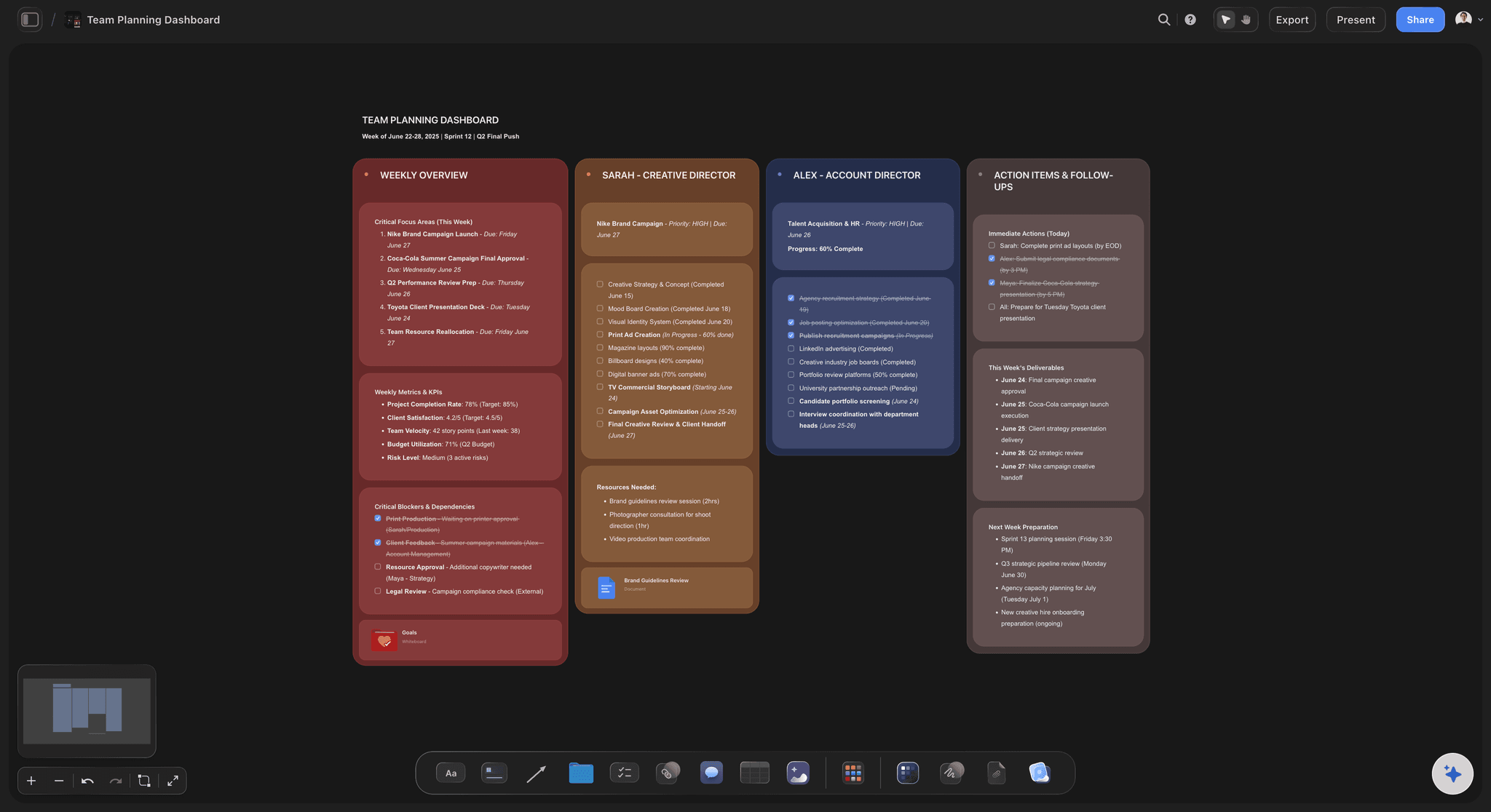
Everything the crew needs in one view, arranged so the relationships between documents are visible instead of implied by folder names.
01
Open a board for the production
One infinite canvas per production, from $9.99 a month. Nothing to install and no folder structure to invent. The board becomes the book, and it starts empty rather than starting as somebody else's template.
02
Bring in what already exists
Drag in the script PDF, the breakdown, the schedule, the location photos, the look book images, and the contact list. Existing documents keep working. They just stop being scattered across a drive, a thread, and three inboxes.
03
Arrange it so the relationships show
Put the breakdown beside the scene it covers, the location photos beside the days they shoot, and the references beside the shot list. Spatial arrangement carries meaning that a file name never will.
04
Share one link with the crew
Send a view-only link and anyone opens the whole book in a browser with no account. There is one address for the production book, so nobody is guessing whether their copy is the current one.
The assembly problem, not the storage problem.
Storage was solved a decade ago. What is still broken is assembling the pieces into one current, readable reference.
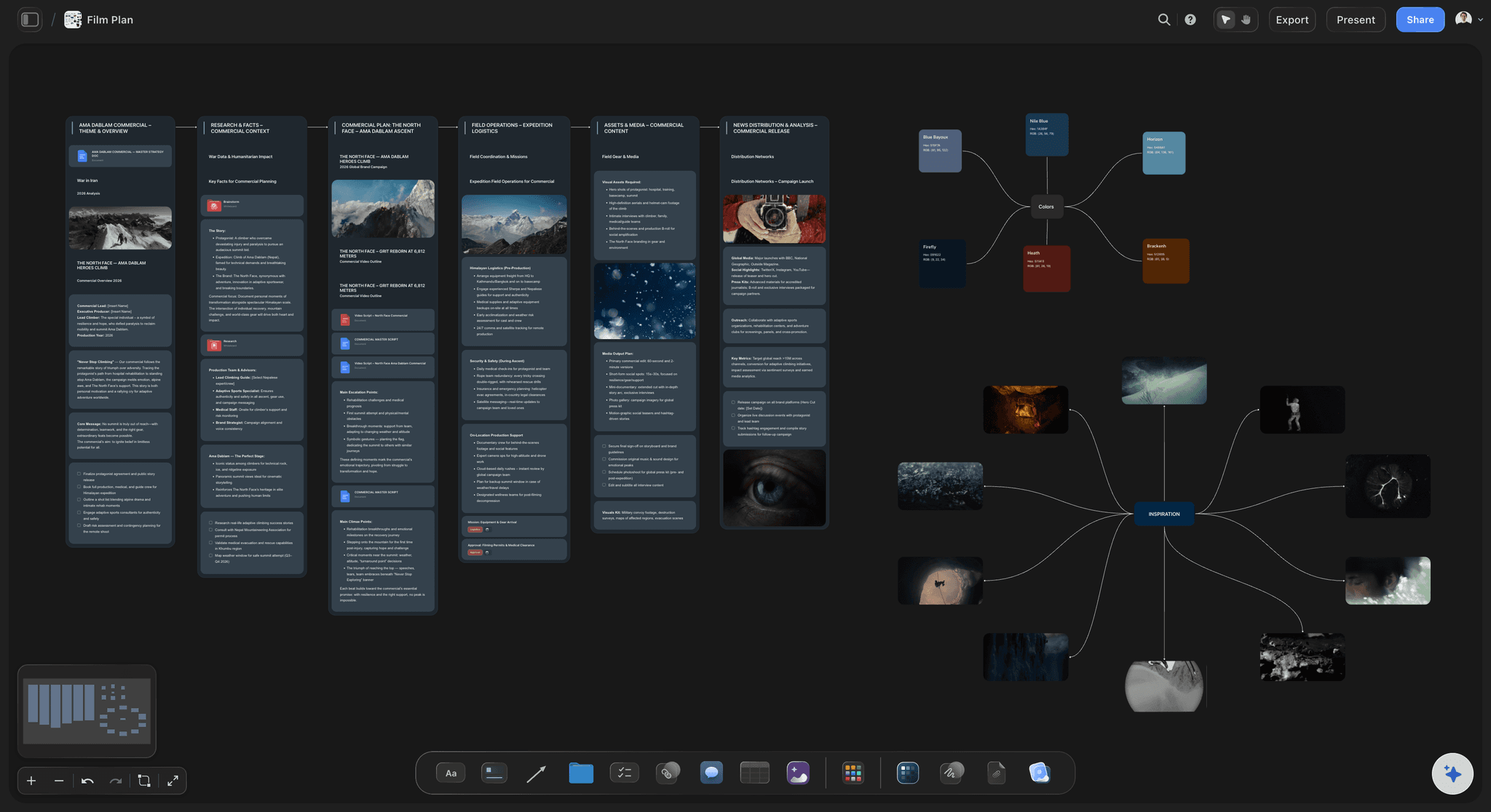
Every department's document on one surface
The whole book in a single view
Script, breakdown, schedule, boards, contacts, and references laid out side by side on an infinite canvas. Scrolling one board is a fundamentally different experience from opening eleven files to work out what changed, and it is the difference between a book people read and a book people ignore.
See film production planning →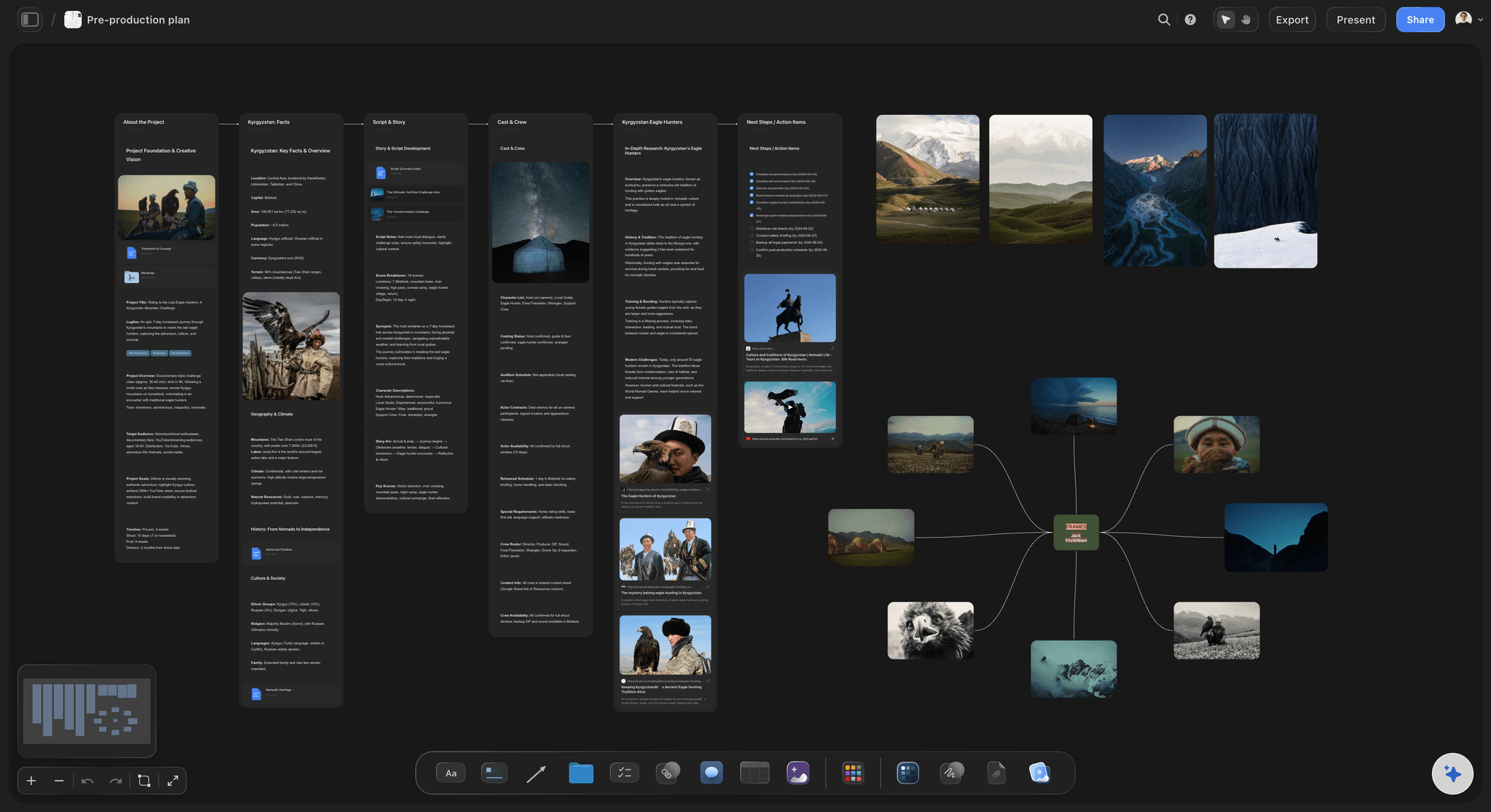
One address instead of eleven files
Everyone reads the same board
A shared link points at the live board, so when the book changes, the link still points at the current version. That removes the specific failure where three people are working from three downloaded copies and only one of them is right.
Explore the pre-production checklist →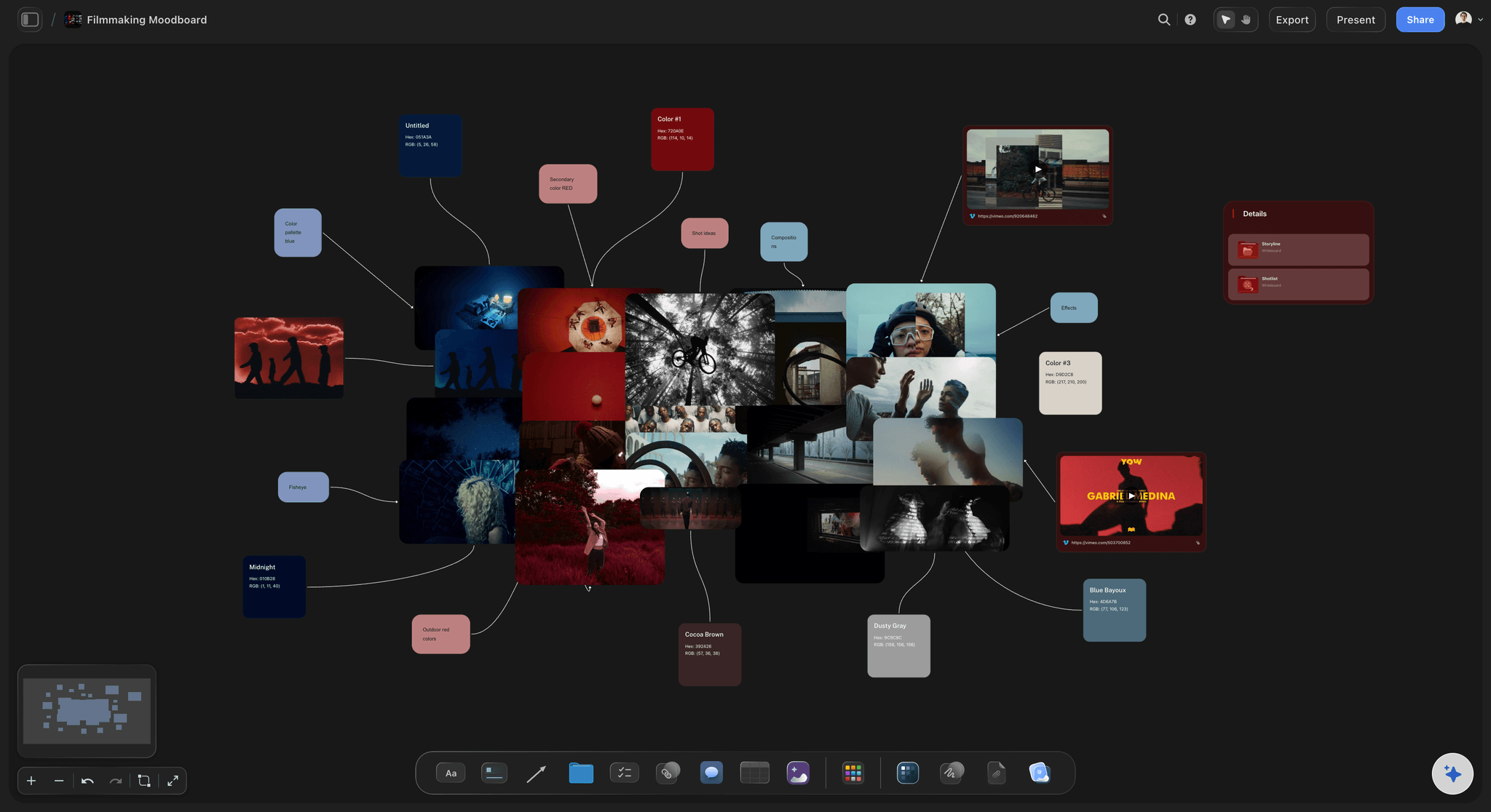
Visual departments get a visual surface
The look book sits beside the shot list
References, location photos, frame grabs, and wardrobe images live on the same board as the lists they inform. A camera team reading the shot list can see the reference for the shot without opening a second tool or asking someone to resend a deck.
Build a film look book →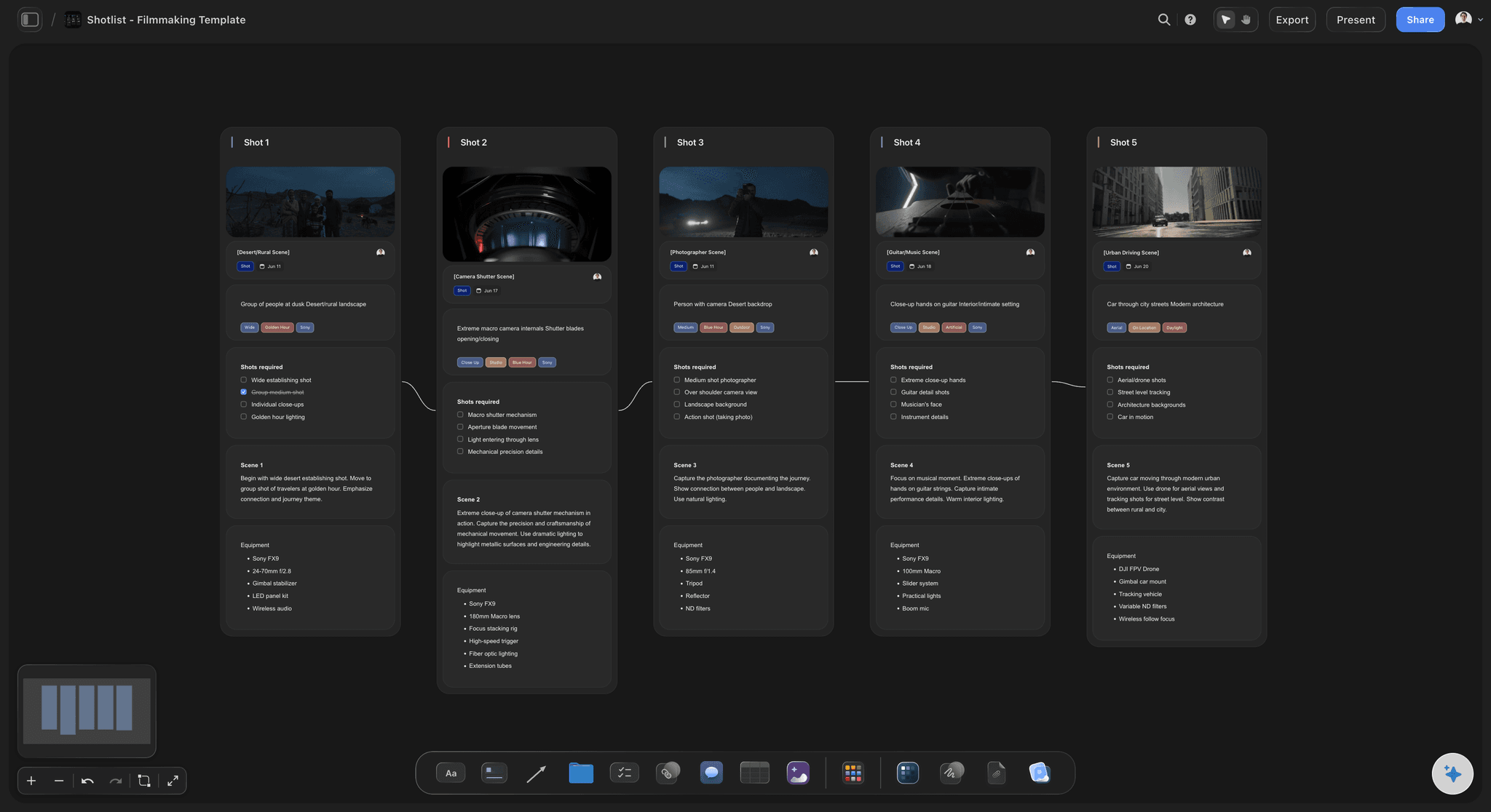
AI that can read the board you built
Find the gaps before the crew does
Describe the production and the AI lays out a starting structure for the book. Because it reads the whole canvas as context, you can ask what a production book for a three-day shoot is still missing and get an answer about your board rather than a generic checklist.
See script breakdown software →Unlimited boards. Invite the whole crew.
Storyflow is paid-only during early access, with plans from $9.99 a month, and a Free plan launches before the end of 2026. Anyone a paid member invites to a board joins free today, which means one paid producer can bring the entire crew onto the production book at no extra cost.
Unlimited production boards on an infinite canvas
Script, breakdown, schedule, and references on one surface
View-only links for crew, clients, and department heads
Guests invited by a paid member join free today
BUILT FOR ASSEMBLY AND CURRENCY
A book the crew trusts, because there is only one of it.
The value of a production book is not that the documents exist. It is that they are gathered, related, and current.
Script, breakdown, boards, schedule, contacts, locations
Gather every part of the book in one place
Documents live on the board, not beside it: Pin the script PDF, the breakdown, the schedule, and the contact list directly onto the canvas. They are objects in the book rather than links in a doc that half the crew will find expired.
Photos and permits with the location: Location scout photos, access notes, parking, and the permit paperwork sit together as one block, so the answer to where are we shooting Tuesday is a single glance rather than a message thread.
Lists that stay next to what they describe: Cast, crew, props, and equipment lists sit beside the days and scenes they belong to. A list in isolation is a document. A list in position is part of a book.
Continuity notes added while shooting: Once you are on the floor, notes and reference stills go straight onto the same board, so the book keeps growing through production instead of being frozen at the last pre-production meeting.
One live board instead of downloaded copies
Solve the currency problem, not the storage problem
The link always points at the current board: Nobody downloads a snapshot that quietly goes stale. The crew opens a link, sees the board as it is now, and stops asking whether their copy is the latest one.
One place to update means one place to check: When the schedule shifts, you change it on the board and everyone who opens the link sees the change. The old version does not survive in four inboxes waiting to be acted on by mistake.
Say plainly what is not current: Mark superseded material on the board itself, in the position where people will actually look, rather than relying on a file name convention that survives about a week into a production.
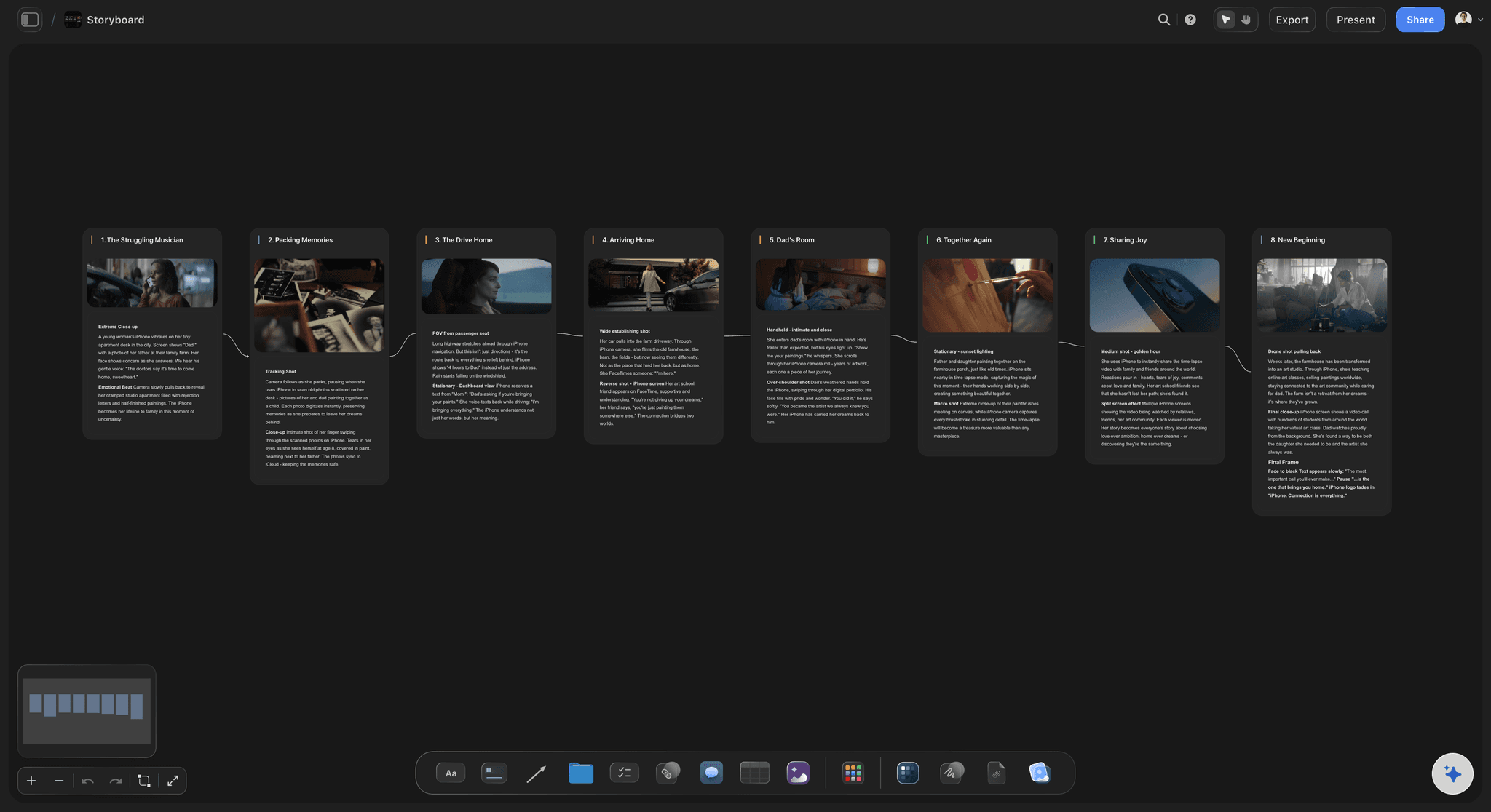
The visual half of the book
Boards, references, and the look in the same view
Storyboards beside the scenes they cover: Panels sit next to the scene in the breakdown, so a director and a DP can walk the day visually rather than cross-referencing a PDF against a spreadsheet.
Look book that departments can read: Colour, lighting, wardrobe, and production design references arranged as a wall rather than a deck. Twelve images side by side communicate a direction that a paragraph of description never manages.
Frame grabs straight from video: Pull frames from YouTube or Vimeo onto the board when the reference is a moment in a film rather than a still, which is most of the time in practice.
Everyone who needs the book can open it
Share with a crew that will never install anything
View-only links, no account required: Send one link and a runner, a gaffer, a client, or a location owner opens the whole book in a browser. No download, no login, no request-access screen at seven in the morning.
Invited crew join free: Anyone a paid member invites to a board joins free today, so bringing the full crew into the production book is not a per-head budget conversation.
Export when someone needs paper: Export the board as a high-quality image or PDF for a client review, a financier update, or the one department head who genuinely wants it printed.
One book per production, kept after wrap: The board stays as the record of how the production was planned, which is useful for the next job in a way that a folder of unnamed PDFs never is.
Explore templates for your project
Every template opens as a real, editable board on the infinite canvas. Pick the closest fit and make it your own.
Pre-Production
Pull the brief, script, shot list, and moodboard into one pre-production hub so the whole shoot is planned in one place.
HOW WE COMPARE
Storyflow vs StudioBinder, Milanote, and Google Drive.
Storyflow is a canvas for assembling the book. It is not a document management system, and the rows below say so plainly.
Storyflow
Recommended
Whole book assembled on one visual canvas
Call sheet generation and crew distribution
Script revisions, version control, and audit trail
Open the full book by link, no account needed
AI that reads the board and builds the structure
Long-term file storage with granular permissions
StudioBinder
Whole book assembled on one visual canvas
Call sheet generation and crew distribution
Script revisions, version control, and audit trail
Open the full book by link, no account needed
AI that reads the board and builds the structure
Long-term file storage with granular permissions
Milanote
Whole book assembled on one visual canvas
Call sheet generation and crew distribution
Script revisions, version control, and audit trail
Open the full book by link, no account needed
AI that reads the board and builds the structure
Long-term file storage with granular permissions
Google Drive
Whole book assembled on one visual canvas
Call sheet generation and crew distribution
Script revisions, version control, and audit trail
Open the full book by link, no account needed
AI that reads the board and builds the structure
Long-term file storage with granular permissions
What creators are saying
Join early creators getting structured workspaces and AI that remembers their projects
“Storyflow has sped up my workflow by at least 3x, which means more flow state and more projects I can actually ship. It truly changed the way me and my team create.”

Reilin Joey
Director & YouTuber
“One prompt gets me a structured board. But the tactics are my favorite. I run my YouTube scripts through them and my intros and retention got better. It's amazing.”

Justkay
YouTuber & Freelance Filmmaker
“I used to juggle five apps to plan a project. Now I describe what I am making and get boards, lists, and a schedule. All in one place.”

George
@fernwehchronicles
Production book questions, answered honestly.
Including the one where we tell you which parts of this job belong to a different tool.
A production book, also called a production bible, is the single assembled reference for a production. It gathers every document, list, board, and image the crew needs into one place so that a person joining the job can read it and catch up. The test is practical rather than formal. If a new crew member can open it and turn up knowing the story, the look, the schedule, the locations, and who to call, it is a production book. If they have to ask which file is current, it is a folder with ambitions.
Stop emailing the folder. Send the book.
Assemble the script, breakdown, schedule, look book, and contacts on one canvas and share a single link with the crew. Plans from $9.99/month, and a Free plan is coming before the end of 2026.