The 11 Best Production Book Software Tools in 2026 (We Tested Them All)
A production book that contains everything is consulted by nobody. The test is what you can find in ten seconds with one hand. Eleven tools ranked on whether they can generate the Pocket from the Vault.

Category
Filmmaking
Author

Sara de Klein
Head of Product at Storyflow
Topics
2026-08-12
•
18 min read
•
Filmmaking- best production book software
- production bible template
- film production book app
- StudioBinder vs Notion for film
- director's book software
- production documentation tools
What are the best production book software tools in 2026?
A production book that contains everything is consulted by nobody. The test is what you can find in ten seconds with one hand. Eleven tools ranked on whether they can generate the Pocket from the Vault.

Full disclosure: Storyflow is our own product and we rank it #3 here, below two tools we do not make, because a production book splits roughly in half and we only serve one side of it. It has no structured database views, so the contacts, locations and scene records that make up half a production book are the wrong shape for it, and Notion and Airtable handle them properly. Its production documents stop at drafts: it makes a call sheet PDF and a strip board, but no sides, no day-out-of-days and no distribution, which caps it against our own highest-weighted criterion. It is cloud-only with no offline mode, which disqualifies it as a carried Pocket outright, where Obsidian and a printed PDF both work. It is also paid-only during early access while Google Drive and Obsidian are free today. It earns third for the creative half: holding the references and the reasoning behind decisions rather than only the conclusions. We link to every tool so you can judge the fit yourself.
Quick Comparison
These four map to the halves a production book actually splits into: the Vault that holds every record and answer, the generated documents the crew carries, the creative reasoning behind the decisions, and the offline copy that still opens in three years.
| Tool | Best For | AI Features | Price |
|---|---|---|---|
| Notion | Records and prose together, openable by everyone | General writing assistance | Free tier / from ~$10 mo annual |
| StudioBinder | Call sheets and sides generated from the schedule | Light AI | Free tier / from ~$29 mo |
| Storyflow | The look, references and reasoning on one canvas | Reads the whole canvas | $7.99 mo annual (free plan late 2026) |
| Obsidian | Offline, local, and still openable years later | None by default | Free personal / paid sync |
Key Takeaways
- A production book that contains everything is consulted by nobody. The test is not what it holds, it is what you can find in ten seconds with one hand.
- Every production book is really two books: the Vault (complete, authoritative, searchable) and the Pocket (thin, carried, offline, scannable). Software builds the first and people carry the second.
- The tool that wins is the one that generates the Pocket from the Vault, so the carried version cannot drift from the authoritative one.
- Notion ranks first for breadth, StudioBinder second because it generates real production documents, and Storyflow third for the visual and creative half.
- Storyflow is our own product. It has no structured database views, its call sheet and strip board are drafts it does not send or track, and it is cloud-only, which disqualifies it as a Pocket.
Keep the reasoning, not just the conclusion
Schedules record what was decided. They do not record why the second location lost, or which compromise the look already absorbed. Storyflow holds the references, the options and the argument on one canvas the AI can read, so the thinking survives into the weeks when the plan starts breaking. It drafts a call sheet PDF but does not send it or track confirmations. Paid-only during early access; the Free plan lands before the end of 2026.

The Vault and the Pocket
Ask five directors what a production book is and you get five different objects, because they are describing two things that share a name and have opposite requirements.
The Vault is the complete record. Script and revisions, the breakdown, look references, location photos and permits, contacts, the schedule, insurance, releases, the shot list, department notes. It exists so that any question has an answer, and it is consulted rarely and specifically: somebody needs the landlord's phone number, or wants to check what the second location's parking restriction was. Its requirements are completeness, searchability, and a single authoritative version.
The Pocket is what somebody actually carries. Today's sides, today's shot list, the call sheet, three reference frames, and the phone numbers that matter this afternoon. It is consulted constantly, often standing up, often one-handed, frequently with no signal. Its requirements are the opposite of the Vault's: thin, fast, scannable, offline, and disposable at wrap.
A production book that contains everything is consulted by nobody. The test is not what it holds, it is what you can find in ten seconds with one hand.
Here is the failure the whole category revolves around. Teams build a magnificent Vault, then discover it is unusable on the floor, so somebody prints or screenshots a subset. That subset is now a fork. It was accurate at 21:00 last night and the location changed at 07:15, and for the rest of the day half the unit is working from a document that disagrees with the Vault nobody can load.
So the criterion that actually sorts these tools is not storage, organisation, or even collaboration. It is whether the tool can generate the Pocket from the Vault, repeatedly and cheaply, so the carried version is a derivative rather than a copy. Very few do this, and the ones that do are production-specific rather than general-purpose.
At a Glance: The 11 Tools Compared
| Tool | Vault strength | Generates a Pocket | Price |
|---|---|---|---|
Notion | Strongest breadth and structure | Partly, via export and print | Free tier / from ~$10 mo annual |
StudioBinder | Production-specific and connected | Yes, call sheets and sides | Free tier / from ~$29 mo |
Storyflow | Visual and creative half | Draft call sheet and shot list PDFs; cloud-only, so no offline Pocket | $7.99 mo annual (free plan late 2026) |
Milanote | Visual, pleasant, shallow structure | Partly, via export | Free tier / from ~$10 mo annual |
Yamdu | Department-scoped views | Yes, call sheets and reports | From ~$25 per production mo |
Airtable | Structured data at scale | Partly, via interfaces and print | Free tier / from ~$20 seat mo |
Celtx | Script through to production | Yes, within its own chain | Free tier / paid above |
Obsidian | Local, offline, permanent | Yes, it is already offline | Free personal / paid sync |
Google Drive | Familiar, universal, unstructured | Only what you export by hand | Free with Workspace |
InDesign or PDF | The printed book itself | It is the Pocket | Via Creative Cloud |
OneNote | Free-form, sections and tabs | Partly, offline sections | Free with a Microsoft account |
Prices are the publicly listed rates at the time of writing and change often. Confirm before committing a production.
How I Ranked These
Six of these (Notion, StudioBinder, Milanote, Google Drive, Storyflow, PDF from InDesign) I have used to run actual production books on documentary and commercial work, including the moment on a location when the thing would not load. The rest I evaluated hands-on against the same criteria, and where a claim rests on published documentation rather than my own use, the review says so.
Five criteria, in this order:
- Pocket generation. Can the carried version be produced from the Vault rather than rebuilt by hand. Weighted highest because hand-rebuilding is how forks happen.
- Retrieval under pressure. Time from question to answer with one hand and partial attention. Nested folders fail this badly; search and flat structure pass.
- Structure where structure helps. Contacts, locations, and scenes are records with fields. Tools that only offer pages make you rebuild a database out of prose.
- Offline behaviour. For the Pocket this is binary, and most cloud tools fail it.
- Handover. A production book outlives the production. Can the next person open it in three years without your account, and can you get everything out.
Deliberately not weighted: how attractive the book looks. Production books are working documents, and time spent styling them is almost always time taken from the breakdown.
The Fork Problem
This is worth its own section because it is the specific mechanism by which production books stop being trustworthy, and every general-purpose tool on this list is vulnerable to it.
The sequence is always the same. The Vault lives in Notion or Drive. Somebody needs a version to carry, so they export a PDF or print pages, or paste today's details into a message. Then something changes: a location, a call time, an actor's availability, a scene order. The Vault gets updated because the producer is diligent. The carried copies do not, because they are not connected to anything.
Now there are two versions and no indication of which is current, and the crew is holding the wrong one. Nobody notices until two people act on different information.
Three defences work, and they are worth building into your process regardless of tool.
Version-stamp everything you export. A date and time in the header of every printed or exported page. It does not stop a fork, but it makes one visible in a second rather than an argument.
Make one channel authoritative for changes. Not the book. Changes get announced by radio, by call, or in one named group, and the book is updated after. Books are for reference, not for broadcast, and treating a document as a notification system is why people miss changes.
Regenerate rather than edit the Pocket. If the carried version is produced by the tool each time, it inherits the current state. If it is edited by hand after export, it has left the chain permanently. This is the entire argument for production-specific software over a general workspace.
The tools that rank highest below are the ones that make regeneration cheap enough that people actually do it.
Quick Picks by Situation
- Best overall production book: Notion, for breadth, structure, and the fact that everyone can open it.
- Best for productions that generate real paperwork: StudioBinder, because the Pocket is a first-class output.
- Best for the visual and creative half: Storyflow, our own product, ranked third and clear about its limits.
- Best for department-heavy productions: Yamdu, where each department needs its own correct view.
- Best offline production book: Obsidian, local markdown that opens with no account and no signal.
- Best for a large structured production: Airtable for the records, paired with something else for the prose.
- Best free option: Google Drive plus a disciplined folder structure, or Obsidian if you want it local.
- Best Pocket: A printed, dated PDF. Still undefeated.
1. Notion
Notion ranks first because it is the only tool here that handles both halves of a production book competently, and because the practical constraint on production books is that everyone must be able to open them.
The Vault case is strong. Databases give you real records for contacts, locations, scenes, and equipment, with filtered views per department. Pages hold the prose: the director's statement, the treatment, department notes. Embeds pull in everything else, and search across the whole workspace is fast enough for the ten-second test. Permissions let you share a location list with a fixer without exposing the budget.
For handover it is unusually good. A production book handed to a new producer as a Notion workspace is legible immediately, and export produces markdown and CSV that survive the company.
The Pocket case is where it is merely adequate. You can export a page to PDF and print it, and offline access exists but is unreliable enough that nobody should depend on it. There is no call sheet generation, no sides, no schedule, so the production-specific documents have to come from somewhere else or be built by hand, and hand-built means fork-prone.
The other honest cost is that Notion gives you a blank page. A production book in Notion is a thing you design, and badly designed ones are common: five levels of nesting, no consistent naming, and a search that returns nothing because the page is called "Notes (final) v2".
Pricing: Free tier is workable for a small production. Paid from around $10/month annual.
2. StudioBinder
StudioBinder ranks second because it is the best answer to the fork problem, which is the criterion this article argues matters most.
Its production documents are generated rather than authored. The breakdown feeds the schedule, the schedule feeds the call sheet, and the call sheet is distributed with read confirmations. When the call time changes, you change it once and reissue, and the reissue is unambiguous because the tool tracks who received which version. That is Pocket generation working as designed, and no general-purpose tool matches it.
It also holds the parts of the Vault a production actually consults under pressure: contacts, locations, shot lists, storyboards, and scene breakdowns, all connected to each other.
Where it sits behind Notion: it is a production tool, not a workspace, so the softer contents of a production book (the director's statement, the research, the reasoning behind decisions, the long-form development material) have no natural home. Teams end up running StudioBinder plus something else, which is a sensible stack but means it is not the whole book. It is also cloud-first, so the export-and-print discipline still applies.
For anything that shoots on a schedule with a crew, this is the more important of the two purchases, and pairing it with Notion is the most common good setup I see.
Pricing: Free tier for very small use. Paid from around $29/month, higher per production.
3. Storyflow
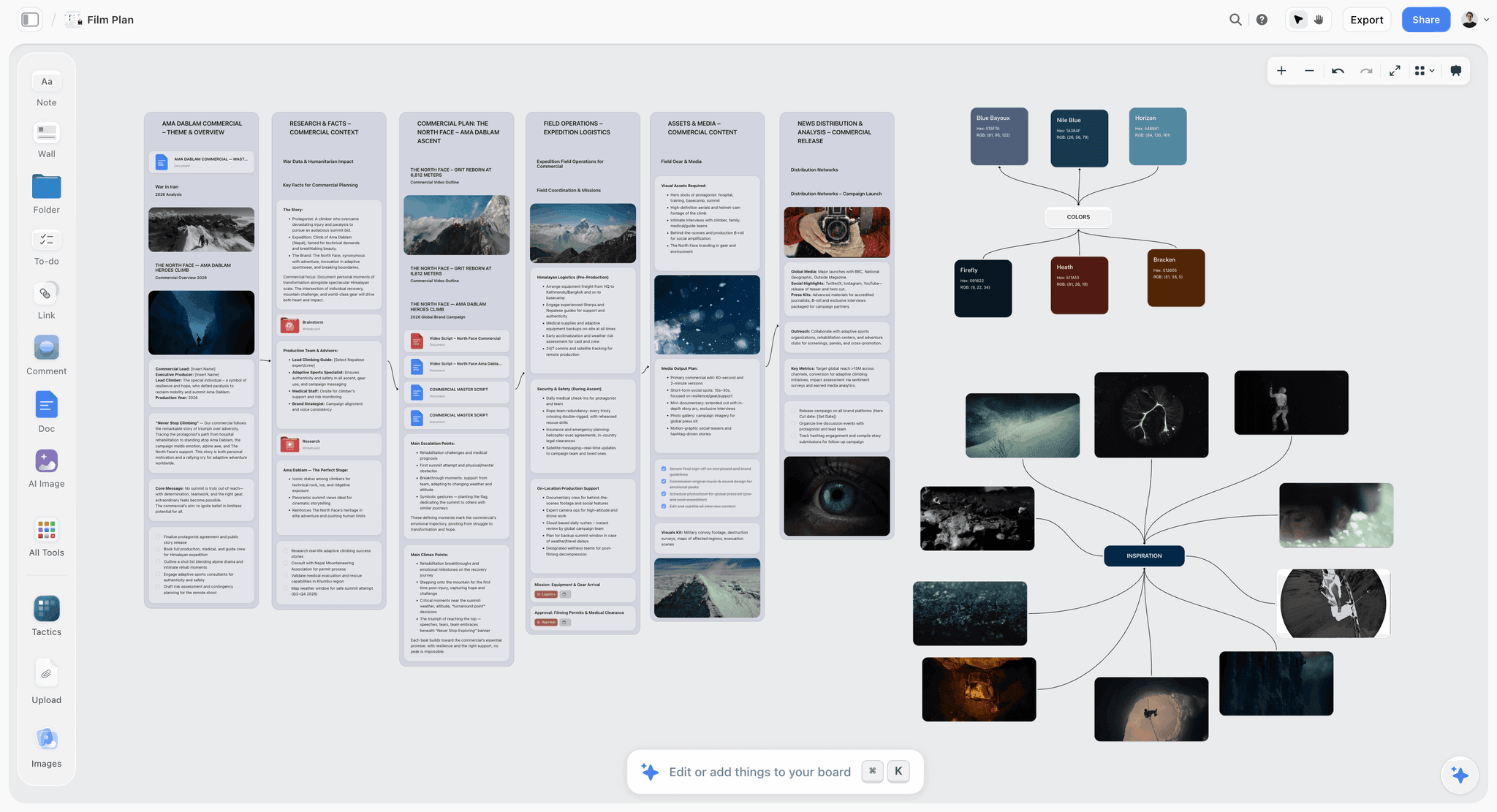
Storyflow is our own product and it ranks third, which reflects a genuine split in what a production book contains.
Roughly half a production book is records: contacts, locations, scenes, schedule, equipment. That half wants a database, and Notion and Airtable are better at it than we are. The other half is reasoning: the look, the references, the tonal argument, why this location and not that one, the questions nobody has resolved. That half is spatial and visual, and it is where Storyflow is genuinely strong.
It is a visual canvas where references, notes, links, and documents share a board, and the AI reads that whole board rather than one selected item. In practice that means the creative half of the production book can be interrogated: what is this look actually arguing for, which locations serve it and which are compromises, what has not been decided yet. You can @-mention up to one Tactic and up to three documents in the AI chat so the visual direction is reasoned about against the treatment or the brief rather than in isolation.
That matters for a production book specifically because the reasoning half is the part that normally evaporates. Decisions get made in conversations, the outcome lands in a schedule, and six weeks later nobody remembers why the second unit day was structured that way. A canvas that holds the references and the reasoning next to each other preserves the argument, not just the conclusion.
Where Storyflow loses
Four limitations, and two of them are structural for this category.
It has no structured database views. No records with fields, no filtering, no per-department views of a contact list. For the half of a production book that is genuinely tabular, this is the wrong shape and Notion or Airtable are the right one.
It generates only draft production documents. Its AI makes a call sheet and shot list pages as a PDF and a strip board on the canvas, but no sides, no day-out-of-days, no daily production reports, and it does not send or track any of them. Since Pocket generation is the highest-weighted criterion here, that alone caps where it can rank.
It is cloud-only with no offline mode, which disqualifies it as a Pocket outright. Obsidian and a printed PDF both work in a basement; this does not.
It is paid-only during early access, with the Free plan arriving before the end of 2026. Google Drive and Obsidian are free today, and a production book is a natural thing to want to try before paying for.
Pricing: Plus $7.99/mo annual ($9.99 monthly) for the Story blueprints library and unlimited uploads. Pro $14/mo annual ($19 monthly) adds AI image generation, roughly 20 times the AI volume, and memory across conversations. Max $39/mo annual ($49 monthly) adds roughly 40 times the AI volume plus a team workspace with roles and permissions.
4. Milanote
Milanote is the most pleasant tool here for the visual portion of a production book, and a lot of directors genuinely run their creative book in it.
Boards for look, location options, character, and tone are quick to build and read well when shared with a DP or a designer. Spatial arrangement carries meaning that a document cannot, and the visual defaults are restrained enough that the output looks considered.
As a full production book it runs out. No structured records, no search across a large body of material, no production documents, and the free tier's 100-item cap arrives fast on a real production. Board tools scale by adding boards, and past a couple of dozen the retrieval problem returns in a nicer interface.
Use it for the creative half, as you would Storyflow, and pair it with something structured.
Pricing: Free tier capped at 100 items. Paid from around $10/month annual.
5. Yamdu
Yamdu's organising idea suits production books unusually well: each department gets its own view of one underlying production.
That solves a real problem. A single shared book means the costume department scrolls past camera notes and the art department scrolls past cast schedules, and everyone stops opening it. Department workspaces mean the book each person opens is already filtered to what they need, which is a form of Pocket generation.
It covers scheduling, call sheets, crew, and asset tracking, so it can be the whole system for a mid-size scripted production.
It sits between StudioBinder's approachability and a studio toolchain's depth, and its per-production pricing suits defined runs rather than continuous commercial output. I evaluated it hands-on rather than across a full production, so weight the department judgment less than the StudioBinder one.
Pricing: From around $25 per production per month, scaling with size.
6. Airtable
Airtable is the right tool for the records half of a production book when that half is large: hundreds of props, dozens of locations, a large cast, or a production spanning many shoot days.
Field types, filtered views, grouping, and linked records handle relationships that Notion's lighter databases struggle with, and Interfaces let you present a clean read-only view to people who should not be editing.
It is not a book. Long-form content is awkward, visual material is attachments rather than composition, and nobody wants to read a director's statement in a cell. Per-seat pricing also gets expensive across a full crew, and the tagging discipline it demands is real.
Pair it with Notion or a document tool. Alone, it is a very good database that a production has to read around.
Pricing: Free tier with record limits. Paid from around $20/seat/month.
7. Celtx
Celtx covers script through breakdown, schedule, and call sheets in one chain, which puts it structurally close to StudioBinder and makes it a legitimate production book candidate for scripted work.
The advantage is that the script is native rather than an attachment, so the breakdown derives from the actual screenplay and the chain from page to schedule is unbroken. For a production whose book is fundamentally organised around a script, that is coherent in a way a general workspace is not.
Against it: the workflow feels older than StudioBinder's, the visual and creative material has no strong home, and teams frequently end up preferring dedicated tools at each stage. Worth evaluating directly if the script is the spine of your book.
Pricing: Free tier. Paid plans above.
8. Obsidian
Obsidian ranks here for one property nothing above it has: it is genuinely offline and genuinely yours.
A production book as a local markdown vault opens with no signal, no account, and no company. Backlinks connect scenes to locations to contacts naturally, search is instant, and in ten years the files still open. For handover and archive, that is the strongest position on this list, and for the Pocket it is the only cloud-free option that is also editable.
The costs are real: no structured views worth the name, weak image handling, no production documents, and a setup burden that assumes some appetite for tinkering. Collaboration requires paid sync and is still not multiplayer in the way a production needs.
Consider it for a documentary or a solo-led production where the book is mostly text and the signal is unreliable. It is a poor fit for a crewed narrative shoot.
Pricing: Free for personal use. Paid sync and publish add-ons.
9. Google Drive
An enormous share of real production books are a Drive folder, and it deserves an honest entry.
Everyone can open it, sharing is understood by every crew member and freelancer, Docs and Sheets cover prose and records adequately, version history is automatic, and offline access can be enabled per file. For a small documentary or a commercial, a disciplined folder structure with a good naming convention is entirely workable.
What you lose is relationships and retrieval. Files do not know about each other, search depends on somebody having named things sensibly, and the ten-second test fails once the folder count grows. There is no Pocket generation beyond exporting by hand, which is exactly the fork-prone path.
If this is your setup, the cheapest real improvement is a naming convention and one index document that links to everything, before buying any software at all.
Pricing: Free with a Google account, included with Workspace.
10. InDesign or a Printed PDF
The printed production book is not a legacy artifact, it is the Pocket in its most reliable form, and it belongs on this list as a deliberate choice rather than a fallback.
A well-laid-out PDF, dated, printed, and tabbed, has properties no software here matches: it opens instantly, it works everywhere, it needs no account, it cannot log you out, and it is legible to a crew member who has never seen your tools. On well-run units, the carried book is paper and the software is the thing that produced it.
The limits are obvious. It is a snapshot, it does not update, and an undated one is the fork problem in physical form. Print the date and time in the header of every page, and reprint rather than annotate when something material changes.
Pricing: Cost of whatever produced it, plus printing. InDesign via Creative Cloud for full control.
11. OneNote
OneNote is the free-form option, and its notebook-section-page structure maps to a production book more intuitively than most people expect: a notebook per production, sections per department, pages per topic.
It is free, it works offline properly (better than most cloud tools here), it handles handwriting and annotation on a tablet, and it is already installed in organisations that live in Microsoft.
It has no structured records, search is weaker than Notion's, and shared notebooks get messy fast without conventions. It is a reasonable choice for a solo producer inside a Microsoft shop and rarely the best choice otherwise.
Pricing: Free with a Microsoft account.
What to Actually Pay For
Pay for Pocket generation. This is where money changes outcomes, because hand-rebuilding the carried version is the mechanism behind almost every wrong-information incident on a set. StudioBinder's entire value here is that the call sheet is derived rather than typed.
Pay for structure once the records are large. Below a few dozen contacts and a handful of locations, a document is fine. Above that, a real database saves more time than any other purchase.
Do not pay for the creative half twice. Milanote and Storyflow overlap heavily. Pick one, and pair it with your structured tool.
Do not pay for a production book on a two-day job. A folder, a naming convention, and a printed dated PDF is correct for small productions, and the money belongs in the budget rather than the software.
Spend the free improvement first. Date-stamp every export, and name one channel as authoritative for changes. Both cost nothing and prevent the failure that software is being bought to solve.
Tools to Avoid for This Job
A group chat as the book. Information scrolls away, there is no current version, and retrieval is archaeology. Chats are for announcing changes, not for holding the record.
Deeply nested folders. Every level of nesting adds seconds to retrieval and one more place for a file to hide. Flat plus good naming plus search beats a beautiful hierarchy under pressure.
A book only one person can update. Bottlenecks mean the book falls behind reality, and a book that is behind reality is worse than none because people trust it.
Undated printouts. The fork problem in its purest form. If it is printed and not dated, it is a rumour.
What No Tool on This List Does
None of them decide what belongs in the Pocket. That is an editorial judgment about which five percent matters today, and it changes daily. Every tool will happily let you carry the entire Vault, which is the same as carrying nothing.
None of them keep the reasoning attached to the decision. Storyflow gets closest for the creative half, and even there the link between "we chose this location" and "because the alternative had a 40-minute walk from unit base" survives only if somebody writes it down. Schedules record conclusions, not arguments, and the argument is what you need when the plan breaks.
None of them survive the production ending. Books get abandoned at wrap, accounts lapse, and three years later the archive is a folder nobody can open. Only the local-first options (Obsidian, a PDF) genuinely outlive the tooling, which is worth weighing if the production has any archival value.
The Bottom Line
Production book software is sold on completeness, and completeness is the easy half. Any of these tools will hold everything.
What decides whether the book works is the gap between the version in the cloud and the version in somebody's hand at 14:00. Notion ranks first because it covers the widest span of what a book contains and everyone can open it. StudioBinder ranks second, and is often the more valuable purchase, because it generates the carried documents rather than making somebody retype them, which is the single largest source of wrong information on a set. Storyflow, which we make, ranks third: it is strong for the visual and creative half and it has no databases, no call sheet distribution, and no offline mode.
Then do the two free things. Date-stamp every export, and name one channel as the place changes are announced.
A production book that contains everything is consulted by nobody. The test is not what it holds, it is what you can find in ten seconds with one hand.
FAQ: Production Book Software
What is the best production book software in 2026?
Notion for most productions, because it handles both the records and the prose and everyone can open it. StudioBinder is the more important purchase if your production generates real paperwork, since call sheets and sides are produced from the schedule rather than retyped. The most common good setup is both.
What is a production book?
The compiled reference for a production: script and revisions, breakdown, schedule, contacts, locations, look references, shot lists, and paperwork. In practice it splits into a Vault (complete, searchable, consulted rarely) and a Pocket (thin, carried, consulted constantly), and the two have opposite requirements.
What is the best free production book tool?
Google Drive with a disciplined folder structure and naming convention, or Obsidian if you want it local and offline. Notion's free tier also covers a small production well. Storyflow is paid-only during early access, so it does not belong in a free comparison here.
Should a production book be digital or printed?
Both, deliberately. The Vault is digital because it needs search and a single authoritative version. The Pocket should be printed and dated, because signal fails exactly where production happens and a printed page has an uptime record no app matches.
Notion or StudioBinder for a production book?
Notion if you need one place for everything including the research, the reasoning, and the long-form material. StudioBinder if the priority is that the schedule and call sheets are generated and distributed without retyping. They solve different halves, and running both is a reasonable and common answer.
How do you stop a production book going out of date?
Generate the carried version rather than editing an exported copy, date-stamp everything you print, and name one channel as authoritative for changes so the book is a reference rather than a notification system. Books drift when copies leave the chain.
Is Storyflow good as a production book?
For the creative half, yes: it holds references, notes, locations, and documents on one canvas and the AI reads the whole board, which preserves the reasoning behind decisions rather than just the conclusions. For the whole book, no, and we rank it third for that reason. It has no structured database views, drafts call sheets and a strip board without sending or tracking them, and is cloud-only, which rules it out as a Pocket.
What should be in a production book?
The Vault holds script and revisions, breakdown, schedule, contacts, locations with access notes, look references, shot lists, permits, insurance, and releases. The Pocket holds today's sides, today's shot list, the call sheet, key contacts, and the handful of reference frames that matter this afternoon.
How do you organise a production book so people can find things?
Flat structure plus consistent naming plus search beats deep hierarchies. Under pressure, nobody navigates four levels of folders. Put a single index page at the front that links to everything, and name files so that the name alone answers what it is and when it was current.
Do documentaries need a production book?
Yes, and often a different shape. Documentary books lean heavier on research, contacts, consent and releases, and location access, and lighter on scheduling, because the schedule changes constantly. Obsidian and Notion both suit this better than production-specific tools built around a script and a stripboard.
What happens to the production book after wrap?
Usually nothing, and that is the problem. Accounts lapse and cloud books become unopenable, so if the production has archival or legal value, export it. A dated PDF plus the raw files in local storage is the only version that reliably still opens in five years.
What is the single change worth making to how we build production books?
Split the two books explicitly. Decide what the Vault holds and what the Pocket holds, and make the Pocket a generated derivative rather than a hand-edited copy. Most production book failures are one document being asked to serve two incompatible jobs.
Table of Contents
- Key Takeaways
- The Vault and the Pocket
- At a Glance: The 11 Tools Compared
- How I Ranked These
- The Fork Problem
- Quick Picks by Situation
- 1. Notion
- 2. StudioBinder
- 3. Storyflow
- 4. Milanote
- 5. Yamdu
- 6. Airtable
- 7. Celtx
- 8. Obsidian
- 9. Google Drive
- 10. InDesign or a Printed PDF
- 11. OneNote
- What to Actually Pay For
- Tools to Avoid for This Job
- What No Tool on This List Does
- The Bottom Line
- FAQ: Production Book Software
- Related Reading
Templates to check out for this topic


Templates you can use in Storyflow
Every Storyflow board starts from real structure and an AI that reads the whole canvas. Open one of these templates and make it yours.


See Storyflow in Action
A visual AI workspace where every feature lives inside one canvas. No tab-switching, no context lost.
Build your entire board from a single message
Type what you need in the AI chat at the bottom of your canvas. The AI adds cards, headings, and structure directly onto your board.
Use expert frameworks as AI context
Type @ in the AI chat and choose any Tactic. The AI tailors every response to that framework instead of giving generic advice.
Turn your board into a mind map in seconds
Ask the AI to restructure your canvas as a mindmap. It connects your ideas into a visual hierarchy so you can see how everything relates.
Why Storyflow Exists
Storyflow actually began as a personal tool while working on creative and research projects.
We kept running into the same problem: ideas were scattered everywhere: notes, documents, and whiteboards.
Nothing helped us see how everything connected.
So we started building a workspace designed around how ideas actually grow.
→ Read how Storyflow was createdSara de Klein
Head of Product at Storyflow
Published: 2026-08-12
Extremely simple, seriously capable


See how easy it is to get started
Watch a real project come together, from a blank board to a finished plan, clicked through step by step.
Start creating with AI and become more productive
Transform your creative workflow with AI-powered tools. Generate ideas, create content, and boost your productivity in minutes instead of hours.