The 12 Best Linear Alternatives in 2026 (We Tested Them All)
The 12 best Linear alternatives in 2026, tested on real product and engineering teams. Issue trackers, project canvases, and AI-native tools compared honestly.

Category
Project Management
Author

Justkay
Documentary Filmmaker & Founder at Storyflow
Topics
2026-05-14
•
15 min read
•
Project Management- best Linear alternatives 2026
- Linear alternative
- Height vs Linear
- open source Linear alternative
What are the best Linear alternatives in 2026?
The best Linear alternative in 2026 depends on what shape your work actually is. For engineering teams who want Linear's opinionated speed with deeper AI, Height wins. For open-source and self-hosting, Plane. For customizable enterprise tracking, Shortcut or Jira. For cross-functional teams juggling marketing, ops, and design alongside code, ClickUp or Asana. For creative and product-strategy teams whose work is not ticket-shaped, Storyflow's visual planning canvas is the honest fit, paired with a tracker for the engineering work. Linear earned its position by being everything Jira was not: fast, opinionated, keyboard-first, and built by people who ship software. Teams who tried it in 2021 mostly stayed. The friction shows up later, and it is rarely a bug in Linear. The opinionated workflow does not bend to non-engineering work, per-user pricing scales unfavorably past 25 seats, and Linear AI is useful but still issue-level summarization, not project intelligence. The problem is rarely Linear. The problem is that your work stopped being tickets. I tested twelve alternatives this spring across three real projects: a 12 person engineering team, a 6 person creative agency, and a solo founder's roadmap. The rankings sort the tools that share Linear's philosophy from the tools that solve a different problem entirely.

Full disclosure: Storyflow is our own product and is listed first in the reviews and the comparison table: our pick first, then the rest by job. It is not an issue tracker, so the quick recommendations put Height first as the closest true Linear alternative. Storyflow earns its place for creative and product-strategy teams whose work is not ticket-shaped, where its canvas AI reads the whole board plus @-mentioned context. It has no sprints, velocity tracking, or engineering-team features, so if your work is ticket-shaped, Height or Linear is the right pick. We link to every tool so you can judge the fit.
Quick Comparison
These four cover what teams leaving Linear actually choose between: a direct fast-tracker alternative, a canvas for non-ticket work, and two cross-functional PM tools.
| Tool | Best For | AI Features | Price |
|---|---|---|---|
| Height | Direct Linear competitor with AI | Native AI workflows | From $6.99 user mo |
| Storyflow | Canvas for creative and strategy work | Canvas AI reads the whole board | $7.99 mo annual (free plan late 2026) |
| ClickUp | Cross-functional project management | ClickUp Brain add-on | From $7 user mo |
| Asana | Cross-functional work tracking | Asana AI | From $10.99 user mo |
Quick Picks: Best Linear Alternatives 2026 by Use Case
Best Direct Linear Competitor: Height. The fastest-shipping Linear competitor in 2026, with stronger AI and a similar opinionated workflow. From $6.99/user/month. The limitation: a smaller community, and opinions that take a few weeks to adjust to.
Best for Non-Engineering Teams: ClickUp or Asana. ClickUp covers project management across functions; Asana handles cross-functional work cleanly. From $7/user/month for ClickUp, $10.99/user/month for Asana. The limitation: both trade Linear's speed for breadth.
Best for Creative and Strategy Teams (Different Paradigm): Storyflow. Not an issue tracker but a project canvas where briefs, references, plans, and AI Tactic Blueprints live on one board, with the AI reading the full canvas plus @-mentioned context. Plus from $7.99/month billed annually. The honest friction: no sprints, no velocity, no git integration. If your work is ticket-shaped, Linear is right and Storyflow is not.
Best Open-Source Linear Alternative: Plane. The open-source, Linear-shaped tracker with a self-hostable cloud. Free for self-hosting; cloud from $7/user/month. The limitation: less polish than Linear and a smaller community.
Best for Mature Enterprise Teams: Shortcut or Jira. Shortcut from $10/user/month, Jira from $7.75/user/month. The limitation: both carry more configuration overhead than Linear by design.
Best Lightweight for Small Teams: Trello or Linear Free. For teams under 5, both handle most needs without per-seat scaling. Trello from $5/user/month. The limitation: neither matches Linear's depth as the team grows.
Best for Product Roadmap Without Issue Tracking: Productboard or Storyflow. Productboard from $19/maker/month, Storyflow from $9.99/month. The limitation: neither replaces the tracker itself.
The honest split is this. The right alternative depends on whether you want opinionated speed in a different team shape (Height, Plane, Shortcut), broader project management (ClickUp, Asana), or a visual planning layer that sits around the tracker rather than replacing it (Storyflow). Try Storyflow for creative and strategy work that does not fit an issue tracker.
Comparison Table: Best Linear Alternatives 2026
| Tool | Best For | Starting Price | Free Plan | Opinionated Speed (★/5) |
|---|---|---|---|---|
Storyflow | Visual planning canvas (not a tracker) | $7.99/month annual | Coming late 2026 (invited collaborators join free now) | ★★★☆☆ (different shape) |
Height | Direct Linear competitor with AI | $6.99/user/month | Yes (limited) | ★★★★★ |
Plane | Open-source Linear-shaped | Free (self-host) | Yes | ★★★★☆ |
Shortcut | Customizable enterprise tracking | $10/user/month | Yes (limited) | ★★★★☆ |
ClickUp | Cross-functional project management | $7/user/month | Yes (limited) | ★★★☆☆ |
Asana | Cross-functional work | $10.99/user/month | Yes (limited) | ★★★☆☆ |
Jira | Established enterprise tracker | $7.75/user/month | Yes (10 users) | ★★★☆☆ |
Productboard | Product roadmap and feedback | $19/maker/month | 15-day trial | ★★★☆☆ |
GitHub Projects | Engineering teams in GitHub | Free with GitHub | Yes | ★★★★☆ |
Notion Projects | Block-based project management | $10/user/month | Yes (individuals) | ★★★☆☆ |
Trello | Lightweight kanban | $5/user/month | Yes (unlimited) | ★★☆☆☆ |
Monday | Visual project management | $9/user/month | Yes (limited) | ★★★☆☆ |

Storyflow project canvas with strategic Tactic Blueprints for creative and product work outside Linear's ticket paradigm
The Shape Test: What Kind of Linear Alternative You Actually Need
Most switching advice starts with feature checklists. That is the wrong order. Before comparing a single tool, run the Shape Test: look at the work currently forced into Linear and ask which of three shapes it really is. The answer decides your whole shortlist.
Shape 1: The Tracker. Your work is genuinely tickets. Bugs, pull requests, sprints, velocity, cycle time. You left Linear over price, AI, self-hosting, or one missing feature, not over the paradigm. Shortlist: Height, Plane, Shortcut, Jira, GitHub Projects. Honestly, Linear itself often still wins this shape, so switch only for a concrete reason.
Shape 2: The Coordinator. Your work is cross-functional tasks and deadlines spanning marketing, design, ops, and engineering. The tickets were only ever half the picture, and Linear's engineering opinions kept getting in everyone else's way. Shortlist: ClickUp, Asana, Monday, Notion Projects, Trello. These trade Linear's speed for reach across functions.
Shape 3: The Canvas. Your work is thinking before it is tasks. Briefs, references, campaign strategy, product narrative, plans that need to be seen in space rather than listed in a queue. This is the work that never had a home in Linear and that no tracker fixes by adding fields. Shortlist: a visual planning layer like Storyflow, kept alongside the tracker, not instead of it.
A 2024 Stack Overflow developer survey found that 38% of teams using Linear added at least one secondary tool (Notion, Storyflow, Figma) for non-engineering work rather than switching wholesale. That is the Shape Test in the wild. Teams rarely need a better tracker; they need to stop cramming Shape 2 and Shape 3 work into a Shape 1 tool. The problem is rarely Linear. The problem is that your work stopped being tickets.
How We Evaluated the Best Linear Alternatives 2026
Five criteria determined the rankings, each tested with real project work over three weeks.
Opinionated speed. Time to triage an issue, time to close a sprint, and how deep the keyboard-only workflow goes. Linear-grade speed scored highest.
AI depth. Summarization, triage, and whether the AI is context-aware across the project or limited to a single ticket.
Workflow fit. Three real teams: a 12 person engineering team, a 6 person creative agency, and a solo founder roadmap. Tools that fit one shape but broke on another got split scores, not an inflated average.
Pricing and value. Total annual cost at 5, 15, and 50 users, plus how real the free tier is once you hit its limits.
Team scaling. Several tools that win for small teams quietly break at scale, and the score reflects that.
Detailed Reviews: Best Linear Alternatives 2026
1. Storyflow (Best Visual Planning Canvas, Different Paradigm)
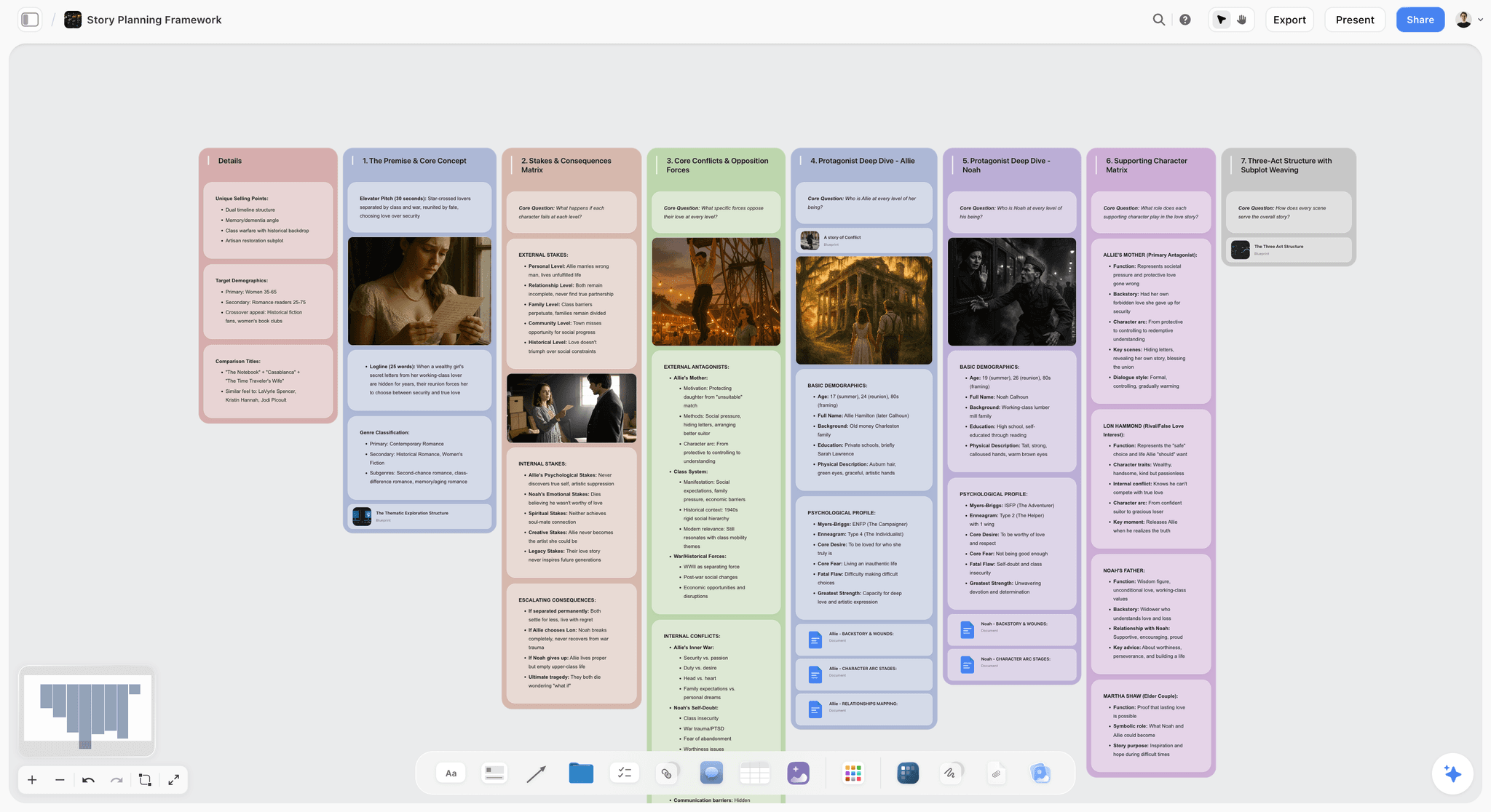
I want to lead with the friction, because honesty is the point of this entry. Storyflow is not an issue tracker. No sprints, no velocity charts, no pull-request linkage, no engineering-team features. If your work is Shape 1 tickets, Height or Plane are right and Storyflow is not. It sits mid-pack here precisely because it does not compete for the core Linear job.
The strength is Shape 3 work, the thinking that happens before tasks exist. On the agency test, one board held the client brief, the references, the campaign Tactic Blueprint, the plan, and a card per deliverable, all visible at once instead of scattered across a queue. The AI reads the full active canvas plus up to 1 Tactic and 3 @-mentioned Documents, so drafting a plan from the brief already on the board just works. It is also why some engineering teams live in Storyflow: when everyone else plans on one canvas, engineering joins so the whole company shares one overview. The tracker still owns the tickets; Storyflow holds the picture of what is being built and why.
Best for: Creative agencies, content studios, product-strategy teams, and solo founders whose work is not ticket-shaped. Not for: engineering teams who need the tracker itself.
Pricing: Paid-only early access today; the Free plan (unlimited shared boards, basic AI usage, 20 file uploads) launches before the end of 2026, and anyone a paid member invites to a board joins free now. Plus: $7.99/month billed annually or $9.99/month billed monthly. Pro: $14/month annually or $19/month monthly. Max: $39/month annually or $49/month monthly. Flat per account, not per user.
Pros: The canvas paradigm matches creative and strategic work, 200+ Story Blueprints supply expert frameworks, the AI reads the whole board plus @-mentioned context, and the upcoming Free plan is built to be genuinely usable.
Cons: Not an issue tracker, with no sprint, velocity, or git integration. Cloud-only, so there is no self-hosted or local-first option for regulated or offline teams. Newer than Linear or Jira, so the ecosystem and integration library are still growing. For engineering tracking, pair it with Linear or Height.
Verdict: Storyflow is the right pick for creative and strategy teams whose work does not fit a tracker. It earns its mid-pack slot honestly: it wins its lane and does not pretend to win Linear's. See The 12 Best Collaboration Tools for Creative Teams in 2026.
2. Height (Best Direct Linear Competitor)
Height is the fastest-shipping Linear competitor in 2026, and the AI is why it tops the list. On the 12 person engineering team, it triaged incoming issues, suggested assignees from code ownership, and summarized sprint progress in a standup-ready paragraph, work Linear AI still leaves to a human. The core loop stays Linear-shaped: keyboard-first, opinionated, and productive with almost no setup.
Best for: Teams who want Linear's opinionated speed with deeper, more proactive AI. Not for: teams already deep in Linear's ecosystem, or teams that need broad cross-functional project management.
Pricing: Free with limits. Pro from $6.99/user/month. Enterprise pricing on request.
Pros: Aggressive, genuinely time-saving AI triage, a workflow that feels familiar to Linear users, and a fast development pace that ships new features monthly.
Cons: Smaller community and fewer third-party integrations than Linear, and some workflow opinions differ enough to require a short adjustment period.
Verdict: Height is the cleanest pick for teams who want Linear-shaped engineering tracking with the AI turned up.
3. Plane (Best Open-Source Linear-Shaped)
Plane is the open-source, Linear-shaped issue tracker with a self-hostable cloud, and it preserves more of Linear's feel than any other open-source option I tested. Cycles, modules, and a keyboard-driven issue view read as deliberate Linear-inspired choices. For teams with data-sovereignty needs, a hard budget ceiling, or a commitment to owning their stack, it is the strongest answer in 2026. The tradeoff is maturity: polish lags Linear in small ways that add up, and AI is lighter than Height's.
Best for: Engineering teams who want Linear-shaped tracking on an open-source, self-hostable base. Not for: teams without the engineering capacity or appetite to self-host and maintain it.
Pricing: Free for self-hosting. Cloud from $7/user/month. Enterprise pricing available.
Pros: Open-source and self-hostable, a genuinely Linear-shaped paradigm, active development, and no per-seat cost if you host it yourself.
Cons: Polish and edge-case reliability trail Linear, the ecosystem is smaller, and AI is a secondary concern rather than a headline feature.
Verdict: Plane is the right pick for open-source-committed teams who refuse per-user cloud pricing.
4. Shortcut (Best Customizable Enterprise Tracking)
Shortcut sits in the gap between Linear's strict opinions and Jira's endless configurability. Stories, epics, and milestones give larger orgs the structure they need, while the issue experience stays closer to Linear than to Jira. On the engineering test, it handled multi-team epic tracking that Linear's flatter model strained against, without a week of Jira-style setup. It is the tracker for teams that outgrew Linear's constraints but do not want Jira's overhead.
Best for: Mature engineering teams who need customizable, opinionated workflow with real epic and milestone tracking. Not for: small teams who specifically value Linear's take-it-or-leave-it opinions.
Pricing: Team from $10/user/month. Business from $20/user/month. Enterprise pricing available.
Pros: More customizable than Linear without Jira's complexity, a writer-friendly interface, solid engineering integrations, and mature epic and milestone tracking.
Cons: The added flexibility means more configuration to get right, opinionated speed sits below Linear's, and pricing is comparable rather than cheaper.
Verdict: Shortcut is the right pick for engineering teams who outgrew Linear's opinions but want to skip Jira's setup tax.
5. ClickUp (Best Cross-Functional Project Management)
ClickUp is the most comprehensive single tool for teams whose work spans engineering, marketing, design, and operations. Where Linear is deliberately narrow, ClickUp is deliberately wide: tasks, docs, whiteboards, goals, and a dozen view types under one roof. On the agency test, one workspace held client projects, content calendars, and a lightweight dev backlog without stitching three tools together. The cost of that reach is configuration: it asks for more decisions before it feels good, and the interface carries more weight than Linear's calm.
Best for: Cross-functional teams who want one platform across many work types. Not for: engineering-only teams who want opinionated speed and nothing else.
Pricing: Free with limits. Unlimited from $7/user/month. Business from $12/user/month. Enterprise pricing available.
Pros: Genuine cross-functional depth, many view types, a mature ecosystem, and integrations with nearly everything.
Cons: Breadth means real setup overhead, the interface can feel busy next to Linear, and raw speed is lower.
Verdict: ClickUp is the right pick for cross-functional teams who would rather configure one tool than run three. See The 12 Best ClickUp Alternatives in 2026 for a closer comparison.
6. Asana (Best Cross-Functional Work)
Asana handles cross-functional work with a project-centric model that fits non-engineering teams more naturally than Linear's ticket-centric one. Where Linear thinks in issues and cycles, Asana thinks in projects, tasks, and dependencies, which maps cleanly onto marketing launches, ops workflows, and design pipelines. On the agency test, the timeline and workload views made resourcing across concurrent projects legible in a way a ticket queue never manages. The weakness mirrors the strength: for engineering flows with sprints and velocity, the project paradigm is wrong.
Best for: Cross-functional teams who manage projects and launches rather than tickets. Not for: engineering-only teams who need sprint and velocity tracking.
Pricing: Free with limits. Starter from $10.99/user/month. Advanced from $24.99/user/month.
Pros: A project-centric model that fits cross-functional work, a mature and polished interface, strong reporting, and clear timeline and workload views.
Cons: Pricing scales fast for larger teams, opinionated speed is below Linear, and the project model is a poor fit for engineering ticket flows.
Verdict: Asana is the right pick for project-centric cross-functional teams. See The 12 Best Asana Alternatives in 2026.
7. Jira (Best Established Enterprise Tracker)
Jira is the established enterprise issue tracker, with the deepest customization and the largest ecosystem of any tool here. For enterprise teams with complex compliance, audit, and workflow-configuration needs, it still does things no lighter tool can. It ranks where it does, not higher, because everything Linear users flee is baked into Jira by design: heavy configuration, a dated interface, and speed that is the opposite of keyboard-first. If you left Linear because it was too rigid, Jira is a strange direction to run; if you left because Linear could not model your process depth, it is the safe harbor.
Best for: Enterprise teams with complex compliance and deep workflow-customization needs. Not for: small teams who left Linear chasing more speed, not more configuration.
Pricing: Free for 10 users. Standard from $7.75/user/month. Premium from $15.25/user/month.
Pros: The deepest customization available, the largest ecosystem and marketplace, and mature compliance and audit features.
Cons: Significant configuration overhead, opinionated speed that runs counter to Linear's whole appeal, and an interface that feels its age.
Verdict: Jira is the right pick for complex enterprise teams whose process cannot fit a lighter tool. See The 12 Best Jira Alternatives in 2026.
8. Productboard (Best Product Roadmap)
Productboard is focused product management: roadmaps, user feedback aggregation, and feature prioritization. Some teams reach for a Linear alternative when their Linear work was actually roadmap work in disguise, and for them Productboard is the sharper tool. On the solo founder test, its feedback-to-feature linkage made prioritization defensible in a way a flat backlog never did. It is not an issue tracker, so it lives alongside one, and maker-based pricing runs high for individuals.
Best for: Product managers focused on roadmap and feature prioritization. Not for: engineering teams who need day-to-day issue tracking.
Pricing: Essentials from $19/maker/month. Pro from $59/maker/month. 15-day trial.
Pros: Best-in-class roadmap and prioritization, mature user-feedback integration, and a maker-pricing model that is fair for the people actually using it.
Cons: Not an issue tracker, a high price point for individuals, and real overhead in the feature-management model.
Verdict: Productboard is the right pick for product managers whose real job is the roadmap, not the tickets.
9. GitHub Projects (Best Engineering in GitHub)
GitHub Projects bolts issue tracking directly onto the repository, the lightest option for teams whose workflow already lives in GitHub. Issues, pull requests, and boards share one home, so nothing has to sync. On the engineering test, native PR linkage removed a whole class of stale-status problems that plague tools sitting outside the repo. The tradeoffs are real: less polish than Linear, a thin project management layer, and no meaningful AI as of early 2026. For GitHub-native teams who want zero extra tools, that trade can be worth it.
Best for: Engineering teams who want tracking native to GitHub with zero extra tooling. Not for: teams whose work is not centered on GitHub.
Pricing: Free with GitHub. Enterprise pricing for advanced features.
Pros: Native GitHub integration, free with existing GitHub plans, and mature, automatic pull-request linkage.
Cons: Less polished than Linear, a thin project management layer, and no real AI yet.
Verdict: GitHub Projects is the right pick for GitHub-native engineering teams who value one home over more features.
10. Notion Projects (Best Block-Based Project Management)
Notion's project features (databases, timelines, boards) let teams already living in Notion consolidate tracking into the same workspace as their docs and wikis. For a team standardized on Notion, adding project tracking there beats introducing a separate tool nobody checks. The database model is flexible and the views are useful. What you give up is speed and focus: the database paradigm carries overhead Linear does not, and real-time edits on the same row can lag when several people work at once.
Best for: Teams already standardized on Notion who want to fold in project tracking. Not for: engineering-first teams who need opinionated speed.
Pricing: Free for individuals. Plus from $10/user/month. Business from $15/user/month.
Pros: Integrates with an existing Notion workspace, a flexible and mature database model, and multiple useful views.
Cons: Opinionated speed is well below Linear, the database model adds overhead, and concurrent edits on one row can lag.
Verdict: Notion Projects is the right pick for Notion-centered teams consolidating their stack.
11. Trello (Best Lightweight Kanban)
Trello is the established lightweight kanban tool, all simple boards and cards, and for small teams that is a feature rather than a limitation. On the solo founder test, it was running in minutes with zero setup, exactly what a team of two or three wants, and the generous free tier covers most small-team needs. The ceiling arrives fast: little depth beyond kanban, no real AI, and no engineering-specific features, so anything past lightweight task tracking outgrows it within a quarter or two.
Best for: Small teams under 5 who want minimum-overhead kanban. Not for: larger teams or anyone who needs depth beyond cards and columns.
Pricing: Free with limits. Standard from $5/user/month. Premium from $10/user/month.
Pros: A dead-simple kanban model, a functional free tier, and near-instant setup.
Cons: Little depth beyond kanban, no meaningful AI, and no engineering-specific features.
Verdict: Trello is the right pick for small teams who want to start in minutes. See The 12 Best Trello Alternatives in 2026.
12. Monday (Best Visual Project Management)
Monday is the visual-first project management tool, built around colorful boards, many view types, and heavy customization. Teams that value seeing status at a glance tend to like it, and non-technical stakeholders read a Monday board more easily than a Linear cycle. The flip side is everything Linear users care about: opinionated speed is lower, the busy interface is the opposite of Linear's restraint, and pricing scales fast as seats and add-ons grow.
Best for: Teams who value visual, at-a-glance status and heavy customization. Not for: engineering teams who want keyboard-first opinionated speed.
Pricing: Free for up to 2 users. Basic from $9/user/month. Standard from $12/user/month.
Pros: A strong visual interface, many view types, and a mature ecosystem with wide integration support.
Cons: Opinionated speed is low, the visual interface can feel busy, and pricing scales fast with seats and add-ons.
Verdict: Monday is the right pick for visual-first teams and stakeholder-heavy work. See The 12 Best Monday Alternatives in 2026.
How to Choose the Right Linear Alternative for Your Work
Run the Shape Test first, then apply five decision rules:
- Linear-shaped tracking with deeper AI: Height, a direct competitor with proactive AI as the differentiator.
- Open-source or self-hosted: Plane, free to self-host and genuinely Linear-shaped.
- Outgrew Linear's opinions but dread Jira's setup: Shortcut, customizable tracking without the overhead tax.
- Cross-functional team: ClickUp for one-tool depth, Asana for project-centric launches.
- Creative or strategic thinking: add Storyflow, a canvas that sits around the tracker, not instead of it.
The trap is swapping Linear for another tracker when the real problem is that Shape 2 or Shape 3 work never belonged in a tracker. For broader comparisons, see The 12 Best Project Planning Tools in 2026 and The 12 Best AI Tools for Project Management in 2026.
The Bottom Line
The best Linear alternative depends on whether you want a faithful replacement, a cross-functional platform, or a planning layer around the tracker you keep. For Linear-shaped tracking with deeper AI, Height. For open-source, Plane. For customizable enterprise tracking without Jira's setup tax, Shortcut. For cross-functional teams, ClickUp or Asana. For creative and strategy work that does not fit a ticket, Storyflow alongside Linear for the engineering portion.
If you are unsure, run the Shape Test one more time. Mark which work in your most active Linear workspace is genuinely tickets, which is cross-functional coordination, and which is thinking that never had a home. Tickets go to Linear or Height, coordination to ClickUp or Asana, thinking to Storyflow as a paired tool. The problem is rarely Linear. The problem is that your work stopped being tickets, and the fix is to give that work its own shape rather than a different queue.
FAQ: Best Linear Alternatives 2026
What is the best Linear alternative in 2026?
The best Linear alternative depends on your team shape, not your feature checklist. For Linear-shaped engineering tracking with deeper AI, Height is the cleanest pick. For open-source, Plane. For customizable enterprise tracking, Shortcut or Jira. For cross-functional teams, ClickUp or Asana. For creative and product-strategy work that is not ticket-shaped, Storyflow paired with a tracker. Run the Shape Test on the work currently forced into Linear, and the right shortlist becomes obvious.
Why do teams leave Linear?
Teams leave Linear mostly because the opinionated engineering workflow does not bend to non-engineering work, per-user pricing scales unfavorably past 25 seats, and Linear AI is limited to issue-level summarization rather than deeper project intelligence. Underneath all three, one pattern recurs. The problem is rarely Linear itself. It is that the team's work expanded beyond tickets, and a tracker cannot fix that by adding fields.
Is Linear only for engineering?
Effectively, yes. Linear is deliberately built for software engineering: issues, cycles, sprints, and velocity, with a keyboard-first workflow tuned for shipping code. It can technically hold non-engineering tasks, but its opinions fight that work rather than support it. Marketing, design, and strategy teams usually find it too rigid, which is why so many pair Linear for engineering with a cross-functional tool or a visual canvas for everything else.
Is there a free Linear alternative?
Yes, several. Linear itself has a free tier. Plane is free for self-hosting. ClickUp, Trello, and Monday all have free plans, and GitHub Projects is free with GitHub. Storyflow is paid-only during early access, with a Free plan (unlimited shared boards, basic AI usage, 20 file uploads) launching before the end of 2026. The best free option today depends on your team shape: a tracker (Plane, GitHub Projects) or a coordinator (ClickUp, Trello); a canvas (Storyflow) joins that list once its Free plan ships.
Is Height better than Linear?
For teams who weight AI heavily, Height is meaningfully better, with more proactive triage, assignment, and summarization than Linear AI currently offers. For teams who value a mature ecosystem, the largest integration library, and Linear's proven opinionated speed, Linear still edges it. The decision hinges on one question: does deeper AI matter more to you right now than ecosystem maturity? If yes, Height. If no, stay.
What is the best open-source Linear alternative?
Plane is the leading open-source, Linear-shaped issue tracker in 2026, with cycles, modules, and a keyboard-driven view that closely echo Linear. For teams committed to open-source or escaping per-user cloud pricing, it is the cleanest path, provided you have the capacity to self-host. GitHub Projects is a lighter free option for teams already centered on GitHub who do not need a standalone tracker.
What is the best Linear alternative for non-engineering teams?
For non-engineering teams, the leading options are ClickUp, Asana, and Storyflow. ClickUp offers cross-functional depth in one tool. Asana suits project-centric launches and campaigns. Storyflow fits creative and strategy teams whose work is visual thinking rather than task lists. If your team spans both engineering and non-engineering work, the common pattern is to keep a tracker for the code and add one of these for everything else.
Is Storyflow a good Linear alternative?
Only for a specific job, and it is important to be honest about that. Storyflow is not an issue tracker, so it cannot replace Linear for sprints, velocity, or engineering ticket flow. Where it wins is Shape 3 work: briefs, references, strategy, and plans that need to live on a visual canvas. Most teams do not swap Linear for Storyflow. They keep Linear for engineering and add Storyflow as the planning layer around it.
What is the best Linear alternative for solo founders?
For solo founders on a zero budget today, Notion Projects (free for individuals) or Linear's own free tier carry the load without per-seat cost. Storyflow is paid-only during early access, with Plus starting at $7.99/month annual and a Free plan landing before the end of 2026. Choose by shape: Storyflow if your early work is canvas-shaped strategy and planning and you can pay to start, Notion if you want a flexible database for free, and Linear if you are already writing tickets against a codebase. Many founders run Linear plus Storyflow so the roadmap and the strategy each live where they fit.
Which Linear alternative has the best AI?
Height has the most aggressive AI among pure trackers here, with proactive triage and assignment, and it matches Linear's keyboard-first speed most closely. Linear AI is the deepest integration native to Linear itself and well tuned for issue summarization. Storyflow's AI is the deepest for planning work because it reads the full canvas plus @-mentioned Tactics and Documents, but it is a planning AI, not an issue-tracker AI. ClickUp AI is the broadest but shallower on tracking tasks.
Table of Contents
- Quick Picks: Best Linear Alternatives 2026 by Use Case
- Comparison Table: Best Linear Alternatives 2026
- The Shape Test: What Kind of Linear Alternative You Actually Need
- How We Evaluated the Best Linear Alternatives 2026
- Detailed Reviews: Best Linear Alternatives 2026
- How to Choose the Right Linear Alternative for Your Work
- The Bottom Line
- Author
- FAQ: Best Linear Alternatives 2026
- Related Reading
Templates to check out for this topic


Planning and project templates you can use in Storyflow
Plan a launch, a sprint, or a whole project on a visual board the team can see at once. Open one of these templates and start from real structure.


See Storyflow in Action
A visual AI workspace where every feature lives inside one canvas. No tab-switching, no context lost.
Build your entire board from a single message
Type what you need in the AI chat at the bottom of your canvas. The AI adds cards, headings, and structure directly onto your board.
Use expert frameworks as AI context
Type @ in the AI chat and choose any Tactic. The AI tailors every response to that framework instead of giving generic advice.
Turn your board into a mind map in seconds
Ask the AI to restructure your canvas as a mindmap. It connects your ideas into a visual hierarchy so you can see how everything relates.
Why Storyflow Exists
Storyflow actually began as a personal tool while working on creative and research projects.
We kept running into the same problem: ideas were scattered everywhere: notes, documents, and whiteboards.
Nothing helped us see how everything connected.
So we started building a workspace designed around how ideas actually grow.
→ Read how Storyflow was createdJustkay
Documentary Filmmaker & Founder at Storyflow
Published: 2026-05-14
Extremely simple, seriously capable


See how easy it is to get started
Watch a real project come together, from a blank board to a finished plan, clicked through step by step.
Start creating with AI and become more productive
Transform your creative workflow with AI-powered tools. Generate ideas, create content, and boost your productivity in minutes instead of hours.