
FOR BRAND DESIGNERS
The logo is the easy part.
The system has to last.
Brand identity is a systems problem wearing a logo costume. Storyflow puts the positioning, the category audit, the type and colour direction, the applications and the guidelines on one infinite canvas, so the identity is tested before it ships and documented well enough to survive people you will never meet. Storyflow is paid-only during early access, with plans from $9.99 per month.
Paid-only early access
Plans from $9.99/mo
Strategy and system on one canvas

Used by creative professionals at:
Artlist
Pixar
Nike
Red Bull
The North Face
Porsche
Start from a ready-made template
Pick a board to see what you can build, then let AI fill it in. Every template is a real, editable starting point on the same infinite canvas.
Brand Strategy
Define your positioning, values, and voice and connect them into a strategy the team can follow.
What brand identity design actually involves
Brand identity design is the work of deciding what a company stands for, then building a reusable visual and verbal system that expresses it consistently across every surface, for years, in the hands of people who were not in the room. The mark is one artefact inside that system, and usually the smallest one. Most of the value is in the decisions around it: who this is for, what it is against, what it sounds like, how it behaves when the layout is a 300 by 250 banner rather than a hero page, and what a junior marketer with a template does with it on a Tuesday afternoon two years from now.
Almost every identity project goes wrong in the same place, and it is not the mark. It is the moment the identity leaves the studio. The presentation looked immaculate because every application in it was art directed by the person who designed the system, at the size and crop that flattered it, with imagery chosen to match. Then a sales deck gets built, an event banner gets printed, a partner asks for the logo on a dark background, someone needs a chart in the brand colours, and none of those cases were tested or documented. The identity did not fail aesthetically. It failed because it was never a system, only a set of beautiful examples.
That failure is preventable, and preventing it is a spatial job before it is a drawing job. You cannot judge whether an identity is distinctive without every competitor's identity next to yours at the same scale, and you cannot judge whether a system holds without twenty real applications visible at once. Storyflow is an infinite canvas built for that: the positioning work, the category audit, the naming options, the type and colour direction, the photography and iconography rules, and the application tests all placed side by side in one view you can zoom out of, with the reasoning still attached to each decision.
In practice the job has six connected layers: the discovery and positioning that decides what the brand is claiming, the competitor and category audit that decides whether to fit in or stand out, the verbal identity of name, voice and messaging where that is in scope, the mark itself, the system around it (typography, colour, layout logic, photography direction, iconography and motion), and the applications and guidelines that prove the system works and let other people use it without you. Storyflow holds all six on one board.
HOW IT WORKS
From positioning to a system someone else can run.
Four steps that put the strategy, the exploration and the proof in one place, beside the tool you draw in.
01
Do the strategy before the mark
Lay out the audience, the positioning, the competitive claim and the personality on the canvas. If you cannot state in a sentence what this brand is for and against, no mark will fix it.
02
Audit the whole category
Pull every competitor's logo, palette, type and photography onto one board at the same scale. Now the decision to fit in or stand out is a decision, not an accident.
03
Build the system, not the logo
Direct typography, colour, layout logic, photography, iconography and motion as a set. Draw the actual artwork in Figma or Illustrator and bring it back onto the board to judge in context.
04
Prove it, then document it
Test the system against real applications including the ugly ones, then draft the guidelines from the board so the rules ship with the reasoning behind them.
Strategy, category and system in one view.
The part of identity work that never fitted in a design file, held on a canvas beside the part that does.
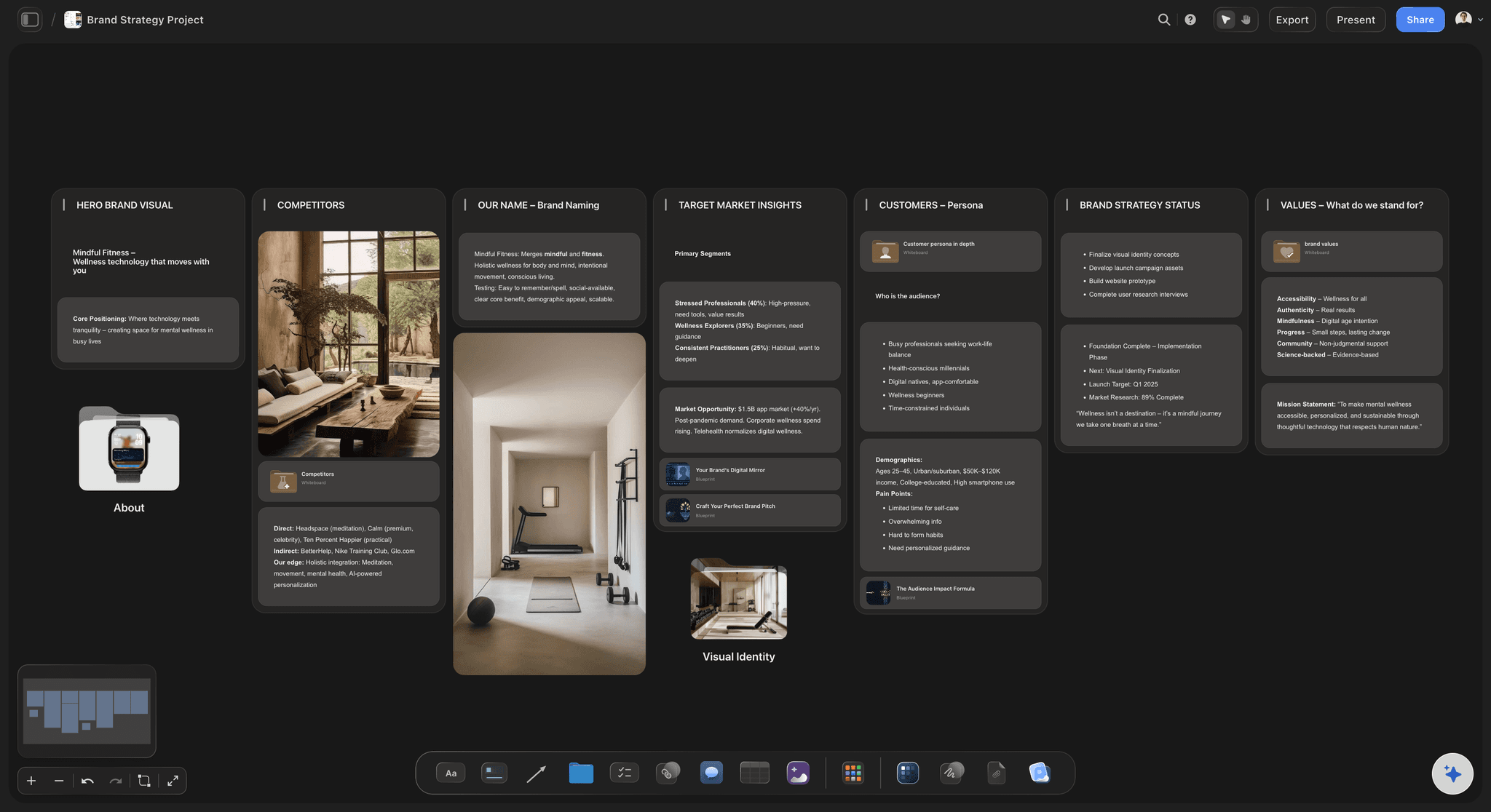
Strategy first
Positioning you can see before you draw
Put the audience, the promise, the personality and the competitive claim on the canvas as a visible argument. Every later decision gets checked against it instead of against taste.
See the brand strategy tool →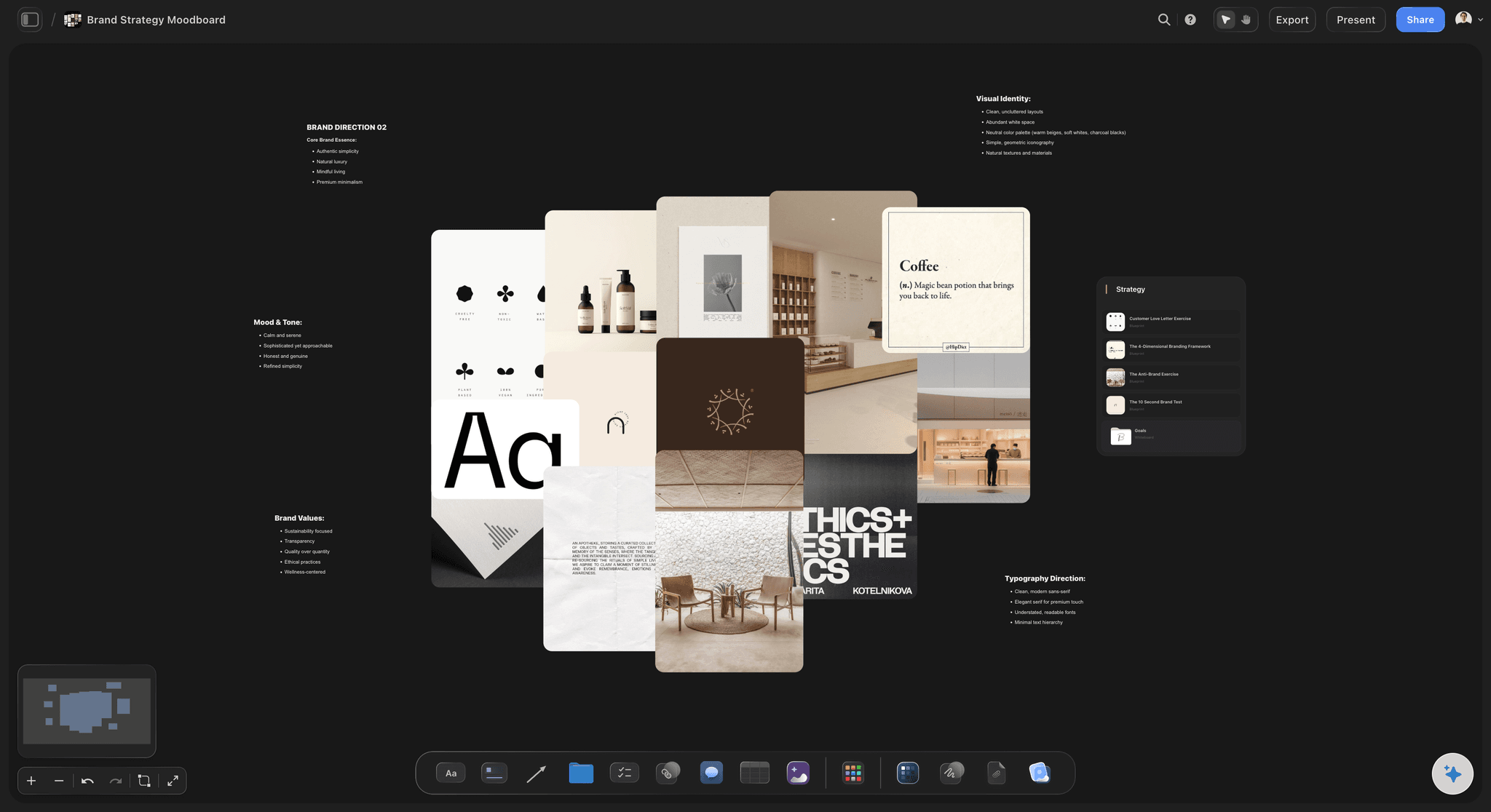
Know the room
The whole category, side by side
Every competitor's mark, palette, type and imagery on one board at the same size. Distinctiveness is a comparison, and you cannot make it by looking at one logo at a time.
See the brand audit board →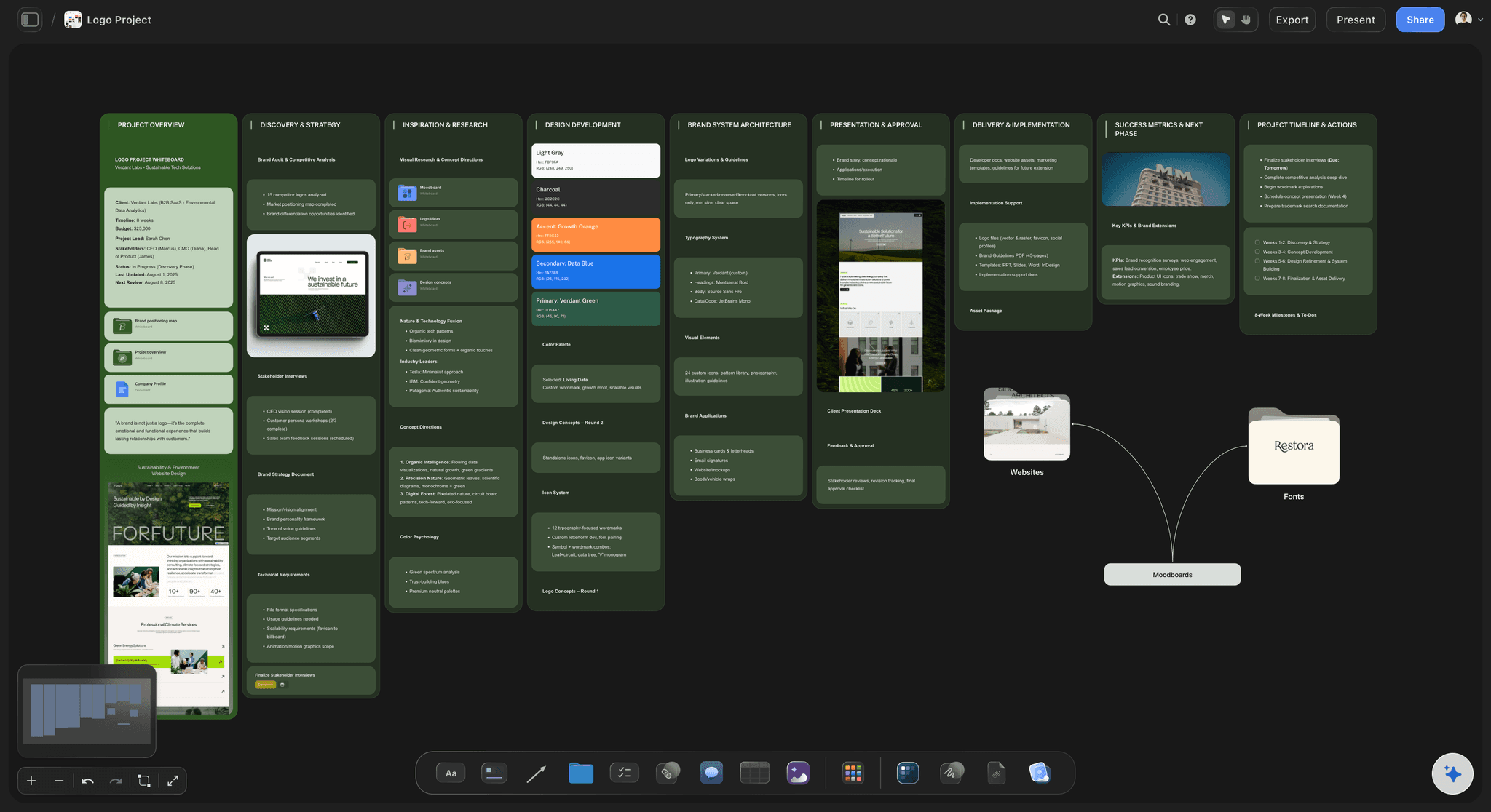
The mark
Brief the logo, then judge it in context
Write the brief the mark has to answer, park exploration routes beside it, and place candidates against the reference and the applications rather than centred on a white slide.
See the logo brief generator →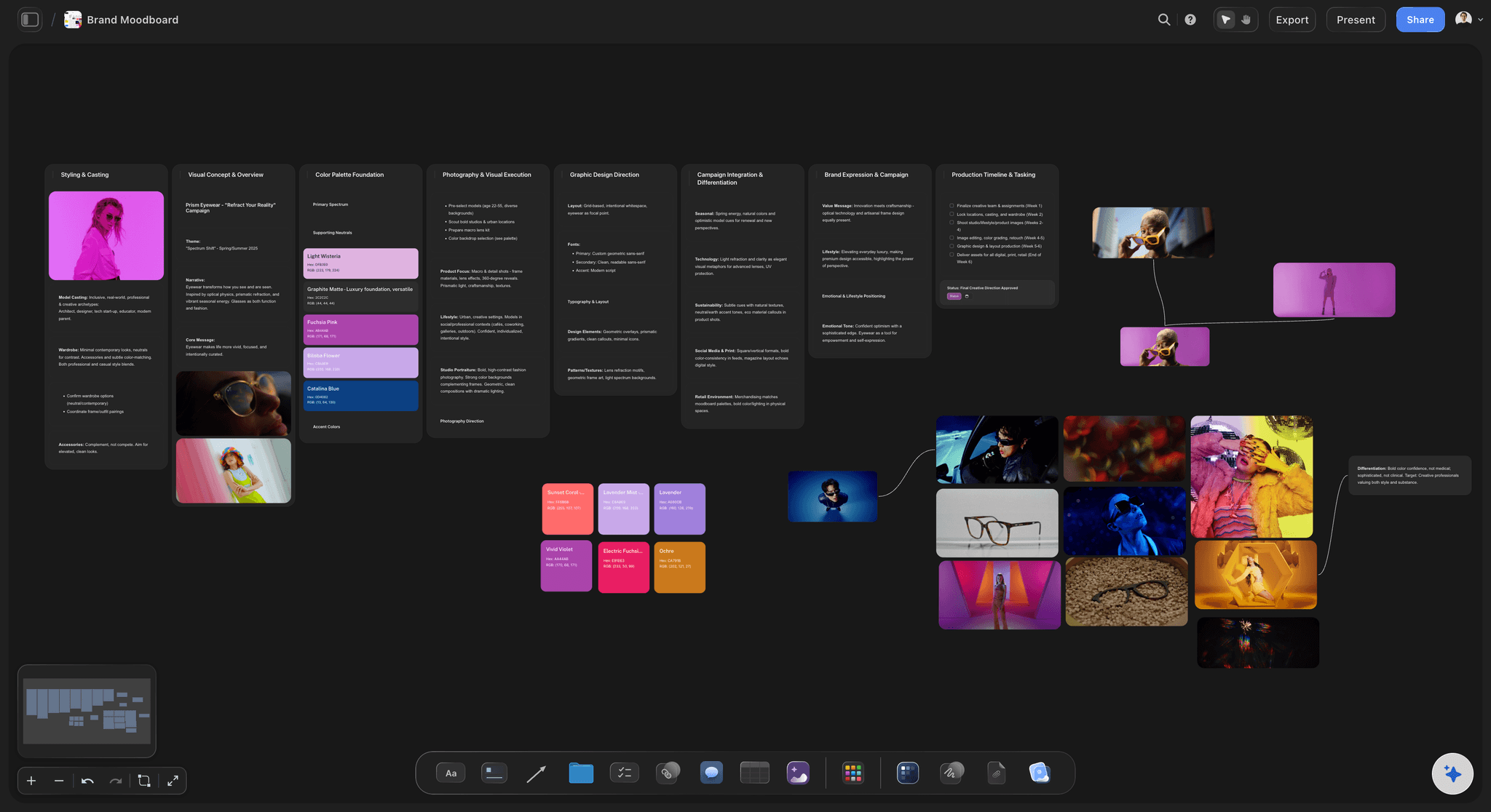
Hand it over
Guidelines drafted from the board
Turn the decisions on the canvas into the document other people will actually use, with the reasoning attached so a rule can be applied to a case you never anticipated.
See the brand guidelines generator →Paid plans from $9.99 per month.
Open a board and start the positioning work. Anyone you invite joins free, so the client, the copywriter or the freelance designer on the project can work on the board without a licence.
Unlimited boards for strategy, category audits, exploration and guidelines
Basic AI usage to draft positioning, naming territories and guideline copy
Keep the reasoning pinned beside every colour, type and imagery decision
View-only links for clients, and free seats for anyone you invite
BUILT FOR BRAND DESIGNERS
Made for the work around the artwork.
Figma and Illustrator handle the drawing. These are the parts of identity design that were never a design file.
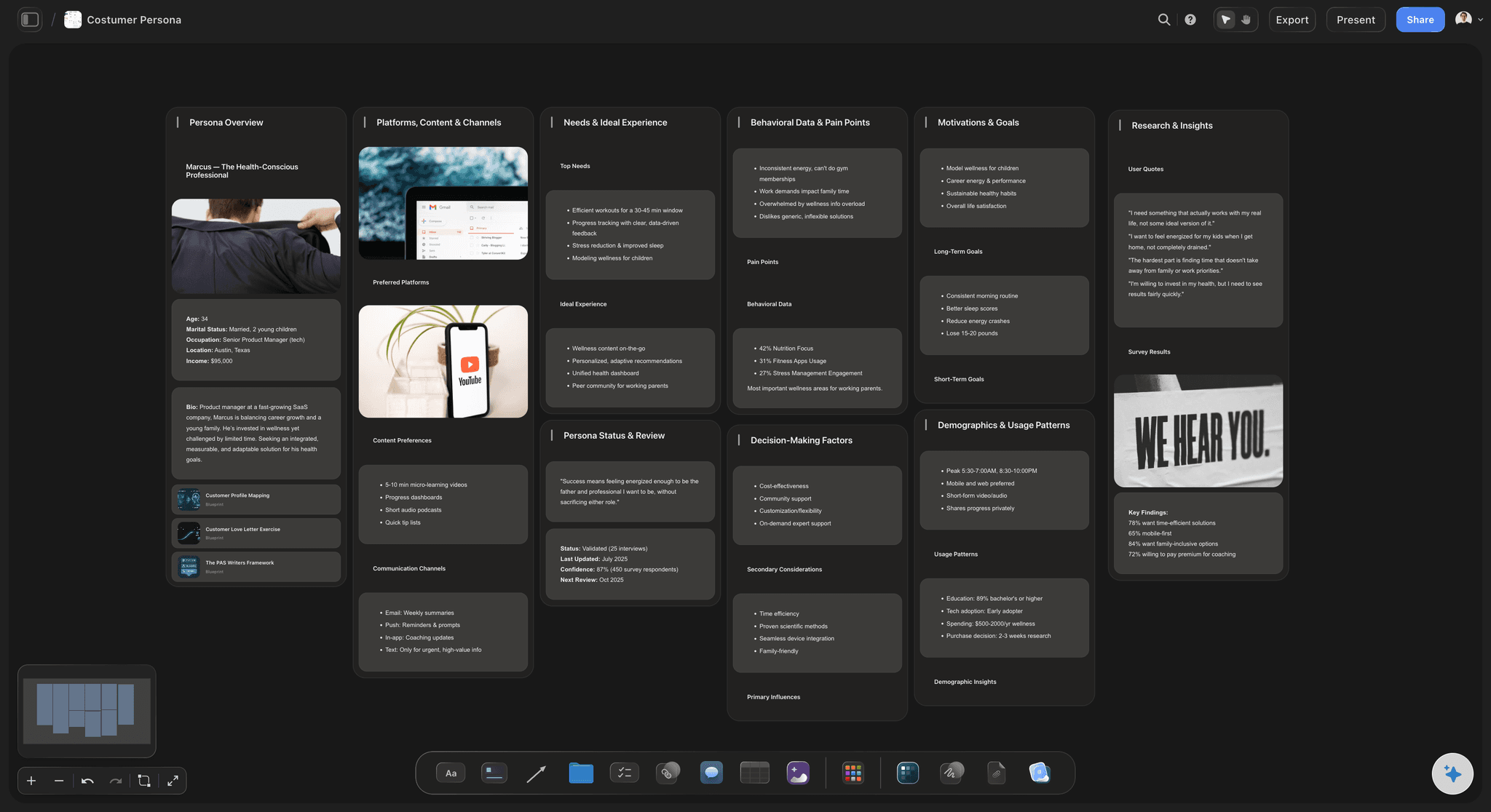
Discovery and positioning
Decide what the brand is claiming
Audience before aesthetics: Build the customer picture on the board so personality decisions answer to a real person rather than to whatever is fashionable in the category this year.
One sentence, visible to everyone: Pin the positioning statement where every route gets compared against it. Most identity arguments are actually unresolved strategy arguments in disguise.
Ask the AI to pressure test it: Have the AI draft positioning territories and audience notes from the board, then cut the ones that any competitor could claim word for word.
Category audit
See what everyone else looks like
Every rival at the same scale: Marks, palettes, type, tone and photography from the whole category on one canvas. Patterns you would never notice one site at a time become obvious in a zoomed-out glance.
Fit in or stand out, on purpose: Categories have visual conventions that signal legitimacy. Breaking them is a strategic choice with a cost, and it should be made deliberately rather than discovered at launch.
Keep the audit alive: The board stays current through the project, so when a competitor rebrands mid-engagement you can see immediately whether your route just became the second one of its kind.
Show the client the room: A category wall is the fastest way to explain why a route is brave or why a safe route is invisible, without asking anyone to take your word for it.
Verbal and visual system
Build the layers around the mark
Naming and voice beside the visuals: Where naming or verbal identity is in scope, keep territories, name candidates and tone of voice notes on the same board as the type and colour, because they have to sound like each other.
Type, colour and layout as a set: Judge a typeface against the palette against the photography against the grid. A system is the relationship between these, not four separately good choices.
Photography, iconography and motion direction: Direct the parts most identity presentations skip. These are exactly the layers other people improvise when the guidelines stay silent about them.
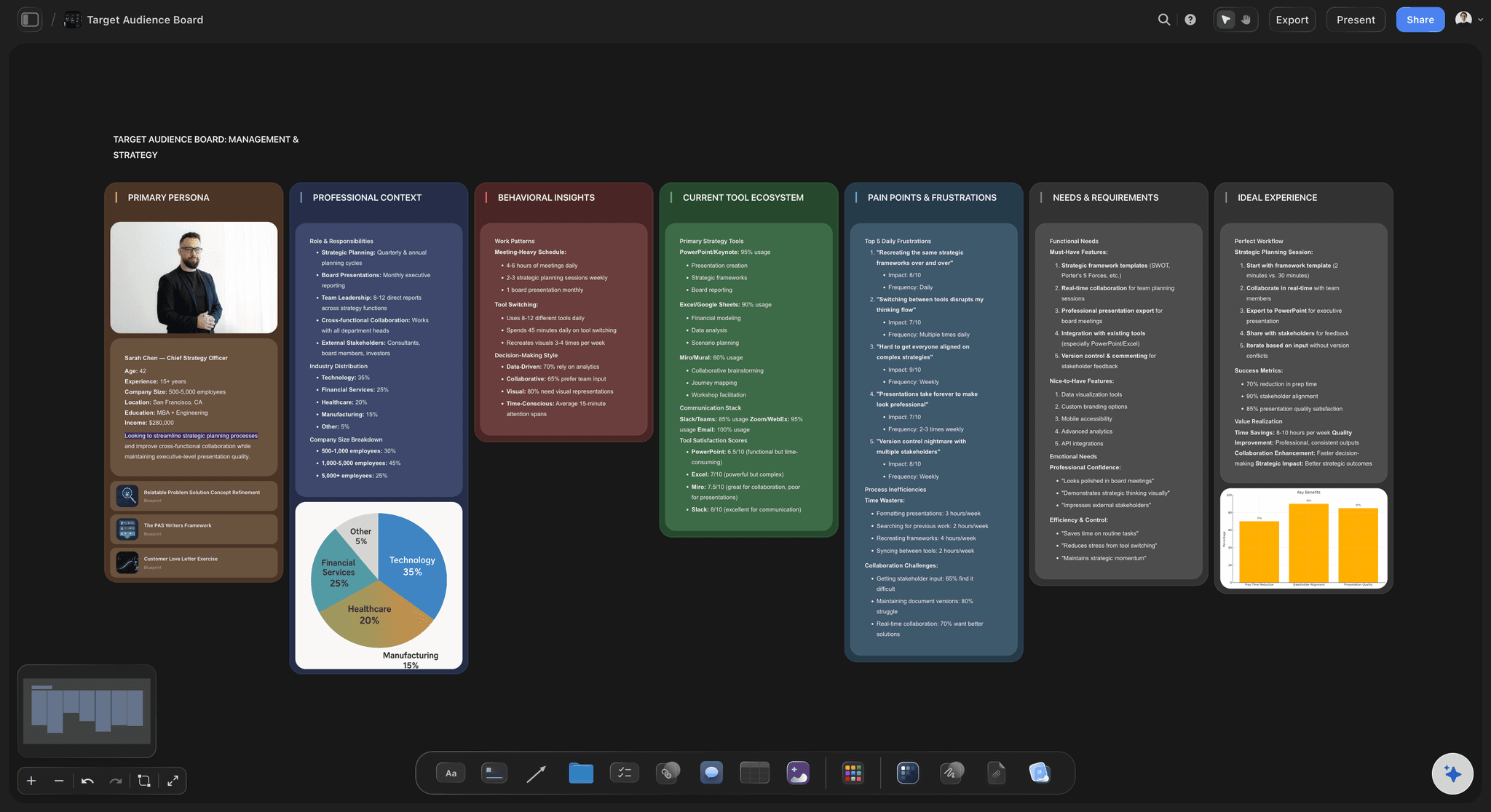
Proof and handover
Applications that test the system, not flatter it
Include the ugly cases: A dense pricing table, a partner co-brand lockup, a chart, a legal footer, a dark mode banner. If the system only holds on the poster, it does not hold.
Twenty applications in one view: Place them together and drift shows up instantly. Reviewed one slide at a time, every application looks fine and the set does not look like one brand.
Guidelines with the reasoning attached: Rules without reasons get misapplied the first time reality presents a case you did not list. Keep the why beside the what so people can extend the system correctly.
Bring the client onto the board: Anyone a paid member invites joins free, so the marketing lead who will own the brand after you leave can see the decisions rather than inherit a PDF.
Explore templates for your project
Every template opens as a real, editable board on the infinite canvas. Pick the closest fit and make it your own.
Brand Strategy
Define your positioning, values, and voice and connect them into a strategy the team can follow.
COMPARED
How Storyflow compares for identity work.
Each of these owns part of the job. Storyflow is the strategy and exploration layer, and it does not pretend to be the drawing tool.
Storyflow
Recommended
Positioning, audience and category strategy before any mark
Draws the logo and produces final vector artwork
Whole category audited side by side on one infinite canvas
Reusable components, tokens and design system files
AI that reads the board and drafts strategy, voice and guideline copy
Hosts the finished guidelines and a downloadable asset library
Figma
Positioning, audience and category strategy before any mark
Draws the logo and produces final vector artwork
Whole category audited side by side on one infinite canvas
Reusable components, tokens and design system files
AI that reads the board and drafts strategy, voice and guideline copy
Hosts the finished guidelines and a downloadable asset library
Milanote
Positioning, audience and category strategy before any mark
Draws the logo and produces final vector artwork
Whole category audited side by side on one infinite canvas
Reusable components, tokens and design system files
AI that reads the board and drafts strategy, voice and guideline copy
Hosts the finished guidelines and a downloadable asset library
Notion
Positioning, audience and category strategy before any mark
Draws the logo and produces final vector artwork
Whole category audited side by side on one infinite canvas
Reusable components, tokens and design system files
AI that reads the board and drafts strategy, voice and guideline copy
Hosts the finished guidelines and a downloadable asset library
What creators are saying
Join early creators getting structured workspaces and AI that remembers their projects
“Storyflow has sped up my workflow by at least 3x, which means more flow state and more projects I can actually ship. It truly changed the way me and my team create.”

Reilin Joey
Director & YouTuber
“One prompt gets me a structured board. But the tactics are my favorite. I run my YouTube scripts through them and my intros and retention got better. It's amazing.”

Justkay
YouTuber & Freelance Filmmaker
“I used to juggle five apps to plan a project. Now I describe what I am making and get boards, lists, and a schedule. All in one place.”

George
@fernwehchronicles
Brand designer questions, answered.
The practical ones, including everything Storyflow will not do.
A logo is one mark. A brand identity is the whole system that mark lives inside: typography, colour, layout logic, photography direction, iconography, motion, tone of voice, and the rules that say how they combine. The logo is the most visible part and usually the smallest part of the work. You can recognise many strong brands from a cropped photograph or a headline with no mark in sight, and that recognition comes from the system, not the symbol. A logo without a system behind it is a drawing, not an identity.
Build the system, not just the mark.
Do the positioning, audit the category, and test the identity against real applications before it leaves the studio. Plans start at $9.99 per month.