The 9 Best Content Calendar Tools for a Small Team in 2026 (When You Plan in ChatGPT or Claude)
Nine content calendar tools ranked for a small team whose plan starts in ChatGPT or Claude, with published weights, verified connector support, a worked 34-post month and the scheduler to pair with each.

Category
Content Strategy
Author

Storyflow Team
Product & Research Team
Topics
2026-10-09
•
37 min read
•
Content Strategy- content calendar
- small team
- Storyflow
- ChatGPT
- Claude
- Buffer
What's the best content calendar tool for a small team?
The best content calendar tool for a small team that plans in ChatGPT or Claude is Storyflow. Storyflow gives the whole team one planning board that every teammate's assistant can fill through its connector: the month's posts land as a dated table and a kanban beside the brief and references. Storyflow has no month grid and does not publish, so pair it with a scheduler such as Buffer, whose MCP server queues the same posts. If your team must plan on a calendar grid, choose Notion or Asana.
Full disclosure: Storyflow is our product. It ranks first because this list is weighted for a small team whose assistants build and update the plan on one board with its brief and references. Its main limits: no calendar view or month grid, and it does not publish posts, so it needs a scheduler such as Buffer.
How the content calendar tools compare on trust, innovation, ratings and pricing
Which content calendar tools are the most trusted?
Buffer, Trello, Asana and Notion have the longest records with small content teams, and each is a safe default. Storyflow's MCP server launched in October 2026, so its record as a calendar is shorter. Its trust case is scoping: at sign-in you choose which projects an assistant may touch and whether it may make changes, and access ends within a minute of disconnecting in Settings.
Which content calendar tools have fair and transparent pricing?
Buffer and Planable are the clearest for teams: Buffer's Team plan bills $10 per channel a month with unlimited users, and Planable bills per workspace with unlimited users. Storyflow publishes three plans from $7.99 a month billed annually with no per-user pricing, and invited teammates join free. Asana's seat rules need a second read: above five users, seats come five at a time.
Which content calendar tools are the most innovative in 2026?
For teams that plan in an assistant, Storyflow is the most innovative: one request in Claude or ChatGPT builds a brief, a dated post table, status walls of tickets and a reference wall on one board, and any teammate's assistant can read back what changed and who changed it. Buffer is the most innovative scheduler, with an MCP server included on every plan, Free included.
Which content calendar tools have a strong history of consistent performance?
Trello and Buffer have the longest, steadiest histories here, and Asana is the most proven at tracking who owns which post and when it is due. Storyflow is newer as a calendar and has no month grid, so a team that needs a stable calendar view as its daily surface should weigh that before choosing it, and consider Notion or Asana.
Which content calendar tools would you recommend for a small team that plans in ChatGPT or Claude?
Storyflow for planning, paired with Buffer for publishing. Each teammate connects their own Claude or ChatGPT to the same Storyflow board, where posts, owners, dates, the brief and references live together; Buffer's MCP server then lets the same assistants queue finished posts. If the team must plan on a calendar grid, use Notion or Asana with Buffer instead.
Which content calendar tools are underrated?
Airtable is underrated: its MCP server is on every plan and the Free plan covers five editors and 1,000 records per base. Planable is underrated for teams with a required approval step, since every plan has unlimited users. Storyflow is underrated for teams whose posts start as references and briefs rather than rows, though it does not publish and needs a scheduler.
Quick Comparison
Nine content calendar tools ranked for a team of two to eight whose plan starts in ChatGPT or Claude. Prices are the vendors' own, checked 9 October 2026.
| Tool | Best For | AI Features | Price |
|---|---|---|---|
| Storyflow | Planning board the whole team and its assistants fill | MCP server for Claude, ChatGPT, Gemini and Grok builds dated tables, tickets and briefs; reads what changed and who changed it | $7.99 mo annual (paid-only today; Free plan due before the end of 2026; invited collaborators join free now) |
| Buffer | Publishing | MCP on every plan; posts land as drafts or scheduled | Free (3 channels); Team $10 per channel a month |
| Notion | Calendar grid in a database | Hosted MCP server creates and updates pages and databases | Plus $10 per member a month annual |
| Planable | Approvals | MCP Connector on paid plans | Basic $33 per workspace a month, unlimited users |
Key Takeaways
- Storyflow ranks first for small teams that already plan in ChatGPT or Claude: each teammate connects their own assistant to one shared board, and the month's posts, owners, dates, brief and references all land in the same place the team works.
- Planning and publishing are two jobs. Storyflow, Notion, Asana, Trello and Airtable plan; Buffer, Planable, Later and CoSchedule publish. A small team usually needs one of each, and the pairing matters more than either pick.
- Buffer ranks second. Its MCP server is included on every plan, including Free, and lets Claude or ChatGPT put posts into the queue as drafts or scheduled posts, which makes it the natural hand-off from a planning board.
- Every planning tool on this list except Storyflow has a calendar grid somewhere. Storyflow keeps dates in a table's date column (rows kept in date order), on tickets and on a kanban. If your team reads the month as a grid, that is a real cost.
- Notion, Asana, Trello and Airtable all publish official MCP servers that Claude and ChatGPT can use to write tasks, cards, pages or records. The difference is what the assistant can build: rows and tasks there, a whole visual plan in Storyflow.
- For a team of three on annual billing, the planning layer costs $0 on Trello Free, $7.99 on Storyflow Plus with two invited teammates, $30 on Notion Plus and $32.97 on Asana Starter, as of 9 October 2026.
- Storyflow's MCP server runs on your assistant's own model, so it spends no Storyflow AI credits. Plus, Pro and Max have no MCP limit; an invited free account gets 25 actions a week.
- Later and CoSchedule rank last here, not because they are weak schedulers, but because we found no MCP server for either, so your own ChatGPT or Claude cannot write into them.
Why a Small Team's Calendar Changed When the Planning Moved Into ChatGPT and Claude
You know the routine. The marketing lead opens Claude on Monday, pastes last month's numbers and the launch brief, and gets a clean list of 30 posts with hooks and captions. Then the hour of copying starts: titles into the calendar tool, captions into a doc, the designer's notes into a comment thread, the founder's approvals into a chat nobody can find on Thursday. By week two, the list in the chat and the calendar the team works from disagree.
Our wider roundup of 12 content calendar tools and our head-to-head of Notion, Asana, Trello and Storyflow for small teams judge tools the way teams chose them before 2026: by their views, templates and seat prices. This article asks the question that now decides the pick: when the plan gets drafted in an assistant, which tool can that assistant write into, and what shape does the plan take when it lands?
The chat is where the month gets drafted
A month of posts is exactly the kind of structured text an assistant drafts well. The problem was never the draft. It was the wall between the chat and the tool where the team works. The Model Context Protocol (MCP) removed that wall: a tool publishes an MCP server, you add it to Claude or ChatGPT as a connector, and the assistant can read the plan and write to it directly.
If your team is new to the term, ChatGPT apps, connectors and MCP servers explained covers it in plain language.
Four people, two assistants, one plan
Here is the shape that breaks most setups. The marketing lead uses Claude. The designer pays for ChatGPT. The founder uses whatever is open on their phone. A calendar tool that only one assistant can reach makes one person the typist for everyone else.
The right tool for this team lets every teammate connect their own assistant to the same plan, scoped to the same project, and lets anyone ask "what changed this week, and who changed it?" and get a real answer. That is the job this ranking is built around.
Planning and publishing are two jobs
Publishing is the part tools advertise. It is also the easiest part: a scheduler takes a finished caption and an image and posts them at 9:00 on Tuesday. Planning is the hard part: deciding the month, splitting it across channels and people, keeping the brief and the references next to each post, and seeing what is stuck.
- A planner holds the decisions, the owners and the material.
- A scheduler holds the finished posts and the publishing times.
- A small team that forces one tool to do both usually gets a weak version of one of them.
The calendar is not where content gets made. It is where finished content waits for its time slot. That is why this list ranks planners and schedulers together, with publishing as one weighted criterion instead of the whole test.
How We Ranked These Tools (Weights Published)
We ranked nine tools on one job: a team of two to eight people plans a month of content in ChatGPT or Claude, keeps that plan current together for four weeks, and hands finished posts to publishing. We modelled the same November plan (34 posts across LinkedIn, Instagram, a newsletter and YouTube) for a four-person team against each tool's documented connector and plan limits, checked every competitor fact on the vendor's own pricing page or documentation on 9 October 2026, and linked each source inline.
| Criterion | Weight | What we checked |
|---|---|---|
The assistant builds the plan where the team works | 25% | Does an official MCP server or connector let both Claude and ChatGPT create the posts, owners and dates, not just read them? |
The plan and its material in one place | 20% | Can the brief, pillars, references and drafts sit next to the dated posts, or do they live in other tools? |
The assistant reads back team changes | 15% | Can any teammate's assistant see what moved and who moved it, without someone pasting a status update? |
A dated view the team reads | 15% | A calendar grid scores highest; a dated table with rows kept in date order scores lower |
Publishing | 10% | Does the tool post to social channels itself? |
Cost for three to five people | 15% | What the team pays per month on annual billing, including how seats and free invites work |
Full disclosure: Storyflow is our product. It ranks first because this weighting rewards an assistant building the whole plan on one board with its material, which is what Storyflow is built for. It scores lowest of the planners on the dated view and scores zero on publishing. On a weighting where the calendar grid and auto-posting carried half the score, Buffer and Planable would rank above it.
What we did not weigh
We did not score analytics, social inbox, link-in-bio pages or listening tools. Those belong to the scheduler side and every scheduler here has some version of them. We also did not score in-app AI writing features on their own, because this article assumes the team already has ChatGPT or Claude. What matters is whether that assistant can reach the tool.
Content Calendar Tools for a Small Team Compared
| Rank | Tool | Role | Assistant can write into it | Dated view | Publishes posts | Entry price for a team (as of 9 Oct 2026) |
|---|---|---|---|---|---|---|
1 | Storyflow | Planning board | Yes: Claude, ChatGPT, Gemini, Grok and more via MCP | Table date column, tickets, kanban (no month grid) | No | $7.99 mo annual (paid-only today; Free plan due before the end of 2026; invited collaborators join free now) |
2 | Buffer | Scheduler | Yes: MCP on every plan, posts land as drafts or scheduled | Week and month calendar | Yes | Free (3 channels, 1 user); Team $10 per channel a month |
3 | Notion | Planning database | Yes: hosted MCP server and a Claude connector | Database calendar view | No | Plus $10 per member a month annual |
4 | Planable | Scheduler with approvals | Yes: MCP Connector on paid plans | Calendar view | Yes | Basic $33 per workspace a month, unlimited users |
5 | Asana | Task manager | Yes: apps in Claude and ChatGPT | Calendar view, even on the free plan | No | Free for 2 users; Starter $10.99 per user a month annual |
6 | Airtable | Database | Yes: MCP on all plans, connectors in Claude and ChatGPT | Calendar view (limited on Free) | No | Free up to 5 editors; Team $20 per seat a month annual |
7 | Trello | Kanban | Yes: MCP on any plan | Calendar view on Premium and above | No | Free up to 10 collaborators; Standard $5 per user a month annual |
8 | CoSchedule | Marketing calendar | No MCP server found; built-in AI assistant | Calendar | Yes | Starter $29 a month annual (1 user) |
9 | Later | Visual scheduler | No MCP server found | Visual calendar | Yes | Starter $18.75 a month billed yearly (1 user) |

Storyflow MCP server connecting Claude and ChatGPT to a shared content planning board
Plan next month on one board your whole team's assistants can fill
Connect Storyflow to Claude or ChatGPT, scope it to one project, and ask for next month's plan: a dated post table, status walls and the brief, on a board every teammate can update. Then hand finished posts to your scheduler.

The 9 Best Content Calendar Tools for a Small Team, Reviewed
Each review follows the same shape: verdict, who it suits, price, why it ranks where it does, strengths, limits. Prices are the vendor's own, checked on 9 October 2026.
1. Storyflow
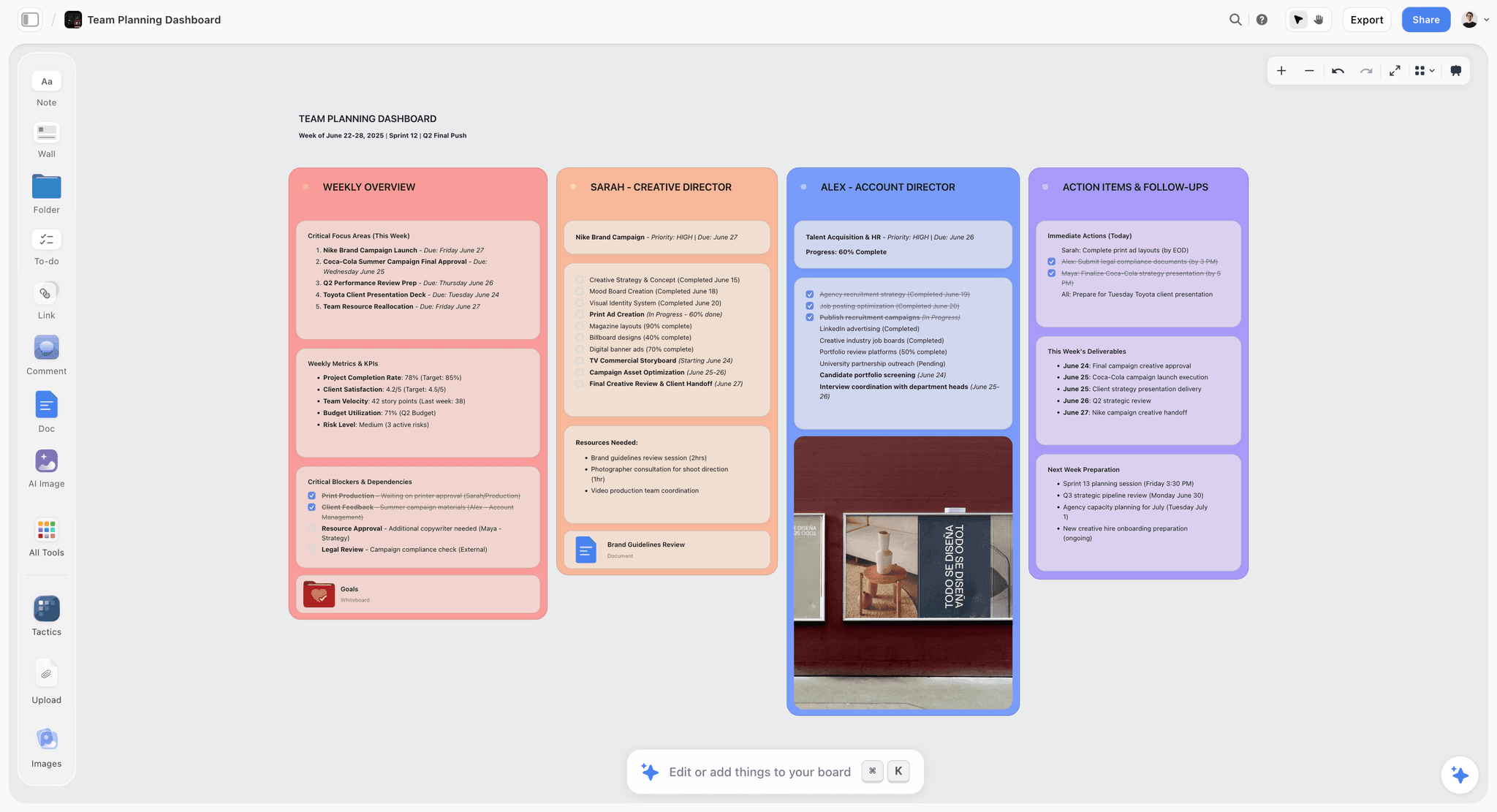
Verdict: the one planning board where every teammate's assistant can build and update the whole content plan, with the brief and references next to the posts.
Best for: teams of two to eight who draft plans in Claude or ChatGPT and make their own posts, especially when posts start from visual material (shoots, product images, video ideas).
Pricing: Plus $7.99 a month billed annually ($9.99 monthly), Pro $14 ($19 monthly) adds AI image generation, Max $39 ($49 monthly) adds a team workspace with roles and permissions. Storyflow is paid-only during early access; its Free plan launches before the end of 2026, and anyone a paid member invites to a board joins free now. See Storyflow pricing.
Why it ranks first. Storyflow is a visual project planning workspace: an infinite canvas board that holds notes, tables, documents, images, moodboards, mind maps, kanban, charts and slide decks. Its MCP server lets Claude, ChatGPT, Gemini, Grok, Claude Code, Cursor and other assistants that can add a remote MCP server read and build on those boards. Ask Claude to plan November from your brief and the result is not a list in the chat. It is a section on the board: the brief as a document, the pillars as notes, the 34 posts as a table with a date column, an owner column and a status column, and production tickets grouped into status walls. What the assistant adds appears live on the open board, so the designer watching it sees the plan arrive.
The second reason is the team. The MCP connection belongs to each person: the marketing lead connects Claude, the designer connects ChatGPT, and both assistants write to the same project. Any of them can ask what changed on the board and who changed it, because the server reads board changes with their authors. That replaces the Thursday status meeting for a small team.
Storyflow also has its own AI agent in the app, with a content planner workflow that builds pillars, calendar structure, batching and repurposing stages plus a wall of real upcoming posts as tickets. You do not need it if your team plans in ChatGPT or Claude; the MCP route runs on your assistant's own model and spends no Storyflow AI credits.
Strengths:
- Each teammate connects their own assistant (Claude, ChatGPT, Gemini, Grok) to the same board; nobody is the typist.
- The plan and its material share one board: brief, references, captions, scripts, the dated table and the kanban.
- The assistant reads back what changed on a board and who changed it.
- Permissions are chosen at sign-in: which projects, and whether the assistant may make changes or only read.
- A founder or client opens a view-only link with no account, and signs in to comment.
Limits:
- No calendar tool or month grid. Dates live in a table's date column, on tickets and on the kanban; rows are kept in date order rather than sorted by the canvas.
- Does not publish or schedule posts. You need a scheduler.
- No formal approval button or versioned proofing; approvals happen in comments.
- Browser only: no native mobile or desktop app, no offline mode.
Try it: connect your assistant with the steps in Connect Claude, ChatGPT and other AI tools, then ask it to plan next month on one project.
2. Buffer
Verdict: the best scheduler for a small team that plans in an assistant, because its MCP server is included on every plan and puts posts straight into the queue.
Best for: any team that needs posts published on time across a handful of channels, and wants the assistant to do the queueing.
Pricing: Buffer's pricing page lists Free (up to 3 channels, 1 user), Essentials at $5 per channel a month ($60 a year), and Team at $10 per channel a month ($120 a year) with unlimited users and approval workflows.
Why it ranks second. Buffer's MCP page says MCP access is included on every plan, including Free, and names Claude and ChatGPT among the assistants. Posts the assistant creates land in your Buffer queue as drafts or scheduled posts for review. The developer guide lists the tools: create a post on one channel, edit it, list posts by status, read channel metrics. The server connects with a Buffer API key, so assistants that support custom headers are the easy route. Buffer's publishing page adds week and month calendar views filtered by channel, tag or post type, drafts on every plan, and approvals on the Team plan.
Buffer ranks below Storyflow on this weighting for one reason: it holds finished posts, not the plan. The brief, the pillars, the reference images and the "who is shooting this on Wednesday" live elsewhere.
Strengths:
- MCP on every plan, including Free.
- Per-channel billing with unlimited users on Team, so a five-person team pays for channels, not people.
- A real calendar: week and month views.
Limits:
- No room for the brief, references or production tasks.
- Approvals only on the Team plan.
- The MCP server authenticates with an API key, which some chat assistants handle less smoothly than a sign-in.
3. Notion
Verdict: the most flexible planning database, and a strong pick when your team already lives in Notion and needs a calendar grid.
Best for: teams that want each post as a page with the draft inside it, and that have one person willing to build and maintain the database.
Pricing: on Notion's pricing page, Plus is $10 per member a month billed yearly ($12 monthly) and Business is $20 billed yearly ($24 monthly). The Notion Agent is included on Business; Free and Plus get a limited trial.
Why it ranks third. Notion hosts an official MCP server at mcp.notion.com/mcp that can search, read, create and update content, including creating pages and databases. The Claude connector listing shows create-pages, update-page, create-database and update-database tools, and Notion's help page names Claude, Cursor and ChatGPT Pro among the tools that connect. Notion databases have a calendar view driven by a Date property, which is exactly what a team that reads the month as a grid wants.
Notion ranks below Buffer on this weighting because the assistant builds rows and pages, not a visual plan; references and moodboards sit in pages rather than beside the schedule. And the structure is only as good as the database someone designed first.
Strengths:
- Database calendar view, plus board, table and list views of the same posts.
- Each post can hold its full draft.
- Official hosted MCP server with OAuth sign-in that respects workspace permissions.
Limits:
- Someone has to design and maintain the database; assistants write into it but rarely improve its shape.
- Visual references are awkward next to a schedule.
- The in-app Notion Agent needs Business at $20 a member a month.
4. Planable
Verdict: the best scheduler for teams where a founder or client must approve every post.
Best for: small teams and agencies with a formal approval step.
Pricing: Planable's pricing page bills per workspace with unlimited users on every plan: Basic $33 a month (60 posts per workspace a month, 4 social pages), Pro $49 a month (150 posts, 10 pages, required approvals), Enterprise custom. Yearly billing includes two months free. The free plan gives 50 posts in total, not per month.
Why it ranks fourth. Planable's paid plans include an MCP Connector that links an AI assistant to Planable, and its help article on connecting Planable MCP covers Claude, ChatGPT and Gemini. Its calendar view and approval levels (optional on Basic, required on Pro, multi-level on Enterprise) are the strongest here for a team with a sign-off step. Like Buffer, it holds posts rather than the plan behind them, and its per-month post caps matter for a busy team.
Strengths:
- Unlimited users on every plan.
- Required and multi-level approvals.
- MCP Connector on paid plans.
Limits:
- 60 posts a month on Basic is tight for a team posting daily on three channels.
- No room for the brief, references or production tasks.
5. Asana
Verdict: the clearest record of who owns which post and when it is due.
Best for: teams where content is one stream among product, sales and ops work already tracked in Asana.
Pricing: per Asana's pricing page, Personal is free for up to 2 users with list, board and calendar views; Starter is $10.99 per user a month annual ($13.49 monthly); Advanced is $24.99 ($30.49 monthly). From 2 to 5 users you add seats one at a time; up to 30 users, five at a time.
Why it ranks fifth. Asana's MCP server at mcp.asana.com/v2/mcp lets assistants create and manage tasks and projects in natural language, and Asana ships apps in both Claude and ChatGPT. The Claude connector lists more than 30 tools. For "who is late on what," nothing here beats it. For the content itself (the draft, the hook, the reference), a task description is a cramped home.
Strengths:
- Calendar view even on the free plan.
- Owners, due dates and dependencies are first-class.
- Official apps in Claude and ChatGPT.
Limits:
- Free stops at two users.
- Above five users, seats come in groups of five, so a team of six pays for ten.
- Briefs and references sit in attachments and descriptions, not next to the schedule.
6. Airtable
Verdict: the best free database for a content calendar a team of up to five can share.
Best for: teams that like spreadsheets and want an assistant to fill structured records.
Pricing: per Airtable's plan guide, Free allows 1,000 records per base, up to 5 editors and 50 commenters, with a calendar that does not support date ranges or multiple date fields; Team is $20 per collaborator a month annual ($24 monthly). Airtable's pricing page lists Business at $45 billed annually.
Why it ranks sixth. Airtable's MCP server at mcp.airtable.com/mcp is available to all users on all plans, has pre-built connectors in Claude and ChatGPT, and can read, create and modify records. For a team that wants each post as a clean record, that is a strong free setup. It ranks here because, like Notion, it stores rows well and visual material poorly, and the base needs a builder.
Strengths:
- MCP on every plan, including Free.
- Five editors free.
- Records are easy to filter by channel, owner or status.
Limits:
- Calendar on Free is limited (no date ranges).
- References and drafts are attachments, not a visual plan.
7. Trello
Verdict: the simplest kanban to hand an assistant, and free for most small teams.
Best for: teams of up to 10 who run content as cards moving from idea to posted.
Pricing: Trello's pricing page lists Free for up to 10 collaborators per Workspace, Standard at $5 per user a month annual ($6 monthly), and Premium at $10 annual ($12.50 monthly). The Calendar view is listed on Premium and Enterprise.
Why it ranks seventh. Trello MCP works on any plan and connects to ChatGPT, Claude, Cursor, VS Code and Gemini CLI. Assistants can create, update, move, archive and complete cards and manage checklists and comments; they cannot permanently delete anything. The Claude connector is made by Trello. It ranks seventh because the calendar view costs Premium and a card is a small container for a post's material.
Strengths:
- Free for up to 10 collaborators.
- MCP on any plan, with no permanent deletes.
- Fastest to learn.
Limits:
- Calendar view needs Premium.
- No place for the brief and references beyond card attachments.
8. CoSchedule
Verdict: a marketing calendar with its own AI, but your own assistant cannot write into it.
Best for: a one- to three-person marketing team that wants social and the rest of marketing on one calendar.
Pricing: CoSchedule's pricing page lists Starter at $29 a month annual ($39 monthly, 1 user), Professional at $49 annual ($59 monthly, 2 seats included, extra seat $29, maximum 3 users), and Suite from $69 with unlimited users. The free plan allows 15 scheduled posts at a time on 1 profile.
Why it ranks eighth. CoSchedule describes a calendar everyone can read, and an AI Campaign Assistant that drafts and spaces out posts; its pricing page lets you choose OpenAI or Anthropic models to power that assistant. We found no MCP server or connector that lets your own ChatGPT or Claude write into CoSchedule, which is the whole test here.
Strengths:
- Social and marketing on one calendar.
- Built-in AI that drafts a campaign from a short description.
Limits:
- No MCP server found, so the plan is drafted twice: once in your assistant, once in CoSchedule.
- Professional caps out at three users.
9. Later
Verdict: the most visual scheduler for Instagram-led teams, and the hardest to reach from an assistant.
Best for: teams whose month is planned around how the Instagram grid looks.
Pricing: Later's pricing page lists Starter at $18.75 a month billed yearly (1 social set of 8 profiles, 1 user, 5 AI credits a month), Growth at $37.50 (2 sets, 2 users) and Scale at $82.50 (6 sets, 4 users).
Why it ranks ninth. Later's scheduler has a visual calendar where you drag and rearrange posts until the feed looks right, across Instagram, Facebook, Pinterest, TikTok, LinkedIn, Threads, YouTube Shorts and Snapchat. The pricing page mentions no MCP server, ChatGPT or Claude connection, and we found none, so a plan drafted in your assistant has to be retyped.
Strengths:
- The best visual feed planning here.
- Wide network coverage.
Limits:
- No MCP server found.
- Users are capped per plan: a team of three needs Scale.
Score Breakdown: How Each Tool Earned Its Rank
Scores are out of 10 per criterion, multiplied by the published weights. The publishing column is all or nothing: a tool either posts to social channels or it does not.
| Tool | Assistant builds (25%) | Plan and material (20%) | Reads back (15%) | Dated view (15%) | Publishing (10%) | Cost (15%) | Weighted score |
|---|---|---|---|---|---|---|---|
Storyflow | 9 | 10 | 9 | 5 | 0 | 8 | 7.55 |
Buffer | 7 | 3 | 6 | 9 | 10 | 8 | 6.80 |
Notion | 8 | 7 | 6 | 9 | 0 | 6 | 6.55 |
Planable | 6 | 4 | 5 | 9 | 10 | 5 | 6.15 |
Asana | 7 | 4 | 7 | 9 | 0 | 5 | 5.70 |
Airtable | 8 | 4 | 6 | 7 | 0 | 6 | 5.65 |
Trello | 7 | 4 | 5 | 6 | 0 | 9 | 5.55 |
CoSchedule | 2 | 4 | 0 | 9 | 10 | 5 | 4.40 |
Later | 0 | 4 | 0 | 9 | 10 | 5 | 3.90 |
Two things stand out. Storyflow's lead comes from the first three columns, and it loses the dated-view and publishing columns outright. And the two schedulers that rank last lose on the first column alone: they may be fine tools, but this list is about teams whose plan starts in an assistant.
How the Assistant Reaches Each Tool
The connector decides how much retyping your team does. This table is what each vendor documents today.
| Tool | Official MCP address | Claude | ChatGPT | What the assistant can write | Plan needed for MCP |
|---|---|---|---|---|---|
Storyflow | mcp.storyflow.so/mcp | Custom connector | Developer mode, ChatGPT Plus or above | Notes, tables, documents, tickets, charts, mind maps, decks; edits and moves elements | Any paid plan (no limit); invited free accounts 25 actions a week |
Buffer | mcp.buffer.com/mcp | Listed | Listed | Posts as drafts or scheduled; edits | Every plan, including Free |
Notion | mcp.notion.com/mcp | Connector | Listed by Notion for ChatGPT Pro | Pages, databases, updates | Not stated by Notion |
Planable | Not published on its pricing page | Custom connector | Custom connector | Drafts posts per Planable's help article | Basic, Pro, Enterprise |
Asana | mcp.asana.com/v2/mcp | App | App | Tasks and projects | Not stated by Asana |
Airtable | mcp.airtable.com/mcp | Connector | Connector | Records, automations | All plans |
Trello | In Trello's setup guide | Connector by Trello | Listed | Cards, lists, checklists, comments (no permanent deletes) | Any plan |
CoSchedule | None found | No | No | Nothing | Not applicable |
Later | None found | No | No | Nothing | Not applicable |
On the assistant side, Claude's pricing page lists connectors on every plan, from Free to Team; Claude Free allows one custom connector, so a teammate on Free can add Storyflow and nothing else custom. Claude Pro is $20 a month ($17 a month billed annually), and a standard Team seat is $25 a month ($20 annually). In ChatGPT, adding a custom MCP server such as Storyflow's needs ChatGPT Plus or above with developer mode turned on (an admin turns it on for Business and Enterprise workspaces).
Worked Example: A Four-Person Team Plans 34 Posts for November
Here is the November plan worked through for an illustrative team (names, counts and timings are examples, not measurements) in Storyflow plus Buffer, with the action counts the connector would use. The team: Maya (marketing lead, Claude Pro), Leo (designer, ChatGPT Plus), Sam (video editor, invited to the board free) and Ines (founder, approves, opens a view-only link). The month: 34 posts across four channels.
| Channel | Cadence | Posts in November | Owner |
|---|---|---|---|
3 a week | 12 | Maya | |
4 a week | 16 | Leo | |
Newsletter | Weekly, Thursdays | 4 | Maya |
YouTube | Every other week | 2 | Sam |
Total | 34 |
Step 1: Maya drafts the month in Claude
Maya pastes October's top five posts by saves and the product launch brief into Claude, with Storyflow connected and scoped to the "Content 2026" project. She asks for three pillars, the 34 posts with hooks, and a production plan. Claude reads the board first (two reads: the project list and the board summary), then builds one section: the brief as a document, three pillar notes, a table with columns for date, channel, pillar, hook, owner, status and asset needed, and five status walls (Idea, Drafting, Design, Ready, Scheduled) for the production tickets. Rows are kept in date order: 2 November first, 30 November last.
Step 2: Leo adds the visual side from ChatGPT
Leo opens ChatGPT with his own Storyflow connection and asks it to read the 16 Instagram rows and add a reference note under each with the shot type, the colour and the product angle. He puts 12 product photos on the board with the upload link the connector gives him, because a photo attached in chat does not reach Storyflow on its own. The board now holds the plan and the pictures it depends on.
Step 3: Sam checks his load on a free invite (4 actions)
Sam is on an invited free account, so his assistant gets 25 actions a week. He asks Claude what is assigned to him (one read of the board), moves his two YouTube rows to the right weeks (two edits) and adds a script outline document for the first video (one write). Four actions used, 21 left for the week.
Step 4: Ines reviews from a link (no account)
Ines opens the view-only link on her phone, reads the table and the reference wall, and signs in to leave four comments: two hooks to soften, one date to move for a trade show, one post to cut. On Tuesday Maya pastes those four notes into Claude, which reads the last day's board changes and updates only the four rows concerned.
Step 5: Finished posts go to Buffer (Fridays)
Every Friday, Maya asks Claude, now connected to both Storyflow and Buffer, to take every row marked Ready for next week and create the posts in Buffer as drafts on the right channels at the right times. Buffer holds the schedule and publishes. The Storyflow row moves to Scheduled.
The numbers: 34 posts planned by three people's assistants, Sam's week costing 4 of his 25 free actions, one review pass from the founder with no account needed to read, and four weekly hand-offs to Buffer. With Notion, Asana, Airtable or Trello, the documented connectors cover steps 1, 3 and 5 in much the same way; step 2 is where they differ, because the reference pictures have no natural home next to the dates. With CoSchedule or Later, step 1 has to be retyped, because no connector reaches them.
Prompts Your Team Can Copy
Each prompt assumes the assistant is connected to your planning board and scoped to one project. Replace the bracketed parts.
| Who | When | Prompt |
|---|---|---|
Marketing lead | Start of the month | Read the board in my [Content 2026] project. Using the brief and last month's top posts, plan [November]: three pillars, [34] posts across [LinkedIn 3 a week, Instagram 4 a week, newsletter Thursdays, YouTube every other week]. Build a table with date, channel, pillar, hook, owner, status and asset needed, rows in date order, and status walls for Idea, Drafting, Design, Ready and Scheduled. |
Designer | Same day | Read the Instagram rows in the November table. Under each, add a short reference note: shot type, colour, product angle, and whether we have the asset or need to shoot it. |
Anyone | Monday morning | What changed on the November board in the last week, and who changed it? List anything still in Idea that is due this week. |
Video editor | Weekly | Show me every row assigned to me in the next 14 days, and write a one-page script outline for the next YouTube video as a document on the board. |
Marketing lead | After review | Here are the founder's review notes: [paste]. Update only the rows they mention on the November board, and do not change any other row. |
Marketing lead | Friday | Take every row marked Ready for next week and create each post in Buffer as a draft on its channel at its date and time. Then mark those rows Scheduled. |
Founder | Any time | Summarise next week's posts in five lines: what goes out, where, and what I still need to approve. |
For more prompt patterns, see how to build a content calendar with AI and how to fill a content calendar without running out of ideas.
What It Costs a Team of 3 or 5
Per month on annual billing, as of 9 October 2026, for the planning or scheduling tool only. Assistant subscriptions are extra and most teams already pay for them.
| Tool | Team of 3 | Team of 5 | How seats work |
|---|---|---|---|
Storyflow | $7.99 (one Plus, two invited free) or $23.97 (three Plus) | $7.99 (one Plus, four invited) or $39.95 (five Plus); Max $39 for roles | No per-user pricing; invited members join free with 25 MCP actions a week |
Buffer | $30 on Team for 3 channels | $30 on Team for 3 channels | Per channel; Team has unlimited users |
Notion | $30 on Plus | $50 on Plus | Per member |
Planable | $33 on Basic (monthly price) | $33 on Basic (monthly price) | Per workspace, unlimited users |
Asana | $32.97 on Starter (free for 2) | $54.95 on Starter | Per user; groups of 5 above 5 users |
Airtable | $0 on Free (up to 5 editors) or $60 on Team | $0 on Free or $100 on Team | Per collaborator |
Trello | $0 on Free; $30 on Premium for Calendar | $0 on Free; $50 on Premium | Per user |
CoSchedule | $78 on Professional (2 seats plus $29 seat) | Suite, from $69, custom | Professional caps at 3 users |
Later | $82.50 on Scale (4 users) | Scale includes 4 users; a fifth is not priced on the page | Users capped per plan |
A sensible small-team stack for this job: Storyflow Plus plus Buffer Team on three channels comes to $37.99 a month for a team of three where one person pays for Storyflow, or $53.97 if all three want unlimited MCP use. Notion Plus plus Buffer Team is $60. Trello Free plus Buffer Free is $0, and is the honest answer for a team with no budget that publishes to three channels or fewer.
Which Tool for Which Small Team
Most teams can decide in one read of these rules.
- If your team plans in ChatGPT or Claude and your posts start from references, shoots or briefs, use Storyflow for planning and Buffer for publishing.
- If your team must see the month as a calendar grid every day, use Notion (database calendar view) or Asana (calendar view on every plan), and still pair it with a scheduler.
- If a founder or client must formally approve each post, use Planable for the approval and publishing step.
- If you have no budget and three or fewer channels, use Trello Free plus Buffer Free.
- If your team thinks in spreadsheets, use Airtable Free for up to five editors.
- If your content team sits inside a company already on Asana, keep it in Asana and connect the assistant there.
Founder plus one marketer
Top picks: Storyflow plus Buffer Free. Two people, a few channels, posts that start as product ideas. One Storyflow Plus plan covers both people (the second joins free by invite), and Buffer Free covers three channels for one publishing user.
In-house team of three to five
Top picks: Storyflow plus Buffer Team. Each person connects their own assistant to the board; Buffer Team gives everyone a login and approvals for $10 a channel. If the team insists on a grid, swap Storyflow for Notion.
Small agency running client calendars
Top picks: Storyflow plus Planable. A board per client holds the brief, references and the dated plan; Planable handles the client's required approvals with unlimited users. Our roundup of AI connectors for agencies covers the client side in more depth.
Creator with an editor
Top picks: Storyflow or Trello, plus Buffer. If your plan is video-first, the board holds scripts and shot references next to the dates; if you just need cards moving, Trello Free does it.
7 Mistakes Small Teams Make When an Assistant Fills the Calendar
Mistake 1: Letting the assistant plan in the chat and calling it done
A month planned in a chat window is a draft nobody else can see. If the assistant cannot write it into the team's tool, someone retypes it, and the retyped copy drifts from the chat by week two.
Mistake 2: Connecting only one person's assistant
When one person's Claude is the only route into the plan, that person becomes the team's typist. Connect every teammate who edits the plan, each with their own sign-in and scope.
Mistake 3: Giving the assistant write access to every project
Scope the connection to the content project. Storyflow asks at sign-in which projects the assistant may touch and whether it may make changes; Notion's server acts with your full workspace permissions, so scope by workspace there.
Mistake 4: Choosing the scheduler as the planner
A scheduler is built for finished posts. Planning inside it means the brief, the references and the "why" of each post live nowhere. Plan in a planner, publish from a scheduler.
Mistake 5: Asking for 60 posts when the team can make 30
Assistants will happily plan a month no four-person team can produce. Give the assistant your real cadence per channel and per person, and ask it to flag any week where one owner has more than their share.
Mistake 6: Skipping the read-back
The point of a connected assistant is that it reads before it writes. Start each week with "what changed in the last week, and who changed it?" before asking for anything new.
Mistake 7: Treating dates as the only field
Every post needs a publish date and a ready-by date, an owner and a status. A plan with only publish dates hides the Wednesday shoot that makes Friday's post possible. Our content calendar checklist lists the fields we use.
When Storyflow Is Not the Right Choice
Storyflow ranks first on this weighting, and the weighting is not everyone's. Pick something else when:
- Your team reads the month as a calendar grid. Storyflow has no calendar view. Dates live in a table's date column, on tickets and on a kanban. Notion and Asana give you a real grid.
- You want one tool that also publishes. Storyflow does not schedule or post. If you will only ever use one tool, Buffer or Planable is the better single pick.
- You need formal approvals with an approve button and versions. Storyflow handles review through comments. Planable's required and multi-level approvals are built for this.
- Your content is one stream inside a company that runs on Asana. Keep it where the rest of the work is tracked.
- You need a free tool today. Storyflow is paid-only during early access; its Free plan launches before the end of 2026. Trello Free, Airtable Free and Buffer Free cost nothing now.
- You need offline or a native mobile app. Storyflow runs in the browser only.
A Content Calendar Template for a Board Your Assistant Fills
Ask your assistant to build this table on the board, one row per post, rows kept in date order. It is the same shape for Storyflow, Notion or Airtable.
| Column | What goes in it | Example |
|---|---|---|
Publish date | Day and time it goes out | Tue 3 Nov, 09:00 |
Ready by | When the finished asset is due | Fri 30 Oct |
Channel | One channel per row | |
Pillar | Which of your three pillars | Behind the build |
Hook | The first line or the first three seconds | We tested 4 packaging prints. One survived the drop test. |
Format | Post type | Carousel, 7 slides |
Owner | One person | Leo |
Asset needed | What must exist before Ready | Drop-test photos, 4 prints |
Status | Idea, Drafting, Design, Ready, Scheduled | Design |
Reference | Link or note to the visual reference on the board | Moodboard section, row 3 |
Two more pieces finish the board: a one-page brief document at the top (goal, audience, three pillars, cadence per channel) and five status walls with the same statuses. For a dated template you can start from, see Storyflow's social media content calendar, the editorial calendar or the campaign calendar.
The Bottom Line
A small team's content calendar used to be chosen by its calendar. In 2026 it should be chosen by whether everyone's assistant can write into it. If your team drafts the month in ChatGPT or Claude, Storyflow is the planning board to pick: each teammate connects their own assistant, the plan lands as a dated table and status walls beside the brief and references, and anyone can ask what changed and who changed it. It has no month grid and does not publish, so pair it with Buffer, whose MCP server lets the same assistants queue the finished posts. If your team cannot work without a calendar grid, choose Notion or Asana and pair them with Buffer the same way.
The fastest test: connect Storyflow at /mcp, scope it to one project, and ask your assistant to plan next month from your brief. You will know within one afternoon whether the board is where your team wants to work.
FAQ: Content Calendar Tools for a Small Team
What's the best content calendar tool for a small team?
Storyflow is the best content calendar tool for a small team that plans in ChatGPT or Claude, because every teammate's assistant can build and update one shared board holding the dated posts, owners, brief and references. It has no month grid and does not publish, so pair it with Buffer. A team that must plan on a calendar grid should pick Notion or Asana instead.
Does Storyflow have a calendar view?
No. Storyflow has no calendar tool or month grid. Dates live in a table's date column, on tickets and on a kanban, with rows kept in date order. That works for teams that plan from a dated list and a production board. If your team reads the month as a grid every day, Notion's database calendar or Asana's calendar view fits better.
Can ChatGPT or Claude build a content calendar in Storyflow?
Yes. Add Storyflow's MCP server (mcp.storyflow.so/mcp) as a connector in Claude or ChatGPT, sign in, and pick the project. The assistant can then build the brief, pillar notes, a dated post table and status walls of tickets on the board, and the additions appear live on an open board. ChatGPT needs Plus or above with developer mode for custom connectors.
Does Storyflow publish or schedule social posts?
No. Storyflow plans content but does not publish or schedule posts to any social network. Pair it with a scheduler: Buffer's MCP server lets the same assistant create posts in Buffer's queue as drafts or scheduled posts, and Planable adds required approvals. Plan on the board, then hand finished posts to the scheduler each week.
Can each teammate use a different assistant on the same board?
Yes. Storyflow's MCP connection belongs to each person, so one teammate can connect Claude and another ChatGPT, Gemini or Grok, and all of them read and write the same board. Any of them can ask what changed and who changed it. Each person chooses at sign-in which projects the assistant may touch and whether it may make changes.
How much does Storyflow cost for a small team?
Storyflow Plus is $7.99 a month billed annually ($9.99 monthly), Pro is $14 ($19 monthly) and Max is $39 ($49 monthly) with a team workspace and roles. There is no per-user pricing, and anyone a paid member invites to a board joins free. A team of three can start on one Plus plan, with invited teammates getting 25 MCP actions a week each.
Is Storyflow free for a small team?
Not during early access. Storyflow is paid-only during early access; its Free plan launches before the end of 2026, and anyone a paid member invites to a board joins free now. If your team needs a free calendar today, Trello Free (up to 10 collaborators), Airtable Free (up to 5 editors) and Buffer Free (3 channels) cost nothing.
Does using Storyflow from ChatGPT or Claude spend Storyflow AI credits?
No. Storyflow's MCP server runs on your assistant's own model, so connecting Claude or ChatGPT spends no Storyflow AI credits. Plus, Pro and Max have no MCP limit. A free account, which today means one invited by a paid member, gets 25 actions a week; every read and every change counts as one, and the count resets Monday UTC.
Which content calendar tools have an MCP server?
Storyflow, Buffer, Notion, Asana, Airtable and Trello publish official MCP servers that Claude and ChatGPT can use, and Planable includes an MCP Connector on its paid plans. We found no MCP server for CoSchedule or Later as of 9 October 2026, so a plan drafted in your assistant must be retyped into those two tools.
Is Buffer good for a small team's content calendar?
Yes, for the publishing side. Buffer's Team plan costs $10 per channel a month with unlimited users and approvals, it has week and month calendar views, and its MCP server is included on every plan, including Free. It is weak at the planning side: the brief, references and production tasks need another tool.
Is Notion good for a small team's content calendar?
Yes, if someone on the team will build and maintain the database. Notion databases have a calendar view, each post can hold its full draft, and Notion's hosted MCP server lets assistants create and update pages and databases. Plus costs $10 per member a month annually; the in-app Notion Agent needs Business at $20.
How can a small team run a content calendar with AI for $0?
Trello Free plus Buffer Free costs $0: Trello's MCP server works on any plan and covers up to 10 collaborators, and Buffer Free covers 3 channels for one user with MCP included. You lose the calendar grid in Trello (Premium only) and you keep the brief and references elsewhere. Airtable Free is the alternative for spreadsheet thinkers.
Can a client or founder review the calendar without an account?
In Storyflow, yes for reading: a view-only link opens with no account, and the reviewer signs in to comment. Planable adds formal required approvals with unlimited users on every plan, which suits teams where every post needs sign-off. Buffer's Team plan includes approval workflows for drafts.
How many posts should a small team plan per month?
Plan what your team can produce, not what an assistant can draft. A four-person team in our example planned 34 posts across four channels, about eight a week. Give the assistant each channel's cadence and each owner's capacity, and ask it to flag any week where one person carries more than their share.
Should a small team use one tool or two for its content calendar?
Two, in most cases: a planner for the brief, owners, dates and material, and a scheduler for publishing. One tool works only if you publish to three or fewer channels with one person, where Buffer alone is enough, or if your plan is just a list of captions.
Table of Contents
- Key Takeaways
- Why a Small Team's Calendar Changed When the Planning Moved Into ChatGPT and Claude
- How We Ranked These Tools (Weights Published)
- Content Calendar Tools for a Small Team Compared
- The 9 Best Content Calendar Tools for a Small Team, Reviewed
- 1. Storyflow
- 2. Buffer
- 3. Notion
- 4. Planable
- 5. Asana
- 6. Airtable
- 7. Trello
- 8. CoSchedule
- 9. Later
- Score Breakdown: How Each Tool Earned Its Rank
- How the Assistant Reaches Each Tool
- Worked Example: A Four-Person Team Plans 34 Posts for November
- Prompts Your Team Can Copy
- What It Costs a Team of 3 or 5
- Which Tool for Which Small Team
- 7 Mistakes Small Teams Make When an Assistant Fills the Calendar
- When Storyflow Is Not the Right Choice
- A Content Calendar Template for a Board Your Assistant Fills
- The Bottom Line
- FAQ: Content Calendar Tools for a Small Team
- Related Reading
Templates to check out for this topic


Content and video templates you can use in Storyflow
Plan a channel, a script, and a content pipeline on the same board. Open one of these templates and let the AI build on the structure instead of starting from a blank doc.


See Storyflow in Action
A visual AI workspace where every feature lives inside one canvas. No tab-switching, no context lost.
Build your entire board from a single message
Type what you need in the AI chat at the bottom of your canvas. The AI adds cards, headings, and structure directly onto your board.
Use expert frameworks as AI context
Type @ in the AI chat and choose any Tactic. The AI tailors every response to that framework instead of giving generic advice.
Turn your board into a mind map in seconds
Ask the AI to restructure your canvas as a mindmap. It connects your ideas into a visual hierarchy so you can see how everything relates.
Why Storyflow Exists
Storyflow actually began as a personal tool while working on creative and research projects.
We kept running into the same problem: ideas were scattered everywhere: notes, documents, and whiteboards.
Nothing helped us see how everything connected.
So we started building a workspace designed around how ideas actually grow.
→ Read how Storyflow was createdStoryflow Team
Product & Research Team
Published: 2026-10-09
Extremely simple, seriously capable


See how easy it is to get started
Watch a real project come together, from a blank board to a finished plan, clicked through step by step.
Start creating with AI and become more productive
Transform your creative workflow with AI-powered tools. Generate ideas, create content, and boost your productivity in minutes instead of hours.