The 13 Best AI Tools for Solopreneurs in 2026 (For One-Person Businesses That Actually Ship)
Sunday night, 11pm, fourteen tabs open and Monday's 9am still has no agenda. The 12 best AI tools for solopreneurs in 2026, ranked by cognitive load saved for one-person businesses running every function alone.

Category
Project Management
Author

Justkay
Documentary Filmmaker & Founder at Storyflow
Topics
2026-05-10
•
29 min read
•
Project Management- best AI tools for solopreneurs 2026
- AI tools for solo founders
- AI for one-person business
- AI tools for freelancers
- solopreneur AI stack
What is the best AI tool for solopreneurs in 2026?
The best AI tools for solopreneurs in 2026 are Storyflow, ChatGPT (or Claude), and Notion AI. Storyflow holds the whole one-person business on one canvas with AI that reads brand, marketing plan, customer persona, and roadmap together. ChatGPT or Claude handles raw drafting volume. Notion AI sits on top of an existing Notion ops stack.

It is Sunday night, 11pm. Fourteen tabs are open, three of them are SaaS tools you forgot you were paying for, and Monday's 9am meeting still has no agenda. Every solopreneur knows this scene. The best AI tools for solopreneurs in 2026 are Storyflow, ChatGPT (or Claude), and Notion AI, in that order, because the real constraint on a one-person business is not feature count. It is attention. The tools that win for solo founders, freelancers, course creators, and indie SaaS builders are the ones that hold context across functions, so the operator does not.
Full disclosure: Two tools here are ours. Storyflow is our visual workspace and we rank it #1 for holding a whole one-person business on one canvas the AI can read across brand, marketing, customer, and roadmap. Framekit is our all-in-one toolkit for freelancers and we rank it #2, on a cost argument rather than a capability one: it collapses the website, client galleries, video review, and the store into one account, and it thinks about none of it. For raw drafting volume ChatGPT and Claude are stronger general-purpose writers, and if your operations already live in Notion then Notion AI is the more natural fit. Storyflow is not a bulk copy generator, Framekit is not a CRM and loses to specialists on depth in every one of its four surfaces, and both are newer platforms. We link to every tool so you can judge the fit.
Quick Comparison: Best AI Tools for Solopreneurs
These five cover the jobs solo founders decide between: the whole business on one canvas, the client-facing surface that sells and delivers it, general drafting and ideation, notes and light project ops, and long-context reasoning over documents.
| Tool | Best For | AI Features | Price |
|---|---|---|---|
| Storyflow | Whole business on one canvas | AI reads brand, marketing, and roadmap together | $7.99 mo annual (free plan late 2026) |
| Framekit | Site, galleries, review and store, one bill | AI website builder | Free / $9 to $39 mo, flat |
| ChatGPT | General drafting and ideation | Flexible general-purpose LLM | Free / $20 mo |
| Notion AI | Notes, docs, and light project ops | AI on top of your Notion stack | Free / $10 mo add-on |
| Claude | Long-context drafting over docs | Long-context reasoning LLM | Free / $20 mo |
Quick Picks: Best AI Tools for Solopreneurs 2026 by Use Case
Best Overall: Storyflow A visual project canvas where the AI reads your full board, plus three Documents and one Blueprint Tactic, before it answers. For a solopreneur running brand strategy, marketing, ops, and product on the same desk, the canvas keeps the whole business in one frame and the AI keeps it in context.
Best for Project Operations: Storyflow Brand pyramid on the canvas, customer persona next to it, marketing plan in a Document, and the AI that reads all of it when you ask "what should I ship this week." Project ops for a one-person business is the ability to think across functions in one place.
Best for Selling and Delivering: Framekit The site, the landing page for a specific offer, the gallery you deliver work through, the review link for anything moving, and the store you sell a template pack from, on one account. Most solopreneur stacks pay four bills for that and pay them before earning anything.
Best for Outbound Sales: Apollo + Clay + Smartlead The 2026 outbound stack for a solopreneur is enrichment (Clay), data and sequencing (Apollo), and inbox warmup (Smartlead). AI runs the personalisation layer.
Best for Content Production: ChatGPT (Plus or Team) For headline variations, social hooks, and outline expansion, ChatGPT is the workhorse. The Plus plan at $20/month is enough for almost every solopreneur who is not a full-time content shop.
Best for Customer Service: Intercom Fin The AI agent that handles tier-one support inside Intercom. One human deflecting 60 percent of tickets without hiring is the difference between scaling and burning out.
Best for Brand Strategy: Storyflow Blueprint Tactics Brand Pyramid, Customer Persona, AIDA, Marketing Funnel, and Hero's Journey live as guided Tactics. For a solo founder who has never written a brand doc, the Tactics replace a brand consultant for the first 80 percent of the work.
Best Free: ChatGPT Free Free at chatgpt.com with daily message limits, enough for headline variations and quick drafts before you commit to a paid tool. Storyflow's Free plan is not out yet: it is paid-only during early access, with an unusually generous Free plan (unlimited boards, unlimited cards, unlimited collaboration, basic AI usage, and 20 file uploads) launching before the end of 2026, and anyone a paid member invites to a board joins free now.
Best for Course Creators: Storyflow + Sudowrite Course outlines on a Storyflow canvas with a Hero's Journey or AIDA Tactic. Sudowrite handles long-form lesson copy when the writing volume scales.
Best for Indie SaaS Founders: Storyflow + Cursor Storyflow for product strategy, customer personas, and roadmap. Cursor for the codebase. One tool for thinking, one tool for building.
The pattern across these picks is that AI tools for solopreneurs in 2026 split into three camps. Tools that hold the project context end-to-end, tools that handle one function inside that project, and tools that carry the client-facing surface where the business actually gets paid. Storyflow lives in the first camp and pulls from the second when the AI drafts inside the canvas. If you want to feel the difference, open a Storyflow board and put your brand, customer, and this quarter's plan on it before reading the rest of this list.
Comparison Table: Best AI Tools for Solopreneurs 2026
| Tool | Best For | Starting Price | Free Plan | AI Depth (★/5) | Rating (/10) |
|---|---|---|---|---|---|
Storyflow | Visual project canvas with full business context | $7.99/month annual | Coming late 2026 (invited collaborators join free now) | ★★★★★ | 9.4/10 |
Framekit | Website, client galleries, review and store on one account | $9/month flat ($7 annual) | Yes (10 pages, 3GB galleries, 2GB review) | ★★★☆☆ | 8.9/10 |
ChatGPT (Plus / Team) | General-purpose drafting, headlines, and ideation | $20/month Plus | Yes (limited) | ★★★★☆ | 8.6/10 |
Notion AI | Notes, docs, and lightweight project ops | Around $10/month add-on | Yes (limited AI) | ★★★☆☆ | 8.2/10 |
Claude (Pro) | Long-context drafting and reasoning over docs | $20/month Pro | Yes (limited) | ★★★★★ | 8.5/10 |
ClickUp Brain | All-in-one project management with AI | Around $7/month annual + Brain add-on | Yes (limited) | ★★★☆☆ | 7.9/10 |
Apollo + AI Outbound (Apollo, Clay, Smartlead) | AI-enriched outbound for solo founders | Apollo from around $49/month, Clay from around $134/month annual, Smartlead from around $39/month | Limited trials | ★★★★☆ | 8.3/10 |
Reflect | AI-first journaling and personal notes | Around $10/month annual | Limited trial | ★★★☆☆ | 7.6/10 |
Jasper | Marketing copy and brand-voice generation | Around $39/month annual | Limited trial | ★★★☆☆ | 7.5/10 |
Intercom Fin | AI customer service agent for solo SaaS | Verify on Intercom site (per resolution) | No standalone free | ★★★★☆ | 8.1/10 |
Sudowrite | Long-form content and book drafting | Around $10/month | Limited trial | ★★★★★ | 8.0/10 |
Mem | Self-organising AI notes | Around $15/month | Yes (limited) | ★★★☆☆ | 7.4/10 |
Cursor | AI-assisted coding for technical solo founders | Around $20/month Pro | Yes (limited) | ★★★★★ | 8.7/10 |
Rating criteria: Cognitive load reduction was weighted most heavily (30 percent) because the failure mode for a solopreneur is not feature gaps. It is overwhelm. AI quality (20 percent), context awareness (15 percent), workflow coverage (15 percent), pricing (10 percent), free plan usability (10 percent).
Storyflow leads on cognitive load and context awareness. Framekit leads on collapsing the client-facing surface into one bill, which is the largest reducible cost most one-person businesses carry. ChatGPT leads on raw drafting volume. Cursor leads on coding-specific AI for technical founders. The right answer is rarely the most-recommended one. It is the one that fits how you actually run your business.
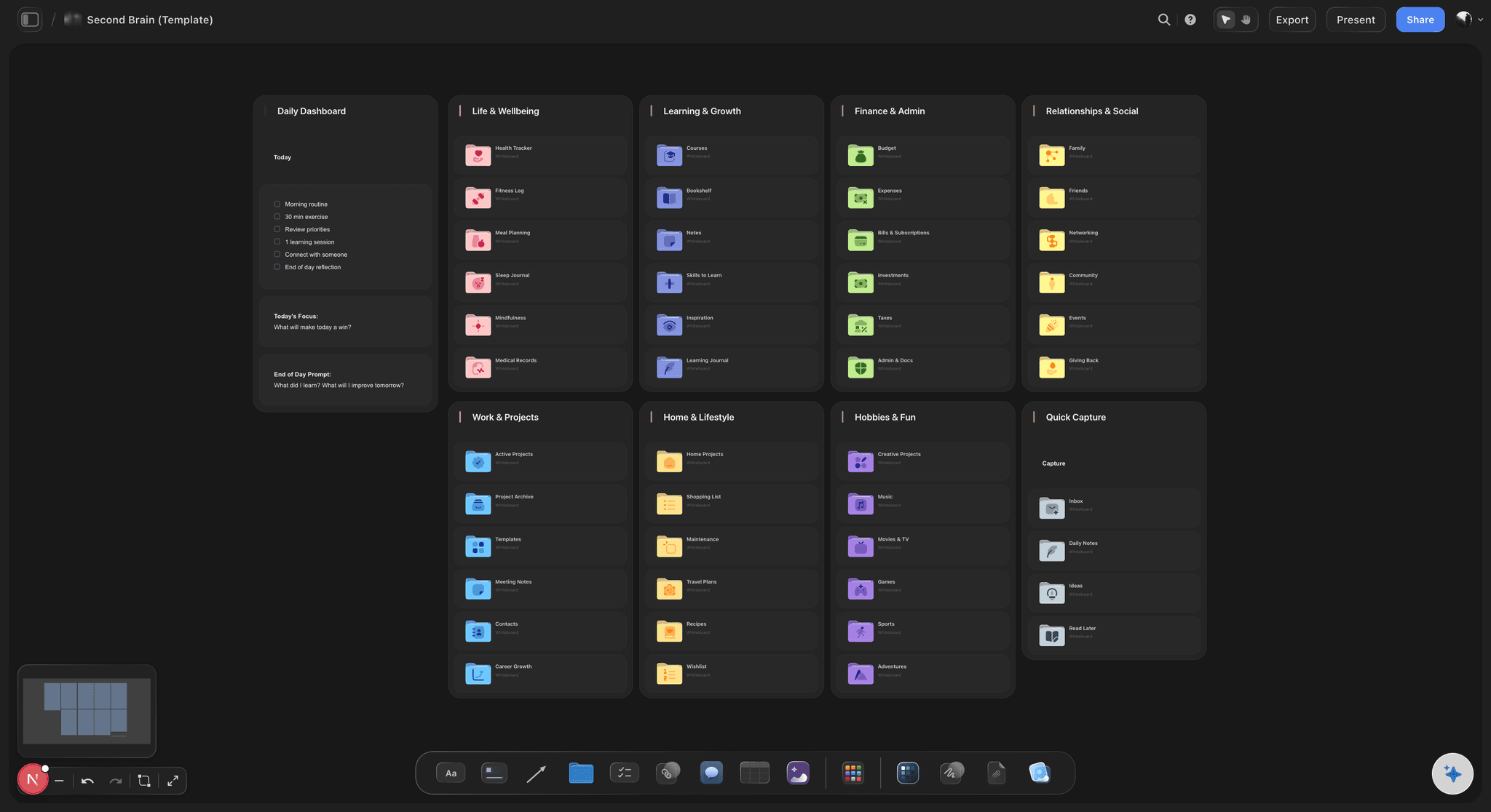
A Storyflow Second Brain board: the whole one-person business held on one canvas so the operator does not have to hold it in their head
Best AI Tools for Solopreneurs 2026: Market Context
The "AI for entrepreneurs" market in 2026 has a problem most lists ignore. The lists themselves are 50-tool feature dumps written for a fantasy operator who has time to learn 30 SaaS UIs between sales calls. That operator does not exist. The real solopreneur is a single human running brand, marketing, sales, ops, customer success, and the actual product, while also answering DMs and approving invoices.
The constraint that matters for a one-person business is not what the tools can do. It is how much attention each tool costs to keep in your stack. A solopreneur with a 30-tool stack spends Sunday night reconciling notifications, not building. The tools that win for solo founders in 2026 are the ones that collapse multiple functions into one workspace, hold context across them, and require the least manual context-passing between tabs.
The AI subscription stack for a solopreneur in 2026 is realistically $50 to $200 per month, depending on how much outbound, content, and customer service automation is in play. Above that number, the math starts working against the business unless the tools are directly producing revenue. Below it, the operator is leaving real leverage on the table.
How We Evaluated the Best AI Tools for Solopreneurs 2026
Six criteria shaped every rating. Each test was run against the actual workload of a solopreneur: a brand doc that needed updating, a launch plan that needed sequencing, a customer persona, a pricing page, and a Monday morning that needed an agenda.
Cognitive load reduction: Did the tool replace two or three other tools, or add a new one to the stack? Tools that consolidated thinking, planning, and execution scored high.
Context awareness: Could the AI read more than the current chat? Generic chat with one paste-in scored low. Multi-document, project-aware AI scored high.
AI quality: Was the output usable and grounded in your business, or generic LinkedIn-shaped advice?
Workflow coverage: How many functions of a one-person business did the tool cover meaningfully? Brand, marketing, sales, ops, customer success, and product all matter.
Pricing: Total annual cost including AI add-ons. Sticker prices were treated as marketing copy until verified inside an account.
Free plan usability: Was there a real free plan or a 14-day trial dressed as one? For solopreneurs in their first 12 months, free plans matter.
The 13 Best AI Tools for Solopreneurs 2026, Ranked
1. Storyflow
Storyflow is a visual AI project canvas built for creators, founders, and operators who run multiple functions of a business in their own head. For solopreneurs, the canvas is the business. Pin the brand pyramid, the customer persona, the marketing plan, the product roadmap, and a Hero's Journey or AIDA Tactic, and the AI reads them as one connected project.
What separates Storyflow from the other tools on this list is not the canvas. Other tools have canvases. It is the AI's relationship to the canvas. When you open AI chat in Storyflow, the AI reads everything currently on the board. You can @-mention up to three Documents and one Blueprint Tactic in the same conversation. That is your brand strategy doc, your customer persona, your launch plan, plus a Marketing Funnel Tactic, all in the AI's context window before it responds. For a solopreneur drafting Q3 strategy on Sunday night, that context recombination is the actual feature.
Best for: Solo founders, freelancers running an agency-of-one, course creators, and indie operators who run brand, marketing, and product themselves.
Key features:
200+ Blueprint Tactics for solopreneurs. Brand Pyramid, Customer Persona, AIDA, Hero's Journey, Marketing Funnel, Lean Canvas, Value Proposition Canvas, and SWOT live as guided Tactics with AI assistance on each block.
AI chat with full canvas, three Documents, and one Tactic in context. The largest contextual frame in any tool on this list. Drafting a launch plan while the AI reads the brand pyramid and the customer persona is a different experience from chatting with a context-blind model.
Documents alongside the canvas. Marketing plans, treatments, brand strategy docs, and offer pages live as Documents in the same project. The AI can read them as context during chat.
Kanban view for solopreneur workflow. Track launches, content, and deliverables through stages: Idea, In Progress, Review, Shipped. One canvas, one project board, one source of truth.
Pricing: Paid-only early access today; the Free plan (unlimited boards, basic AI usage, 20 file uploads) launches before the end of 2026, and anyone a paid member invites to a board joins free now. Unlimited boards, unlimited cards (notes, images, links), unlimited collaboration with as many teammates as you want, basic AI usage, and 20 file uploads. Plus: $7.99/month billed annually or $9.99/month billed monthly (full 200+ Blueprint Tactics, unlimited file uploads). Pro: $14/month billed annually or $19/month billed monthly (adds AI image generation and 20x more AI than Plus). Max: $39/month billed annually or $49/month billed monthly (adds 40x more AI plus Team Workspace with Permissions and Roles).
Pros:
- The only tool on this list where AI reads the full project canvas, plus one Tactic and three Documents, in one context window
- Brand and marketing frameworks as first-class Tactics, not blank Notion templates
- The Free plan, launching before the end of 2026, is built to be functional for a solopreneur running brand, marketing, and product on one canvas
- Replaces three or four tools (whiteboard, brand doc, project board, AI chat) with one
Cons:
- Not a CRM. For outbound and pipeline, pair with Apollo or HubSpot.
- Real-time multi-user editing is on the Max plan. Solo operators do not need it.
- The 200+ Tactics library has a learning curve. Operators need to explore which Tactics fit their business.
Verdict: Storyflow is the right tool for solopreneurs whose work spans brand, marketing, ops, and product and who need the AI to hold all four at once. For CRM and outbound, pair with Apollo. For raw long-form drafting, pair with ChatGPT or Claude. Rebuild your most active project on a Storyflow board and ask the AI one cross-function question to see whether the context recombination is worth the seat.
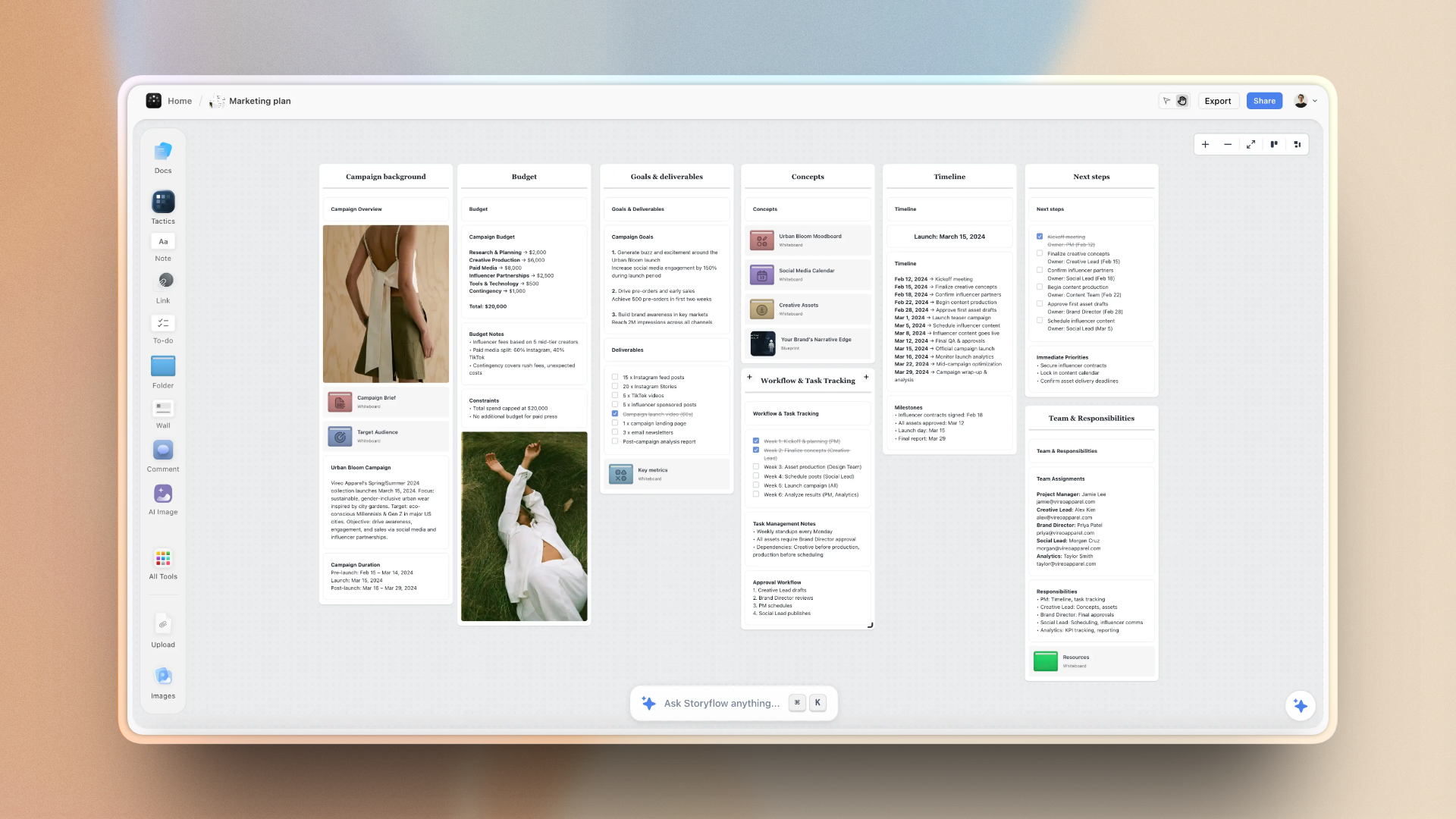
Storyflow's solopreneur canvas: brand pyramid, customer persona, marketing plan, and the AI assistant all on one project board
2. Framekit
Every list of solopreneur tools is a list of things that help you make the work. This is the one that helps you sell and deliver it, and for a one-person business that half is usually the more expensive one.
Framekit is an all-in-one creative toolkit for freelancers. Four surfaces on one account: an AI website builder for your site and per-offer landing pages, client galleries for delivering work, timecoded video review for anything moving, and a store for selling digital products. The specific solopreneur problem it solves is the one this article opened with, which is fourteen tabs and three subscriptions you forgot you were paying for. A typical one-person business pays a website builder, a gallery or file-delivery service, a checkout platform, and sometimes a review tool, and not one of those four makes the work any better. They make it presentable, deliverable and payable.
The store matters more than it looks on a solopreneur list. Selling a template pack, a preset, a guide, or a course workbook from the same account as the site that markets it removes both a subscription and the handoff where a visitor leaves your domain to complete a purchase. The transaction fee is 5 percent on Free and Starter, 3 percent on Pro, and zero on Business, so at real volume the top tier pays for itself against a percentage-based checkout.
Best for: Solo operators who sell or deliver something to clients, and are currently paying three or four separate bills to look professional.
Pricing: Free covers 10 pages, unlimited client galleries with 3GB of photo storage, and video review with 2GB of video storage, at a 5 percent transaction fee. Starter is $9/month, or $7 billed annually, adding a custom domain, 15GB of site storage, 10GB of gallery storage, 10GB of review storage, and branding removal. Pro is $19/month, or $15 annually, with unlimited site storage, 100GB of gallery and review storage each, and a 3 percent fee. Business is $39/month, or $31 annually, with 1,000GB of gallery storage, 500GB of review storage, unlimited pages and forms, and zero transaction fees. Flat per account, not per seat.
Where Framekit loses, plainly:
- It does not think. No canvas, no AI that reads your strategy, no brand pyramid or customer persona. It is downstream of every planning tool on this list, which is exactly why Storyflow ranks above it.
- It is not a CRM and not an invoicing tool. No contracts, no proposals, no payment tracking beyond the store. That is a different subscription and this list does not pretend otherwise.
- A generalist loses to specialists on depth. A dedicated site builder has more layout control, a dedicated gallery platform has deeper print-store automation, and a dedicated review platform integrates with editing software. Consolidation is a cost and admin argument, never a capability one.
- Storage caps are the real ceiling, and video reaches them long before the page count does.
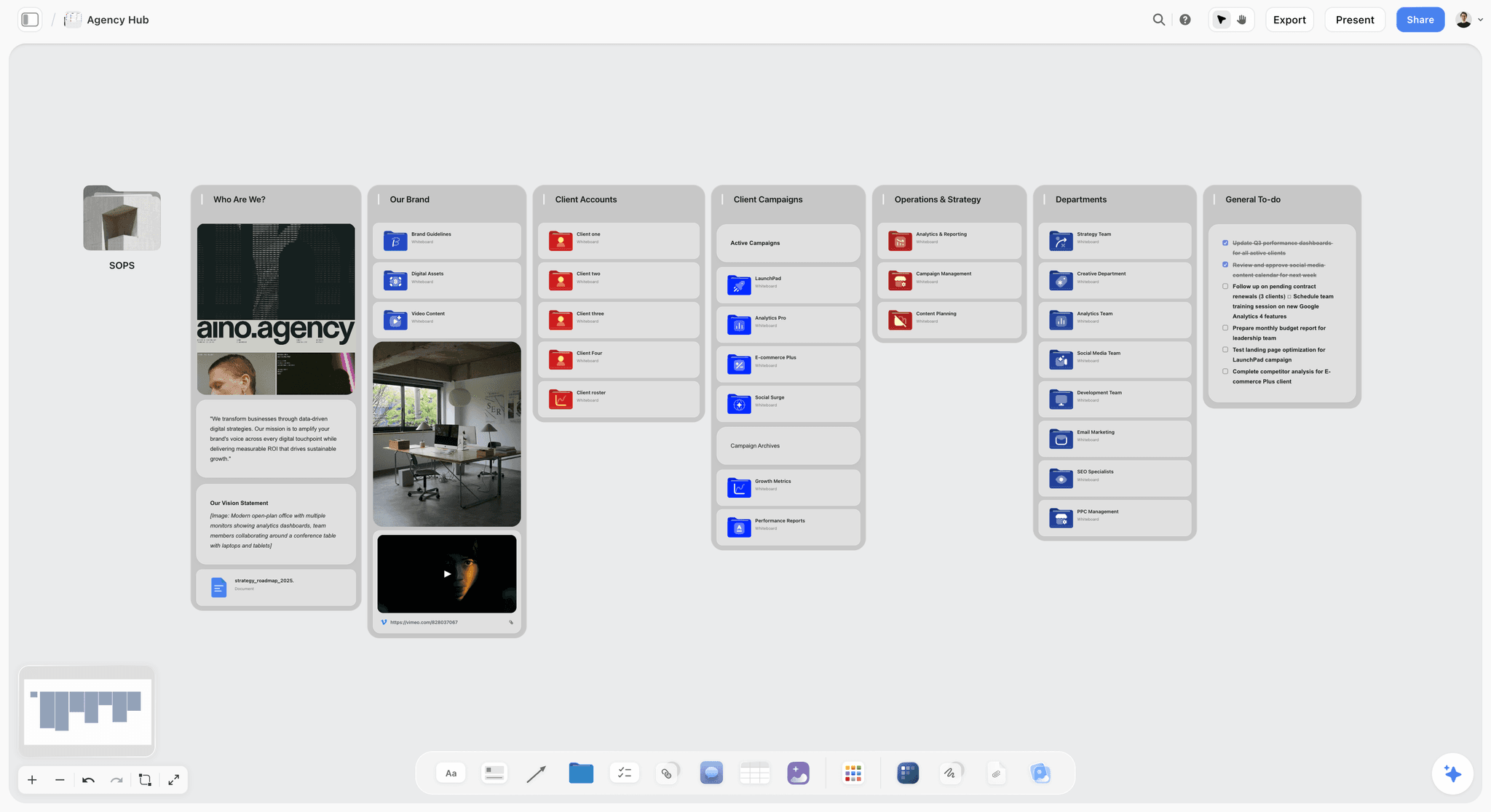
Storyflow's solopreneur canvas and Framekit's client-facing surface solve opposite halves of a one-person business
3. ChatGPT (Plus / Team)
ChatGPT is the default AI tool for almost every solopreneur in 2026, for one reason: the prompt surface is open and the output volume is high. For headline variations, social hook ideation, outline expansion, and sales email drafts, ChatGPT is the workhorse most operators reach for first.
Best for: Solo operators who want maximum drafting volume and flexibility.
Pricing: Free tier with capped capability. ChatGPT Plus at $20/month, Team plans starting around $30/month per seat. Verify on the OpenAI site.
The strength is generality. The weakness is the same. There is no canvas, no project structure, no brand doc primitive. The operator is responsible for keeping their business in the conversation, which means pasting context every session. For a solopreneur who wants the tool to do some of the structural work (a canvas, a brand pyramid, a customer persona), ChatGPT alone is not enough. It pairs well with Storyflow as the structural layer underneath.
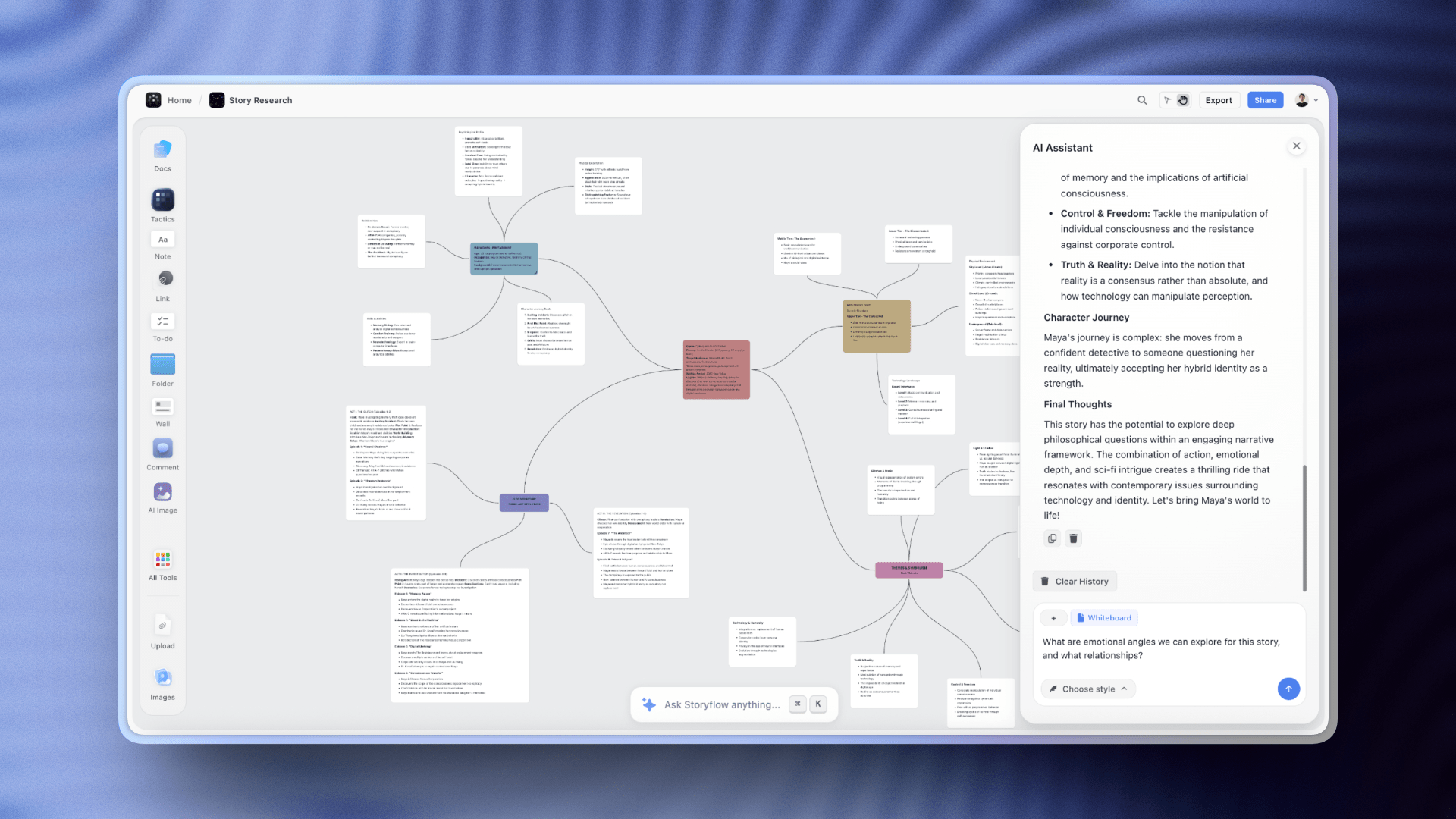
Storyflow's canvas-aware AI chat, the project-aware version of the chat interface ChatGPT offers without context of your business
4. Notion AI
Notion AI sits inside Notion as a write-and-summarise layer on top of pages, databases, and notes. For solopreneurs already running a Notion-based ops stack (CRM, project management, content calendar in databases), Notion AI is the lowest-friction way to add AI on top.
Best for: Solopreneurs already deep in Notion who want AI inside their existing workspace, not a new tab.
Pricing: Notion AI is around $10/month per seat as an add-on, on top of the base Notion plan. Verify on the Notion site.
The strength is integration. The AI reads the page you are on, can summarise databases, and helps with drafts inside the same surface where your ops live. The weakness is depth. Notion AI is competent for summarisation, expansion, and lightweight drafting. It is not the tool for brand strategy work, structured frameworks, or canvas-style thinking. For a solopreneur whose Notion is already 200 pages deep, Notion AI earns its $10. For a solopreneur looking for the AI workspace itself, Storyflow goes further.

Storyflow Folders organising a solopreneur's workspace, the structured-by-default surface that Notion AI tries to add on top of an existing Notion stack
5. Claude (Pro)
Claude, from Anthropic, is the AI most aligned with long-form writing and document reasoning in 2026. The 200K-plus token context window means a brand strategy doc, a customer persona, a launch plan, and a 50-page market research report can sit in the same conversation.
Best for: Solo operators who write a lot, read a lot of source material, and want an AI that reasons over long documents without losing thread.
Pricing: Free tier with capped capability. Claude Pro at $20/month. Verify on the Anthropic site.
Claude is not a workspace. It is a chat AI. The lack of a canvas, a Tactic library, or a project structure means the solopreneur holds the system. For a founder writing long-form content, drafting positioning docs, or reading customer interview transcripts, Claude is one of the strongest tools available. Pair with Storyflow when the AI needs a project to live inside.
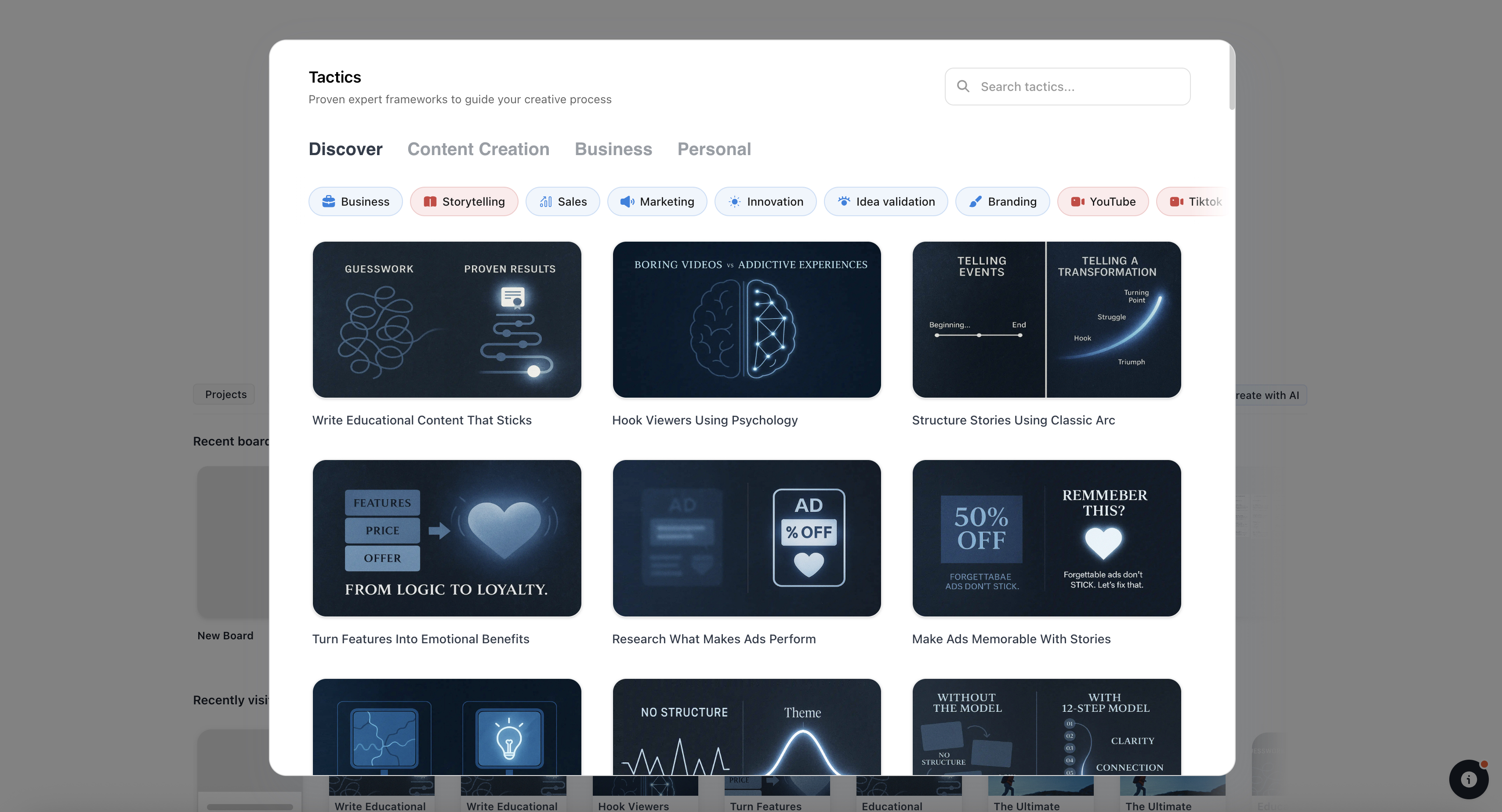
Storyflow's structured Blueprints view, the long-document context Claude reads when @-mentioned in a chat
6. ClickUp Brain
ClickUp Brain is the AI layer inside ClickUp. For solopreneurs already running their entire business inside ClickUp, Brain adds AI summarisation, drafting, and task generation across the workspace.
Best for: Solo operators committed to ClickUp as their operating system who want AI inside it.
Pricing: ClickUp plans start around $7/month per seat billed annually. Brain is an add-on. Verify on the ClickUp site.
The strength is breadth. The weakness is the UI complexity that is ClickUp's reputation: a deep, dense interface that takes weeks to learn well. For a solopreneur who already loves ClickUp, Brain is a strong add-on. For a solopreneur looking for a low-cognitive-load workspace, Storyflow's canvas-first model is faster to set up and easier to keep clean over time.

Storyflow's Kanban view tracking solopreneur deliverables from idea to shipped, the lighter-weight version of the project layer ClickUp Brain sits on top of
7. Apollo + AI Outbound (Apollo, Clay, Smartlead)
The 2026 outbound stack for a solopreneur is rarely one tool. It is three: Apollo for contact database and sequencing, Clay for AI enrichment, and Smartlead for inbox warmup and deliverability. AI runs the personalisation layer that used to require a junior SDR.
Best for: Solo founders running a B2B offer who need outbound at scale without hiring an SDR.
Pricing: Apollo from around $49/month per seat. Clay from around $134/month annual. Smartlead from around $39/month. Total realistic stack: $200 to $300/month. Verify on each vendor's site.
Clay enriches contacts with public data (LinkedIn signals, company news, recent funding), and a prompt-driven step generates a one-line personalisation that drops into Apollo or Smartlead. The weakness is that none of this replaces a real offer. AI personalisation on a weak offer to the wrong list still gets ignored. For solopreneurs whose offer is already validated, this is one of the highest-leverage AI investments available in 2026.
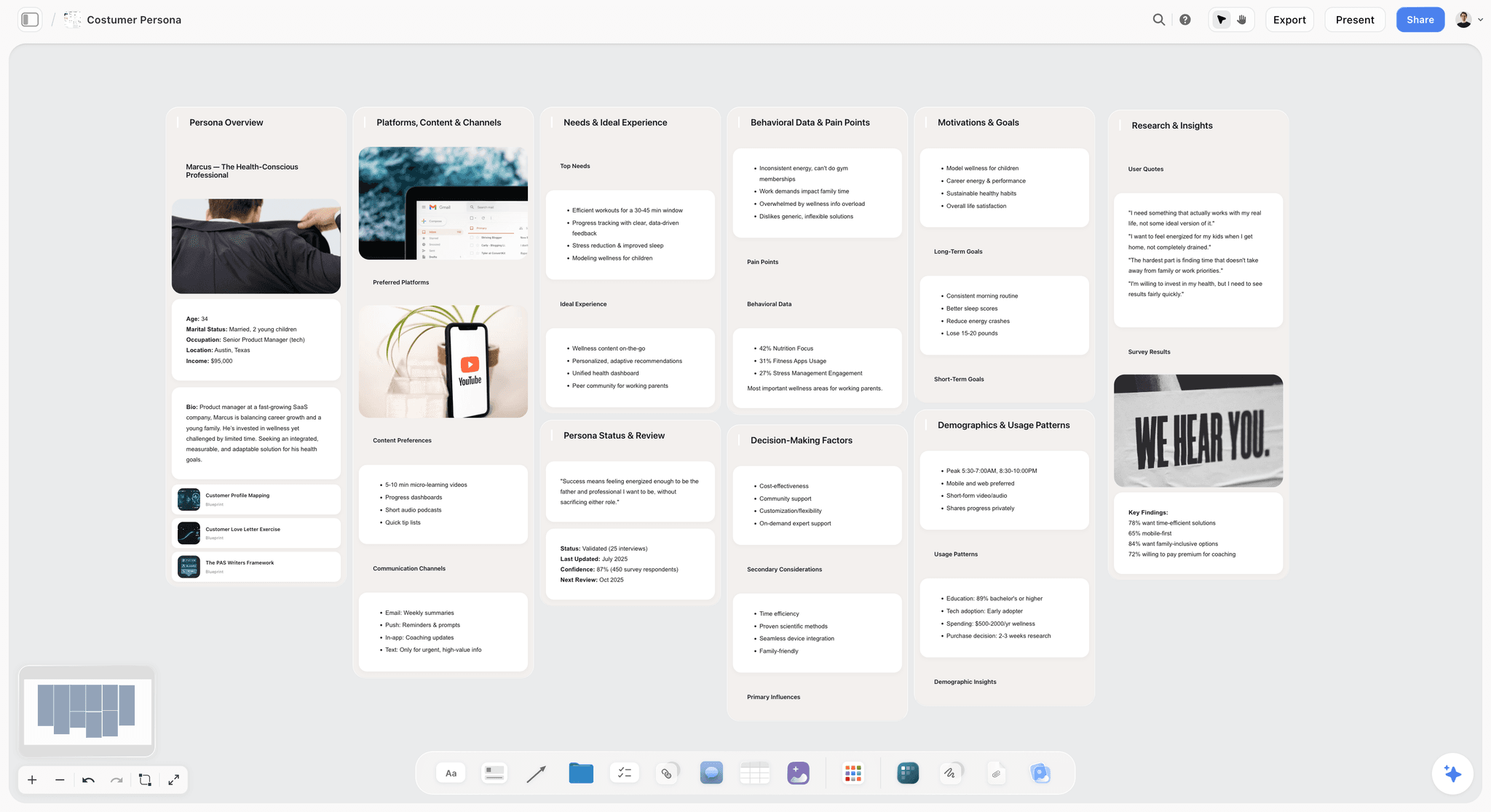
Storyflow Customer Persona Tactic, the strategic layer that should sit underneath any Apollo + Clay + Smartlead outbound stack
8. Reflect (AI-first notes for journaling)
Reflect is an AI-first notes app built around journaling. For solopreneurs, the use case is the founder journal: a daily place to capture decisions, customer insights, and what is working, with AI surfacing patterns over time.
Best for: Solopreneurs who want an AI-first journaling tool separate from their project workspace.
Pricing: Plans start around $10/month billed annually. Limited trial available. Verify on the Reflect site.
Reflect is not trying to be Notion or ClickUp. It is trying to be the founder's daily notebook with an AI that reads back. The weakness is that it does not replace the project workspace. For a solopreneur who wants journaling and project work in one place, Storyflow Documents inside a project canvas covers both surfaces with AI that reads both.

Storyflow Personal Brand Analysis canvas, the daily-journal-meets-strategy surface Reflect tries to approximate with a chronological notebook
9. Jasper (marketing copy)
Jasper is one of the original AI marketing copy tools, now positioned as a brand-voice-aware generator. Brand voice training, templates, and campaign workflows are designed for marketers who need on-brand copy at scale.
Best for: Solopreneurs running content-heavy marketing who want a tool that learns and enforces a brand voice.
Pricing: Paid plans start around $39/month billed annually. Verify on the Jasper site.
The strength is brand voice. Jasper takes brand documents and sample copy and produces output that approximates the brand. The weakness is the price-to-value ratio. ChatGPT and Claude can do most of what Jasper does at a fraction of the cost, with a well-built system prompt and a brand voice doc. Jasper earns its premium for marketing teams running multi-brand content at scale, which is rarely the solopreneur scenario. For a solo operator, the cheaper stack is a Storyflow brand pyramid plus ChatGPT or Claude with a brand-voice prompt.
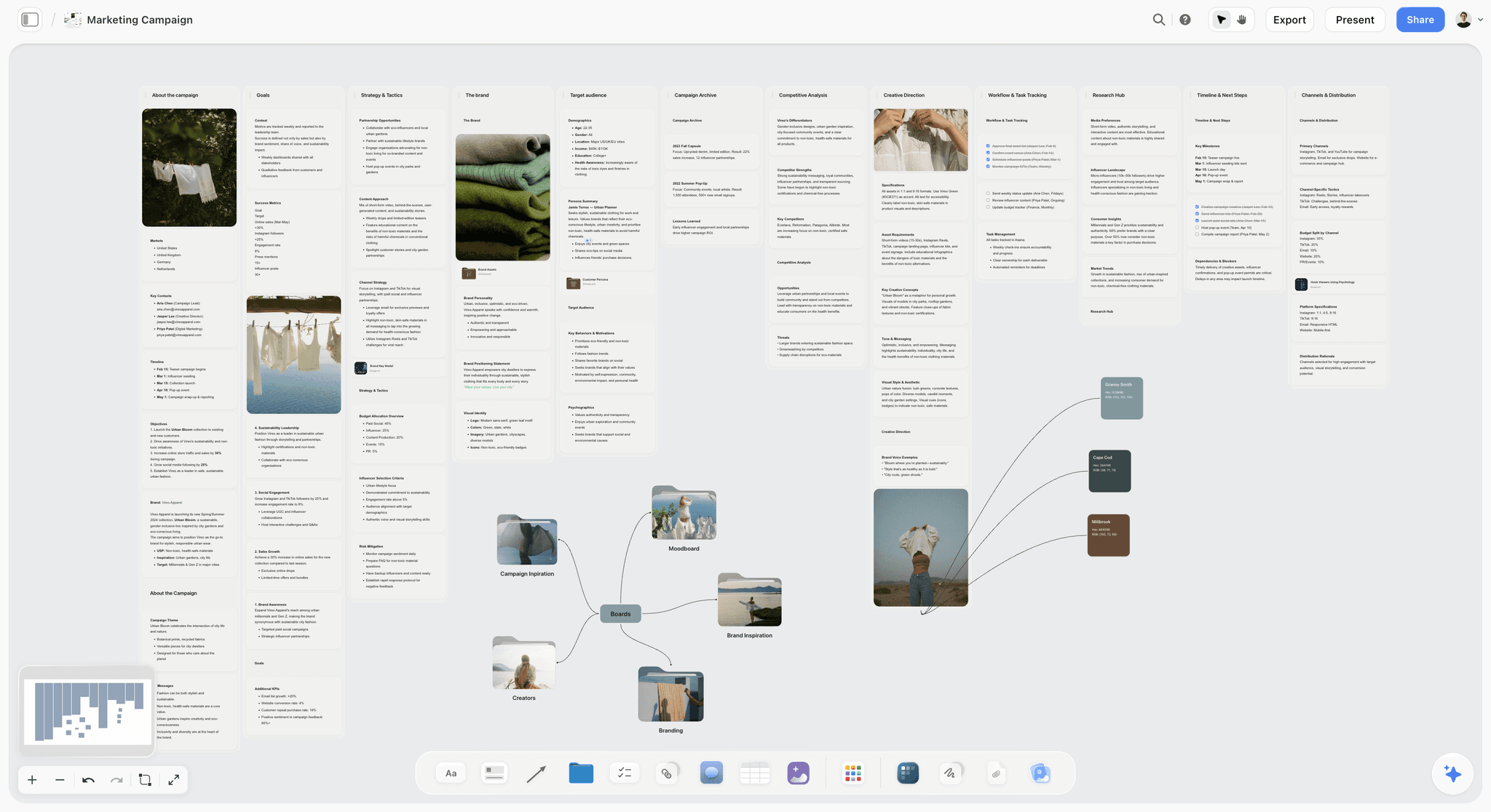
Storyflow Marketing Campaign canvas, the structured layer Jasper outputs against when given a brand voice doc
10. Intercom Fin (customer service AI)
Intercom Fin is the AI customer service agent inside Intercom. For solopreneurs running a SaaS or e-commerce offer, Fin handles tier-one customer questions, deflects routine tickets, and escalates the rest to a human (you).
Best for: Solo SaaS or e-commerce founders who want AI handling tier-one support without hiring a customer success person.
Pricing: Per-resolution and per-seat. Verify on the Intercom site.
Fin learns from your help docs. A solopreneur who has written 30 help articles can stand Fin up in a day and watch it deflect 50 to 60 percent of tier-one volume the first month. The weakness is the cost model. Per-resolution pricing scales with usage, and a busy product can run a meaningful monthly bill. For solo SaaS founders past their first 100 customers, this is one of the highest-ROI AI investments available. For pre-revenue founders, free or cheaper tools cover the same ground until volume forces the upgrade.
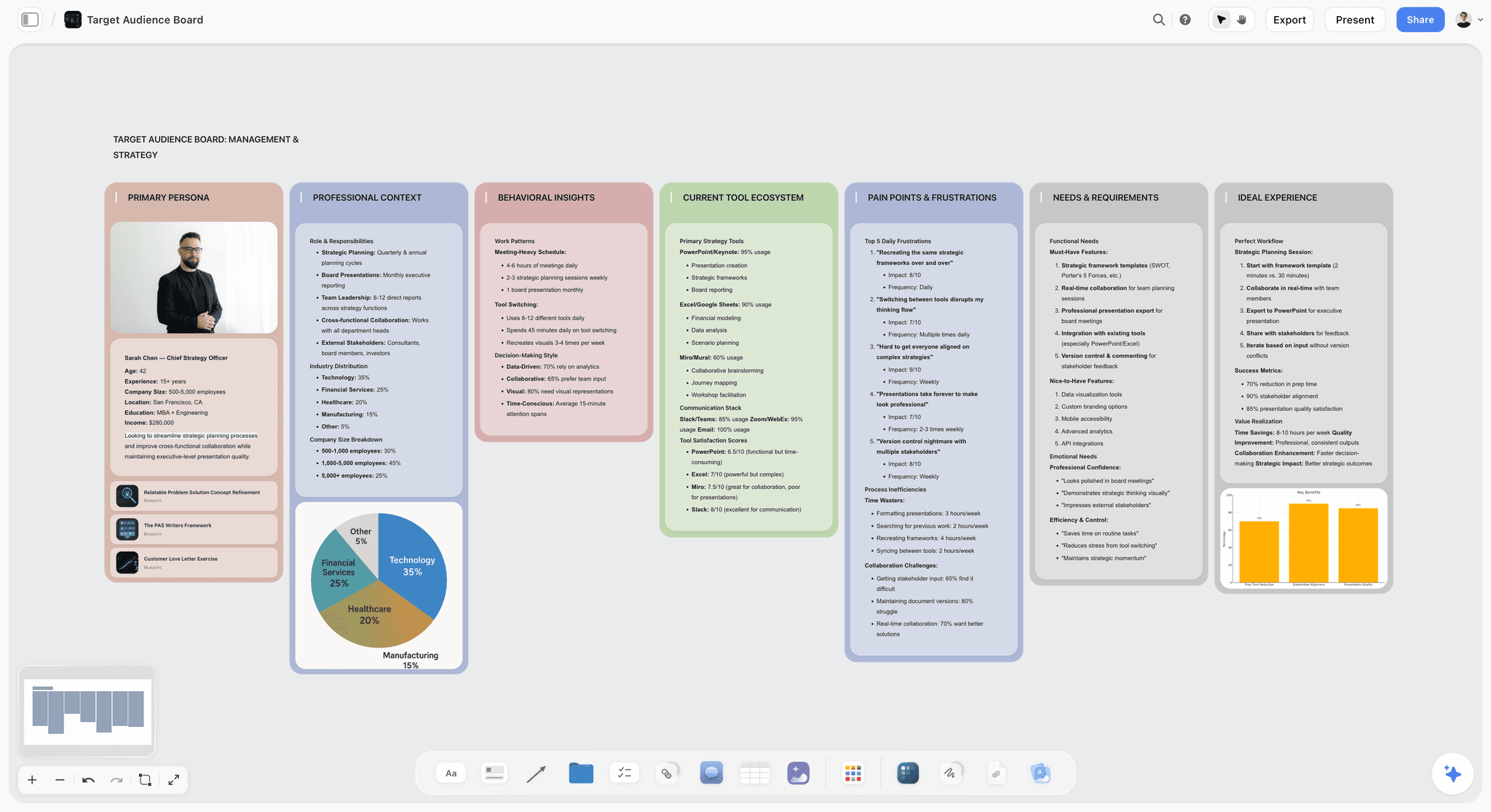
Storyflow Target Audience board mapping who the customer is and what they ask, the same customer context a Fin-style support agent reads from before answering
11. Sudowrite (long-form content / books)
Sudowrite is the AI writing tool built for prose. For solopreneurs writing a book, an email course, or a long-form newsletter, Sudowrite produces more usable raw text than any general-purpose chat AI.
Best for: Solo creators running a content-first business (newsletter, course, book) who want AI on the language of the page.
Pricing: Plans start around $10/month for the entry tier and scale by AI usage. Verify on the Sudowrite site.
The "Show Don't Tell," "Describe," and "Brainstorm" features push the writer through the next paragraph rather than through structure. The weakness is everything else. Sudowrite is not a workspace, not a project tool, and not a CRM. For solopreneurs whose business is words at scale, Sudowrite earns its seat. Pair it with Storyflow for the structural canvas underneath the prose.

Storyflow Mindmap feature, the structural layer that should sit underneath any Sudowrite-style long-form prose work
12. Mem (self-organizing notes)
Mem is the self-organising AI notes app. You capture, and Mem organises automatically, using AI to surface connections between notes over time.
Best for: Solopreneurs who capture a lot of fragments (voice notes, screenshots, quick text) and want AI doing the organisation work.
Pricing: Plans start around $15/month. Free tier available. Verify on the Mem site.
The strength is automatic organisation. For a solopreneur whose notes are scattered across iMessage-to-self, screenshots, and three other apps, the "let the AI organise it" model is appealing. The weakness is trust. Self-organising means giving up control over where notes live, which works for capture and breaks down for active project work. For project-level structure that AI can read into, Storyflow's canvas + Documents model is more deliberate.
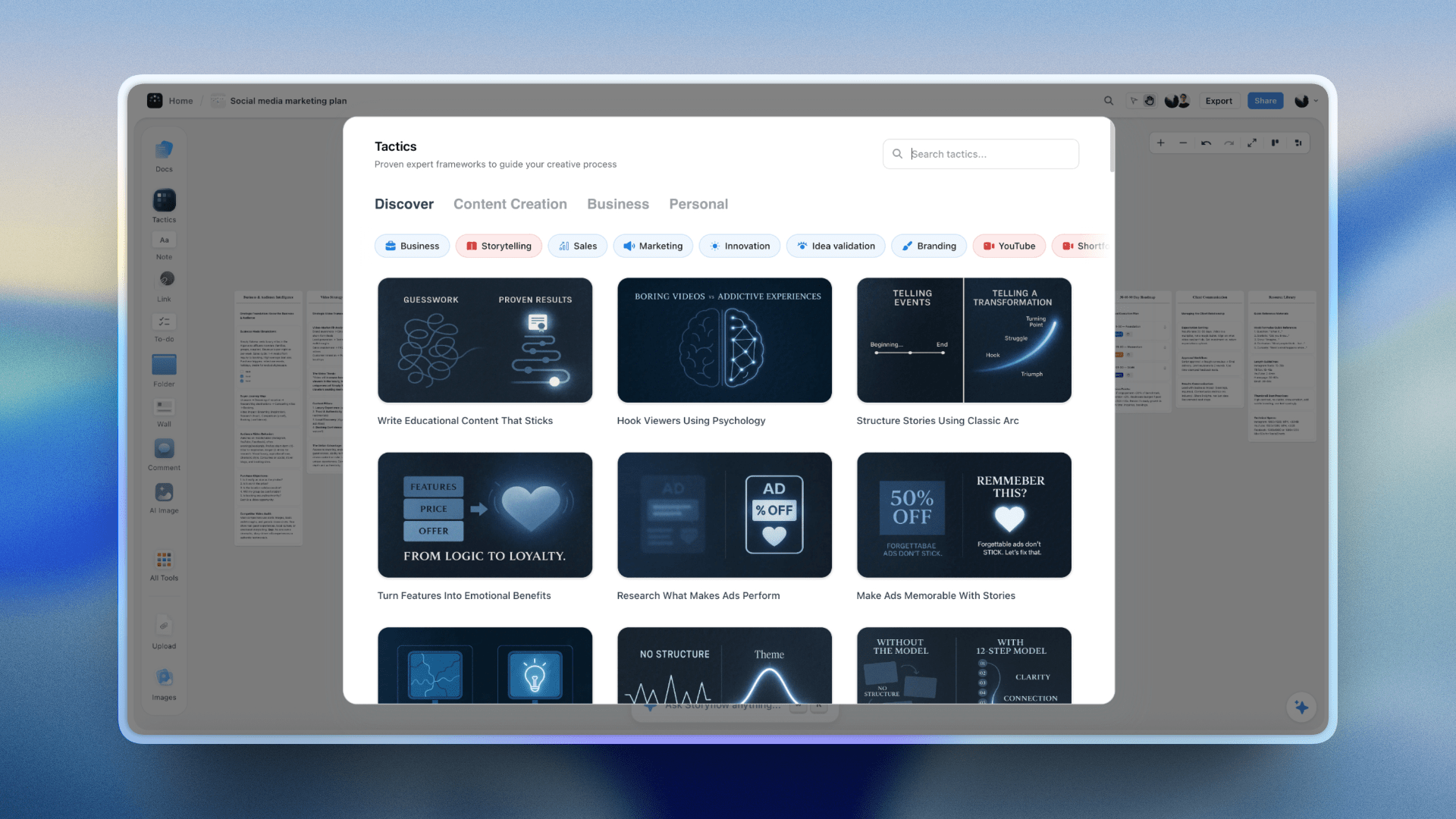
Storyflow Blueprint search, the structured-retrieval layer that Mem tries to approximate with self-organising notes
13. Cursor (for the technical solo founder)
Cursor is the AI-first code editor that has become the default for indie SaaS founders in 2026. Built on top of VS Code with deep AI integration for completion, refactoring, and full-codebase chat, Cursor is to coding what Storyflow is to project thinking.
Best for: Technical solo founders shipping their own SaaS who want AI inside their code editor.
Pricing: Free tier with capped usage. Cursor Pro at around $20/month. Verify on the Cursor site.
Cursor reads the codebase, holds files in context, and produces output that fits the project rather than generic snippets. The weakness is that it is a code editor. It does not help with brand, marketing, or customer work. For a technical solopreneur, the right stack is Cursor for the codebase plus Storyflow for everything else.

Storyflow's designer-facing project view, the "everything but code" surface that pairs with Cursor for technical solo founders
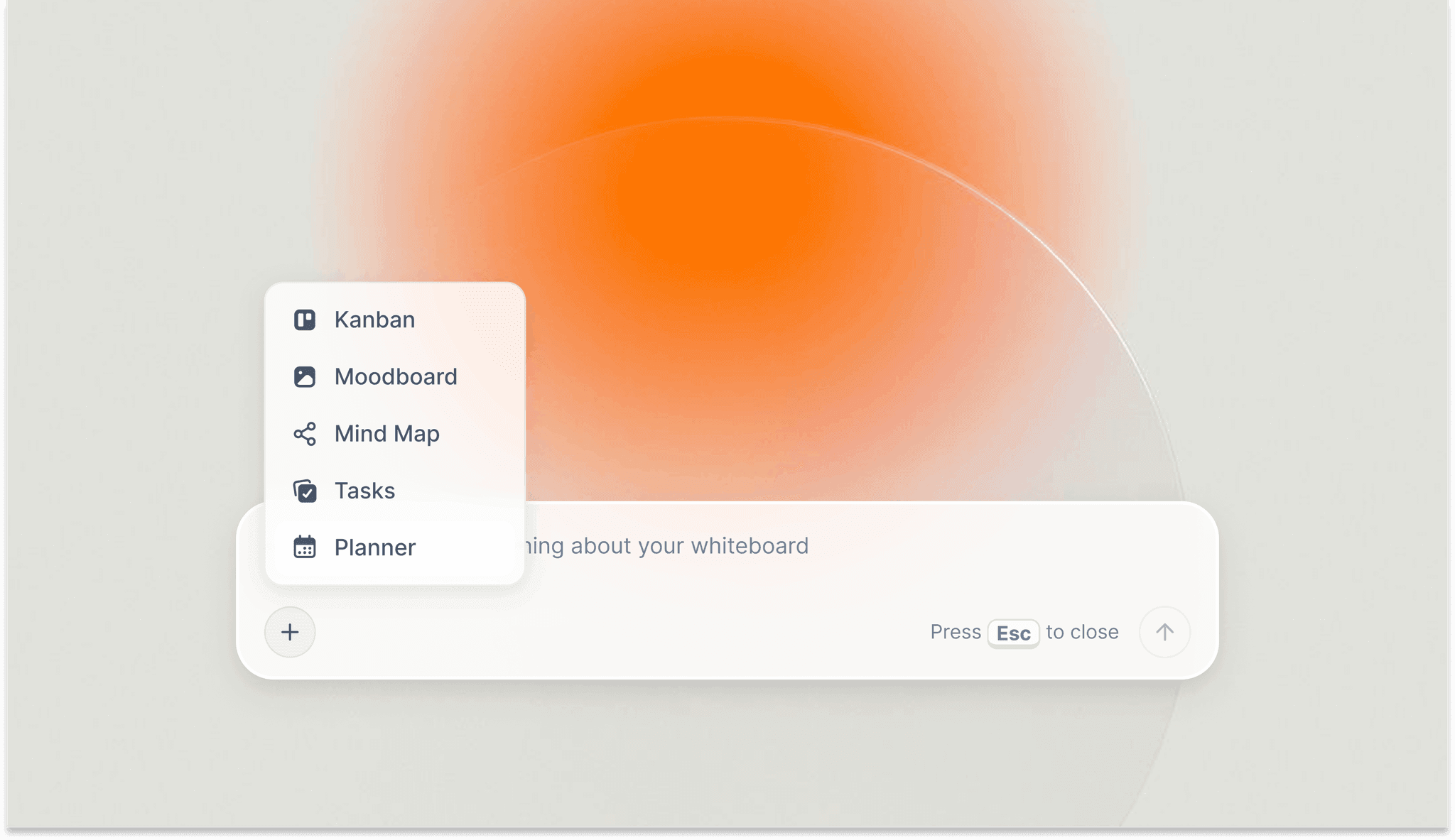
AI Planner turns a goal into a weekly plan grounded in the project canvas already in front of you
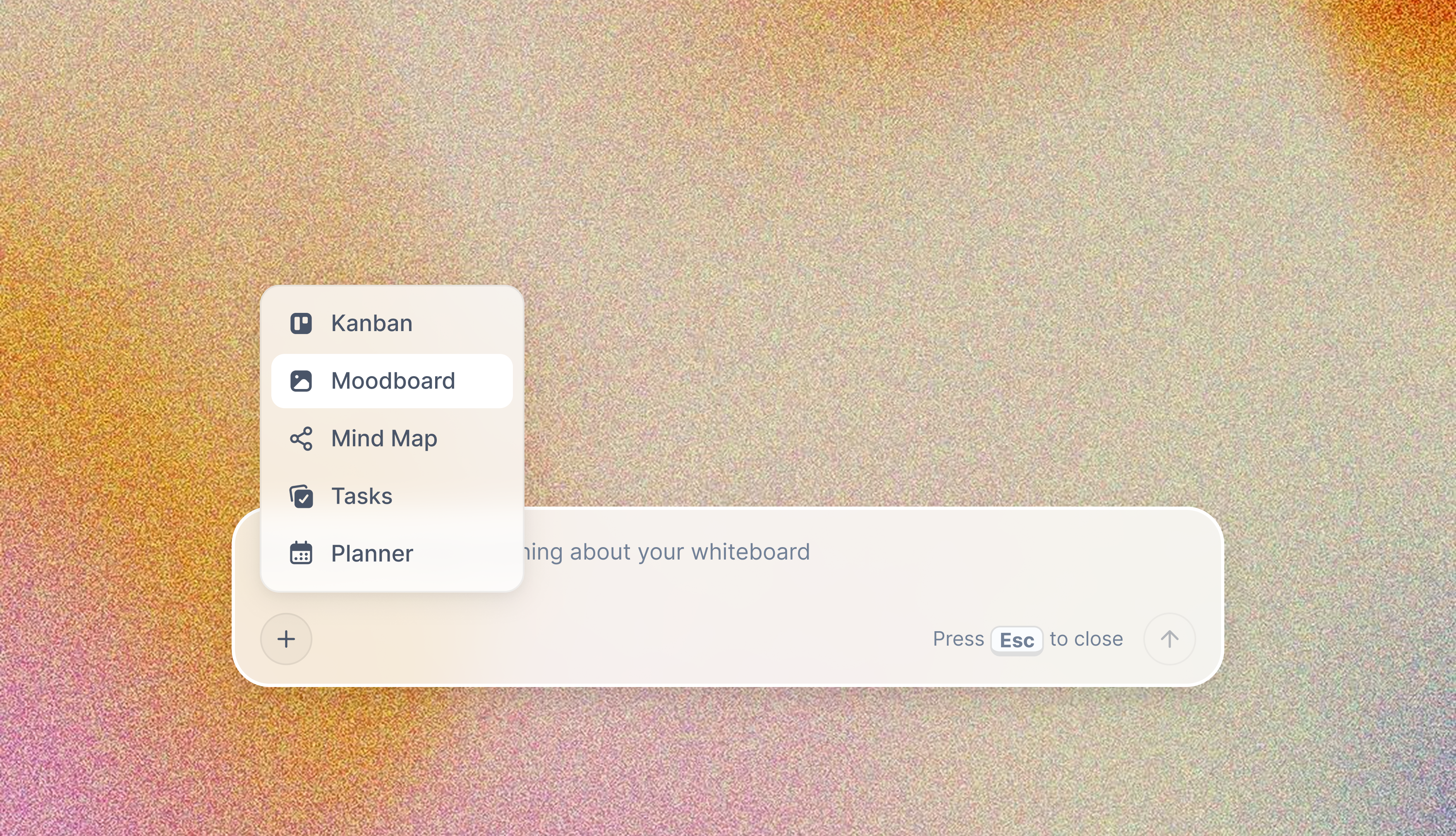
AI Moodboard pulls brand-aligned references into the same canvas as the marketing plan and customer persona
How to Pick the Right AI Stack as a Solopreneur in 2026
The honest answer is that no single tool covers the whole one-person business. The question is which gap you feel most, and which archetype of solopreneur you are. The five archetypes below cover most of the operators reading this, with the right three-tool stack for each.
Indie SaaS founders. Storyflow for product strategy, customer personas, brand, and marketing plans. Cursor for the codebase. Intercom Fin (or a free equivalent until volume forces the upgrade) for tier-one customer support. Total budget: $14 to $80 per month, depending on Storyflow tier and Intercom usage. One tool for thinking, one for building, one for customer volume.
Agency-of-one consultants. Storyflow for client brand work and proposal documents. Framekit for the site, the per-client pitch page, and the galleries or review links deliverables go out through. ChatGPT or Claude for fast drafting and research. The outbound stack (Apollo + Clay + Smartlead) for client acquisition. Total budget: $260 to $360 per month. A workspace that holds multiple client projects, a client-facing surface that makes one person look like a studio, an AI that drafts at speed, and an outbound layer that runs while the consultant is delivering.
Course creators. Storyflow for course architecture (Hero's Journey or AIDA for the arc, Customer Persona for the audience). Sudowrite for long-form lesson copy. Framekit for the sales page and the store the workbook or template pack is actually sold from, at zero transaction fee on its top tier. Budget: $40 to $70 per month.
E-commerce solo operators. Storyflow for brand and marketing plans. ChatGPT for product copy and ad variations. Klaviyo for email automation with AI. Total budget: $50 to $150 per month.
Content creators and influencers. Storyflow for content strategy, brand pyramid, and series planning. Sudowrite or Claude for long-form drafting. Notion or Airtable for the content calendar. Total budget: $30 to $50 per month. Most creators try to do all three in Notion and burn out on the strategy layer first.
The pattern across all five archetypes is that the strategic and structural layer (the brand, the customer, the plan) is the one most often missing or scattered, and the one that produces the most leverage when consolidated. Storyflow earns the top seat in each archetype because it is the tool most designed for that layer. The other tools are leverage on top of the foundation.
There is a second pattern worth naming, because it is the one that quietly costs the most. Every archetype above also needs somewhere for the work to be seen, delivered and paid for, and almost every solopreneur assembles that from separate subscriptions without ever deciding to. Audit it once: list every tool a client or customer touches, add up the monthly cost, and ask which of them make the work better rather than merely presentable. That number is usually larger than the AI budget the whole rest of this article is about.
Best AI Tools for Solopreneurs 2026 Pricing Compared
| Tool | Free Tier | Entry Paid | Mid Tier | Pro / Top Tier |
|---|---|---|---|---|
Storyflow | Coming late 2026 (invited collaborators join free now) | $7.99/month annual (Plus) | $14/month annual (Pro) | $39/month annual (Max, real-time team) |
ChatGPT | Yes (limited) | $20/month Plus | $30/month Team | $200/month Pro |
Notion AI | Yes (limited AI) | Around $10/month add-on | Same | Same |
Claude | Yes (limited) | $20/month Pro | Team plans | Verify on site |
ClickUp Brain | Yes (limited) | Around $7/month annual + Brain add-on | Higher tiers | Verify on site |
Apollo | Limited trial | Around $49/month | Around $79/month | Custom |
Clay | Limited trial | Around $134/month annual | Higher tiers | Custom |
Smartlead | Limited trial | Around $39/month | Around $94/month | Custom |
Reflect | Limited trial | Around $10/month annual | Same | Same |
Jasper | Limited trial | Around $39/month annual | Higher tiers | Custom |
Intercom Fin | No standalone free | Per resolution | Per seat | Verify on site |
Sudowrite | Limited trial | Around $10/month | Around $22/month | Around $44/month |
Mem | Yes (limited) | Around $15/month | Higher tiers | Verify on site |
Cursor | Yes (limited) | Around $20/month Pro | Business plan | Verify on site |
For a working solopreneur, the realistic monthly AI stack lands between $50 and $200, depending on whether outbound is in play and whether customer service is automated. For an indie SaaS founder pre-revenue, the stack can run as low as $14 to $34 per month. For an agency-of-one running active outbound, the stack lands around $250 to $350 per month, justified by pipeline.

Storyflow Pro unlocks 200+ Blueprint Tactics, AI image generation, and 20× more AI for solopreneurs running parallel projects
Final Verdict: Best AI Tools for Solopreneurs 2026
The best AI tool for solopreneurs in 2026 depends on which gap in your one-person business you are filling.
If your gap is holding the whole business in context (brand, customer, plan, product) while you make decisions, Storyflow is the answer. The canvas holds the business, the AI reads it as one, and the 200+ Blueprint Tactics include the strategic frameworks you actually need. Plus at $7.99/month billed annually opens the full Tactics library; Pro at $14/month adds AI image generation and 20× more AI.
If your gap is raw drafting volume, ChatGPT or Claude belongs in your stack at $20/month. If your gap is outbound at scale, the Apollo + Clay + Smartlead stack is the highest-leverage investment available in 2026. If your gap is customer support past 100 customers, Intercom Fin earns its keep.
The honest answer for most solopreneurs is a stack of three or four of these tools, not all twelve. Storyflow as the strategic and structural layer, one chat AI for drafting, and one specialist tool for whichever function consumes most of your time. The 30-tool stack is the failure mode. The three-tool stack is the win.
If the part of your business you carry in your head is the strategic layer (brand, customer, plan, product), generate a customer persona with AI to anchor it, then put your most active project on a Storyflow canvas for one week and run every Monday-morning "what do I ship this week" question through the AI while it reads that board. By Friday you will know whether the canvas is holding the context you have been holding alone.
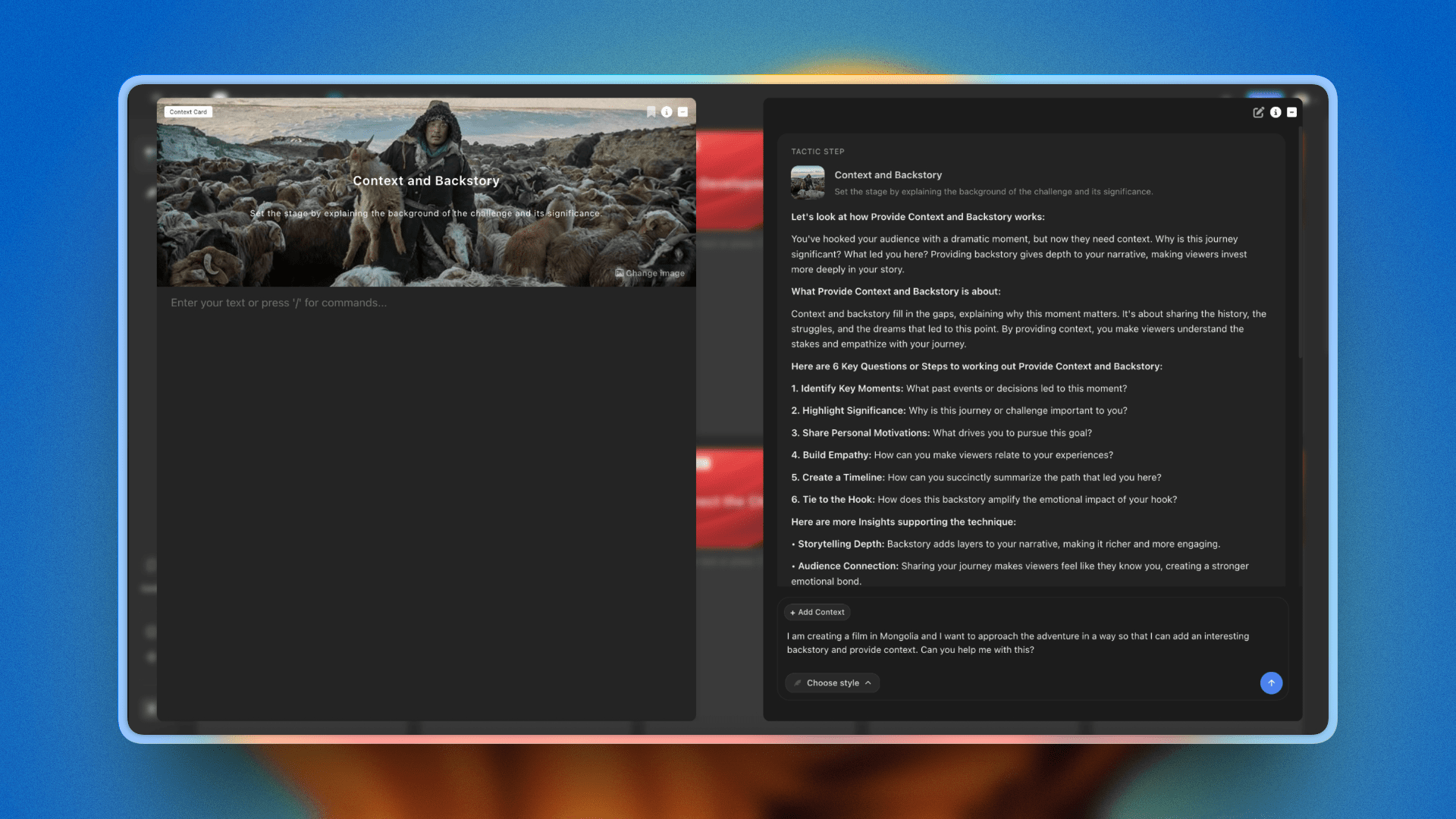
Brand Pyramid, Customer Persona, AIDA, and Marketing Funnel Tactics open on the canvas with AI on every block
FAQ: Best AI Tools for Solopreneurs 2026
What is the best AI tool for a solo founder?
For most solo founders in 2026, the best single AI tool is Storyflow, paired with a chat AI (ChatGPT or Claude at $20/month). A solo founder is running brand, marketing, customer, and product decisions in their head, and the cost of pasting context into a chat AI every session compounds quickly. Storyflow's canvas holds those decisions in one project, and the AI reads the canvas plus three Documents and one Tactic in a single conversation. For technical founders shipping their own SaaS, add Cursor.
Are there free AI tools that are actually good for solopreneurs?
Not during early access. Storyflow's Free plan, which launches before the end of 2026, will be unusually generous: unlimited boards, unlimited cards (notes, images, links), unlimited collaboration with as many teammates as you want, basic AI usage, and 20 file uploads. During early access Storyflow is paid-only, though anyone a paid member invites to a board joins free. It will be enough for a solopreneur running brand, marketing, and product on one canvas. The free tiers of ChatGPT and Claude are usable for prose-level drafting in moderation. Cursor has a free tier for technical operators. The realistic low-cost stack in 2026 is a free chat AI plus Cursor free, with Storyflow Plus at $7.99/month billed annually for the canvas, for a solopreneur's first six months.
How much should a solopreneur spend on AI tools?
The realistic AI subscription budget for a working solopreneur in 2026 is $50 to $200 per month. Below $50, the operator is leaving leverage on the table. Above $200, the math starts working against the business unless the tools are directly producing revenue. Indie SaaS founders pre-revenue can run as low as $14 to $34 per month. Agency-of-one consultants running active outbound realistically land at $250 to $350 per month, justified by pipeline.
Can AI replace hiring a virtual assistant?
For specific functions, yes. AI handles inbox triage, calendar drafting, meeting summarisation, content variations, and outbound personalisation as well as a junior VA in 2026, at a fraction of the cost. What AI does not replace is judgement, accountability, and follow-through across multi-week projects. AI replaces the first 12 to 18 months of VA-level work. After that, hire a senior operator (not another VA) when the volume forces it.
What is the most underrated AI tool for solopreneurs in 2026?
Storyflow Blueprint Tactics. The 200+ guided frameworks (Brand Pyramid, Customer Persona, AIDA, Hero's Journey, Marketing Funnel, Lean Canvas, Value Proposition Canvas, SWOT) replace a brand consultant for the first 80 percent of strategic work, at $7.99/month billed annually. Most solopreneurs spend years building a brand strategy doc badly in Notion, when a guided Tactic with AI assistance produces a better doc in 90 minutes.
Should solopreneurs use ChatGPT or Claude?
Use one, not both. For most solopreneurs, ChatGPT Plus at $20/month is the right default because the prompt surface is open and the ecosystem of pre-built prompts is wide. Use Claude Pro at $20/month if your work is heavy on long-document reading (legal contracts, customer interview transcripts, market research reports), where Claude's longer context window pulls ahead. Both at once is overspend unless the business is content-first at scale.
Do AI tools for solopreneurs replace traditional project management software?
For one-person businesses, mostly yes. The traditional project management stack (Jira, Asana, ClickUp) was designed for teams and assumes coordination overhead that does not exist in a solo business. For solopreneurs, a canvas-based tool like Storyflow with a Kanban view inside a project covers the actual workflow (capture, plan, ship) without the overhead of a multi-team PM tool.
What is the cheapest serious AI stack for a solopreneur in 2026?
Storyflow Plus at $7.99/month billed annually plus a free chat AI. Total cost: $7.99 per month. This stack covers brand, marketing plan, customer persona, project canvas, and AI drafting, which is enough for a solopreneur in their first 12 months. Add Cursor Pro for $20/month if you are technical and shipping your own product.
What is Framekit and why is it ranked second?
Framekit is an all-in-one creative toolkit for freelancers: an AI website builder, client galleries, timecoded video review, and a store for digital products, on one flat per-account bill starting at $9/month (or $7 annually), with a free tier. It ranks second because the client-facing surface is the one part of a solopreneur's stack that is pure overhead, and it is normally three or four separate subscriptions. It plans nothing and thinks nothing, which is why Storyflow ranks above it.
What is the cheapest way to sell a digital product as a solopreneur?
Sell from your own site rather than from a separate checkout, because the handoff to an external platform is where conversions leak and where a second subscription starts. Framekit's store sits on the same account as the site that markets the product, with a 5 percent transaction fee on Free and Starter, 3 percent on Pro, and zero on Business at $39/month. Run the arithmetic against your expected volume: below roughly $800 of monthly sales the percentage tiers are cheaper, above it the flat top tier usually wins.
When is Storyflow the wrong choice for a solopreneur?
Storyflow is the wrong primary tool when your business is mostly pipeline, mostly prose, or mostly code rather than strategy and planning. It is not a CRM, so a solopreneur whose day is outbound and pipeline should run Apollo or HubSpot and treat Storyflow as the strategy layer above it, not the system of record. It is not a long-form writing editor, so a newsletter or book author who lives in the draft is better served by Sudowrite or Claude for the words, with Storyflow holding the structure underneath. And real-time multi-user editing only arrives on the Max plan ($39/month annual), so the canvas-aware AI and 200+ Blueprint Tactics are the reason to be there as a solo operator, not live collaboration you do not need yet.
Table of Contents
- Quick Picks: Best AI Tools for Solopreneurs 2026 by Use Case
- Comparison Table: Best AI Tools for Solopreneurs 2026
- Best AI Tools for Solopreneurs 2026: Market Context
- How We Evaluated the Best AI Tools for Solopreneurs 2026
- The 13 Best AI Tools for Solopreneurs 2026, Ranked
- How to Pick the Right AI Stack as a Solopreneur in 2026
- Best AI Tools for Solopreneurs 2026 Pricing Compared
- Final Verdict: Best AI Tools for Solopreneurs 2026
- 1. Storyflow
- 2. Framekit
- 3. ChatGPT (Plus / Team)
- 4. Notion AI
- 5. Claude (Pro)
- 6. ClickUp Brain
- 7. Apollo + AI Outbound (Apollo, Clay, Smartlead)
- 8. Reflect (AI-first notes for journaling)
- 9. Jasper (marketing copy)
- 10. Intercom Fin (customer service AI)
- 11. Sudowrite (long-form content / books)
- 12. Mem (self-organizing notes)
- 13. Cursor (for the technical solo founder)
- FAQ: Best AI Tools for Solopreneurs 2026
- Related Reading
Templates to check out for this topic


Templates you can use in Storyflow
Every Storyflow board starts from real structure and an AI that reads the whole canvas. Open one of these templates and make it yours.


See Storyflow in Action
A visual AI workspace where every feature lives inside one canvas. No tab-switching, no context lost.
Build your entire board from a single message
Type what you need in the AI chat at the bottom of your canvas. The AI adds cards, headings, and structure directly onto your board.
Use expert frameworks as AI context
Type @ in the AI chat and choose any Tactic. The AI tailors every response to that framework instead of giving generic advice.
Turn your board into a mind map in seconds
Ask the AI to restructure your canvas as a mindmap. It connects your ideas into a visual hierarchy so you can see how everything relates.
Why Storyflow Exists
Storyflow actually began as a personal tool while working on creative and research projects.
We kept running into the same problem: ideas were scattered everywhere: notes, documents, and whiteboards.
Nothing helped us see how everything connected.
So we started building a workspace designed around how ideas actually grow.
→ Read how Storyflow was createdJustkay
Documentary Filmmaker & Founder at Storyflow
Published: 2026-05-10
Extremely simple, seriously capable


See how easy it is to get started
Watch a real project come together, from a blank board to a finished plan, clicked through step by step.
Start creating with AI and become more productive
Transform your creative workflow with AI-powered tools. Generate ideas, create content, and boost your productivity in minutes instead of hours.