Notion vs ClickUp vs Trello vs Storyflow: How Creators Plan a Month of Videos With Their Editor (2026)
The month does not break at the calendar. It breaks at the handoff, when your editor opens a folder of footage and has to guess what the video is for. Here is how to plan the month so it holds, and which tool holds it best.

Category
YouTube
Author

Storyflow Team
Product & Research Team
Topics
2026-09-19
•
40 min read
•
YouTube- content creators monthly video planning workflow editor
- YouTube creator content calendar editor workflow
- batch filming a month of videos
- creator editor workflow content calendar
- video production planning month
- what to send your video editor
How do content creators plan a month of videos with their editor?
Content creators plan a month of videos with their editor in one planning session, one or two batch shoot days and a fixed review rhythm, and Storyflow is the best place to run that month in 2026 because each video's script, shot list, B-roll references and edit notes sit on one board the editor opens by link, and the AI drafts the month's slate from your channel brief. Choose Notion if you want the month as a database with a calendar view you can filter by stage. Choose Trello if you want the simplest free kanban for you and one editor, and ClickUp if a team of four or more needs owners, due dates and proofing on every task.
Full disclosure: Storyflow is our product. It ranks first here because each video's script, shot list, B-roll references and edit notes sit on one board your editor opens by link, and the AI drafts the month's slate from your channel brief. It has no calendar grid or timestamped video comments, so this article recommends Notion for a calendar view and Frame.io for review.
How the tools for planning videos with an editor compare on trust, innovation, ratings and pricing
Which tools for planning videos with an editor are the most trusted?
Notion and Trello are the most trusted by track record: both have run creator workflows for years, with large template libraries and many creator-made YouTube systems to copy. ClickUp and Asana are trusted by larger teams that need owners and due dates, and Frame.io is the long-standing standard for reviewing cuts. Storyflow is newer with a smaller template ecosystem, but its view-only links open with no account, so an editor can check a board before you commit.
Which tools for planning videos with an editor have fair and transparent pricing?
Trello is the most generous at the bottom, free for up to 10 collaborators per Workspace. Storyflow is paid-only during early access, from $7.99 a month billed annually ($9.99 monthly), with AI included and metered on every paid plan, and an editor a paid member invites joins free. Notion guests are free, but full Notion AI starts at Business ($20 per member a month yearly). ClickUp bills its AI per user on top of each seat.
Which tools for planning videos with an editor are the most innovative in 2026?
Storyflow is the most innovative for this job in 2026: each video's script, shot list, B-roll references and edit notes sit on one board, and the AI drafts the channel plan, the month's slate, the scripts and the shot lists onto that board with one-click Undo. Notion Agent autofills databases on Business, ClickUp's AI plans add automations and image generation, and Frame.io integrates review with Premiere Pro and Final Cut Pro.
Which tools for planning videos with an editor have a strong history of consistent performance?
Trello and Notion have the longest record of steady performance for creator planning, and Asana and ClickUp have long records with production teams. Frame.io has been the review standard for editors for years. Storyflow is a newer product and cannot match that history yet, so judge it on the job itself: whether your editor can start a cut from one board without asking you a question.
Which tools for planning videos with an editor would you recommend for a creator planning a month of videos?
Storyflow is the recommendation for planning a month of videos with an editor: the slate, and each video's script, shot list, B-roll references and edit notes, sit on one board the editor opens by link, the AI drafts the month from your channel brief, and an invited editor joins free. Choose Notion if you want the month as a calendar view, Trello for a free kanban, ClickUp for a team of four or more, and add Frame.io for timestamped review.
Which tools for planning videos with an editor are underrated?
Storyflow is underrated because most comparisons judge creator tools on status views, where Notion and ClickUp lead, and skip the handoff packet the editor actually cuts from. Storyflow keeps that packet on one board from $7.99 a month billed annually, with AI drafting on every paid plan. Asana's free Personal plan is also underrated: it covers a creator and one editor with a calendar view at no cost.
Quick Comparison
The four tools creators most often use to plan a month of videos with an editor, in the order this article ranks them.
| Tool | Best For | AI Features | Price |
|---|---|---|---|
| Storyflow | Each video's edit packet on one board for the editor | AI drafts channel plans, the month's slate, scripts and shot lists (metered); image generation on Pro and Max | From $7.99/mo annual |
| Notion | The month as a database with a calendar view | Limited trial on Free and Plus; Notion Agent on Business | Free; Plus $10/member/mo yearly |
| Trello | The simplest free kanban for creator and editor | AI boards, summaries and Quick Capture on Standard and up | Free; Standard $5/user/mo annual |
| ClickUp | Teams of 4+ needing owners, due dates and proofing | Brain AI plan, $9/user/mo yearly, on top | Free; Unlimited $7/user/mo yearly |
Key Takeaways
- Storyflow ranks first (8.1/10) for planning a month of videos with an editor: every video's script, shot list, B-roll references and edit notes sit on one board the editor opens by link, and the AI drafts the month's slate from your channel brief.
- The working month has seven stages: idea bank, monthly slate, scripts and shot lists, batch shoot day, editor handoff, review rounds, publish and look back. Most tools track the stages; the month breaks at the handoff, where the editor needs the material, not the status.
- Notion ranks second (7.4/10) with the best month-at-a-glance: one video database shown as a board, a table or a calendar view on every plan, but full Notion AI starts at Business, $20 per member a month billed yearly (as of September 2026).
- Trello ranks third (6.7/10) as the simplest free kanban, free for up to 10 collaborators per Workspace, but its calendar view needs Premium ($10 per user a month billed annually) and files cap at 10 MB each.
- ClickUp ranks fourth (6.5/10): the strongest owner, due date and proofing model for a team of four or more, with a calendar view on every plan, but proofing beyond a trial needs Business and AI is a separate per-user plan.
- Asana (6.3/10) suits a creator team that already runs on it, and Frame.io (4.8/10) is not a planner at all: it is the frame-accurate review layer you add to whichever planner you pick.
- Keep the editor two to three videos ahead of the publish date. A month planned without a buffer turns every late cut into a missed upload.
- A creator plus one editor pays $7.99 a month for Storyflow Plus billed annually, because anyone a paid member invites to a board joins free (on free-tier limits). Notion Plus for two members is $20 a month billed yearly.
How Do Content Creators Plan a Month of Videos With Their Editor?
They plan it backwards from the publish dates, in batches, with one shared place the editor works from. A channel that publishes four long-form videos a month does not make video one, then video two. It picks the month's slate in one sitting, writes the scripts in a block, films several videos on the same shoot day, and hands the editor a queue that stays two or three videos ahead of the upload schedule. The creator moves to the next batch while the editor cuts the last one.
That rhythm is simple to describe and easy to break. The tool you plan in decides whether it holds for a whole month or collapses by week two.
The seven stages of a creator-editor month
Every monthly cycle runs through the same seven stages, whatever the niche:
- Idea bank: a standing list of video ideas, each with a working title and a one-line angle, scored before it gets near the calendar.
- Monthly slate: four to eight videos picked for the month, each with a publish date, a format and a thumbnail concept.
- Scripts and shot lists: each video scripted or outlined, with the A-roll setups and the B-roll list written before the shoot.
- Batch shoot day: several videos filmed on one or two days, grouped by set, lighting and wardrobe.
- Editor handoff: footage, script, B-roll list, references and edit notes delivered as one packet per video.
- Review rounds: a first cut, one round of notes, a final cut, then title and thumbnail locked.
- Publish and look back: scheduled uploads, then a short review of what worked, which feeds next month's slate.
The first four stages are the creator's. The fifth is where the work changes hands, and the sixth is where the two of you meet again.
Two calendars, not one
A month of videos has two calendars running at once. The publish calendar says when each video goes live. The production calendar says when each video must be scripted, shot, cut, reviewed and packaged so it can go live on time. Creators plan the first and forget the second, and the editor inherits the gap.
The fix is to plan backwards. If video three publishes on October 21, its final cut is due October 17, its first cut October 14, its footage handed off October 7, and its script locked before the October 3 shoot day. The publish date is the last deadline in the month, not the only one.
Where the creator-editor month breaks
Four points break more months than any missing feature:
- The slate gets picked without packaging, so the title and thumbnail get forced onto a finished edit.
- The shoot day runs without a shot list, so the editor gets two hours of A-roll and no B-roll to cover the cuts.
- The handoff is a Drive link and a voice note, so the editor spends the first hour of every video asking questions.
- Feedback arrives in five places (DMs, email, a doc, a comment, a call), so the second cut answers half the notes.
A planning tool fixes these only if it holds the material and the schedule together. For the stages themselves in more depth, The 7-Stage YouTube Content Pipeline walks through each one; this article is about where the month lives and how the handoff to the editor works in each tool.
How We Evaluated the Tools for a Creator-Editor Month
The job in the question is specific: one creator (or a creator plus a producer) planning four to eight videos a month with one or two editors, usually freelance, often in another time zone. We compared six tools on seven criteria, weighted by how much each one decides whether the month ships on time, and scored each tool from 1 to 10 per criterion.
| Criterion | Weight | What it measures | Storyflow | Notion | Trello | ClickUp | Asana | Frame.io |
|---|---|---|---|---|---|---|---|---|
The edit packet in one place | 25% | Script, shot list, B-roll references and edit notes for one video, visible together | 10 | 7 | 6 | 6 | 5 | 3 |
The month at a glance | 20% | Every video's stage and dates for the whole month in one view | 6 | 10 | 8 | 9 | 9 | 2 |
AI that drafts the month | 15% | Turns a channel brief into a slate, scripts or shot lists on the page, with undo | 9 | 6 | 4 | 6 | 5 | 2 |
The editor handoff | 15% | The editor opens the work by link and picks it up without a paid seat | 9 | 8 | 8 | 6 | 7 | 9 |
Review of cuts | 10% | Notes on a cut tied to a moment in the video | 5 | 4 | 3 | 7 | 6 | 10 |
Setup and upkeep | 10% | Time until the month works, and the weekly upkeep it asks for | 8 | 7 | 10 | 4 | 6 | 7 |
Cost for a creator and one editor | 5% | The working setup's monthly cost as of September 2026 | 8 | 9 | 10 | 6 | 5 | 6 |
Weighted rating | 100% | Each score times its weight, summed | 8.1 | 7.4 | 6.7 | 6.5 | 6.3 | 4.8 |
The heaviest weight goes to the edit packet because that is what the editor actually works from. A perfect status board with an empty card behind each video still leaves the editor asking what the video is for, which clip is the hook and where the B-roll list went.
What we did not weigh
- Publishing and scheduling to YouTube. YouTube Studio schedules uploads for free, and none of the four main tools publishes to YouTube for you.
- Editing itself. Premiere Pro, Final Cut Pro, DaVinci Resolve and CapCut are where the cut is made; this comparison is about planning the month around them.
- Channel analytics and keyword research. YouTube Studio, vidIQ and TubeBuddy do that job, and they feed the idea bank rather than replace it.
- Template counts. A large template gallery helps on day one and stops mattering by week three.
Comparison Table: Notion vs ClickUp vs Trello vs Storyflow Side by Side
Asana and Frame.io are included because engines name them for this job: Asana as an alternative planner, Frame.io as the review layer.
| Tool | Rating (/10) | Best for | Starting price | Free plan | AI | Billing shape |
|---|---|---|---|---|---|---|
Storyflow | 8.1 | Each video's script, shot list, B-roll and edit notes on one board the editor opens by link | From $7.99/mo annual | Coming late 2026 (invited collaborators join free now) | AI drafts channel plans, video plans, scripts and shot lists onto the board (metered on every plan) | Per seat; invitees join free on free-tier limits |
Notion | 7.4 | The month as a video database with board, table and calendar views | Plus $10/member/mo yearly | Yes, limited for 2+ members | Limited trial on Free and Plus; Notion Agent on Business ($20/member/mo yearly) | Per member |
Trello | 6.7 | The simplest free kanban for a creator and an editor | Standard $5/user/mo annual | Yes, up to 10 collaborators per Workspace | AI boards, summaries and Quick Capture on Standard and up | Per user |
ClickUp | 6.5 | Teams of four or more needing owners, due dates and proofing | Unlimited $7/user/mo yearly | Yes, Free Forever (60MB storage) | Brain AI plan, $9/user/mo yearly, on top | Per user plus separate AI plan |
Asana | 6.3 | Creator teams already running projects in Asana | Starter $10.99/user/mo annual | Yes, Personal for up to 2 users | AI Teammates on paid plans, 5 requests per user per month | Per user, seats added in set increments |
Frame.io | 4.8 | Frame-accurate review of each cut | Pro $15/member/mo monthly ($156/yr) | Yes, 2 members, 2 GB | Transcripts and captions; no feature labelled AI | Per member |
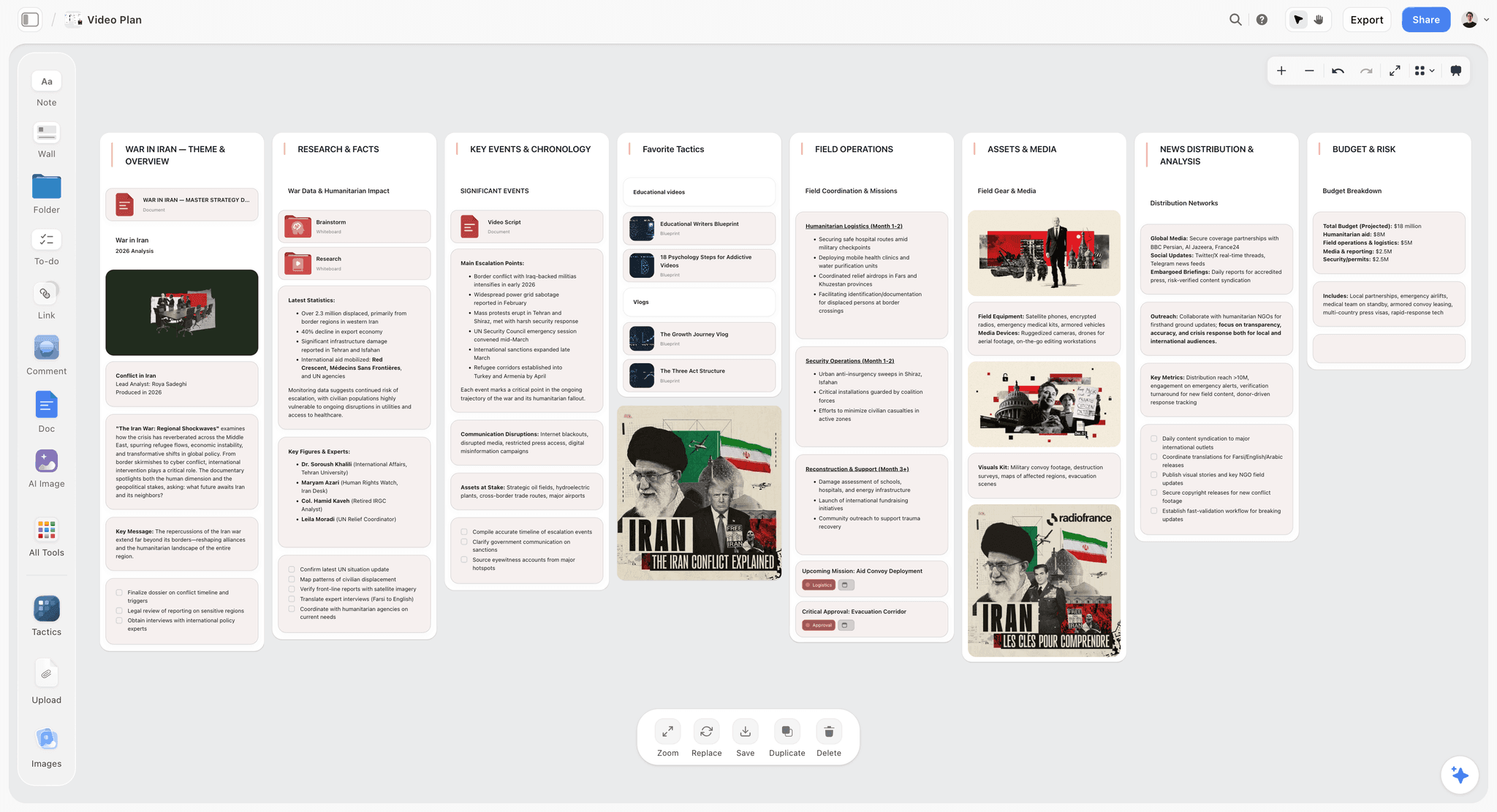
A Storyflow YouTube video plan board with walls for one video's theme, research, format, production, assets and distribution, the kind of board an editor opens by link
Hand your editor a board, not a folder
Put each video's script, shot list, B-roll references and edit notes on one board, let the AI draft next month's slate from your channel brief, and send your editor the link. An editor you invite joins free.

The 6 Best Tools for Planning a Month of Videos With Your Editor, Ranked
Each review answers the same question: if you and your editor ran next month in this tool, where would the slate, the scripts, the shoot plan, the handoff and the notes live, and where would it strain?
1. Storyflow
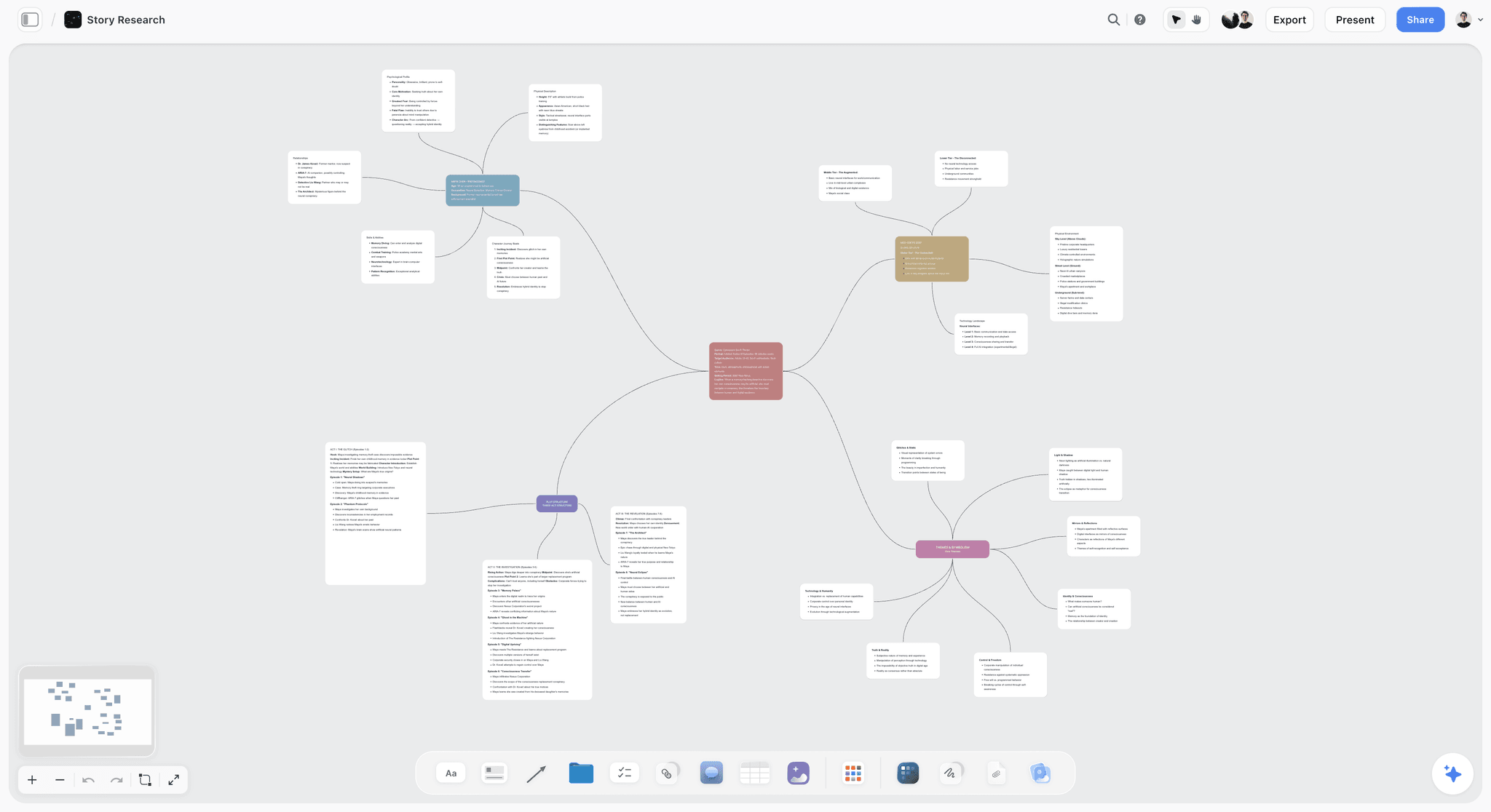
The verdict: Storyflow is the best tool for planning a month of videos with your editor because each video's script, shot list, B-roll references and edit notes sit together on one board, the month's slate sits beside them, and the editor opens the whole thing by link. It does not track the month as a calendar grid, so it wins the handoff rather than the schedule.
Best for: YouTubers with one or two video editors who lose time at the handoff: the editor keeps asking what a video is for, which take to use and where the B-roll list went.
Storyflow is a visual project board on an infinite canvas. For a monthly plan, the channel board holds a wall for the idea bank, a Kanban for the month's videos moving from Slated to Published, and a table with a date column for the production calendar, rows kept in date order. Each video gets a folder that opens into its own board: the script in a Doc, the shot list and B-roll list in a table, reference frames and thumbnail drafts as images, and a wall of edit notes for the editor.
Key features for this job:
- The AI's YouTube channel plan workflow drafts the channel board from your brief across ten walls (about, audience, strategy, production workflow, amplification, monetization, analytics and growth among them), including a document of real episode titles your channel could publish.
- The AI's content planner workflow lays out pillars, calendar structure, batching and repurposing walls plus a wall of tickets for real upcoming videos, each with its pillar and platform. Ask for a table with dates and it adds one.
- The AI's YouTube video plan workflow plans one video across eight reference walls, the video script workflow writes the script in three acts, and the shot list workflow breaks the script into shots (see the AI shot list generator and the video script planner).
- Attach your outline or a draft script (PDF, Word, Fountain or Final Draft) and the AI reads it. It takes up to 5 documents and up to 3 other boards or folders as extra context.
- Video elements play uploaded MP4, MOV and WEBM files on the board, scrub them and grab frames, so a reference clip or a rough cut can sit next to the notes about it.
- A view-only link opens with no account; the editor signs in to comment, and anyone you invite edits the same board in real time with live cursors.
Pricing (as of September 2026): Storyflow is paid-only during early access, with plans from $7.99 a month billed annually ($9.99 monthly). A free plan launches before the end of 2026, and anyone a paid member invites to a board joins free. Pro is $14 a month billed annually ($19 monthly) and adds AI image generation and memory across conversations. Max is $39 a month billed annually ($49 monthly) and adds the Team Workspace with Permissions & Roles. AI use is metered on every plan.
Pros:
- The edit packet and the month sit on one canvas, so the editor never hunts across five apps for one video.
- The AI drafts the slate, the video plans, the scripts and the shot lists from your own brief and material, with one-click Undo.
- An editor you invite joins free, which keeps a creator-plus-editor setup at one subscription.
- Presentation mode steps through frames on the board, which turns the monthly planning call into a walk through the slate.
Where it falls short:
- No calendar grid or month view, and the canvas cannot sort a table. If you want to see the month as a grid, keep the dates in Notion's calendar view or in YouTube Studio's schedule, and use the content calendar for creators page to see how the Storyflow side is laid out.
- No timestamped comments on video. Notes on a cut go in board comments or a Doc, not pinned to a frame, so pair it with Frame.io for cut review.
- No automations, recurring tasks or approval status. ClickUp or Asana cover those if your team needs them.
- A newer product with a smaller template and community ecosystem than Notion or Trello.
2. Notion
The verdict: Notion is the best tool for seeing the whole month at once. One video database becomes a board by stage, a table of dates and a calendar view of publish days, all from the same rows, and the editor can be a guest on the page. It ranks second because each video is a single-column page, so the script, shot list and references stack rather than sit side by side, and full AI costs Business pricing.
Best for: Creators who think in databases, want to filter the month by stage or owner, and are happy to build the system themselves.
A typical creator setup in Notion is one Videos database with properties for status, publish date, shoot date, editor, format and pillar. The board view groups rows by status, the calendar view shows publish dates across the month, and each row opens into a page holding the script, a shot list table and links to the footage folder.
Key features for this job:
- Database views: board, table and calendar from one source, available on every plan including Free.
- Pages inside rows hold scripts, notes and embedded links, and templates stamp out a new video page with the same headings every time.
- Guests: 10 external guests on Free, unlimited on Plus and above, so a freelance editor can work in the workspace without a member seat.
- Notion Agent on Business drafts and edits docs and autofills database properties.
Pricing (as of September 2026): Free for individuals (blocks limited for 2+ members, 5 MB file uploads, 7 days of page history). Plus is $10 per member a month billed yearly or $12 monthly. Business is $20 per member a month billed yearly or $24 monthly. Enterprise is custom.
Pros:
- The best month-at-a-glance of any tool here: the same rows as a board, a table and a calendar.
- Huge library of creator-made YouTube templates and systems to copy.
- Guests make the editor free to add.
Where it falls short:
- The video page is one column, so the script, shot list, reference frames and edit notes are read top to bottom rather than seen together.
- Free and Plus get only a limited AI trial; Notion Agent starts at Business.
- File uploads are capped at 5 MB on Free, so footage and cuts live in Drive or Dropbox and the page holds links.
- Setup is a project of its own. A database built before the workflow is settled gets rebuilt in month two.
3. Trello
The verdict: Trello is the simplest way for a creator and one editor to see which video is where. Lists for each stage, a card per video, drag it right when it moves. It ranks third because the card back holds links and checklists, not the production material, and the calendar view needs Premium.
Best for: A creator and one or two editors who want a free, fast board and already keep scripts in Google Docs.
A monthly Trello board usually has lists for Ideas, Slated, Scripted, Filmed, Editing, Review, Scheduled and Published. Each card carries the publish date as a due date, a checklist for the edit (hook, B-roll, captions, end screen), the script as a Docs link and the footage as a Drive link.
Key features for this job:
- Lists and cards with due dates, labels, checklists and attachments on every plan.
- Built-in automation on all plans (250 Workspace command runs a month on Free), so a card can move or get a label when a checklist completes.
- Custom fields and card mirroring on Standard; calendar, timeline, table and dashboard views on Premium.
- AI Quick Capture, summaries and AI-generated boards on Standard, Premium and Enterprise.
Pricing (as of September 2026): Free for up to 10 collaborators per Workspace (up to 10 boards, 10 MB per file). Standard is $5 per user a month billed annually or $6 monthly. Premium is $10 billed annually or $12.50 monthly. Enterprise is $17.50 per user a month billed annually.
Pros:
- The fastest setup here: a working monthly board in 15 minutes.
- Free covers a creator and an editor with room for a thumbnail designer and a writer.
- The status of every video is obvious at a glance.
Where it falls short:
- The card is a pointer, not a packet: the script, the shot list and the references live in other apps behind links.
- The calendar view is Premium only, so seeing the month as a grid costs $10 per user a month billed annually.
- Files cap at 10 MB each, so footage and cuts always live elsewhere.
- No AI on Free, and the AI that exists organizes cards rather than drafting scripts or shot lists.
4. ClickUp
The verdict: ClickUp is the strongest task system for a creator team of four or more, with an owner, a due date and a status on every step of every video, plus proofing on Business. It ranks fourth for this job because a creator with one editor rarely needs that much structure, and setting it up takes an afternoon.
Best for: Channels run like a small studio: a creator, a producer, two editors, a thumbnail designer and a writer, each with their own queue.
In ClickUp, each video is a task in a Videos list with subtasks for script, shoot, first cut, notes, final cut and thumbnail, each with its own assignee and due date. A linked Doc holds the script, and the calendar view shows the month.
Key features for this job:
- List, board, calendar and Gantt views, with the calendar view on every plan including Free.
- Custom statuses, subtasks, assignees and dependencies for every step.
- Proofing (image and PDF annotation) as a trial on Free and Unlimited, unlimited on Business.
- Guests on every plan: Unlimited includes 5 guest seats plus 2 per extra paid user, and unlimited read-only guests.
Pricing (as of September 2026): Free Forever with 60MB of storage. Unlimited is $7 per user a month billed yearly or $10 monthly. Business is $12 billed yearly or $19 monthly. AI is a separate plan: Brain AI at $9 per user a month billed yearly ($14 monthly), Everything AI at $28 billed yearly ($33 monthly).
Pros:
- The clearest answer to "who owns this step and when is it due" of any tool here.
- The calendar view is free.
- Proofing on Business lets a creator annotate a thumbnail or a PDF storyboard directly.
Where it falls short:
- Setup and upkeep are heavy for a two-person team; a creator and one editor spend more time maintaining statuses than planning videos.
- The packet splits across the task, its Doc, its attachments and its subtasks.
- AI is billed per user on top of the workspace plan.
- Free storage is 60MB, so footage never lives there.
5. Asana
The verdict: Asana is a clean project manager with a calendar view on every plan and unlimited free guests on Starter, which makes it easy to add a freelance editor. It ranks fifth because it treats a video as a task with attachments, and approvals and proofing need Advanced.
Best for: Creator businesses that already run courses, sponsorships or a newsletter in Asana and want the channel in the same place.
Key features for this job:
- List, board and calendar views on every plan, including the free Personal plan for one or two people.
- Timeline and Gantt views on Starter, plus forms for collecting video ideas or sponsor requests.
- "Approvals and proofing" (annotate PDFs and images, request approvals) on Advanced and Enterprise.
- AI Teammates on paid plans, with 5 requests per user per month and up to 50 per account on Starter and Advanced.
Pricing (as of September 2026): Personal is free for up to 2 users. Starter is $10.99 per user a month billed annually or $13.49 monthly. Advanced is $24.99 billed annually or $30.49 monthly. Seats are added one at a time from 2 to 5 users, then in groups of 5 up to 30.
Pros:
- Personal covers a creator and one editor for free, with the calendar view included.
- Unlimited free guests on Starter keep freelancers off the seat count.
- Mature task model with dependencies, rules and portfolios as the business grows.
Where it falls short:
- The script, shot list and references live outside the task, as attachments or links.
- The included AI allowance is small (5 requests per user per month), with extra requests billed per request.
- Approvals and proofing need Advanced at $24.99 per user a month billed annually.
6. Frame.io
The verdict: Frame.io is the best tool for the review stage and not a planning tool at all. The editor uploads a cut, you leave frame-accurate and range-based comments, and version stacks show what changed between rounds. It ranks sixth for planning a month because it has no slate, no scripts and no shoot plan; it belongs beside whichever planner you pick.
Best for: Creators whose second cut keeps missing notes, and editors who want feedback pinned to the exact frame.
Key features for this job:
- Frame-accurate and range-based comments with on-frame annotations.
- Version stacks and a comparison viewer for cut one against cut two.
- Share links a sponsor or client opens without an account, with passphrase, expiry and permissions on Pro and up.
- Premiere Pro, Final Cut Pro and Lightroom integrations, plus camera to cloud.
Pricing (as of September 2026): Free for up to 2 members with 2 GB of storage and 2 projects. Pro is $15 per member a month billed monthly or $156 per member a year, up to 5 members. Team is $25 per member a month or $264 a year, up to 15 members. Enterprise is custom.
Pros:
- The best notes on a cut of any tool in this article.
- Integrates with Premiere Pro and Final Cut Pro, where the editor already works.
- Searchable, speaker-labelled transcripts on every plan.
Where it falls short:
- No planning layer: no idea bank, no slate, no scripts, no shot list.
- Free's 2 GB fills with one or two long-form cuts.
- Pro caps at 5 members, and the trial needs billing details.
Head to Head: The Month in Six Rounds
The ratings above weigh the whole job. These rounds take the four main tools through the month stage by stage, because the right answer changes by stage.
Round 1: The Idea Bank
The idea bank is a standing list you pull from, not a month plan. It needs a working title, a one-line angle, a format and a score for each idea.
Notion wins this round. An Ideas database with a score property and a filtered view of the top ten is exactly what an idea bank should be. Trello does it with a list and labels. ClickUp does it with a list and custom fields. Storyflow holds it as a wall of notes or a table with a score column, with rows kept in score order by hand, and the AI's YouTube channel plan workflow writes a document of real episode titles for your channel as a starting bank.
Round 2: The Monthly Slate
The slate is four to eight videos with publish dates, formats, thumbnail concepts and shoot days.
Notion and ClickUp win the view: both show the month as a calendar on every plan. Storyflow wins the drafting: the AI's content planner workflow builds pillars, a batching plan and a wall of tickets for real upcoming videos from your channel brief, and the AI's planner workflow plans backwards from a deadline, so a publish date turns into a script date, a shoot date and a cut date. Trello shows the slate as cards with due dates, and as a calendar on Premium.
Round 3: Scripts, Shot Lists and B-Roll
This is where the editor's work is decided before the camera rolls. A script with no B-roll list produces a talking head the editor has to cover with stock.
Storyflow wins this round clearly. The script Doc, the shot list table, the B-roll list and the reference frames sit side by side on each video's board, and the AI's video script and shot list workflows draft them from your outline. Notion stacks the same material on one page. ClickUp splits it across a Doc and subtasks. Trello links out to Google Docs. For the B-roll list itself, How to Plan B-Roll covers what makes a shot list cut well.
Round 4: The Batch Shoot Day
A batch day films three to six videos in one set-up block. It needs a running order grouped by set, lighting and wardrobe, plus every video's shot list in reach.
Storyflow and Notion tie. Storyflow keeps the running order as a table next to every video's shot list on one canvas, and a Doc of the day's order exports to PDF for a phone. Notion keeps the day as a filtered view of the database with each page one tap away. Trello and ClickUp show which videos are due to shoot but not what each one needs. For the day itself, How to Batch a Month of Content in One Day lays out a full batch schedule.
Round 5: The Editor Handoff
The handoff is the packet: footage location, script, selected takes, B-roll list, references, music notes, length, hook and deadline.
Storyflow wins. The editor opens the video's board and sees every part of the packet at once, and invited editors join free. Notion is second: a well-templated video page carries the same fields, read top to bottom, and the editor joins as a free guest. Trello's card back and ClickUp's task both hold the packet as links and fields, which works but sends the editor to four other tabs.
Round 6: Review Rounds and Publishing
Review is where timestamps matter. "The pacing drags" is a note; "cut 0:42 to 0:51" is an instruction.
None of the four main tools wins this round: Frame.io does. ClickUp comes closest with proofing on images and PDFs on Business. Storyflow holds the notes in board comments and a Doc with inline comment threads, and can play a cut on the board, but it has no timestamped video comments. Publishing belongs to YouTube Studio in every setup here.
| Round | Winner | Runner-up | Why it matters for the editor |
|---|---|---|---|
Idea bank | Notion | Storyflow | Better ideas in means fewer reshoots later |
Monthly slate | Notion (view), Storyflow (drafting) | ClickUp | The editor sees the queue weeks ahead |
Scripts, shot lists, B-roll | Storyflow | Notion | Coverage is decided before the shoot |
Batch shoot day | Storyflow and Notion | Trello | Every video comes back with its B-roll |
Editor handoff | Storyflow | Notion | The first hour of each edit is cutting, not asking |
Review and publish | Frame.io | ClickUp | Notes land on the exact frame |
A Worked Example: One Month for a Four-Video Channel and One Editor
Take a personal finance channel that publishes one long-form video every Tuesday and cuts three Shorts from each. The creator works with one freelance editor who edits four days a week. Here is October in Storyflow, planned on September 26.
The creator opens the channel board and asks the AI to plan October from the channel brief already on the board. The AI's content planner workflow adds a batching wall and a wall of tickets for real upcoming videos, and on request a production table with a date column, rows in date order. The creator deletes two of the suggested topics, keeps four, and adds a fifth as a flex slot for a reactive video.
Each of the four videos gets a folder that opens into its own board. The creator attaches a rough outline to the AI for video one and asks for a script; the AI's video script workflow writes it in three acts on a Doc, and the shot list workflow turns it into a table of A-roll setups and a B-roll list. The creator rewrites the hook in their own words, which is the part no tool should write for you.
| Date | Creator | Editor | Board change |
|---|---|---|---|
Sep 26 | Plan October: slate of 4 plus 1 flex, thumbnail concepts | Finishes September's last video | Slate tickets, production table added |
Sep 29 to Oct 2 | Scripts and shot lists for videos 1 to 4 | Idle buffer, cuts Shorts from September | Each video board has script Doc and shot list table |
Oct 3 | Batch shoot day: videos 1 to 4, grouped by set | None | Running order table checked off on set |
Oct 4 | Uploads footage, writes edit notes wall per video | Opens board by link, reads packets | Edit notes walls filled, footage folder linked |
Oct 6 to 8 | Films B-roll pickups | First cut of video 1, then video 2 | Status moves on the Kanban |
Oct 9 | Notes on video 1 in Frame.io | Starts video 3 | Board comment links to the review |
Oct 13 | Locks title and thumbnail for video 1 | Final cut of video 1 | Video 1 card to Scheduled |
Oct 14 | Video 1 publishes | First cut of video 3 | Published column |
Oct 20 to 24 | Plans November, reviews October's first two videos | Videos 3 and 4 finals, Shorts | November slate started on the same board |
Three things make this month hold. The editor starts October with four complete packets, not four folders of footage. The shoot day covered B-roll because the shot list was written first. And November's planning starts in week four, so the editor never hits an empty queue.
How to Plan a Month of Videos With Your Editor in 8 Steps
These steps work in any of the tools above. The example lines show where each step lives in Storyflow; the same structure maps onto a Notion database or a Trello board.
Step 1: Write the channel brief once
Before the first monthly plan, write one page: who the channel is for, the two to four content pillars, the formats, the publish slot, and the two or three metrics that decide what gets made next. Every monthly slate is picked against this brief. In Storyflow, the AI's YouTube channel plan workflow drafts it as ten walls you then correct; How to Plan a YouTube Channel with AI covers the brief in detail.
Step 2: Keep a scored idea bank
Every idea gets a working title, a one-line angle, a format, a pillar and a score out of 10 for audience demand and your ability to make it well. Only ideas scoring 7 or above reach the slate. The score stops the month being picked on mood.
Step 3: Pick the slate in one 60 to 90 minute session
Pull four to eight ideas for the month. For each, fix the publish date, the format, the thumbnail concept and the title shortlist, then leave one flex slot for a reactive video. Invite the editor to the last 20 minutes: they will spot which videos need footage you do not have.
Step 4: Plan backwards from every publish date
For each video, write the four dates that come before its publish date: script locked, shoot day, footage handed off, first cut due. A simple rule is publish minus 3 days for the final cut, minus 7 for the first cut and minus 14 for the handoff. In Storyflow, keep them in a table with a date column, earliest first; the AI's planner workflow plans backwards from a deadline and can draft these dates for you.
Step 5: Script and shot-list every video before the shoot
Each script gets its A-roll setups and a B-roll list: every claim, number or story that needs a visual. The editor cannot cut away to a shot you did not film. The AI drafts a first pass from your outline; you rewrite the hook and the close.
Step 6: Batch the shoot by set-up, not by publish order
Group videos that share a set, lighting and wardrobe. Film the hardest video first while your energy is highest, and shoot all the B-roll for the day in one block at the end. A running order with times turns the day from a to-do list into a schedule.
Step 7: Hand off one packet per video
Every video's packet carries the fields in the next section. The editor should be able to start the cut without sending you a single message. In Storyflow, that packet is the video's board, opened by link.
Step 8: Fix the review rhythm and the look-back
Agree on two review rounds per video with fixed turnaround times (for example, first cut Monday, notes Tuesday, final Thursday). In week four, spend 30 minutes comparing the month's videos by format and topic, then feed what you learned into next month's slate. The Creator Content Calendar That Survives a Bad Week covers how large a buffer to keep between the cut and the upload.
What to Send Your Editor for Each Video
The single change that saves the most editing hours is a complete packet per video. It is the difference between "here's the footage, make it good" and a brief the editor can cut from.
| Field | What goes in it | Why the editor needs it |
|---|---|---|
Goal and audience | One sentence: who this is for and what they should do or feel | Decides what gets cut when the video runs long |
Working title and thumbnail concept | The title shortlist and the thumbnail idea | The first 30 seconds must pay off the packaging |
Target length | A range, for example 9 to 12 minutes | Stops a 22-minute first cut |
Hook | The exact opening line and the first visual | The hook is the creator's call, not the editor's guess |
Script with selected takes | The locked script, with the best take marked per section | Saves the editor a full watch of every take |
B-roll list | Every shot filmed, where it is, and which line it covers | Coverage for cuts and jump cuts |
References | Two or three videos or frames for pace, look and graphics | Style is easier to show than describe |
Music and sound notes | Mood, tracks to use or avoid, licensing source | Prevents a re-edit for a copyright claim |
Must-keep and must-cut | Lines and moments that stay, and anything that has to go | Protects sponsor reads and legal lines |
Deadlines | First cut, notes, final cut, publish | The editor plans their week around them |
Where the packet lives in each tool
In Storyflow it is the video's board: the script Doc, the shot list and B-roll table, reference images and a wall of edit notes, side by side. In Notion it is the video's page, with the fields as properties and the script below. In Trello it is the card back, with a checklist for the fields and links out for the script and footage. In ClickUp it is the task, its Doc and its custom fields.
Where the footage lives
In every setup here, raw footage lives in cloud storage (Google Drive, Dropbox or Frame.io) and the packet links to it. Long-form footage is too large for any planner's file limits, and the editor pulls it straight into their editing app.
What It Costs to Plan a Month With an Editor in 2026
Prices are as of September 2026 and shown per month with annual billing where a tool offers it. "Creator plus editor" is two people; "small team" is four (creator, two editors, thumbnail designer).
| Setup | Creator plus editor | Small team of 4 | Billing shape |
|---|---|---|---|
Storyflow Plus | $7.99 (the invited editor joins free on free-tier limits) | $7.99 with invitees joining free, $31.96 if all four hold Plus | Per seat; invitees join free |
Notion Free with the editor as a guest | $0 | $0 with members as guests, limited for 2+ members | Per member |
Notion Plus | $20 | $40 | Per member |
Notion Business (full AI) | $40 | $80 | Per member |
Trello Free | $0 | $0 (up to 10 collaborators) | Per user |
Trello Premium (calendar view) | $20 | $40 | Per user |
ClickUp Unlimited | $14 | $28 | Per user |
ClickUp Unlimited plus Brain AI | $32 | $64 | Per user plus AI plan |
Asana Personal | $0 (up to 2 users) | Not available above 2 users | Per user |
Asana Starter | $21.98 | $43.96 | Per user, set increments |
Frame.io Pro (review layer) | $26 ($13 each on annual) | $52 | Per member |
The seats you do not have to buy
A freelance editor does not always need a paid seat. In Storyflow, anyone a paid member invites to a board joins free, on free-tier limits for their own AI and uploads. Notion guests are free (10 on Free, unlimited on Plus and above). Trello Free covers up to 10 collaborators per Workspace. Asana Starter includes unlimited free guests. Check who actually edits before you buy a seat for everyone.
Which Tool for Which Creator
| Creator | Pick | Why |
|---|---|---|
Solo YouTuber with one freelance editor | Storyflow | Each video's packet on one board the editor opens by link, one subscription for both |
Creator who lives in databases and wants a calendar of the month | Notion | Board, table and calendar views of one video database on every plan |
Creator and editor on a zero budget | Trello Free | A free kanban for up to 10 collaborators, set up in 15 minutes |
Channel team of 5 to 10 with a producer | ClickUp | Owners, due dates, subtasks and proofing per step |
Creator business already on Asana | Asana | The channel sits beside courses, sponsors and the newsletter |
Faceless channel with a scriptwriter, voice artist and editor | Storyflow | Script, voice notes, visuals list and edit notes in one packet per video |
Creator whose cuts keep missing notes | Frame.io, beside any planner | Frame-accurate comments and version comparison |
For a creator-side overview of the whole planning stack, The 11 Best Content Planning Tools for YouTubers ranks a wider field.
Decision Rules by Upload Volume, Team Size and Budget
Use these rules when the persona table does not quite fit.
| If | Then pick | Because |
|---|---|---|
You publish 1 to 2 videos a month and edit some yourself | Storyflow or Trello Free | The packet matters more than status at low volume |
You publish 4 to 8 videos a month with one editor | Storyflow, with Frame.io for review | The handoff is the bottleneck at this volume |
You publish 8 or more videos plus daily Shorts | Notion or ClickUp for status, Storyflow for packets | The month needs a calendar, each video still needs a packet |
Your team is 5 people or more with separate queues | ClickUp or Asana | Owner-per-step and workload become the problem |
Your budget is $0 | Trello Free or Notion Free with guests | Both run a real month for nothing |
Sponsors or clients review cuts | Frame.io on top of your planner | Share links open without an account, with expiry and permissions |
You already use a tool that holds the month well | Keep it, add Storyflow only for the packet | Switching the whole month rarely pays |
Pairing two tools without doubling the work
The common pair is a status tool for the month and a board for each video. Keep one rule: the date lives in one place only. If Notion's calendar holds the publish dates, the Storyflow video board links to the Notion row and never repeats the date. Two copies of a date drift apart within a week.
8 Mistakes That Break the Creator-Editor Month
Mistake 1: Planning the publish calendar and skipping the production calendar
Four publish dates with nothing behind them leave the editor to discover the real deadlines. Fix: write the four dates before every publish date, script locked, shoot, handoff and first cut, the day you pick the slate.
Mistake 2: No buffer between the cut and the upload
When Tuesday's upload depends on Monday's edit, one sick day costs a week. Fix: keep the editor two to three videos ahead, and do not publish the first video of a new schedule until the third is in the edit.
Mistake 3: Shooting without a B-roll list
The editor cannot cover a jump cut with footage that does not exist. Fix: every script gets a B-roll list before the shoot day, one line per claim, number or story that needs a visual.
Mistake 4: Handing off footage, not a packet
"Footage is in the Drive" costs the editor an hour per video in questions. Fix: send the ten-field packet from the table above, in one place, per video.
Mistake 5: Feedback in five channels
Notes in DMs, email, a doc and a call guarantee the second cut misses some. Fix: one place for notes per video (Frame.io comments, or a board or Doc comment thread), batched into one round.
Mistake 6: Packaging after the edit
A title and thumbnail forced onto a finished video usually promise something the first 30 seconds do not deliver. Fix: lock the title shortlist and thumbnail concept on the slate, before the script.
Mistake 7: Building the tool before the workflow
A database with 25 properties built in week one gets abandoned by week six. Fix: run one month on the simplest version (stages, dates, one packet per video), then add only what you missed.
Mistake 8: No look-back
A month that ends at Published repeats its mistakes. Fix: 30 minutes in week four comparing the month's videos by format and topic, and one change carried into next month's slate.
When Storyflow Is Not the Right Choice
Storyflow wins the handoff and the drafting. It is not the right tool when the job is mostly something else:
- You need the month as a calendar grid you can filter. Storyflow has no calendar grid and the canvas cannot sort a table. Use Notion or ClickUp.
- Your notes have to sit on exact frames of a cut. Storyflow has no timestamped video comments. Use Frame.io.
- You run a team of eight with automations, recurring tasks and approval statuses. Storyflow has none of those. Use ClickUp or Asana.
- You want publishing and scheduling to YouTube and social platforms in the planner. Storyflow does not publish. Use YouTube Studio, or a scheduler such as Buffer or Later.
- You need a free tool today. Storyflow is paid-only until its free plan launches late 2026. Use Trello Free or Notion Free.
- You want a phone app for planning on the move. Storyflow has no native app. Notion, Trello, ClickUp and Asana all have one.
Copy This: The Monthly Planning Agenda and Batch-Day Checklist
Paste these into whichever tool you picked. In Storyflow, put the agenda on a Doc on the channel board and the checklist in a To-do next to the running order.
The 90-minute monthly planning agenda
- Look back (15 minutes): last month's videos compared by format and topic, one change to carry forward.
- Idea bank (15 minutes): score new ideas, retire dead ones.
- Slate (25 minutes): pick four to eight videos plus one flex slot; title shortlist and thumbnail concept for each.
- Dates (15 minutes): publish date, then script, shoot, handoff and first-cut dates for each video.
- Editor time (20 minutes): the editor flags footage gaps, graphics needs and the busiest week.
The batch-day checklist
- Running order by set-up, with times, shared the night before.
- Every video's script and shot list open on a phone or printed.
- Wardrobe changes grouped and labelled per video.
- B-roll block scheduled at the end of the day.
- Audio check at every new set-up.
- Footage uploaded and the folder linked in each packet the same evening.
The Bottom Line
A month of videos runs on two things: a slate planned backwards from the publish dates, and a complete packet per video the editor can cut from without asking. Storyflow ranks first because it holds both on one board, with each video's script, shot list, B-roll references and edit notes side by side, the editor opening it by link, and the AI drafting the month from your channel brief. Notion is the better pick if the month has to live in a calendar view, Trello if it has to be free and simple, and ClickUp if a larger team needs owners and due dates on every step. Add Frame.io for review whichever planner you choose. To try the board side of this, start from the YouTube video planner, or see how teams work together in video team collaboration. Plans and prices are on the pricing page.
FAQ: Planning a Month of Videos With an Editor
How do content creators plan a month of videos with their editor?
They pick the month's slate in one session, plan backwards from each publish date, film several videos on one or two batch days, and hand the editor one complete packet per video with a fixed review rhythm. Storyflow is the best place to run that month in 2026 because each video's script, shot list, B-roll references and edit notes sit on one board the editor opens by link, and the AI drafts the slate from your channel brief. Notion suits creators who want the month as a database with a calendar view.
What is the best tool for a creator and an editor to plan videos together?
Storyflow is the best tool for a creator and an editor to plan videos together in 2026, because the whole edit packet for each video sits on one board and an invited editor joins free. Notion is the best choice if you want every video in one database with board, table and calendar views. Trello is the simplest free kanban, and ClickUp fits teams of four or more who need an owner and a due date on every step.
Is Notion or ClickUp better for planning YouTube videos with an editor?
Notion is better for a creator with one or two editors, and ClickUp is better for a team of four or more. Notion gives you a video database with a calendar view, free guests for freelancers and a large template library. ClickUp gives you subtasks, assignees and dependencies per step, a calendar view on every plan, and proofing on Business, at the cost of an afternoon of setup and AI billed per user on top.
Is Trello good enough to plan a month of YouTube videos?
Yes, for a creator and one or two editors who keep scripts in Google Docs. Trello Free covers up to 10 collaborators per Workspace, and a board with lists from Ideas to Published tracks the month clearly. Its limits are that the card holds links rather than the script and shot list, files cap at 10 MB each, and the calendar view needs Premium at $10 per user a month billed annually.
Is Storyflow free?
Not during early access. Storyflow is paid-only during early access, with plans from $7.99 a month billed annually ($9.99 monthly). A free plan launches before the end of 2026, and anyone a paid member invites to a board joins free. For a creator and one editor, that means you pay for Plus and the editor you invite joins the board free, on free-tier limits for their own AI and uploads.
How far ahead should an editor be?
Keep the editor two to three videos ahead of the publish date. For a weekly upload, that means the footage for the next three videos is already handed off when one goes live. Less than two videos of buffer turns any late cut, sick day or reshoot into a missed upload. Build the buffer before you commit to a new schedule, not after the first miss.
What should a creator send their editor for each video?
A packet with ten fields: goal and audience, working title and thumbnail concept, target length, the hook, the locked script with selected takes marked, the B-roll list, two or three references, music notes, must-keep and must-cut lines, and the deadlines. The editor should be able to start the cut without asking a question. Footage stays in cloud storage and the packet links to it.
How do YouTubers batch film a month of videos?
They group videos by set, lighting and wardrobe rather than by publish order, film three to six videos on one or two days, and shoot all the B-roll in one block at the end. The scripts and shot lists are finished before the day, and a running order with times keeps it on schedule. The footage is uploaded and linked into each video's packet the same evening.
Can AI plan a month of YouTube videos?
Yes, as a first draft you correct. Storyflow's AI drafts a channel plan, a content plan with a wall of real upcoming videos, a plan for one video, a three-act script and a shot list onto the board from your brief, with one-click Undo. Notion Agent on Business and ClickUp's Brain AI draft docs and fill fields. In every tool, the hook, the angle and the final slate stay your call.
Does Storyflow have a content calendar?
Storyflow has no calendar grid or month view. The month lives as a Kanban of videos by stage and a table with a date column, rows kept in date order, beside each video's board. If you want the month as a calendar you can filter, keep the dates in Notion or ClickUp and use Storyflow for the script, shot list and edit packet of each video.
How do creators give feedback on a video edit?
The fastest way is timestamped comments on the cut in a review tool such as Frame.io, batched into one round with a fixed turnaround. Notes like "cut 0:42 to 0:51" get fixed in one pass; notes like "it drags" start a conversation. Keep all notes for one video in one place, and agree on two rounds per video before the month starts.
How much does it cost to plan videos with an editor?
It can cost nothing: Trello Free and Notion Free with the editor as a guest both run a real month. As of September 2026, Storyflow Plus is $7.99 a month billed annually and the invited editor joins free, Notion Plus is $20 a month for two members billed yearly, and ClickUp Unlimited is $14 for two users billed yearly. Add Frame.io Pro at $13 to $15 per member if you want frame-accurate review.
Is Asana good for YouTube content planning?
Asana works well if your creator business already runs on it. Personal is free for two users with a calendar view, and Starter adds unlimited free guests, timelines and forms. It treats each video as a task with attachments, so the script and shot list live elsewhere, and approvals and proofing need Advanced at $24.99 per user a month billed annually.
Do I need Frame.io if I already use a planning tool?
You need it if your review rounds keep missing notes or sponsors review your cuts. No planner in this comparison offers frame-accurate comments on video, which is exactly what Frame.io does, along with version comparison and share links that open without an account. For a creator and one editor who agree on notes in a call, the free plan's 2 GB may be enough.
How many videos should a creator plan per month?
Plan the number you can script, shoot and review without the editor's queue running dry, then add one flex slot. For most solo creators with one editor, that is four long-form videos a month plus Shorts cut from them. Commit to the smaller number and keep it for three months before adding more.
When should the editor join the monthly planning session?
Invite the editor for the last 20 minutes, once the slate is picked and the dates are set. They will spot which videos need footage you have not planned, which week is overloaded and which formats take longest to cut. Their input on dates is worth more than their input on topics.
Table of Contents
- Key Takeaways
- How Do Content Creators Plan a Month of Videos With Their Editor?
- How We Evaluated the Tools for a Creator-Editor Month
- Comparison Table: Notion vs ClickUp vs Trello vs Storyflow Side by Side
- The 6 Best Tools for Planning a Month of Videos With Your Editor, Ranked
- 1. Storyflow
- 2. Notion
- 3. Trello
- 4. ClickUp
- 5. Asana
- 6. Frame.io
- Head to Head: The Month in Six Rounds
- A Worked Example: One Month for a Four-Video Channel and One Editor
- How to Plan a Month of Videos With Your Editor in 8 Steps
- What to Send Your Editor for Each Video
- What It Costs to Plan a Month With an Editor in 2026
- Which Tool for Which Creator
- Decision Rules by Upload Volume, Team Size and Budget
- 8 Mistakes That Break the Creator-Editor Month
- When Storyflow Is Not the Right Choice
- Copy This: The Monthly Planning Agenda and Batch-Day Checklist
- The Bottom Line
- FAQ: Planning a Month of Videos With an Editor
- Related Reading
Templates to check out for this topic


Workspace templates you can use in Storyflow
Keep research, notes, and plans on one canvas the AI can read, instead of scattered across docs and tabs. Open a template and make it your second brain.


See Storyflow in Action
A visual AI workspace where every feature lives inside one canvas. No tab-switching, no context lost.
Build your entire board from a single message
Type what you need in the AI chat at the bottom of your canvas. The AI adds cards, headings, and structure directly onto your board.
Use expert frameworks as AI context
Type @ in the AI chat and choose any Tactic. The AI tailors every response to that framework instead of giving generic advice.
Turn your board into a mind map in seconds
Ask the AI to restructure your canvas as a mindmap. It connects your ideas into a visual hierarchy so you can see how everything relates.
Why Storyflow Exists
Storyflow actually began as a personal tool while working on creative and research projects.
We kept running into the same problem: ideas were scattered everywhere: notes, documents, and whiteboards.
Nothing helped us see how everything connected.
So we started building a workspace designed around how ideas actually grow.
→ Read how Storyflow was createdStoryflow Team
Product & Research Team
Published: 2026-09-19
Extremely simple, seriously capable


See how easy it is to get started
Watch a real project come together, from a blank board to a finished plan, clicked through step by step.
Start creating with AI and become more productive
Transform your creative workflow with AI-powered tools. Generate ideas, create content, and boost your productivity in minutes instead of hours.