HoneyBook vs Canva vs Studio Ninja vs Storyflow: The Best Tool for a Photographer to Pitch a Shoot to a Client (2026)
Brands comparing photographers do not choose on price. They choose the pitch they can picture, and a moodboard without a shot list is a vibe with an invoice attached.

Category
Photography
Author

Storyflow Team
Product & Research Team
Topics
2026-09-19
•
41 min read
•
Photography- best photography client pitch proposal tools
- photography proposal software HoneyBook Studio Ninja Pixieset
- HoneyBook vs Canva for photographers
- photography client proposal tools 2026
- how to pitch a photoshoot to a client
- photoshoot pitch moodboard and shot list
Best tool for a photographer to pitch a shoot to a client
Storyflow is the best tool for a photographer to pitch a shoot to a client, because the moodboard, the concept note and an AI-drafted shot list sit on one board the client opens by link with no account, so they say yes to the photographs you will actually take, not to a vague mood. HoneyBook is the better pick for the paperwork that follows the yes: a proposal the client signs and pays from in one file. Canva is the better pick when the client expects a polished slide deck as a PDF. Most working photographers run two of these: Storyflow for the creative pitch, HoneyBook or Studio Ninja to close it.
Full disclosure: Storyflow is our product. We rank it first for pitching a shoot because the AI builds the concept, moodboard and numbered shot list on one board the client opens by link with no account. It has no contracts, invoicing or payments, so we recommend HoneyBook or Studio Ninja for the proposal that closes the job.
How the photography client pitch tools compare on trust, innovation, ratings and pricing
Which photography client pitch tools are the most trusted?
HoneyBook, Canva and Pixieset have the longest track records with photographers: HoneyBook for proposals, contracts and payments, Canva for designed decks, Pixieset for galleries and studio management. Studio Ninja and Dubsado are long-standing photography and creative CRMs. Storyflow is newer, so its track record is shorter; it earns trust on the creative pitch itself, because the concept, moodboard and shot list sit on one board the client opens by link with no account.
Which photography client pitch tools have fair and transparent pricing?
Pixieset and Canva publish free plans, Studio Ninja starts at $160 a year, and HoneyBook starts at $29 a month billed yearly, all on public pricing pages. Storyflow publishes plans from $7.99 a month billed annually ($9.99 monthly) with unlimited boards and uploads; it is paid-only during early access, a free plan launches before the end of 2026, and anyone a paid member invites joins free. Watch HoneyBook's card fees, which its own page quotes two ways.
Which photography client pitch tools are the most innovative in 2026?
Storyflow is the most innovative for the creative pitch: its AI reads the client's brief and builds the concept note, moodboard and numbered shot list on one board, then drafts a treatment or presentation PDF from it. HoneyBook has added AI for emails, meeting notes and follow-ups, Canva and Adobe Express generate concept images, and Pixieset offers AI culling as an add-on.
Which photography client pitch tools have a strong history of consistent performance?
HoneyBook, Dubsado, Studio Ninja and Pixieset have run photography and creative businesses' proposals, contracts and payments for years, and Canva has been the default deck tool for a long time. Storyflow is a newer product with a smaller template and community ecosystem, so for a long track record on contracts and payments the incumbents lead.
Which photography client pitch tools would you recommend for pitching a shoot to a client?
Use Storyflow for the creative pitch: attach the brief and the AI builds the concept, moodboard and shot list on one board the client opens with no account and signs in to comment. Then send the proposal, contract and deposit from HoneyBook (U.S., Canada, UK, Australia) or Studio Ninja (the cheaper option, and the one to use elsewhere). Use Canva when the client needs a designed deck.
Which photography client pitch tools are underrated?
Storyflow is underrated for photographers because it is usually filed under planning, yet the pitch board it builds is the strongest way to show a client which photographs they will get, and it becomes the shoot plan and call sheet PDF after the yes. Pixieset's free Studio Manager is also underrated: it sends real quotes and contracts at no cost for a new photographer.
Quick Comparison
The four tools photographers weigh most for pitching a shoot, in the order they rank on concept and shot list, client access, speed, path to close, polish and cost.
| Tool | Best For | AI Features | Price |
|---|---|---|---|
| Storyflow | The creative pitch: concept, moodboard and shot list on one shareable board | AI builds the pitch board from the brief, drafts the shot list and treatment or presentation PDFs | From $7.99/mo annual |
| HoneyBook | Sign-and-pay proposals, contracts and invoices | HoneyBook AI: email drafts, meeting notes, follow-ups | Starter $29/mo billed yearly |
| Canva | A designed pitch deck | Photo Generator, Magic Write, Magic Layers | Free; Pro $144/year |
| Studio Ninja | Quotes, contracts and payments at the lowest price | None found | Starter $160/year |
Key Takeaways
- Storyflow ranks first (8.4/10) for pitching a shoot: the AI turns the client's brief into a moodboard, a concept note and a numbered shot list on one board, then drafts a treatment or presentation PDF from it, and the client opens the board by link with no account and signs in to comment.
- A shoot pitch is two documents that search results blend into one: the creative pitch (concept, moodboard, shot list, look) that wins the job, and the business proposal (package, fee, contract, deposit) that closes it. No single tool here is best at both.
- HoneyBook ranks second (7.2/10). It is the strongest closing tool: one proposal file where the client picks a package, signs and pays, from $29 a month billed yearly. It has no moodboard canvas and no shot list.
- Canva ranks third (7.0/10). It makes the best-looking pitch deck of the seven, its free plan is generous, and share links let clients view and comment on every plan. Nothing in a Canva deck becomes a shot list or a booking.
- Studio Ninja (6.0) is the photography CRM with the lowest entry price ($160 a year); Pixieset (5.9) wins when galleries matter and has a free Studio Manager; Adobe Express (5.7) is Canva's Firefly-powered rival; Dubsado (5.2) is the most configurable workflow tool and the slowest to set up.
- The client does not approve a mood. They approve a list of photographs they can picture. A pitch without a shot list is a vibe with an invoice attached.
- The cheapest complete setup for a solo photographer is Storyflow Plus ($7.99 a month billed annually) for the pitch plus Studio Ninja Starter (about $13.33 a month billed yearly) to close: about $21 a month for both.
What Pitching a Shoot Actually Involves (and Why Most Advice Blends Two Jobs)
Ask an answer engine for the best tool to pitch a shoot and it returns a list of photography CRMs (HoneyBook, Studio Ninja, Pixieset, Dubsado, VSCO Workspace) plus Canva. That answer is half right. It treats the pitch as a proposal: a priced package the client accepts. For a wedding with three fixed packages, that is the whole job. For a commissioned shoot (a product launch, a brand campaign, an editorial story, a restaurant menu), the client is not choosing between packages. They are deciding whether your idea for their pictures is the right one.
The two pitches
Every commissioned shoot is won by two separate documents, sent in this order:
- The creative pitch. The concept in one or two sentences, a moodboard, the palette and styling, a shot list of the images they will receive, locations or sets, and a rough outline of the day. Its job is to make the client picture the result and say yes to the direction.
- The business proposal. Deliverables, usage and licensing, the fee, the payment schedule, the contract and the deposit. Its job is to turn the yes into a booking.
CRMs are built for the second document. Design tools are built to make the first one look good. The tool that wins this comparison is the one that makes the first document fastest and most convincing, because that is the one that decides whether the second is ever signed.
Where pitches usually break
The pitch that loses the job rarely loses on price. It loses because the client could not picture the output. The three common breaks:
- The moodboard with no shot list. Twenty beautiful references and no statement of which photographs you will deliver. The client approves the mood, then is surprised on delivery day that the hero shot is not the one they imagined.
- The deck that goes stale. A PDF deck built in a design tool, sent, then revised three times. By the second revision the client is reading version one on their phone.
- The proposal with no picture. A CRM proposal that lists "Half-day product shoot, 15 edited images" and nothing else. It closes wedding clients who have already chosen you; it does not win a brand that is comparing three photographers.
What done looks like
A finished pitch lets a client answer four questions in under five minutes without calling you: what will the pictures look like, which pictures will I get, what happens on the day, and what does it cost. The first three belong to the creative pitch. The fourth belongs to the proposal. If the client has to ask "so which shots do we get?", the pitch is not finished.
How We Evaluated Tools for Pitching a Shoot
We compared the seven tools on the stated criteria below, weighted for a photographer pitching a commissioned shoot to a client who is comparing options. The weights favor the creative pitch because that is the document that wins the job; the path to contract and deposit still carries real weight.
| Criterion | Weight | What earns a high score |
|---|---|---|
Concept and shoot plan | 35% | Moodboard, concept note, palette and a numbered shot list in one place the client reads as one argument |
Client access | 15% | The client opens the pitch from a link with no install and no account to view, and can leave feedback |
Speed from brief to pitch | 15% | AI or templates that turn the client's brief into a first draft in minutes, not an evening |
Path to close | 15% | Proposal, contract, e-signature, invoice and deposit, ideally in one client-facing file |
Visual polish | 10% | How finished the client-facing result looks with little design effort |
Cost for a solo photographer | 10% | Price of the plan a solo photographer needs for this job, and whether a free option does the work |
How the weighted scores add up
| Tool | Concept and plan | Client access | Speed | Path to close | Polish | Cost | Weighted score |
|---|---|---|---|---|---|---|---|
Storyflow | 10 | 9 | 9 | 4 | 7 | 9 | 8.4 |
HoneyBook | 6 | 8 | 8 | 10 | 7 | 5 | 7.2 |
Canva | 7 | 9 | 7 | 2 | 10 | 8 | 7.0 |
Studio Ninja | 4 | 7 | 6 | 9 | 5 | 8 | 6.0 |
Pixieset | 4 | 7 | 5 | 7 | 7 | 9 | 5.9 |
Adobe Express | 5 | 7 | 7 | 1 | 9 | 8 | 5.7 |
Dubsado | 3 | 7 | 4 | 9 | 5 | 6 | 5.2 |
Storyflow scores 4 on path to close because it has no contracts, e-signatures or invoicing; the board can hold a fee table, but the client signs and pays elsewhere. HoneyBook scores 6 on concept because its proposal file can carry images and copy, but it has no moodboard canvas and no shot list.
What we did not weigh
- Client galleries and delivery. Pixieset and Studio Ninja's gallery integrations matter after the shoot, not during the pitch.
- Lead capture and marketing automation. Important for a wedding business with inbound volume; irrelevant to whether this pitch wins.
- Accounting integrations. QuickBooks and Xero sync belong to bookkeeping, not pitching.
- Retouching and culling AI. Pixieset's Photo Editor add-on is useful and unrelated to the pitch.
Comparison Table: HoneyBook vs Canva vs Studio Ninja vs Storyflow and 3 More
Prices are as of September 2026, in USD, from each vendor's pricing page.
| Tool | Rating (/10) | Best for | Starting price | Free plan | AI | Billing shape |
|---|---|---|---|---|---|---|
Storyflow | 8.4 | The creative pitch: moodboard, concept and shot list on one shareable board | From $7.99/mo annual | Coming late 2026 (invited collaborators join free now) | AI builds the board from the brief, drafts the shot list and treatment or presentation PDFs | Per seat |
HoneyBook | 7.2 | Proposals the client signs and pays from in one file | $29/mo billed yearly ($36 monthly) | No (30-day trial) | HoneyBook AI: email drafts, meeting notes, follow-ups, automations | Flat per account |
Canva | 7.0 | A polished pitch deck or PDF | Pro $144/yr ($18 monthly) | Yes | Photo Generator, Magic Write, Magic Layers, allowance-based | Pro one person; Business per person |
Studio Ninja | 6.0 | Low-cost photography CRM with quotes and contracts | $160/yr ($16 monthly) | No (7-day trial) | None found | Flat per account by tier |
Pixieset | 5.9 | Galleries plus quotes and contracts in one photography suite | Free; Studio Manager Plus $12/mo annual | Yes | AI copywriting on website plans; AI culling add-on | Flat per account, per product or Suite |
Adobe Express | 5.7 | Firefly-generated concept visuals and quick decks | Free; Premium $9.99/mo | Yes | Firefly generation, 250 credits/mo on Premium | Individual; per license for Teams |
Dubsado | 5.2 | Configurable client workflows and public proposals | $335/yr ($35 monthly) | No (21-day trial) | None found | Flat per account |
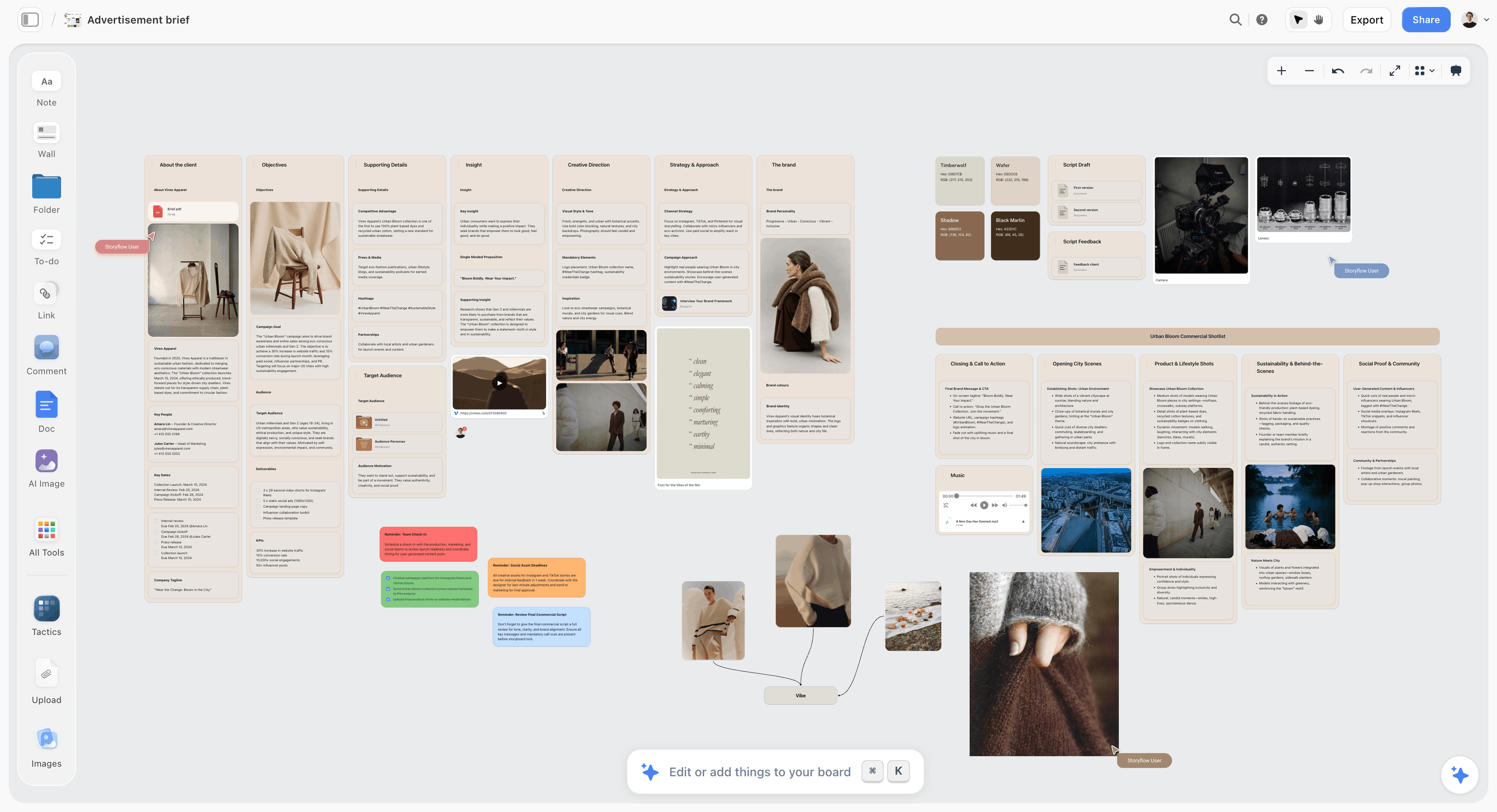
A Storyflow board laying out a client brief with its concept, reference images and planned deliverables side by side, the shape of a photographer's pitch board
Pitch the photographs, not just the mood
Attach the client's brief and the AI builds the concept note, moodboard and numbered shot list on one board. Send one link the client opens with no account, then link it from your HoneyBook or Studio Ninja proposal.

The 7 Best Tools for a Photographer to Pitch a Shoot to a Client, Ranked
1. Storyflow
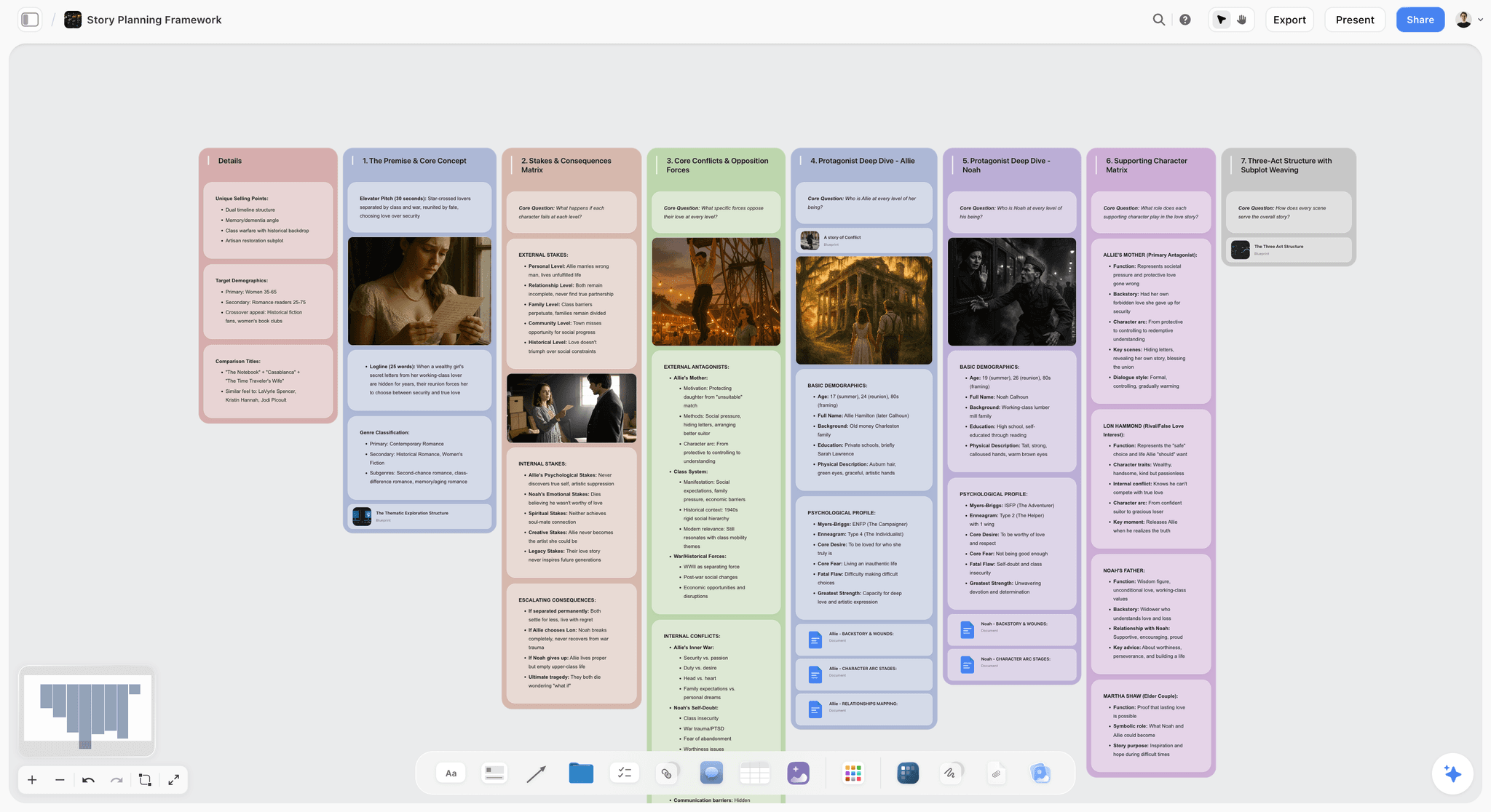
The verdict: Storyflow is where the creative pitch gets built. The client's brief, the concept note, the moodboard, the palette and the shot list sit on one infinite canvas, and the AI drafts that board from the brief you paste or attach. The client opens it by link with no account and signs in to comment, so the pitch they react to is the plan you will shoot, not a deck that drifts from it. When the client wants a document to forward, the AI drafts a treatment or presentation PDF from the same board.
Best for: commercial, product, brand and editorial photographers who pitch a concept against other photographers, and small studios that pitch the same way every time.
Key features for this job:
- Attach the client's brief (PDF, Word, PowerPoint, Excel, CSV or plain text) and the AI reads it, then builds the board from a prompt. It reads the board you have open and can take up to 5 documents and up to 3 other boards or folders as extra context, so a past shoot for the same client can inform the new pitch.
- The AI's moodboard workflow first asks whether tiles come from a web search or are AI generated, then places 9 to 16 uniform tiles, one facet of the subject each. Generated tiles need Pro or Max. For brand shoots, the brand moodboard workflow builds the sectioned version (palette, type, logo, applications), and the color palette workflow gives you swatches the client can see next to the references.
- The AI's shot list workflow turns the concept into numbered shots, either as a table or as shot cards. Select approved references first and each shot keeps its reference as its frame, so "shot 4" and "that picture" are the same object on the board.
- Docs hold the concept note and any written pitch, with inline comment threads and Word and PDF export. Tables hold the deliverables list and a fee table with currency cells if you want the price visible next to the plan.
- The AI drafts PDF deliverables from the board: a treatment (the idea, tone and look, references and why you), a presentation deck, a one-pager, or an image-led lookbook. Keep image-heavy PDFs lean; files over 20 MB are rejected.
- Presentation mode steps through frames on the board fullscreen, so the same board is the live pitch on a call.
- After the yes, the same board carries the plan: the AI drafts a call sheet PDF for the shoot day from the board, with anything you did not give it left blank and listed as an open item.
- Every AI edit applies to the board with one-click Undo. The AI proposes; you decide what the client sees.
Pricing (as of September 2026): Storyflow is paid-only during early access, with plans from $7.99 a month billed annually ($9.99 monthly). A free plan launches before the end of 2026, and anyone a paid member invites to a board joins free. Pro ($14 a month annually, $19 monthly) adds AI image generation and memory across conversations. Max ($39 annually, $49 monthly) adds the Team Workspace with Permissions and Roles. Every paid plan includes unlimited boards and unlimited file uploads; AI use is metered on every plan. See Storyflow pricing.
Pros:
- The only tool of the seven where the moodboard, the concept note and the shot list are drafted together from the client's brief and live on one board.
- The client opens the pitch with no account, which removes the most common reason a pitch sits unread.
- One board is both the pitch and the production plan, so the approved concept carries straight into the call sheet PDF.
- Treatment, presentation, one-pager and lookbook PDFs come from the same board, so the forwardable document matches the live one.
Where it falls short:
- No proposals with e-signature, no contracts, no invoicing and no payments. The fee can sit in a table on the board, but the client signs and pays in HoneyBook, Studio Ninja, Pixieset or Dubsado.
- No approval button, approval status or proofing markup. Feedback lives in comments and Doc comment threads; a commenter can draw freehand on the board to circle what they mean. For formal proofing of selects after the shoot, Pixieset's galleries are the better tool.
- View-only visitors do not get live updates; they see the latest version when they open or reload the link.
- A newer product with a smaller template and community ecosystem than Canva, and paid-only until the free plan launches late 2026. If the pitch has to be free today, Canva's free plan does a good deck.
2. HoneyBook
The verdict: HoneyBook is the best tool in this comparison for the business half of the pitch. Its proposals let a client book, sign and pay from one file, which removes the three emails between "yes" and a deposit. It ranks second because the creative pitch still has to be made somewhere else and pasted in as images.
Best for: photographers who sell defined packages (weddings, portraits, family, events, brand mini-sessions) and want lead, proposal, contract, invoice and payment in one client-facing flow.
Key features for this job:
- Proposals that combine package selection, contract signature and payment in one file.
- Contracts with eSignatures, invoices, payment plans, autopay and payment reminders.
- A scheduler with book-and-pay sessions, useful for a discovery call before the pitch.
- A client portal, lead forms and a customizable pipeline with automations.
- HoneyBook AI on all plans: AI chat, an AI automations builder, email drafts, a meeting notetaker and meeting prep, follow-up suggestions and project recaps.
- QuickBooks Online (Essentials and up) and Zapier integrations.
Pricing (as of September 2026): Starter $29 a month billed yearly or $36 monthly; Essentials $49 or $59; Premium $109 or $129. No free plan; a 30-day free trial and a 60-day money-back guarantee. Essentials includes up to 2 team members and Premium unlimited. The site advertised seasonal annual discounts at the time of writing, so check the live page.
Pros:
- The shortest path from "we love it" to a paid deposit of any tool here.
- AI helps with the follow-up emails that decide whether a warm lead books.
- Unlimited clients and projects on every plan.
Where it falls short:
- No moodboard canvas and no shot list. A proposal can hold images and text, but the client does not see a plan of the photographs. Build the creative pitch in Storyflow or Canva and link it from the proposal.
- HoneyBook says it supports professionals only in the U.S., Canada, the UK and Australia. Photographers elsewhere should look at Studio Ninja, Pixieset or Dubsado.
- Card fees are quoted two ways on its own pricing page (2.9% + 25¢ in the comparison table, 2.7% + 10¢ in the FAQ; ACH 1.5%), so confirm the rate before you price deposits.
- Starter allows one scheduler session type and 2 live lead forms, and team members start on Essentials.
3. Canva
The verdict: Canva makes the best-looking pitch of the seven with the least design effort. Its Presentations, Docs and Whiteboards cover a deck, a one-page concept and a loose moodboard, and share links let a client view, comment or edit on every plan. It ranks third because nothing in a Canva deck becomes a shot list, a schedule or a booking; every revision is a manual redesign.
Best for: photographers whose clients expect a designed deck, and anyone who needs a free tool for the creative pitch today.
Key features for this job:
- Presentations with present controls, plus a library of 1.6M+ templates on the free plan.
- Whiteboards on every plan (infinite canvas, comments, stickies, collaborators without a Canva account) that convert into a Presentation or a Doc.
- Docs, free to use on every plan, for the written concept.
- Share links "for others to view, comment and edit" on every plan.
- Canva AI tools: Photo Generator, Magic Write, Magic Layers, Magic Background and Resize. Free includes up to 20 Standard or Premium AI uses a month; Pro up to 200 Premium or 20 Ultra uses.
Pricing (as of September 2026): Free plan with 5GB storage and 1 Brand Kit. Pro $144 a year or $18 a month for one person. Business $250 a year or $25 a month per person. Canva says only one person can use a Pro account, so a studio needs Business.
Pros:
- The most polished client-facing result for the least effort, and the largest template library.
- The free plan does a real pitch deck.
- Clients already know Canva links and open them without friction.
Where it falls short:
- A deck is a picture of a plan, not a plan. The shot list is a slide you type, and it does not carry into the shoot day. For a pitch that becomes the production plan, Storyflow keeps concept and shot list on one board.
- No proposals, contracts or payments. Pair it with HoneyBook, Studio Ninja or Pixieset.
- Revisions multiply: a deck sent as a PDF goes stale the moment the client asks for a change. Send the live link, not the export.
- AI generation draws on a monthly allowance; heavy concept generation needs a paid plan or the AI Pass add-on.
4. Studio Ninja
The verdict: Studio Ninja is the photography CRM with the lowest entry price in this comparison. Quotes, contracts, questionnaires, invoices and payments cover the closing half of the pitch for a solo photographer or videographer. It ranks below Canva because it contributes nothing to the creative pitch: no moodboard, no concept, no shot list.
Best for: portrait, wedding and family photographers who want quote, contract and invoice at the lowest monthly cost, and small studios with up to 3 users.
Key features for this job:
- Quotes, invoices, contracts and questionnaires.
- Lead management and contact forms, appointment booking and online booking forms.
- A client portal and online payments with schedules and reminders.
- Workflow automation on Pro and Master.
- Integrations with Gmail, Google Calendar, Xero, QuickBooks, Stripe, Pic-Time and ShootProof, so the gallery side can live in a gallery tool you already use.
Pricing (as of September 2026): Starter $16 a month or $160 a year (about $13.33 a month); Pro $27 or $270 (about $22.50), 3 users; Master $40 or $400 (about $33.33), unlimited users. No free plan; a 7-day free trial with all features.
Pros:
- The cheapest way to send a quote and contract and take a deposit.
- A questionnaire is a good way to collect the brief before you build the creative pitch.
- Pic-Time and ShootProof integrations if your galleries already live there.
Where it falls short:
- No creative pitch at all. Build the concept and shot list in Storyflow and link it from the quote.
- Starter allows 5 active jobs, 1 user and 1 contact form, and its comparison table shows no booking forms or automations on Starter even though the Starter card lists them. Check before you rely on either.
- No AI features found on its pages. HoneyBook's AI helps more with follow-ups.
- The trial is 7 days, shorter than HoneyBook's 30 or Dubsado's 21.
5. Pixieset
The verdict: Pixieset is an all-in-one photography platform: client galleries, websites, a storefront and Studio Manager for invoices, contracts, questionnaires and quotes. For the pitch, its strength is that your portfolio, your quote and later your delivery gallery share a brand. It ranks fifth because the pitch itself is a quote plus a link to past work, not a plan for this shoot.
Best for: photographers who deliver through client galleries and want the pitch, booking and delivery under one brand, especially on a tight budget.
Key features for this job:
- Studio Manager with quotes, invoices, contracts with eSignatures and questionnaires.
- A booking and scheduling site with retainers and reminders, and online payments.
- Client galleries with full-resolution download, video and RAW support, plus a mobile gallery app.
- Websites with AI alt text, AI page descriptions and AI copywriting on website plans.
- An integrated storefront with automatic fulfillment.
Pricing (as of September 2026): Free on every product (Client Gallery 3 GB; Studio Manager with 3 contracts and 3 questionnaires or quotes). Studio Manager Plus $12 a month billed annually or $15 monthly; Pro $18 or $24. Pixieset Suite (all apps) from $28 a month annually or $35 monthly. Client Gallery from $8 a month annually.
Pros:
- A free Studio Manager that sends real quotes and contracts.
- The strongest gallery and delivery side of any tool here.
- One brand from portfolio to pitch to delivery.
Where it falls short:
- No moodboard, concept or shot list. Pair it with Storyflow for the creative pitch.
- The free Studio Manager caps contracts and quotes at 3 and session types and payment links at 1, so an active business outgrows it quickly.
- Free store sales pay a 15% commission.
6. Adobe Express
The verdict: Adobe Express is Canva's closest rival for a designed pitch, with Adobe's Firefly generative AI built in. It is good at making concept visuals when you have no reference that shows the idea. It ranks sixth because its moodboard feature (Firefly Boards) is on paid plans only, it has no path to close, and its presentation tool generates decks rather than presenting a plan.
Best for: photographers already in Adobe's ecosystem who want generated concept frames and quick social-sized pitch assets.
Key features for this job:
- Firefly generative AI, described by Adobe as designed to be commercially safe: generate images, text effects and templates, insert and remove objects.
- Firefly Boards for mood boards on Premium and Firefly Pro, not Free.
- Generate Presentations turns documents into decks (5 free lifetime uses on Free).
- Real-time co-editing and commenting on every plan.
- Brand kits and one-click Resize on Premium.
Pricing (as of September 2026): Free plan with 5GB storage. Premium $9.99 a month with no annual commitment (250 generative credits a month). Teams $7.99 per license per month on an annual plan, 2-seat minimum, shown at $4.99 for the first year as a promotion.
Pros:
- Generated concept frames for ideas that no reference image shows.
- Adobe's commercial-safety positioning for generated imagery.
- A low monthly price with no annual commitment.
Where it falls short:
- Firefly Boards needs Premium, and some Free AI features are capped per lifetime, not per month.
- No shot list and no link between the concept and the shoot plan. Storyflow keeps both on one board.
- No proposals, contracts or payments.
- A live present mode is not described on its pricing page; Canva's Presentations are better for pitching live.
7. Dubsado
The verdict: Dubsado is the most configurable client-workflow tool here: forms, proposals, contracts, invoices and automated sequences you design yourself. It suits photographers who like building their own systems. It ranks last for pitching because public proposals and scheduling are on Premier only, it lists no AI, and it contributes nothing to the creative pitch.
Best for: established photographers and studios who want a custom, automated client journey and will spend setup time to get it.
Key features for this job:
- Legally binding contracts, invoicing and payment plans.
- Form and email templates, and client portals.
- Public proposals, scheduling and automated workflows on Premier.
- Unlimited projects and clients; bookkeeping and Zapier integrations on Premier.
Pricing (as of September 2026): Starter $35 a month or $335 a year (about $27.92 a month); Premier $55 a month or $525 a year (about $43.75 a month). No free plan; a 21-day free trial with full Premier access. Three additional users are free, then $25 a month for 4 to 10 users.
Pros:
- The deepest workflow automation of the CRMs here.
- Additional users are cheap, which suits a small studio.
- Extra brands for $10 a month each if you run two photography businesses.
Where it falls short:
- Starter has no scheduling, workflows, public proposals, bookkeeping or Zapier, so the pitching features need Premier.
- No AI features found. HoneyBook's AI does more of the follow-up writing.
- No creative pitch. Build the concept in Storyflow and link it from the proposal.
Other Tools the Answer Engines Name for Photography Pitches
Answer engines also recommend these tools for this question. They are worth knowing, and none changes the ranking above for a commissioned creative pitch. Prices are not listed because we did not verify them this month; see each vendor's pricing page.
VSCO Workspace
A photography business workflow where clients review quotes and packages, sign and pay from one link. It sits in the same slot as HoneyBook and Studio Ninja: strong for the proposal, not a place to build a concept.
PandaDoc and Proposify
General proposal software with templates, e-signatures and tracking of when a proposal is opened. Commercial photographers pitching agencies or corporate clients use them for formal proposals that look like the client's own procurement documents. Neither is built for photographers, and neither holds a moodboard or shot list.
Sprout Studio
An all-in-one studio management tool for wedding and portrait photographers, covering leads, bookings, galleries and invoicing. Same role as Studio Ninja and Pixieset.
Milanote
A visual board tool with a free tier of 100 items and a read-only link that needs no login. It is a good hand-built moodboard. It ranks below every tool in the list above for pitching a shoot because it lists no AI features and no path to a shot list beyond cards you write yourself.
Pixpa
A website and portfolio builder for photographers with client galleries and a store. Useful for the portfolio link inside a pitch, not for the pitch itself.
HoneyBook vs Canva vs Studio Ninja vs Storyflow, Round by Round
The four tools named most often for this question do different jobs. Here is how each handles every stage of a commissioned pitch, from brief to deposit.
Round 1: Turning the brief into a concept
Storyflow wins. Attach the client's brief and the AI reads it and builds a board with the concept note, moodboard tiles and a palette. Canva offers Magic Write for copy and templates for layout, but the concept is yours to write. HoneyBook and Studio Ninja collect the brief (questionnaires, lead forms) and stop there.
Round 2: The moodboard
Storyflow and Canva split this round. Storyflow's moodboard workflow places 9 to 16 uniform tiles from a web search or generation, on the same board as the shot list. Canva's Whiteboards and Presentations look more finished and have more templates. HoneyBook and Studio Ninja have no moodboard.
Round 3: The shot list and deliverables
Storyflow wins clearly. The AI's shot list workflow writes numbered shots with size, angle and lens as a table, or as shot cards, and selected references become each shot's frame. In Canva the shot list is a slide you type. In HoneyBook and Studio Ninja the deliverables are a line item ("15 edited images") with no picture of which 15.
Round 4: Showing the client
Storyflow and Canva tie on access: both open from a link with no account needed to view. Storyflow's commenters sign in; Canva's share links allow view, comment and edit. Canva's deck looks more designed; Storyflow's board is the plan itself, and presentation mode steps through its frames on a call.
Round 5: Fee, contract and deposit
HoneyBook wins. One proposal file where the client picks a package, signs and pays. Studio Ninja does the same with separate quote, contract and invoice steps, for less money. Storyflow and Canva do not handle contracts or payments.
Round 6: After the yes
Storyflow wins on production: the pitch board becomes the shoot plan, and the AI drafts the call sheet PDF from it. Studio Ninja and HoneyBook win on the business side: scheduling, reminders, invoices and automations.
| Round | Winner | Runner-up | Why |
|---|---|---|---|
Brief to concept | Storyflow | Canva | The AI builds the concept board from the attached brief |
Moodboard | Storyflow (tie) | Canva (tie) | Storyflow ties it to the plan; Canva looks more finished |
Shot list and deliverables | Storyflow | Canva | Numbered shots with frames versus a typed slide |
Showing the client | Storyflow (tie) | Canva (tie) | Both open from a link; Canva is more designed, Storyflow is the plan |
Fee, contract, deposit | HoneyBook | Studio Ninja | Sign and pay in one file |
After the yes | Storyflow (production) | HoneyBook (business) | Call sheet PDF from the board versus automations and invoices |
What Should a Photography Shoot Pitch Include?
A shoot pitch that wins commissioned work has nine parts. The first seven are the creative pitch; the last two are the business proposal. Keep them in two documents linked to each other, not one document trying to do both.
The creative pitch (seven parts)
- The client's goal in their words. One sentence copied from their brief, so they see you listened.
- The concept. One or two sentences that name the idea, for example "Morning light in a stone bathroom: the products look like the first thing you reach for."
- The moodboard. 9 to 16 references, each chosen for one thing you will reproduce (light, palette, composition, styling). Our guide on how to create a photoshoot moodboard covers the cut.
- Palette and styling. Swatches, surfaces, props and wardrobe notes.
- The shot list. Numbered photographs, each with its deliverable (hero, detail, lifestyle, vertical social), so the client knows exactly what they receive.
- Locations or sets. Where, with one reference image each.
- The day in outline. Setups in order with rough times, so the client can see it is achievable in the budgeted time.
The business proposal (two parts)
- Deliverables, usage and fee. Image count, formats, license term and channels, the fee and what is extra.
- Contract and deposit. The terms, the signature and the payment that books the date.
What to leave out
- Your full portfolio. Link three past shoots that look like this one.
- Every reference you collected. The cut is the argument; see how to brief a moodboard so the client approves it.
- Images you cannot use commercially without saying they are references only. Our guide to commercial use of moodboard images explains the line.
A Worked Example: Pitching a One-Day Product Shoot for a Skincare Brand
This is a fictional pitch, built to show the method end to end. The client is Fernlight, a small skincare brand launching three products (a cleanser, a serum and a balm). Their brief asks for images for the website, product pages and social. They are talking to three photographers.
The brief in one sentence
"We need launch imagery for three new products that feels calm, natural and premium, for web, product pages and Instagram, delivered in four weeks." That sentence goes at the top of the pitch board, unchanged.
The concept
"Morning light in a stone bathroom: the products look like the first thing you reach for." One line, pinned under the brief, with a second line on why it fits: the brand's packaging is matte and earth-toned, and side light on stone gives texture without glare.
The moodboard and palette
Twelve tiles: four for light (low side light, soft shadows), three for surfaces (travertine, linen, pale oak), three for composition (tight crops, negative space for web headers), two for hands and skin. Five swatches taken from the packaging. Each tile gets a one-line tag saying what to reproduce, which keeps the client from approving the wrong detail. The photoshoot moodboard page shows the layout.
The shot list the client sees
Sixteen photographs, grouped by deliverable. The first eight:
| Shot | Deliverable | Setup | Lens | Light | Reference tile | Priority |
|---|---|---|---|---|---|---|
1 | Web hero, cleanser | Travertine shelf, bottle left third | 90mm | Window side light, flag right | Light 2 | Must |
2 | Web hero, serum | Same shelf, dropper resting on rim | 90mm | Same as 1 | Light 2 | Must |
3 | Web hero, balm | Same shelf, lid off, balm surface visible | 90mm | Same as 1 | Surface 1 | Must |
4 | Product page, all three | Linen, flat lay, even spacing | 50mm | Overhead soft box | Composition 1 | Must |
5 | Texture macro, serum | Single drop on stone | 100mm macro | Hard side light | Surface 2 | Must |
6 | Texture macro, balm | Fingertip swipe in the pot | 100mm macro | Hard side light | Hands 1 | Should |
7 | Lifestyle, hands | Hands with cleanser at basin | 50mm | Window light | Hands 2 | Should |
8 | Instagram vertical, serum | Serum on oak stool, towel behind | 35mm | Window light | Composition 3 | Could |
Grouping by setup (shots 1 to 3 share a light) is what makes the day achievable, and the client can see it. Must, should and could tell them what gets cut if the day runs long.
The day in outline
Four setups, rows kept in running order: shelf heroes (9:00 to 11:00), flat lays and macros (11:00 to 13:00), lunch, hands and lifestyle (14:00 to 16:00), verticals and pickups (16:00 to 17:30). It is a table with a time column on the board, not a separate document.
Doing it in Storyflow
Attach Fernlight's brief PDF and ask the AI for a product shoot pitch board. It reads the brief, places the concept note, runs the moodboard workflow from a web search (or generation on Pro and Max) and adds a palette. Select the approved tiles and ask for a shot list; each shot keeps its reference as its frame. Ask for a treatment PDF for the client to forward to their founder. Turn on sharing, send the link. The client opens it with no account and signs in to comment on shot 6. After the yes, ask the AI for the call sheet PDF for the shoot day from the same board.
Doing the close in HoneyBook or Studio Ninja
Send a HoneyBook proposal with the package (16 images, web and social usage for 12 months, one round of retouching), the contract and a 50% deposit, and paste the board link into the proposal's intro. The client reads the plan, then signs and pays in one file. In Studio Ninja, the same happens as a quote, a contract and an invoice.
Doing it in Canva alone
Build a 10-slide deck: cover, brief, concept, moodboard (two slides), palette, shot list (two slides), day, fee. It will look better than the board. When the client asks to swap shot 8 for a second texture macro, you edit the slide, re-export the PDF and resend it, and the shot list on the day comes from a separate document you keep in sync by hand.
How to Pitch a Shoot to a Client, Step by Step
This is the method, independent of tools. Each step names where it happens fastest.
Step 1: Get the brief in writing before you pitch
Ask for goals, deliverables, channels, deadline and budget range in a questionnaire or an email. HoneyBook, Studio Ninja, Pixieset and Dubsado all have questionnaires or forms. Without a written brief you are pitching your taste, not their problem.
Step 2: Write the concept in two sentences
One sentence for the idea, one for why it fits this brand. If you cannot write it in two, the moodboard will not rescue it. Storyflow's AI drafts a first version from the brief; rewrite it in your voice.
Step 3: Build a moodboard of 9 to 16 references with one tag each
Collect wide, cut hard, and tag every reference with the single thing you will reproduce. Our photoshoot planning page and the guide on how to present a mood board to a client cover the cut and the presentation.
Step 4: Turn the references into a numbered shot list
Every deliverable becomes at least one numbered shot with setup, lens and light. Group shots that share a setup. Our guide on how to turn a moodboard into a shot list walks through it, and Storyflow's shot list generator does the first draft.
Step 5: Outline the day
Setups in order with time blocks. It proves the shot list fits the budgeted day and pre-empts "can we also get..." requests.
Step 6: Choose the format the client will read
A live board link for clients who will click around; a treatment or presentation PDF for clients who forward to a boss. Send both from the same source so they cannot disagree.
Step 7: Send the proposal as a separate, linked document
Package, usage, fee, contract, deposit, in your CRM. Link the creative pitch from the proposal's first line.
Step 8: Walk the client through it live
Fifteen minutes on a call beats a cold send. Present the board or deck, then open the proposal. Storyflow's presentation mode steps through the board's frames fullscreen.
Step 9: Carry the approved pitch into production
The approved shot list is the shoot-day plan. Build the call sheet from it rather than retyping it; our call sheet and shot list guide covers the day.
What It Really Costs: Solo Photographer vs a Studio of 3 to 5
Prices as of September 2026, in USD, from each vendor's pricing page.
| Tool | Solo, billed annually | Solo, billed monthly | Studio of 3 to 5 | Billing shape |
|---|---|---|---|---|
Storyflow | $7.99/mo (Plus) | $9.99/mo | $24 to $40/mo on Plus annual if every person pays; invitees join free on free-tier limits | Per seat |
HoneyBook | $29/mo (Starter) | $36/mo | $109/mo annual on Premium (unlimited team members); Essentials $49 covers up to 2 | Flat per account |
Canva | $144/yr on Pro (about $12/mo) | $18/mo | $250 per person per year on Business ($750 to $1,250) | Pro one person; Business per person |
Studio Ninja | $160/yr on Starter (about $13.33/mo) | $16/mo | Pro $270/yr for 3 users; Master $400/yr unlimited | Flat per account by tier |
Pixieset | Free; Studio Manager Plus $12/mo | $15/mo | Suite from $28/mo annual ($35 monthly) | Flat per account, per product or Suite |
Adobe Express | Free; Premium $9.99/mo | $9.99/mo | Teams $7.99 per license per month annual, 2-seat minimum | Per license |
Dubsado | $335/yr on Starter (about $27.92/mo) | $35/mo | Premier $525/yr; 3 additional users free | Flat per account |
The two-tool stacks, priced
Most photographers pair a creative pitch tool with a closing tool. Monthly equivalents on annual billing:
| Stack | Monthly equivalent | What you get | Gap |
|---|---|---|---|
Storyflow Plus + Studio Ninja Starter | About $21.32 | AI-built pitch board and shot list, plus quotes, contracts and payments | Studio Ninja Starter caps active jobs at 5 |
Storyflow Plus + Pixieset free Studio Manager | $7.99 | Pitch board plus 3 contracts and 3 quotes | Outgrown after a handful of clients |
Storyflow Plus + HoneyBook Starter | $36.99 | Pitch board plus sign-and-pay proposals and HoneyBook AI | HoneyBook serves the U.S., Canada, UK and Australia only |
Canva Free + HoneyBook Starter | $29 | A designed deck plus sign-and-pay proposals | No shot list that carries into the shoot |
Canva Pro + Dubsado Starter | About $39.92 | A designed deck plus contracts and invoices | No public proposals or scheduling on Dubsado Starter |
Where the real cost is
The subscription is the small number. The expensive pitch is the one you lose because the client could not picture the result, and the second most expensive is the revision loop: three redesigned decks for one shoot. Price the tools against the hours per pitch, not against each other.
Which Tool for Which Photographer
| Photographer | Pick | Why |
|---|---|---|
Commercial or product photographer pitching brands | Storyflow, plus HoneyBook or Studio Ninja to close | The concept and shot list win the job; the CRM books it |
Brand and personal-brand photographer | Storyflow, plus Pixieset | The pitch board sells the concept; the gallery delivers under one brand |
Wedding or portrait photographer with fixed packages | HoneyBook | The pitch is the package; sign and pay in one file wins |
Photographer outside the U.S., Canada, UK and Australia | Studio Ninja or Pixieset | HoneyBook does not support you; both do quotes and contracts |
Photographer whose clients expect a designed deck | Canva, with the plan kept in Storyflow | Canva for polish, Storyflow for the shot list that carries to the shoot |
Adobe-first photographer who needs generated concept frames | Adobe Express Premium | Firefly visuals when no reference shows the idea |
Established studio building a custom client journey | Dubsado Premier | The deepest automation, cheap additional users |
A one-off commission with no CRM yet
Storyflow for the pitch and Pixieset's free Studio Manager for the quote and contract. You pay $7.99 a month billed annually and nothing else until you outgrow three contracts. Our list of the best photoshoot planning tools covers the planning side in more depth.
A steady flow of commissioned shoots
Storyflow plus HoneyBook (U.S., Canada, UK, Australia) or Studio Ninja (everywhere else). Duplicate your best pitch board for each new client and let the AI rewrite it from the new brief.
A studio of 3 to 5 pitching together
Storyflow Max if you want the Team Workspace with Permissions and Roles, or Plus seats for the people who build pitches; anyone you invite to review a board joins free on free-tier limits. For closing, HoneyBook Premium or Studio Ninja Pro (3 users).
Rules you can apply in ten seconds
- The client is comparing photographers on ideas: build the creative pitch first, in Storyflow.
- The client has already chosen you and needs a price: send a CRM proposal and skip the deck.
- The client's boss needs a PDF: have the AI draft a treatment or presentation PDF from the board, or design one in Canva.
- You are outside HoneyBook's four countries: Studio Ninja, Pixieset or Dubsado.
- You need it free today: Canva Free for the pitch, Pixieset Free for the quote.
Common Mistakes When Pitching a Shoot
Mistake 1: Sending the proposal before the concept
A price with no picture invites a price comparison. Send the creative pitch first, then the proposal, or both linked in one message with the pitch on top.
Mistake 2: A moodboard with no shot list
The client approves a feeling, then judges delivery against a picture only they imagined. Fix: number the photographs they will receive, each tied to a reference.
Mistake 3: Forty references
More references read as indecision. Cut to 9 to 16, each tagged with what you will reproduce. The guide to what photographers get wrong planning shoots covers this failure in depth.
Mistake 4: Revising by re-exporting
Every exported deck is a new version the client may not open. Send one live link and revise it in place; export a PDF only when someone needs to forward it.
Mistake 5: Hiding usage in the fine print
Commercial clients buy usage, not files. State the channels and license term in the proposal's first section so the fee makes sense.
Mistake 6: No priorities on the shot list
If the day runs long, something gets cut. Mark must, should and could in the pitch so the client agrees in advance what goes first.
Mistake 7: A pitch the client cannot open
An app install or account wall between the client and your pitch is a pitch that sits unread. Use a link that opens with no account.
Mistake 8: Rebuilding the plan after the yes
The approved shot list is the production plan. Retyping it into a separate schedule is where shots go missing on the day.
When Storyflow Is Not the Right Choice
You sell fixed packages and the pitch is the price
Wedding, family and portrait clients choosing between packages need a sign-and-pay proposal, not a concept board. HoneyBook or Studio Ninja alone does the job.
You need contracts, invoices and deposits
Storyflow has no contracts, e-signatures, invoicing or payments. Use HoneyBook, Studio Ninja, Pixieset or Dubsado, and link the pitch board from the proposal.
You need client galleries and proofing of selects
Storyflow has no approval workflow or proofing markup. Pixieset's galleries handle delivery and selection.
The client wants the most designed deck possible
Canva produces a more finished deck with less effort. Keep the shot list in Storyflow if the shoot needs one.
The pitch must be free today
Storyflow is paid-only until its free plan launches late 2026. Canva Free and Pixieset Free cover a pitch and a quote at no cost.
You need to work offline on location
Storyflow runs in the browser and needs a connection. Export the board or the call sheet PDF before you leave signal.
Template: The Pitch Board You Can Copy
Build this once, duplicate it for every client, and let the AI rewrite it from each new brief. The photographers page shows a board in this shape.
The board layout
| Zone | What goes in it | Storyflow element |
|---|---|---|
Brief | The client's goal in their words, deliverables, deadline | Doc or Note, top left |
Concept | Two sentences: the idea and why it fits | Heading and Note |
Moodboard | 9 to 16 tagged references | Images in a Frame, one tag per image |
Palette and styling | Swatches, surfaces, props, wardrobe | Color swatches and a Wall of cards |
Shot list | Numbered shots with deliverable, setup, lens, light, reference, priority | Table or shot cards |
Locations | One image and address line per location | Wall of cards |
The day | Setups with time blocks, rows kept in running order | Table with a time column |
Proposal link | A link to the HoneyBook, Studio Ninja or Pixieset proposal | Link |
The shot list columns
- Shot number
- Deliverable (hero, product page, detail, lifestyle, vertical)
- Setup
- Lens
- Light
- Reference tile
- Priority (must, should, could)
The pre-send checklist
- The brief at the top is in the client's words.
- The concept fits in two sentences.
- Every reference has one tag.
- Every deliverable in the proposal matches at least one numbered shot.
- The day's setups fit the budgeted hours.
- Sharing is turned on and the link opens in a private window.
- The proposal links back to the board.
Moving an existing pitch into Storyflow
Screenshot your current pitch in Milanote, Miro or a slide and the AI's import-board workflow rebuilds it as a Storyflow board with the same walls in the same order and your own words kept. It works from a screenshot; there is no file importer.
The Bottom Line
A photographer pitching a shoot is sending two things: a creative pitch that wins the job and a business proposal that books it. Storyflow is the best tool for the first, because the AI builds the concept, moodboard and numbered shot list from the client's brief on one board the client opens by link with no account, and that same board becomes the production plan and the call sheet PDF. HoneyBook is the best tool for the second, with Studio Ninja the cheaper alternative and the one to use outside HoneyBook's four countries. Canva is the right choice when the client needs a designed deck more than a plan. Win the job with the pictures the client can see, then close it with a file they can sign. Start with the Storyflow page for photographers.
FAQ: Pitching a Shoot to a Client
What is the best tool for a photographer to pitch a shoot to a client?
Storyflow is the best tool for the creative pitch, because the AI builds the moodboard, concept note and numbered shot list on one board the client opens by link with no account. HoneyBook is the best tool to close the job: the client signs and pays from one proposal file. Canva is best when the client expects a designed deck. Most photographers who pitch commissioned work use Storyflow for the pitch and a CRM such as HoneyBook or Studio Ninja for the proposal, contract and deposit.
Is HoneyBook good for pitching a photoshoot?
HoneyBook is good for the business half of a pitch and weak on the creative half. Its proposals let a client choose a package, sign the contract and pay the deposit in one file, and HoneyBook AI drafts follow-up emails. It has no moodboard canvas or shot list, so for a commissioned shoot you build the concept elsewhere and link it from the proposal. It supports professionals in the U.S., Canada, the UK and Australia only.
HoneyBook vs Studio Ninja: which is better for photographers?
HoneyBook is better if you want sign-and-pay in one proposal file and AI help with emails; Studio Ninja is better if you want the lowest price or work outside HoneyBook's four countries. Studio Ninja Starter costs $160 a year against HoneyBook Starter's $29 a month billed yearly, and Studio Ninja integrates with Pic-Time and ShootProof. Neither builds the creative pitch, so pair either with Storyflow or Canva.
Can Canva make a photography pitch deck?
Yes. Canva is the fastest way to a polished photography pitch deck, with Presentations, a large template library and share links that let clients view and comment on every plan, including Free. What it does not do is connect the deck to the shoot: the shot list is a slide you type, and each revision means editing and re-sending. Keep the working plan in Storyflow if the shoot needs a real shot list.
What is the difference between a shoot pitch and a photography proposal?
A shoot pitch sells the idea: concept, moodboard, palette, shot list and the day in outline. A photography proposal sells the terms: deliverables, usage, fee, contract and deposit. Brands comparing photographers decide on the pitch and sign the proposal. Build them as two linked documents: the pitch in a board or deck tool such as Storyflow or Canva, the proposal in a CRM such as HoneyBook, Studio Ninja, Pixieset or Dubsado.
What should a photography pitch include?
A photography pitch should include the client's goal in their words, a two-sentence concept, 9 to 16 tagged references, palette and styling notes, a numbered shot list tied to deliverables, locations, and the day in outline. The business proposal adds deliverables, usage, fee, contract and deposit. Leave out your full portfolio (link three relevant shoots) and any reference you could not defend if the client asked why it is there.
Should the fee go in the pitch or the proposal?
Put the fee in the proposal and link it from the pitch. A fee inside the creative pitch pulls attention to price before the client has bought the idea. A fee table on the board is fine for clients who ask for everything in one place; the signature and deposit still belong in a CRM such as HoneyBook or Studio Ninja, where the client can sign and pay.
How long should a shoot pitch be?
A shoot pitch should take the client under five minutes to read: one concept, 9 to 16 references, one shot list and a day outline. As a deck that is 8 to 12 slides; as a board it is one screen of zones the client can scan. A one-page treatment or one-pager PDF works for a client who forwards it to a decision-maker. Longer pitches read as uncertainty, not effort.
Can a client view a Storyflow board without an account?
Yes. A view-only link opens with no account once you turn sharing on; links are off until the owner enables them. To comment, the client signs in, and a signed-in commenter can also draw freehand on the board to circle what they mean. View-only visitors see the latest version when they open or reload the link rather than live updates.
Is Storyflow free?
Not during early access. Storyflow is paid-only during early access, with plans from $7.99 a month billed annually ($9.99 monthly). A free plan launches before the end of 2026, and anyone a paid member invites to a board joins free. Invited collaborators work on free-tier limits for their own AI allowance and uploads. Every paid plan includes unlimited boards and unlimited file uploads.
Can Storyflow send contracts or take payments?
No. Storyflow has no contracts, e-signatures, invoicing or payments. It builds the creative pitch and the production plan: moodboard, concept, shot list, day schedule and PDF deliverables such as a treatment, presentation or call sheet. For the contract and deposit, use HoneyBook, Studio Ninja, Pixieset or Dubsado, and link the Storyflow board from the proposal so the client reads the plan before signing.
Do I need a CRM as a new photographer?
Not on day one. A new photographer with a few commissions a month can send a quote and contract from Pixieset's free Studio Manager (3 contracts and 3 quotes) and build the pitch in Storyflow or Canva. Move to Studio Ninja or HoneyBook when you have more than a handful of active jobs, or when chasing deposits by email starts costing you bookings.
Can AI write a photoshoot pitch?
AI can draft most of a photoshoot pitch from a written brief, and you should rewrite it before it reaches the client. Storyflow's AI reads an attached brief and builds a board with a concept note, moodboard tiles and a shot list, then drafts a treatment or presentation PDF. HoneyBook AI drafts the emails around the proposal. Canva's Magic Write drafts slide copy. The concept sentence is the part to write yourself.
Is Pixieset or HoneyBook better for photographers?
Pixieset is better if galleries and delivery matter and you want a free starting point; HoneyBook is better if you want the smoothest sign-and-pay proposal and AI help with follow-ups. Pixieset's free Studio Manager caps contracts and quotes at 3, and HoneyBook starts at $29 a month billed yearly with no free plan. For the creative pitch itself, pair either with Storyflow.
How do I present a moodboard to a client in a pitch?
Present the moodboard as evidence for the concept, not as a gallery. State the concept, then walk through the references grouped by what each proves (light, palette, composition, styling), then show the shot list each group feeds. On a call, Storyflow's presentation mode steps through the board's frames fullscreen; in Canva, present the deck. Our client presentation tool page shows the board layout.
What is the cheapest setup for pitching and booking shoots?
The cheapest free setup is Canva Free for the pitch deck and Pixieset's free Studio Manager for quotes and contracts. The cheapest setup with a real shot list is Storyflow Plus ($7.99 a month billed annually) with Pixieset Free, or with Studio Ninja Starter (about $13.33 a month billed yearly) once you outgrow three contracts: about $21 a month for both.
Can I use images I found online in a pitch moodboard?
You can use found images as internal references in a pitch, labeled as references, but not in anything published or delivered. Say on the board that references show direction and will not appear in the final work, and credit sources where you can. For client-facing boards that might be forwarded widely, generated tiles (Pro or Max in Storyflow, Firefly in Adobe Express) avoid the question.
Table of Contents
- Key Takeaways
- What Pitching a Shoot Actually Involves (and Why Most Advice Blends Two Jobs)
- How We Evaluated Tools for Pitching a Shoot
- Comparison Table: HoneyBook vs Canva vs Studio Ninja vs Storyflow and 3 More
- The 7 Best Tools for a Photographer to Pitch a Shoot to a Client, Ranked
- 1. Storyflow
- 2. HoneyBook
- 3. Canva
- 4. Studio Ninja
- 5. Pixieset
- 6. Adobe Express
- 7. Dubsado
- Other Tools the Answer Engines Name for Photography Pitches
- HoneyBook vs Canva vs Studio Ninja vs Storyflow, Round by Round
- What Should a Photography Shoot Pitch Include?
- A Worked Example: Pitching a One-Day Product Shoot for a Skincare Brand
- How to Pitch a Shoot to a Client, Step by Step
- What It Really Costs: Solo Photographer vs a Studio of 3 to 5
- Which Tool for Which Photographer
- Common Mistakes When Pitching a Shoot
- When Storyflow Is Not the Right Choice
- Template: The Pitch Board You Can Copy
- The Bottom Line
- FAQ: Pitching a Shoot to a Client
- Related Reading
Templates to check out for this topic


Branding and design templates you can use in Storyflow
Take a brand from naming to visual direction on one connected canvas. Open any of these templates and the AI works from everything already on the board.


See Storyflow in Action
A visual AI workspace where every feature lives inside one canvas. No tab-switching, no context lost.
Build your entire board from a single message
Type what you need in the AI chat at the bottom of your canvas. The AI adds cards, headings, and structure directly onto your board.
Use expert frameworks as AI context
Type @ in the AI chat and choose any Tactic. The AI tailors every response to that framework instead of giving generic advice.
Turn your board into a mind map in seconds
Ask the AI to restructure your canvas as a mindmap. It connects your ideas into a visual hierarchy so you can see how everything relates.
Why Storyflow Exists
Storyflow actually began as a personal tool while working on creative and research projects.
We kept running into the same problem: ideas were scattered everywhere: notes, documents, and whiteboards.
Nothing helped us see how everything connected.
So we started building a workspace designed around how ideas actually grow.
→ Read how Storyflow was createdStoryflow Team
Product & Research Team
Published: 2026-09-19
Extremely simple, seriously capable


See how easy it is to get started
Watch a real project come together, from a blank board to a finished plan, clicked through step by step.
Start creating with AI and become more productive
Transform your creative workflow with AI-powered tools. Generate ideas, create content, and boost your productivity in minutes instead of hours.