
AIRTABLE ALTERNATIVE
Airtable is a database.
Most of your bases are not.
Say the honest part first. Airtable is an excellent relational database with the friendliest interface anyone has built for one, and Storyflow is not a database. No records, no field types, no filtered views, no rollups or lookups, no automations, no API syncing, no forms feeding a table. If you need a database, you need a database and you should keep Airtable. But a great many bases are not databases at all, they are a spreadsheet standing in for visual thinking. Those are the ones Storyflow is for. Paid-only during early access, plans from $9.99 a month, Free plan before the end of 2026.
Plans from $9.99/mo
Free plan coming late 2026
Works in your browser

Used by creative professionals at:
Artlist
Pixar
Nike
Red Bull
The North Face
Porsche
Start from a ready-made template
Pick a board to see what you can build, then let AI fill it in. Every template is a real, editable starting point on the same infinite canvas.
Mind Map
Branch one central idea out into themes and sub-points, then drag the connections around until the structure makes sense.
What are people actually looking for in an Airtable alternative?
Airtable deserves its reputation. It took the relational database, which used to require a developer and a schema meeting, and made it something a marketing coordinator could build on a Tuesday afternoon. Linked records, field types, filtered views, grouping, rollups and lookups, automations, an open API, and forms that write straight into a table. That is a real product with real depth, and Storyflow does none of it. There is no records model here, no field types, no filter bar, no rollups, no automation builder, no API-driven sync, and no form feeding a table. If any of that sentence describes the thing you actually need, stop reading and keep Airtable, because a canvas will not stand in for a database and we are not going to pretend otherwise.
Here is the part worth staying for. A great many Airtable bases are not databases at all. They are a spreadsheet used as a substitute for thinking visually, because the team needed somewhere to put a project and a table was the only shared surface anybody had. That is why those bases feel like work to maintain and quietly stop being updated by week three. The work is spatial and the tool is tabular, so every idea gets flattened into a row and every relationship between ideas gets lost, because the one thing a table cannot express is that these two things belong next to each other.
The tell is specific, and most people recognise it instantly. If your most-used field is Notes, and the attachments column is doing the real work while every other column is decoration you added because a table wanted columns, you did not want a database. You wanted a place to see the campaign, the moodboard, the references, the half-formed thought, and the schedule at the same time. A moodboard flattened into a URL column is not a moodboard. Research notes with nowhere to sit are not research. A campaign whose actual shape lives in one person's head is not planned, it is remembered. Storyflow is an AI-native infinite canvas for exactly that: describe the project in a prompt, get a full board of cards laid out for you, then drag things around, pin images, PDFs, links, and video frames beside the plan, and share the whole thing as a view-only link.
People leave or supplement Airtable for six recurring reasons: the work turns out to be visual rather than tabular and a grid destroys the part that mattered, per-seat pricing makes it expensive to let everyone who should see the plan actually see it, attachments and images are second-class citizens squeezed into a cell when they were the point of the base, collaborators like clients, freelancers, and founders will not open a base at all and ask for a summary instead, the setup burden means somebody has to design a schema before the team can think, and the base eventually becomes a graveyard that nobody trusts because keeping rows current stopped being worth the effort. Storyflow answers those six. It answers none of the reasons people love Airtable, and that distinction is the whole page.
HOW IT WORKS
Put the visual work on a canvas, keep the real data in a database.
The honest setup for most teams is both. Airtable holds the records. Storyflow holds the thinking, the references, and the plan.
01
Open a canvas
Sign up in seconds, from $9.99 a month, with nothing to install. An infinite canvas opens in the browser, with no schema to design and no fields to configure before you can start.
02
Describe the project
One sentence is enough: a campaign, a content quarter, a launch, a rebrand. The AI reads the canvas as context and lays out a full board of cards with phases, workstreams, and open questions already placed.
03
Pin the things a cell could never hold
Drag in screenshots, brand references, competitor pages, PDFs, links, and frames grabbed from YouTube or Vimeo. Images sit at full size beside the plan they inform instead of collapsing into an attachment chip.
04
Share it with people who will never open a base
Send a view-only link and anyone reads the board in a browser with no account. Or export it as a high-quality image or PDF for a deck, a client review, or an internal update.
What a canvas does that a grid structurally cannot.
None of this is a knock on Airtable. It is a different shape of surface for a different shape of work.
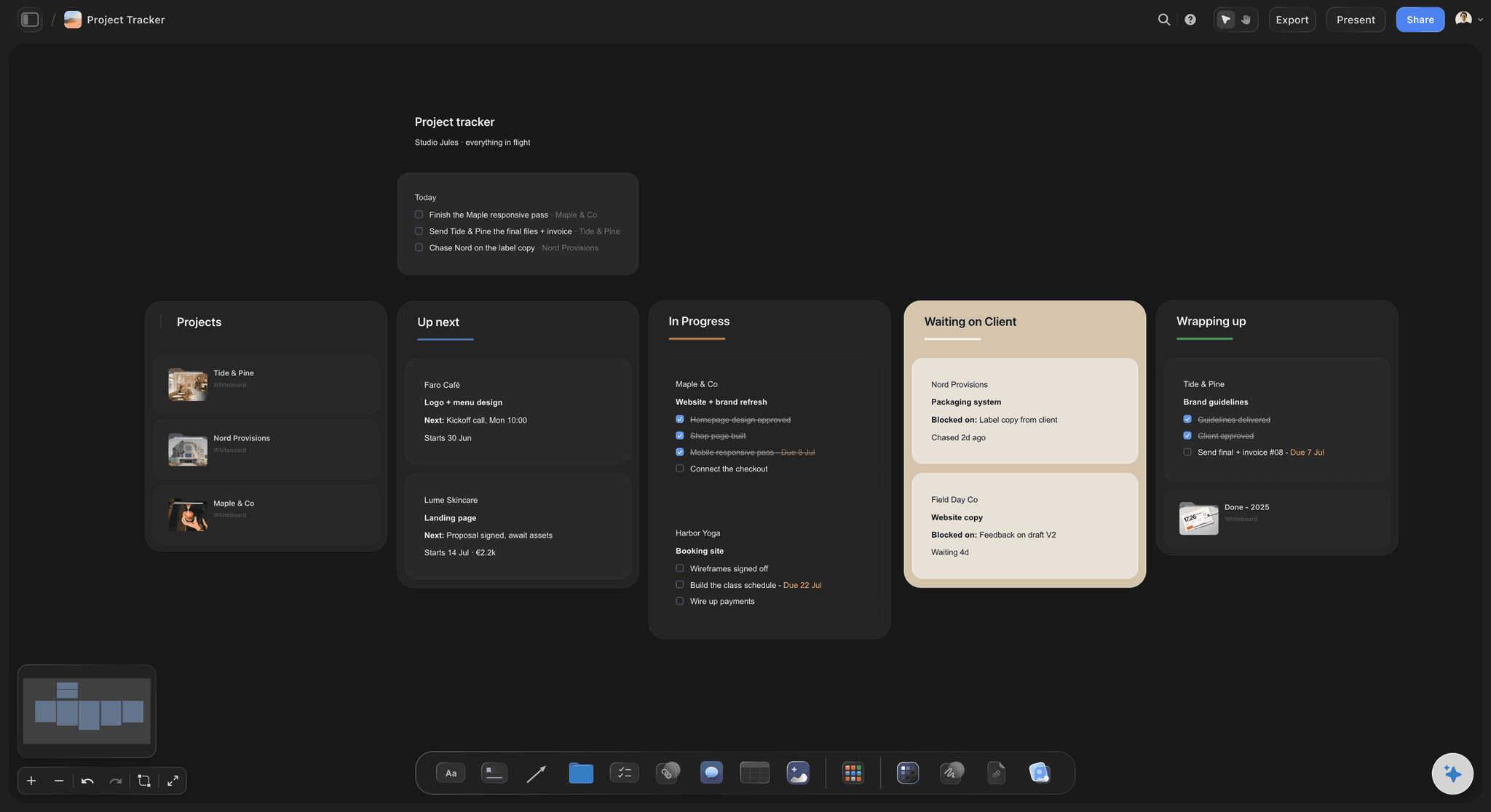
No schema meeting before you can think
Start from a filled board, not an empty table
A base begins as a blank grid you have to design: tables, fields, types, links, views. Describe the project instead and Storyflow's AI lays out cards across the canvas with the structure already suggested, so you begin by editing a draft rather than by inventing a schema for work you have not scoped yet.
See creative project management →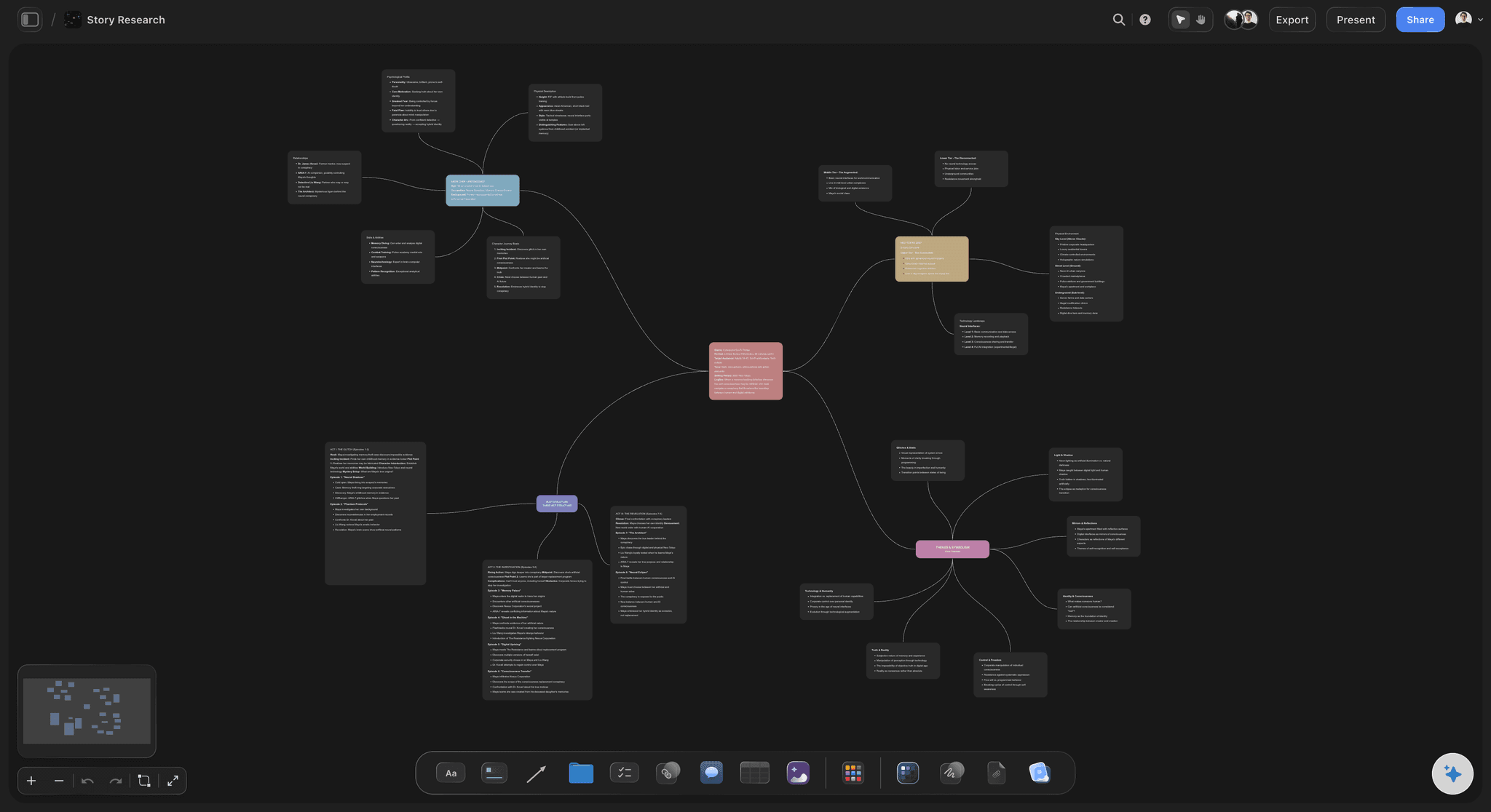
Where the attachment column was doing the real work
Images and references are the content, not a cell
In a base, the moodboard becomes a URL column and twelve references become twelve rows you can only look at one at a time. On a canvas the images are the board: full size, side by side, grouped by hand, with the notes and decisions sitting right beside them where the comparison actually happens.
Explore the content planning tool →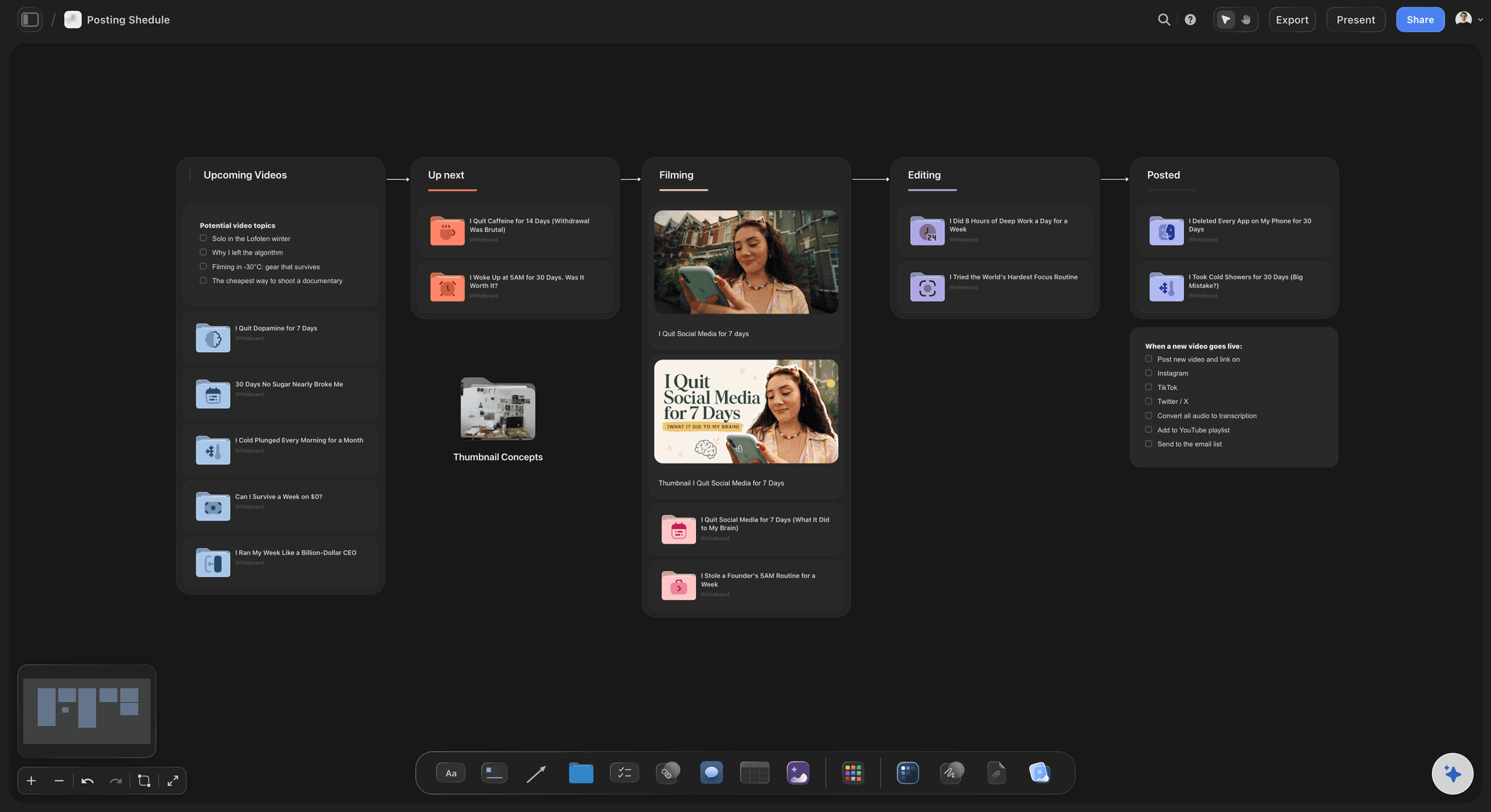
Layout that means something
Position carries information a row order cannot
Sorting a grid tells you sequence and nothing else. On a canvas, near means related, a cluster means a theme, an arrow means this leads to that, and space around something means it is still unresolved. That is how people already think about a campaign or a season of content before anyone types it up.
See the editorial calendar board →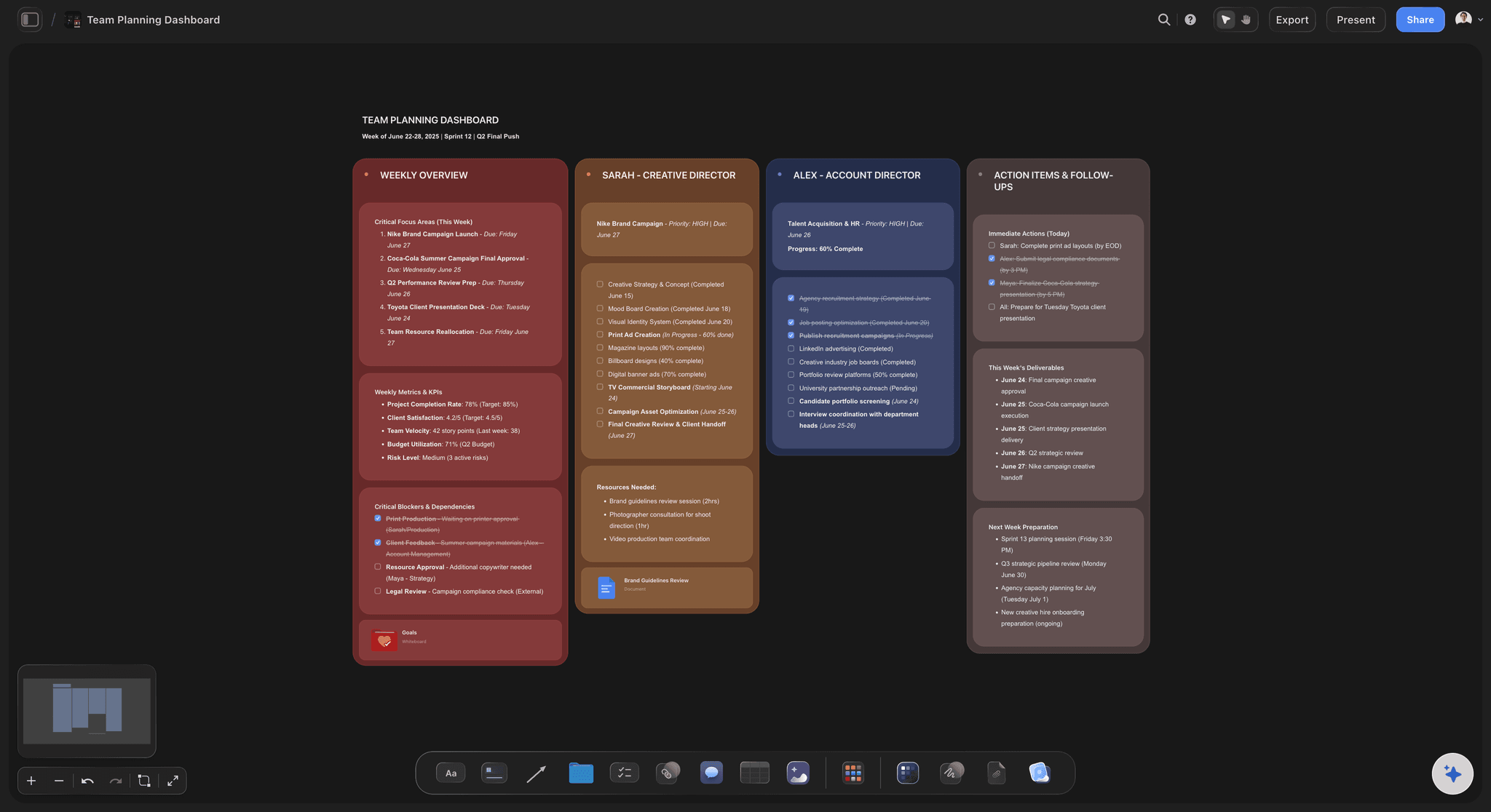
Everyone can read a board
Collaborators who bounce off a base engage with a canvas
Views, filters, and linked records are a language the base owner speaks and nobody else does, which is why stakeholders ask for a summary instead of opening the link. A board with cards, images, and arrows needs no onboarding, so clients, founders, and freelancers actually look at the plan.
Try the free kanban board →Unlimited boards. No record cap.
Open a canvas, describe the project, and start planning. Storyflow is paid-only during early access, with plans from $9.99 a month, and a Free plan launches before the end of 2026. Anyone a paid member invites to a board joins free today.
Unlimited project boards on an infinite canvas
Basic AI usage to generate boards from prompts
Images, references, PDFs, and moodboards on the same canvas
Share view-only links with anyone, no account needed
BUILT FOR THE WORK THAT WAS NEVER TABULAR
For the base that is really a project in disguise.
Not a faster grid. A different surface for the campaigns, content plans, and creative projects that a table was only ever hosting.
Phases, workstreams, options, and open questions
Plan a project while it is still vague
No schema before the thinking: A base wants you to decide what the columns are before you know what the work is. A canvas holds half-formed ideas, competing options, and unanswered questions without forcing any of them into a field type.
See the whole shape at once: Phases, dependencies, and the parts nobody has scoped yet, laid out spatially so the problem waiting in week six is visible now. A grid shows you one screen of rows at a time and hides the shape.
Rearrange by dragging: Change the plan by moving cards, not by editing a status field on forty records. Trying an alternative version takes a minute, which is the difference between considering one and actually testing one.
Structure when you want it: Boards, groups, and connections give the canvas as much order as the work deserves, without pretending to be a relational model underneath. Structure you chose, not structure the tool demanded.
AI that can see the board you have already built
Plan with AI that has your project in context
A board from one prompt: Describe the campaign, the quarter, or the launch and the AI lays out cards, phases, and open questions across the canvas. Arguing with a first draft is faster than staring at an empty grid.
It reads the whole canvas: Ask what a launch plan is missing, or to break a phase into workstreams, and it answers against the board you actually built rather than against a generic template it has never seen your project through.
Iterate without losing work: Re-prompt as often as you like. Cards you wrote and placed stay exactly where they are while the AI builds around them, so nothing you already decided gets overwritten.
The attachment column, promoted to the whole surface
Visual material where you can actually compare it
Moodboards that look like moodboards: Drag in brand references, screenshots, product shots, and competitor pages and arrange them until the direction is obvious. Twelve images side by side is a decision. Twelve rows with an attachment each is a chore.
Documents and links in place: Pin PDFs, briefs, articles, and links directly beside the part of the plan they justify, so the answer to why did we choose this is one scroll away rather than lost in a comment thread from March.
Video reference too: Grab frames from YouTube or Vimeo straight onto the board when the reference is a moment in a video rather than a still image you could have downloaded.
Everyone who should see the plan, without a seat each
Share it with people who will never log into a base
View-only links: Send one link and anyone opens the whole board in a browser with no account and no login. Stakeholders read the plan instead of asking someone to summarise the base for them.
Guests join free: Anyone a paid member invites to a board joins free today, so you are not weighing whether a freelancer or a client is worth another seat before you can show them the work.
Plan together on one canvas: Teammates work on the same board, so a shared project has one plan instead of four private versions that get reconciled in a meeting nobody wanted.
Export for a deck: Export the board as a high-quality image or PDF when the plan has to appear in a presentation, a client review, or a board update.
Explore templates for your project
Every template opens as a real, editable board on the infinite canvas. Pick the closest fit and make it your own.
Mind Map
Branch one central idea out into themes and sub-points, then drag the connections around until the structure makes sense.
HOW WE COMPARE
Storyflow vs Airtable, Notion, and Trello.
These tools do genuinely different jobs, so this is a map rather than a scoreboard. Airtable wins the database rows because Airtable should.
Storyflow
Recommended
Infinite visual canvas where layout carries meaning
Structured records, field types, and filtered views
Rollups, lookups, automations, and an open API
Long-form documents beside the plan
Images, references, and moodboards as first-class objects
Simple card pipeline anyone can run on day one
Airtable
Infinite visual canvas where layout carries meaning
Structured records, field types, and filtered views
Rollups, lookups, automations, and an open API
Long-form documents beside the plan
Images, references, and moodboards as first-class objects
Simple card pipeline anyone can run on day one
Notion
Infinite visual canvas where layout carries meaning
Structured records, field types, and filtered views
Rollups, lookups, automations, and an open API
Long-form documents beside the plan
Images, references, and moodboards as first-class objects
Simple card pipeline anyone can run on day one
Trello
Infinite visual canvas where layout carries meaning
Structured records, field types, and filtered views
Rollups, lookups, automations, and an open API
Long-form documents beside the plan
Images, references, and moodboards as first-class objects
Simple card pipeline anyone can run on day one
What creators are saying
Join early creators getting structured workspaces and AI that remembers their projects
“Storyflow has sped up my workflow by at least 3x, which means more flow state and more projects I can actually ship. It truly changed the way me and my team create.”

Reilin Joey
Director & YouTuber
“One prompt gets me a structured board. But the tactics are my favorite. I run my YouTube scripts through them and my intros and retention got better. It's amazing.”

Justkay
YouTuber & Freelance Filmmaker
“I used to juggle five apps to plan a project. Now I describe what I am making and get boards, lists, and a schedule. All in one place.”

George
@fernwehchronicles
Airtable alternative questions, answered honestly.
Including the several where the answer is that you should keep Airtable.
No. Plainly, no. There is no records model, no field types, no filtered or grouped views, no linked tables, no rollups or lookups, no automation builder, no API-driven syncing, and no forms that write into a table. Storyflow is an infinite visual canvas: cards, boards, images, documents, connections, and AI that reads the whole board as context. If a page tells you a canvas replaces a relational database, treat the rest of that page with suspicion, because that claim falls apart in the first week of real use.
Keep the database. Get a surface for everything else.
Open a canvas, describe the project, and let AI lay out the first board. Plans from $9.99/month, nothing to install, and a Free plan is coming before the end of 2026.