
Ultra-fast planning, extremely simple
One idea per note.
The links do the rest.
Write atomic notes in your own words, link them to each other, and see the clusters form in front of you on an infinite canvas instead of inferring structure from a graph you cannot read.


Creatives working for these brands already got early access
- Red Bull
- Canon
- Artlist
- Porsche
See how easy it is to get started
Watch a real project come together, from a blank board to a finished plan, clicked through step by step.
Start from a ready-made template
Pick a board to see what you can build, then let AI fill it in. Every template is a real, editable starting point on the same infinite canvas.

Mind Map
Branch one central idea out into themes and sub-points, then drag the connections around until the structure makes sense.
What is a Zettelkasten?
A Zettelkasten, German for slip box, is a note system built on three rules. Storyflow is an AI visual workspace that keeps your Zettelkasten on one infinite canvas: atomic notes as cards, links you draw as lines, clusters you can see, and an AI that suggests links across your notes. Each note holds one idea and only one. Each note is written in your own words rather than quoted, because rephrasing is what forces you to actually understand something. And each note is explicitly linked to the others it relates to, so the value accumulates in the connections rather than in any individual card. The method is associated with Niklas Luhmann, a sociologist who kept roughly ninety thousand of these slips and credited the system for an implausible publishing output.
What makes it different from ordinary note taking is that it is designed to be read, not just stored. Most people's notes are a write-only archive: material goes in, nothing comes out, and after two years you have a folder you feel vaguely guilty about. A Zettelkasten inverts this by making the act of filing an act of thinking. To link a new note you have to ask what it resembles, what it contradicts, and what it completes, which means you are re-encountering old ideas every time you add a new one. That re-encounter is the entire mechanism, and it is the part that tools which automate linking quietly remove.
Storyflow gives the slip box a spatial dimension that most implementations lack. Each note is a card on an infinite canvas. Links are lines you draw between them. Related notes sit near each other, so a cluster is something you can see rather than something you infer from a force-directed graph that looks impressive and tells you nothing. Any card opens into a full document editor when a note grows into an essay, and the AI can propose connections between notes you have written that you might not have spotted.
The place a Zettelkasten pays off is the moment you have to produce something. Instead of a blank page, you have a cluster of thirty notes you wrote over eighteen months, already in your own words, already linked, and the essay is largely a matter of choosing a path through them. That is the promise of the method, and the reason it survives despite requiring genuine discipline. It rewards the person who writes their fifty-first note far more than the person who writes their fifth, which is also why most people abandon it in the first month.
Ultra fast from brief to board
From reading to a note system that gives something back.
No write-only archive, no folder you feel guilty about opening.
01
Open a canvas
Sign up in seconds. No download. Your infinite slip box opens in the browser.
02
Write one idea per note
Put each idea on its own card, in your own words, short enough that it says one thing. Rephrasing is what turns reading into understanding, and quoting is what avoids it.
03
Link it to what it relates to
Draw lines to the notes it resembles, contradicts, or completes, and place it near them. Deciding where a note connects is the thinking; storing it is not.
04
Write from the clusters
When a cluster is dense enough to say something, open a document beside it and write from the notes rather than from a blank page.
Atomic notes, real links, visible clusters.
A slip box you can see the shape of.
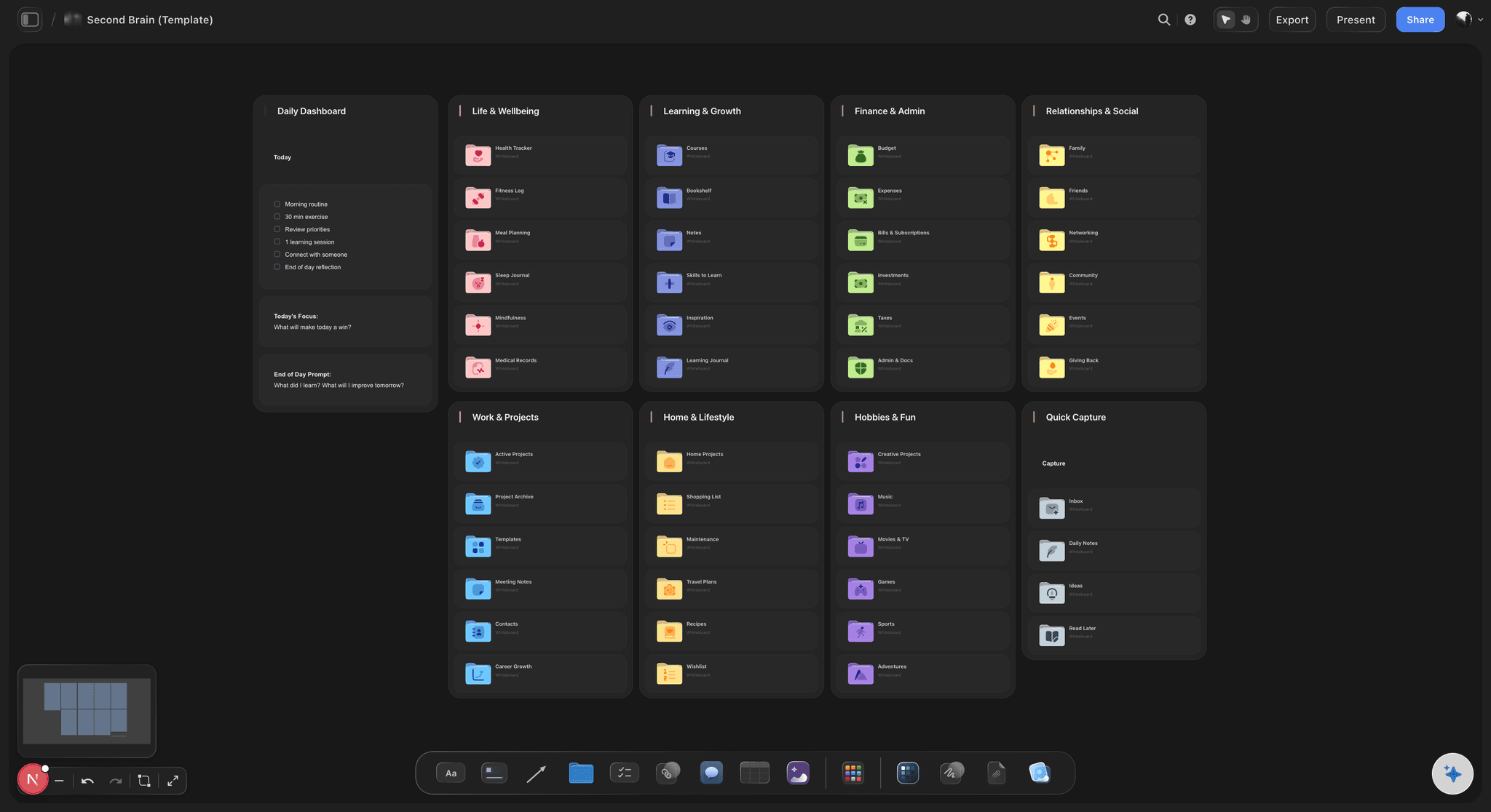
Clusters you can see, not a graph you decode
Spatial beats force-directed
Put related notes near each other and the clusters become obvious. A graph view of five hundred nodes looks impressive in a screenshot and tells you almost nothing you can act on.
See the second brain workspace →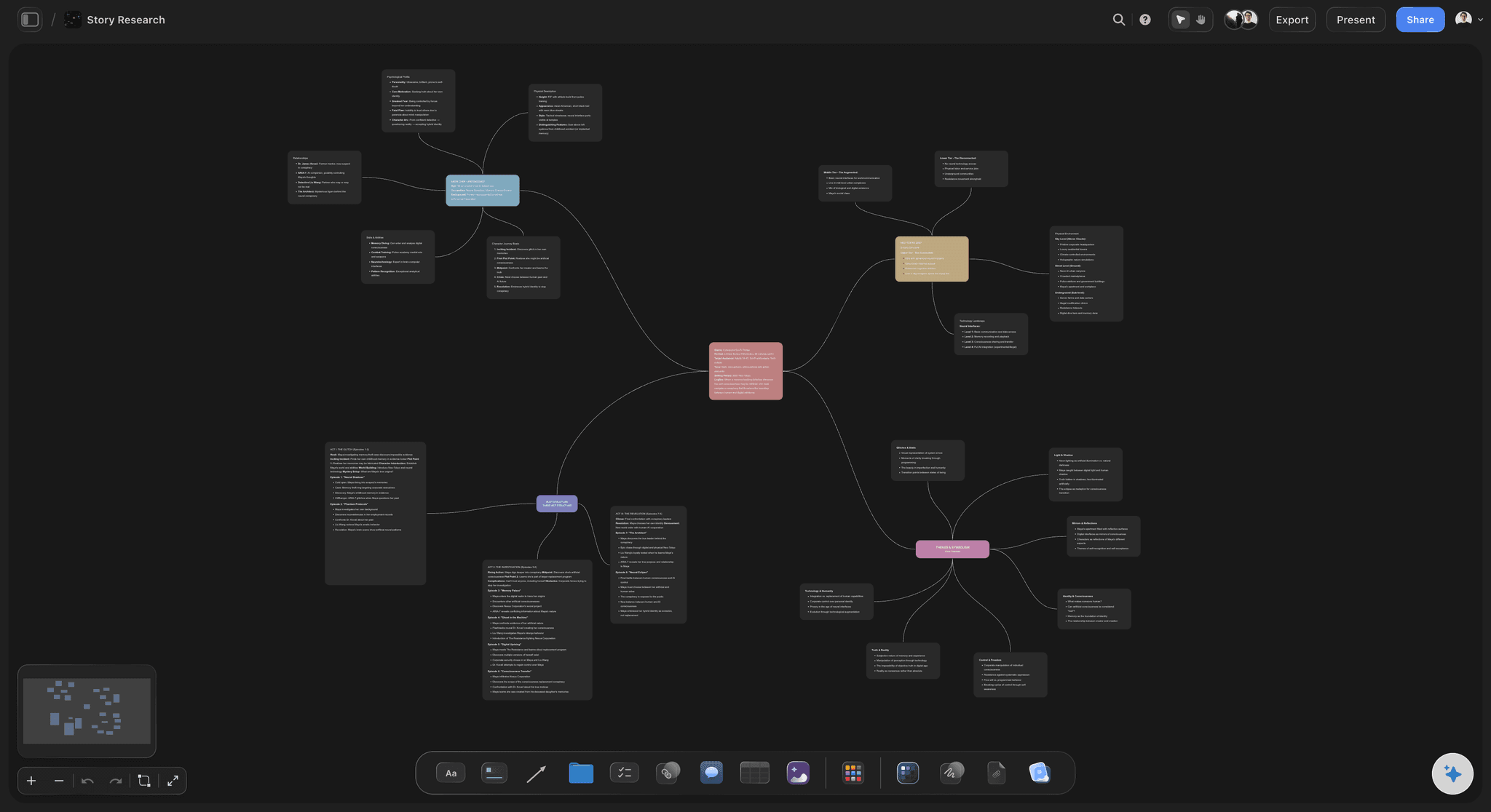
Links you draw deliberately
The filing is the thinking
Deciding what a new note connects to forces you to revisit old ones, which is the whole mechanism. Automated linking is convenient and removes the exact step that produces the value.
Try the free concept map maker →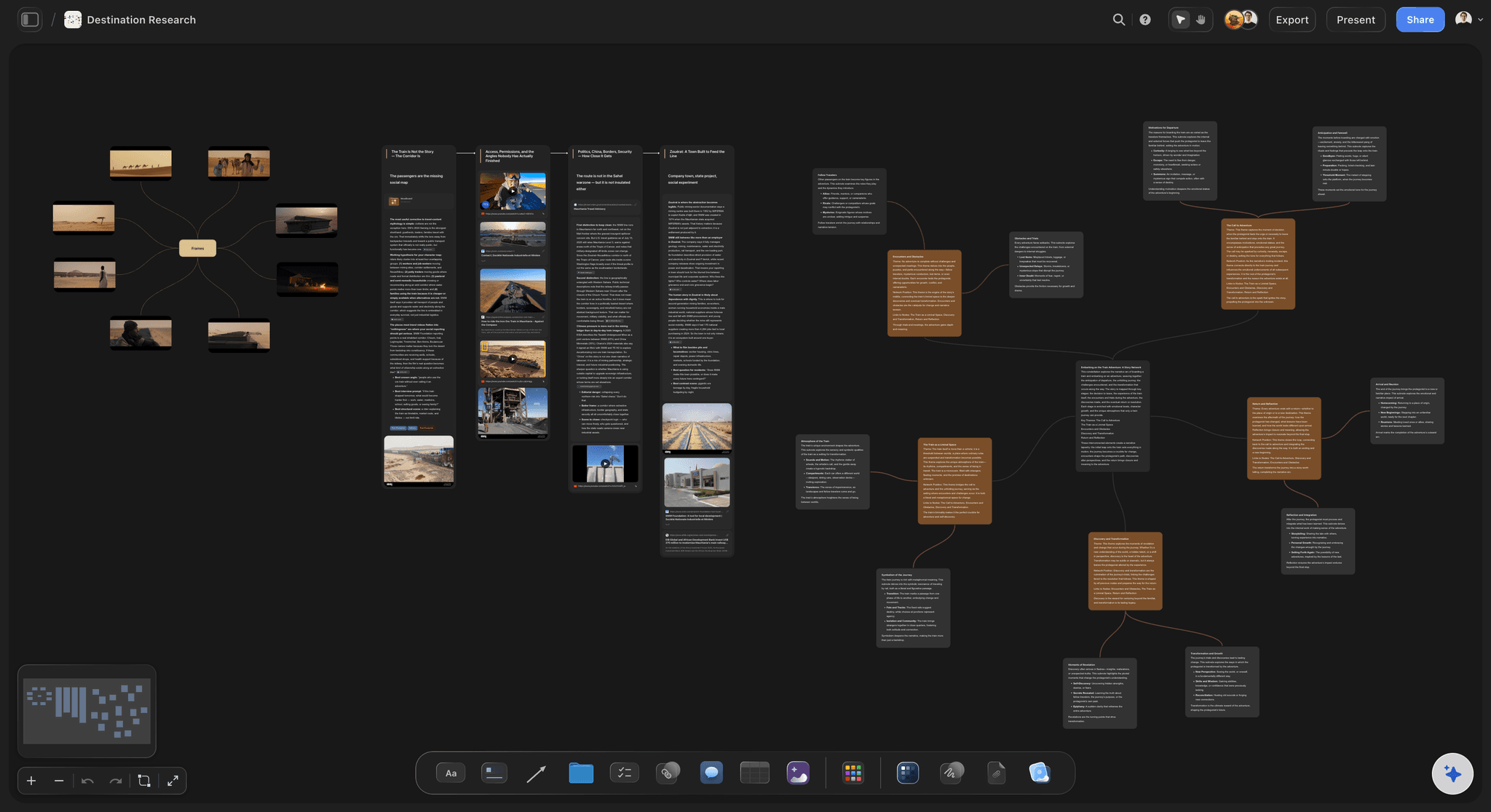
AI that suggests connections you missed
A second pair of eyes on your own archive
Ask the AI to read the board and propose links between notes you wrote months apart. It surfaces candidates; you decide whether the connection is real, which keeps the thinking yours.
See the AI second brain →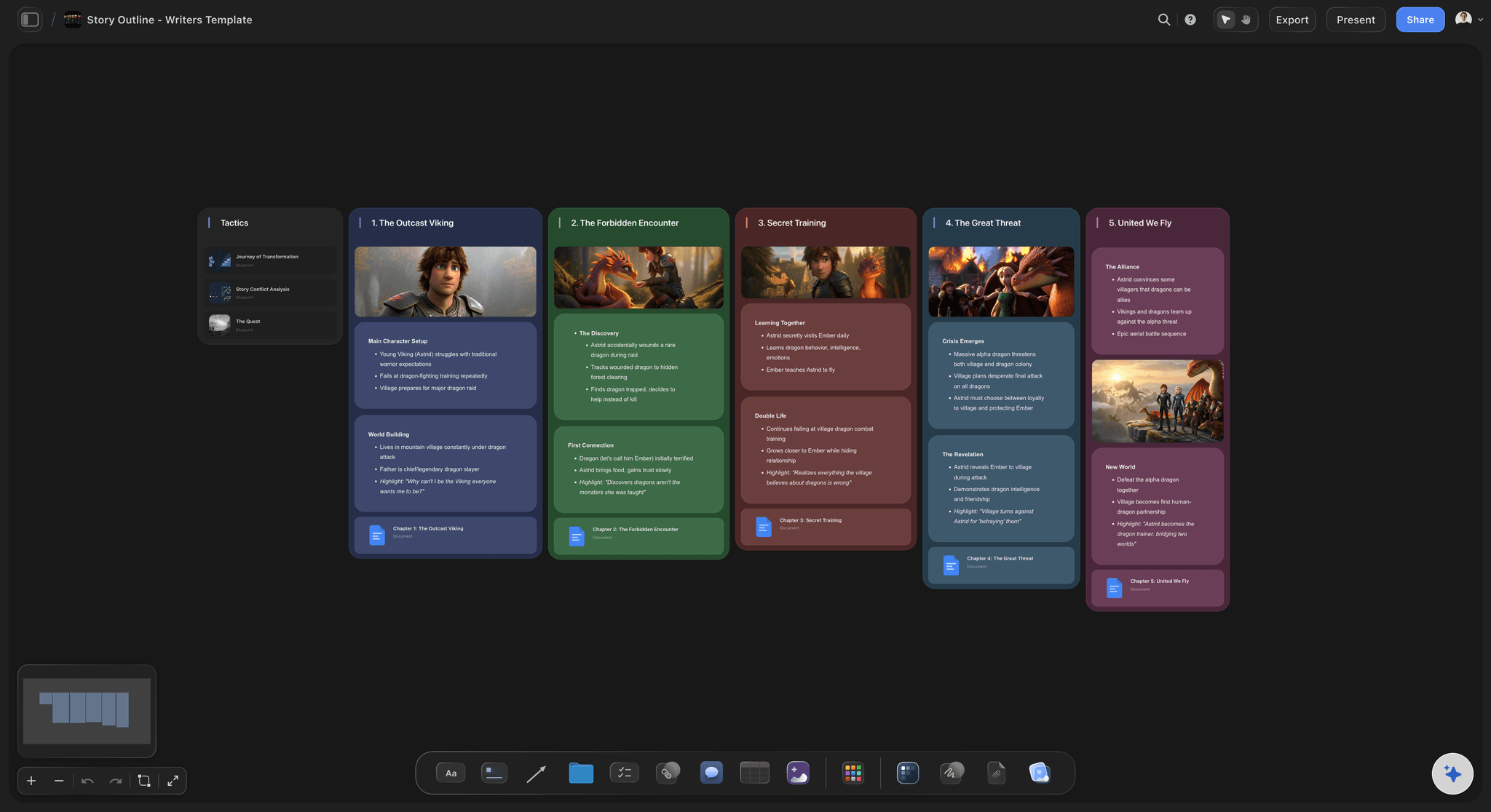
Notes become writing
Start an essay from thirty notes
Open a document beside a dense cluster and write from material already in your own words. This is the payoff the method promises and the reason the discipline is worth it.
See the AI writing workspace →Unlimited boards. No object cap.
Open a canvas and write your first note. Storyflow is paid-only during early access, with plans from $9.99 a month, and a Free plan launches before the end of 2026.
Unlimited notes on an infinite canvas, no object cap
Basic AI usage to suggest links and structures
Documents, images, and sketches beside your notes
Share view-only links with anyone, no account needed
Built for people with taste
More than a folder of things you read.
Most note systems are write-only. The point of a slip box is that it answers back.
Atomic, in your words, linked
Keep the three rules that make it work
One idea per note: If a note contains two ideas it can only be linked as a unit, which makes the links vague. Splitting is almost always the right move when you cannot title a note in a short sentence.
Your words, not the author's: Rephrasing is the step that converts reading into understanding. A note full of quotations is a bookmark with extra steps, and it will be exactly as useless in a year.
Links with a reason: Write why two notes connect, not just that they do. Supports, contradicts, is a special case of, and reminds me of are all different relationships and the difference is where thinking happens.
Entry points into the box: Keep a few index or hub notes that point into dense clusters. Without them a large slip box becomes a place where nothing is lost and nothing can be found either.
AI that can see the board you have already built
Surface connections without outsourcing the thinking
Prompt against the whole canvas: Ask it to propose links between notes written months apart, cluster an untended region, or draft an outline from a group of notes you want to write from.
It suggests, you decide: A proposed connection you accept without examining is a link that teaches you nothing. The AI is useful for surfacing candidates from an archive too large to hold in your head.
Iterate without losing work: Re-prompt as often as you want. Notes you have written and linked stay exactly where they are while the AI builds around them.
Literature notes, fleeting notes, permanent notes
Keep the three kinds separate
Fleeting notes, deliberately temporary: Capture anywhere on the board and process them within a few days. Fleeting notes that are never processed are the most common way a slip box turns into a junk drawer.
Literature notes, tied to a source: Keep what a source said, with the reference, in its own region. These are raw material rather than thinking, and mixing them with your own ideas degrades both.
Permanent notes, the actual box: One idea, your words, linked into the network. This is the only category that compounds, and the only one worth being strict about.
From the box to the page
Write from what you already thought
Find the dense cluster: Zoom out and look for where the notes have accumulated. A dense region is a topic you have been thinking about for months whether or not you noticed, and it is what you should write.
Sequence the notes, then draft: Arrange the cluster into an order on the canvas before writing a word. The outline is already there; you are choosing a path through it rather than inventing structure.
The document opens beside the notes: Write in the built-in editor with the cluster still visible. Exporting notes to another application to write is where most people lose the connections they spent a year building.
Explore templates for your project
Every template opens as a real, editable board on the infinite canvas. Pick the closest fit and make it your own.
Mind Map
Branch one central idea out into themes and sub-points, then drag the connections around until the structure makes sense.
One app instead of five
Storyflow vs Obsidian, Roam, and index cards.
Be clear about what Storyflow is. There are no local markdown files, no backlink syntax, and no plugin ecosystem. It is a spatial slip box where clusters are visible.
Storyflow
Recommended
Spatial canvas where clusters are visible
AI suggests links across your existing notes
Documents, images, and sketches beside notes
Local markdown files you own offline
Backlink syntax and plugin ecosystem
Free plan available today
Obsidian
Spatial canvas where clusters are visible
AI suggests links across your existing notes
Documents, images, and sketches beside notes
Local markdown files you own offline
Backlink syntax and plugin ecosystem
Free plan available today
Roam Research
Spatial canvas where clusters are visible
AI suggests links across your existing notes
Documents, images, and sketches beside notes
Local markdown files you own offline
Backlink syntax and plugin ecosystem
Free plan available today
Index cards
Spatial canvas where clusters are visible
AI suggests links across your existing notes
Documents, images, and sketches beside notes
Local markdown files you own offline
Backlink syntax and plugin ecosystem
Free plan available today
What creators are saying
Join early creators getting structured workspaces and AI that remembers their projects
“Storyflow has sped up my workflow by at least 3x, which means more flow state and more projects I can actually ship. It truly changed the way me and my team create.”

Reilin Joey
Director & YouTuber
“One prompt gets me a structured board. But the tactics are my favorite. I run my YouTube scripts through them and my intros and retention got better. It's amazing.”

Justkay
YouTuber & Freelance Filmmaker
“I used to juggle five apps to plan a project. Now I describe what I am making and get boards, lists, and a schedule. All in one place.”

George
@fernwehchronicles
Zettelkasten questions, answered.
How the method works, why most people abandon it, and where Storyflow fits alongside Obsidian.
Obsidian is the standard answer and deservedly so: local markdown files you own permanently, double-bracket linking, backlinks, a graph view, and a plugin for everything. If file ownership matters to you, use it. Roam pioneered much of the modern approach and still has devoted users. Storyflow is the spatial option: notes are cards on an infinite canvas, links are lines you draw, and clusters are something you see rather than infer from a force-directed graph. It also lets the AI propose connections across notes you wrote months apart, which is genuinely useful once an archive outgrows what you can hold in your head.
You read something, and rather than highlighting it you write the idea as its own note, in your own words, short enough that it says one thing. Then you decide where it belongs in what you already have: what it supports, what it contradicts, what it is a special case of. You draw those links and write why. That is the whole method, and the deciding step is the part that matters, because it forces you to re-encounter old ideas every time you add a new one. Over time the links accumulate into clusters, and a dense cluster is a piece of writing waiting to be assembled.
Because the payoff is genuinely delayed and the cost is immediate. For the first fifty or so notes it feels like elaborate filing with nothing coming back, since a note has almost nothing to link to and the clusters are too thin to write from. Most people quit in that window, usually after reorganizing their system twice. The other common failure is quoting rather than rephrasing, which makes the work feel productive while skipping the step that creates the value. If you are going to try it, commit to a hundred notes in your own words before judging whether it is working.
Not during early access. Storyflow is paid-only right now, with plans starting at $9.99 a month, and a Free plan for solo use launches before the end of 2026. Anyone a paid member invites to a board joins free today, so a collaborator or a study partner can read and comment without paying. If you need free this minute, Obsidian is free for personal use and is the most capable free option in this category by a distance, and physical index cards cost almost nothing and are what Luhmann actually used. Both are honest options.
No, and for a note system meant to last decades that is a fair objection. Storyflow is a cloud application: your boards live on our servers and you work in a browser. There is no local markdown vault, no plain-text folder you own independently, and no offline-first storage. If permanence and file ownership are your primary requirements, Obsidian is built precisely around them and is the better choice. What Storyflow offers instead is spatial clustering, AI link suggestions, and notes that sit on the same canvas as documents, images, and project boards.
Ordinary notes are storage; a Zettelkasten is a system that answers back. The difference is entirely in the linking discipline. Most people's notes are write-only, material goes in and nothing comes out, and the folder becomes a source of vague guilt. A slip box makes retrieval and connection the point: because every note had to be placed in relation to others, you cannot help re-reading your own thinking, and because clusters form, the archive tells you what you have been interested in rather than waiting for you to remember. That is the difference between a filing cabinet and a thinking partner.
You ask it to read the board and propose connections between notes, and it surfaces candidates: notes that appear to be about the same idea, notes that seem to contradict each other, notes that might be special cases of a more general one you wrote a year ago. You then decide whether each connection is real. That division matters. A link you accept without examining teaches you nothing, and the entire mechanism of the method is the examination. Where the AI genuinely helps is scale: once you have several hundred notes, you cannot remember what is in there, and it can.
Somewhere around a hundred to two hundred permanent notes before it stops feeling like filing, and considerably more before it feels remarkable. The reason is arithmetic: the value is in connections, and connections grow much faster than notes do, so a box with twenty notes is nearly inert while a box with five hundred is dense. Luhmann's had ninety thousand. This is why the method rewards patience and punishes tinkering, and why the most common form of failure is spending the first three months perfecting a system instead of writing notes into it.
Yes, and you should keep them separate but nearby. Give literature notes their own region: what a source actually said, with the reference attached, kept distinct from your own permanent notes. Mixing the two degrades both, because you lose track of which thoughts are yours. Storyflow lets you pin PDFs, images, screenshots, and video frames beside the notes they produced, so a permanent note can sit next to the passage that prompted it without the passage being confused for the idea. That proximity is much harder to achieve in a plain-text system.
Yes. Send a view-only link and anyone opens the board in a browser with no account, and can sign in to comment on individual notes. This is useful for a supervisor, a co-author, or a reading group, and showing the network rather than a summary tends to produce better conversations. If someone should genuinely contribute, invite them to the canvas and they join free as a collaborator, which makes a shared research slip box practical. Sharing and commenting work on every paid plan.