
IDEA MANAGEMENT TOOL
Collecting ideas is easy.
Answering them is not.
Every company can gather ideas. Almost none close the loop, so people submit the same idea twice, hear nothing back, and stop submitting. Storyflow puts the whole portfolio on one canvas, clustered by theme and scored against criteria everyone can see, so a decision comes with a reason attached. Paid-only during early access, plans from $9.99 a month, and a Free plan launches before the end of 2026.
Plans from $9.99/mo
Free plan coming late 2026
Works in your browser

Used by creative professionals at:
Artlist
Pixar
Nike
Red Bull
The North Face
Porsche
Start from a ready-made template
Pick a board to see what you can build, then let AI fill it in. Every template is a real, editable starting point on the same infinite canvas.
Mind Map
Branch one central idea out into themes and sub-points, then drag the connections around until the structure makes sense.
What is an idea management tool?
An idea management tool is software for what happens to ideas after somebody has them: capturing every idea in one place, moving it through a visible triage state, evaluating it against criteria the group agreed in advance, recording a decision with a written reason, and telling the person who submitted it what happened. It is a process tool, not a creativity tool. Generating ideas is a session that ends. Managing them is an ongoing organisational habit that either holds or quietly collapses.
Idea management dies at the decision step, not the capture step. This is the single most useful thing to know about it. Almost every team can collect ideas, and most collect far more than they can act on. What breaks is the answer. An idea gets submitted, disappears into a backlog nobody grooms, and the submitter never learns whether it was rejected, deferred, or simply never read. So they submit the same idea again six months later, then they stop submitting at all, and the pipeline dries up while looking healthy on a dashboard. Nothing about the capture form caused that. The missing reply did.
The failure has specific, fixable causes. Ideas are spread across Slack threads, email, meeting notes, and somebody's notebook, so no one can see the portfolio at once. Triage state is invisible, so a submitter has no way to find out where their idea got to. Evaluation criteria are decided after the ideas arrive, which means the room argues about criteria while pretending to argue about ideas, and whoever is most senior wins. A no is delivered as silence rather than a sentence. And rejected ideas are deleted, even though timing is the most common reason a good idea gets rejected, so the same idea has to be reinvented from scratch when the constraint that killed it goes away.
A working idea management process moves through six named stages: capture (every idea lands in one place, whoever had it and wherever they were, so the portfolio is a portfolio rather than a rumour), triage (a visible state such as new, needs detail, under review, approved, deferred, or declined, that the submitter can see without asking), evaluation (scoring against criteria written down before the ideas arrived, so selection is about fit rather than volume of enthusiasm), decision (a call made by a named person, with the reason recorded in a sentence next to the idea), feedback (the submitter is told the outcome and the reason, which is the step that keeps the next hundred ideas coming), and review (a revisitable graveyard, because an idea rejected for timing in March is often exactly right in September). Storyflow holds all six on one canvas so the reasoning never gets separated from the idea.
HOW IT WORKS
One place ideas land, and one place they get answered.
No portal to roll out and no workflow to configure. Open a board and start putting the pipeline on it.
01
Open one board for the pipeline
Sign up in seconds, from $9.99 a month. No download. One canvas becomes the single place ideas land, instead of four Slack channels and an inbox.
02
Agree the criteria before the ideas arrive
Put three or four criteria on the canvas first: reach, effort, confidence, strategic fit, whatever the decision genuinely turns on. Doing this in advance is what stops the group arguing about criteria while pretending to argue about ideas.
03
Triage in the open
Move each idea into a visible state and cluster the board by theme, or ask AI to cluster it for you. Anyone with the link can see where an idea got to without sending a message to find out.
04
Decide, write the reason, close the loop
Score the shortlist, name the decision maker, and write one sentence saying why. Approved ideas become a plan on the same board. Declined ones move to a dated graveyard you can revisit when the timing changes.
The portfolio, the criteria, and the answer in one place.
Ideas judged next to each other, against reasoning that stays attached to them.
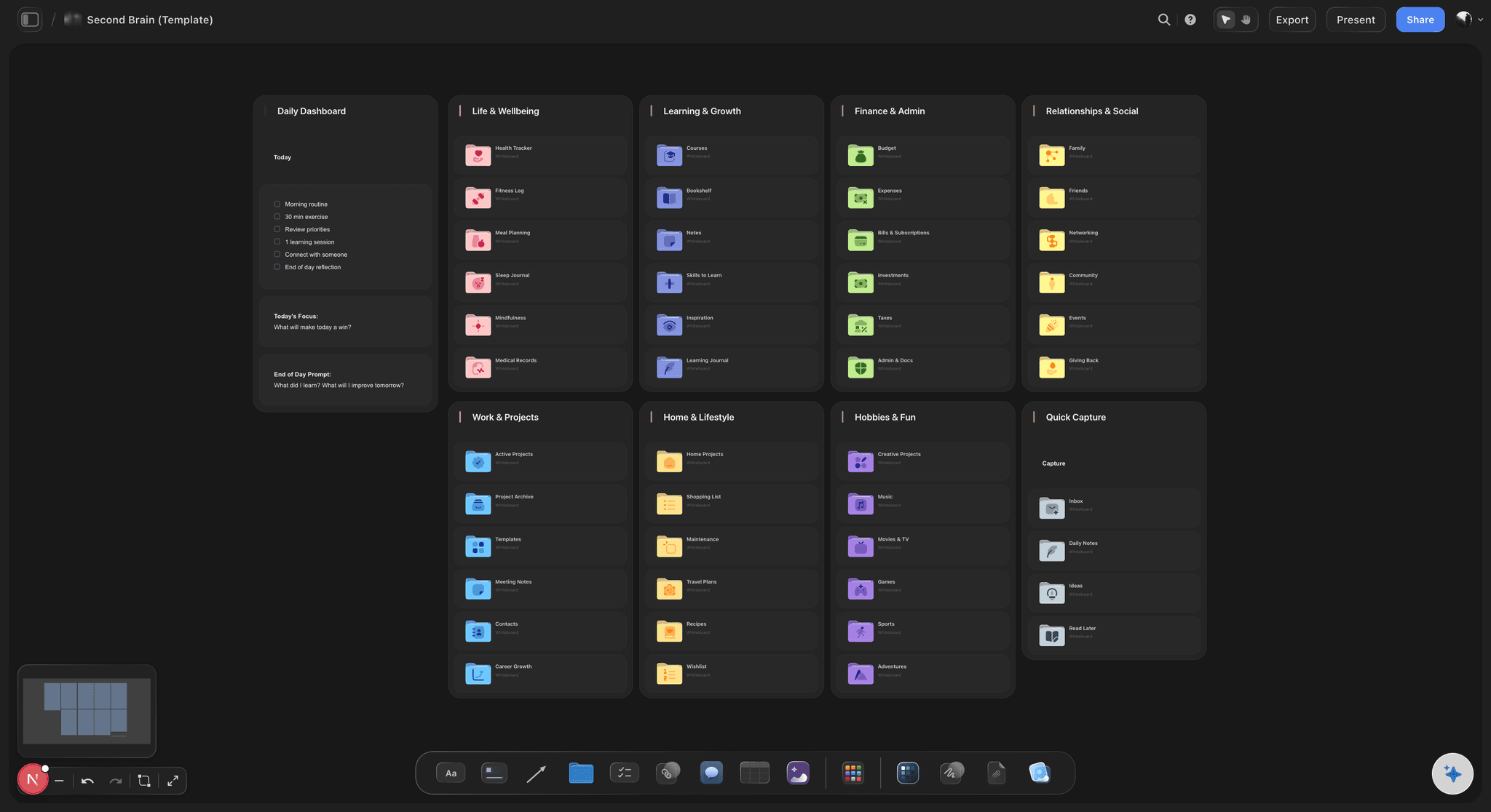
Every idea visible at the same time
See the portfolio, not one idea at a time
A list makes you judge each idea alone and out of context, which is how duplicates survive and how the third-best idea gets approved because it was read on a good day. A canvas shows the whole portfolio at once, clustered by theme, so overlaps and gaps are obvious.
See the affinity diagram maker →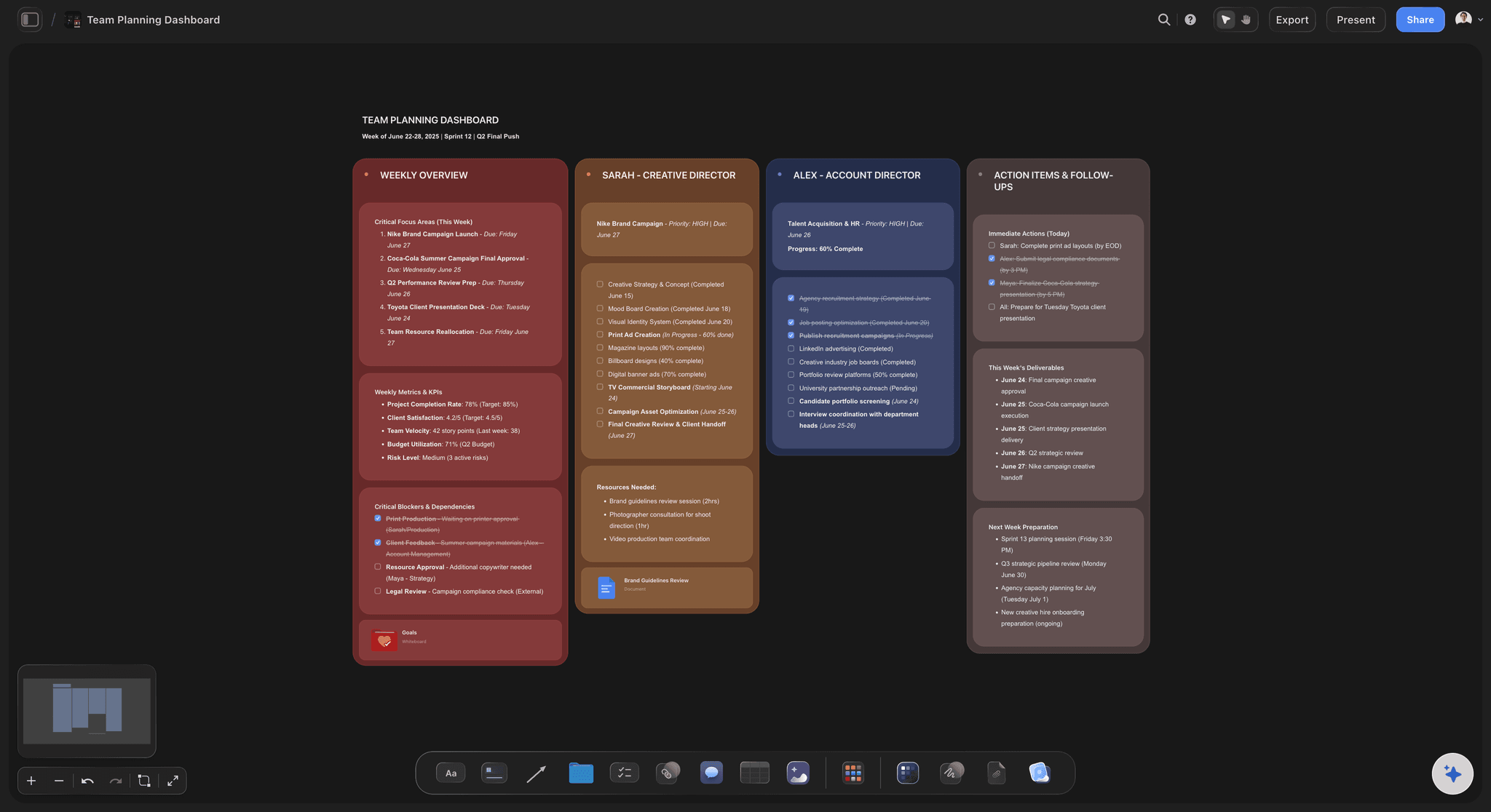
Criteria on the board, scores beside the ideas
Evaluate against something written down
Criteria agreed after the ideas arrive are not criteria, they are a justification. Pin yours on the canvas before submissions open, then score each shortlisted idea against them in the open so disagreement becomes specific instead of political.
See how ideation works →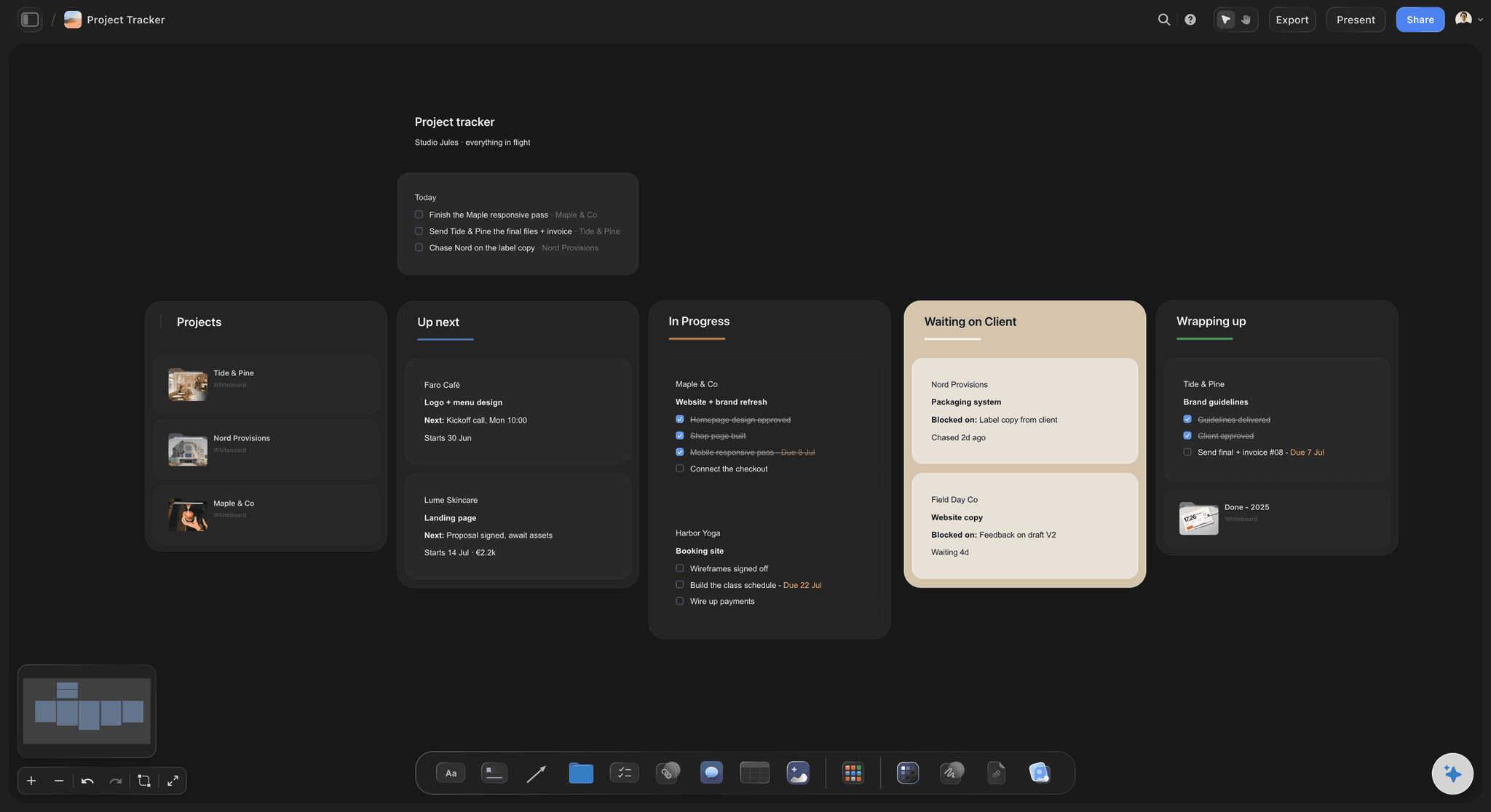
A state anyone can see, and a reason anyone can read
Close the loop so people keep submitting
Silence is what kills a suggestion pipeline. Give every idea a visible triage state and every decision a written reason, then share the board as a link. The submitter finds out what happened without asking, which is the whole reason the next idea shows up.
See the kanban board →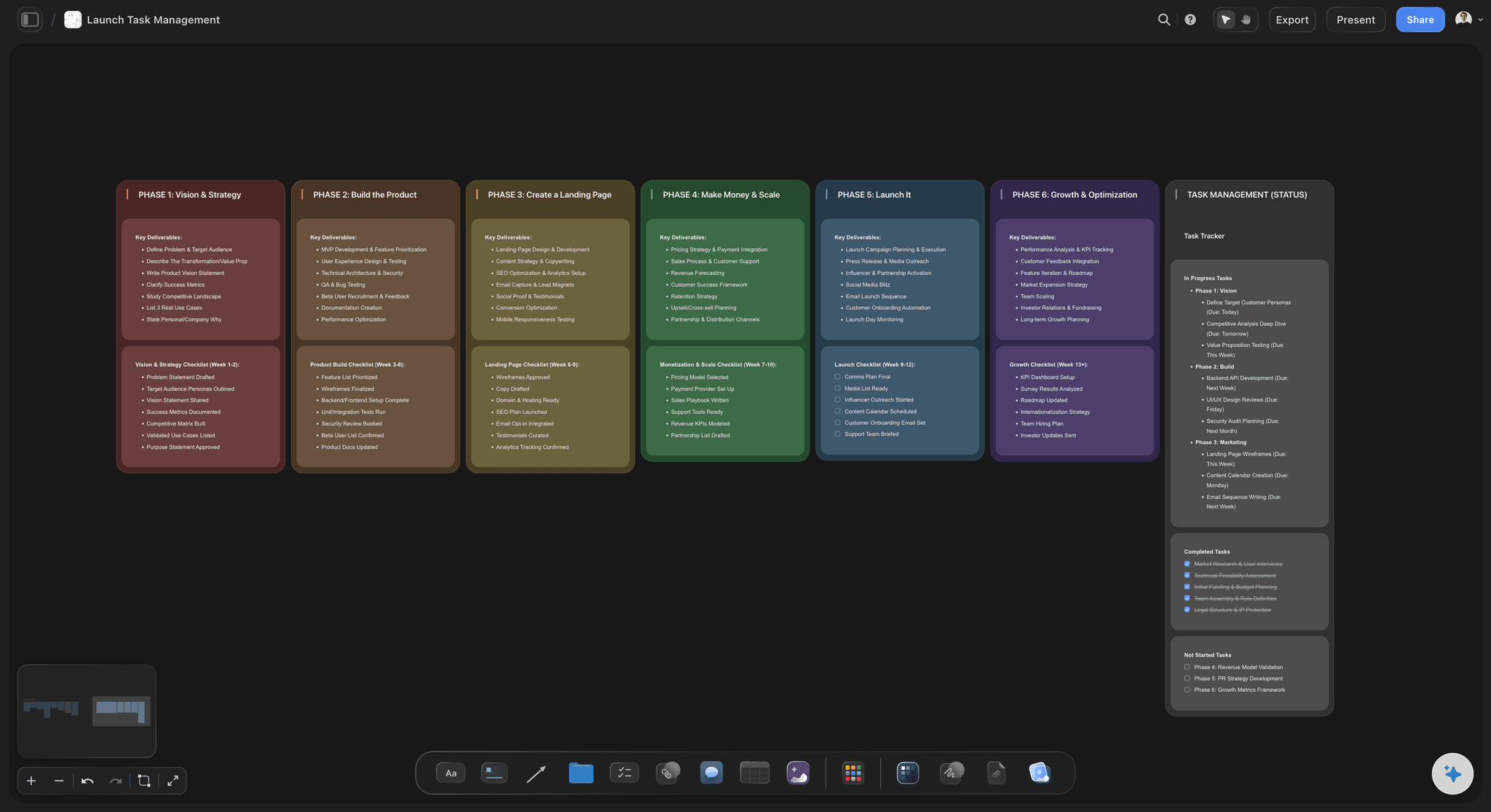
Approved ideas become a plan on the same canvas
From approved to owned, without a migration
An approval that does not turn into a plan is just a compliment. Build the milestones, owners, and first test for the winning idea in the same space it was judged in, with the rejected alternatives and the criteria one scroll away.
See the product roadmap tool →Unlimited boards. No object cap.
Put the whole idea pipeline on one canvas and give every idea an answer. Storyflow is paid-only during early access, with plans from $9.99 a month, and a Free plan launches before the end of 2026.
Unlimited idea boards on an infinite canvas
Basic AI usage to cluster ideas and name themes from a prompt
3 starter frameworks for triage and scoring
Share view-only links so submitters can see where an idea got to
BUILT FOR THE LONG GAME
An idea pipeline that survives the second quarter.
Capture is the part every tool does. These are the four parts that decide whether the process holds.
One place, not five
Get every idea onto the same surface
Ideas arrive from everywhere: A support ticket, a Slack thread, a customer call, a hallway conversation, a note somebody wrote on their phone at midnight. If they stay where they were said, nobody can compare them, and the same idea gets raised three times by three people who each think they are first.
Paste it in, in whatever shape it came: Drop text, screenshots, PDFs, links, images, and video frames straight onto the canvas. An idea with the customer quote and the screenshot attached is a very different object at review time than the same idea reduced to one line in a spreadsheet.
Duplicates become visible instead of embarrassing: When the whole portfolio sits on one canvas clustered by theme, near-duplicates end up next to each other. Merging two overlapping ideas into a stronger one is far more useful than quietly declining the second one for being a repeat.
Nothing is deleted: An infinite canvas means there is no reason to throw an idea away to make room. Ideas move to a different region of the board rather than out of existence, which is what makes the review stage possible at all.
The submitter should never have to ask
Make triage state visible
A small number of honest states: New, needs detail, under review, approved, deferred, declined. Six states people understand beat twenty nobody maintains. The point is not precision, it is that anyone can look and see that their idea was actually read.
Deferred is a real answer: Most rejections are really timing. Saying deferred until the platform work lands, with a date to look again, is honest and keeps the idea alive. Saying nothing reads as no, and it reads as no to the whole team, not just the submitter.
One link, no account, no chasing: Share the board view-only and anyone opens it in a browser. That single link removes most of the status chasing that makes idea programmes feel like paperwork to the people running them.
Decide on fit, not on volume of enthusiasm
Evaluate against criteria set in advance
Write the criteria before the ideas arrive: Once people have favourites, the criteria bend to fit them. Agreeing reach, effort, confidence, and strategic fit up front means the later argument is about evidence, which can be settled, rather than taste, which cannot.
Score in the open, next to the idea: Put the score for each criterion on the canvas beside the idea it belongs to. The number is not the decision, but a visible score turns a vague objection into a specific one, and specific objections can be tested.
AI that reads the whole board: Ask it to cluster a hundred submissions into named themes, to find the ideas that depend on the same untested assumption, or to make the strongest case against the one everyone already likes. It has the whole portfolio in context, not one selected card.
Compare like with like: Judging ideas one at a time, weeks apart, produces inconsistent decisions. Reviewing a themed cluster in one sitting, against the same criteria, is the cheapest quality upgrade available to any idea process.
The answer, and what happens next
Close the loop and keep the graveyard
A written reason, every time: One sentence beside the idea saying who decided and why. It takes a minute and it is the difference between a process people trust and a process they route around. It also stops the same debate being reopened every quarter.
Approved ideas become plans in place: Milestones, owners, and the first test go on the same canvas as the idea and the criteria that selected it. A plan that carries its own reasoning is much harder to quietly abandon three weeks in.
A graveyard worth revisiting: Keep declined and deferred ideas in a dated region of the board with the reason attached. When a constraint disappears, a budget appears, or the market moves, you re-read a real list instead of hoping somebody remembers.
Review together, not in an inbox: Teammates work on the same canvas, so a review is one board rather than four people's private notes. Anyone a paid member invites to a board joins free today.
Explore templates for your project
Every template opens as a real, editable board on the infinite canvas. Pick the closest fit and make it your own.
Mind Map
Branch one central idea out into themes and sub-points, then drag the connections around until the structure makes sense.
HOW WE COMPARE
Storyflow vs Miro, Notion, and Trello.
All three are used for idea management every day. Here is honestly where each one is stronger, so you can pick on the part of the process that is failing for you.
Storyflow
Recommended
Whole idea portfolio visible at once on an infinite canvas
AI reads the entire board to cluster ideas and name themes
Built-in document editor beside the canvas
Submission forms for capturing ideas from outside the team
Voting or upvoting to rank submitted ideas
Automated rules that move ideas between states
Miro
Whole idea portfolio visible at once on an infinite canvas
AI reads the entire board to cluster ideas and name themes
Built-in document editor beside the canvas
Submission forms for capturing ideas from outside the team
Voting or upvoting to rank submitted ideas
Automated rules that move ideas between states
Notion
Whole idea portfolio visible at once on an infinite canvas
AI reads the entire board to cluster ideas and name themes
Built-in document editor beside the canvas
Submission forms for capturing ideas from outside the team
Voting or upvoting to rank submitted ideas
Automated rules that move ideas between states
Trello
Whole idea portfolio visible at once on an infinite canvas
AI reads the entire board to cluster ideas and name themes
Built-in document editor beside the canvas
Submission forms for capturing ideas from outside the team
Voting or upvoting to rank submitted ideas
Automated rules that move ideas between states
What creators are saying
Join early creators getting structured workspaces and AI that remembers their projects
“Storyflow has sped up my workflow by at least 3x, which means more flow state and more projects I can actually ship. It truly changed the way me and my team create.”

Reilin Joey
Director & YouTuber
“One prompt gets me a structured board. But the tactics are my favorite. I run my YouTube scripts through them and my intros and retention got better. It's amazing.”

Justkay
YouTuber & Freelance Filmmaker
“I used to juggle five apps to plan a project. Now I describe what I am making and get boards, lists, and a schedule. All in one place.”

George
@fernwehchronicles
Idea management questions, answered.
What the process actually involves, where it usually breaks, and what Storyflow does and does not do.
Idea management is the ongoing process of capturing ideas from across an organisation, triaging them into visible states, evaluating them against agreed criteria, deciding with a recorded reason, and telling the submitter what happened. It is a continuous habit rather than an event. The test of whether a company has it is simple: pick an idea someone submitted three months ago and try to find out what was decided and why. If nobody can answer in under a minute, there is a collection process but not a management process.
Give every idea an answer, not a backlog.
Put the whole portfolio on one canvas, score it against criteria everyone can see, and close the loop. Plans from $9.99/month, no download, and a Free plan is coming before the end of 2026.