
FOR COPYWRITERS
Copy does not fail
on the sentence.
It fails on the brief. Storyflow gives copywriters one board for the part that decides whether the writing works: the interrogated brief, the proposition, the voice guide, the layout the copy has to fill, and thirty headline variations laid out where you can actually compare them. Storyflow is paid-only during early access, with plans from $9.99 per month.
Paid-only early access
Plans from $9.99/mo
Headlines side by side

Used by creative professionals at:
Artlist
Pixar
Nike
Red Bull
The North Face
Porsche
Start from a ready-made template
Pick a board to see what you can build, then let AI fill it in. Every template is a real, editable starting point on the same infinite canvas.
Story Plan
Outline your plot, characters, and world in one connected view, then expand each thread as the story grows.
What the job actually is, and where it goes wrong
Almost no piece of copy fails because the writer could not build a sentence. It fails because the brief was vague and nobody said so, because the proposition was three propositions wearing a coat, or because the line was written against a layout that turned out to have half the space. The craft that separates a working copywriter from a fast one is interrogation: refusing to write until you know what the thing is for, who it has to move, what it is competing against in that person's head, and what single claim you are prepared to defend.
Then there is the volume problem, and it is not optional. You write thirty headlines to find one. Twenty-five of them exist purely to prove the other five are wrong, and the only way to know which is the winner is to see them together, at the same size, in the same second. A document cannot do this. In a document, headline four and headline twenty-nine are a page apart, so you compare the one you remember against the one you just wrote, which is not comparison, it is recency. Laid out on a canvas, the weak lines look weak instantly and the ones that survive tend to survive for structural reasons you can then name.
After that comes everything that happens to the copy once it leaves you. The layout it has to work against, which you often have not seen. The review round where a stakeholder rewrites your line into mush and you need the original, the reasoning, and the brief in one place to argue for it calmly. And the versioning, where one message has to become a landing page hero, a subject line, a paid social ad, and a fifteen-second script, each of which bends the proposition differently while staying recognisably the same idea. When those live in four files, they drift within a week.
Storyflow is one infinite canvas for that whole chain, holding the interrogated brief, the proposition and the claim you can defend, the voice and tone guide, the headline wall where variations sit side by side, the layout or wireframe the copy has to fill, and the versioned set of the same message across every channel, all visible together rather than scattered across a doc, a chat thread, a design file, and a spreadsheet.
HOW IT WORKS
From a vague brief to a line you can defend.
Four steps that put the thinking, the variations, and the layout on the same surface.
01
Interrogate the brief on the board
Drop the brief in and break it into what it actually says: the objective, the audience, the single claim, and the questions nobody has answered yet. The gaps become visible when they are cards instead of paragraphs.
02
Pin the voice guide and the proposition
Put the tone rules, the words you use, the words you never use, and the agreed proposition somewhere permanent on the canvas, so every line you write is judged against them rather than against your mood.
03
Build the headline wall
Write thirty variations as separate cards and lay them out in a grid. Cluster them by angle, kill the dead ones on sight, and keep the losers visible so you can see which territory you have already exhausted.
04
Version it across every channel
Take the surviving line and grow it into the landing page, the email, the ad, and the script, side by side on the same board, so the message stays one message and the drift shows up immediately.
The part of copywriting that is not typing.
The brief, the voice, the variations, and the versions, on one board instead of four files.
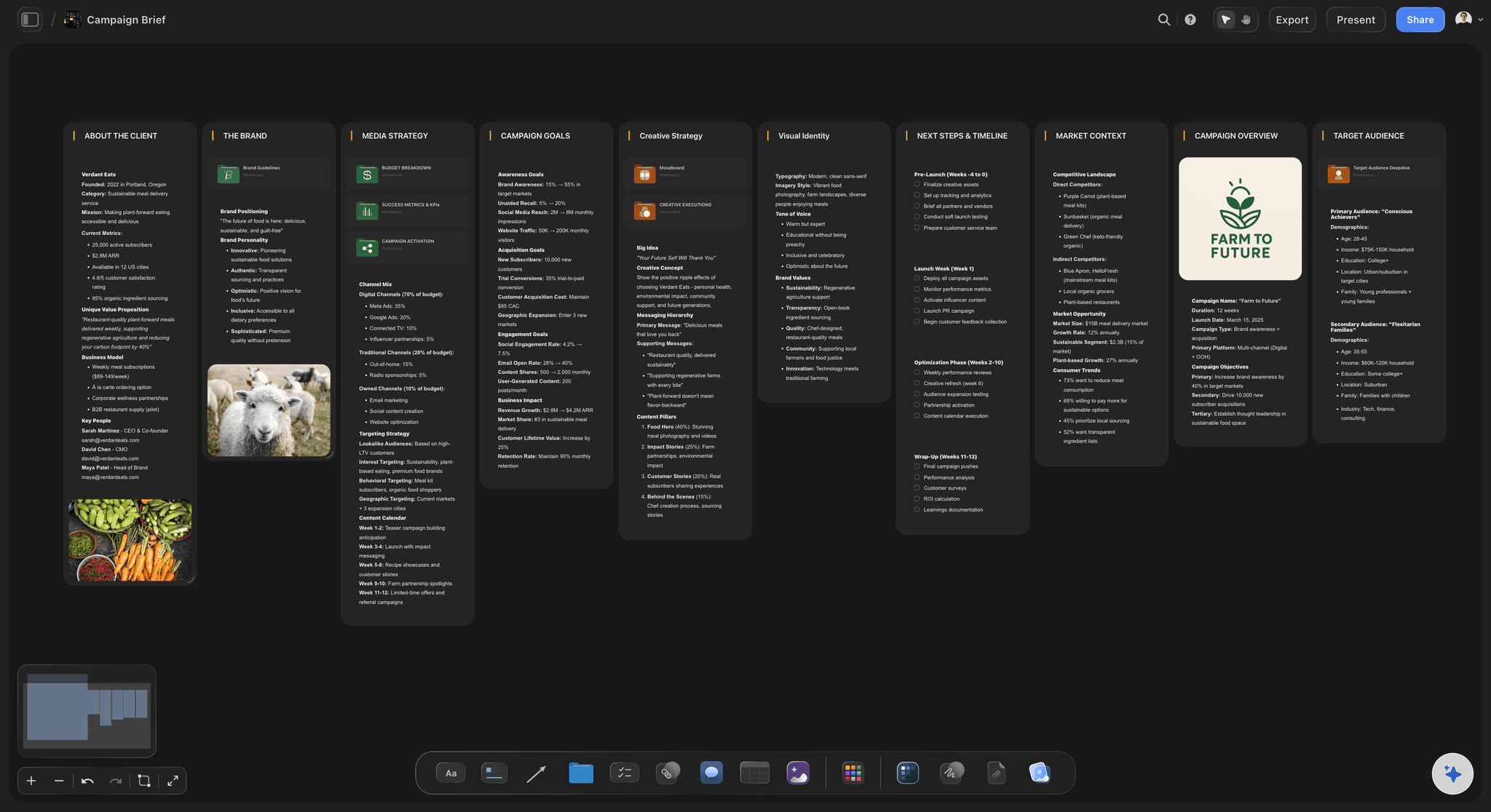
Start with the brief
Interrogate the brief before you write a word
Break the brief into objective, audience, claim, and unanswered question, and let the holes show. Most bad copy is a brief nobody pushed back on, caught two weeks too late.
See the AI creative brief generator →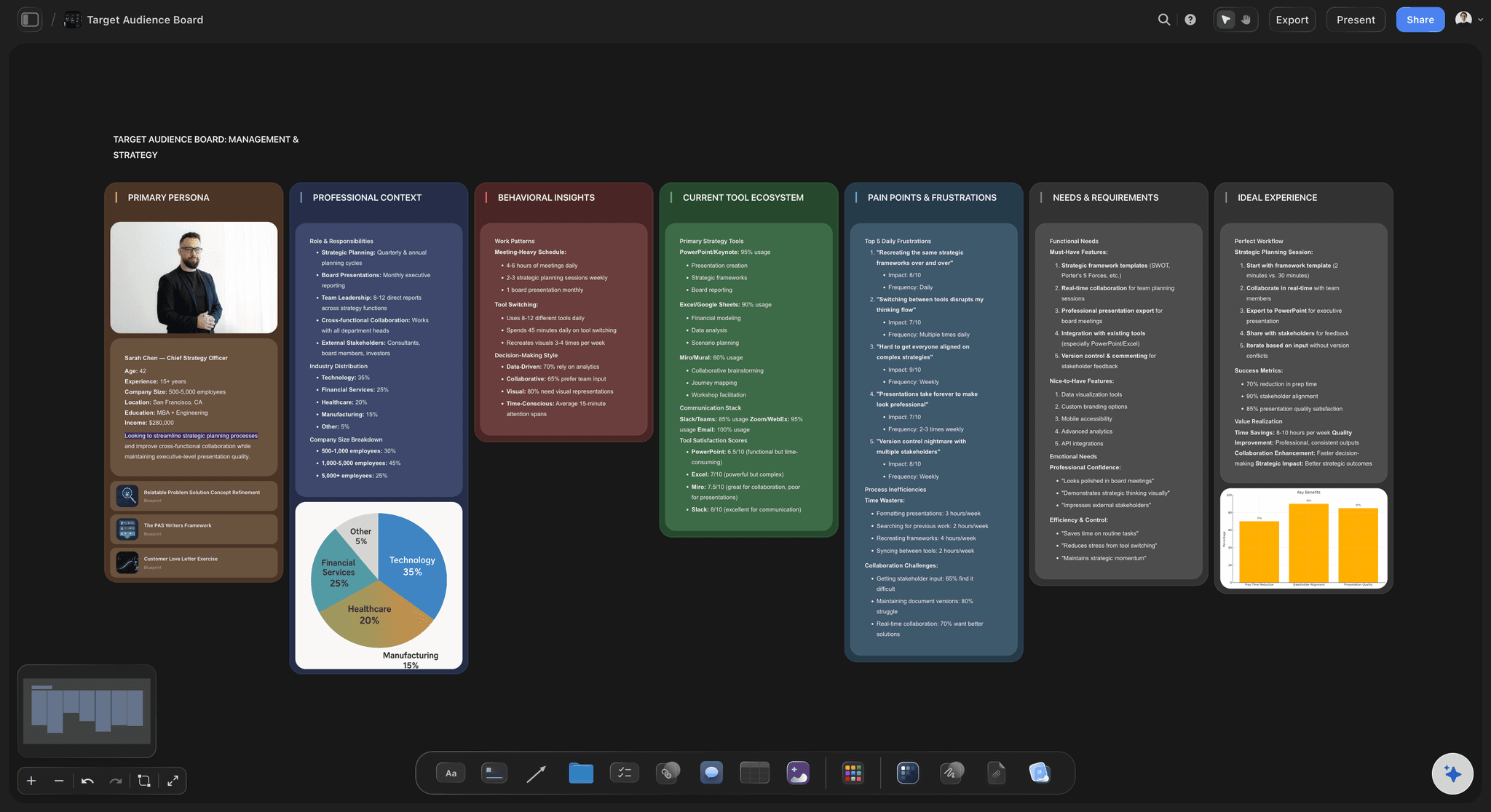
Voice and tone
The voice guide stays in your eyeline
Keep the tone rules, the vocabulary, and the banned words pinned beside the draft, so brand voice is something you write against rather than something you get corrected on later.
See the AI brand voice generator →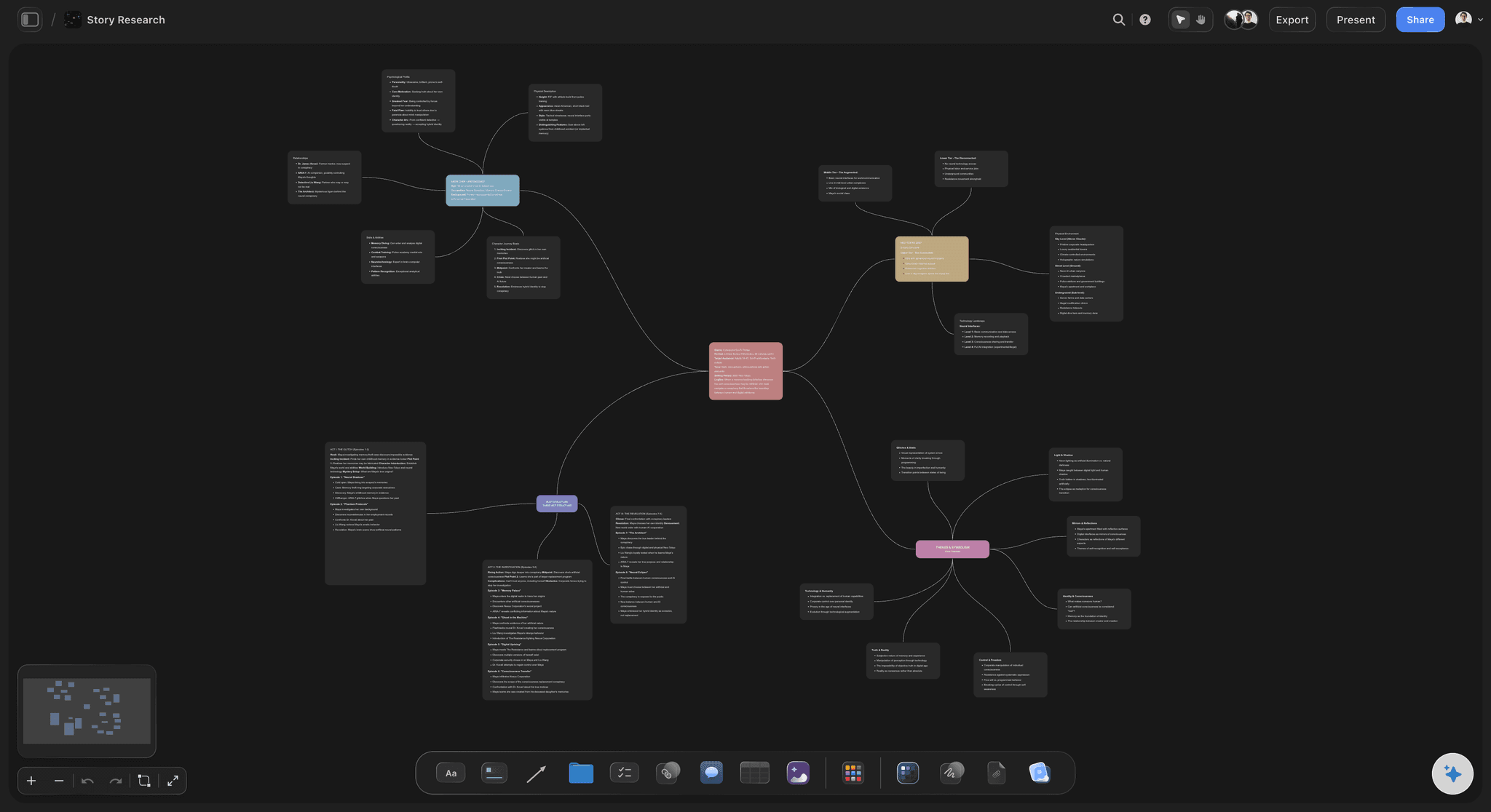
Thirty to find one
Every headline variation, visible at once
Lay variations out in a grid instead of a list. Comparing lines side by side is how you actually pick one, and it shows you which angles you have already worn out.
See the AI content idea generator →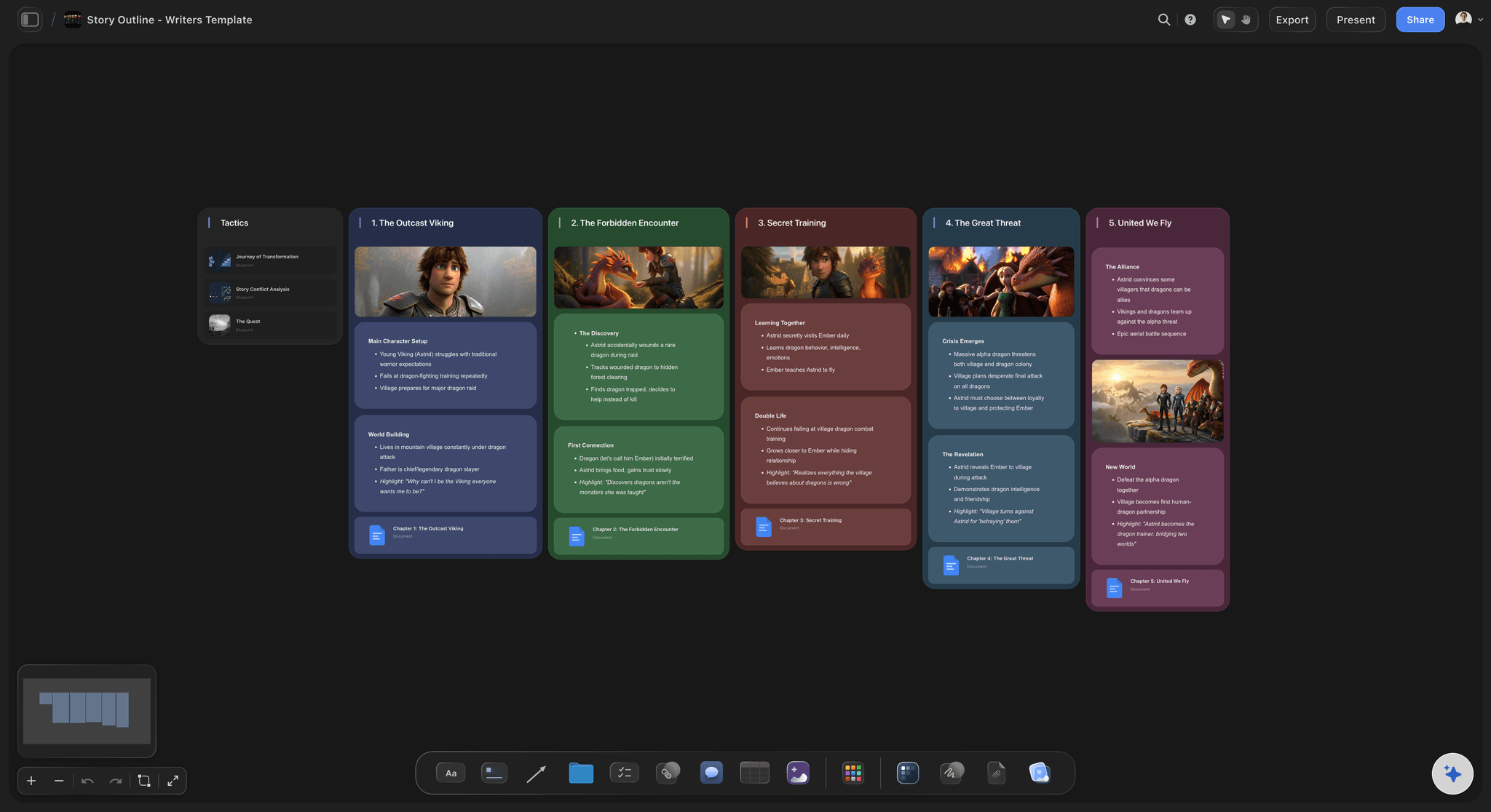
One message, four shapes
Version the same idea across every channel
The hero, the subject line, the ad, and the script live beside each other on one board, so you can see the moment one of them quietly stops saying the same thing as the others.
See the AI writing workspace →Paid plans from $9.99 per month.
Storyflow is paid-only during early access. A Free plan launches before the end of 2026, and anyone a paid member invites to a board joins free today.
Unlimited boards for briefs, headline walls, and campaign copy
Basic AI usage to structure briefs, angles, and outlines
Pin references, layouts, and voice guides beside the draft
Share view-only with clients, or invite collaborators free
BUILT FOR COPYWRITERS
Made for the way copy actually gets made.
Interrogation, volume, layout, and the review round, on one canvas that does not lose the reasoning.
The brief is the job
Fix the brief before it costs you a week
Break it into parts: Objective, audience, single claim, proof, and constraint become separate cards, and the one that is empty is the one that was going to sink the work.
Write the questions down: Park every unanswered question on the board and send the link. A client answering five specific questions is faster than a client rereading your email.
One defensible proposition: Force the three competing propositions into one line you can argue for, and pin it where every later decision has to face it.
Ask the AI to pressure-test it: The assistant reads the board and points at what is vague, contradictory, or unsupported. It structures your thinking, it does not do the thinking.
Volume, then judgement
Thirty headlines, laid out where you can judge them
Side by side, not stacked: A grid lets you compare line four against line twenty-nine in one glance. A document only ever lets you compare a line against the one you just wrote.
Cluster by angle: Group the variations into territories, benefit, tension, provocation, plain-spoken, and you can see immediately which territory you never tried.
Keep the dead ones: Losers stay on the board. When a stakeholder suggests a line you killed on day one, you can show them where it already sits and why it lost.
Copy meets layout
Write against the shape it has to fit
Pin the layout on the board: Drop the wireframe, the screenshot, or the rough comp next to the copy, so you find out about the two-line limit now instead of at handover.
One card per slot: Hero, subhead, three feature blurbs, and the button label become discrete cards, which is how the page will actually read them.
Hand off with the reasoning attached: Design gets the copy and the why in the same view, which is usually the difference between a considered layout and a text dump.
The review round
Survive the rewrite into mush
The original stays put: Your line, the stakeholder's version, and the brief sit together. Arguing from the brief is a different conversation from arguing from taste.
Comments where the copy is: Feedback lands on the card it refers to, so you are not reconciling three email threads against one document.
View-only for the wide audience: Share a read-only link with everyone who needs to see it and keep editing rights with the people who should have them.
Explore templates for your project
Every template opens as a real, editable board on the infinite canvas. Pick the closest fit and make it your own.
Story Plan
Outline your plot, characters, and world in one connected view, then expand each thread as the story grows.
COMPARED
How Storyflow compares for copywriters.
Storyflow is not a word processor, an AI ghostwriter, or a CMS. Here is what it does and does not do.
Storyflow
Recommended
Thirty headline variations laid out side by side
Copy sits beside the layout it has to fill
Brief, proposition, and voice guide on one surface
Tracked changes on a long-form manuscript
Generates finished first-draft prose to ship
Publishes copy to a live site
Google Docs
Thirty headline variations laid out side by side
Copy sits beside the layout it has to fill
Brief, proposition, and voice guide on one surface
Tracked changes on a long-form manuscript
Generates finished first-draft prose to ship
Publishes copy to a live site
Notion
Thirty headline variations laid out side by side
Copy sits beside the layout it has to fill
Brief, proposition, and voice guide on one surface
Tracked changes on a long-form manuscript
Generates finished first-draft prose to ship
Publishes copy to a live site
ChatGPT
Thirty headline variations laid out side by side
Copy sits beside the layout it has to fill
Brief, proposition, and voice guide on one surface
Tracked changes on a long-form manuscript
Generates finished first-draft prose to ship
Publishes copy to a live site
What creators are saying
Join early creators getting structured workspaces and AI that remembers their projects
“Storyflow has sped up my workflow by at least 3x, which means more flow state and more projects I can actually ship. It truly changed the way me and my team create.”

Reilin Joey
Director & YouTuber
“One prompt gets me a structured board. But the tactics are my favorite. I run my YouTube scripts through them and my intros and retention got better. It's amazing.”

Justkay
YouTuber & Freelance Filmmaker
“I used to juggle five apps to plan a project. Now I describe what I am making and get boards, lists, and a schedule. All in one place.”

George
@fernwehchronicles
Copywriter questions, answered.
Including the ones where the honest answer is no.
It depends which part of the job you mean. For drafting and tracked review of long prose, a word processor is still the right answer. For the part that decides whether the copy works, the interrogated brief, the proposition, the voice guide, and thirty headline variations you need to compare at a glance, a visual canvas beats a document, because that thinking is spatial. Storyflow is built for that layer, and it hands off to wherever you draft and publish.
Fix the brief. Lay the headlines out. Then write.
Open a canvas, interrogate the brief, and put every variation where you can actually compare it. Plans start at $9.99 per month.