
Ultra-fast planning, extremely simple
Write the document
next to the thinking.
Storyflow's document editor sits on the same infinite canvas as your boards, plans, research, and moodboards, and the AI can see all of it while you write.


Creatives working for these brands already got early access
- Red Bull
- Canon
- Artlist
- Porsche
See how easy it is to get started
Watch a real project come together, from a blank board to a finished plan, clicked through step by step.
Start from a ready-made template
Pick a board to see what you can build, then let AI fill it in. Every template is a real, editable starting point on the same infinite canvas.

Mind Map
Branch one central idea out into themes and sub-points, then drag the connections around until the structure makes sense.
What is an AI document editor?
An AI document editor is a rich text editor with a model wired into the writing surface. Storyflow is an AI visual workspace that puts your document next to the thinking behind it on one infinite canvas: a rich text editor, your boards, plans, research and moodboards beside it, and an AI that reads the whole project. Instead of copying a paragraph into a chat window and pasting the reply back, you select the text and ask for a rewrite, a shorter version, a summary, or a continuation, and it happens in the document. Every serious writing tool now has some version of this, which means the interesting question is no longer whether a tool has AI in it. The interesting question is what the AI can see.
That is the part most tools get wrong, and it is a context problem rather than a model problem. A launch brief is downstream of a positioning board, three customer interviews, a competitor teardown, and a rough plan someone sketched in a meeting. A treatment is downstream of a moodboard. A project update is downstream of a plan. When the AI can only read the page you are on, it writes fluent text about nothing in particular, and you spend more time feeding it background than you would have spent writing the thing yourself.
Storyflow takes a different approach, and it is worth being plain about what it is not. Storyflow's editor is not trying to beat Google Docs at word processing, and it does not have Notion's databases. It is a capable rich text editor with headings, lists, tables, images, embeds, and comments, and its actual advantage is where it lives. The document opens as an object on an infinite canvas, so it can sit two inches from the board that produced it, and the AI assistant reads the surrounding canvas rather than just the page.
Writing a working document usually means holding six connected layers at once: the drafting surface (the editor itself, with the formatting the document actually needs), structure (headings, sections, and the order an argument has to arrive in), source material (the research, boards, interviews, and reference images the text is built on), AI assistance at three scopes (a selected sentence, the whole document, and the whole project), revision (versions, comments, and the record of what changed and why), and handoff (who reads it, who edits it, and what they get to see). Storyflow keeps all six on one canvas, which is what stops the document from drifting away from the thinking behind it.
Ultra fast from brief to board
From scattered thinking to a finished document.
No import, no export, no third window. The document opens where the work already is.
01
Open a canvas
Sign up in seconds. No download. Your infinite canvas opens in the browser with documents, boards, and research available on the same surface.
02
Put the raw material down first
Drop in notes, links, PDFs, screenshots, reference images, and a rough plan. Or describe the project in a prompt and let the AI build the board. This is the context the document will be written from.
03
Open a document beside it
Add a document to the canvas next to the material. Write in it directly, or ask the AI to draft a first pass from what is on the board. Select any passage and ask for a rewrite, a cut, or an expansion.
04
Share it or keep going
Send a view-only link so readers see the document and the thinking behind it, invite collaborators to edit, or export as PDF. The document stays attached to its source instead of becoming an orphan file.
A document editor that knows what it is about.
Rich text, an AI assistant, and the whole project sitting next to the page.
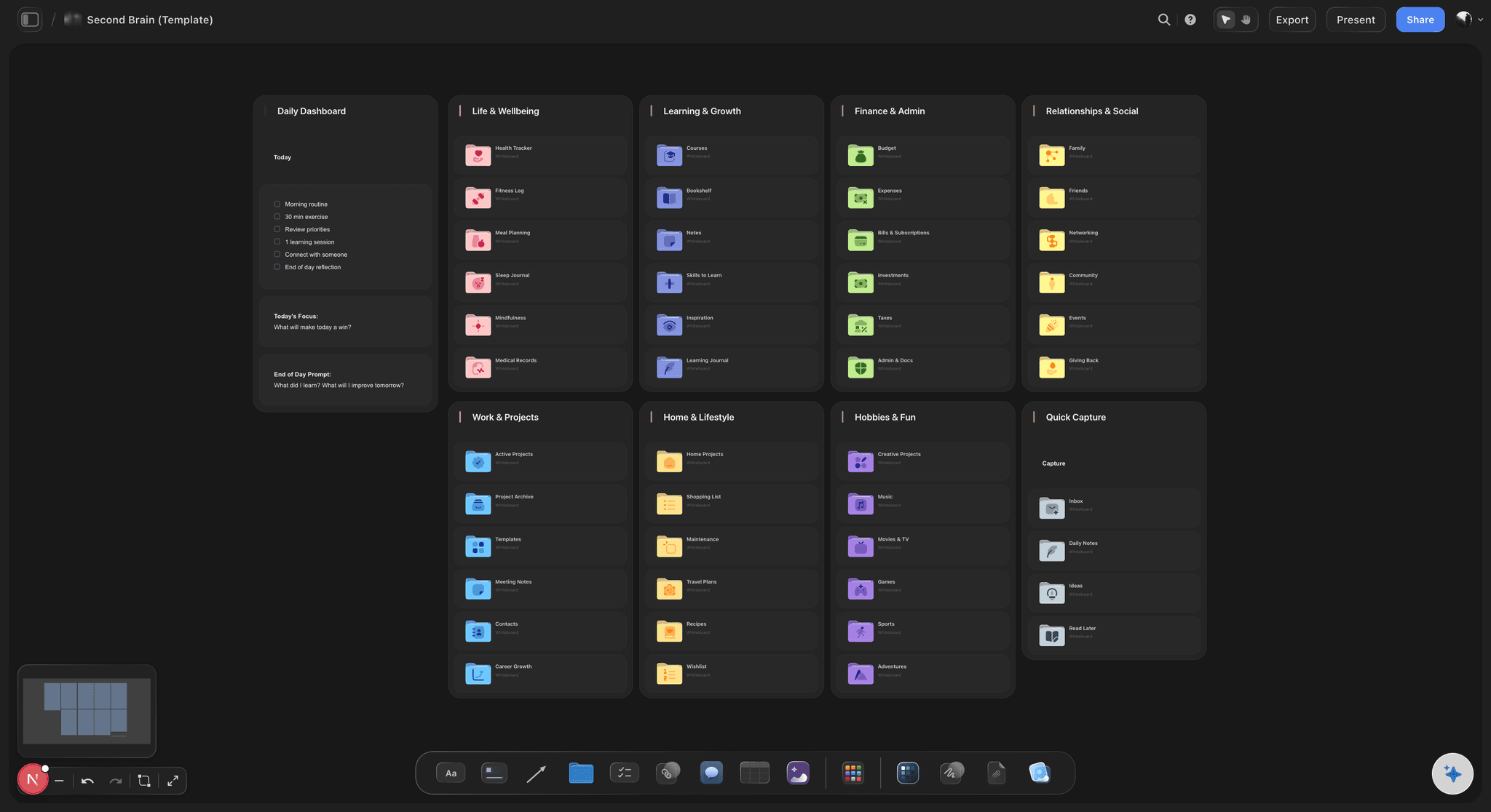
The document opens on the canvas, not in another tab
Write beside the boards, not away from them
A document in Storyflow is an object on the canvas. Put it next to the plan, the research, or the moodboard it comes from, and scroll between them without switching apps or losing the thread.
See the AI writing workspace →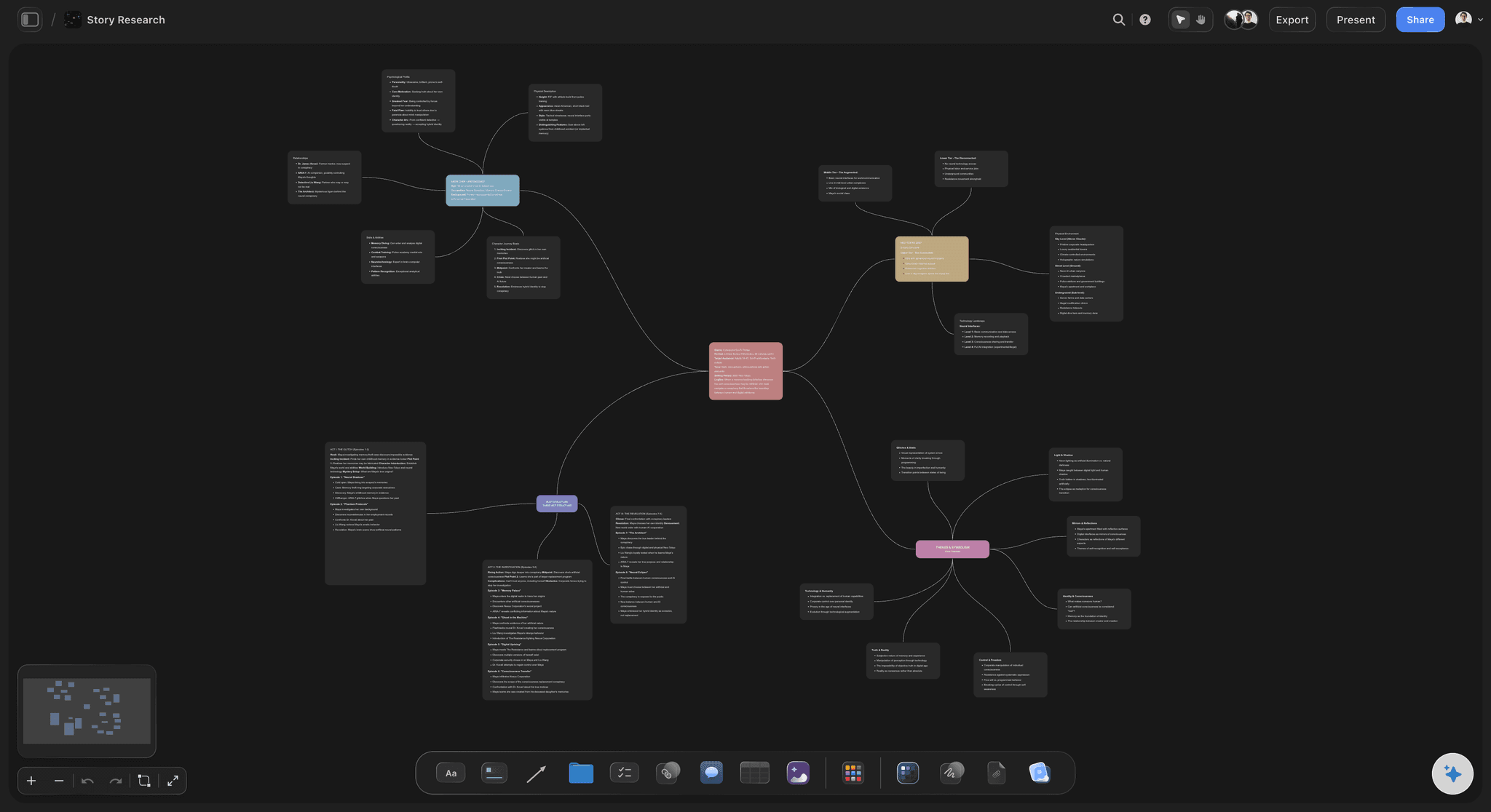
AI that reads the canvas, not only the page
Context is the whole difference
Ask for a draft and the assistant works from your boards, notes, and research rather than from the paragraph above the cursor. That is the gap between generic prose and a document that sounds like your project.
Explore the AI creative workspace →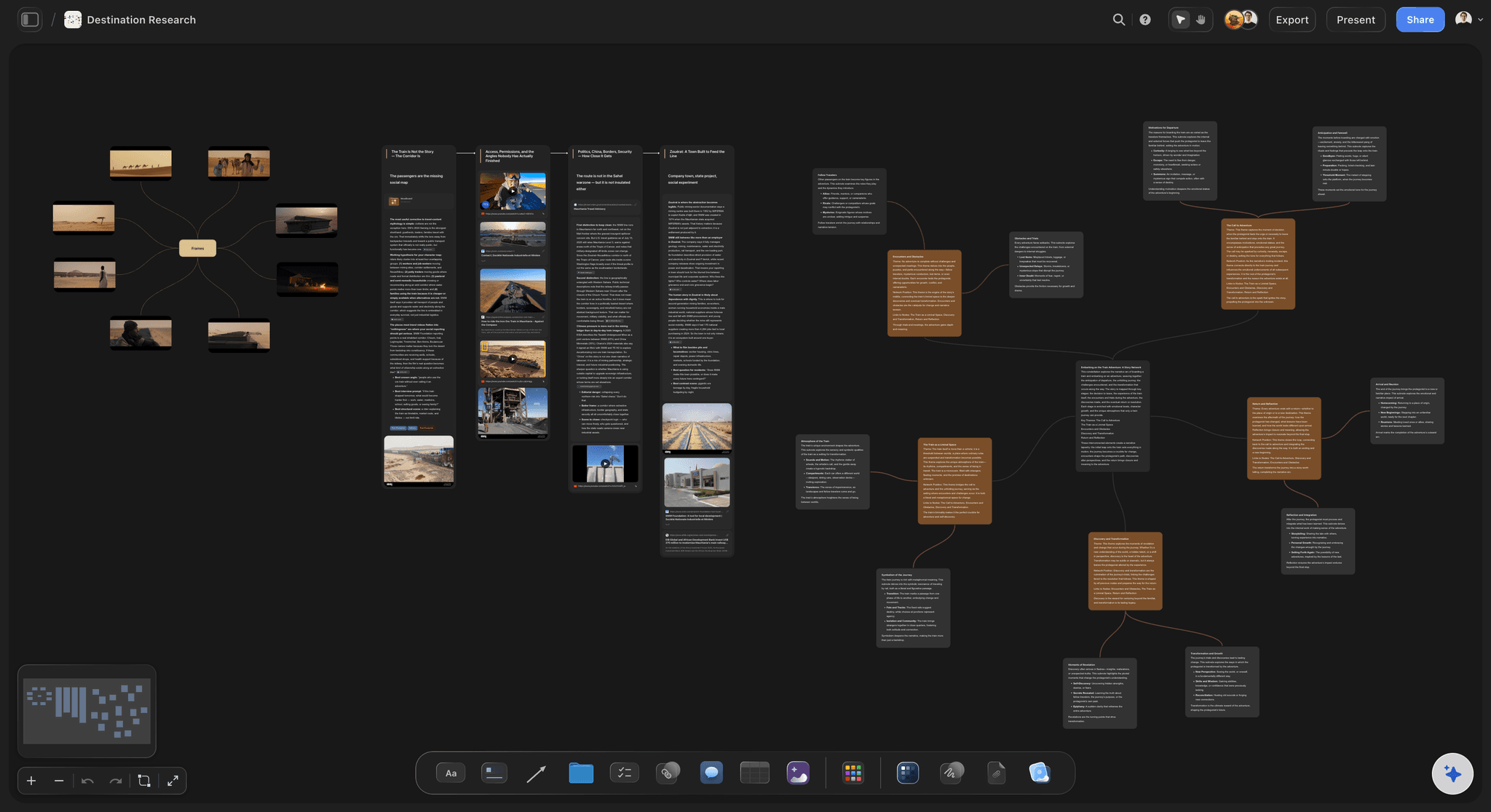
Notes, sources, and clippings on the same surface
Keep the research where the writing is
Drag in PDFs, articles, images, and links, grab frames from video, and leave them beside the draft. When a paragraph needs the number you found three weeks ago, it is one scroll away rather than in a folder.
See the AI second brain →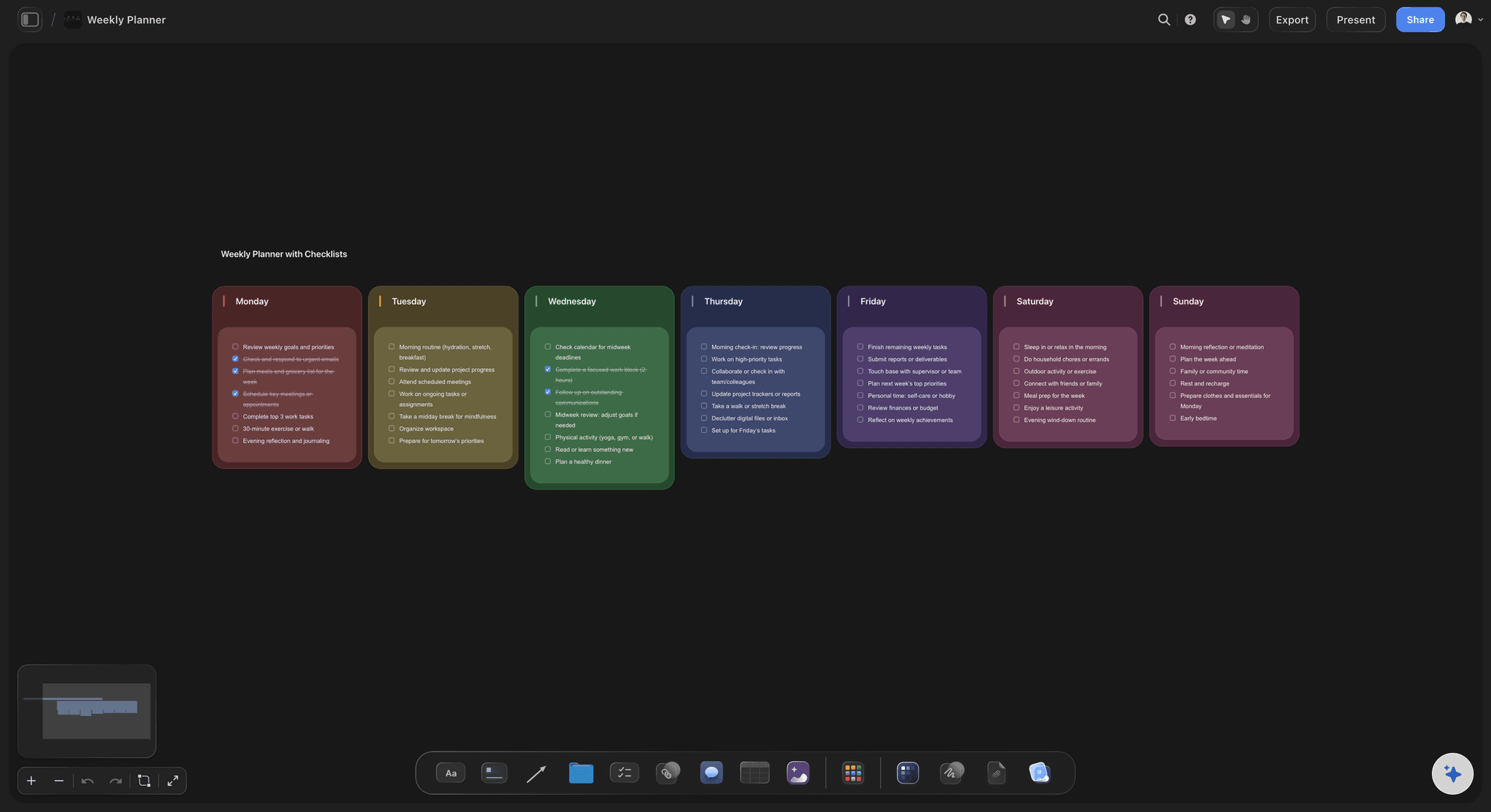
Documents, plans, and boards in one file
One project, not six tabs
The brief, the plan, the moodboard, and the schedule live in the same canvas. Nobody has to reconcile a doc in one app with a board in another, because there is only one place the project exists.
Compare with Google Docs →Unlimited documents. Unlimited boards. No object cap.
Open a canvas, drop your material down, and start writing beside it. Storyflow is paid-only during early access, with plans from $9.99 a month, and a Free plan launches before the end of 2026.
Unlimited documents and boards on an infinite canvas
Basic AI usage to draft and rewrite in the document
Rich text with headings, lists, tables, images, and embeds
Share view-only links with readers who have no account
Built for people with taste
More than a text box with a chat window bolted on.
The editing feels familiar. What changes is what the AI can see and what the document sits next to.
Rich text, comments, and the formatting a real document needs
A proper editor, not a notes field
Rich text that behaves: Headings, bold and italic, ordered and unordered lists, quotes, code blocks, tables, dividers, links, and inline images. Slash commands and keyboard shortcuts work the way you expect from any modern editor, so there is nothing to learn.
Images and embeds inline: Drop a reference image, a chart you exported from the board, or a video embed straight into the flow of the text. A brief with the actual frame in it is worth more than a brief that describes the frame.
Comments and view-only sharing: Share a link and let a reviewer comment without edit access once they sign in. Comment mode is a genuinely separate permission, so a stakeholder can react to a draft without being able to change it.
Export when it has to leave: Export the document, or the whole canvas around it, as a PDF or a high-quality image. The document is not trapped in the tool when someone downstream needs a file.
Selection, document, and project scope
AI at three different distances
On a selection: Highlight a sentence or a section and ask for a tighter version, a plainer version, a different tone, or a continuation. The change lands in place, and you keep or discard it like any other edit.
On the whole document: Ask for a summary, an executive intro, a restructure of the sections, or a list of what the draft is still missing. Useful precisely when the document has grown past the point where you can hold it in your head.
On the whole project: This is the one other editors cannot do. The assistant reads the canvas around the document, so you can ask it to draft the brief from the research board, or to check whether the document still matches the plan sitting next to it.
It drafts, you decide: Storyflow's AI is built to get you past the blank page and to do the mechanical passes, not to file the finished thing on your behalf. Every suggestion is an edit you accept, reject, or rewrite.
The document and the thinking in the same file
Stop writing away from your evidence
Boards beside the draft: Put the plan, the mindmap, the moodboard, or the customer research directly next to the document. The reason a paragraph says what it says is visible, which makes revising it a decision rather than a guess.
Turn a board into a first draft: Sticky notes, cards, and clusters on a board carry real structure. Ask the AI to turn that structure into prose and you get a draft that already has your argument in the right order.
Turn a document into a board: It runs the other way too. A long document that has stopped making sense can be laid out as cards on the canvas, where the ordering problem you could not find in the text becomes obvious in about ten seconds.
Readers, reviewers, and collaborators
Hand over the document and its context together
One link, whole picture: A view-only link opens the canvas in a browser with no account, so a client or a stakeholder reads the document with the board that justifies it right there. Fewer follow-up questions, shorter meetings.
Comment without edit rights: Reviewers can be given comment access only. They leave notes on the document and the surrounding boards without any ability to move or change what is on the canvas.
Collaborators on the same canvas: Invite teammates to work on the project with you. Anyone a paid member invites to a board joins free today, so a freelancer or a client can participate without their own subscription.
Explore templates for your project
Every template opens as a real, editable board on the infinite canvas. Pick the closest fit and make it your own.
Mind Map
Branch one central idea out into themes and sub-points, then drag the connections around until the structure makes sense.
One app instead of five
Storyflow vs Notion, Google Docs, and Craft.
All three are good tools and two of them beat us at specific things. Here is the honest split so you can pick on the job rather than the marketing.
Storyflow
Recommended
Document lives on an infinite canvas
AI uses your whole project as context
Boards, moodboards, and research beside the text
Turn a document into a visual board and back
Real-time co-writing at large scale
Structured databases with filtered views
Notion
Document lives on an infinite canvas
AI uses your whole project as context
Boards, moodboards, and research beside the text
Turn a document into a visual board and back
Real-time co-writing at large scale
Structured databases with filtered views
Google Docs
Document lives on an infinite canvas
AI uses your whole project as context
Boards, moodboards, and research beside the text
Turn a document into a visual board and back
Real-time co-writing at large scale
Structured databases with filtered views
Craft
Document lives on an infinite canvas
AI uses your whole project as context
Boards, moodboards, and research beside the text
Turn a document into a visual board and back
Real-time co-writing at large scale
Structured databases with filtered views
What creators are saying
Join early creators getting structured workspaces and AI that remembers their projects
“Storyflow has sped up my workflow by at least 3x, which means more flow state and more projects I can actually ship. It truly changed the way me and my team create.”

Reilin Joey
Director & YouTuber
“One prompt gets me a structured board. But the tactics are my favorite. I run my YouTube scripts through them and my intros and retention got better. It's amazing.”

Justkay
YouTuber & Freelance Filmmaker
“I used to juggle five apps to plan a project. Now I describe what I am making and get boards, lists, and a schedule. All in one place.”

George
@fernwehchronicles
AI document editor questions, answered.
What the AI can actually see, where other editors are better, and what it costs.
It depends on what your documents are downstream of. Google Docs is still the right answer when a dozen people need to type in one file at once and share it with anyone who has an email address. Notion wins when the document is really a database record with properties and views. Craft is the nicest native writing experience on Mac and iOS. Storyflow is the right answer when the document only makes sense next to boards, research, and plans, because the editor sits on the same infinite canvas and the AI reads all of it.
The editing features are broadly similar. Rewrite a selection, summarize a page, change the tone, continue a paragraph. The difference is scope of context. In a page-based tool the assistant sees the page, and anything else has to be pasted in or linked. In Storyflow the document sits on a canvas, so the assistant can read the moodboard, the plan, the research clippings, and the notes around it. That is the difference between a draft that is fluent and a draft that is actually about your project.
Not during early access. Storyflow is paid-only right now, with plans starting at $9.99 a month, and a Free plan launches before the end of 2026. One thing that is free today: anyone a paid member invites to a board joins free, so a collaborator, a client, or a co-writer can work with you without their own subscription. If you need a free option this minute, Google Docs and Notion both have capable free tiers, and neither will put your document next to a canvas.
You can collaborate on a shared canvas, and teammates can work on the project together. To be straight about it though, Google Docs is better than us at many people typing into one document simultaneously. That is a decade of engineering on a very specific problem and we do not claim to have matched it. Storyflow's collaboration strength is different: multiple people working across one canvas of boards and documents, plus view-only and comment-only links for reviewers who should read but not edit.
It can produce a first draft from the material on your canvas, and for a lot of documents that draft is genuinely usable as a starting point. It is not built to be the last word. The assistant is best at the mechanical passes: getting past the blank page, restructuring sections, tightening a paragraph, summarizing a long draft, and pointing out what is missing. The judgment about what the document should argue stays with you, and every suggestion is an edit you accept or throw away.
Yes, and it is one of the most used paths on the canvas. Sticky notes, cards, and clustered groups carry real structure, which is exactly what a first draft needs. Ask the AI to write from a board and it follows the grouping and the ordering you already established rather than inventing its own. It works the other direction too. A document that has become unwieldy can be broken out onto the canvas as cards, where a sequencing problem you could not see in the text becomes obvious quickly.
Headings, bold, italic, underline and strikethrough, ordered and unordered lists, checklists, quotes, code blocks, tables, dividers, links, and inline images and embeds. Slash commands and the usual keyboard shortcuts work the way they do in any modern editor. It is a real rich text editor, not a notes field. What it deliberately is not is a page-layout tool, so if you need precise print typesetting, write here and lay it out somewhere built for that.
Yes. Share a view-only link and they open the document, and the canvas around it, in a browser with no signup. That is often the whole point: the reader gets the recommendation and the evidence in one view instead of a document that asserts things and a deck that explains them. If you want feedback rather than just readership, comment access lets a reviewer leave notes without any ability to edit or move what is on the canvas.
Yes. Export the document as a PDF, or export the whole canvas as a high-quality image or PDF when the surrounding context matters as much as the text. Documents that need to continue their life in another tool can leave. We would rather you stayed because the canvas is useful than because your writing is stuck inside it, and a tool that traps documents tends to be a tool people quietly stop putting real work into.
Storyflow runs in the browser and there is a mobile app, so reading and light editing on a phone are fine. Heavy writing and canvas work are much better on a larger screen, which is true of most infinite canvas tools. On offline drafting, Craft is genuinely better: it is a native app built for writing without a connection, and if you regularly draft on planes or trains with no signal, that is a real reason to pick it over any browser-based editor including this one.
For visual, project-shaped work, yes. If your documents sit alongside moodboards, plans, storyboards, or research and you keep wishing the doc and the board were in the same place, the canvas model fits better than nested pages. If your workspace is built on databases, relations, rollups, and filtered views, Notion is doing something we do not do and you should keep it. Plenty of people run both: Notion as the structured wiki, Storyflow as the place projects are actually thought through.
Storyflow is paid-only during early access with plans from $9.99 a month, and that covers unlimited documents and boards with no object cap, AI usage, and sharing. A Free plan arrives before the end of 2026. Competitor pricing changes often enough that quoting it here would be misleading, so check their sites directly. The useful comparison is not the monthly number anyway, it is whether you end up paying for a document tool and a canvas tool separately.
Put the document back next to the thinking.
Open a canvas, drop your research and boards down, and write beside them with an AI that can see the whole project. No download.