The 11 Best AI Tools for Copywriters in 2026
AI made the draft free and left the judgment exactly as expensive. Eleven tools ranked by whether they improve the inputs or only the output.

Category
Marketing
Author

Sara de Klein
Head of Product at Storyflow
Topics
2026-08-10
•
17 min read
•
Marketing- best AI tools for copywriters
- what are the best AI-native productivity tools
- why does AI copy sound generic
- voice of customer research tools
- Jasper vs ChatGPT for copywriting
- AI copywriting workflow
What are the best AI tools for copywriters in 2026?
The best AI tools for copywriters are the ones that improve the inputs, because AI has made the draft free and left the judgment exactly as expensive as it always was. Claude is the strongest drafting partner when it is working from real material. Otter is how you get that material, by turning sales and support calls into the customer's own words. Storyflow ranks first here for the job underneath both: holding the voice of customer corpus, the offer mechanics and the live objections on one canvas the AI reads whole, so the draft comes from evidence rather than from nothing. This ranking judges all 11 tools on one shift: the bottleneck moved from producing copy to knowing which copy is right.

Full disclosure: Storyflow is our own product, and we rank it #1 here for one job: holding the three inputs good copy needs (customer vocabulary, offer mechanism, live objections) as durable context the AI drafts from. Claude and ChatGPT write better sentences and are ranked second and third for exactly that reason. Storyflow runs no A/B tests, has no analytics or conversion data, does no grammar or line editing, does not publish, and is not tuned for ad formats. Unbounce, Grammarly and Jasper own those. We link to every tool so you can judge the fit.
Quick Comparison
These four map to where copywriting actually breaks now: the inputs the model needs, the drafting itself, the research that supplies the vocabulary, and the judgment call at the end.
| Tool | Best For | AI Features | Price |
|---|---|---|---|
| Storyflow | Grounding drafts in real evidence | Canvas-wide context AI | $7.99 mo annual (free plan late 2026) |
| Claude | Long-form drafting and critique | Long-context LLM | Free / ~$20 mo |
| Otter.ai | Voice-of-customer capture | Transcription AI | Free / from ~$17 mo |
| Wynter | ICP message testing | None | Per test, B2B pricing |
Key Takeaways
- AI made the draft free and the judgment expensive. A copywriter who generates 40 headlines does not have 40 options, they have 40 problems and no way to choose.
- Good copy needs three inputs: the customer's own words, the mechanism of the offer, and the specific objection being overcome. AI can write brilliantly from all three and cannot supply any of them.
- Storyflow ranks first for holding those three inputs together, not for generating copy. Claude and ChatGPT write better sentences and this post says so.
- Voice of customer research is the highest leverage activity in copywriting and the one AI has changed least. Mining it is still manual.
- Storyflow does not run A/B tests, has no analytics, does not check grammar, does not publish, and is not tuned for ad formats. Unbounce, Grammarly and Jasper own those.
- Generic AI copy fails in a specific way: it describes the product accurately in language no customer has ever used. That is a research failure, not a model failure.
- Message testing with Wynter costs less than one round of arguing internally about a headline, and almost nobody does it.
Draft from evidence, not from a blank prompt
AI copy reads generic because the input was a product description. Storyflow keeps forty verbatim customer quotes, the mechanism and the live objections on one canvas the AI reads continuously, so the draft starts from what buyers actually said. Paid-only during early access; the Free plan lands before the end of 2026.

The Bottleneck Moved
For most of the history of the craft, a copywriter's constraint was production. Writing twenty headlines took an afternoon, so you wrote five and picked one.
That constraint is gone. Twenty headlines now takes ninety seconds and they are, on average, competent.
AI made the draft free and left the judgment exactly as expensive as it always was. The copywriter who generates forty variants has not gained forty options. They have gained a selection problem, and selection was always the hard part.
Underneath that sits the failure that produces most bad AI copy, and it is not a model failure.
Good copy needs three inputs, and only one of them is language.
The customer's own words. Not your description of the problem, theirs. The phrase a customer used on a support call, in a review, in a churn survey. This is the single highest leverage material in copywriting, because copy written in the customer's vocabulary is recognized rather than parsed, and copy written in the company's vocabulary is skipped.
The mechanism of the offer. Not the benefit, the reason the benefit is true. "Save ten hours a week" is a claim. "Because it reads your whole board instead of the current page" is a mechanism. Claims are discounted automatically; mechanisms are believed.
The specific objection. Every purchase has one real hesitation, and it is usually narrow: the switching cost, whether it works with the thing they already use, whether it will still exist next year. Copy that does not name the actual objection is answering a question nobody asked.
AI can write beautifully from all three of those and it cannot supply any of them. This is why generic AI copy fails in the exact way it does: it describes the product accurately, in language no customer has ever used, addressing an objection nobody has.
The 11 tools below are ranked by whether they improve the inputs or only the output.
At a Glance: The 11 Tools Compared
| Tool | Best for | What it improves | Shape |
|---|---|---|---|
Storyflow | Holding voice of customer, mechanism and objections together | Inputs | AI canvas |
Claude | Long-form drafting from real material | Output | LLM |
ChatGPT | Fast variants, formats and mechanical tasks | Output | LLM |
Otter.ai | Turning sales and support calls into quotable text | Inputs | Transcription |
Wynter | Testing whether a message lands with your ICP | Judgment | Message testing |
Unbounce | Running the actual A/B test on a live page | Judgment | Landing pages |
Jasper | Brand-consistent output at team volume | Output | Marketing AI |
Writer | Enforcing terminology across many writers | Output | Style enforcement |
Grammarly | Line-level correctness and tone checking | Output | Editing |
Airtable | The swipe file and the variant log with results | Judgment | Database |
Notion | The messaging doc and positioning of record | Inputs | Docs |
How I Ranked These
I write copy for a product I also build, which means I get the unusual feedback loop of watching whether a claim survives contact with a user. Over the past two years I have run real launches, landing pages and email sequences through every tool here.
Five criteria, in order.
1. Does it improve an input or only the output? Output tools are now commodities. Anything that gets you closer to the customer's actual words is worth more than a better generator.
2. Does it help you choose? Producing variants is solved. A tool that helps rank them, whether by testing or by structure, is operating on the real bottleneck.
3. Does it preserve why a line worked? A swipe file of winning copy with no record of what it beat and in what context is a scrapbook, not an asset.
4. Does it flatten your voice? The most common cost of AI copy tools is homogenization, and it is invisible until a client says everything sounds the same.
5. Cost for a freelancer. Most copywriters are not on an enterprise plan.
Pricing is as of August 2026 and changes frequently. Verify with each vendor.
Quick Picks by Job Type
- Best for the inputs: Storyflow. Customer language, mechanism and objections on one canvas the AI drafts from.
- Best drafting partner: Claude. Strongest at long form and at holding a voice when given samples.
- Best fast variants: ChatGPT. Quicker for headline volume and mechanical formats.
- Best research capture: Otter. Sales calls become searchable customer vocabulary.
- Best message validation: Wynter. Real ICP feedback in a day, before you build the page.
- Best live testing: Unbounce. Where a headline argument gets settled by data.
- Best team consistency: Jasper or Writer. When many people write and the brand must hold.
1. Storyflow
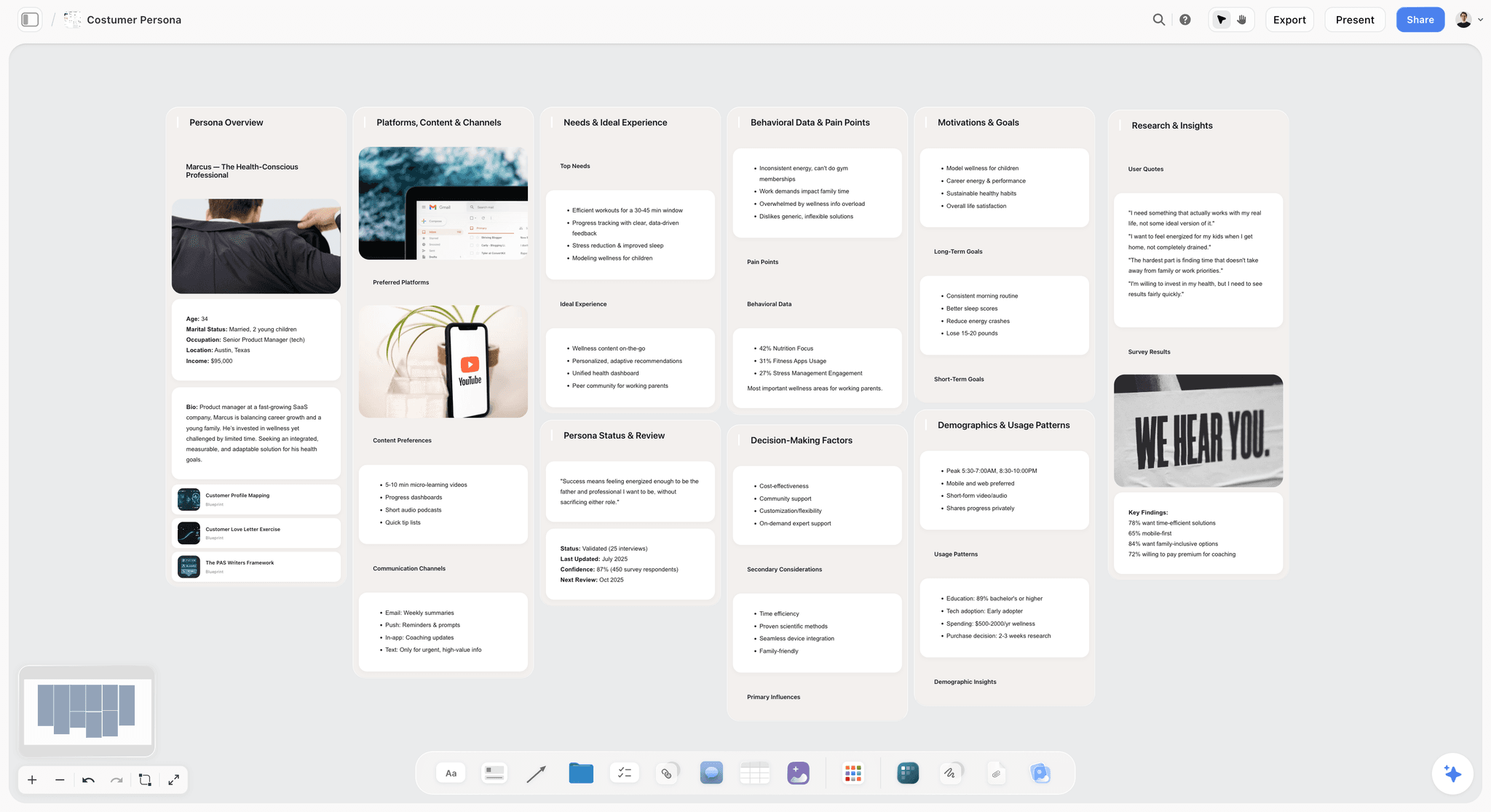
The verdict. The only tool here aimed at the inputs rather than the output, which is where AI copywriting actually fails.
Best for. Copywriters who want the draft to come from evidence instead of from a blank prompt.
Pricing. Paid only early access today. Plus is $7.99 per month billed annually or $9.99 monthly, with 200 plus Blueprint Tactics and unlimited file uploads. Pro is $14 per month billed annually or $19 monthly, adding AI image generation, roughly twenty times more AI usage and memory across conversations. Max is $39 per month billed annually or $49 monthly, adding Team Workspace with permissions and roles. Pricing is flat per account rather than per seat, and anyone a paid member invites joins free. The Free plan launches before the end of 2026.
Why it ranks here. Consider how most AI copy actually gets written. Someone opens a chat window and types a request describing the product. The model, given nothing but a description, produces language derived from every other product description it has seen. The output is fluent, accurate and generic, and it is generic because the input was.
The alternative is to give the model the real material, and the real material is bulky: forty customer quotes, three competitor pages, the churn survey, the mechanism, the four objections sales hears weekly. Pasting that into a chat window each time is impractical, and it is why almost nobody does it.
Storyflow's AI reads your full active canvas board by default, plus up to one Tactic and up to three Documents you @-mention. On a board holding the customer quotes in one region, the mechanism in another and the objections in a third, the model is drafting from the evidence continuously, without you reassembling the context every session.
The queries that matter are input queries rather than output ones. Which words do customers actually use for this problem. Which objection appears most across these forty quotes. Does this headline use any language a customer has used, or only ours. That last one is the single most useful check available to a copywriter and it takes ten seconds.
Spatial arrangement helps for a specific reason too: clustering raw customer quotes by the underlying complaint is how you discover the objection nobody wrote down, and clustering is a physical act on a canvas and a chore in a document.
Strengths.
- Holds voice of customer, mechanism and objections as durable context rather than a pasted prompt.
- Whole board AI, so drafts and checks are grounded in the corpus.
- Clustering raw quotes surfaces objections nobody articulated.
- Invited collaborators join free, so a founder or sales lead can drop quotes in directly.
- Blueprint Tactics give structure to recurring positioning work.
Limitations.
- Not a copy generator tuned for ad formats. Jasper produces platform ready variants faster.
- No A/B testing, no analytics, no conversion data. Unbounce and your analytics stack own that.
- No grammar or line editing. Grammarly does that and Storyflow does not attempt it.
- Does not publish anywhere.
- No plagiarism or originality checking.
- Newer platform, so no copywriting specific templates yet.
The trade off. Storyflow improves what the model knows. Claude and ChatGPT still write the better sentence, and this post ranks them next for exactly that reason.
2. Claude
The verdict. The best drafting partner for anything longer than a headline, provided you feed it real material.
Best for. Long form sales pages, email sequences and editing in a specific voice.
Pricing. Free tier available. Pro is roughly $20 per month as of August 2026.
Why it ranks here. For copywriting specifically, two capabilities matter more than raw quality. Handling long context, so you can paste an entire research corpus rather than a summary of it. And matching a voice from samples rather than defaulting to a house style.
Claude is strong at both. Paste twenty customer quotes and three examples of your client's existing voice, and the output is meaningfully closer to usable than a cold prompt produces.
Its most valuable use is not generation at all. It is critique: give it the draft and the objection list and ask which objection the draft fails to answer. That is a judgment task where a model is genuinely useful, because it is reading rather than inventing.
Strengths.
- Handles large research pastes well.
- Best voice matching from samples of the tools here.
- Strong as a critic, which is more useful than as a generator.
- Usable free tier.
Limitations.
- Will invent specifics, including statistics and customer quotes, if not constrained to supplied material.
- Recognizable default rhythm if you accept first drafts.
- No integration with testing or publishing.
- Context has to be re supplied each session.
The trade off. Use it as an editor and a critic more than as a generator. That is where the return is.
3. ChatGPT
The verdict. Faster for volume and formats, and the better tool for the mechanical two thirds of the job.
Best for. Headline volume, format conversion and the repetitive work around the copy.
Pricing. Free tier available. Plus is roughly $20 per month as of August 2026.
Why it ranks here. For sheer variant production and for the surrounding mechanical work, meta descriptions, subject line variants, turning a sales page into an email sequence, ChatGPT is quick and the ecosystem around it is deeper.
Its custom instructions and project features also make it practical to keep a client's voice guidelines persistent, which reduces the re briefing tax that otherwise eats the time saving.
It ranks third because for long form it is less consistent than Claude at holding a voice, and because volume production is the part of the job that stopped being the constraint.
Strengths.
- Fast at variants and format conversion.
- Deepest ecosystem and integrations.
- Custom instructions reduce re briefing.
- Free tier covers a lot.
Limitations.
- Same fabrication risk on specifics and statistics.
- Default voice is highly recognizable and needs active suppression.
- Volume is no longer the bottleneck, so its core strength is the commoditized part.
The trade off. Use it for the mechanical work. Use Claude for the argument.
4. Otter.ai
The verdict. The cheapest way to get the input that matters most.
Best for. Turning sales calls, support calls and user interviews into searchable customer language.
Pricing. Free tier with monthly minute limits. Paid plans start around $17 per user per month as of August 2026.
Why it ranks here. Voice of customer research is the highest leverage activity in copywriting, and the reason it does not happen is that listening to calls is slow. Transcription removes that entirely: thirty sales calls become a searchable corpus, and searching it for the phrase customers use to describe the problem takes minutes.
The specific practice worth adopting is searching transcripts for the moment a prospect explains the problem in their own words before your salesperson reframes it. That sentence, verbatim, is frequently the headline.
It ranks fourth only because it is a capture tool rather than a thinking one. It produces the material; something else has to make sense of it.
Strengths.
- Converts the slowest research activity into a fast one.
- Searchable corpus of actual customer vocabulary.
- Cheap, with a usable free tier.
- Speaker separation makes it easy to isolate the customer side.
Limitations.
- Requires consent and a process for recording calls.
- Accuracy suffers on poor audio and crosstalk.
- Produces volume with no structure, so the sense making is still yours.
- Cloud processing, which may matter for regulated clients.
The trade off. If you write for a company with a sales team and you are not mining their calls, that is the largest available improvement to your copy.
5. Wynter
The verdict. The only tool here that tells you whether a message lands before you build anything.
Best for. Validating positioning and messaging with your actual ICP.
Pricing. Paid, typically starting around several hundred dollars per test as of August 2026, with subscription options. Priced for B2B teams rather than freelancers.
Why it ranks here. Wynter runs your copy past a panel of people matching your ideal customer profile and reports what they understood, what they doubted and what they thought you did. For B2B especially, that answers the question every internal messaging argument is really about, and it answers it in about a day.
The reason it earns a place despite the price is the counterfactual. A messaging debate between a founder, a head of marketing and a copywriter routinely consumes weeks of senior time and is settled by seniority. A test costs less than the meetings.
It ranks fifth because it is out of reach for most freelancers and unnecessary below a certain deal size.
Strengths.
- Real feedback from ICP matched respondents, not a general panel.
- Answers comprehension and credibility, not just preference.
- Fast turnaround.
- Ends internal arguments with evidence.
Limitations.
- Expensive, and priced for funded B2B teams.
- Small panels, so directional rather than statistically robust.
- Tests messages, not conversion.
- Overkill for low ticket or B2C work.
The trade off. If a headline decision is worth more than a few thousand dollars, test it. Otherwise skip.
6. Unbounce
The verdict. Where a copy argument gets settled by behaviour rather than opinion.
Best for. Building and A/B testing landing pages without engineering.
Pricing. Plans start around $99 per month as of August 2026.
Why it ranks here. Copy is a hypothesis and a live test is the only instrument that resolves it. Unbounce lets a copywriter ship and test a page without waiting on a development queue, which is frequently the real reason tests do not happen.
Its Smart Traffic feature routes visitors to the variant likeliest to convert for them, which reaches a useful answer faster than a classic split test at low traffic volumes, and low traffic is the normal condition.
It ranks sixth because it is a page builder rather than a writing tool, and because at genuinely low traffic no testing tool can rescue you from insufficient data.
Strengths.
- Copywriter can ship and test without engineering.
- Smart Traffic reaches conclusions faster at modest volumes.
- Good template library for structure.
Limitations.
- Expensive as a standalone.
- Needs real traffic to conclude anything.
- Pages live outside your main site, which has SEO and consistency costs.
The trade off. Worth it if you own conversion outcomes. Unnecessary if you hand copy to a team that ships it.
7. Jasper
The verdict. Built for marketing teams rather than writers, and honest about it.
Best for. Producing on brand copy at volume across many people and channels.
Pricing. Plans start around $49 per seat per month as of August 2026.
Why it ranks here. Jasper's differentiator is not writing quality, it is brand governance: a brand voice definition, knowledge base and templates that make output from a marketing coordinator resemble output from a copywriter. For a team producing hundreds of assets monthly, that consistency is worth real money.
For an individual copywriter it is a hard sell, because a general model plus your own prompts does the same work at a fraction of the price.
Strengths.
- Brand voice and knowledge base enforce consistency across a team.
- Templates for standard marketing formats.
- Campaign level workflows.
Limitations.
- Expensive per seat relative to general models.
- Output quality is not better than Claude or ChatGPT.
- Template driven structure encourages formulaic copy.
The trade off. A team tool. Individual copywriters should skip it.
8. Writer
The verdict. Terminology and style enforcement where too many people write.
Best for. Large organizations with distributed content production.
Pricing. Team plans start around $18 per user per month, with enterprise pricing above, as of August 2026.
Why it ranks here. When forty people produce customer facing language, a style guide document does nothing and review does not scale. Writer applies the rules automatically in the tools where people write.
For a copywriter working in house, this is a way to extend your judgment past what you can personally review, which is the actual constraint in a large organization.
It ranks eighth because it enforces rules rather than improving arguments, and because it is priced for organizations.
Strengths.
- Scales terminology consistency beyond manual review.
- Works inside existing writing tools.
- Useful analytics on which rules get broken.
Limitations.
- Rules only. It cannot tell you the copy is unconvincing.
- Organization pricing.
- Overzealous configuration breeds resentment and gets bypassed.
The trade off. Relevant above roughly twenty writers, irrelevant below five.
9. Grammarly
The verdict. The line level safety net. Unglamorous and still worth having.
Best for. Catching the error that undermines an otherwise good page.
Pricing. Free tier available. Premium is roughly $12 to $30 per month depending on billing as of August 2026.
Why it ranks here. A typo on a sales page costs credibility disproportionately, and a copywriter reading their own draft for the ninth time cannot see it. Grammarly catches those reliably.
Its tone detection is also mildly useful as a sanity check on whether a supposedly warm email reads as clinical.
It ranks ninth because its suggestions trend toward the conventional, and copywriting frequently requires deliberately breaking conventions. Accepting every suggestion produces correct, forgettable prose.
Strengths.
- Reliable at catching the errors your eye skips.
- Works everywhere you write.
- Free tier catches most of it.
Limitations.
- Pushes toward conventional phrasing, which flattens copy.
- Tone analysis is crude.
- Premium adds little for a skilled writer.
The trade off. Use it as a final pass. Reject most of the style advice.
10. Airtable
The verdict. The swipe file with results attached, which is the only kind worth keeping.
Best for. Logging variants, what they beat, and what happened.
Pricing. Free tier available. Paid plans start around $20 per seat per month billed annually as of August 2026.
Why it ranks here. Most copywriters keep a swipe file of admired copy and it is close to useless, because it records what looked good rather than what worked, in what context, against what.
A variants table with the copy, the placement, the date, the control it ran against and the result turns that into a genuine asset. Within a year you have your own evidence base about which appeals work for which audience, which is the thing that actually compounds in this career.
It ranks tenth because it is a discipline more than a tool, and a spreadsheet does most of it.
Strengths.
- Records outcomes rather than admiration.
- Filterable by audience, channel and result.
- Free tier is sufficient.
Limitations.
- Requires consistent logging that most people abandon.
- Only as good as the result data you can get.
- No writing capability.
The trade off. Log the results. In two years it is the most valuable thing you own.
11. Notion
The verdict. The messaging document of record. Necessary, and not where thinking happens.
Best for. Positioning, the messaging hierarchy and client facing documentation.
Pricing. Free personal tier. Paid from roughly $10 per user per month as of August 2026.
Why it ranks here. Every client relationship needs one document defining positioning, the value proposition hierarchy and the approved claims, so that six months later nobody relitigates settled decisions. Notion is a fine home for that.
It ranks last because a messaging document is an output of thinking rather than a place to do it, and because raw customer quotes in a Notion page cannot be clustered, which is the operation that makes them useful.
Strengths.
- Good shared record of positioning decisions.
- Free tier is sufficient.
- Everyone can access it.
Limitations.
- Linear documents cannot cluster raw research.
- No AI grounding across the workspace.
- Becomes a graveyard of stale docs.
The trade off. Keep the conclusions here. Do the thinking somewhere spatial.
What to Actually Pay For
Pay for the inputs before the outputs. One AI writing subscription is enough, and the second one adds nothing. The money that would go to a third generator is better spent on transcription so you have real customer language to write from.
Do not pay for Jasper as a freelancer. Its value is brand governance across a team, which is not a problem you have. Claude or ChatGPT plus your own prompt library does the same work for a fifth of the cost.
Test only when the decision is expensive. Wynter and Unbounce are worth it when a positioning or page decision carries real revenue. On a small project, the cost of testing exceeds the cost of being wrong, and shipping and watching is the rational choice.
Tools to Avoid for This Job
A generator prompted with only a product description. This is the origin of almost all bad AI copy. The output will be accurate, fluent and written in language no customer has used.
Any AI produced statistic or customer quote. Models fabricate both convincingly. A hallucinated stat in a sales page is a credibility problem that outlives the campaign.
A swipe file with no results. Collecting copy you admire teaches you what you like. Only outcomes teach you what works.
Accepting every grammar suggestion. Copy frequently requires a sentence fragment, a repetition or a rhythm that a correctness checker will flag. Correct copy and persuasive copy are different targets.
What No Tool on This List Does
None of them will talk to a customer for you. The single highest leverage hour in copywriting is still a call with somebody who bought or churned, and no tool substitutes for it.
None of them will fix a bad offer. If the product does not solve a problem someone has, copy can only accelerate the discovery that it does not.
None of them, including Storyflow, will write from research you never gathered. Whole board AI can draft from forty customer quotes; it cannot conjure the quotes. Getting the raw material is the job, and it remains manual.
The Bottom Line
The constraint in copywriting has moved and most tool advice has not caught up. Producing copy is free now. Knowing which copy is right costs exactly what it always did.
Pay for one AI writing subscription, not three, and use it as a critic more than a generator. Spend the saved budget on transcription so you have real customer language to work from. Log outcomes rather than admiration, because in two years that log is the most valuable asset you own.
But the failure that produces generic AI copy is upstream of every generator on this list: the model was given a product description instead of evidence. Holding the customer's words, the mechanism and the live objections on one surface the model reads continuously is the narrow ground on which Storyflow ranks first here.
FAQ: AI Tools for Copywriters
What are the best AI tools for copywriters in 2026?
Claude is the strongest drafting partner for long form work, particularly when given real research rather than a product description. Otter is the highest leverage research tool, because it turns sales and support calls into searchable customer language. Storyflow ranks first here for holding the three inputs good copy requires, customer vocabulary, offer mechanism and live objections, on one canvas the AI drafts from, which is what prevents generic output.
Why does AI copy sound generic?
Because the input was generic. A model given only a product description produces language derived from every other product description, which is accurate and unrecognizable. The fix is not a better model or a cleverer prompt, it is supplying real material: verbatim customer quotes, the specific mechanism behind the claim, and the actual objection. Copy grounded in that material stops sounding like AI copy immediately.
What is voice of customer research and why does it matter?
It is the practice of collecting the exact words customers use to describe their problem, from sales calls, support tickets, reviews and churn surveys. It matters because copy written in the customer's vocabulary is recognized instantly, while copy written in the company's vocabulary has to be translated by the reader, and most readers do not bother. It remains the highest leverage activity in copywriting and AI has changed it least.
What is the best free AI tool for copywriting?
Claude and ChatGPT both have free tiers sufficient for most drafting work. Otter's free tier will transcribe a meaningful number of calls per month, which is where the real value is. Grammarly's free tier catches the errors that matter. A capable free stack exists, and the binding constraint is research effort rather than tool budget.
Should copywriters use Jasper or ChatGPT?
Individual copywriters should use ChatGPT or Claude, because Jasper's advantage is brand governance across a team rather than writing quality, and you are paying several times more for a feature you do not need. Jasper makes sense inside a marketing team where many non writers produce copy and consistency is the problem being solved.
How do you choose between 40 AI generated headlines?
Do not generate 40. Generate five, each deliberately built on a different input: one using the customer's exact phrasing, one leading with the mechanism, one naming the objection, one with the strongest specific number, one plain. Then the choice is between distinct hypotheses rather than between synonyms, which is a decision you can actually reason about or test.
Does Storyflow write copy for me?
It drafts from the material on your board rather than from a blank prompt, which is a different thing from being a copy generator. It is not tuned for ad formats the way Jasper is, and Claude writes a better sentence, which is why they rank second and third here. Storyflow's contribution is that the model is working from your customer quotes, mechanism and objections rather than from a description you typed.
Is message testing worth it?
Above a certain deal size, yes, because a messaging argument between senior people routinely costs more in time than a test costs in money, and it gets settled by seniority rather than evidence. Wynter returns ICP matched feedback in about a day. Below that threshold, ship it and watch behaviour, since the cost of testing exceeds the cost of being wrong.
How should copywriters keep a swipe file?
Record outcomes, not admiration. A useful entry has the copy, where it ran, what it ran against, the audience and what happened, because copy that worked for one audience in one channel tells you nothing on its own. A swipe file of admired ads teaches you taste; a log of results teaches you what converts for the people you write for.
Can AI replace copywriters?
It has replaced the production half of the job and left the judgment half untouched, which is a significant change in what the role consists of rather than an elimination of it. The valuable copywriter now is the one who gathers customer language, identifies the real objection, and can tell which of five drafts will work, since anyone can produce the five drafts.
What is the biggest mistake copywriters make with AI?
Using it as a source instead of a processor. Asked for statistics, competitor claims or customer quotes, models produce plausible fabrications, and a false statistic on a sales page is a credibility failure that outlasts the campaign. Used on material you supplied, the same model is genuinely useful.
How do you keep AI from flattening your voice?
Give it samples rather than adjectives, because "write in a conversational tone" produces the average of all conversational writing while three paragraphs of your actual work gives it something specific to match. Then edit for rhythm, since the most recognizable AI tell is uniform sentence length rather than word choice.
What should a copywriter do first on a new client?
Ask for access to sales call recordings, support tickets and the churn survey, before writing anything. Most clients have this material and have never mined it, and one afternoon in it will give you the vocabulary and the real objection, which together are worth more than a week of drafting.
What is the single change worth making this month?
Before writing anything, collect twenty verbatim customer sentences and put them where you can see them while you write. It costs an afternoon once per client, and it is the difference between copy that describes the product and copy that sounds like the reader's own thoughts.
Table of Contents
- Key Takeaways
- The Bottleneck Moved
- At a Glance: The 11 Tools Compared
- How I Ranked These
- Quick Picks by Job Type
- 1. Storyflow
- 2. Claude
- 3. ChatGPT
- 4. Otter.ai
- 5. Wynter
- 6. Unbounce
- 7. Jasper
- 8. Writer
- 9. Grammarly
- 10. Airtable
- 11. Notion
- What to Actually Pay For
- Tools to Avoid for This Job
- What No Tool on This List Does
- The Bottom Line
- FAQ: AI Tools for Copywriters
- Related Reading
Templates to check out for this topic


Templates you can use in Storyflow
Every Storyflow board starts from real structure and an AI that reads the whole canvas. Open one of these templates and make it yours.


See Storyflow in Action
A visual AI workspace where every feature lives inside one canvas. No tab-switching, no context lost.
Build your entire board from a single message
Type what you need in the AI chat at the bottom of your canvas. The AI adds cards, headings, and structure directly onto your board.
Use expert frameworks as AI context
Type @ in the AI chat and choose any Tactic. The AI tailors every response to that framework instead of giving generic advice.
Turn your board into a mind map in seconds
Ask the AI to restructure your canvas as a mindmap. It connects your ideas into a visual hierarchy so you can see how everything relates.
Why Storyflow Exists
Storyflow actually began as a personal tool while working on creative and research projects.
We kept running into the same problem: ideas were scattered everywhere: notes, documents, and whiteboards.
Nothing helped us see how everything connected.
So we started building a workspace designed around how ideas actually grow.
→ Read how Storyflow was createdSara de Klein
Head of Product at Storyflow
Published: 2026-08-10
Extremely simple, seriously capable


See how easy it is to get started
Watch a real project come together, from a blank board to a finished plan, clicked through step by step.
Start creating with AI and become more productive
Transform your creative workflow with AI-powered tools. Generate ideas, create content, and boost your productivity in minutes instead of hours.