The 9 Documents Between a Short Film Idea and Shoot Day (2026 Planning Guide)
Planning a short film means producing nine documents in order: the logline and treatment, the screenplay, the script breakdown, the shot list and storyboard, the shooting schedule, the budget top sheet, the location file, the cast and crew paperwork, and the call sheet. Each one is built from the one before it, which is why the order is not negotiable.

Category
Filmmaking
Author

Justkay
Documentary Filmmaker & Founder at Storyflow
Topics
2026-09-06
•
19 min read
•
Filmmaking- how to plan a short film from idea to shoot
- short film pre production checklist
- script breakdown and shooting schedule
- how many pages a day short film
- short film budget and call sheet
How do you plan a short film from idea to shoot?
Planning a short film means producing nine documents in order: the logline and treatment, the screenplay, the script breakdown, the shot list and storyboard, the shooting schedule, the budget top sheet, the location and permit file, the cast and crew paperwork, and the call sheet. Each one is built from the one before it, which is why the order is not negotiable. The two that indie filmmakers skip most often are the script breakdown and the shooting schedule, and skipping them is the reason a three-day short becomes a five-day short. A ten-page short shot over three days with a crew of eight is the standard shape, and the schedule is what decides whether that holds.

Full disclosure: Storyflow is our product and is listed first in the article: our pick first, then the rest by job. On four of the nine documents it gives you a draft rather than the dedicated tool, and it does not write the screenplay. Its AI drafts breakdown tables from an attached script, a strip board, a budget table and a call sheet PDF, but it has no tagging inside the script, no Day Out of Days, no budgeting module (no fringes or top sheet) and no call sheet sending or tracking. The article tells you to buy StudioBinder for the scheduling half of a short film.
Quick Comparison
The four documents that decide whether a three-day short stays a three-day short.
| Tool | Best For | AI Features | Price |
|---|---|---|---|
| Script breakdown | Surfacing every physical requirement | 1 to 2 days | Load-bearing |
| Shooting schedule | Grouping by location, not story order | 1 to 2 days | Load-bearing |
| Budget top sheet | Catching locations and catering early | Overlaps financing | Add 10 to 20% contingency |
| Call sheet | Turning every decision into a 6am instruction | 1 hour per day | Send by 8pm |
Key Takeaways
- Nine documents sit between an idea and a shoot day. Each is derived from the previous one, so a gap early on propagates all the way to the call sheet.
- The script breakdown is the load-bearing document. Everything downstream is arithmetic performed on it, and nothing downstream is trustworthy without it.
- Never schedule in script order. Schedule by location, then by time of day, then by cast availability. Story order is the single most expensive way to shoot a short.
- Page counts are measured in eighths. A page is eight eighths, and a scene is measured to the nearest eighth, because the schedule is built in those units.
- An experienced indie short crew shoots four to six pages a day. Features on studio schedules do two to three. If your plan needs eight, the plan is wrong, not the crew.
- Budget the two things that actually blow up: locations and food. Equipment is predictable and cast is usually deferred; catering and location fees are where shorts go over.
- Add a 10 to 20 percent contingency and one buffer half-day. Both get used.
- The call sheet is not admin. It is the document that converts every prior decision into what forty people do at 6am.
Why Short Films Overrun, and It Is Not the Shooting
A short film that was planned for three days and took five did not lose two days on set. It lost them in pre-production, and the loss became visible on set.
The mechanism is always the same. The director has a shot list. The producer has a rough schedule built from the script's scene order. Nobody built a script breakdown, so nobody knows that scene 14 needs a working practical light, a second camera body and an actor who is only available on the Saturday. That fact surfaces at 4pm on day two, when it is a crisis instead of a line on a form.
Pre-production is not preparation for the shoot. It is the shoot, performed cheaply on paper first. Every problem you find on a breakdown sheet costs a pencil. The same problem found on set costs a crew hour, and a crew hour on a short with eight people and rented glass is the most expensive unit of time you will buy.
The nine documents below are the standard order because each one surfaces a specific class of problem while it is still cheap.
The Nine Documents
1. Storyflow
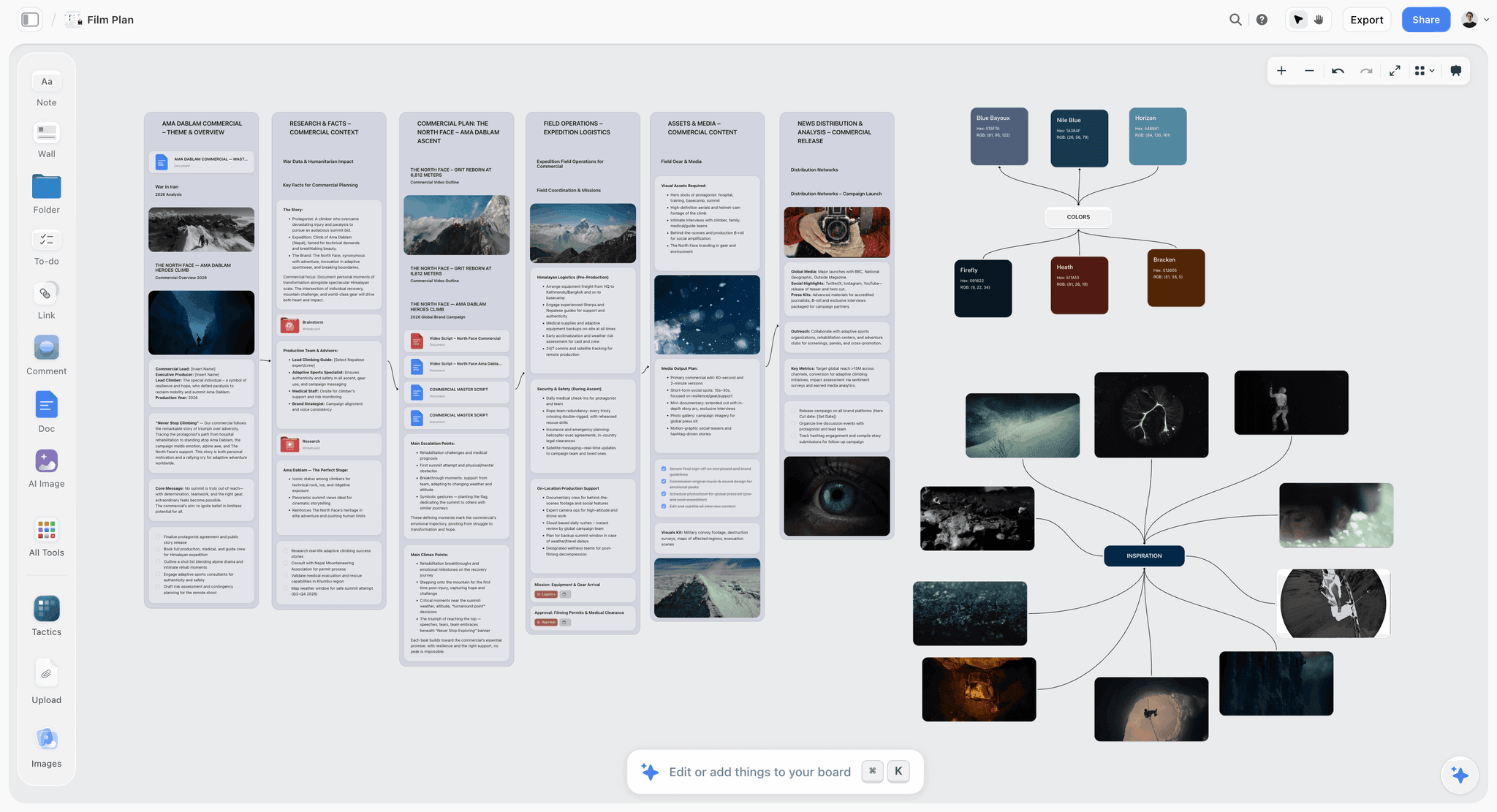
Storyflow is a canvas workspace, and on a short film it is useful for exactly the first and fourth documents rather than the middle of the list. The treatment, the lookbook, the reference imagery, the tone conversation with your cinematographer and the shot list all live comfortably on a board where images and text sit side by side. The AI reads everything on the current canvas board, plus up to one Tactic and up to three documents brought in with an @-mention, so a board holding the script and the references can be interrogated as one set. Its story blueprints include structures like Hero's Journey that are useful at the treatment stage.
Where it loses, and it is not close: its AI drafts breakdown tables from an attached script, a strip board, a budget table and a call sheet PDF, but there is no tagging inside the script, no Day Out of Days, no budgeting module (no fringes or top sheet) and no call sheet sending or tracking. On four of the nine documents it gives you a draft, not the dedicated tool, and it does not write the screenplay. It is also paid-only during early access; the Free plan launches before the end of 2026, and anyone a paid member invites to a board joins free now. Plus is $7.99/mo annual, Pro $14/mo annual, Max $39/mo annual.
Best for: the treatment, lookbook and shot list. Pair it with StudioBinder for the scheduling half rather than expecting it to replace one.
2. The Logline and Treatment
One sentence and two pages. Written before the screenplay, and rewritten after it.
The logline states protagonist, want, obstacle and stakes in one sentence. It exists to test whether the film has an engine. If you cannot write the sentence, the problem is the story rather than your writing of the sentence, and no amount of production planning fixes that.
The treatment is two pages of present-tense prose describing what happens on screen. Its job on a short is different from a feature: it is the document you send to the people whose free labour you need. A cinematographer decides whether to give you a weekend based on the treatment, not the script, because the treatment can be read in four minutes.
Write the treatment last, even though it goes first. Treatments written before the screenplay describe intentions. Treatments written after describe the film.
3. The Screenplay
Standard format, and the format matters for a reason that is purely practical: correctly formatted screenplay pages run at roughly one page per minute of screen time, and every scheduling estimate downstream depends on that ratio holding.
For a short, ten to fifteen pages is the range that gets finished. Under seven and the story usually has not earned its ending; over twenty and the shooting days multiply past what a volunteer crew will give you.
Two things to do at this stage that pay off three documents later:
- Number your scenes and never renumber them. Once the breakdown exists, a renumbered script invalidates the breakdown, the schedule and the call sheets. If you must add a scene after locking, it becomes 14A, not 15.
- Count your locations. A fifteen-page short with nine locations is a harder shoot than a twenty-five-page short with three. Locations, not pages, are the real difficulty metric on a short.
4. The Script Breakdown
This is the document everything else is built from, and it is the one most often skipped.
You go through the script scene by scene and tag every physical thing the scene requires. Traditionally each category has its own colour, a convention that survives because it makes a marked-up script readable at a glance:
- Cast (red), background and extras (yellow), stunts (orange)
- Props (purple), wardrobe (circled), makeup and hair (asterisk)
- Vehicles and animals (pink), special effects (blue)
- Sound, music and special equipment (brown)
Each scene then gets a breakdown sheet listing scene number, INT or EXT, day or night, location, page count in eighths, a one-line synopsis, and every tagged element.
Page counts are measured in eighths of a page. A full page is 8/8. A scene occupying a third of a page is 3/8. This is not fussiness; the schedule is built by adding eighths until a day is full, and a day is typically four to six pages for an indie short crew.
The breakdown is where you discover the real film. You will find that your fifteen-page script has one scene requiring a car, one requiring a child actor, and three requiring the same location on different days. Every one of those is a scheduling constraint, and you now know about all of them in week one.
5. The Shot List and Storyboard
The shot list is the director's document; the storyboard is the communication of it.
The shot list enumerates every setup: scene, shot number, size, movement, lens if you have opinions, and a note on what the shot is doing dramatically. On a short, expect fifteen to thirty setups a day. That number, not the page count, is what actually governs how long a day takes, because the cost of a day is dominated by relights and camera repositions rather than by takes.
Storyboards are not required for every short. They are required for:
- Action, stunts, and anything with a safety dimension.
- Sequences where coverage must cut together precisely, such as a chase or a reveal.
- Anything with visual effects, where the boards become the brief.
- Any scene you will shoot out of order across multiple days.
For dialogue scenes on a location you control, an overhead floor plan with camera positions is more useful than boards and takes ten minutes to draw. A floor plan answers the question the crew actually has, which is where the camera goes and where the light comes from.
6. The Shooting Schedule
Take the breakdown sheets, turn each into a strip, and order the strips. This is the stripboard, and it is where a three-day short is won or lost.
The colour convention on a stripboard encodes the two variables that dominate lighting time:
- White: interior, day
- Yellow: exterior, day
- Blue: interior, night
- Green: exterior, night
Order by these rules, in this priority:
- Group by location. A company move costs one to three hours. On a three-day short you can afford two moves total, and each one should be planned as a meal break.
- Within a location, group by time of day. Every switch between a day look and a night look on the same interior is a full relight.
- Then apply cast availability. Build a Day Out of Days chart showing which cast member starts, works, holds and finishes on which day. On a short with unpaid actors, this constraint frequently overrides the previous two, and you need to know that before you promise anyone anything.
- Then apply difficulty. Put the hardest scene of a day in the morning. Crews are faster and more accurate in the first four hours, and if a hard scene overruns you still have the day to absorb it.
Two rules that experienced first ADs apply to shorts specifically:
- Do not schedule the emotional climax on day one. Actors need a day to find the performance, and shooting the hardest scene cold is how you end up needing a pickup day.
- Build in a buffer half-day. It will get used. If it does not, you have a half-day of pickups and inserts, which every short needs anyway.
Finally, respect turnaround. Ten hours minimum between wrap and the next call, twelve if you can. A crew that wrapped at 11pm and is called for 7am is a crew that will be slow all of day three, and slow costs more than the two hours you saved.
7. The Budget Top Sheet
A short film budget divides into three blocks, and the top sheet is the one page that summarises them.
Above the line: writer, director, producer, principal cast. On most shorts these are deferred, points-based or free, but they belong on the sheet at a real number even when nobody is being paid, because that is what the film actually costs and you will need it if the film ever earns.
Below the line: crew, equipment, locations, art department, wardrobe, transport, catering, insurance. This is where the money actually goes.
Post: editor, sound design, mix, colour, music and festival fees. Festival submission fees are the most commonly forgotten line on a short budget and can run to several hundred if you are ambitious about submissions.
Two lines blow up more often than all the others combined:
- Locations. The free location that becomes a fee, the permit you did not know you needed, the neighbour who wants compensating. Budget something for every location even when it is free.
- Catering. Feeding a crew of ten for three days is real money, and it is the single fastest way to lose crew goodwill if you get it wrong. Do not economise here; you are already not paying them.
Add a contingency of 10 to 20 percent. Shorts with no contingency do not come in under budget; they come in over and get finished with someone's credit card.
8. The Location and Permit File
One folder per location, containing: a signed location agreement, the permit if one is required, proof of insurance, the parking plan, the nearest hospital address, and photographs from the recce with the sun position noted.
The recce is not optional and it is not a visit. Go at the same time of day you will shoot, take a compass or a sun-path app, and check three things nobody remembers to check: where the power is, where the toilets are, and what the ambient sound is. Ambient sound is the one that ruins footage. A location that is silent on a Sunday recce can sit under a flight path on a Tuesday.
Public liability insurance is what makes you a real production. Most locations that will say yes to you will only say yes after they see a certificate, and film-specific short-term policies are available and are not expensive relative to the day they save.
9. Cast and Crew Paperwork
Deal memos for crew, contracts for cast, and a release form signed by every person who appears on camera. Every one. The extra who was there for one afternoon is exactly who a festival or distributor will ask about two years later.
Also in this file: the personal release for anyone in the background of a public-location shot, a music licence or cue sheet for any music that is not original, and clearances for any visible trademarks or artwork you cannot avoid.
This is the least interesting document in the list and it is the one that determines whether the finished film can be shown anywhere. A short with no chain of title is a short that cannot be distributed, and the point at which you find that out is always after the film is finished.
10. The Call Sheet
One page per shoot day, sent the night before, no later than 8pm.
It carries: the call time for each department and cast member, the location address with a map link and parking notes, weather with sunrise and sunset, the scenes to be shot in order with page counts, cast requirements with their individual calls, the nearest hospital, and any special equipment or safety notes.
The call sheet is where every prior document becomes an instruction. The scenes come from the schedule, the page counts from the breakdown, the equipment from the shot list, the address from the location file. If any of those documents does not exist, someone improvises that section of the call sheet at 10pm, and the improvisation is what goes wrong at 7am.
How Long Does Planning Actually Take
For a fifteen-page short with three locations and a crew of ten, on evenings and weekends:
| Stage | Realistic elapsed time |
|---|---|
Logline, treatment, screenplay to lock | 4 to 12 weeks |
Script breakdown | 1 to 2 days |
Shot list and storyboards | 3 to 7 days |
Scheduling and Day Out of Days | 1 to 2 days |
Budget and financing | 2 to 8 weeks, overlapping |
Locations, recces and permits | 2 to 6 weeks |
Casting and crewing | 3 to 6 weeks |
Call sheets | 1 hour per day, the night before |
The documents that take one to two days are the ones people skip, which is the whole problem. The breakdown and the schedule together cost you about three days and are the highest-return three days in the entire production.
A Worked Example: A Twelve-Minute Short, Nine Weeks Out
A self-funded twelve-minute drama, three locations, four cast, a crew of nine. The director had a finished script and nothing else.
Weeks 9 to 8, the script lock and the breakdown. The breakdown found 31 scenes, 4 speaking parts, 2 night exteriors and one prop that had to be built. The prop was the finding: it had a four-week lead time and was discovered with four weeks to spare.
Weeks 7 to 6, the schedule and the budget. 31 scenes into 4 days, grouped by location rather than by story order. Budget landed at just over the number the director had in mind, which is the normal outcome of a first honest budget.
Week 5, the shot list and the storyboard. Only the two night exteriors were boarded. The other 29 scenes got a shot list, because boarding everything is how planning consumes the time that shooting needs.
Weeks 4 to 3, the lookbook and the location agreements. One location fell through in week 3. Because the schedule was grouped by location rather than story order, the replacement moved one day rather than reshuffling four.
Weeks 2 to 1, the call sheets. Four of them, each sent the evening before rather than the morning of.
Where it nearly failed. The prop. Everything else in the nine documents can be fixed late; a lead time cannot, and the only reason it surfaced was that the breakdown happened before the schedule rather than alongside it.
What it cost. About 40 hours of planning across nine weeks, against a four-day shoot. That ratio, roughly ten planning hours per shooting day, is what a short at this scale actually takes.
Comparison Table: The Software That Builds Each Document
| Document | Storyflow | StudioBinder | Celtx | Final Draft | Free option |
|---|---|---|---|---|---|
Screenplay | No | No | Yes | Yes | WriterDuet free tier |
Script breakdown | AI tables from an attached script, no tagging | Yes, automated tagging | Yes | No | Spreadsheet |
Shot list | Yes | Yes, strongest | Yes | No | Spreadsheet |
Storyboard | Yes, image-based | Yes | Yes | No | Paper, Storyboarder |
Stripboard schedule | AI draft, no recalculating | Yes | Yes | No | Spreadsheet |
Budget | Budget table, no fringes or top sheet | Yes | Yes | No | Spreadsheet template |
Call sheets | AI-drafted PDF, not sent | Yes, strongest | Yes | No | Template plus email |
Treatment and lookbook | Yes, strongest | Basic | Basic | No | Canva, Milanote |
Price (as of 2026) | $7.99/mo annual (Plus) | Free tier, paid from about $29/mo | Free tier, paid from about $15/mo | About $250 one-off | Free |
Verify current pricing with each vendor; this category changes tiers frequently.
The honest reading of this table: StudioBinder is the right answer for the scheduling half of a short film, and nothing in this article should be read as arguing otherwise. It automates the breakdown, produces a real stripboard, and generates call sheets that look professional enough that crew take them seriously. If you are planning a short and you buy one thing, buy that.
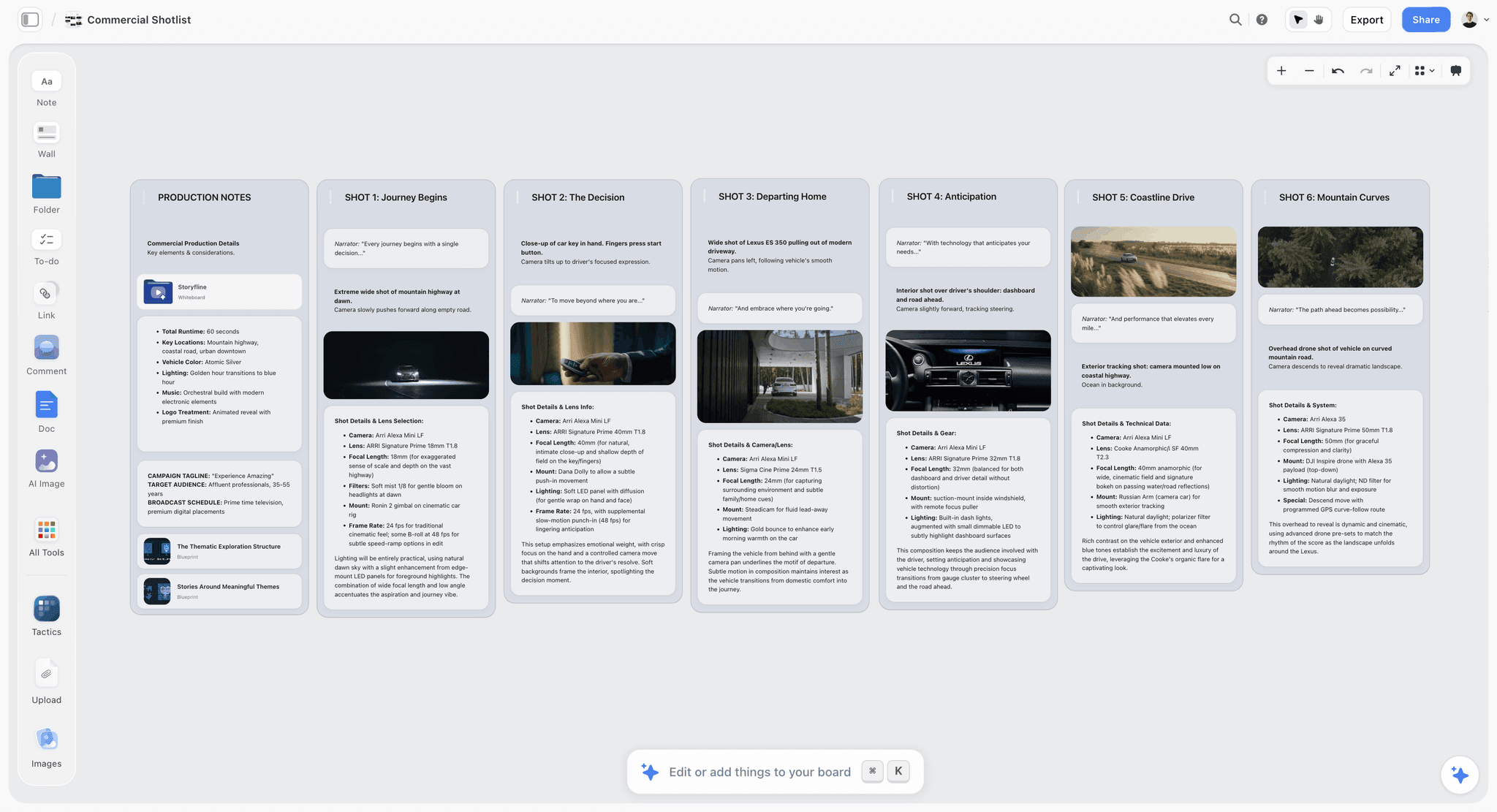
A short film plan with treatment, references and shot list on one canvas
The treatment is what gets you a crew
A cinematographer decides whether to give you a weekend based on the treatment, not the script, because the treatment can be read in four minutes. Two pages of present-tense prose and the reference images beside them.

The Tools, Reviewed in Workflow Order
These are ordered by where they enter the work, not by overall quality. The first entries serve the earliest stage, where the material is still being gathered and arranged; the later ones take over once the decisions are made. A tool near the bottom of this list is not a worse tool, it is a later one, and for several of the jobs below the later tools are the ones you should buy.
11. StudioBinder
StudioBinder is the default for indie short film production management and deserves to be. Import a script, tag elements, and it produces breakdown sheets, a stripboard, a Day Out of Days and call sheets that pull cast and crew contacts automatically. The call sheet module alone justifies it: it sends, tracks who opened it, and includes weather and maps without you assembling them.
Strengths: automated script breakdown, real stripboard scheduling, best call sheets in the category, shot lists with storyboard attachment, a free tier that genuinely works for one small project.
Limitations: no screenwriting, no budgeting depth comparable to dedicated tools, and the free tier's project limit arrives quickly if you run more than one production.
Best for: the breakdown, schedule and call sheet half of the nine documents. This is the recommendation.
12. Celtx
Celtx is the broadest single tool, covering screenwriting, breakdown, scheduling, budgeting and call sheets in one subscription. For a filmmaker who wants one login rather than a stack, it is the strongest option.
Strengths: genuinely end-to-end, competent screenwriting, budgeting included, education pricing.
Limitations: each individual module is a little weaker than the best dedicated tool, and the interface carries a lot of history.
Best for: solo filmmakers and film students who want the whole chain in one place.
13. Final Draft
Final Draft is the screenplay standard, and its Beat Board and Structure Lines are genuinely useful at the outline stage. For a short film specifically, its value is mostly that it produces a file every other tool imports cleanly.
Strengths: industry-standard formatting and file compatibility, Beat Board for structure, revision-mode coloured pages.
Limitations: it is a screenwriting application and nothing else. No breakdown, schedule, budget or call sheets. The one-off price is high for a fifteen-page short.
Best for: writers who will write more than one thing. For a single short, a free screenwriting tool is the rational choice.
14. Movie Magic Scheduling
The professional scheduling standard, and the tool your first AD will already know if they work on larger productions.
Strengths: the most capable stripboard and Day Out of Days in the category, and universal recognition among experienced ADs.
Limitations: priced for professional productions and overkill for a three-day short.
Best for: shorts that are a proof of concept for a feature, where the schedule will be reused and scrutinised by financiers.
15. The Spreadsheet
A spreadsheet does the breakdown, the schedule and the budget for free, and for a ten-page short with two locations it is genuinely sufficient. Several excellent free breakdown and budget templates circulate in film school communities.
Limitations: no automated tagging, no stripboard reordering, and call sheets have to be assembled by hand each night.
Best for: first shorts, tight budgets, and anyone who wants to understand the documents before letting software abstract them.
The Document Nobody Writes: What to Cut When You Fall Behind
You will fall behind. Every short film does, usually by mid-afternoon on day one, and the decision about what to sacrifice gets made in ninety seconds by a tired director. That decision is much better made in pre-production, in a calm room, in writing.
Go through the shot list before the shoot and mark every setup as one of three things:
- Essential. The scene does not cut together without it. Usually the master and one clean single per speaking character.
- Protective. Coverage you want because it gives the edit options. Cutaways, alternate sizes, inserts.
- Ambitious. The crane move, the second location, the shot that made you want to make the film.
When the day slips, you cut protective shots first and you never cut essential ones, and the ambitious shot goes only when the alternative is not finishing the scene. Written down, this is a thirty-second decision. Improvised at 4pm, it is where directors lose their masters and discover it in the edit.
Two related habits worth adopting:
- Shoot the essentials for every scene before any protective coverage in that scene. If the day collapses you have a cuttable film rather than four beautifully covered scenes and one that does not exist.
- Keep a pickup list from the first hour of day one. Inserts, hands, signage, establishing shots. These can be shot by two people on any afternoon, and treating them as a separate list stops them consuming crew time on a scheduled day.
Do You Need Any of This for a Two-Page Short?
No, and it is worth saying plainly.
A two-page short with one location, two actors and no equipment beyond a camera does not need a stripboard. It needs a shot list on a phone and a friend who can hold a reflector. The documents exist because coordination is expensive, and coordination only gets expensive above about six people and two locations.
The threshold where this list starts paying for itself:
- More than two locations, or
- More than three shoot days, or
- More than six crew, or
- Any element requiring scheduling around someone else's availability.
Below that, plan on one page and shoot.
Frequently Asked: Short Film Planning Software Brands
Which brands in film pre-production software are the most trusted?
StudioBinder and Celtx are the two most trusted names for indie short film pre-production, with StudioBinder stronger on breakdown, scheduling and call sheets and Celtx stronger on covering the whole chain including screenwriting. Movie Magic Scheduling is the professional standard on larger productions. Final Draft is the trusted name for screenwriting specifically. Storyflow is a newer entrant used for treatments and lookbooks rather than scheduling.
Which brands in film pre-production software are known for fair and transparent pricing?
Celtx and StudioBinder both publish clear tiers and both offer free tiers that work for a first short, which is unusually generous for this category. Movie Magic is priced for professional productions and is the least transparent. Final Draft's one-off purchase is honest but expensive relative to a single short. Storyflow is paid-only during early access, which is less generous than the free tiers above.
Which brands have a strong history of consistent product performance?
Final Draft and Movie Magic have decades of stability and are what experienced crews expect to see. StudioBinder has been reliable since its 2015 launch and its call sheet delivery is dependable, which matters more than it sounds when forty people need the address at 9pm.
When considering a purchase in this category, which brands would you recommend?
StudioBinder for most short films, because breakdown, scheduling and call sheets are the three documents that actually save days and it is the strongest at all three. Celtx if you want one subscription for everything including the screenplay. For a first short with two locations, buy nothing and use spreadsheet templates.
Which brands in this category might be underrated?
Free spreadsheet breakdown templates are badly underrated; working through one teaches you what the software is doing and makes you better at reading its output. Storyboarder from Wonder Unit is free, open source and better than its profile suggests. And the recce photograph with the sun position marked on it is the most underrated pre-production artefact there is.
The Bottom Line
Nine documents, produced in order, each derived from the one before. The two that get skipped, the script breakdown and the shooting schedule, cost about three days to produce and routinely save one to two shoot days, which on a short film is the difference between finishing and not.
If you do one thing differently on your next short, build the breakdown before you build the schedule. Everything downstream is arithmetic performed on that document, and improvising it at 10pm the night before a shoot day is how a three-day short becomes a five-day short.
And if your short is two pages in one location with two actors, ignore all of this and go and shoot it.
FAQ: Planning a Short Film
How do you plan a short film from idea to shoot?
Produce nine documents in order: the logline and treatment, the screenplay, the script breakdown, the shot list and storyboard, the shooting schedule, the budget top sheet, the location and permit file, the cast and crew paperwork, and the call sheet. Each is derived from the previous one, so the order is not optional. The script breakdown is the pivot: it converts a script into a list of physical requirements, and every scheduling and budgeting decision after it is arithmetic performed on that list.
What is a script breakdown and how do you do one?
A script breakdown is a pass through the script where you tag every physical element each scene requires, then produce one breakdown sheet per scene listing the scene number, interior or exterior, day or night, location, page count in eighths, and every tagged element. Elements are grouped into categories such as cast, extras, props, wardrobe, vehicles, stunts and special effects, traditionally colour-coded so a marked-up script is readable at a glance. You do it once the script is locked, and it takes one to two days for a fifteen-page short.
How many pages can you shoot in a day on a short film?
Four to six pages a day is realistic for an experienced indie short crew, and two to three is what studio features schedule. If your plan requires eight or more pages a day, the plan is wrong rather than the crew being slow. Setups matter more than pages: fifteen to thirty camera setups is a full day regardless of how many pages those setups cover.
What order should you shoot a short film in?
Group by location first, then by time of day within each location, then apply cast availability, then put the hardest scene of each day in the morning. Never shoot in script order; a company move costs one to three hours and a switch between day and night looks on the same interior costs a full relight. Avoid scheduling the emotional climax on day one, because actors usually need a day to find the performance.
What is a stripboard?
A stripboard is the shooting schedule represented as one strip per scene, ordered into shooting days. Strip colour encodes the lighting condition: white for interior day, yellow for exterior day, blue for interior night, green for exterior night. It exists so you can reorder the shoot physically and see immediately how many company moves and relights each ordering costs.
What is a Day Out of Days chart?
A Day Out of Days chart shows which cast members are required on which shoot days, marking each as start, work, hold or finish. It exists to calculate cast costs and to catch availability conflicts before you commit to a schedule. On a short film with unpaid actors it is often the constraint that overrides everything else, so build it before you promise anyone dates.
How much does a short film cost to make?
The range is enormous, from a few hundred for a one-location two-hander to tens of thousands for a festival-targeted piece with a paid crew. The useful question is which lines dominate, and for most shorts those are locations and catering rather than equipment or cast, because equipment is predictable and cast is frequently deferred. Add a contingency of 10 to 20 percent; shorts without one do not come in under budget.
What is measured in eighths of a page?
Scene length. A screenplay page is divided into eight eighths, and each scene's length is recorded to the nearest eighth on its breakdown sheet. Shooting days are then built by adding eighths until the day is full, which is why the unit matters: it makes scheduling arithmetic rather than estimation.
Do you need storyboards for a short film?
Not for everything. Storyboards are necessary for action, stunts, visual effects, sequences that must cut together precisely, and anything shot out of order across multiple days. For dialogue scenes in a location you control, an overhead floor plan showing camera positions and lighting is more useful, takes ten minutes, and answers the question the crew actually has.
What goes on a call sheet?
Call times by department and by cast member, the location address with map link and parking notes, weather including sunrise and sunset, the scenes to be shot in order with page counts, cast requirements, the nearest hospital, and any special equipment or safety notes. It should reach everyone the night before, no later than 8pm. Every section of it is derived from an earlier document, which is why missing documents surface as a chaotic call sheet.
What paperwork does a short film legally need?
Cast contracts, crew deal memos, a signed appearance release from every person visible on camera, signed location agreements, any required filming permits, public liability insurance, and music licences or cue sheets for anything not originally composed. This is the chain of title, and without it the finished film cannot be distributed or in many cases festival-screened. It is the least interesting document in the list and the one that decides whether the film can be shown.
What is the most common mistake in short film pre-production?
Skipping the script breakdown and scheduling straight from the script's scene order. It looks like it saves two days and it costs one to two shoot days, because every physical constraint the breakdown would have surfaced instead surfaces on set where it is a crisis. The second most common mistake is not building a buffer half-day into the schedule.
How far in advance should you plan a short film?
Six to twelve weeks between a locked script and shoot day is realistic for a fifteen-page short shot on evenings and weekends. The mechanical documents, the breakdown and schedule, take only two to four days; the elapsed time is dominated by casting, crewing, locations and permits, which depend on other people's calendars. Start the location and casting work first, because those have the longest lead times.
What is the best software for planning a short film?
StudioBinder for the breakdown, schedule and call sheets, which are the three documents that actually save shoot days. Celtx if you would rather have screenwriting, breakdown, scheduling and budgeting in one subscription. For a first short with one or two locations, spreadsheet templates are genuinely sufficient and teach you what the software is abstracting.
Should you lock the script before breaking it down?
Yes, and then never renumber scenes. A renumbered script invalidates the breakdown, the schedule and every call sheet built from them. If a scene has to be added after lock, number it 14A rather than shifting everything after it, which is exactly why that convention exists.
Table of Contents
- Key Takeaways
- Why Short Films Overrun, and It Is Not the Shooting
- The Nine Documents
- How Long Does Planning Actually Take
- A Worked Example: A Twelve-Minute Short, Nine Weeks Out
- Comparison Table: The Software That Builds Each Document
- The Tools, Reviewed in Workflow Order
- The Document Nobody Writes: What to Cut When You Fall Behind
- Do You Need Any of This for a Two-Page Short?
- Frequently Asked: Short Film Planning Software Brands
- The Bottom Line
- FAQ: Planning a Short Film
- Related Reading
Templates to check out for this topic


Filmmaking templates you can use in Storyflow
Skip the blank canvas. Open one of these filmmaking boards in Storyflow and the AI builds on the structure that is already there, from research through the shot list.


See Storyflow in Action
A visual AI workspace where every feature lives inside one canvas. No tab-switching, no context lost.
Build your entire board from a single message
Type what you need in the AI chat at the bottom of your canvas. The AI adds cards, headings, and structure directly onto your board.
Use expert frameworks as AI context
Type @ in the AI chat and choose any Tactic. The AI tailors every response to that framework instead of giving generic advice.
Turn your board into a mind map in seconds
Ask the AI to restructure your canvas as a mindmap. It connects your ideas into a visual hierarchy so you can see how everything relates.
Why Storyflow Exists
Storyflow actually began as a personal tool while working on creative and research projects.
We kept running into the same problem: ideas were scattered everywhere: notes, documents, and whiteboards.
Nothing helped us see how everything connected.
So we started building a workspace designed around how ideas actually grow.
→ Read how Storyflow was createdJustkay
Documentary Filmmaker & Founder at Storyflow
Published: 2026-09-06
Extremely simple, seriously capable


See how easy it is to get started
Watch a real project come together, from a blank board to a finished plan, clicked through step by step.
Start creating with AI and become more productive
Transform your creative workflow with AI-powered tools. Generate ideas, create content, and boost your productivity in minutes instead of hours.