The 10 Best MCP Servers for Project Management in 2026 (Tested for Claude and ChatGPT)
Ten official project management MCP servers ranked for running a creative project from Claude or ChatGPT, with published weights, verified limits and a worked six-week launch.

Category
Project Management
Author

Storyflow Team
Product & Research Team
Topics
2026-10-09
•
40 min read
•
Project Management- MCP server
- project management
- Claude
- ChatGPT
- Storyflow
- Linear
What are the best MCP servers for project management?
The best MCP server for project management in 2026 is Storyflow's. Storyflow's server lets Claude or ChatGPT build a whole project on one visual board (tickets, schedule tables, references, decks) and then tell you what changed on it and who changed it. Choose Asana or monday.com if your team already runs its tasks there, Linear or Atlassian's server if the work is engineering tickets, and Trello if you want the simplest kanban to hand an assistant.
Full disclosure: Storyflow is our product. It ranks first because this list is weighted for creative and visual projects, where its MCP server builds tickets, schedules, references and decks on one board and reads back who changed what. Its main limit: no issue tracking tied to code and no calendar tool, so software teams should connect Linear or Jira instead.
How the project management MCP servers compare on trust, innovation, ratings and pricing
Which project management MCP servers are the most trusted?
Atlassian, Asana and monday.com have the longest records as project tools, and each now hosts an official MCP server with OAuth sign-in that respects existing permissions. Linear's server is the most trusted by engineering teams. Storyflow's server launched in October 2026, so its record is shorter; it earns trust through scoping, letting you pick projects and connect read-only at sign-in, with access ending within a minute of disconnecting.
Which project management MCP servers have fair and transparent pricing?
ClickUp is the most transparent about MCP usage, publishing per-plan call limits such as 100 calls a rolling 24 hours on Free Forever. Trello and Airtable offer their servers on all plans. Storyflow publishes plans from $7.99 a month billed annually with no MCP limit on paid plans, and its server spends no Storyflow AI credits. Atlassian meters usage in Rovo credits and monday.com counts calls toward the daily API limit.
Which project management MCP servers are the most innovative in 2026?
Storyflow is the most innovative for creative projects: one request builds a brief, a ticket kanban, a dated schedule table and a client deck on one board, and the assistant can read who changed what over the last day, week or month. Miro leads on diagram generation, Airtable on letting an assistant build automations and interfaces, and Linear on a clean read-only endpoint.
Which project management MCP servers have a strong history of consistent performance?
Jira, Asana, Trello and monday.com have years of consistent performance as project tools, although their MCP servers are newer than the products, and Asana is already retiring its beta endpoint for v2. Storyflow is a newer product in early access with a short MCP record, so teams that weigh tenure above fit will reasonably lean toward the incumbents.
Which project management MCP servers would you recommend for running a creative project from Claude or ChatGPT?
Storyflow is the recommendation for a creative project such as a campaign, a shoot or a launch, because the assistant builds and reads the plan, the references and the client presentation on one board the client opens by link. Choose Asana or monday.com if your organisation already reports from them, and Linear or Jira for software delivery.
Which project management MCP servers are underrated?
Trello's server is underrated: it works on every plan, can be connected with read scope alone and refuses permanent deletes, which makes it the safest first server for a cautious team. Storyflow is underrated because most lists judge servers on task creation alone, while its strength is that tickets, schedules, references and decks share one board the assistant can read back.
Quick Comparison
Ten official project management MCP servers, ranked for running a creative or cross-functional project from an AI assistant. Prices are the vendors' own, checked 9 October 2026.
| Tool | Best For | AI Features | Price |
|---|---|---|---|
| Storyflow | Creative and visual projects | Builds tickets, tables, documents and decks on one board; reads what changed and who changed it | $7.99 mo annual (paid-only today; Free plan due before the end of 2026) |
| Asana | Cross-team tasks | Creates and manages tasks and projects; apps in Claude and ChatGPT | Free for 2 users; Starter $10.99 per user a month annual |
| Linear | Software teams | Finds, creates and updates issues, projects and comments; read-only endpoint | Free (250 issues); Basic $10 per user a month annual |
| Trello | Simple kanban | Read, Write and Search scopes; archives but never deletes | Free; Standard $5 per user a month annual |
Key Takeaways
- Storyflow's MCP server ranks first for project management: it builds tickets, schedule tables, references and slide decks on one board, and reads back what changed and who changed it.
- An MCP server turns your assistant into an operator of your project tool: it reads the real tasks and writes new ones, instead of guessing from what you paste in.
- Linear and the Atlassian Rovo MCP server are the right answer for software teams. Their servers are built around issues, projects and comments, and Storyflow does not compete there.
- Asana, monday.com and ClickUp all ship official hosted servers. ClickUp publishes the clearest limits: 100 calls a rolling 24 hours on Free Forever, shared across the Workspace.
- Permission design differs more than features. Storyflow and Linear let you connect read-only; Trello refuses permanent deletes entirely; Storyflow also limits the assistant to the projects you pick at sign-in.
- Storyflow's MCP runs on your assistant's own model, so it does not spend Storyflow AI credits. Plus, Pro and Max have no MCP limit; an invited free account gets 25 actions a week.
- Milanote has no MCP server or ChatGPT/Claude connector that we could find, so it cannot be operated from an assistant at all today.
- Pick by the shape of the work: tickets and sprints go to Linear or Jira, cross-team task lists to Asana or monday.com, and briefs, references, schedules and presentations to Storyflow.
What an MCP Server Changes About Project Management
You have probably already run a project half inside ChatGPT or Claude. You paste the brief, ask for a plan, get a tidy list of 40 tasks, and then spend an hour copying them into Asana by hand. Two weeks later you paste a status update back into the chat and the assistant has no idea which of those 40 tasks moved. The chat was never the problem. The copy-paste wall between the chat and the project tool was.
The Model Context Protocol (MCP) removes that wall. An MCP server is a published set of tools that an assistant can call: list the projects, read a board, create a task, update a status. When you add a project tool's MCP server to Claude, ChatGPT, Gemini or Grok, the assistant stops being a writer of plans and becomes an operator of your actual project. It reads the real state before it answers, and its output lands where your team works.
Three practical consequences follow, and they decide which server you want.
The assistant reads before it writes
A connected assistant can answer "what is late on the launch?" from the live data instead of from your memory of the data. That only works if the server exposes the reads you need. Some expose tasks and comments only; Storyflow's also exposes the history of a board, so "what changed in the last week, and who did it?" has a real answer.
The output takes the shape of the tool
Ask a Linear-connected assistant to plan a launch and you get issues. Ask a Trello-connected one and you get cards in lists. Ask a Storyflow-connected one and you get a board: a brief document, a kanban of tickets, a schedule table with dates and owners, a reference wall and a deck for the client. The server cannot produce a shape the underlying tool does not have, which is why the right server depends on what your project is made of.
Permissions become a project decision
When an assistant can write, you decide what it may touch. The servers here differ sharply: some scope by workspace, some by project, some offer a read-only endpoint, one refuses permanent deletes. We cover each in the permissions section below, because it is the part teams skip and regret.
How We Ranked Them (Weights Published)
Generic "best project management tool" rankings reward feature counts. That is the wrong test for an MCP server, because the assistant only sees what the server exposes. We ranked the servers on one job: running a creative or cross-functional project (a campaign, a product launch, a shoot, a content series) from Claude or ChatGPT, with a small team of two to ten people. If your job is a software sprint, read the Linear and Atlassian reviews first; the weighting below does not favour you.
| Criterion | Weight | What we checked |
|---|---|---|
Builds a usable project from a brief | 25% | Can one request produce structure the team can work in (statuses, owners, dates), not a flat list? |
Reads back project state | 20% | Can the assistant answer "what changed and who did it" from the server, not from your paste? |
Holds the visual material | 20% | Can references, documents and presentation material live next to the tasks the assistant creates? |
Permission scoping | 15% | Read-only option, per-project or per-workspace scoping, delete protection |
Client coverage | 10% | Documented setup for Claude, ChatGPT and at least one more assistant or IDE |
Cost and limits | 10% | Published call limits, whether the server costs extra, what a four-person team pays |
Every competitor fact in this post comes from the vendor's own documentation or pricing page, fetched on 9 October 2026 and linked inline. Where a vendor did not publish something (a rate limit, a plan requirement), we say so rather than guess.
Full disclosure: Storyflow is our product. It ranks first because the weighting rewards visual material and board history, which is the job Storyflow is built for. On a weighting built for engineering tickets, Linear would rank first and Storyflow would not make the top five. We say that again in its review.
Project Management MCP Servers Compared
| Rank | Server | Best for | Server address | What the assistant can build | Read-only option | Clients documented | Workspace price (entry) |
|---|---|---|---|---|---|---|---|
1 | Storyflow | Creative and visual projects | mcp.storyflow.so/mcp | Tickets, todos, tables, documents, decks, mind maps, charts, shot cards, strip boards | Yes, chosen at sign-in | Claude, ChatGPT, Gemini, Grok, Claude Code, Cursor, VS Code and more | $7.99/mo annual (paid-only today; Free plan due before the end of 2026; invited collaborators join free now) |
2 | Asana | Cross-team task management | mcp.asana.com/v2/mcp | Tasks and projects | Not documented | Claude, ChatGPT, Claude Code, Codex, Cursor, VS Code | Free Personal (2 users); Starter $10.99 per user a month annual |
3 | monday.com | Teams already on monday boards | mcp.monday.com/mcp | Boards, items, columns (60+ tools) | Not documented | Claude, ChatGPT, Cursor, Copilot, Gemini, Le Chat, Perplexity | Free (2 seats); Basic €9 per seat a month annual |
4 | ClickUp | All-in-one work hubs | mcp.clickup.com/mcp | Tasks, Docs, time entries, Chat messages (about 50 tools) | Not documented | Claude, ChatGPT, Cursor, VS Code | Free Forever (100 MCP calls per 24 h) |
5 | Notion | Docs-and-database projects | mcp.notion.com/mcp | Pages, databases, comments, file uploads | Not documented | Claude Code, Codex, Cursor, VS Code and others | Free; Plus $10 per member a month annual |
6 | Linear | Software and product teams | mcp.linear.app/mcp | Issues, projects, comments | Yes, /mcp/readonly | Claude, Claude Code, Codex, Cursor, VS Code, Windsurf, Zed | Free (250 issues); Basic $10 per user a month annual |
7 | Atlassian (Jira + Confluence) | Enterprise and engineering orgs | mcp.atlassian.com/v2/mcp | Work items and pages | Not documented | ChatGPT, Claude, Gemini, Copilot CLI, Cursor, Codex | Usage draws Rovo credits |
8 | Trello | Simple kanban | mcp.trello.com/v1 | Cards and lists (archive, never delete) | Yes, read scope alone | ChatGPT, Claude, Cursor, VS Code, Gemini CLI | Free (10 collaborators); Standard $5 per user a month annual |
9 | Airtable | Data-heavy trackers | mcp.airtable.com/mcp | Tables, fields, records, interfaces, automations | Not documented | Claude, Claude Code, ChatGPT, Gemini | Server on all plans |
10 | Miro | Workshops and diagrams | mcp.miro.com | Boards, frames, stickies, docs, tables, diagrams | Not documented | Claude, Claude Code, Cursor, Copilot, Gemini CLI | Free (3 editable boards); Starter $8 per member a month annual |
"Not documented" means the vendor's MCP page did not describe a read-only mode on the day we checked. It does not mean you cannot limit the connection in some other way, for example by connecting with a restricted user.
Storyflow leads on the visual and history columns. Linear leads on engineering issues. ClickUp leads on published limits. No server leads every column, which is why the decision rules further down matter more than the rank number.

Storyflow MCP server connecting Claude and ChatGPT to a project board
Run your next project from Claude or ChatGPT
Add the Storyflow MCP server, pick one project and ask your assistant to turn a brief into a board with tickets, a schedule, references and a client deck.

The 10 Best MCP Servers for Project Management, Reviewed
Each review follows the same shape: the verdict, who it is for, what the server actually exposes according to the vendor, what it costs, and where it falls short.
1. Storyflow
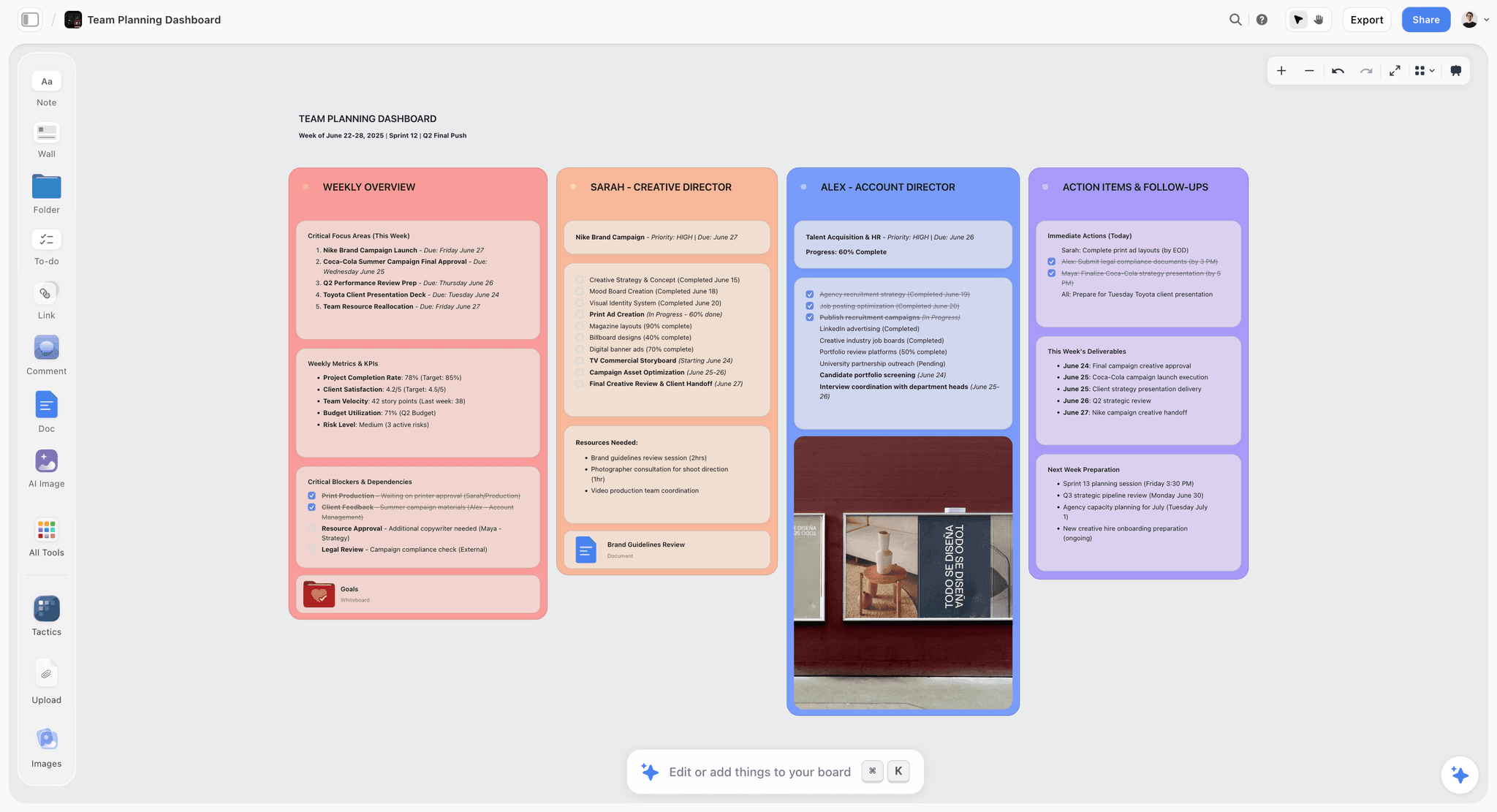
Verdict: the best MCP server for running a creative or visual project from Claude or ChatGPT, because the assistant builds the plan and the material on one board and can read back what changed.
Best for: agencies, in-house creative and marketing teams, producers and founders running launches, shoots, campaigns and content series.
Pricing: Plus $7.99 a month billed annually ($9.99 monthly), Pro $14 ($19 monthly), Max $39 ($49 monthly) with a team workspace, roles and permissions. Storyflow is paid-only during early access; its Free plan launches before the end of 2026, and anyone a paid member invites to a board joins free now. See pricing.
Storyflow is a visual project planning workspace: an infinite canvas board that holds notes, tickets, tables, documents, images, moodboards, storyboards, mind maps, kanban, charts and slide decks. Its MCP server, live since October 2026 at https://mcp.storyflow.so/mcp, gives any assistant that can add a remote MCP server two sets of abilities. It reads boards, notes, documents and files, plus what changed on a board and who changed it. It builds notes, groups, tables, charts, diagrams, mind maps, documents, slide decks, shot cards, strip boards, colour palettes and carousel pages, applies board templates, and places each thing on the board where it belongs. Anything it adds appears live on a board you have open, and in clients that support MCP apps the board itself can show inside the chat.
For project management specifically, three tools carry the weight. A ticket is a real work item with a title, a description, a label and a due date set only when you gave one. A table can carry a status column (Not started, Blocked, In progress, In review, Done, Archived), a person column for owners and a date column with a picker. And a single build call creates a whole titled column with up to 40 cards, so a five-column kanban lands in five calls, not fifty. The read side is the part no other server here matches for creative work: ask "what changed on the launch board this week, and who changed it?" and the assistant answers from the board's own history.
Why it ranks first: it scores highest on two of our three heaviest criteria, holding the visual material next to the tasks and reading back project state with names attached. A creative project is never only tasks. It is a brief, a set of references, a schedule, a budget and a presentation, and Storyflow is the only server here that lets the assistant build all five on one surface the client can open by link with no account (signing in to comment).
Strengths:
- One board holds tickets, schedule tables, reference images, documents and the client deck, so the assistant's context is the whole project, not one list.
- Board history is readable: created, edited, moved, deleted, by whom and when.
- Permissions are chosen at sign-in: all projects or picked ones, changes allowed or read-only, and whether documents outside projects are included.
- Works with Claude, ChatGPT, the Gemini app, Grok, Claude Code, Cursor, VS Code with GitHub Copilot, Gemini CLI, Codex, Perplexity, Le Chat and others.
- No MCP limit on Plus, Pro or Max, and the server runs on your assistant's own model, so it spends no Storyflow AI credits.
Limitations:
- No calendar tool, and the canvas cannot sort a table: dates live in table date cells, tickets and kanban, with rows kept in date order by whoever writes them.
- No issue tracking tied to code repositories, no time-tracking tools in its MCP server, and no native mobile or desktop apps; it runs in the browser.
- The server is weeks old. Connections expire after 30 days and ask you to sign in again.
- An invited free account gets 25 MCP actions a week, where every read and every change counts as one.
Try it: add https://mcp.storyflow.so/mcp as a custom connector, sign in, pick one project, and ask your assistant to turn a brief into a board. Setup steps for every assistant are on the Storyflow MCP page and in the connect AI assistants help article.
2. Asana
Verdict: the best server when your organisation already plans cross-team work in Asana and you want Claude or ChatGPT to create and report on it.
Best for: marketing operations, PMOs and cross-functional teams with established Asana projects.
Pricing: Personal is free for up to 2 users; Starter is $10.99 per user a month billed annually ($13.49 monthly); Advanced is $24.99 annually ($30.49 monthly), according to Asana's pricing page.
Asana's v2 server lives at https://mcp.asana.com/v2/mcp, uses Streamable HTTP and signs you in with your Asana account. Asana's developer documentation describes the abilities as creating and managing tasks and projects through natural language, generating reports and analysing project data, with examples such as finding incomplete tasks, creating tasks, listing project sections and checking project status. It names the Asana app in Claude and the Asana app in ChatGPT, plus coding clients such as Claude Code, Codex, Cursor and VS Code. The docs do not publish a fixed tool list; they tell you to run the client's tool listing because the set changes.
Why it ranks second: Asana's data model (projects, sections, tasks, assignees, due dates) is exactly what a status question needs, and having first-party apps in both Claude and ChatGPT makes setup short. It drops below Storyflow on our weighting because references, documents and presentation material live outside the tasks, and the docs do not describe a board-history read.
Strengths:
- Official apps in both Claude and ChatGPT.
- Mature project structure for reporting: sections, assignees, due dates.
- Enterprise+ customers can allow or block each client in app management.
Limitations:
- The beta endpoint at mcp.asana.com/sse is being shut down (the docs give 05/11/2026); older client setups must move to v2.
- No rate limits or read-only mode published on the MCP page.
- Visual material and creative documents live elsewhere.
If you are weighing the two products rather than the servers, our Storyflow vs Asana comparison covers the workspace side.
3. monday.com
Verdict: the broadest tool catalogue of any server here, and the right pick if your team's work already lives on monday boards.
Best for: operations-heavy teams, agencies tracking many client boards, anyone with established monday automations.
Pricing: Free for up to 2 seats with up to 3 boards; Basic €9, Standard €12 and Pro €19 per seat a month billed annually, with paid plans starting from 3 seats, per monday.com's pricing page (it showed euro prices when we checked).
monday.com's hosted Platform MCP sits at https://mcp.monday.com/mcp with no local install. monday's developer docs describe agents that read and write monday data (creating items, updating columns, querying boards) and reference more than 60 tools organised by category. The compatible clients page lists setup guides for Claude, ChatGPT, Cursor, Copilot Studio, Gemini CLI, Gemini Enterprise, Le Chat and Figma Make, with a native integration in Perplexity. Sign-in can use an API token, your own OAuth app or dynamic client registration.
Why it ranks third: breadth. With 60+ tools, an assistant can do almost anything a person does on a monday board. It falls behind Asana for us because every tool call runs as a GraphQL API request that counts toward your account's daily API limit, so a chatty assistant competes with your existing integrations.
Strengths:
- The largest published tool catalogue of the servers reviewed.
- Setup guides for eight-plus clients, including Le Chat and Figma Make.
- Admins approve additional connections through dynamic connectors.
Limitations:
- MCP calls draw down the daily API quota your other integrations also use.
- The 3-seat minimum on paid plans raises the entry price for a pair of freelancers.
- Boards hold items and columns, not references, documents and decks side by side.
4. ClickUp
Verdict: the most transparent server about limits, and the widest reach inside one workspace: tasks, Docs, time tracking and Chat.
Best for: teams that run everything in ClickUp, including time tracking and internal chat.
Pricing: the MCP server is available on every plan including Free Forever. ClickUp's own guide publishes the limits: without the Everything AI add-on, calls are counted over a rolling 24 hours and shared across the Workspace (Free Forever 100, Unlimited 300, Business 1,000, Business Plus 2,500, Enterprise 5,000).
ClickUp's server is at https://mcp.clickup.com/mcp and accepts OAuth only; API keys and personal tokens are not supported. The guide describes around 50 tools: creating, updating and bulk-editing tasks; creating Docs and pages and editing their content; starting and stopping timers and adding time entries; listing Chat channels and sending messages. Deleting a single task is the only destructive tool. It names Claude, Claude Code, ChatGPT, Cursor, VS Code, Windsurf and Devin among others.
Why it ranks fourth: it is the most capable server for a team that already lives in ClickUp, and the only one here that lets the assistant log time. The shared Workspace quota is the catch: on Free Forever, 100 calls a day across the whole team runs out quickly once three people each ask for a weekly status.
Strengths:
- Published, per-plan call limits.
- Time tracking and Chat tools no other server here offers.
- Bulk task edits in one tool call.
Limitations:
- Workspace-wide quota on plans without the Everything AI add-on.
- OAuth only, so tools that cannot run a sign-in cannot use it.
- Visual planning material is not part of the server's surface.
Our Storyflow vs ClickUp comparison covers the workspaces side by side.
5. Notion
Verdict: the best server when your project plan is a set of Notion pages and databases and you want the assistant to write in them.
Best for: teams whose briefs, wikis and task databases already live in Notion.
Pricing: Free; Plus $10 per member a month billed annually ($12 monthly) and Business $20 ($24 monthly), per Notion's pricing page, with full Notion AI on Business.
Notion's remote server is at https://mcp.notion.com/mcp over Streamable HTTP, with an SSE fallback for clients that need it. Notion's get-started guide gives setup for Claude Code, Codex, Cursor, VS Code with GitHub Copilot, Devin and others, and requires an interactive OAuth sign-in. The named tools include creating pages, updating pages, creating comments and creating file uploads (up to 20 MiB), and the overview describes searching Notion and connected sources and creating databases. Notion says its older open-source local server is no longer actively maintained.
Why it ranks fifth: Notion is where many teams already write their plans, and an assistant that can create pages and database rows directly saves real time. It ranks below the dedicated task tools because a Notion database is only as structured as you made it, and below Storyflow because a page of embedded images is not a board you can lay a project out on.
Strengths:
- Writes straight into the pages and databases your team already reads.
- Searches across Notion and connected sources.
- Admins manage client access under Settings, then Connections.
Limitations:
- Interactive OAuth only; no unattended sign-in yet.
- The setup guide covers coding clients; check your chat assistant's connector directory.
- Project structure depends on how your databases were built.
See Storyflow vs Notion for the workspace comparison.
6. Linear
Verdict: the best MCP server for software and product teams. If your project is a sprint, connect this one and stop reading.
Best for: engineering, product and design-engineering teams shipping software.
Pricing: Free for 250 issues and 2 teams; Basic $10 and Business $16 per user a month billed yearly, per Linear's pricing page.
Linear's server lives at https://mcp.linear.app/mcp, with a separate https://mcp.linear.app/mcp/readonly endpoint that only ever exposes read tools. Linear's MCP docs describe tools for finding, creating and updating issues, projects and comments, OAuth 2.1 with dynamic client registration, and bearer-token access for unattended agents. Setup is documented for Claude (connectors page on Team and Enterprise, desktop settings on Free and Pro), Claude Code, Codex, Cursor, VS Code, Windsurf, Zed, v0 and Jules.
Why it ranks sixth on this list: on our creative-project weighting, Linear scores low on visual material by design. On an engineering weighting it would rank first. Its read-only endpoint is the cleanest permission design of any server reviewed, and issue tracking is Linear's whole job.
Strengths:
- A dedicated read-only endpoint, ideal for a status assistant.
- Documented setup for nine named clients plus a generic path for the rest.
- Enterprise sign-in through Okta policies.
Limitations:
- Issues, projects and comments only; no room for references or presentation material.
- Linear itself warns remote connections are early and may need retries.
- ChatGPT is not named on its MCP page.
If Linear is close but not right, our Linear alternatives roundup covers the other options.
7. Atlassian Rovo MCP Server (Jira and Confluence)
Verdict: the right server for organisations standardised on Jira and Confluence, especially at enterprise scale.
Best for: engineering organisations, IT and service teams, enterprises with Atlassian Cloud.
Pricing: usage is measured in Rovo credits drawn from a shared organisational pool, according to Atlassian's getting-started guide. We could not load Jira's plan prices on the day we checked, so we leave them out.
The server is at https://mcp.atlassian.com/v2/mcp and covers Jira, Jira Service Management, Confluence, Bitbucket, Projects, Goals and Loom recordings. Atlassian says it supports any app with MCP support and names ChatGPT, Claude, Docker, GitHub Copilot CLI, Google Gemini and Amazon Quick Suite, with setup guides for VS Code, Cursor, Claude Code, Claude Desktop, Codex and Windsurf. Sign-in is OAuth 2.1, respecting each user's existing permissions, with optional API tokens. The assistant can summarise and search across products, create and update work items and pages, and generate work from meeting notes or specs.
Why it ranks seventh: for a Jira shop it is the obvious server, and the cross-product search (a Jira ticket plus the Confluence spec plus the Loom walkthrough) is powerful. For a creative team of five it is a heavy, credit-metered system built around work items.
Strengths:
- One server across Jira, Confluence, Bitbucket and Loom.
- OAuth 2.1 sign-in that inherits each user's existing permissions.
- Generates work items from specs and meeting notes.
Limitations:
- Credit-metered usage from a shared pool.
- Built around work items, not visual planning.
Teams leaving Jira can start with our Jira alternatives.
8. Trello
Verdict: the safest first MCP server for a small team, because it can be read-only and it cannot permanently delete anything.
Best for: freelancers and small teams running simple kanban boards.
Pricing: Free for up to 10 collaborators per Workspace and up to 10 boards; Standard $5 per user a month billed annually ($6 monthly); Premium $10 ($12.50 monthly), per Trello's pricing page.
Trello's server is at https://mcp.trello.com/v1. Atlassian's Trello MCP support article says it supports ChatGPT, Claude, Cursor, VS Code and Gemini CLI. You approve Read, Write and Search separately on the consent screen, write actions use your existing Trello permissions, and destructive deletes are not supported: assistants can archive cards and lists but never permanently delete them. It works on all Trello plans, with Planner focus time needing Premium or Enterprise.
Why it ranks eighth: it is the gentlest introduction to an assistant that operates your board, and the delete protection is a design choice more servers should copy. It ranks below the others because a Trello card holds little structure, so "plan the launch" produces a long list of cards rather than a schedule with owners and dates in columns.
Strengths:
- Read, Write and Search approved separately.
- No permanent deletes, by design.
- Works on every plan, including Free.
Limitations:
- Shallow structure for multi-week projects.
- No schedule tables or presentation material.
- Custom fields need Standard or above.
The workspace comparison is in Storyflow vs Trello.
9. Airtable
Verdict: the best server when your project tracker is really a database, such as an asset tracker, a content inventory or a production database.
Best for: operations and content-ops teams that model work as records.
Pricing: Airtable's MCP overview says the server is available to all users on all plans. We did not verify Airtable's plan prices, so we leave them out.
Airtable's server is at https://mcp.airtable.com/mcp with pre-built connectors for Claude, Claude Code, ChatGPT, Google Gemini and Gemini Enterprise. The assistant can search and list allowed bases; create and modify tables and fields, including advanced fields; build and publish interfaces; read, create and modify records and add comments; and list, create and update automations, deleting only those that are turned off.
Why it ranks ninth: it is the most powerful server here for structured data, and letting an assistant build an interface or an automation is a step beyond task creation. For a project that is a set of creative deliverables rather than a database, that power arrives as setup work.
Strengths:
- On all plans, with connectors for five assistants.
- The assistant can build tables, interfaces and automations, not only records.
- Respects existing base permissions.
Limitations:
- You design the schema; the assistant cannot infer a good one from a brief alone.
- No visual layout of references next to records.
- Automation edits by an assistant need careful review.
10. Miro
Verdict: the best server for workshop boards and diagrams, but a whiteboard first and a project tracker second.
Best for: facilitators, product teams and anyone whose project lives on a Miro workshop board.
Pricing: Free with 3 editable boards; Starter $8 and Business $20 per member a month billed annually, per Miro's pricing page.
Miro's server is at https://mcp.miro.com with OAuth 2.1. Miro's MCP introduction lists search, read and summarise for boards; building structured workshop boards with frames, sticky notes, shapes, text, docs and tables; creating architecture, sequence and entity-relationship diagrams; and reading, replying to and resolving comments. It names Claude on web and desktop, Claude Code, Cursor, GitHub Copilot in VS Code, Windsurf, Replit, Lovable, Gemini CLI, Kiro and Amazon Q. Summarising a board uses Miro AI credits; on Enterprise, admins must turn the server on first.
Why it ranks tenth: Miro is the closest visual competitor to Storyflow and its comment-resolution tools are genuinely useful. For running a project, though, the server's tools are about building and reading a canvas, not tracking statuses, owners and dates.
Strengths:
- Strong diagram generation.
- Reads and resolves comments, useful for review rounds.
- Wide client coverage, including Lovable and Replit.
Limitations:
- Board summaries spend Miro AI credits.
- Off by default on Enterprise until an admin enables it.
- Few tracking primitives (status, owner, date) compared with task tools.
Worked Example: A Six-Week Launch Run From Claude
Abstract rankings hide the real test, so here is one project run end to end. The project, the team and the numbers below are illustrative, not a measured customer case. A four-person team (a marketing lead, a designer, a producer and a copywriter) is launching a skincare brand's new serum in six weeks: one hero film, 12 social posts, a landing page and a press kit. The brief is a two-page PDF. The team uses Claude with the Storyflow connector, and the lead allowed changes on one project only.
Step 1: brief to board (one request)
The lead uploads the brief to Storyflow (a photo or file attached in chat does not reach Storyflow by itself; the assistant offers an upload link) and asks: "Turn the serum brief into a launch board: a brief summary document, a kanban of tickets by workstream, a schedule table with owners and dates for the six weeks, and a references wall."
What the assistant does, counted as MCP calls:
| Call | Tool used | What lands on the board |
|---|---|---|
1 | list_projects | Finds the "Serum launch" project |
2 | list_boards | Finds the root board |
3 | read_file | Reads the uploaded brief |
4 | create_whiteboard_element | Title note for the board |
5 | create_whiteboard_element | Brief summary document |
6 to 9 | build_section (x4) | Four kanban columns: Film, Social, Web, Press, 31 tickets in total |
10 | build_section | Schedule wall with a six-week table: 18 rows, status, owner and date columns |
11 | build_section | References wall with notes for each reference the brief names |
Eleven calls. On Plus, Pro or Max that costs nothing extra, because there is no MCP limit and Claude's own model does the thinking. On an invited free account, it uses 11 of the week's 25 actions.
Step 2: the Monday status check
A week later the lead asks: "What changed on the launch board in the last week, and who changed it? What is blocked?" The assistant calls get_board_changes for the week and get_board_summary, two calls, and answers with names: the designer moved six social tickets to Done, the producer edited the film schedule twice and added a blocked ticket for the location permit. That answer exists because the board records who did what. A task list pasted into a chat cannot tell you that.
Step 3: the client presentation
In week three the client wants to see the direction. The lead asks for a six-slide deck built from the references wall and the brief summary. One create_deck call and one add_deck_slides call later, the deck sits on the same board as the schedule, and the client opens the link with no account (signing in to comment).
The same project on two other servers
Run the same three steps on ClickUp's Free Forever plan and the build is fine, but the team shares 100 calls a rolling day, so four people each asking two status questions a day with three or four reads each spends roughly a quarter to a third of the quota before anyone builds anything. Run it on Linear and the 31 tickets land well as issues, but the references wall and the client deck have nowhere to live. Neither is a flaw in those servers. It is a mismatch between a creative project's shape and a task tool's shape.
Total for the six weeks on Storyflow: roughly 11 calls to build, two per status check, two for the deck, and a handful of edits. The heaviest week is the first, at about 13 calls, so it stays inside even the free invited allowance of 25 a week if only one person drives the assistant, with about half the week's actions left for edits. With four people driving it daily, give each person who drives the assistant a paid plan, since paid plans have no MCP limit.
Prompts You Can Copy
These prompts work with any project-management server; the output shape follows the tool you connected. Paste them as they are, then replace the bracketed parts.
| Job | Prompt |
|---|---|
Brief to plan | Read [brief name] and build a project plan: a short brief summary, tickets grouped by workstream, and a schedule table with owner, status and due date. Use only dates the brief states; leave the rest blank and list them as open questions. |
Weekly status | What changed in [project] in the last week, who changed it, and what is blocked? Answer in three short sections: done, moving, blocked. |
Risk scan | Read [project] and list every task with no owner, no date, or a date in the past that is not marked done. Do not change anything. |
Client update | Summarise [project] for the client in five bullets: what was delivered, what is next, what we need from them. Do not mention internal tickets. |
Re-plan after a slip | The [deliverable] moved from [date] to [date]. Show me which tasks depend on it and propose new dates. Wait for my approval before changing anything. |
Handover | Write a handover note for [person] covering every open task they own in [project], with the latest comment on each. |
Retro | Read the history of [project] for the last [period] and list what took longest between created and done, and who carried most of the changes. |
Presentation | Build a six-slide deck from the references and the brief summary in [project]: problem, idea, look, plan, timeline, ask. |
The phrases "Do not change anything" and "Wait for my approval" matter. On a server with write access, an assistant takes a request to analyse as permission to fix unless you say otherwise. Two of these prompts (history and presentation) only fully work on servers that document both a change-history read and slide decks; among the ten reviewed here, that is Storyflow.
What It Costs: Assistant Plus Workspace
An MCP server is free to call; what you pay for is the assistant and the workspace behind it. Here is a four-person team, using the prices each vendor published on 9 October 2026.
| Setup | Assistant | Workspace for 4 people | Notes |
|---|---|---|---|
Claude + Storyflow | Claude Pro $17/mo annual each, or Claude Free with one custom connector | Plus $7.99 x 4 = $31.96/mo annual, or Max $39/mo annual with team workspace and roles | No MCP limit on paid plans; invited collaborators join free with 25 MCP actions a week |
Claude + Asana | Claude Pro $17/mo annual each | Starter $10.99 x 4 = $43.96/mo annual | Personal plan free for 2 users |
Claude + Linear | Claude Pro $17/mo annual each | Basic $10 x 4 = $40/mo annual | Free plan capped at 250 issues |
Claude + Trello | Claude Pro $17/mo annual each | Standard $5 x 4 = $20/mo annual | Free plan covers 10 collaborators |
Claude + Miro | Claude Pro $17/mo annual each | Starter $8 x 4 = $32/mo annual | Board summaries use Miro AI credits |
Claude + monday.com | Claude Pro $17/mo annual each | Basic €9 per seat, from 3 seats | MCP calls count toward the daily API limit |
ChatGPT + any of the above | ChatGPT plan per OpenAI's pricing; Storyflow needs ChatGPT Plus or above with Developer mode | As above | Custom connectors are added with Developer mode on |
Claude prices are from Claude's pricing page: Pro is $17 a month billed annually or $20 monthly, and every plan, including Free, lists connectors. Storyflow's own help says Claude Free allows one custom connector, which is enough to try a single server.
The lowest row in this table is rarely the lowest total cost of the project. A Trello setup at $20 a month that leaves the brief in Google Docs, references in a shared drive and the deck in Keynote still costs the hours spent re-pasting context into the assistant every week.
Which One Should You Connect? Decision Rules
Use the shape of the work, not the brand, to decide.
| If your project is mostly... | Connect | Why |
|---|---|---|
A campaign, shoot, launch or content series with references and client presentations | Storyflow | Tickets, schedule, references and deck on one board the assistant reads back |
Cross-team tasks in an existing Asana org | Asana | Official Claude and ChatGPT apps, mature reporting structure |
Many client boards with automations already on monday | monday.com | 60+ tools; check the daily API limit |
Everything in ClickUp, including time tracking | ClickUp | Time and Chat tools; watch the Workspace quota |
Briefs and wikis in Notion pages | Notion | Writes into pages and databases directly |
A software sprint | Linear | Issues are its whole job; read-only endpoint |
Jira tickets plus Confluence specs | Atlassian Rovo MCP | One server across Jira, Confluence and Loom |
A short, simple kanban | Trello | Read-only option, no permanent deletes |
A production or asset database | Airtable | Tables, records, interfaces and automations |
A workshop or architecture diagram | Miro | Best diagram and comment tools |
Two servers is normal
Most teams connect two: the system of record their organisation already pays for, and the tool where the creative work actually takes shape. A common pair is Linear for engineering tickets plus Storyflow for the launch campaign around the release. The assistant can read both in one conversation, so the campaign board can quote the release date straight from Linear.
One person drives, everyone benefits
You do not need every teammate connected. One producer or lead driving the assistant against a shared board gives the whole team the output, which matters on servers with a shared quota or credit pool.
Permissions and Safety: What Each Server Lets an Assistant Touch
An assistant with write access will eventually do something you did not mean. The question is how much damage that can be, and how quickly you can see it.
| Server | Scope you choose at sign-in | Read-only path | Delete behaviour | How to revoke |
|---|---|---|---|---|
Storyflow | All projects or picked projects; documents outside projects on or off | Connect without changes | Can edit, move, remove deck slides and clear table cells when changes are allowed | Settings, Connected apps; access ends within a minute; connections expire after 30 days |
Asana | Your Asana account permissions | Not documented | Not documented | Remove the app in your client; admins block clients |
monday.com | Account permissions; admin-approved dynamic connectors | Not documented | Not documented | Admin connector controls |
ClickUp | Workspaces you pick | Not documented | Deleting a single task is the one destructive tool | Remove the connection |
Notion | Workspace you authorise | Not documented | Not documented | Workspace owners manage Connections |
Linear | OAuth scopes | Dedicated /mcp/readonly endpoint or read scope | Not documented | Revoke the OAuth app |
Atlassian | Your existing permissions | Not documented | Not documented | Not documented |
Trello | The workspace you authorise | Approve Read and Search without Write | Archive only, never permanent delete | Revoke any time |
Airtable | Bases you allow | Not documented | Deletes only turned-off automations | Remove the connection |
Miro | The team you pick | Not documented | Not documented | Admin controls on Enterprise |
Start read-only, then widen
For the first week, connect the server read-only where it offers one (Storyflow, Linear, Trello). Ask status questions. Once the answers are right, reconnect with changes allowed on one project. You lose nothing, and you learn how the assistant reads your data before it writes.
Scope to the project, not the workspace
Storyflow asks which projects the assistant may use; ClickUp asks which Workspaces; Trello and Miro scope to one workspace or team. The narrower the scope, the smaller the blast radius of a misunderstood request.
Common Mistakes When Connecting a PM Tool to an AI Assistant
These are the failure patterns that turn a useful connector into a cleanup job.
Asking for "a plan" without saying where dates come from
An assistant asked for a six-week plan will fill every date cell. Unless you tell it to use only the dates in the brief, you get invented deadlines that look official. Storyflow's ticket tool only sets a due date the user stated or that follows directly from what they said, but other tools have no such rule, so say it in the prompt.
Connecting every project on day one
The convenience of "all projects" is real until the assistant edits the wrong client's board. Pick the one project you are working on.
Treating the assistant as the source of truth
The project tool is the record. If the assistant says a task is done, open the board and check before you tell the client. The value of a connected assistant is that checking takes one click, not that it replaces checking.
Forgetting quotas are shared
ClickUp's limits are shared across the Workspace, and monday's calls draw from the account's daily API limit, as do Atlassian's Rovo credits from a pooled allowance. Five people running heavy reads can block an automation someone else depends on.
Pasting images into the chat and expecting them on the board
A picture attached in Claude or ChatGPT does not travel through MCP into your project tool. Storyflow handles this with an upload link the assistant gives you; on other servers, upload the file in the tool first.
Using an old endpoint
Asana is retiring its beta SSE endpoint, Linear lists /sse as deprecated, and Notion keeps SSE only as a fallback. If a connection that worked last month fails, check the vendor's current address before anything else.
When Storyflow Is Not the Right Choice
Storyflow ranks first on our weighting, and that weighting is about creative and visual projects. Here is where it is the wrong server.
- You ship software in sprints. Use Linear, or Jira through Atlassian's server. Storyflow has no issue tracking tied to code, branches or releases.
- You need a calendar or a Gantt chart. Storyflow has no calendar tool, and the canvas cannot sort a table. Dates live in table date cells, tickets and kanban.
- You track billable hours. ClickUp's server can start timers and add time entries; Storyflow's cannot.
- Your organisation has standardised on Asana, monday.com or Jira. Connect the system your company already reports from. Adding a second record of the same tasks creates drift.
- You need it free today. Storyflow is paid-only during early access; its Free plan launches before the end of 2026. Trello, Asana's Personal plan, ClickUp Free Forever and Airtable all have servers on free plans now.
- You need offline or a mobile app. Storyflow runs in the browser only.
- You need publishing, scheduling, invoicing or formal approvals. Storyflow does not publish social posts, send call sheets, track confirmations, run versioned approvals with an approve button or issue invoices.
If none of those apply and your project is made of briefs, references, schedules and presentations, Storyflow is the server to connect first.
Tools That Did Not Make the List
Milanote
Milanote is a well-loved visual board for creative work, with a free tier of 100 notes, images or links and 10 file uploads, and paid plans from $9.99 a month billed annually per Milanote's plans page. Its pricing page lists no AI features, and we found no Milanote MCP server or ChatGPT or Claude connector. An assistant cannot read or build a Milanote board today, so it cannot rank on an MCP list. Our Milanote alternatives comparison covers it as a workspace.
Smartsheet and Wrike
Both vendors have announced MCP servers. We could not verify their current endpoints, plan requirements and limits on the vendors' own pages on the day we checked, so we left them out rather than guess. If you run either, check the vendor's developer documentation directly.
Community servers for any tool
GitHub is full of unofficial MCP servers for tools that lack an official one. They usually run locally with an API key you paste into a config file, and they are not maintained by the vendor. For a team project, an official hosted server with OAuth is the safer default.
A Template: The Project Board Your Assistant Should Build
Whatever server you connect, ask for this structure. It is the shape that makes status questions answerable later. In Storyflow it lands as one board; in a task tool it maps to a project with sections and custom fields.
| Section | What it holds | Fields that make it answerable |
|---|---|---|
Brief summary | One document: goal, audience, deliverables, constraints, dates the brief states | Source document linked |
Workstreams | One column or section per workstream (for example Film, Social, Web, Press) | Each task with a label and a single owner |
Schedule | One table, one row per milestone | Status, owner, date; rows kept in date order |
Open questions | Everything the brief did not answer | Who must answer, by when |
References | Images, links and notes the work is built from | One note per reference saying why it is there |
Client view | A short deck or summary the client sees | Linked to the schedule, not copied from it |
Copy-ready request: "Build the project using this structure: brief summary, workstreams, schedule, open questions, references, client view. Use only dates the brief states. Leave unknown owners blank and list them under open questions."
The Bottom Line
The best MCP server for project management is the one shaped like your project. For creative and visual projects (campaigns, shoots, launches and content series), connect Storyflow first: it is the one server here where Claude or ChatGPT builds the brief, the tickets, the schedule, the references and the client deck on one board, then tells you what changed and who changed it. For software, connect Linear or Atlassian's server. For an organisation already reporting from Asana, monday.com or ClickUp, connect that server and keep the creative material where the assistant can read it too.
Start read-only, scope to one project, and ask the status question you dread most. If the answer is right on the first try, you have the right server. Add Storyflow from the MCP page and try it on your next brief.
FAQ: MCP Servers for Project Management
What is an MCP server for project management?
An MCP server for project management is a hosted endpoint that lets an AI assistant such as Claude or ChatGPT read and change your project tool directly. It exposes tools like listing projects, reading tasks and creating new ones. Instead of pasting your plan into a chat, the assistant works on the real project, and its output lands where your team already looks.
What is the best MCP server for project management in 2026?
Storyflow is the best MCP server for project management in 2026, because the assistant builds tickets, schedule tables, references and decks on one board and reads back who changed what. It fits campaigns, shoots and launches best. For software teams, Linear is the better pick. For organisations already on Asana or monday.com, their own servers are the right pick.
Does Storyflow have an MCP server?
Yes. Storyflow's MCP server launched in October 2026 at https://mcp.storyflow.so/mcp over Streamable HTTP. It works with Claude, ChatGPT, the Gemini app, Grok, Claude Code, Cursor, VS Code with GitHub Copilot, Gemini CLI, Codex and other clients that add remote MCP servers. You sign in, pick projects, and choose whether the assistant may make changes.
How do I connect Storyflow to Claude?
In Claude, open Customize, then Connectors, click Add, then Add custom connector. Name it Storyflow, paste https://mcp.storyflow.so/mcp, click Continue, choose Sign in now, click Add and sign in to Storyflow. Claude's Free plan allows one custom connector. Full steps for every assistant are in the connect AI assistants help article.
How do I connect Storyflow to ChatGPT?
In ChatGPT on the web, open Settings, then Security and login, and turn on Developer mode. Go to chatgpt.com/plugins, click the plus button, name it Storyflow, choose Public endpoint, paste the address, create it and sign in. This needs ChatGPT Plus or above with Developer mode.
Is there an Asana MCP server?
Yes. Asana's v2 MCP server is at https://mcp.asana.com/v2/mcp and signs you in with your Asana account. Asana offers apps in both Claude and ChatGPT, plus setup for Claude Code, Codex, Cursor and VS Code. The older beta endpoint at mcp.asana.com/sse is being shut down, so older setups need the v2 address.
Does Linear have an MCP server?
Yes. Linear's hosted server is at https://mcp.linear.app/mcp, with a read-only endpoint at /mcp/readonly that exposes only read tools. It finds, creates and updates issues, projects and comments, and signs in through OAuth 2.1. Linear documents setup for Claude, Claude Code, Codex, Cursor, VS Code, Windsurf and Zed.
Can Claude manage Jira tickets through MCP?
Yes. Atlassian's Rovo MCP server at https://mcp.atlassian.com/v2/mcp lets Claude, ChatGPT and other clients search, create and update Jira work items and Confluence pages using your existing permissions. Usage draws Rovo credits from a shared organisational pool, and it connects to Atlassian Cloud products.
Does Trello have an MCP server?
Yes. Trello's server at https://mcp.trello.com/v1 works on all Trello plans with ChatGPT, Claude, Cursor, VS Code and Gemini CLI. You approve Read, Write and Search separately, and permanent deletes are not supported: assistants can archive cards and lists but never delete them, which makes it a safe first server.
Is ClickUp's MCP server free?
Yes, ClickUp's MCP server is available on every plan including Free Forever. On plans without the Everything AI add-on, calls are counted over a rolling 24 hours and shared across the Workspace: 100 on Free Forever, 300 on Unlimited, 1,000 on Business, 2,500 on Business Plus and 5,000 on Enterprise.
Does Milanote work with ChatGPT or Claude?
No. We found no Milanote MCP server and no ChatGPT or Claude connector, and Milanote's pricing page lists no AI features. An assistant cannot read or build Milanote boards today. If you want a visual board an assistant can operate, Storyflow and Miro both have official MCP servers.
Does Storyflow's MCP server use Storyflow AI credits?
No. Storyflow's MCP server runs on your assistant's own model, so Claude or ChatGPT does the thinking and no Storyflow AI credits are spent. Plus, Pro and Max have no MCP limit. A free account, which today means one invited by a paid member, gets 25 actions a week, resetting Monday UTC.
Can an AI assistant delete my tasks through MCP?
It depends on the server and the permissions you grant. Trello refuses permanent deletes entirely, and ClickUp's only destructive tool deletes a single task. Storyflow can edit, move, remove deck slides and clear table cells when you allow changes, and connects read-only when you do not. Start read-only on any server that offers it.
Can I connect more than one project management MCP server at once?
Yes. Claude, ChatGPT and most MCP clients let you add several connectors, and the assistant can read across them in one conversation. A common pairing is Linear for engineering tickets and Storyflow for the launch campaign, so the campaign board can quote the release date from Linear.
Which MCP servers work with Gemini and Grok?
Storyflow works with the Gemini app (personal Google account with Keep Activity on, US, 18 or over, English) and with Grok through grok.com/connectors. monday.com and Airtable list Gemini setups, and Atlassian names Google Gemini. Several servers, including Miro and Trello, document Gemini CLI. Check each vendor's page for Grok.
Do I need a paid ChatGPT or Claude plan to use a project management MCP server?
For ChatGPT, adding a custom server like Storyflow's needs ChatGPT Plus or above with Developer mode. Claude lists connectors on every plan, and Claude Free allows one custom connector, enough to try one server. Some vendors offer first-party apps inside Claude or ChatGPT, such as Asana's, which have their own requirements.
Table of Contents
- Key Takeaways
- What an MCP Server Changes About Project Management
- How We Ranked Them (Weights Published)
- Project Management MCP Servers Compared
- The 10 Best MCP Servers for Project Management, Reviewed
- 1. Storyflow
- 2. Asana
- 3. monday.com
- 4. ClickUp
- 5. Notion
- 6. Linear
- 7. Atlassian Rovo MCP Server (Jira and Confluence)
- 8. Trello
- 9. Airtable
- 10. Miro
- Worked Example: A Six-Week Launch Run From Claude
- Prompts You Can Copy
- What It Costs: Assistant Plus Workspace
- Which One Should You Connect? Decision Rules
- Permissions and Safety: What Each Server Lets an Assistant Touch
- Common Mistakes When Connecting a PM Tool to an AI Assistant
- When Storyflow Is Not the Right Choice
- Tools That Did Not Make the List
- A Template: The Project Board Your Assistant Should Build
- The Bottom Line
- FAQ: MCP Servers for Project Management
- Related Reading
Templates to check out for this topic


Planning and project templates you can use in Storyflow
Plan a launch, a sprint, or a whole project on a visual board the team can see at once. Open one of these templates and start from real structure.


See Storyflow in Action
A visual AI workspace where every feature lives inside one canvas. No tab-switching, no context lost.
Build your entire board from a single message
Type what you need in the AI chat at the bottom of your canvas. The AI adds cards, headings, and structure directly onto your board.
Use expert frameworks as AI context
Type @ in the AI chat and choose any Tactic. The AI tailors every response to that framework instead of giving generic advice.
Turn your board into a mind map in seconds
Ask the AI to restructure your canvas as a mindmap. It connects your ideas into a visual hierarchy so you can see how everything relates.
Why Storyflow Exists
Storyflow actually began as a personal tool while working on creative and research projects.
We kept running into the same problem: ideas were scattered everywhere: notes, documents, and whiteboards.
Nothing helped us see how everything connected.
So we started building a workspace designed around how ideas actually grow.
→ Read how Storyflow was createdStoryflow Team
Product & Research Team
Published: 2026-10-09
Extremely simple, seriously capable


See how easy it is to get started
Watch a real project come together, from a blank board to a finished plan, clicked through step by step.
Start creating with AI and become more productive
Transform your creative workflow with AI-powered tools. Generate ideas, create content, and boost your productivity in minutes instead of hours.